The representation of women in American government presents a conundrum. The country is noted for having a high percentage of women in business, the professions, and higher education. Today, for example, 52 percent of college students are women, compared to only 50 percent in Britain, 48 percent in the European Union, and 26 percent in Japan. As political scientists Nancy Burns, Kay Lehman Schlozman, and Sidney Verba have noted, “in comparative terms, when it comes to the proportion of women in managerial and administrative positions outside government, the United States is at the top of the list—ahead of all fifteen countries in the European Union and just about all of the nations of the world.”Footnote 1 In addition, the US has active feminist organizations and has passed such landmark legislation as Title VII in 1964 and Title IX in 1972, which respectively guarantee women's equality in employment and education. What is more, despite recent troubles, America ranks high in the world as an economic power, and it is the world's oldest democracy and one of its most stable democracies. On these measures the United States performs as well, if not better, than comparable democracies. Thus, one would expect the United States also to be among the world's pacesetters today when it comes to the political representation of women as elected leaders. However, nothing could be farther from the truth.
Other nations have achieved near gender parity in their legislatures, as in the case of Sweden (47 percent). Also notable, as of 2008, women comprised at least thirty percent of national legislatures in twenty-three nations and over twenty-five percent in twenty nations, as in Argentina (40 percent), The Netherlands (39.3 percent), Spain (36.3 percent), Belgium (35.3 percent), Iceland (33.3 percent), New Zealand (33.1 percent), Austria (32.8 percent), Germany (31.6 percent), Uganda (30.7 percent), Switzerland (28.5 percent), and Australia (26.7 percent). The United States, however, lags far behind not only most of its Western counterparts but many other nations as well. In the same year, for example, women made up only 16.8 percent of legislators in the House of Representatives, placing the United States not first, or even close to first, but a lowly 84th among the world's countries in terms of the percentage of women elected to national legislative office, as table 1 reports.
Percent women elected to national legislature,a 2008

a Percent women elected to lower house, 2008, IPU.
Many seeking to explain the laggard status of the United States point to the way political context influences women's access to electoral office. Among the most important features of a country's political context are structural variables, including the electoral system itself. Researchers have found, for example, that women candidates are more successful in countries that have proportional representation, parliamentary legislatures, and multiple parties, none of which characterize the US.Footnote 2 Other explanations focus on women role models as a crucial component of the political context in which women run for office as candidates. As Burns, Schlozman, and Verba point out, the public initially views politics as purely a “man's game.”Footnote 3 Once women are elected to political office, however, and even at the earlier stage when women run as candidates for political office, their inclusion as role models transforms politics into also looking like a “woman's game.” In the US, the relative lack of women in political office produces a political context that perpetuates the view of politics as a man's game.
This article extends the study of how political context affects women's political representation by focusing on the state itself. I argue that the state's public policies establish a political environment that shapes public attitudes about women's suitability as political leaders and women's election to political office. Without a doubt, government policies initially come into being by virtue of public attitudes as mediated by social movements, interest groups, and political parties. Once in place, however, public policies then have a feedback effect on the very attitudes that were responsible for their adoption in the first place.
Although the policy feedback model has been applied to a wide range of political processes, it has yet to be applied to the study of women's political representation.Footnote 4 This article fills that void. It notes that the consensus among researchers—if not common sense—is that voters attribute stereotypical maternal traits to women, including women candidates running for political office. From a policy feedback perspective, therefore, when the state adopts policies representing the maternal traits associated with women, those policies assign a political meaning to maternalism that locates women not only in the private sphere of the home but also in the public sphere of the state itself. The result is to increase both the public's view of women as suitable political leaders and the percentage of women actually elected to political office. As this article establishes, most democracies now do adopt maternalist policies, and the feedback effects of these policies, even controlling for a multitude of other variables, have a positive impact on women's political representation. The United States, however, is one of the few democracies that has failed to adopt maternalist policies, and it is this failure that explains its laggard status.
Policy Feedback
Political science is often centered on citizens by virtue of its focus on how public preferences, as mediated by political parties, interest groups, and social movements, are independent variables that cause the adoption of public policies by legislatures. The key feature of the policy feedback model is to reverse this citizen-centered approach, focusing instead on how public policies, once enacted, have their own effects on the public. By so doing, it centers the policy process on the state. Footnote 5 According to this perspective, the state's public policies are independent variables that have an impact on public attitudes and electoral behavior, as the dependent variables. Or as an early proponent, Theodore Lowi, argues, the policy feedback model analyzes how policies produce politics.Footnote 6
Political scientists initially applied the policy feedback model to the study of political elites and then later to the study of the mass citizenry.Footnote 7 Others applied it to the study of organizational settings, such as how employment practices affect employee attitudes, behavior, and sex discrimination policies.Footnote 8 Here it is extended to the study of women's political representation.Footnote 9 As Paul Pierson and others note, public policies have interpretative effects that show people who belongs to society, what traits are associated with the state itself, and who is suitable to be a political leader. Policies also have resource effects that provide people with the time, information, and material to increase their civic capacity to participate in the political process, as in voting.Footnote 10 The analysis here focuses on the interpretative and resource feedback effects of two types of policies on women's political representation: policies representing women's individual sameness with men and those representing women's maternal group difference from men.
All democracies, to be categorized as such, must adopt policies that affirm women's individual sameness with men. An example is the US Constitution's 19th Amendment that guarantees the right to vote without regard to one's sex. Democratic policies based on women's individual sameness with men have an interpretative effect on public attitudes by teaching voters that women are as suitable as men to be political leaders in the public sphere of the state. Such policies also have resource effects that promote civic capacities to participate in political processes, such as voting, by expanding the electorate. Thus, liberal democracies founded on a principle of individual equality, or sameness, promote women's political representation.
The problem, however, is that sameness is not enough, because in even the most advanced industrial democracies the public continues to view women as maternalists who are different from men. As sociologists Barbara Reskin and Denise Bielby note, “all societies categorize their members by their sex.”Footnote 11 What is more, all societies infer personality traits and a wide range of skills and capacities on the basis of what is presumed to be an individual's biological sex.Footnote 12 Sex-based inferences are sex stereotypes, and these stereotypes matter because they are exaggerated views of sex differences that are generally held by a majority of a country's population and that “prescribe appropriate behavior” for men and women.Footnote 13 What is more, researchers find that people in general, including voters, depend upon cues, such as a person's sex, to make decisions about the traits, issue propensities, political party allegiances, and personality patterns of individuals.Footnote 14 Women more than men, for example, are associated with such policies as education, health, welfare, and peace and are more likely to be assumed to have relational personality traits.Footnote 15 The fact that in many instances these stereotypes correspond to actual differences between men and women as a group only reinforces the way the public uses sex as a cue for attributing a wide range of differences to women and men.Footnote 16 Women candidates, for example, are more likely to run for types of political office that are consistent with the stereotypes applied to them by the public.Footnote 17
Of all the attributes of sex difference, one of the most stable stereotypes evident in every political system as well as throughout historical time is the greater association of women compared to men with social and biological maternalist identities. Social maternalism refers to the care of people after they are born. While both men and women presumably are equally able to engage in care-work, to this day in even the most advanced industrial democracies, such as Sweden, women still continue to do more care-work in the home and in the service sector of the market than do men.Footnote 18 Perhaps this is the reason that the public continues to associate women rather than men with social maternalism.
Biological maternalism refers to the generation of a new human being. Both men and women are necessarily involved in this activity by virtue of their contribution respectively of sperm and ova. The public, however, views women as being more involved in biological maternalism, since it is only individuals from the group women who have the additional capacity to become pregnant and give birth, which is a capacity possessed by no individuals from the group men. Hence, the public associates biological maternalism more with women than with men.Footnote 19
What interests me here is the question of how the public learns of the political meaning of maternalism. Does the public associate women's maternal identities solely with the private sphere of the home or the service sector of society, or does the public also associate women's maternal identities with the state itself? The answer depends on the state. What matters is whether the state also has a maternalist identity by virtue of having adopted public policies representing the traits voters associate with women. In such a political system, what the public assumes women “do” is transferred to the state and becomes what government “does.” As a result, the state itself makes politics look like a woman's game. The effect of such a political context is to teach voters that women's maternal identities place them not only in the home or the service sector of the market, but also in the state itself. Attitudes about women's suitability as political leaders improve and women's election to political office increases.
What promotes women's political representation is, therefore, a state that combines democratic policies affirming women's sameness with men and maternalist policies representing women's group difference from men (see figure 1). Democracies by definition adopt public policies affirming individual sameness. In addition, many democracies also adopt public policies representing social and biological maternalism.
Policy feedback for mass publics: How policy affects political attitudes, civic engagement, and electoral outcomes*
*Adapted from Suzanne Mettler and Eric Welch, “Civic Generation: Policy Feedback Effects of the G.I. Bill on Political Involvement Over the Life Course,” British Journal of Political Science, 34:3 (July Reference Mettler and Welch2004): 497–518. Also see, Eileen McDonagh, The Motherless State: Women's Political Leadership and American Democracy (Chicago: University of Chicago Press, Reference McDonagh2009).

Defining Maternal Public Policies
The two dimensions of maternalism, social and biological, have counterparts in public policy. Social maternalism, or care-work, is a traditional task of women within the home.Footnote 20 Women's roles as wife, mother, daughter, sister, aunt, or grandmother are to care for children, husbands, the elderly, the ill, the disabled, and those who in other ways need assistance. What makes this work maternal is not that the recipient is female but rather that the care-giver is female. When the state takes on the activities traditionally provided by women in the home, say by providing benefits, or protections to children, the elderly, the ill, or the disabled, care-work in effect becomes the job of the state itself. The state then becomes a social maternalist, exhibiting the same traits that define women's traditional roles in the home. The public policy that corresponds to social maternalism is, therefore, welfare provision. From a policy feedback perspective, a country that adopts welfare provision teaches voters that to have social maternalist attributes, as women are assumed to have, indicates a location in the public sphere of the state itself. The interpretative impact primes voters to view women as more suitable as political leaders, and the resource effects of welfare provision increase civic capacities to engage in political processes.Footnote 21 I hypothesize, therefore, that a democracy that affirms individual equality as well as women's maternal group difference by adopting welfare provision will promote more favorable attitudes about the suitability of women as political leaders and women's election to political office.
Biological maternalism, or the generation of a new human being, can also be represented in public policies. There are two dimensions to biological maternalism: a sex classification as female and actual biological motherhood. The female sex classification refers to being a member of the group with the capacity to bear offspring. People associate being a member of the group, female, with the capacity to be pregnant, whether or not all individual women in that group have that capacity or choose to exercise it. A public policy that corresponds to this aspect of biological maternalism is gender quotas. Gender quotas are usually studied as an instrumental variable similar to other types of political structures that enhance women's electoral prospects, such as proportional representation, multiple parties, and parliamentary systems. Doing so, however, misses their symbolic, gender-specific reference to women's biological sex classification as female, a gender identity that is absent from other types of political structures by virtue of their being gender neutral. There is nothing about proportional representation, for example, that signals the state's association with men or women. Not so with gender quotas. They are a gendered political structure that directly connects political rule in the state in the form of access to national legislatures with women in distinction to men.Footnote 22 Gender quotas, therefore, signify that the political meaning of women's female sex classification is to be located inside the state.
Gender quotas are becoming a major topic of study within political science, but their symbolic importance has only recently been recognized. Marian Sawer, for example, argues that the symbolic impact of gender quotas is one of the most salient arguments for their adoption.Footnote 23 Teresa Sacchet also notes the “tangible outcomes” of gender quotas that have been the focus of most research, particularly how gender quotas increase the election of women to political office and how “women being elected has an impact on the policy agenda.” As she argues, however, equally important is the way gender quotas have symbolic and subjective impacts on voters, including views about gender relations that extend “beyond simply increasing the number of women in political positions.”Footnote 24 Gender quotas teach people that a female sex classification signifies not only a location in the home as wives and mothers and in the service sector of the market as social workers, but also in the state itself as members of its legislature.Footnote 25 Gender quotas therefore, do more than instrumentally increase the percentage of women candidates running for political office. They also symbolically define the political meaning of being female as signifying a location in the state by teaching voters that women merit election to national legislatures not “in spite of” their sex difference from men but precisely “because of” their sex difference from men.Footnote 26 From a policy feedback perspective, therefore, I hypothesize that a democracy that affirms individual equality as well as women's maternal group difference by adopting gender quotas will promote more favorable attitudes about the suitability of women as political leaders and will increase women's election to political office.
The other way in which women are associated with biological maternalism is by actually bearing a child, thereby becoming a biological mother. Women who do so are necessarily extending family-kinship groups. The mother-child dyad is itself a family at minimum, but to bear a child requires a biological father, even if only by means of a sperm bank. In addition, the biological mother and father necessarily have biological mothers and fathers, and so on back down the generations. Thus, by necessity, when a woman bears a child, she is extending a family-kinship network. The public policy that corresponds to women's biological maternalism in terms of connecting family-kinship networks to the state is the hereditary monarchy.
It is safe to say that hereditary monarchies are a little-explored institution in political science. If and when the topic ever comes up, they are generally dismissed as merely being symbolic institutions that wield no real political power in a constitutional democracy. However, their symbolism is precisely the point, for what they symbolize is the fusion of the family with the state and, by extension, the fusion of the state with women's biological capacity to generate and care for families. When hereditary monarchies provide an avenue for women to assume positions of political leadership as sovereigns, as is the current case in the monarchies of the United Kingdom, Commonwealth countries, and The Netherlands, they also provide role models of women exercising political rule. However, as an institution, what they symbolize is that women's biological maternalism is a political attribute upon which the state and access to political rule is founded. The interpretive impact teaches people that the biological maternalism attributed to women signifies a location in the state.
In addition, hereditary monarchies historically and still today promote philanthropic activities and organizations that enhance civic capacities. Monarchies initiated the first state-sponsored welfare legislation, the Elizabethan Poor Laws of 1601, and by means of many “royal societies” advanced research and education, leading some scholars to depict monarchies as the “first welfare states.”Footnote 27 According to these views, we should credit hereditary monarchies with increasing the resources in society that promote civic capacities central to democratic governance. Indeed, that is exactly what political scientists Jeremy Mayer and Lee Sigelman found in their study, namely, that monarchies augment the civic capacities of citizens by increasing the interpersonal trust among citizens, by establishing a legacy of democratic performance of the country, and by decreasing public support for revolution.Footnote 28 As they concluded, monarchies bolster the conditions that promote democracy and consistently weaken the conditions that undermine democracy.Footnote 29 I hypothesize, therefore, that a democracy that affirms individual equality as well as women's maternal group difference by means of a hereditary monarchy will have interpretative and resource effects that promote more favorable attitudes about the suitability of women as political leaders and women's election to political office.Footnote 30
Testing the Policy Feedback Model
To test the policy feedback model as applied to women's political representation, I measure the relevant variables as follows.
Individualism: Women's sameness with men
At the very least, to be classified as a democracy a political system must guarantee the same political rights to individuals in spite of their race, class, or sex differences, such as the right to vote and to hold political office. For decades, Freedom House has been an organization that has kept tabs on the degree of democracy evidenced in different political systems by assessing their theoretical and actual guarantees of individual rights. A country is defined here as such a democracy, if it has received a score of “free” from Freedom House and has been so categorized since at least 1974.Footnote 31
Maternalism: Women's group difference from men
Three public policies are representative of maternal traits: welfare provision, gender quotas, and hereditary monarchy. Welfare provision is measured in two ways. First, I code whether welfare has a constitutional status as an obligatory duty of the state to guarantee the provision of at least some basic needs, such as housing, education, and health care. Second, I measure welfare provision in terms of its government funding, based on the percentage that the government contributes to the costs of health care. A country qualifies as having welfare provision if its constitution both mandates such provision and its government provides at least fifty percent of the funds expended annually on health needs.Footnote 32
There are many types of gender quotas, and they range widely in the percentages required for women's election to national legislatures or inclusion on political party candidate lists. In addition, there is variation in whether there are sanctions for ignoring gender quotas, the severity of the sanctions, and whether sanctions are enforced. Perhaps for this reason, though studies find that gender quotas do in general promote women's political representation, they are by no means a guarantee of women's election to national legislatures.Footnote 33 I use five criteria to code gender quotas: constitutional and legislative gender quotas for women as members of a parliament or legislature that are at least fifteen percent; voluntary political party gender quotas for women as candidates that are at least thirty percent for at least two political parties or at least forty percent for one political party; the political party had at least one representative in the national legislature in both 1999 and 2003; the political party meets its target in terms of putting women candidates on the ballot; and the rationale for establishing gender quotas is based on women's group difference from men.Footnote 34
Hereditary monarchies are measured as an institution open to women as sovereigns. Male-only monarchies are not included on the grounds that their omission of women from political rule significantly diminishes the representation of maternalism.Footnote 35
Public attitudes about women as political leaders
This is a dependent attitudinal variable assessed in relation to the feedback effects of the state's public policies. It is measured on the basis of the information from the World Values Survey (WVS).Footnote 36 In order to take stock of an individual's attitude toward the subject at hand, the surveyor reads a statement and asks the respondent to indicate the degree to which he or she agrees or disagrees with the sentiment conveyed. An individual may strongly agree, agree, disagree, or strongly disagree. I use respondents' answers to the question: “Men make better political leaders than women do.”Footnote 37
Percent women elected to national legislature
Percent women elected to national legislatures is a dependent variable investigated in relation to the feedback effects of policies representing women's individual sameness with men and their maternal group difference from men for the year 2008.Footnote 38
Control variables
Research indicates that women role models promote women's political representation. Researchers have found, for example, that political environments that have examples of women elected to political office and women's participation in political processes are ones that promote more women running as political candidates and more public support for women.Footnote 39 Women candidates supply positive role models for adolescents, for example, thereby increasing the perception that politics is an appropriate activity for women and bolstering the interest and participation in politics among women, especially young women.Footnote 40 The increased political visibility of women actually elected to political office, therefore, should promote more positive public attitudes about women as political leaders.Footnote 41 Consequently, I control for the percentage of women already in a national legislature when analyzing public attitudes about women as political leaders. The WVS attitudinal data, which comes from the year 2000, are analyzed in relation to the percentage of women elected to the national legislature in the year 1997, on the assumption that the full impact of women's political office-holding on public attitudes about women's leadership will not be felt until at least a few years after women's election.
Political leadership is associated with masculine psychological attributes, such as independent thinking and high self-esteem. Even as women must conform to stereotypical maternal expectations of voters, so, too, must women who run for office display masculine attributes of independence. Thus, I control for whether respondents value the trait of independence in others on the grounds that such respondents would be more likely to support women candidates who exhibit independence, and, thus, are more likely to accept women as suitable for political office. Scholars also note that sociological roles associated with gender affect people's attitudes about the appropriateness of women's participation in nontraditional roles outside the home. Women who run for political office by necessity engage in nontraditional roles for women. Thus, I control for whether respondents approve of women's engagement in nontraditional roles outside the home in the arena of work and job independence, on the grounds that such respondents are more likely to have a favorable view of women candidates.
There is also general agreement that women's election to office is promoted by a high percentage of women in the labor force, high education levels, high literacy rates, high urbanization, high manufacturing and high GNP.Footnote 42 I control for these characteristics. Respondents who are employed in professional jobs rather than agricultural ones most likely will have more positive attitudes about women as political leaders, as do respondents who are well educated, receive high incomes, and live in urban areas, so I also control for these variables. In addition, religious orientation has been shown to affect attitudes about how appropriate it is for women to take on leadership roles in the state, and so I control for both religious denomination and degree of religiosity. I also control for race and ethnicity as well as sex, age, and Nordic countries, all of which have been asserted to be influences on support for women as political leaders.Footnote 43
Scholars also find that women do better in multi-membered than in single member districts when there is a system of proportional representation when elections are highly competitive with multiple parties running for office, and in parliamentary rather than presidential systems, so I also control for these features of a political system.Footnote 44 (For a description of variables, refer to Appendix A.)
Explaining Women's Political Representation
Political Attitudes
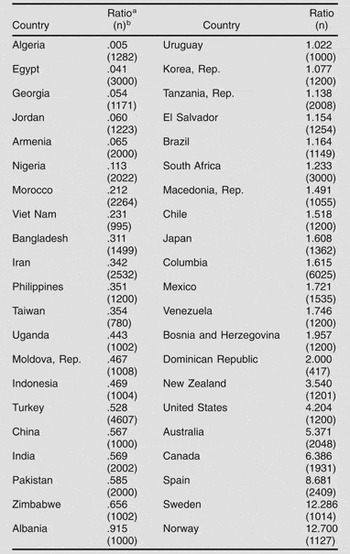
A total of 68,498 respondents from 48 nations were asked if they agree with the statement that men make better political leaders than women. Over 10,000 (15.6 percent) indicated that they “disagree strongly” with the statement, with the implication that they believe women to be at least as capable as men for political leadership, while nearly 15,000 (22.3 percent) said they “agree strongly” that men make better political leaders. Thus, the ratio of individuals world-wide who strongly view women as suited for political leadership compared to those who strongly believe the opposite, is .701. In other words, for every 701 people around the world who strongly view women as suitable political leaders, there are 1000 people who strongly oppose women for political leadership. However, there is a great deal of variation in public attitudes among different political systems. In Egypt the ratio is only .041 while in Spain the ratio is 8.681. (Refer to table 2). The question of interest is how the state's public policies account for that variation.
Ratio of people strongly supporting women as political leaders compared to those who strongly do not, World Values Survey, 2000

a Ratio. Number of respondents strongly supporting women as political leaders compared to number of respondents strongly opposed to women as political leaders, as derived from World Values Survey, 2000, variable d059.
b Number of respondents, WVS, 2000.
Although all democracies endorse public policies affirming the individual equality of men and women, in general people view men as more suited for political leadership than women.Footnote 45 Hence, to the degree that women can be defined as the same as men, people in democracies should be inclined to view both men and women as suited for political office. Some democracies, however, also adopt public policies representing maternal traits associated with women's difference from men, such as welfare provision, gender quotas, or hereditary monarchies. Both individualist and maternalist policies have feedback effects. Democracies adopting public policies based on individual sameness, as expected, do promote positive public attitudes about the suitability of women as political leaders. In nondemocracies, the ratio of those who support women versus opposing them as political leaders is very low, registering only .648, as compared to democracies, where the ratio is 3.739 (refer to table 3).
Public attitudes: Support for women as political leaders by maternal public policies and democratic public policies, World Values Survey, 2000a

a Refer to Appendix A for variable descriptions
b Ratio. Number of respondents strongly supporting women as political leaders compared to number of respondents strongly opposed to women as political leaders, as derived from World Values Survey, 2000, variable d059.
c Number of respondents, WVS, 2000.
d No cases
The adoption of maternal public policies by democracies, however, additionally increases public support for women as political leaders, as noted in table 3. Generally, as the number of maternal public policies in democracies increases, so do public attitudes about the suitability of women as political leaders increase. The ratio of support for women as political leaders in democracies that adopt only one type of maternal public policy is 1.608 and 1.368 for welfare provision and gender quotas respectively, while the ratio is 3.540 and 8.326 in democracies that adopt two or three maternal public policies respectively. Hence, the public's view of women as political leaders is most promoted by a combination of public policies representing individual equality (or democracy) and policies representing the maternal group differences that voters attribute to women.
Needless to say, a wide range of other variables also influence public attitudes about women's leadership capacities, such as the percentage of women already in political office, voters' psychological orientations, their sociological role preferences, socioeconomic status, education, race, ethnicity, religious orientation, sex, age, and perhaps residence in a Nordic country. When all of these characteristics are taken into consideration, as we would expect, some of them are statistically significant. However, even when controlling for an extremely wide range of variables, the feedback effects of public policies representing individual equality (democracy) and maternal traits (welfare provision, gender quotas, and hereditary monarchies) remain statistically significant and powerful predictors of public support for women as political leaders. Democracy alone, for example, increases the ratio of public support for women as political leaders by .084; gender quotas alone by .070; welfare provision and gender quotas together by .326; gender quotas and democracy by .045; welfare provision, hereditary monarchy, and democracy by .105; and all three types of maternal public policies combined with democracy by .145 (refer to table 4).Footnote 46
Predicting public attitudes: Regression analysis assessing the impact of maternal and democratic public policies on public attitudes about women as political leaders, controlling for relevant variables, World Values Survey, 2000a

*** p = .000,
** p = .05,
* p=.100
a Ratios are normalized to represent “strongly agree” and “strongly disagree” as percentages, using the formula: ratio percent = ratio/(ratio +1). Refer to Appendix A for variable descriptions
b Unstandardized regression coefficient
c Standardized regression coefficient
d Dummy variables, see Appendix A. The omitted dummy variable is “no maternal public policies.” Other dummy variables are omitted because there are no cases.
e Drops out of equation
Election to Political Office
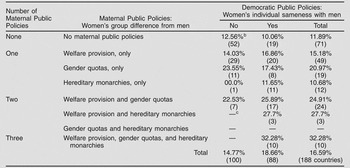
It is clear that democracies defined by policies affirming individualism promote women's election to national legislatures. In such countries the average percentage of women elected is 18.66 percent, compared to only 14.77 percent in nondemocracies (refer to table 5). However, when a democratic country also adopts public policies representing maternal traits, the feedback effects increase women's electoral success even more. Specifically, as the number of maternal public policies in a democracy increases, the percentage of women elected to political office increases. Democracies that have no maternal public policies elect an average of only 10.06 percent women to their national legislatures. On the other hand, in democracies that have at least one maternal public policy, such as welfare provision, gender quotas, or a hereditary monarchy, the average percentage of women elected increases to 16.86 percent, 17.43 percent, and 11.65 percent respectively. When democracies adopt two maternal public policies, the percentage increases even more, to 25.89 percent (welfare provision and gender quotas) and 27.7 percent (welfare provision and hereditary monarchies). And when democracies adopt all three types of maternal public policies, the average percentage soars to 32.28 percent (refer to table 5).
Percent women elected to national legislatures in relation to maternal public policies and democratic public policies, 2008a

a Refer to Appendix A for variable descriptions
b Ave. Percent women elected to lower house, 2006, data from IPU; number of cases in parentheses.
c No cases
These findings remain when controlling for a wide range of variables that also affect women's election to national legislatures, such as proportional representation, multiple parties, a country's wealth, and the percentage of women in the labor force. In addition to the expected positive impact of these variables, so, too, do public policies representing individual equality (democracy) and maternalism (welfare provision, gender quotas, and hereditary monarchies) have a positive impact on women's electoral success. The presence of gender quotas only, for example, increases the percentage of women elected by 9.126 percent; the presence of welfare provision and gender quotas increases it by 6.299 percent (refer to table 6). The impact of a political context defined by a democracy void of maternal public policies, such as the United States, is negative, decreasing women's election to national legislatures by −5.3 percent (refer to table 6). However, democracy has a positive impact on women's electoral success when combined with maternalist public policies, increasing women's representation by 19.5 percent when combined with a monarchy, by 16.3 percent when combined with welfare provision and a monarchy, and by 10.4 percent when combined with all three types of maternal public policies.Footnote 47
Regression analysis predicting the percent women elected to national legislatures by maternal public policies and democratic public policies, controlling for other relevant variables, 2008.a

*** p = .001,
** p = .05,
* p = 1.00
a Refer to Appendix A for variable descriptions
b Unstandardized regression coefficient
c Standardized regression coefficient
d Dummy variables, refer to Appendix A. The omitted dummy variable is “no maternal public policies.” Other dummy variables are omitted because there are no cases.
Comparable Democracies
The United States prides itself on its revolutionary heritage, which ideologically and institutionally destroyed its monarchical heritage, thereby de-maternalizing the American state at its founding. It is not alone in this regard. So, too, did France establish its democracy on the basis of a violent revolution, and its current constitution, like that of the United States, is void of references to the government's affirmative duty to care for people in need and its rationale for parité is based on the universal sameness of men and women rather than their difference.Footnote 48 In the case of Japan, in the late nineteenth century it de-maternalized its monarchy by prohibiting women from becoming sovereigns, thereby negating centuries of history in which women had ruled as empresses.Footnote 49
The significance of a de-maternalized state for women's access to political leadership can be seen by comparing the United States with other democracies that share similar political and economic goals, such as the OECD (Organisation for Economic Co-operation and Development) countries. Of these thirty democracies, a group of 25 have the highest possible Freedom House scores for the protection of civil liberties and political rights, which includes the United States. Of these 25 countries, only two have adopted no maternalist public policies, notably France and the United States, and of the 25 countries, it is these two countries that have the lowest average percent women elected to their national legislatures, namely, 17.5 percent as reported in table 7. Other OECD countries comparable to France and the United States in terms of having the highest possible score on individualistic public policies are notable for adopting at least one public policy representing maternal traits, if not more. And it is these countries that elected more women to their national legislatures, such as an average of 21.9 percent for those that adopt welfare provision, 26.2 percent for those that adopt welfare provision and gender quotas, 33.1 percent for those that adopt welfare provision and a monarchy, and 32.3 percent for those that adopt all three types of maternal public policies. The laggard status of the American state is, therefore, explained by its failure to combine public policies based on individual equality with policies representing the maternal traits that voters associate with women's group difference from men. This policy configuration, while not exceptional, is unusual in relation to comparable democracies.
OECD countries: Percent women elected to national legislatures in relation to maternal public policies and democratic public policies, 2008a

a Refer to Appendix A for variable descriptions
b Scores from Freedom House, 2008: perfect = a score of “1” on both political rights and civil liberties.
c No cases
d Ave. Percent women elected to lower house, 2008 data from IPU; number of cases in parentheses.
What the State Does Matters
Liberal principles affirming individual equality have much power to advance the political inclusion of groups subordinated because of their ascriptive characteristics, such as race, sex, or class, and have been correctly valorized for so doing. Political scientist Karen Orren, for example, analyzes how the American liberal heritage held the key to advancing the rights of workers. Historically, American liberal norms competed with—and usually lost to—the feudal norms inherited from England in judicial decisions that relied on common law. However, in 1937 in N.L.R.B. v. Jones, the Supreme Court upheld the rights of workers to engage in collective bargaining, thereby legitimizing liberal contract rights to advance the rights of laborers.Footnote 50 Rogers Smith also emphasizes the power of liberal principles for promoting the inclusion of those subordinated by virtue of their ascriptive characteristics. He argues that it is the “logic of Enlightenment liberalism,” that wins the day for challenging “legal systems that automatically subordinate women, blacks, Native Americans, homosexuals, and non-Christians … [as] presumptively invalid.”Footnote 51
America's liberal heritage no doubt explains much about the course of American political development. However, the policy feedback model establishes that liberal equality is not enough to enhance substantially women's political representation. Also necessary is the government's adoption of public policies that represent the maternal group differences voters attribute to women. Rather than casting ascriptive identities as the ontological enemy of liberal precepts of individual equality, a policy feedback model shows that it is the combination of policies affirming both women's sameness with men and women's maternal group difference with men that most promotes women's political representation. Many contemporary liberal democracies do this by embodying in their public policies both individualism and maternalism, and it is this combination that promotes women's political representation.
Recognizing that not all liberal democracies are the same casts in new light some of the most important feminist critiques of the liberal state that fault its principles of individual sameness for being inherently dangerous to women. Law scholar Catharine MacKinnon, for example, shows how liberal individualism as codified into law does little more than leave women stranded in a virtual state of nature—the private sphere of the home—where men can dominate them by means of brute force without fear of state intervention.Footnote 52 Nancy Hirschmann also argues that the liberal social contract excludes women from the public sphere by basing political membership on a type of autonomous individualism that corresponds more with men's experiences than with women's.Footnote 53
Not all liberal states are the same, however. While all endorse principles of individual equality that represent women's lives as if they were the same as men's, many also adopt public policies that represent gender-specific traits associated with women's maternal group difference from men. And it is the latter that generate a political context that promotes women's greater electoral inclusion. When it comes to women's political representation, therefore, liberal individual equality is beneficial to women, if and when it is combined with public policies representing maternal traits. The problem with democracies such as the American state, therefore, is not that they are liberal, but rather that they fail also to be maternal.Footnote 54
For some, of course, the very word “maternalism” conjures specters of essentialist views that “reduce” women to the private sphere of the home, where they are deprived of access to the public sphere of the state as participants. That scenario typifies a good deal of American political history. It was women's maternal identities, for example, that systematically kept them from jury duty in many states until late in the twentieth century, despite the fact that the Supreme Court had ruled nearly a hundred years before in 1879 in Strauder v. West Virginia Footnote 55 that it was unconstitutional to use a person's race as a criterion for jury duty.Footnote 56 In 1961, for example, the Supreme Court ruled in Hoyt v. Florida Footnote 57 that it was constitutional for a state to omit all women from jury lists, on the grounds that states needed to preserve the “general welfare” by relieving women “from the civic duty of jury duty,” so that woman who were “still regarded as the center of home and family life,” could fulfill the domestic responsibilities so crucial for the well-being of society.Footnote 58 While acknowledging that the Florida statute in question made no distinction between married and unmarried women, between women responsible for child care and those who were not, or between women with young children in contrast to women with older children, the Court nevertheless explained, “we cannot regard it as irrational for a state legislature to consider preferable a broad exemption” that excludes all women solely on the basis of their sex.Footnote 59 Not until 1975 in Taylor v. Louisana Footnote 60 did the Supreme Court reverse itself by ruling that women do have a constitutional right to be selected for jury duty on the same basis as men.
The Taylor decision, as overdue as it was, nevertheless exemplifies the problem with an either/or approach to women's rights. In the US, typically, either women's maternalist identities are cited as justification for their separation from the public sphere of political participation, or those identities are completely ignored as if the lives of men and women actually are the same. A better policy solution is to acknowledge how many/most women have dual identities as individuals who are the same as men and as maternalists who disproportionately engage in social and biological reproductive tasks more often than do men. In the case of jury duty, for example, why not call women to service on the same basis as men while also providing an exemption option to women who are pregnant, nursing infants, or otherwise engaged in biological or social maternalist activities that make it all but impossible to serve as a juror.Footnote 61 Similarly, Title VII, which upon passage in 1964 made it a federal crime to discriminate against women in employment contexts, opened doors to women that had previously been closed solely “because of” their sex. Yet women who entered the labor force in the wake of this legislation did not leave behind their maternal identities, such as their disproportionate involvement in social and biological maternalism. Title VII is, therefore, not enough to ensure women's equal opportunities in the work force compared to men's. Additional public policies are necessary to assist with the social and biological maternalist tasks that women characteristically do more than men, such as assisting employed women who become pregnant.
When it comes to locating women's group difference in relation to the state, therefore, it is a fallacy to use an either/or approach. Women's political representation is enhanced not by public policies that embody either a sameness principle or a group difference principle alone, but rather by public policies that embody both in what might be termed a hybrid state. Although in the United States the claim that the “personal is political” was little more than a slogan during the civil rights revolution of the 60s, in most other democracies the personal is fused with the political in the form of the state's adoption of at least one public policy representing those maternal traits that traditionally characterize women's roles in the home. And herein lies the key explaining why the United States lags so far behind most comparable democracies when it comes to women's political representation. Women run for political office in the United States in a political context that lacks the positive feedback effects of maternal public policies. The state itself is thus the principal source of women's underrepresentation, at the same time that it is the potential source of women's empowerment.
Appendix A Maternal Public Policies
Welfare provision: There is a constitutional provision establishing that it is an affirmative obligation of the state to provide for the welfare needs of people and the government provides at least 50 percent of the funds spent on health care; health care funds are calculated on the basis of data provided by the World Health Organization for the year 2000. http://www3.who.int/whosis/core/core_select_process.cfm?country.
Gender quotas: Measured as a legislative quota above 15 percent in lower or upper house or a voluntary political party quota of 30 percent or more in at least two parties or a voluntary political party quota of 40 percent or more in at least one party and the political party is represented in the legislature in 1999 and 2003. Data for gender quotas are from the Global Database of Quotas for Women, Institute for Democracy and Electoral Assistance (IDEA), Stockholm University and from Mona Lena Krook (Reference Krook2007).
All women political parties are not included in this measure. South Africa is included in this measure. France is not included in this measure because its legislated principle of gender quotas, parité, is premised on the universality of human beings, not their sex difference. (Scott Reference Scott2005)
Hereditary monarchies: Monarchies that do not restrict sovereignty to men, as indicated by national constitutions, as coded by the author.
Maternal public policies: Coded as dummy variables: 0 = no maternal public policies, 1 = welfare only, 2 = quotas only, 3 = monarchy only, 4 = welfare and quotas only, 5 = welfare and monarchy only, 6 = quotas and monarchies only, 7 = all. I am indebted to Dan Carpenter for suggesting this coding format.
Democracy
Democracy: Country coded as free by Freedom House. 2004 (tables 3,4,5); 2006 (table 6), 1 = free, 0 = not free.
Public Attitudes
Attitudinal Support for Women as Political Leaders: Number of respondents strongly supporting women as political leaders compared to number of respondents strongly opposed to women as political leaders, as derived from World Values Survey, 2000, variable D059. The variable is in percentage decimal form for regression analysis. Predicted values obtained from WVS regression analysis based on respondents' attitudes are used in country level regression analysis.
Percent Women Elected
Percent women elected to lower house, national legislature, in 1997. The data about the percentage of women elected to national legislatures is from the Inter-Parliamentary Union, Women in Parliaments. The percentage is for the Lower House or Single Legislature. http://www.iup.org/wmn-e/world.htm. (table 4); data from IPU, 2008.
Psychological orientation variables from WVS
Children's independence: Respondents' agreement/disagreement with the following statement: “Children should be encouraged to be independent.” (A029).
Children's imagination: Respondents' agreement/disagreement with the following statement: “Children should be encouraged to be imaginative.” (A034).
Political Structures
Closed PR: Closed-list proportional representation (PR) system, dummy variable, party leaders rank candidates and voters only cast votes for parties. (Kunicová and Rose-Ackerman Reference Kunicová and Rose-Ackerman2005)
Plurality: dummy variable, plurality/majoritarian system with single-member districts. (Kunicová and Rose-Ackerman Reference Kunicová and Rose-Ackerman2005)
Parliamentary system: Dummy variable, coded by author. (Banks Reference Banks1991)
Presidential System: Dummy variable, coded by author. (Banks Reference Banks1991)
Electoral System: Structure of the electoral system. Coded 2 if voters choose among party lists in multi member districts that average five or more seats per district; 1 if party lists are used by district size averages of fewer than five seats, or a combination of party list and candidate voting is used, or voters choose among individual candidates but in multi member districts; 0 if voters choose among individual candidates in single-member districts; −1 if no party system at all. (Kenworthy and Malami Reference Kenworthy and Malami1999)
Sociological roles orientation variables from WVS
Wife's obedience: Respondents' agreement/disagreement with the following statements: “The wife must obey her husband.” WVS, 2000, D077, Wife must obey, 1 = agree strongly, 2 = agree, 3 = neither agree or disagree, 4 = disagree, and 5 = strongly disagree.
Women having work outside the home: “Women should have the right to work outside the home.” (D073). WVS, 2000, D073, Woman having work outside home, 1 = agree strongly, 2 = agree, 3 = neither agree or disagree, 4 = disagree, 5 = strongly disagree.
Socioeconomic variables from WVS
Profession occupation: Type of job WVS, 2000, X036, recoded as Professional/managerial: 0 = no, 1 = yes.
Education: Level of Education WVS, 2000, X025R, recoded as Education: 1 = lower, 2 = middle, 3 = upper.
Income: WVS, 2000, X047R, recoded as Income: 1 = lower, 2 = middle, 3 = upper.
Economic variables
Population 2003: according to GDP2002/Population 2003, Labor Force Percent Women 2003 from World Bank, World Economic Outlook Database, April 2004.
Percent Manufacturing 2002: according to GDP2002/Population 2003, Labor Force Percent Women 2003 from World Bank, World Economic Outlook Database, April 2004.
Percent Urban, 2003: according to GDP2002/Population 2003, Labor Force Percent Women 2003 from World Bank, World Economic Outlook Database, April 2004.
Average GDP 2002: according to GDP2002/Population 2003, Labor Force Percent Women 2003 from World Bank, World Economic Outlook Database, April 2004.
Demographic variables
Race/ethnicity from WVS. I recoded variable X051 into race/ethnicity categories. WVS, 2000
Sex: WVS, 2000, X001, recoded to Sex: 0 = male, 1 = female.
Age: WVS, 2000, X003, recoded to Age: (1) = 15–29 years, (2) 30–49 years, (3) 50+.
Religion from WVS: I recoded religious denominational affiliation (variable F025) into categories measured as Protestant, Catholic, Muslim, Jewish, Other, where each is combined with degree of religious service attendance (variable F028), rescored as follows: respondent attends religious services (1) never, practically never, (2) less than once a year, (3) once a year, (4) specific holy days other than Christmas, Easter, etc., (5) only on specific holy days/Christmas, Easter, (6) once a month, (7) once a week, (8) more than once a week. Those respondents answering none to religious affiliation question are omitted. Data supplemented where necessary from World Religions, http://www.infoplease.com/ipa/A0855613, accessed November 6, 2008, and U.S. Department of State, http://www.state.gov/g/drl/rls/irf, accessed Nov 6, 2008.
Nordic Countries: Denmark, Iceland, Finland, Norway, Sweden, dummy variable, 0 = no, 1 = yes.