Introduction
Autism spectrum disorder (ASD) is a neurodevelopmental disorder affecting ~1.5% of children in the USA (Wiggins, Baio, & Rice, Reference Wiggins, Baio and Rice2006), and characterized by difficulties in social communication and rigid, repetitive behaviors. While the disorder likely arises due to a combination of genetic and environmental factors (Bai et al., Reference Bai, Hon, Yip, Windham, Sourander, Francis and Sandin2019; Sandin et al., Reference Sandin, Lichtenstein, Kuja-Halkola, Larsson, Hultman and Reichenberg2014), potential modifiable risk factors for this disorder remain unknown.
As the pathology underlying ASD likely originates in utero, a search of the actionable, etiological risk factors for the disorder has focused on maternal exposures in pregnancy. Although the fetus is protected from many such exposures due to the placental barrier – which ensures lack of direct mixing of maternal and fetal blood – certain hormones (Chan, Vasilopoulou, & Kilby, Reference Chan, Vasilopoulou and Kilby2009; Dancis, Jansen, & Levitz, Reference Dancis, Jansen and Levitz1980), immunoglobulins (Kohler & Farr, Reference Kohler and Farr1966; Palmeira, Quinello, Ana, Zago, & Carneiro-sampaio, Reference Palmeira, Quinello, Ana, Zago and Carneiro-sampaio2012), nutrients (Acosta et al., Reference Acosta, Ramirez, Powell, Jansson, Lager, Gaccioli and Jansson2015), viruses (Castanha et al., Reference Castanha, Braga, Cordeiro, Souza, C. D., Martelli and Marques2016) and toxins (Mahadevan et al., Reference Mahadevan, Wolf, Dubinsky, Cortot, Lee, Siegel and Abreu2013) can still pass through this barrier, potentially exposing the fetus to a number of external insults from maternal circulation. Furthermore, some of those factors can affect placental function without having to cross it (Walker, Filis, Shaughnessy, Bellingham, & Fowler, Reference Walker, Filis, Shaughnessy, Bellingham and Fowler2019), potentially affecting the fetus in spite of the mechanical shield provided by the placenta.
Fetal exposure to factors in maternal circulation provides therefore a plausible mechanism for how maternal health factors in pregnancy may impact the fetus. To date, some of the maternal diagnoses linked with offspring ASD risk include e.g. depression (Rai et al., Reference Rai, Lee, Dalman, Golding, Lewis and Magnusson2013; Viktorin, Uher, Reichenberg, Levine, & Sandin, Reference Viktorin, Uher, Reichenberg, Levine and Sandin2017), diabetes (Xiang et al., Reference Xiang, Wang, Martinez, Walthall, Curry, Page and Getahun2019), autoimmune diseases (Atladóttir et al., Reference Atladóttir, Pedersen, Thorsen, Mortensen, Deleuran, Eaton and Parner2009), asthma (Croen, Grether, Yoshida, Odouli, & Van de Water, Reference Croen, Grether, Yoshida, Odouli and Van de Water2005), and recurrent infections (Atladóttir et al., Reference Atladóttir, Thorsen, Østergaard, Schendel, Lemcke, Abdallah and Parner2010). Nevertheless, pregnant women receive many other diagnoses around pregnancy, most of which have not been evaluated for an association with offspring ASD. We have previously shown (Janecka et al., Reference Janecka, Kodesh, Levine, Lusskin, Viktorin, Rahman and Reichenberg2018) that mothers of children with ASD have on average four more distinct diagnoses around the pregnancy than mothers of control children – suggesting that the associations between maternal health and ASD may be far more pervasive than just the diagnoses identified to date.
Here we conduct an exploratory study to investigate the association between offspring ASD and the full spectrum of maternal diagnoses around pregnancy. Using a large, population-based cohort from Israel, we test the associations between the full range of recorded maternal diagnoses and offspring ASD, applying a series of rigorous screens for potential false-positive findings and controlling for the correlation between maternal diagnoses. Despite the methodological rigor, we emphasize that the findings cannot be interpreted as reflective of causal relationships. In the Discussion section, we elaborate on potential confounding effects and the further work required to understand the etiological relevance of our findings to ASD.
Methods
Sample
Our sample is population-based, derived through a case–cohort ascertainment design, as described in detail previously (Janecka et al., Reference Janecka, Kodesh, Levine, Lusskin, Viktorin, Rahman and Reichenberg2018; Levine et al., Reference Levine, Kodesh, Viktorin, Smith, Uher, Reichenberg and Sandin2018). Briefly, the data source was Meuhedet, a large health maintenance organization (HMO) in Israel. Legislation requires all Israeli citizens to purchase medical insurance from an HMO (each offering equivalent medical provision and fees) and prohibits HMOs refusing a citizen membership, thus limiting the risk of ascertainment bias in the sample.
The cohort birth years were defined as 1 January 1997 through 31 December 2008, and children were followed up until January 26 2015. The study sample comprised of 19.5% of 270 799 children born within the Meuhedet HMO within those years, sampled without stratification, as well as all ASD cases born within those years. Additionally, all siblings of those individuals, born within the cohort birth years, were also included in the sample.
This ascertainment design produced a subcohort including random 19.5% of Meuhedet children born between 1997 and 2008, together will all siblings of ASD cases and controls. Due to random sampling, the subcohort included some ASD cases, and thus overlapped with the individuals selected independently as ASD cases. Individuals sampled both into the subcohort, and as ASD cases or their siblings, contributed to all analyses only once. Family relations (siblings, parents) in the dataset were identified through the Meuhedet Family Relations Register.
In order to ensure complete coverage of maternal diagnoses during, and prior to pregnancy (see exposure definition in Maternal diagnosis classification) for all births, we used the subset of children born on, or after 1 January 1999 through 31 December 2008, as maternal medical records in the first year of the follow-up (1997) may be incomplete. Due to the low likelihood of reproduction beyond ages 13–55 in females, and below 13 in males, we excluded all children born to mothers younger than 13 or older than 55, or fathers older than 55, as records of those children were likely to include administrative errors.
This study was approved by the institutional review board of the University of Haifa and the Helsinki Ethics Committee of the Meuhedet. Those bodies waived the need for informed consent because the study data were fully de-identified.
Exposure
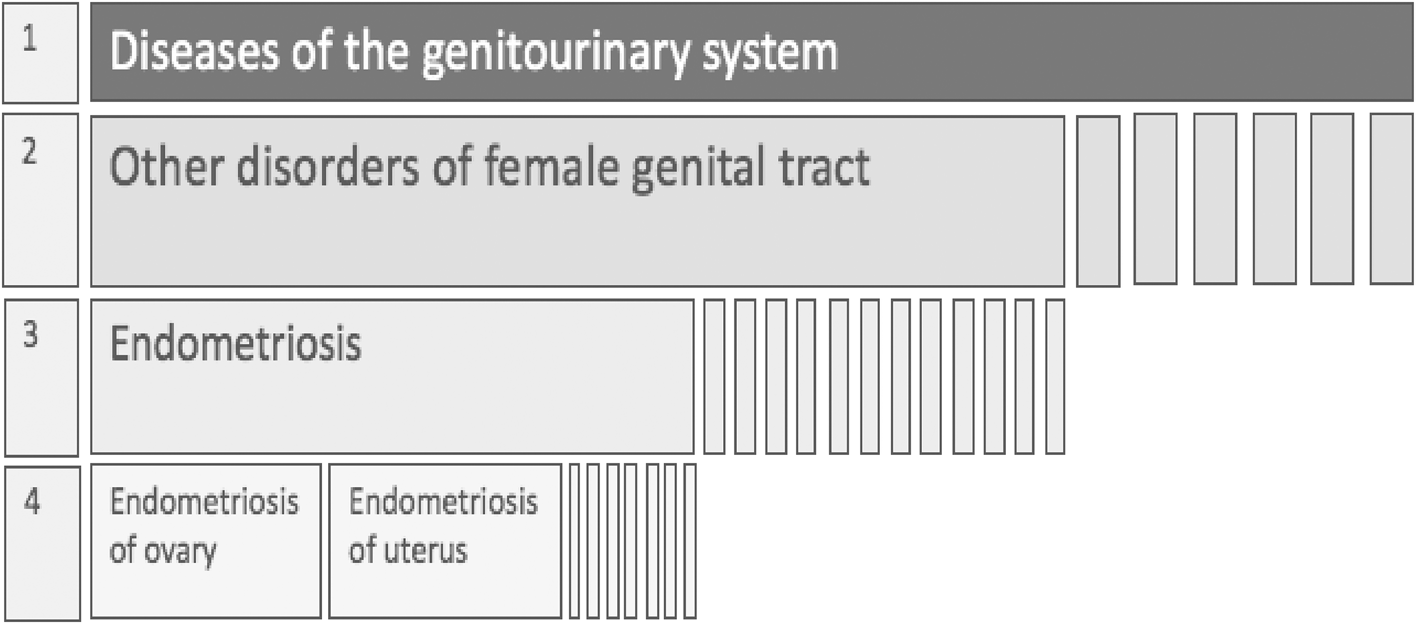
The exposures were maternal diagnoses classified according to the International Classification of Diseases, Ninth Revision (ICD-9). Although the ICD-10 taxonomy was comprehensively adopted in Israel in 2015, i.e. considerably later than the end of the exposure period in our study, few providers began the transition already in 2008, resulting in a small fraction of the diagnoses in our dataset coded using the ICD-10 system. In order to ensure completeness of the data, these diagnoses were harmonized with the remainder of the data and re-coded to ICD-9, using publicly available resources (ICD10Data, 2021; online Supplementary Table S1). All diagnostic codes were identified through the Meuhedet Diagnostic Classification Register. The ICD-9 diagnoses are organized hierarchically, with four levels of information going from least to most specific to the given diagnosis (see Fig. 1 for an example). For the current analyses, we used the information at level 3 as it provides both a useful summary and sufficient detail regarding the underlying health condition. In the current analyses, we included all recorded maternal diagnoses, irrespective of the internal system they affect, their chronicity or severity. The exposure period was defined as the pregnancy period (here defined as 271 days prior to the child's date of birth) and the preceding year (i.e. a total of 636 days prior to the child's date of birth). Widening of the exposure window beyond pregnancy allowed us to ascertain temporally proximal diagnoses which could still exert effects on the fetus.
. Example of the hierarchical organization of the ICD-9 taxonomy. ICD-9 categories are organized from the most general (level 1, top row), through most specific diagnostic codes (level 4, bottom row). Level 3 diagnoses were used in the current study.

Prior to the analyses, we filtered out the diagnoses not recorded in any women during the exposure period, and those where the available information did not allow assignment to any ICD-9 code. The exposures were coded as binary variables (yes/no) indicating the presence/absence of any given level 3, ICD-9 diagnosis within the exposure period. Earlier analyses have demonstrated that the diagnostic rates of all interrogated conditions approximate those recorded in Sweden (Janecka et al., Reference Janecka, Kodesh, Levine, Lusskin, Viktorin, Rahman and Reichenberg2018).
Outcome
ASD cases were ascertained using the ICD-9 and ICD-10 criteria for ASD from the ICD (ICD-9 codes 299 and ICD-10 codes F84, including all subcodes within those categories). In the Meuhedet system, all children with suspected ASD underwent evaluation by a panel of social workers, a psychologist, and either a trained psychiatrist, a developmental-behavioral pediatrician, or a child neurologist. The final diagnosis was made by a board-certified developmental-behavioral pediatrician. All children were followed up until 26 January 2015, first ASD diagnosis, or death, whichever occurred first. Earlier analyses have demonstrated that age-specific ASD prevalence in this sample matches that reported previously in Israel (Janecka et al., Reference Janecka, Kodesh, Levine, Lusskin, Viktorin, Rahman and Reichenberg2018).
Covariates
In all adjusted models, the covariates included child's year of birth, maternal age at child's birth, number of all maternal diagnoses during the exposure period (636 days prior to child's date of birth), and residential socioeconomic status (SES). Child's year of birth was included in the models in order to account for the temporal changes in ASD diagnosis (Davidovitch, Hemo, Manning-Courtney, & Fombonne, Reference Davidovitch, Hemo, Manning-Courtney and Fombonne2013), as well as other possible temporal effects influencing the patterns of maternal diagnoses. Maternal age at child's birth – to account for differential ASD risk observed across different maternal age categories (Janecka et al., Reference Janecka, Hansen, Modabbernia, Browne, Buxbaum, Schendel and Grice2019; Sandin et al., Reference Sandin, Hultman, Kolevzon, Gross, MacCabe and Reichenberg2012), and the age-dependent nature of many maternal medical diagnoses. SES – to account for factors that could contribute to differential healthcare utilization, impacting the probabilities of the diagnosis of both any maternal condition and ASD (Davidovitch et al., Reference Davidovitch, Hemo, Manning-Courtney and Fombonne2013). Finally, the number of maternal diagnoses in the exposure period – to account for differential utilization of healthcare around pregnancy, which influences the likelihood of maternal receipt of any diagnosis (we have also shown that this number and is also associated with ASD risk (Janecka et al., Reference Janecka, Kodesh, Levine, Lusskin, Viktorin, Rahman and Reichenberg2018; Rahman et al., Reference Rahman, Kodesh, Levine, Sandin, Reichenberg and Schlessinger2020)). Information about all covariates was obtained from the Meuhedet records, except for SES, which was obtained from the Central Bureau of Statistics Registry (Demographic Characteristics of the Population in Localities and Statistical Areas, 1995). Residential SES was derived from household census data and represented an index of the number of electrical appliances per person and per capita income. In unadjusted (crude) models, the only covariate was child's year of birth.
Statistical analysis
All analyses were done using R software, version 3.6.3 (R Core Team, 2014). The relative risk of ASD and the associated two-sided 95% confidence intervals were estimated by the hazard ratios (HRs) from Cox proportional hazard regression models using survival package (Therneau & Li, Reference Therneau and Li1999). Proportional hazard assumption was examined using standardized Schoenfeld residuals (Grambsch & Therneau, Reference Grambsch and Therneau1994). In all models, we adjusted for within-family correlation of data, arising due to the presence of siblings in the dataset, by calculating robust standard error estimates (Barlow, Reference Barlow1994).
We applied inverse probability weighting to account for the sample ascertainment procedures, which were based on both the ASD status, and family size (i.e. due to inclusion of siblings of the randomly selected 19.5% individuals, larger families were more likely to be ascertained). Each individual was assigned a weight. All ASD cases and their siblings received a weight of 1, even when, due to the random subcohort sampling, they were also sampled into the subcohort. For other control individuals in the subcohort that weight was always higher, reflecting a lower probability of being included in the sample for those individuals; the exact weight given to those individuals was dependent on the family size, with individuals from smaller families receiving higher regression weights (see online Supplementary Table S2).
Filtering of potential false-positive findings
Statistical analyses of the associations between maternal diagnoses and ASD risk in offspring were conducted in four steps in order to remove the associations with a high likelihood of representing Type I errors.
First, we filtered out maternal diagnoses recorded in fewer than 10 cases and 10 controls. This is due to the instability of the maximum likelihood regression coefficients when the number of events per variable is small – a problem known as sparse data bias (Greenland, Mansournia, & Altman, Reference Greenland, Mansournia and Altman2016). Imposing the cut-off of 10 events per variable has been shown as suitable to eliminate such bias (Peduzzi, Concato, Kemper, Halford, & Feinstein, Reference Peduzzi, Concato, Kemper, Halford and Feinstein1996).
Threshold for nominal statistical significance for analytical p values was set at 0.05. For each of the nominally significant diagnoses in Cox proportional hazards model, we performed permutation testing. Such tests allow the estimation of the probability of observing any given association under the null, i.e. in the absence of a real association between exposure and outcome (Ludbrook & Dudley, Reference Ludbrook and Dudley1998). The rate of ASD, relationship between the follow-up time and ASD status, and correlations between the exposure and covariates in each permuted dataset remained the same as in the original dataset; however, the original associations between ASD and maternal exposure were broken in the permutations – allowing estimation of regression coefficients expected under the null. We performed 1000 permutations of each nominally significant association, in order to determine empirical p values [defined as the proportion of tests producing a p value equal to, or smaller than the analytical p value (i.e. in the non-permuted dataset)]. To validate the analytical p value derived from the analyses in the original dataset, we required that at least 95% of the p values observed after permutations are higher than that analytical p value, i.e. producing an empirical p value <0.05.
Due to the multitude of tests being performed (equal to the number of distinct maternal diagnoses), we then used false discovery rate (FDR) correction for multiple testing (Benjamini & Hochberg, Reference Benjamini and Hochberg1995) on empirical p values. The permissible FDR (Q-value) was set at 0.05.
Finally, all diagnoses that remained significant after the FDR correction were entered into a joint multiple regression model to account for possible correlation between those diagnoses. The model specifications were analogous to those used in initial adjusted univariate regressions, as described above. An outline of the analytical framework is presented in online Supplementary Fig. S1. Throughout the Results section, we refer to single-diagnosis models adjusted only for the child's year of birth as ‘crude models’; to single-diagnosis models, adjusted for the full set of covariates as ‘adjusted univariate’; and to multiple-diagnoses models, adjusted for the full set of covariates as ‘multiple regression’.
Missing data and sensitivity analyses
In order to evaluate the effects of missing covariate data on the results, we verified if the covariate missingness was related to the study variables, as well as the consistency of the results in the data with and without missing data imputed using multivariate imputation by chained equation, implemented in the mice package (Zhang, Reference Zhang2016). We used full outcome (ASD diagnosis, and time to diagnosis) and covariate information [maternal age and number of diagnoses in pregnancy; child's date of birth; SES; number of siblings (used for weights’ calculation)], as well as auxiliary variables (child's sex and paternal age) to perform five imputations of the dataset. None of the variables was transformed prior to the imputation process.
Earlier studies have suggested high levels of comorbidity between ASD and other psychiatric and physical conditions (Mannion & Leader, Reference Mannion and Leader2013). In order to ensure that the associations observed in our study do not reflect comorbidities in mothers with ASD, we re-analyzed the data after exclusion of all families where the mother herself had a recorded ASD diagnosis.
Results
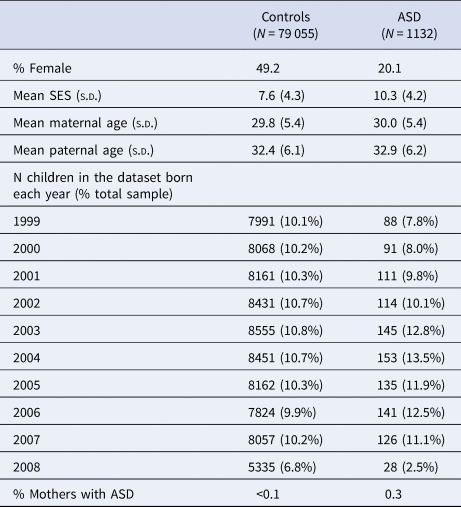
There were 88 713 children in the Meuhedet dataset born 1999–2008. Of those, 23 individuals were removed from the sample due to being born to mothers younger than 13 or older than 55, or fathers older than 55. Additional 8503 individuals had missing SES data, andno individuals were removed due to missing information on any other covariates - producing a final analytical sample of 80 187 children (90% of the 1999–2008 birth cohort; see the population flowchart in online Supplementary Fig. S2), born to 30 864 mothers. There were 1132 children diagnosed with ASD, and 79 055 controls, with the median age at the end of follow-up 11.2 (IQR: 8.8–13.6). We identified five mothers of children in the cohort who themselves received an ASD diagnosis during the follow-up period. Sample characteristics are presented in Table 1 (see online Supplementary Table S3 for the characteristics of the sample before exclusions, as well as of the excluded subset of children).
Analytical sample demographic characteristics (N = 80 193)

Associations between maternal diagnoses and offspring ASD
There were 822 distinct level 3 ICD-9 diagnoses recorded in women during pregnancy and the preceding year in the Meuhedet records (online Supplementary Fig. S3). Of those, 453 maternal diagnoses were nominally statistically significantly associated with offspring ASD risk (online Supplementary Fig. S4). Most of these associations were between ASD and very rare maternal diagnoses, which in our sample were recorded in mothers of very few controls, and none of the cases; consequently, majority of these associations indicated a negative association between maternal diagnosis and ASD (point estimate HR<0.01; online Supplementary Fig. S5), likely reflecting high rates of Type I error when testing such rare exposures. Only 52 (11%) of those 453 diagnoses were associated with an increased risk of ASD (point estimate HR >1; online Supplementary Fig. S6).
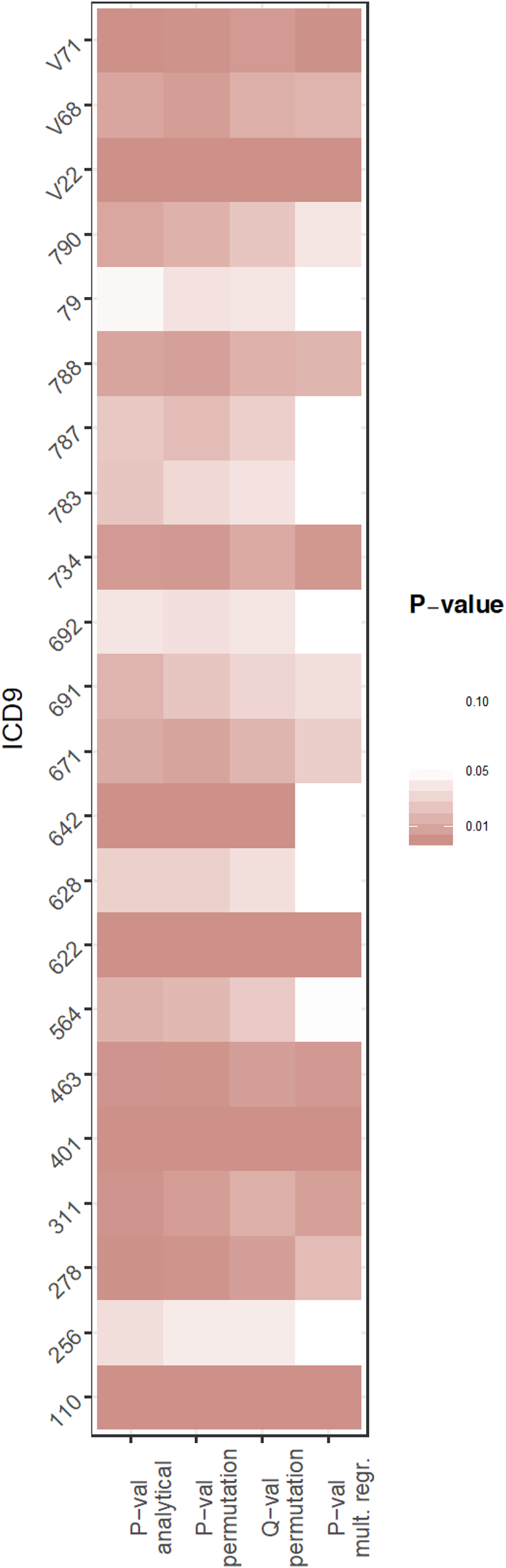
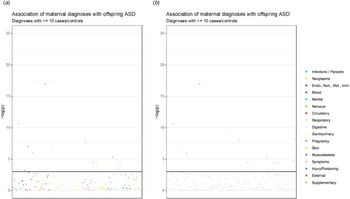
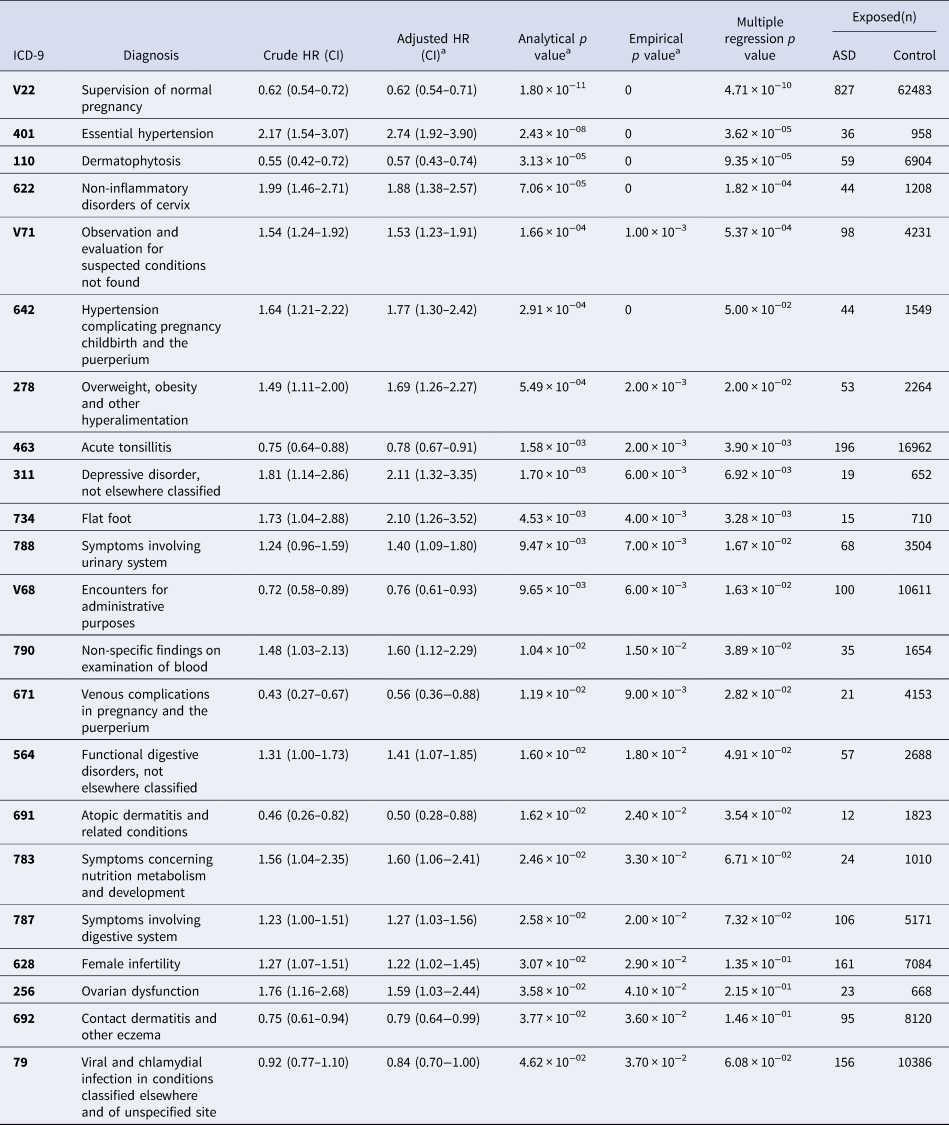
After filtering out diagnoses recorded in mothers of less than 10 cases or 10 controls, due to unreliability of the regression coefficients for sparse predictors, we retained 148 maternal diagnoses in the dataset. Among those, 22 were nominally significantly associated with offspring ASD (Table 2 and Fig. 2; see online Supplementary Table S4 for all results), distributed across a broad range of diagnostic categories (Fig. 3a). Fourteen of those diagnoses (64%) were associated with an increased risk of ASD [HR > 1; cf. 42% in unadjusted models (online Supplementary Table S5)]. Frequencies of those diagnoses in cases and controls are presented in online Supplementary Table S6.
Diagnoses (ICD-9) nominally associated with ASD through the consecutive stages of filtering.

p Values of the associations between maternal diagnoses and ASD, for diagnoses recorded in at least 10 cases and 10 controls. Each dot represents a –log(p value) of an association between a distinct maternal diagnosis (level 3 of the ICD-9 codes) and offspring ASD. The results are color-coded by broad ICD-9 categories (level 1), as shown in the legend. Figure 3a represents p values for all diagnoses recorded in at least 10 cases and 10 controls; Fig. 3b shows the same results, but the diagnoses that were filtered out in permutation testing or subsequent control for multiple testing are shown in grey (N.B. the diagnoses that were non-significant in the multiple regression step are not shown in grey).

Top associations between maternal diagnoses and offspring ASD, ordered by the p values from adjusted univariate models

a Univariate models, adjusted for maternal age at child's birth, child's year of birth, SES, and total number of diagnoses in pregnancy.
Permutation testing revealed that none of those 22 associations could arise under the null (empirical p value <0.05), and all of them remained significant after controlling for multiple testing. In the final multiple regression step, 16 of those diagnoses remained significantly associated with ASD (Table 2 and Fig. 3b; online Supplementary S6), including e.g. essential hypertension (p = 3.62 × 10−05), non-inflammatory disorders of the cervix (p = 1.82 × 10−04), and depressive disorder (p = 6.92 × 10−03). The Schoenfeld residuals did not indicate a violation of the proportional hazards assumption (online Supplementary Table S7 and Fig. S8).
Online Supplementary Table S8 shows the counts of all diagnoses recorded in at least 10 cases and 10 controls, as well as their counts significant in the consecutive filtering stages, categorized by broad (level 1) ICD-9 categories.
Sensitivity analyses
All results remained virtually unchanged after exclusion of women with recorded ASD diagnosis (online Supplementary Table S9; n mothers = 5 and n children = 13 were excluded).
Missing information in our study was limited to the SES variable, and was related to the ASD diagnosis (10% missing among the controls, 15% among ASD cases), validating our approach to re-analyze the data after the SES imputation. We observed a very close alignment between the effect sizes and levels of significance observed when using models with and without data imputation (respectively, N = 88 690 and N = 80 187), suggesting data missingness had no substantial effects on the study results (online Supplementary Table S10).
Discussion
Using our approach, we screened over 820 maternal ICD-9 diagnoses around pregnancy for an association with ASD, and through an iterative process of identifying likely false-positive associations, we identified 16 maternal diagnoses with robust evidence for an association with offspring ASD. Those 16 diagnoses that passed through all filtering stages included previously reported ASD risk factors, e.g. depression (Rai et al., Reference Rai, Lee, Dalman, Golding, Lewis and Magnusson2013) and hypertension (Gardener, Spiegelman, & Buka, Reference Gardener, Spiegelman and Buka2009). In addition, our systematic approach allowed us to identify also novel associations that warrant further attention in ASD research, e.g. non-inflammatory disorders of the cervix, and urinary symptoms.
The mechanisms underlying these associations remain to be elucidated. Advancing our knowledge about the etiology of ASD will require careful consideration of potential causal factors underlying these associations, including e.g. shared genetic effects (whereby maternal genetic variation transmitted to offspring contributes to the risk of both maternal diagnosis and offspring ASD), maternal use of medication, or socioeconomic factors associated with receiving specific diagnoses. For example, apparent ‘protective’ effects (HRs < 1) observed in our study likely reflect differential utilization of healthcare – whereby women with more medical supervision during pregnancy were less likely to have a child with ASD, but through their frequent medical contacts, were also more likely to receive relatively minor diagnoses (e.g. acute tonsillitis or venous complications of pregnancy). In support of this, (i) we observed that mothers of children with ASD in this sample were less likely to attend a prenatal care appointment or see a healthcare professional for administrative purposes (ICD-9 V22, V68), and (ii) adjusting for the total number of diagnoses received during the exposure period as well as SES - both indexing healthcate utilization - removed mostly the associations with HRs < 1.
Therefore, interpreting our results – and other findings on this topic that rely on registry data – it is important to bear in mind that they do not necessarily reflect causal relationships. In order to better understand the etiology of ASD, identifying maternal diagnoses associated with an increased risk of the disorder needs to be followed by careful examination of the causal factors driving the association, taking into account genetic and social determinants of health and disease, and other factors associated with receiving a medical diagnosis (e.g. medication).
From the methodological standpoint, the systematic nature of our approach allowed comparisons of risk estimates (HRs) and the strength of the evidence for an association (p value) across a wide range of diagnoses, using a unified analytical process. The key analytical advantages of such an approach are (i) facilitated synthesis of information regarding ASD risk factors pertaining to maternal diagnoses, compared to pooling of many individual studies, each investigating single/few diagnoses, and (ii) limiting false-positive findings through explicit acknowledgement of, and addressing the issue of multiple testing.
While our study represents a novel approach for analyzing associations between maternal diagnoses around pregnancy and ASD, its limitations need to be acknowledged. Importantly, the definition of the exposure window in our study (pregnancy and one year preceding it) likely did not allow us to ascertain the associations between ASD and maternal chronic diagnoses, particularly those that are well-managed and do not necessitate frequent contacts with healthcare professionals (e.g. diabetes). Therefore, we do not propose that the list of associations detected by us is exhaustive. Likewise, the results need to be interpreted as specific to the sample at hand, and further validation should be sought in other cohorts. Rates of ASD differ by country (Delobel-Ayoub et al., Reference Delobel-Ayoub, Saemundsen, Ego, Moilanen, Ebeling, Rafnsson and Schendel2020) – with prevalence in Israel [0.5% (Davidovitch et al., Reference Davidovitch, Hemo, Manning-Courtney and Fombonne2013)] representing a relatively low estimate compared to the USA [1.7% (Baio et al., Reference Baio, Wiggins, Christensen, Maenner, Daniels, Warren and Dowling2018)] – as likely do patterns of maternal morbidity in pregnancy. Replication of the observed associations in other cohorts will be thus crucial for the determination of the robustness of the associations reported here, an essential step prior to causal analysis. Owing to the left-censoring of the data, as well as the evidence of under-diagnosis of ASD in the past (Rutter, Reference Rutter2005), likely we could not identify all mothers with ASD in the sample. As a result, the sensitivity analyses could fail to fully account for the effects of comorbidities in ASD females. Similarly, lack of emigration data for the HMO members precluded accurate right-censoring of the data for the individuals who became unavailable for follow-up prior to 26 January 2015. Furthermore, exposure in our study was defined as the presence of at least one record of a given diagnosis during the exposure period, rather than two, as reported in some other studies (e.g. Razaz, Tomson, Wikström, & Cnattingius, Reference Razaz, Tomson, Wikström and Cnattingius2017). While this could introduce some fraction of false positives (non-exposed children classified as exposed, e.g. due to administrative errors), our study focused on relatively common diagnoses where those would have limited influence; additionally, false negatives (exposed children classified as not exposed) would be more likely in a study with a relatively narrow exposure period, compromising statistical power. Finally, we did not have access to information allowing to estimate family-level SES, and thus could only control for residential measures of SES. While those two are expected to strongly correlate, this correlation will not be perfect, and thus the SES adjustment in our study should be considered incomplete.
In conclusion, our work applied a novel approach for identifying associations between maternal diagnoses around pregnancy and offspring ASD, consisting of systematic testing of a wide range of maternal diagnoses, followed by a series of validation steps to filter out the likely false-positive associations. We showed that such an approach replicates many of the previously reported ASD maternal clinical risk factors, and identifies novel associations, warranting replication and follow-up in future studies designed to elucidate the underlying causal mechanisms.
Supplementary material
The supplementary material for this article can be found at https://doi.org/10.1017/S0033291721001021
Data
The data underlying this article cannot be shared publicly due to concerns for the privacy of individuals that participated in the study. Interested researchers should discuss access options with Arad Kodesh and Stephen Z. Levine.
Code
All code is available upon request from the corresponding author.
Acknowledgements
We would like to acknowledge the generous support of the Seaver Foundation.
Authors contributions
MJ designed the study, planned the statistical analyses, assisted in carrying out the analyses, was involved in results interpretation, manuscript write-up, and revisions. AK and SZL provided the data, assisted in carrying out the analyses, were involved in results interpretation, manuscript write-up, and revisions. VK, RR, AS, PFO, JG, DS, LC, and AR contributed to the study design, were involved in results interpretation, manuscript write-up, and revisions. SS contributed to the study design, data analysis, was involved in results interpretation, manuscript write-up, and revisions. All authors approved the manuscript version to be published.
Financial support
This work was supported in part by a grant from the Eunice Kennedy Shriver National Institute of Child Health and Human Development, the National Institute of Environmental Health Sciences, and the National Institute of Neurological Disorders and Stroke (Dr Reichenberg, Dr Kodesh, Dr Levine [grant number HD 073978]); by a grant from the Eunice Kennedy Shriver National Institute of Child Health and Human Development (Dr Reichenberg, Dr Sandin, Dr Schendel, Dr Buxbaum [grant number HD098883]); by a grant from the National Institute of Mental Health (Dr Janecka, Dr Reichenberg, Dr Sandin, Dr Schendel, Dr Grove, Dr Croen [grant number MH124817]); and by T32 award from the National Institute of Mental Health to Dr Khachadourian [grant number MH122394]. The sponsors had no role in the design and conduct of the study; collection, management, analysis, and interpretation of the data; preparation, review, or approval of the manuscript; and decision to submit the manuscript for publication.
Conflict of interest
None.