INTRODUCTION
Quantification of the sea surface reservoir ages (R), a measure of the difference between the marine and atmospheric radiocarbon (14C) ages at the same time, contributes substantially to a better understanding of ocean dynamics and climate. This difference is due to the isolation of subsurface seawater from the atmosphere and to 14C decay. It reflects the balance between the 14C production and the ocean–atmosphere exchange of 14CO2 as well as mixing between the surface and subsurface waters by vertical convection and horizontal advection due to changes of wind strength and oceanic currents. Values of R can be measured from biogenic carbonates, the 14C of which representing that of the dissolved inorganic carbon (DIC) in seawater in which they grow.
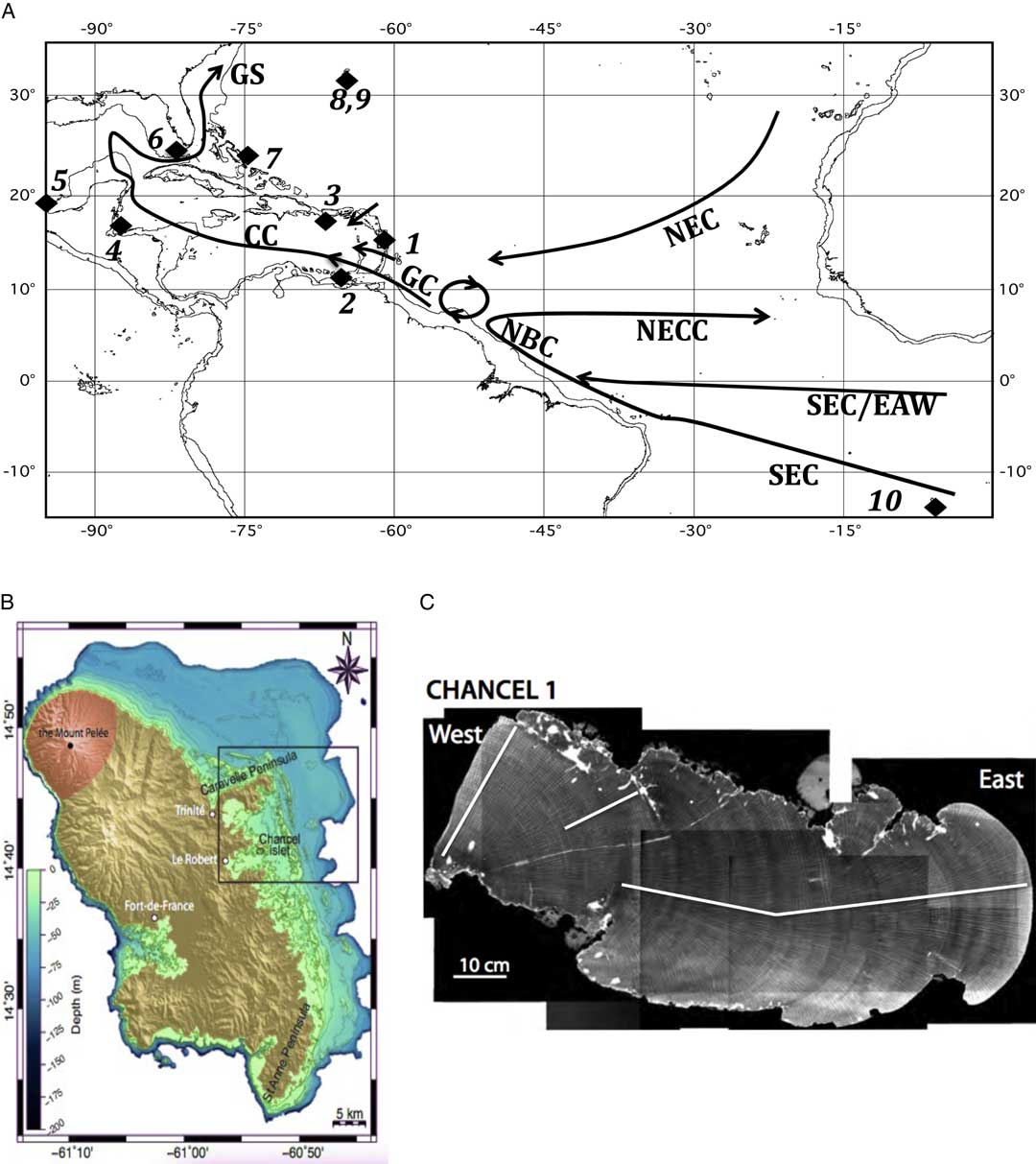
Numerous estimates of R from corals were obtained in the subtropical western North Atlantic (Druffel and Linick Reference Druffel and Linick1978; Druffel Reference Druffel1980, Reference Druffel1982, Reference Druffel1997; Druffel and Suess Reference Druffel and Suess1983; Goodkin et al. Reference Goodkin, Druffel, Hughen and Doney2012; Fernandez et al. Reference Fernandez, Lapen, Andreasen, Swart, White and Rosenheim2015), the Caribbean Sea (Druffel Reference Druffel1980; Druffel and Suess Reference Druffel and Suess1983; Guilderson et al. Reference Guilderson, Cole and Southon2005; Kilbourne et al. Reference Kilbourne, Quinn, Guilderson, Webb and Taylor2007), and the Gulf of Mexico (Wagner et al. Reference Wagner, Guilderson, Slowey and Cole2009). No values of R were acquired within the Atlantic inflow, which penetrates into the eastern Caribbean Sea through the sill passages along the Lesser Antilles volcanic arc. Here we report values of R for the eastern Caribbean Sea and the western tropical North Atlantic region from 14C measurements of an annually banded coral Siderastrea siderea collected alive in early 2008 at îlet Chancel off the eastern coast of Martinique Island in the Lesser Antilles arc (14°70′N; 60°90′W; 1.50 m water depth) (Figure 1A).
(A) Location of corals, scleroponges, and mollusk shells cited in the text and schematic patterns of the oceanic currents. 1: Martinique; 2: Cariaco basin (Guilderson et al. Reference Guilderson, Cole and Southon2005); 3: Puerto-Rico (Kilbourne et al. Reference Kilbourne, Quinn, Guilderson, Webb and Taylor2007); 4: Belize (Druffel Reference Druffel1980); 5: Gulf of Mexico (Wagner et al. 2005); 6: Florida (Druffel and Linick Reference Druffel and Linick1978; Druffel Reference Druffel1980, Reference Druffel1982); 7: Bahamas (Fernandez et al. 2012); 8: Bermuda north shore (Druffel 1989; Reference Druffel1997); 9: Bermuda south shore (Goodkin et al. Reference Goodkin, Druffel, Hughen and Doney2012); 10: Santa Helena (Lewis et al. Reference Lewis, Reimer and Reimer2008). NEC: North Equatorial current; NECC: North Equatorial undercurrent; NBC: North Brazil current; GC: Guiana current; SEC: South Equatorial current; EAW: East Atlantic current; CC: Caribbean current; GS: Gulf Stream. The 1000-m isobath is represented: (B) location and (C) radiography of coral Chancel 1. White thick lines represent sampling plates.

Martinique Island is located alongside one of the main passages of the Atlantic inflow (Wilson and Johns Reference Wilson and Johns1997; Johns et al. Reference Johns, Wilson and Molinari1999, Reference Johns, Townsend, Fratantoni and Wilson2002; Cherubin and Richardson Reference Chérubin and Richardson2007). This island is characterized by sustained volcanic activity with widespread hydrothermal and geothermal fields and diffuse degassing of CO2 from shallow magma chambers. This old mantle-derived CO2 dissolves into shallow aquifers and rivers (Rivé et al. Reference Rivé, Gaillardet, Agrinier and Rad2011) and in coastal seawater from submarine gas vents, mainly located offshore the western coast of Martinique (Gadalia et al. Reference Gadalia, Baltassat, Bouchot, Caritg-Monnot, Gal, Girard, Gutierrez, Jacob, Martelet, Coppo, Rad, Tailame, Traineau, Vittecoq and Wawrzyniak2015). Residence time of waters in the hydrothermal and geothermal systems may be extremely short (<10 yr), but it is mostly of some hundred years up to ten thousand years (Sanjuan et al. Reference Sanjuan, Millot, Brach, Foucher, Roig and Baltassat2005; Rad et al. Reference Rad, Rivé and Allègre2011). In Martinique, river discharges are very small (<1 m3/s) so that sea surface aging by freshwater runoff is unlikely. Only massive destabilization of shallow aquifers as well as active submarine CO2 degassing from geothermal fields, such as during an eruption, may potentially drive local aging of sea surface in coastal areas near coral reefs.
The values of R are established during two decades marked by a quasi-stable atmospheric 14C content (Stuiver et al. Reference Stuiver, Reimer and Braziunas1998) and by either quiescent or active volcanism between 1835 and 1845 and between 1895 and 1905, respectively. One devastating 2-yr-long eruption of Montagne Pelée volcano, killing 28,000 people, occurred in 1902–1903 on Martinique Island (Lacroix Reference Lacroix1904). Values of R from coral Chancel 1 in Martinique were compared to previous data from corals and scleroponges collected in the subtropical and tropical western North Atlantic (Druffel and Linick Reference Druffel and Linick1978; Druffel Reference Druffel1980, Reference Druffel1982, Reference Druffel1997; Druffel and Suess Reference Druffel and Suess1983; Guilderson et al. Reference Guilderson, Cole and Southon2005; Kilbourne et al. Reference Kilbourne, Quinn, Guilderson, Webb and Taylor2007; Wagner et al. Reference Wagner, Guilderson, Slowey and Cole2009; Goodkin et al. Reference Goodkin, Druffel, Hughen and Doney2012; Fernandez et al. Reference Fernandez, Lapen, Andreasen, Swart, White and Rosenheim2015). We analyzed the variability of R during each decade and a potential effect of volcanic activity on the 14C ages. Oxygen isotope analyses were performed to account for changes of local hydrology, ocean dynamics and volcanism.
MATERIAL AND METHODS
The full description of coral Chancel 1, which was collected alive in January 2008 at a water depth of ~1.50 m on the Atlantic coast of Martinique Island, is reported elsewhere (Weil-Accardo et al. Reference Weil-Accardo, Feuillet, Jacques, Deschamps, Beauducel, Cabioch, Tapponnier, Saurel and Galetzka2016) (Figure 1B). The coral slab extends over a ~1-m length, and X-radiographs were taken to display the annual density bands (Figure 1C). Chronology is based on the counting of annual bands of growth, Th/U dating and on the correlation of die down surfaces of a series of corals from microatolls sampled south of the Caravelle Peninsula (Weil-Accardo et al. Reference Weil-Accardo, Feuillet, Jacques, Deschamps, Beauducel, Cabioch, Tapponnier, Saurel and Galetzka2016). In addition, U/Th dating was performed on the growth band years 1849–1851 in coral Chancel 1 with a MC-ICPMS-Neptune following previously described procedure (Pons-Branchu et al. Reference Pons-Branchu, Douville, Roy-Barman, Dumont, Branchu, Thil and Borst2014) (Table 3). Annual bands were drawn on a tracing overlay of the radiography digitized at the scale of the coral allowing a precise sampling along growth axes using a diamond saw.
X-ray diffraction of random samples was performed using a PANalytical X’Pert Pro diffractometer at the GEOPS Laboratory to infer presence of calcite (Table 1). Oxygen and carbon isotopes were analyzed at the LSCE using an Optima-VG mass spectrometer (isotope ratio mass spectrometer) coupled with a common acid bath and an automated preparation line to produce CO2. The isotope compositions were calibrated against the NBS 18 and 19 standards. Oxygen and carbon isotopic compositions are reported in the classical notation δ expressed in per mil (‰) versus PDB (Pee Dee Belemnite). The external precision is 0.02 and 0.04‰ (1σ) for carbon and oxygen respectively. The method for radiocarbon analyses of carbonates was described elsewhere (Tisnerat-Laborde et al. Reference Tisnérat-Laborde, Poupeau, Tannau and Paterne2001). Chemical pretreatment of coral powder was done using HNO3 (0.01N) and rinsed in distilled water. Carbonate hydrolyzes with H3PO4 in a semi-automatic vacuum line were performed at the Gif-LSCE Radiocarbon Laboratory. Graphite targets were prepared and measured at the French National AMS-ARTEMIS-LMC14 facility (Cottereau et al. Reference Cottereau, Arnold, Moreau, Baqué, Bavay, Caffy, Comby, Dumoulin, Hain, Perron, Salomon and Setti2007). Results are expressed in conventional years BP and the ∆14C ‰ is the deviations in parts per thousand (‰) of a sample’s 14C/12C ratio of known age from that of the absolute standard activity in 1950 (Stuiver and Polach Reference Stuiver and Polach1977). Reservoir age, R, is the difference at the date of coral growth between the measured 14C age and the atmospheric 14C age using the calibration record single-year IntCal98 (Stuiver et al. Reference Stuiver, Reimer and Braziunas1998), which takes more account of the variability of the atmospheric 14C ages than the calibration record IntCal13 (Reimer et al. Reference Reimer, Bard, Bayliss, Beck, Blackwell, Bronk Ramsey, Buck, Edwards, Friedrich, Grootes, Guilderson, Haflidason, Hajdas, Hatté, Heaton, Hogg, Hughen, Kaiser, Kromer, Manning, Reimer, Richards, Scott, Southon, Turney and van der Plicht2013). ∆R is the difference between the measured 14C age and the modeled global sea surface age from a global box-diffusion carbon model (Stuiver et al. Reference Stuiver, Pearson and Braziunas1986; Stuiver and Braziunas Reference Stuiver and Braziunas1993) using the marine calibration dataset IntCal 04 (Hughen et al. Reference Hughen, Baillie, Bard, Bayliss, Beck, Bertrand, Blackwell, Buck, Burr, Cutler, Damon, Edwards, Fairbanks, Friedrich, Guilderson, Kromer, McCormac, Manning, Bronk Ramsey, Reimer, Reimer, Remmele, Southon, Stuiver, Talamo, Taylor, van der Plicht and Weyhenmeyer2004), which is equivalent to the marine IntCal13 over the considered time interval (Reimer et al. Reference Reimer, Bard, Bayliss, Beck, Blackwell, Bronk Ramsey, Buck, Edwards, Friedrich, Grootes, Guilderson, Haflidason, Hajdas, Hatté, Heaton, Hogg, Hughen, Kaiser, Kromer, Manning, Reimer, Richards, Scott, Southon, Turney and van der Plicht2013).
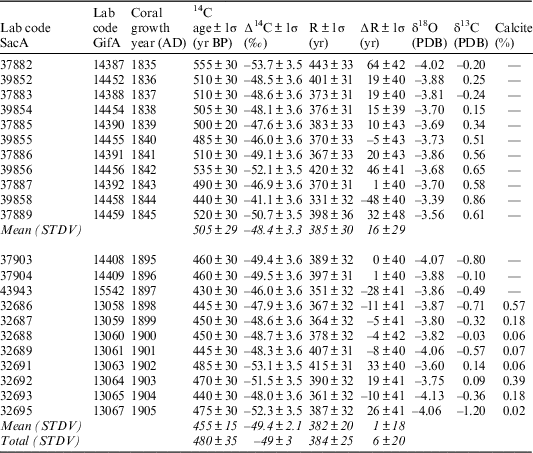
Lab codes and values of 14C, stable oxygen and carbon isotopes, and calcite content in % in annual growth bands in coral Chancel 1. 14C ages are expressed in conventional yr BP. See text for R, ∆R, and ∆14C calculations.

HYDROLOGIC SETTING AND SEA SURFACE DIC ∆14C
The water masses in the western tropical North Atlantic and the eastern Caribbean Sea were previously described in detail (Morrison and Nowlin Reference Morrison and Nowlin1982; Wilson et al. Reference Wilson, Johns and Molinari1994; Stramma and Schott Reference Stramma and Schott1999; Stramma et al. Reference Stramma, Rhein, Brandt, Dengler, Böning and Walter2005; Rhein et al. Reference Rhein, Kirchner, Mertens, Steinfeldt, Walter and Fleischmann-Wischnath2005) and the following description is summarized for the upper water masses (~500 m) near the Lesser Antilles (Rhein et al. Reference Rhein, Kirchner, Mertens, Steinfeldt, Walter and Fleischmann-Wischnath2005; Kirchner et al. Reference Kirchner, Rhein, Hüttl-Kabus and Böning2009). The tropical surface waters (TSW) at 27°C form the mixed layer which are influenced by the freshwater plumes of the Amazon and Orinoco Rivers. These are transported equatorward by the North Brazil Current (NBC) and the Guiana Current (GC) (Figure 1A) into the western tropical North Atlantic and the Caribbean Sea where they spread extensively (Pailler et al. Reference Pailler, Bourlès and Gouriou1999; Hellweger and Gordon Reference Hellweger and Gordon2002; Ffield Reference Ffield2005, Reference Ffield2006). Below TSW is the underlying salinity maximum water (SMW) formed by subduction of surface waters at the northern and southern Atlantic tropics/subtropics transitions (Wilson et al. Reference Wilson, Johns and Molinari1994; Stramma et Schott Reference Stramma and Schott1999; Stramma et al. Reference Stramma, Rhein, Brandt, Dengler, Böning and Walter2005; Rhein et al. Reference Rhein, Kirchner, Mertens, Steinfeldt, Walter and Fleischmann-Wischnath2005; Kirchner et al. Reference Kirchner, Rhein, Hüttl-Kabus and Böning2009). The northern surface waters flow westward from the North Atlantic subtropical gyre along the North Equatorial Current (NEC). Surface waters from the South Atlantic gyre and from the east South Atlantic (EAW) flow along the South Equatorial Current (SEC) then the NBC and GC (Wilson et al. Reference Wilson, Johns and Molinari1994; Bourles et al. Reference Bourlès, Gouriou and Chuchla1999; Stramma and Schott Reference Stramma and Schott1999; Stramma et al. Reference Stramma, Rhein, Brandt, Dengler, Böning and Walter2005). Anticyclonic rings form at the retroflection of NBC near ~6°N feeding the eastward flowing North Equatorial Countercurrent (NECC). They transport the South Atlantic waters as far as 15–18°N along the Atlantic side of the Lesser Antilles islands, where they decay (Hu et al. Reference Hu, Montgomery, Schmitt and Muller-Karger2004; Fratantoni and Richardson Reference Fratantoni and Richardson2006; Ffield Reference Ffield2005). Below SMW down to ~400–500 m water-depth are found the central waters (CW) (Rhein et al. Reference Rhein, Kirchner, Mertens, Steinfeldt, Walter and Fleischmann-Wischnath2005) which originate from both the South Atlantic Central water (SACW) and the North Atlantic Central water (NACW), zonally separated across the North Atlantic at around 15°N (Stramma et al. Reference Stramma, Rhein, Brandt, Dengler, Böning and Walter2005). SMW from the southern origin are fresher than SMW from the North (Bourles et al. Reference Bourlès, Gouriou and Chuchla1999) as well as NACW are saltier and warmer than SACW (Stramma et al. Reference Stramma, Rhein, Brandt, Dengler, Böning and Walter2005).
The Atlantic inflow into the Caribbean Sea penetrates through the sill passages of the Lesser Antilles, the main ones located to the south of 14°N in the Grenada (11°N) and the St Lucia-Martinique (14°N) passages and to the north in the Antigua and Anegada-Jungfern (17°N) passages (Morrison and Nowlin Reference Morrison and Nowlin1982; Wilson and Johns Reference Wilson and Johns1997; Johns et al. Reference Johns, Townsend, Fratantoni and Wilson2002; Cherubin and Richardson Reference Chérubin and Richardson2007). These inflows feed the Caribbean Current flowing westward and northward through the Yucatan strait to feed the Florida Current then the Gulf Stream (Figure 1A).
In the Caribbean region and western tropical North Atlantic, two main hydrologic features will have an impact on the variability of the sea surface δ18Ο and ∆14C. First, the Martinique Island is exposed all the year round to the E–NE Trade Winds so that sea surface waters will pile up along the roughly northwest/southeast coast of the island, and significant local upwelling cannot form. Second, the well-marked salinity gradient between the fresh buoyant surface waters TSW and the underlying SMW causes a strong pycnocline and a stable barrier layer (BL) in density (Sprintall and Tomczak Reference Sprintall and Tomczak1992; Pailler et al. Reference Pailler, Bourlès and Gouriou1999; de Boyer Montégut et al. Reference de Boyer Montégut, Madec, Fischer, Lazar and Iudicone2004). It is almost permanent all the year round (de Boyer Montégut et al. Reference de Boyer Montégut, Madec, Fischer, Lazar and Iudicone2004, Reference de Boyer Montégut, Mignot, Lazar and Cravatte2007; Mignot et al. Reference Mignot, de Boyer Montégut, Lazar and Cravatte2007) and it may be episodically eroded or suppressed by strong winds such as those generated by hurricanes (Grodsky et al. Reference Grodsky, Reul, Lagerloef, Reverdin, Carton, Chapron, Quilfen, Kudryavtsev and Kao2012). As the evaporation minus precipitation budget is positive in the region between 10°N and 20°N (Schmitt et al. Reference Schmitt, Bogden and Dorman1989; Dessier and Donguy Reference Dessier and Donguy1994; Hellweger and Gordon Reference Hellweger and Gordon2002), the BL was linked to advective processes and runoff from the Amazon and Orinoco Rivers (Pailler et al. Reference Pailler, Bourlès and Gouriou1999; Mignot et al. Reference Mignot, de Boyer Montégut, Lazar and Cravatte2007; Balaguru et al. Reference Balaguru, Chang, Saravanan and Jang2012). This stable BL separates the density based mixed layer from the thermocline and inhibits wind induced turbulent vertical mixing of the thermocline waters into the surface mixed layer (Pailler et al. Reference Pailler, Bourlès and Gouriou1999; Ffield Reference Ffield2005, Reference Ffield2006; de Boyer Montégut et al. Reference de Boyer Montégut, Mignot, Lazar and Cravatte2007; Mignot et al. Reference Mignot, de Boyer Montégut, Lazar and Cravatte2007).
The sea surface 14C content in the tropical Atlantic and Caribbean Sea was measured in the years 1955–1957 before the huge 14C input into the atmosphere due to the nuclear tests in the 1960s (Broecker et al. Reference Broecker, Gerard, Ewing and Heezen1960). The values of ∆14C, corrected from the small bomb 14C input (Broecker et al. Reference Broecker, Gerard, Ewing and Heezen1960), are more depleted in surface waters of SEC due to upwelling than in the NEC ones at –63‰ and –52‰, respectively. In the Caribbean Sea, the sea surface ∆14C is around –56‰.
RESULTS
Results are reported in Tables 1 and 2. Negligible crystallization of calcite (<1%) is documented from X-ray diffraction measurements (Table 1). Chancel 1 grew continuously over a time span of ~230 yr (Weil-Accardo et al. Reference Weil-Accardo, Feuillet, Jacques, Deschamps, Beauducel, Cabioch, Tapponnier, Saurel and Galetzka2016). The thickness of the annual bands does not vary greatly at an average of ~6±1 mm along the growth axis except prior to ~1830 AD when it varies between ~3 and 4 mm. The uncertainty at 1 σ on the counting is estimated at ±1 yr, except prior to 1830 AD at ±2 yr. Values of δ234U are in the accepted range for modern seawater at ~146‰ (Delanghe et al. Reference Delanghe, Bard and Hamelin2002; Robinson et al. Reference Robinson, Belshaw and Henderson2004; Andersen et al. Reference Andersen, Stirling, Zimmermann and Halliday2010) (Table 3). The mean Th/U age of 1853±12 (2σ) AD is in close agreement with the counting of the growth band years at 1849–1851 AD (Weill-Accardo et al. 2016).
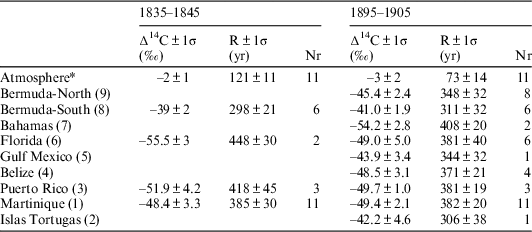
Mean values of ∆14C, R, and number (nr) of values between 1835 and 1845 and between 1895 and 1905. * refers to values in IntCal98 (Stuiver et al. Reference Stuiver, Reimer and Braziunas1998) and numbers in parentheses to coral sites cited in the text. Same legends as in Figure 1.

Results of uranium-thorium dating of two aliquots of the growth year bands 1849–1851. The Th/U ages are expressed as years before 1950 (yr BP) or in calendar years (AD). “Age cor” are corrected for detrital thorium using a mean marine 230Th/232Th activity ratio of 10±4 (Frank et al. Reference Frank, Paterne, Ayliffe, van Weering, Henriet and Blamart2004), close to the estimated correction of the non-radiogenic 230Th in one Haitian coral (Weil-Accardo et al. Reference Weil-Accardo, Feuillet, Jacques, Deschamps, Beauducel, Cabioch, Tapponnier, Saurel and Galetzka2016). Errors are propagated and are given at the 2σ confidence level.

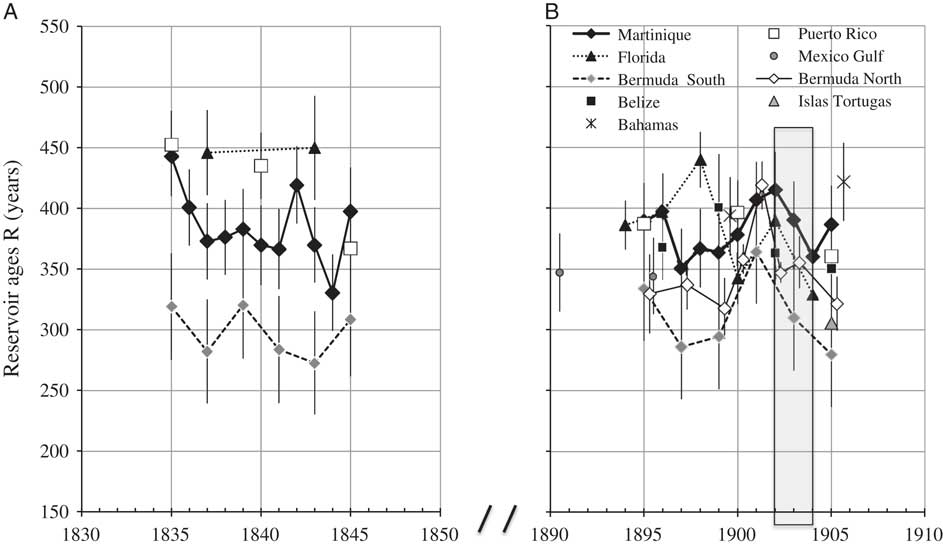
Between 1835 and 1845, and 1895 and 1905, the arithmetic means of R at 1σ are similarly centered at 385±30 yr BP and 382±20 yr BP, respectively (Figure 2, Table 1). Mean value of ∆R in the western tropical Atlantic is close to zero during the two decades. The variability of R is larger during the oldest decade than during the youngest one, when the Montagne Pelée eruption occurred. Values of R vary from 331±32 yr up to 443±33 yr during the older decade and from 351±32 yr up to 415±31 yr during the younger decade.
Values of sea surface reservoir ages R (yr) off Martinique and at the sites located in Figure 1A as a function of calendar years (AD) between years (A) 1835–1845 and (B) 1895–1905. The gray box in (B) marks the 2-yr-long eruption of Montagne Pelée. The legend in (B) also pertains to (A).

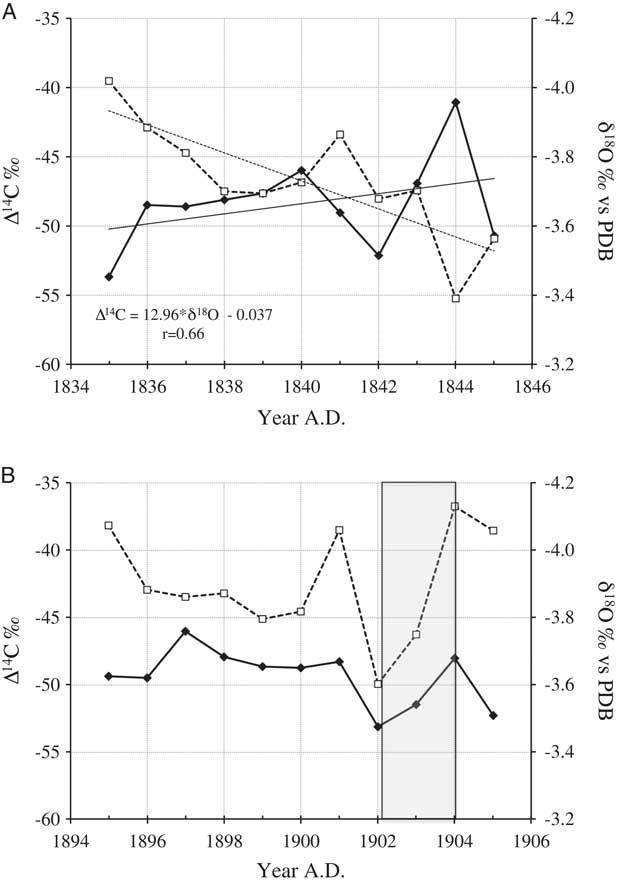
Values of δ18O vary similarly by 0.5–0.6‰ around the mean of –3.9‰ during the two decades. However they exhibit a well-marked increase of ~0.4‰ during the older decade (Figure 3A) while no trend exists during the younger one (Figure 3B). During the older decade, values of δ18O and ∆14C are significantly correlated at the 95% confidence level (r = 0.65). At the time of the eruption of Montagne Pelée in 1902–1903, a well-marked δ18O high is recorded and it coincides with slightly depleted ∆14C values although in the range of uncertainties (Table 1).
Variations of ∆14C (‰) (left axis, black diamonds) and δ18O (‰ PDB) (right axis, open squares) between (A) 1835 and 1845 and (B) 1895 and 1905. The gray box in (B) marks the 2-yr-long eruption of Montagne Pelée.

DISCUSSION
There is no large regional departure of the sea surface 14C near Martinique from the modeled global mixed layer value (Hughen et al. Reference Hughen, Baillie, Bard, Bayliss, Beck, Bertrand, Blackwell, Buck, Burr, Cutler, Damon, Edwards, Fairbanks, Friedrich, Guilderson, Kromer, McCormac, Manning, Bronk Ramsey, Reimer, Reimer, Remmele, Southon, Stuiver, Talamo, Taylor, van der Plicht and Weyhenmeyer2004) (∆R ≈ 0) and values of R are identical at an average of 384±25 yr between 1935 and 1845 and between 1895 and 1905. The sea surface variations of 14C off Martinique reproduce mainly the atmospheric 14C changes at steady state in the western tropical North Atlantic/Eastern Caribbean and the ocean–atmosphere 14CO2 exchange and ocean dynamics do not vary greatly when comparing the two decades. Nevertheless, the oldest decade records a large range of variations in ∆14C and δ18O characterized by a moderate increase of ∆14C and a well-marked increase of δ18O of ~0.4‰, which is not observed during the youngest decade (Figure 3).
The variations of δ18O reflect the changes of the sea surface temperatures (SST) and sea surface salinities (SSS), due to changes in the evaporation-precipitation budget and runoff. In addition, in the eastern Caribbean Sea, SSS also depend on the oceanic current patterns (Hellwegger and Gordon Reference Hellweger and Gordon2002) and they may be punctually related to changes in volcanic activity. Although in this region rainfalls play a minor role in changing the sea surface salinities (Schmitt et al. Reference Schmitt, Bogden and Dorman1989; Dessier and Donguy Reference Dessier and Donguy1994; Hellweger and Gordon Reference Hellweger and Gordon2002), we analyzed their local influence by comparing the records of δ18O and precipitation on Martinique Island. The fluctuations of δ18O in coral Chancel 1 are analyzed using available records of SST (ersst.v3 at ncdc.noaa.gov/data-access/marineocean-data; Xue et al. Reference Xue, Smith and Reynolds2000; Smith et al. Reference Smith, Reynolds, Peterson and Lawrimore2006), the precipitation records (www.climexp.knmi.nl; van Oldenborgh and Burgers Reference Van Oldenborgh and Burgers2005) as well as the values of δ18O of seawater near volcanic gas vents and in groundwaters (McCarthy et al. Reference McCarthy, Pichler and Price2005; Sanjuan et al. Reference Sanjuan, Millot, Brach, Foucher, Roig and Baltassat2005; Jones et al. Reference Jones, Hembury, Palmer, Tonge, Darling and Loughlin2011; Hemmings et al. Reference Hemmings, Gooddy, Whitaker, Darling, Jasim and Gottsmann2015; Sanjuan and Brach Reference Sanjuan and Brach2015). We first compared the sea surface 14C values in coral Chancel 1 with previous data from the tropical and subtropical North Atlantic (Druffel and Linick Reference Druffel and Linick1978; Druffel Reference Druffel1980; Druffel and Suess Reference Druffel and Suess1983; Druffel Reference Druffel1982 Reference Druffel1997; Guilderson et al. Reference Guilderson, Cole and Southon2005; Kilbourne et al. Reference Kilbourne, Quinn, Guilderson, Webb and Taylor2007; Wagner et al. Reference Wagner, Guilderson, Slowey and Cole2009; Goodkin et al. Reference Goodkin, Druffel, Hughen and Doney2012; Fernandez et al. Reference Fernandez, Lapen, Andreasen, Swart, White and Rosenheim2015). We then analyzed the variability of δ18O and ∆14C, linked to local hydrology, ocean dynamics, and volcanism.
Comparison of R and ∆14C in Chancel 1 and in Corals and Scleroponges of the Tropical and Subtropical Western North Atlantic
The mean values of R and ∆14C near Martinique compare well with previous ones (Table 2): in Puerto Rico (Kilbourne et al. Reference Kilbourne, Quinn, Guilderson, Webb and Taylor2007), Belize (Druffel Reference Druffel1980; Druffel and Suess 1983), the Gulf of Mexico (Wagner et al. Reference Wagner, Guilderson, Slowey and Cole2009), the Florida Strait within the Gulf Stream (Druffel and Linick Reference Druffel and Linick1978; Druffel Reference Druffel1980, Reference Druffel1982, Reference Druffel1997; Druffel and Suess Reference Druffel and Suess1983), and the Bahamas (Fernandez et al. Reference Fernandez, Lapen, Andreasen, Swart, White and Rosenheim2015). In one instance, slightly higher ∆14C than observed in the whole Caribbean Sea is observed from one coral near Islas Tortugas in the Cariaco basin, but it is based only on a one-year average (Guilderson et al. Reference Guilderson, Cole and Southon2005). No gradient in the mean ∆14C is observed between the Atlantic inflow east off Martinique Island and the Caribbean Sea and Gulf Stream.
Values off Martinique are older than the subtropical North Atlantic ones considering coral records from either the northern or the southern shorelines off Bermuda (Druffel 1989, Reference Druffel1997; Goodkin et al. Reference Goodkin, Druffel, Hughen and Doney2012). Compared to values of R and ∆14C from the southern coral, which characterizes open ocean conditions in the subtropical gyre (Goodkin et al. Reference Goodkin, Druffel, Hughen and Doney2012), they differ by 70–90 yr and 8–9‰ in Chancel 1, respectively, over the two decades (Figure 2). The difference in ∆14C compares well with the ~11‰ offset between the SEC and NEC DIC ∆14C, the southern waters having the most 14C-depleted values (Broecker et al. Reference Broecker, Gerard, Ewing and Heezen1960). The aging of the tropical sea surface off Martinique Island reflects the imprint of the South Atlantic Waters transported by the SEC/NBC/GC along the Lesser Antilles arc and into the Caribbean Sea.
Fluctuations of δ18O and ∆14C in Coral Chancel 1
Changes in δ 18 O between 1835 and 1845
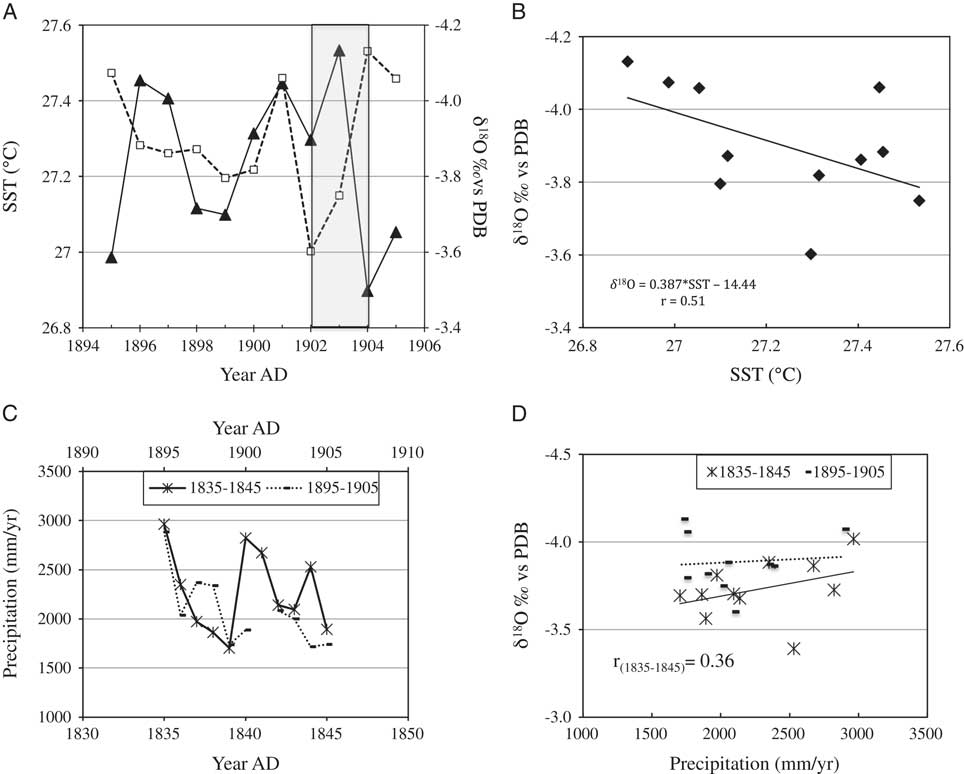
The δ18O and SST in carbonates are commonly negatively correlated, the more depleted the δ18O, the warmer the SST, and vice versa (Weber and Woodhead Reference Weber and Woodhead1972). The correlation between available SST between 1895 and 1905 (Xue et al. 2000; Smith et al. Reference Smith, Reynolds, Peterson and Lawrimore2006) and δ18O is positive (Figures 4A, 4B). This implies that the variations of δ18O are dominated by sea surface salinity changes (SSS), the low salinities corresponding to depleted δ18O values, and vice versa. The mean annual precipitation on Martinique Island are very similar between 1835 and 1945 (2270 mm/yr) and between 1895 and 1905 (2200 mm/yr) (van Oldenborgh and Burgers Reference Van Oldenborgh and Burgers2005) (Figures 4C, 4D). The changes of the salinity-dependent δ18O are not correlated to the variations in the mean annual precipitation on Martinique Island in agreement with previous findings (Dessier and Donguy Reference Dessier and Donguy1994; Hellweger and Gordon Reference Hellweger and Gordon2002; Folz et al. 2004). Furthermore, the annual and interannual variations of evaporation are weak in the Caribbean region (Yoo and Carton Reference Yoo and Carton1990; Dessier and Donguy Reference Dessier and Donguy1994; Hellweger and Gordon Reference Hellweger and Gordon2002; Folz et al. 2004) so that the increase of δ18O between 1835 and 1845 cannot be due to evaporation processes. As the density BL prevents vertical mixing in this region (Pailler et al. Reference Pailler, Bourlès and Gouriou1999; Sprintall and Tomczak Reference Sprintall and Tomczak1992; de Boyer Montégut et al. Reference de Boyer Montégut, Madec, Fischer, Lazar and Iudicone2004), the changes of the salinity-dependent δ18O near Martinique are therefore related to advective processes, as previously stated (Dessier and Donguy Reference Dessier and Donguy1994; Hellweger and Gordon Reference Hellweger and Gordon2002). In the southeast Caribbean Sea, the SSS changes are highly correlated to the Amazon River freshwater discharges (Hellwegger and Gordon Reference Hellweger and Gordon2002), the influence of which was felt far from the river mouth by depleted δ18O (Karr and Showers Reference Karr and Showers2002) and low SSS (Ffield Reference Ffield2005). Changes of δ18O between 1835 and 1845 are thus attributed to variations in either the magnitude of the Amazon and Orinoco runoff or in the current strength of the SEC/NBC/GC, which transport the South Atlantic Waters (SAW) into the western tropical North Atlantic and Caribbean Sea, or both.
(A) Variations of the mean annual SST (°C) (left axis, black triangles) at ~16°N; 61°W (Xue et al. 2000; Smith et al. 2006) and δ18O (‰ versus PDB) (right axis, open squares) and (B) variations of δ18O as a function of the mean annual SST (°C) between 1895 and 1905; (C) variations of the mean annual precipitation (in mm/year) on Martinique Island (van Oldenborgh and Burgers 2005) and (D) variations of δ18O as a function of the mean annual precipitation between 1835 and 1845 and between 1895 and 1905.

Changes in Oceanic Water Masses Advection off Martinique Island between 1835 and 1845
The South Atlantic Waters (SAW), transported northward into the Caribbean Sea, are characterized by low SSS, related to the Amazon River discharges (Hellwegger and Gordon Reference Hellweger and Gordon2002) and by low ∆14C (Broecker et al. Reference Broecker, Gerard, Ewing and Heezen1960). Thus the increase of both δ18O and ∆14C off Martinique between 1835 and 1945 requires a decrease in the strength of the SEC/NBC/GC and thus in the freshwater advection. Changes in SAW advection into the eastern Caribbean across the sills were previously pointed out from repeated hydrographic surveys (Wilson and Johns Reference Wilson and Johns1997; Johns et al. Reference Johns, Townsend, Fratantoni and Wilson2002; Rhein et al. Reference Rhein, Kirchner, Mertens, Steinfeldt, Walter and Fleischmann-Wischnath2005). Similarly, variations in the northward extent of equatorial water masses was also evidenced in the northern Caribbean Sea at Puerto Rico from a post-1963 coral record of ∆14C (Kilbourne et al. Reference Kilbourne, Quinn, Guilderson, Webb and Taylor2007).
The fraction of SAW in TSW is not well assessed and it is estimated in SMW at 20–30% along the Lesser Antilles arc up to ~15°N (Rhein et al. Reference Rhein, Kirchner, Mertens, Steinfeldt, Walter and Fleischmann-Wischnath2005; Kirchner et al. Reference Kirchner, Rhein, Hüttl-Kabus and Böning2009). Using a 25% SAW fraction in TSW, similarly as in SMW, and NEC ∆14C at ~–39‰ in ~1835 (Goodkin et al. Reference Goodkin, Druffel, Hughen and Doney2012) (Table 2), one may calculate a ∆14C value of the SEC at –85‰ when ∆14C is ~–50‰ in 1835 off Martinique. This calculated value is identical to the one determined at ~–85‰ in AD 1815–1835 at Santa Helena located within the southern branch of the SEC (Lewis et al. Reference Lewis, Reimer and Reimer2008). To augment the ∆14C near Martinique by ~5‰ such as from 1835 to 1845, the SAW fraction might be reduced from 25% to 15%.
Changes of δ 18 O during the 1902–1903 Eruption of Montagne Pelée
Warm and salty surface waters prevailed at the time of the eruption (Figure 4A). The values of δ18O from hydrothermal and geothermal fluids are mainly depleted with respect to those of seawater in the Lesser Antilles volcanic arc. Hydrothermal fluids from aquifers and groundwaters have very depleted δ18O varying between about 0‰ and –4‰ versus SMOW (Jones et al. Reference Jones, Hembury, Palmer, Tonge, Darling and Loughlin2011; Hemmings et al. Reference Hemmings, Gooddy, Whitaker, Darling, Jasim and Gottsmann2015; Sanjuan and Brach Reference Sanjuan and Brach2015), compared to the seawater value (~1‰ versus SMOW; McCarthy et al. Reference McCarthy, Pichler and Price2005; Sanjuan and Brach Reference Sanjuan and Brach2015). Similarly, δ18O from CO2 degassing in submarine gas vents vary between values of seawater and those of the δ18O-depleted meteoritic waters (~–2‰/SMOW) and the largest vents of highest flow rate have δ18O values closer to the meteoritic ones (McCarthy et al. Reference McCarthy, Pichler and Price2005). However few positive values of δ18O, higher than the seawater one, were measured at +2.5‰ in geothermal fluids from hot water ponds on the southern seashore on Montserrat Island (Hemmings et al. Reference Hemmings, Gooddy, Whitaker, Darling, Jasim and Gottsmann2015) and at ~+2‰ on the western seashore of Martinique (Sanjuan et al. Reference Sanjuan, Millot, Brach, Foucher, Roig and Baltassat2005). Thus, the observed increase of δ18O in Chancel 1 could be linked to enhanced seaward discharge of geothermal fluids when the eruption occurred, although volcanic fluids are statistically characterized by δ18O-depleted values and hot water ponds are mainly located on the western coast of Martinique (Sanjuan et al. Reference Sanjuan, Millot, Brach, Foucher, Roig and Baltassat2005; Gadalia et al. Reference Gadalia, Baltassat, Bouchot, Caritg-Monnot, Gal, Girard, Gutierrez, Jacob, Martelet, Coppo, Rad, Tailame, Traineau, Vittecoq and Wawrzyniak2015). This feature, if it exists, would account for a slight ∆14C decrease of 5‰, that is in the range of uncertainties (Table 1).
CONCLUSION
Values of R and ∆14C for the eastern Caribbean Sea and the western tropical North Atlantic are quantified from one annually banded coral Chancel 1 collected on the eastern coast of Martinique Island.
The mean values of R and ∆14C are similar between 1835 and 1845 and between 1895 and 1905 with an average of 385±25 yr and –49±3‰ respectively for the two decades. No gradient in the mean values of R and ∆14C is observed along the Caribbean Current from the eastern Caribbean Sea to the Florida Straits. A positive gradient of about ~70–90 yr and 8–9‰, respectively, is observed between the tropical and subtropical regions of the North Atlantic in agreement with the advection of the old South Atlantic Waters by the SEC/NBC/GC into the Caribbean Sea and the northwestern tropical Atlantic.
Sea surface aging due to enhanced volcanic activity such as during the 2-yr-long eruption of Montagne Pelée cannot be completely excluded. It could amount to some ~40 yr (∆14C ~5‰), which is in the range of dating uncertainties.
Between 1835 and 1845, a reduced northward advection of the South Atlantic Waters, characterized by low SSS and low ∆14C, towards the Martinique Island is inferred from the well-correlated increase of both δ18O and ∆14C. Using modern estimates of the SAW fraction around the Lesser Antilles (Kirchner et al. Reference Kirchner, Rhein, Hüttl-Kabus and Böning2009) and values of ∆14C in the South Atlantic (Lewis et al. Reference Lewis, Reimer and Reimer2008) and subtropical North Atlantic (Goodkin et al., Reference Goodkin, Druffel, Hughen and Doney2012), we calculated that the SAW fraction off Martinique Island was reduced from 25% to 15% from 1835 to 1845. Thus, although the sea surface ∆14C compare well between the two decadal records in the western tropical North Atlantic, their variability indicates changes in ocean dynamics.
ACKNOWLEDGMENTS
This work received the financial support of the CEA-CNRS-UVSQ, the CNRS/INSU programs: OA/Leffe-ARRA, ST/PERSEIS; the ACI–FNS Risques Naturels et Changement climatique and the ANR SUBSISMANTI. Thanks are due to E. Kaltnecker, C. Noury, L. Foliot, and F. Manssouri for technical support and the LMC14 team for graphite targets preparation and AMS-14C measurements. M. Fontugne and P. Laceby are thanked for their helpful discussions and suggestions.