Introduction
What are the consequences of state support for, and official recognition of, one religion or religious institution over all others in the state? Specifically, how does such support impact affiliation with both (1) the institution that is the recipient of this privileged status and (2) all other religious institutions?
Although at first glance these appear to be questions which have been extensively studied, little consensus has emerged on the answers. One approach is to focus on the “demand” side of the market for religion. According to this view, what determines the growth or decline of religious belief and participation is largely the values, attitudes, or rational choice calculations of the citizens of the state. As demand for religion fluctuates, so will membership and participation in religious bodies; what policies the state adopts toward religion is of limited importance. Those who hold this view are often associated with some version of the secularization hypothesis, which holds that as states proceed on a trajectory of economic and human development, they become less religious.
This demand-side explanation of religious belief and behavior has been the subject of criticism since the early 1990s. Skeptical scholars pointed to worldwide growth in religious belief, as well as the anomalously high rates of religious belief and church attendance in a highly developed country like the United States. An alternative paradigm for explaining diversity in religious engagement emerged that focused on the supply side of the equation. Under religious market theory, the strength and vitality of religion can be explained by the level of competition in the religious marketplace. Some states intervene in the market to create artificial monopolies through a combination of preferential treatment for one religion and punitive measures against others. In such cases, we should expect to see low religiosity compared to states with a clear separation of church and state, where religious “firms” compete for adherents under genuine market conditions.
While previous approaches to the study of church-state interactions have contributed to our understanding, they have not provided compelling answers to the questions posed in this paper. Empirical tests of both the supply- and demand-side theories of religiosity have produced contradictory findings, at times supporting and at times challenging each theory. In addition to yielding inconclusive results, these studies are often methodologically flawed because they tend to examine global variations in religiosity by making synchronous cross-state comparisons rather than looking at changes in religiosity over time, ignoring the path-dependent and historically grounded nature of religious belief. Additionally, most studies have not drawn a distinction between the effects of state support on (1) the religion that is favored and (2) all other religions in the state. Instead, they have tended to examine the effect of state involvement in religion on religiosity within the state as a whole.
In contrast to this approach, I argue that state support for, and official recognition of, one religion will have markedly different consequences for (1) the favored religious firm and (2) all other religious institutions. Similar to religious market theory, I expect that dependence on state support creates disincentives for the favored religious organization to attract adherents and cultivate participation. Further, the involvement of the state in the affairs of the favored religion that often goes hand-in-hand with official status and financial support runs the risk of stripping that institution of its theological distinctiveness and spiritual vitality by turning it into a soulless, bureaucratized branch of government.
However, I depart from religious market theory in recognizing that the weaknesses that state-backed favoritism engender in the favored religion should create opportunities for other religious firms to step in and provide the types of religious products lacking on the market. Unless they are prohibited from doing so by overt government repression, alternative religious bodies should actually benefit from the vacuum in the market created by an increasingly hollow, complacent, and inefficient church. In other words, if demand for religion holds fairly constant but the product offered by the dominant state religion is increasingly unattractive, other religious bodies should enjoy an opportunity for growth.
To test my theoretical expectations, I conduct a quantitative analysis of changes in religious affiliation in 174 states between 1990 and 2010. I compare the way that state favoritism of one religion affects the growth in adherents (as a percentage of total population) for both the favored religion and all other religions in the state. I perform multivariate analyses controlling for a variety of factors that could impact change in religious affiliation over time, including existential security, regime type, net migration, post-Communist background, and major religious traditions. My findings suggest that, consistent with my theory, religious institutions that receive favorable treatment from the state lose ground relative to those that do not.
Theories and findings on variation in religiosity
As stated in the introduction, demand-side explanations of variation in religiosity are often related to the secularization thesis: the expectation that as societies follow a path of development from poor, rural, agriculture-based economies to wealthy, urban, industrial or post-industrial economies, they will decline in their need or desire for religious belief and institutions. As Norris and Inglehart (Reference Norris and Inglehart2004) point out, there is no single theory of secularization and no single causal mechanism proposed to link development and decline in religiosity. The traditional view, originating in the Enlightenment and espoused by twentieth-century social scientists like Berger (Reference Berger1967) is that the rise of rationalism and empiricism undermines belief in the supernatural claims of religion and confidence in the utility of religious institutions. In essence, growing faith in reason, science, and technology supplants religious belief and undermines ecclesiastical authority. However, this view is challenged by Norris and Inglehart's finding that more religious societies are actually more likely to have a positive view of science (Reference Norris and Inglehart2004, 68).
A related but distinct theory of secularization based on the work of Durkheim (Reference Durkheim2001) and proceeding from the functionalist perspective suggests that the decline of religion results from the expansion of secular state institutions, which come to perform many of the social functions formerly carried out by religious organizations. The expansion of the welfare state in the provision of social goods like education, healthcare, and a social safety net for the most vulnerable members of society effectively muscles out churches and faith-based charitable institutions and strips them of their core functions. While there is a certain logic to this perspective, it seems unnecessarily reductive in that it neglects the spiritual and moral leadership role of churches. Indeed, the advancement of the welfare state has perhaps allowed churches to maximize their distinctiveness by allowing them to focus on what sets them apart from other institutions: their ability to give life a sense of meaning and purpose, and to provide a moral and ethical code by which to live.
The rumors of religion's demise proved to be greatly exaggerated. With religiosity increasing globally toward the end of the twentieth century and with the persistence of “problematic” cases like the United States (high in both development and religiosity), the secularization thesis came under considerable criticism. An alternative explanation of variation in religiosity presented by Stark and Iannaccone (Reference Stark and Iannaccone1994) placed primary importance on the supply side of religious markets. The argument posited that unregulated religious economies tend to be pluralistic, whereas religious monopolies generally result from state coercion and regulation. Pluralistic religious economies entail competition for adherents, leading religious “firms” to specialize and cater to the specific tastes and needs of different segments of the population. This diversity of religious firms and their relative effectiveness (stemming from a necessary response to competitive pressures) in turn leads to greater rates of religious participation. In contrast, as Stark and Finke (Reference Stark and Finke2000) further elaborate, the absence of a clear separation of church and state hampers religiosity due to government's corrupting influence on state churches by disincentivizing effort among both the clergy and the laity, and by restricting freedom of religion for minority faiths. Ultimately, the expectation of religious markets theory, empirically corroborated by some early studies (e.g., Iannaccone Reference Iannaccone1991; Chaves and Cann Reference Chaves and Cann1992), is that government policy, rather than inherent demand in the population, is the primary explanation for variations in religiosity.
In their effort to update secularization theory and defend it from its critics, Norris and Inglehart (Reference Norris and Inglehart2004) offer their own account of the decline of religiosity, focusing on the concept of existential security. They argue that individuals who grow up in societies where security is lacking and survival is uncertain are more likely to value the sense of certainty and safety offered by religion. In contrast, those who grow up in societies where security and survival are taken for granted will find little use for religion in their lives. Norris and Inglehart argue that a process of secularization has indeed taken place in wealthy societies since the middle of the twentieth century, while religiosity has remained constant in poor societies. They find evidence that this divergence can primarily be attributed to the security of the former and the vulnerability of the latter type of state. Ultimately, Norris and Inglehart conclude that the global growth of religious affiliation in the twentieth century is explained by higher birth rates in poorer, more religious countries, and does not in itself undermine the secularization thesis.
The existential security hypothesis has received support in numerous subsequent studies. Ruiter and van Tubergen (Reference Ruiter and van Tubergen2009) find that both economic insecurity (measured at the individual level) and socioeconomic inequality (measured at the state level) lead to increased religious attendance. Barber's (Reference Barber2011) empirical analysis concludes that increased economic development, income security, and health security each result in the decline of the religious belief. Rees (Reference Rees2009) utilizes income inequality as a proxy for personal security and finds that it has at least as strong of an influence on religiosity as wealth, urbanization, and government involvement in regulating religion. Immerzeel and van Tubergen (Reference Immerzeel and van Tubergen2013) find that a host of economic and existential factors related to insecurity are associated with cross-national variations in religiosity. However, while Höllinger and Muckenhuber (Reference Höllinger and Muckenhuber2019) corroborate previous studies' macro-level findings regarding the inverse relationship between security and religiosity, their individual-level, within-states tests of the hypothesis largely fail to support this linkage.
Returning to the question of church-state relations, several prominent scholars have critiqued establishment of religion and state interference in the religious sphere. An-Na'im (Reference An-Na'im2009) argues that the separation of religion and state in the Islamic world is not only desirable but essential for Islam's flourishing. He contends that the observance of Shari'a is only authentic and transformative if it is based on voluntary submission rather than state compulsion. While religious values ought to play a role in shaping laws, the state must remain neutral regarding religious doctrine in order to allow religious life to thrive. Stone (Reference Stone2008) similarly argues that historical Jewish legal doctrines have contributed to a modern conception of separation of church and state. Koppelman (Reference Koppelman2013) defends the American approach to church-state relations, affirming First Amendment doctrine which views religion as a societal good and gives legal protection to religious practice, while simultaneously preserving neutrality so as not to favor particular religious doctrines over others. He argues that while religious believers should be able to influence public policy debates, laws adopted by government should be defensible on nonreligious terms. Nussbaum (Reference Nussbaum2008) likewise emphasizes the importance of government impartiality in the area of religion, but also the importance of the mutual recognition and tolerance between religions embodied in the American understanding of secularism. For her, “separation of church and state” does not mean insulating the state from malign religious influence but protecting religious minorities from discrimination in matters of doctrine and religious practice.
Other scholars have offered a more positive view of church-state linkages. Miller (Reference Miller2014) argues that states have the right to intervene in the religious sphere for the purpose of preserving historical national culture, and the right to require migrant minorities to integrate within this culture. Miller (Reference Miller2021) further argues for the legitimacy of a “liberal establishment” of religion that blends support and recognition of a national church with a commitment to liberal principles like freedom of conscience. He believes such establishment may be desirable if the relevant religion has deep historical roots in the state and a majority of the population continues to desire its official recognition. However, Miller stresses that the version of establishment he defends entails the organizational separation of church and state, with no overt meddling by politicians in ecclesiastical matters. Thus, even in this account friendly to establishment, there is the implicit recognition that state interference in a religious institution's affairs can have problematic consequences. Weiler (Reference Weiler2010, Reference Weiler2013) challenges the notion that the absence of religious symbols or language in public spaces, national anthems or constitutions is any more “neutral” or impartial than their presence. He argues that religious symbols and notions need not be purged from the public square while their secular counterparts freely proliferate, and favorably cites the UK-Dutch model of education that funds secular and religious schools alike. Perez (Reference Perez2020) critiques views such as Miller and Weiler's, arguing against the applicability of what he terms the “religious majoritarian approach.” He holds that this approach presupposes a religious and cultural homogeneity that rarely obtains in contemporary pluralistic societies and that its application can threaten both minority rights and the autonomy of religious bodies.
While the theory behind the benefits of competitive religious markets appears sound, several empirical studies have produced findings that appear to contradict its expectations. Norris and Inglehart (Reference Norris and Inglehart2004) find that religious pluralism, religious freedom, and state regulation of religion are not statistically significant predictors of religious participation in the United States and Europe and that religious pluralism is negatively associated with religious participation in post-Communist states. McCleary and Barro (Reference McCleary and Barro2006) determine that an established state religion has a statistically significant positive effect on religious attendance, belief in hell and the afterlife, and the share of population describing itself as religious, and that religious pluralism is not a statistically significant predictor of most measurements of religiosity. Driessen (Reference Driessen2014) finds that state favoritism of religion is positively and statistically significantly associated with higher levels of individual religiosity.
On the other hand, a host of studies have also lent credibility to the religious markets theory. State regulation of religion was found to be a statistically significant negative predictor of religiosity by both McCleary and Barro (Reference McCleary and Barro2006) and Ruiter and van Tubergen (Reference Ruiter and van Tubergen2009). Traunmüller and Freitag (Reference Traunmüller and Freitag2011) find that a variety of forms of state support and involvement in religion, including the funding of religion, levying of church taxes, implementing religious legislation, and favoring one religion over others are negatively associated with membership in, volunteering for, and financial contributions to religious organizations. In their extensive study of the impact of state regulation on religion, Fox and Tabory (Reference Fox and Tabory2008) find that countries with greater separation of church and state have higher levels of church attendance and a higher proportion of the population describing itself as religious; however, the authors find less evidence that religious belief is influenced by state policies.
Moving beyond the impact on religiosity, much of the existing literature on the consequences of state-favored or established religion has focused on consequences for religious minorities, religious liberty, and democracy. Fox and Flores (Reference Fox and Flores2009) examine the impact of constitutional clauses that embody religious freedom, protect against religious discrimination, and establish a separation between religion and state. They find that none of these clauses is a statistically significant predictor of decreased religious discrimination. In contrast, Rahman (Reference Rahman2013) argues that establishment of religion indirectly leads to decreased religious freedom for minorities because it creates a market monopoly for the favored religion, which in turn increases that religion's political influence. However, the strong association between state establishment of religion and market monopolization could very easily be a case of reverse causation. Lastly, Driessen (Reference Driessen2010) finds that government favoritism toward a particular religion does not inherently negatively impact democracy and that a variety of church-state models are compatible with democratic practice.
Another body of research has focused on the effect of state favoritism toward a particular religion on social attitudes. Analyzing data from Swiss cantons, Helbling and Traunmüller (Reference Helbling and Traunmüller2016) find a positive association between higher levels of state support for religion and negative attitudes toward Muslim migrants. Turning to the attitudes of religious minorities themselves, Perez et al. (Reference Perez, Fox and McClure2017) determine that contrary to intuitive expectations, there is no evidence that unequal governmental support for religion breeds resentment toward the state.
Overall, the theoretical arguments against the religious establishment are broadly persuasive as they highlight its potential problematic influence on majority and minority religions alike. However, quantitative empirical studies have found surprisingly little evidence that strict separation of church and state is necessary to protect minority religious rights or safeguard democracy, and state favoritism toward a particular religion is not as consequential for the attitudes of minority religion adherents toward the state as one would expect. The question of whether competitive religious markets lead to greater religiosity is still an open one, with empirical studies yielding contradictory findings. One limitation of existing research is that it has not explored the possibility that state favoritism can actually improve the ability of minority religions to grow and flourish, which I propose in the following section.
A Theory of the consequences of state favoritism for religious organizations
What can we make of the conflicting findings regarding the influence of religious markets on religiosity? First, it should be pointed out that the stories told by the demand and supply approaches to the question need not be mutually exclusive and could well be complementary. Thus, although I am primarily concerned with testing a version of the religious markets theory, I do not discount the possibility that economic and human development can produce variation in societal demand for religion, and consequently in religious belief and participation. Indeed, I include variables related to development and existential security as necessary controls in my analysis.
The contradictory findings could in part be explained by methodological limitations in existing studies, which tend to examine global variations in religiosity cross-sectionally, holding time constant, rather than looking at changes in religiosity over time. Religious belief and practice are historically grounded and path-dependent to a significant extent, something which both Norris and Inglehart (Reference Norris and Inglehart2004) and Ruiter and van Tubergen (Reference Ruiter and van Tubergen2009) affirm. Consequently, much of the variation therein can be explained by factors other than the level of market competition or the level of development. Reverse causality can be a serious problem when trying to make inferences about the effect of state favoritism toward religion: if a study finds a positive correlation between government support for one religion and societal religiosity, it is at least as plausible that the historically high religiosity of the society has resulted in such supportive government policies as it is that those policies cause religiosity. Indeed, the findings of Barro and McCleary (Reference Barro and McCleary2005) suggest the causal arrow runs from historic adherence to a religion to official status. Looking at change over time, however, allows us to control for these historically contextual factors and isolate the effect of both government policies and economic development.
Equally important, most studies have failed to distinguish between and study separately the effects that state support has on (1) the religion that is favored and (2) all other religions in the state. Even proponents of the religious market theory, who place high importance on the role of government, have tended to look at the effect of state involvement in religion on religiosity within the state as a whole. The assumption seems to be that since state support creates disincentives for the favored religious institution to innovate and attract adherents, religious belief and practice in general will be negatively impacted. For instance, Stark and Finke (Reference Stark and Finke2000) suggest that in Germany and Scandinavian countries, the government-promoted notion that religion should be “free” to the people and not require any personal sacrifice disadvantages competing religious organizations that are dependent on financial contributions.
In contrast to this approach, I argue that state support for, and official recognition of, one religion will have markedly different consequences for the favored religious firm compared to all other religious institutions. Similar to religious market theory, I expect that dependence on state support creates strong disincentives for the favored religious organization to attract adherents and cultivate participation. Further, the involvement of the state in the affairs of the favored religion—which often goes hand-in-hand with official status and fiscal support—runs the risk of stripping that institution of its theological distinctiveness and spiritual vitality by essentially turning it into a branch of government.
However, the weaknesses that state-backed favoritism engenders in the favored religion should create opportunities for other religious firms to step in and provide the types of religious products lacking on the market. Unless they are prohibited from doing so by overt and pervasive government repression, alternative religious bodies should actually benefit from the vacuum in the market created by an increasingly hollow, complacent, and inefficient church. In other words, if demand for religion holds constant but the product offered by the dominant state religion is increasingly unattractive, other religious bodies should enjoy an opportunity for growth.
Putting together my focus on change in religiosity over time and my theoretical expectations regarding the divergent consequences of state favoritism for favored and non-favored religions, I derive the following hypotheses:
H1: The most popular religion in a state will experience less growth (or greater decline) in the number of adherents as a share of the state's population over time if that religion is favored by the state to the exclusion of other religions.
H2: Religions other than the one most popular in the state will experience greater growth (or lesser decline) in the number of adherents as a share of the state's population over time if the most popular religion is favored by the state to the exclusion of other religions.
Finally, if we accept the logic of the of the first two hypotheses, we can expect the following cumulative effect:
H3: The most popular religion in a state will perform relatively worse compared to other religions in terms of change in the share of population over time if that religion receives exclusive favorable treatment from the state.
Data
To test my theoretical expectations, I collected data on 174 sovereign states in the period 1990–2010, with states serving as both the unit of analysis and unit of observation. There are three dependent variables: (1) the percentage change in size of the dominant (most popular) religion in a stateFootnote 1 as a share of population, (2) the percentage change in size of all other religions in a state, and (3) the percentage change in size of the dominant religion relative to all other religions. The first variable is calculated by taking the percentage of the state's population belonging to the most popular religion in 2010 and subtracting the percentage in 1990, dividing the result by the 1990 percentage, and multiplying by 100. Positive values indicate growth while negative values indicate decline. The second variable is calculated by the same process but reflects the percentage change of the population adhering to all religions other than the dominant religion. For my multivariate analysis, I also calculate this change in affiliation for two separate periods, 1990 to 2000 and 2000 to 2010. The third variable is calculated by subtracting other religion percentage change from dominant religion percentage change; positive values indicate that the dominant religion grew at a faster rate (or declined at a slower rate) than all other religions. The data for the 1990, 2000 and 2010 share of population is from the Religious Characteristics of States dataset (Brown and James Reference Brown and James2017).Footnote 2 The median growth for the most popular religion in the state between 1990 and 2010 was 9.8%; for minority religions it was 14.8%.
The selection of 1990, 2000 and 2010 as the years for comparison is driven, in part, by the availability of data for this period. However, it is a reasonable time period for analysis for several other reasons. First, it represents a period after the Cold War, the demise of Communism in Central and Eastern Europe, and the third wave of democratization. As such, it reflects realities about religion in the current international system. Second, two decades is a long enough period to capture genuine and meaningful change in religious affiliation but not so long a period that it fails to account for significant changes in state policies toward religion (which tend to be fairly stable from year to year).
One possible objection to using religious affiliation as a measure of religiosity is the significant share of nominal believers in many states (individuals who exhibit little religious participation or theologically orthodox belief). While this is certainly a problem when seeking to make cross-national comparisons about religiosity, the fact that the dependent variable here is percentage change over time somewhat ameliorates this concern. What this means is that religiosity is measured first relative to the same state at a previous point in time; only then are cross-national comparisons made. This serves as a built-in control for states that exhibit high religious affiliation but low participation. Whether a state has a high or low share of nominal believers, changes in the number of religious adherents over time are likely indicative of changes in societal religiosity. Further, as stated above, the primary advantage of using change over time as the dependent variable is that it controls for states' unique historical and cultural characteristics, making it better able to isolate the effect of government policies on religiosity.
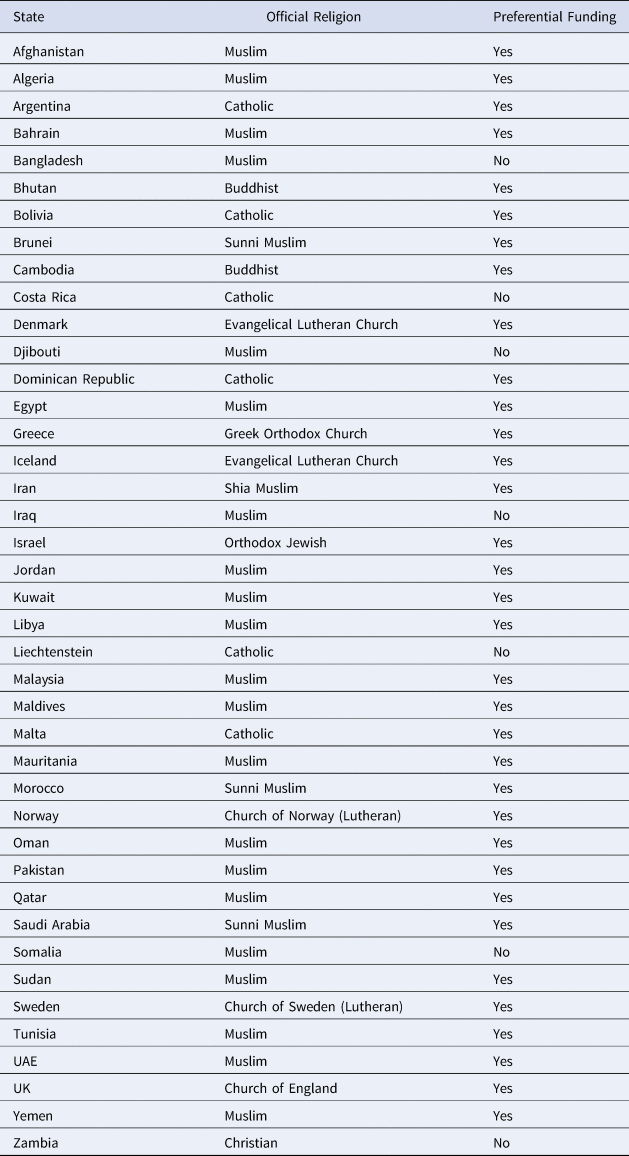
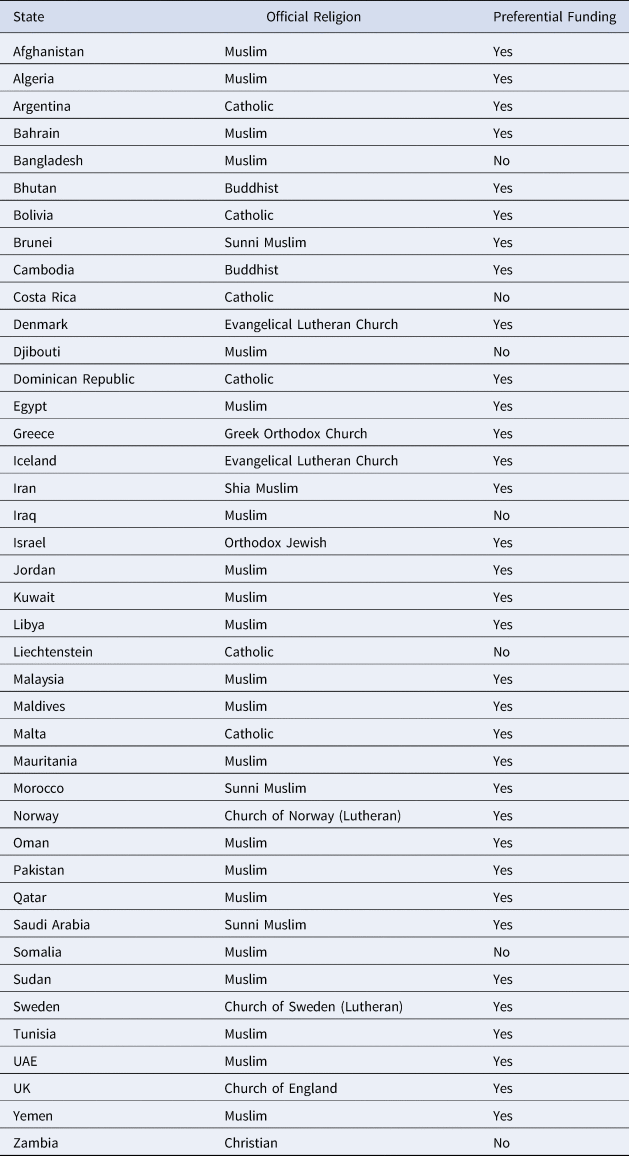
The first independent variable in the analysis is official religion, coded as “1” if the most popular religion in the state was also constitutionally established as the official religion of the state for a majority of the years in the period 1990–2010, and “0” otherwise. Data on official establishment of religion was derived from the Official Religion variable in the Religion and State dataset (Fox Reference Fox2011). There are a total of 41 countries that had an official religion during this period; a list of these states and the respective official religion is presented in Table 1. Since some religious institutions receive preferential treatment without enjoying official status, and since not all official religions enjoy special access to state resources, I constructed an additional variable called preferential funding. This variable was derived from the religion funding exclusivity (vfundingx) variable in the Religion and State dataset. It is coded “1” for all countries that grant preferential or exclusive funding to a single religion (corresponding to categories 4 and 5 on vfundingx) and “0” otherwise. Since I theorize that the cumulative relationship between official recognition and preferential access to state resources is most likely to produce the expected effect, I also employ an interaction term between official religion and preferential funding in my analysis.
States with established religion
In my multivariate analysis, I control for demand-side factors, since changes in religious affiliation could be driven as much (or more) by societal demand for religion than by state policies toward religion. Perhaps what impacts changes in religious affiliation for dominant and minority religions alike is the perceived need for or utility derived from religious affiliation, which itself is a function of the level of existential security enjoyed by the country. I initially sought to incorporate three different variables aiming to capture existential security: (1) the state's average per capita Gross Domestic Product (GDP) in the period 1990–2010, based on data from the World Bank (2020a), (2) state fragility, which I obtained from the Fund for Peace's Fragile States Index (2020), and (3) life expectancy within each state, averaged over the period 1990–2010 (International IDEA 2020). However, the preliminary analysis indicated that these three variables are highly correlated with each other, with Pearson's r ranging between 0.76 and 0.86. In order to avoid the problem of multicollinearity but retain the different dimensions of security these variables capture, I constructed the composite variable existential security. First, I normalized each of the aforementioned variables to have values ranging from 0 (lowest) to 1 (highest), and I inverted state fragility so that higher values indicate greater security. Then I computed the average of the three indicators, resulting in a variable with theoretical values ranging from 0 (lowest security) to 1 (highest security). The expectation is that states enjoying greater wealth, longer lifespans, and stable and well-functioning institutions over this period would be less likely to experience growth in religious affiliation.
I employed a series of additional control variables in my analysis. Since the change in religious belief could be influenced by migration as well as by factors internal to the state, I included net migration as another control variable. I calculated it by measuring the average net migration as a percentage of population for each country during four five-year periods (1990–95, 1995–2000, 2000–05, 2005–10) based on data from the World Bank (2020b). The expectation is that countries with greater positive net migration are more likely to experience growth in minority religions as a share of population and are consequently also more likely to see a decline in the share of population subscribing to the most popular religion of the state. Since religious markets theory seems to presuppose the existence of a somewhat free market for religion, I incorporated regime characteristics by using states' average Polity index for the period 1990–2010. The resulting variable, democracy, ranges from −10 (least democratic) to 10 (most democratic. The intuition is that in more politically closed and repressive states, there will be less opportunity for religious affiliations to shift over time, regardless of whether there is an established religion or not.
I included several dummy variables to account for countries possessing unique characteristics that may distort results. The first of these, Post-Communist, has a value of 1 if the state is a former Communist country and 0 otherwise. It accounts for the historical background of such states, which often experienced a resurgence in religiosity after the abolition of regimes that sought to suppress religious practice and belief. Next, I constructed a series of dummy variables to capture the influence of particular religious traditions as fixed effects. Majority Muslim, Majority Catholic, Majority Orthodox, and Majority Other Christian each have value of 1 if a majority of the state's citizens belong to the respective religion and 0 otherwise. I selected these categories because they dominate the religious landscape in the dataset; 26% of the states included are majority Muslim, 23% are majority Catholic, 8% are majority Orthodox and 27% fall in the Other Christian category.Footnote 3 The residual category is comprised primarily of Eastern religions like Buddhism and Hinduism. Finally, I control for region by utilizing the dummy variables Africa, Asia, Europe, North America (including Central America and the Caribbean) and South America. The residual category is comprised of countries in the Oceania region.
Analysis
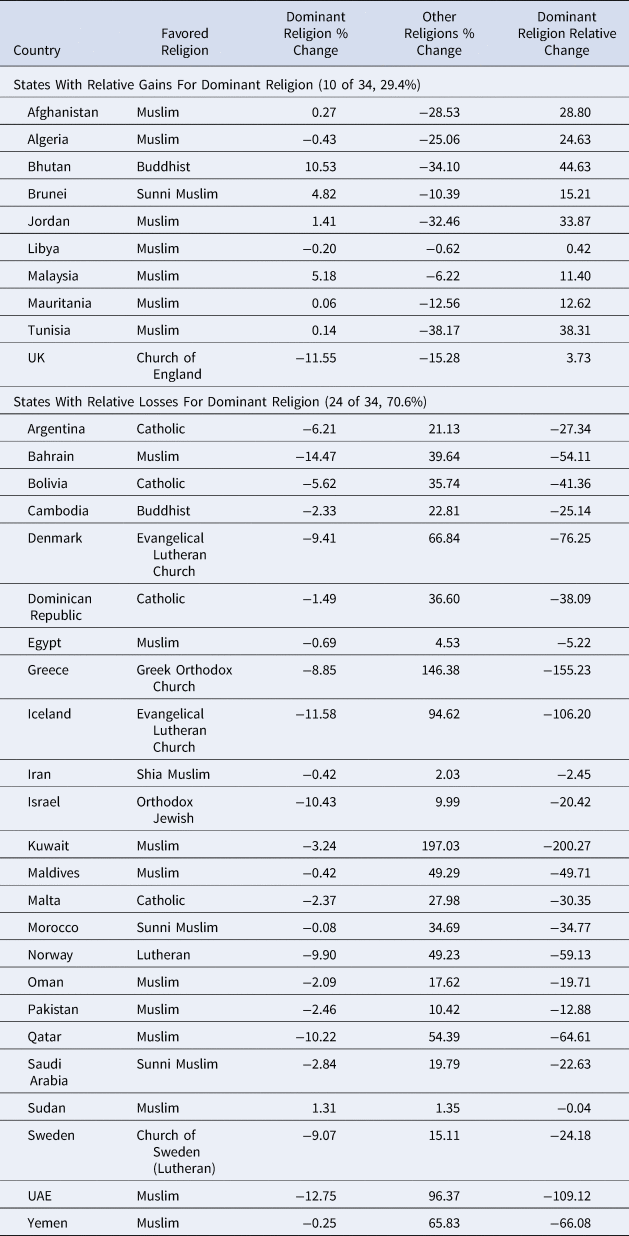
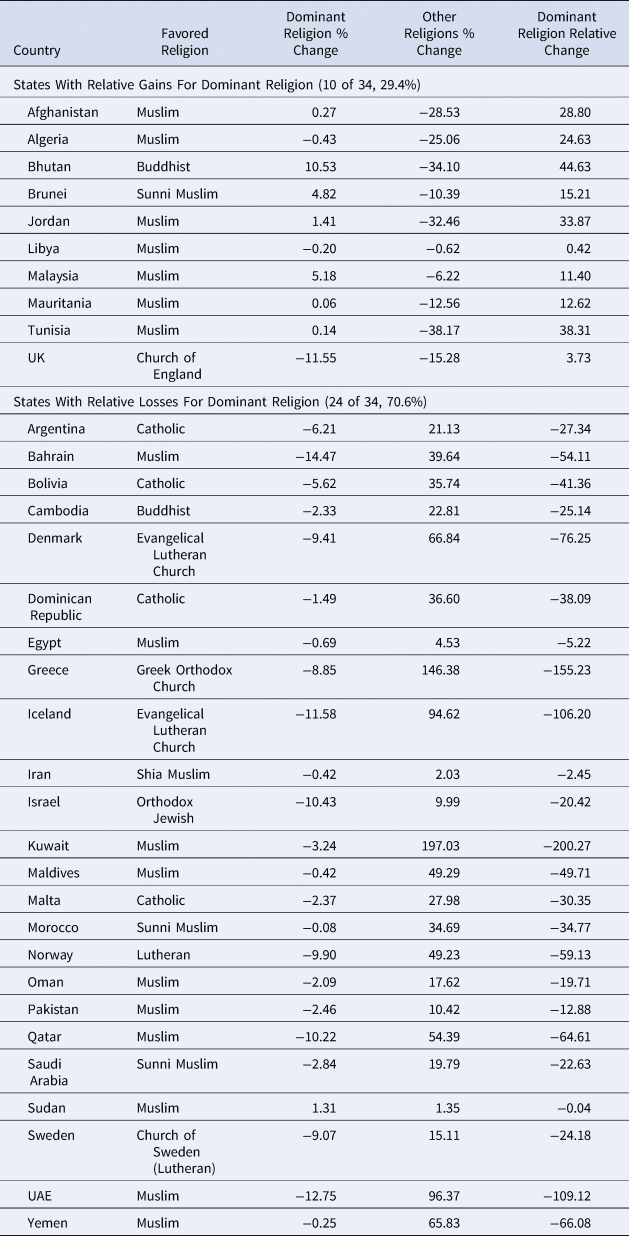
I begin the analysis by examining the relative performance of the dominant in religion in states where that religion is both established and granted preferential funding, displayed in Table 2. There are a total of 34 states in the dataset where a single religion or religious institution is both constitutionally established and has preferential access to state resources. In only 10 (29.4%) of those states did the favored religion perform better than other religions in the state (i.e. it gained more adherents or lost fewer adherents) in the period 1990–2010. The remaining 24 states (70.6%) saw the relative decline of the favored religion. This is in sharp contrast with the remaining 140 countries in the dataset, out of which 70 (50%) experienced the relative growth of the dominant religion and 70 (50%) experienced its relative decline.
Religious Affiliation Change in States With Official And Preferentially Funded Religions, 1990–2010
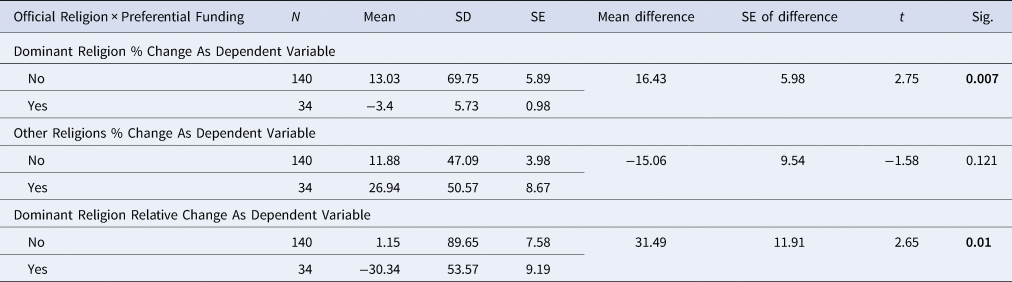
Next, I move on to some bivariate analysis to examine how this combination of religious establishment and preferential funding is associated with the three dependent variables in the analysis: dominant religion percentage change, other religions percentage change, and relative change in dominant religion. Are there differences in these variables between the two groups that we would be unlikely to observe by chance alone? To answer this question, I perform an independent samples t-test, with results reported in Table 3.
Independent samples t-tests for change in religious affiliation, 1990–2010
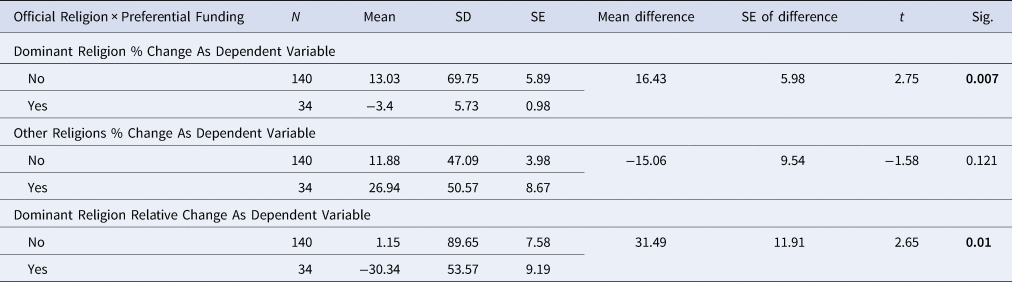
The analysis reveals some striking differences between states with and without policies favoring a single religion. In states with an established and preferentially funded religion, the dominant religion of the state declined as a share of population by 3.4% on average in the period 1990–2010. In contrast, in states without such religious favoritism, the share of the population belonging to the most popular religion grew by 13%. Combining these numbers, the difference of the two means is 16.4. The associated t-test reveals a t-statistic of 2.69, which is significant at the p < 0.01 level.
The corresponding analysis for other religions' percentage change is less conclusive. Once again, there is a notable difference in the means of the variable between the two categories of states, and it manifests itself in the predicted direction. In states with an official and preferentially funded religion, the share of population adhering to other (non-dominant) religions grew by 26.9% on average, while other states witnessed only 11.9% growth in the same category. Thus, there is a similar-sized difference between the two means as the one observed for dominant religion percentage change. However, the larger standard error of the difference in this case yields a smaller t-statistic (−1.58) with a corresponding p-value of 0.12.
However, when we examine the performance of the dominant religion relative to its rivals, strong differences between the two categories are once again evident. In states with an official and preferentially funded religion, minority religions performed substantially better than the established one. In the remaining states, the dominant religion slightly outperformed its rivals. Here the difference in means (31.5) is statistically significant with a p-value of 0.01. The overall picture presented by these bivariate analyses supports the proposed expectations: on average, enjoying an official status and special access to state resources negatively impacts the growth of a religion, both as a share of total population and relative to other religions in the state.
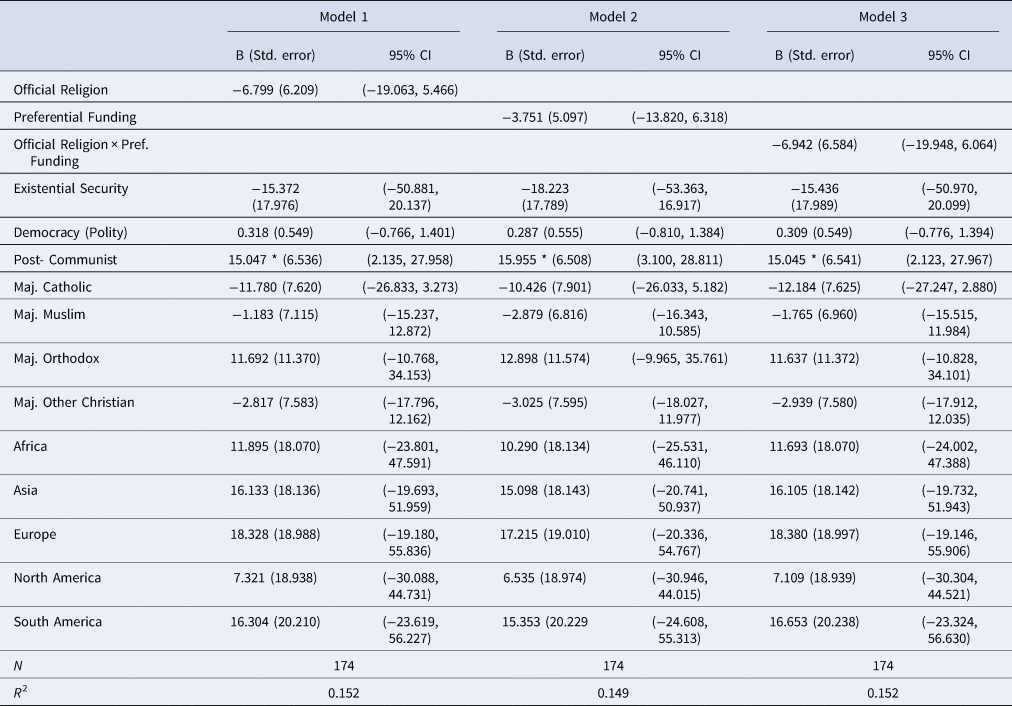
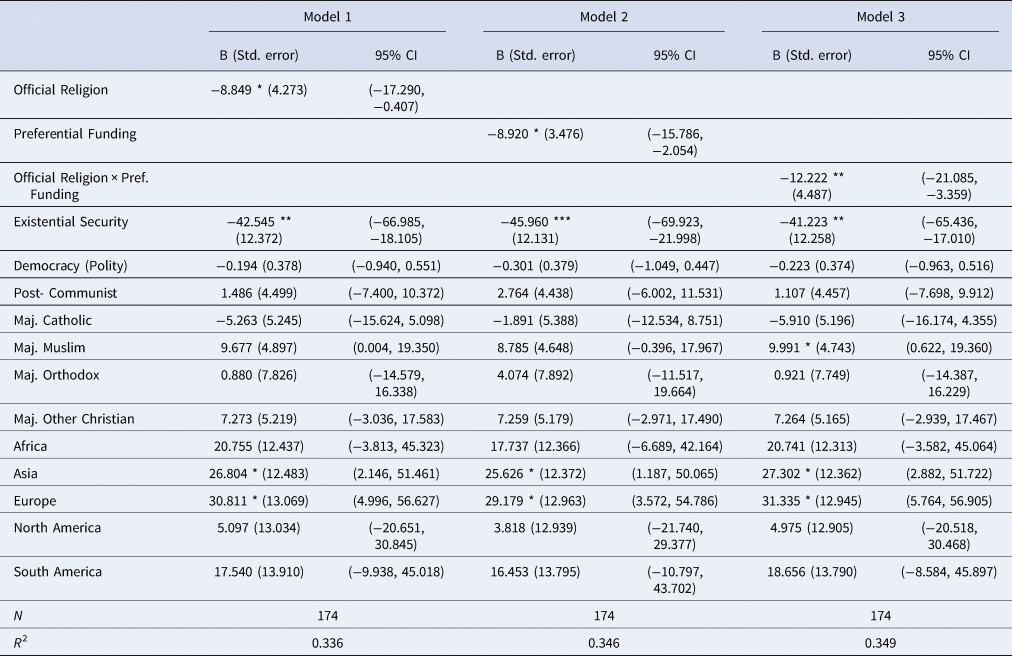
In order to isolate the effect of the independent variables and control for a host of potentially influential factors, I next move on to a multivariate analysis of my theoretical expectations. I utilize three ordinary least squares (OLS) regression models corresponding to the three operationalizations of my independent variable. Model 1 examines the influence of official religion, Model 2 of preferential funding and Model 3 looks at the interaction between these two variables. Each of these models also accounts for the host of control variables described above. The three models are utilized to explain variation in the three operationalizations of the dependent variable: dominant religion percentage change, other religion percentage change and dominant religion relative performance. To account for the possibility of temporal variation, I run the analysis on two different subsets of the data—one that measures change in religious affiliation in the period 1990–2000, and one in the period 2000–2010.
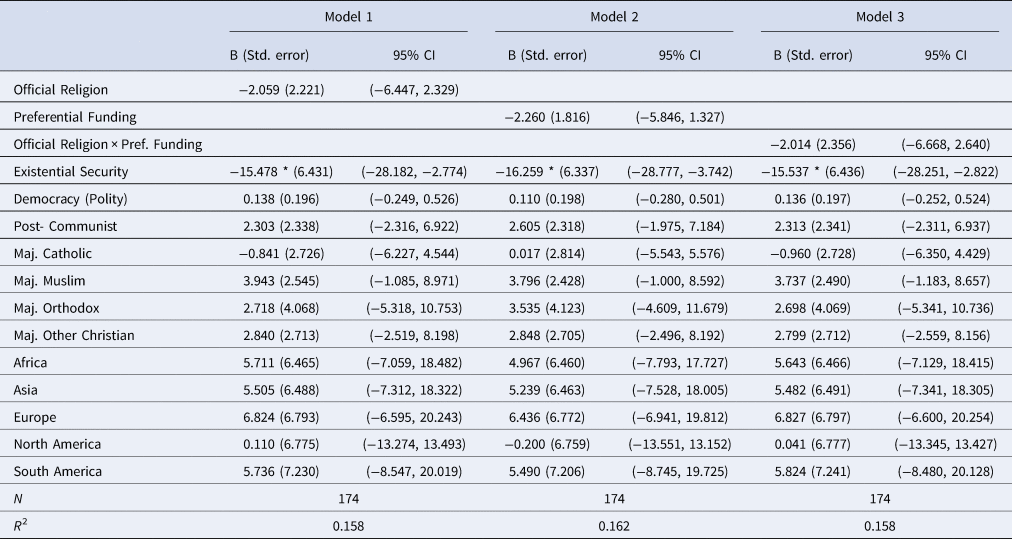
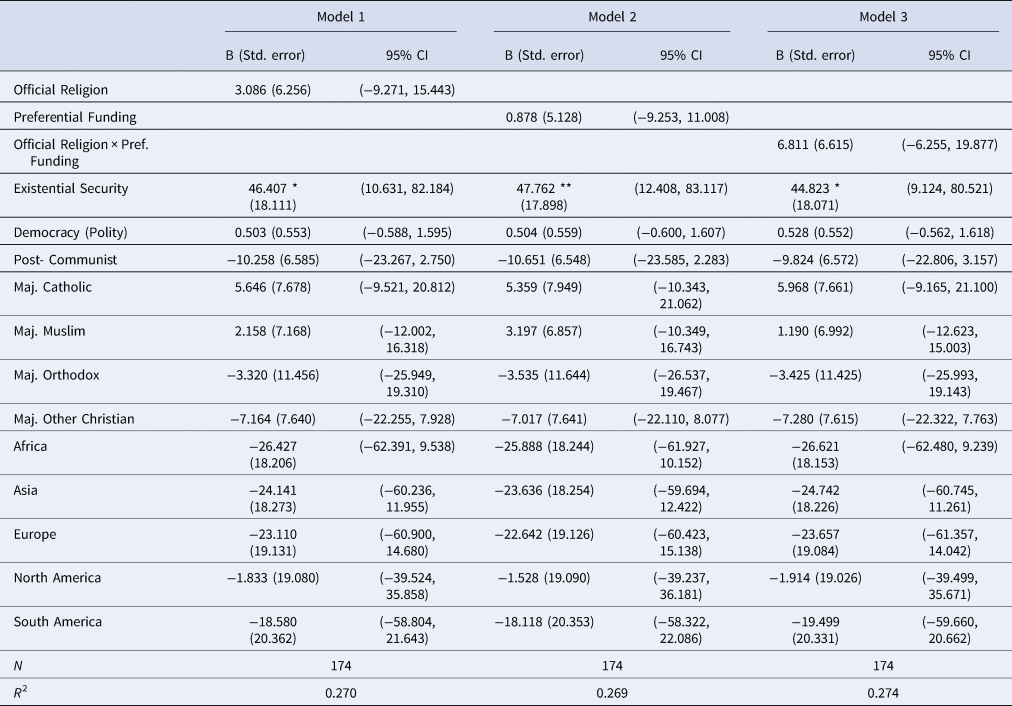
Tables 4 and 5 explore the influence of state favoritism on change in affiliation with the dominant religion of the state in the periods 1990–2000 and 2000–2010, respectively. The coefficients for each of the three variables that capture state support exhibit the predicted negative sign, indicating favoritism is associated with decline in the largest religion. However, these coefficients are not statistically significant in either of the two time periods examined. Among the control variables, two stand out. Post-Communist has a positive and statistically significant (p < 0.05) effect on the dependent variable in the 1990–2000 data, while existential security has a negative and statistically significant (p < 0.05) effect in the 2000–2010 data. These results suggest that the period immediately following the collapse of Communism was favorable to the growth of the largest religion, while existential security can negatively impact affiliation with that religion.
OLS regression of state favoritism on change in dominant religion affiliation, 1990–2000
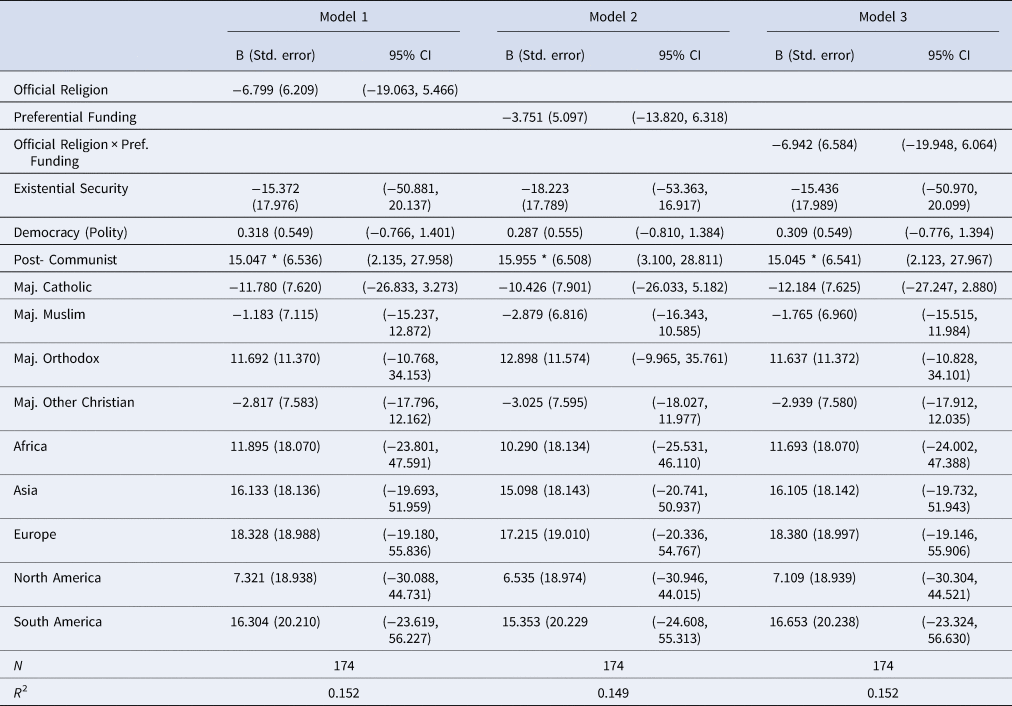
* = statistically significant at p ≤ 0.05 level.
OLS regression of state favoritism on change in dominant religion affiliation, 2000–2010
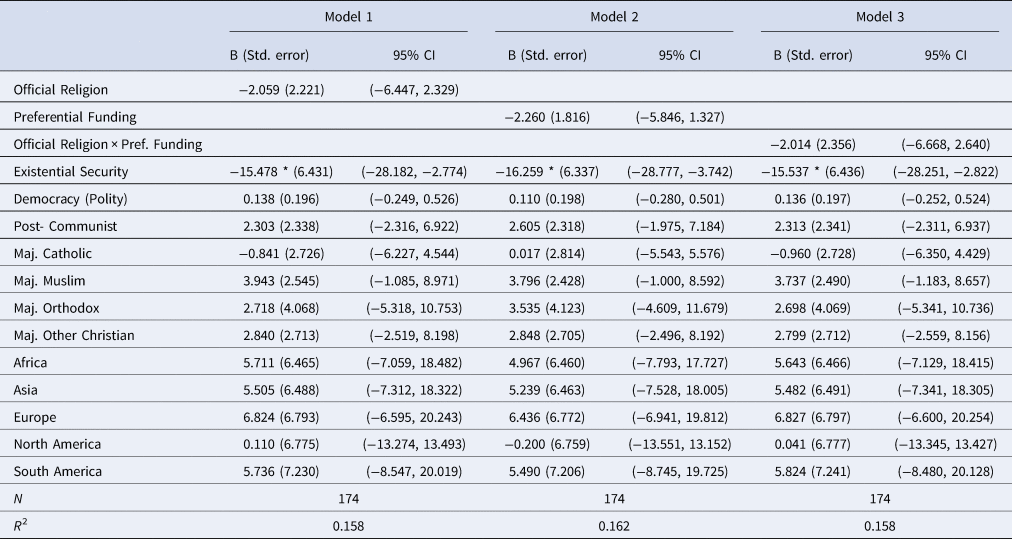
* = statistically significant at p ≤ 0.05 level.
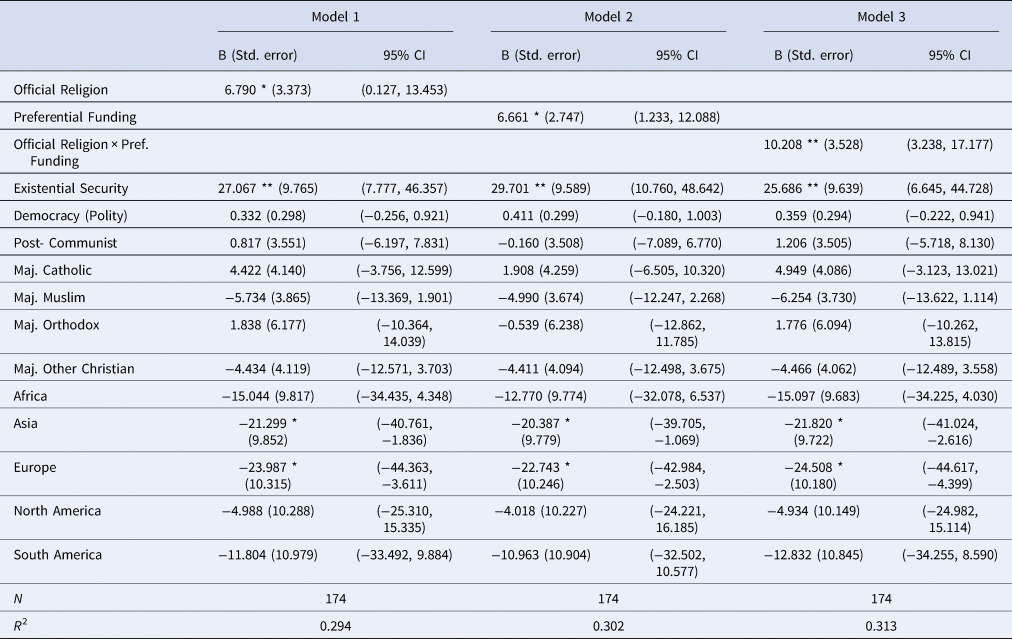
Tables 6 and 7 explore the influence of state favoritism on change in affiliation with all religions other than the largest one in the periods 1990–2000 and 2000–2010, respectively. Once again, the coefficients for each of the three variables that capture state support exhibit the predicted sign—state favoritism toward the largest religion is associated with stronger performance for other religions. While these coefficients are not statistically significant in the 1990–2000 data, each of the three operationalizations of state support reach significance in the 2000–2010 data. Official religion and preferential funding are both significant predictors at the p < 0.05 level, while the interactive term between them is significant at p < 0.01. These results suggest that the combination of official status and special access to funding for the favored religion may be especially powerful in boosting affiliation with non-favored religions. Existential security is also a consistently statistically significant predictor, this time with a positive sign. It appears that while greater security may hinder the growth of dominant religions, it is favorable to affiliation with minority religions in the state.
OLS regression of state favoritism on change in other religions affiliation, 1990–2000
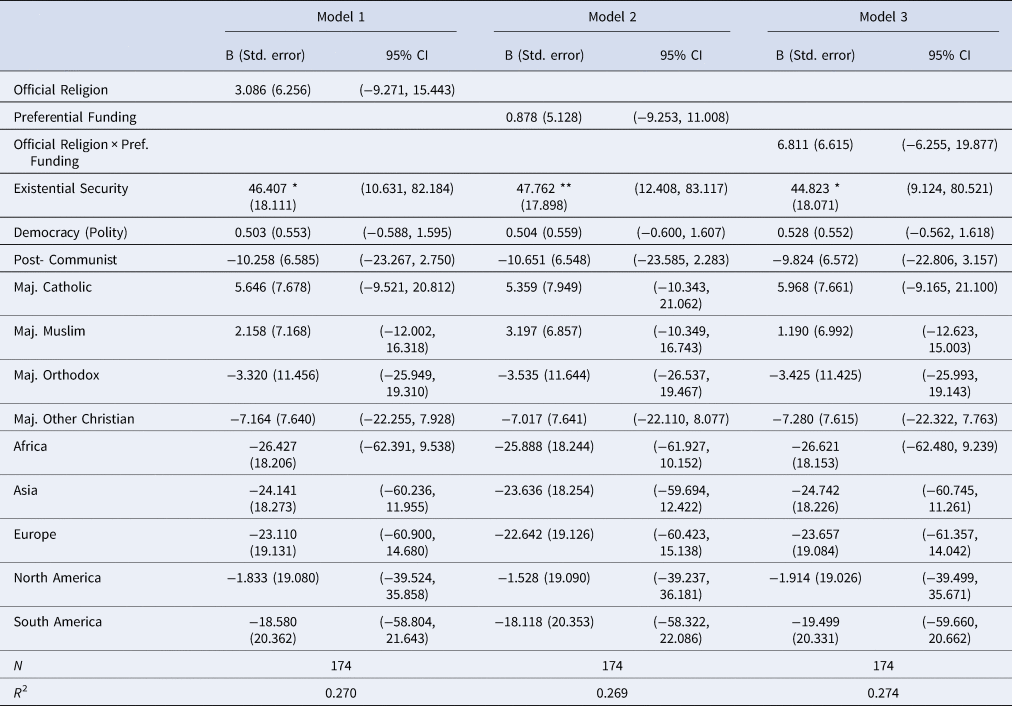
* = statistically significant at p ≤ 0.05 level.
** = statistically significant at p ≤ 0.01 level.
OLS regression of state favoritism on change in other religions affiliation, 2000–2010
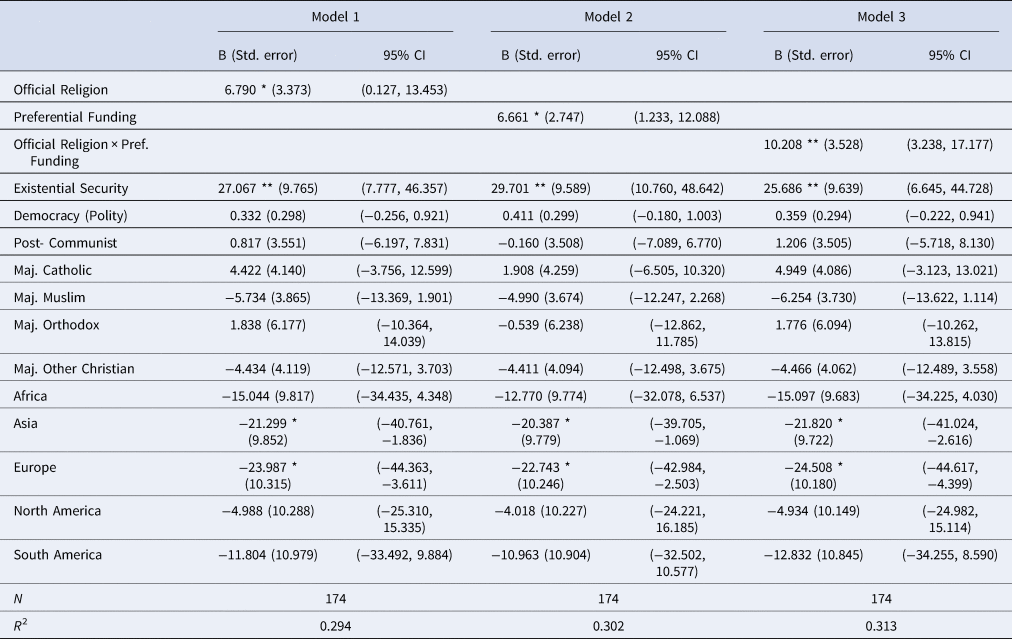
* = statistically significant at p ≤ 0.05 level.
** = statistically significant at p ≤ 0.01 level.
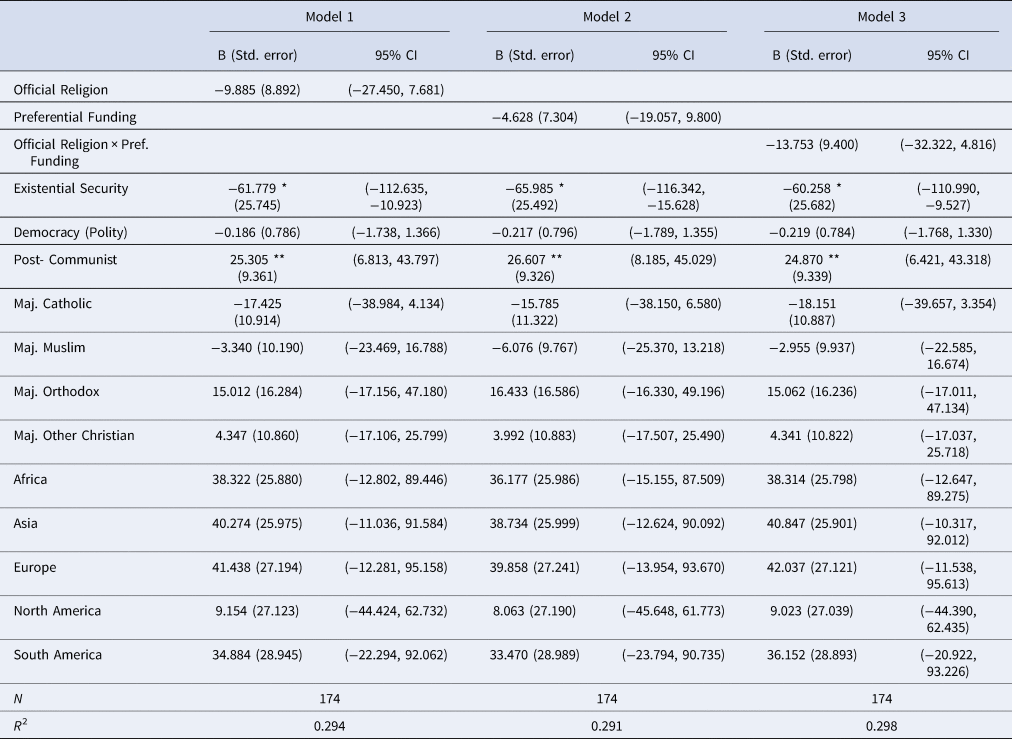
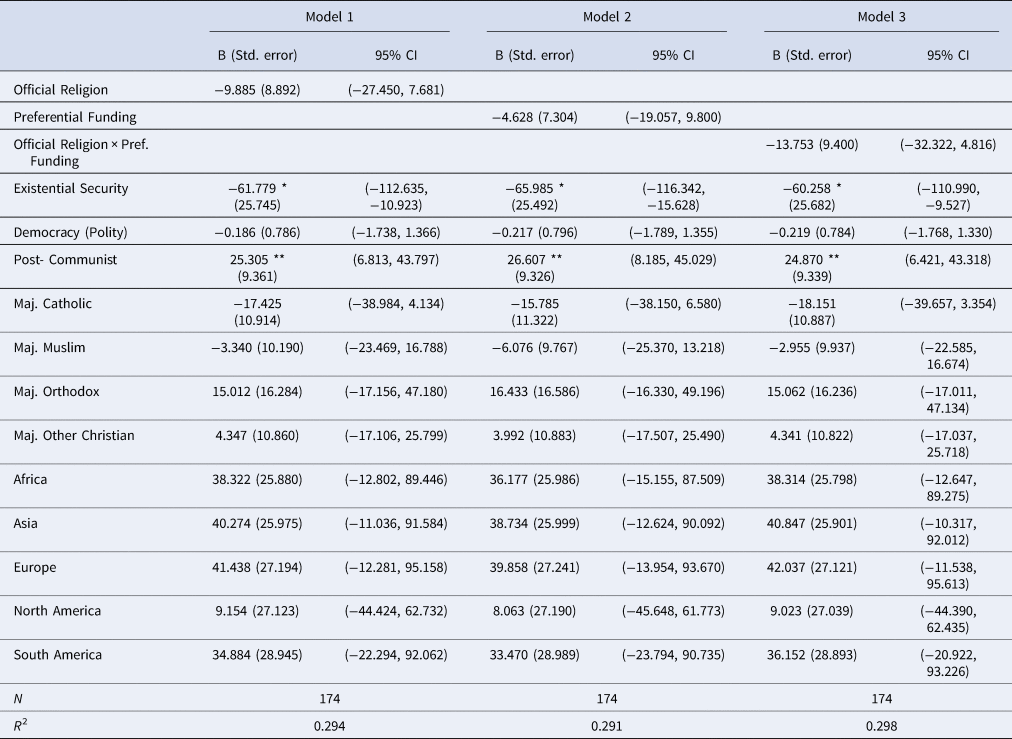
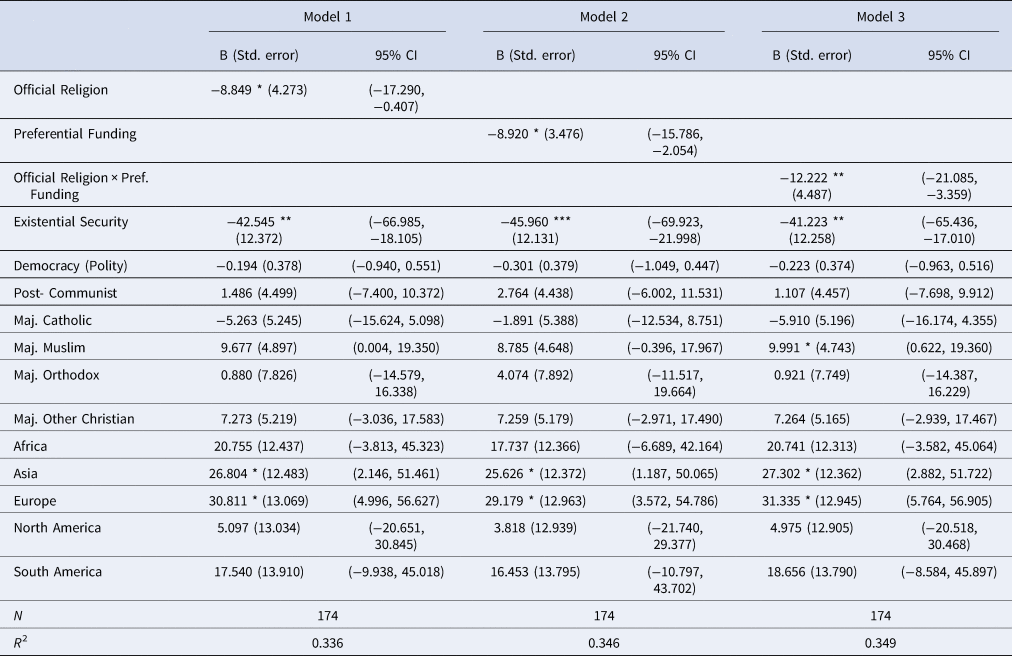
Tables 8 and 9 explore the influence of state favoritism on the relative performance of the largest religion in the state in the periods 1990–2000 and 2000–2010, respectively. The coefficients for the three operationalizations of state support are consistently negative, indicating that such support tends to lead to worse performance for the state's largest religion vis-à-vis others. While these coefficients are not statistically significant for the 1990–2000 data, official religion and preferential funding are both significant at p < 0.05 in the 2000–2010 data, while the interactive term between them is significant at p < 0.01. Once again, the strongest effect seems to be produced by the presence of both forms of state favoritism working in conjunction. Existential security is consistently negatively associated with the dependent variable, and this relationship is statistically significant in both examined time frames. This strong relationship indicates that greater material and physical security may cause dominant religions to lose ground relative to their competitors. Lastly, Post-Communist has a positive effect on the dependent variable, but it is statistically significant (p < 0.01) only in the 1990–2000 dataset.
OLS regression of state favoritism on relative change in dominant religion, 1990–2000
* = statistically significant at p ≤ 0.05 level.
** = statistically significant at p ≤ 0.01 level.
OLS regression of state favoritism on relative change in dominant religion, 2000–2010
* = statistically significant at p ≤ 0.05 level.
** = statistically significant at p ≤ 0.01 level.
Based on the findings of these multivariate analyses, it appears that there is insufficient evidence to support Hypothesis 1, which proposed that the most popular religion in a state will experience less growth (or greater decline) if that religion is favored by the state to the exclusion of other religions. However, while the lack of statistical significance for official religion appears at first glance to be a null finding, it does bear some importance. The concept of official state recognition and sponsorship of a religious institution is predicated on the idea that such government actions will be beneficial to that institution. The fact that official recognition seems to exert a negative (though not statistically significant) influence on that religious firm's ability to attract adherents undermines the basis for offering such support.
Moreover, the analysis presented in Tables 7 and 9 presents evidence that while state support may not directly decrease affiliation with the favored religion, it can cause that religion to lose ground relative to its competitors in the religious marketplace. The findings suggest that in the period 2000–2010, minority religions tended to thrive in countries in which the largest religion was the official state religion and received preferential access to funds. The strongest effect appears to be produced by these two factors (official status and special access to state resources) working in conjunction. Thus, there is some evidence in support of Hypotheses 2 and 3.
Greater existential security appears to be broadly favorable to the growth of minority religions but unfavorable to the growth of the largest religion in the state. Perhaps under conditions of low material and physical security, people tend to be less willing to deviate from the societal norm and tend to continue to affiliate themselves with the predominant religion of their state. However, conditions of greater security seem to encourage the growth of association with minority religions. A post-Communist background exerts the opposite effect, favoring the dominant religion over its competitors. However, this effect seems to be limited to the first decade following the transition away from Communism.
Conclusion
Existing research on the consequences of state involvement in religion has not been able to provide a clear answer to the question of how state favoritism toward one religion to the exclusion of others affects both (1) the favored religion and (2) all other religions in the state. Building on religious market theory, I have argued that state favoritism should both disincentivize favored religious organizations from actively recruiting adherents and also decrease the effectiveness and efficiency with which such organizations meet their members' needs. The cumulative effect of such complacency and ineffectiveness should, over time, result in declining membership and religious participation. This decline will leave a vacuum in the supply side of the market for religious services, and, if demand for religion remains constant, create opportunities for other religious firms to attract followers. Thus, I proposed that preferential treatment will hurt the very institutions it is meant to support, creating the conditions for them to be displaced by rival religious organizations.
The empirical tests of my theory partly support its expectations. The negative impact of establishment of religion and preferential funding on affiliation with the largest religion was substantial in bivariate analysis but did not prove statistically significant in multivariate analyses. However, the presence of an officially recognized and preferentially funded religion seems to be beneficial for the growth of other religions over time and consequently results in the dominant religion losing ground relative to its competitors. These findings are statistically significant in multiple regression analyses in the 2000–2010 period when controlling for existential security, regime type, net migration, former Communist background, religious tradition and region. The two distinct factors (establishment of religion and preferential funding) appear to each exert an independent influence on religious affiliation, but they are most impactful when working in conjunction. Overall, these findings suggest that, when it comes to religious affiliation, official state recognition and state funding may harm institutions it is meant to support and protect.
While the primary focus of this paper was on testing my reformulation of religious markets theory, the analysis also yielded other intriguing findings. Contrary to the expectations of commonly articulated demand-side theories of religiosity, greater existential security was not associated with decreases in affiliation with all religions over time. In fact, greater security was positively associated with change in minority religious affiliation, both in absolute terms and relative to the majority religion of the state. These findings were strongly statistically significant and suggest that improved life conditions may encourage the citizens of a state to become more fluid in their religious identities and affiliations, while insecurity may cause populations to “hunker down” and stick with familiar and socially pervasive religious institutions. Among other control variables, a post-Communist background was an influential predictor of strong performance for the largest religion, both in absolute terms and relative to other religions in the state, but only for the 1990–2000 period. It appears that the transition away from Communism was favorable to the religious institution most closely associated with the respective nation, but this effect did not last beyond the first decade following political reform.
Ultimately, this paper has demonstrated that supply-side factors like state support for religion and demand-side factors like existential security may produce dramatically different effects when we examine majority and minority religions separately. This is a distinction that has generally been overlooked in the greater scholarly debate between the secularization thesis and religious markets theory, and the failure to take it into account could be contributing to the contradictory findings in the literature. Going beyond religiosity as the dependent variable, the existing literature on the consequences of state favoritism toward a single religion has tended to focus on potential negative consequences for minority religions, religious liberty, and democracy. My theory and findings suggest that such favoritism could actually benefit minority religious institutions by undermining the competitiveness of the majority religion. Going forward, a rigorous comparative examination of the effects of state favoritism on the two types of religious organizations (majority and minority) could illuminate the complex ways in which it influences the religious affiliation, practice, and belief of the citizens of the state. Similarly, future demand-side analyses that prioritize the importance of existential security would do well to parse out its effect on majority and minority religions.
Financial support
The research presented in this paper has not received any outside funding. Replication data available from author upon request.
Dan Koev is an Associate Professor and Chair of the Government and Criminal Justice Department at Regent University. He holds a Ph.D. in Political Science from the University of Illinois. He has previously published research on ethnic politics and right-wing populism, and his current research examines the impact of existential security and church-state policies on religious belief and practice.