Highlights
-
• Indo-SURFT adapts the Seeking Safety Module for the Indonesian women context.
-
• The adapted module is acceptable and tolerable for incarcerated women with MUD.
-
• Participants rated Indo-SURFT highly for usefulness and applicability.
-
• The adapted module enhanced functioning even after 3 months follow-up.
Introduction
Substance use disorder (SUD) continues to increase globally, with the recent World Drug Report by UNODC (2024) estimating up to 64 million affected individuals. A US survey indicated that overdoses due to stimulants (other than cocaine) nearly tripled between 2015 to 2019, with the number of MUD diagnoses rising by 62% (Han et al. Reference Han, Compton, Jones, Einstein and Volkow2021). Similarly, according to the Indonesian Drugs Report (BNN 2022), amphetamines and methamphetamines are ranked as the second most commonly used drug, which accounts for 25.7% among substances used. Moreover, an additional survey done by the Indonesian National Narcotics Board (BNN) reported that among people who use drugs undergoing rehabilitation, approximately 57.96% were in treatment due to methamphetamine use (BNN 2018). Globally, daily methamphetamine use among women escalated from 0% in 2007 to 11% by 2017 (Bach et al. Reference Bach, Hayashi, Milloy, Nosova, Kerr, Wood and Fairbairn2020). In Indonesia the pattern is mirrored, where SUD rates jumped from 1.8% in 2019 to 1.95% in 2021 and even more alarmingly for women (0.5% to 1.46%), with marijuana and methamphetamine being the most abused drugs (Kanato et al. Reference Kanato, Sarasiri and Leyatikul2022). Rohmanika et al. Reference Rohmanika, Arozal, Louisa, Gayatri, Kekalih, J.E.M., Lestari and Utami(2022) demonstrated that women have 1.95 times higher odds for methamphetamine-use disorder (MUD) along with comorbidities.
Women are at risk to progress quicker from first use to addiction—a pattern known as telescoping—and they often report stronger cravings and more intense withdrawal symptoms than men (Harris et al. Reference Harris, Laks, Stahl, Bagley, Saia and Wechsberg2022). Studies showed that hormonal fluctuations especially estrogens might be the one to blame, as this will heighten the reinforcing effects of the drugs used, which in the end increase their vulnerability to relapse again (Ahmed et al. Reference Ahmed, Zyla, Hammond, Blum and Thanos2024). This may explain why women sometimes relapse even after brief abstinence. Given that cravings are the primary trigger for methamphetamine relapse, addressing this issue is crucial in tailoring treatment approaches for women (Jiang et al. Reference Jiang, Yang, Huang, Zhao, Li, Chen, Jin and Zhou2024). Incarcerated women with MUD, in particular, face remarkable barriers due to their unique vulnerabilities—whether it be past trauma or abuse, higher rate of co-occurring mental health issues, caregiving duties, and internal and external stigma (Bairan et al. Reference Bairan, Boeri and Morian2014). Despite this, there has been a lack of access to healthcare in institutionalized facilities, including in Indonesia. The majority of correctional facilities in Indonesia provide neither psychiatric nor harm-reduction services, such as opioid-substitution therapies (Lembaga Bantuan Hukum Masyarakat & Harm Reduction International 2024; Subandi et al. Reference Subandi, Praptomojati, Madhina, Hardi, Ahmad and Wuryansari2022).
Cognitive Behavioral Therapy (CBT) has been widely used as an intervention to help individuals with MUD. A systematic review found that CBT helped reduce methamphetamine use along with psychiatric symptoms (Stuart et al. Reference Stuart, Baker, Denham, Lee, Hall, Oldmeadow, Dunlop, Bowman and McCarter2020). While a previous meta-analysis (Magill and Ray Reference Magill and Ray2009) highlights the effect of brief format CBT among women with SUD, one widely utilized module is the Seeking Safety (SS) program developed by Najavits et al. (Reference Najavits, Weiss, Shaw and Muenz1998). The program was initially designed for women with SUD and psychiatric comorbidities. It has been empirically showcased to be effective even among women with MUD (Joekar et al. Reference Joekar, Fathali Lavasani, Mahaki, Noroozi, Birashk and Najavits2018).
Thus, our study developed the Indonesian Substance Use Reduction for Female Therapy (Indo-SURFT) module which adapted the SS therapy with local sociocultural considerations. This program aims to address the unique needs of incarcerated women with MUD, laying the foundation for sustained recovery and reintegration to life after prison. Indo-SURFT holds the potential to be implemented throughout the nation, providing a standardized, empirically validated framework for the rehabilitation of women with SUD in prisons across Indonesia. This study aims to assess the feasibility and tolerability of the Indo-SURFT and to evaluate the module’s preliminary efficacy for functional recovery, craving reduction, and enhancement of emotional regulation.
Methods
Study design
This pilot and feasibility study utilizes a pre–post intervention design to evaluate the effects of the Indo-SURFT module on a sample of incarcerated women with MUD in Indonesia. Following a thorough intake screening process, all participants underwent a comprehensive baseline assessment (T1), participated in the Indo-SURFT intervention for a duration of 6 weeks, and completed a follow-up assessment immediately post-treatment (T2), in addition to a 3-month follow-up (T3). This study aims to portray significant changes in craving and emotional vulnerabilities before and after the intervention, as can be seen in the study flowchart in Fig. 1.
Study flowchart. A total of 41 women prisoners who were charged for narcotics naïve to medical rehabilitation were screened with ASSIST. This resulted in 33 participants who were then divided into 4 groups, each consisting of 8–9 participants, for twice-weekly treatment sessions for a total of 6 weeks. Group assignments for each participant were made randomly. Assessments were conducted three times: T1 (week 0) for baseline data before intervention, T2 (week 6) immediately after intervention was given and T3 (week 18) 3 months follow-up post intervention.

Sample size
The sample size of 33 participants was selected as a rule of thumb for pilot studies (Totton et al. Reference Totton, Lin, Julious, Chowdhury and Brand2023). Participants were recruited for this study using a consecutive sampling approach from a correctional institution for women in Indonesia.
Participants and settings
Participants were incarcerated women who were charged for drugs-related charges, naïve to medical rehabilitation, and were being held in a correctional facility in Jakarta, Indonesia. Screening was conducted using the WHO Alcohol, Smoking, and Substance Involvement Screening Test (ASSIST). This screening typically takes 5–10 mins to complete, allowing for a quick yet comprehensive evaluation of substance involvement (Humeniuk et al. Reference Humeniuk, Henry-Edwards, Ali, Poznyak and Monteiro2010).
Inclusion criteria specified that eligible participants must be: (1) between 18 and 59 years of age, (2) diagnosed with MUD according to the DSM-5-TR or ICD-11 criteria, (3) demonstrate proficiency in the Indonesian language, and (4) provide signed informed consent indicating their willingness to partake in the study. Participants with (1) severe mental disorders (i.e., psychoses) or intellectual disabilities, as well as (2) those displaying extreme agitation that may impede effective engagement in cognitive–behavioral therapy, were excluded to maintain study safety and validity. Two medical doctors from Dr Cipto Mangunkusumo National Referral Hospital, Jakarta, Indonesia, assessed participants eligibility to ensure rigorous adherence to these criteria.
Baseline and follow-up assessments included sociodemographic sections, user response ratings, and a range of validated instruments to measure outcomes, including the Addiction Severity Index (ASI) (McLellan et al. Reference McLellan, Cacciola, Alterman, Rikoon and Carise2006), University of Rhode Island Change Assessment Scale (URICA) (Hasler et al. Reference Hasler, Klaghofer and Buddeberg2003), Self-Reporting Questionnaire 20 items (SRQ-20) (Prasetio et al. Reference Prasetio, Triwahyuni and Prathama2022), World Health Organization Quality-of-Life Brief (WHOQOL-BREF) (Anisah and Djuwita Reference Anisah and Djuwita2019), and a Visual Analog Scale (VAS) to measure the severity of cravings.
Instruments
Sociodemographic and User Response Rating
The sociodemographic section included items on age, most recent education, last occupation, marital status, monthly income prior to incarceration, history of recidivism, family history for incarceration, personal history of mental illness prior to incarceration, and history of physical or sexual abuse.
The user response rating assesses participants’ perceptions on usefulness and applicability of the module to daily life, using a four-point Likert scale: 0 = completely disagree, 1 = somewhat disagree, 2 = moderately agree, 3 = completely agree. Using the same scale, participants were also asked to rate whether the therapists and module handouts are satisfactory. Additionally, after each session, participants were asked to report any side effects, including emotional discomfort. After the final session, participants were invited to provide qualitative feedbacks regarding their overall experience.
Addiction Severity Index (ASI)
ASI is used to evaluate the severity of an individual’s addiction. There are multiple domains assessed including: medical, employment, alcohol use, drug use, legal, family/social, and psychiatric. This instrument is assessed through a semi-structured interview with two key components: problem severity, which is self-rated by the patient on a 5-point Likert scale ranging from 0 (not at all) to 4 (very severe), and treatment need, which is evaluated by the psychiatrist using a 0–9 scale to assess the need for treatment in each domain related to substance use (McLellan et al. Reference McLellan, Cacciola, Alterman, Rikoon and Carise2006).
University of Rhode Island Change Assessment Scale (URICA)
URICA is a questionnaire designed to assess an individual’s readiness for behavioral change. The questionnaire consists of 32 items, with each item scored on a 5-point Likert scale, from 1 (strongly disagree) to 5 (strongly agree). The mean scores for the four subscales (stages of change)—pre-contemplation, contemplation, action, and maintenance—are calculated using a specific formula based on a specific set of items, to determine the individual’s readiness to change (Hasler et al. Reference Hasler, Klaghofer and Buddeberg2003).
Self-Reporting Questionnaire 20 items (SRQ-20)
SRQ-20 is a 20-item screening tool developed by the World Health Organization to identify common health symptoms, specifically symptoms of depression and anxiety in primary care and community settings. Each of those items consists of a yes or no question, focusing on symptoms that the individual experience over the past 30 days. For every “yes” response, 1 point is given, while a “no” response scores 0. The final score ranges from 0 to 20, with higher scores indicating greater psychological distress in the patient (Prasetio et al. Reference Prasetio, Triwahyuni and Prathama2022).
World Health Organization Quality-of-Life Brief (WHOQOL-BREF)
WHOQOL-BREF is a 26-item questionnaire designed to assess quality of life across four domains: Physical Health, Psychological Health, Social Relationships, and Environmental Health. Responses are rated on a 5-point Likert scale, where higher scores indicate better quality of life. Domain scores are calculated by averaging the item scores for each domain and transforming them onto a 0–100 scale for comparability. This tool provides a comprehensive evaluation of an individual’s well-being (Anisah and Djuwita Reference Anisah and Djuwita2019).
Visual Analog Scale (VAS) for craving
The single-item VAS is used to assess the intensity of a participant’s craving. Participants are asked to mark their level of craving on a horizontal line, where the left endpoint (0) represents “no craving at all,” and the right endpoint (10) represents “the strongest craving imaginable.” The participant can place their mark on any part of the line and the score will be recorded as a 0 to 10 score (Flaudias et al. Reference Flaudias, Teisseidre, De Chazeron, Chalmeton, Bertin, Izaute, Chakroun-Baggioni, Pereira, Brousse and Maurage2019).
Development of the indo-SURFT module
The Indo-SURFT module was developed by the Department of Psychiatry at the Faculty of Medicine, Universitas Indonesia and the School of Psychology at the University of Queensland, Australia. It is a culturally adapted 12-session group therapy program and designed to address sex-specific triggers and relapse risk factors within a cognitive–behavioral framework. The content for this module is adapted from Lisa Najavits’ Seeking Safety (SS) Treatment Manual, a CBT-based program initially created to support clinicians working with individuals affected by trauma and substance use disorders (Najavits Reference Najavits2002; Najavits et al. Reference Najavits, Weiss, Shaw and Muenz1998). After a focus group discussion involving three addiction psychiatrists and one psychologist, 15 of the 25 topics in SS were selected and tailored to reflect cultural relevance and address specific challenges (e.g., Indonesian societal expectations, religious roles of women within the family, and motherhood responsibilities) faced by Indonesian women with MUD.
Key topics covered in the module include: (1) introduction to treatment, (2) safety, (3) when substances control you, (4) asking for help, (5) taking good care of yourself; self-nurturing, (6) compassion, (7) red and green flags; coping with triggers, (8) recovery thinking, (9) commitment, (10) healthy relationship; setting boundaries in relationship, (11) healing from anger, and finally (12) termination to provide closure.
The Indo-SURFT program begins with an introductory session, followed by twice-weekly 90-minute therapy sessions across 6 weeks. Each session is structured to include three phases—an opening, a middle, and a closing phase. During each session, participants engage in guided discussions, reflecting on their understanding of the material, sharing any uncertainties, and completing tasks—such as identifying triggers and coping skills.
Delivering the intervention
The intervention was delivered by two trained addiction psychiatrists from the Department of Psychiatry, Faculty of Medicine, Universitas Indonesia, Indonesia. The psychiatrists were responsible for delivering CBT sessions according to the Indo-SURFT module and following up on participants’ engagement. The intervention comprised of four groups, each consisting of 8 to 9 participants, totaling 33 participants. Sessions were divided into two timeslots per day, with two groups scheduled in the morning and another two in the afternoon. The intervention was conducted from August to September 2024 at a correctional facility in Jakarta, Indonesia and follow-up performed was in December 2024. Participants were not given any form of incentives.
Statistical analysis
To assess intervention tolerability and efficacy, statistical analysis was done using the Statistical Package for the Social Sciences (SPSS) version 30.0 for Mac. Descriptive statistics summarized the demographic and clinical data. Generalized estimating equations (GEE) was utilized to analyze the changes through pre-intervention, post-intervention, and 3-month follow up. This study chose GEE as it allows for correction of within participants effects and repeat measurements over time. The robust model and exchange association were chosen, and the analyses were adjusted for age, education, prior occupation, marital status, previous income, duration of sentence served, history of family incarceration, recidivism, history of mental illness, history of therapy, and history of abuse. GEE has been described to be robust to speculative association model determination (Zeger and Liang Reference Zeger and Liang1986), thus appropriate for the current study’s exploratory nature. GEE has also been shown to be robust to missing data and non-inferior compared to other alternative methods (Hengelbrock et al. Reference Hengelbrock, Konietschke, Herm, Audebert and Aigner2025; Overall and Tonidandel Reference Overall and Tonidandel2004). At the end of therapy, all participants (n = 33, 100%) had completed the sessions. During follow up, 4 participants did not appear for data gathering, however all participants were included in the analysis (intention to treat). Two participants had been transferred to another facility, while the other two did not provide specific reasons to the wardens. Consequently, 4 of 99 observations (3 observations per subject) were missing, representing 4.04% of the total data (less than 5%). Following a guideline by Jakobsen et al. (Reference Jakobsen, Gluud, Wetterslev and Winkel2017), this was preserved without any imputations as to not introduce unnecessary bias.
Data monitoring
Data monitoring procedures were in place to track any adverse events, such as psychological symptoms, physical complaints, hospitalization, or death, which may occur during the study. These incidents were reported by facility wardens and participants were asked to self-report any subjective adverse effects, such as withdrawal symptoms or increased cravings, to provide a comprehensive view of the intervention’s impact on the well-being of the participant.
Results
Sociodemographic data
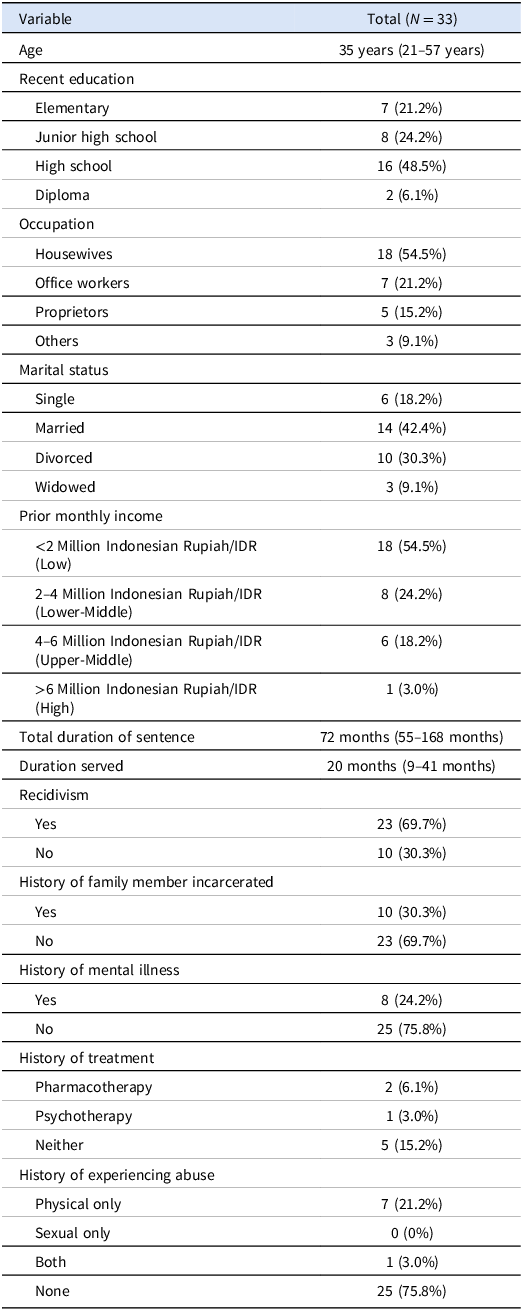
A total of 41 incarcerated women were approached and agreed to be screened with ASSIST. In the end, 33 participants consented to the study and participated in the Indo-SURFT module. The participants had a median age of 35 years (21–57). Overall, the median of total sentence duration for the participants was 72 months (55–168). They had served about a third of their sentence, at a median of 20 months (9–41). Nearly half of the participants (n = 16, 48.5%) had attained high school education, while some finished elementary school education (n = 7, 21.2%). Around 54.5% (n = 18) of the participants reported being housewives prior to being incarcerated. There were 14 married participants (42.4%), with 10 being divorced, three were widows, and six were single. A third (n = 10) were recidivist and eight (24.2%) had at least one psychiatric diagnosis prior to current incarceration. None of the incarcerated women were provided with psychiatric services (pharmacotherapy or psychotherapy) during their time in prison. Detailed sociodemographic data are presented in Table 1.
Sociodemographic profile of the participants

*Data are presented as Median (Min–Max) or N (%).
Treatment feasibility and tolerability
Overall, 80.5% of the women approached agreed to partake in the study, showcasing a high degree of acceptance. Of the 33 participants that acceded, all completed the full twelve sessions, which amounted to 100% compliance. Two participants, each on one separate sessions (n = 2/396, 0.5%), reported negative emotional reactivity after the session. In the first session, based on the user response ratings, participants rated the module 2.23 ± 0.497 for usefulness and 2.48 ± 0.627 for applicability in their lives. The usefulness domain increased significantly (Mdiff = 0.484, 95%CI [0.235, 0.732], p < 0.001, d = 0.482) to 2.71 ± 0.461 on session 12. The applicability rating also escalated to 2.68 ± 0.475 but did not reach statistical significance (p = 0.103). Furthermore, using the user response ratings, participants rated the psychiatrists 2.09 ± 0.522 and material handout 2.06 ± 0.496 on the first session. Both elevated significantly to 2.73 ± 0.453 (Mdiff = 0.636, 95%CI [0.219,0.690], p < 0.001, d = 0.488) and 2.60 ± 0.496 (Mdiff = 0.546, 95%CI [0.293, 0.798], p < 0.001, d = 0.496), respectively, after the last session.
Additionally, we explored individual reports after the last session. Participants commented “feeling happy they have been provided a space to share”, “learning from others’ experience and being more open to possibilities”, “the topics reminded me of my old self and help me practice new skills”, and “learning to open up and sharing concerns”. Others shared more hopeful messages such as “I hope this will help me reduce my substance use” or “I want to learn about my behavior and perhaps in the future I can stop using”. Some participants gave constructive inputs for example “I wish there are more sessions”, “I feel like I have to rush other activities to join the therapy”, “the [physical] space is not wide enough”, and “I hope there are more private spaces”.
Clinical outcomes
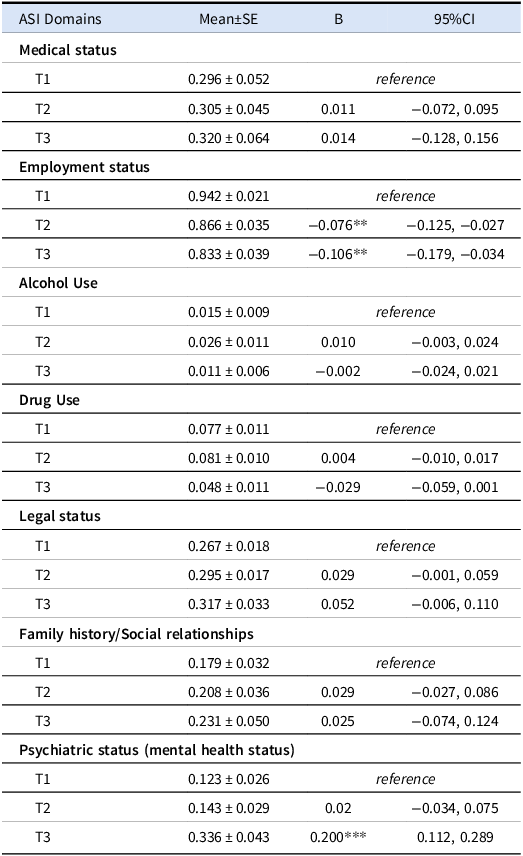
The composite score for employment’s ASI domain demonstrated significant decrease from pre-intervention to post-intervention (B = −0.076, 95%CI [−0.125, −0.027], p = 0.002) and the effect was preserved during the 3-months follow up (B = −0.106, 95%CI [−0.179, −0.034], p = 0.004). Compared to baseline, the psychiatric domain significantly increased during follow up (B = 0.200, 95%CI [0.112, 0.289], p≤ 0.001). None of the other domains displayed significant differences after participating in the module (See Table 2).
Longitudinal associations for addiction severity indices

ASI, Addiction Severity Index; SE, Standard of Error; CI, Confidence Interval; *p < 0.05; **p≤ 0.01; ***p≤ 0.001.
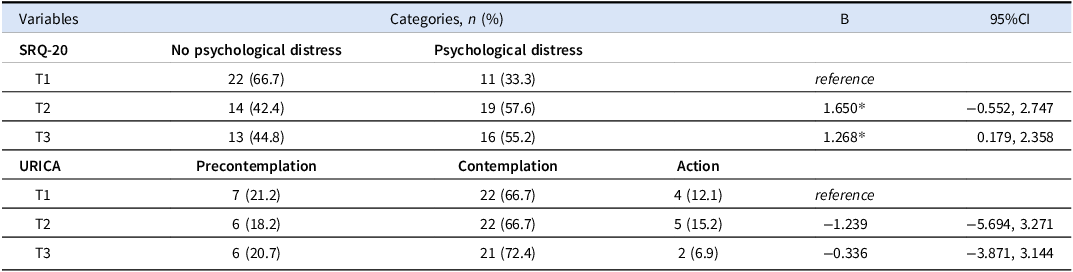
Referring to Table 3, there were 11 (33.3%) participants identified with psychological distress (SRQ-20) at baseline. This increased to 19 participants following the intervention (B = 1.650, 95%CI [0.552, 2.747], p = 0.003) and subsequently declined to 16 participants (55.2%) during the 3-month follow-up, which remained significantly different from baseline (B = 1.268, 95%CI [0.179, 2.358], p = 0.022). Looking at the stage of change through URICA, 4 (12.1%) participants were already in the action stage, 22 (66.7%) in contemplation, and 7 (21.2%) in precontemplation. There is a slight increment of action-ready participants (n = 5) after the module, albeit it was not statistically significant.
Longitudinal associations for SRQ-20 and URICA

SRQ-20, Self-reporting Questionnaire 20 items; URICA, University of Rhode Island Change Assessment Scale; *p < 0.05; **p≤ 0.01; ***p≤ 0.001.
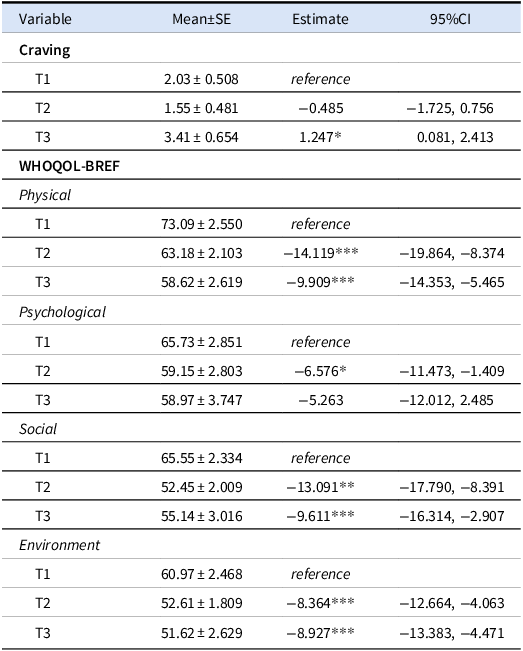
The craving level described prior to intervention averaged at 2.03 ± 0.508 and was not significantly different after intervention (1.55 ± 0.481). However, it significantly rose to 3.41 ± 0.654 (B= 1.247, 95%CI [0.081, 2.413], p= 0.036) when followed up three months after. All of the WHOQOL-BREF had significant changes. Participants scored the environmental domain the lowest at baseline (60.97 ± 2.468) and it diminished further to 52.61 ± 1.809 (T2) and 51.62 ± 2.629 (T3) significantly. Please refer to Table 4 for detailed findings on WHOQOL-BREF findings.
Longitudinal associations for WHOQOL-BREF and craving

WHOQOL-BREF, World Health Organization Quality-of-Life Brief; SE, Standard of Error; CI, Confidence Interval; *p < 0.05; **p≤ 0.01; ***p≤ 0.001.
Discussion
This Indo-SURFT study was a pilot study to assess the adaptation of a structured CBT module among incarcerated women with MUD. This is the first study, as far as the authors are aware of, in Indonesia utilizing a structured CBT module specifically tailored to this population and focusing on comprehensive addiction recovery. Other studies in Indonesia have been implementing general CBT approach and sought improvement in anxiety or depressive symptoms, forgiveness, and withdrawal symptoms (Aini Reference Aini2015; Fitri and Widyastuti Reference Fitri and Widyastuti2021; Khalda Reference Khalda2023; Osman Reference Osman2008). Overall, the therapy demonstrated a high level of acceptance among the targeted population, with 80.5% of the approached incarcerated women agreeing to participate. Although some participants reported that the CBT sessions disrupted their existing daily routines, all were able to complete the full intervention protocol, indicating good feasibility. The majority also rated the module quite favorably in terms of usefulness (M = 2.71 ± 0.461) and applicability (2.68 ± 0.475). In addition, both the therapists and module content received high ratings, with mean scores of 2.73 and 2.60 out of 3, respectively. These findings suggest that the Indo-SURFT module is well-tolerated and suitable for implementation in the correctional facility settings in Indonesia.
The present study demonstrated significant improvements in ASI scores both at the end of the 6-week intervention and at the 3-month follow-up, with the most notable changes observed in the employment domain that reflects the improvement in participants’ functional capacity. The Indonesian correctional facility provides incarcerated women with the opportunity to work and earn a modest income, which may be utilized during their sentence to purchase snacks, personal hygiene items, phone credits or retained for use following their release. A recent cohort study conducted in Sweden found that individuals with risky substance use who had lower ASI scores—particularly in areas like employment, substance use, and physical and mental health—were more likely to regain employment, highlighting ASI’s utility in predicting long-term recovery outcomes (Lindner et al. Reference Lindner, Scarpa, McCarty and Lundgren2024). Consequently, the observed improvement in the employment domain among Indo-SURFT participants may not only be clinically relevant but also represent a broader indicator of successful psychosocial rehabilitation.
The psychiatric subdomain remained stable through the end of intervention but exhibited a significant worsening on the 3-month follow-up compared to baseline. Participants also reported declines in quality of life (QoL) over time, most notably in the WHOQOL-BREF environmental domain. This divergence between functional improvement and worsening mental health may partly reflect increased insight into emotional states during and after therapy. CBT has been shown to enhance insight in individuals with SUD and thereby influence treatment outcomes (Raftery et al. Reference Raftery, Kelly, Deane, Baker, Ingram, Goh, Lubman, Carter, Turner, Dean, Sinclair and McKetin2020). However, increased insight can paradoxically be associated with greater distress and exacerbation of anxiety or depressive symptoms (Cooke et al. Reference Cooke, Peters, Fannon, Anilkumar, Aasen, Kuipers and Kumari2007; Ward and Lincoln Reference Ward and Lincoln2025). In psychiatric populations, greater disorder awareness was observed to correlate positively with shame and internalized stigma (Buchman-Wildbaum et al. Reference Buchman-Wildbaum, Váradi, Schmelowszky, Griffiths, Demetrovics and Urbán2020). If enhanced insight occurs without concurrent perceived support or psychosocial improvements, it may contribute to maladaptive self-evaluations such as self-blame and self-hatred (Ward and Lincoln Reference Ward and Lincoln2025; Yanos et al. Reference Yanos, Vayshenker, Pleskach and Mueser2016). Indonesian correctional facilities are frequently not routinely equipped with psychiatric services (Subandi et al. Reference Subandi, Praptomojati, Madhina, Hardi, Ahmad and Wuryansari2022), a circumstance encountered by incarcerated women with preexisting psychiatric conditions in the current study. Many incarcerated individuals, particularly women, enter prison with preexisting mental health conditions and are especially vulnerable to negative emotions due to their roles as primary caregivers for their children, higher likelihood of exposure to violence, and social roles that subject them to the phenomenon known as the “double burden” in daily life (Aziz Reference Aziz2023; Khalik and Permata Reference Khalik and Permata2024). Many have also reported problems in correctional facilities particularly pertaining environmental health such as poor sanitary, insufficient ventilation, lacking temperature control, and inadequate lightning (Harjono et al. Reference Harjono, Batubara, Situmorang, Wibowo and Deviari2023; Raharjo et al. Reference Raharjo, Eliyana, Saputra, Anggraini, Budiyanto and Anwar2024), all of which are worsened by overcrowding in many facilities (Purwani et al. Reference Purwani, Saefudin and Budiyanto2024). Incarcerated persons are thus more prone to poorer psychological well-being as they spend more time in prison with deprived condition, especially environmental health (Slotboom et al. Reference Slotboom, Kruttschnitt, Bijleveld and Menting2011).
Alternatively, after the 6-week period of Indo-SURFT module, participants reported lower craving score, albeit not statistically significant, in contrast to baseline. Notably, craving scores increased significantly at follow-up, suggesting that the therapeutic effects may diminish over time without continued support. These findings highlight the potential need for a more sustained intervention protocol, such as extending the duration of the module or incorporating maintenance sessions (Maruca and Shelton Reference Maruca and Shelton2017). Furthermore, the inclusion of individualized sessions may serve as a booster to enhance treatment outcomes for those at higher risk (Peyenburg Reference Peyenburg2022). Future research is warranted to evaluate the efficacy of combining group-based and individual therapy formats in sustaining long-term recovery and in identifying characteristics of women requiring such combination therapy.
This study has several limitations. The 12-session, 6-weeks intervention may not be long enough to create lasting changes, especially in a prison setting with high stress and impoverished environment. Unfortunately, this study did not measure insight quantitively, which might shed light on the paradoxical relationship between functioning and psychological distress. The absence of a control group limits our ability to attribute observed improvements solely to the intervention; nonetheless, the significant pre- to post-intervention changes and maintained during follow-up suggest Indo-SURFT’s potential efficacy. Future studies should include a control group to strengthen the findings. To reduce the risk of bias from self-reported data and social desirability, we used standardized clinician-rated questionnaires to ensure reliable results. Although some (n = 4) follow-up data were missing, all participants (n = 33) had completed all 12 sessions and initially we recruited a larger sample than required, which preserved statistical power and reduced the impact of attrition. Lastly, the generalizability of the current findings is limited as it was conducted only in a single correctional facility. These methodological considerations provide a foundation for more rigorous future research.
Conclusion
This study demonstrates the tolerability and feasibility of Indo-SURFT, a culturally and gender-responsive CBT module, in addressing the specific needs of incarcerated women with MUD in Indonesia. The module is able to improve the functional domain for recovery and reduce craving during the treatment phase, although craving reductions were not maintained at follow-up. The current 6-week protocol might need to be strengthened with extended maintenance or booster sessions to preserve and extend improvements. Findings from this pilot study will inform larger-scale and multisite studies, as well as the potential integration of Indo-SURFT within national treatment frameworks in correctional facilities.
Data availability
The data obtained and used in the analyses of this study is available upon reasonable request to the corresponding author. The data are not available in public domain in accordance with the agreement with the University and Ministry of Law and Human Rights, Republic of Indonesia regarding data sharing and publication of sensitive data on incarcerated people.
Acknowledgments
We extend our gratitude to the Directorate General of Corrections, Ministry of Law and Human Rights, Republic of Indonesia for the support and for granting permission to conduct this research within the correctional facility.
Author contributions
KS: conceptualization, formal analysis, funding acquisition, investigation, methodology, project administration, resources, writing – original draft, writing – review & editing. JL: conceptualization, funding acquisition, methodology, supervision, validation, writing – review & editing. EH: methodology, project administration, writing – review & editing. BJM: methodology, investigation, visualization, project administration, writing – original draft, writing – review & editing. LTS: data curation, formal analysis, software, validation, visualization, writing – original draft, writing – review & editing. FDN: investigation, resources, writing – original draft, writing – review & editing. AA, KSK, and CT: investigation, project administration, writing – original draft, writing – review & editing. AL and AM: project administration, supervision, writing – review & editing.
Funding statement
This work was supported by the Universitas Indonesia PUTI 2024 Grant (Grant Number NKB 271/UN2.RST/HKP.05.00/2024) and PT. MINERAL INDUSTRI INDONESIA (PERSERO) / MIND ID (Grant Number 016/CSR/PK/IX/2024).
Statements and declarations
The authors declare no conflicting interests.
Compliance, ethical standards, and ethical approval
This study has received ethical approval from the Research Ethical Committee of the Faculty of Medicine, Universitas Indonesia (approval number: KET-735/UN2.F1/ETIK/PPM.00.02/2023). All participants provided written informed consent. The authors assert that all procedures contributing to this work comply with the ethical standards of the relevant national and institutional committee on human experimentation and with the Helsinki Declaration of 1975, as revised in 2008. The study had been pre-registered in clinicaltrials.gov with registration number: NCT06174714.