Poetic forms are metaphors. The names that we give to these forms are necessarily metaphoric—broadly, in that language is metaphoric (whether latently or unmistakably, quick or dead), and specifically, in that we understand prosody by way of analogy.Footnote 1 As Seeta Chaganti has written, “Comparison—how, for instance, do walled enclosures and literary forms both constrain?—provides a language with which to describe effects and functions, patterns and affordances” (1–2). When we identify a unit of poetic lines as a bayt or stanza (from the Arabic for “house, dwelling, way-station” and the Italian for “a dwelling or halting place”), the writing of a qaṣīda or sonnet becomes, to paraphrase John Donne's metapoetic conceit, the building of pretty rooms (Ladha 1). In Greek and Latin poetry, feet (πόδɛς and pedes, respectively) are units of measurement but also anatomical organs: the soft feet of the elegy walk with limping steps, while the hooves of epic hexameter pound across the battlefield (Henkell 451). In Much Ado about Nothing, William Shakespeare describes blank verse as an “even road” (5.2.34)—a Roman road, perhaps, like Watling Street—along which wheel words like “Leander” (30) and “Troilus” (31) “run smoothly” (33), “turn[ing] over and over” (35). In the 1674 prose preface to Paradise Lost, John Milton describes meter as either “fit” or “lame.” Samuel Taylor Coleridge imagined the rhythms of English poetry as the clip-clops of horses: The trochee tripping solemnly, the spondee stalking slowly, the swift anapests thronging “with a leap and a bound” (808). To the pioneering pedagogues of English language and literature in the nineteenth century, the rhythms of meter sounded like a drumbeat ordering the march of progress (Martin 4), and to the next generation of teachers, in the early twentieth century, like England's heartbeat (7). To modernist poets like Ezra Pound, meter felt like a shackle.Footnote 2 These metapoetic images change across time and space, thereby changing how we read and write.
Let us take up a peculiar, and peculiarly challenging, case study in this field of interest—the long history of the various metapoetic metaphors that have been used to describe, classify, and interpret one specific metrical form of Middle English poetry, best known for its use in Sir Gawain and the Green Knight and Geoffrey Chaucer's Tale of Sir Thopas: the so-called bob and wheel, which is defined by The Princeton Encyclopedia of Poetry and Poetics as “a set of heterometric poetic lines coming at the end of a line of an isometric stanza” (Howes).Footnote 3 This name—bob and wheel—and this definition, with its pseudo-scientific terminology (“heterometric,” “isometric”), ultimately derive from the period between 1860 and 1930 identified by Meredith Martin as the foundation of the professional study of English language and literature.Footnote 4 There is no name for what we call the bob and wheel in the medieval manuscripts in which the form is found. Middle English provides no easy, ready labels for any of the forms we might expect to find—no iambs, trochees, dactyls, or anapests—nothing even remotely resembling the shelves of volumes written in the nineteenth and twentieth centuries debating alliteration versus rhyme or stress versus syllable. Instead, as Christopher Cannon puts it, the “unusual,” “unpredictable,” and even inexplicable forms of medieval poetry “resist” classification (“Form” 178).Footnote 5 In this fog, taxonomy fails. Few definitions of the bob and wheel agree.Footnote 6 This form is either northern or southern, foreign or native.Footnote 7 It is either ancient or new.Footnote 8 There are either many or few instances of the form in English poetry.Footnote 9
And yet where taxonomy fails, the multiplicity and flexibility of metapoetic metaphor flourishes.Footnote 10 Over the course of its long reception, what we call the bob and wheel of Sir Gawain and the Green Knight has been imagined in many ways: as the sting of a scorpion, a blow in a game of blindman's buff, the pendulum of a grandfather clock, the tail of a dog, the naked ass of a woman, and a cog in a spinning wheel. Each of these metapoetic images has not only represented but also influenced readers’ experience of the text—reflecting and diffracting, bringing before-unseen patterns of meaning into focus and resonating with before-unheard synchronous frequencies.Footnote 11
Before proceeding, I offer some further introduction to “that oddity in Middle English poetry,” the bob and wheel (Kerby-Fulton and Klein 98). But first, a disclaimer. Since the critical conversation about this form began almost two hundred years ago, our discussion of the bob and wheel has focused (as my discussion will) on its peerless execution in Sir Gawain and the Green Knight and its send-up in The Tale of Sir Thopas.Footnote 12 And yet it must be admitted that these examples could hardly be called representative.Footnote 13 The forms that the bob and wheel takes in Sir Gawain and the Green Knight and The Tale of Sir Thopas are each completely unique: no other extant Middle English poem combines alliterative long-line stanzas with a rhyming bob and wheel in an A / BABA scheme as does Sir Gawain and the Green Knight or tangles bobs and tails exactly the way Chaucer's Tale of Sir Thopas does. And yet these exceptions nevertheless prove the rule: medieval forms—individuals rather than types—resist classification.
So what is the bob and wheel? Even the quickest glance at any page of a modern edition of Sir Gawain and the Green Knight could not miss it. The bob stands out (fig. 1). It is invariably the shortest line in the stanza, usually only a word or two long—something like “in town,” “all green,” or “for shame!”Footnote 14 First and foremost, this device signals “the imminent closure of the stanza” with the concluding “wheel,” four rhyming lines that follow the bob (Chickering 2). Beyond Sir Gawain and the Green Knight, variations on these patterns are many: sometimes the stanza rhymes with the bob and the wheel, sometimes the bob rhymes only with the wheel; sometimes the bob comes after the wheel, sometimes the wheel comes without the bob, and sometimes the bob without the wheel (Stanley 422–25). Making matters even more complicated, medieval scribes format the bob and wheel in a manner so baffling to modern editors that they have elected to rearrange it entirely—not only passively ignoring but actively undoing this form's ordinatio (its layout on the leaf of the manuscript). In medieval manuscripts like Cotton Nero A.x, Harley 2253, and the Ellesmere (Huntington MS EL 26.C.9), the bob “floats” in the right margin, hovering nearby—just above or just below—the spot where we think it should, metrically speaking, be fixed (Kerby-Fulton 57). This complication means that we do not know where (or rather when) the bob occurs—Kathryn Kerby-Fulton and Andrew Klein have demonstrated that in Sir Gawain and the Green Knight (and likewise in The Tale of Sir Thopas) the bob works grammatically with any number of nearby lines (100).Footnote 15 This format of this form constructs for the reader, in the words of Wan-Chuan Kao, “a kind of premodern choose-your-own adventure” (158).
The first stanza of Sir Gawain and the Green Knight, featuring the bob and wheel.

The phrase “bob and wheel” was coined by the antiquarian Edwin Guest (1800–80), the founder of the English Philological Society, the precursor of the collective behind the Oxford English Dictionary (Martin 43).Footnote 16 In his “epoch-making” (as Walter W. Skeat heralded it) History of English Rhythms, published in 1838, Guest defined the bob and wheel as “a very short and abrupt wheel,” a “wheel” being “the return of some marked and peculiar rhythm” (572–73).Footnote 17 Guest claimed to have recovered rather than invented the nomenclature he used: “The name has been used by some of our classical writers, and—to quiet the fastidious reader—has been sanctioned by Johnson,” presumably in his Dictionary (573). And yet an unquiet fastidious reader might well object that no such phrase can be found in the writings of any “classical” English writer or in Samuel Johnson's Dictionary of the English Language.Footnote 18 True, of the four meanings given by Johnson for the noun bob, one is “the words repeated at the end of a stanza” (“Bob” [Dictionary], def. 2), but the combination of bob and wheel, plus the specific recalibration of the phrase's meaning, is all Guest. Guest invented this term of art and its attendant, implicit metaphor.
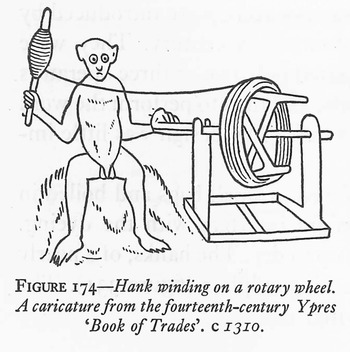
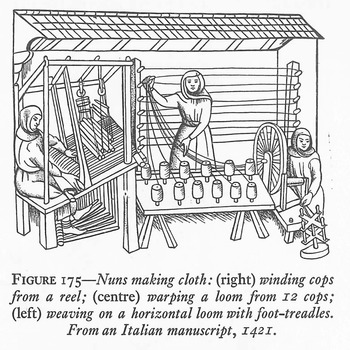
Guest consistently describes the bob and wheel as a kind of mechanism that “interweaves” rhyme with meaning (620). He uses this specific verb, interweave, over and over again, almost a dozen times in this chapter of his study. His combination of the nouns bob with wheel alongside this frequent repetition of the verb interweave begins to suggest the outline of an image. A “bob” or “bobbin” is also a spool—according to Johnson, “a small pin of wood, with a notch, to wind the thread about when women weave lace” (“Bobbin” [Dictionary]), or, as the Oxford English Dictionary has it, “an article round which thread or yarn is wound, in order to be wound off again with facility, and as required, in weaving, sewing, etc.” (“Bobbin,” def. 1). Combine bob in this sense with Guest's choice of wheel and weave and the resulting lexical combination suggests the image of this poetic form as a kind of gear in a medieval cloth-manufacturing machine, something like a bobbin threader or rotary wheel, a loom (whether a horizontal, foot-powered treadle loom or broadloom), or a spindle or spinning wheel, all of which feature interconnected parts called “bobs” or “bobbins” and “wheels”—in short, as a mechanism that threads and spins the narrative (figs. 2, 3, and 4).Footnote 19 This implicit analogy makes good use of one of the most ancient and enduring metapoetic metaphors of global literature, text as textile, if with a peculiarly nineteenth-century English fixation on the warp and weft of medieval textile machinery.Footnote 20
A bobbin threader or rotary wheel (Singer et al. 208). Reproduced with permission of the Oxford Publishing Limited through PLSclear.

A horizontal loom (Singer et al. 209). Reproduced with permission of the Oxford Publishing Limited through PLSclear.

A spindle-wheel (Singer et al. 203). Reproduced with permission of the Oxford Publishing Limited through PLSclear.

Guest's image has had an enormous influence on our reading of Sir Gawain and the Green Knight—in no small part because the poem responds so well to the long-lived conceit of text as textile. Guest's metapoetic metaphor resonates as vibrantly in the fourteenth century as it does in the nineteenth. In his brief and precious account of Middle English prosody (precious because such accounts are so rare), the fourteenth-century chronicler Robert Mannyng uses the word enterlace to describe the construction of intricate and elaborate poetic patterns (86), a word that suggests images of intertwining, interweaving, and tying together—in short, the making of textiles. A treasury of scholarship attests to the importance of the analogy between text and textile in medieval English literature, Sir Gawain and the Green Knight in particular.Footnote 21 Few texts are as fascinated by fabrics and the trade talk behind their construction: trimming, padding, and staining; stitching, cutting, and braiding; fastening, weaving, and knotting; gilding, studding, and stapling; embroidering, engraving, and enameling. So many gorgeous textiles unfold in the bob and wheels of Sir Gawain and the Green Knight: the tablecloth at Camelot (line 125), the silk belt girding Gawain's sword (589), the lady's gay and glorious linen dress (1,814), and the embroidered brocades of Gawain's “ryche cote-armure” (586) and the bridle of the Green Knight's horse (177). In the twenty-sixth stanza of the poem, a stanza and bob work together to describe how “mony burde” (many women—in other words, a women's workshop, or gynaeceum) labored for seven winters to embroider the parrots, periwinkles, turtle-doves, and true-love knots on Gawain's fabulous “urysoun,” the cloth covering the back and sides of his helmet (613–14).Footnote 22 These forms seem to invite us to imagine the bob spinning and unspooling the thread of the narrative into the wheel of a circular rhyme scheme. When Gawain dresses for battle at Camelot, the long alliterative lines of the stanza clothe him in fur and silk and then encase him in armor, winding the spindle; the bob spins the thought, reminding us what Gawain needs this armor for (his date with death); and the wheel catches and turns the stanza's thread, completing the process by putting on Gawain's surcoat, spurs, and sword (585–89). Under the auspicious influence of this metaphor of text as textile, Sir Gawain and the Green Knight becomes, in the vivid words of Geraldine Heng, “an interlinked, overlapping tracery,” “a knitting together,” an endless analytic knot (503).
Guest's image of the bob and wheel as a textile manufacturing machine feels so right and true that it has created its own origin myth. As SparkNotes has it (and as I have heard repeated by students and scholars alike): “The phrase ‘bob and wheel’ derives from a technique used when spinning cloth—the bobs and wheels in Sir Gawain and the Green Knight help to spin the plot and narrative together in intricate ways” (1–2).Footnote 23 Here, the anonymous compilers of SparkNotes seem to claim that the medieval technology of cloth-spinning (the specific reference—whether the distaff and spindle, the upright loom, the spinning wheel, or the horizontal broadloom—remains unclear) inspired the Gawain poet, that the poem somehow imitates that technology in its formal structure, perhaps in the same way that Robert Hooke's Micrographia imitates the microscope or contemporary code poetry the language of computer programming. Coincidentally, or providentially, an anonymous author writing in the programming language Perl is called, like the anonymous author of Sir Gawain and the Green Knight, a Perl poet (Tomasula 488–90). There is no evidence that the poetic form of the bob and wheel “derives” (as SparkNotes puts it) from the spinning wheel in the same way that code poetry derives from the computer. Instead, it appears that the ghostly metaphor conjured by Guest's choice of words dominates our understanding of this form and this poem so powerfully that the relation between metaphor and form has come to feel causal rather than accidental. It feels as though the metaphor invented the form—as though the spinning wheel made the poem.
And yet, contrary to Guest's disclaimer that his words derive directly from Johnson, Johnson does not seem to have necessarily had sewing, spinning, or weaving in mind when he defined “the words repeated at the end of a stanza” as a “bob.” Johnson gives several additional definitions for the noun bob, each of which projects its own peculiar image, perhaps the most striking of which is the image of a “bob” as “something that hangs so as to play loosely,” like “a pendant” (“Bob” [Dictionary], def. 1). In the late nineteenth century, the editors of A New English Dictionary on Historical Principles, a precursor to The Oxford English Dictionary, were so taken with Johnson's image of the lyrical pendant that they incorporated it into their definition of bob as “refrain”: “The refrain or burden of a song (? as if a pendant to each stanza)” (“Bob” [New English Dictionary], def. 11), a definition that has been repeated in every subsequent edition. This alternative image of the bob and wheel as a pendant hanging from the stanza, a composite image constructed across time by Johnson and the editors of the Oxford English Dictionary, turns this formal device into a precision instrument—specifically, as Hugh Kirkpatrick clarifies, “as the weight on the end of a clock pendulum” (4). Sir Gawain and the Green Knight, then, under the influence of this idea-image, becomes a pendulum clock, an invention patented by the Dutch mathematician Christiaan Huygens in 1657 (based on an older model designed by Galileo), and the bob and wheel the “weight at the bottom of the pendulum in the form of a vertically attached, double-sided convex disk, called a bob” (Vincent and Leopold 12 [fig. 5]). The pendulum bob swings from side to side, keeping perfect time, its oscillations exactly isochronous—isochronous, not coincidentally, is the term that philologists in the eighteenth century borrowed from clockmakers to describe the tick-tock rhythms that they discerned in poetry.Footnote 24 According to the logic of the implicit and influential analogy between poetry and clockmaking, the bobs and wheels of Sir Gawain and the Green Knight divide the poem into perfectly precise poetic units just as the vibrations of the swinging bob and all the tiny wheels and gears of a pendulum clock divide time into hours, minutes, and seconds. This understanding of the bob and wheel resonates with the medieval poem's use of this form to keep time (in more ways than one—formally, by signaling the end of each stanza, but also narratively, by marking the passage of time), and with the critical tradition of searching for symmetry, harmony, and mathematical perfection in the form and content of the four poems of the Cotton Nero A.x. manuscript—an approach that this manuscript richly rewards. Gawain's virtues are manifested in the magical number five: the five-sided red and gold pentangle on his shield, mirrored in the poem's five-line bob and wheel, its 2,530 (2,525 + 5) lines, and its 101 stanzas (2,530 divided by 101 equals twenty-five with a remainder of five).Footnote 25 To readers under the influence of the idea-image of poetry as horology, Sir Gawain and the Green Knight is no tangled knot. It is an unerring machine.
Christiaan Huygens's pendulum clock, illustrated in his 1673 Horologium oscillatorium (4).

And yet despite their differences, these two images of the bob and wheel—Guest's implicit metaphor of the textile machine on the one hand and the Oxford English Dictionary's composite image of the pendulum clock on the other—have much in common. Broadly speaking, both interpretations of Guest's phrase “bob and wheel” (and, behind it, Johnson's “bob” and “wheel”) represent and encourage a perennial tendency to imagine this device in Sir Gawain and the Green Knight as a cog in one machine or another: a loom, spinning wheel, or pendulum clock. And although at least one of these machines postdates Sir Gawain and the Green Knight by centuries, the poem nevertheless rewards a technical approach—an engineer's or maker's eye. In the poem's most metapoetic passage, which appears in the bob and wheel of the second stanza, the text describes its letters (“letteres”) as locked (“loken,” meaning secured with lock and key or fastened together [“Loken,” def. 3]) and its narrative (“stori”) as stuck (“stoken,” meaning nailed down [32–36; “Steken,” def. 9b])—imagery repeated in a later bob and wheel's description of Bertilak's architectural defenses: his castle's well-built drawbridge, impenetrable walls, and “stoken” gates (Sir Gawain 781–84). These conjoined descriptions of locking and stocking, bolts and nails, represent the poem as a kind of high-tech security system, a defensive variation on Geoffrey of Vinsauf's famous metaphor of the invention of a poem as the building of a house (20).Footnote 26 Small wonder, then, that the mechanical metapoetic metaphors compiled and coined by lexicographers, philologists, and formalists imitating the scientific methods of artisans and engineers have suited the “lel letteres loken” (35; “lel” meaning “true,”’ “accurate,” and “exact,” as well as “well-aimed, hitting the mark”—the right words, in short, locked in tight and right) of this poem so aptly (“Leal,” defs. A1b, A2; “Lēl,” def. 2C).
And yet while the image of Sir Gawain and the Green Knight as a machine resonates in both medieval and modern contexts (within the text itself and within the nineteenth-, twentieth-, and twenty-first-century academic commentary written about the text), its vibrations—contrary to Guest's claims—do not synchronize as well with the period in between. While Guest claims that he got his definition of the bob and wheel from Johnson and other authors from the early modern period and eighteenth century, these authors actually seem to have correlated the poetic meaning of bob with a very different array of associations—less mechanical and more performative. As Ad Putter has noted, in Johnson's Dictionary (and before Guest's History of English Rhythms more broadly) attestations of the word bob in a metapoetic sense tend to suggest “something you would sing” (156). Case in point: Johnson provides the following supporting quotation for his definition of the noun bob meaning “the words repeated at the end of a stanza”: “To bed, to bed, will be the bob of the Song” (“Bob” [Dictionary], def. 2). The source of this quotation is one Sir Roger L'Estrange (1616–1704), a Cavalier pamphleteer who appears to have been especially fond of the phrase “bob of the song,” and so is invariably quoted when this sense of the word comes up. In his Fables of Aesop and Other Eminent Mythologists with Morals and Reflections (1692), L'Estrange tells the story of “an honest, down-right, plain-dealing” bride who on her wedding night keeps asking, very persistently, when it will be time to go to bed. L'Estrange concludes, “Let Flesh and Blood pretend what it will, to bed, to bed, will be the Bob of the Song”—in other words, the recurring chorus (in the double sense of the refrain and the point or the heart of the matter). Across his work, L'Estrange gives us several such musical bobs, including the rousing refrains “Out with your Purse, and Pay your Host” (Fables 336) and “I ha’ drunk many a Pot of Good Ale” (Otes 8). This sense of bob as the refrain of a song tracks across not only the work of L'Estrange but also early modern literature more broadly, the earliest witnesses of which include, from 1569, The Travayled Pilgrim by the antiquarian Stephen Bateman (1542–84); from 1571, an interlude of Damon and Pithias by Richard Edwards (ca. 1523–66); and, from 1606, Choice, Chance, and Change: or, Conceites in Their Colours, a satire by Nicholas Breton (1545–1626).Footnote 27 These early modern texts all make use of the specific phrase “bear the bob,” meaning “join in the chorus” or “take up the refrain” (246n). In Bateman's allegory, for example, Poverty “bear[s] the bob” in a chorus of lollygagging fools (23), and in Breton's satire, a raucous pander “bear[s] the bob, while others play and sing” (35). Each of these examples refers to rowdy traditions of communal singing, specifically drunken singing at weddings and feasts, in halls and taverns.Footnote 28
The example of Edwards's Damon and Pithias demands a closer look. The scene that features the phrase “bear the bob” occurs within the comic B-plot of rustics and servants. In this particular scene, one Grim the Collier, a yokel with a thick country accent, gets robbed and bamboozled by two court lackeys, Will and Jack. Will and Jack get Grim drunk, set him up in a barber's chair, and give him a close shave (dousing him in urine and sheering off his pimples with a butcher knife) as they rob him blind (literally, in that they also blinker him with a pair of gag spectacles), all the while singing a drinking song in three parts—in which the phrase “bear the bob” plays a part. Jack says to Grim, “You are like to bear the bob, for we will give it” ([King] 13.267). “Bear the bob,” in this context, means something to the effect of “to carry the chorus,” but with the second meaning of “to be fooled” ([Walker] 383), “cheated” ([King] 168), or robbed. As Will and Jack “give” Grim the “bob” (by leading him into the refrain), they also, as Ros King glosses their phrase, give him “a sharp rebuke or bitter jest” (168). The precise wording of this quotation (and of the others above featuring the same phrase) suggests that bearing the bob (or “burden,” as the refrain is also sometimes called) meant playing the part of the fool, dupe, or victim, as if in some kind of game. It is as if the phrase “bear the bob” meant “take the hit”—“bob” in the sense of “blow,” which, as it turns out, is yet another of this word's many early modern meanings (“Bob” [Dictionary], def. 3)—perhaps in the same way that our expression punch line compares the final pivot in the narrative flow of a joke to a violent blow. Be that as it may, this much seems clear enough: whereas Guest pictured the bob as a cog or gear in a machine (as a thing, in other words), Johnson used bob to describe action—whether singing, fooling, bouncing, or whacking.
Let us say, for the moment, that Guest was right to believe that Johnson's definitions of wheel and bob, extrapolated from early modern sources, could, like a trail of breadcrumbs, lead us back to otherwise-lost medieval poetic traditions. If this were so, then the performative sense of bob found in Johnson (although put aside by Guest) might suggest a premodern understanding of what we call the bob and wheel as a kind of communal performance, or even, more specifically, as a drinking song or party game. But does this interpretation suit the text? Is there any internal textual evidence that Sir Gawain and the Green Knight, and medieval poetry more broadly, imagines the bob and wheel as a refrain in a kind of drinking song or party game? Readers have indeed felt this particular vibration—especially twentieth- and twenty-first-century readers fascinated by the surface of the manuscript.Footnote 29 The puzzling (to us) formatting of the bob and wheel in medieval manuscripts—the “floating bob” that hovers in the margins—has persuasively been explained as evidence of, in Jessica Brantley's words, a “fundamental” reliance “on oral performance” (429). Kerby-Fulton and Klein provide a useful overview of the bob and wheel's many such performative capacities: It can work as a catchword, a mnemonic, and a cue for repetition, improvisation, or call-and-response (114–15). E. G. Stanley even speculates that the bob could have cued the performer to shout, prompting the audience to sing the wheel all together in chorus (421). It begins to seem as though Guest might have been onto something when he looked to the early modern sense of the word bob as “refrain” for insight into this nameless form.
As far back as the sixteenth century, “bearing the bob” meant singing the chorus of a song, but also, as we have seen, playing a specific role in some kind of game—the role of “it,” as in, “Tag, you're it.” Both senses seem to resonate with Sir Gawain and the Green Knight, a poem that is all about games—“game[s] inside games,” as Heng has it (505)—not only in details like the handy-dandy game played by the knights and ladies at Camelot (Sir Gawain 66–70) but also in the overarching double-plot structure of the interlocking beheading game and triple exchange of winnings. The poem introduces itself as a game and a performance piece: King Arthur (like the reader) demands to be entertained (90–99), and the Green Knight (like the poem itself) fulfills this demand with carnage, cleavage, and clever plot twists. Scholarship has long been attuned to the poem's enormous debts to performative traditions—from mummings and interludes to drinking songs and Christmas games, and particularly to the game of blindman's buff, or blindman's bluff, known by many names: hood-man blind, the hood-wink play, frog in the middle, hot cockles, and, most importantly for our purposes, “the bobbid game” (Opie and Opie 118–19),Footnote 30 described in a fifteenth-century sermon as a
common game in use nowadays . . . , which the soldiers played with Christ at his Passion: it is called the bobbid game. In this game, one of the company will be blindfold and set in a prone position; then those standing by will hit him on the head and say—“A bobbid, a bobbid, a biliried: / Smyte not her, bot thu smyte a gode!” And as often as the former may fail to guess correctly and rede amys, he has to play a fresh game. And so, until he rede him that smote him, he will be blindfold stille and hold in for the post of player. (Owst 510)
The joke of this game is that the victim cannot tell who hit him, and must keep playing until he figures it out—the very plot in which Gawain finds himself so entangled. Indeed, for many of the pioneering readers of this poem in the early twentieth century, the plot of Sir Gawain and the Green Knight revealed the game hidden behind all games: a pagan ritual of human sacrifice.Footnote 31
This reading may be passé, even outré, and yet the bob and wheel of Sir Gawain and the Green Knight has struck more than one reader as a kind of playful and surprising blow, as yet another iteration of the violent pattern set in motion by the Green Knight's beheading game.Footnote 32 Putter points out, “The bob always has an element of surprise, since we can never predict where in the stanza it is going to come” (162), a surprise that Larry Benson describes as a “sting” (166), Stanley as a “hit” (421), and Howell Chickering as a “punch” or “strike” (11, 13). The bob and wheel delivers narrative blows in content as well as form: not only abrupt exclamations (Sir Gawain, in line 412, “Bot slokes!”; in line 965, “For God!”; in line 1530, “For schame!”) but also surprising reversals and revelations. Most famously, the seventh stanza, which introduces the Green Knight into the poem, waits until the very last line of the bob and wheel to reveal that the mysterious stranger in the doorway is “overall enker-grene” (150)—head-to-toe vivid green. The next stanza imitates this same structure, waiting until the bob to deliver the punch line that the horse he rides in on is vivid green too (175). Other narrative blows delivered by the bob and wheel include some of the poem's biggest surprises, like the news that the Green Chapel is only two miles away from where Gawain is standing in the forty-third stanza (1074–78), the bombshell of the lady's first sexual proposition in the forty-ninth (1236–40), and the ultimate disclosure of the name of the mastermind behind the entire plot, “Morgne the goddes,” Morgan the goddess, in the ninety-eighth (2452).Footnote 33 The reader, like Gawain, spends the poem in a state of suspense, waiting for the blow to land—rather like the blindfolded dupe in a game of blindman's buff.
The term of art invented by Guest to describe the form of Sir Gawain and the Green Knight has taken on many meanings over the years. Guest and his fellow prosodists and philologists in the late nineteenth and early twentieth century represented the bob and wheel as cogs in a machine (whether a pendulum clock or a textile manufacturing device). In the early modern period, however, the words that Guest took from Johnson's Dictionary (bob and wheel) would seem to have suggested a bouncing, playful, and even violent game rather than the unerring clicks and ticktocks of a precision instrument—a sympathetic suggestion to twenty-first-century readers sensitive to the details on the surfaces of medieval manuscripts. But, in any case, both images—of the bob and wheel as a mechanical device and of the bob as the slapping refrain of a drinking song—have resonated with readers because they resonate with the text. When projected onto the poem, these images dazzle the eye. Under their influence, readers have seen Sir Gawain and the Green Knight as a tangled knot, an isochronous machine, and a raucous game.
But how would a medieval poet or prosodist have pictured Guest's bob and wheel? What images could we discern in the rhyming flourishes of Sir Gawain and the Green Knight if we did not project postmedieval metapoetic metaphors onto the text's surface? As fate would have it, the earliest attestation of the word bob in the Oxford English Dictionary appears in Sir Gawain and the Green Knight: when the Green Knight storms into Camelot at Christmas, he bears in hand “a holyn bobbe” (206), a “bunch” or “cluster” of holly (“Bob” [Oxford English Dictionary], def. 1). For some prosodists, this single appearance of a bob (not a “bob” in Guest's sense of the word, as the holly bob actually appears in an alliterative long line and not in the bob at all) looks like the missing evidentiary link connecting Guest's terminology back to the poem, and thereby mitigating or even absolving its apparent anachronism.Footnote 34 But I would suggest that if we let medieval rather than Victorian prosody and poetry be our guide, different images come to dominate the foreground of our field of vision: the pentangle, the circle, and the tail.
It is no secret that Sir Gawain and the Green Knight represents itself, first and foremost, with the figure of the pentangle, the five-sided, five-pointed symbol that adorns Gawain's shield, and with the interlocked figure of the circle of the green girdle that rings it round. Both these images—the pentangle and the circle—reveal themselves in what Guest calls the bob and wheel, a circle of rhyme (rhyming A / BABA) in five lines. At three crucial moments in the poem, that circular rhyme scheme not only makes a circle in rhyme but also describes a circle: the wheel of the twenty-sixth stanza, the wheel that leads into the introductory description of the pentangle, describes the priceless golden “cercle” that Gawain wears around his crown (615); and the wheel of the very last stanza (the one-hundred-and-first), which describes the crown of thorns (2527–30), circles back to the wheel of the first stanza, which describes that crown's typological mirror-image, the wheel of fortune (16–19). This double image in form and content of an encircled pentangle with which the poem figures itself is totally unique, proving the point, yet again, that medieval forms—individuals rather than types—resist classification (Cannon, “Form” 178).
And yet although “medieval poets left behind no ars poetica explicating their understanding of English meter and poetic style” in the exact manner of George Puttenham's Arte of English Poesie, George Saintsbury's History of English Prosody from the Twelfth Century to the Present Day, or the vast Princeton Encyclopedia of Poetry and Poetics (Weiskott 476), they did leave behind telling asides and turns of phrase rich in metapoetic puns and metaphors—like the image, for example, of the tail.Footnote 35 In his discussion of Middle English poetry, Mannyng refers to “ryme couwee,” from the French couée, meaning tailed (1.85–9).Footnote 36 Mannyng describes “coppl[ing]” a “kowe,” or coupling a tail (linking or joining, in some way, a tail to a stanzaic body), as an art practiced by “seggers” and “harpours” (tellers and harpers [1.75–92]). What Mannyng precisely means by this phrase (“coupling a tail”) is a matter of much debate, but this much is clear: he imagines a stanza that ends with a flourish as an animal with a tail.Footnote 37 This metapoetic image extends from the Middle Ages to the present day (Zayaruznaya 25), although our definition of tail rhyme is much more elaborate and particular than the amorphous and ambiguous phrases (like Mannyng's “coupling a tail”) that we find in medieval prosody.Footnote 38 Although twentieth- and twenty-first-century taxonomists may classify the bob and wheel as a subspecies, variation, descendent, or cousin of tail rhyme, the unique form of Sir Gawain and the Green Knight (specifically its combination of unrhymed alliterative long lines with a rhyming bob and wheel in an A / BABA scheme) has excluded its bob and wheel from commentary on tail-rhyme romance except as a point of comparison.Footnote 39 We do not tend to think of the stanzas of Sir Gawain and the Green Knight as having tails.Footnote 40 We think of them, thanks to Guest, as having “bobs” and “wheels.” And yet if we put modern taxonomy and terminology aside, then the tail, and not the “bob,” is the image that reveals itself most clearly in both prosody and practice from the Middle Ages.
In his De vulgari eloquentia, Dante labels various parts of songs as the “head, or frons” and “tail, that is, a sirma or cauda” (83). In her work on medieval music, Anna Zayaruznaya connects Dante's theory of tail-rhyme to medieval metapoetic practice, drawing our attention to a motet by Guillaume de Machaut in which the lyrics of a musical tail (technically, as Jacques Boogaart defines it, an “isolated breve at the end of the talea” [qtd. in Zayaruznaya 35]) describe the tail of a scorpion, which “Retro pungit sevius” (“stings very savagely from behind” [Zayaruznaya 34]). Here, Machaut's motet not only describes but also imitates the scorpion—a double mimesis of form and content, an auditory analogue of the visual pun of “The Mouse's Tale” from Lewis Carroll's Alice's Adventures under Ground (1862–64), a tail-rhyme concrete poem narrated by a mouse and printed on the page in the shape of that mouse's winding tail (fig. 6).
Lewis Carroll's tail-rhyming “The Mouse's Tale” from Alice's Adventures under Ground (1862–64), British Library Add. MS 46700. Reproduced courtesy of the British Library.

Middle English poets like to play this game not so much with the tails of animals but rather with the tails of women, exploiting the obscene valence of the word tail, which, as the Middle English Dictionary informs us, included “the coccygeal region,” “pudendum,” and “penis” in its broad semantic range (“Tail,” def. 1b). Middle English poetry, as we know, loves nothing so much as a dirty pun. In the thirty-ninth stanza of Sir Gawain and the Green Knight, which contrasts the young and beautiful Lady Bertilak to the old woman who attends upon her (and who later turns out to be Morgan the Goddess), an exclamation in the bob (“for Gode!”) sets off a wheel that describes that old woman's “balw and brode” (“big and broad”) “buttokes” (966). The tail-end of the old woman's big body, in short, hangs off the end of the stanza—an ass in form and content. Sir Gawain and the Green Knight is not the only bob-and-wheel poem to make this particular joke. In the bob-and-wheel romance Sir Tristrem, one stanza's bob and wheel exposes Isolde's “queynt” (“cunt,” “sexual organs”) “aboven hir kne” (2.2254), “naked” for everyone to see (2.2255). In the bob-and-wheel satire “Lord that lenest us lyf” from the Harley manuscript, the bob and wheel lifts up a proud shrew's skirt to reveal her “foule ers” (“foul arse” [line 22]). These instances bring out the humor of the vulnerable posterior position of the tail (“tail” not in the strict modern sense of “tail rhyme,” but rather much more broadly conceived as a flourish at the end of a stanza), imagining the form seen by Johnson as a game and by Guest as a machine as a protruding, naked ass.
Which, naturally, brings us to Chaucer, whose parody of the bob and wheel in The Canterbury Tales provides us with by far the most vivid, detailed, and influential metapoetic description of this form from the entire corpus of Middle English. Scholars understand Chaucer to have mocked the rival poetic traditions practiced by Sir Gawain and the Green Knight in two places. First, in the prologue to his tale, the Parson appears to imitate the sound of alliterative poetry, riffing on a consonant with the babbling nonsense sounds “rum ram ruf” (Parson's Tale, line 43), a phrase that has been interpreted as an insult aimed at the alliterative tradition that Chaucer did not deign to practice—mere baby-talk, barking, bullshit (Skeat 446). But this little dig at the alliterative tradition is nothing compared to Chaucer's prolonged and devastating roast of tails and bobs in the tale told by Chaucer's self-deprecating self-portrait, the Chaucer-pilgrim.Footnote 41 Bobs on top of tails—five bobs, specifically: “in town” (793), “so wilde” (803), “with mace” (813), “thy mawe” (823), “in londe” (887)—pop in and out of the bad romance of The Tale of Sir Topas seemingly at random.Footnote 42 As Aditi Nafde writes, “It seems that the [bobs have] been added simply for the sake of having a bob-line, deliberately to suggest poor style and uneasy rhymes” (146–47). These bobs are, as Kao describes them, “shitty” (160). I love an elf-queen, Sir Thopas narrates, for there is no woman in the world worthy to be my mate—and then the most overused, “vacuous,” “vapid,” and “excrescent” bob imaginable (Stanley 417–18), “in town” (Tale, line 793), suddenly interjects itself out of nowhere.Footnote 43
Chaucer tells us exactly what to think of this bad writing in the furious voice of the Host, Harry Bailey, who puts a stop to The Tale of Sir Thopas with an extensive metapoetic invective against “ryme doggerel” (925). This verbal assault against “drasty” (“dirty-nasty”) rhymes triggers a rapid-fire series of vivid imagistic suggestions (923). With these imagistic suggestions, Chaucer painted hypotypostic portraits of the forms of the bob and the tail that are hard to unsee and impossible to forget, for which reason they never have been. First, the adjective “drasty,” glossed by the Riverside Chaucer as “crappy” (216n) suggests images of “dregs, lees; fæces, refuse, residue”—in other words, gunk, garbage, and shit (“Drast | Drest”). Chaucer minted the phrase “doggerel” for this occasion, a diminution that the Oxford English Dictionary's etymologists think must derive from dog (“Doggerel”), the way the childish expressions “kitty-cat” and “doggy-dog” derive from cat and dog. The Host concludes with a grand finale: “Pleynly, at a word / Thy drasty rymyng is nat worth a toord!” (Tale 929–30)—“Plainly, in a word, your crappy rhyming is not worth a shit.” This burn sets up and then takes apart its analogy: the Chaucer-pilgrim's rhyme is so shitty that it isn't even worth a shit—it is shit, and yet it is such shit that it overtakes shit's attributes and evacuates the vehicle from the metaphor. Shit, our go-to reference for all things worthless, fails; the shittiness of this rhyming overtaxes the capacity of analogy itself. Combine these associations, and we have dregs, feces, or garbage; a doggy-dog; and the shittiest shit, shit that out-shits shit.
The composite image that begins to emerge from these associations looks, to me, at least, like a dog's shitty tail (or rather, to be as filthily specific as Chaucer himself, like a dog's tail shitting out shit-bobs), the obscene Chaucerian response to the elegant scorpion stinger imagined by Machaut. When Chaucer translated the scorpion passage from Machaut's ninth Latin Motet in his Book of the Duchess, early in his career, he did not even try to imitate its virtuosic harmony of form and content, its stinger made of an “isolated breve at the end of the talea” (Zayaruznaya 34–35). Chaucer could (and did) end his couplet on the scorpion's “stynge” (rhyming, adroitly, with “flaterynge”—as the scorpion flatters us with his head while stinging us with his tail), but he simply could not match Machaut's virtuosity while staying within the bounds of his chosen, and rather limited, form (Chaucer, Book, lines 635–36).Footnote 44 But by the time he got to The Tale of Sir Thopas, Chaucer was ready to show what he, and what English poetry, could do with forms—forms upon forms, rhymes upon rhymes, brackets upon brackets, tails upon tails—albeit in his preferred modes of reverse psychology and vicious self-deprecation. Vicious self-deprecation on behalf of English poetry as well as himself—or rather on behalf of English poetry standing in for himself, as if the two, Chaucer and English, were one.Footnote 45 As indeed they have effectively become in his epithet: “The Father of English.”Footnote 46 It hardly comes as a surprise, then, that these Middle English forms—tails and bobs—remain underdogs to this day in the strict hierarchy of English prosody. That stink that Chaucer put on them still smells.
Chaucer tells us that the end is every tale's strength. The structure of bob and wheel encourages us to end as we began—as does Sir Gawain and the Green Knight, the last wheel of which, as we have seen, circles back to the first. Middle English poetry comes to us without self-declared titles, authors, genres—or forms (Cannon, “Form” 178). Caroline Levine has argued that forms—like, in her example, the sonnet—remain relatively stable and recognizable over time, beyond “interpretive activity or debate” (13).Footnote 47 And yet the strange shape of the medieval form unnamed until Guest named it the bob and wheel (a form that is either native or foreign, old or new, legion or rare, fixed or flexible) does not settle questions of interpretation but rather, like a Rorschach test, opens them up. Different readers see, and have seen, different forms in the inkblot of the bob and wheel: A girdle encircling a pentangle, a swinging pendulum, a slap in the face, a spinning wheel, a wagging tail. These phantasmic images in the text are there and yet also not there. Once perceived and named, some catch on better and longer than others—especially when, as in the case of the nostalgic image of medieval textile machinery suggested by Guest's choice of words, they suit both the text and the times. True, the ordination of the lines in the Gawain manuscript do not change. Those letters, as the poem itself tells us, are locked (line 35). But the imagistic forms that these letters and lines take on in our mind's eye do change with the times—and, it follows, so too does the language with which they have been described, defined, and classified. These metapoetic metaphors—half-articulated but widely repeated, impressionistic but influential—shape and are shaped by our readings of the text, not only in their own historical moment (for example, in 1838 for Guest's image of the “interweaving” mechanism of the “bob” and “wheel”), but also backward and forward in the time warp of the archive (where Guest converses with Chaucer, Johnson, and the Oxford English Dictionary). Under the influence of these metapoetic metaphors (text as textile, narrative as game, prosody as horology), Sir Gawain and the Green Knight shapeshifts, taking on forms of its own. A dirty joke, a drinking song, a feat of engineering, an endless knot.