I. INTRODUCTION
The demands for renewable sources and efficient energy storage devices of people have been increasingly urgent, due to the rapid development of global economy, a sharp drop in fossil energy reserves and the ever increasing environmental problems. Supercapacitors (SCs, also known as electrochemical capacitors or ultracapacitors), with high power density, long cycle life, fast charge/discharge rates, high stability, and low maintenance cost, have attracted extensive attention as a novel type of energy storage device, Reference Li, Zhang, Xing, Li, Xue and Yan1 wherein the properties of electrode materials are the key to determine the performance of supercapacitors. Currently, there are several types of electrode materials for supercapacitors as follows: carbonaceous materials (carbon nanotubes, activated carbon, graphene, carbon fabrics), Reference Frackowiak2–Reference Zhang, Ma, Tong, Hu, Zhao, Hu and Wang4 transition metal oxides (RuO2, NiCo2O4, MnO2, Co3O4) Reference Henderson, Mu, Dahal, Lyubinetsky, Dohnálek, Glezakou and Rousseau5–Reference Cui, Zhang, Tong, Luo, Wang, Zhang, Xie and Wu8 /hydroxides (Ni(OH)2, Co(OH)2) Reference Li, Han, Fan, Wang, Tao and Guo9–Reference Ma, Liang, Takada and Sasaki11 and conducting polymers (polyaniline, polythiophene, polypyrrole). Reference Dubal, Ballesteros, Mohite and Gómez-Romero12,Reference Thakur, Majumder, Choudhary and Pimpalkar13
Layered double hydroxides (LDHs), the lamellar compounds, consist of the interaction between the positively charged host layers and interlayer anions by noncovalent bonds. Its hydrotalcite-like structure can be characterized by the general chemical formula
 ${\left[ {{\rm{M}}_{1 - X}^{2 + }{\rm{M}}_X^{3 + }{{\left( {{\rm{OH}}} \right)}_2}} \right]^{X + }}{\left( {{{\rm{A}}^{n - }}} \right)_{{x \over n}}}\cdot m{{\rm{H}}_2}{\rm{O}}$
, where M2+ and M3+ denote the divalent and trivalent metal cations respectively, and A
n− represents almost any inorganic and organic anion.
Reference Guo, Zhang, Evans and Duan14
For the past few years, LDHs have sparked a great interest in academic and industrial fields for its extensive applications, including catalysis, separation, biology, and electrochemistry.
Reference Lu, Xu, Zhu, Yang, Lei, Liu, Li and Sun15–Reference Chen, Hu, Chen, Yan and Wu18
In the case of electrochemistry, LDHs special structures not only determine their anion exchange property and capacity to intercalate anions, but also provide a large specific surface area for the formation of electric double layer capacitance. At the same time, the variable anions can offer abundant electrochemically active sites for the production of faradic pseudocapacitance.
Reference Guo, Zhang, Evans and Duan14
Among them, the electrochemical performances of Ni/Al-LDH have been extensively investigated.
Reference Huang, Lei, Wei, Liu, Liu, Cao, Yin and Wang19–Reference Hall, Lockwood, Bock and Macdougall22
Pure LDHs are easy to be stacked together during the synthesis, thereby resulting in particle aggregation, the decrease of specific surface area of materials and the contact area between electrolyte and electroactive components, as well as the decline of electrolyte ion mass and electron transfer rates.
The direct construction of the 3D structure on the conductive substrate can partially alleviate above issues, thus improving the electrochemical natures of active materials. Compared to the conventional 2D planar framework, the electrodes with peculiar 3D porous architecture can increase electrolyte penetration, electron transport, and the electrochemical active surface area. It is well known that the carbon cloth (CC) material, one of the ideal flexible electrode substrate materials, possesses numerous advantages, such as simple preparation process, high conductivity, stable chemical property, good mechanical properties, light weight, predominant flexibility, ascendant corrosion resistance, and low price. Reference Horng, Lu, Hsu, Chen, Chen and Chen23,Reference Hai and Zou24
Herein, the Ni/Al-LDH/CC flexible electrode material, the Ni/Al-LDH nanoflakes directly growing on the surface of CC, is prepared by a facile and convenient hydrothermal way. Its particular open structure was helpful to make full contact between the electrolyte and the electrode materials, also support the electrochemical active substances as many as possible. In addition, unlike other powdered-type supercapacitors, Ni/Al-LDH/CC, as electrodes without binder, is conducive to the reduction of interfacial resistance and the enhancement of electrochemical reaction rate. Meanwhile, the Ni/Al-LDH/CC as flexible electrode, one of the future trends of supercapacitor development, shows advantages of portability, elastic applications, and many other uses. In this work, the as-prepared Ni/Al-LDH/CC exhibited a specific capacitance (C sp) value of 359 F/g at a current density of 0.3 A/g and 105.9% retention after 3000 cycles, markedly higher than that of pure Ni/Al-LDH in the same conditions (C sp of 219 F/g, 81.5% retention of the initial value after 3000 cycles at 1.0 A/g). Moreover, to further evaluate the actual application, an asymmetric supercapacitor, Ni/Al-LDH/CC as positive electrode and AC as negative electrode, achieved high energy density 20.9 Wh/kg with power density 262.5 W/kg, as well as 83.5% retention of the initial value after 3000 cycles at the current density of 0.5 A/g.
II. EXPERIMENTAL SECTION
A. Synthesis of Ni/Al-LDH/CC and Ni/Al-LDH
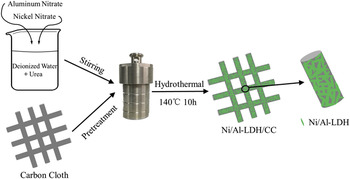
The preparation of Ni/Al-LDH/CC composite is described in Fig. 1. In this experiment, all chemical reagents, analytical and from Sinopharm Chemical Reagent Co. Ltd (Shanghai, China), were used without further purification. The CC substrate, from Phychemi (Hong Kong, China) Company Limited, was cleaned by ultrasonication in acetone, absolute ethanol, and deionized water for 30 min to remove impurities. After preliminary treatment, the CC was dried in an oven at 60 °C for 4 h, cut into 2 × 3 cm rectangles, and weighed. As for a typical procedure, 0.009 mol Ni(NO3)2·6H2O and 0.003 mol Al(NO3)3·9H2O were dissolved in a solution, consisting of 80 mL deionized water and 0.04 mol urea. The solution was stirred at room temperature until clarification, transferred to a 100 mL Teflon-lined autoclave with the processed CC and hold 140 °C for 10 h. When the autoclave was cooled to room temperature, the resultant was rinsed with ethanol and deionized water by ultrasonic, then dried at 60 °C for 8 h. Such product was labeled as Ni/Al-LDH/CC. For a comparative study, the pure Ni/Al-LDH powder was prepared under identical conditions except for the CC.
Schematic diagram of Ni/Al-LDH/CC preparation.

B. Fabrication of electrodes
The Ni/Al-LDH/CC was cut into suitable size (1 × 2 cm2) and directly used as the working electrode. In brief, the Ni/Al-LDH (or the activated carbon, denoted as AC) powder, conducting agent graphite, and polytetrafluoroethylene (PTFE) were mixed in a mass ratio of 85:10:5 and dispersed in appropriate ethanol to form a homogeneous paste. This paste was incorporated on a 1 cm2 CC carrier, dried at 60 °C in an oven for 8 h to remove residual ethanol, and thus to get Ni/Al-LDH electrodes (or AC electrodes).
C. Characterization of samples
Powder X-ray diffraction (XRD; Cu Kα radiation, λ = 1.5406 Å, 40 kV, 200 mA, 5–70°) was collected by a D8 ADVANCE diffractometer (Bruker AXS GmbH, Karlsruhe, Germany). Raman spectra were conducted using a Renishaw InVia Raman microscope (Renishaw plc, Wotton-under-Edge, United Kingdom) at an excitation laser wave length of 532 nm. The surface components of composites were investigated with X-ray photoelectron spectroscopy (XPS; ESCALAB250Xi, Thermo Fisher Scientific Inc., Waltham, Massachusetts). A field emission scanning electron microscopy (FESEM; S-4800 II, Hitachi Ltd., Tokyo, Japan), equipped with X-ray energy dispersive spectrometer (EDS) to analyze the constant elements qualitatively, was used to observe the microstructure and morphology of samples.
D. Electrochemical measurement
A three-electrode configuration was used to test the electrochemical performance of as-prepared electrode materials with 6 M KOH aqueous solution as the electrolyte at room temperature. A 1 × 1 cm2 platinum foil and a saturated calomel electrode (SCE) were used as counter and reference electrodes respectively. Meanwhile, Ni/Al-LDH/CC and Ni/Al-LDH were used as working electrodes separately. Cyclic voltammetry (CV; potential window of 0–0.5 V, scan rate of 5–100 mV/s) and galvanostatic charge/discharge measurements (GCD; potential range of 0–0.35 V, 0.3–5.0 A/g current density) were carried out using a CHI660E electrochemistry workstation (Shanghai ChenHua Instrument Co. Ltd., Shanghai, China). Electrochemical impedance spectroscopy (EIS; a frequency range of 0.01 Hz–100 kHz, potential amplitude of 5 mV) was tested by the Autolab 302N (Metrohm Autolab, Utrecht, the Netherlands).
The electrochemical performances of the asymmetric supercapacitor (Ni/Al-LDH/CC//AC) were tested by a two-electrode system, Ni/Al-LDH/CC positive electrode and AC negative electrode, in 6 M KOH electrolyte. CV, GCD, and cycle properties were measured on a CHI660E electrochemistry workstation (Shanghai Chenhua Instrument Co. Ltd., Shanghai, China).
III. RESULTING AND DISCUSSION
A. Structural and morphology characterization
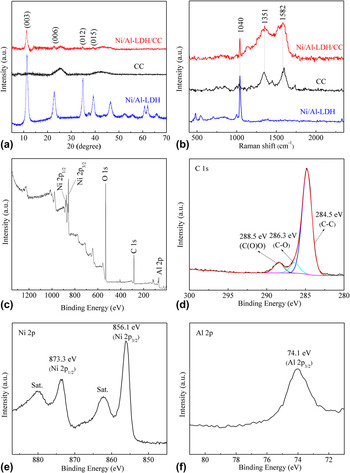
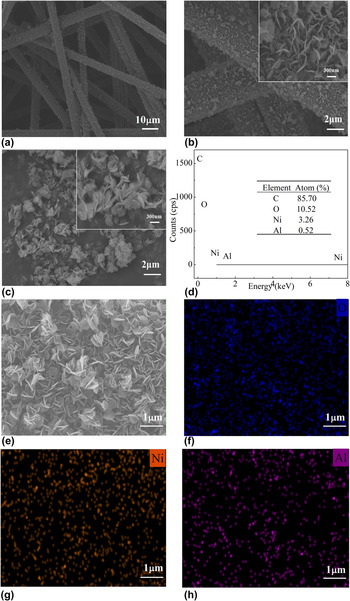
As shown in Fig. 2(a), the XRD pattern of CC consists of two weak and broad diffraction peaks at about 25.7° and 42.4°, corresponding to the characteristic peaks of carbon materials. Reference Zhou, Li, Xing, Shen, Bi, Zhu, Qiu and Zhuo25 Meanwhile, the Ni/Al-LDH/CC gives the same diffraction peaks as the CC. Also, both Ni/Al-LDH and Ni/Al-LDH/CC exhibit narrow, sharp reflections at 11.4°, 22.9°, and 34.8°, ascribing to the (003), (006), and (012) planes, indicating a representative hydrotalcite-like structure (PDF No. 89-7111). Additionally, the interplanar spacing (d) of (003) diffraction peak for the Ni/Al-LDH/CC is 0.789 nm, in agreement with the interlayer distance of the bimetallic hydroxide (about 0.77 nm). Reference Wang, Xiang and Li26 Simultaneously, the Ni/Al-LDH/CC has (006) plane with d value of 0.392 nm, basically matches the equality of d (003) = 2d (006), indicating a relatively complete lamellar structure, some hexagonal LDH nanoplatelets growing on CC surfaces, coinciding with the SEM image of Fig. 3(b).
(a) XRD patterns, (b) Raman spectra of samples; (c) XPS survey spectra, (d) C 1s, (e) Ni 2p and (f) Al 2p for Ni/Al-LDH/CC.

SEM images of (a, b, e) Ni/Al-LDH/CC and (c) Ni/Al-LDH. (d) EDS spectrum of Ni/Al-LDH/CC. Elemental maps of (f) O, (g) Ni and (h) Al of Ni/Al-LDH/CC.

Raman spectroscopy is a good nondestructive approach to determine the ordered and disordered crystal structures of carbon materials. From Raman results in Fig. 2(b), as for Ni/Al-LDH/CC and CC, the two broad peaks at about 1351 and 1582 cm−1 correspond to the D band (a breathing mode of point photons of A1g symmetry, reflecting the disorder degree of crystal structure) and G band (the first order scattering of the E1g phonon of sp 2 C atoms, suggesting the order degree), respectively. Reference Zhang, Wang, Zhu, Zhang, San Hui and Nam Hui27 Furthermore, the intensity ratio of D and G bands (I D/I G) for Ni/Al-LDH/CC is higher than that of CC, indicating more defects existing in CC substrate of Ni/Al-LDH/CC. To some extent, enough defect sites on the surface of CC contribute to promoting nucleation of Ni/Al-LDH on CC significantly, and inhibit agglomeration of Ni/Al-LDH nanocrystallites during the growth of the LDH. Moreover, as well as the D and G bands, a diffraction peak at 1040 cm−1 of Ni/Al-LDH/CC is relevant with the typical Raman diffraction of Ni/Al-LDH.
XPS spectroscopy was used to obtain an insight into the surface properties, and analyze composition information. The overall XPS spectrum of Ni/Al-LDH/CC is shown in Fig. 2(c), where core levels of C 1s, O 1s, Ni 2p, and Al 2p are identified, and no other fomite species are detected. The C 1s spectrum [Fig. 2(d)] clearly indicates different types of main C groups: C–C at 284.5 eV (the nonoxygenated ring C), C–O at 286.3 eV (the C in C–O bonds) and O–C=O at 288.5 eV (the carboxylate carbon). Reference Ensafi, Jafari-Asl, Nabiyan and Rezaei28,Reference Wang, Zhou, Xing, Yu, Feng, Song and Hu29 From Ni 2p [Fig. 2(e)], two spin–orbit doublets at 856.1 and 873.3 eV, with their own adjacent obvious shake-up satellites (named as “Sat.”), are assigned to Ni 2p 3/2 and Ni 2p 1/2 of Ni2+, respectively. Reference Chen, Hu, Chen, Yan and Wu18 For the Al 2p [Fig. 2(f)], only one fitted peak at the binding energy of 74.1 eV, arises from the Al3+ in the formation of Al–OH. Reference Wang, Xiang and Li26
From Fig. 3(c), large amounts of thin Ni/Al-LDH layers are stacked and crowded without obvious porous structure [Fig. 3(c), inset]. Nevertheless, as for the Ni/Al-LDH/CC [Fig. 3(a)], the active materials cover onto carbon cloth fiber almost completely and homogeneously. Also, the interconnected lamellar Ni/Al-LDHs grow vertically on the carbon cloth substrate, forming a unique 3D porous structure [Figs. 3(b) and 3(e)]. This structure provides a larger specific area and more active sites, so as to facilitate the electrolyte diffusion to electrodes easily and enhance the electrochemical reaction on electrode surface, compared to samples with no substrates. Moreover, the EDS spectrum [Fig. 3(d)] explicitly illustrates the presence of C, O, Ni, and Al atoms in Ni/Al-LDH/CC, consistent with the XPS results. The elemental maps [Figs. 3(f)–3(h)] further demonstrate O, Ni, Al uniform distribution on sample surface.
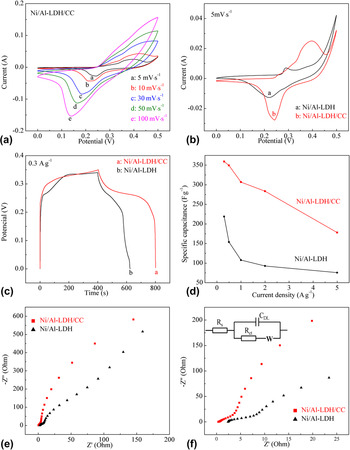
Figure 4(a) shows the CV curves of Ni/Al-LDH/CC at different scan rates in 6 M KOH electrolyte. A pair of redox peaks can be obviously observed in each of these curves, showing typical pseudocapacitive characteristic of sample, attributing to the conversion between different oxidized Ni states:
 $${\rm{Ni}}{({\rm{OH}})_2} + {\rm{O}}{{\rm{H}}^ - } \leftrightarrow {\rm{NiOOH}} + {{\rm{H}}_2}{\rm{O}} + {{\rm{e}}^ - }\quad .$$
(a) CV curves of Ni/Al-LDH/CC at different scan rates. Comparison of (b) CV curves, (c) GCD curves and (d) C sp of Ni/Al-LDH/CC and Ni/Al-LDH. (e) Nyquist plot. (f) Enlarged curves of Nyquist plot (inset is the electrical equivalent circuit).

Generally, the smaller the potential difference (ΔE ac) between the anodic and cathodic peaks, the better the reversibility. At different scan rates, ΔE ac is higher than the theoretical value of 59 mV, being irreversible. Reference Wang, Song, Li, Liu, Zhou, Jing, Zhang and Jiang30 However, the redox peaks are similar for each curve. Namely, the redox current increases with the increase of scan rate, and the oxidation and reduction peaks moved to the right and left, leading to a continuous enlargement in the potential difference. These indicate the quasireversible and faradic redox reactions, mainly leading to the faradic pseudocapacitance, of Ni/Al-LDH during the charge–discharge process.
From the CV curves in Fig. 4(b), the peak currents of Ni/Al-LDH are lower than that of Ni/Al-LDH/CC, showing the relatively slow electron transfer of the former during redox reaction. Besides, the integral areas of CV curves can be used for assessing the behavior of capacitance. Evidently, the CV surrounding area of Ni/Al-LDH/CC is larger than the pristine Ni/Al-LDH electrode under the same scan rate [Fig. 4(b)], revealing its higher capacitance.
Figure 4(c) shows the GCD curves of Ni/Al-LDH and Ni/Al-LDH/CC electrodes in 6 M KOH electrolyte at 0.3 A/g. Obviously, there are two distinct voltage stages in their discharge curves: a rapid potential drop from 0.35 to 0.27 V (the result of internal resistance), and a slow potential decay from 0.27 to 0.23 V (the capacitive feature of the electrode). The nonlinear discharge lines demonstrate the origin of discharge capacitance mainly from faradic redox reaction of Ni species Ni/Al-LDH. The C sp (F/g) can be calculated according the following equation:
 $${C_{{\rm{sp}}}} = {{I \times \Delta t} \mathord{\left/ {\vphantom {{I \times \Delta t} {(m \times \Delta V)}}} \right. \kern-\nulldelimiterspace} {(m \times \Delta V)}}\quad ,$$
where I is the discharging current (A), Δt is the discharge time (s), m is the mass of active material in the electrode (g), and ΔV is the total potential deviation (V). Obviously, compared to Ni/Al-LDH, Ni/Al-LDH/CC performs a longer discharge time at the same current density of 0.3 A/g [Fig. 4(c)], revealing better charge storage performance of Ni/Al-LDH/CC. Simultaneously, the C sp of Ni/Al-LDH/CC (359 F/g) has evident enhancement, 1.6 times of Ni/Al-LDH (219 F/g). As for Ni/Al-LDH/CC, due to its unique open structure, facilitating the contact between the electrolyte and electrode materials, the electrochemical active matters can be fully utilized to devote for capacitance improvement.
Furthermore, from the discharge curves (Figs. S1 and S2), the C sp of Ni/Al-LDH/CC electrode are found to be 359, 349, 307, 283, and 178 F/g at current densities of 0.3, 0.5, 1.0, 2.0, and 5.0 A/g, higher than the corresponding C sp of the Ni/Al-LDH electrode (219, 154, 108, 93, and 76 F/g) [Fig. 4(d)]. Similarly, the C sp of both samples decrease gradually with the increase of current densities, caused by the resistance in Ni/Al-LDH and the deficient faradic redox reaction from the active materials under high current densities. While at low current density, the diffusion time of electrolyte ions is enough to make it have a good contact with the active surface and ensure the full use of active materials.
The EIS analysis is a main method to study the electrochemical reaction kinetics. The Ni/Al-LDH/CC and pure Ni/Al-LDH were measured at open circuit potential with an ac perturbation of 5 mV during the frequency range of 100 kHz–0.01 Hz. Both the two Nyquist plots, consisting of the semicircle and the approximate straight line over the high and low frequency range respectively, are illustrated in Figs. 4(e) and 4(f) (partial enlargements of the Nyquist curves, the inset is the equivalent circuit). In the high frequency region, the intercept value (R s) of the curve at the real axis (Z′) stands for the equivalent series resistance of the three-electrode system, including ion resistance of electrolyte, intrinsic resistance of substrate and contact resistance at the active LDH materials/CC collector interface. Reference Li, Cheng, Fang, Yang, Liu and Zhang31 Meanwhile, the semicircular diameter represents the charge transfer resistance (R ct), resultant from the faradic reactions and electric double layer capacitance on particle surface, relevant with the surface properties of porous electrode active materials. The larger the diameter of semicircular, the bigger the resistance for charge transfer. According to Fig. 4(e), GNLS fitting method, Reference Momodu, Barzegar, Bello, Dangbegnon, Masikhwa, Madito and Manyala32,Reference Li, Chen, Wang, Zhang and Yan33 based on the equivalent circuit, was used for analyzing impedance data. The Ni/Al-LDH/CC shows low equivalent series resistance (R s = 0.4 Ω), charge transfer resistance (R ct = 0.5 Ω), and high double layer capacitance (C DL = 0.1759 F), in comparison with pure Ni/Al-LDH (R s = 2.4 Ω, R ct = 5.3 Ω, C DL = 0.1317 F). In addition, in the low frequency extent, the slope of the approximate straight line is the diffusion impedance (called Warburg resistance), as a result of the electrolyte ion diffusion. Reference Fan, Wang, Li, Yu and Chen34 Apparently, Ni/Al-LDH/CC curve has a larger angle to the real axis than that of Ni/Al-LDH, implying its smaller diffusion resistance. The above results can be attributed to conductive network formed by the special 3D porous structure, promoting the electron transport between the active materials and the current collector, and thus enhancing the electrochemical performance of the composites.
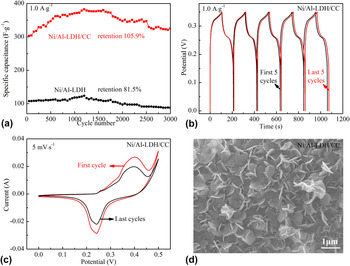
The cycling feature of supercapacitors plays a crucial role in their practical application. The GCD cycles results are seen in Fig. 5(a). The C sp of Ni/Al-LDH/CC increases by 24.4% (382 F/g, corresponding to the 1200 cycles) and 5.9% (325 F/g, after 3000 cycles) than the initial value (307 F/g), attributing to insufficient exploitation of active materials at the initial stage. With the increase of cycles, electrochemical active sites in the electrode adequately exposed to the electrolyte progressively, leading to a maximum capacitance in the cycle tests. For the Ni/Al-LDH, the original and maximum capacitances are only 108 F/g and 124 F/g, as well as the final capacitance retention 81.5% (88 F/g), implying its lower capacitance retention than Ni/Al-LDH/CC. Figure 5(b) illustrates the first and last 5 GCD curves of Ni/Al-LDH/CC during 3000 GCD cycles. Evidently, the final 5 GCD curves are also symmetric, almost coincident with the initial 5 curves, suggesting the good charge/discharge reversibility and cycling stability for Ni/Al-LDH/CC. At the same time, according to the comparison of CV curves [Fig. 5(c)], there is no obvious change between the first and last cycles, further showing superior cyclic stability of Ni/Al-LDH/CC, ascribing to its unique lamellar structure. Furthermore, the SEM image after 3000 cycle tests [Fig. 5(d)], show nearly unchanged 3D porous structure, same as the original one [Fig. 3(b)], also implying its comparatively good stability.
(a) Cycling performance of samples at a current density of 1.0 A/g. (b) The first and last 5 GCD cycles, (c) first and last cycles CV curves, and (d) SEM images after 3000 cycles of the Ni/Al-LDH/CC electrode.

To expand the potential window and enhance the energy density without sacrificing the power density, an asymmetric supercapacitor (denoted as Ni/Al-LDH/CC//AC), the Ni/Al-LDH/CC as positive electrode and AC (Fig. R1) as negative electrode, was developed. Also, its electrochemical properties were tested in 6 M KOH aqueous solution.
The individual-electrode discharge charge (Q, C/g) can be calculated by the following formula:
 $$Q = I \times \Delta t{\rm{/}}m\quad ,$$
where I is the discharging current (A), Δt is the discharge time (s) and m represents the mass of active materials.
The C sp (F/g) of asymmetric capacitor can be estimated by the following equation:
 $${C_{{\rm{sp}}}} = {I \mathord{\left/ {\vphantom {I {\left[ {\left( {{{\Delta V} \mathord{\left/ {\vphantom {{\Delta V} {\Delta t}}} \right. \kern-\nulldelimiterspace} {\Delta t}}} \right) \times m} \right]}}} \right. \kern-\nulldelimiterspace} {\left[ {\left( {{{\Delta V} \mathord{\left/ {\vphantom {{\Delta V} {\Delta t}}} \right. \kern-\nulldelimiterspace} {\Delta t}}} \right) \times m} \right]}}$$
in which, I stands for the discharging current (A), Δt is the discharge time (s) and m represents the total mass of active materials in both two electrodes.
The computational formulas for energy density (E, Wh/kg) and power density (P, W/kg) for the asymmetric capacitor are listed as follows:
 $$E = {C_{{\rm{sp}}}} \times {(\Delta V)^2}{\rm{/}}7.2\quad ,$$
 $$P = 3600 \times E{\rm{/}}\Delta t\quad ,$$
where C sp is the capacitance of capacitor (F/g), ΔV is the maximum operating voltage (V), and Δt is the discharge time (s).
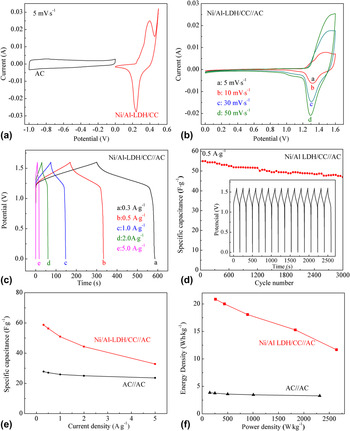
As shown in Fig. 6(a), the CV curve of AC electrode is similar to the rectangular pattern with a −1 to 0 V potential window, suggesting its electric double layer capacitance characteristic. In contrast, a pair of redox peaks is shown in CV curve of the Ni/Al-LDH/CC, with potential window of 0–0.5 V, demonstrating its faradic pseudocapacitance feature.
(a) CV curves of AC and Ni/Al-LDH/CC at 5 mV/s. (b) CV curves at different scan rates and (c) GCD curves at different current densities of Ni/Al-LDH/CC//AC. (d) Cycling performance at 0.5 A/g of Ni/Al-LDH/CC//AC. (e) C sp and (f) energy density versus power density of Ni/Al-LDH/CC//AC and AC//AC.

The mass ratio of Ni/Al-LDH/CC to AC in Ni/Al-LDH/CC//AC is controlled according to the principle of charge balance between the electrodes. Reference Zhang, Hui, Hui, Chen, Chen and Lee35 Their discharge charge values, evaluating by Eq. (3) and Fig. S3, are 106 C/g and 126 C/g respectively. Consequently, the best mass ratio of AC to Ni/Al-LDH/CC is 126:106 as for Ni/Al-LDH/CC//AC.
From the CV curves [Fig. 6(b)] of Ni/Al-LDH/CC//AC at different scan rates, the working voltage is enhanced to 1.6 V. Also, the CV curves deviate from a rectangular shape greatly, owing to the co-existence of double layer from AC and the pseudocapacitance from Ni/Al-LDH/CC. The shapes of all CV curves do not change obviously with the increasing scan rates, implying good fast charge–discharge performance. As for Ni/Al-LDH/CC, the GCD curves [Fig. 6(c)] at different current densities in 6 M KOH electrolyte under the potential window of 0–1.6 V, are almost symmetrical, typical GCD feature of supercapacitors, manifesting its good electrochemical reversibility and capacitance characteristics. Meanwhile, the cyclic life curve, 3000 continuous GCD tests at 0.5 A/g [Fig. 6(d)], is still stable. And the C sp (47 F/g) of Ni/Al-LDH/CC//AC keeps 83.9% of the initial value (56 F/g), proving its high cyclic stability and capacitance retention. Meanwhile, the first 15 times GCD curves during 3000 cycles [inset in Fig. 6(d)], is of good symmetry and reproducibility, further verifying its good long-term cyclic stability.
Comparatively, a symmetrical supercapacitor (AC//AC), AC as active materials for positive and negative electrodes, was tested in the potential window of 0–1.0 V. From formula (4) and GCD curves [Figs. 6(c) and Fig. S4], the C sp [Fig. 6(e)] of Ni/Al-LDH/CC//AC, are obtained to be 59, 56, 51, 43, and 33 F/g at current densities of 0.3, 0.5, 1.0, 2.0, and 5.0 A/g, higher than the corresponding ones of AC//AC (28, 27, 26, 25, and 24 F/g).
Meanwhile, according to Eqs. (5) and (6), the energy and power densities [Fig. 6(f)] of Ni/Al-LDH/CC//AC are obviously higher than that of AC//AC at the same conditions. Furthermore, its energy density is 5.4 times of AC//AC. The Ni/Al-LDH/CC//AC delivers an energy density of 20.9 Wh/kg at a power density of 262.5 W/kg, and still remains 12.4 Wh/kg at power density 2463.8 W/kg, much higher than AC//AC. It is well known that energy and power densities much depend on the operating voltage. In this work, the working voltage of Ni/Al-LDH/CC//AC is up to 1.6 V, larger than 1.0 V of AC//AC, indicating its superior practical applications for supercapacitor.
IV. CONCLUSIONS
In this work, the Ni/Al-LDH/CC composite, as none-binder electrode materials with CC as the conductive substrate, was successfully synthesized by a facile one-step hydrothermal method. The unique 3D porous structure could efficiently buffer the agglomeration and the volume change of Ni/Al-LDH, accelerate the contact between the electrode and electrolyte, as well as mitigate the effects of binder and conductive agents in powdered-type supercapacitors. Meanwhile, Ni/Al-LDH/CC affords a higher C sp (359 F/g at 0.3 A/g, 1.6 times of Ni/Al-LDH), better cycling performance (5.9% increase of C sp after 3000 cycles), and smaller R ct (5.3 Ω), in contrast to the pristine Ni/Al-LDH. Additionally, the assembled Ni/Al-LDH/CC//AC, Ni/Al-LDH/CC, and AC as the positive and negative electrodes respectively, exhibits a high working voltage (up to 1.6 V), large energy and power densities (energy density is up to 20.9 Wh/kg at power density of 262.5 W/kg, and 12.4 Wh/kg at 2463.8 W/kg), along with favorable cyclic performance (83.9% capacitance retention after 3000 cycles). All above results suggest the great potential of Ni/Al-LDH/CC as high-performance supercapacitors electrode materials.
Supplementary Material
To view supplementary material for this article, please visit https://doi.org/10.1557/jmr.2017.227.
ACKNOWLEDGMENTS
This work was financially supported by the Priority Academic Program Development of Jiangsu Higher Education Institutions (PAPD), the Natural Science Foundation of China (NO.21375116) and Postdoctoral Science Foundation of China (2014M551668). The related measure and analysis instrument for this work was supported by the Testing Center of Yangzhou University.