Kings are the rulers of people, but scholars are the rulers of kings
Al-‘Askari, al-Hathth‘ala talab al-‘ilm, fo.6r-vFootnote 1
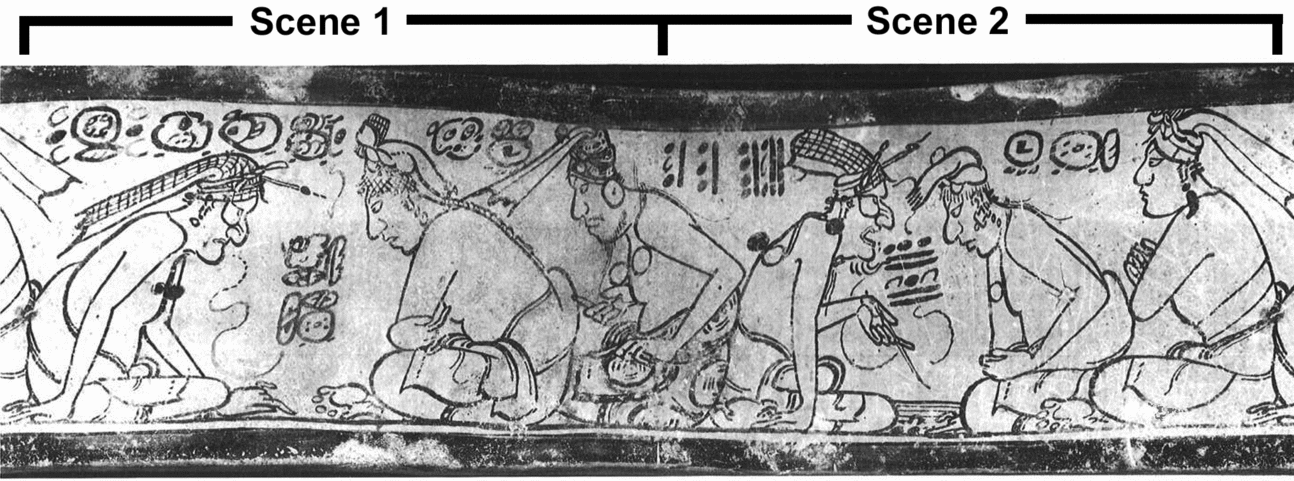
There is a well-known vase that provides a vivid glimpse into Classic Maya education.Footnote 2 Rendered as a kind of mythic template, this vessel, Vase 1196 (Kerr File No. 1196), depicts two scenes in which the same aged deity, Itzamna,Footnote 3 instructs two pairs of young men, each identified by a hieroglyphic caption (Fig. 1). One pair is identified as ‘youthful lords’ (ch'ok ajaw) of a particular place, a label indicating their statuses as heirs designate (Houston & Inomata Reference Houston and Inomata2009, 144–5), while the other pair is simply ‘of’ that same place. While the labelled distinction drawn between these two sets of students is already worthy of note, this detail is made all the more meaningful when we consider the difference in what each set of students is being taught.
A depiction of Classic Maya pedagogy in two scenes on an unprovenienced Late Classic Vessel. (Courtesy Justin Kerr).

In each scene, the teacher speaks to his students, his lessons rendered in calligraphic text blocks amidst wispy lines, a common artistic convention that indicated the inscribed words issued from his mouth. The ‘youthful lords’ are taught a maxim about the gifts of agriculture and fertility, as their teacher points instructively to the ground while staring sternly at his apprentices as if emphasizing the importance of his statements.Footnote 4 His two students look downward towards the floor to where he points. In the scene featuring the other students, the curriculum changes: the instructor speaks and gestures downward with a stylus in hand toward an open codex bookFootnote 5 as his students look on. Rather than some philosophical maxim, his words are all bar and dot numerals bound to one another by the same black wisps of line representing his speech—‘7, 8, 9, 12, 13, 11’—a lesson in numbers for his non-heir students.
Housed in the Kimbell Art Museum, this unprovenienced vase provides one of the only known representations of Late Classic period (ad 550–900) pedagogy, a view into how an idealized Late Classic educational practice was envisioned at the time (Houston & Inomata Reference Houston and Inomata2009, 187). Although similar narrative scenes exist in Classic Maya artworks—in which an aged figure, presumably the teacher or professional, sits at the fore with two younger figures seated in neat order behind (see Kerr File nos. 1180; 2220; 5450; 6500; 8457)—this particular vase is unique in that it provides explicit evidence of education in two areas of a specifically non-craft curriculum. It is evidence that education in more abstract forms of knowledge existed in structured format during the Late Classic period.
In this way, Vase 1196 could even serve to frame the notion of curricular emphases for particular demographic categories within noble classes: distinctions between broader concepts, philosophical lessons and maxims, rhetoric and oratory taught to heirs and high nobility (scene 1); and mathematics, numbers, certain technical and administrative reasoning emphasized among the lesser nobility and non-heirs designate (scene 2). A Precolumbian Mesoamerican emphasis on performance oratory and politico-ideological rhetoric in leadership posts is well attested (Carrasco Reference Carrasco2000; Inomata Reference Inomata2006)—underscored on this vessel as the curriculum of the first set of youths and evident in the titles of the highest political officials (Houston & Stuart & Reference Houston, Stuart, Inomata and Houston2001, 59). The second lesson's emphasis on mathematics, numbers and tallies would have served a purpose in the administration of polities, tribute quotas and labour demands, among other things. In other words, these two depicted areas of curriculum fit quite well with the two main ways in which archaeologists argue power was produced and maintained in Classic Maya society (Foias Reference Foias2013, 111–219; Houston & Inomata Reference Houston and Inomata2009, 28–64; Masson & Freidel Reference Masson and Freidel2002)—pedagogy and state together (though separated into distinct niches) in the classroom.
Since the term ‘state’ may initially conjure notions of a monolithic entity, it is important to emphasize that there was no single Classic Maya state. Rather, there were various Maya states operating alongside one another during the Classic period, each centred on a city and a sovereign leader supported by a royal court. Each such polity drew from a broadly shared political ideology and codified repertoire of symbols, histories and literacies in mathematics and hieroglyphic writing (Houston & Inomata Reference Houston and Inomata2009). Given this dynamic network of royal courts and the often divisive tensions of its politics, it is rather remarkable that there existed such wide standardization across polities. Education was key to this endeavour, and exploring institutionalized pedagogical systems can help us understand the ways in which these uniform approaches to statecraft were nurtured among the elite and ruling strata.
It is no secret that education is key to shaping society and naturalizing cultural, political and economic practices (and the inequalities such organizational systems sustain). Specialized and commonly controlled forms of knowledge have long been closely connected to political power in this way, a relationship going back to eras before sedentism and the subsequent technologies of writing and bureaucracy ever took shape (Kelly Reference Kelly2015; Renfrew Reference Renfrew, Renfrew and Scarre1998). Thus understanding how particular forms of knowledge are created, defined, controlled and dispersed through institutions and pedagogical processes constitutes a vital anthropological approach for examining how power, systems of inequality, cultural difference and structures of violence are produced, normalized and reinforced in societies across time.
In this article, I explore evidence of scholars, specialized knowledge and systems of education within the context of Precolumbian Mesoamerica, specifically among the multiple competing sovereignties commonly grouped as Classic Maya ‘civilization.’ By examining the concrete details surrounding the creation and transmission of controlled knowledge—the specific social, political and economic details, physical sites of instruction, curricula and actors that inhabit such institutions—we can better grapple with what are often abstract notions of power through populating institutional settings with ‘the physical persons who constitute the state’ (Fassin Reference Fassin and Fassin2015, 4) and thus better understand how such roles and everyday practices fit into the construction and maintenance of Maya statecraft.
The archaeology of education
Modern scholars have long been working to understand educational systems in ancient societies. Primary historical documents and inscribed texts have been vital in these endeavours, providing crucial sources for the kinds of data—curricula, patronage information, student/teacher demography, etc.—that often elude archaeologists when considering formalized instruction (Beck Reference Beck1964; Bonner Reference Bonner1977; Gilliot Reference Gilliot2012; Lucas Reference Lucas1979; Siu Reference Siu1993; Williams Reference Williams1972). As these studies make clear, much of the early formal education that we know of is both linked to and sourced in written documents and inscribed objects, with non-inscribed archaeological data and material objects related to contexts and agents of learning often difficult to identify.
Throughout the ancient world, a broad curriculum of specialized and often state-sponsored forms of knowledge were at the core of formal education, which were commonly carried out and taught within specific ‘communities’. Whether discussed as ‘script communities’ (Houston Reference Houston2004), ‘textual communities’ (van Egmond Reference van Egmond and van Soldt2012) or ‘communities of practice’ (Wendrich Reference Wendrich2012), these social institutions operated akin to what we might call schools today. In some cases, these took shape as formalized state and/or religious institutions built around particular bodies of knowledge, and in others, education took on more informal forms built upon the teachings of a single or small group of scholars and their schools of thought (Berkey Reference Berkey1992; Cribiore Reference Cribiore2001; Goodblatt Reference Goodblatt1975; Mookerji Reference Mookerji1969; Reece Reference Reece1968; Smith Reference Smith1955). Familiarity with the written word was often central in these ancient educational contexts, and cohorts of writing practitioners and keepers of other controlled forms of knowledge frequently held or went on to hold additional social, ritual and administrative roles that went beyond literacy alone (Baines Reference Baines1983; Flad Reference Flad2008; Lurie Reference Lurie2011; van Egmond & van Soldt Reference van Egmond and van Soldt2012).
In cases for which neither writing systems nor historical accounts from observers existed to draw on, archaeological approaches toward education and knowledge transmission have often revolved around discussions of chaîne opératoire, social learning theory and Bourdieu-inspired practice in ‘crafting’ contexts as key windows into learning processes (Bamforth & Finlay Reference Bamforth and Finlay2008; Bourdieu Reference Bourdieu1977; Crown Reference Crown2014; Fischer Reference Fischer1989; Leroi-Gourhan Reference Leroi-Gourhan1964; Minar & Crown Reference Minar and Crown2001; Tehrani & Riede Reference Tehrani and Riede2008). Other approaches explore the transmission of locally important cultural and historical knowledge within primarily oral traditions, investigating how such information was pragmatically encoded (commonly in verse and song) and recalled with the aid of local natural and constructed landscapes, as well as with the help of particular objects (Bassie-Sweet Reference Bassie-Sweet2008; Basso Reference Basso1996; Kelly Reference Kelly2015; Renfrew Reference Renfrew, Renfrew and Scarre1998).
Archaeologies of childhood and adolescence are at the core of many inquiries into education as well (Kamp Reference Kamp2001; Sofaer Derevenski Reference Sofaer Derevenski2000). These rely on diverse approaches, like osteology, cognitive science, ethnohistory and ethnography, to look at the informal ways in which individuals were socialized and taught—using evidence of youths’ experiences of learning and ‘play’ to show how these experiences were important for the ways in which societies functioned and changed through time (Baxter Reference Baxter2006; Cunnar & Högberg Reference Cunnar and Högberg2015; Finlay Reference Finlay, Moore and Scott1997; Greenfield et al. Reference Greenfield, Maynard and Childs2000; Högberg Reference Högberg2008; Park Reference Park1998). In the study of Precolumbian Mesoamerica, such approaches have proven richly productive for scholars investigating diverse political, gendered and ancestral economies and concepts of both individual and community identity in ancient households, neighbourhoods and states (Ardren & Hutson Reference Ardren and Hutson2006; Hammond & Hammond Reference Hammond and Hammond1981; Hayden & Cannon Reference Hayden and Cannon1984; McAnany Reference McAnany2010; Wilk & Rathje Reference Wilk and Rathje1982).
Writing and artistic works have unsurprisingly been at the centre of archaeological inquiries into the transmission of literacy and other specialized forms of knowledge in Classic Maya society (Coe Reference Coe1973; Houston & Stuart Reference Houston and Stuart1992; Vail Reference Vail2015). Scholarly approaches to these specialized forms of knowledge often bring together material analyses of craft production with ethnographic, epigraphic and iconographic inquiries into certain classes of material objects. These include polychrome ceramics, murals, stelae and codex books that were crafted by individuals known by their artistry and craft: as scribes, artisans, carvers, or scribal specialists (Hurst Reference Hurst2009; Satterthwaite Reference Satterthwaite1965; Stuart Reference Stuart1989).
At the rapidly abandoned site of Aguateca, for example, a wealth of artefactual evidence showed that elite residents across four different households crafted various objects requiring specialized knowledge across many different media forms: ornamental shell and bone carving; limestone, jade and pyrite stone work; fine polychrome ceramic painting; and possibly even codex books as well (Aoyama Reference Aoyama2009; Inomata et al. Reference Inomata, Triadan, Ponciano, Pinto, Terry and Eberl2002). In the north room of Structure M8-10 a large concentration of scribal implements was found, including a chert pestle and concave object for grinding pigments, stone mortars for mixing pigment and three halved conch-shell inkpots (Inomata & Stiver Reference Inomata and Stiver1998, 437). A barkbeater was found in the south room of the same structure. This evidence collectively has led some archaeologists to categorize this building as a ‘house of writing’ (tz'ibnaah)—sometimes depicted on polychrome ceramic vessels—where literacy was practised and likely imparted (Fash Reference Fash1991, 120; Houston Reference Houston2000, 149–50). At Copan, similarly compelling evidence suggests that Structure 9N-82 was possibly a ‘house of writing’ as well (Fash Reference Fash1991, 135–7; Webster Reference Webster1989), while nearby, epigraphic and iconographic evidence suggests another residence, Group 9M-22, to have been a ‘house of sculpture’(Houston Reference Houston2000, 150). One ancient resident of Structure 9N-82 held the courtly office of Ah K'uhuun (Houston & Inomata Reference Houston and Inomata2009, 259) and individuals working in this office, while undoubtedly literate, were not just ‘scribes’. Rather, they seem to have performed a variety of political and religious roles within royal courts as well (Jackson & Stuart Reference Jackson and Stuart2001; Zender Reference Zender2004). The same has been proposed regarding several other courtly titles in which literacy was a clear feature, though not the defining characteristic (Houston & Stuart Reference Houston, Stuart, Inomata and Houston2001).
Much of the evidence at Aguateca shows tools and artistic products overlapping with one another across these various residential contexts, implying in some senses a kind of broadly elite practice of ‘art-making’ as opposed to a particular object speciality (Inomata Reference Inomata2001)—residents operating as artistic and literate ‘multicrafters’ (Hirth Reference Hirth2009). Meanwhile, various studies on inscribed and artistically specialized objects have confirmed their creation and distribution among a distinctly elite class of individuals (Halperin & Foias Reference Halperin and Foias2010; Reents Budet et al. Reference Reents-Budet, Bishop, Taschek and Ball2000; Webster et al. Reference Webster, Fash, Widmer and Zeleznik1998; Widmer Reference Widmer and Hirth2009)—with kings and queens of Maya polities even bearing responsibility for their creation in some cases (Reents-Budet Reference Reents-Budet1994, 55–6). Yet, as the Copan Ah K'uhuun case reminds us, it is important to remember that such individuals were part of a social stratum akin to an aristocracy. As such, they were an elite demographic of society, the majority of whom would probably not have been producing these objects as their primary means of livelihood (Houston & Inomata Reference Houston and Inomata2009, 182–92; Kovacevich Reference Kovacevich, Hirth and Pillsbury2013, 270).
The kinds of speciality material objects found in the Aguateca residences and in various other contexts throughout the Maya area pull from broadly shared and surprisingly consistent bodies of abstract, decidedly ‘elite’ knowledge and ideological repertoires in their art-making. Such works required an intimate acquaintance with shared and even standardized conventions in writing and literacy, religious doctrine and elite decorum; and in many cases and to varying degrees, mathematics and natural sciences as well (Aveni Reference Aveni2011; Herring Reference Herring2005; Houston et al. Reference Houston, Robertson and Stuart2000; Schele & Miller Reference Schele and Miller1986). This is not to say that styles and forms between polities and regions across the Maya Lowlands did not differ—but rather to note that the core themes, aesthetics and content guiding the creation of these classes of non-utilitarian objects were widely shared and surprisingly conservative across regions and through time (Houston Reference Houston2000, 142–7; Jackson Reference Jackson2009; Loughmiller-Newman Reference Loughmiller-Newman2008; Taube Reference Taube2004). Thus the contexts of use, forms and content of these objects would have been largely legible across the Classic period aristocratic demography, and in certain tightly controlled ways would have contributed to reinforcing inequalities and social hierarchies to the general public as well (McAnany Reference McAnany, Wells and McAnany2008).
I emphasize here that while this article reviews pedagogical processes not all that different from the kinds of informal pedagogies and workshop apprenticeships widely discussed in the archaeological literature, it seeks to contribute an elaboration of more formal educational structures in which the production of crafts and artistic works were ancillary and not necessarily the intended ‘trade’ for pupils. In other words, I am trying to draw out what I would classify as a non-craft-based pedagogy, the likes of which we see on Vase 1196—a controlled, and ostensibly elite, curriculum in which shared conventions in civics, writing and literacy, religious doctrine, elite decorum, ritual practice, oratory, mathematics and science were taught as a means to instill specialized and highly political knowledge in students; and imbue alongside these shared conventions a consciousness of possessing restricted knowledge which set them apart in society.
Beyond naturalizing inequality, these specialized forms of knowledge were also politically very important in that they framed and structured many key aspects of social, political and religious life and appear to have helped shape public understandings of causality (Milbrath Reference Milbrath1999; Rice Reference Rice2008; Wells & Davis-Salazar Reference Wells and Davis-Salazar2007). Such knowledge was instrumental in reinforcing existing power structures by assuring institutions of Maya states were ‘able to rest their claims to legitimacy on their fit with the nature of the universe’, as Mary Douglas once put it (Reference Douglas1986, 46). Claims to legitimacy were intimately bound up with the performance and spectacle surrounding public ritual, political ceremony and state sacrifice—crucial to the functioning of Classic period Maya societies, and a means by which local institutions legitimized and stabilized governing authority and social hierarchies while simultaneously reaffirming community cohesion (Houston & Stuart Reference Houston and Stuart1996; Inomata Reference Inomata2006; Lucero Reference Lucero2003). But what were the institutional structures and formal channels by which such knowledge was generated, transmitted and disseminated; where was it taught? To which specific actors did various kinds of pupils go to learn these complex and abstract forms of knowledge that adorn portable objects at sites like Aguateca, and monumental art and architecture at ancient cities like Copan and Palenque? Such artefacts and monuments are bound up with shared messages of noble authority—but what pedagogical processes perpetuated these messages through time, and how might we identify them archaeologically?
Insights from Aztec education
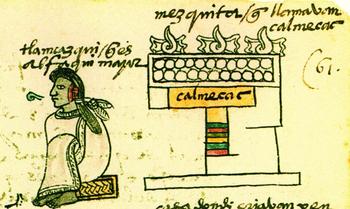
Accounts of the Aztec Empire provide an important comparative case study regarding Precolumbian education. Operating at the time of Spanish arrival, Aztec schools are perhaps the most thoroughly documented of indigenous American educational systems. We are told that formal schooling was compulsory for all Nahua children born within the Aztec Empire (Torquemada Reference Torquemada1723, 187). However, rather than promoting the kind of individual personal development or particular ‘trade’ common to Western scholastic tradition, these schools instead focused on efficiently and productively integrating youths into Nahua society and state. There were two categories of school, both of which were attached or in close association with temples dedicated to particular deities: the ‘telpochcalli’, which was mostly for the children of ‘common folk’ (macehualtin) to train and serve as warriors and eventually join their community as ordinary citizens; and the ‘calmecac’, which was an institution of higher learning where the children of lords, nobles, dignitaries and priests were educated. Military training was a key part of both school curricula (Fig. 2).
Aztec calmecac, reproduced from Codex Mendoza.

Although there was a clear trend in which social classes attended which institution, this was not a formalized policy and sources strongly suggest that the choice of whether a child attended the telpochcalli or the calmecac lay with his father and his abilities, regardless of whether or not the child was common or noble-born (Calnek Reference Calnek, Klor de Alva, Nicholson and Quiñones Keber1988; Sahagún Reference Sahagún, Dibble and Anderson1978). This has led to a commonly accepted idea that, although highly gendered (Joyce Reference Joyce2000), Aztec state education was meritocratic at least to some degree.
The Aztec example reveals a sophisticated Precolumbian state education system with two types of institutions, both of which were attached to temples and their state-sponsored ideologies (perhaps with varied points in curriculum between temples and across regions: see Calnek Reference Calnek, Klor de Alva, Nicholson and Quiñones Keber1988). They were formal, in that they were institutions in which student life was wholly separated from family residences and workshops. There were more telpochcalli than calmecac, funnelling most young men into military service. But although there were fewer calmecac, these schools were vital state instruments for training and placing the elite (whether by ability or bloodline) into positions of state and religious authority, administration and government. Frances Berdan (Reference Berdan2014, 203) summarizes the specific studies undertaken in the calmecac as including ‘history, calendrics, songs, orations, and hieroglyphic writing, which was said to serve as the basis for mastering the mechanical, military, astrological, religious, and legal curriculum’. The Aztec system thus serves as a helpful model for thinking about the socially integrative ways in which certain domains of knowledge were more widely shared than others, as well as how these varying degrees of shared knowledge might contribute to cultural ideas of social hierarchy and order. Furthermore, and in line with Aztec ideas of social order (as well as with education systems in many other parts of the world), it was the religious authorities that transmitted specialized knowledge and sciences to the youth within the calmecac.
Many archaeologists have searched for the Maya equivalent of a calmecac (Cheek & Spink Reference Cheek, Spink and Sanders1986; Harrison Reference Harrison1970; Izquierdo Reference Izquierdo1983; Souza de Fernández Reference Souza de Fernández2002). After all, there were Maya ‘Men's Houses’, highly similar to Aztec telpochcallis, which are attested in the colonial, ethnographic and even occasionally in the archaeological record of Maya societies through time (Houston Reference Houston2009). Yet archaeological support for a Maya calmecac nonetheless remains quite elusive.
As testament to the difficulty in identifying educational loci, the most important calmecac of the Aztec Empire, located in the heart of the Aztec capital of Tenochtitlan (modern-day Mexico City), has only recently been archaeologically identified. Raúl Barrera and his team discovered the walls of a large building with wide staircases and dozens of artefacts that hint at student life in ad 1500. However, as mostly everyday objects, these artefacts do not really prove education was carried out there. The evidence confirming that the find was indeed the Tenochtitlan calmecac came from several of the institution's distinctive roof ornamentations, which were documented in the colonial record (Atwood Reference Atwood2014). In other words, secondary Spanish accounts have been vital in trying to identify ancient places of learning, even in cases like the Tenochtitlan calmecac in which general location and size were already more or less understood.
Textual sources on Maya education
Writing from the Yucatan Peninsula during the sixteenth century, Diego de Landa provides another key source on Precolumbian education. He tells us of intellectually rigorous Maya pedagogy reminiscent of the Aztec calmecac, albeit at a much smaller scale. Landa states that this system was firmly in the hands of figures he called ‘high priests’, who were revered for their specialized knowledge by lords and farmers alike. Unlike the more meritocratic acceptance policies described for their Aztec contemporaries, these Maya ‘priests’ apparently taught only members of the nobility: lords, heirs, would-be ‘priests’ and other individuals of high rank (Roys Reference Roys1972, 87; Tozzer Reference Tozzer1941, 27). Though not as extensive as the descriptions of the Aztec educational system, Landa does provide an informative description of Maya specialized pedagogy in which the teacher, rather than the institution, is the central organizing principle. Landa writes of the ‘high priest’:
He was very much respected by the lords and had no allotment of Indians, but besides the offerings, the lords made him presents and all the priests of the towns brought contributions to him, and his sons or his nearest relatives succeeded him in his office.
In him was the key of their learning and it was to these matters that they dedicated themselves mostly; and they gave advice to the lords and replies to their questions . . .
They provided priests for the towns when they were needed, examining them in the sciences and ceremonies, and committed to them the duties of their office, and to the good example to people and provided them with books and sent them forth. And they employed themselves in the duties of the temples and in teaching their sciences as well as in writing books about them . . .
They taught the sons of the other priests and the second sons of the lords who brought them for this purpose from their infancy, if they saw that they had an inclination for this profession . . .
The sciences which they taught were the computation of the years, months and days, the festivals and ceremonies, the administration of the sacraments, the fateful days and seasons, their methods of divination and their prophecies, events and the cures for diseases, and their antiquities and how to read and write with the letters and characters, with which they wrote, and drawings which illustrate the meaning of the writings. (Tozzer Reference Tozzer1941, 27–8)
These priestly figures—advising lords, instructing others, serving as the ‘key’ of Maya learning, writing books on Maya science, medicine, antiquities, etc.—were the scholars and the teachers of Precolumbian Yucatan. Landa makes no mention of any public buildings dedicated to specialized instruction akin to a calmecac, but rather, we are told this specialized education was carried out within the residences of these ‘priests’ instead of within communal ‘Men's Houses’. The emphasis here is on the individual ‘priest’ (and his bloodline) as the institution. Landa reminds us this priestly figure trained not only other ‘priests’, but the sons of lords (a decidedly elite demography); that he was financially supported through the patronage of lords; and that students were sent to live with him. Landa further informs us that the young students sent to live with a particular ‘priest’ were male. That these students were taught within a residential context suggests a kind of small-scale, niche educational experience quite different from the more rigid large-scale institutional contexts of the Aztec calmecac, telpochcalli or even Maya Men's Houses. Also, female and child members of a priest's family would have been at least peripherally present within residential learning contexts on a daily basis.
Landa also provides key details regarding the curriculum taught by these ‘priests’, which he glosses as ‘sciences’. These sciences echo the curriculum described in colonial sources for the Aztec calmecac—a reminder that broadly shared concepts of what constituted specialized knowledge have long existed within Mesoamerica, and supporting discussions for the significant movement of individuals and their ideas across regional and socio-political boundaries (Price et al. Reference Price, Burton, Fullagar, Wright, Buikstra and Tiesler2008; Tokovinine & Beliaev Reference Tokovinine, Beliaev, Hirth and Pillsbury2013; Vail & Hernández Reference Vail and Hernández2010; White et al. Reference White, Storey, Longstaffe and Spence2004).
Movement back and forth to renowned centres of knowledge across Mesoamerica is a key thematic component to various surviving foundational and personal dynastic narratives (Carrasco et al. Reference Carrasco, Jones and Sessions2000; Estrada-Belli et al. Reference Estrada-Belli, Tokovinine, Foley, Hurst, Ware, Stuart and Grube2009). Colonial documents additionally make clear that certain cities were indeed regarded as centres of learning. The Nahua city-state of Tezcoco was apparently one such location, well known as a place of the learned within the Aztec Empire (Alva Ixtlilxóchitl Reference Alva Ixtlilxóchitl and O'Gorman1975–77; Lee Reference Lee2008).
The Postclassic Maya centre of Mayapan is cited by Landa as having been a place of learning to which ‘priests’ came for instruction before returning to their villages more knowledgeable and in possession of sacred bark-paper books (Tozzer Reference Tozzer1941, 39–40)—a detail prompting arguments that Mayapan was possibly a center for codex book production as well (Love Reference Love1994: 13–14; Milbrath & Peraza Lope Reference Milbrath and Peraza Lope2003;). Looking backward, Calakmul, the hegemonic nexus of Late Classic Maya political power, stands as perhaps the best potential candidate for such a centre existing during earlier times. In at least two hieroglyphic contexts from much smaller and politically subordinate sites, royal youths are either depicted or discussed as ‘going away’ to Calakmul for extended periods of time (Houston & Inomata Reference Houston and Inomata2009). In a statistical analysis of hieroglyphic signs, Nikolai Grube shows a Late Classic surge and standardization of new phonetic signs rippling across the Lowlands after ad 562 (Grube Reference Grube, Robertson and Fields1994). Intriguingly, this is the exact moment in time at which Calakmul was taking hegemonic control of most of the Maya Lowlands—and fits well with the hypothesis that as Calakmul itself became the central political hub in the Maya landscape, it also became the premier centre for the generation and increasingly standardized dissemination of elite learning, writing and specialized knowledge forms.
Of course, discussion of such centres of learning does not preclude the existence of localized educational institutions at less dominant Maya polities. Rather, it complicates our models of education during the Late Classic period. Landa tells us that, once trained, the students of the ‘high priest’ would be sent back out to their communities. Ostensibly, such former students could take on local students of their own. But how these scales of education and movement played out in Classic Maya society is difficult to pin down. For instance, was a specialist trained at a major centre like Calakmul considered more valuable than one trained at Naranjo? It is intriguing to think of shifting hierarchies related to educational pedigree among Maya educated persons as emerging as part of such systems, resulting in a complex and shifting network of intellectual influence, knowledge production and dissemination every bit as dynamic as the Maya political sphere itself.
The archaeology of Maya schools
Peter Harrison (Reference Harrison1970) made one of the first concerted archaeological attempts to locate Classic Maya schools in place and time, focusing on the Central Acropolis at Tikal. He suggested that three structures may have operated as a kind of telpochcalli—which he termed a Boys’ Pre-marriage House—and that up to five different structures may have served as priestly residences and schools akin to the Aztec calmecac (Harrison Reference Harrison1970, 267–72). Harrison based these assertions, however, on evidence that he carefully acknowledged as relatively tenuous: largely based on graffiti content, architectural features related to size and sleeping quarters, and (in the priestly school instance) an absence of burials. Since the time of Harrison's important initial work, there have been subsequent attempts to identify Maya ‘schools’. However, these attempts have often come up against the same problem of recognizing compelling diagnostic evidence of learning as distinct in some way from general artefacts of residential life (Cheek & Spink Reference Cheek, Spink and Sanders1986; Cohodas Reference Cohodas1976).
Scott Hutson (Reference Hutson2011) recently revived the proposition that graffiti imagery serves as a possible diagnostic of learning, in work that pulls from the much broader corpus of graffiti documented at Tikal. While graffiti are found in a variety of contexts that were clearly not schools, they also occur (and would even be expected) in contexts of education. Loosely echoing some of Harrison's previous suggestions, Hutson raises the possibility that incised, haphazard images possibly reflect inter-subjective learning processes, in which ‘beginners and those with more experience work and play together informally’ (Hutson Reference Hutson2011, 422).
Alongside Hutson's work on identifying diagnostic remnants of learning processes, Stephen Houston (Reference Houston2000; Reference Houston2009; Reference Houston2012) has explored the question of Maya schooling, bringing to light several loci where formalized instruction of some kind is suggested via secondary (artistic or textual) evidence. Each of these suggested contexts is similar in that they occur in royal precincts or palace complexes. Two of his suggested examples (Str. Sub IA at San Bartolo and Str. 1 at Bonampak) are separated in time by nearly a thousand years, and feature finished murals in intimate, restrictive settings that emphasize didactic ‘moral narratives’ on themes of royal duty and obligation, and local historicity (Houston Reference Houston2012, 153; Miller & Brittenham Reference Miller and Brittenham2013; Saturno Reference Saturno, Fash and López Luján2009). Both examples also contain some limited evidence of subsequent graffiti-like sketching, unrelated to the mural programmes.
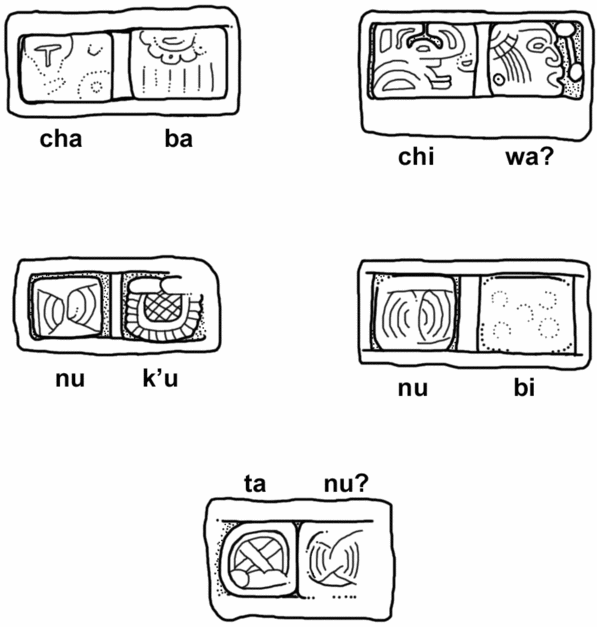
Carved and inscribed stone evidence forms the basis for Houston's remaining four examples. The evidence cited at two of these contexts relates directly to the physical and military expectations for young men in Maya society—with scenes of boxing and wrestling at Rancho San Diego and a hieroglyphic proclamation of six important war captives (all but one of who are called ‘youth’) at Palenque (Houston Reference Houston2009; see Barrera Rubio & Taube Reference Barrera Rubio and Taube1987). The last two examples he points out are from northern and southern extremes of the Maya area: Chichen Itza in Mexico and Copan in Honduras. At Chichen Itza, Houston highlights a potential ‘House of Writing’ at the Osario structure, based on what he compellingly argues to be a Maya syllabary (Houston Reference Houston2000, 150). This is the only artefact I am aware of from which specific insight into the hieroglyphic learning process can be gleaned. The carved panel pairs hieroglyphic syllables in complementary oppositions, suggestive of a mnemonic device for memorizing hieroglyphic signs (Fig. 3).
Possible hieroglyphic primer from Osario, Chichen Itza (redrawn after Houston Reference Houston2000, 151).

In the final example at Copan, a carved ‘great youth’ title (chak ch'ok) and roof ornamentations evoking Copan's dynastic crest led to Houston's suggestion that Str. 10L-20 of the East Court was a young men's house (Houston Reference Houston2009, 172–3; see Fash Reference Fash2011, 80, fig. 92). Under increased scrutiny, this last example has proven an increasingly compelling case as potential quarters for specialized students (as have several of Houston's suggestions), though full discussion extends beyond the scope of this article. Building on these examples, one recently published context from the Classic Maya site of Xultun, Guatemala, to which I now turn, has also yielded compelling evidence of an educational locale. This high-status residence within one of the urban centre's administrative sectors, called Los Sabios, helps expand discussion of these questions of Classic period pedagogy and the politics that surround it.
Los Sabios, Xultun, as a place of learning
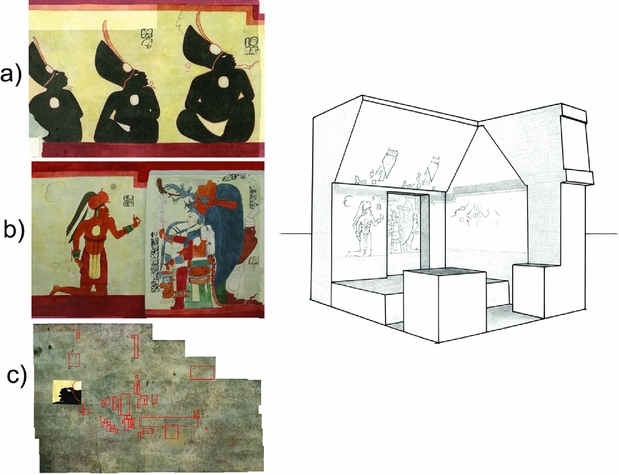
Constructed upon a natural promontory, Los Sabios sits just west of Xultun's main palace group and administrative sector, connected via a labyrinth of passageways and promenades. Discovered in 2010, an eighth-century mural in a small vaulted chamber of the residential group contains evidence of specialized knowledge being generated, curated and transmitted, alongside evidence for codex book creation and inscription (Rossi et al. Reference Rossi, Saturno and Hurst2015; Saturno et al. Reference Saturno, Aveni, Stuart and Rossi2012; Reference Saturno, Hurst, Rossi and Stuart2015). Bi-partite in composition, the mural features an instructive primary scene depicting a hieroglyphically ranked and uniformed order of individuals and novices interacting with the local ruler, and a programme of more than 40 distinct numerical and astronomical calculations, rendered separately from the mural and inscribed in various hands over and around the figures of the mural scene (Fig. 4). Members of the order depicted in the scene are labelled with ranked variations of a shared title of the office, ‘Taaj’. The arrangement of these figures interestingly aligns with Classic Maya artistic conventions to provide ‘visual guidance to social hierarchy and interaction’ (Houston Reference Houston2012, 168–9; see Meskell & Joyce Reference Meskell and Joyce2014, 51)—adding an instructional, almost didactic quality to the mural scene.
Los Sabios mural: Rm. 2, Str. 10K2 reconstruction with north and east walls visible; reconstruction of mural scene (right); (left) (a) west wall; (b) north wall;(c) east wall with figure and micro-text sections highlighted. (Illustrations: H. Hurst.)

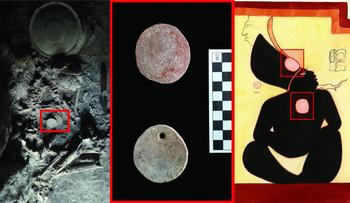
Elsewhere, researchers have explored the associations between these men labelled as ‘Taaj’ (Classic Mayan for ‘obsidian’) in the iconographic, epigraphic and ethnohistorical record (Saturno et al. Reference Saturno, Rossi, Hurst and Stuart2017). These findings show that such Taaj figures existed at various distant polities during the Classic period, with their titles and uniforms hinting at a standardization of this ranked order and the roles of its members across the eighth-century Maya Lowlands. There is also strong evidence that codex books were made at Los Sabios by these Taaj; yet there is no indication that the Taaj figures were perceived as ‘scribes’ or ‘bookmakers’ per se (Rossi et al. Reference Rossi, Saturno and Hurst2015; Saturno et al. Reference Saturno, Rossi, Hurst and Stuart2017). As ethno-historic narratives convey, individuals during the colonial era who generated and recorded astronomical, calendrical and other similar bodies of specialized knowledge were not regarded as ‘scribes’ or ‘bookmakers’ either. Instead, book-making was simply one aspect of a much broader purview for such figures, which, at least during the sixteenth century, included teaching the kinds of non-craft pedagogies for specific portions of high-born youth that this article explores for the Classic period. Los Sabios looks to have been one such context where a specialized kind of pedagogy was taking place for at least few decades during the mid eighth century, after which the mural chamber was filled in, sealed and converted into a shrine for one of these Taaj, presumably the resident teacher (Fig. 5; Rossi et al. Reference Rossi, Saturno and Hurst2015).
Burial 10 (left); ceramic pendants (centre) and Sakun Taaj of mural room west wall (right). (Illustrations: H. Hurst and L. Hammon; photographs: author.)

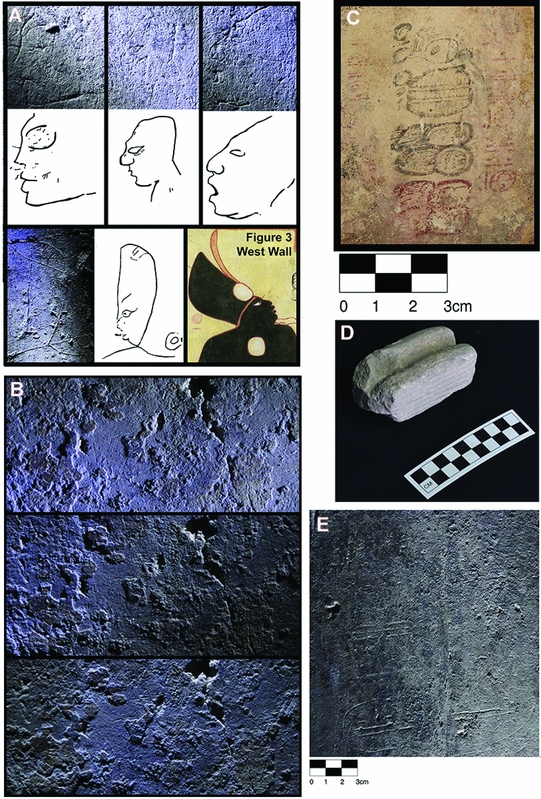
A key piece of evidence underpinning this argument for pedagogy by the Taaj is micro-writings and sketches in the mural room itself. Some of the inscriptions are sketches of deity heads and rudimentary copies of the mural scene figures, incised or painted in various places in the room (Fig. 6). Some are expertly drawn, others less so. In other contexts such ‘sketches’ might be referred to as ‘graffiti’ (i.e. Trik & Kampen Reference Trik and Kampen1983). However, when the filling and sealing of the room is considered, it appears that these drawings were carried out during the limited use-life of the room, as experts and novices practised side-by-side.
Evidence of pedagogy and book-making. (A) Incised profiles on mural room walls (Illustrations: author and H. Hurst); (B) multiple levels of replastering and re-inscription on east wall; (C) east wall micro text (see Aveni et al. Reference Aveni, Saturno and Stuart2013); (D) bark beater; (E) east wall incised ring numbers (see Saturno et al. Reference Saturno, Aveni, Stuart and Rossi2012). (Photographs: author.)

In addition to these sketches, assorted mathematical micro-texts constitute the primary evidence of local scientific practice, and are interspersed amongst the painted figures of the instructive narrative scene (Aveni et al. Reference Aveni, Saturno and Stuart2013; Bricker et al. Reference Bricker, Aveni and Bricker2014; Saturno et al. Reference Saturno, Aveni, Stuart and Rossi2012). Again, various handwritings and refinements make it clear that multiple people of varying skill levels were working side-by-side within the room (Fig. 6; see also Saturno et al. Reference Saturno, Hurst, Rossi and Stuart2015). These sciences included certain kinds of predictive astronomy and their accompanying mathematics, systematic reconciliations between human calendars and celestial cycles, as well as almanacs and divination tools that were built upon ‘indigenous concepts that deal with quantitative knowledge of the natural world’ (Aveni Reference Aveni2011, 187). The scientific texts constitute a completely separate body of work from the narrative scene and are unfinished in the sense that most are informally organized, not clearly related to one another, incomplete, and in some cases even crudely rendered.
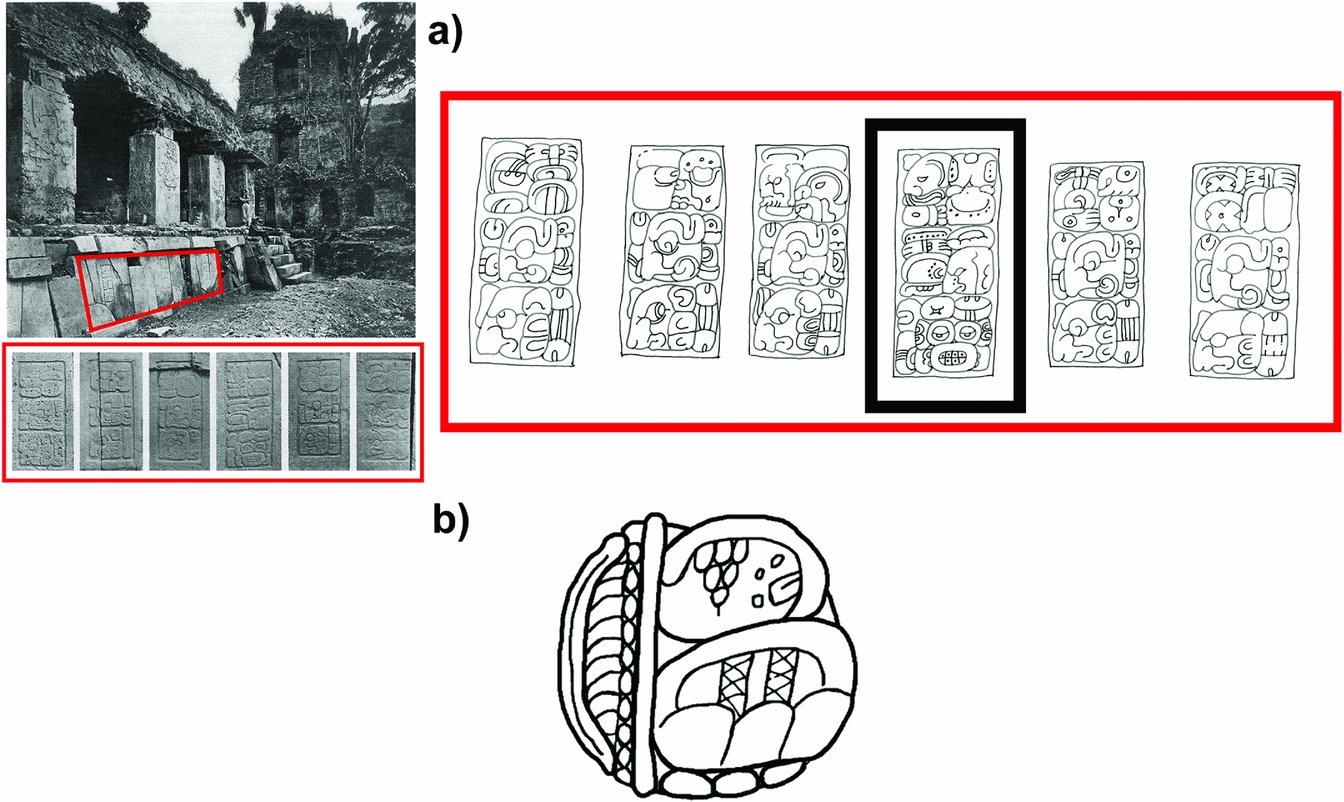
In and of themselves, these inscribed and artistic data suggest that Los Sabios was place where a curriculum of mathematics and natural sciences was actively being developed, practised and transmitted to novices, alongside being inscribed as ‘finished’ content within codex books for future reference and consultation (Saturno et al. Reference Saturno, Aveni, Stuart and Rossi2012; Rossi et al. Reference Rossi, Saturno and Hurst2015). We also see in the Xultun mural scene the individual ranked as the ‘senior’ member of the Taaj order (Sakun Taaj, or ‘Senior Obsidian’). This figure is seated at the front of two ‘youth’ novices of the order, closely in line with common artistic conventions when rendering teacher and student, master and novice, in Maya art. This same ‘Senior Obsidian’ title turns up in only two other known epigraphic contexts and in both of those instances it also occurs in close association with high-born youths (Fig. 7; Saturno et al. Reference Saturno, Rossi, Hurst and Stuart2017). One of these two examples, House C at Palenque, is among potential educational locales put forth by Houston (Reference Houston2009), mentioned above. The other is from a high-status residence excavated and published as part of the Copan ‘North Group’ (Ashmore Reference Ashmore1991, 210; Carelli Reference Carrelli1990).
Other occurrences of Sakun Taaj. (A) (left) Potential ‘Men's House’ of House C, Palenque with carved panels below (Maudslay 1889–Reference Maudslay1902, pls. 26, 29); (right) Line drawings of carved panels with texts naming youths (ch'ok) and a Sakun Taaj (enclosed in black box) (drawing: Linda Schele © David Schele); (B) Medallion inscription from Str. 8L-74, North Group, Copan (redrawn after C. Carrelli in Ashmore Reference Ashmore1991, 210).

Even the wall surfaces of the Los Sabios mural room reveal an active and perpetually revised work space, in which plasters were continually reapplied over inscribed surfaces in order to create new writing surfaces. The area of densest micro-text concentration occurs on the lower east wall, where at least three superimposed layers of text—rendered over successively applied, thin plaster patches—indicate that individuals working in the mural room inscribed texts, plastered over these texts and inscribed them anew (Saturno et al. Reference Saturno, Hurst, Rossi and Stuart2015). This wall was thus treated as kind of practice scratchboard akin to what we see in ancient schools and pedagogical documents in other parts of the world (see, for example, Cribiore & Davoli Reference Cribiore and Davoli2013). Taken together, these features of Los Sabios provide a useful rubric for comparison with other archaeological contexts as a potential way forward in the study of formal pedagogical systems in Maya society—complementing and extending earlier assessments of the archaeological signatures that may help identify spaces of specialized educational in Classic Maya cities.
Discussion: gender divides and class stratification in Precolumbian education
The various archaeological contexts discussed as potential Maya ‘schools,’ though varied, are all closely associated (if not directly part of) palace structures, or what Simon Martin (Reference Martin, Inomata and Houston2001) has called ‘court complexes’. In a discussion on these complexes, Martin underscores what he sees as four key functionalities of extended court complexes: that they contained the offices of state officials; workshops for craft production; settings for tribute administration; and residences for temporary and long-term foreign visitors—arguments which have been roundly supported by the archaeological record from sites across the Maya area, including Los Sabios (Chase & Chase Reference Chase and Chase1992; Christie Reference Christie2003; Hendon Reference Hendon1987; Inomata & Triadan Reference Inomata and Triadan2014).
Although education is not highlighted on this list, a palace-based pedagogy is suggested by Martin in his discussion on foreign and high-status youths being sent for long-term residence and ostensibly training in such places. Stephen Houston and Takeshi Inomata (Reference Houston and Inomata2009, 187) more explicitly allude to this process, arguing that such youths acted as ‘pages’ and were trained in proper elite decorum while in residence. In this way, we already see a stark difference in the structure of Classic Maya formalized education for nobility versus Aztec settings for this kind of specialized pedagogy, since calmecac schools were commonly attached to temples, not palace residences. Additionally, at least in principle, any male—high-born or commoner—could potentially enter into such Aztec institutions. But what might this distinction between a temple school in the Aztec area and palace school in the Maya region suggest in terms of not only general curriculum, but also accessibility to education among the Maya populace? How might it have played out along the lines of class and gender?
Spanish accounts make no indication that education during the colonial period in the Maya area was ‘meritocratic’ or centralized in any large-scale way like the Aztec systems. In fact, the prevalent restriction of such education to high-born youths is made quite explicit in colonial sources (Roys Reference Roys1972; Tozzer Reference Tozzer1941). A palace- or acropolis-based education system would suggest similar restrictions on specialized pedagogy among the Classic Maya. Such contexts for education serve to support arguments that constraints on certain bodies of knowledge were maintained by a state system widely acknowledged as rife with pronounced vertical inequalities, which were emphasized and even celebrated by noble classes (McAnany Reference McAnany, Wells and McAnany2008).
Colleagues and I have presented evidence elsewhere arguing that the Taaj of Los Sabios were among those actors who were considered qualified to transmit particular domains of scientific, ritual and highly political knowledge (Saturno et al. Reference Saturno, Rossi, Hurst and Stuart2017). However, it is difficult to assess exactly who would have comprised the student body. Was Los Sabios a place in which only would-be Taaj were trained, or was it a place where the children of nobles and lords were sent to be trained in the requisite skills for courtly life and leadership roles, as we see in the pedagogical arrangements of the ‘high priest’ in Yucatan and in the calmecac of the Aztec? The Taaj household and its inhabitants were institutionally embedded within the larger governmental system, perhaps attracting some noble youths for niche education within a larger network of specialized curators of restricted bodies of knowledge. As several examples suggest, it is possible that Classic Maya princes and future kings were educated in such contexts too, just as depicted in the scene on Vase 1196 that shows ‘youthful heirs’ being educated in an intimate, informal setting by an aged specialist.Footnote 6
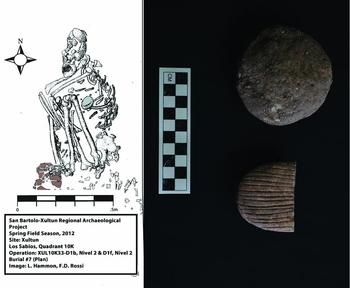
Before concluding, I want to return to the Los Sabios archaeological context, and an interesting piece of evidence with which to think about the restrictions and slippages a so-called meritocratic Aztec system versus vertical Maya system of education makes possible. This evidence comes from a central burial at Los Sabios. Perhaps it goes to show my own gendered assumptions, but I read so much about ‘Men's Houses’ of learning that it honestly came as a surprise when the important individual centrally buried with the tools for making bark-paper books turned out, upon osteological examination, to be a woman (Fig. 8; Suzuki & Rossi Reference Suzuki, Rossi, Arroyo, Méndez Salinas and Ajú Álvarez2016).
Female burial (left) with bark beater and stucco smoother (right). (Photographs: author; illustration: L. Hammon and author.)

When we read various colonial documents, see images like those on Vase 1196 and remember how the Taaj order of Los Sabios depicted itself on the mural, we commonly see and read of only men acting in spheres of political life and its specialized knowledges. Of course, detailed colonial accounts and Precolumbian representations of women, from the monumental to the smallest of scales, exist in great numbers throughout the Maya area (Proskouriakoff Reference Proskouriakoff and Lothrop1961). However, as Rosemary Joyce (Reference Joyce1993) explores, even monumental (and thus inherently political) representations of queens and other woman elites were, in terms of iconography and action, canonically ‘female’—with representations deploying both real and symbolic associations of what were highly gendered spheres of labour and action (largely related to ‘food and cloth’, birth and child rearing and domestic ritual). But I want to emphasize here that such images and accounts are ‘official’ narratives of a sort, often reflective of dichotomized societal ideals of gender conceptualized and made manifest.
Archaeology might add nuance to the reality and rigidity of such conceptualizations. I pause with the example of this woman buried at Los Sabios precisely because she presents us with something that is not in the nearby mural image. In fact, she presents us with something that the image (that is, the mural narrative) left out—emphasizing how the choices underpinning what was intentionally omitted brings to light some of the self-definitions and gendered erasures that must have been commonplace in Classic Maya society.
She was found in a context closely associated and contemporary with the mural room, which makes her consideration in this educational context important to ongoing interpretations, as counterpoint to the commonly assumed absence of females from formal Maya educational contexts. Furthermore, she held the two artefacts necessary for book-making (bark beater and stucco smoother), an act clearly linked to the activities unfolding in the mural room. What was her role, and why was she buried there with such symbolic (or maybe not so symbolic) tools? This case illuminates an intriguing question of accessibility to such knowledge, as it would have unfolded in a mixed gendered household that doubled as a place of learning.
This is especially interesting to contrast with Aztec educational structures and their distinct stratifications and allowances along the lines of gender and class. Within the Aztec system, young women were also dedicated to either a calmecac or telpochcalli, brought to schools as babies and offered up in service by their parents. But the female child then grew up in her family home (not within the institution like the males), learning those abilities culturally gendered as female in the home (Berdan Reference Berdan2014, 203; Joyce Reference Joyce2000; Sahagún Reference Sahagún, Dibble and Anderson1969, 211). The time actually spent by young women living in service to the temple as part of the calmecac was apparently only a year (Durán Reference Durán, Horcasitas and Heyden1971, 84–6). As part of either Aztec educational institution, the two sexes were educated separately in markedly different locales, in accordance with different curricular goals and cultural roles—for the sexes in Aztec culture were ideologically cast as a kind of complementary opposition, a social order reinforced by the educational system in place.
While the institutions of the Aztec educational system seem to evince a different opportunity for social mobility between classes, did those same gendered institutions perhaps uphold stratifications of their own? Interrogating these contexts of everyday practice is vital, not only for understanding how social norms are shaped and replicated, but also for considering how certain kinds of agency are rendered possible in the first place (Bourdieu Reference Bourdieu1977; Giddens Reference Giddens1984). When one begins to think through what is known about gender in Maya society, it is striking that there are many examples of women who turn up in positions of prominent political power often related to control of specialized domains of knowledge more commonly associated with men—whether this is Maya queens depicted as warriors, or women serving as scribes, or in other courtly offices (Ardren Reference Ardren2002; Jackson & Stuart Reference Jackson and Stuart2001, 221–2; Reents-Budet Reference Reents-Budet1994, 48). It is possible that in Maya society, educational stratifications along the lines of gender may have become at times unexpectedly fluid through the practice of taking place in the context of a household, rather than in a centralized state institution wholly separate from the domestic sphere (see Hendon Reference Hendon1996; Joyce Reference Joyce2001).
Building on the work of James March and Johan Olsen (Reference March and Olsen1989), among others, Adam T. Smith discusses the importance of considering the roles that institutions played in constituting state authority, defining them as ‘collectivities bound together by shared histories and interests that shape ingrained values and routines—recursively shape their members and, over time, can provide the foundations for governmental stability (or ossification) and transformation’ (Smith Reference Smith2003, 235). In relation to such overarching structures, we often think of models of Aztec states as more ‘horizontal’ and Maya as more ‘vertical,’ but archaeological particulars like this add nuance to how these broad directionalities may have played out in practice across particular social spheres like education, whose rules were perhaps not always as rigid as represented. Considering the mixed residential and niche pedagogical spaces at places like Los Sabios, Xultun and elsewhere, we can perhaps better understand and model Maya education, not as part of rigidly structured institutions, but rather as semi-formal contexts of learning in which unexpected mobilities were occasionally made possible for people otherwise excluded from more bureaucratically administered forms of controlled knowledge.
Acknowledgements
This article draws on primary research carried out as part of my dissertation work with the San Bartolo/Xultun Archaeological Project, and I would like to thank Project Director William Saturno and mentors Heather Hurst, Stephen Houston, David Stuart and David Carballo for their sage guidance and helpful comments. I would further like to thank the editorial team at CAJ and the two anonymous reviewers for their insightful suggestions and helpful avenues for improvement on the initial draft of this article. Many thanks also to IDAEH for helping facilitate this research, as well as the many friends and colleagues on the project and beyond who worked with me in both field and library, especially Aviva Cormier and Shintaro Suzuki. This research would not have been possible without the support of Boston University, Dumbarton Oaks Research Library and Museum, the Cora Du Bois Trust and the American Philosophical Society.