Introduction
The rapid development in wireless communication that occurs in the last few decades causes a huge increase in data usage. Considerably more substantial bandwidth is exploited to increase the capacity and enable users to experience several gigabit-per-second data rates [Reference Khalily, Tafazolli, Xiao and Kishk1]. The lack of bandwidth in the present technology can be overcome by the millimeter-wave (mm-wave) frequency spectrum regulated by FCC for 5G technology. According to FCC's document, the local multipoint distribution system band is 27.5–28.35 GHz, 29.1–29.25 GHz, and 31–31.3 GHz. Also, the 32 GHz band (31.8–33.4 GHz) is under consideration [Reference Marcus2]. A high-performance mm-wave antenna with wide bandwidth is required to support extensive high-speed high-data-rate wireless connectivity since the antenna elements are in close proximity [Reference Venugopal, Valenti and Heath3]. One of the crucial problems of mm-wave due to its small wavelength is the increased link loss and path loss under different atmospheric conditions [Reference Khalily, Tafazolli, Xiao and Kishk1, Reference Venugopal, Valenti and Heath3]. So, a high gain antenna at the line of sight is preferred for broadcast applications.
Omnidirectional antennas with high efficiency are highly preferred antennas over the directional antennas for short-range [Reference Venugopal, Valenti and Heath3] wireless communication due to their better signal reception [Reference Lin, Ziolkowski and Baum4]. An antenna with an omnidirectional radiation pattern offers a high degree of reliable connectivity in all directions, limited in directional antennas [Reference Malik, Patnaik and Karthikeyan5]. The required gain for an omnidirectional antenna is comparatively less than the directional antenna in 5G WLAN communication. To enhance the omnidirectional antenna's radiation gain, it has to be loaded with electromagnetic-band gap (EBG) as a superstrate in patch and ground, and use it as a superstrate. Metamaterial and metasurface [Reference Pallavi, Kumar, Ali and Shenoy6], negative permeability metamaterial [Reference Tang, Hou, Liu and Zhao7], and dielectric resonator [Reference Anab, Khattak, Owais, Khattak and Sultan8] are also some of the few methods to improve the radiation gain. Today, there is an integration of different wireless applications in a single device. So, a compact microstrip patch antenna with dual or multi-band is the best solution for this [Reference Malik, Patnaik and Karthikeyan5, Reference Zhu, Guo and Wu9–Reference Hasan, Bashir and Chu16]. Over the past decades, numerous dual-band antennas with good omnidirectional radiation patterns have been reported for Wireless Local Area Networks (WLANs), particularly in 2.4/5 GHz [Reference Malik, Patnaik and Karthikeyan5, Reference Zhu, Guo and Wu9–Reference Chamaani and Akbar pour12, Reference Bhattacharjee, Sekhar, Chaudhuri and Mitra17]. One of the commonly used techniques is defected ground structures (DGS) to introduce multiple bands in a single antenna, which excite additional resonances in a patch radiator [Reference Malik, Patnaik and Karthikeyan5]. DGS are usually slots cut inside the ground plane. It will change the surface current distribution by creating resonant gaps [Reference Jilani, Abbasi and Alomainy18]. In this work, the antenna geometry is developed based on DGS by introducing slots [Reference Shi, Qian and Ni11] in the ground plane. The proper design of DGS gives two different frequency bands in the 5G spectrum.
Very few mm-wave antennas with the omnidirectional radiation pattern have been reported to the best of the author's knowledge. A single-band antenna with an omnidirectional radiation pattern [Reference Mao, Khalily, Xiao, Brown and Gao19] and a dual-band antenna with an omnidirectional radiation pattern [Reference Xiang, Zheng, Wong, Pan, Wang and Xia15, Reference Hasan, Bashir and Chu16] are proposed for 5 G applications. These antennas have good bandwidth and moderate gain, but the design is complex and has a larger size. The works in [Reference Verma, Kumar and Singh20, Reference Fernández, Masa-Campos and Sierra-Pérez21] report omnidirectional circular polarized radiation characteristics in the mm-wave band at 38 and 37 GHz, respectively, but both the works report problems such as bulky structure, installation difficulty, and high cost. The designs given in [Reference Lin, Ziolkowski and Baum4, Reference Li, Chi, Wang and Wang13, Reference Nie, Zhang and Fu22] are circular polarization omnidirectional antennas that are proposed for 5G applications. It suffers from minimal bandwidth and complex geometry. In [Reference Ali, Das, Medkour and Lakrit23], two monopole omnidirectional MIMO antenna designs of size 26 × 9 × 11 mm2, having 5 and 5.7 dBi gain at the frequencies 27 and 39 GHz, are proposed, respectively. In [Reference Nakmouche, Allam, Fawzy, Bing Lin and Abo Sree24], modeling of a dual-band monopole omnidirectional antenna design using H-slotted DGS assisted by ANN for 5G sub-6 GHz applications is presented. A multi-band rectangular dielectric resonator omnidirectional antenna, having a stacked radiator with semi-circular slots etched on the left and right sides of an upper radiator, is proposed for a future 5G wireless communication system [Reference Anab, Khattak, Owais, Khattak and Sultan8]. Some works have been recently released [Reference Liu, Li, Ge, Wang and Ai25, Reference Sun, Wu, Fang and Yang26] by different authors on designing 5G antennas/arrays. A millimeter-wave low-profile wideband magnetoelectric monopole antenna with the vertically polarized end-fire radiation is presented. It is the combination of a pair of the top-loaded electric monopoles with a thin open-ended substrate integrated waveguide with the extended lower broad wall. It is a high gain directional array antenna with 60% of impedance bandwidth [Reference Wang, Yujian, Junhong, Lei, Meie, Zhan and Zheng27].
A compact novel dual-band omnidirectional printed antenna for 5G wireless communication systems is reported in the present research work. The proposed antenna geometry is designed with a star-shaped patch [Reference Shi and Liu28] attached with six disc-shaped elements [Reference Bhattacharjee, Sekhar, Chaudhuri and Mitra17] at the top. The star patch decides the frequency band at 34 GHz, and the six-disc shape elements at the top and bottom with respect to parameter values give the frequency band at 28 GHz with good impedance matching. The feeding point and the DGS in the ground provide an omnidirectional radiation pattern at 28 and 34 GHz bands. The respective realized gain of 28 and 34 GHz frequencies is 1.1 and 3.2 dBi.
Design of antenna geometry
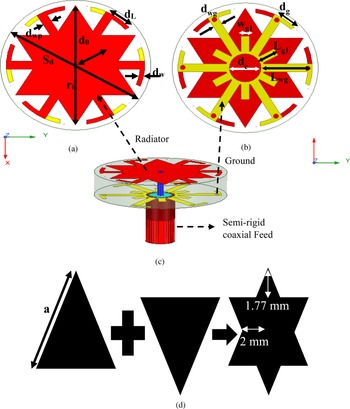
The proposed compact dual-band patch antenna structure for 5G WLAN communication is shown in Figs 1(a–c). The detailed dimensions of the prototype antenna are given in Table 1. A star-shaped radiator is placed at the top of the round-shaped substrate with six disc-shaped elements attached. The substrate used here for the design is Rogers RT/Duroid 5880, having a dielectric constant of 2.2 with a thickness of 1.6 mm and δ = 0.001. The star-shaped radiator is formed by combining two equilateral triangles with side length, “a = 6.53 mm”, where both of its center lie at the same point. Its details are shown in Fig. 1(d).
Structure of the proposed antenna. (a) Top view. (b) Rear view. (c) Pin-type view. (d) Graphical demonstration of formation of the proposed star-shaped patch antenna.

Antenna design parameters [unit: millimeters]

The star-shaped patch's radius “r” (3.77 mm) will decide the resonance frequency at 34 GHz. The six λ/4 elements determine the second resonant frequency of 28 GHz. The combination of these two elements produces a dual band in the proposed antenna geometry. The resonance frequency of the star-shaped patch is calculated using the triangular patch antenna equation [Reference Balanis29] as given in equation (1).

Here C is the frequency of light. For T11 mode Knm = 1.84118. The value of ɛr (dielectric constant) will decide the size of the radiator, and the star radius “r” determines the resonance.
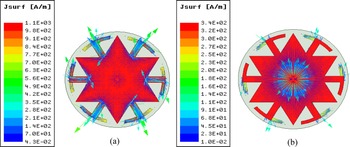
The impedance matching of the antenna is achieved for 50 Ω by varying the dimensions of disc-shaped element parameters. Branch length of the element in both patch and ground is equivalent to the tip of the star, and it is fixed for 28 GHz. The dimensions of branch width (dwp, dwg), wings width (dw), and wings length (dg, dL) will decide the impedance matching and fine-tuning of the frequency. Also, the wing length determines the surface current distribution between the patch and the ground, which causes an excellent omnidirectional radiation pattern. The arc shape on the wings of dipoles gives a uniform radial distribution of surface current that improves the radiation. Six small branches have a width of 0.45 mm placed at the inner side of the patch on the ground side. Suppose any extension of this branch toward the outer triangle does not give a 34 GHz frequency. So, proper ground geometry is necessary for dual resonant frequency. The 0.3 mm slot in the ground dipole is exploited to fine-tune the surface current in the clockwise direction. It gives a better omnidirectional pattern at 28 GHz with realized gain of 1.1 dBi. In 34 GHz, most of the current distribution is at the center of the star-shaped patch. It gives an omnidirectional pattern at 34 GHz with a realized gain of 3.2 dBi.
Moreover, the antenna structure is simple to fabricate and compact in size. The antenna is fed by a 50 Ω, 047 semi-rigid coaxial cable [Reference Zhu, Guo and Wu9]. The maximum operating frequency of this cable is 40 GHz. The K-connector is soldered to the end of the cable; it also works up to 40 GHz. Both the cable and the connector are manufactured by Taoglas CAB.058 [Reference Dadgar Pour, Sorkherizi and Kishk30].
Parametric study
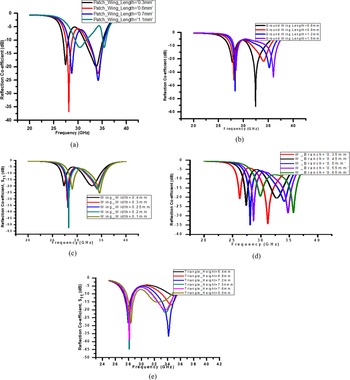
A detailed parametric study on triangular radius and different dipole parameters is done here, and its corresponding analyzing graphs are shown in Fig. 2. Figure 2(a) shows the variations of dipole parameters patch wing length (dL) and how it affects the lower frequency at 28 GHz. From the figure, it is clear that the upper frequency remains the same with these variations. Figure 2(b) shows the variation of ground wings length (dg) cause variation for the upper frequency at 34 GHz by keeping the frequency at 28 GHz. Upper frequency shifts right by the increase of ground wings length. Wings width (dw) both in patch and ground will give proper impedance matching for the lower frequency at 28 GHz shown in Fig. 2(c). Branch width (dwp, dwg), both in patch and ground, is one of the main parameters that cause the shifting of both frequencies. It is well apparent in Fig. 2(d). If the branch width increases, frequency shifts to the right and vice versa. The fine-tuning on triangular height shown in Fig. 2(e) will cause the frequency variation in 5G bands at 34 GHz. It is not affecting much the lower frequency at 28 GHz. The proper impedance matching and resonance frequency matching are achieved by fine-tuning triangle height and dipole parameters, specifically wings width and wings length, on both the patch and ground sides. Branch width variation on both patch and ground sides provides a frequency with variation within a limited fixed frequency range. This design is a single-layer structure without much design parameters complexity. The antenna is designed and optimized using the 3D electromagnetic simulation tool.
Parametric study on (a) wings length at patch (dL), (b) wings length at ground (dg), (c) wings width both in patch and ground (dw), (d) branch width (dwp, dwg). Parametric study on (e) triangular patch radius (height).

Results and discussions
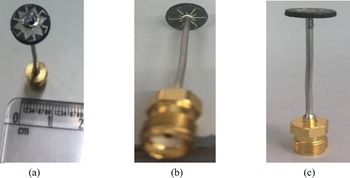
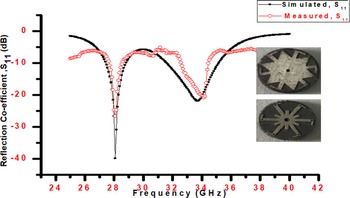
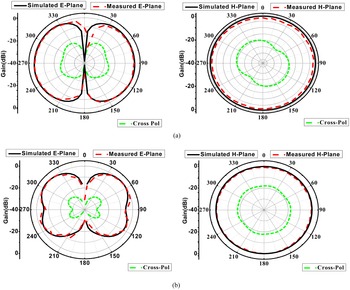
The prototype of the proposed compact dual-band antenna with an omnidirectional radiation pattern is fabricated and studied experimentally. The photos of the fabricated proposed dual-band antenna with an omnidirectional radiation pattern are given in Fig. 3. Figure 4 shows the comparisons between the simulated and the measured reflection coefficient (S11) characteristics. The measurement is carried out using an N9951A Microwave Analyzer. The measured bandwidth for the first resonance frequency at 28 GHz is 1.3 GHz (27.5–28.8 GHz) and for the second resonance frequency at 34 GHz is 2.2 GHz (32.45–34.65 GHz). The measured results show 4.64 and 6.55% of impedance bandwidth at 28 and 34 GHz, respectively. From Fig. 4, it is observed that both simulated and measured results have good agreement. The omnidirectional radiation pattern of the proposed antenna is validated with the simulated patterns given in Fig. 5, which shows the radiation patterns obtained at 28 and 34 GHz, respectively. The cross-polarization is <−20 dB in the two orthogonal planes (XOZ and YOZ planes) in both frequency bands, so the proposed antenna offers better performance. The radiation pattern for both E and H-planes for both observed resonance frequencies is measured inside the anechoic chamber at the center for the electromagnetic lab (CSIR-National Aerospace). The dipole-shaped radiation in the E-plane and omnidirectional radiation in the H-plane are observed at dual frequencies.
Photos of prototype antenna. (a) Front view. (b) Rear view. (c) Side view.

Simulated and measured reflection coefficient for the proposed work.

Simulated and measured far-field radiation pattern at (a) 28 and (b) 34 GHz for both E and H-planes.

The radiation pattern for the azimuth plane for both the lower band (28 GHz) and upper band (34 GHz) is omnidirectional. Therefore, the signal reception fidelity for the presented antenna is relatively high and can detect the signal coming at any angle in the azimuth plane. The measured realized gains for 28 and 34 GHz are 1.1 and 3.2 dBi, respectively. The considerable gain variation is due to the insertion loss of the feed and soldering. Here a simulated radiation efficiency of above 95% is achieved for both bands due to the use of low loss substrate and by maintaining the compact size. The simulated directivity of the antenna is 1.146 and 3.33 dBi for resonance frequency 28 and 34 GHz, respectively. The simulated and measured reflection coefficient and antenna gain have a good agreement, which can be observed in Figs 4 and 5. These parameters indicate that the simulated radiation efficiency is almost near the original value.
Figure 6 shows the surface current distribution of the proposed antenna for both resonance frequencies. At 28 GHz, the maximum current distribution is observed at the inner circle of the star patch. But for 34 GHz, the maximum current distribution is achieved at the edges of star-shaped patch and disc-shaped elements. These two different current distributions are achieved with the help of proper placing of disc-shaped elements and the DGS method with its accurate parameter values, which is obtained through a parametric study. Figure 7 shows simulated gain at both resonance bands.
Surface current distribution of proposed antenna at (a) 28 GHz and (b) 34 GHz.

Simulated and measured gain for both resonance bands.

A comparison of configuration features and operating characteristics of the reported and proposed dual-band omnidirectional millimeter-wave antenna is summarized in Table 2. It is evident from the comparison that the proposed work offers miniaturized size, better efficiency, and comparable bandwidth with most of the works. Also, the proposed work has a dual-band with an omnidirectional pattern.
Comparison between the proposed antenna and previous works

OCP, omnidirectional circular polarized; OMD, omnidirectional radiation.
The salient features of the proposed antenna are,
i The proposed dual-band patch antenna achieves compactness with the minimum size of 8 mm diameter in contrast to [Reference Wu, Yin, Yu, Wang and Hong14, Reference Hasan, Bashir and Chu16, Reference Jilani, Abbasi and Alomainy18–Reference Nie, Zhang and Fu22, Reference Ashraf, Haraz, Ali, Ashraf and Alshebili31]. Despite compactness, it also covers the dual-band resonating frequencies such as 28 and 34 GHz used for 5G WLAN application, unlike in [Reference Lin, Ziolkowski and Baum4, Reference Jilani, Abbasi and Alomainy18–Reference Nie, Zhang and Fu22].
ii The obtained bandwidth is 1.3 and 2.2 GHz, for 28 and 34 GHz, respectively, it is better than [Reference Wu, Yin, Yu, Wang and Hong14, Reference Verma, Kumar and Singh20–Reference Nie, Zhang and Fu22].
iii The proposed antenna design with the defective ground structure and center feeding method is very simple with [Reference Lin, Ziolkowski and Baum4, Reference Wu, Yin, Yu, Wang and Hong14, Reference Mao, Khalily, Xiao, Brown and Gao19–Reference Nie, Zhang and Fu22] less complexity of design and fewer design parameters.
iv The proposed design achieves overall simulated efficiency of 96% for resonant bands 1.3 and 3.4 GHz, respectively, which is better compared with all the existing literature along with moderate peak gain.
Conclusion
A star-shaped dual-band patch antenna attached with six disc-shaped elements and proper DGS has been proposed for 5 G WLAN communication. The proposed antenna has a single center feed, a low profile, and a straightforward compact structure without any feeding complexity. An antenna prototype has been fabricated and measured to validate the simulation and theory. The design procedures of the proposed antenna with the impact of design parameters are discussed. The designed antenna covers a 5G 28 GHz band from 27.5 to 28.8 GHz with a realized gain of 1.1 dBi. It also covers 5G 34 GHz band from 32.45 to 34.65 GHz with a realized gain of 3.2 dBi. So, due to omnidirectional radiation and reasonable gain performance at dual frequencies, the designed antenna can be used for future high data rate 5G short-distance wireless communication systems.
Acknowledgements
The authors acknowledge the support provided by the Centre for Electromagnetic, CSIR-National Aerospace Bangalore, Government of India, for the accomplishment of the project.
 Melvin Chamakalayil Jose received the B.E. degree in Electronics and Communication Engineering from Bharathidasan University in 2002, and the Master of Engineering in Power Electronics from Amrita University, Coimbatore, India in 2008. He has 12 years of teaching experience in reputed institutions in Kerala. He is currently working toward the Ph.D. degree at Anna University, Chennai. He is a research scholar in the Department of Electronics and Communication Engineering, SSN College of Engineering, Chennai. His primary research interests are broadband array antennas, reconfigurable antennas, and FSS structures for wireless communication applications.
 Sankararajan Radha is the Professor and Head of Department of ECE, and has 26 years of teaching and 13 years of research experience in the area of Mobile ad hoc Networks. She has graduated from Madurai Kamaraj University, in Electronics and Communication Engineering during the year 1989. She has obtained her Master degree in Applied Electronics with First Rank from the Government College of Technology, Coimbatore and the Ph.D. degree from the College of Engineering, Guindy, Anna University, Chennai. She also worked as a visiting researcher at Carnegie Mellon University, USA for a period of 6 months in the area of Wireless Sensor Networks. She has 72 publications in international and national journals and conferences in the area of Mobile ad hoc Network and Wireless Sensor Networks. She has received IETE – S K Mitra Memorial Award in October 2006 from IETE Council of India, Best paper awards in various conferences, and CTS – SSN Best Faculty Award – 2007 and 2009 for outstanding performance for the academic years 2006–2007 and 2008–2009.
 Balakrishnapillai Suseela Sreeja received her B.E. degree from Bharathidasan University in 2002, M.E. and Ph.D. degrees from Sathyabhama University in the years 2004 and 2012. She has 14 years of teaching experience in various universities, including Sathyabhama University, India, Linton University College, Malaysia, and SSN College of Engineering, India. Her research interests include high-frequency devices and structures, smart devices, MEMS and NEMS devices, and co-integration of devices and circuits.
 Mohammed Gulam Nabi Alsath received his B.E., M.E., and Ph.D. degrees from Anna University Chennai in the years 2009, 2012, and 2015, respectively. He is currently serving as an Associate Professor in the Department of Electronics and Communication Engineering, SSN College of Engineering, Chennai, India. His research interests include microwave components and circuits, antenna engineering, signal integrity analysis, and solutions to EMI problems. To his credit, he has filed 12 patents and published several research articles on antennas and microwave components in leading international journals. He has also presented and published his research papers in the proceedings of international and national conferences. He is currently serving as an Associate Editor in IET Microwaves Antennas and Propagation.
 Pratap Kumar received the B.Tech. degree in Electronics and Communication Engineering from Bharath University in 2007, and the Master of Engineering in Communication Engineering from Anna University, Coimbatore, India in 2017. He is currently working toward the Ph.D. degree at Anna University, Chennai. He is a research scholar in the Department of Electronics and Communication Engineering, SSN College of Engineering, Chennai. His primary research interests are re-configurable antenna and RF and microwave engineering for wireless communication applications.