Introduction
Major depressive disorder (MDD) is the single largest contributor to global disability, affecting as many as 300 million people worldwide (World Health Organization, 2017). Despite great efforts, our current understanding of its etiology is still limited given its complex symptomatology and the mixed findings regarding MDD-related brain abnormalities (Zhuo et al., Reference Zhuo, Li, Lin, Jiang, Xu, Tian and Song2019) and antidepressant treatment effects (Cipriani et al., Reference Cipriani, Furukawa, Salanti, Chaimani, Atkinson, Ogawa and Geddes2018). Mounting evidence demonstrates a bidirectional relationship of dietary profiles with neurobiology and psychiatry, giving rise to the nascent field of nutritional neuroscience (Kiecolt-Glaser, Jaremka, & Hughes, Reference Kiecolt-Glaser, Jaremka and Hughes2014). In this framework, several nutrients (e.g. vitamins, omega-3 polyunsaturated fatty acids, and minerals) have gained considerable attention in depression (Mikkelsen, Stojanovska, & Apostolopoulos, Reference Mikkelsen, Stojanovska and Apostolopoulos2016; Parker & Brotchie, Reference Parker and Brotchie2011; Parker, Brotchie, & Graham, Reference Parker, Brotchie and Graham2017; Wang, Um, Dickerman, & Liu, Reference Wang, Um, Dickerman and Liu2018; Wani, Bhat, & Ara, Reference Wani, Bhat and Ara2015). Remarkably, vitamin D has been suggested to play a prominent role in the pathogenesis of depression and its treatment (Parker et al., Reference Parker, Brotchie and Graham2017).
The involvement of vitamin D in the development and functioning of the central nervous system has been studied over the last two decades. It is well established that vitamin D is engaged in various neural processes such as the growth and development of neurons as well as the synthesis, release and regulation of neurotransmitters (Eyles, Burne, & McGrath, Reference Eyles, Burne and McGrath2013). Active form of vitamin D can be produced by the brain and vitamin D receptors are widely distributed across distinct brain systems (e.g. the prefrontal cortex and limbic system) (Eyles, Smith, Kinobe, Hewison, & McGrath, Reference Eyles, Smith, Kinobe, Hewison and McGrath2005), providing a mechanistic account for the role of vitamin D in emotion, cognition, and neuropsychiatric diseases (Di Somma et al., Reference Di Somma, Scarano, Barrea, Zhukouskaya, Savastano, Mele and Marzullo2017; Eyles et al., Reference Eyles, Burne and McGrath2013; Schlogl & Holick, Reference Schlogl and Holick2014). In parallel, a large number of clinical studies have documented an intimate association between low serum concentration of vitamin D (SCVD) and depression (Aghajafari, Letourneau, Mahinpey, Cosic, & Giesbrecht, Reference Aghajafari, Letourneau, Mahinpey, Cosic and Giesbrecht2018; Anglin, Samaan, Walter, & McDonald, Reference Anglin, Samaan, Walter and McDonald2013; Ju, Lee, & Jeong, Reference Ju, Lee and Jeong2013) along with a beneficial effect of vitamin D supplementation on this disease (Cheng, Huang, & Huang, Reference Cheng, Huang and Huang2020; Gowda, Mutowo, Smith, Wluka, & Renzaho, Reference Gowda, Mutowo, Smith, Wluka and Renzaho2015). While preliminary, our prior work found that total intracranial volume mediated the relationship between SCVD and depressive symptoms in patients with MDD (Zhu et al., Reference Zhu, Zhao, Zhang, Zhang, Yang, Zhang and Yu2019). Nonetheless, the neural substrates underlying the association between vitamin D and depression are rather complex and need further investigation.
There is a significant gender difference in depression characterized by the fact that females are more likely to develop MDD than males (Ferrari et al., Reference Ferrari, Charlson, Norman, Patten, Freedman, Murray and Whiteford2013; Seedat et al., Reference Seedat, Scott, Angermeyer, Berglund, Bromet, Brugha and Kessler2009), yet the exact mechanisms contributing to this gender difference remain poorly understood. Several possible explanations have been proposed, including gender differences in (1) the monoamine systems (Ngun, Ghahramani, Sanchez, Bocklandt, & Vilain, Reference Ngun, Ghahramani, Sanchez, Bocklandt and Vilain2011) whose dysfunction may be causally related to MDD (Booij, Van der Does, & Riedel, Reference Booij, Van der Does and Riedel2003; Ruhe, Mason, & Schene, Reference Ruhe, Mason and Schene2007), (2) hypothalamus-pituitary-adrenal axis function responsible for stress responses (Bangasser & Valentino, Reference Bangasser and Valentino2014; Fernandez-Guasti, Fiedler, Herrera, & Handa, Reference Fernandez-Guasti, Fiedler, Herrera and Handa2012; Zagni, Simoni, & Colombo, Reference Zagni, Simoni and Colombo2016), and/or (3) the levels of gonadal steroid hormones such as estrogens (Fernandez-Guasti et al., Reference Fernandez-Guasti, Fiedler, Herrera and Handa2012; Solomon & Herman, Reference Solomon and Herman2009). It is now also clear that there is a link between vitamin D and production/release of gonadal hormones (Kinuta et al., Reference Kinuta, Tanaka, Moriwake, Aya, Kato and Seino2000; Lorenzen et al., Reference Lorenzen, Boisen, Mortensen, Lanske, Juul and Blomberg Jensen2017). Meanwhile, population-based studies have reported consistent findings of lower SCVD in females than males (Choi et al., Reference Choi, Lee, Lee, Kim, Park, Kim and Park2020; Milaneschi et al., Reference Milaneschi, Shardell, Corsi, Vazzana, Bandinelli, Guralnik and Ferrucci2010; Rhee, Lee, & Ahn, Reference Rhee, Lee and Ahn2020; Song, Kim, Rhee, Youm, & Kim, Reference Song, Kim, Rhee, Youm and Kim2016; Toffanello et al., Reference Toffanello, Sergi, Veronese, Perissinotto, Zambon, Coin and Manzato2014b) but conflicting findings of gender-dependent associations between SCVD and depressive symptoms (Milaneschi et al., Reference Milaneschi, Shardell, Corsi, Vazzana, Bandinelli, Guralnik and Ferrucci2010; Rhee et al., Reference Rhee, Lee and Ahn2020; Toffanello et al., Reference Toffanello, Sergi, Veronese, Perissinotto, Zambon, Coin and Manzato2014b). Despite these previous findings, however, whether and how SCVD relates to MDD in a gender-dependent manner is still an open question.
Depression involves deficits in a variety of cognitive domains including attention, memory, learning, and executive function (Bortolato et al., Reference Bortolato, Miskowiak, Kohler, Maes, Fernandes, Berk and Carvalho2016; Pan et al., Reference Pan, Park, Brietzke, Zuckerman, Rong, Mansur and McIntyre2019). Cognitive deficits are thought to be a core domain of depressive psychopathology and a principal mediator of psychosocial functioning in MDD (Pan et al., Reference Pan, Park, Brietzke, Zuckerman, Rong, Mansur and McIntyre2019). The persistence of cognitive deficits after remission of depressive symptoms has been proved to contribute to the failure in achieving full functional recovery in patients suffering from MDD (Bortolato et al., Reference Bortolato, Miskowiak, Kohler, Maes, Fernandes, Berk and Carvalho2016). Prospective memory (PM) is a multi-phase process entailing intention encoding, maintenance, and retrieval (Cona, Scarpazza, Sartori, Moscovitch, & Bisiacchi, Reference Cona, Scarpazza, Sartori, Moscovitch and Bisiacchi2015). This complex process involves a plurality of neural networks (Cona et al., Reference Cona, Scarpazza, Sartori, Moscovitch and Bisiacchi2015; Gonneaud et al., Reference Gonneaud, Rauchs, Groussard, Landeau, Mezenge, de La Sayette and Desgranges2014). Likewise, sustained attention is a multicomponent mental faculty supported by distributed neural networks (Fortenbaugh, DeGutis, & Esterman, Reference Fortenbaugh, DeGutis and Esterman2017; Langner & Eickhoff, Reference Langner and Eickhoff2013). There is mounting evidence that cognitive deficits such as PM and sustained attention seem to be typical features of depression (Han et al., Reference Han, Klimes-Dougan, Jepsen, Ballard, Nelson, Houri and Cullen2012; McFarland & Vasterling, Reference McFarland and Vasterling2018; Rock, Roiser, Riedel, & Blackwell, Reference Rock, Roiser, Riedel and Blackwell2014; Zhou et al., Reference Zhou, Wang, Zheng, Zhang, Ungvari, Ng and Xiang2017). Interestingly, strong evidence has revealed that vitamin D deficiency is associated with worse cognitive abilities in healthy adults (Mayne & Burne, Reference Mayne and Burne2019) and low vitamin D gives rise to cognitive decline in the elderly population (Toffanello et al., Reference Toffanello, Coin, Perissinotto, Zambon, Sarti, Veronese and Sergi2014a). Moreover, Pettersen observed that vitamin D supplementation significantly improved cognitive performance, particularly among individual who had lower vitamin D status at the baseline (Pettersen, Reference Pettersen2017). Together, these previous reports have led to an assumption of a potential association between depression, vitamin D, and cognitive disturbances. Nevertheless, whether depression and vitamin D influence cognition independently or synergistically with each other as well as the underlying neural mechanisms have received scant attention with a few exceptions (Lerner, Sharony, & Miodownik, Reference Lerner, Sharony and Miodownik2018; Roy, Reference Roy2021).
Resting-state functional magnetic resonance imaging (rs-fMRI) has emerged as a non-invasive neuroimaging technique to assess spontaneous brain activity based on the blood-oxygen-level-dependent (BOLD) signal (Biswal, Yetkin, Haughton, & Hyde, Reference Biswal, Yetkin, Haughton and Hyde1995). As the most commonly used metrics derived from rs-fMRI, amplitude of low-frequency fluctuations (ALFF) (Zang et al., Reference Zang, He, Zhu, Cao, Sui, Liang and Wang2007) and its normalized version fractional ALFF (fALFF) (Zou et al., Reference Zou, Zhu, Yang, Zuo, Long, Cao and Zang2008) measure the low-frequency oscillation intensity of BOLD time courses and reflect local neural activity strength. Taking advantage of effectively suppressing non-specific signal components and showing improved sensitivity and specificity relative to ALFF, fALFF has been widely applied to the research of MDD and has enjoyed significant success in unraveling local neural activity abnormalities in this condition (Guo et al., Reference Guo, Liu, Zhang, Zhang, Yu, Liu and Xiao2013; Lai & Wu, Reference Lai and Wu2015; Qiu et al., Reference Qiu, Li, Luo, Li, Zhou, Cao and Sun2019; Zhu et al., Reference Zhu, Zhang, Yang, Zhang, Zhao, Zhang and Yu2020). In regard to the vitamin D–brain relation, earlier structural MRI research has established a link between SCVD and brain morphology (i.e. volume and thickness) in both healthy and depressed individuals (Ali et al., Reference Ali, Labriffe, Navasiolava, Custaud, Dinomais and Annweiler2020; Annweiler, Annweiler, Montero-Odasso, Bartha, & Beauchet, Reference Annweiler, Annweiler, Montero-Odasso, Bartha and Beauchet2014; Foucault et al., Reference Foucault, Duval, Simon, Beauchet, Dinomais and Annweiler2019; Karakis et al., Reference Karakis, Pase, Beiser, Booth, Jacques, Rogers and Seshadri2016; Plozer et al., Reference Plozer, Altbacker, Darnai, Perlaki, Orsi, Nagy and Janszky2015; Zhu et al., Reference Zhu, Zhao, Zhang, Zhang, Yang, Zhang and Yu2019), leaving the relationship between SCVD and brain function largely unknown. Thus, it would be of great interest to examine the association between SCVD and fALFF modulated by MDD.
Here, we sought to determine the relationship between gender, SCVD, cognition, and fALFF in a large sample of MDD patients and healthy subjects. Building on previous literature, we hypothesized (1) a group by gender interaction for SCVD, (2) a gender-specific association of SCVD with cognition and MDD-related fALFF alterations, and (3) a mediative role of MDD- and SCVD-related fALFF changes in accounting for the relation between SCVD and cognition in a gender-specific fashion.
Materials and methods
Study design and setting
A cross-sectional design was employed in this study. Patients were recruited consecutively from Affiliated Psychological Hospital of Anhui Medical University between November 2017 and January 2020. We also enrolled healthy controls (HC) from the local community via poster advertisements.
Participants
In this study, a total of 244 right-handed subjects were enrolled, including 122 MDD patients and 122 gender- and age-matched HC. Two well-trained clinical psychiatrists confirmed the diagnoses of depression using the MINI-International Neuropsychiatric Interview (M.I.N.I.) in accordance with the International Classification of Diseases (ICD-10) criteria (Sheehan et al., Reference Sheehan, Lecrubier, Sheehan, Amorim, Janavs, Weiller and Dunbar1998). HC were carefully screened to confirm an absence of any psychiatric illness using the M.I.N.I. The exclusion criteria for all participants included (1) the presence of other psychiatric disorders such as substance-induced mood disorder, bipolar disorder, anxiety disorders, schizophrenia, substance abuse, or dependence; (2) a history of significant physical or neurological diseases; (3) a history of head injury with loss of consciousness; (4) contraindications for MRI such as pregnancy. Additional exclusion criterion for HC was a family history of major neurological or psychiatric illnesses among their first-degree relatives. In addition, participants with SCVD values greater than mean + 3 × standard deviation (s.d.) or smaller than mean – 3 × s.d. (i.e. extreme outliers, n = 3) were excluded, resulting in the final sample of 241 participants (122 patients with MDD and 119 HC). Moreover, regular antidepressant medications were received by all patients with MDD, including selective serotonin reuptake inhibitors, serotonin-norepinephrine reuptake inhibitors, and noradrenergic and specific serotonergic antidepressants. This study was approved by the ethics committee of The First Affiliated Hospital of Anhui Medical University. Written informed consent was obtained from all participants after being given a complete description of the study.
Sample size definition
Since there are no studies directly exploring the relationship between vitamin D and fALFF in patients with MDD, we reviewed previous literature on group comparisons in fALFF and listed the effect sizes (Cohen's d) of fALFF changes in online Supplementary Table S1. We found that Cohen's d of fALFF changes in these previous studies was 0.54–1.56. We performed a statistical power analysis to estimate the required sample size using the software G*Power (Faul, Erdfelder, Lang, & Buchner, Reference Faul, Erdfelder, Lang and Buchner2007) with the following parameters: test family = t tests, statistical test = difference between two independent groups, minimum effect size d = 0.54, significance criterion σ = 0.05, statistical power 1–β = 0.8. The statistical power analysis demonstrated that the required sample size to detect the most subtle inter-group difference (minimum d = 0.54) is 55 for each group. Therefore, our sample of 122 patients with MDD and 119 HC used in this study provided sufficient statistical power for analysis.
Demographic and clinical variables
The demographic and clinical data including gender, age, educational level, body mass index (BMI), illness duration, onset age, episode number, and antidepressant medications were collected by the trained research staff. We used the 24-item Hamilton Rating Scale for Depression (HAMD) (Williams, Reference Williams1988) and the 14-item Hamilton Rating Scale for Anxiety (HAMA) (Thompson, Reference Thompson2015) to assess the severity of depression and anxiety symptoms. Notably, we used the Chinese versions of the HAMD and HAMA, which have been documented to show great reliability and validity (Zheng et al., Reference Zheng, Zhao, Phillips, Liu, Cai, Sun and Huang1988) and have been widely applied in the Chinese population (Guo et al., Reference Guo, Xiang, Xiao, Hu, Chiu, Ungvari and Wang2015; Lai et al., Reference Lai, Deng, Xu, Zhao, Xu, Liu and Rong2021; Shen et al., Reference Shen, Wei, Yang, Zhang, Du, Jia and Zhang2020; Tong et al., Reference Tong, Bo, Shi, Dong, Sun, Gao and Yang2021).
The cognitive assessment was done by a clinical psychiatrist trained in neuropsychological testing. PM is defined as the ability to remember to carry out an intended action after a delay without any explicit instruction to do so (Einstein & McDaniel, Reference Einstein and McDaniel1990; McDaniel & Einstein, Reference McDaniel and Einstein2011). PM is typically classified into event-based prospective memory (EBPM; i.e. the ability to remember to carry out an intended action at the occurrence of a certain event) and time-based prospective memory (TBPM; i.e. the ability to remember to carry out an intended action at a certain time). The schematic representation of the EBPM and TBPM tests is shown in online Supplementary Fig. S1. A computerized version of the Continuous Performance Task-Identical Pairs (CPT-IP) (Cornblatt, Risch, Faris, Friedman, & Erlenmeyer-Kimling, Reference Cornblatt, Risch, Faris, Friedman and Erlenmeyer-Kimling1988) was used to measure sustained attention. The schematic representation of the CPT-IP design is shown in online Supplementary Fig. S2. The main outcome variables of interest are CPT-IP-2, -3, and -4 reflecting sustained attention scores at increasing memory loads on digit span.
Serum concentration measurement of vitamin D
After an overnight fasting period, peripheral venous blood samples (2 ml) were collected from all participants in the morning of MRI scanning. Samples were sent to the Department of Clinical Laboratory, Affiliated Psychological Hospital of Anhui Medical University immediately for centrifugation and serum was separated. Vitamin D [25(OH)D] was measured in serum using a chemiluminescence immunoassay technique in a fully automated Maglumi 1000 analyzer (SNIBE Co., Ltd., China). Internal quality control provided by the manufacturer was used to assure quality. SCVD was stratified as follows: 30–100 ng/ml (75–250 nmol/l) as sufficiency, 20–30 ng/ml (50–75 nmol/l) as insufficiency, <20 ng/ml (50 nmol/l) as deficiency (Ringe & Kipshoven, Reference Ringe and Kipshoven2012).
Image acquisition
MRI data were acquired using a 3.0-Tesla MR system (Discovery MR750w, General Electric, Milwaukee, WI, USA) with a 24-channel head coil. During scanning, tight but comfortable foam and earplugs were used to minimize head movement and scanner noise. All subjects were instructed to relax, keep their eyes closed but not fall asleep, think of nothing in particular, and move as little as possible. All participants underwent a high-resolution three-dimensional T1-weighted brain volume sequence with the following parameters: repetition time (TR) = 8.5 ms; echo time (TE) = 3.2 ms; inversion time (TI) = 450 ms; flip angle (FA) = 12°; field of view (FOV) = 256 mm × 256 mm; matrix size = 256 × 256; slice thickness = 1 mm, no gap; voxel size = 1 mm × 1 mm × 1 mm; 188 sagittal slices; and acquisition time = 296 s. Resting-state BOLD fMRI data were acquired using a gradient-echo single-shot echo planar imaging sequence with the following parameters: TR = 2000 ms; TE = 30 ms; FA = 90°; FOV = 220 mm × 220 mm; matrix size = 64 × 64; slice thickness = 3 mm, slice gap = 1 mm; 35 interleaved axial slices; 185 volumes; and acquisition time = 370 s. Routine T2-weighted images were also collected to exclude any organic brain abnormality. None of the participants was excluded for visually inspected imaging artifacts.
fMRI data preprocessing and fALFF analysis
Resting-state fMRI data were preprocessed using Statistical Parametric Mapping software (SPM12, http://www.fil.ion.ucl.ac.uk/spm) and Data Processing & Analysis for Brain Imaging (DPABI, http://rfmri.org/dpabi) (Yan, Wang, Zuo, & Zang, Reference Yan, Wang, Zuo and Zang2016). The first 10 volumes for each subject were discarded, and the remaining volumes were corrected for the acquisition time delay between slices. Realignment was then performed to correct the motion between time points. Head motion parameters were computed by estimating the translation in each direction and the angular rotation on each axis for each volume. All data were within the defined motion thresholds (i.e. translational or rotational motion parameters <2.0 mm or 2.0°). We also calculated FD, which indexes the volume-to-volume changes in head position. Several nuisance covariates (the estimated motion parameters based on the Friston-24 model, the linear drift, the white matter signal, the cerebrospinal fluid signal, and the spike volumes with FD >0.5) were regressed out from the data. In the normalization step, individual structural images were firstly co-registered with the mean functional image; the transformed structural images were then segmented and normalized to the Montreal Neurological Institute (MNI) space using a high-level nonlinear warping algorithm, i.e. the diffeomorphic anatomical registration through exponentiated Lie algebra technique (Ashburner, Reference Ashburner2007). Finally, each filtered functional volume was spatially normalized to MNI space using the deformation parameters estimated during the above step and resampled into a 3 mm isotropic voxel. After spatial normalization, all data sets were smoothed with a 6 mm full-width at half-maximum Gaussian kernel.
The BOLD time course of each voxel obtained from the preprocessed data was transformed to a frequency domain via a Fast Fourier Transform (FFT), and then the power spectrum was obtained. fALFF was defined as the ratio of the power spectrum in the low-frequency band (0.01–0.1 Hz) to that in the entire frequency range (Zou et al., Reference Zou, Zhu, Yang, Zuo, Long, Cao and Zang2008). For the purpose of standardization, the fALFF value of each voxel was divided by the global mean fALFF value, yielding a standardized fALFF map per subject.
Statistical methods
The statistical analyses of demographic and clinical data were performed using the SPSS 23.0 software package (SPSS, Chicago, IL, USA). Two-sample t tests were used to compare age, years of education, BMI, FD, HAMD, HAMA, EBPM, TBPM, and CPT-IP between patients with MDD and HC. Pearson χ2 test was used to test group differences in gender. A threshold of p < 0.05 was considered statistically significant (two-tailed).
As our primary focus was set on the group × gender interaction effect on SCVD, we employed a general linear model to test this effect with age and education as nuisance covariates. In case of significant interaction, we conducted post hoc pairwise comparisons in SCVD between patients and HC in females and males, respectively. For a gender showing significant group differences, subsequent analyses examining the associations of SCVD with clinical variables and neuroimaging data were performed in this gender. With respect to clinical variables, we tested their associations with SCVD using partial correlation analyses controlling for age and education. Multiple comparison correction was performed using the false discovery rate (FDR) method with a corrected significance level of p < 0.05. For neuroimaging data, a voxel-wise two-sample t test was initially used to test fALFF differences between patients and HC controlling for age, years of education, and FD. For the voxel-based analysis, multiple comparisons were corrected using the cluster-level family-wise error (FWE) method, resulting in a cluster defining threshold of p = 0.001 and a corrected cluster significance of p < 0.05. Then, fALFF value of each cluster with a significant group difference was extracted and used for region of interest (ROI)-based correlation analyses with SCVD. To assess their clinical relevance, we further examined the associations of the SCVD-sensitive fALFF with clinical variables. For these ROI-based analyses, age, education, and FD were included as nuisance covariates and multiple comparisons were corrected by the FDR method.
To investigate the potential relationship among SCVD, neuroimaging parameters, and clinical variables, we tested the SCVD-fALFF-clinical variables mediation model where fALFF mediated the relation between SCVD and clinical variables. The mediation analyses were performed using the PROCESS macro (http://www.processmacro.org/) available for SPSS (Hayes, Reference Hayes2009; Hayes, Reference Hayes2014). Only variables that showed a significant correlation with others were considered independent, dependent, or mediating variables in the mediation analyses. Age, education, and FD were included as covariates of no interest. Based on 5000 bootstrap realizations, the significance of mediation effects was assessed by the bootstrap 95% confidence interval (CI) in the way a significant indirect effect is indicated when the bootstrap 95% CI does not include zero.
Validation analysis
Given a significant effect of BMI on SCVD (Wortsman, Matsuoka, Chen, Lu, & Holick, Reference Wortsman, Matsuoka, Chen, Lu and Holick2000), we performed the above analyses after additionally controlling for BMI. To test the specificity of the results, we also repeated our analyses in the gender showing no group effect on SCVD.
Results
Group × gender interaction on SCVD
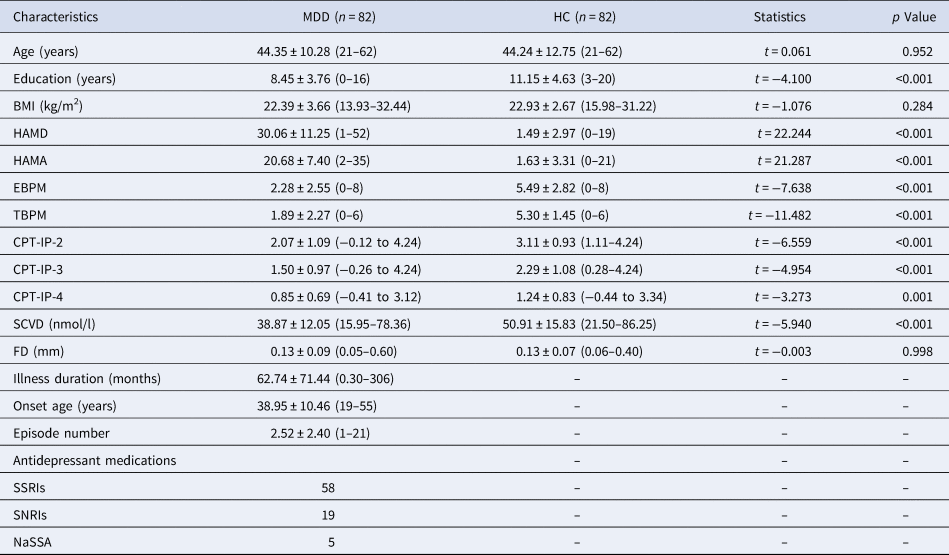
In favor of our hypothesis, we observed a significant interaction effect (F = 6.050, p = 0.015) of group × gender on SCVD (online Supplementary Fig. S3). Post hoc analyses revealed that patients with MDD showed a significant SCVD reduction relative to HC in females (p < 0.001) but not males (p > 0.05), suggesting a gender-specific effect. Accordingly, we focused our subsequent analyses on females. Demographic and clinical data of females are listed in Table 1 and described in the online Supplementary materials. Among 82 female patients, 11 (13.41%) were classified as vitamin D insufficiency and 70 (85.37%) as deficiency. In addition, demographic and clinical data of all subjects are shown in online Supplementary Table S2.
Demographic and clinical data of females

MDD, major depressive disorder; HC, healthy controls; BMI, body mass index; HAMD, Hamilton Rating Scale for Depression; HAMA, Hamilton Rating Scale for Anxiety; EBPM, event-based prospective memory; TBPM, time-based prospective memory; CPT-IP, Continuous Performance Task-Identical Pairs; SCVD, serum concentration of vitamin D; FD, frame-wise displacement; SSRIs, selective serotonin reuptake inhibitors; SNRIs, serotonin norepinephrine reuptake inhibitors; NaSSA, noradrenergic and specific serotonergic antidepressant.
Data are expressed as means ± standard deviations. Numbers in parentheses are the range.
Associations between SCVD and cognition in females
We found significant positive correlations of SCVD with EBPM [partial correlation coefficient (pr) = 0.267, p < 0.001], TBPM (pr = 0.355, p < 0.001), and CPT-IP-2 (pr = 0.215, p = 0.006) in females (p < 0.05, FDR corrected). No significant correlations were found between SCVD and clinical symptoms (HAMD and HAMA) in female patients with MDD (online Supplementary Table S3).
Associations between SCVD and fALFF in females
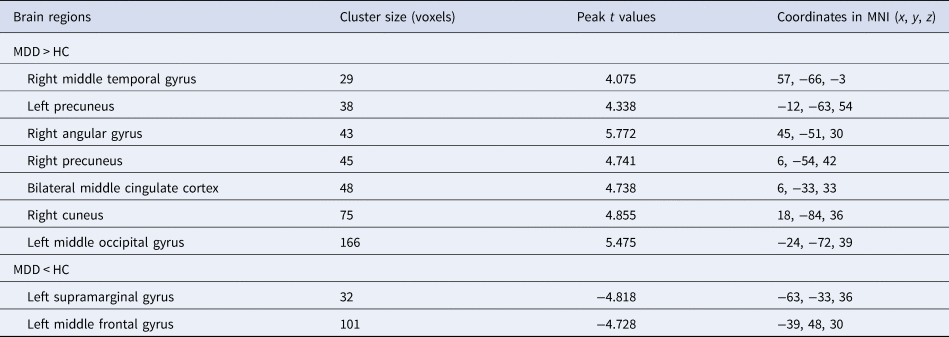
Compared with female HC, female patients with MDD exhibited increased fALFF of the right middle temporal gyrus (MTG), left precuneus, right angular gyrus (ANG), right precuneus, bilateral middle cingulate cortex (MCC), right cuneus and left middle occipital gyrus, and reduced fALFF in the left supramarginal gyrus and left middle frontal gyrus (MFG) (p < 0.05, cluster-level FWE corrected) (Table 2 and online Supplementary Fig. S4).
Brain regions showing group fALFF differences in females

fALFF, fractional amplitude of low-frequency fluctuations; MDD, major depressive disorder; HC, healthy controls; MNI, Montreal Neurological Institute.
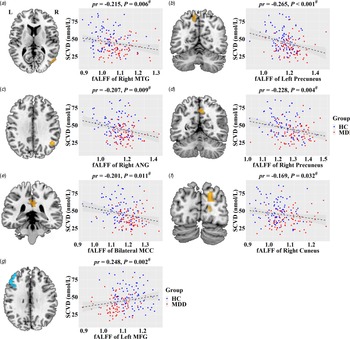
The significant correlations between SCVD and MDD-related fALFF alterations in females are illustrated in Fig. 1. SCVD was negatively correlated with fALFF of the right MTG (pr = −0.215, p = 0.006, Fig. 1a), left precuneus (pr = −0.265, p < 0.001, Fig. 1b), right ANG (pr = −0.207, p = 0.009, Fig. 1c), right precuneus (pr = −0.228, p = 0.004, Fig. 1d), bilateral MCC (pr = −0.201, p = 0.011, Fig. 1e), and right cuneus (pr= −0.169, p = 0.032, Fig. 1f), and positively correlated with fALFF of the left MFG (pr = 0.248, p = 0.002, Fig. 1g) in females (p < 0.05, FDR corrected).
Associations between SCVD and fALFF in females. (a–g) On the left, SCVD was correlated with fALFF of brain regions showing group differences; on the right, scatter plots show the correlations between SCVD and fALFF. #p < 0.05, false discovery rate correction for multiple comparisons. The warm color represents increased fALFF and the cold color denotes decreased fALFF in patients with MDD. SCVD, serum concentration of vitamin D; fALFF, fractional amplitude of low-frequency fluctuations; MTG, middle temporal gyrus; ANG, angular gyrus; MCC, middle cingulate cortex; MFG, middle frontal gyrus; L, left; R, right; MDD, major depressive disorder; HC, healthy controls; pr, partial correlation coefficient.

Associations between SCVD, fALFF, and cognition in females
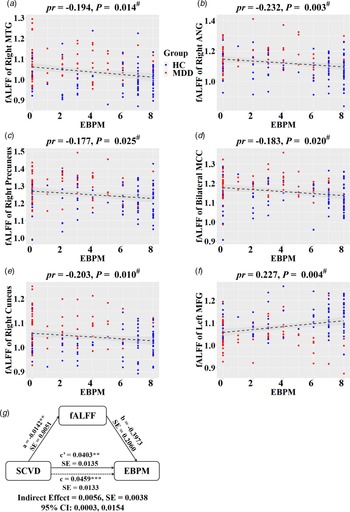
EBPM was negatively correlated with fALFF of the right MTG (pr = −0.194, p = 0.014, Fig. 2a), right ANG (pr = −0.232, p = 0.003, Fig. 2b), right precuneus (pr = −0.177, p = 0.025, Fig. 2c), bilateral MCC (pr = −0.183, p = 0.020, Fig. 2d), and right cuneus (pr = −0.203, p = 0.010, Fig. 2e), and positively correlated with fALFF of the left MFG (pr = 0.227, p = 0.004, Fig. 2f) in females (p < 0.05, FDR corrected). To summarize individual differences in fALFF, a principal component analysis (PCA) was performed to identify latent components underlying the EBPM-related fALFF. Based on the Kaiser–Guttman criterion, components with an eigenvalue <1.5 were removed. As a consequence, only the first fALFF component that accounted for 41.02% of the variance was retained and extracted for subsequent mediation analysis. In the mediation analysis model, all paths were reported as unstandardized ordinary least squares regression coefficients, namely, total effect of X on Y (c) = indirect effect of X on Y through M (a × b) + direct effect of X on Y (c’). We found that the relationship between SCVD and EBPM was significantly mediated by the first fALFF component (indirect effect = 0.0056, s.e. = 0.0038, 95% CI 0.0003–0.0154) in females (Fig. 2g).
Associations between SCVD, fALFF, and EBPM in females. (a–f) Scatter plots show correlations between SCVD-related fALFF and EBPM. (g) Graphical representation of the mediation analysis between SCVD and EBPM with first fALFF component as the mediator: estimates of the mediated (a × b), direct (c’), and total (c) effects. #p < 0.05, false discovery rate correction for multiple comparisons; **p < 0.01; ***p < 0.001. SCVD, serum concentration of vitamin D; fALFF, fractional amplitude of low-frequency fluctuations; EBPM, event-based prospective memory; MTG, middle temporal gyrus; ANG, angular gyrus; MCC, middle cingulate cortex; MFG, middle frontal gyrus; MDD, major depressive disorder; HC, healthy controls; pr, partial correlation coefficient; SE, standard error; CI, confidence interval.

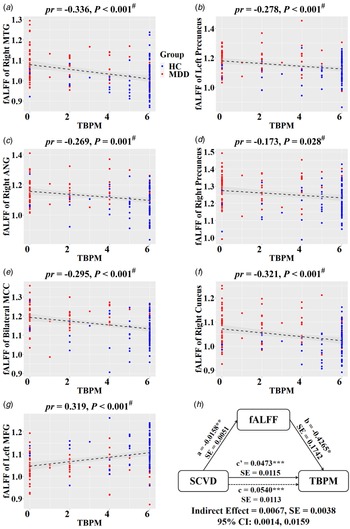
TBPM was negatively correlated with fALFF of the right MTG (pr = −0.336, p < 0.001, Fig. 3a), left precuneus (pr = −0.278, p < 0.001, Fig. 3b), right ANG (pr = −0.269, p = 0.001, Fig. 3c), right precuneus (pr = −0.173, p = 0.028, Fig. 3d), bilateral MCC (pr = −0.295, p < 0.001, Fig. 3e), and right cuneus (pr = −0.321, p < 0.001, Fig. 3f), and positively correlated with fALFF of the left MFG (pr = 0.319, p < 0.001, Fig. 3g) in females (p < 0.05, FDR corrected). PCA revealed that the first fALFF component accounted for 42.12% of the variance. Then, we found that the relationship between SCVD and TBPM was significantly mediated by the first fALFF component (indirect effect = 0.0067, s.e. = 0.0038, 95% CI 0.0014–0.0159) in females (Fig. 3h).
Associations between SCVD, fALFF, and TBPM in females. (a–g) Scatter plots show correlations between SCVD-related fALFF and TBPM. (h) Graphical representation of the mediation analysis between SCVD and TBPM with first fALFF component as the mediator: estimates of the mediated (a × b), direct (c’), and total (c) effects. #p < 0.05, false discovery rate correction for multiple comparisons; *p < 0.05; **p < 0.01; ***p < 0.001. SCVD, serum concentration of vitamin D; fALFF, fractional amplitude of low-frequency fluctuations; TBPM, time-based prospective memory; MTG, middle temporal gyrus; ANG, angular gyrus; MCC, middle cingulate cortex; MFG, middle frontal gyrus; MDD, major depressive disorder; HC, healthy controls; pr, partial correlation coefficient; s.e., standard error; CI, confidence interval.

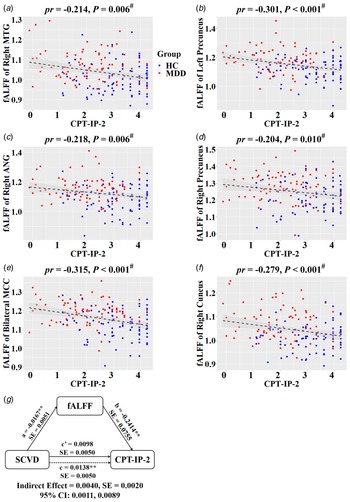
CPT-IP-2 was negatively correlated with fALFF of the right MTG (pr = −0.214, p = 0.006, Fig. 4a), left precuneus (pr = −0.301, p < 0.001, Fig. 4b), right ANG (pr = −0.218, p = 0.006, Fig. 4c), right precuneus (pr = −0.204, p = 0.010, Fig. 4d), bilateral MCC (pr = −0.315, p < 0.001, Fig. 4e), and right cuneus (pr = −0.279, p < 0.001, Fig. 4f) in females (p < 0.05, FDR corrected). PCA revealed that the first fALFF component accounted for 48.14% of the variance. Then, we found that the relationship between SCVD and CPT-IP-2 was significantly mediated by the first fALFF component (indirect effect = 0.0040, s.e. = 0.0020, 95% CI 0.0011–0.0089) in females (Fig. 4g).
Associations between SCVD, fALFF, and CPT-IP-2 in females. (a–f) Scatter plots show correlations between SCVD-related fALFF and CPT-IP-2. (g) Graphical representation of the mediation analysis between SCVD and CPT-IP-2 with first fALFF component as the mediator: estimates of the mediated (a × b), direct (c’), and total (c) effects. #p < 0.05, false discovery rate correction for multiple comparisons; **p < 0.01. SCVD, serum concentration of vitamin D; fALFF, fractional amplitude of low-frequency fluctuations; CPT-IP, Continuous Performance Task-Identical Pairs; MTG, middle temporal gyrus; ANG, angular gyrus; MCC, middle cingulate cortex; MDD, major depressive disorder; HC, healthy controls; pr, partial correlation coefficient; SE, standard error; CI, confidence interval.

There were no significant correlations of fALFF with other cognitive variables (CPT-IP-3 and CPT-IP-4) in females or with clinical symptoms (HAMD and HAMA) in female patients with MDD (online Supplementary Table S4).
Validation analysis
After additionally adjusting for BMI, the interaction effect of group × gender on SCVD was still significant (F = 6.066, p = 0.015) and the correlations of SCVD with clinical variables and fALFF remained unchanged (online Supplementary Tables S5 and S6), suggesting no effect of BMI on our findings. In males, no significant correlations were found between SCVD and cognition (online Supplementary Table S7), between SCVD and fALFF (online Supplementary Table S8), and between fALFF and cognition (online Supplementary Table S9), indicating female specificity of our results.
Discussion
To the best of our knowledge, this is the first study to examine the relationship between gender, SCVD, cognition, and fALFF in a large sample of MDD patients and HC. Three main findings were observed in the present study. First, we found a significant group-by-gender interaction effect on SCVD whereby MDD patients showed a reduction in SCVD relative to HC in females but not males. Second, there was a female-specific association of SCVD with cognition (i.e. PM and sustained attention) and MDD-related fALFF alterations in widespread brain regions. Finally, MDD- and SCVD-related fALFF changes mediated the relation between SCVD and cognition in females.
A large body of evidence from both cross-sectional and longitudinal studies has suggested a close relationship between circulating levels of vitamin D and depression (Briggs et al., Reference Briggs, McCarroll, O’'Halloran, Healy, Kenny and Laird2019; Milaneschi et al., Reference Milaneschi, Hoogendijk, Lips, Heijboer, Schoevers, van Hemert and Penninx2014; Wong, Chin, & Ima-Nirwana, Reference Wong, Chin and Ima-Nirwana2018). In line with these previous reports, our data showed that most female patients with MDD exhibited insufficient or deficient circulating vitamin D that was markedly lower than HC, raising the possibility that low vitamin D may have a pivotal role in the pathophysiology of MDD. Moreover, extensive research has evidenced that vitamin D supplementation has the potential for reducing depressive symptoms and/or preventing depression (Alghamdi et al., Reference Alghamdi, Alsulami, Khoja, Alsufiani, Tayeb and Tarazi2020; Casseb, Kaster, & Rodrigues, Reference Casseb, Kaster and Rodrigues2019; de Koning et al., Reference de Koning, van Schoor, Penninx, Elders, Heijboer, Smit and Lips2015). Despite these promising findings, further mechanistic studies might help advance the clinical translation of vitamin D supplementation by identifying biological pathways through which vitamin D exerts its effect on depression.
Consistent with prior epidemiological research demonstrating gender differences in vitamin D status (Choi et al., Reference Choi, Lee, Lee, Kim, Park, Kim and Park2020), we found that females had lower SCVD than males both in MDD patients and HC. Factors contributing to lower vitamin D in females are insufficient sunlight exposure, higher BMI, more fat tissue, and more sedentary life (Sezgin, Ozturk, Turkal, & Caykara, Reference Sezgin, Ozturk, Turkal and Caykara2019). For instance, female urban dwellers tend to adhere to the traditional Chinese aesthetic opinion that values paler skin, such that females often intentionally avoid sunshine or use sun cream when they are outdoors (Yan, Zhang, Cheng, Wang, & Qin, Reference Yan, Zhang, Cheng, Wang and Qin2019). Using sun cream may exponentially suppress vitamin D synthesis in the skin (Faurschou et al., Reference Faurschou, Beyer, Schmedes, Bogh, Philipsen and Wulf2012). By contrast, males prefer to do outdoor activities, increasing their sun exposure and vitamin D synthesis. Moreover, it is well known that females typically exceed males in subcutaneous fat (Eisner et al., Reference Eisner, Zargooshi, Berger, Cooperberg, Doyle, Sheth and Stoller2010), and subcutaneous adipose tissue may store large amounts of vitamin D (Didriksen, Burild, Jakobsen, Fuskevåg, & Jorde, Reference Didriksen, Burild, Jakobsen, Fuskevåg and Jorde2015). Therefore, the greater subcutaneous fat in females takes up more vitamin D produced by the skin, resulting in fewer vitamin D molecules entering the blood circulation in females. It is also apparent that females are more likely to develop depression than males (Ferrari et al., Reference Ferrari, Charlson, Norman, Patten, Freedman, Murray and Whiteford2013; Seedat et al., Reference Seedat, Scott, Angermeyer, Berglund, Bromet, Brugha and Kessler2009). Based on these phenomena, one may speculate that lower vitamin D in females might render them more susceptible to genetic and environmental risk factors for MDD. Crucially, our current observation that MDD patients showed a reduction in SCVD relative to HC in females rather than males emphasizes a specific involvement of vitamin D in the pathogenesis of depression in females. The reasons for this are unknown and seem to be multifaceted. Although speculative, a potential explanation is that lower vitamin D may lead to altered gonadal hormone levels that may in turn contribute to the development of depression given an intimate association between vitamin D and production/release of gonadal hormones (Kinuta et al., Reference Kinuta, Tanaka, Moriwake, Aya, Kato and Seino2000; Lorenzen et al., Reference Lorenzen, Boisen, Mortensen, Lanske, Juul and Blomberg Jensen2017). This notion is partially supported by some investigations showing that (1) females are more likely to experience mood disturbances and depression during times of hormonal flux such as puberty, perimenstrual, postpartum, and perimenopausal periods (Ahokas, Kaukoranta, Wahlbeck, & Aito, Reference Ahokas, Kaukoranta, Wahlbeck and Aito2001; Parker & Brotchie, Reference Parker and Brotchie2004; Solomon & Herman, Reference Solomon and Herman2009), (2) the incidence of depression in females during menopause appears to be similar to that in males (Bebbington et al., Reference Bebbington, Dunn, Jenkins, Lewis, Brugha, Farrell and Meltzer1998), and (3) hormone replacement therapy during the perimenopausal period can effectively prevent postmenopausal depression (Gordon & Girdler, Reference Gordon and Girdler2014).
It is widely accepted that cognitive impairment is a characteristic of MDD (Bortolato et al., Reference Bortolato, Miskowiak, Kohler, Maes, Fernandes, Berk and Carvalho2016; Pan et al., Reference Pan, Park, Brietzke, Zuckerman, Rong, Mansur and McIntyre2019), with persistence of cognitive deficits precluding patients from achieving complete functional recovery (Bortolato et al., Reference Bortolato, Miskowiak, Kohler, Maes, Fernandes, Berk and Carvalho2016). Parallel empirical evidence has linked vitamin D deficiency to poorer cognitive performance in normal adults (Annweiler et al., Reference Annweiler, Montero-Odasso, Llewellyn, Richard-Devantoy, Duque and Beauchet2013; Balion et al., Reference Balion, Griffith, Strifler, Henderson, Patterson, Heckman and Raina2012) and has suggested low vitamin D as a significant predictor of cognitive worsening in older adults (Llewellyn, Lang, Langa, & Melzer, Reference Llewellyn, Lang, Langa and Melzer2011; Miller et al., Reference Miller, Harvey, Beckett, Green, Farias, Reed and DeCarli2015; Pavlovic et al., Reference Pavlovic, Abel, Barlow, Farrell, Weiner and DeFina2018; Slinin et al., Reference Slinin, Paudel, Taylor, Ishani, Rossom, Yaffe and Ensrud2012). Besides, a randomized trial revealed that high dose vitamin D supplementation enhanced cognition in healthy adults (Pettersen, Reference Pettersen2017). These previous findings jointly work to establish a possible causal relationship between vitamin D changes and cognitive alterations in healthy populations. Coherent with previous reports (Han et al., Reference Han, Klimes-Dougan, Jepsen, Ballard, Nelson, Houri and Cullen2012; McFarland & Vasterling, Reference McFarland and Vasterling2018; Rock et al., Reference Rock, Roiser, Riedel and Blackwell2014; Zhou et al., Reference Zhou, Wang, Zheng, Zhang, Ungvari, Ng and Xiang2017), we found that female MDD patients exhibited cognitive dysfunction in PM and sustained attention, which was associated with lower SCVD. Apart from complementing and extending previous literature by identifying a similar vitamin D–cognition association in a psychiatric condition, this finding may represent an informative clue yielding insights into real-world clinical practice by assignment of female patients with MDD and cognitive dysfunction to adjuvant vitamin D supplementation therapy, which may ultimately advance a precision approach to personalized antidepressant choice.
Female patients with MDD presented with local neural activity abnormalities characterized by altered fALFF in widespread areas of the brain that are distributed across the frontal, temporal, parietal, occipital, and limbic regions. Several previous rs-fMRI studies have reported fALFF differences between MDD patients and healthy subjects (Huang et al., Reference Huang, Lu, Yu, Li, Zhang, Hu and Xu2017; Li, Rossbach, Zhang, Liu, & Zhang, Reference Li, Rossbach, Zhang, Liu and Zhang2018; Liu et al., Reference Liu, Guo, Liu, Long, Ma, Xue and Chen2013; Liu et al., Reference Liu, Ma, Yuan, Song, Jing, Lu and Wang2017; Shen et al., Reference Shen, Qiu, Li, Zhang, Wu, Wang and Peng2014; Wang et al., Reference Wang, Dai, Su, Wang, Tan, Jin and Si2012), with some endorsing our finding of increased fALFF in the cuneus and decreased fALFF in the supramarginal gyrus and MFG in patients (Huang et al., Reference Huang, Lu, Yu, Li, Zhang, Hu and Xu2017; Liu et al., Reference Liu, Guo, Liu, Long, Ma, Xue and Chen2013; Wang et al., Reference Wang, Dai, Su, Wang, Tan, Jin and Si2012), and others contrasting with our observation of increased fALFF in the precuneus, ANG, and MTG in patients (Li et al., Reference Li, Rossbach, Zhang, Liu and Zhang2018; Liu et al., Reference Liu, Ma, Yuan, Song, Jing, Lu and Wang2017; Shen et al., Reference Shen, Qiu, Li, Zhang, Wu, Wang and Peng2014; Wang et al., Reference Wang, Dai, Su, Wang, Tan, Jin and Si2012). As our group comparison analysis focused solely on females, we identified local neural activity alterations specific to female MDD patients, which may in part explain the commonalities and differences with prior research in mixed patients.
The relationship between vitamin D and the brain has been well established, as characterized by the critical involvement of vitamin D in the growth and development of neurons as well as the synthesis, release, and regulation of neurotransmitters (Patrick & Ames, Reference Patrick and Ames2015) and the broad spatial distribution of vitamin D receptors across the entire brain (Eyles et al., Reference Eyles, Smith, Kinobe, Hewison and McGrath2005). Recently, such association has attracted intense interest from researchers in the field of neuroimaging. For example, a wealth of evidence from brain structural MRI studies suggests that healthy subjects have SCVD that is linked to different brain morphological features including global and regional volume and regional cortical thickness (Ali et al., Reference Ali, Labriffe, Navasiolava, Custaud, Dinomais and Annweiler2020; Annweiler et al., Reference Annweiler, Annweiler, Montero-Odasso, Bartha and Beauchet2014; Foucault et al., Reference Foucault, Duval, Simon, Beauchet, Dinomais and Annweiler2019; Karakis et al., Reference Karakis, Pase, Beiser, Booth, Jacques, Rogers and Seshadri2016; Plozer et al., Reference Plozer, Altbacker, Darnai, Perlaki, Orsi, Nagy and Janszky2015). In patients with MDD, our previous research revealed that SCVD was correlated with total intracranial volume, which further mediated the association between SCVD and depressive symptoms (Zhu et al., Reference Zhu, Zhao, Zhang, Zhang, Yang, Zhang and Yu2019). However, these past investigations place less emphasis on brain function. It is generally assumed that functional measures (e.g. fALFF) are a more specific index of state-related changes in brain function, perhaps more closely tracking the onset and offset of symptom expression, whereas structural measures are more stable and thus may relate to more enduring illness characteristics. Leveraging fALFF, the present study found that most of the MDD-related brain functional abnormalities were correlated with SCVD in females. These findings might have clinical implications for informing a novel conceptualization that vitamin D supplementation may reverse MDD-related functional alterations in a gender-dependent way.
Of note, we found that the MDD- and SCVD-related fALFF alterations were associated with PM and sustained attention in females. Further mediation analyses revealed that these fALFF alterations mediated the relation between SCVD and cognition. The affected brain regions are a widely distributed set of areas within the default mode network (the precuneus, ANG, and MTG), executive control network (the MFG), and visual network (the cuneus), in support of the view that complex cognitive functions are assumed to rely on multiple neural processes arising from functional integration and segregation of distinct brain systems. Our data may shed important light on the potential neurobiological mechanisms whereby lower SCVD contributes to cognitive impairment in female patients suffering from MDD.
Several limitations should be considered in this study. First, our chronic and antidepressant-medicated MDD patients may introduce various confounding factors due to antidepressant medication and illness duration. Future studies would benefit from recruiting a sample of first-episode, medication-naive patients with MDD. Second, patients with MDD and HC were not matched in terms of educational level in this study. Although education was considered a nuisance covariate, we cannot completely exclude its potential effects on our results. Third, causal relationship cannot be inferred from this cross-sectional design. Longitudinal studies with intervention targeted toward elevating SCVD in MDD patients are warranted to establish the direction of causality. Fourth, the diagnoses of depression were determined by two well-trained clinical psychiatrists using the M.I.N.I. according to the ICD-10 criteria and the severity of depression symptoms was assessed using the HAMD. However, the gold standard interview, such as Composite International Diagnostic Interview (CIDI), is the most preferred. Finally, we failed to collect more relevant information about participants' lifestyle profiles. Further analysis of these data may facilitate the interpretation of our findings.
In conclusion, our data revealed a plausible association between low vitamin D, brain dysfunction, and cognitive impairment in female patients with MDD. These results could help elucidate the neural mechanisms by which low vitamin D contributes to cognitive impairment in MDD in a gender-dependent manner. More generally, these findings might have clinical implications for assignment of female patients with MDD and cognitive dysfunction to adjuvant vitamin D supplementation therapy, which may ultimately advance a precision approach to personalized antidepressant choice.
Supplementary material
The supplementary material for this article can be found at https://doi.org/10.1017/S0033291722000708
Acknowledgements
We are grateful to study participants for volunteering their time. We greatly appreciate the Chinese psychiatrists and psychologists who have developed the Chinese versions of the HAMD and HAMA, the MINI-International Neuropsychiatric Interview (M.I.N.I.), and the International Classification of Diseases (ICD-10) criteria.
Financial support
The study was supported by the National Natural Science Foundation of China (grant numbers: 81801679, 82071905, and 81771817).
Conflict of interest
None.