Countries with Muslim-majority populations often are viewed as places where women are particularly oppressed. To a degree, this perception reflects reality. Fish (Reference Fish2002) demonstrates that, relative to Catholic countries, Muslim countries are associated with larger male–female literacy gaps, higher male–female population sex ratios (which can reflect poorer treatment of females), and lower scores on the United Nations Development Program's (UNDP's) Gender Empowerment Measure, which focuses on political participation, economic influence, and income. Looking at the developing world, Cherif (Reference Cherif2010) finds that Muslim countries are associated with inheritance and nationality laws that are discriminatory toward women. Some suggest that Islam itself is responsible for limitations on women's economic, political, and social freedoms. Whether referring to the substance of Islamic (shari'a) law, which treats men and women differently, or to the ways in which politicians defer to conservative interpretations of shari'a law in order to build and/or consolidate their legitimacy, or to contemporary regimes' need to appease (or at least not inflame) important Islamist constituencies who favor a subordinate role for women, many accounts of gender inequality in Muslim countries assert that “prevailing interpretations of Islamic law . . . and the attitudes it informs” are a key culprit (Cherif Reference Cherif2010, 1145).
While this could be correct, the causal influence attributable to Islam is far from definitive; significant cross-national variation in women's status exists within the universe of Muslim-majority countries. One standout subset of Muslim-majority countries with respect to a particularly important measure of women's status is the Arab world—those states where the dominant language is Arabic and where citizens have a shared sense of culture and history as Arabs. Markedly fewer women participate in labor markets in Arab countries relative to their counterparts in non-Arab Muslim countries. Indeed, Arab countries have the lowest rates of female labor force participation globally (UNDP 2005, 88). This article examines why Arab women are less represented in labor markets relative to their peers in non-Arab Muslim states.
A review of the literature on women's status in the Arab world suggests that three phenomena potentially constitute obstacles to progress in the realm of gender equality and might, therefore, contribute to our understanding of regional female labor force participation rates. First, economic globalization and structural adjustment have been a dominant trend in the region's political economy and are associated with the dismantling of state programs (e.g., subsidized transportation and child care) that had facilitated women's entry into the workforce. Second, Arab states have experienced considerable levels of war and militarization, both of which have been linked to increasing misogyny and discrimination against women. Third, the Arab world has endured significant Western political-military, economic-commercial, and cultural intrusions that have generated serious grievances and a politics of identity that has nurtured the rise and popularity of Islamist movements. Explicitly rejecting the imposition of Western norms and signaling what they claim is “authentic” about Arab culture, these groups call for limits on female autonomy.
After describing these literatures, this article turns to assessing whether the dynamics central to each of these phenomena play out more forcefully in Arab states relative to non-Arab Muslim states. I show that according to a number of indicators, economic globalization and structural adjustment have not affected the Arab world more intensively than they have non-Arab Muslim states and, thus, cannot account for Arab underperformance where female labor force participation is concerned. Three factors do distinguish Arab states, however. Arab states have experienced interstate war more frequently than have non-Arab Muslim states. They have endured more intensive Western intrusion, evidenced by a higher concentration of U.S. military bases in Arab, as opposed to non-Arab, Muslim countries. And Arab states have resisted the imposition of Western gender norms more vigorously than have non-Arab Muslim states. Specifically, more Arab states have registered reservations when acceding to the Convention on the Elimination of All Forms of Discrimination Against Women (CEDAW).
I then present regression models demonstrating that, in Muslim-majority countries, interstate war and reservations regarding CEDAW's content are associated with reduced female labor participation rates and reduced female earnings relative to males' when controlling for key variables, such as fertility, level of development, and oil wealth. Moreover, when the three variables that distinguish Arab states—interstate war, the presence of U.S. military bases, and reservations regarding CEDAW—are added to baseline models of my measures of female labor force participation, Arab dummy variables lose statistical significance. Thus, there is nothing necessarily intrinsic about “Arabness” per se that has negative repercussions for women's work. Instead, in the context of Muslim-majority states, women struggle relatively more to enter the workforce and command income on an equitable basis with men in countries that have experienced interstate war and that have registered reservations to CEDAW. While these phenomena are more intense in Arab states, they are by no means exclusive to that region of the world.
This article contributes to, and dialogues with, an emergent literature that is suspicious of treating Muslim-majority states as a homogenous unit and that observes that many of the (negative) characteristics attributed to the “Muslim world” inhere primarily in the subset of Muslim states that are Arab. Until recently, however, little progress had been made in systematically determining how Arab states are distinct in ways that are theoretically relevant to these observations. This article's findings may help to explain Arab exceptionalism in other areas of women's status, as well as with respect to democratization. Conversely, this emergent literature contains insights pertaining to the broader questions regarding Arab exceptionalism that are raised in the analysis.
THE PUZZLE
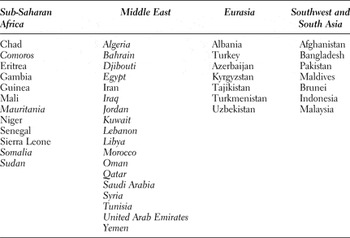
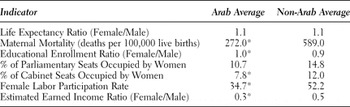
Forty-four countries have clear Muslim majorities (Fish Reference Fish2011, 17–18) (see Table 1). Of these, roughly half (21 of 44) are Arab.Footnote 1Table 2 compares the averages of several measures of women's status for Arab and non-Arab Muslim states, respectively.Footnote 2 Arab states do not universally lag behind non-Arab Muslim states when it comes to women's status. Arab and non-Arab Muslim states have essentially equivalent female–male life expectancy ratios. Arab states outperform non-Arab Muslim states when it comes to educating women and caring for their physical health. Many more women in non-Arab Muslim countries die due to pregnancy-related causes than do women in Arab countries. And a larger proportion of Arab girls and women are enrolled in primary, secondary, and tertiary education relative to their male counterparts than is the case in non-Arab Muslim states.
Muslim-majority countries of the world, by geographic region

Note: Arab states are italicized.
Women's status in Arab and non-Arab Muslim states

Note: * indicates that two-tailed T-test for difference of means is statistically significant at p < .05.
On average, Arab states have fewer women in parliament, and this has long been true. But the difference vis-à-vis non-Arab Muslim states is not statistically significant. The lack of statistical significance is a new development brought about by the large number of Arab states that have adopted quotas for female legislators in recent years.Footnote 3 In the past decade, no other world region has made larger gains in the area of women's parliamentary representation (Dahlerup Reference Dahlerup2009, 28). Arab states lag behind their non-Arab Muslim counterparts in the share of cabinet positions occupied by women, and here the difference is statistically significant. However, it may not remain so for long; between 1995 and 2009, the average percentage of ministerial positions occupied by women in Arab countries grew from 1.1 to 7.8, a 633% increase. Non-Arab Muslim countries registered a 114% increase in the same period. The situation with respect to political inclusion thus is improving, with Arab states outpacing others in expanding women's access to parliaments and cabinets.
When it comes to women's experience in the labor force, however, the picture is less encouraging. The female labor participation rate data tell us that just 34.7% of women in Arab states are economically active, whereas 52.2% of their counterparts in non-Arab Muslim states are—a statistically significant difference. The final indicator, the ratio of female-to-male estimated earned income, provides a different perspective on women's experience in the labor force. Estimated female earned income is a calculation of the share of a country's GDP that is earned by women (taking into account the female share of the economically active population and what women are paid relative to men), divided by the female population. Estimated male earned income is total GDP minus the share of GDP earned by women, divided by the male population. The ratio of female-to-male estimated earned income will be smaller in countries where female labor force participation is low and wage discrimination against women is pronounced. The Arab average for this indicator is statistically significantly smaller than that for non-Arab Muslim states.
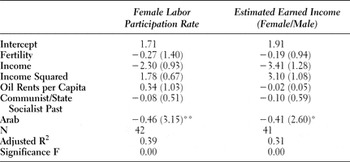
Does the Arab world stand out when we control for other factors bearing on women's labor force participation? Table 3 presents regression equations predicting the Female Labor Participation Rate and Female-to-Male Estimated Earned Income, controlling for variables that are routinely accounted for in the literature on female labor force participation in the Middle East and/or Muslim world (Haghighat-Sordellini Reference Haghighat-Sordellini2009; Robinson Reference Robinson2005; Ross Reference Ross2008; Tzannatos Reference Tzannatos1999). Fertility rates should affect the supply of female labor, and are expected to vary inversely with female labor force participation. Levels of development (represented here by the log of gdp/capita, and termed Income) are theorized to affect the demand for female labor, with larger output creating larger opportunities for employment, including for women. There is consensus that the relationship between levels of development and female labor force participation likely is U-shaped rather than linear, however. For this reason the square of Income also is included (following Ross Reference Ross2008 and Haghighat-Sordellini Reference Haghighat-Sordellini2009). Oil Rents per Capita is included following Ross (Reference Ross2008), who showed that higher oil and natural gas rents are associated with lower female labor force participation worldwide. He posits that the infusion of such rents shifts economies' loci to the oil, construction, and services sectors, which primarily employ men, raising salaries in those sectors. The agricultural and manufacturing sectors (where women tend to be employed) in turn are hurt, lowering demand for women's labor and wages for women. In addition, household incomes rise due to higher male wages and government payouts, making women's employment outside the home less necessary.
The effect of hypothesized variables on indicators of female labor force participation (OLS regression analysis – coefficients [and standard errors])

Notes: The Breusch-Pagan/Cook-Weisberg test found the data in these models (and those in Table 5) to be homoskedastic. Levels of significance in two-tailed tests: * p < .05; **p <. 01.
Also following Ross (Reference Ross2008), I control for whether there is a legacy of communist or state socialist rule. Historically, communist regimes in Muslim settings campaigned against veiling and seclusion, and reformed personal status laws in order to break the grip that Islam and patriarchy were perceived as exercising on female autonomy; in addition, they worked vigorously and successfully to educate women and draw them into the labor force on a massive scale in order to serve ambitious agricultural collectivization and industrial growth goals (Edgar Reference Edgar2006, Tohidi Reference Tohidi, Bodman and Tohidi1998). Seven Muslim-majority states experienced these dynamics to varying extents: Albania, Azerbaijan, Kyrgyzstan, Tajikistan, Turkmenistan, Uzbekistan, and Yemen.Footnote 4 I modify Ross's communist dummy variable to include several additional cases: Algeria, Egypt, Iraq, Syria, and Tunisia. These were led in the postindependence period by regimes that carried out state socialist reforms that had important consequences for women and work. These regimes nationalized significant segments of the economy and expanded the public sector, all the while expanding female access to education and promoting female labor force participation by providing women with labor-related legal protections (e.g., guarantees of equal rights and equal wages), maternity leave, and child-care options (UNDP 2005, 59–60). While the policy interventions of these states were less massive in scope than in the communist cases,Footnote 5 the lengths to which they went to educate and employ women were substantial, and differentiate them from others in the data set. I expect the Communist/State Socialist Past dummy to vary directly with measures of female labor force participation.
As Table 3 demonstrates, these models explain approximately one-third of the variation in the dependent variables. In both, the only independent variable to achieve statistical significance is the dummy for whether the country in question is an Arab state, included in order to capture region-specific variation not specified in the model.Footnote 6 All else equal, then, Arab countries indeed appear to be associated with reduced female achievement in the labor arena. This finding is consistent with several larger-n cross-national studies showing that variables denoting how Muslim a country is do not help account for women's labor force participation outcomes, while variables indicating whether or not a country is Arab (or in the Middle East), do (Donno and Russett Reference Donno and Russett2004; Robinson Reference Robinson2005; Ross Reference Ross2008).Footnote 7 The dearth of women in Arab labor forces is consequential because female labor force participation is associated with increased school enrollment, higher literacy rates, lower fertility rates, greater financial independence, more influence within the family, and increased social and political skills, awareness, and mobilization for women (Cherif Reference Cherif2010; Ross Reference Ross2008).
Donno and Russett concluded in 2004 that “Islamic culture, in particular, may not be a major impediment to achieving women's rights, but something about Arab states is” (p. 602). What explains women's more difficult experience vis-à-vis labor markets in Arab states relative to non-Arab Muslim states? The existing literature has not yet systematically analyzed the causal dynamics that undergird this apparent Arab exceptionalism. This article seeks to address the void.
THEORETICAL BACKGROUND
The literature on women's status in the Arab world (and/or Middle East) points us to three phenomena that have affected women's status in ways that might account for Arab underperformance vis-à-vis female labor force participation—if it can be demonstrated that they are more prevalent in Arab relative to non-Arab Muslim states. The first has been the need of many heavily indebted Arab states to liberalize their economies beginning in the 1980s (Moghadam Reference Moghadam2003, 54). In the face of structural adjustment policies dictated by international financial institutions disbursing much-needed loans, and in the sweep more broadly of the expansion of global capitalism, many Arab states have had to (at least partially) privatize their once state-led economies, streamline their bureaucracies, cut social welfare spending, and integrate with the global economy. These reforms have caused various forms of hardship for citizens, among them rising prices and unemployment, as well as disappearing safety nets. As states cut back on social welfare spending, women lost services and supports (e.g., subsidized child care and transportation) that once helped keep them in the labor force. In addition, Arab working women had concentrated their employment in the public sector because it was perceived as safer and more appropriate than private employment. As bureaucracies shed redundant employees, women lost what was once a key perch for their labor force participation (Posusney and Doumato Reference Posusney, Doumato, Doumato and Posusney2003, 5).
At the same time, structural adjustment and economic globalization are associated with two related mechanisms that tend to boost women's labor force participation: an increase in foreign direct investment (and thus foreign-owned firms) and an increase in low-wage, export-oriented industries manufacturing such products as textiles, clothing, processed agricultural goods, and assembled electronic devices. Export production–oriented industries tend to employ women disproportionately because their labor is lower skilled, matching these industries' needs; because their labor is cheaper; because they are perceived as more docile and less likely to organize; and because of perceptions that women are better suited to performing tasks that demand manual dexterity (Villareal and Yu Reference Villareal and Yu2007, 367–69). For legal and cultural reasons, foreign-owned industries are not as likely to discriminate against women in hiring (Ross Reference Ross2008, 108); and Villareal and Yu (Reference Villareal and Yu2007, 385) present evidence in the Mexican context that managers in foreign-owned manufacturing firms have a preference for hiring female workers. Moghadam (Reference Moghadam2003, 42) notes that the Middle East has received less foreign direct investment than other world regions. If Arab states have enjoyed less foreign direct investment and lower growth in the export sector than non-Arab Muslim states have, then that fact might help explain their female labor force participation deficit.
A second potential explanation may lie in the fact that war has been frequent in the Arab world.Footnote 8 War has causal effects on gender, and there is an inverse relationship between frequency of war and the egalitarianism of gender relations (Goldstein Reference Goldstein2001, 398–99). Goldstein (Reference Goldstein2001) shows that much of gender role socialization (from childhood on) stems principally from societies' need to turn men—who are not biologically more drawn to or fitter for war than women—into “tough” beings, in control of their emotions, who can be brave and disciplined soldiers capable of enduring pain and hardship in war. Once young men join military organizations, the literature suggests that they absorb norms of masculinity emphasizing not only conquest and aggression, hierarchy, and domination (Segal Reference Segal2008) but also superiority over and contempt for, females. Yuval-Davis (Reference Yuval-Davis1997, 101) and Goldstein (Reference Goldstein2001, 356) find that misogyny is built into the ways in which recruits are taught to view not only the enemy but also subordinates, soldiers who do not perform up to standard, and civilians. Individuals in these categories are feminized and degraded. In settings where military institutions are prominent, such norms “cannot but spill over into the civil society” (Yuval-Davis Reference Yuval-Davis1997, 106). Indeed, militarization has been linked to higher incidences of domestic violence (Segal Reference Segal2008, 31–32; Yuval-Davis Reference Yuval-Davis1997, 106).
During wars, women suffer death, injury, and other severe stresses associated with damage to infrastructure, internal displacement, the loss of economic livelihoods, and the need to protect their families. They often are targets for rape by enemy forces. In dangerous times, protective families may keep daughters confined to the home more than they otherwise would (Pratt and Al-Ali Reference Pratt, Al-Ali, Al-Ali and Pratt2009, 11–12). Yet home, too, is a dangerous place in war, as domestic violence tends to increase rapidly during hostilities, “as a direct effect of militaristic cultures, alongside the strains, displacements and traumas of war” (Segal Reference Segal2008, 32).
When wars end, violence against women continues. Often, women are victims of sexual assault to a greater extent than they were preconflict (Pankhurst Reference Pankhurst and Pankhurst2008a, 5–6). Pratt and Ali (2009, 17) argue that the reasons underlying this phenomenon include “heightened aggression and militarization, and . . . prevailing constructions of masculinity promoted during conflict.” In terms of violence committed by actual combatants returning home, it may be that the traumas of war leave psychological wounds that soldiers take out on their families. Yet Pankhurst (Reference Pankhurst and Pankhurst2008b, 305) asserts that abuse of women “is often part of a deliberate military strategy intended to build the morale of soldiers, and to increase male bonding.” She cites a publication of the UN Development Fund for Women (UNIFEM) that reports the conviction of some observers that soldiers are violent in civilian life not because of the experience of conflict, but rather due to “the culture of violence and masculinity that permeates military forces” (2008a, 7).
Women's rights and collective status also come under attack in the wake of wars. Typically during war, a discourse emphasizing gender difference emerges wherein men are to fight bravely in order to protect what Enloe has famously called their “womenandchildren” back home (Pratt and Al-Ali Reference Pratt, Al-Ali, Al-Ali and Pratt2009, 15–16; Segal Reference Segal2008, 22). Such traditionalizing roles may lay the groundwork for continued or increased gender discrimination in postconflict contexts (Pratt and Al-Ali, Reference Pratt, Al-Ali, Al-Ali and Pratt2009, 15–16). In addition, military mobilization for war “puts a premium on communal unity in the name of national survival, a priority that can silence women critical of patriarchal practices and attitudes”; this dynamic can work to sustain male privilege over the long run (Enloe Reference Enloe2000, 57). To make matters worse, scholars have noted a pattern across varied national, regional, and temporal contexts wherein, at war's end, a backlash occurs against the increased public visibility and employment that women often experience during war as a result of higher demand for their labor and altered domestic authority structures facilitated by men's absence. Gender orders routinely are renegotiated postwar in favor of enhanced male privilege, with women assigned to maternal and domestic roles, distinctly subordinate status, and restricted life choices (Horne Reference Horne, Stefan, Karen and Tosh2004; Pankhust 2008a). Indeed, the backlash phenomenon is “often about ‘restoring’ or ‘returning’ to something associated with peace in the past, even where the change actually undermines women's rights to a more unequal situation than before the war” (Pankhurst Reference Pankhurst and Pankhurst2008a, 3–4). One or more of these dynamics linked to war and militarization may be reducing women's access to employment in Arab states.
A third phenomenon suggested by the literature as potentially working against women's labor force participation is the fact that the Arab world's bitter political-military, economic, and cultural encounter with the West has generated grievances and fueled a type of identity politics that together have given rise to influential Islamic movements that advocate conservative roles for women. Western powers colonized most of the region and were pivotal in the emergence of the state of Israel, an Arab regional enemy. By the early 1970s, all Arab states had gained their independence from overt forms of Western imperialism, but Western interventions and intrusions—which featured the hegemonic United States in the lead (Lizardo Reference Lizardo2006, 155)—continued apace in political-military, economic-commercial, and cultural domains. These interventions and intrusions ushered in defeat in war, deepening dictatorship, economic crisis, and calls for the delineation of an authentic Arab identity in the face of an onslaught of Western popular culture. In the past generation, Islamist movements have dominated the formulation of a response to all three forms of perceived Western predation and their consequences. These movements' conservative approach to women's roles may mitigate against growth in female labor force participation in the Arab context.
In the political-military domain, the United States has had a significant presence in the Arab world. It has been the main superpower backer of Israel, a state that, in the eyes of many Arabs, exists illegitimately on Arab soil. Meanwhile, the United States has lent considerable political, diplomatic, and material support to many (often secular) Arab regimes. In addition (and indicative of close ties between the United States and many Arab governments), the U.S. military footprint in the Arab world is considerable, with bases, equipment, and troops stationed in many of the region's states. Over time, these manifestations of U.S. power have generated significant local grievances and anti-Western sentiment. Arab states suffered military defeats to Israel on multiple occasions, and Arab regimes' increasingly authoritarian and corrupt nature led them to become unpopular with their citizens over time—yet until recently, the United States largely turned a blind eye to such repression given its strategic interest in these regimes' willingness to repress Islamist oppositional movements and cooperate in the global war on terror (El-Said and Harrigan Reference El-Said and Harrigan2006, 463).
In the economic-commercial domain, Western penetration of the region grew as a result of the oil shocks of the 1970s and as Arab states liberalized and integrated with the global economy beginning in the 1980s. Western capitalist ideology was offered as a solution to the region's economic ills, with the United States positioned as the major power behind the global financial institutions that prescribed deregulation and market reform (i.e., the International Monetary Fund and the World Bank) (Lizardo Reference Lizardo2006, 155). Investment in, and rapid modernization of, Arab societies followed, yet Western influence bred its detractors. While a segment of society became enriched, economic crises stemming from indebtedness and falling oil prices in the 1980s triggered structural adjustment programs that yielded painful austerity measures and climbing unemployment, poverty, and socioeconomic inequality for the masses across the region (El-Said and Harrigan Reference El-Said and Harrigan2006, 457). The ensuing class gap created resentment against Western institutions and policy among those left out of economic globalization's allegedly rising tide.
Western cultural influences went hand in hand with political-military and economic-commercial penetration. Secularism, gender equality, and other Western values were promoted. And as U.S. (and other Western) multinational corporations invested, bringing with them symbols of U.S. economic might and global hegemony (e.g., McDonalds, Nike, Coca-Cola), consumer capitalist norms were introduced. Moreover, such corporations consciously exported U.S. popular culture and lifestyles as part of the marketing and merchandising process in order to make U.S. brand-name consumer goods more attractive (Barber Reference Barber1996, Chapter 4). Exports from the globally hegemonic U.S. film industry—along with U.S. television and music videos—also spread U.S. culture, ideas, and lifestyles (Barber Reference Barber1996, 82–94). While Western political-military and economic-commercial penetration have directly engendered resentment and grievance, they have also indirectly—through concomitant cultural penetration—provoked a politics of identity wherein local actors react against what they perceive as the global adoption and standardization of Western norms, values, and practices, and instead strive to articulate what is distinctive and authentic about indigenous culture and tradition (Abu Deeb Reference Abu-Deeb and Sharabi1988, 167; Barber Reference Barber1996; Boullata Reference Boullata and Sharabi1988, 147; Moghadam Reference Moghadam2002).
In Arab states, Islamic movements have been the main agent responding to Western influence and the identity politics it has engendered, and articulating what the proper Arab response to the West should be. These movements stem from grievances tied to the political and economic failures of West-backed regimes, Western military influence and intrusions, and Western cultural invasion (Keddie Reference Keddie2007, 161–62; Moghadam Reference Moghadam2009, 61). They and their supporters criticize extant regimes' authoritarian nature and failure to achieve economic prosperity and equality—as well as the U.S. policy of backing such dictatorships (El-Said and Harrigan Reference El-Said and Harrigan2006, 461). They oppose U.S. domination generally, including the presence of U.S. forces on Muslim soil (Munson Reference Munson2003). And Islamists fault Western values for, among other things, undermining the Muslim family (Moghadam Reference Moghadam2009, 47). In response to these grievances, Islamists have articulated an ideology that casts tradition, identity, and cultural authenticity in religious terms and have argued that Islamic identity is in danger (Moghadam Reference Moghadam2009, 45). They call on their coreligionists to stop mimicking the dominant West and, instead, to return to Islam as “a means of regaining [their] true identity” (Munson Reference Munson2003, 44). While Islamic movements are diverse both ideologically and tactically, their “overarching common goal is the establishment or reinforcement of Islamic laws and norms as the solution to economic, political, and cultural crises” (Moghadam Reference Moghadam2009, 37).
A central way in which Islamists delineate authentic identity—and thus difference from the West—is through their vision of gender relations. They “seek to recuperate traditional patterns, including patriarchal gender relations, in reaction to the ‘westernizing’ trends of globalization” (Moghadam Reference Moghadam2009, 26–27). Islamists have made identity “incumbent on women's behavior, dress, and appearance” (Moghadam Reference Moghadam2009, 45). Gender relations figure prominently in identity articulation in part because in the nineteenth century, Western colonial powers criticized the treatment of women in Arab society and used this issue to denigrate local culture and justify imperialism (Ahmed Reference Ahmed1992). Resentment of Western moral superiority—and imperialism in general—has meant that in the Arab world, “postcolonial politics has yielded a dynamic wherein the ‘woman question’ animates political and ideological contests couched in the language of cultural authenticity versus foreign influence” (Abu-Lughod Reference Abu-Lughod1998, 243). Put another way, women are used to mark the community's boundaries (Joseph Reference Joseph and Joseph2000, 6–7).
If Western norms advocate women's equality with men in the public and private spheres, then Islamists typically advocate for limitations on women's mobility outside the home (Moghadam Reference Moghadam2005, 124; Olmsted Reference Olmsted, Doumato and Posusney2003, 89–90; Yuval-Davis Reference Yuval-Davis1997, 63). They encourage modest dress and veiling. And they prefer that women do not work outside the home (Hatem Reference Hatem, Nelson and Chowdhury1994, 232). Rather, according to Islamists, women's primary duty is to home and family. Thus, the literature suggests that one drag on women's labor force participation in the Arab world is the force and gendered consequences of the Islamist response to a sense of crisis—political, economic, and identity-related—that has emerged in the region as a result of Western influence. If the precipitants of, and/or response to, such a sense of crisis can be shown to be stronger in Arab states than in non-Arab Muslim states, then this may advance our understanding of Arab exceptionalism where female labor force participation is concerned.
IN WHAT WAYS ARE ARAB STATES DISTINCT?
The literature suggests that Arab women could lag behind their non-Arab Muslim counterparts in labor force participation due to three phenomena: the consequences of economic globalization and structural adjustment; the impact of war and militarization; and/or the ways in which conflicts with the West have generated grievances and a politics of identity, which Islamist movements have capitalized on, all the while articulating conservative roles for women. Yet none of these dynamics is limited in geographic scope only to Arab states. All have played out in non-Arab Muslim (and other non-Western) states as well. For the research puzzle as it is delineated here, the question becomes: Have these phenomena impacted Arab states more severely than they have non-Arab Muslim states? To answer this question, I propose a series of indicators of the causal mechanisms implicit in each of these issue areas as they relate to women's labor force participation.Footnote 9 The objective is to determine whether the dynamics central to each are more present, more intense, or more pronounced in Arab states relative to non-Arab Muslim states. If they are not, then they cannot help account for Arab exceptionalism vis-à-vis female labor force participation.
Economic globalization and structural adjustment are hypothesized to be detrimental to female labor force participation because they generate short- to medium-term unemployment and because they require the dismantling of welfare supports that once facilitated women's entry into the workforce. To determine whether Arab states have been more intensively exposed to the global economy relative to non-Arab Muslim states, I examine levels of imports and exports as a percentage of gross domestic product. To gauge the extent to which states may be experiencing dislocations and austerity deriving from structural adjustment programs, I report interest and principal payments to the International Monetary Fund (IMF) as a percentage of gross domestic product. To discern whether Arab states are host to fewer foreign-owned firms and export-oriented industries, which the literature suggests boosts women's employment, I report foreign direct investment (FDI) as a percentage of GDP and what percentage of states' merchandise exports manufactured goods represent.
War has been demonstrated to be harmful to women's status, both during conflicts themselves but also in their aftermaths. To examine whether Arab states have endured more war than non-Arab Muslim states have, data are presented regarding states' involvement in both civil and interstate war. In addition, because the literature characterizes many of the detrimental effects of war on women's status as operating through the socialization that males receive inside military institutions, the proportion of the total labor force that military personnel constitute is investigated, as a gauge of how large a sector of society is impacted by the production of misogynistic norms within such institutions.
As for the ways in which Arab states' difficult political-military, economic-commercial, and cultural encounter with the West has engendered grievances and a politics of identity that gives rise via Islamist movements to conservative norms regarding women, I examine five measures. Because the experience of Western domination has deep historical roots, I construct a dummy variable denoting whether or not a country experienced intensive colonization by a Western power. The intuition here is that the scope of grievances against the West and the intensity of associated identity politics might be reduced in those countries that escaped this fate altogether or in which Western powers dictated foreign policy but did not intervene in domestic economic, social, and political affairs. The remaining four variables are chosen in order to measure the magnitude of contemporary Western—and specifically U.S.—political-military, economic-commercial, and cultural influence in Muslim-majority states.
To measure the strength of U.S. support for (often secular and authoritarian) governments, the total value of U.S. economic and military assistance to the country in question is utilized. A dummy variable indicating whether or not a U.S. military base was located on a country's soil in the 2000s is constructed to determine the extent of the military footprint of the United States across Muslim states. To assess U.S. economic and commercial penetration, data on the value of U.S. foreign direct investment is presented. These indicators are geared toward assessing the relative magnitude of the types of Western interference that the literature argues are fueling the grievances and identity politics that Islamists have used as a platform to promote conservative, traditional roles for women (among other values). Perhaps there is more such “raw material” for Islamist mobilization in Arab relative to non-Arab Muslim states.
This literature also suggests that Islamists use gender relations as a marker of indigenous identity and advance norms restricting women's independence as a direct challenge to the egalitarian norms insisted on by the West. To assess whether this dynamic is more prevalent in Arab states, I employ a dummy variable for whether or not states registered reservations when acceding to CEDAW, the U.N. convention that requires states to eliminate obstacles to women's equality in a wide array of domains, such as with respect to politics, nationality laws, education, employment, health care, and personal status law. Bluntly stated, CEDAW demands that states “modify cultural norms to eliminate practices that hinder women's right to equality” (Brandt and Kaplan Reference Brandt and Kaplan1995, 109).
Nearly every Muslim state has ratified the treaty, but 25 did so while simultaneously registering reservations regarding the convention's content—in essence signaling their unwillingness to be bound by aspects of the convention. The central concern of Muslim states is the preservation of the present patriarchal structure of the Muslim family, viewed as dictated by Islamic law (Sonbol Reference Sonbol2010, 350–51). While the majority of the state actors who have registered reservations are otherwise secular, Muslim states tend to hew closely to Islamic norms regarding family law. Incumbents often are reluctant to challenge these norms, especially if they face powerful Islamist opponents. The CEDAW reservation dummy thus functions as a gauge of the dynamic posited in the literature where, in the context of the identity politics provoked by the onslaught of Western norms and values, Islamists promote traditional roles for women as a way of marking indigenous authentic identity and rejecting imposed Western norms. The assumption is that in states that register reservations, Islamists or other conservative actors are influential. If this is the case more in Arab states than in non-Arab Muslim states, then it suggests that women face a more difficult normative environment in which to pursue employment outside the home.
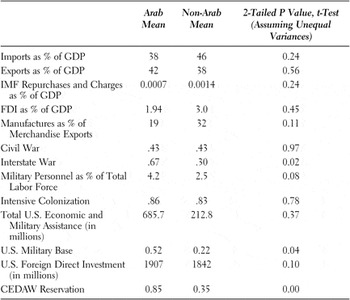
For these 13 indicators, Table 4 provides the Arab and non-Arab Muslim mean values and results of t-tests for whether the difference between the means is statistically significant. It demonstrates that Arab and non-Arab Muslim states have been integrated into the global economy to similar degrees with respect to imports and exports. Arab states do not have larger IMF debt service burdens on average than do non-Arab Muslim states. Although Moghadam (Reference Moghadam2003) had noted that the Middle East has received less FDI than other world regions, there is not a statistically significant difference between Arab and non-Arab Muslim states in terms of the amount of foreign direct investment each group has received. Finally, while, on average, Arab states produce fewer manufactures for export than do non-Arab Muslim states, the difference is not statistically significant. Variables related to economic globalization and structural adjustment, therefore, do not distinguish the two groups of states and appear to provide little leverage on the puzzle posed in this article.
Arab and non-Arab Muslim states compared

With regard to war and militarization, Arab and non-Arab Muslim states have had similar levels of exposure to civil war. A much higher percentage of Arab states, however, have been exposed to interstate war since independence. And while, on average, military personnel represent a higher proportion of the labor force in Arab states than they do in non-Arab Muslim states, the difference is not statistically significant at the p < .05 level.
With respect to the severity of Muslim majority states' encounters with the West, similar percentages of Arab and non-Arab Muslim states experienced intensive colonization. The aggregate historical picture thus is not different across the two groups of countries. In the contemporary period, while the average level of U.S. economic and military assistance granted to Arab states is higher than that granted to non-Arab Muslim states, the difference is not statistically significant. The same is true for levels of U.S. foreign direct investment. But Arab states do stand out in two ways. First, the military footprint of the United States is much heavier in Arab states: 52% of Arab states host at least one U.S. base, while only 22% of non-Arab Muslim states do. If U.S. military penetration fuels grievances and the identity politics that strengthen the influence of Islamist movements and their conservative gender views, then there appears to be more raw material for such a dynamic in Arab states. Second, 85% of Arab states registered reservations to CEDAW, whereas only 35% of non-Arab Muslim states did so. Arab states, thus, resist globalizing Western cultural norms much more vigorously than do non-Arab Muslim states. This may indicate that the strength of identity politics and the influence of Islamist movements—which use the comportment of women to differentiate their societies from the West—are heightened in Arab states relative to non-Arab Muslim states.
TESTING THE HYPOTHESES SIMULTANEOUSLY: DO THESE VARIABLES HELP EXPLAIN ARAB EXCEPTIONALISM?
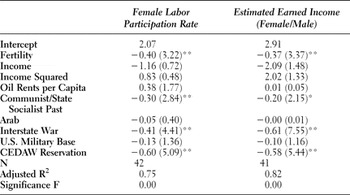
Compared to non-Arab Muslim states, then, the Arab world has suffered more interstate war, experienced more of a U.S. military presence, and manifested more resistance to Western globalizing norms regarding women's equality. Theoretically, there is reason to believe that each of these dynamics might negatively impact women's experience in the labor force. The analysis now considers these three differentiating factors simultaneously. Table 5 presents the regression equations from Table 3, augmented by the three variables that distinguish Arab states in ways that might account for Arab underperformance with respect to female labor force participation: the experience of interstate war, a U.S. military base presence, and the registration of CEDAW reservations. The objective is to ascertain whether these additional explanatory factors eliminate or reduce the impact of the Arab dummy—and improve the fit of the models more generally.
The effect of hypothesized variables on indicators of female labor force participation (OLS regression analysis – coefficient [and standard errors])

Note: Levels of significance in two-tailed tests: *p < .05; **p <. 01.
For both dependent variables—Female Labor Participation Rate and Female-to-Male Estimated Earned Income—the results are similar. These models explain much more of the variation than did the baseline models in Table 3, with adjusted R-squareds rising from .39 to .75 and .31 to .82, respectively. In both cases, Fertility now is statistically significant and, as expected, varies inversely with female achievements in the labor force. In both, the Communist/State Socialist Past dummy also is now significant. But it is signed in the opposite direction from what was expected: Countries that experienced such governance are associated with a reduced female presence in the labor force.
At least two potential explanations for this outcome emerge from the literature. First, in Central Asia after the fall of communism, a nationalist backlash ensued against communist ideology and policies that had long been perceived as anti-Islam, foreign, and forcibly applied. As in the Arab world, women have been used as symbols demarcating indigenous authentic identity from that of the oppressor; they have been encouraged to dress more conservatively and retreat from the workforce to return to “traditional” gender roles (Werner Reference Werner and Luong2004, 66). Second, in both Central Asian and Arab cases, while regimes' commitment to employing women has fallen in recent decades, laws passed in the communist or state socialist period to facilitate female employment (e.g., requiring employers to provide maternity leave, child care, etc.) are still on the books and make women's labor more expensive and therefore less in demand (Hatem Reference Hatem1992, 239; Kamp Reference Kamp and Luong2004, 53; Tzannatos Reference Tzannatos1999, 566). When the models are rerun replacing Fertility, Income, and Income Squared with Urban and Female Education (as was done to those on Table 3 as a robustness check), the Communist/State Socialist Past dummy is still negative but does not achieve significance at the p < .05 level for either dependent variable. It is, thus, not robust to this alternate specification.
In contrast to what Ross (Reference Ross2008) found, Oil Rents per Capita is not significant in either model in Table 5. It should be noted, however, that Oil Rents per Capita correlate very highly with Income (0.73) and Income Squared (0.77). When the regressions are rerun omitting these potentially confounding variables, Oil Rents per Capita remained insignificant in the case of Female-to-Male Estimated Earned Income, but was significant (at p < .01) in the case of Female Labor Participation Rate.Footnote 10 In this one case of statistical significance, the coefficient was positive, thus implying that higher levels of oil wealth are associated with higher female achievements in the labor force—the opposite of Ross's finding. These divergent findings may result either from the disparity in size and scope of our respective data sets (Ross's N = 160+) or from the fact that Ross does not control for such variables as fertility or interstate war.
In terms of the three variables identified as distinguishing Arab states in ways that may bear on female labor force participation, the presence or absence of U.S. military bases shows no relationship to the dependent variables. The Interstate War and CEDAW Reservation dummies are, however, statistically significant in both models. The experience of interstate war is associated with depressed female access to, and/or earnings in, the labor force, consistent with the literature. The same is true with manifest resistance to Western cultural norms in the form of registration of reservations to CEDAW. In both models, the Arab dummy is no longer statistically significant, suggesting that interstate war and backlash against the imposition of Western social norms help explain why Arab states stand out as having low achievements for women in the labor force. These findings are robust to alternative specifications: When Urban and Female Education are included in the model in place of Fertility, Income, and Income Squared—as well as when Income and Income Squared are excluded—the Interstate War and CEDAW Reservation dummies remain negative and statistically significant at p < .01, and the Arab dummy remains statistically insignificant.
DISCUSSION
There is nothing necessarily intrinsic about “Arabness” per se that has negative repercussions for women's work. Instead, the models presented in Table 5 suggest that in the context of Muslim-majority states, women struggle relatively more to enter the workforce and command income on an equal basis with men in countries that have experienced interstate war and that have registered substantive reservations to CEDAW. While these phenomena are more intense in Arab states, they are by no means exclusive to that region of the world. War, of course, is a global phenomenon. And whereas most Arab countries registered reservations when acceding to CEDAW, three did not (Comoros, Djibouti, Yemen)—while seven non-Arab Muslim states did (Bangladesh, Brunei, Malaysia, Maldives, Niger, Pakistan, and Turkey). Still, these findings beg the question: Why are interstate war and reservations to CEDAW more frequent in Arab states?
What can be said here in response to these questions highlights this article's contribution to, and dialogue with, an emergent literature that is suspicious of treating Muslim-majority states as a homogenous unit and that has suggested that many of the (negative) characteristics attributed to the “Muslim world” inhere primarily in the subset of Muslim states that are Arab. In the past decade, scholars have demonstrated that the Arab world underperforms not only with respect to labor force participation but also with respect to other indicators of women's status and to levels of democracy. Large-n statistical studies have shown dummies for Arab/Middle East states to be significant and inversely related to women's representation in parliament (Paxton Reference Paxton1997; Ross Reference Ross2008), as well as to female–male literacy gaps, sex ratios, women in cabinet and subcabinet positions, and life expectancy ratios (Donno and Russett Reference Donno and Russett2004). Moreover, many have argued both qualitatively and quantitatively that Arab regimes stand out as more authoritarian than non-Arab Muslim systems of governance (al-Braizat Reference al-Braizat2002; Karatnycky Reference Karatnycky2002; Stepan with Robertson 2003).
Until recently, however, little progress had been made in systematically determining how Arab states are distinct in ways that help account for these findings. This article shows that Arab states can be distinguished from the broader Muslim-majority context in their more frequent exposure to interstate war, their heavier U.S. military footprint, and their more manifest resistance to the imposition of Western gender norms. These findings may have broader implications. For example, the experience of interstate war and resistance to globalizing Western gender norms might help to explain Arab exceptionalism with regard to measures of women's status other than labor force participation, and could be pursued in future research. With regard to Arab states' resistance to democratization, some have posited U.S. backing for regional regimes as an explanation (al-Braizat Reference al-Braizat2002, 274; Stepan with Robertson 2003, 41–42); yet such backing is not quantified and confirmed as distinguishing Arab states from non-Arab Muslim states. While this study did not find a statistically significant difference in the amount of U.S. economic and military aid directed toward Arab versus non-Arab Muslim states, U.S. military bases are concentrated in Arab states and are indicative of especially close, mutually supportive ties between those regimes and the United States—lending credence to this line of argument.
Conversely, this emergent literature contains insights regarding the deeper questions raised by the analysis presented here. Stepan and Robertson (Reference Stepan and Robertson2003, 41–42) discuss Arab states' decades-long conflict with Israel as a possible explanation for the resilience (until 2011) of Arab authoritarianism. This conflict has littered the region with multiple wars between Israel and one or more Arab countries, and helps explain the relative prevalence of interstate war in Arab as compared to non-Arab Muslim states. Indeed, if wars involving Israel are removed from the Correlates of War data from which the interstate war dummy variable used here is constructed, then at p < .05, Arab states no longer can be distinguished from non-Arab Muslim states with regard to the frequency of experience with interstate war. At the same time, Israel enjoys high levels of U.S. support and—together with the region's oil deposits—constitutes a key U.S. interest in the region. This observation contextualizes another important characteristic of the wars in which Arab states have participated. As coded in the Correlates of War data set, many Arab states' war involvement has featured the United States, either as an adversary (Iraq in 1991 and 2003) or as a coalition partner (Egypt, Morocco, Oman, Qatar, Saudi Arabia, Syria, and the United Arab Emirates in 1991). In non-Arab Muslim states, only Afghanistan has experienced interstate war characterized by direct U.S. involvement. Israel and the intensity of U.S. geostrategic interest in the region thus help to explain the higher frequency of interstate war involvement for Arab states.
The fact that a critical number of interstate wars in which Arab states have participated involve either Israel or the United States has additional significance. It contextualizes the concentration of U.S. military bases in the region and underscores how much more the United States has been a political-military presence in Arab relative to non-Arab Muslim states. Israel's existence and United States interference figure centrally in the grievances with, and sense of crisis vis-à-vis, the West that have facilitated the rise of political Islamism, which in turn has been associated with the spread of conservative gender norms. Arab states' many wars involving Israel and the United States thus may contribute to persistent gender inequality not only through the increased societal misogyny shown in the literature to be associated with war generally but also because such wars reflect an intensity of confrontation with the West that is simply not seen in non-Arab Muslim states.Footnote 11 This confrontation has empowered Islamists and their conservative gender politics.Footnote 12
This article's findings thus highlight a key analytical dilemma surrounding the question of why resistance to the imposition of Western gender norms (as seen through reservations to CEDAW) is particularly prominent in the Arab world. The answer may be that, relative to non-Arab Muslim contexts, Arab society itself is at present more discriminatory against women. This perspective finds support in the work of Rizzo, Abdel-Latif, and Meyer (Reference Rizzo, Abdel-Latif and Meyer2007), who disaggregate Arab and non-Arab Muslim countries and investigate whether differences in public opinion exist vis-à-vis gender equality and other issues. Using World Values Survey data, they find that Arabs are more likely than are non-Arab Muslims to agree with statements signaling unequal gender views – for example, “men make better leaders,” “when jobs are scarce, men should get them,” “women must obey their husbands”—and the difference is statistically significant.
This article offers a different explanation for the higher rate of CEDAW reservations in Arab states. Relative to their non-Arab Muslim counterparts, Arab states have had a more pronounced experience with U.S. political-military interference. A more substantial clash with the United States may mean deeper grievances with the West of the sort that fuel Islamist movements' resonance. The CEDAW finding may (indirectly) indicate that Islamist movements are stronger and more influential in Arab states than in non-Arab Muslim states—and, therefore, that the conservative gender norms they have advocated are more salient. The Rizzo, Abdel-Latif, and Meyer study furnishes substantial support for the plausibility of this perspective. They show that many more (73% vs. 46%) Arabs than non-Arab Muslims identified first and foremost as Muslims rather than with their national identity (e.g., Lebanese or Yemeni); and Arabs were more likely to think that religious authorities have adequate solutions to social problems (almost 80% believe this). This suggests that Arabs are more open to—if not already persuaded by—Islamist movements and their platforms. The study also found that Arabs who supported gender equality were generally against democracy, while in non-Arab Muslim states support for gender equality went hand-in-hand with support for democracy. The authors posit that pro–gender equality respondents in Arab states feared that democratic elections would bring to power Islamists who would proceed to undermine women's status. If the authors are correct, then their findings suggest that Islamist movements are more politically powerful and socially salient in Arab as compared to non-Arab Muslim states.
Ultimately, this analytical dilemma cannot be resolved here. The question of the origin of Arab resistance to Western gender norms is an important one, however, and deserving of further study. From the perspective of the analysis presented here, reservations to CEDAW reflect regime sensitivity to conservative sentiments that stem not necessarily from the givens of Arab society and culture, but rather from the ways in which the identity politics of standing up to the West has played out more intensively in Arab relative to non-Arab Muslim states. This politics has been dominated by Islamist movements that promote conservative gender norms, and there is evidence that the appeal and influence of such movements is stronger in Arab states. Thus, attitudes toward women's roles in the Arab world may not be a fixed cultural characteristic. Instead, they may be contingent and relational, and at present the product of a particularly difficult set of encounters with the West. The distinction is subtle but important, because the latter interpretation implicates not only Arab society but also Western intervention and U.S. policy where the region's female labor force participation deficit is concerned.
APPENDIX: VARIABLE DEFINITIONS AND SOURCES
The variables are listed in order of their appearance in tables and notes. Values for a majority of the variables come from UNDP Human Development Report and World Bank World Development Indicators data. In employing these sources, I am following Paxton (Reference Paxton1997), Donno and Russett (Reference Donno and Russett2004), and Fish (Reference Fish2002), who use UNDP data; and Robinson (Reference Robinson2005) and Ross (Reference Ross2008), who use World Bank data.
In Table 2:
Life Expectancy Ratio (Female/Male): At birth. UNDP 2009 Human Development Report (HDR) (data are for 2007).
Maternal Mortality: Annual number of deaths of women from pregnancy-related causes per 100,000 live births. World Bank World Development Indicators online WDI (data are for 2005).
Educational Enrollment Ratio (Female/Male): Female combined primary, secondary, and tertiary gross enrolment ratio divided by male combined ratio. UNDP 2009 HDR (data are for 2007).
% of Parliamentary Seats Occupied by Women: Inter-Parliamentary Union's “Women in national parliaments” database. http://www.ipu.org/wmn-e/classif.htm (December 2010 data). Where parliaments are bicameral, lower house is used.
% of Cabinet Seats Occupied by Women: UNDP 2009 HDR (data are for 2008).
Female Labor Participation Rate: Proportion of female population age 15 and older that is economically active. WDI (data are for 2008). According to International Labour Organization definitions, “economically active” means that a person is supplying or seeks to supply labor for the production of all economic goods and services, whether for the market or for barter or for own consumption. This indicator thus includes members of the population employed both in the formal and the informal sectors, including agricultural and nonagricultural employment (see United Nations/International Labour Office 2009).
Estimated Earned Income Ratio (Female/Male): Ratio of estimated female earned income to estimated male earned income. UNDP 2008 HDR (data are for 2007). For further details on how this variable is constructed, see p. 376 of the 2007/2008 Human Development Report, available at http://hdr.undp.org/en/media/HDR_20072008_EN_Complete.pdf.
In Tables 3 and 5:
Fertility: The number of children that would be born to a woman if she were to live to the end of her childbearing years and bear children in accordance with current age-specific fertility rates. WDI (data are for 2000).
Income: Log of Gross Domestic Product per capita. UNDP 2008 HDR (data are for 2007; Afghanistan's figure is derived from the CIA's World Factbook, available at http://www.cia.gov).
Oil Rents per Capita: The total value of oil and natural gas rents divided by midyear population (in constant 2000$). Relative to measures typically used in “resource curse” studies—the value of exported oil divided by GDP—Ross's is a more precise measure because his numerator, the total value of oil and natural gas rents, includes the value of oil consumed domestically, takes production costs into account, and excludes oil that is imported and later reexported. Using population rather than GDP in the denominator gives a more intuitive sense of the relative value of such rents (Ross Reference Ross2008, 111–12, 121). My thanks go to Michael Ross for sharing his data for this variable.
Communist/State Socialist Past?: Dummy. Coded 1 if the country experienced communist or state socialist rule. Coded 0 if it did not.
In Note 6:
Urban: Percentage of total population that lives in urban areas. WDI (data are for 2008).
Female Education: Combined gross enrollment ratio for primary, secondary, and tertiary education. UNDP 2007/2008 HDR (data are for 2005).
In Table 4:
Imports as % of GDP: Value of all goods and other market services received from the rest of the world, divided by gross domestic product. WDI (data ranges from 2000 to 2002).
Exports as % of GDP: Value of all goods and other market services provided to the rest of the world, divided by gross domestic product. WDI (data are for 2003).
IMF Repurchases and Charges as % of GDP: Payments of principal and interest to the IMF (in current US$); divided by GDP (in current US$). WDI (data are for 2007). Numerator values for Brunei, Bahrain, Iraq, Kuwait, Libya, Oman, Qatar, Saudi Arabia, and the United Arab Emirates were assumed to be zero.
FDI as % of GDP: Net inflows of investment to acquire a lasting management interest in an enterprise operating in an economy other than that of the investor. WDI (data are for 2001).
Manufactures as % of Merchandise Exports: Manufactures include chemicals, basic manufactures, machinery and transport equipment, and miscellaneous manufactured goods. WDI (data are for 2007).
Civil War? Dummy. Coded 1 if a state has experienced civil war since independence, 0 if it has not. Correlates of War Intra-State War Data, 1816–1997 (v3.0). (Sarkees Reference Sarkees2000).
Interstate War? Dummy. Coded 1 if a state has participated in interstate war since independence, 0 if it has not. Correlates of War Inter-State War Data, 1816–1997 (v3.0). (Sarkees Reference Sarkees2000).
Military Personnel as % of Total Labor Force: Counts active-duty military personnel, including paramilitary forces if they may be used to support/replace regular military forces. WDI (data are for 1999–2000).
Intensive Colonization? Dummy. Coded 0 (by author) if there was no experience of formal subordination to a Western power or if Western influence was limited to defense treaties only [Afghanistan, Iran, Kuwait, Maldives, Saudi Arabia, Turkey, United Arab Emirates]. Coded 1 if a Western power interfered in domestic political, economic, and/or social affairs [Albania, Algeria, Azerbaijan, Bahrain, Bangladesh, Brunei, Chad, Comoros, Djibouti, Egypt, Eritrea, Gambia, Guinea, Indonesia, Iraq, Jordan, Kyrgyzstan, Lebanon, Libya, Malaysia, Mali, Mauritania, Morocco, Niger, Oman, Pakistan, Qatar, Senegal, Sierra Leone, Somalia, Sudan, Syria, Tajikistan, Tunisia, Turkmenistan, Uzbekistan, Yemen (while North Yemen was never colonized, Britain ruled South Yemen intensively from 1839 to 1967).
Total U.S. Economic and Military Assistance: In Millions. U.S. Overseas Loans and Grants: Obligations and Loan Authorizations, July 1, 1945–September 30, 2009 (Greenbook), available at http://gbk.eads.usaidallnet.gov/query/do (values are for 2005).
U.S. Military Base? Dummy. Coded 1 if the United States had a primary deployment, logistics, or training facility on the country's territory at any point during the 2000s; coded 0 if it did not. Sources: Department of Defense Base Structure Report Fiscal Year 2009 Baseline, available at http://www.defense.gov/pubs/pdfs/2009Baseline.pdf; Website of U.S. Central Command, http://www.centcom.mil/; Website of U.S. Africa Command, http://www.africom.mil/, and www.globalsecurity.org's description of the U.S. Central Command, available at http://www.globalsecurity.org/military/facility/centcom.htm.
U.S. Foreign Direct Investment: U.S. direct investment abroad, in millions, on a historical-cost basis. The value of U.S. direct investors' equity in, and net outstanding loans to, their foreign affiliates [foreign business enterprises in which a single U.S. parent owns at least 10% of the voting securities or the equivalent]. Source: U.S. Department of Commerce/Bureau of Economic Analysis, http://www.bea.gov/international. Data range from between 2001 and 2009.
CEDAW Reservation? Dummy. Coded 1 if, at the time of ratification or accession to the treaty, a country registered a reservation to one or more articles of the treaty specifically regarding equal treatment of women and men. Some, like Kuwait and Turkey, have since rescinded portions of their initial reservations; these were nonetheless coded as 1 based on their initial reservations. Mauritania's and Pakistan's reservations do not specify which articles are objected to and instead are blanket in tone (e.g., “we agree, subject to consistency with shari'a”); these were assumed to be substantive reservations and these countries were coded as 1. Countries are not counted as having entered a substantive reservation if the only article they objected to was Article 29, which concerns dispute-resolution mechanisms regarding the treaty. Iran, Sudan, and Somalia are not parties to the treaty at all. Iran and Sudan are counted as having registered reservations because their respective Islamist regimes can be presumed to be rejecting the substance of the treaty in its entirety; Somalia is not counted in the averages due to its failed-state status for much of the recent past. Data compiled from http://treaties.un.org/ and http://www.un.org/womenwatch/daw/cedaw/reservations-country.htm.