Introduction
Recently, many successful in vitro culture systems for bovine early embryos have been reported and applied to many reproductive technologies. However, the rates of development to the blastocyst stage, which is the critical point to term, remain at around 20–30% of cultured embryos (Lee et al., Reference Lee, Fukui, Lee, Lim and Hwang2004; Fujita et al., Reference Fujita, Umeki, Shimura, Kugumiya and Shiga2006; Lim et al., 2006). It has been reported that the early development of mammalian embryos is greatly suppressed in cultures with single or reduced numbers of embryos (Lane & Gardner, Reference Lane and Gardner1992; Kato et al., 1994; Ikeda et al., 1999; Mizushima & Fukui, Reference Mizushima and Fukui2000; Fujita et al., Reference Fujita, Umeki, Shimura, Kugumiya and Shiga2006). These results indicate that the culture system of early embryos is inadequate and incomplete. There must be some limiting factors in the in vitro embryo culture systems.
It has been suggested that suppression of early development in individual cultures might be caused by a deficiency of cooperative interaction among embryos (Keefer et al., Reference Keefer, Stice, Paprocki and Golueke1990; Paria & Dey, Reference Paria and Dey1990; O'Neill, Reference O'Neill1997). Autocrine factors such as epidermal growth factor, platelet-activating factors, insulin-like growth factors, etc., in culture drops have been shown to affect embryonic development (Yang et al., Reference Yang, Yang and Foote1993; O'Neill, Reference O'Neill1997; Gopichandran & Leese, Reference Gopichandran and Leese2006). However, the mechanisms of the interactions remain unclear. Discovering the mechanisms of the interactions might make it possible to establish a completely controlled culture system and also make the culture of fewer numbers of embryos derived from individual cattle by ovum pick-up, nuclear transfer and transgenesis successful. Chemically defined media have been developed for the culture of bovine zygotes to the blastocyst stage (Pinyopummintr & Bavister, Reference Pinyopummintr and Bavister1991; Nagao et al., Reference Nagao, Saeki, Hoshi and Kainuma1994). Defined media facilitate the analytical study of beneficial or suppressive factors in embryo development and the mechanisms of early development of bovine embryos under controlled environmental conditions.
Co-culture with various somatic cells has been shown to support bovine embryonic development from the 1-cell stage to the blastocyst stage (Eyestone et al., 1989; Goto et al., 1989). We previously reported that one of the beneficial roles of bovine oviductal epithelial tissue during co-culture with bovine early embryos may be to remove toxic substances from the medium (Nagao et al., Reference Nagao, Saeki, Hoshi and Kainuma1994). Therefore, there may be a cooperative interaction among bovine early embryos and culture conditions mediated by the reduction of toxic factors in the medium such as reactive oxygen (Nagao et al., Reference Nagao, Saeki, Hoshi and Kainuma1994), glucose and inorganic phosphate (Sirard et al., Reference Sirard, Parrish, Ware, Leibfried-Rutledge and First1988; Seshagiri & Bavister, Reference Seshagiri and Bavister1989; Petters et al., Reference Petters, Johnson, Reed and Archibong1990). However, serum albumin or serum, which was commonly used as a component of culture media, may make it difficult to study the cooperative interaction, as these supplements contain unknown factors that influence embryonic development (Kane & Headon, Reference Kane and Headon1980; Kane, Reference Kane1983). Protein-free culture systems should facilitate study of the cooperative interaction.
In this study, we examined interactions between the number of embryos, drop size, oxygen concentration and presence of glucose and inorganic phosphate in the medium during development of bovine IVM/IVF embryos in a protein-free medium.
Materials and Methods
Bovine oocyte collection and in vitro maturation
Oocyte collection and in vitro maturation of the oocytes were carried out as previously described (Saeki et al., Reference Saeki, Hoshi, Leibfried-Rutledge and First1990a). Briefly, bovine cumulus–oocyte complexes (COCs) obtained from antral follicles of slaughterhouse ovaries were washed and cultured for 21 h in tissue culture medium 199 with a 25 mM HEPES buffer (Cat. No. 12340, Gibco) supplemented with 0.1% (w/v) polyvinyl alcohol (PVA; M.W. 30,000–70,000; Sigma Chemical Co.), 0.5 mM sodium pyruvate (Nacalai Tesque Inc.), 1% (v/v) antibiotic–antimycotic solution (Gibco), 0.02 AU/ml follicle stimulating hormone (Antrin) and 1 µg/ml estradiol-17β (Sigma).
In vitro fertilization
In vitro fertilization was carried out as described by Nagao et al. (1995b). Briefly, frozen–thawed semen was washed with a discontinuous Percoll solution (Saeki et al.; Pharmacia). The matured COCs (10 COCs/drop) were inseminated with the washed spermatozoa (1 × 10⁶ cells/ml) in a defined medium (Brackett & Oliphant, Reference Brackett and Oliphant1975) modified by excluding glucose and supplemented with 1 µg/ml heparin (from porcine intestinal mucosa, Sigma; m-DM) in 100 µl drops of the medium covered with mineral oil (Squibb) in each culture dish (Falcon) for 6 h. Following the insemination, the sperm and cumulus cells were completely removed from the oocytes by vortex agitation (Sirard et al., Reference Sirard, Parrish, Ware, Leibfried-Rutledge and First1988). Some oocytes were fixed and stained for assessment of the fertilization (Iritani & Niwa, Reference Iritani and Niwa1977).
In vitro culture of IVM/IVF embryos
In vitro culture of IVM/IVF embryos was essentially carried out as described by Nagao et al. (1995a). Briefly, denuded embryos which were 6 h post insemination were cultured in a protein-free modified synthetic oviduct fluid (m-SOF; Nagao et al., 1995a) supplemented with or without glucose and/or phosphate (KH2PO4) under 5% CO2, 5% O2 and 90% N2 at 39°C with high humidity. Aliquots (1–250) of the embryos were placed in droplets (1–250 µl) of the medium covered with mineral oil (Squibb) in each culture dish (Falcon). Both cleavage (≥2-cell) and development to the blastocyst stage were examined under a stereo-microscope (×60) 7 days following the insemination. Some blastocysts were fixed and stained immediately for determination of the cell number (Saeki et al., Reference Saeki, Nagao, Utaka and Ishimori1990b).
Experimental design
Experiment 1. To examine the effects of the number of embryos, different numbers of embryos (1, 5, 10, 25, 50, 100 and 250) were cultured in 50 µl drops of the medium.
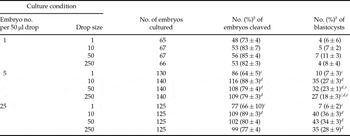
Experiment 2. To examine the effects of embryo density, one, five and 25 embryos were cultured in different sizes of the medium drop (1, 10, 50 and 250 µl).
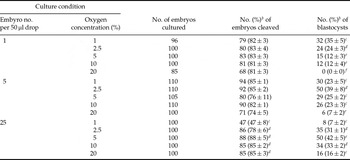
Experiment 3. To examine the effects of the oxygen concentration and embryo number, one, five and 25 embryos were cultured in 50 µl drops of the medium at 1, 2.5, 5, 10 and 20% O2 concentration.
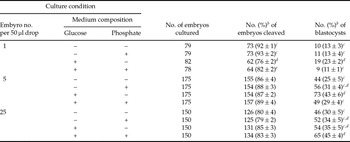
Experiment 4. To examine the effects of glucose and inorganic phosphate in a culture medium and embryo number, one, five and 25 embryos were cultured in 50 µl drops of the medium excluding glucose and/or inorganic phosphate (KH2PO4).
Statistical analysis
The frequencies of cleavage and development to the blastocyst stage calculated for every replicate were summarized as the mean ± SEM. The frequency and cell count of blastocysts were compared using Fisher's protected least significant difference (PLSD) test following analysis of variance (ANOVA).
Results
Experiment 1
The number of embryos in a drop during in vitro culture seriously affects early development of the bovine embryos. The frequencies of blastocyst development of groups of 25, 50 and 100 embryos/drop were higher than the other groups (p < 0.05, Table 1).
Effects of embryo number per drop in in vitro culture of bovine embryos on development to the blastocyst stagea

aReplicate number of each experimental groups was five.
bPercentage of cultured embryos.
cMean ± SEM.
d,e,fValues with different superscripts within the same column differ significantly (p < 0.05).
Experiment 2
When embryos were cultured in a 1 µl drop, cleavage and blastocyst development were suppressed irrespective of the embryo number/drop (p < 0.05, Table 2). In each number of embryos per drop, reducing or increasing the size of the drops (10, 50 and 250 µl drops) had no effect on the blastocyst development (p > 0.05).
Effects of embryo number and drop size in in vitro culture of bovine embryos on development to the blastocyst stagea

aReplicate number of each experimental groups was four.
bPercentage of cultured embryos were showed as mean ± SEM.
c,d,eValues with different superscripts within the same column and same group differ significantly (p < 0.05).
Experiment 3
The highest frequencies of the blastocyst development in the group of one embryo per drop was obtained at 1% O2, for five embryos in a drop group it was at 2.5% O2 and for 25 embryos in a drop group it was at 5% O2 (p < 0.05, Table 3). Reduced oxygen concentration improved blastocyst development of fewer number of embryos/drop.
Effects of embryo number and oxygen concentration in in vitro culture of bovine embryos on development to the blastocyst stagea

aReplicate number of each experimental groups was four.
bPercentage of cultured embryos were showed as mean ± SEM.
c–fValues with different superscripts within the same column and same group differ significantly (p < 0.05).
Experiment 4
The frequencies of blastocyst development in groups of one and five embryos/drop were improved in the medium which excluded inorganic phosphate (p < 0.05, Table 4). In a group of 25 embryos/drop, excluding glucose and/or inorganic phosphate had no effect on the blastocyst development (p > 0.05).
Effects of embryo number and medium composition in in vitro culture of bovine embryos on development to the blastocyst stagea

aReplicate number of each experimental groups was five.
bPercentage of cultured embryos were showed as mean ± SEM.
c,d,eValues with different superscripts within the same column and same group differ significantly (p < 0.05).
Discussion
Effects of the number of embryos during in vitro culture on the early development of bovine embryos were investigated in Experiment 1. We found that culturing embryos in groups (25, 50 and 100 embryos/drop) enhanced blastocyst development (Table 1), as has been shown in previous reports in mice (Paria & Dey, Reference Paria and Dey1990; Lane & Gardner, Reference Lane and Gardner1992; Kato & Tsunoda, Reference Kato and Tusnoda1994) and cattle (Keefer et al., Reference Keefer, Stice, Paprocki and Golueke1990). This result shows the existence of a cooperative interaction among the embryos in a culture drop. The possible reasons for this effect are as follows: bovine embryos improve their developmental environment by producing factors that stimulate their own early development in culture and/or by reducing the levels of toxic factors in the medium. Co-culture of normal mouse embryos with uncleaved embryos has been shown to decrease the developmental ability of normal embryos (Salahuddin et al., Reference Salahuddin, Ookutsu, Goto, Nakanishi and Nagata1995). However, in our embryo culture condition, in which the average cleavage rate was around 70–80%, uncleaved embryos in culture drops did not affect the early development of fertilized embryos to blastocysts (data not shown).
The ligands and receptor mRNAs for many kinds of growth factors have been detected in the early embryos of many species (Rappolee et al., Reference Rappolee, Brenner, Schultz, Mark and Werb1988; Corps et al., Reference Corps, Brigstock, Littlewood and Brown1990; Watson et al., Reference Watson, Hogan, Hahnel, Wiemer and Schultz1992). It has been shown that growth factors are produced by early embryos as well as by oviduct epithelial cells and uterus epithelial cells and that supplementation of the growth factors clearly plays an important role in early embryonic development in vitro (Gardner & Kaye, Reference Gardner and Kaye1991; Paria & Dey, 1993; Yang et al., Reference Yang, Yang and Foote1993: O'Neill, Reference O'Neill1997: Gopichandran & Leese, Reference Gopichandran and Leese2006). These reports may be evidence of an autocrine role for growth factors during embryo development and suggest that decreasing the embryo number in culture drops will dilute the concentration of some growth factors in the drop, resulting in the suppression of embryo development. Therefore, we tried to improve blastocyst development in culture with fewer embryos by decreasing the drop volume, i.e. by concentrating some autocrine factors in the medium (Experiment 2). However, the volume of the medium drops did not affect blastocyst development (Table 2). This result indicates that the quantity of some of the growth factors produced by embryos might be very small and that the effects of these growth factors on development might be very slight. Alternatively, decreasing the drop volume may increase the concentration of metabolites such as ammonium (Orsi & Leese, Reference Orsi and Leese2004), resulting in a toxic developmental environment for the embryos.
We also speculated that bovine embryos may decrease the concentration of toxic factors in the drops, resulting in enhanced blastocyst development. In Experiment 3, we examined the relationship between the number of embryos and the oxygen concentration during culture. We found that oxygen concentration was correlated with embryo number and that lower oxygen concentrations enhanced the development of smaller numbers of embryos. The frequencies of blastocyst development for one, five and 25 embryos in a drop were highest at 1, 2.5 and 5% O2, respectively (Table 3). A possible reason for this effect may be the consumption of oxygen in the medium by the aerobic metabolism of each embryo. The oxygen consumption of early mouse embryos has been shown to be around 150–500 × 106 µl/embryo/h (Mills & Brinster, Reference Mills and Brinster1967; Houghton et al., Reference Houghton, Thompson, Kennedy and Leese1996). Therefore, the oxygen concentration of the microenvironment around the embryos in microdrops may be reduced to a lower level than that of the gas phase in the incubator. A low oxygen concentration of around 5–10% has been shown to enhance early embryonic development in a cell-free group culture (Quinn & Harlow, Reference Quinn and Harlow1978; Thompson et al., Reference Thompson, Simpson, Pugh, Donnelly and Tervit1990; Nagao et al., Reference Nagao, Saeki, Hoshi and Kainuma1994). Oxygen tension in the oviduct is approximately 11–60 mmHg (1.5–8.7%) (Mastroianni & Jones, Reference Mastroianni and Jones1965; Mass et al., Reference Mass, Storey and Mastroianni1976; Fisher & Bavister, 1993). However, as shown in this study (Table 3), the optimal oxygen concentration for a single embryo in an in vitro cell-free condition may be lower than that previously reported. It has been previously shown that concentrations of reactive oxygen species in embryos increase proportionally to oxygen concentration, thereby causing lipid peroxidation and enzyme inactivation that result in cell damage (Nasr-Esfhani et al., Reference Nasr-Esfhani, Aitken and Jonson1990; Ribarov & Benov, Reference Ribarov and Benov1981).
We also examined the relationship between the number of embryos and glucose and inorganic phosphate (KH2PO4) in the culture medium in Experiment 4. We found that the amount of inorganic phosphate in the medium was correlated to embryo number and that excluding phosphate from the medium enhanced the development of fewer embryos (Table 4). Inorganic phosphate and glucose in the medium have been shown to be detrimental to embryo development (Schini & Bavister, Reference Schini and Bavister1988). Seshagiri and Bavister (Reference Seshagiri and Bavister1989) showed that inorganic phosphate regulates the glucose-mediated inhibition of development of hamster 8-cell embryos in vitro. These inhibitory effects were also observed in a pig embryo culture (Petters et al., Reference Petters, Johnson, Reed and Archibong1990). Therefore, 1.17 mmol inorganic phosphate in the medium may be detrimental for the early development of low density mbovine embryos as shown in Table 4.
Our results indicate that there is a cooperative interaction among bovine early embryos during in vitro culture and that this interaction may be mediated though the reduction of toxic factor(s). At low embryo density (one to five embryos/drop), reduced oxygen concentration (1–2.5%) or the exclusion of inorganic phosphate from the medium enhances blastocyst development. Our protein-free culture system for bovine embryos reveals these interactions first. Elucidating the mechanisms of these interactions might make it possible to establish a completely controlled culture system and also allow the culture of fewer embryos. These results may also be useful for practical and biological application of ovum pick-up, nuclear transfer and transgenesis culture systems for individual cattle.