The process of selecting cabinet ministers often takes place behind closed doors, including weighing the need to balance or manage factions within the president's party and/or coalition partners; addressing demands for diversity in the cabinet, such as appointment of women or other historically underrepresented groups; sending signals about the administration's policy agenda; and enabling the president to have people he or she trusts close at hand. On the other hand, ministerial exits are usually less private affairs. In some cases they come after weeks of public or congressional scrutiny and criticism of ministers for policy failures or follow extended speculation about who will lose their seat when the president reshuffles the cabinet. Some ministers depart to pursue lucrative private-sector opportunities. Other ministers switch posts but stay in government. How ministers exit can have implications for the administration since a president who is frequently forced to shuffle the cabinet or sack ministers looks ineffective, and comparisons to rats and sinking ships are difficult to avoid in the wake of excessive changes. At the same time, an administration with zero turnover may also not be healthy, as it would suggest that presidents are staidly bound to their initial course of action and unable (or unwilling) to adapt to changing circumstances.
While how ministers leave the cabinet has implications for the president's perceived efficacy, it also has implications for the individual ministers involved. Ministers who exit voluntarily while perceived as successes are likely to have better future prospects than those roundly seen as failures. For those who have future ambitions in politics, this is critical. Some ministers spend their entire tenure in the same post and remain until the end of the term, others move from one portfolio to another, some leave, apparently voluntarily, often for a job in the private sector, and others are forced to resign or even fired. Are there systematic patterns to this variation, and are those patterns gendered? As appointment of women to full cabinet-rank posts and more diverse posts has increased in some countries, we can explore whether women are more likely than men to exit in a particular way (e.g., are they more or less likely to be fired?) and whether the same factors explain how women and men exit. This is important because while we know that women are holding more posts and more diverse cabinet posts (Escobar-Lemmon and Taylor-Robinson Reference Escobar-Lemmon and Taylor-Robinson2005; Jacob, Scherpereel, and Adams Reference Jacob, Scherpereel and Adams2014, Krook and O'Brien Reference Krook and O'Brien2012), we do not know if they are successful once in the cabinet. Appointment of women may be viewed as important only for diversity in the photos of the initial cabinet, but then interest in cabinet gender diversity may wane, and women may face a tougher time in the cabinet than their otherwise similar male colleagues. In addition, if women bring different types of experience or connections to the cabinet than men, that too may cause women and men to have different likelihoods of exiting in different ways. Additionally, if women are more likely to exit early (either because they meet a bad end or retire) that raises questions about whether they have the opportunity to be full power players.
EXPECTATIONS ABOUT MINISTERIAL EXIT AND WHY IT MAY BE GENDERED
Cabinet duration has long been a subject of interest in parliamentary systems and is increasingly a subject of investigation in presidential systems (e.g., Amorim Neto Reference Amorim Neto2006; Camerlo Reference Camerlo2011; Kellam Reference Kellam2013; Raile, Periera, and Power Reference Raile, Pereira and Power2011). In parliamentary systems, ministers are typically expected to want to stay in their post as long as possible and to avoid a bad end (Berlinski, Dewan, and Dowding Reference Berlinski, Dewan and Dowding2007, 245), but neither that literature nor the presidential literature explains individual ministers' exits focusing more on overall questions of cabinet composition.
A liberal feminist account of equality would predict that men and women, assuming their backgrounds are comparable, have the same types of experiences when it comes to exiting the cabinet. This comports with a conventional wisdom suggesting that it is not sex, but qualifications that determine a minister's fate once in office. On the other hand, a perspective that sees women as more collaborative and preferring to avoid conflict (see Carey, Niemi, and Powell Reference Carey, Niemi, Powell, Thomas and Wilcox1998; Jeydel and Taylor Reference Jeydel and Taylor2003; Kathlene Reference Kathlene1994; Simon Rosenthal Reference Simon Rosenthal2000) would predict that even if all else is equal, women would be more likely to retire early, while men would be more likely to fight losing battles and exit in disgrace. Additionally, if women play an important symbolic role in these cabinets, it might be more politically costly to outright fire a female minister, and thus she might be eased out and announce her retirement, whereas a man might be summarily dismissed. Thus, with respect to minister sex, two general competing propositions emerge:
P1a:
Men and women ministers will be equally likely to exit the cabinet in all ways, and they will be equally likely to survive in post until the end of the term (liberal feminist account).
P1b:
Women will be more likely than men to retire; men will be more likely to engage in conflict and thus to meet a bad end (collaborative-conflictual nature).
But, beyond such basic and competing expectations, backgrounds of men and women cabinet ministers may differ in ways that affect how experience and connections prompt a minister to stay in the same post, switch posts, or end up the loser in a conflict. The effect of background is especially interesting in presidential systems because cabinet ministers do not need to come from the legislature, and, in fact, many are not career politicians, so there is a very broad and diverse pool of potential appointees.Footnote 1 We thus consider how and when differences in background have similar and different effects for men and women.
Experience is expected to influence a minister's capacity to do his/her job. Huber and Martinez-Gallardo (Reference Huber and Martinez-Gallardo2008, 169) argue that “[m]inisters often need technical expertise regarding which policies will yield desired outcomes in a particular portfolio” and “the political skills necessary to broker compromises with key actors …” (ibid.,170). Bäck, Meier, and Persson (Reference Bäck, Meier and Persson2012, 5) hypothesized that ministers with parliamentary experience were likely to last longer in their post because a PM should be better able to ex ante gauge their competence and loyalty. They found support for their hypothesis in Sweden, but not in Germany. Political experience, as well as policy expertise, could also be important for members of presidential cabinets due to challenges that are common in executive-legislative relations and because of the oversight powers of legislative committees. Because of oversight activities, cabinet ministers may work for two principals: the president and the relevant committee (Andeweg Reference Andeweg2000, 388). Andeweg cites U.S. literature that describes these two principals as being “in a constant ‘War of Control of Administration’ (Kaufman Reference Kaufman1981, 181–84),” but he also sees two principals as allowing a minister to play one principal off against the other. This suggests that policy expertise is less likely to be fungible across portfolios, leading to the following proposition:
P2:
Ministers with relevant policy expertise will be less likely to switch posts than ministers who lack policy expertise.
Yet research about women running for elected office in the United States has found that women tend to be better qualified than men before they will run or win office (e.g., Fulton Reference Fulton2012; Lawless and Fox Reference Lawless and Fox2005, Chapter 6; Lawless and Pearson Reference Lawless and Pearson2008;). Lawless and Fox (Reference Lawless and Fox2005, 107) write, “Existing in traditionally sexist professional environments leads many eligible women candidates to conclude that they need to be more qualified than men to compete evenly.” If women tend to want more experience before they are appointed to full cabinet rank posts, or if selectors require it of them, we might expect that extensive policy expertise in a field would make women even less likely than men to be willing to switch posts, possibly making women more likely to exit the cabinet if they cannot remain in the same post. Some support for this expectation for cabinet ministers can be found in Escobar-Lemmon and Taylor-Robinson (Reference Escobar-Lemmon and Taylor-Robinson2009), which found that women who hold more than one post in Latin American cabinets are better qualified for their second post than are men who switch posts (also see Borrelli Reference Borrelli2002, 102 for the United States).
In contrast to policy expertise, political experience is a skill that should be broadly applicable and not post specific. It could help male and female ministers navigate rough political waters, so we expect the following:
P3a:
Ministers with political experience will be more likely than other ministers to switch posts.
P3b:
Ministers with political experience will be less likely to meet a bad end than ministers who lack political experience.
Yet the political experience of men and women may differ, as has been demonstrated in a detailed analysis of the Argentine Congress (Franceschet and Piscopo Reference Franceschet and Piscopo2014; also see Borrelli Reference Borrelli2010 for the U.S. cabinet). In addition, as politics and political parties in particular are still male-dominated domains (Morgan and Hinojosa Reference Morgan and Hinojosa2015), women in cabinets having extensive political experience may signal their ability and/or connections to succeed at that male-dominated game, and thus it may be extra helpful for women in avoiding a bad end.
Cabinet ministers may have their own policy or political goals. Andeweg (Reference Andeweg2000, 390) argues that if their preference is to build their future political career, a minister will follow the lead of the executive to maximize their time in office or lay the groundwork for a promotion. But, if ministers care most about policy, they may “use their autonomy to further their personal political views regardless of whether these are congruent with those of their principal.” It is particularly problematic if the minister internalizes the expectations of career bureaucrats in his/her ministry or its key constituencies (Andeweg Reference Andeweg2000, 391), which may be more likely if the minister has links to ministry clients. Andeweg also predicts that over time ministers with client links may “drift” from the executive's policy preferences if they become more aligned with the preferences of their sector. Key ministry clienteles may become competing principals “if they possess the ability to sanction a minister's policy decisions by mobilizing the public or withdrawing essential policy support” (Bäck, Meier, and Persson Reference Bäck, Meier and Persson2012, 4). Links to ministry-related interest groups help a minister understand his/her ministry's issue jurisdiction. Additionally, links to clients can raise the cost to the president of removing the minister. This suggests the following:
P4a:
Ministers with client links should be less likely to switch posts than ministers who lack client connections.
P4b:
Ministers with links to key ministry constituents should be less likely to be forced out of their posts than ministers who lack client links.
But again, we need to explore whether client links have the same protective effect for women and men, in particular since women may have built links with different types of clients (e.g., women's groups) or lack opportunities to build links with certain types of clients (e.g., business groups, clientelistic networks) that may be particularly helpful for enabling them to remain in power (Franceschet and Piscopo Reference Franceschet and Piscopo2014, 99). We note that Borrelli (Reference Borrelli2002, 54, 74) found that in the U.S. cabinet women tended to be appointed to posts for which they did not have links to department clients, which she argued increased their dependence upon the president, and that they were more likely than men to be generalists and less likely to be liaisons.
Presidents often want confidants in their inner circle. U.S. President John F. Kennedy and Costa Rican President Oscar Arias both appointed their brothers to key posts. Appointees may also be connected to the president professionally (e.g., prior experience working together in the executive branch) or from work on the president's campaign. Some appointees are known to be long-time friends. Unconstrained by the need to appoint members of parliament, presidents have greater ability to bring such people into their cabinets. Thus,
P5a:
Ministers who were connected to the president prior to their appointment will be more likely to remain in the cabinet.
P5b:
Ministers who are connected to the president will also be more likely than other ministers to switch posts.
Here with regard to gender we expect connections to the president to be equally protective for women as men—though investigating that is one of the purposes of this article. However, a relevant question is whether women are equally likely as men to have such connections.
We begin with a baseline expectation that well-qualified cabinet ministers—both women and men—will stay in their post (not switch posts), and they will not be forced out of office (meet a bad end). However, being well qualified should not decrease the chance that a minister would retire from the cabinet and move to a job in the private sector because the traits that made him/her qualified for the cabinet post could also be valuable in the private sector, and qualification for a post may not correlate well with job satisfaction. Hence,
P6:
Ministers entering the cabinet from the business sector will be more likely to retire early than ministers from the government sector.
We expect a business background to create additional employment opportunities for both men and women. However, women's careers often differ from those of men, and women are less likely than men to have connections to business groups and are less likely to come from business/banking careers (see Escobar-Lemmon and Taylor-Robinson Reference Escobar-Lemmon and Taylor-Robinsonn.d., Chapter 4). Nonetheless, we expect that women who have this less common career trajectory will derive the same benefits from it that men do.
DATA AND ANALYSIS
As explained above, our goal is to evaluate whether there are significant differences by sex in the treatment of cabinet ministers. To do this we examine all cabinet ministers in five presidential democracies: Argentina, Chile, Colombia, Costa Rica, and the United States. Those five cases provide us with some important variation in the experience with democracy, federalism, and women's representation. Thus, while our conclusions are limited to presidential systems and might be tempered to some extent by wealth, we do expect them to be generalizable to other countries with U.S.-style presidential regimes.
Costa Rica, Colombia, and the United States are long-established democracies, so there has been time for norms about cabinet qualifications to develop. Costa Rica and Colombia have the longest enduring democracies in Latin America.Footnote 2 Chile and Argentina were part of the region's redemocratization during the Third Wave,Footnote 3 plus both have had female presidents: Michelle Bachelet (2006–2010, 2014–present) and Cristina Fernandez (2007–2015).Footnote 4 We examine presidential systems in the western hemisphere because that is where presidential-styleFootnote 5 democratic regimes evolved, and these countries provide variance in the independence and policymaking powers of the president (Mainwaring and Shugart Reference Scott and Shugart1997).
These five countries also vary in government structure, from relatively centralized unitary systems in Costa Rica and Chile, to a decentralized unitary system in Colombia, to decentralized federations in Argentina and the United States. Chile, Colombia, and Costa Rica have been leaders in terms of numbers of women appointed to the cabinet and diversity of posts held for an extended period of time.Footnote 6 Argentina, like Brazil and Mexico, has lagged in appointment of women to the cabinet (Luna, Roza, and Vega Reference Luna, Roza and Vega2008), but the case is of interest because it was the first country to adopt a national gender quota, thus creating a large pool of women with legislative experience. The United States also lags in appointment of women, but it is the most extensively studied presidential cabinet, and, in particular, the study of women in the cabinet is more developed (see Borrelli Reference Borrelli2002, Reference Borrelli2010; Martin Reference Martin1989, Reference Martin, Borrelli and Martin1997). These Latin American cases have higher levels of economic and human development than many countries of the region, which facilitates comparison with the United States.
Finally, while these countries are not optimal for the study of coalition cabinets—all Chilean cabinets are coalitions, but we include only Concertación governments, and that coalition was negotiated as part of the country's transition to democracy rather than the result of negotiation after election of a president—several presidents in our dataset lacked a single-party majority in the congress and thus had to negotiate with opposition parties in order to pass legislation. In addition, dominant parties—particularly in Argentina and Costa Rica, but also in Colombia—are known for internal faction competition, which is another factor presidents have to consider when appointing ministers and shuffling their cabinet.
Our dataset is comprised of all ministers holding posts of full cabinet rank, initial and replacement in two to four recent administrations. We include the following:
• Argentina: De la Rúa (1999–2001), Duhalde (2002–2003), Kirchner (2003–2007), Fernández (2007–2011)—96 ministers (19 women, 20%)
• Chile: Lagos (2000–2006), Bachelet (2006–2010)—94 ministers (33 women, 35%)
• Colombia: Pastrana (1998–2002), Uribe (2002–2006), Uribe (2006–2010)—83 ministers (20 women, 24%)
• Costa Rica: Rodríguez (1998–2002), Pacheco (2002–2006), Arias (2006–2010)—97 ministers (24 women, 25%)
• United States: Clinton (1993–1997), Clinton (1997–2001), Bush (2001–2005), Bush (2005–2009)—77 ministers (14 women, 18% women)
Measuring Ministerial Exit
To determine how a minister left office we drew primarily on newspaper stories describing the political situation and usually announcing the replacement of one minister with another. Based on this, we coded ministers as exiting in one of four ways:
1. Survivors remain in office until the end of the president's term (232 of the total 447 ministers, or 53%). Survivors exit with the president when he/she leaves office. We also code as survivors those who exited at the end of the first term for presidents elected to two consecutive terms and those reappointed to the same post by the next president. Monica Nagel and Roberto Rojas in Costa Rica nicely illustrate this mode of exit. Both were appointed as part of President Rodríguez's initial cabinet, and both remained in their posts—Justice and Foreign Affairs, respectively—until the end of the administration.
2. Switchers leave their post but move to another cabinet post (54 ministers, 12%). They may move from one cabinet post to another during a single administration, move from one cabinet post to another when a new administration starts, or move from a cabinet post to another high-level appointed post (e.g., chief of staff, ambassador).Footnote 7 Nilda Garré and Aníbal Fernández from Argentina both illustrate this type. Garré was appointed Minister of Defense by President Kirchner and reappointed to that post by President Fernández at the beginning of her term and then later switched to Minister of Security. Aníbal Fernández initially served as Minister of the Interior during President Kirchner's term. He was moved to Minister of Justice by President Fernández at the beginning of her administration and then moved to Cabinet Chief.
3. Bad end is the mode of exit for ministers who leave the cabinet under fire or in disgrace/shame (88 ministers, 20%). A few were dismissed by the president, but most resigned in the face of problems or protests or were surrounded by scandal. Policy failure or policy or personal conflict with the president were other reasons for resignation. Yasna Provoste and Martin Zilic, both ministers in President Bachelet's cabinet in Chile, illustrate this type of exit. Yasna Provoste served as Minister of Planning during the Lagos administration and then switched to Minister of Education under Bachelet. However, in April 2008 she was suspended by the Chamber of Deputies and later impeached by the Senate. Martin Zilic was Bachelet's original Minister of Education, but Bachelet asked him to resign in July 2006 in response to the ongoing student protests. We also include in this category ministers who leave in a cabinet shuffle (16 ministers), regardless of whether they were described in the press as the cause of the cabinet shuffle.Footnote 8
4. Retire is the mode of exit for ministers who apparently leave by choice (65 ministers, 15%). This category includes ministers who explicitly say they are retiring from the working world, returning to private-sector employment (28 ministers), or leaving to seek elected office themselves or help someone else win an election (32 ministers). While it is possible that some of those who stated they were retiring were in fact “pushed out,” we would note that in these cases there was at least some interest in creating the appearance that these exits were voluntary. Elvira Cuervo de Jaramillo and Parmenio Cuellar of Colombia both illustrate this mode of exit. President Uribe appointed Elvira Cuervo as his Minister of Culture at the beginning of his second term, but she then left the cabinet to return to the private sector. Cuellar was appointed Minister of Justice at the beginning of President Pastrana's term, but then he too left the cabinet to return to work in the private sector. William Daley in the United States is an example of retiring from the cabinet to take part in a campaign, as he stepped down from President Clinton's cabinet where he served as Secretary of Commerce to chair Al Gore's presidential campaign. We exclude from our analyses the eight ministers who died in office or whose extreme health problems forced their resignation.Footnote 9
Observing Policy Expertise, Political Experience, and Linkages
Data on the explanatory variables come from biographical information about each minister, gathered primarily from Web searches.Footnote 10 Thus, our study utilizes publicly known credentials of ministers. It is possible that a minister actually has a characteristic, but it was not visible, which means that if presidents were using this appointment as a signal, it was not an effective signal.
After building biographical sketches, each author coded every minister on every variable, and then we discussed coding disagreements, adding additional coding rules to clarify how we handled borderline cases. All characteristics are coded as binary variables, meaning a minister was either judged to have this trait or not.
To measure policy expertise we include a measure coded 1 if the minister has substantial experience. To meet the threshold of substantial experience, a minister needed to have worked in the area for an extended period of time; a year of experience or a related degree obtained 20 years prior did not meet this threshold. Experience could be obtained in either government or the private sector.
We operationalize political experience in three ways. First, we measure whether a minister was an insider (slightly modified from Borrelli's use of the term in her Reference Borrelli2002 study of U.S. cabinets), defined as having previously held office as vice-minister or minister, or having built a career in national government (either in elected posts or senior appointed positions). “Outsiders” may have worked for the government for years, but not in a high-level post or not in the capital. Second, we code as officeholders those who have run for or held elected office (at any level of government) or held high appointed office (e.g., ambassador, agency director). Third, we build on Cohen's (Reference Cohen1988) typology of party activity in the United States and code as organizational partisans those who held a post in their party (national, local, party office in congress), managed a campaign, or were a presidential campaign advisor.
We code a minister as having links to ministry clients if the minister is known to be associated with any group whose interest/purpose overlaps the policy purview of their ministry. The association can be established via formal membership, close contact through work, membership in professional associations, or service on a board of directors.
A minister was coded as having connections to the president if they were identified as a long-time friend or confidant of the president or had a long-time involvement in their political exploits; if they served as campaign advisor to the president or some other similar association; or if they had family ties.
To explore the impact of having a business background we include a series of dummy variables for whether a minister had a primarily government sector career (including elected or appointed posts or employed in government at any levels), legal career, other private sector (e.g., education, consulting, medicine, unions, and other miscellaneous private careers), or revolving door career (a career moving back and forth between government and private sector). The excluded/comparison category for each of the above is the excluded category of business sector (e.g., banking or industry) careers.Footnote 11
Finally, we include three sets of control variables. First, we recognize that not all ministries may be equally stable or volatile and that type of exit may vary by type of post. To account for this, based on Keman (Reference Keman, Blondel and Thiébault1991), we aggregate ministries into three broad categories—Economic, Social Welfare, Central—based on similar policy responsibilities. This provides a way to consider whether there are differences across the types of ministries without including a dummy variable for each individual ministry. Economic ministries manage the national economy or regulate/oversee sectors of the economy: Agriculture, Commerce & Industry, Energy/Mining/Environment, Finance/Treasury, Planning, and Public Works & Transportation. Social Welfare ministries oversee a country's social welfare programs: Education, Culture, Health, Housing & Urban Development, Labor & Social Security, and Women's Affairs. Central ministries are responsible for managing a country's national and international affairs: Defense, Foreign Affairs, Justice & Public Security, and Presidency & Communications. Second, we account for whether a minister was appointed as part of the initial cabinet or not. Replacement appointees are thought to differ from initial appointees (see Borrelli Reference Borrelli2002, 42; Cohen Reference Cohen1988, 113–16; Mann and Smith Reference Mann and Smith1981; Nicholls Reference Nicholls1991), but replacement ministers also face less time until the end of the term. If the probability of something bad occurring increases the longer a minister serves, all else being equal, initial ministers may have a higher risk of being forced out. Third, to account for unobserved heterogeneity across countries, we include country dummies.
WHAT DETERMINES HOW MINISTERS EXIT?
To test whether women and men are treated equally with regard to how they exit the cabinet—in other words, whether sex predicts cabinet exit when controlling for minister background—we estimate a multinomial logit model. This is the appropriate estimation technique because our dependent variable is four mutually exclusive, unordered categorical outcomes (survivor, switcher, bad end, retire).Footnote 12 To test our propositions we estimate a model using all the predictors and control variables described above. The comparison category is survivor, so coefficients should be interpreted as the impact of that variable upon the log odds that a minister exits each way rather than remaining in the same post until the end of term.
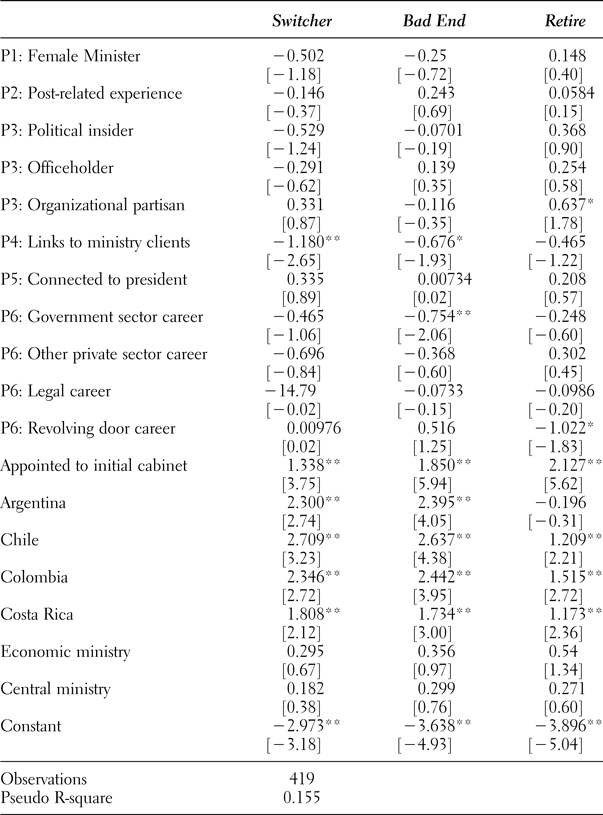
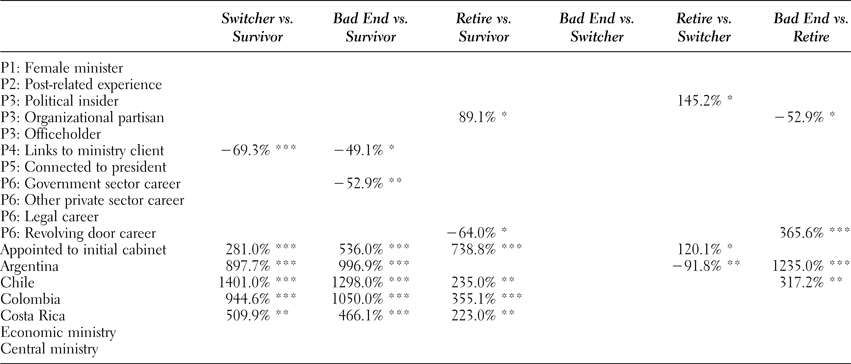
The models reported in Table 1 suggest that relatively few of our background characteristics predict the way in which ministers exit early rather than survive to the end of the term. These results, however, tell only part of the story, as they only compare the probability of each type of exit with the probability of remaining in office until the end of the term. While the comparisons among the types of early exit rather than remaining to the end of the term are interesting, some of our hypotheses were couched in terms of the way that a background trait could affect different modes of exit. Consequently, we retrieved the coefficients for all paired exit comparisons, and to make them more intuitively interpretable, we report the percent change in the odds for all coefficients that are statistically significant at the .10 level in Table 2.
Multinomial logit model of mode of exit
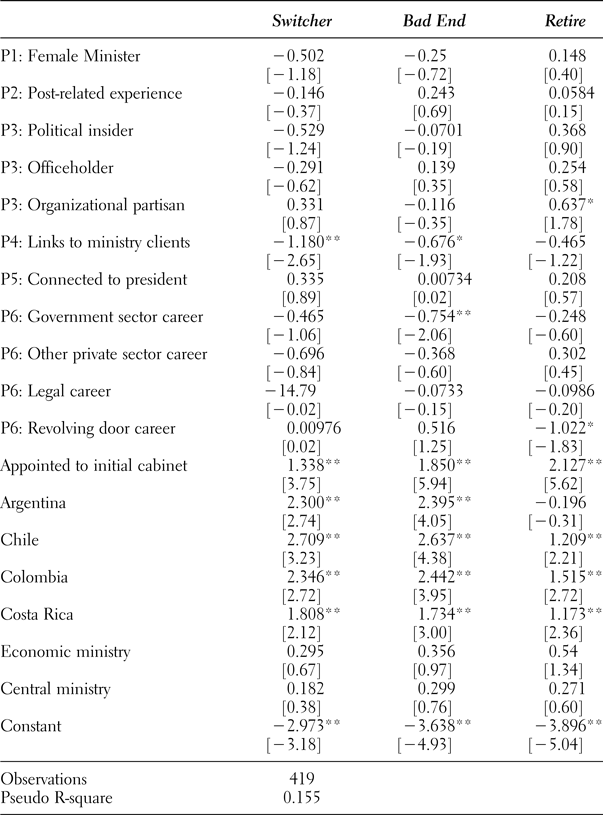
Notes: Z-scores in brackets. * p < 0.10, ** p < 0.05, *** p < 0.01
Comparison (base) category is survive until the end of term.
Odds ratios for comparison of all modes of exit

Notes:* p < 0.10, ** p < 0.05, *** p < 0.01
Numbers reported in the table are percentage change in the odds for coefficients from model in Table 1 with p < .10.
The results in Tables 1 and 2 provide support for few of our propositions. Most important for gender integration, women are basically treated the same as men, although we provide a further test of this below. Being an insider or organizational partisan, having client linkages, or coming from government versus business careers and revolving door versus business careers predict only some types of exit. We find no evidence that having policy expertise (measured with the prior related experience variable), having held prior office, or being personally connected to the president have any effect upon whether a minister exits before the end of the term or distinguishes one type of early exit from another.
We find limited support for our expectation that ministers with political experience are less likely to meet a bad end (P 3b). Organizational partisans have a 53% decrease in the odds of meeting a bad end as opposed to retiring, suggesting that political experience may allow them to figure out when to leave in time to avoid being fired. However, we see no effect of any of the three variables we use to measure political experience reducing the risk of meeting a bad end rather than remaining until the end of the term. We find reasonable support for our expectations with regard to client linkages (P 4). We expected to find that ministers with known links to ministry clients were less likely to switch (P 4a) and also less likely to be forced out or meet a bad end (P 4b). As predicted, having links to clients decreases by 69% the odds a minister will switch posts and decreases by 49% the odds a minister will meet a bad end rather than remain in his/her post until the end of the term.
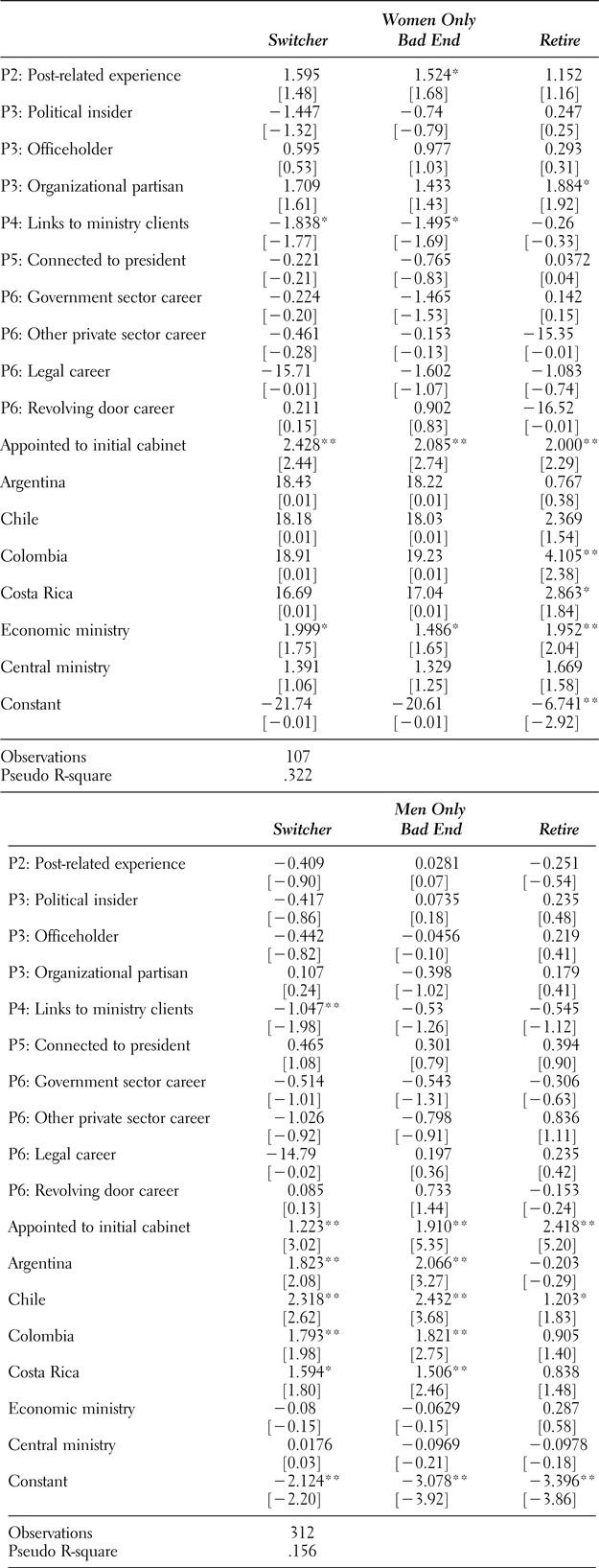
The models presented in Tables 1 and 2 provide a strong test of whether gender has an independent and direct effect upon how a minister exits the cabinet, taking into account background. Even when comparing all possible exits, we find no differences between men and women in how they exit, suggesting support for the liberal feminist account (P 1a) that once women enter the cabinet they are treated equally with men. This is also unsurprising, as almost identical percentages of male and female ministers exit in each of the four ways. (Among male ministers, 52.7% are survivors, 12.7% switch, 20.6% meet a bad end, and 13.9% retire. Among female ministers, 53.2% are survivors, 11% switch, 18.4% meet a bad end, and 17.4% retire.) However, in our discussion of expectations, we noted specific ways in which career paths might be gendered, and thus some background characteristics might be more useful to men than women or provide greater insulation for women than men. To examine this, we compare models for only women and only men (Table 3) and report the percentage change in the odds for statistically significant coefficients in Tables 4. This strategy allows us to assess whether the background variables work in a way that differs for male and female ministers.
Multinomial logit models of mode of exit, by sex
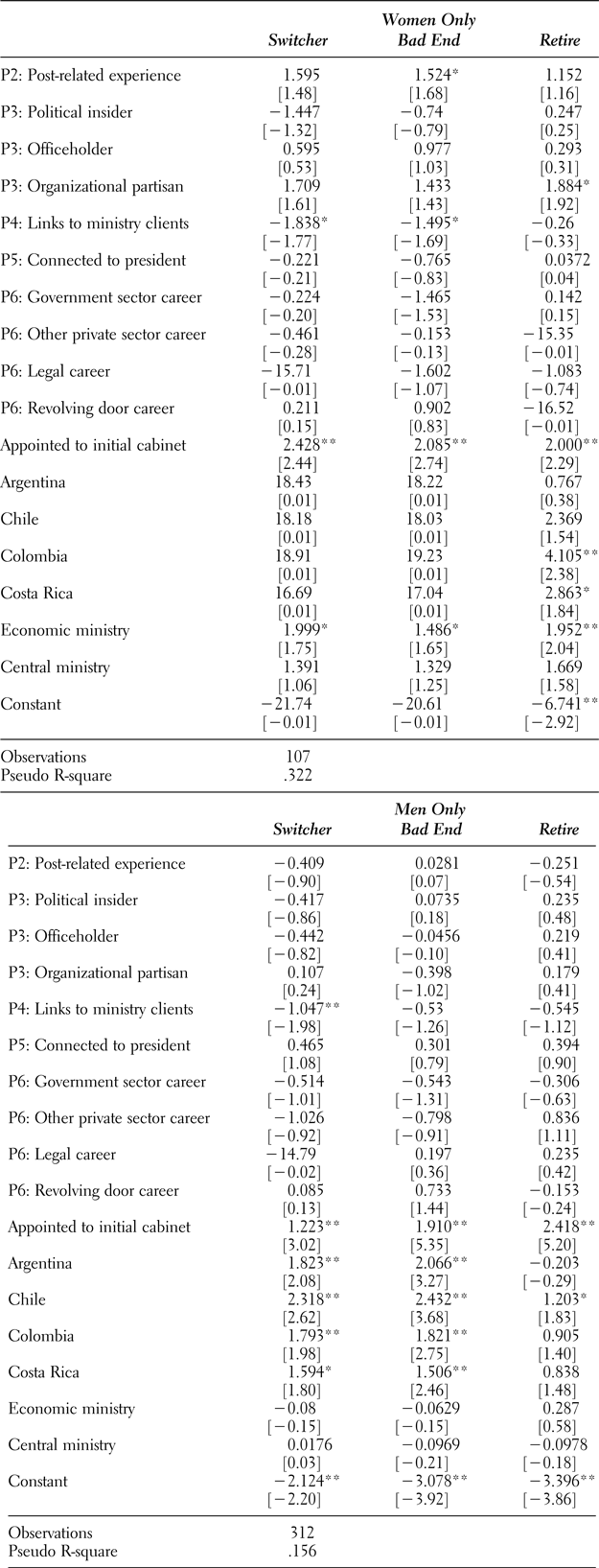
Notes: Z-scores in brackets. * p < 0.10, ** p < 0.05, *** p < 0.01
Comparison (base) category is survive until the end of term.
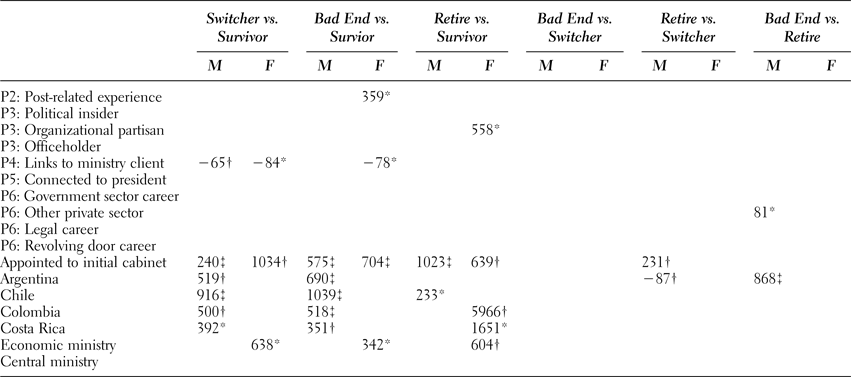
Percentage Change in Odds, Male and Female Ministers
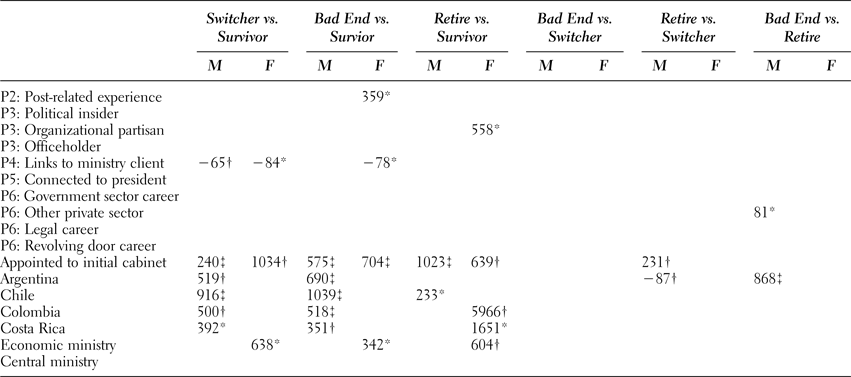
Numbers reported in the table are percentage change in the odds for coefficients from model in Table 3 with p < .10.
* p < 0.10,† p < 0.05,‡ p < 0.01
Examination of Table 4 reveals some commonalities and some differences in the way in which background characteristics matter for male and female ministers,Footnote 13 though few are in keeping with our prior expectations. Both insider status and office holding (two of the measures of political expertise) and most of the career variables are insignificant. Additionally, the other political experience variable (organizational partisan) does not have the expected effect, as it increases (for female ministers) the odds of retiring rather than surviving until the end of the term. Additionally, none of the political experience variables have any effect in the case of male ministers. In the full sample, links to clients reduced the risk of switching or meeting a bad end compared to remaining until the end of the term. Both those effects still hold for female ministers, but only the former (decreased risk of switching) holds true for male ministers. It appears that women are more protected by having links to groups that may make them too costly for presidents to fire. This is interesting since Borelli found in her study of the United States that women were less likely than men to have these kinds of links (but that included mainly earlier presidential administrations).
This split sample comparison reveals further differences. For female ministers, policy experience affected exits, but in an unexpected way. Female ministers with high levels of policy experience related to their post were more likely to meet a bad end than they were to remain in post until the end of the term. This effect is substantively large, as having that relevant policy experience increased the odds of meeting a bad end by 359% for female secretaries only. One possible reason for this is that a person with policy expertise may dig in their heels to fight for a policy they support (Andeweg Reference Andeweg2000). But there may be strongly enough gendered expectations about behavior that such a cantankerous attitude may be harmful to women because it is viewed as gender inappropriate but is accepted as normal, forceful, strong-minded behavior for a man. Of course, alternative explanations may also be at work. These findings provide suggestive evidence that background characteristics do not matter in the same way for male and female cabinet ministers and that there is in fact a gendered effect.
CONCLUSION
As women are becoming more represented in the cabinet, it makes sense to begin examining what happens to them once they are there. Getting an appointment is part of the story, yet the extent to which ministers are perceived as successful and the way in which they leave may contribute more to how they are viewed by society today and remembered by history. At a broader level it might limit the willingness of future women to accept invitations to serve in the highest levels of government because of the way they will be treated. Or it might discourage presidents from nominating women. It also may have important consequences for the future employment prospects of these ministers. Our analysis investigated the way background shapes cabinet exit and whether it appears to matter in the same way for both men and women.
What we are able to say rather definitively is that there are no significant differences between men and women in how they exit, which we view as compelling evidence of gender integration. At least in these five countries, they appear to succeed or fail about as frequently as the men. Presidents do not appear to treat women either badly or with kid gloves, women are not more frequently “retired” while the men remain, and presidents let their female appointees, like the men, take responsibility for a policy failure. That said, while our analysis suggests equal treatment regarding public information about why men and women leave the cabinet, it does not take into account the dynamics going on in the cabinet that led up to the moment when they are either dismissed or announce their resignation or their efforts to hang on by their fingertips until the end of the term. Future research is needed to shed light on these internal dynamics, possibly through interviews or archival analysis of meeting minutes, to find if there are systematic ways where women are treated differently.
That research would allow a deeper investigation of the effect of client links including whether the women who seem—based on our analysis—to be protected from meeting a bad end by client links are instead marginalized within the cabinet. Sometimes ministries have multiple and competing clients. Future research needs to identify if some of those links are more influential than others in predicting a person's chances to retain their post. For example, when the minister of Mining, Energy, and Environment only has links to mining interests, does that provide complete insulation, or does it actually make them more likely to have policies fail as conflicts with other groups arise? And does this function the same way for male and female ministers?
While our analysis shows that minister sex is not a significant variable for predicting mode of exit, some background traits matter for women, but not men. We think it is quite notable that, with regard to client links, it is women with client links, not men, who are less likely to meet a bad end than to survive. But not all background characteristics work in women's favor. Women with policy expertise (which is the majority) were more likely to meet a bad end than survive, and women who are organizational partisans are more likely to retire rather than survive. Nonetheless and somewhat counterintuitively, we express optimism that because background does not matter in many different ways and that women are being allowed to fail at the same rates as men, it shows they are being given real agency as political actors. True equality may not yet have been achieved, and “different but equal” treatment may still persist. Glass ceilings that may limit their access to, or opportunities to succeed in, some kinds of posts certainly still exist in women's careers. Additionally, as long as boys and girls are pushed into different career paths, expectations about gendered stereotypes remain that may limit the norms of “acceptable” behavior in a post that may handicap women in succeeding at their job. Still, if scandal can ruin the careers of women as easily as men, it may also mean that the ability to overcome it can propel them to the same heights in the exercise of power.