Introduction
The three volumes of the Manual of Nearctic Diptera (MND) (McAlpine et al. Reference McAlpine, Peterson, Shewell, Teskey, Vockeroth and Wood1981, Reference McAlpine, Peterson, Shewell, Teskey, Vockeroth and Wood1987; McAlpine and Wood Reference McAlpine and Wood1989) stand alongside Hennig's Handbuch der Zoologie (Hennig Reference Hennig1973) treatment of Diptera as the most significant achievements of Dipterology in the 20th century. The success of the MND is testament to the vision and tenacity of the initiator of the project, J.G. Chillcott, and the editorial team of J.F. McAlpine, B.V. Petersen, G.E. Shewell, H.J. Teskey, J.R. Vockeroth, and D.M. Wood. The 1600 pages of the MND remain an essential resource for the phylogeny, morphology, taxonomy, identification, and biology of Diptera. Introductory sections and family chapters were written by a team of 52 specialist systematists, with the editorial group taking on a very large portion of the workload. Arguably, the MND has had more impact than Hennig's treatize simply because of its greater depth and publication in English, the international language of science. Although he died in 1976, Hennig's influence on the 1989 work was strong because of his 3 month visit to the Ottawa group in 1967 and an unfinished manuscript of his was the original nucleus for Volume 3. Imitation is the most sincere form of flattery and similar series have now been produced for the Palaearctic and Central American regions and are being planned for the Afrotropical Region. The exquisite figures in the MND prepared by Ralph Idema have often been reproduced in those encyclopaedic treatments and continue to support dipteran comparative morphology with rigour, clarity, and beauty. It is no surprise that the MND was awarded the first Thomas Say award of the Entomological Society of America.
Our contribution focuses on the impact of Volume 3 of the MND (MND3) (McAlpine and Wood Reference McAlpine and Wood1989), addressing the phylogenetic relationships of Diptera at family level. Attesting to the importance of the work, MND3 is a key reference in the introductory sections of almost all papers dealing with the systematics and phylogeny of Diptera published since 1989. MND3 is outstanding because of its scope and rigorous, consistent approach, treating the relationships of the entire order at family level using Hennigian argumentation. Informative characters from all life stages were identified using outgroup comparison and monophyletic taxa were identified using synapomorhies mapped onto nodes. Many new character systems were explored and explained in detail. In addition, a classification was proposed based on the relationships established. In many ways MND3 was significant for entomology as a whole, because it was the first major cladistic treatment of any insect order. We will address in turn five kinds of impacts that MND3 has had on Dipterology:
1. Inspiration of quantitative analyses of the same scope (e.g., Cumming et al. Reference Cumming, Sinclair and Wood1995; Oosterbroek and Courtney Reference Oosterbroek and Courtney1995; Friedrich and Tautz Reference Friedrich and Tautz1997; Yeates Reference Yeates2002).
2. Stimulation of synthetic appraisal across the entire Diptera (e.g., Yeates and Wiegmann Reference Yeates and Wiegmann1999; Woodley et al. Reference Woodley, Borkent and Wheeler2009; Wiegmann et al. Reference Wiegmann, Trautwein, Winkler, Barr, Kim and Lambkin2011), and consensus through supertree analyses (Yeates et al. Reference Yeates, Irwin and Wiegmann2003, Reference Yeates, Wiegmann, Courtney, Meier, Lambkin and Pape2007; Lambkin et al. Reference Lambkin, Trueman, Yeates, Holston, Webb and Hauser2009), as well as new estimates from combined molecular and morphological datasets (e.g., Skevington and Yeates Reference Skevington and Yeates2000; Irwin and Wiegmann Reference Irwin and Wiegmann2001; Winterton et al. Reference Winterton, Yang, Wiegmann and Yeates2001; Meier and Baker Reference Meier and Baker2002; Meier and Wiegmann Reference Meier and Wiegmann2002; Ståhls et al. Reference Ståhls, Hippa, Rotheray, Muona and Gilbert2003; Kerr Reference Kerr2010).
3. Motivation for the collection of molecular data to test hypotheses of relationship between families (e.g., Pawlowski et al. Reference Pawlowski, Szadziewski, Kmieciak, Fahrni and Bittar1996; Miller et al. Reference Miller, Crabtree and Savage1997; Bernasconi et al. Reference Bernasconi, Pawlowski, Valsangiacomo, Piffaretti and Ward2000; Gleeson et al. Reference Gleeson, Howitt and Newcomb2000; Nirmala et al. Reference Nirmala, Hypsa and Zurovec2001; Cameron et al. Reference Cameron, Lambkin, Barker and Whiting2007; Moulton and Wiegmann Reference Moulton and Wiegmann2007; Bertone et al. Reference Bertone, Courtney and Wiegmann2008).
4. Exploration of new morphological character systems to provide novel phylogenetic characters (e.g., Wood Reference Wood1991; Stuckenberg Reference Stuckenberg1999).
5. Stimulation of more detailed scrutiny of the groundplan analysis method used in the MND3 chapter on Muscomorphan relationships (McAlpine Reference McAlpine1989).
1. Quantitative analyses of major sections of Diptera
The three chapters of MND3 (McAlpine Reference McAlpine1989; Wood and Borkent Reference Wood and Borkent1989; Woodley Reference Woodley1989) treated, respectively, the paraphyletic “Nematocera”, “Orthorrhapha”, and the monophyletic Muscomorpha (=Cyclorrhapha). Although breathtaking in scope, the methods used in MND3 were superseded by the early 1990s by quantitative techniques incorporated into software packages such as Hennig86 and PAUP that codified the Hennigian cladistic method. The new techniques, however, required preparation of a matrix of character state scores for each taxon under consideration, and polarization of characters by reference to outgroup character states. Under the new paradigm, most parsimonious trees were calculated by algorithms implemented in software routines. Homology and homoplasy were established by quantitative calculation of character transformation steps on the tree. In contrast, MND3 chapters mapped synapomorphies onto the nodes, but dealt with homoplasy in a qualitative way and no explicitly scored character matrix was published.
MND3 inspired a new generation of phylogenetically minded dipterists to re-examine the MND3 relationships using modern, quantitative methods (e.g., Rotheray and Gilbert Reference Rotheray and Gilbert1989; Vossbrinck and Friedman Reference Vossbrinck and Friedman1989; Brown Reference Brown1992). One of the first of these was Wiegmann et al.'s (Reference Wiegmann, Mitter and Thompson1993) morphological analysis of brachyceran relationships seeking evidence for the phylogenetic origin of the Cyclorrhapha (=Muscomorpha of McAlpine Reference McAlpine1989). That analysis suggested the rare and enigmatic North American genus Apystomyia Melander (Apystomyiidae) was sister to Eremoneura, and empidoids were sister to Cyclorrhapha. Apystomyia had been removed from obscurity among the proratine Bombyliidae in Volume 1 of the MND (Hall Reference Hall1981), and more recently has been placed as sister to all Cyclorrhapha (Trautwein et al. Reference Trautwein, Wiegmann and Yeates2010; Wiegmann et al. Reference Wiegmann, Trautwein, Winkler, Barr, Kim and Lambkin2011) based on nucleotide sequence data.
Interestingly, in MND3 Woodley (Reference Woodley1989) supported the notion of a sister-group relationship between Empidoidea and Muscomorpha (=Eremoneura), whereas McAlpine (Reference McAlpine1989) suggested that the muscomorphan origins could be traced to Stratiomyomorpha. Almost all modern authors have supported Eremoneura (Sinclair Reference Sinclair1992; Griffiths Reference Griffiths1994; Cumming et al. Reference Cumming, Sinclair and Wood1995; Moulton and Wiegmann Reference Moulton and Wiegmann2004; Sinclair and Cumming Reference Sinclair and Cumming2006), indeed it is now considered one of the best-supported major clades of Diptera (reviewed in Yeates et al. Reference Yeates, Wiegmann, Courtney, Meier, Lambkin and Pape2007; Woodley et al. Reference Woodley, Borkent and Wheeler2009).
A few years later, Oosterbroek and Courtney (Reference Oosterbroek and Courtney1995) published a phylogenetic analysis of “nematoceran” family relationships using quantitative methods. Their analysis exhibited a number of striking differences in comparison to the results of Wood and Borkent (Reference Wood and Borkent1989) in MND3. First, Oosterbroek and Courtney (Reference Oosterbroek and Courtney1995), acknowledging that “Nematocera” was paraphyletic and Brachycera arose from some subgroup of them, included Brachycera in their phylogenetic tree. Wood and Borkent (Reference Wood and Borkent1989) did not discuss the origin of Brachycera in their chapter, leaving this to Woodley who tentatively suggested Anisopodidae as sister to Brachycera, and this is the result obtained by Oosterbroek and Courtney (Reference Oosterbroek and Courtney1995). Second, Wood and Borkent (Reference Wood and Borkent1989) found Tipulidae to be sister of the remaining Diptera, whereas Oosterbroek and Courtney (Reference Oosterbroek and Courtney1995) proposed a much larger grouping of Ptychopteromorpha plus Culicomorpha as sister-group, with Tipulidae placed near the origin of Brachycera. More recent molecular analysis has produced results that share some elements of both earlier analyses: Tipulomorpha are near the base of the tree but Deuterophlebiidae are sister to the remaining Diptera, and the sister of Brachycera is Bibionomorpha as a whole, including Anisopodidae (Bertone et al. Reference Bertone, Courtney and Wiegmann2008; Wiegmann et al. Reference Wiegmann, Trautwein, Winkler, Barr, Kim and Lambkin2011).
Quantitative analysis of the paraphyletic “orthorrhaphous” Brachycera by Yeates (Reference Yeates2002) produced results largely in agreement with MND3 (Woodley Reference Woodley1989). For Woodley (Reference Woodley1989), the relationships between the major infraorders of lower Brachycera were unresolved; Yeates (Reference Yeates2002), however, resolved them with Xylophagomorpha and Tabanomorpha together being sister to Stratiomyomorpha, which was in turn sister to the entire Muscomorpha (including Asiloidea and Empidoidea). Within Muscomorpha, Woodley left unresolved the relationship between Asiloidea, Empidoidea, and Muscoidea (=Muscomorpha of McAlpine Reference McAlpine1989). Yeates (Reference Yeates2002) resolved them with Asiloidea placed as sister to Empidoidea plus Muscomorpha, and this result was recently corroborated with molecular data (Trautwein et al. Reference Trautwein, Wiegmann and Yeates2010). Orthorrhaphan paraphyly has been a feature of almost all recent phylogenetic treatments since MND3, be they quantitative, qualitative, molecular, morphological, or combined. Orthorrhapha (excluding Empidoidea), however, were monophyletic in Wiegmann et al.'s (Reference Wiegmann, Trautwein, Winkler, Barr, Kim and Lambkin2011) combined molecular analysis.
2. Analyses across the entire Order Diptera
The three chapters of MND3 (McAlpine Reference McAlpine1989; Wood and Borkent Reference Wood and Borkent1989; Woodley Reference Woodley1989) treated the three major groupings of Diptera, but did not make an effort to stitch the three sections together to give an overview of dipteran relationships. Woodley (Reference Woodley1989) localized the sister of Brachycera tentatively around Anisopodidae and suggested that the weight of evidence favoured a sister-group relationship between Empidoidea and Cyclorrhapha. McAlpine (Reference McAlpine1989) suggested that the origins of Cyclorrhapha lay near Stratiomyomorpha. In addition, there was some internal inconsistency in the terminology of Diptera higher categories in MND3; the group that Woodley (Reference Woodley1989) referred to as Muscoidea was termed Muscomorpha by McAlpine (Reference McAlpine1989) and most subsequent workers. The publication of MND3 therefore encouraged other authors to provide an overview of dipteran relationships for a number of reasons.
Yeates and Wiegmann (Reference Yeates and Wiegmann1999) reviewed dipteran relationships in order to summarize the results of morphological cladistic studies and qualitative analyses produced in the previous decade and provide a platform for the avalanche of molecular data being gathered by a number of laboratories. Their summary figure (Yeates and Wiegmann Reference Yeates and Wiegmann1999; Fig. 1) was a qualitative diagram of the relationships between higher categories that annealed the MND3 chapters together and recognized more recent results.
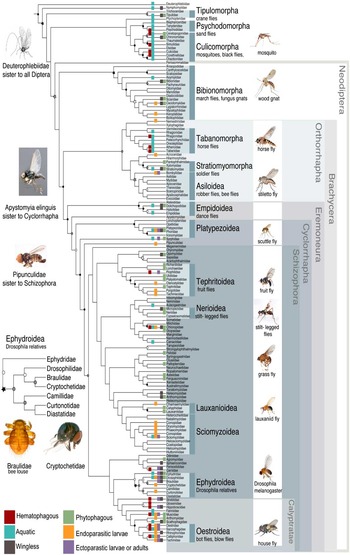
Cladogram of the maximum likelihood analysis of the 2nd Tier FLYTREE taxon set from Wiegmann et al. (Reference Wiegmann, Trautwein, Winkler, Barr, Kim and Lambkin2011). This analysis includes over 200 taxa and 7 kb of molecular data. Traits known to occur in at least one species within a family are mapped with colour-coded boxes to the family-level phylogeny. The number of origins of each trait are estimated with reference to the phylogeny and the known biology of the organisms.

In an attempt to synthesize previous results using the quantitative consensus method of supertree analysis, Yeates and Wiegmann (Reference Yeates and Wiegmann2005) summarized the phylogenetic results found in nine prominent publications over the previous three decades (Griffiths Reference Griffiths1972; Hennig Reference Hennig1973; McAlpine Reference McAlpine1989; Wood and Borkent Reference Wood and Borkent1989; Woodley Reference Woodley1989; Cumming et al. Reference Cumming, Sinclair and Wood1995; Oosterbroek and Courtney Reference Oosterbroek and Courtney1995; Sinclair et al. Reference Sinclair, Cumming and Wood1995; Yeates Reference Yeates2002). The three chapters of MND3 (McAlpine Reference McAlpine1989; Wood and Borkent Reference Wood and Borkent1989; Woodley Reference Woodley1989) were key contributors to this dataset.
At about the same time an international consortium of dipterists developed a collaborative project that would eventually be funded under the Assembling the Tree of Life initiative (FLYTREE, National Science Foundation Grant EF-0334948). Proposing to develop new datasets sampled for taxa across the entire Diptera and including hundreds of morphological characters and many kilobases of molecular genetic data, an objective of this research is to provide a new, quantitative phylogeny for Diptera at the family level. Initial results (Wiegmann et al. Reference Wiegmann, Trautwein, Winkler, Barr, Kim and Lambkin2011; Fig. 1) have shown broad agreement with the MND3 chapters, with some intriguing differences. Although Wiegmann et al. (Reference Wiegmann, Trautwein, Winkler, Barr, Kim and Lambkin2011) found that Tipulomorpha are close to the base of the dipteran tree, Deuterophlebiidae and Nymphomyiidae are unique early clades placed as successive sisters to the rest of the order. They also placed the entire Bibionomorpha including Anisopodidae as sister of Brachycera, and considered a large component of the lower Brachycera (Xylophagomorpha, Tabanomorpha, Stratiomyomorpha, and Asiloidea) to be monophyletic (a result not seen in previous analyses) and Empidoidea as sister to Apystomyiidae plus Cyclorrhapha. There are fundamental differences between MND3 and FLYTREE in the arrangement of acalyptrate families. In particular, McAlpine (Reference McAlpine1989) advocated acalyptrate monophyly; however, FLYTREE molecular results place the calyptrate flies emerging from within Acalyptratae near Ephydroidea, rendering the acalyptrates paraphyletic (Wiegmann et al. Reference Wiegmann, Trautwein, Winkler, Barr, Kim and Lambkin2011).
3. Analyses of molecular datasets
The revolution in DNA sequencing that provided the first technological platform for molecular systematics occurred at about the same time as MND3 was published. Early molecular results (Whiting and Wheeler Reference Whiting and Wheeler1994; Whiting et al. Reference Whiting, Carpenter, Wheeler and Wheeler1997) focussed on ordinal level relationships, and produced the novel grouping of Halteria (Strepsiptera + Diptera). This was in stark contrast to other authors, including Wood and Borkent (Reference Wood and Borkent1989) in MND3 who suggested fleas (Siphonaptera) as the sister-group to flies. Although most early molecular work on this question had used nuclear ribosomal DNA, it was not until very recently that a large dataset using six low or single copy nuclear genes was able to test the Halteria hypothesis (Wiegmann et al. Reference Wiegmann, Trautwein, Kim, Cassel, Bertone and Winterton2009). This study recovered a traditional arrangement, with (Siphonaptera + Mecoptera) as sister to Diptera.
Subsequently, there has been a flood of analyses using molecular data at or below the infraordinal level. Some of the earliest were studies on Cyclorrhapha (Vossbrinck and Friedman Reference Vossbrinck and Friedman1989) and Culicomorpha (Pawlowski et al. Reference Pawlowski, Szadziewski, Kmieciak, Fahrni and Bittar1996; Miller et al. Reference Miller, Crabtree and Savage1997; Beckenbach and Borkent Reference Beckenbach and Borkent2003). Many other studies have been published since then, for example, on Calyptratae (Nirmala et al. Reference Nirmala, Hypsa and Zurovec2001; Kutty et al. Reference Kutty, Pape, Wiegmann and Meier2010), Empidoidea (Collins and Wiegmann Reference Collins and Wiegmann2002a; Moulton and Wiegmann Reference Moulton and Wiegmann2004, Reference Moulton and Wiegmann2007), lower Cyclorrhapha (“Aschiza”) (Collins and Wiegmann Reference Collins and Wiegmann2002b), Asiloidea (Yeates et al. Reference Yeates, Irwin and Wiegmann2003; Trautwein et al. Reference Trautwein, Wiegmann and Yeates2010), and lower Diptera (“Nematocera”) (Bertone et al. Reference Bertone, Courtney and Wiegmann2008). All of these studies have relied on MND3 to provide a phylogenetic framework in which to operate, guide the choice of outgroups and provide phylogenetic hypotheses to test.
MND3 continues to provide context for designing studies, posing appropriate questions, and impelling new data collection. Higher-level analyses that combine data from multiple genes and (or) morphology, and use modern methods to evaluate alternative support, continue to increase the credibility of our phylogenetic inferences for some of the most difficult questions in dipterology, including major studies of family-level relationships within and among muscomorphan clades (Skevington and Yeates Reference Skevington and Yeates2000; Han and Ro Reference Han and Ro2005; Petersen et al. Reference Petersen, Meier, Kutty and Wiegmann2007; Kutty et al. Reference Kutty, Pape, Pont, Wiegmann and Meier2008; Gibson et al. Reference Gibson, Skevington and Kelso2010; Winkler et al. Reference Winkler, Rung and Scheffer2010). The tradition of explicit morphological character analysis that Hennig defined, and that the MND3 fully realized, remains a vibrant component of Diptera systematics and is exemplified by subsequent large cladistic studies within Tipuloidea (Petersen et al. Reference Petersen, Bertone, Courtney and Wiegmann2010), Blephariceromorpha (Courtney Reference Courtney1991), Sciaroidea (Amorim and Rindal Reference Amorim and Rindal2007), Asiloidea (Dikow Reference Dikow2009), Empidoidea (Sinclair and Cumming Reference Sinclair and Cumming2006), Carnoidea (Buck Reference Buck2006), Sciomyzoidea (Meier Reference Meier1996), and Ephydroidea (Grimaldi Reference Grimaldi1990) among many others.
4. Exploration of novel morphological character systems
Very soon after the MND was published, the volumes became the scaffolding for the phylogenetic interpretation of organ systems, and provided the impetus to discover new phylogenetically informative characters. The evolution of the digestive tract of flies was examined in detail by King (Reference King1991), showing that a discrete gastric cardia is formed by local specialization of anterior midgut epithelium in Schizophora.
A series of influential papers explored the homology and phylogenetic importance of male genitalia and the male genital tract (Wood Reference Wood1991; Cumming et al. Reference Cumming, Sinclair and Wood1995; Sinclair et al. Reference Sinclair, Cumming and Wood1995, Reference Sinclair, Borkent and Wood2007). These papers presented a revised interpretation of the homologies of male genital structures between lower Diptera, lower Brachycera, and Eremoneura and provided us with the epandrial hypothesis of male genital evolution in Eremoneura and numerous synapomorphies for Empidoidea, Eremoneura, and clades within these groups (e.g., Sinclair and Cumming 2006).
Stuckenberg (Reference Stuckenberg1999) reexamined the homology and phylogenetic interpretation of the dipteran antenna, proposing that the term flagellum be restricted to the lower Diptera, and postpedicel be used in Brachycera. He interpreted antennal evolution in terms of separation of the chemosensory and mechanosensory functions in Brachycera.
5. Groundplan analyses versus exemplar approaches
McAlpine's (Reference McAlpine1989) chapter on Cyclorrhaphan relationships in particular made explicit use of groundplan analyses, recording features he considered to be plesiomorphies, and including characters in the groundplan list that could be considered synapomorphies of the group as well. In McAlpine's view this was an essential step in establishing character polarities and discovering sister-group relationships based on synapomorphies; this was a view shared by many prominent phylogenetic entomologists such as Hennig (e.g., Hennig Reference Hennig1969). Although the reality of the concept of groundplans and its application was questioned by some dipterists (e.g., Stuckenberg Reference Stuckenberg1990), Yeates (Reference Yeates1995) argued that none of the proposed methods could be used to establish character states in unknown ancestral organisms, and indeed groundplans were not needed to establish character polarity. Instead, he advocated an approach that selected and scored exemplars of focal taxa, chose outgroup exemplars from the set of possible sister-group taxa, and polarized characters on the internal branch between the ingroup and outgroup. The exemplar approach is now widely used in the phylogenetic analysis of all groups. The problems and challenges of groundplan analysis were also subsequently explored from a palaeontological perspective (Bethoux et al. Reference Bethoux, Kristensen and Engel2008). These authors noted that groundplan analysis requires the groundplan states be deduced as a necessary step preceding phylogenetic analysis; in the exemplar approach the states at particular nodes are inferred by optimization as a critical part of the analysis.
Conclusions
Our knowledge of the phylogenetic relationships of Diptera advanced through the 20th century at an unprecedented rate, and the most influential single publication was MND3. Although the methods used in the work were subsequently replaced, and datasets now (2011) span a wealth of molecular genetic and genomic data, MND3 remains outstanding because of its scope and rigorous, consistent approach treating family-level relationships of the entire order using Hennigian argumentation. It was the first and most comprehensive phylogenetic treatment of any insect order. In providing a comprehensive review of morphological evidence along with explicit hypotheses, the three chapters of MND3 (McAlpine Reference McAlpine1989; Wood and Borkent Reference Wood and Borkent1989; Woodley Reference Woodley1989) energized a modern generation of dipterists boldly to publish new, quantitative cladistic treatments of many dipteran groups. The chapters also acted as an authoritative scaffold for the emergence of dipteran molecular systematics in the 1990s, and will remain so as we move forward into the phylogenomic era.