Introduction
An important feature of the bilingual brain is the ability to control two or more languages and to select the language that is appropriate for a particular context. Most bilingual models agree on the existence of a unique conceptual representation for the two languages that is matched to two different lexical entries (De Groot, Reference De Groot, Schreuder and Weltens1993; Kroll & Stewart, Reference Kroll and Stewart1994). For instance, the concept of snail would be linked to the lexical representation lumaca in Italian and caracol in Spanish, for an Italian–Spanish bilingual. Moreover, most studies provide evidence that the two languages are simultaneously activated in the bilingual mind, and that the linguistic properties of the non-intended language affect both the production and comprehension of the intended language at the semantic, phonological and grammatical levels (e.g., Blumenfeld & Marian, Reference Blumenfeld and Marian2007; Colomé, Reference Colomé2001; Costa, Caramazza & Sebástian-Gallés, Reference Costa, Caramazza and Sebástian-Gallés2000; Hoshino & Thierry, Reference Hoshino and Thierry2011; Ju & Luce, Reference Ju and Luce2004; Paolieri, Cubelli, Macizo, Bajo, Lotto & Job, Reference Paolieri, Cubelli, Macizo, Bajo, Lotto and Job2010; Weber & Cutler, Reference Weber and Cutler2004).
Grammatical gender is an inherent property of nouns that controls agreement phenomena within and outside the noun phrase in gendered languages (Corbett, Reference Corbett1991). The results of many experiments suggest that this property is activated and interacts in the two lexical systems of bilingual speakers during production (e.g., Bordag & Pechmann, Reference Bordag and Pechmann2007, Reference Bordag and Pechmann2008; Paolieri et al., Reference Paolieri, Cubelli, Macizo, Bajo, Lotto and Job2010; Salamoura & Williams, Reference Salamoura and Williams2007). To illustrate, studies on bilingual production (e.g., studies using translation tasks) have shown that gender interactions are present in languages with gender marked systems. For example, Salamoura and Williams (Reference Salamoura and Williams2007) found that Greek–German bilinguals were slower translating words from L1 to L2 when words did not share gender in the two languages (but only when gender agreement between a noun and an adjective was required). Paolieri and colleagues (Reference Paolieri, Cubelli, Macizo, Bajo, Lotto and Job2010, Experiment 3) also found similar results when Italian–Spanish participants were asked to translate words from L1 to L2 (both for bare noun translation and article + noun combinations). These results imply a gender integrated view in bilinguals, either because there is a single integrated gender system (Salamoura & Williams, Reference Salamoura and Williams2007), or because the lexical representations that specify grammatical gender are linked (Paolieri et al., Reference Paolieri, Cubelli, Macizo, Bajo, Lotto and Job2010). Relative to the voluminous work on gender effects during bilingual production, evidence of gender effects during bilingual comprehension is scarcer, although the available research suggests that participants show differential behavior for words whose gender in one language (typically the L2) is incongruent with the gender of words in the other language (e.g., Weber & Paris, Reference Weber and Paris2004).Footnote 1 This suggests that grammatical gender interacts between languages during word recognition.
Because grammatical gender behaves as an important morpho-syntactic cue to identify words and to build syntactic representations in real time (e.g., Foucart & Frenck-Mestre, Reference Foucart and Frenck-Mestre2011; Hopp, Reference Hopp2013; Lew-Williams & Fernald, Reference Lew-Williams and Fernald2010; Sabourin & Stowe, Reference Sabourin and Stowe2008; Wicha, Moreno & Kutas, Reference Wicha, Moreno and Kutas2004), one should expect some influence of the native gender information in bilinguals when they comprehend in their second language. However, there might be some differences depending on whether comprehension is visual (e.g., written-word processing) or auditory (e.g., spoken language processing). According to the dual route proposed by Gollan and Frost (Reference Gollan and Frost2001), grammatical gender can be accessed from two independent routes. The first one is through the morphological marking of nouns, which is represented at the word form level. To illustrate, in Spanish and Italian grammatical gender surfaces as nominal suffixes, since most ending vowels are marked for gender (e.g., ventana and finestra –window in Spanish and Italian, respectively– both marked for feminine with the ending vowel a; Cantone & Müller, Reference Cantone and Müller2008). However, grammatical gender is an inherent property of nouns (Corbett, Reference Corbett1991), and cannot be just determined by means of morphological rules. Thus, the second way to access grammatical gender is through an abstract route at a lexical level that is independent of any morphological gender marker, i.e., without the influence of gender-correlated form markers. In this case, each noun has its own gender representation, which can be activated without receiving activation from the level of form (Levelt, Roelofs & Meyer, Reference Levelt, Roelofs and Meyer1999). This might suggest that written words allow participants to rapidly access gender information by using the form route, since the morphological visual marking is immediately present in the input. In contrast, gender access derived from spoken-language might differ since the auditory speech signal unfolds as a sequence of transient acoustic events that requires moment-by-moment careful signal monitoring, and so morphological markers (i.e., ending vowels) may not be immediately available in the input. Hence, it is relevant to investigate possible between-language gender interactions both during bilingual reading and during spoken comprehension. However, the few studies focusing on grammatical gender and bilingual comprehension have used lexical decision tasks, and evidence regarding how gender is integrated during spoken-language comprehension in bilinguals is very scarce. The purpose of this study, then, is to explore how grammatical gender interacts in a spoken-word recognition task in Italian–Spanish bilinguals by using an eye tracking technique. We aim to determine whether gender information of the native language affects auditory comprehension in the L2, and to explore the time course of on-line integration of gender information during spoken-word recognition in bilinguals.
The use of eye tracking along with spoken language instructions and visual displays make it possible to examine the mental processes that accompany spoken language comprehension (e.g., Allopenna, Magnuson & Tanenhaus, Reference Allopenna, Magnuson and Tanenhaus1998; Tanenhaus, Spivey-Knowlton, Eberhard & Sedivy, Reference Tanenhaus, Spivey-Knowlton, Eberhard and Sedivy1995). The typical visual world task consists of a display showing several objects in a visual workspace while participants follow spoken instructions to pick up or move one of the objects (see Huettig, Rommers & Meyer, Reference Huettig, Rommers and Meyer2011, for a review). Given that eye movements provide a measure of speech comprehension closely time locked to the speech signal input (Tanenhaus, Magnuson, Dahan & Chambers, Reference Tanenhaus, Magnuson, Dahan and Chambers2000), it is possible to draw inferences about comprehension processes by analyzing the time course of reference resolution and the pattern of fixations to potential referents in the visual display.
Spivey and Marian (Reference Spivey and Marian1999) have used the visual world paradigm to examine language co-activation at the phonological level in bilinguals during a spoken-word recognition task. Results showed that English–Russian participants looked at the picture of a marker when hearing the Russian word marku (stamp) more often than at distractor objects because of the phonological similarity between languages. This pattern suggests that bilingual listeners do not deactivate their alternative language when involved in a comprehension context (Marian & Spivey, Reference Marian and Spivey2003a, Reference Marian and Spivey2003b) and supports the idea that the two languages of a bilingual are connected at the phonological level.
The visual world procedure has also been used to study grammatical gender processing in monolingual contexts (Dahan, Swingley, Tanenhaus & Magnuson, Reference Dahan, Swingley, Tanenhaus and Magnuson2000). Dahan and collaborators found that lexical activation of targets and distractors during a visual world task was modulated by the grammatical gender information of the nouns. In their experiment, French speakers were presented with a display showing four pictures and were given spoken instructions to click on one of them (e.g., cliquez sur le(MASC) bouton(MASC) – click on the button). The objects included a target (bouton(MASC) – button), a cohort competitor (i.e., a name which shares the same initial onset and vowel; bouteille(FEM) – bottle), and two distractors. Previous studies have shown that the latency in looking at the target picture is longer when there is a cohort competitor in the visual workspace (Tanenhaus, Spivey-Knowlton, Eberhard & Sedivy, Reference Tanenhaus, Spivey-Knowlton, Eberhard, Sedivy, Inui and McClellands1996). However, Dahan et al. (Reference Dahan, Swingley, Tanenhaus and Magnuson2000) found that this cohort effect was diminished when a gender-marked article preceded the target word, thus preventing the early activation of nouns inconsistent with that gender (gender-mismatching phonological competitors).
Similarly, a recent visual world study with bilinguals has shown that Italian native speakers are also able to exploit the grammatical gender information provided by the definite articles when interpreting speech utterances in their second language (Dussias, Valdés Kroff, Guzzardo & Gerfen, Reference Dussias, Valdés Kroff, Guzzardo and Gerfen2013), offering strong evidence about the importance that this feature has on the processing of the second language in bilinguals. In short, the ability to process grammatical gender seems to play an important role in facilitating the interpretation of speech. Moreover, this ability is not restricted to adults, since several studies have found that 24-month old children are also faster orienting to a referent target in a visual-world scene when there is a mismatch in the grammatical gender of the pictures (Lew-Williams & Fernald, Reference Lew-Williams and Fernald2007; van Heugten & Johnson, Reference Van Heugten and Johnson2011; van Heugten & Shi, Reference Van Heugten and Shi2009).
The present study
Given that grammatical gender is a property of nouns that has been shown to interact and cause interference in bilingual speakers (Paolieri et al., Reference Paolieri, Cubelli, Macizo, Bajo, Lotto and Job2010; Salamoura & Williams, Reference Salamoura and Williams2007), we might expect the same type of connections and influences within an on-line spoken-word recognition context. Although morphological gender markers might be more slowly accessed in spoken than in written comprehension given the serial nature of the auditory signal, Gollan and Frost's (Reference Gollan and Frost2001) dual route theory of a faster form based route and a slower lexical based route predicts that gender effects might also be found in spoken comprehension. Our prediction, therefore, is that incongruent gender-marked nouns in the bilingual's two languages should modulate the interpretation of noun phrases in a spoken-word recognition task. Because little is known about cross-language gender effects in on-line spoken comprehension contexts, we decided to work with two Romance languages with similar gender systems (Italian and Spanish), while making critical use of nouns whose gender representation differs between the two. Gender processing in these two languages has previously been shown to interact in language production, as Italian–Spanish speakers are slower naming pictures with gender-incongruent nouns relative to gender-congruent nouns between languages (Paolieri et al., Reference Paolieri, Cubelli, Macizo, Bajo, Lotto and Job2010). However, there are no studies exploring how congruence or incongruence in gender between these two languages affects L2 processing in spoken language comprehension. In two visual world studies, we manipulated the L1 gender congruency of the pictures to explore whether Italian learners of Spanish were affected by the gender representations of their native language when interpreting spoken instructions in the L2. In a third experiment, we tested a Spanish monolingual group as a control.
Experiment 1
Using a visual world task, Italian–Spanish speakers were provided with pairs of pictures that did or did not share grammatical gender in Italian, but that always shared gender in Spanish. Concurrently, participants heard a Spanish sentence and were instructed to click on the named picture (encuentra la(FEM) bufanda – find the scarf) while their eye movements were recorded. If both languages are active in bilinguals and L1 grammatical gender affects the spoken language processing of L2 noun-phrases, we should observe a diminished proportion of fixations as a function of time to the target pictures in incongruent gender trials relative to gender congruent trials.
Method
Participants
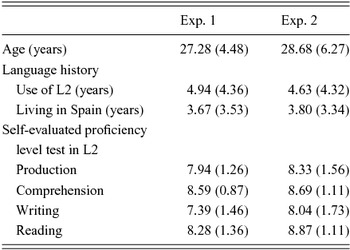
Thirty-two Italian–Spanish proficient bilinguals with a mean age of 27 years (SD = 4.48) volunteered to participate in the experiment. Spanish proficiency was assessed through a self-rated subjective questionnaire administered at the end of the experiment proper (see Table 1 for a description of the participants).
Language history and self-evaluated proficiency scores of the Italian-Spanish bilinguals in Experiment 1 and 2.

Note: The scores are on a 10-point scale, in which 10 represents native-speakers level and 1 complete lack of knowledge of the language. Mean are shown with corresponding standard deviations in parentheses.
Design and materials
The main task of the experiment consisted of an on-line spoken-word recognition task using a visual world procedure. Participants were presented with a visual display showing two pictures and heard instructions in Spanish asking them to click on the named picture. Meanwhile, their eye movements were recorded.
Forty-eight pictures were selected from Lotto, Dell'Acqua and Job (Reference Lotto, Dell'Acqua and Job2001), half with masculine nouns and half with feminine nouns for Italian and Spanish. Of these, 36 pictures had names whose gender was congruent between the two languages (e.g., sciarpa(FEM) and bufanda(FEM) – scarf) and 12 pictures had names whose gender was incongruent (e.g., letto(MASC) and cama(FEM) – bed). A complete list of the stimulus materials is provided in Appendix A.
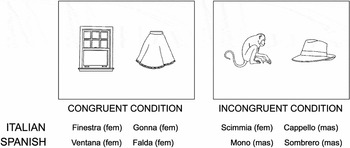
The 48 pictures were assigned to two experimental conditions: congruent and incongruent (see Figure 1 for a sample of the conditions). The congruent condition included 12 pairs of pictures whose names shared grammatical gender in Italian (finestra(FEM) and gonna(FEM) – window and skirt, respectively). Therefore, 24 gender-congruent nouns were assigned to this condition, since it comprises 12 pairs of pictures with the same gender value in the two languages. On the other hand, the incongruent condition included 12 pairs of pictures whose names had different grammatical genders in Italian (e.g., scimmia(FEM) and cappello(MASC) – monkey and hat, respectively). Therefore, 12 congruent nouns and 12 incongruent nouns were assigned to this condition, since it includes 12 pairs with one member of the pair gender-congruent and the other one gender-incongruent between the two languages. Critically, all pictures in the two conditions shared grammatical gender in Spanish (in the previous examples, ventana(FEM) and falda(FEM) , for the congruent condition; mono(MASC) and sombrero(MASC) for the incongruent condition). Thus, any differential effects in the pattern of fixations found between the congruent and incongruent conditions should be attributable to the activation of the different Italian gender representations of the target items.
Example of pairs of pictures across conditions in Experiment 1.

Additionally, we introduced 12 filler pairs that were composed of pictures with different genders in Spanish (the language of presentation) in which each member of the pair also shared the gender of its Italian translation equivalent (e.g., aereo(MASC) and arancia(FEM) in Italian; avión(MASC) and naranja(FEM) in Spanish – plane and orange, respectively). The nouns of the experimental pairs were controlled for frequency in Spanish and Italian (Alameda & Cuetos, Reference Alameda and Cuetos1995, for Spanish; and Bertinetto, Burani, Laudanna, Marconi, Ratti, Ronaldo & Thornton, Reference Bertinetto, Burani, Laudanna, Marconi, Ratti, Ronaldo and Thornton2005, for Italian) and number of letters (all ts < 1) across conditions. Translations of the pictured nouns were also matched for overall phonological overlap for the two experimental conditions. This was computed by taking into consideration the percentage of the number of letters shared by the two pictures’ nouns in Italian and Spanish for each condition. Finally, target and distractor pictures in each pair, as well as location of the picture on the screen (left or right), was counterbalanced across participants. All of the 36 pairs were equally distributed among conditions and presented once in a random order during the entire experiment.
For the speech instructions, 36 Spanish sentences were recorded, always using the same structure: “encuentra” + “definite article el(MASC) or la(FEM) ” + “target noun” (e.g., encuentra la bufanda – find the scarf). The sentences were produced using standard, broad focus intonation (i.e., no narrow focus or other emphasis was produced on any of the target noun phrases). Because we wanted to explore between-language interactions in a spoken-word recognition task, controlling the onset and duration of the definite article in the sentences was critical. For this reason, the article preceding the target noun in each selected sentence was hand-edited to a duration of 147 ms, followed by a blank space of 50 ms using the Praat software package. Duration of the word encuentra was also hand-edited to 800 ms. This way, the duration of the acoustic signal conveying grammatical gender prior to the onset of the target noun was identical across all items.
Procedure
Participants were tested individually in a quiet room. Before taking part in the experiment proper, participants completed a familiarization task, which included the 72 pictures used in the experiment. During this phase, participants were instructed to name each picture in Spanish together with its corresponding definite article (i.e., el(MASC) or la(FEM) ). This was done to ensure that the bilingual participants were able to assign the correct Spanish name to each picture and also to ensure that they knew the correct gender value of the nouns in Spanish. Participants were provided with the correct response in case an error was made. Overall, the mean naming error percentage (i.e., production of names other than expected) was 11.71%; and the mean gender error (i.e., production of the incorrect gender-marked article) was 0.65%. Pictures incorrectly named during this phase by the participants were not included in the data analysis of the eye-tracking phase. The stimuli were presented using E-Prime experimental software, version 1.1 (Schneider, Eschman & Zuccolotto, Reference Schneider, Eschman and Zuccolotto2002). This phase lasted about 5 minutes after which participants started the spoken-word recognition task.
Participants’ eye movements were recorded using an Eyelink 1000 eyetracker (SR Research, Ontario, Canada). Viewing was binocular but eye movements were recorded from one eye only. Stimuli were presented on a color 17-inch ViewSonic 17PS monitor, with participants seated 65 cm from the monitor and resting their chins comfortably on a chin rest. Sampling rate was 500 Hz. Calibration was checked on each trial and spatial resolution was better than 0.5 degrees. To begin each trial, participants looked at a fixation point in the center of the computer screen. Subsequently, two pictures appeared on the screen and 500 ms later the speech signal started to play. Participants were instructed to click on the picture named in the sentence. The pictures had a dimension of 168 x 168 pixels and were located at a distance of 192 pixels from each other. Before starting, participants completed a practice phase with 8 trials including pictures that were never presented during the experimental session. The entire data collection procedure lasted about 20 minutes including the calibration and practice phase. At the end of the experiment, the subjective questionnaire evaluating L2 proficiency was administered.
Coding and data analysis
Fixations were automatically defined by the eye tracker using the detection algorithm supplied by SR Research and were calculated online by the eye tracker software. Because the sampling rate of the eye-tracking was 500 Hz, we obtained one fixation every 2 ms. Fixations within each frame were then classified as falling into one of three regions: the target area, the distractor area, or outside of these two areas (i.e., the blank space around the pictures). Fixations were coded as “1”s if they fell into the target area (i.e., the complete square area occupied by the target picture), and as “0”s otherwise. Saccade times as well as blinks were not added to fixation times.
First, we conducted an analysis of variance with the total proportions of target fixations (relative to distractor and outside areas) across conditions in predefined time windows. This analysis addressed how likely the participants were to look at target pictures depending on whether their gender were congruent or incongruent between languages (see Huettig et al., Reference Huettig, Rommers and Meyer2011 for a review).
Because this approach does not inform us about the continuous processing of the speech signal, a second analysis was conducted to explore the time course of the gender effect – i.e., the gradual activation of target pictures’ nouns across conditions. We performed successive one-tailed t-tests on the proportions of target fixations in predefined time windows at each point (1 data point = 2 ms) along fixation waveforms. To control type I errors for the large number of samples tested, we used the method proposed by Guthrie and Buchwald (Reference Guthrie and Buchwald1991), which tabulates the number of consecutive tests that should be significant for assessing reliable effects. This index is computed given the number of participants, the sampling interval length, and the temporal autocorrelation of the data, thus providing a suitable alternative to conservative multiple-comparison methods. This statistical approach has been applied widely to ERP data (e.g., Picton, Bentin, Berg, Donchin, Hillyard, Johnson, Miller, Ritter, Ruchkin, Rugg & Taylor, Reference Picton, Bentin, Berg, Donchin, Hillyard, Johnson, Miller, Ritter, Ruchkin, Rugg and Taylor2000), pupillometry (e.g., Kuipers & Thierry, Reference Kuipers and Thierry2011, Reference Kuipers and Thierry2013), and also to eye-tracking data to link parallel language activation and inhibitory control on time-to-time samples during the Stroop task (e.g., Blumenfeld & Marian, Reference Blumenfeld and Marian2013).
Results and Discussion
Data from trials with errors in selecting the correct picture were excluded from the final data analysis (overall, 0.26% of the total of trials). Analyses on the accuracy data were not performed due to the low error rate for mouse click responses.Footnote 2 Then, we defined a time window extending from 200 to 900 ms after article onset to compare the proportion of target fixations in the congruent and incongruent condition. This frame starts with the time that an eye movement takes to be launched by the definite article in the speech signal (Matin, Shao & Boff, Reference Matin, Shao and Boff1993) and ends with the target selection, i.e., at the moment in which the differences between conditions seem to disappear (see Figure 2). The ANOVA on the mean proportion of target fixations revealed that the participants looked at the target pictures more when they were congruent in gender between languages (59%, SD = 10.4) than when they were incongruent in gender (52%, SD = 9.9) [F1 (1, 31) = 15.054, MSE = 53.281, p = .001; F2 (1, 46) = 8.293, MSE = 72.533, p = .006]. In order to consider the possible impact of the phonological similarity between Italian and Spanish feminine determiners (la (FEM)), an additional ANOVA including gender (masculine and feminine) and condition (congruent and incongruent) revealed no interaction effects [F1 (1, 62) = .552, MSE = 159.94, p = .46; F2 (1, 44) = .481, MSE = 68.819, p = .49]. Thus, the similarity between the feminine definite article in the two languages did not influence the obtained pattern of results.
Total proportion of fixations to target pictures from article onset for Italian–Spanish bilinguals in Experiment 1. Shaded area shows the temporal window in which the grammatical gender effect (congruent vs. incongruent) is significant according to the time-course analysis.

This result indicates that the presence of an Italian–Spanish incongruent gender noun influences the fixations on the target picture. Items that did not share gender across languages yielded a reduced proportion of fixations on target pictures relative to target items in the congruent gender condition. Specifically, when the bilinguals heard an instruction in their L2, Spanish, to find a picture in the display, they exhibited a lower proportion of looks over time to the target item when its translation equivalent in Italian was different in gender. Importantly, although the task was performed in Spanish only (the L2), the activation of Italian gender (i.e., the gender of the name of the picture in the L1) modulated the pattern of eye fixations over time. This result suggests that bilinguals are not exempt from the influences of their native-gender knowledge when listening to speech in their L2.
To explore the time course of the gender effect we performed time-step t-tests between the two conditions every two milliseconds from 400 to 900 ms (250 sampling points). Because the tables provided by Guthrie and Buchwald (Reference Guthrie and Buchwald1991) are given for a horizon of 150 time samples, we divided the time window into two bins of 250 ms (125 time samples), as proposed by the authors. Consistent with their method, we adopted a criterion of at least 12 significant consecutive t-tests (24 ms) to consider the differences between conditions reliable. The results indicated that the first time point where the two conditions differed from each other was at 498 ms from article onset, and that this difference remained significant until the end of the time window (see shaded area, Figure 2). In other words, the influence of the grammatical gender in the native language impacted spoken-word recognition from 498 ms onwards.
However, it could be argued that several aspects of our procedure and design might have affected our results: 1) the presence of a familiarization phase, in which the pictures were presented along with their corresponding definite articles, may have induced a gender-centered processing mode in the subsequent eye tracking session that could have otherwise be absent; 2) due to the nature of the manipulation, the distractors in the congruency manipulation could not be counterbalanced, and a different set of pictures were used as distractors in the two conditions of the experiment. Although the distractors in the two conditions were carefully matched, the fact that they were different pictures may have biased the results. Thus in Experiment 2, we removed the familiarization phase and used the same distractors for each of the experimental conditions.
In addition, Experiment 2 aimed to explore the temporal dynamics of the gender congruency effect. As mentioned earlier, the gender congruency effect was significant at 498 ms from article onset in the speech signal. However, we know that planning an eye movement typically takes 150–200 ms before it is launched (Matin et al., Reference Matin, Shao and Boff1993), and therefore, the gender effect should have been observed approximately 150–200 ms after target onset (i.e., at about 350 ms from article signal). Several factors may have produced this delay in the effect. First, it is possible that, although previous evidence suggests that bilinguals are able to exploit gender cues to select the correct target (Dussias et al., Reference Dussias, Valdés Kroff, Guzzardo and Gerfen2013), L2 gender processing is generally slow, and gender effects are not evident from the article onset but only when the noun unfolds in the sentence and participants have enough information to select the correct picture on the display. Moreover, it is also possible that gender processing might start upon article presentation, but gender co-activation may take more time, and gender congruency effects may not have been evident until later. In this sense, when we inspected the results of the filler trials (i.e., pairs of different-gender pictures in the two languages), we observed that the number of fixations to the referents started to increase at the time of 200 ms from the article signal, because in this case the definite articles become a potential cue to identify the target pictures in advance (Dahan et al., Reference Dahan, Swingley, Tanenhaus and Magnuson2000; Dussias et al., Reference Dussias, Valdés Kroff, Guzzardo and Gerfen2013). This would lead to the suggestion that the between-language gender effect of our results could originate from the onset of the definite article. However, because these items were not well controlled in terms of their lexical variables, and because the gender effects appeared so late in the pattern of fixations, we cannot be sure at which moment the gender effect arises.
To explore the temporal dynamics of the gender congruency effect, in Experiment 2 we introduced a new condition (different-gender condition) to explore whether L2 gender processing was taking place from the article onset, the point where gender information is presented first. The comparison between different-gender trials (where the definite articles is an informative cue for interpreting speech) and same-gender trials (i.e., congruent and incongruent condition, where articles are less informative) should provide important information about the moment in which the gender effect appears.
Finally, it is possible that not only gender information, but also some further acoustic or orthographic information, could have influenced the pattern of fixations in Experiment 1. Crucially, although we controlled for phonological overlap between conditions, such that the congruent and incongruent conditions were matched, some words remained that shared some orthographic overlap between languages [cereza-ciliegia (cherry); taladro-trapano (powerdrill); ojo-occhio (eye); lobo-lupo (wolf); manzana-mela (apple); pelota-palla (ball); silla-sedia (chair); clavo-chiodo (nail); bolo-birillo (bowl); in Spanish and Italian, respectively]. Therefore, the presence of these words may have influenced our results and produced slower fixations (Allopenna et al., Reference Allopenna, Magnuson and Tanenhaus1998). Hence, we created a new set of materials so that target and distractor nouns never shared orthographic features or had similar phonological onsets across translations. If the same pattern of results were obtained, we should be more confident in generalizing our results.
Experiment 2
In Experiment 2, Italian–Spanish bilinguals were required to perform a spoken-word recognition task similar to the one used in the previous experiment. With this, we aimed to replicate the pattern of findings observed in Experiment 1, where bilingual speakers were influenced by their native gender knowledge while processing spoken utterances in their L2. In Experiment 2, care was taken that the experimental materials did not contain phonologically related words between languages and that target and distractor nouns never shared orthographic onset in any of the languages. We expected to obtain results similar to those obtained in Experiment 1 (gender congruency effects) even though possible biasing factors related to the materials and procedure were removed.
More importantly, the goal in Experiment 2 was to explore the temporal dynamics of the gender congruency effect by including a well-controlled different-gender condition. A recent study by Dussias and colleagues (Reference Dussias, Valdés Kroff, Guzzardo and Gerfen2013) has shown that Italian learners of Spanish can benefit from the processing of the determiner articles to anticipate upcoming nouns during L2 sentence interpretation. Using a visual world procedure, participants were presented with pairs of pictures that did or did not share gender. Their results showed that when both pictures differed in gender, bilingual speakers used the gendered articles to anticipate the selection of the target pictures. However, when the nouns of the two pictures shared the same gender, speakers waited to hear the onset of the noun to correctly select the appropriate target. Note that this different-gender condition corresponds to our filler condition in Experiment 1. Therefore, in Experiment 2 we controlled for lexical variables across these items and included them as an additional experimental condition (the so-called different-gender condition). With this set-up, we should be able to explore whether gender congruency effects are linguistically driven by the gender information encoded in the definite articles or whether, in contrast, they occur at some time later in the speech processing.
To summarize, in the same-gender trials (i.e., congruent and incongruent conditions) we expected to replicate the pattern of results observed in Experiment 1, in which smaller proportions of fixations to the target picture were observed when the gender of the nouns was incongruent between Italian and Spanish. Moreover, we expected that trials where the definite article provided enough information to anticipate the upcoming noun (i.e., different-gender condition) would show facilitation relative to trials where this information was not present (i.e., the same-gender trials in the congruent and incongruent gender translations). That is, we expected that the presence of the determiner in the different-gender trials would produce more and faster fixations than in the trials where the nouns of the two pictures were similar in gender. Finally, we were interested in comparing the time courses of the two gender effects: same-different gender trials and congruent-incongruent gender translations. The first effect would indicate the moment when L2 determiner gender processing starts, while the second would signal the moment in which L1 co-activation occurs. Hence, this comparison would provide important information about the moment in which the gender processing and gender co-activation occurs.
Method
Participants
A new group of 26 Italian–Spanish proficient bilinguals voluntarily participated in this experiment (mean age of 28 years, SD = 6.27). Spanish proficiency was measured through a self-rated subjective questionnaire at the end of the session proper (see Table 1 for a description of the participants).
Design and materials
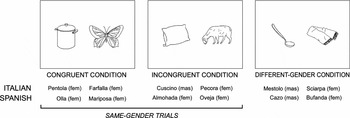
We selected 56 pictures from Snodgrass and Vanderwart (Reference Snodgrass and Vanderwart1980), half with feminine nouns and half with masculine nouns for Italian and Spanish. Of these, 42 were congruent in gender between the two languages, and 14 were incongruent. Three conditions were created: congruent, incongruent (similar to Experiment 1, both representing same-gender trials in Spanish), and different-gender trials (in which one of the pictures in the pair was feminine and the other one was masculine both in Spanish and in Italian). The between-language gender congruency of the target was not manipulated in different-gender trials because of the difficulty of introducing a larger number of well-controlled stimulus materials, and because we could more clearly observe between-language gender congruency effects in the same gendered article condition. Therefore, the first independent variable was gender congruency (congruent vs. incongruent conditions, similar to those included in Experiment 1), and the second independent variable was gender-match (same-gender trials – including both congruent and incongruent conditions – vs. different-gender trials). As in Experiment 1, the congruent condition included pairs of pictures with similar gender value in Italian (e.g., pentola(FEM) and farfalla(FEM) – pot and butterfly, respectively), whereas the incongruent condition comprised pairs of pictures with different gender nouns in Italian (e.g., cuscino(MAS) and pecora(FEM) – pillow and sheep, respectively). Importantly, in both conditions, the gender of the object nouns in the scene always matched in Spanish (in the previous examples, olla(FEM) and mariposa(FEM) for the congruent condition; almohada(FEM) and oveja(FEM) for the incongruent condition), effectively creating a ‘same-gender’ condition (see Figure 3). In the different-gender condition, the pairs of objects in the scene did not match in gender (i.e., one was masculine and the other one was feminine) but critically, the gender in each pair matched across Spanish and Italian (e.g., mestolo(MASC) and sciarpa(FEM) in Italian; cazo(MASC) and bufanda(FEM) in Spanish –ladle and scarf, respectively) (see Appendix B).
Example of pairs of pictures across conditions in Experiment 2.

In Experiment 2, each condition was composed of 14 different target-distractor picture pairs. While the target pictures varied among conditions, the distractors were the same across the three conditions so that any between-condition effect could not be attributable to presence of different distractors. To avoid expectancy effects due to the repeated role of the same pictures as distractors, we created 28 filler trials where these pictures acted as targets. The nouns of the 42 experimental pairs were controlled for frequency in Spanish and Italian (Alameda & Cuetos, Reference Alameda and Cuetos1995, for Spanish; and Bertinetto et al., Reference Bertinetto, Burani, Laudanna, Marconi, Ratti, Ronaldo and Thornton2005, for Italian) and number of letters (all ts < 1) across conditions. Care was taken to exclude cognate words, and pictures that shared the initial phoneme in Spanish or Italian. Finally, the location of the pictures on the screen was counterbalanced across participants and the 70 trials were randomly presented during the whole experiment.
For the instructions, 70 Spanish sentences were recorded using always the same structure “encuentra + article + noun”. In this case, the duration of the word encuentra was hand-edited to 730 ms, followed by the definite article with a duration of 200 ms. Finally, a blank space of 50 ms preceded the speech signal of the target noun.
Procedure
The procedure was similar to the one used in Experiment 1, with the only exception that the familiarization phase was removed.
Results and discussion
The process for calculating the mean proportion of target fixations through the defined temporal window was identical to the one used in Experiment 1. Errors selecting the correct picture were removed from the final analysis (overall, 1.65% of the total of trials). The low rate of mouse click errors did not allow us to perform an analysis based on accuracy.
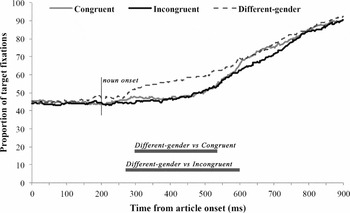
In order to explore the gender congruency effect (i.e., congruent vs. incongruent conditions) we defined a temporal window starting at 200 ms from article onset and ending at 550 ms (i.e., when the differences across the two conditions tend to vanish; see Figure 4). The ANOVA on the mean proportion of target fixations revealed a higher number of target fixations in the congruent condition (40%, SD = 15.5) than in the incongruent condition (34%, SD = 15.7) [F1 (1, 25) = 4.295, MSE = 81.160, p = .04; F2 (1, 26) = 1.580, MSE = 122.307, p = .22]. The analysis also showed no significant interaction between gender (masculine and feminine) and condition (congruent and incongruent) [F1 (1, 50) = 1.39, MSE = 213.789, p = .24; F2 (1, 24) = .945, MSE = 125.467, p = .34], indicating that the gender of the target nouns did not influence our results.
Total proportion of fixations to target pictures from article onset for Italian–Spanish bilinguals in Experiment 2. Shaded area shows the temporal window in which the grammatical gender effect (congruent vs. incongruent) is significant according to the time-course analysis. The horizontal grey bars represent where the different-gender condition significantly differs from congruent and incongruent conditions.

Then, to provide fine-grained information about the time course of the gender effect, time-step t-tests on two 175 ms long bins were performed for every frame (2 ms) from 200 to 550 ms. Following Guthrie and Buchwald's (Reference Guthrie and Buchwald1991) method, the validity of the multiple comparisons was verified by adopting a criterion of at least 11 successive significant tests. The analysis revealed that the difference between target fixations in the congruent and incongruent conditions became significant at 360 ms from article onset and remained significant until 462 ms in the speech signal (see shaded area, Figure 4). Therefore, bilingual speakers were again influenced by the gender of their L1 when performing a spoken word recognition task in L2. Because the nouns in these conditions never shared orthographic and phonological overlap between Italian and Spanish and all aspects of the procedure were carefully matched, only the valence of grammatical gender of the nouns could explain the lower proportion of target fixations in the incongruent condition. Thus, target pictures for which the translation equivalent of nouns in Italian and Spanish shared the same gender exhibited an increased proportion of target fixations relative to the incongruent condition. Similarly to Experiment 1, this suggests that the smaller proportion of fixations to the incongruent nouns can be interpreted as indexing the coactivation of the two gender systems, a situation that led to a reduction of the predictive value of the spoken Spanish determiners during the speech instruction for incongruent items.
To explore the processing of the gender information encoded by the definite articles, we compared the different-gender condition to both the congruent and incongruent conditions. Based on a visual inspection of the graph, a time window extending from 200 to 800 ms (i.e., when the disparities between conditions seem to disappear) was defined. The analyses of variance showed significant differences in target fixations between different-gender and incongruent conditions (53%, SD = 13.6, and 44%, SD = 13.1, respectively) [F1 (1, 25) = 7.790, MSE = 127.693, p = .01; F2 (1, 26) = 6.523, MSE = 86.763, p = .01], as well as between different-gender and congruent conditions (53%, SD = 13.6, and 47%, SD = 14.0, respectively) [F1 (1, 25) = 5.162, MSE = 91.961, p = .03; F2 (1, 26) = 2.713, MSE = 94.341, p = .11]. Then, to analyze the specific time point in which the conditions began to differ from each other, we performed consecutive t-tests between different-gender and incongruent conditions, as well as between different-gender and congruent conditions, for sampling points from 200 to 800 ms (two 300 ms long bins; 150 sampling points each). Following the Guthrie and Buchwald method (Reference Guthrie and Buchwald1991), a minimum sequence of 12 contiguous significant t-tests was used to consider the differences reliable. Two events are noticeable: first, different-gender and incongruent conditions started to differ at 300 ms from article onset and the difference remained significant until 640 ms in the speech signal; second, different-gender and congruent conditions differed from 434 to 748 ms from article onset (see horizontal grey bars, Figure 4).
The comparison of the time courses of the two gender effects (same-different gender trials and congruent-incongruent gender translations) seems to suggest that L2 determiner gender processing initiates before L1/L2 gender co-activation. However, the facts that (i) different-gender pairs started to diverge from the incongruent condition 134 ms before the congruent condition (i.e., 300 and 434 ms, respectively), and (ii) that this difference disappeared 108 ms before the congruent condition (i.e., 640 and 748 ms, respectively), can be interpreted in two possible ways. Specifically, it might be that incongruent gender targets were undermining the predictive value of the spoken (gendered) article in Spanish as a cue for the gender of the upcoming noun. By contrast, it might be the case that gender congruency strengthens the validity of the gendered L2 article as a cue during lexical selection. Despite the fact that it is difficult to dissociate these two interpretations given the present data, we can nevertheless conclude that the grammatical gender of the L1 modulates spoken-word recognition shortly after L2 gender information becomes available to bilinguals.
In conclusion, when the two pictures differed in gender, the proportion of target fixations increased relative to the condition where both pictures shared gender in Spanish, but were congruent or incongruent with Italian. Hence, as in previous studies (Dahan et al., Reference Dahan, Swingley, Tanenhaus and Magnuson2000; Dussias et al., Reference Dussias, Valdés Kroff, Guzzardo and Gerfen2013), our results seem to indicate that bilingual speakers use the gender information encoded in the gender-marked definite articles to select upcoming words during speech recognition. Additionally, when the two nouns of the pictures share gender in Spanish but they are incongruent in Italian, the proportion of target fixations are fewer and hinder the selection of the target. This pattern of fixations suggests that the coactivation of the two conflicting gender representations for incongruent items led to a reduction in the validity of the gender cue provided by the Spanish article in the auditory stream. That is, the reliability of gender as a cue to identify the appropriate target was reduced.
Although our results clearly suggest that bilingual speakers are influenced by their native grammatical gender during spoken-word recognition, we decided to conduct an additional experiment with Spanish monolingual speakers to be sure that: (1) No differences between the congruent and incongruent condition are observed, given that both pictures in these conditions always share grammatical gender in Spanish; and that (2) we observe a higher proportion of target fixations in different-gender trials because of the difference in gender between the two pictures help participants to identify the picture correctly (Dussias et al., Reference Dussias, Valdés Kroff, Guzzardo and Gerfen2013).
Experiment 3
The aim of Experiment 3 was to further rule out the possibility that our experimental material was responsible for the overall pattern of results we observed. Thus, in Experiment 3 Spanish monolingual speakers performed the same spoken-word recognition task used in Experiment 2.
Method
Participants
Twenty-six Spanish monolingual speakers with a mean age of 22 years (SD = 3.99) voluntarily participated in the experiment. None of them reported having any knowledge of Italian or being proficient at any other language.
Materials, design and procedure
The same experimental material and general procedure as those in Experiment 2 were used in this study.
Results and discussion
Errors in selecting the correct target were removed from the data analysis (overall, 0.34% of the total of trials). Then, accuracy analyses were not plausible due to the few errors made by the participants.
As in the previous experiment, we compared the congruent and incongruent conditions to explore the gender congruency effect. As can be seen in Figure 5, these two conditions seem not to differ, so we defined a similar temporal window from 200 to 600 ms to that used in Experiment 2 (although a visual inspection of the graph seems to show differences between these conditions from the time of 600 ms onwards, the analysis did not yield significant differences between them). The ANOVA on mean proportion of target fixations revealed no differences between congruent and incongruent gender trials (49%, SD = 13.0, and 48%, SD = 12.1) [F1 (1, 29) = .145, MSE = 101.658, p = .7; F2 (1, 26) = .093, MSE = 81.195, p = .76]. This finding is expected because the items included in these conditions always shared gender in Spanish. Then, the difference in gender in Italian should not influence the latencies for the Spanish group of participants. This result indicates that the materials themselves were well controlled for in terms of their lexical properties and were not, per se, responsible for the difference found between the conditions in bilingual speakers.
Total proportion of fixations to target pictures from article onset for Spanish monolingual speakers in Experiment 3. The horizontal grey bars represent where the different-gender condition significantly differs from congruent and incongruent conditions.

Then, to explore how speakers use the gendered article to anticipate the target selection we compared same- (i.e., congruent and incongruent) and different-gender trials. We defined a time window from 200 to 600 ms from article onset (i.e., when the differences across conditions seem to disappear). The two analyses of variance showed significant differences between proportions of target fixations in different-gender trials and incongruent gender trials (56%, SD = 13.5, and 48%, SD = 12.1, respectively) [F1 (1, 29) = 12.089, MSE = 83.717, p = .002; F2 (1, 26) = 5.506, MSE = 87.751, p = .02], as well as between different-gender trials and congruent gender trials (56%, SD = 13.5, and 49%, SD = 13.0, respectively) [F1 (1, 29) = 6.812, MSE = 114.910, p = .01; F2 (1, 26) = 2.821, MSE = 131.107, p = .10]. Finally, to explore the time course of these differential effects, we performed successive t-tests in two 200 ms long bins within the time period comprised between 200 and 600 ms (100 sampling points each). Guthrie and Buchwald's (Reference Guthrie and Buchwald1991) method tabulates a minimum of 11 consecutive significant comparisons to consider the differences between conditions reliable. By doing this, different-gender and incongruent conditions were significantly different from 270 to 600 ms, while differences between different-gender and congruent conditions were significant from 296 to 534 ms (see horizontal grey bars, Figure 5).
Taken together, the results show that monolingual speakers also benefitted from the gender information provided by the definite articles during sentence processing. Specifically, when the two pictures differ in gender, hearing the definite article offers enough information to anticipate the selection of the target picture. In contrast, when the two pictures share gender (i.e., during the congruent and incongruent condition for Spanish speakers) participants delayed target selection until the onset of the disambiguating picture. Thus, approximately 200 ms after the noun onset signal the proportion of fixations to the target pictures begins to increase.
General Discussion
The experiments reported in this study yield important results concerning L2 gender processing. Although grammatical gender congruency effects have been widely described through different pairs of languages in both production and recognition tasks (e.g., Bordag & Pechmann, Reference Bordag and Pechmann2007, Reference Bordag and Pechmann2008; Lemhöfer, Spalek & Schriefers, Reference Lemhöfer, Spalek and Schriefers2008; Paolieri et al., Reference Paolieri, Cubelli, Macizo, Bajo, Lotto and Job2010; Salamoura & Williams, Reference Salamoura and Williams2007), little is known about how gender processing in the L2 is influenced by the native language during on-line spoken comprehension tasks. In our study, when bilingual participants were asked in their L2 to find a picture in the display, they produced fewer fixations when the target picture was incongruent in gender between Italian and Spanish than when the target picture was gender-congruent. Thus, despite the fact that the task was performed in the L2 Spanish, the activation of L1 influenced the pattern of eye fixations. So far, the few studies investigating gender processing during comprehension have focused on the visual domain (i.e., written-word recognition, e.g., Salamoura & Williams, Reference Salamoura and Williams2007). We might expect that gender access derived from spoken language might either not be observable or differ from that shown in visual reading comprehension, since auditory signal processing is incremental and, therefore, grammatical gender is not immediately accessible. However, as Gollan and Frost's (Reference Gollan and Frost2001) model suggests, although the effects of gender marking depend on the availability of form-based routes across languages, abstract gender routes are likely accessed in all gendered languages during comprehension. In fact, in our study, whenever gender retrieval may be delayed due to the incremental nature of spoken signal processing, the possibility to use a lexical based route to retrieve gender information can explain our gender congruency effect during a spoken-word recognition task. Our study then suggests that access to grammatical gender information can be modulated by the linguistic context of the participant regardless the modality of presentation (written or spoken).
More importantly, results from Experiments 1 and 2 show that this influence was at the gender level of representation. Although some phonological variables could have influenced the gender congruency effects in Experiment 1 by delaying the interpretation of the speech signal because of the orthographic and phonological overlap of some translations of the pictured nouns (Allopenna et al., Reference Allopenna, Magnuson and Tanenhaus1998), when these variables were controlled in Experiment 2, we continued to observe the influence of the native gender knowledge on L2 processing. In addition, because in Experiment 2 the pictures were not presented along with their articles + nouns before the eye tracking session, the participants’ processing could not be biased by a gender-centered mode when performing the task. In support of the interpretation that between-language gender congruency effects were due to the interaction of the bilinguals’ two languages at the gender level, the monolingual speakers in Experiment 3 did not show any differences in the pattern of fixations between the congruent and incongruent conditions. This pattern of results rules out explanations of the data based on other properties of the nouns themselves and speaks to the importance of grammatical gender on bilingual lexical access.
Crucially, this study supports the notion that the two gender systems interact not only during production or visual recognition tasks, but also during real-time spoken-language processing. Our results can be explained in the context of language co-activation by assuming that in bilingual speakers, when the task requires participants to select the name of the target picture, the pictures automatically activate the L1 lexical representations and spread activation to their corresponding L2 lexical entries. Regarding the structure of the bilingual gender systems, the pattern of results suggests that the two systems are interrelated in the bilingual mental lexicon. The two languages can be thought of as interacting, either because there is one single integrated gender system (Salamoura & Williams, Reference Salamoura and Williams2007), or because the lexical representations of the two languages specifying gender information are connected (Paolieri et al., Reference Paolieri, Cubelli, Macizo, Bajo, Lotto and Job2010). According to both assumptions, the more similar the lexical representations of the two nouns are, the more activated the L2 noun will be. This means that when two nouns share grammatical information, the L2 target should receive more activation, thus producing a higher proportion of fixations – i.e., the effect of gender congruency facilitation.
Thus, in our study, sharing (or not sharing) grammatical gender features affected the activation of upcoming words during the interpretation of spoken instructions by modulating the predictive value of the spoken (gendered) article in L2 as a cue for selection of the appropriate target. Coactivation of – incongruent – gender in both languages renders the determiner a less useful cue for bilinguals to predict the gender of the upcoming word (the article signals one gender, but two incongruent genders are activated for the target). Indeed, other experiments have also shown that grammatical gender information influences lexical access in monolingual speakers (Dahan et al., Reference Dahan, Swingley, Tanenhaus and Magnuson2000; Lew-Williams & Fernald, Reference Lew-Williams and Fernald2007). In this study, we show how bilinguals are also influenced by the gender information of their native language during a comprehension task. Note that this and other studies (Paolieri et al., Reference Paolieri, Cubelli, Macizo, Bajo, Lotto and Job2010; Salamoura & Williams, Reference Salamoura and Williams2007) have shown gender interactions in gender-marked languages. However, the studies by Dussias et al. (Reference Dussias, Valdés Kroff, Guzzardo and Gerfen2013) and Hopp (Reference Hopp2013) indicate that the influence of gender also emerges in languages without clear grammatical gender rules (but see Lew-Williams & Fernald, Reference Lew-Williams and Fernald2010, for a failure to find gender effects in Spanish learners with English as L1).
Another relevant finding refers to the effect for the different-gender trials, where the nouns associated with the two pictures did not share gender in neither of the two languages. In these trials, for both monolingual and bilingual speakers, hearing the definite article provided a valid cue to launch earlier fixations over the target pictures, which would be predicted based on previous visual-world studies (Dahan et al., Reference Dahan, Swingley, Tanenhaus and Magnuson2000; Dussias et al., Reference Dussias, Valdés Kroff, Guzzardo and Gerfen2013; Lew-Williams & Fernald, Reference Lew-Williams and Fernald2007). Therefore, we found an expected facilitatory effect during the processing of grammatical gender markers, showing how this property influences lexical access by providing valuable information to build sentence meaning during sentence interpretation in monolingual and bilingual language processing (Bates, Devescovi, Hernández & Pizzamiglio, Reference Bates, Devescovi, Hernández and Pizzamiglio1996; Grosjean, Dommergues, Cornu, Guillelmon & Besson; Reference Grosjean, Dommergues, Cornu, Guillelmon and Besson1994). This result is consistent with the idea that interlocutors incrementally process (i) linguistic information as it becomes available in the speech and (ii) information extracted from lexical items of pictures, in order to restrict the range of potential referents and facilitate the interpretation of the discourse (Chambers, Tanenhaus, Eberhard, Filip & Carlson, Reference Chambers, Tanenhaus, Eberhard, Filip and Carlson2002). Furthermore, it suggests that bilinguals also benefit from gender cues during lexical selection when they comprehend language in their L2 (Dussias et al., Reference Dussias, Valdés Kroff, Guzzardo and Gerfen2013; Hopp, Reference Hopp2013).
Finally, the comparison of the two gender effects (same-different-gender trials and congruent-incongruent gender translations) provided new insights regarding the temporal dynamics of grammatical gender processing during bilingual spoken recognition. Thus, L2 gender processing as indexed by the same-different gender trial effect was evident before L1/L2 gender coactivation (as signaled by gender congruency effects in the same-gender trials). This result suggests that gender co-activation arises early during the sentence processing, and that only later L2 gender processing becomes evident. This seems to indicate that participants make rapid use of the gendered determiners in the auditory stream, and that this process is shortly followed by the parallel activation of the languages. In fact, time-course analyses of Experiment 2 show that congruent items (relative to incongruent items) allow bilinguals to anticipate upcoming nouns in the speech signal, but only when the presence of a definite article does not provide valid information to anticipate the target selection.
In a similar vein, some studies on language co-activation at the lexical level have shown that lexical co-activation during visual sentence processing is not initiated at the very start of the reading process, and it does not occur until some processing has taken place. For example, Macizo and Bajo (Reference Macizo and Bajo2006, Experiment 2b) reported a study in which Spanish–English bilinguals translated a series of sentences including cognate words to the L2. The authors found that translation was facilitated when cognates appeared only in the final fragment of the sentence (i.e., when the cognate was being read), suggesting that co-activation of languages may take some time to be built in bilingual sentence processing.
To conclude, this study bridges evidence on gender processing and on parallel activation of languages in bilinguals during a task requiring real-time processing of speech. Gender congruency effects in comprehension domains had been previously reported using written-word recognition tasks (e.g., Salamoura & Williams, Reference Salamoura and Williams2007). However, this study provides new support to gender effects in auditory comprehension, evidencing that, similarly to visual-word recognition, gender can be also accessed independently of any morphological gender marker (Gollan & Frost, Reference Gollan and Frost2001). Our results are consistent with the proposal that lemma representations are accessed in both language production and comprehension (Levelt et al., Reference Levelt, Roelofs and Meyer1999), and with the possibility of using the same mechanism to model gender representation in both language production and comprehension (Gollan & Frost, Reference Gollan and Frost2001). Moreover, the results agree with the recent model of bilingual language comprehension called BLINCS (Bilingual Language Interaction Network for Comprehension of Speech; Shook & Marian, Reference Shook and Marian2013). The novelty of this model is the integration of audio-visual information during comprehension of speech, taking into consideration the visual context (i.e., the presented objects in the scene) as well as the phonological input (i.e., the spoken instructions). The model proposes the existence of interconnected processing levels within a cross-linguistically integrated lexicon, thus predicting interactions between languages that can be influenced – as in our study – by grammatical gender.
Our results speak in favor of the nature of incremental language processing, where listeners take advantage of all types of cues in real time to maximize efficiency in interpreting speech. This study demonstrates how the first language remains activated when bilinguals perform a task in their second language. Moreover, not only co-activation, but even connections between languages, and competition during selection of the appropriate lexical items have been found in Italian–Spanish speakers. Finally, an important finding is that connections at the level of grammatical gender not only interfere (when gender is incongruent) but also facilitate access to L2 lexical information in the presence of gender congruency.
Appendix A. Stimulus material of Experiment 1. Pairs of pictures included in each condition (Spanish, Italian and English translations, respectively)

Appendix B. Stimulus material of Experiments 2 and 3. Pairs of pictures included in each condition (Spanish, Italian and English translations, respectively)