


1. INTRODUCTION
Among the Scandinavian languages, the tonal accents found in Swedish and Norwegian are mirrored in Danish by the stød, a kind of laryngeal accent or creaky voice associated with sonorous second moras of certain heavy syllables, as in [hunʔ] ‘dog’ (cf. stødless [hunə] ‘dogs’).Footnote 1 The goal of this paper is to show that an analysis of the complex behavior of the stød requires a proper understanding of the prosodic constituent structure of Danish, involving prosodic word (ω), foot (f), syllable (σ), and mora (μ). An indispensable analytical notion, with many implications beyond accent, turns out to be that of the perfect prosodic word. After presenting the workings of the perfect prosodic word with an example from Serbian/Croatian (Section 2) and examining its role in language acquisition (Section 3), we turn to the fundamental features of the Danish stød system (Section 4), where the perfect prosodic word plays an explanatory role in determining the presence and absence of this glottal accent. Section 5 concludes by examining the status of the perfect prosodic word constraint within current prosodic theory and Optimality Theory (OT). A specific point of interest here is how it might connect to so-called minimal word effects in language acquisition, interface constraints, generalized alignment theory, as well as the more recent Match Theory.
2. ILLUSTRATING THE PERFECT PROSODIC WORD IN SERBIAN/CROATIAN
We illustrate the basic idea of the perfect prosodic word with an example from Zec (Reference Zec1999), who analyzes a case of vowel shortening in the Neo-Štokavian dialect of Serbian/Croatian as due to the aim of creating a word exactly coextensive with a foot (indicated by ‘(…)f’ – in this case, a moraic trochee = two light syllables or one heavy syllable, with only vowels contributing moras). As shown in (1), the shortening is triggered by a set of derivational suffixes including -ost (forming abstract nouns) and -ăsk (adjective-forming, with a yer vowel), but not by inflectional suffixes, such as the nominative singular -da.Footnote 2
(1)


Shortening is restricted to monosyllabic bases – it is not observed in polysyllabic bases ending in a heavy syllable, as (2) illustrates.
(2)
Restating the gist of the analysis by Zec, who is pursuing a very similar idea, we take this shortening to be driven by the constraint PerfectWord, formulated in (3), which prefers words to be coextensive with feet (ω = f) when this is at all attainable.Footnote 3
(3)

The basic idea is that shortening is restricted to forms consisting of a monosyllabic base + monosyllabic suffix because in longer forms no such perfect prosodic word fulfilling constraint (3) can be formed in any case: High-ranking Max(Segment), included in (4) below, prevents deletion. We call words that fulfill this constraint ‘perfect prosodic words’.
To complete the analysis, the three relevant constraints and their ranking are given in (4), and tableau (5) illustrates their interaction.
(4)
(5)
Constraints in OT are ranked but violable (with violations indicated by ‘*’). In (5a), both candidates satisfy Max(Segment), but the second candidate is eliminated because it violates PerfectWord. This violation is fatal (marked by ‘!’) because there is another candidate that satisfies this constraint. The optimal candidate (indicated by ‘▶’), [(ludost)f]ω, violates Max(μ) ‘Don't delete a mora’, but nonetheless is the winner because there is no other candidate that satisfies the higher-ranked constraints and satisfies Max(μ). In the case of (5b), given the input /humaan-ost/, there is no candidate that can satisfy the PerfectWord constraint without violating the higher-ranked constraint Max(Segment), which prohibits the deletion of a segment.
Thus, all moras are preserved, except when a perfect prosodic word can be created by shortening a vowel – but not at the cost of deleting a segment. We will see in Section 4 below that essentially the same PerfectWord constraint is operative in Danish.
3. LANGUAGE ACQUISITION AND THE PerfectWord CONSTRAINT
As a violable constraint, PerfectWord is usually outranked in adult phonology by the faithfulness constraints Max(Segment) and Dep(Segment), the latter stating that a segment in the input has a corresponding segment in the output (‘no insertion of segments’). This ranking ensures exactly foot-sized words. In general, of course, it is possible to have the opposite ranking, which means that the language generated by the grammar will simply not have words exceeding the size of a foot. This is indeed what we find in child language: It is well-known that one-foot prosodic words are a major milestone in language acquisition (baˈnana > ˈnana, giˈraffe > ˈraffe, ˈelephant > ˈefa, etc., see Demuth Reference Demuth1996), where young children set an upper limit on word size that is respected for a significant amount of time before longer items are mastered. For example, for a child acquiring English, Matthei (Reference Matthei1989) found modification processes involving both augmentation and truncation to fit a disyllabic moraic trochee as a template: Some disyllabic words were shortened by a mora, as seen in (6a), some monosyllabic words augmented when produced in isolation, as in (6b), and some disyllabic words truncated when combined with another monosyllabic word, as in (6c) (cited after Demuth Reference Demuth2011). Such constellations of facts are significant because they illustrate an active constraint interaction effect that is unlikely to be reducible just to limitations of the working memory and the production buffer available to the young child.
(6)
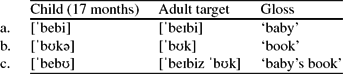
In one of the most careful longitudinal studies of the prosodic development of children for any language known to us, Fikkert (Reference Fikkert, Dressler, Prinzhorn and Rennison1995) (see also Fikkert Reference Fikkert1994) demonstrated for a child (Robin) acquiring Dutch a phase where disyllabic words with final stress (necessarily larger than one foot in a language with trochaic stress) were truncated to fit a single-foot template:
(7)
Fikkert (Reference Fikkert, Dressler, Prinzhorn and Rennison1995:79) goes on to state that ‘[d]uring the second stage, both syllables of the adult word are produced, but with stress on the first syllable’, citing data as in (8).Footnote 4
(8)
Augmentation is also found in Dutch acquisition. According to Fikkert (Reference Fikkert, Dressler, Prinzhorn and Rennison1995:81), ‘it is not unusual for an extra syllable to be produced after a final stressed syllable’, and she presents the data in (9).
(9)
Monosyllabic words are often augmented to have two syllables (10).
(10)
Fikkert (Reference Fikkert, Dressler, Prinzhorn and Rennison1995:81) points out that this is ‘further evidence for the trochaic template, since an optimal trochee consists of a strong syllable followed by a weak one’.Footnote 5 What we have before us in this Dutch acquisition case, then, is very strong evidence for a PerfectWord phase, in our terms. Since every child's path towards the full acquisition of the adult grammar's constraint ranking is individual and idiosyncratic, a detectable acquisition stage of this kind is of course not predicted to be a universal fact, but it is widespread enough to have attracted the attention of theoretical phonologists, and researchers working in the area of phonological acquisition have not hesitated to postulate constraints equivalent to PerfectWord. For example, Pater (Reference Pater2004:227) formulates a WordSize constraint stating that ‘[a] word is made up of a single trochee’.
A developmental stage where PerfectWord >> Max(Segment), Dep(Segment) holds fits very naturally into a view where language acquisition starts with a phase where all markedness constraints outrank all faithfulness constraints (M >> F) and consists in the successive demotion by the learner of constraints found to be violated in winning candidates (Smolensky Reference Smolensky1996, Tesar & Smolensky Reference Tesar and Smolensky1998, Prince & Tesar Reference Prince and Tesar2004). Prosodic words that fulfill PerfectWord are words in their unmarked state, and we refer to them as ‘perfect prosodic words’, or simply ‘perfect words’. The idea is that the perfect word phase is not just a transitory period in language acquisition, but remains active in adult phonology – sometimes, as in the case of the analysis of Danish below, playing a subtle but explanatory role in the accentual phonology.
4. THE DANISH LARYNGEAL ACCENT AND THE PERFECT PROSODIC WORD
Words with Accent I and Accent II (see Riad Reference Riad1998), manifested as different tonal configurations in Swedish and Norwegian, correspond in Danish to words with and without a glottal accent (stød), respectively. This characteristic prosodic feature of Danish, henceforth interchangeably referred to as ‘stød’ or ‘glottal (laryngeal) accent’, has in the past received different kinds of phonological representation. The most direct approach taken by numerous authors since Martinet (Reference Martinet1937) takes the laryngeal accent at face value and posits a laryngeal prosodeme. In this line of analysis, the connection with the tonal accents in the closely related languages is a purely diachronic one. A second kind of approach sees the laryngeal aspects of the Danish accent as a secondary accompaniment to a basically tonal prosodeme. Based on some phonetic evidence and the pan-Scandinavian accentual correspondences, Riad (Reference Riad1998) proposes that the stød is phonologically a word-based tonal accent melody: a laryngeally enhanced falling High-Low contour tone associated with a heavy syllable, i.e. with a monosyllabic foot, as argued by Ito & Mester (Reference Ito and Mester1997), who present a similar proposal. The idea originates in Kiparsky's (Reference Kiparsky, Kehrein, Boersma and van Oostendorp1995) analysis of the Livonian stød, a nearly extinct Finnic language closely related to Estonian with a very similar prosodic feature. The tonal approach has the virtue of providing an immediate explanation for many distributional properties of the stød, including the fact that it lodges only on sonorants and never on obstruents.Footnote 6 On the other hand, as argued by Grønnum, Vazquez-Larruscain & Basbøll (Reference Grønnum, Vazquez-Larruscain and Basbøll2013), the tonal analysis is somewhat removed from the phonetic surface, and also leaves some features of the stød unexplained. Fortunately the choice between the two approaches has little bearing on our current concerns; what matters is that the stød is, uncontroversially, a suprasegemental property – so we will here remain agnostic and simply assume that the stød is represented as an accent with some identifying characteristic, be it laryngeal or tonal.
This section presents an OT analysis of some of the core aspects of the stød. We will show that the interaction of the accent constraints and the prosodic constraints provides a better understanding of both the location of glottal accent in the word and the circumstances in which certain words have no glottal accent.
4.1 Word accent requirement and the accent basis
Stød is found only on sonorant second moras of heavy syllables (closed syllables and syllables with long vowels or diphthongs – for example, halʔs ‘throat’ has stød but fisk ‘fish’ does not because /l/ can carry a stød but not /s/ or /k/. This sonority requirement (traditionally called stød basis, see Basbøll Reference Basbøll and Kiefer1972), which differentiates the laryngeal accent of Danish from the cognate tonal accents of Swedish and Norwegian, is exemplified with more examples in (11), where VR rimes, but not VO rimes, provide a stød basis (‘R’ includes the second part of long vowels and diphthongs, liquids, nasals, and the voiced continuants ð and ɣ, and ‘O’ stands for ‘obstruent’). Our examples are given in Danish orthography, with indications of vowel length (ː), laryngeal accents (ʔ), and silent consonants ‹C›.
(11)
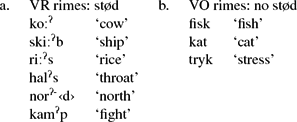
Some analyses (see Clements & Keyser Reference Clements and Keyser1983, Zec Reference Zec1988, Basbøll Reference Basbøll2003) have built the stød basis into the very moraic structure of Danish, and proposed that only [+sonorant] elements in the rime are moraic, as is shown in (12). The stød can then be viewed as always localized on the second (weak) mora of a heavy syllable.
(12)
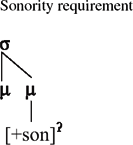
The claim that only sonorants project moras, however convenient it might be for stød purposes, does not sit well at all with the stress and word minimality facts of Danish, where obstruent-closed syllables clearly count as heavy, as they do in the other Scandinavian languages. Regarding the even closer association between stød and moras that comes with the claim that sonorant consonants are only moraic when they bear stød, Grønnum & Basbøll (Reference Grønnum, Basbøll, Solé, Beddor and Ohala2007:199) adduce phonetic evidence against such differential mora assignment:
Consonants with stød are not generally longer than consonants without stød across all positions. If consonants without stød are not moraic … and if morae in Danish are to have durational correlates in the consonants, as they do in typical mora-counting languages, this is an obstacle to the analysis […].
We therefore assume that all codas project moras (and hence count as heavy for stress), but that the laryngeal accent cannot associate to obstruents.
Besides the sonority requirement in (12) above on the locus of the laryngeal accent, a more precise characterization identifies such heavy syllables with sonorous dependent moras as monosyllabic feet (Ito & Mester Reference Ito and Mester1997):
(13)
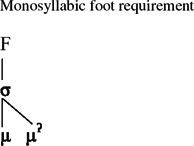
The foot-based characterization in (13) explains a series of further facts. The Danish foot is trochaic and quantity-sensitive: (ˈHL)f, (ˈLL)f, (ˈH)f, where ‘H’ and ‘L’ stand for ‘heavy syllable’ and ‘light syllable’, respectively. As shown in (14a and b), respectively, the stød is observed on monosyllabic but not on disyllabic feet, even when the sonority requirement (12) is fulfilled. Thus, the monosyllabic foot (ˈbarʔn)f carries a laryngeal accent, but the same heavy sonorant-only syllable barn in the disyllabic foot (ˈbarn.li‹g›)f does not.
(14)
Historically, a natural conjecture is that the glottal accent arose when the tonal fall assigned to a foot was compressed into a single syllable. Some cases of stød are synchronically unpredictable, as shown by contrastive uses, as in morʔ‹d› ‘murder’ vs. mor ‘mother’ and venʔ‹d› ‘turn’ vs. ven ‘friend’.Footnote 7 A certain degree of lexicalization is therefore undeniable, the real question is its extent: Do such examples show that stød is in general merely a lexicalized historical residue of the original tonal accents? We think not. On the one hand, the regularity of the stød patterning in longer words, mostly loanwords of non-Germanic origin, shows that it is rule-governed: Words with final primary stress have stød, whereas words with penultimate stress do not. With trochaic footing, final stress indicates a right-aligned monosyllabic foot, as in (15a), and penultimate stress a right-aligned disyllabic foot, see (15b).
(15)
Both the sonority requirement in (12) and the monosyllabic foot requirement in (13) are always observed, and adopting part of the traditional term stød basis we refer to the combination of these conditions as AccentBasis:
(16)
It should be understood that AccentBasis here refers to what is most likely the result of the interaction of several elementary constraints. For the purposes of this paper, we use it as a descriptive shorthand for the basic phonological requirements that need to be fulfilled for glottal accent to appear. AccentBasis is thus a necessary, not a sufficient condition – there are sonorous heavy syllables constituting feet that do not carry stød (such as mor ‘mother’ vs. morʔ‹d› ‘murder’ given above).
The constraint requiring a glottal accent to be assigned to words is WordAccent, defined in (17), a constraint active in other languages, such as Japanese (see Ito & Mester Reference Ito and Mester2012).
(17)

WordAccent, then, is fulfilled by words with a glottal accent like those in (14a)/(15a) above and violated by unaccented words like those in (14b)/(15b). The ranking AccentBasis >> WordAccent ensures that the correct output is chosen as the winner in the OT tableaux in (18).
(18)
In (18a–b), the winning accented candidate fulfills both AccentBasis and WordAccent, whereas the losing unaccented candidates violate either WordAccent or AccentBasis. On the other hand, in (18c–d), the accented candidates all violate AccentBasis in one way or another: The laryngeal accent falls on a nonsonorous mora in *[(fisʔk)]; it falls within a disyllabic foot in *[o(ˈmeːʔga)], and on a light syllable in *[o(ˈmeːgaʔ)]. Since none of the accented candidates can fulfill AccentBasis, the unaccented candidates, [(fisk)] and [o(ˈmeːga)], emerge as the winners, even though they violate lower-ranked WordAccent.
4.2 Rightmost accent and the head foot
In words with more than one monosyllabic foot fulfilling AccentBasis, the glottal accent appears on only one of them, namely, the last one in ω.Footnote 8 This foot can either be a head foot, with primary stress, as in (19a), or a nonhead foot, with secondary stress, as in (19b).
(19)
The locus of primary stress and that of the glottal accent thus need not coincide, showing that the glottal accent is not merely a prosodic enhancement of ω-headhood, and is not solely regulated by the prosodic constraints regulating stress (Trochee, WeightToStressPrinciple (WSP), Headedness, etc.). Rather, there is a separate constraint governing the location of accent, RightmostAccent, defined in (20).
(20)

RightmostAccent prohibits the constellation in (21c, d, g), where the accented syllable does not fall into the last foot, but is followed by another foot in ω (accented or unaccented). In (21) and subsequent OT tableaux, solid vertical lines between constraints indicate crucial ranking, broken vertical lines lack of crucial ranking.
(21)
RightmostAccent is violated in the candidates in (21c, d, g), where the nonfinal foot carries the glottal accent. We find some additional evidence for RightmostAccent in compounds composed of short (monosyllabic) members. Primary stress is assigned on the leftmost, secondary stress on the rightmost compound member, as in (22b) below. The glottal accent, found when the words occur in isolation, as in (22a), does not appear when they are first members of compounds. On the other hand, the glottal accent is preserved on rightmost compound members.
(22)
Suppose such compounds with short first members constitute single prosodic words: Then the deaccentuation of their first members can be attributed to the working of RightmostAccent, which rules out candidates like ω[(ˈfoːʔd)(bol ʔ‹d›)] as well as ω[(ˈfoːʔd)(bol‹d›)]. These deaccentuation examples further confirm that the laryngeal accent does not necessarily coincide with the head foot, but with the last foot in ω.
Not all compounds deaccent their first members systematically. Deaccentuation occurs when the first member is monosyllabic, but not when it is longer.Footnote 10 Although it is beyond the scope of this paper to launch into a full analysis of Danish compounds, we hypothesize that the difference is caused by the way these morphological-syntactic structures are mapped onto prosodic form. Prosodic length of the word often causes different mappings, and one possibility for Danish is that a prosodic word binarity requirement similar to the one for Japanese (Ito & Mester Reference Ito, Mester, Miyamoto and Ochi2007) is at work, so that nonbranching (in particular, monosyllabic) prosodic words are avoided as members of compounds, and are directly incorporated into the entire compound word. The four possible combinations, short–short, long–long, short–long, long–short (where short = one foot, long ˃ one foot) can be illustrated with recursive prosodic structure as in (23), where short words do not project ωs on their own, but long words do. Right ω-edges are marked by bolded brackets in the schematic diagrams below.
(23)
The location of compound stress is leftmost in the topmost ω (abstracting away from right-branching compounds, see Liberman & Prince Reference Liberman and Prince1977), that of the glottal accent rightmost in all ω. In short–short compounds like (23a), there is only one ω, hence one stød location.Footnote 11 In long–long compounds like (23b), both members are ωs, hence two stød locations. For short–long compounds like (23c) and long–short compounds like (23d), only the longer member is a ω, but with an accentual difference: When the long member is on the right, as in (23c), there is only one accent, because the right edges of both the larger ω and the smaller ω coincide.Footnote 12 But when the longer member is on the left, as in (23d), there are two accents, one at the right edge of the small ω and another at the right edge of the large ω.
Basbøll (Reference Basbøll2003:6–7) presents a different kind of evidence for the regularity and productivity of the stød. It concerns the appearance of stød in the Danish school pronunciation of Latin, as illustrated in (24), where ‘stød occurs in a (primarily or secondarily) stressed ultimate and penultimate syllable, if its sound structure permits stød’.
(24)

These occurrences of stød are obviously not borrowed from Latin, but must be due to the automatic imposition of a native pattern on foreign material. Departing from Basbøll's Non-Stød Principle stated in syllable-counting terms (‘[t]he penultimate syllable of the min-word has non-stød’, Basbøll Reference Basbøll2003:13), we suggest that the Latin examples are treated like complex Danish words (hence multiple støds are possible), with automatically imposed foot structure as in the last line in (24), where HL trochees are permitted only finally. Given these conditions, stød appears where expected: on all heavy syllables with stød basis that constitute monosyllabic feet – (ˈenʔ) and (ˌlɛ:ʔ), but not (ˈlɑ:.rɔm).
4.3 The perfect prosodic word and the balanced trochee
While there can be little doubt that the basic distribution of the laryngeal accent of Danish is rule-governed, it is also true that its appearance and non-appearance is to a significant extent controlled by morphological factors. The most well-known example is the systematic difference in stød behavior between unaccented simplex roots and accented prefix+root combinations, as illustrated in (25).
(25)
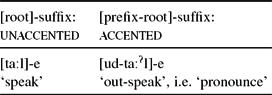
If what we are witnessing here is a case of accent deletion, it takes place in an unexpected place: in the underived environment of the simplex root, whereas there is no deletion in the derived environment consisting of prefix-root – the opposite of what is expected in the typology of processes established in lexical phonology (Kiparsky Reference Kiparsky and Yang1982).
Previous approaches have taken recourse to various strategies, be it a special accent insertion rule for complex stems, or a special deletion rule for simplex stems, or an assignment of morphological levels depending on phonological size (endings on monosyllabic forms are level-1, endings on polysyllabic forms are level-2).
Our hypothesis is that the different stød-behavior of simplex and complex form reflects a difference in prosodic structure: root-suffix, exemplified in (26a), is wrapped into a single disyllabic foot, whereas in prefix-root-suffix, exemplified in (26b), the root forms a monosyllabic foot excluding suffix and prefix.Footnote 13
(26)
If (26) is indeed the correct foot structure, the correct accentual outcome is predicted:
(27)
This proposal reduces the baffling accented/unaccented alternation between derived forms and their bases to a known quantity, monosyllabic vs. disyllabic feet – but apparently at the cost of an even more baffling stipulation: Why would roots get parsed as monosyllabic feet when they are part of a morphologically complex stem, but as part of disyllabic feet also including the suffix when no prefix is present? The reason, we suggest, is twofold: Besides well-formedness conditions on foot structure, we are witnessing the effects of the perfect prosodic word. Let us begin by addressing the first part of the question: Why do morphologically complex – and polysyllabic – stems have monosyllabic feet? The answer lies in Rhythmic Harmony, as shown in (28).
(28)
Rhythmic Harmony is the linguistic reflex of a general principle in the psychology of rhythmic grouping (see Hay & Diehl Reference Hay and Diehl2007 for a recent experimental validation): While elements contrasting in intensity (marked by strong ■ vs. weak □) naturally form groupings with initial prominence, see (29a), elements contrasting in duration (marked by long — vs. short –) naturally form groupings with final prominence, as shown in (29b).
(29)
a. … □)(ˈ■ □)(ˈ■ □) (ˈ■ □) (ˈ■ □) …
b. … (– ˈ—)(– ˈ—)(– ˈ—)(– ˈ—)(– …
Cross-linguistic consequences (Hayes Reference Hayes1995) include both trochaic shortening (ˈHL→ ˈLL, as in English, Fijian, Hawaiian, Italian (dialects), Latin, Tongan, etc.) and iambic lengthening (LˈL → LˈH, as in Choctaw, Chickasaw, Hixkaryana, Munsee, Unami, Yupik, etc.). We can assume, therefore, that there is a constraint – or a more general principle entailing it – against unbalanced trochaic feet (*HL), favoring moraic-trochaic parsing.
(30)

If ranked above syllable parsing, *HL predicts that the accented form emerges as the winner with this ranking:
(31)
Next we turn to the second part of the question: Why do morphologically simplex – and monosyllabic – roots form disyllabic feet including the suffix? In fact, the same ranking *HL >> ParseSyll that just produced the right result for polysyllabic stems selects the wrong candidate in (32), with glottal accent also on monosyllabic stems.
(32)
One way of stating the observation is as follows: Monosyllabic roots form monosyllabic feet, i.e. carry stød, in morphologically complex forms, as in (31), in avoidance of rhythmically unbalanced HL trochees. But when building such an unbalanced trochee manages to make the whole prosodic word a single rhythmic unit, it is chosen as the superior parse. This is what happens in the case of a monosyllabic root followed by a suffix, and this is nothing but a perfect prosodic word effect, as earlier encountered in Serbian/Croatian (Section 2 above): The constraint PerfectWord dominates the balanced trochee constraint *HL.
(33)
The PerfectWord constraint has no bearing on morphologically complex forms of more than two syllables, as seen in (34), since none of the relevant candidates fulfills it.
(34)
The ranking of the prosodic and accent constraints is given in (35).
(35)
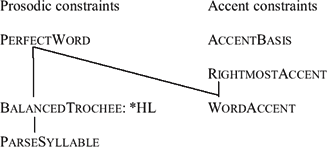
Max(Segment) dominates PerfectWord, hence the perfection of the prosodic word cannot be achieved by deletion, see (36a), but is only attainable, at the cost of an unbalanced trochee, with inputs that are already short, see (36b).
(36)
We see here the same type of constraint interaction involving PerfectWord as that observed in prosodically-conditioned shortening in Serbian/Croatian (Zec Reference Zec1999) (recall (5) in Section 2 above). Danish prefers balanced trochees, i.e. moraic-trochaic footing, but the dispreferred unbalanced trochee (a trimoraic HL foot) emerges when such a foot can wrap an entire prosodic word (the HL foot must therefore necessarily be in final position, as in the Danish Latin examples in (24) above).
A final piece of the analysis of the Danish laryngeal accent involves underived (morphologically simplex) forms. We saw earlier that monomorphemic forms with penultimate stress (relevant examples are repeated in (37) below) have the schematic foot structure [… f(σσ)]ω, and are hence unaccented. This means that even though, as trisyllables, they do not enjoy PerfectWord status, their final foot must consist of the trimoraic trochee HL.
(37)

One reasonable interpretation of these facts is as in (38): The parsing of root syllables takes precedence over the avoidance of HL trochees.
(38) ParseRootSyll >> *HL >> ParseSyll
Tableau (39) compares monomorphemic /omeːga/, where the root parsing preference forces a disyllabic (and hence unaccented) foot, with polymorphemic /be-taːl-e/, whose inflectional last syllable does not qualify for root parsing, hence disyllabic HL footing yields to rhythmically superior H footing, with glottal accent as the hallmark of a monosyllabic foot.
(39)
Instead of positing a special constraint ParseRootSyll, a possible alternative in a model of Stratal OT (Kiparsky Reference Kiparsky, Uyechi and Wee2010) could have the ranking ParseSyll >> *HL: Parsing first at the root level, roots of the form […HL] are parsed as […(HL)], e.g. [o(meːga)], roots of the form […H] as […(H)], e.g. [(taːʔl)]. At the stem/word level, the parsing assigned at the root level is preserved by prosodic faithfulness (ProsFaith), except when it is possible to fulfill the PerfectWord constraint without deletion: Max(Segment) >> PerfectWord >> ProsFaith >> ParseSyll >> *HL. The parsing of /taːl-e/ changes from [(taːʔl)e] into [(taːle)], but [o(meːga)] and [be-(taː ʔ)l-e] and [(ud)-(taːʔ)l-e] remain unchanged (modulo resyllabification). A similar explanation, we hypothesize, accounts for the fact that the related noun [(ud)-(taːl-e)] is again stødless: In conformity with (23c) above, the second compound member is parsed as its own ω (the internal structure of [ta:le]N is no longer accessible at the noun cycle, in lexical-phonological terms), so the perfection of this prosodic word takes effect: [(ud)‑[(ta:le)]ω]ω (see Basbøll Reference Basbøll2005:379–382 for an account along these lines). When considering the overall analysis of Danish phonology and morphology, we suspect that a stratal account would have more analytical tools to cover various morphologically dependent cases than the root-specific parsing constraint given above. Such investigations, however, are far beyond the scope of this paper, which does not attempt to deal with the morphological factors governing the stød, or with the distribution of stød in foreign words, which differs in some respects from that in native words (see Basbøll Reference Basbøll2005:414–418). Our goal has been the more modest one of showing that the notion of the PerfectWord plays a crucial role in understanding the basic structural generalizations regarding the distribution of the glottal accent of Danish.
5. FURTHER CONSEQUENCES FOR THE PERFECT PROSODIC WORD
Perfect (one-foot) prosodic words, as we have seen, are a major milestone in language acquisition (Section 3), and the PerfectWord constraint has been shown to be at work in two case studies, prosodically-conditioned vowel shortening in Serbian/Croatian (Section 2) followed by the Danish glottal accent, where the emergence of the perfect prosodic word plays an explanatory role in determining the presence and absence of stød (Section 4). Here we briefly present other cases where the PerfectWord constraint may account for the special behavior of single-foot words, and conclude by considering its status in connection with recent developments in syntax–prosody interface theory.
5.1 Other perfect prosodic word effects
Perfect words have a special status cross-linguistically known from the literature under the term minimal word effects (McCarthy & Prince Reference McCarthy and Prince1990 et sqq.). The minimal word sets a lower limit on content word size in many languages. Thus Myers (Reference Myers1987) presents evidence that Shona, like other central Bantu languages, imposes a disyllabic minimality condition on words. Monosyllabic noun stems therefore appear in isolation with an epenthetic initial vowel:
(40)
Whether or not a word minimality requirement is observed is a language-specific affair, and depends on the specific constraint ranking in the grammar. Mudzingwa (Reference Mudzingwa2010:13, 205–206) in fact shows that different dialects of Shona differ in the relative ranking of Onset and the Word Minimality constraint, with the result that some enforce the disyllabicity condition (e.g. Zezuru), others do not (e.g. Karanga).
The perfect (minimal) word also serves as a template in a host of prosodically defined word formation processes, for example, as patterns for morphological reduplication and truncation. A well-known case occurs in the Western Oceanic language Manam (Lichtenberk Reference Lichtenberk1983:598–613), where reduplication serves various derivational functions including continuative, progressive, and persistive aspects of verbs, agent nouns, as well as singular and plural forms of adjectives. Both prefixed and suffixed reduplicants occur (italicized in (41) below), depending on the word formation process, and, abstracting away from some complicating factors, they fit a perfect word template, in this case, a bimoraic trochee, the stress foot of the language.
(41)
Beyond such templatic formations, Bennett & Henderson (Reference Bennett and Henderson2013) have identified a PerfectWord syndrome in the Mayan language Uspanteko, where it leads to the appearance of tone/accent and a specific kind of foot structure. Uspanteko, with regular iambic footing, shows trochaic footing in perfect prosodic word contexts (a bisyllabic foot that has a non-rising sonority profile and a head that bears tone), interacting with a constraint governing the relative prominence of foot heads (i.e. foot heads should bear tone), and a NonFinality constraint preventing tone from appearing on a final short vowel.
PerfectWord has also an interesting effect in connection with the phonology of loanwords in Japanese (Kubozono, Ito & Mester Reference Kubozono, Ito and Mester2008, see also references cited there). An important question here is under which conditions coda consonants in English source words are rendered as geminates in Japanese. Consider a well-known example like doraggu rágu ‘drug lag’ (where the mark on the vowel indicates pitch accent).Footnote 15 The puzzle here is why English coda /g/ is rendered as a geminate in the first word, but not in the second. First, why not dorágu? Even though voiced obstruent geminates are possible in the Japanese loan vocabulary (but not in native words), they are still highly marked (Kawahara Reference Kawahara2006). The answer is that the parsing do(rágu) with a final bimoraic foot violates NonFinality(Accent), different from do(rág)gu. Why, then, is the foot not shifted one syllable over, as in (dóra)gu? But this version has the accent on an epenthetic vowel, which violates the constraint HeadDep of Alderete (Reference Alderete, Hermans and van Oostendorp1999) and is widely avoided in the Japanese loan vocabulary (as in many other languages, such as Fijian (Kenstowicz Reference Kenstowicz2007); exceptions are found chiefly among older long-established loans, such as kurisúmasu ‘Christmas’). This gives rise to do(rág)gu, fulfilling both NonFinality(Accent) and HeadDep, at the cost of violating lower-ranking NoVoiObsGem. But then, why not the parallel (rág)gu instead of (rágu)? One attractive answer is that even though [(rágu)] violates NonFinality(Accent), it satisfies PerfectWord, so it is selected as the winner.
The guiding idea of the perfect prosodic word is that it assigns a special status, developmentally and cross-linguistically, to one-foot words. But the phonological effects themselves of the PerfectWord constraint can be very different: templatic restrictions in a variety of prosodic morphological formations, vowel shortening in Serbian/Croatian, stød realization in Danish, gemination/degemination effects in Japanese, and tonal prominence assignment in Uspanteko. Although each such case in an individual language may only be relevant for a small portion of the phonological system, it is nonetheless important that it need not be identified as exceptional but finds a place in the overall grammatical system. Viewed from this perspective, the perfect prosodic word may play a key role and lead to interesting results, and we expect that this notion may play a pivotal role cross-linguistically in accounting for some aspects of phonological systems that have hitherto eluded a formal explanation.
5.2 The perfect prosodic word and Match Theory
One of the arguments that might be leveraged against PerfectWord is that it appears to be a type of templatic constraint (ω = f), akin to constraints like RED = f. The latter type of constraint was abolished in the Generalized Template Theory (GTT) of McCarthy and Prince (McCarthy & Prince Reference McCarthy, Prince and Gonzàlez1994, Reference Macaulay and Salmons1995), where all templatic effects are claimed to be reducible to the interaction of more basic constraints. This is why Pater (Reference Pater2004) hypothesized that his WordSize constraint (here in essence equivalent to PerfectWord) should not be thought of as a constraint by itself, but rather as an effect resulting from the interaction of several more basic constraints, including alignment constraints of the familiar type. In order to achieve the effects of ω = f, at least three alignment constraints are necessary: Align-Right (ω, f) and Align-Left (ω, f), aligning both word-edges to foot edges, and All-Feet-Right (or Left), disallowing the presence of more than a single foot.
Before immediately concluding, however, that the PerfectWord constraint needs to be reduced to a combination of more elementary constraints through constraint conjunction (Smolensky Reference Smolensky1995), or be reconceptualized within a version of Harmonic Grammar (Coetzee & Pater Reference Coetzee and Pater2008, Potts et al. Reference Potts, Pater, Jesney, Bhatt and Becker2010, where lower-ranked constraints can ‘gang up’ against a higher-ranked constraint), we should reassess the arguments against templatic constraints. Conceptual considerations aside, the main empirical argument for GTT and against templatic constraints is the so-called Kager–Hamilton problem. There are supposed to be examples of segmental changes with structural descriptions only fulfilled in the reduplicant that are back-copied onto the base. A case in point is Malay, which lacks phonemic nasalization and where nasal harmony spreads rightwards through vowels, glides, and laryngeals.Footnote 16 However, templatic size restrictions are allegedly never back-copied onto the base in this way – for example, it is supposed to be impossible for a hypothetical word pataka to reduplicate as [pata]RED-[pata]BASE, when the reduplicant is restricted to a single foot. If templatic constraints existed, so the argument goes, templatic requirements could be easily backcopied. This is an interesting argument, but it has been undermined, and with it GTT's entire reductionist edifice, by the fact that the abolishment of all templatic constraints is neither a sufficient nor a necessary step with respect to the Kager–Hamilton problem. It is not sufficient since back-copying can still be achieved within GTT by other means, such as alignment or Output–Output constraints (see Raimy Reference Raimy2000:173; Gouskova Reference Gouskova2007:392). It is not necessary since cases that can plausibly be interpreted as templatic back-copying are in fact attested, making the Kager–Hamilton conundrum a pseudo-problem not in need of a solution. Examples include doubled truncated nicknames like JoJo and CoCo (Inkelas & Zoll Reference Inkelas and Zoll2005:89, from the names Josephine and Collette) as well as reduplicative constructions in Kinande (Bantu), Japanese, and Guarijío (Uto-Aztecan), to name a few cases (see Downing Reference Downing2000, Kurisu Reference Kurisu2005, and Caballero Reference Caballero2006, respectively).
In hindsight, GTT seems to have overshot its mark, and templatic constraints remain with us as established members of the constraint set, as argued in detail in Gouskova (Reference Gouskova2007) (a similar conclusion is reached in McCarthy Reference McCarthy2008:297 and McCarthy, Kimper & Mullin Reference McCarthy, Kimper and Mullin2012:210–211, involving one of the originators of GTT). Moving beyond GTT, we can consider templatic restrictions like PerfectWord (ω = f) to not simply be the combined effect of other constraints, but reassess them as independent constraints in their own right, and investigate their status in current phonological theory.
A promising line of investigation starts within the theory of the syntax–prosody interface, which has taken a significant step in advance with the development of Match Theory (Selkirk Reference Selkirk2009, Reference Selkirk2011, see also other work in a similar vein, such as Elfner Reference Elfner2012 and Ito & Mester Reference Ito and Mester2013). Its central idea is that syntax–prosody mapping constraints are of a simpler kind than in previous approaches, essentially demanding the direct replication of core constituents of syntax (words/phrases/clauses) by corresponding prosodic constituents (prosodic words/phonological phrases/intonational phrases). The general format of these constraints is given in (42) (after Selkirk Reference Selkirk2011:451).
(42) Match(α,π) [ = Syntax–Prosody Faithfulness]
The left and right edges of a constituent of type α in the input syntactic representation must correspond to the left and right edges of a constituent of type π in the output phonological representation.
Match Theory, in its focus on constituency and not privileged boundaries, is in this central aspect very different from its antecedent and competitor, the End-based Theory, which singles out one edge – left or right – of designated syntactic constituents as the edge to be matched by a corresponding edge of a prosodic constituent, while the other edge is ignored (see (43) below). While the phonological and phonetic effects that diagnose prosodic boundaries often diagnose only one boundary and thus seem to support the End-based Theory, this is largely an argument from silence. As shown in detail by Selkirk (Reference Selkirk2011), in the rare but crucial cases where diagnostics for both edges exist, such as in Xitsonga (a Bantu language of northeast South Africa and Mozambique), the prosodic constituent structure predicted by Match Theory, with both edges in correspondence, is in fact evident in the data (see Kisseberth Reference Kisseberth, Cole and Kisseberth1994 and Cassimjee & Kisseberth Reference Cassimjee, Kisseberth, Hyman and Kisseberth1998 for the original data and analysis). Prosody, as it emerges from the syntax–phonology mapping, often does not exactly correspond to syntax at all. Whereas End-based Theory builds syntax–prosody disalignment into the mapping constraints themselves, Match Theory interprets it as due not to the mapping constraints themselves, which would require an imperfect and distorted match, but rather to the fact that the mapping constraints, even though they demand a perfect match, are often dominated by other constraints – most importantly, by eurhythmic constraints that govern prosodic form by itself (binarity, antilapse, etc.) and result in syntax–prosody disalignment for this reason. This kind of conception emerges very naturally within an overall framework with violable constraints, such as Optimality Theory.
One point of interest when comparing Match Theory and the End-based Theory is the fact that the latter, quite apart from its specific role in syntax–prosody mapping issues, has given rise to a very general alignment schema relating edges of linguistic structures of various types with each other. The specific setup of the original End-based Theory is schematized in (43), where grammatical categories are aligned with prosodic categories, not vice versa, and only at the same (left or right) edge.
(43)

This turns out to be just a subcase of a general alignment framework developed by McCarthy & Prince (Reference McCarthy, Prince, Booij and van Marle1993), where any grammatical category and any prosodic category can be freely aligned, and alignment can go from edge to corresponding edge or from edge to anti-edge, as schematically shown in (44).
(44)

A generalized alignment requirement ‘demands that a designated edge of each prosodic or morphological constituent of type Cat1 coincide with a designated edge of some other prosodic or morphological constituent Cat2’ (McCarthy & Prince Reference McCarthy, Prince, Booij and van Marle1993:80), as formally expressed in (45).
(45) Generalized Alignment – formal definition
Align(Cat1, Edge1, Cat2, Edge2) = def ∀Cat1 ∃Cat2 such that
Edge1 of Cat1 and Edge2 of Cat2 coincide,
where Cat1, Cat2 ∈ PCat ∪ GCat, Edge1, Edge2 ∈ Right, Left.
This much richer network of alignment relations was put to fruitful use in subsequent research. Syntax-internal GCat-to-GCat alignments are the basic tools to impose ordering restrictions in syntax and morphology, such as the position of heads, specifiers, and arguments (Grimshaw Reference Grimshaw1997, Reference Grimshaw, Legendre, Grimshaw and Vikner2001). PCat-to-GCat alignments express the syntactic-morphological grounding of higher-level prosodic categories, where left/right prosodic words edges, for example, have to correspond to left/right grammatical word edges (see Selkirk Reference Selkirk1996, among others). Finally, prosody-internal PCat-PCat alignment is ubiquitous in phonology, accounting for directionality of footing (McCarthy & Prince Reference McCarthy, Prince, Booij and van Marle1993) and prosodic anchoring effects such as the requirement that prosodic words begin with a foot (Ito & Mester Reference Ito and Mester1992, Reference Ito, Mester, Kager, van der Hulst and Zonneveld1999).
Against this background, it is natural to ask whether Match constraints might also be fruitfully extended, from being solely concerned with syntax–prosody mapping to other types of mapping. Selkirk (Reference Selkirk2011:451) herself has proposed the existence of mirror-image prosody–syntax Match constraints of the general form Match(π,α), and it is interesting to speculate whether prosody–prosody matching constraints might also be of relevance. In particular, might the PerfectWord constraint be understood as a Match constraint requiring prosodic words to be coextensive with feet?
(46)
Match constraints are constituency-based, hence both edges of the constituent are required to be matched. From the Match perspective, there is thus no need for a multitude of edge-based alignment contraints to be operative in the grammar to account for perfect word and other templatic effects. This line of research has the potential to uncover new generalizations and to lead to further theoretical developments. However, together with many questions regarding the prosodic structure of Danish left unresolved here, we must leave these issues for future exploration.
ACKNOWLEDGEMENTS
For comments on an earlier version of this paper, we are grateful to Hans Basbøll, Ryan Bennett, Paul Kiparsky, Catherine Ringen, Miguel Vazquez-Larruscain, Sten Vikner, two anonymous reviewers, as well as audiences at MIT, Stanford, and UC Santa Cruz, where parts of this work were presented. We remain responsible for all remaining errors and shortcomings.


