In recent years, consumers are becoming more concerned about the quality of the food that they purchase in the markets. This growing demand for information includes details about environmental issues, animal welfare and production conditions of ruminant-derived products, with particular interest in the diet (Bernués et al. Reference Bernués, Olaizola and Corcoran2003; Sivadier et al. Reference Sivadier, Ratel, Bouvier and Engel2008). This fact is even more important for traditional and high-value-added products, which is the case of the Idiazabal Protected Denomination of Origin (PDO) cheese produced from the milk of the Latxa breed under study. Latxa sheep are reared in a definite geographical area of the Basque Country and Navarre in northern Spain. They are fed concentrate and conserved forages during pasture shortage and fresh pasture the rest of the year, with indoor supplementation to meet their nutritional needs. The use of the land contributes to maintaining clean forests and attracting tourism, but the most interesting thing is that the pasture is a component of the ‘terroir’ concept which is closely related to the authenticity and quality of some cheeses (Morand-Fehr et al. Reference Morand-Fehr, Fedele, Decandia and Le Frileux2007). In addition, better nutritional quality of pasture milk and cheeses has been recently reported (Khanal et al. Reference Khanal, Dhiman and Boman2008; Rego et al. Reference Rego, Rosa, Regalo, Alves, Alfaia, Prates, Vouzela and Bessa2008; Abilleira et al. Reference Abilleira, Collomb, Schlichtherle-Cerny, Virto, de Renobales and Barron2009). Until now, no specification about the feeding management exists for Idiazabal PDO cheese and, in the last few years, pasture grazing as part of the diet is decreasing owing to the abandonment of rural areas and because sheepherding is a very demanding and not a socially appreciated activity (Oregui & Falagán-Prieto, Reference Oregui and Falagan Prieto2006). In order to ensure the continuity of this system, and in response to consumer demand, there is a need to increase the value of cheese manufactured from grazing ewes and differentiate it from cheese from ewes kept indoors all year round. If new specifications regarding flock management and feeding of the sheep are to be included, it is very important for PDO Regulatory Councils to have an authentication tool of the animal diet to certify the higher value of pasture cheeses. In this sense, terpenes have been proposed several times as potential pasture biomarkers in milk, cheese and meat products of ruminants (Mariaca et al. Reference Mariaca, Berger, Gauch, Imhof, Jeangros and Bosset1997; Priolo et al. Reference Priolo, Cornu, Prache, Krogmann, Kondjoyan, Micol and Berdagué2004; Prache et al. Reference Prache, Cornu, Berdagué and Priolo2005; Sivadier et al. Reference Sivadier, Ratel, Bouvier and Engel2008).
Terpenes originate from the secondary metabolism of plants and they can be rapidly transferred to milk from feed (Viallon et al. Reference Viallon, Martin, Verdier-Metz, Pradel, Garel, Coulon and Berdagué2000; Bouvier et al. Reference Bouvier, Rahier and Camara2005). Approximately ten-times more terpenes were found in milk from animals fed pasture than in milk from animals fed the corresponding hay (Cornu et al. Reference Cornu, Kondjoyan, Martin, Verdier-Metz, Pradel, Berdagué and Coulon2005). Cheeses made with milk from cows fed pasture were much richer in terpenes than cheeses made with milk from cows fed only a total mixed ration (Carpino et al. Reference Carpino, Mallia, La Terra, Melilli, Licitra, Acree, Barbano and Van Soest2004). However, environmental factors, soil characteristics, botanical composition and geographical location of the pasture, as well as phenological stage of each grass species contribute to the high diversity in the terpene composition of the pasture (Mariaca et al. Reference Mariaca, Berger, Gauch, Imhof, Jeangros and Bosset1997). In addition to this large variability throughout the grazing season, grazing management also affects the terpene content in milk. A continuous increase of terpenes was observed in strip-grazing strategy while very little effect was observed in paddock grazing (Tornambé et al. Reference Tornambé, Cornu, Pradel, Kondjoyan, Carnat, Petit and Martin2006). But, despite the considerable amount of research on the topic it remains unclear whether these compounds would be useful to trace the diet of the ruminants under real conditions where diets consist of a mixture of fresh pasture and other feeds.
The objective of the present work was to report changes in terpene composition of ewes’ raw milk throughout the milking period as affected by seasonal changes in feeding under part-time grazing of commercial flocks. In addition, the potential use of terpenes as marker compounds for grazing fresh pasture was evaluated.
Materials and Methods
Chemicals
Standards of terpenes (see Tables 1 and 2) were purchased from Fluka and Sigma-Aldrich (Madrid, Spain). Standards were of high purity (⩾90%) except for α-terpinene and terpinolene (⩾85%). High purity (⩾99%) n-paraffin mixtures of alkanes from C7 to C24 were purchased from Supelco (Bellefonte CA, USA). High purity (⩾95%) 1,3,5-triisopropylbenzene (TIPB) was purchased from Fluka. n-Pentane was of analytical grade (Panreac, Barcelona, Spain). Helium was of 99·999% purity (Praxair, Madrid, Spain).
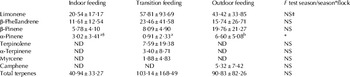
Mean terpene content (μg/kg) of milks from C-flocks† (n=4) throughout the season

† C-flocks: flocks grazing on cultivated private grasslands where ryegrass (Lolium perenne) and white clover (Trifolium repens) were predominant species
‡ NS: not significant; * P⩽0·05; ND: not detected
§a, b Means in a row followed by a different superscript letter were significantly different (P<0·05)
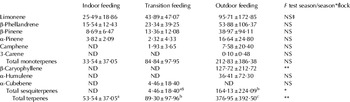
Mean terpene content (μg/kg) of milks from NC-flocks† (n=5) throughout the season

† NC-flocks: flocks grazing on non-cultivated community-owned grasslands consisted of herbaceous plants such as Trifolium repens, Festuca rubra and Agrostis capillaries, and also other non-graminoid plants and some shrubs
‡ NS: not significant; * P⩽0·05; ** P⩽0·01; ND: not detected
§a, b, c Means in a row followed by a different superscript letter are significantly different
Commercial flocks and milk samples
Nine commercial flocks of Latxa sheep participated in this study. All the flocks belonged to the PDO Idiazabal cheese and were located in the Basque Country at an altitude of 500–900 m. The flocks consisted of 100–500 head and had the same seasonal lambing system. Suckling lambs were weaned with 30 d, and milk production period for cheesemaking extended from winter (February) to early summer (July). Ewes were milked twice a day using automatic milking machines. Bulk milk samples (1·5 l) equivalent at two milkings (in the evening and morning) of each flock were taken from the tank once a month from each farmhouse throughout this period from February to July. Sample collection was done in 2006.
Feeding management
On each sampling day sheepherders completed a thorough questionnaire about the quantity and composition of the feeds given to the sheep. In outline, all the sheepherders followed the same feeding strategy that consisted of concentrate and conserved forages (alfalfa and grass hay) in winter and part-time grazing with varying supplementation of concentrate and forage (depending on the grazing time) from spring onwards (Fig. 1). In February (‘indoor feeding’) the diet consisted of cereal-based concentrate formulations (43±17%) and conserved forages (54±14%). From March onwards, the concentrate and conserved forage amounts in the diet decreased resulting in an important increase of the contribution of the fresh pasture to the diet of the flocks. In March and April (‘transition feeding’) there was great variability in the percentage of fresh pasture in the diet (65±23%) because they were transition months in which the flocks started to graze and progressively increased the grazing time (4±1 h). From May onwards (‘outdoor feeding’) the flocks spent 8±3 h in the pasture, fresh pasture being the predominant component (85±7%) of the diet (Fig. 1).
Average contribution (percentage) of different feed types to the diet of the flocks throughout the milk production season of 9 commercial Latxa flocks.

Each farmhouse purchased different concentrate formulations and conserved forages from local suppliers and some of the sheepherders prepared the forages themselves. Nutritional labels of the concentrates were collected. Average composition of the concentrates on a dry matter basis was as follows: crude protein 19·73±2·25%, crude fat 3·18±0·88%, crude fibre 7·59±2·05%, ash 6·89±1·38%. From March onwards, when pasture was available for the flocks, four commercial flocks (C-flocks) grazed on cultivated private grasslands where ryegrass (Lolium perenne) and white clover (Trifolium repens) were predominant species, whereas five commercial flocks grazed on non-cultivated community-owned grasslands (NC-flocks). The pasture composition of such community-owned grasslands in this area has been reported by Mandaluniz et al. (Reference Mandaluniz, Aldezabal and Oregui2009) and consisted of herbaceous species such as Trifolium repens, Festuca rubra and Agrostis capillaris, but also other non-graminoid plants and some shrubs. Weather conditions were rather similar for all locations of the flocks participating in this study. Average monthly temperatures from February to July were: 3·4°C, 9·4°C, 10·7°C, 14·1°C, 18·0°C and 20·7°C (Euskalmet, 2006) indicating a very cold winter followed by an extraordinary warm spring and summer. Monthly accumulated rainfall records from February to July were 50·8, 146·7, 53·9, 32·9, 57·0 and 46·9 l/m2, respectively, indicating very low rainfall records except for March (Euskalmet, 2006). Fresh pasture intake was estimated from the time spent on pasture and the rest of feeds ingested (Perojo et al. Reference Perojo, Garcia-Rodriguez, Arranz and Oregui2005). Milk samples were stored at−80°C until analysis.
Terpene analysis
Terpene analysis was carried out according to Abilleira et al. (Reference Abilleira, de Renobales, Nájera, Virto, Ruiz de Gordoa, Pérez-Elortondo, Albisu and Barron2010). Briefly, terpenes were extracted by HS-SPME from the oil phase obtained by centrifugation of the milk samples. Spiked oil phase aliquots were placed in 4-ml vials at 40°C for 30 min using TIPB as internal standard (200 μg/kg). SPME manual holder (Supelco) with a 1-cm DVB/CAR/PDMS fibre (Supelco) was used to trap volatiles from the vial headspace. Terpenes were analysed using an 8000 series gas chromatograph (GC) equipped with a Supelcowax (Supelco) capillary column (60 m × 0·25 mm × 0·25 μm film thickness) and coupled to an MD 800 mass spectrometer (MS) detector (Fisons Instruments, Milan, Italy). Fibre was desorbed in the injector port at 240°C during 5 min in splitless mode. Helium (1 ml/min) was used as carrier gas. Oven temperature was initially held at 40°C for 10 min, then increased to 110°C at 5 deg C/min followed by 10 deg C/min to 240°C. MS detector operated by Electron Impact (EI) at 70 eV in full scan mode (2 scan/s) from m/z 19 to 250. Source temperature was 200°C. Compounds were identified by comparing their mass spectra with those of authentic standards and the National Institute of Standards and Technology (NIST, USA) mass spectral library. A series of C7–C24 n-alkanes was run to calculate the linear retention indexes (LRI). LRI of each compound was also compared with those of authentic standards. SIM mode detection monitoring ions m/z 93 and 136 for monoterpenes and ions m/z 93, 136, 161, 189 and 204 for sesquiterpenes (Viallon et al. Reference Viallon, Martin, Verdier-Metz, Pradel, Garel, Coulon and Berdagué2000) was also used to increase the specificity and sensitivity of the analysis for quantitative approach. Concentrations of individual terpenes were calculated in the milk samples using the internal standard quantification method as described by Abilleira et al. (Reference Abilleira, de Renobales, Nájera, Virto, Ruiz de Gordoa, Pérez-Elortondo, Albisu and Barron2010). Analyses were carried out in duplicate. Terpene content was expressed as μg/kg of milk fat.
Statistical analysis
SPSS statistical package, version 17.0 (SPSS Inc., Michigan, USA) was used for statistical analysis. Analysis of variance (ANOVA) was used to determine the presence of significant differences (P⩽0·05) in the terpene content of milks throughout the milking period as affected by increasing pasture intake of the flocks. Mixed linear model was used including ‘season’ as fixed effect nested within ‘flock’ as random effect. F test of the ‘season’ against the interaction term ‘season*flock’ was used. Three groups of milk samples were compared on the ‘season’ factor according to pasture intake of the flocks: ‘indoor feeding’ (milks from February), ‘transition feeding’ (milks from March and April) and ‘outdoor feeding’ (milks from May to July). Means for those different groups were compared using Tukey's test. Principal component analysis (PCA) was performed separately for C-flocks and NC-flocks on individual terpene contents and the percentage of fresh pasture in the diet as seasonal variable. Only variables with communality value higher than 0·4 were included. The Kaiser criterion (eigenvalue >1) was used to select the principal components. Factors were rotated (Varimax method) for ease of interpretation.
Results and Discussion
Terpenes
A total of twelve terpenes were positively identified in milk fat of Latxa ewe flocks throughout the season. Nine corresponded to monoterpenes: α-pinene and β-pinene, 3-carene, camphene, myrcene, α-terpinene, limonene, β-phellandrene and terpinolene, and the other three were sesquiterpenes: α-cubebene, β-caryophyllene and α-humulene. All of them have been previously identified in other studies where the importance of botanical composition of the pasture and maturity stage of the plants in terpene profile and content was reported (Viallon et al. Reference Viallon, Verdier-Metz, Denoyer, Pradel, Coulon and Berdagué1999; Agabriel et al. Reference Agabriel, Cornu, Journal, Sibra, Grolier and Martin2007; Fedele et al. Reference Fedele, Pizzillo, Claps and Cifuni2007). In this respect, it must be highlighted that monoterpenes were detected in the milk from both C-flocks and NC-flocks throughout the season whereas sesquiterpenes only were detected in the milks of NC-flocks when the animals were allowed to graze. As mentioned above, these NC-flocks grazed in non-cultivated community-owned grasslands in which herbaceous species, non-graminoid plants and some shrubs constituted the grasslands biodiversity (Mandaluniz et al. Reference Mandaluniz, Aldezabal and Oregui2009). In any case, taking into account mean values calculated from both C-flocks and NC-flocks, total terpene content of milk samples was significantly (P⩽0·05) higher in the ‘outdoor feeding’ flocks (262·50±337·06 μg/kg) than in ‘transition feeding’ (95·55±132·17 μg/kg) and ‘indoor feeding’ (47·82±35·14 μg/kg) flocks. According to the review by Prache et al. (Reference Prache, Cornu, Berdagué and Priolo2005) milk from animals grazing in pasture contains a wider range and higher amounts of terpenes than milk from ruminants that are fed concentrate or conserved forage.
In the case of C-flocks, limonene was the predominant monoterpene (55±7% of total monoterpenes) followed by β-phellandrene (22±5% of total monoterpenes), β-pinene and α-pinene (13±7% and 4±4% of total monoterpenes, respectively) whereas camphene, myrcene, α-terpinene, and terpinolene together represented less than 6% of total monoterpenes throughout the season (Table 1). In the case of NC-flocks, monoterpenes were the main terpene compounds throughout the season limonene being the predominant one (48±3% of total monoterpenes) followed by β-phellandrene (27±2% of total monoterpenes), β-pinene and α-pinene (17±1% and 5±3% of total monoterpenes, respectively) whereas camphene and 3-carene together represented less than 3% of total monoterpenes throughout the season (Table 2). Other authors have reported that limonene, β-phellandrene, β-pinene and α-pinene were the main monoterpenes in milk and cheese from animals grazing fresh pasture (Viallon et al. Reference Viallon, Verdier-Metz, Denoyer, Pradel, Coulon and Berdagué1999; Favaro et al. Reference Favaro, Magno, Boaretto, Bailoni and Mantovani2005; Tornambé et al. Reference Tornambé, Cornu, Pradel, Kondjoyan, Carnat, Petit and Martin2006; Agabriel et al. Reference Agabriel, Cornu, Journal, Sibra, Grolier and Martin2007).
Despite changes observed in the mean total monoterpene content of milks from C-flocks or NC-flocks throughout the season, non significant differences (P>0·05) were observed within each group between ‘indoor feeding’, ‘transition feeding’ and ‘outdoor feeding’ flocks (Tables 1 and 2). Among individual monoterpenes, only significant differences (P⩽0·05) were found in the content of α-pinene being slightly higher in milks from ‘outdoor feeding’ flocks than in milks from ‘indoor feeding’ and ‘transition feeding’ C-flocks (Table 1). It was remarkable that camphene was only detected in the milks from C-flocks and NC-flocks when animals were allowed to graze, and that myrcene, α-terpinene and terpinolene only were found in the milks from ‘transition feeding’ C-flocks (Tables 1 and 2).
Sesquiterpenes were only detected in the milks from ‘transition feeding’ and ‘outdoor feeding’ NC-flocks (Table 2). Sesquiterpenes accounted for 44% and 5% of total terpenes, respectively for ‘outdoor feeding’ and ‘transition feeding’ flocks. α-Cubebene was only detected in the milks from ‘transition feeding’ flocks whereas β-caryophyllene and α-humulene were detected in the milks from ‘outdoor feeding’ flocks. β-Caryophyllene was the main terpene compound (accounting for 78% and 34% of total sesquiterpenes and terpenes, respectively) found in the ‘outdoor feeding’ flocks. Significant increments (P⩽0·05) were found for the content of total sesquiterpenes in the milks from ‘outdoor feeding’ flocks when compared with ‘transition feeding’ flocks owing to the high concentration of β-caryophyllene accumulated in the milks form ‘outdoor feeding’ flocks (Table 2). Other authors have reported that β-caryophyllene was the main sesquiterpene in milks and cheeses from animals grazing fresh pasture (Viallon et al. Reference Viallon, Verdier-Metz, Denoyer, Pradel, Coulon and Berdagué1999; Favaro et al. Reference Favaro, Magno, Boaretto, Bailoni and Mantovani2005; Tornambé et al. Reference Tornambé, Cornu, Pradel, Kondjoyan, Carnat, Petit and Martin2006; Agabriel et al. Reference Agabriel, Cornu, Journal, Sibra, Grolier and Martin2007).
Relationship between terpenes in milk and feed management
In ‘indoor feeding’ flocks, when the proportion of fresh pasture in the diet was non-existent, low concentrations of total terpenes (40·94±33·27 and 53·54±37·05 μg/kg, respectively for C-flocks and NC-flocks) were detected and they were exclusively monoterpenes (Tables 1 and 2). Because terpenes are plant secondary metabolites, the main dietary source of the monoterpenes found in the milks from winter months was the conserved forage (hay and silage) (Fig. 1). Viallon et al. (Reference Viallon, Martin, Verdier-Metz, Pradel, Garel, Coulon and Berdagué2000) showed that terpene profile of milk was strongly affected by the forage type ingested by the animals and that the distribution of terpenes in the forages was very plant-specific. Other authors reported that the botanical species in the forage determined milk terpene profile, whereas forage conservation methods affected terpene content (Fedele et al. Reference Fedele, Pizzillo, Claps and Cifuni2007). Figueiredo et al. (Reference Figueiredo, Rodrigues and do Céu Costa2007) reported reduced percentage of terpenes in red clover silage compared with the fresh plant and a drop in the most common sesquiterpene (β-caryophyllene) in hay. It has also been reported that grass species (Poaceae or monocotyledons) are poor in terpenes, especially in sesquiterpenes, whereas forbs (non-Poaceae dicotyledons) are rich in those compounds (Mariaca et al. Reference Mariaca, Berger, Gauch, Imhof, Jeangros and Bosset1997; Viallon et al. Reference Viallon, Martin, Verdier-Metz, Pradel, Garel, Coulon and Berdagué2000; Fedele et al. Reference Fedele, Pizzillo, Claps and Cifuni2007). According to the questionnaires completed by the sheepherders the forages given to the sheep were basically alfalfa hay (Fabaceae) and grass hay (Poaceae) (data not shown), so the results for ‘indoor feeding’ flocks are consistent with those reported in the literature.
On the contrary, the highest concentrations of terpenes were recorded for ‘outdoor feeding’ NC-flocks (376·95±392·50 μg/kg) when fresh pasture became the predominant component of the diet (Fig. 1), β-caryophyllene being the main compound (127·71±212·72 μg/kg) (Table 2). However, as mentioned above, no sesquiterpene was found in milks from ‘outdoor feeding’ C-flocks. The information collected about the botanical species of the cultivated private grasslands indicated that the predominant plants were terpene-poor species because they belonged to graminoids or leguminouses. Although plants selected by the sheep were not monitored, and neither were plant communities of non-cultivated grasslands analysed, the milk samples of the NC-flocks showed the highest diversity of terpene compounds when flocks were allowed to graze (Table 2). Moreover, it must be highlighted that botanical, physiological and environmental factors could affect the terpene accumulation in milk and explain the high variability observed in the terpene concentrations found in both C-flocks and NC-flocks throughout the season. In this respect, Schlichtherle-Cerny et al. (Reference Schlichtherle-Cerny, Imhof, Fernández-García and Bosset2004) demonstrated that rumen fermentation had an impact on the terpene profile that was probably due to hydrogenation reactions. Viallon et al. (Reference Viallon, Martin, Verdier-Metz, Pradel, Garel, Coulon and Berdagué2000) observed a gap between the variations of mono- and sesquiterpenes after a shift in the diet from a terpene-poor to a terpene-rich hay suggesting that differences in solubility of each terpene group in the animal tissues might have slowed down the incorporation of sesquiterpenes to the milk fat. On the other hand, weather conditions and the stage of maturity could affect the accumulation of terpenes in the plants of pastures, and ultimately affect the terpene composition of the milks from grazing flocks (Rajeswara Rao et al. Reference Rajeswara Rao, Kaul, Mallavarapu and Ramesh1996; Cornu et al. Reference Cornu, Carnat, Martin, Coulon, Lamaison and Berdagué2001; Tornambé et al. Reference Tornambé, Cornu, Pradel, Kondjoyan, Carnat, Petit and Martin2006).
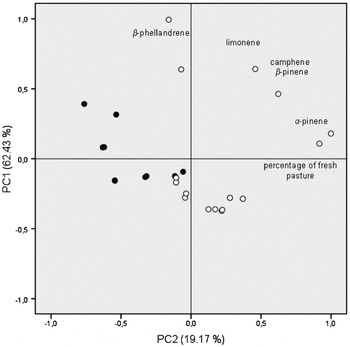
In order to relate seasonal changes to terpene composition of milk samples, PCA was applied to individual terpenes and percentage of fresh pasture in the diet as seasonal variable. Two PCAs were applied separately for C-flocks and NC-flocks using data corresponding to ‘indoor feeding’ and ‘outdoor feeding’ flocks. Three principal components (PC) accounting for 79·99% of the total variance were extracted for NC-flocks. Four monoterpenes, including major compounds (limonene, β-phellandrene, camphene and β-pinene) showed positive loadings (>0·96) with PC1, whereas 3-carene and α-humulene showed high positive loadings (⩾0·81) with PC3, and β-caryophyllene and α-pinene were positively correlated (>0·85) with PC2. The percentage of fresh pasture in the diet was also correlated to PC2 indicating that this component reflected seasonal changes in milk due to grazing management and, in consequence, PC2 was named seasonal feeding factor (Fig. 2). On the other hand, milk samples from ‘indoor feeding’ flocks were distributed separately from milk samples from ‘outdoor feeding’ flocks according to the seasonal feeding factor (Fig. 2). In the case of C-flocks (Fig. 3), only two components accounting for 81·64% of the total variance were extracted. β-Phellandrene and limonene showed high positive loadings (⩾0·89) with PC1, whereas α-pinene showed high positive loadings (⩾0·80) with PC2 in which was also correlated to the percentage of fresh pasture in the diet. Camphene and β-pinene showed positive loadings with both PCs (factor loadings ⩾0·65). In this case, the seasonal feeding factor (PC2) was also responsible for separating milk samples from ‘outdoor feeding’ flocks from milk samples from ‘indoor feeding’ flocks (Fig. 3).
Plot depicting variable loadings and sample distribution (factor scores mean values) from PC analysis of the terpene compounds of milks from NC-flocks corresponding to ‘indoor feeding’ flocks (●) and ‘outdoor feeding’ flocks (○). NC-flocks: flocks grazing on non-cultivated community-owned grasslands consisted of herbaceous plants such as Trifolium repens, Festuca rubra and Agrostis capillaries, and also other non-graminoid plants and some shrubs.

Plot depicting variable loadings and sample distribution (factor scores mean values) from PC analysis of the terpene compounds of milks from C-flocks corresponding to ‘indoor feeding’ flocks (●) and ‘outdoor feeding’ flocks (○). C-flocks: flocks grazing on cultivated private grasslands where ryegrass (Lolium perenne) and white clover (Trifolium repens) were predominant species.

Taking into account the above mentioned results, as the contribution of fresh pasture to the diet of both the NC-flocks and C-flocks increased, the two terpene compounds which best reflected this seasonal pattern were β-caryophyllene and α-pinene. In order to evaluate, in a preliminary form, the potential use of these compounds as markers for grazing fresh pasture it was evident that α-pinene was not suitable because low concentrations of α-pinene were detected in the milks of ‘indoor feeding’ flocks (Tables 1 and 2). One of the points reported in this study is that sesquiterpenes were absent in the milks when sheep were not grazing, and that sesquiterpenes were only detected in the milks from flocks when sheep grazed in non-cultivated community-owned grasslands (NC-flocks). In consequence, only in the case of NC-flocks, a sesquiterpene, in particular β-caryophyllene, could be useful as a potential pasture biomarker in the production management used by these farmers. Supporting this idea, Dumont & Adda (Reference Dumont and Adda1978) and Favaro et al. (Reference Favaro, Magno, Boaretto, Bailoni and Mantovani2005) found sesquiterpenes only in cheeses made from summer milk when animals grazed mountain pastures. Other authors found sesquiterpenes in winter during non-grazing periods, but their amount was more than doubled when the animals were fed on fresh pasture (Agabriel et al. Reference Agabriel, Cornu, Journal, Sibra, Grolier and Martin2007). In this sense, some authors have proposed β-caryophyllene as a generic marker of grass feeding in cheese and meat products because of its ubiquity in fresh pasture plants (Mariaca et al. Reference Mariaca, Berger, Gauch, Imhof, Jeangros and Bosset1997; Priolo et al. Reference Priolo, Cornu, Prache, Krogmann, Kondjoyan, Micol and Berdagué2004; Favaro et al. Reference Favaro, Magno, Boaretto, Bailoni and Mantovani2005; Sivadier et al. Reference Sivadier, Ratel, Bouvier and Engel2008).
In short, a marked influence of the fresh pasture on the terpene content of milk from commercial flocks was observed. Regardless of the feeding, limonene and β-phellandrene were the most abundant monoterpenes and β-caryophyllene showed the highest concentrations among sesquiterpenes. Terpene content increased in the milks of commercial flocks when animals were reared under grazing management. In this respect, terpene composition of milks differentiated two groups of commercial flocks according to the type of grassland used by farmers. Monoterpenes were detected in the milks of all the commercial flocks throughout season, whereas sesquiterpenes were only detected in the milks from flocks grazing on non-cultivated community-owned grasslands in which a higher biodiversity of plant species grew. Bearing in mind the large number of factors that can affect the terpene content in milk, it is difficult to propose a reliable terpene to differentiate diets based on fresh pasture grazing from those based on concentrate and conserved forages. However, our preliminary results indicated that β-caryophyllene could be a potential pasture-diet marker in the case of milks from animals grazing higher biodiversity of plant species. In-depth studies including information on terpene composition of plants ingested by the animals are necessary to evaluate the suitability of β-caryophyllene or another terpenoid compound as pasture biomarker.
The authors thank local farmers for supplying cheese samples and technical information on their farming and feeding systems, the Regulatory Board of PDO Idiazabal cheese and Artzai-Gazta sheepherders association for technical support. This work was supported by grants from the Universidad del País Vasco/Euskal Herriko Unibertsitatea (Leioa, Spain) together with the Departamento de Medio Ambiente y Ordenación del Territorio del Gobierno Vasco (UNESCO Cathedra/2005), and the Instituto Nacional de Investigación y Tecnología Agraria y Alimentaria (Madrid, Spain) (RTA2006-00100-C02-02). E A acknowledges a predoctoral fellowship from the Gobierno Vasco/Eusko Jaurlaritza.