Introduction
Although dementia is mostly considered a disease of old age, it is estimated that 6%–9% of the dementia patients are younger than 65 years of age (WHO, 2012). Young Onset Dementia (YOD), defined as dementia with the onset of symptoms before the age of 65 years, has an estimated prevalence of 50–100/100,000 people aged 45–65 years (Harvey et al., Reference Harvey, Skelton-Robinson and Rossor2003). The Alzheimer's Association estimates that there are 220,000–640,000 patients with YOD in the USA (Alzheimer's Association, 2006). YOD has a devastating impact on the lives of patients and their families, ultimately resulting in institutionalization in most cases (Bakker et al., Reference Bakker2012a; Reference Bakker2012b). In institutional care, patients with YOD generally have to depend on care services designed for people with late onset dementia (LOD), which does not necessarily suit the needs of younger persons with dementia. The amount and type of activities provided are generally designed for women above 80 years of age, as this is the largest group in traditional care units. Younger persons may have different interests and needs, first because they come from a younger generation with different life styles and activities, such as use of computers or smart phones and engagement in physical activities such as fitness and swimming. Second the younger group seems to consist of more men than in the older group, again resulting in different needs in activities and environment. The lack of appropriate activities and meaningful interactions with persons from the same age group may be one explanation for the reported excess of challenging behavior in YOD.
The age limit of 65 years, which is traditionally used to delineate LOD from YOD, does not necessarily represent a pathological or nosological entity (Miyoshi, Reference Miyoshi2009). However, the reported differences in problems, needs, and coping (Werner et al., Reference Werner, Stein-Shvachman and Korczyn2009; Bakker et al., Reference Bakker, de Vugt, Vernooij-Dassen, van Vliet, Verhey and Koopmans2010) justify a further enquiry into the characteristics and specific problems and needs for institutional care in this group.
Although in studies on (community dwelling) YOD patients, the Alzheimer's type of dementia is most prevalent, the amount of other dementia subtypes differs from that of LOD, with relatively lower prevalence rates of Alzheimer dementia and higher prevalence rates of frontotemporal, alcohol-related, and other dementias (Harvey et al., Reference Harvey, Skelton-Robinson and Rossor2003; Ikejima et al., Reference Ikejima2009; Garre-Olmo et al., Reference Garre-Olmo2010). The caregivers of YOD patients in general perceive a very high burden, mainly due to patient behavioral disturbances and life phase specific problems. Direct comparison of caregiver burden in YOD and LOD is difficult due to methodological limitations of available studies (Arai et al., Reference Arai, Matsumoto, Ikeda and Arai2007; van Vliet et al., Reference van Vliet, de Vugt, Bakker, Koopmans and Verhey2010). Clinical experience suggests that professionals in long-term care for YOD patients also perceive a high caregiver burden.
Research about YOD in long-term care is still scarce. Data thus far suggest that younger residential patients have lower prevalence rates of Alzheimer's disease compared to older patients (Fries et al., Reference Fries, Wodchis, Blaum, Buttar, Drabek and Morris2005). Apathy and depressive symptoms have been shown to occur frequently in a nursing home population with YOD (Leontjevas et al., Reference Leontjevas, Leontjevas, van Hooren, Waterink and Mulders2009).
In general, data on characteristics and needs of the patients with YOD in long-term care facilities are still merely circumstantial. Knowledge about characteristics and care needs is important to evaluate whether the services provided by current care facilities are appropriate to meet the specific needs of this group.
In 2002, 20 Dutch long-term care organizations with special interest in care for younger people with dementia joined in a National Steering Committee for Younger People with Dementia. This Committee aimed to optimize care for this special group, by developing a National Care Program, based on best practices and expert opinions (Salari and Plaisier, Reference Salari and Plaisier2004). Specialized care according to the Care Program consists of specially trained nursing, medical and psychological staff, application of different therapeutical environments according to the patients’ needs, and the availability of facilities appropriate for younger people, such as computer and sports equipment. Furthermore, the committee recommended and facilitated research projects to establish the characteristics and needs of younger people with dementia and to optimize the care program. The participating organizations provide specialized day-care, community-based services, and long-term care units for patients with YOD in 15 care homes. Therefore, the Dutch situation offers a unique opportunity to collect data on the characteristics of younger institutionalized patients with dementia.
The aim of this study is to describe a group of patients with YOD patients admitted to specialized YOD care units in long-term care settings. The following research questions will be addressed in the first paper of this study:
-
1. What are the demographic characteristics of the institutionalized YOD group?
-
2. What are the dementia-related characteristics: prevalence of different dementia types, severity of the dementia, disease awareness, and neuropsychiatric symptoms?
-
3. What are health- and care-related characteristics: comorbidity, need for assistance in ADLs, and communicational abilities?
Patients and methods
The BEYOnD study (Behavior and Evolution in Young Onset Dementia) is an explorative descriptive study, with a multicenter, longitudinal design, of which the baseline data are presented in this paper.
Patients
Patients were included from 2005 to 2008 from Dutch care homes in different parts of the country, urban as well as rural areas. Eight out of 15 organizations of the Dutch National Steering Committee for people with YOD agreed to participate in this study. These homes all deliver specialized care for YOD as well as regular dementia care. No further selection of care homes was applied. The eight homes had a total of 248 places in special care units for YOD, varying from 8 to 80 YOD patients per nursing home. The inclusion criteria for admittance to the special care units for YOD varied somewhat regarding age, dementia type, and severity of NPS.
Patients were included when (1) they had a diagnosis of dementia according to DSM-IV-TR (American Psychiatric Association, 2000), stated as such by the attending clinician and verified by the researchers from record documents, (2) first documented symptoms (in the medical records) were present before the age of 65 years, (3) patients resided in the care home for at least four weeks. At inclusion it was allowed that patients were older than 65 years. To test for age effects, additional analysis regarding dementia subtype, dementia severity, and NPS were performed on the group of patients younger than 66 years and compared to the group of 66 years and older.
Data collection and assessments
Medical and demographic data were extracted from the patients’ medical file.
From all patients data were collected on age, gender, marital status, education, year of first documented symptoms, date of diagnosis, dementia subtype, date of admission to the nursing home, medical history, and comorbidity on the day of inclusion. The type of dementia was recorded as stated in the medical record, in the original diagnostic letter from the memory clinic or physician that established the diagnosis, according to the applicable criteria. Most patients had an adequate medical work-up determining the type of dementia. If this was not the case, then diagnosis was recorded as unknown or Not Otherwise Specified (NOS).
On the day of inclusion, the researcher (AM) and research assistant (psychologist) collected data from the original medical records of all patients. They interviewed registered nurses and nursing assistants specifically assigned for individual patients, according to the protocols provided with the following assessments.
The severity of the dementia was assessed by the Global Deterioration Scale (GDS; Reisberg et al., Reference Reisberg, Ferris, de Leon and Crook1982). The GDS is a seven-point scale (1–7) ranging from “no global impairment” (1) to “very severe global impairment” (7). This scale is widely used for the assessment of dementia severity and is shown to correlate well with behavioral, neuro-anatomic, and neuropsychological measures.
NPS were assessed by the Dutch version of the Neuropsychiatric Inventory – Nursing Home version (NPI–NH; Kat et al., Reference Kat, de Jonghe, Aalten, Kalisvaart, Droes and Verhey2002). The NPI was originally developed for assessment of NPS in outpatients with dementia by Cummings (Cummings et al., Reference Cummings, Mega, Gray, Rosenberg-Thompson, Carusi and Gornbein1994). The Nursing Home version was developed for the use of professional caregivers within institutions and proved to be valid and reliable if applied by trained nursing staff (Wood et al., Reference Wood2000; Lange et al., Reference Lange, Hopp and Kang2004).
The NPI-NH includes 12 NPS: delusions, hallucinations, agitation/aggression, depression, anxiety, euphoria/elation, apathy/indifference, disinhibition, irritability/lability, aberrant motor behavior, night-time behavior disturbances, and appetite/eating disturbances. After a screening question on the presence of a specific behavioral change, both the frequency (F) and severity (S) of each symptom were rated on a four- (1–4) and three-point (1–3) Likert scale, respectively. A separate score was calculated for each symptom by multiplying the frequency and severity scores (F × S scores), resulting values ranging from 0–12 for each symptom. The total NPI score was obtained from the sum of all F × S scores. The total score had a range of 0–144.
Agitated and aggressive behaviors were further specified using the Dutch version of the Cohen Mansfield Agitation Inventory (CMAI; Cohen-Mansfield and Billig, Reference Cohen-Mansfield and Billig1986). The CMAI assesses the frequency of 29 agitated or aggressive behaviors and is validated for use in nursing home patients (Miller et al., Reference Miller, Snowdon and Vaughan1995). The Dutch CMAI (CMAI-D) has been validated (de Jonghe and Kat, Reference de Jonghe and Kat1996). The frequency of each symptom is rated on a seven-point scale (1–7) ranging from “never” to “several times an hour.” Total CMAI is obtained from the sum of all item-scores. The total score has a range of 29–203 points.
Activities of daily living (ADL) were assessed using the InterRAI Long-Term Care Facility (LTCF) section G (2005, version 07). This observational scale measures resident self-involvement in the personal ADL. Based on this scale the hierarchic ADL scale including four of the ADL items of the InterRAI LTCF, each with six response categories, was used. These were scored according to a decision tree with eight scale categories, ranging from 0 (independent) to 6 (totally dependent) and 8 (activity not seen). When first introduced, its reported psychometric properties were good to excellent (inter-rater reliability) and had internal consistency (Cronbach's α) of 0.90 (Morris et al., Reference Morris, Fries and Morris1999).
Awareness was assessed with the Guidelines for the Rating of Awareness Deficits (GRAD) that defines impaired awareness as the absence of explicit knowledge or recognition of one's own cognitive deficits (Verhey et al., Reference Verhey, Rozendaal, Ponds and Jolles1993). The GRAD is a reliable (k value of 0.70) semi-structured interview in which the degree of awareness can be assessed by comparing the patient's and the caregiver's histories of the patient's functioning and complaints (Verhey et al., Reference Verhey, Ponds, Rozendaal and Jolles1995; Zanetti et al., Reference Zanetti1999). Awareness was rated on a four-point scale (4 (intact), 3 (mildly disturbed), 2 (moderately disturbed), and 1 (awareness absent)). The score 0 was added to indicate persons with whom no communication was possible at all, so no information could be obtained about their awareness.
Comorbidity was retrieved from the medical file and categorized into: cerebrovascular disease, cardiovascular disease, pulmonary disease, diabetes, epilepsy, other neurological comorbidity, malignancies (excl. neurological), psychiatric comorbidity, and other comorbidity.
Ethical considerations
The study has been carried out in the Netherlands in accordance with the applicable rules concerning the review of research ethics committees and informed consent. The study was reviewed and approved by the HREC of Arnhem-Nijmegen.
Statistical analysis
Statistical analysis was carried out using SPSS version 20.0. This was a descriptive study with qualitative variables given as number and frequency, and continuous variables represented as means, with standard deviation and range. Comparison of prevalence of dementia subtypes, severity of dementia, and prevalence of NPS between the total study population and the age group of 65 years or younger, was performed by cross tabulation with χ 2 test for nominal variables and with t-test for independent samples in the case of scale variables. p values of <0.05 were considered significant.
Results
Two hundred and thirty-one patients were eligible for inclusion and data on these patients were collected from 2006 to 2008.
Demographic characteristics
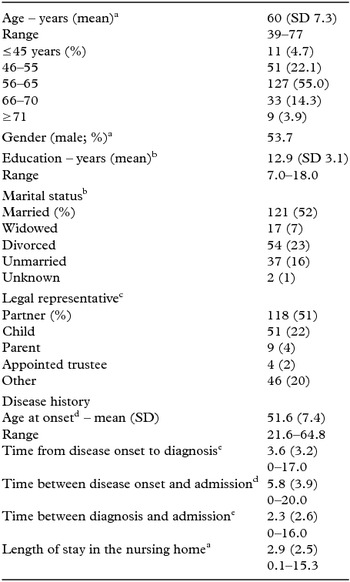
The demographic characteristics are represented in Table 1, showing slightly more men than women, with a mean age of 60 years (Table 1). There was a large range in age. Almost one-fifth of the residents were older than 65 years.
Patient characteristics

a n = 230, b n = 211, c n = 228, d n = 222, e n = 215.
The majority of the included persons were married, and almost one-quarter were divorced. Most of them had their partner as a legal representative, and nine had a parent as their legal representative. The date of diagnosis was found in 219 records. In five persons dementia diagnosis was established after admission to the nursing home. They were excluded from this analysis.
Dementia-related characteristics
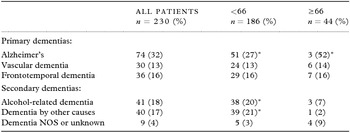
The distribution of the dementia subtypes is represented in Table 2. Alzheimer’s-type Dementia (AD) was the most prevalent type, followed by Alcohol-related Dementia, Frontotemporal Dementia (FTD), and Vascular Dementia. Dementia by other causes was present in a significant part of the patients of whom only one patient was older than 65 years. In nine patients the subtype of dementia was not known, with four of them older than 65 years.
Dementia subtype

*p < 0.05.
Exclusion of 44 patients older than 65 years resulted in a significant different prevalence of AD, alcohol-related dementia, and dementia due to other causes. Other causes included Huntington's disease (eight patients), Lewy body disease or Parkinson's disease with dementia (seven patients), post-anoxic encephalopathy (six patients), dementia after traumatic brain injury (five patients), and fewer patients with multiple sclerosis, neurolues, dementia after (other) infectious encephalitis/meningitis, after radiation therapy or brain surgery for tumor treatment, schizophrenia, and metabolic degenerative brain disease. In nine patients dementia was reported as NOS or no type of dementia was found in the records.
Eighteen percent of the residents had a GDS score of 2–4, indicating very mild to mild dementia, 25% of the residents had moderate dementia (GDS = 5), while more than half of them had severe (GDS = 6; 30%) to very severe dementia (GDS = 7; 28%). If only people with YOD of 65 years or younger are included, the GDS distribution differs significantly (p = 0.003), with more people having GDS scores of 4 and 5 (20% and 27% respectively) and less with GDS = 7 (23%).
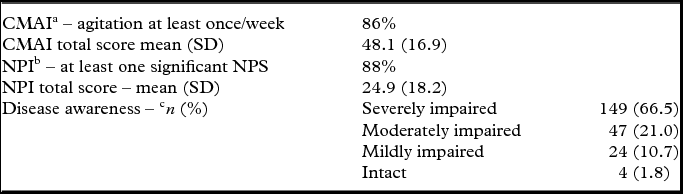
Data on NPS were obtained from 227 persons with YOD (Table 3). Almost 90% of them had at least one clinically relevant NPS. The mean total NPI score was 24.9 (SD 18.2) points. Agitation was present at least once a week in almost 90% of the participants. The mean total CMAI score was 48.1 (SD 16.9). There were neither significant differences in total CMAI (p = 0.834) or NPI (p = 0.544), nor in the prevalence of significant NPI symptoms (p = 0.883) after exclusion of persons older than 65 years.
Neuropsychiatric symptoms and disease awareness

a n = 227, b n = 226, c n = 224.
Disease awareness was reported as intact in only four participants (1.8%). In almost one-third of the patients there was some disease awareness, although mildly or moderately impaired. In two-third of the patients awareness was severely impaired or absent. Within this group there was a subgroup of 56 (25.0%) patients without any meaningful communication about awareness.
Health- and care-related characteristics
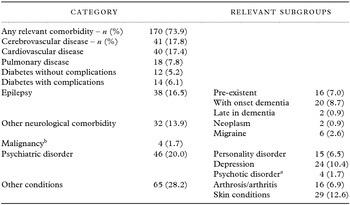
Relevant comorbidity was present in more than three quarters of the participants (Table 4). Psychiatric disorders were most frequently reported, and were present in one-fifth of the patients, mainly depression. Cerebrovascular and cardiovascular comorbidity were the next most frequent comorbid problems with 17.8% and 17.4% respectively. Epilepsy was reported in 17.8% of all participants, of which the majority were reported to have an onset in the same year as the onset of dementia. In almost half of the epilepsy patients epilepsy was already pre-existent. Epilepsy occurred in all groups, except in the FTD group. In the group of dementia from “other causes” epilepsy was recorded in 10 of 49 patients.
Comorbidity

N = 230; aincluding schizophrenia; bexcl. neurological.
Numbers in subgroups do not add up to the number of the total group, due to the possibility of more than one diagnosis per patient, or other (less frequent) diagnoses.
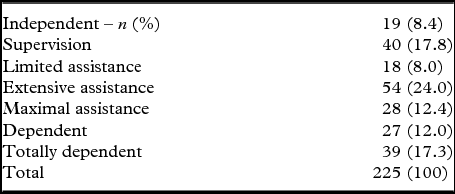
Dependency on care (Table 5) as measured by the amount of assistance needed in activities of daily living varied from independency in 8.4% of the residents to total dependency in 17.3%. Most residents with YOD required extensive assistance (24%).
ADL score (hierarchic ADL scale – Resident Assessment Instrument)

N = 225.
Discussion
This is the first study to report figures from a large group of institutionalized people with YOD. There were slightly more men than women in this group and most were between 55 and 65 years of age. AD was the most prevalent type of dementia and there was a large variety of other underlying diagnoses. There was also an important variation in disease severity, disease awareness and care dependency. NPS and especially agitation have extremely high prevalence rates.
Demographic characteristics in institutionalized people with YOD are comparable with the YOD-outpatient population as described in the NeedYD (Needs in Young Onset Dementia) study (Bakker et al., Reference Bakker2012b). The participants in this study have a mean age of 60 which may not be that young in general, but compared to the usual nursing home population this differs more than 20 years in age (Wetzels et al., Reference Wetzels, Zuidema, de Jonghe, Verhey and Koopmans2010c), representing different generations with different histories and needs. In the YOD group men are slightly overrepresented, in contrast to the older nursing home population where 80% of the patients are female (Wetzels et al., Reference Wetzels, Zuidema, Jansen, Verhey and Koopmans2010a). In the YOD group relatively many persons are divorced. This may be may be the result of the specific challenges the people with YOD and their families go through.
The dementia-related characteristics found in this study differ from with the results found in the community dwelling population (Bakker et al., Reference Bakker2012b). Where in outpatients AD was most prevalent and predicted institutionalization (Bakker et al., Reference Bakker2012b), the prevalence of AD in the nursing home population was lower. This may be due to exclusion of persons with alcohol-related dementia in the NeedYD population, while in our nursing home study this group represents 18%, resulting in lower frequencies of other diagnoses. Another explanation may be a different diagnostic trajectory of the nursing home population. The outpatients all were selected from specialized diagnostic centers and specialized day-care centers, where extensive diagnostic workup is standard. The nursing home population partly had a different trajectory and therefore may not have had always an extensive workup to establish the type of dementia. In this group there may be patients with undiagnosed Alzheimer's disease.
In the study population a wide variety of underlying diagnoses was found. The relatively high prevalence of alcohol-related dementia and FTD is likely to result in different patterns of NPS and leads to different needs for care and guidance. Separate analysis of the patients older than 65 years resulted in a distribution of dementia subtypes which resembles the LOD population (Wetzels et al., Reference Wetzels, Zuidema, Jansen, Verhey and Koopmans2010a).
Compared to the outpatient-population far more nursing home residents have severe or very severe dementia (58% vs. 15%) as could be expected. This is consistent with the fact that advanced dementia was a significant predictor of institutionalization (Bakker et al., Reference Bakker2012b). Compared to the older nursing home population however, the severity of dementia amongst persons with YOD shows more heterogeneity, with 42% of them in GDS-stage 2 to 5, compared to only 21% in LOD (Zuidema et al., Reference Zuidema, Derksen, Verhey and Koopmans2007). NPS occur in almost all people with YOD. There is a higher prevalence of significant NPS (88% shows at least one clinically relevant symptom, vs. 81% in LOD), as well as higher frequency and severity of all symptoms, represented by the total NPI score (a mean total score of 24.9 vs. 16.9), compared to the LOD population (Zuidema et al., Reference Zuidema, Derksen, Verhey and Koopmans2007; Wetzels et al., Reference Wetzels, Zuidema, de Jonghe, Verhey and Koopmans2010b).
Comparison of the community-dwelling population and the nursing home population (van Vliet et al., Reference van Vliet2012) with YOD suggests that the nursing home population does not have very different characteristics apart from more advanced dementia and a higher prevalence of NPS, suggesting that institutionalization is a frequently occurring episode in later stages of the disease or when NPS become more severe. This contradicts the argument that institutionalized persons represent a subgroup with different baseline characteristics. The latter could be true though for persons with alcohol-related dementia or specific (e.g. traumatic or ischemic) causes of dementia, with institutionalization following more shortly after diagnoses.
Methodological considerations
This study is limited in its power to demonstrate specific characteristics of the YOD population due to the descriptive nature and the use of a selected cohort of patients without direct comparison to other patient groups. The selected sample may be biased by the selection of patients residing in specialized care units, excluding people with YOD in regular care settings. Furthermore, the specialized care units all have somewhat varying criteria for admission to the specialized units in care homes, such as age (all units focused on people under 65 years of age but some also admitted at older age; some units preferably move people to a regular care unit above the age of 65 years, others let them stay in the YOD unit regardless of age), inclusion or exclusion of people with alcohol-related dementia, Huntington's disease or other specific diagnoses, and the inclusion or exclusion of people with severe NPS. These varying criteria may result in different profiles in the special care units for YOD. Exclusion of individuals older than 65 years did indeed reveal differences in distribution of dementia subtypes and severity of dementia, but no difference in prevalence or severity of NPS.
Furthermore, the fact that specialized care units are not widespread and therefore usually further away from the patients family home, it may be assumed that older persons and those without challenging behavior may be more likely to be placed in regular care homes more nearby. This may lead to an over-representation of younger people and of persons with more behavioral problems in the special care units for YOD compared to people with YOD living in regular care homes.
Confirmation of diagnosis from medical record may also result in bias. Although in recent years more facilities and guidelines are available for diagnosis and management of dementia patients, part of the population residing in nursing homes at the time of inclusion were diagnosed without the extensive workup that is advocated now-a-days. Therefore, in this group there are more people with an incomplete diagnosis, or a diagnosis of dementia NOS.
It may be debated whether diagnoses included such as alcohol-related dementia or dementia due to traumatic or infectious brain injury should be included in a study concerning YOD. There is no international consensus on which types of dementia should be included in the group of YOD and recent studies on community-dwelling people with YOD do not include these diagnoses. In the present study, these diagnoses were included, because these are part of the YOD population in nursing home settings and contribute to the specific challenges and needs in long-term care facilities for younger people. However, this may reduce the comparability with other studies on YOD where these subgroups are not taken into account.
Cohort effects should be taken into account with every comparison of characteristics of younger patients with those of elderly persons. Therefore, it is not easy to determine whether differences found are due to different attitudes or other cohort effects, e.g. differences in the pre- or post-world-war generation.
Conclusions and possible implications
The YOD nursing home population is heterogeneous in many regards and differs from the LOD population, which may result in different interests, coping styles, and needs. NPS occur in almost all YOD patients.
The found difference in gender distribution may imply different social dynamics and different needs in accommodation and activities (e.g. repairing furniture, watching soccer on TV). Whether this also leads to different patterns in NPS needs to be established and will be subject to further analysis.
The variation in dementia subtype and severity combined with very frequent NPS results in extra challenges for accommodating this group. It may be more challenging to form groups of patients that can live together in a harmonious way. This heterogeneity also challenges skills of the professional caregivers, for they will have to switch almost constantly between different approaches of care (e.g. either stimulate or set boundaries to patients own actions), communication styles, and sets of rules for the management of NPS. This heterogeneity and its resulting complexity require professional caregivers with more skills and usually higher educational level. Care will have to be delivered in settings more accommodated to a mixed male and female population with appropriate, meaningful activities for all individuals. Criteria for admission to YOD special care units, but also criteria for moving patients to regular care settings, need to be addressed. It can be debated, whether older persons with (in origin) YOD require specialized care. Further analysis of the data from this study will be performed to obtain information on determinants of prognosis, NPS, and use of psychotropic drugs. More research, with a prospective design and directly comparing patient groups, still has to be done to evaluate which factors are most challenging for patients and professional caregivers and how these factors can be influenced to improve quality of life and work in this specialized nursing home care settings.
Conflict of interests
None.
Description of authors’ roles
A.J.M.J. Mulders designed the study, collected the data, performed the analysis, and wrote the first version of the paper. S.U. Zuidema provided support with study design, methodology, statistical analysis and writing process, and reviewed the paper. F.R. Verhey and R.T.C.M. Koopmans supervised and supported the design of the study and reviewed the paper.