Large scale programmes for monitoring invasive species, such as Early Detection Rapid Response (EDRR) and Cooperative Agricultural Pest Survey (CAPS), have been used effectively to detect new introductions of non-native wood inhabiting insects (Hoebeke and Rabaglia Reference Hoebeke and Rabaglia2008; Cognato et al. Reference Cognato, Olson and Rabaglia2011, Reference Cognato, Rabaglia and Vandenberg2013). Development and deployment of practical, effective, and standardised methods that optimise trap efficacy are important to the continued success of these programmes. Studies to compare the effects of trap type, lure placement, and habitat selection (Dodds et al. Reference Dodds, Dubois and Hoebeke2010; Dodds Reference Dodds2011, Reference Dodds2014; Graham et al. Reference Graham, Poland, McCullough and Millar2012; Miller et al. Reference Miller, Crowe, Barnes, Gandhi and Duerr2013) on diversity and abundance of wood inhabiting insects have provided some guidance on how to optimise sampling efforts. Aerial malaise traps (AMTs) were more effective at capturing cerambycid species, unique species, and rare species than funnel traps, modified funnel traps, and intercept panel traps (Dodds et al. Reference Dodds, Dubois and Hoebeke2010, Reference Dodds, Allison, Miller, Hanavan and Sweeney2015).
Several variations of AMTs exist and can include top and bottom collectors. Top collection cups were more effective for capturing Cerambycidae (Coleoptera) than bottom collecting cups on traps without a removable bottom, but the opposite was true for Scolytinae (Coleoptera: Curculionidae) (Dodds et al. Reference Dodds, Dubois and Hoebeke2010). Traps with the bottom collectors completely removed have not been compared with full traps to see if removal causes a reduction in efficacy. Bottom collecting cups are problematic for traps as they quickly fill with large amounts of debris and rain water, often damaging traps because of excessive weight pulling at the top. The large amounts of debris also increases processing time in the laboratory. Determining the importance of bottom collectors for surveying cerambycids and scolytines would provide guidance on whether or not this cup was necessary. To this end, we tested a variant of an AMT known as a SLAM trap (MegaView Science, Taichung City, Taiwan) with top and bottom collectors to a SLAM trap with only a top collector for their effectiveness at sampling the diversity and abundance of Cerambycidae and Scolytinae.
Five replicates of the two trap types were established in a mixed red pine (Pinus resinosa Aiton, Pinaceae) and white pine (Pinus strobus Linnaeus) stand on the Massabesic Experimental Forest near Lyman, Maine, United States of America (43.56110°N, 70.63089°W). The five replicates were located throughout the stand in a randomised complete block design. Traps within each block were located ~20 m apart, with at least 30 m separating blocks. Traps were hung from a rope tied between two trees with at least 3 m separating the trap from each tree. The bottom collecting cup of traps with a bottom collecting cup was at least 0.5 m from the ground. Tops of all traps were hung at approximately the same height.
Each trap was baited with ultrahigh release ethanol (≈80 g releasing ≈0.4 g/day, Synergy Semiochemical, Burnaby, British Columbia, Canada), α-pinene [≈170 g releasing ≈2 g/day, enantiomeric composition 75% (–), Synergy Semiochemical], and a generic cerambycid lure (3-hydroxy-2-hexanone releasing ≈20 mg/day, Chemtica, Durant, Oklahoma, United States of America). Traps used wet collection cups (Morewood et al. Reference Morewood, Hein, Katinic and Borden2002; Miller and Duerr Reference Miller and Duerr2008) filled with 3–5 cm of propylene glycol antifreeze (Prestone® RV Waterline, Lake Forest, Illinois, United States of America) as the killing and preserving agent. Collections were made approximately every two weeks from 19 July to 26 September 2013. All samples were kept frozen until processing. All scolytine and cerambycid beetles were identified to species and tallied. Voucher specimens were deposited in the Durham Field Office Forest Insect Collection (Durham, New Hampshire, United States of America).
Trap captures were pooled over the entire trapping period by trap type for all analyses. Trap type was compared using analysis of variance (ANOVA) with replicates as a block and trap type as the main factor (JMP 6.0; SAS, Cary, North Carolina, United States of America). We tested for differences between the top/bottom and top-only traps, as well as differences between only the top collecting cup of top/bottom traps and top-only traps. The latter test was to determine if bottom collecting cups interfered with top collecting cup effectiveness. Data were normally distributed and variances were homoscedastic.
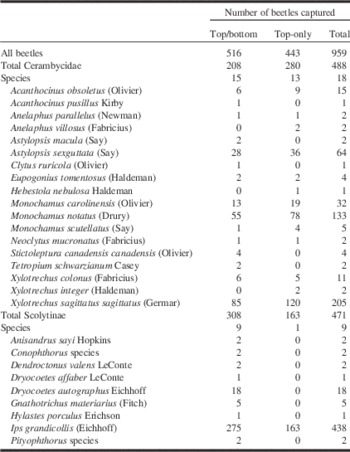
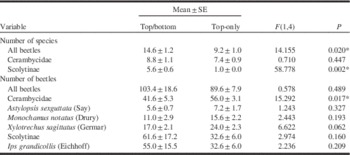
In total, 959 cerambycid and scolytine beetles representing 27 species were captured during this study (Table 1). A total of 488 cerambycids from 18 species and 471 scolytines from nine species were captured in the two trap types. There were no differences in the mean number of total beetles (F(1,4)=0.578, P=0.489), cerambycids (F(1,4)=15.292, P=0.017), or scolytines (F(1,4)=2.974, P=0.160) captured in the traps (Table 2). Average number of total species (F(1,4)=14.155, P=0.020) and scolytines (F(1,4)=58.778, P=0.002) were significantly higher in the top/bottom compared with top-only traps. The number of cerambycid species captured in each trap type were not significantly different (F(1,4)=0.710, P=0.447).
Catches of cerambycid and scolytine beetles in SLAM traps with and without bottom collector.

Mean±standard error of species, number of beetles for top/bottom and top-only SLAM traps with results of ANOVA.

Note:
* Denotes significantly different means between trap types (P<0.05).
The most abundant cerambycid species collected were Xylotrechus sagittatus sagittatus (Germar), Monochamus notatus (Drury), and Astylopsis sexguttata (Say) representing 42.0%, 27.3%, and 13.1% of all cerambycids captured, respectively. Trap type had no effect on abundance of these three species (Table 2). The most abundant scolytine species collected was Ips grandicollis (Eichhoff) representing 93.0% of all scolytines captured. Analyses showed no difference in captures of I. grandicollis between the two trap types (F(1,4)=2.236, P=0.209).
Top/bottom traps captured five unique cerambycid species and eight unique scolytines. Top-only traps captured three unique cerambycid species, while no unique scolytines were captured in these traps. Only four individuals of two cerambycid species, X. sagittatus sagittatus and Stictoleptura canadensis canadensis (Olivier), were collected in bottom cups. Of the nine scolytine species captured in top/bottom traps, only one species, Hylastes porculus Erichson, was captured exclusively in the top collection cup.
Our results suggest no benefit of having the bottom collector attached to traps for abundance or richness of cerambycids, and an advantage only for species richness of scolytines. Species richness is the most important variable to consider when testing effectiveness of detection traps (Dodds et al. Reference Dodds, Allison, Miller, Hanavan and Sweeney2015). Species richness and unique species captured for both families combined was greater in top/bottom than top-only traps. However, this was primarily attributed to the scolytine portion of the trapping samples where 88.9% of species (60.7% of individuals) were captured in bottom cups.
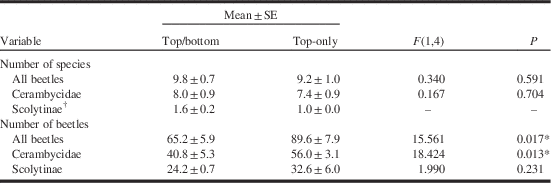
When data were analysed to compare only the top cup catch from the top/bottom traps and top-only traps, there were significantly more total beetles (F(1,4)=15.561, P=0.017) and cerambycids (F(1,4)=18.424, P=0.013) in top-only traps than top cups in top/bottom traps (Table 3). There was no significance differences between total beetle species (F(1,4)=0.340, P=0.591), cerambycid species (F(1,4)=0.167, P=0.704), or number of individuals of scolytines (F(1,4)=1.990, P=0.231). Statistical analysis of the number of scolytine species was not practical due to the small number of species collected from the top cup in each trap type.
Mean±standard error of species and number of beetles in the top cup of top/bottom and top-only SLAM traps with results of ANOVA.

Notes:
* Denotes significantly different means between trap types (P<0.05).
† Not compared statistically due to low captures.
When only comparing top collecting cups, we found no effect of the bottom collecting cup on the number of cerambycid or scolytine species collected in the top cup only, while abundance of total beetles and cerambycids were greater in the top-only trap. This suggests that having a bottom interferes in some way with top cup abundance and there was actually a benefit to having it removed. Beetles arriving at traps from below may be blocked access to the trap altogether with the bottom collector attached. It is also possible that the added weight when bottom collectors fill with debris and water may deform the trap and top collector and prevent some beetles from navigating to the cup.
It was not unexpected that the bottom collecting cup was important for capturing scolytines. Many scolytines are known to retract wings and drop when striking an object in flight. Conversely, cerambycids were more diverse in top collection cups, suggesting that at least some of these species may land softer on traps than scolytines. Dodds et al. (Reference Dodds, Dubois and Hoebeke2010) also found higher number of cerambycid species in top collecting cups of canopy malaise traps compared with bottom cups. Debris in the trap bottom can easily prevent a cerambycid from falling directly into the collection cup and provide a pathway out of the collection area and likely off the trap. Smaller scolytines likely fall through the debris more easily and reach the collecting cup to be captured more frequently than larger more agile cerambycids.
The results of this experiment have implications for exotic insect trapping programmes that use, or are considering using, top and bottom collecting aerial malaise traps. With the exception of total species and scolytine species captured, the addition of the bottom collecting apparatus on SLAM traps did not generally improve collections over SLAM traps with top cups only. Top cup only comparisons were not significantly different, except for total beetle and cerambycid abundance. This suggests that the bottom cup was important for improving scolytine species richness estimates only. Funnel traps or cross-vane panel traps are the standard trap used in exotic species detection efforts (Rabaglia et al. Reference Rabaglia, Duerr, Acciavatti and Ragenovich2008; United States Department of Agriculture, Animal and Plant Health Inspection Service 2011) and are effective bark-beetle traps (Lindgren Reference Lindgren1983; Stone et al. Reference Stone, Goodyer, Sims, Penman and Carnegie2010). Pairing a cross-vane or funnel trap with a top collecting SLAM trap should help maximise survey efforts. Funnel or panel traps would readily sample the scolytine community, while the top collecting SLAM could improve collections of cerambycids (Vance et al. Reference Vance, Kirby, Malcolm and Smith2003; Dodds et al. Reference Dodds, Dubois and Hoebeke2010, Reference Dodds, Allison, Miller, Hanavan and Sweeney2015).
Acknowledgments
We thank Jon Janelle (United States Forest Service, Northern Research Station) for help locating the study site in the Massabesic Experimental Forest. Michael Simmons (University of New Hampshire, Durham, New Hampshire) and Justin Williams (United States Forest Service, Southern Research Station) helped with trap collections.