In a world where humans grow old, tadpoles change into frogs, and milk turns to cheese, it would be strange if language alone remained unaltered. (Aitchison 2001:4).
INTRODUCTION
A striking aspect of the World Trade Center tragedy of September 11, 2001 – from a sociolinguistic perspective – was the fact that many of its survivors spoke English with an accent. Anyone interested in language could not help but note the irony embedded in the aftermath of the event: the English-language media record of this “attack on America” was forever marked by the sounds of nonnative, or accented, American English. Though the media record of the World Trade Center attack cannot be construed as official in terms of belonging or relating to an office of authority, the country's national and local media will be historical documents that different types of authorities – whether historians, political scientists, linguists, attorneys, or government functionaries – will consult to make sense of the event in years to come. The discourse and the discursive messages emanating from that day in U.S. history will be remembered collectively as a nationally and nationalistically defining moment. However, as the days and months after unfolded in real time, the occurrence also revealed the country's diversity. The prediction here is that in years to come, there will be a great contrast between what was said on and about September 11 that portrayed national unity and sameness, and how it was said, which revealed the inescapable fact of national diversity and multicultural difference. The question that I raise here is how difference at the micro level of communication can become part of the macro-level, authoritative mechanisms of representation. Beverley (1999:2) states, “Power is related to representation: which representations have cognitive authority or can secure hegemony, which do not have authority or are not hegemonic.” This article examines how nonstandard, or accented, American English becomes part of the official public record, and hence part of an authoritative representation of the past. In so doing, this analysis attempts not only to chart language change but also to bring to light the possible portals through which dominant culture can be, albeit slowly, altered to include diverse voices.
There are many different types of official records that are drafted and archived by important social institutions. For example, doctors and insurance companies keep medical records for their patients and clients, universities keep official transcripts for their students, banks maintain and have access to credit reports on their customers, and the civil and criminal justice system archives an array of official records that contain versions of the past for plaintiffs, respondents, witnesses, defendants, and victims. In each of these institutions, the records comprise many different elements: case numbers, seals, signatures, and most important for our purposes, language.
What follows from the construction of these written artifacts is the creation of institutional memory. I adopt this term (see Trinch 2001b, 2003) from Charlotte Linde (1999),1
Linde (1999) uses the term “institutional memory” to refer to the oral and written discursive and narrative work that institutional representatives do to stave off questions or restore order after a challenge to institutional identity. For her, institutional memory is the narrative product created by its agency representatives in the face of current or future adversity. For me, in contrast, institutional memory refers to official versions of events that institutions archive not only for themselves, but also for their clients, the greater public.
In the postindustrial United States, we expect official documents to be recorded in Standard American English (SAE), or the variety of English that has social prestige precisely because of its association with the importance ascribed to the contexts of its use. Though all social institutions communicate both externally with the public and internally with their own members in a professional jargon that often differs from SAE (see Tiersma 1999), language specialists continue to teach in their introductory linguistics courses that the existence of SAE, though it is an idealized form, is closely approximated in educational arenas, in the national media, and in legal and governmental spheres of communication. Here, I show how the language used to create official records in the legal system reflects, albeit in a largely non-strident way, the impact that cultural and linguistic diversity can have in “standard language arenas” in multicultural nations like the United States.
SITES OF DATA COLLECTION
The official record under examination here is the legal document known as the affidavit. An affidavit is “a voluntary declaration of facts written down and sworn to by the declarant before an officer authorized to administer oaths. A great deal of evidence is submitted by affidavit, especially in pretrial matters” (Black's Law Dictionary 1999), and this evidence is considered to be legal testimony. Often, however, affidavits are created through an interview in which the person with the power to administer the oath is also the person who actually drafts the document.
In the interview data I analyze, Latina women speak to socio-legal professionals about their situations of domestic abuse. These Latina women come to the legal system in search of a solution to domestic violence. In response, the American legal system typically offers women who have been abused by their intimate partners the chance to apply for a protective order (see Klein 1996, Merry 2001). A protective order is a court injunction mandating that the abuser stay away from the complainant for a specified period. In order to obtain these court injunctions, women often must submit to an interview, from which the interviewer to whom they speak draws up an affidavit. These affidavits then come to constitute an official record of intimate-partner abuse. I collected the interview and affidavit data in two cities in the U.S. Southwest with sizable Latino populations. One of the cities, which I call Anytown, has a multigenerational Latino population that is mostly bilingual. This city has reached what Silva-Corvalán 1995 calls societal bilingualism, with more than 50% of its population fluent in both Spanish and English. The other city, referred to in my work as Someville, contains large enclaves of monolingual or bilingual Hispanics. Some of these Hispanics are immigrants who have recently arrived in the United States, while the families of others have been there for generations. Someville can be characterized as a city that consists of several instances of group bilingualism because of its ethnic enclaves, but my ethnography of its legal system suggests that for the most part, one will not find many bilingual Latino legal professionals.
In these two cities there are two different agencies that help women apply for protective orders: a district attorney's office in Anytown and a pro bono law clinic in Someville. In the district attorney's office, paid paralegals, mostly bilingual Latina women, help clients with the application process. A total of 100 interviews, 38 of which resulted in affidavits, were collected in this setting. In the pro bono law clinic, volunteer interviewers, most of whom are attorneys, paralegals, or law students, dedicate a couple of hours each week or each month to help women apply for orders. At the clinic, most of the interviewers are not Spanish-English Latino bilinguals. A total of 73 interviews, 45 of which yielded affidavits, were collected from this site. This description alone indicates how differently a Latina woman's experience within the American judicial system can be. Her linguistic interaction with legal institutions will be shaped as much by where she lives as it will be by who she is. The U.S. legal arena, as a site of language contact (Eades 2003), embodies linguistic and cultural diversity.
LANGUAGE CONTACT
Language contact is typically problematized in situations where two distinct groups of people exist in the same geographic area and speak different languages. Because of their proximity to one another and at least one overlapping subset of shared values and goals, speakers of these two languages must come in direct contact with each other. When this occurs, the grammars of the two languages generally are mutually influenced. Languages in contact yield various types of admixture results. Changes to one language based on the sounds, structures, or lexical items of the other language are known in linguistic terms as borrowing, simplification, overgeneralization, transfer, code-switching, analysis, and grammatical convergence (Silva-Corvalán 1995:5). The degree and the direction of influence are often explained in terms of the relative prestige of each language, which is closely tied to the socioeconomic power of its speakers. Where speakers of both languages consider themselves to be equals, languages and language groups are said to be in adstratal relationships. But where there is clearly a dominant and a nondominant group, members belong to what are known as superstratum and substratum language groups, respectively. Whereas “adstratum languages function as donor and recipient at the same time,” “in a situation of unequal prestige or power, the superstratum language is typically the donor language and accepts only a few loanwords from the substratum language(s)” (Stewart & Vaillete 2001:352).
Eades (2003) reviews the literature on speakers of different languages coming in contact with one another in the legal systems of different countries around the globe. She describes linguistic diversity as it exists within legal arenas as those situations in which speakers of a nondominant language (L2 speakers) or speakers of a nonstandard dialect (D2 speakers) come in contact with speakers of the dominant societal language, which, not coincidentally, is also considered to be the “official language” of the law. Eades, in reviewing the literature on L2 and D2 speakers, finds the following: (i) English is the official language of most of the legal systems examined by scholars; (ii) these legal systems generally assume monolingualism; and (iii) “original utterances, in a language other than English, have no legal status” (Eades 2003:115). When L2 or D2 speakers interact with speakers of the more prestigious language or the more standard variety in legal settings, a situation of language contact, albeit a nontraditional one, is created.
Much of this law and language research examines the disadvantages suffered by speakers of nonstandard dialects (see Wodak 1985; Conley & O'Barr 1990; Conley 1998; Eades 1993, 1996, 2000, 2003; Matsuda 1991; Sarat & Felstiner 1995), of limited English proficiency, or of foreign languages (Berk-Seligson 1990, 2000; Brière 1978; Hale 1997, 2002). These studies report three general findings: (i) Anglo-dominant legal systems tend to transform the language of the lay person so that it becomes more amenable to the legal setting; (ii) the legal system discriminates against those whose command of English differs from the standard American variety; and (iii) we can expect misinterpretation and misrepresentation, both literally and figuratively, of the litigants' speech when Standard American English is not the code they dominate.
Some of the work in this area (Trinch 2001a, 2001b, 2003) has focused on how the transformation of lay voices into appropriate legal discourse can be pernicious both to the litigant in question and to groups of people like him or her. For example, that battered Latina women's stories look and sound very different before they are transformed into reports and institutionalized by legal personnel leaves these litigants open to questions regarding their credibility in future judicial proceedings. As a result of such transformations, institutional memory offers a representation of domestic abuse that distorts the way women themselves see it and describe it.
From a discourse analytic point of view, the accounts of domestic abuse that emerge within the protective order interview and that subsequently get written into the affidavit do not belong solely to the Latina women who sign their names to them. Rather, these affidavits consist of abuse narratives that were created through the joint communicative efforts of victims, interviewers, and (where present) interpreters as well. While Latina women supply the raw material, it is the service providers, occupying the socially sanctioned, communicative position of interviewer, who ask questions, ratify or ignore topics, and ultimately edit the women's accounts. Undoubtedly, in the interview situation the scales of power tilt unequally toward the interviewer. However, because of the interactive nature of textual production, it would be unusual to find that interlocutor influence is solely unilateral. The collaborative essence of text making should also permit Latinas to map themselves onto the legal system in some way.
The questions I ask here, then, are the following: (i) What, if anything, gets left behind in the record that would indicate that the women reporting are Latinas? Or, as has been suggested previously, does the system homogenize the voices of victims so that all litigants come to sound and look identical in the eyes of the law? And (ii), is there room for the representation of cultural and linguistic diversity in the official legal record of abuse, given that this record is largely comprised of discourse?
MULTILINGUALISM AND MULTICULTURALISM
Diversity in the United States does not begin and end with only the presence of what are perceived to be large, uniform ethnic groups. Even though both out-group and in-group members use ethnic labels to distinguish themselves (see Oboler 1995), it is impossible to generalize about “what Latinos do,” “what Anglos would say,” or “how Arab-Americans might act.” In the spirit of this difficulty, this article has two primary objectives. First, it seeks to describe the diversity of a U.S. Latino population that moves through one particular public sphere of communication. And in this same vein, it will also outline the diversity of this group's experience within the system in terms of the variety of people they may meet, the level of professionalism they will encounter, and their ability to speak in Spanish with service providers. Second, and perhaps more important, this study reveals, in a sociolinguistic way, how these Latinos bring a discursive multiculturalism to the U.S. legal system by narrating their experience within it. To this end, I examine how Latina women in institutional interactions leave traces of language and culture within the English-language record. Acting as the empirical site for this investigation of diversity and representation in the U.S. legal system, the protective order application interview demonstrates how one group of U.S. Latina women ethnolinguistically marks the official record of the judiciary.
U.S. LATINO DIVERSITY
That U.S. Latinos possess varied degrees of Spanish-English bilingualism is a well-documented fact (Berk-Seligson 1980, Sánchez 1994, Mendoza-Denton 1999). Some Hispanists study different varieties of U.S. Spanish (Silva-Corvalán 1994, García 1995, Zentella 1997), investigate Latino English (Fought 2003), or examine code-switching varieties of Spanish and English (Poplack 1982; Valdés 1982; Rubin & Toribio 1996; Zentella 1997; Toribio 2001). Other research has made us aware of the many factors that influence whether and how quickly U.S. Latinos shift from Spanish to English (see Peñalosa 1980, 1985; Paulston 1994). These factors are sociohistorical, economic (Villa 2001), and geographic (Bills, Hernández-Chavez & Hudson 1995). Among other things, these studies show that an ethnic group's degree of contact with other ethnic groups (Briggs 1986, Galindo 1987, Galindo & González 1999), in addition to the attitudes group members hold toward the dominant and subordinate languages (Murguia & Telles 1996), play a role in language maintenance and language shift. Of interest here is what U.S. Latino bilingualism is within, and what it means for, the U.S. legal system. The data set of protective order application interviews illustrates how this one social service provides a unique sociology of language through which we may understand how U.S. Latinos interact with and penetrate U.S. institutions.
Although the presence of a sizable ethnic population challenges public institutions to provide services in the language (or, in some cases, the dialect) of their constituents, most social institutions still do not adequately represent or report the array of difference found among a particular group of its clients. As has been noted in other studies (Marin et al. 1983, Oboler 1995), it is also the case here that where legal authorities employ standard intake forms to process their clients' cases, they usually are not required to provide any detailed description of clients' ethnicity. Interviewers and clients need only place a check in a box next to one of the words “Anglo,” “White,” “African-American,” “Hispanic/Latino,” “Asian,” or “Other.” In large institutions, scratching beneath the surface of such labels to determine whether “Hispanic/Latino” clients were Spaniards or Mexicans is a nearly impossible task.
In stark contrast to this homogenizing nomenclature of the official record, my data corpus of 173 protective order application interviews shows that U.S. Latino interaction with the U.S. sociolegal system is anything but undifferentiated. In Anytown and Someville, interviewers and Latina women alike came from different ethnic and/or national backgrounds.2
The interviewing service providers who self-identify using the panoramic “Latino” term come from Mexico, the United States, Cuba, El Salvador, Argentina, and Bolivia. Non-Latino interviewers are from the United States (both African and Anglo Americans), the Philippines, Germany, and Iran.
In Anytown, the interview norm consists of Mexican American, U.S.-born, bilingual victims, who are interviewed by Mexican American, U.S.-born, bilingual paralegals. In two-thirds of the cases, interviews are conducted in English, but occasionally, these English interviews involve some switches to Spanish. Once in a while, Mexican American women in their late forties or older who have been part of a U.S. Latino community for several decades show a preference to speak in Spanish or to code-switch between English and Spanish. The Mexican American bilingual interviewers, of course, are able to accommodate them. Additionally, owing to constant migration, these Mexican American, U.S.-born bilinguals will interview Mexican nationals who have recently arrived in the United States.
In Someville, the interviews reflect even more diversity. It is possible to hear one protective order interview in which a Latina interviewer from El Salvador speaks with a U.S. Latina interviewee in English, and then later, another interview in which the same Salvadoreña speaks with a Central American Latina client in Spanish. In the Someville data set there are interviewers who are of African American, Filipino, Japanese, Armenian, German, Anglo or Mexican descent who speak no Spanish at all. Yet these interviewers must talk with Latina victims who speak English as well as with those Latinas who speak in Spanish. When victims do not speak English and service providers do not speak Spanish, protective order interviews in Someville are mediated by interpreters.
Adding this third-party linguistic liaison to the mix further complicates the picture and consequently the interaction. On one end of the spectrum, there are interpreters who are Mexican Americans born and raised in the United States, whose Spanish-language acquisition began as a first language in the home. For these U.S. Latino interpreters, however, Spanish became the focus of their study as a foreign language in school. At the other end of the spectrum, interpreters are foreign-born, Uruguayan and Argentine émigrés for whom Spanish was also the language of their childhood. Yet unlike their Mexican American counterparts, it was English that became the object of study in formal schooling. In between these two very different groups of Latino interpreters we find Anglo-American interpreters who grew up speaking English and who, as adolescents or adults, began to learn Spanish in school or during stays abroad.

This affidavit appears in Trinch 2001a.
All names, dates, places and other identifying characteristics have been changed to protect the anonymity, maintain the confidentiality, and respect the privacy of all participants in this study.
Of course, not all native English speakers need interpreters to speak with their Spanish-speaking clients. In other words, some native English speakers are bilingual. And, within U.S. institutions, we find that Anglo-American English-Spanish bilinguals also exhibit differential levels of Spanish language proficiency. Not surprisingly, then, in these interviews there are native English speakers with Spanish language skills that vary widely.
Despite all of this ethnolinguistic variety, the legal process of obtaining a protective order operates, for the most part, quite systematically. Interviewers are trained to help clients fill out paperwork, craft a legally relevant account of domestic violence, and ultimately draft a legible affidavit. To be felicitous, it seems that the affidavits must be written in a particular way, because they all share common thematic and structural characteristics (for more detail, see Trinch & Berk-Seligson 2002). A sample affidavit is given above in (1). The affidavits have this overall appearance, structure, and basic content irrespective of the ethnolinguistic background of clients and interviewers. However, a close study of the affidavits reveals interesting traces of Latino language and culture. This finding suggests that Latinos are indeed marking the official record of the United States legal system with their accented English. Also notable, however, is the fact that there are certain omissions of Latino language and culture, not all of which could be easily construed as insignificant for future judicial proceedings.
METHODOLOGY
The affidavits from both the D.A.'s office and the pro bono law clinic were examined for patterns that pointed to Spanish language and/or U.S. Latino culture. Because I was present for most of the interviews, I was also aware of some elements that could be defined as cultural or ethnolinguistic which I saw to be present in the interview. The participant observation element of my data collection enabled me to predetermine certain categories of analysis, such as “language of the interview,” to see if any such indication was contained within affidavits. For the most part, however, the units of analysis suggested themselves through their recurrence. The interaction that went into the construction of the affidavit was taped and, in most instances, transcribed. The discursive items under investigation are: (i) the language of the interview (Spanish or English), (ii) the language women claimed they, their abusers, or other family members used in their prior conversations, (iii) cultural themes and/or cultural stereotypes, and (iv) a series of nonstandard English language items.
LANGUAGE OF THE INTERVIEW
Regardless of the fact that approximately one-third of the protective order interviews that I tape-recorded in Someville and Anytown involved communication in Spanish, in each case the resulting affidavit exists only and entirely in English. In the affidavits from the pro bono law clinic, there is never a statement regarding language of the interview or use of an interpreter. Only one affidavit from the D.A.'s office mentions a client's speaking in Spanish. Curiously out of place, there is one line on this particular affidavit that states, “This affidavit was read back to me in Spanish by Rita Rodríguez of the Domestic Violence Unit.” In terms of institutional memory, these data reveal the system's ambivalence toward language. While quite a premium is placed on linguistic accuracy and referential consistency, it seems as if no importance at all is ascribed to the language in which testimony is given.
LANGUAGE OF PRIOR DISCOURSE
In several interviews, women point to U.S. Latino culture and linguistic practices with references to prior discourse, or what Tannen 1999 calls “constructed dialogue.” Prior discourse is also known in linguistics as “reported speech,” or the language that speakers use to represent conversations that supposedly took place in the past. Tannen's (1999) point of renaming this phenomenon “constructed dialogue” derives from the fact that whether a speaker directly quotes or merely paraphrases prior utterances, she is probably characterizing or creating that speech as much as she is “reporting” exactly what was said. Nonetheless, some of the women in this sample highlight the importance of Spanish for both the abusive situation and the context in which abuse is reported. The following excerpt shows how reported speech can act as an index for Latino language and culture.5
This excerpt is analyzed to make a different point in a paper I wrote on the possibility of women's acquiring the report genre (Trinch 2005).

The transcription conventions used here have been adapted from those found in Matoesian (1993:53–56). They are as follows:

‘Words’ Single quotation marks with words, immediately following Spanish data are my translations of the Spanish into English.
The client in (2) utilizes metalanguage, in this case commentary about the language in which the abuser threatened to kill her. In response to the paralegal's question And what kind of threats was he making?, the client states, That he was gonna kill me, in Spanish. In another analysis (Trinch 2005), I argue that the client's employment of the adverbial qualifier only in this utterance acts as an evaluation of the interview and the affidavit, two English-language contexts that require exactitude. This particular client had been through the protective order application process before, and thus may have acquired knowledge of both the importance of being precise and the fact that English dominates in these settings. After she and the paralegal work out the details of the orientation to the event in question, the client, unprompted by the paralegal, reintroduces the fact that the abuser's threats were made in Spanish. This time she marks the information with the contrastive connector but. In this situation, but and only seem to indicate that the client would tell the paralegal exactly what the threats were, except for the fact that they were uttered in Spanish. When the paralegal asks her to report what the threats were with her question What was he saying?, the client counters with her own question, What was he saying in Spanish? Instead of merely answering in Spanish or simply translating the quotations, this client again brings up the fact that Spanish was the language of the threats. These three references to Spanish suggest that, for the client, Spanish in this context is both important and problematic. As a bilingual/bicultural person, this client's language use and metalanguage index the dilemma many people may feel when they live “life on the hyphen” between being Latino (or ethnic in general) and being a U.S. American (cf. Pérez-Firmat 1994). Having membership in two cultures sometimes results in conflict, and this client aptly illustrates the bicultural/bilingual struggle. The resulting affidavit presents a clear sense that from the legal system's perspective, the language of prior discourse, even when consisting of a death threat, is relegated to a valueless position. The report written by the paralegal states only, “José was making threats to kill me.” The paralegal does not refer to the translation in any way. And when she writes the affidavit, she erases the fact that these threats were uttered in Spanish, and thus resolves all possible opposition between Spanish and English. Only English prevails.
A similar phenomenon can be viewed in the following excerpt. The client in (3) also incorporates metalinguistic references to highlight the importance of language itself in the abuse situation. But again, this sociolinguistic marker, distinguishing the experiences of battered Latina, Spanish-speaking women from those of English-speaking battered women in the United States, receives no space in the official record.

The corresponding affidavit notably omits the fact that the abuser was able to exert his power and control over his wife in the presence of police officers and states only the following:

Previously (Trinch 2003), I analyzed this omission as a distortion of the characters of the people involved in the domestic dispute. Here, however, I wish to point out that the disappearance of this prior linguistic fact purges the record of crucial linguistic details. Arguably, such information goes beyond Rivera's (1996) and Bonilla-Santiago's (1996) discussions of the linguistic barriers Latina women encounter when reporting domestic violence, because this excerpt shows how language can act as a tool of power that abusers can exert over their victims as well as over monolingual law enforcement officers. The client's words stress that her husband has a unique advantage not only over her, but also over limited-Spanish-proficient service providers. Additionally, this example demonstrates the unfortunate position of Latino children, who are necessarily drawn into the vortex of domestic violence through the linguistic act of interpreting for their non-English-speaking parents. Noticeably, then, some victims possess a keen awareness of the significance of translation, the challenges of interpretation, and the weightiness of language in general. The disjuncture between these discourse processes is noteworthy, because these official, written documents privilege English alone even in situations where other languages have great meaning.
THEMATIC CONTENT
In terms of thematic content, ethnic markings of lo latino are barely noticeable in these documents. Relative to the oral narratives that emerge in the interviews in which some Latina victims refer to their countries of origin, the official written documents usually say nothing of these foreign lands. In the interview, even when women do not explicitly refer to their former countries, they do invoke them by mentioning that their abusers have threatened to have them deported. Latin American countries also become an issue when Latinas disclose that abusers have threatened to take their children across the border to avoid U.S. law enforcement. In battering relationships, threats to take children are common tactics used by abusers to control their intimate partners, but a threat of deportation is somewhat particular to undocumented Latina women (see Rivera 1997, Terán 1999, Bonilla-Santiago 1996). Written records of such threats are inconsistent, however. In (4) below, the interview data show how women introduce these issues of deportation and illegal residency. This conversation, as we will see, does appear in institutional memory.

The pro bono paralegal volunteer inscribes this threat in the affidavit in the following way:

The question here is whether the system and its service providers have any obligation to make a record of these types of abuse, particularly because they are the very kinds that distinguish the battering experience of women from different ethnic groups. Excerpt (6) shows a different bicultural emblem. Here, the client points to her own and her abuser's Latino identity by making reference to otherness. Her remarks bring into focus the tension that can be involved for those who are members of an ethnic enclave that is situated among members of the more dominant Anglo ethnic group.

Without explicitly stating that her previous marriage to an Anglo elicits her abuser's contempt, she insinuates as much by suggesting that this fact was an instigating factor in the penultimate incident of abuse. The client states that her ex-husband is jealous of the son that is staying with her, and though at first she says she does not know why, she then immediately introduces a possible reason for his feelings with the como or ‘since’ clause. Here both Spanish como and its English translation ‘since’ mean ‘because’ or ‘given that’. The como clause explains the new information she offers about her current husband's jealousy of her son. It also provides a justification for why the abuser, at the age of 61, wants to father children. Though the affidavit that resulted from this interview makes no mention of the ethnicity of the client's first husband, the father of her children, her juxtaposition of his ethnic identity with her husband's jealousy is a way of pointing to the environment in which she and her current family live as ethnic minority members in a country that is Anglo-dominant. By bringing up the otherwise unnecessary fact that her first husband was “American,” her narrative suggests that this is indeed one of the reasons that she and her current spouse have problems. She indicates that her new husband resents her sons both because they are half “American,” and because she herself allowed an Anglo out-group member to father them. Without going into great detail about the construction of gender, it is worth noting that this client's commentary about her husband illustrates the varied and complex ways in which masculinity and masculine identities are constructed at the intersection of race, class, ethnicity, and sex. In this case, the client indicates that for her husband, a felicitous Latino male gender performance is in dialogue with what it means to be an Anglo male. It is likely that this phenomenon is not particular to the U.S. Latino community, as men from other ethnic groups might also resent the fact that their wives were previously married to out-group members. However, the client in (6) definitely offers a statement that not only inflects her identity as a Latina but also emphasizes the types of disharmony that can be found in a country divided by racial and ethnic lines.
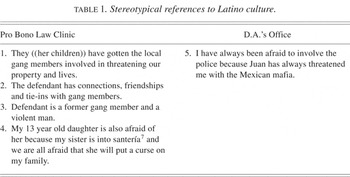
The corpus of 83 affidavits also yields five examples of stereotypical references to Latino culture in the United States. Four of these come from the pro bono law clinic and one from the D.A.'s office. These statements appear in Table 1. Perhaps it is coincidental that four of the five affidavit writers are not Latinos themselves. The data are too limited to state with any certainty that non-Latinos are more inclined to record stereotypical or negative cultural material indexing Latino life in the United States, but they do present a point of departure for a testable hypothesis. That said, these results might be as much a function of what Latina women choose to talk about as they are of interviewers' bias toward Latinos. But topics such as gang violence, mafias, and superstitious beliefs undeniably tend to get overly associated with ethnic culture.
Stereotypical references to Latino culture.Two types of Santería can be found among some U.S. Latinos. For some Latinos of Caribbean descent, the practice of Santería has been described as a type of religion that has come about through a syncretic relationship between Catholicism and African religions. This client, however, refers to the other type of Santería, understood as “black magic.”

The interview data do, however, indicate that some Latina women bring up more innocuous references to Latino culture, though none of these references makes its way to the affidavits. One example of a cultural utterance that gets filtered out of the affidavit by a Latina interviewer is illustrated in (7) and (8). In (7) below, a client discusses an altercation she had with her ex-husband at their son's school-sponsored dance. The client mentions that the confrontation began when she realized that she mistakenly thought that she was being followed to the dance floor by a male friend who had asked her to teach him how to dance a cumbia.8
A cumbia is both a type of Mexican music as well as the step people dance when the music is played. Though originating in Colombia, cumbias are now known as Mexican tunes and dances. Cumbias are enjoyed widely in Mexico and among many Mexican American groups in the United States.

In the affidavit, we see no imprints of this ethnic mark, even though this client, in her oral narrative, refers to her Mexican-American culture and identity in two ways. First, she specifies that her friend did not want to learn just any old dance, but rather a cumbia, a specific kind of dance practiced by Mexican-Americans in her region. And second, the client emphasized her ethnic identity by her use of Spanish phonology to say the word [kúmbia]. These shows of ethnicity are reduced to the unmarked referencing of the generic idea of dancing in the official representation. The portion of the affidavit that reflects this part of the interview is shown in (8):

The Latina victims and the service providers who co-author these written texts cannot highlight Latino identity through code-switching (Valdés 1982; Zentella 1997). Nor can they perform Latino identity through the use of particular phonological variants in English, as would be the case in oral communication (see Giles 1979, Mendoza-Denton 1997). But physical presence of Latinos within the legal system authorizes them, at least to a certain extent, as narrators/writers of institutional memory. And the data reveal that Latino tracks, both ethnic and linguistic, do occur throughout these documents. We have already seen that in the process of co-constructing official narratives of abuse, Latinos leave certain perceptible marks of their culture – whether negative and stereotypical or positive or neutral. In the remainder of this article, we will see that much of what they leave behind in terms of language is, in actuality, what is considered to be nonstandard English.
TRACES OF SPANISH-ENGLISH CONTACT IN INSTITUTIONAL TEXTS
The most common and perhaps the most obvious mark of Latina women's presence in the legal system is made through the simple inclusion of Hispanic first names and surnames in their affidavits. Spanish names that appear, however, refer not only to the women themselves and to the abusers against whom they seek court orders, but also to the women's family members, friends, and children. The necessary mention of these social and familial networks is testament both to the fact that Latina women use the legal system and to the fact that Latino communities are part of the United States. Of course, Hispanic names also occur on these documents in reference to authorities such as paralegals, police officers, and detectives who are working on the case. This point will prove to be important in the explanation of language change. While the inclusion of names is perhaps quite a basic marker of ethnicity, it should not be considered unimportant. Rymes (2001:160) states, “[a] proper name … is … a repository of accumulated meanings, practices, and beliefs, a powerful linguistic means of asserting identity … and inhabiting a social world.”
SPANISH LANGUAGE AND CULTURE IN THE UNITED STATES
Beyond the mention of Hispanic names, these affidavits reveal other linguistic indications of a Latino presence in the U.S. legal system. Though not Spanish per se, the documents do include a variety of English known as U.S. Latino English. Scholars (García 1974, Penfield & Ornstein-Galicia 1985, Peñalosa 1980, Galindo 1987, Fought 2003) continue to grapple with defining U.S. Latino English. The major divide that separates the two camps centers on whether Latino English is a bona fide variety of Standard American English or whether it is an imperfectly learned second language spoken by a large number of Spanish/English bilinguals. I adopt Fought's (2003:1) definition for Latino English as “a nonstandard variety of English, influenced by contact with Spanish, and spoken as a native dialect by both bilingual and monolingual speakers.” Following Fought and Santa Ana 1993, I propose that Latino English in the Southwest be seen as a native dialect of English that is acquired as a first language by children growing up in regions where it is spoken. However, as my data will suggest, some of the features found in the Latino English of the region can also be found in the English of very proficient speakers of English whose native language is Spanish and who come from other Latin backgrounds. So, regardless of where the influence of Spanish comes from, imprints of it can definitely be found in the English-language record.
Among the remnants of Spanish contained within these English-language legal documents we find consistent linguistic constructions that emphasize that Latino English actually has institutional representation in the United States. With respect to the lexicon, there are calques or loan translations, particularly among verbs. And with regard to the semantic-syntactic interface, there tends to be simplification and generalization of English verbal forms and prepositions. Much of the work that has been done on the Spanish/English contact situation in the United States focuses on how English has influenced Spanish. In the remainder of this article, I examine just the opposite: how Spanish forms and Spanish contact, and in some cases the peculiarities of this regional variety of Spanish, influence English. Central to the analysis here, however, is the fact that this dialect of English cannot be described as only a nonstandard spoken variety. The data presented suggest that this variety of English has a written form that can be found in one of the most important, influential, and prestigious institutions in the United States.
The lexicon
Haugen (1972:81) defines linguistic borrowing as “the attempted reproduction in one language of patterns previously found in another.” According to Haugen, among the most common types of borrowings are calques or loan translations, which he defines as particular structural patterns that have been imported from a donor into a host language. These patterns derive from the combination of two separate and unrelated constituents that are transferred into one language to mimic the structure and meaning of forms in the speaker's other language. From the data analyzed here, some examples of this phenomenon are the verbs “to get on the car” and “to get off the car,” where standard English would require “to get in the car/to get out of the car.” These verbal calques arguably come from Spanish forms, bajar del/subir al carro, literally ‘to get down from (i.e., off) the car’ and ‘to get up into (i.e., on) the car’. Examples of this phenomenon that I find in the English of the affidavits are the following:
(a) Samuel stopped on the road and asked me to drive. I got off the car to go around to the driver's side.
(b) He tore my blouse as I was trying to get off the car.
(c) I was finally trying to get off the car when we came to a stop sign.
There are also traces of irse a, which typically is translated into SAE as ‘to go out to’, ‘to leave for’, ‘to leave’ or even just ‘to go’. Where written SAE would translate Se fue a Anytown as ‘He went to Anytown’, ‘He took off to Anytown’, or ‘He left for Anytown’, the U.S. Latino version of this usage is He left to Anytown. Examples from the data include:
(a) On or about January 12, 2000, Juan left to Nevada for a few days and took the baby.
(b) I walked away and Juan got the bottle of liquor and I left to my mother's house.
(c) I left to work.
(d) At work my legs became numb and I left to the doctor.
Another instance of nonstandard English lexical items occurring in the record seems to have resulted from a type of translation error. These Latina women often say that their intimate partners tell them to watch their backs. They express this in English, however, using the phrase take care of yourself in utterances such as He insulted me and told me to take care of myself. The oddity of the juxtaposition of these two sentences in English stems from the fact that in English to take care of oneself is generally employed as an affectionate leave-taking device. For instance, people taking leave from a face-to-face or phone conversation might say to each other, O.K., take care, or All right then, take good care of yourself. In SAE the second part of the above utterance is rarely, if ever, combined with an insult to carry the pragmatic force of a threat. While the Spanish verb cuidarte can certainly mean ‘to take care of oneself’, in Latino Spanish it also apparently has the menacing meaning ‘to watch your back’ (i.e., ‘to be on guard’).
A final example of a verbal calque found in these English-language legal documents is the use of passed by to mean ‘came by’, as in the sentence Vicente passed by my house and started cursing at me. In SAE, to pass by connotes movement; here, the client was talking about the abuser's coming into her house (e.g., ‘coming by’) to swear at her – something that he could not do as easily if he were just walking, driving or passing by. The Spanish verbal construction pasar por, however, means ‘to stop by a place for a short period of time’. So while temporary, the Spanish verb pasar, when combined with the preposition por, implies a longer stay than does its literal English counterpart, which is really a false cognate. For example, Me pasaré por tu casa would be translated as ‘I will come by your house for a little while’; the English sentence I will pass by your house would imply just the opposite: ‘I'll be on my way somewhere else, and though I know your place is on my way, I will not stop to see you.’
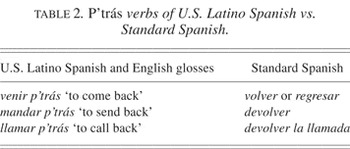
A slightly different manifestation of the contact situation marks the record with a loan translation from English that has been brought into Spanish, and from there returned to English. In Mexican-American Spanish it is quite common to find English constructions of the form Verb + Preposition ‘back’ (e.g., to call back, to come back, to send back) calqued into Spanish. In Spanish, then, the English examples given above would take the form Verb + Preposition p' trás (e.g., llamar p'trás, venir p'trás, mandar p'trás, respectively). As is well known among U.S. Latinos and Hispanists, the p'trás verbs in U.S. Latino Spanish are translated into Standard Spanish and English as shown in Table 2.
P'trás verbs of U.S. Latino Spanish vs. Standard Spanish.

In language contact theory, this phenomenon would be considered a superstratum-induced change because the native language of the subordinate group has been influenced by the language of the dominating group. In a few instances, however, the affidavits indicate that this superstratum-induced change in Spanish is making its way back (p'trás) into English. For example, there are statements in the affidavits that use the preposition back with verbs that already imply a “boomerang” motion in standard English. Two of these statements from the affidavits provide examples:
(a) Juan returned back for me and took me back to Nevada.
(b) José returned back after the police left.
In a more standard variety of English, this usage would either be avoided, or at least considered redundant. In this case, what we find in the affidavit is a combination of a superstratum-induced and subsequent substratum-induced change. While return means ‘to go or come back to a former place,’ the verb itself does not take back. The redundancy of returned back may be the result of some type of linguistic analogy or pragmatic intensification, but it is also one that is most likely born of the language contact situation.
Divergent deictic organization
In the legal record, there are also instances of translation confusion – particularly the type that arises from different deictic organizations or indexical relations between ostensibly equivalent Spanish and English words. Deictic words, as is well understood in the study of pragmatics, are those that derive their meaning from both the physical context and the discourse context of the utterances in which they are situated. “Essentially deixis concerns the ways in which languages encode or grammaticalize features of the context of utterance or speech event, and thus also concerns ways in which the interpretation of utterances depends on the analysis of that context of utterance” (Levinson 1992:54). Fillmore 1966 points out the deictic nature of the English motion verbs to go and to come and shows how these words encode motion and direction of either or both the speaker and the hearer at the time of the utterance. In Levinson's examples, the utterance He's coming indicates movement of “he” toward the speaker's location at the time of the utterance. In contrast, the utterance He's going would imply that “he” is moving away from the speaker. Though he's coming would, in standard Spanish, be translated as Él viene or in the past, Él vino, a translation of I'm coming, as First Person Pronoun + Verb of Motion moving toward the addressee, would require the use of ir in Spanish, as in Yo voy, which would be glossed ‘I'm going’. Levinson (1992:83) suggests that Spanish venir ‘to come’ cannot be used to translate English to come in the first person of the present tense, “since this cannot mean ‘the speaker is moving towards the location of the speaker’, but rather, means ‘the speaker is moving towards the location of the addressee’ at the time of speaking.” Thus, if in Spanish one were asked, ¿Te vienes conmigo o te quedas aquí? ‘Are you coming with me or are you staying here?’, in order to answer in standard Spanish, one would have to answer, Me voy contigo, literally ‘I'm going with you’. Interestingly, in English, either I'm coming with you or I'm going with you would be an acceptable answer in this context.
Thus, another source of nonstandard English in the official record is the unequal deictic relationship of Spanish words ir and venir with their presumed English equivalents to go and to come. As was the case with the p'trás verbs above, it seems that this interplay and divergence between standard English and standard Spanish probably results from the nonstandard English and Spanish we find in the U.S. Southwest with respect to colloquial usages of venir and ir in singular forms.
In the English-language legal record constituted by these affidavits, there are instances where these verbs to come and to go are used in such nonstandard manners. The following tokens were found in the affidavits:
(a) He kept calling for one hour and then went (SAE: came) to the house. When he got there, I told him to leave.
(b) Miguel told Vicente to leave and come (SAE: go) back home or he was going to kill him.
(c) When my daughter refused to see him, he became angry and ran to the bathroom to slap her face continuously. I came (SAE: went) into the bathroom to stop him and …
In the above examples we see that the record encodes coming when one would expect going, and vice versa. In (a), the record shows the victim talking about being at home, having the abuser call her there, and then having him visit her there. Since the person about whom she is talking goes to where she is, we would expect that Standard English would employ coming rather than going.9
I would like to thank one of the anonymous reviewers for Language in Society for pointing out an interesting case of paradox in English deixis. While the first sentence requires came because it places the speaker at home – even though she is not at home when reporting the event – the second sentence makes this case clear with the adverb there, and its counterpart here would not be acceptable.
Use of the pluperfect verbal form interchangeably with simple past tense
Another nonstandard oral usage of English that I often heard Latinos in my field sites use involved the employment of pluperfect verbal morphology to express simple past tense meaning.10
It is important to note that some native speakers of English may also use these pluperfect and/or other linguistic forms in ways similar to what I find this Latino community doing. I am not asserting that these forms will be found exclusively among Latinos, nor am I suggesting that all other native speakers of English would consider them “incorrect.” I do not use the terms “nonstandard” and “ungrammatical” synonymously. In other words, native speakers of English may find these forms grammatical and acceptable in the Chomskyan sense of first language acquisition, even though standard language resources, such as dictionaries or grammars, do not record or recognize them.
(a) The defendant had hit me about the face with a closed fist and my nose and jaw had been injured. [Arguably, in SAE this sentence would be written as “The defendant was hitting me (or, hit me) in the face with his fist and my nose and jaw were injured.”]
(b) After he had finished ((raping me)) he said he had to take care of some things and left.
(c) On June 12, 2003, Juan was sick and had stayed at my house so that I could take care of him.
(d) In 2000, Juan and I had already separated and Juan had come over to my apartment and was questioning me about guys that I was dating.
This particular syntactic form is not a direct derivative of Standard Spanish. The pluperfect in Standard Spanish, as in SAE, codes the completion of an action prior to and relative to the completion of another action (Butt & Benjamin 1995). In other words, the pluperfect is a grammatical form that expresses the termination of an act prior to a specific or implied past time. Examples of standard usage in both languages include the following:
(a) He had been dead an hour when we arrived.
(b) Ya se había muerto cuando llegamos.
In some of the cases cited from the affidavits (b and c above, for example), the use of the pluperfect is not necessarily nonstandard. In other words, the form appears to be employed canonically, because the sentences encode that one action is completed before another action in the past. Indeed, there are overlapping instances where either the simple past – especially in narrative syntax, which itself suggests that ‘first A happened, then B happened” by placing one verb before the other – or the pluperfect could be used interchangeably. In fact, we might hypothesize that it is because of this common ground of meaning that U.S. Latinos extend the usage of the pluperfect into nonstandard utterances like those found in sentence (a). In any case, we see in each of these narrative utterances that the simple past tense would suffice to express that one action occurred before another. Nevertheless, these affidavits incorporate the present perfect to represent the time of the action in these narratives.
Along these lines, Pollán 2001 notes that in the Spanish/Galician bilingual situation, the simple past tense can be expressed in narrative discourse with three surface manifestations. These forms are the simple past tense (canté), the past subjunctive (cantara), and the pluperfect (había cantado). Pollán argues that these different morphosyntactic forms are sociopragmatic variants. While in Standard Spanish these forms would be translated as ‘I sang’, ‘I sang (+subjunctive)’ and ‘I had sung’ respectively, in the Galician/Spanish bilingual situation, according to Pollán, they can all also refer exclusively to the simple past. Arguing that in this contact situation the forms distinguish different types of pragmatic focalization, Pollán makes the case that the nonstandard usage signifies low informative relevance; that is, these forms provide mere background information. With respect to the example The defendant had hit me about the face with a closed fist and my nose and jaw had been injured, it seems unlikely that the authors of an affidavit about violence would want to diminish emphasis on violent behavior in any way. Thus, while these data cannot easily support the conclusion that the usage in the U.S. Southwest of the pluperfect mirrors what Pollán is finding in the Galician/Spanish context, given that the pluperfect is unexpected – as it is sometimes located in the action-setting rather than in the scene-setting verbs – we could hypothesize that its purpose in the U.S. Spanish/English bilingual arena marks events as highly reportable and important.
Prepositions
The above examples certainly occur more than once in the written affidavits and enough in the oral speech of the interviews to conclude that they are linked directly back to the Spanish/English contact situation. In the U.S. Southwest, there is a stable population of Latinos that enjoys societal bilingualism and whose English and Spanish dialects differ from their respective standards, even if some members of this ethnic group do not speak any Spanish at all. However, in these legal documents, the widest trail leading back to Spanish is a consistent nonstandard use of English prepositions in and on. Quite common to the data set is the use of the preposition on where one would expect in for written documents in SAE. The following examples serve to illustrate this:
(a) I came into the bathroom to stop him and he hit me on the back of my head with a closed fist.
(b) … while we were in my car having an argument he hit me on my head with a closed fist.
(c) … and then he began hitting me on the face and on the back when I tried to get away from him.
(d) He then called me a “fucking bitch” and he hit me on the mouth with his closed hands and also began choking (me).
(e) … we had his daughter with us and he hit me on the arms with his closed hands.
(f) … I was laying on the floor and for no apparent reason he began kicking me on the leg.
(g) Juan then hit me on my head, arms, back and wrist.
(h) Juan struck me on the face with his hand and told me that one of these days he was going to do me in.
(i) Once Juan got there, he hit me on the neck and face with his hand.
(j) Juan grabbed our daughter in one arm and punched me on the face with his other hand.
(k) I tried to get the phone and he punched me on the eye and dragged me by my hair.
(l) Juan kicked me on my leg.
(m) Juan also raised his fist to hit me several times, but instead punched the wall and made several holes on the wall.
Webster's Third New International Dictionary (1971:1139) defines the preposition in as “a function word [used] to indicate location or position in space or in some materially bounded object.” By way of contrast, the same source states that on is “used as a function word to indicate position over and in contact with that which supports from beneath.” Neither entry includes specific usage of these prepositions to describe the location of forceful or violent actions by someone on another person's body. The American Heritage Dictionary (1982:648) gives as its first definition of in “within the limits or bounds, or area of: was hit in the face; in the spring; in the garden.” So, while it does not speak particularly of violence located on the body, it does give “was hit in the face” as its first example. In an electronic language usage resource, The ins and outs of prepositions, however, Yates 1999 gives as the twenty-third definition of in the meaning “location on the body.” Yates describes the prevalent pattern for this use and function of in as:

Furthermore, Yates states, verbs that commonly take this pattern include hit, hurt, kick, poke, punch, scratch, slap, and strike. Though more general, Webster's first definition of in coincides with the meaning encoded in this pattern. This is especially evident when it is examined next to Webster's examples: “put the key IN the lock”, “travel IN Italy”, “play IN the street”, “wounded IN the leg”, and “read IN bed.”
In Spanish the preposition en glosses as three possible prepositions in English: ‘in’, ‘on’, and ‘at’. That is, where standard Spanish would utilize only en, standard English chooses one of three distinct prepositions, as the following examples illustrate:

Spanish does, however, possess the preposition a, which often glosses as English ‘to’ or ‘at’, but English in and on are generally conflated and handled in Spanish grammar as ‘en’. The data suggest that it is this conflation of English in and on that is, at the very least, facilitating a semantic/syntactic restructuring of these function words in U.S. Latino English.
Though everybody recognizes that prepositions behave somewhat unpredictably, they especially do so, García 1995 points out, in languages such as Spanish and English where case markings are only vestigial and prepositions and word order are left to signal semantic roles at the phrase and sentence levels. But García's (1995) work provides evidence from the Spanish of the Southwest that reinforces my assumption that there is an interplay between Spanish en and English in and on that can explain the widespread usage of this nonstandard prepositional preference for utterances that locate violent acts on the body. In Texan Spanish, García 1995 notes, the most frequent use of the pronoun en introduces a static locative, and such usage is consistent with the Spanish monolingual norm. She goes on to state:
In locative expressions which are not clearly concrete … and in quasi-locatives or associated concepts … there appears to be an over-reliance on ‘en’ at the expense of other prepositions, adverbials, and verbs. Its extreme use extends its semantic function … and may indicate a semantic bleaching of ‘en’. (García 1995:211)
To summarize her findings, in U.S. Latino Spanish of the Southwest, en “exhibits two tendencies which have been shown to be conducive to [Spanish] language change: (1) over-reliance on one form at the expense of others and (2) apparent influence from another linguistic system with which it is in close contact” (García 1995:211).
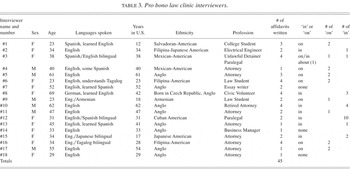
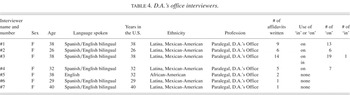
My data reveal a similar or related phenomenon occurring in the English of the region. Of the 83 affidavits examined, 36 include the nonstandard English usage on where we would expect in, as illustrated in the examples given above. Interestingly, these 36 affidavits are not distributed evenly between the D.A.'s office and the pro bono law clinic. Only 12 affidavits from the clinic contain on in place of in in these prepositional phrases. In the D.A.'s office, the incidence of the nonstandard patterning of on in this position appears in 24 of the 38 affidavits. Furthermore, the number of tokens of this form is higher for both sites than the number of total affidavits that contain it, but this is also true to different extents within each site. Thus, in the D.A.'s office, we find a total of 44 tokens (on 24 out of 38 affidavits), and in the clinic we find a total of 14 nonstandard utterances (on 12 out of 45 affidavits).
This finding leads me to ask whether in is also being used in these prepositional phrases – and if perhaps in and on are in some sort of free variation with each other. The search for the use of the more standard English preposition in in such phrases turns up in 13 (of 45) affidavits from the pro bono law clinic, and it shows up in only one (of 38) for the D.A.'s office. This evidence indicates that within the D.A.'s office, there is a clear preference for the use of on in lieu of in for these types of prepositional phrases. But the situation is very different in the data from the pro bono law clinic. The law clinic data suggest a more complicated arrangement between the two prepositions.
In contrast to the D.A.'s office, where, with only one exception, six of the seven interviewers are Mexican-American women from ethnolinguistic backgrounds similar to those of their clients,11
I should point out that of all the elements examined to substantiate the claim that the English-language legal record is somewhat permeable to the incorporation of diversity through tracks of Latino language and culture, the use of nonstandard prepositional forms is perhaps the most consistent item. However, this is not to say that every affidavit includes a description of such hand-to-hand violence. There are some affidavits that contain no mention of abusers' physical attacks that would necessitate the use of a preposition to describe being hit, struck, kicked or punched “in” some part of the body.
Pro bono law clinic interviewers.

D.A.'s office interviewers.

It seems, then, that in the predominantly Hispanic situation of Anytown, a city that can be described as having enjoyed and continuing to thrive in societal bilingualism, the shift from the use of in to a preference for on in these types of phrases has indeed already occurred. Though it is tempting to trace such a change directly back to the Spanish/English contact situation and “blame” the Spanish of the region for the innovation in English, the data from the pro bono law clinic temper such a conclusion. Evidence from the clinic, where interviewers and interviewees self-identify as members of different ethnicities and where bilingualism occurs at group and individual levels, shows the prepositions in and on also to be in somewhat of a state of flux. Two Anglo, English-language monolingual male interviewers, for example, write on rather than in in the affidavits in their sentences12
According to my native speaker's intuition, sentence (a) here is grammatical, but sentences (b) and (c) remain awkward to me. I asked native speakers for grammaticality judgments on the sentences that I found in these affidavits, and many of them could not or would not make definitive judgments on whether in or on was the “correct” form. In many cases, people thought either one would do. When I asked them pointedly, however, “Would you say, ‘He hit me in the nose’ or would you rather say, ‘He hit me on the nose’?” most would agree that they would produce in, but not necessarily hear on as awkward. Also, as an anonymous reviewer pointed out, English prepositions are not only complicated, they are also quite idiomatic. For example, in New York City, it is common to hear that people “are waiting on line,” while in other parts of the United States, people “wait in line.”
(a) We got into a fight and he started hitting me on the left side of my face.
(b) The defendant proceeded to hit me on the head with an open hand.
(c) I tried to push him away, but he hit me on my nose with a closed fist.
Interestingly, of the other seven Anglo interviewers represented in the data, three do not write about violence using such prepositional phrases, and the other four all show a preference for only in.
The utterances examined suggest that this alteration has been undertaken among U.S. Latinos in the Southwest where the use of on has replaced the more standard English use of in for these prepositional phrases that often locate the target of a violent act. But consonant with the theory and findings of Silva-Corvalán, my conclusion does not hold transfer from the Spanish of the region, or the contact situation, solely accountable for this variation of English. Silva-Corvalán (1995:9) recaps her 1994 finding that “even under conditions of intense contact and strong cultural pressure, speakers of the receding language simplify or overgeneralize grammatical rules but do not introduce elements which would cause radical changes in the structure of the[ir] language.” Though referring to the ways in which U.S. Latinos in contact with English come to speak Spanish (what she calls the “receding language”), I would argue, Silva-Corvalán's hypothesis holds true as well for the ways in which U.S. Latinos come to speak English. Furthermore, the fact that there are two English-speaking, monolingual males who also use on, where Standard English would predict in, could suggest internal motivation to simplify the choice between in and on, which are apparently in competition with and obviously semantically related to one another. It does seem, however, that the substratum influence of Spanish makes the change in English happen far more rapidly.13
Milroy 2001 is critical of the idea of internally motivated changes. He makes the argument that this construct is not only ideologically loaded, but that such professional linguistic analyses have actually aided in legitimizing the standard variety and delegitimizing other varieties. His point is well taken.
DISCUSSION AND CONCLUSION
By examining both the language used by victims in the interviews and the language written into the affidavits, my data suggest that Latinas and their Latino interviewers are marking the English language record with dialectal changes. Some representations of U.S. Latino English or of U.S. Latino Spanish – depending on how one looks at the topic – exist across the entire corpus, but they tend to be more frequent in areas where Spanish/English bilingualism reaches societal proportions. That is, we can expect to find more calques, loan translations, and simplifications in the English legal record in geographical areas where both interviewers and interviewees are Latino Spanish-English bilinguals and where these two languages exist in a nearly diglossic situation. In social settings where Latino groups live as enclaves, either among other ethnic groups or within a larger, dominant Anglo cultural setting – also known as a situation of Spanish/English group bilingualism – some Latinas will still leave their marks, but to a lesser extent. The pro bono law clinic finds itself in such a situation. Most pro bono interviewers who are bilinguals are merely individuals who happen to speak Spanish and English. That is, unlike interviewers in the D.A.'s office, clinic interviewers are not part of the community of group bilingualism. Perhaps for that reason, they tend to write the accounts of violence in more standard American English.
Thus, just as the media reports from the World Trade Center disaster indicated that the public record is open to include English with an accent, so too are the legal reports that I examine here. We see, then, that Latina women, to varying degrees, leave behind in the institution's memory linguistic and cultural emblems. Their texts inhabit the public sphere and assert, albeit sometimes quite softly, the ethnolinguistic diversity of the United States. This assertion of Latino identity occurs at the thematic, lexical, and perhaps even syntactic levels inside a context of Standard English legalese.
It is important to consider what these influences on Standard English in official legal discursive spaces mean for Latina women and for Latinos more generally.14
I would like to thank Diana Eades, John Conley, William O'Barr, Lawrence Solan, and Peter Tiersma for asking me this question after I presented a version of this article at the Annual Meeting of the Law and Society Association Conference, May 28, 2004. I would also like to thank MaryEllen García and Ana María Escobar for their questions and comments after I presented a much earlier version at the 30th Annual Meeting of the Linguistic Association of the Southwest in September 2001.
Sommer (2003:6), inspired by Wittgenstein 1995, discusses the presence of two languages in a discursive field (i.e., a bilingual region) in terms of language games. These two languages, as players, she states, “take advantages of the uneven playing field where a powerful language expects to win every match, but where other languages jostle and rub power to win some points.” The way Sommer uses the word language can refer to Spanish and English, legal vs. lay discourse, educated vs. uneducated speech, and marked (or accented) vs. unmarked (or unaccented) speech. Adopting this metaphor, we see that most law and language research has revealed how powerful language wins. Here, though, we are presented with an example of how other languages “jostle and rub power to win some points.”
Moving from this abstract metaphor to our concrete case and from theory to practice, we should note that the players are not languages themselves, but the speakers who use these different languages. These speakers of different languages probably do not make these linguistic maneuvers to win points consciously or intentionally. In fact, I would argue, points won seem to occur during social interactions when participants are unsuspecting, unassuming and unaware of what is happening to dominant language. Additionally, points won occur in locations (i.e., lexical and especially syntactic areas) that may well exist below the speakers' radar.
That said, we still must ask what Sommer's (2003:6) statement – “Using more than one language causes problems for universal, across-the-board games of politics, philosophy and aesthetics” – means for Latinos. Put differently, we might ask: What benefits could arise for Latinos because of this type of inclusion of Spanish and/or Latino English in the official legal record? Some have suggested that the affidavits look more authentic with the inclusion of these nonstandard forms, and that therefore, judges – hearing the real voices of real people – may be more inclined to grant orders. Prior ethnography and findings (see Trinch 2003), however, do not lead to this conclusion. Irrespective of what seems to be an overarching, if implicit, policy of linguistic transformation of lay voices in the sociolegal system, the fact remains that judges use the affidavits to grant temporary ex parte orders until there can be a hearing on these cases.15
Temporary ex parte orders are issued to women by judges based solely on their affidavits. Before orders can become permanent, the defendant must be properly served a summons to appear in court. If the defendant does not appear, the ex parte orders, once considered temporary because they were issued to the women without the defendant's knowledge, become permanent (meaning enforceable and in effect for a period of one year) orders.
Still, just as it is important for critical discourse analysts to point out where dominant language wins and what speakers of the nondominant language lose, it is also crucial for us to know and understand the reverse. A realistic starting place for Latino empowerment probably resides in the more mundane settings of law schools, and in introductory and advanced linguistics and language courses, where teachers problematize issues of communication, representation, Standard English, and official records. Milroy (2001:552) argues that the “very act of carrying out and publishing … research is part of the legitimizing process” of those dialects that are considered to be nonstandard varieties. Connecting the dots between research and teaching, we might agree then that data such as those presented above could be shown to students to reveal how people from different cultures and languages influence each other when they come in contact. While many language students and language faculty understand that they themselves do not speak Shakespeare's English or Cervantes's Spanish, they often hold tightly to notions that Standard English, as well as a standard for their foreign language, exists as a pure, perfect, and even superior form to all other dialects.16
In other words, though language experts (students and faculty in foreign language departments) recognize that language changes, they often enter into debates about what is “correct” for both English and Spanish even after having learned about dialectal differences. Milroy 2001 argues that linguists have helped to perpetuate this myth of “correctness” by insisting on a difference between internally (i.e., in and of the system) and externally (i.e., socially) motivated changes. Milroy reviews how historical linguists have conceptualized linguistic innovations brought about by social factors to be corruptions, while those thought to be systemic are seen as pure.
If legal institutions are not impervious to multicultural or multilinguistic representations, then it stands to reason that other important social institutions might also be open to non-Anglo norms and ways of speaking. As a new direction in law and language research or sociolinguistic research and discourse analysis in other institutional settings, theorists and empiricists could locate nondominant language marks and traces, identify the portals through which these marks flow, and then determine what type of influence they might ultimately have on these systems specifically and on cultural and linguistic practices more broadly.