Introduction
Poor social outcome is often reported in psychosis. Long-term follow-up studies suggest that less than 50% of people with non-affective psychosis achieve a social recovery, and only 10–20% of people return to competitive employment (Johnstone et al. Reference Johnstone, Macmillan, Frith, Benn and Crow1990; Jablensky et al. Reference Jablensky, Sartorious, Ernberg, Anker, Korten, Cooper, Day and Bertelson1992; Harrison et al. Reference Harrison, Croudace, Mason, Glazebrook and Medley1996), despite the majority suggesting that they want to work (Mueser et al. Reference Mueser, Salyers and Mueser2001). Around 50% of people with severe affective psychosis also fail to return to work and remain disabled (Tsai et al. Reference Tsai, Chen, Kuo, Lee, Lee and Strakowski2001). Long-term follow-up studies indicate that poor social outcomes in psychosis tend to emerge early, often become stable, and are closely associated with long-term social course (Strauss & Carpenter, Reference Strauss and Carpenter1977; Carpenter & Strauss, Reference Carpenter and Strauss1991). The development of an effective intervention to improve social recovery in affective and non-affective psychosis could potentially have important long-term benefits, especially if applied to cases who have developed poor social functioning in the early course of the disorder.
Effective interventions to improve psychosocial recovery in psychosis may need to consider factors associated with impairments in a sophisticated manner. These effects may include residual psychotic symptoms, sensitivity to stress, and underlying cognitive deficits. In particular, care needs to be taken not to overstimulate. Past clinical trials of interventions that have attempted to promote social activity without taking careful account of sensitivity to psychosis and anxiety have shown increased risk of relapse, especially among people who still show psychotic symptoms (Hogarty et al. Reference Hogarty, Goldberg, Schooler and Ulrich1974, Reference Hogarty, Kornblith, Greenwald, DiBarry, Cooley, Ulrich, Carter and Flesher1997). Cognitive behaviour therapy (CBT) may provide a useful basis for developing such an intervention. Several studies have reported evidence for the efficacy of CBT on depression and negative symptoms, where these have been assessed as secondary outcomes (Sensky et al. Reference Sensky, Turkington, Kingdon, Scott, Scott, Siddle, O'Carroll and Barnes2000; Turkington et al. Reference Turkington, Kingdon and Turner2002; Durham et al. Reference Durham, Guthrie, Morton, Reid, Treliving, Fowler and MacDonald2003; Gumley et al. Reference Gumley, O'Grady, McNay, Reilly, Power and Norrie2003; Wykes et al. Reference Wykes, Steel, Everitt and Tarrier2008). However, these trials used relatively insensitive measures of social functioning and no trial to date has directly targeted changes in social recovery as a primary outcome. An optimal intervention for people with psychosis who want to work but who have some degree of residual problems might be for therapists to combine techniques of CBT with those of vocational case management (Mueser et al. Reference Mueser, Salyers and Mueser2001).
We have developed a novel CBT intervention specifically focused on improving constructive social behaviour while managing sensitivity to stress, social anxiety and psychotic symptoms. Social recovery is a complex construct probably best assessed across several domains. Although engagement in competitive work will always represent a key marker of social recovery (Mueser et al. Reference Mueser, Salyers and Mueser2001), it is not the only marker of social improvement. Engagement in other domains of activity such as education, household chores, constructive voluntary work and structured social activities reflect realistic and meaningful recovery goals for many service users and carers, and also have wider economic benefits. In this study we therefore used time spent engaged in structured social and constructive economic activity as our primary measure of outcome. We were also interested in assessing the impact of the intervention on a range of tertiary outcomes including hopelessness, psychotic symptoms, depression and anxiety. These reflect common psychological responses to the experience of psychosis and associated social adversity that are important in their own right (Birchwood, Reference Birchwood2003) but that also have important associations with symptomatic outcomes and withdrawn and amotivated social behaviour (Fowler et al. Reference Fowler, Freeman, Smith, Kuipers, Bebbington, Bashforth, Coker, Hodgekins, Gracie, Dunn and Garety2006).
This study was designed as a trial platform to investigate the feasibility and initial efficacy of a new CBT intervention to improve social recovery in psychosis. We aimed to specifically target young people in the early stages of psychotic disorder who were showing persistent signs of poor social functioning and unemployment despite previous efforts by early intervention and mental health services to promote social recovery after the first episode. Our aim was also to clarify and define selection criteria and we therefore included people with both affective and non-affective psychosis. Previous studies have shown that people with affective psychosis tend to make better recoveries after the first episode (Macmillan et al. Reference Macmillan, Howells, Kale, Hackmann, Taylor, Hill, Bradford and Fowler2007) and have better social outcomes generally than people with non-affective psychosis (Werry et al. Reference Werry, McClellan and Chard1991; Cannon et al. Reference Cannon, Jones, Gilvarry, Rifkin, McKenzie, Foerster and Murray1997; Jarbin et al. Reference Jarbin, Ott and Von Knorring2003). We therefore aimed to explore the differential effect of the intervention on affective and non-affective psychosis.
Method
Design
The Improving Social Recovery in Early Psychosis (ISREP) study was a single-blind randomized controlled trial (RCT) comparing cases who received Social Recovery Cognitive Behaviour Therapy (SRCBT) in addition to treatment as usual (TAU) (treatment arm) with those receiving TAU alone (control arm). Participants were randomized to CBT or control following a baseline assessment and initial screening for suitability. Randomization was stratified for diagnosis (affective/non-affective psychosis was considered a prognostic factor) and administrative centre (Norfolk/Cambridgeshire). Post-treatment assessments were conducted at the end of the intervention phase (9 months following randomization). The primary outcome was weekly hours spent in constructive economic activity and structured activity. Secondary outcomes included psychotic symptoms, anxiety and depression, and hopelessness. Baseline and post-treatment assessments were conducted by research assistants who were blind to group allocation.
Participants
We aimed to identify a group of young people with psychosis, early in the course of disorder, showing signs of persisting social disability problems despite previous attempts by mental health services to promote social recovery following the first episode. Therefore, our inclusion criteria were: (1) current diagnosis of affective or non-affective psychosis (including schizophrenia, schizo-affective disorder, bipolar disorder, and psychotic depression) but not first episode; (2) illness duration ⩽8 years. Onset of illness was defined as the first contact with psychiatric services for psychotic symptoms. This was checked by research assistants from information in case-notes; (3) positive psychotic symptoms (hallucinations and delusions) in relative remission [less than moderate severity, scoring ⩽4, on individual symptoms on the Positive and Negative Syndrome Scale (PANSS)]; and (4) unemployed status or currently engaged in <16 h paid employment or education. Participants were excluded if: (1) the psychotic disorder was thought to have an organic basis; (2) acute psychosis was present; and (3) the primary diagnosis was drug dependency on opiates or cocaine.
The study protocol was approved by local ethics committees and all participants gave written consent to participate following a formal explanation of the study.
Participant flow and characteristics
Participants were recruited from secondary mental health services in the East Anglia region of the UK, localized around two sites. The site based in Norfolk (centre 1) recruited from cases in the Norfolk and Waveney Mental Health NHS Foundation Trust. A site based in Cambridgeshire (centre 2) recruited from cases in two mental health trusts: the Cambridgeshire and Peterborough Mental Health Partnership and the West Suffolk Hospital National Health Service (NHS) Trust. Together the two centres recruited from a catchment area with a semi-rural population of around two million people, living in small cities, towns and rural areas.
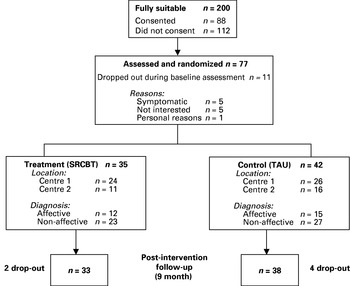
The CONSORT flow diagram in Fig. 1 shows the initial referral rate, allocation by centre and diagnosis, and the level of drop-out from the main outcome assessment. A total of 200 suitable participants were identified, of whom 77 individuals who consented to participate were recruited into the study. The average age was 29 (range 18–52) years. Participants had been in contact with services for an average of 5 years, and the average duration of unemployment was 209 weeks. Fifty-five participants were male (71%). The majority of the sample had a diagnosis of non-affective psychosis (65%).
CONSORT diagram of flow of participants through the trial. SRCBT, Social Recovery Cognitive Behaviour Therapy; TAU, treatment as usual.

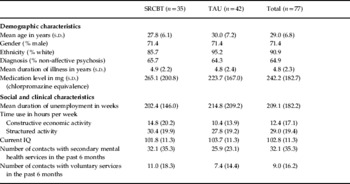
Thirty-five participants were randomized to the treatment condition and 42 to TAU, the control condition. Key clinical and social characteristics of the sample are summarized in Table 1. This shows that randomization resulted in balanced groups in terms of demographics, diagnosis, duration of illness, and social characteristics. Although not shown in Table 1, the affective and non-affective psychosis subgroups were also well balanced in terms of clinical and social characteristics. There were no differences between the affective and non-affective groups in terms of duration of either illness or unemployment. However, the affective subgroup were slightly older.
Baseline characteristics of participants

SRCBT, Social recovery cognitive behaviour therapy; TAU, treatment as usual; s.d., standard deviation.
Treatments
SRCBT
Therapy consisted of three stages and combined techniques of CBT with vocational case management. Stage 1 involved developing a formulation of the person in social recovery. This consisted of assessment and history taking with respect to personal motivation, pre-morbid hopes/expectations and goals that had been changed, possibly with respect to the impact of illness. The focus was on identifying meaningful personal goals that could be linked with achievable day-to-day activity targets and thus address motivation and hopelessness. This often involved validation and acceptance of barriers, threats and difficulties, while focusing on promoting hope for social recovery.
Stage 2 involved identifying and working towards medium- to long-term goals. A particularly important aspect of this was identifying specific pathways to meaningful new activities. Where relevant, this included referral to relevant vocational agencies, or alternatively direct liaison with employers or education providers. Cognitive work at this stage involved promoting a sense of agency and addressing hopelessness, feelings of stigma and negative beliefs about self and others.
Stage 3 involved the active promotion of social activity, work, education and leisure linked to meaningful goals. This involved promotion of activity by behavioural experiments, while managing symptoms of anxiety and low-level psychotic symptoms. Mastery and pleasure in achieving goals was reviewed with respect to gains achieved in social opportunities in work, education and leisure.
Specific therapeutic procedures used in the study were drawn from existing CBT manuals. Prominent among these were procedures to focus on self-regulation of psychotic symptoms and improve social recovery from psychosis (e.g. chapters 11 and 15 of Fowler et al. Reference Fowler, Garety and Kuipers1995). Therapists were also encouraged to use techniques of activity scheduling and reviewing mastery and pleasure, as described in Beck et al. (Reference Beck, Rush, Shaw and Emery1979) ; and behavioural experiment approaches to manage social anxiety, as described in Butler (Reference Butler1999). Therapists were also encouraged to combine therapist role with case management roles typical of individual placement and support working practices; for example by adopting an assertive outreach worker style of contact, most frequently visiting people at home or in the workplace. Therapists were also encouraged to adopt a pragmatic and problem-solving approach in assisting people to overcome work-related problems. This often involved setting up joint interviews with clients and employment and education providers to discuss potential problems.
Therapy in Norfolk was carried out by case managers who had no previous formal training in CBT, but who had over 2 years' experience working in an early intervention in psychosis team, under the supervision of expert CBT therapists. Therapy in the Cambridge-based centre was carried out by CBT therapists who had attended approved courses prior to working on the trial. Therapy in both centres was supervised by experienced CBT specialists. Adherence and competence were monitored using tape recordings and individual and group supervision. Participants received a mean of 12 sessions (s.d.=7).
TAU
Both sites provided active case management by multi-disciplinary secondary care mental health teams. The services provided by the Norfolk and Waveney Mental Health Partnership Trust (centre 1) had a pre-existing active policy of promoting social recovery in case management. This consisted of multi-disciplinary case management, and was backed by the availability of services to provide supported employment for people with severe and enduring mental health problems. Such an approach was consistently available for all cases. The Cambridgeshire site (centre 2) also had active multi-disciplinary case management, although supported employment agencies were less consistently available as part of generic services.
Measures
Primary outcome
Time Use Survey (adapted from the UK 2000 Time Use Survey; Short, Reference Short2006)
This measure consists of a semi-structured interview in which the participant is asked about how they have spent their time over the past month. Activities enquired about include: work, education, voluntary work, leisure, sports, hobbies, socializing, resting, housework/chores, childcare, and sleep. Time spent on each of the activities is calculated in terms of the number of hours per week allocated to that activity over the past month. Two summary measures were derived from the Time Use Survey: hours in ‘Constructive Economic Activity’ and hours in ‘Structured Activity’. Constructive economic activity is calculated as the sum of hours per week over the past month spent in work, education, voluntary work, housework and chores, and childcare. The constructive economic activity assessment could be undertaken by telephone contacts and triangulated with carer reports and also face-to-face interviews, thus maximizing available data at post-treatment. Structured activity is calculated as the sum of hours per week over the past month spent in constructive economic activity, but also includes voluntary and structured leisure activities, sports and hobbies. The structured activity assessment required a face-to-face interview with the participant.
Secondary outcomes
PANSS (Kay et al. Reference Kay, Fiszbein and Opler1987)
The PANSS is a 30-item rating scale developed to assess symptoms associated with psychosis. Symptoms occurring over the past week are rated. PANSS total scores were used.
Beck Hopelessness Scale (BHS; Beck & Steer, Reference Beck and Steer1988)
The BHS is a 20-item self-report scale designed to assess the way an individual perceives the future. Items are rated using a dichotomous true/false response format. Total scores from the BHS were used.
Quality of Life Scale (QLS; Heinrichs et al. Reference Heinrichs, Hanlon and Carpenter1984)
The QLS is a 21-item semi-structured interview designed to assess the functional impairments associated with psychosis, including problems with interpersonal relationships and occupational role functioning. Two scores were used: the total QLS score and the score on the Instrumental Role Functioning subscale (e.g. employment, accomplishment, role satisfaction).
Tertiary assessments
Tertiary outcomes and other measures included the Beck Depression Inventory (BDI-II; Beck et al. Reference Beck, Steer and Brown1996), the Beck Anxiety Inventory (BAI; Beck & Steer, Reference Beck and Steer1987), the Social and Occupational Functioning Assessment Scale (SOFAS; Goldman et al. Reference Goldman, Skodol and Lave1992), and the Camberwell Assessment of Needs (CAN; Slade et al. Reference Slade, Phelan, Thornicroft and Parkman1996). The Client Service Receipt Inventory (CSRI; Beecham & Knapp, Reference Beecham, Knapp, Thornicroft, Brewin and Wing1992) was also administered to assess service use over the period of the trial. All self-reports were completed independently by participants. The GAS, CAN, CSRI and SOFAS were completed with case managers where appropriate.
Reliability of research assessments and blinding procedures
Baseline and post-treatment assessments were conducted by research assistants who were independent of treatment delivery and randomization. Every effort was made to ensure they were kept blind to allocation. Formal training in all measures was provided and interviews were audio-taped for reliability and quality control. Research assistants met regularly throughout the trial to maintain reliability of procedures and ratings. Where blindness was broken, another research assistant conducted the post-treatment assessment. Ninety-three per cent of the post-treatment assessments were completed blind. The research assistants made allocation guesses after post-treatment assessments. These were 58% correct for CBT and 64% correct for TAU. This is within the levels that would be expected by chance.
Statistical analyses
Hypotheses
Primary hypothesis
It was predicted that the provision of SRCBT added to case management (TAU) would improve levels of constructive economic and structured activity in comparison to cases receiving TAU alone.
Secondary hypothesis
We predicted that SRCBT added to TAU would improve on secondary outcomes of symptoms of psychosis, emotional disorder and hopelessness.
We also aimed to explore the differential effect of therapy in affective and non-affective psychosis. Our trial platform legitimized limited investigation of research questions regarding interactions with diagnostic group and centre. However, we understood that these would be underpowered. These investigations were undertaken to inform the design of future research, for example selection criteria for a larger, multicentre RCT for independent replication/extension.
Sample size and power of the study
The purpose of the study was to conduct exploratory efficacy research on a new intervention to improve social recovery in psychosis. The sample size was predicated on testing for an effect of SRCBT on activity with an effect size of around 0.6. Sample sizes with a minimum of 30 in each group would then be sufficient to detect such an effect with 90% power.
Analysis plan
We first report descriptive statistics for each primary and secondary outcome at baseline and post-treatment for the combined study sample, and then the sample split by diagnosis. These estimates provide the basis for a provisional estimate of effect size, albeit biased by drop-outs and potential non-random differences at baseline.
Primary analyses and significance testing were conducted on an intention-to-treat basis. Following the protocol, ANCOVA models were used to test the significance of differences between the treatment and control groups. For each ANCOVA, outcome at the end of treatment (e.g. hours in structured activity at post-treatment) was used as the dependent variable; allocation to treatment, centre, and diagnosis were used as fixed factors; and three key variables assumed to be associated with outcome and predictive of drop-out were used as covariates. The covariates were: baseline outcome (e.g. hours in structured activity at baseline); baseline schizotypal symptoms score; and duration of unemployment. Non-significant interactions were removed before final testing for main effects. Where initial testing indicated the presence of an interaction between treatment and diagnosis, we planned to undertake a series of further ANCOVAs for each diagnostic group (affective/non-affective psychosis). These were similar to the whole-group ANCOVAs but used allocation to treatment and location as fixed factors, thus allowing assessment of treatment effect independently of the diagnosis by treatment interaction. These analyses allow for the presence of missing outcome data under the assumption that the data are missing at random (MAR), conditional on the covariates included in the regression model (i.e. allocation, schizotypal symptoms, duration of unemployment, and baseline values of the outcome variables).
Results
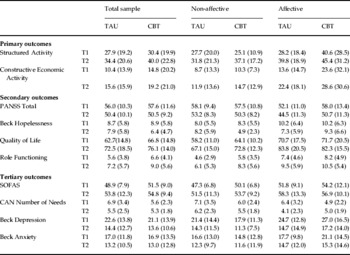
Primary outcome data (constructive economic activity) were available for 92% of the recruited sample. Eighty per cent of the sample completed post-treatment face-to-face interviews, providing structured activity and secondary outcome assessments. Questionnaire assessments for secondary outcomes (e.g. BDI, BAI, BHS) were available for around 75% of the sample. Descriptive statistics for all outcome variables are given in Table 2. These are broken down by treatment and diagnostic group at baseline and post-treatment and derive from data available at post-treatment assessment (i.e. completers).
Descriptive statistics for primary, secondary and mediator variables by treatment and diagnosis

TAU, Treatment as usual; CBT, cognitive behaviour therapy; PANSS, Positive and Negative Syndrome Scale; SOFAS, Social and Occupational Functioning Assessment Scale; CAN, Camberwell Assessment of Needs; T1, baseline assessment; T2, post-treatment (9 months).
Values given as mean (standard deviation).
Contacts with secondary mental health services
There were no differences in the level of support given to treated cases and controls at baseline or the number of contacts available for participants between the two sites. However, the TAU group received more contacts with secondary mental health services than the treatment group over the course of the trial (mean=11.9, s.d.=11.3 versus mean=9.7, s.d.=18.8; t=2.02, p=0.05). The difference in the mean number of contacts with voluntary services was not significant.
Outcomes for the combined group (non-affective and affective psychosis)
Table 2 shows that all participants made large improvements in most domains, including activity and symptoms, as a result of both CBT and TAU conditions. There were no main effects of CBT treatment for any of the outcome variables. There were, however, strong trends suggesting treatment by diagnosis interactions for PANSS [F(1, 69)=3.99, p=0.05] and CAN [F(1, 69)=3.27, p=0.08]. There were no main effects of centre, or centre by diagnosis interactions for any of the outcome variables in the combined group.
Non-affective psychosis group
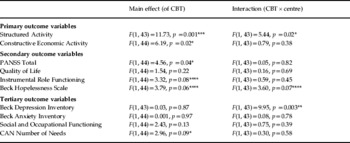
The non-affective group consisted of 50 cases (23 treatment, 27 controls) for whom 43 post-treatment assessments were available. Descriptive results are reported in Table 2. Table 3 shows the results of significance testing for the main outcome variables in the non-affective subgroup. The ANCOVAs for the non-affective psychosis group showed significant benefits for treatment (CBT) on constructive economic activity, structured activity, and PANSS; and trends for improvements in hopelessness, instrumental role functioning, and number of unmet needs (CAN). There was also a significant main effect of centre for BHS scores favouring centre 1 [F(1, 44)=6.08, p=0.02]; and significant treatment by centre interactions for structured activity and depression. The treatment by centre interactions were consistent with a relatively large treatment effect on activity favouring the expert therapist centre (centre 2). However, effects on depression tended to favour the non-expert therapist centre (centre 1).
Results of model estimates of treatment effects within the non-affective psychosis group (using expectation-maximization estimates for missing data)

CBT, Cognitive behaviour therapy; PANSS, Positive and Negative Syndrome Scale; CAN, Camberwell Assessment of Needs.
* p<0.05, ** p<0.01, *** p<0.001, **** p<0.10.
Affective psychosis group
There were 27 cases in the affective psychosis group who were predominantly people with bipolar disorder. The results for nine cases in the treatment group and 12 in the control group were available post-treatment. The descriptive statistics in Table 2 show suggestions of effects favouring CBT on anxiety and beliefs about self but few indications of effects on activity or other outcomes. However, there were no significant effects for treatment or centre on any of the outcome variables. The main observation is of striking improvements in activity levels for the affective psychosis group in both the treatment and control conditions.
Admissions to hospital
Ten participants had admissions into hospital during the trial. Six of these were in the treatment group and four were in the control group. The average number of days spent in hospital for the whole sample over the course of the trial was 3.8 (s.d.=17.2). In the 6 months prior to participating in the trial there had been 15 admissions in the sample. Seven of these were in the group allocated to TAU, and eight were in the group allocated to receive treatment. The average number of days spent in hospital for the whole sample in the 6 months preceding the trial was 5.8 (s.d.=14.4). Thus, participating in the trial did not seem to have an adverse effect on relapse rates.
Discussion
This trial was designed to refine methods and estimate the effect size of the use of SRCBT on the primary outcome of hours in constructive social activity; and secondary outcomes of psychotic symptoms, emotional disorder, and hopelessness. The primary study comparison provided no clear evidence for the benefit of CBT on a combined sample of patients with affective and non-affective psychosis. However, a planned secondary analysis revealed some evidence for the potential of CBT to improving constructive and structured activity among a more homogeneous sample of patients with non-affective psychosis with poor social outcomes relatively early in the course of disorder.
The indications of benefits for the cognitive behavioural intervention in non-affective psychosis are promising but require replication in a large multi-centre trial. These gains were large and clinically meaningful. There was an average gain of 12 h per week in structured activity for CBT in comparison to 4 h for TAU in the non-affective psychosis group. This was achieved in association with clinically meaningful and significant improvements in symptoms and hopelessness. The affective psychosis cases (mainly bipolar disorder) also showed large gains in both symptoms and activity but as this occurred in both treatment and control groups, it is likely to be the result of a response to TAU conditions and possibly the placebo effect of being involved in a trial.
The study provided a relatively strict evaluation of efficacy as large improvements also occurred in the control group on most of the target variables of outcome, including activity, symptoms and depression. These gains were unexpected as we had deliberately recruited a group of patients who had stable poor social outcome at recruitment and may be the result of a good response to the TAU provided. The affective psychosis group made particularly large gains in activity and depression in both control and treatment conditions. As cases in the affective and non-affective psychosis groups were well matched on clinical and social factors, the differences observed between these two groups are unlikely to be due to variables such as duration of either illness or unemployment. The findings may be more consistent with our recent observations, and those of others, that bipolar disorder cases respond rapidly and with good social recovery outcomes to early intervention services compared with non-affective psychosis (Macmillan et al. Reference Macmillan, Howells, Kale, Hackmann, Taylor, Hill, Bradford and Fowler2007).
It was certainly the case that there was an active treatment factor in the TAU condition. All cases were in receipt of active treatment from secondary mental health teams. In both centres the control group received more than 20 contacts from these teams over the course of the trial, with some interventions aiming to improve social recovery and also providing generic case management. Informal observations also suggested that involvement in the therapy trial may have acted as a catalyst for those providing TAU to focus attention on the social recovery needs of cases in both the therapy and control groups. Furthermore, involvement in the trial assessment procedures for all cases provided several sessions of discussing, reviewing and monitoring social and symptomatic outcomes that may have had a beneficial effect. It is therefore important to interpret the impact of the study in terms of the effect size of providing an additional focused cognitive behavioural intervention over and above a good existing community mental health service.
Improvements in emotional disorder could be taken as support for the cognitive model underpinning the intervention, which focused on deliberately fostering positive self-esteem and hope while working towards adopting new social activities. The aim of the study was also to develop an intervention that deliberately linked improvements in meaningful activities with improvements in psychological well-being and self-esteem, while also managing risk of sensitivity to stress. In this regard it is important to note that there was no indication of any worsening of psychotic symptoms, as has been observed in other studies (Hogarty et al. Reference Hogarty, Goldberg, Schooler and Ulrich1974, Reference Hogarty, Kornblith, Greenwald, DiBarry, Cooley, Ulrich, Carter and Flesher1997). Indeed, the findings suggest that symptoms improved. Clinical observations by therapists suggested the need to take particular care regarding initial increases in social anxiety symptoms associated with involvement in new activities. However, there was no significant increase in anxiety symptoms over the course of the intervention. We intend to explore the association between changes in emotional and psychological variables and changes in activity in future mediational analyses.
This study has highlighted that it was possible for case managers to provide hope and to manage many aspects of cognitive therapy work associated with SRCBT, within their existing case management style of work and skill base. However, there were suggestions that those therapists in the trial who had received more formal prior training (mainly in centre 1) achieved stronger effects, especially on activity. Supervision discussions and analysis of case-notes suggest that these differences may have arisen from those therapists who had less formal training in CBT feeling less confident about using more structured active behavioural interventions, particularly in cases where assisting people to engage in new activities may lead to short-term increases in anxiety. At the present time, trained CBT therapists may be best placed to deliver the behavioural experiment aspects of this intervention, with rigorous levels of adherence and competence. However, this study clearly shows that case managers can deliver an intervention that accrues many significant benefits (particularly in terms of increasing hope); and that it may be possible to develop specific programmes of training focusing on improving their skills to apply the intervention in day-to-day practice at some stage in the future.
The results of this study need to be regarded with caution and as indicative of an effect size useful for researchers undertaking further research. The study was designed to be exploratory rather than confirmatory and lacks power. The results for the non-affective group are therefore suggestive, and those for the affective group are too small to warrant any formal conclusion. The study has been useful in indicating that the key outcome assessments are sensitive to change and, in the case of activity assessment, are relatively independent of other dimensions of outcome. The results also indicate the possible promise of undertaking further research on what seems to be a highly feasible intervention to improve activity in non-affective psychosis. A further large-scale trial of this type of intervention is warranted.
Acknowledgements
We appreciate the involvement of the trial therapists who included Dorothy O'Connor, Annabella Houlden, Neil Harmer, Cas Wright, Mark Wright, Ian Bell, Nick Whitehouse, Patrick Wymbs, Sarah Newman and Marie Alexander. UK Mental Health Research Network staff including Angela Browne, Freya Mellor and Barbara Dickson provided assistance with recruitment and assessment. Funding for the trial was provided by a Medical Research Council (MRC) trial platform grant.
Declaration of Interest
None.