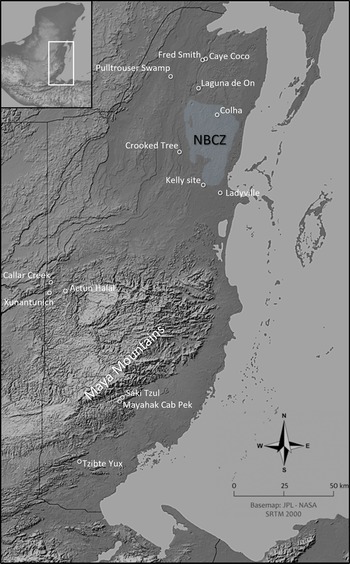
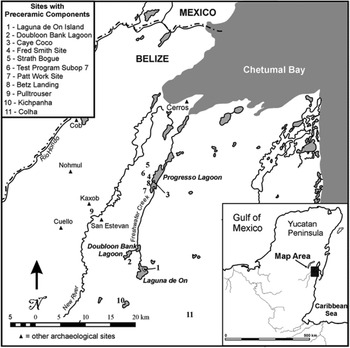
Until relatively recently, the paucity of reliable dates for the preceramic in the Maya Lowlands has meant that the specific technological and morphological aspects of stone tools had been the primary means by which Archaic people (ca. 8000–1000 BC) were identified and their presence regionally documented (see Hester et al. Reference Hester, Shafer and Kelly1980, Reference Hester, Kelly and Ligabue1981; Lohse et al. Reference Lohse, Awe, Griffith, Rosenswig and Valdez2006; MacNeish and Nelken-Terner Reference MacNeish and Nelken-Terner1983a, Reference MacNeish and Nelken-Terner1983b; Zeitlin Reference Zeitlin1984; Zeitlin and Zeitlin Reference Zeitlin, Zeitlin, Adams and MacLeod2000). Radiocarbon dates for some of the earliest occupations with abundant quantities of lithics come from caves and rockshelters, such as El Gigante in Honduras (Iceland and Hirth Reference Iceland, Hirth, Lohse, Borejsza and Joyce2021; Scheffler Reference Scheffler2008; Scheffler et al. Reference Scheffler, Hirth and Hasemann2012); Los Grifos and Santa Marta in Chiapas, Mexico (Acosta Ochoa Reference Acosta Ochoa2010; Acosta Ochoa et al. Reference Acosta Ochoa, Martínez, Ulloa-Montemayor, Suárez and Ardelean2019; García-Bárcena and Santamaría Reference García-Bárcena and Santamaría1982; Lohse Reference Lohse, Lohse, Borejsza and Joyce2021; Santamaría Reference Santamaria, García-Bárcena and Martínez1981); and Mayahak Cab Pek, Saki Tzul, and Tzibte Yux in southern Belize (Prufer and Kennett Reference Prufer, Kennett, Houk, Arroyo and Powis2020; Prufer et al. Reference Prufer, Meredith, Alsgaard, Dennehy and Kennett2017, Reference Prufer, Alsgaard, Robinson, Meredith, Culleton, Dennehy and Magee2019, Reference Prufer, Robinson and Kennett2021; Figure 1). In northern Belize, radiocarbon dates confirm the use of Archaic period stone tools, notably a hammerstone and a plano-convex biface with adherent cultigen starch grains (maize, squash, manioc, and chili pepper) at Caye Coco, an island site in the Freshwater Creek drainage (Rosenswig et al. Reference Rosenswig, Pearsall, Masson, Culleton and Kennett2014:316, Table 2), and a stemmed Lowe point and a constricted uniface from organic wetland soil that also contained maize pollen at Pulltrouser SwampFootnote 1 (Pohl et al. Reference Pohl, Pope, Jones, Jacob, Piperno, deFrance, Lentz, Gifford, Danforth and Kathryn Josserand1996:359, 362, Figure 3). At Actun Halal in western Belize, a constricted biface has been dated to about 2200 BC within an Archaic stratigraphic zone that also contained maize pollen (Lohse Reference Lohse2007:26; Reference Lohse2010; Reference Lohse, Hutson and Ardren2020:20). Archaic period stone tools with adherent cultigen starch grains were also identified at other sites in the Freshwater Creek drainage of northern Belize, including shore sites (Fred Smith, the Patt Work site, and Doubloon Bank Lagoon) and another island site, Laguna de On; however, no radiocarbon dates are associated with them (Rosenswig et al. Reference Rosenswig, Pearsall, Masson, Culleton and Kennett2014; Figure 2).
Map of Belize with preceramic sites indicated and the Northern Belize Chert-bearing Zone (map drawn by W. James Stemp).

Map of northern Belize with the island site of Caye Coco, the shoreline site of Fred Smith, and other preceramic sites in the Freshwater Creek drainage (map drawn by Robert Rosenswig).

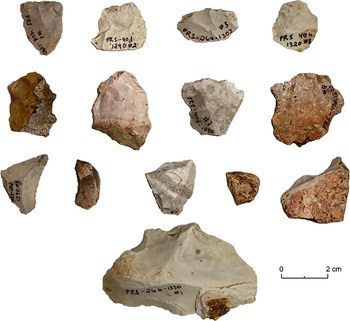
Debitage from Caye Coco, Freshwater Creek, Belize. (Top row) noncortical biface edge flakes; (second row) cortical and noncortical flakes; (third row) cortical and noncortical shatter/blocky fragments; and (fourth row) cortical flake/core fragment. Note the substantial white patination and burning on the artifacts. (Color online)

Although much of the evidence for the preceramic in Belize is derived from stone tools, particularly diagnostic formal types like fluted points, stemmed points, and constricted adzes (see Supplemental Text 1), significant amounts of chipped stone debitage, much of which is heavily patinated, have also been recovered from preceramic sites. Most of the debitage has not undergone detailed analysis. Because debitage can reveal so much about the activities at archaeological sites (e.g., Aoyama Reference Aoyama1999, Reference Aoyama2009; Lewenstein Reference Lewenstein1987; Stemp Reference Stemp2001; Stemp et al. Reference Stemp, Helmke and Awe2010, Reference Stemp, Graham, Helmke and Awe2021), we examine the chipped chert debitage from the island site of Caye Coco and the shore site of Fred Smith to assess strategies of raw material procurement, tool production, and tool use as a way to evaluate sedentism and subsistence practices.
The analyses of Archaic period debitage from Caye Coco and Fred Smith reveal that the people living at both sites procured most of their identifiable tool stone from the Northern Belize Chert-bearing Zone (NBCZ), even though other sources of lower-quality lithic material were closer. They made a few bifaces and unifaces and produced many flakes using hard-hammer percussion. The debitage at both sites was used for a variety of tasks that were primarily subsistence or domestic in nature; however, tool use patterns vary somewhat at each location. The technological and use-wear data, in addition to other archaeological evidence, from these two sites suggest a reliance on both wild resources available in and around Progresso Lagoon and cultigens that were locally grown at these locations where Archaic people were settling. We also compare the debitage from Caye Coco and Fred Smith to debitage from other preceramic sites in Belize and other regions within the Maya Lowlands.
Archaic Campsites in Northern Belize: Ladyville 1 and Caye Coco
Although they were exceptionally rare, open-air sites and their use in the Archaic period can be demonstrated in northern Belize. Patinated lithics, including two Lowe points, recovered from a mottled-orange-sand stratum that also contained a hearth feature have been dated to the Late Archaic (4078–3835 cal BP [2128–1885 BC]) at Ladyville 1 (Kelly Reference Kelly1993:215); however, Kelly expressed doubt about the reliability of the contextual relationship between the points and the hearth. At Caye Coco, patinated stone tools and debitage are also associated with a distinctive orange soil horizon containing patinated lithics and no ceramics (Rosenswig Reference Rosenswig2004, Reference Rosenswig2015; Rosenswig and Masson Reference Rosenswig and Masson2001; Rosenswig et al. Reference Rosenswig, Pearsall, Masson, Culleton and Kennett2014). Two pit features and a possible post mold were documented descending from the orange soil horizon into the limestone bedrock that underlies the island. These aceramic orange soils are attributed to the latter part of the Archaic period, but there was clearly postdepositional mixing of the dated carbon remains (Rosenswig Reference Rosenswig2021). Radiocarbon assays from two carbonized wood samples in Pit Feature 2 produced results of 6730–6610 cal BP (UCIAMS-17909) and 8320–8180 cal BP (UCIAMS-17908; Rosenswig et al. Reference Rosenswig, Pearsall, Masson, Culleton and Kennett2014:Table 1, Figure 2). Two pieces of carbon were found within the same relatively small feature, but their dates from 1,700 years apart suggest that at least one of them was not deposited when the pit was formed. The assay from carbonized wood recovered from Pit Feature 1 produced a result of 2790–2740 cal BP (UCIAMS-17911), which put it in the age range of the earliest ceramic Swasey phase. No Formative period ceramic deposits are documented on Caye Coco despite extensive excavation and the sealing of all preceramic strata beneath Terminal Classic and Postclassic Maya occupation of the island (Rosenswig and Masson Reference Rosenswig and Masson2002; Rosenswig et al. Reference Rosenswig, Briggs and Masson2020).
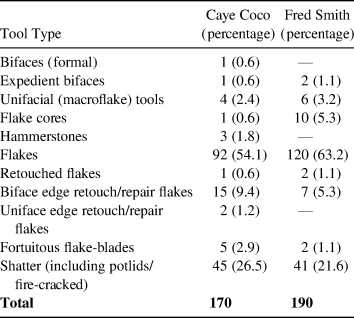
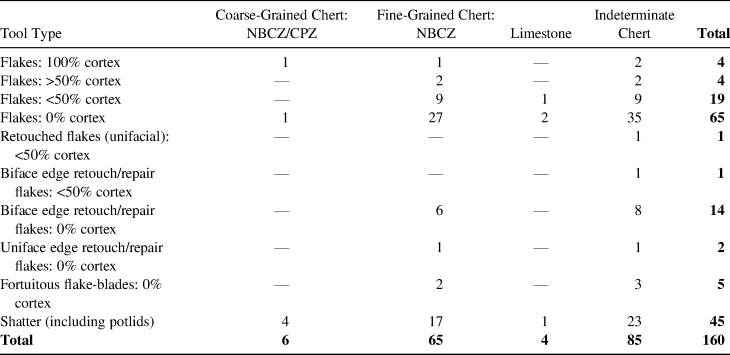
Number of Tools by Type from Caye Coco and Fred Smith, Freshwater Creek, Belize.

Three radiocarbon dates from the Betz Landing site (Zeitlin Reference Zeitlin1984) are directly relevant to the data presented in this article. Betz Landing is located on the shore of Progresso Lagoon directly across from Caye Coco and about 500 m south of the Fred Smith site. These dates of 3650–3260 cal BP (I-11900) and 3710–3340 cal BP (I-11901) were recovered from a reddish-brown soil horizon with no ceramics, located 20–40 cm below the surface. Below this layer, a dark gray soil is reported to contain stone tools and to have an associated radiocarbon date of 6190–2310 cal BP (UCR-1650; Zeitlin Reference Zeitlin1984:364–365). These six dates are what currently fix the lithic materials from the Caye Coco and Fred Smith sites in absolute time. However, the distinctively colored, aceramic soil horizon in which all tools and debitage were recovered and the thick, white patina on the lithics themselves distinguish them from the subsequent Formative period occupation in the region. In addition to occupation locations, preceramic tool production workshops with heavily patinated lithics have been identified in northern Belize at Colha, the Kelly site, and Ladyville 32 (Hester et al. Reference Hester, Iceland, Hudler and Shafer1996; Iceland Reference Iceland1997, Reference Iceland and Powis2005; Kelly Reference Kelly1993). Chipped stone tools have also been recovered on the shore of Crooked Tree island's Northern Lagoon in northern Belize, but they appear to come from a mixed aceramic deposit (Stemp and Harrison-Buck Reference Stemp and Harrison-Buck2019). In western Belize, use of a quarry location near the end of the Late Archaic period is suggested by the recovery of patinated lithics in an aceramic paleosol at the site of Callar Creek (Horowitz Reference Horowitz2015, Reference Horowitz2017).
Chipped Stone Debitage from the Caye Coco and Fred Smith Sites
The sites of Caye Coco and Fred Smith have been described elsewhere (Rosenswig Reference Rosenswig2004; Rosenswig et al. Reference Rosenswig, Pearsall, Masson, Culleton and Kennett2014). This article presents a more detailed reanalysis of the flake and shatter debitage from Caye Coco and Fred Smith undertaken by Stemp in 2020–2021, which replaces all previous reporting on lithics from these sites. This is also the first detailed use-wear study of these materials: earlier reports only documented the presence or absence of use-wear using a hand-held lens (8× magnification) and did not attempt to determine motions or contact material types.
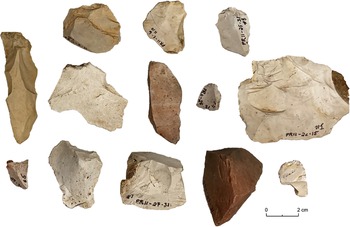
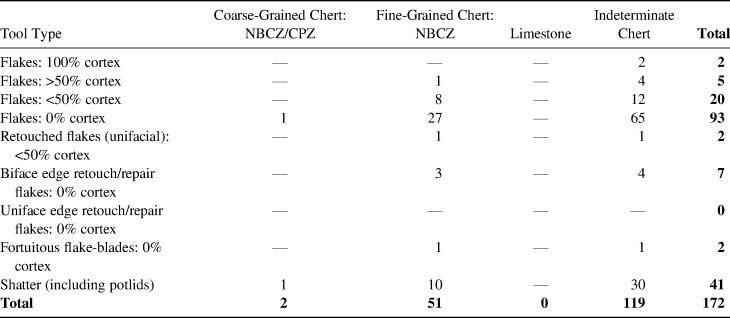
The Archaic period chipped stone assemblage from Caye Coco analyzed here consists of 170 artifacts excavated from Operations 26 and 40 in 2001 (Rosenswig Reference Rosenswig2004). They can be divided into tools, cores, and hammerstones (10, or 5.9% of the assemblage) and production debris or debitage, including different types of flakes and shatter (160, or 94.1%; Table 1; Figure 3). Most of the tools, including an expedient biface and unifacially retouched macroflakes, are rather crudely made. One better-made formal biface was also recovered (Rosenswig et al. Reference Rosenswig, Pearsall, Masson, Culleton and Kennett2014:Table 3). There were 190 chipped stone artifacts excavated from Archaic deposits from Operations 1, 2, and 4 at the Fred Smith site in 2001 (Rosenswig Reference Rosenswig2004). Another 359 chipped stone artifacts were collected from a recently disturbed area of the site. Although these artifacts are relatively similar to tools and debitage found in excavated contexts (Rosenswig et al. Reference Rosenswig, Pearsall, Masson, Culleton and Kennett2014:Figure 12), only the excavated material is presented here. Eighteen tools and cores (9.5% of the assemblage), including expediently made bifaces and unifaces, and production debris, including 172 types of flakes and shatter (90.5%), were excavated from the site (Table 1; Figure 4). No hammerstones were recovered at Fred Smith during the excavations, although one was recovered from the surface.
Debitage from Fred Smith, Freshwater Creek, Belize. (Top row) noncortical biface edge flakes; (second row) cortical and noncortical flakes; (third row) cortical and noncortical shatter/blocky fragments; and (second row, far left) noncortical fortuitous flake-blade. Note the substantial white patination and burning on the artifacts. (Color online)

Technological Analysis
Raw Materials
As noted by Rosenswig and coauthors (Reference Rosenswig, Pearsall, Masson, Culleton and Kennett2014:318), the majority of the chipped stone from Caye Coco and Fred Smith is patinated. The degree of patination varies, but most flakes and shatter are either completely covered in a well-developed white patina (see Hester et al. Reference Hester, Shafer, Kelly and Ligabue1982), which greatly complicates visual identification of raw material type, or possess heavy to moderately developed patination, with some spots on the surface where the original stone surface can be seen. Some of the recently broken debitage reveals characteristics of the stone encased within the patinated tool surfaces. Where the raw material characteristics can be observed, they are consistent with fine-grained, dark brown, honey-colored, yellowish-brown, or grayish-brown cherts from the NBCZ (see Hester and Shafer Reference Hester and Shafer1984; Shafer and Hester Reference Shafer and Hester1983). In some instances, banding and mottling can also be observed that are consistent with NBCZ chert.
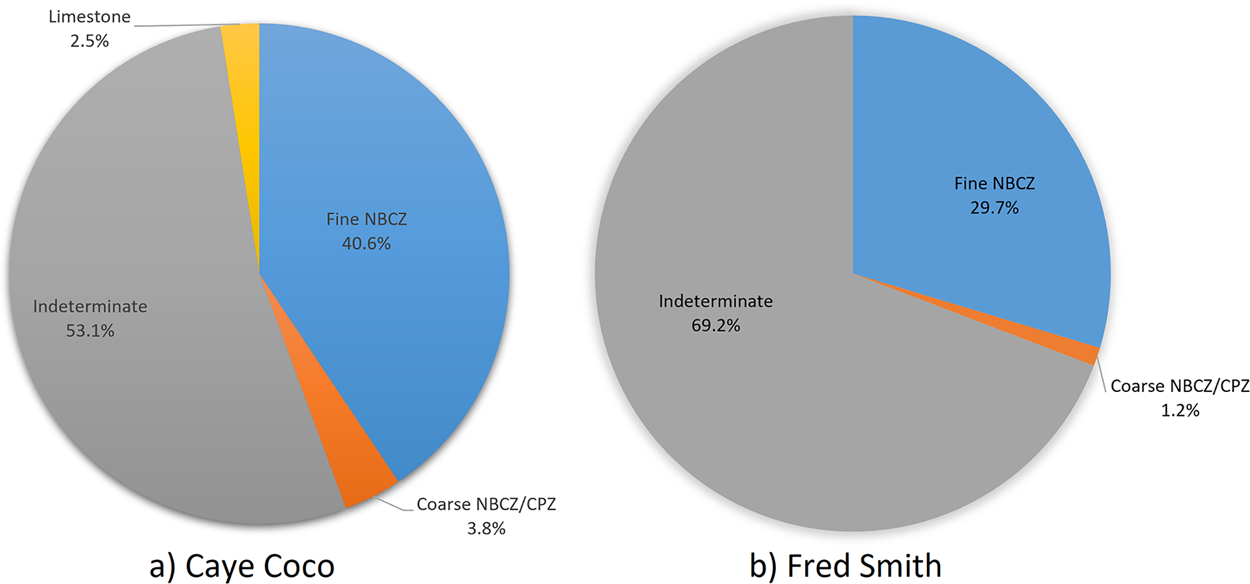
Less than half of the debitage (n = 65) at Caye Coco and about one-third (n = 51) at Fred Smith can be assigned to the fine NBCZ or Colha raw material category based on stone grain size, color, and sometimes the presence of banding and mottling (Figures 5a and 5b). There are some partially patinated chipped stone artifacts made from coarse-grained stone at both Caye Coco (n = 6) and Fred Smith (n = 2). Based on color, they may have come from the NBCZ or possibly the Cryptocrystalline Pebble Zone (CPZ; Hester and Shafer Reference Hester and Shafer1984; Oland Reference Oland1999; Paris Reference Paris2012) in the environs of the Freshwater Creek drainage. Although this stone is coarse grained, it is very “Colha-like” in appearance. Just over half of the debitage (n = 85) at Caye Coco and more than two-thirds (n = 119) at Fred Smith were so heavily patinated or severely burnt that they were difficult to identify; thus, they were conservatively classified as “indeterminate” in terms of source. However, given the generally fine grain of the “indeterminate” artifacts and the faint banding on some pieces, they most likely derive from the NBCZ (see Rosenswig et al. Reference Rosenswig, Pearsall, Masson, Culleton and Kennett2014:318). Among the patinated debitage at Caye Coco were four pieces made from relatively fine-grained hard limestone. No chipped limestone debitage was noted at Fred Smith.
Debitage by raw material types at (a) Caye Coco (n = 160) and (b) Fred Smith (n = 172), Freshwater Creek, Belize.

Despite the proximity of lower-quality chert and chalcedony in the vicinity of Caye Coco and Fred Smith (see Oland Reference Oland1999; Rosenswig et al. Reference Rosenswig, Pearsall, Masson, Culleton and Kennett2014), the Archaic people from both sites preferentially selected the much better-quality stone from the NBCZ for flaking purposes. This indicates deliberate selection of high-quality stone—even for the production of technologically simple tools—which was more costly because the stone had to be procured from sources that were farther away. Large quantities of stone tools, including debitage, from the NBCZ have also been noted at other preceramic sites in northern Belize, such as Colha (Iceland Reference Iceland1997) and Crawford Bank/Crooked Tree (Stemp and Harrison-Buck Reference Stemp and Harrison-Buck2019). Colha is in the NBCZ proper and Crawford Bank/Crooked Tree is closer to the NBCZ than the sites of Progresso Lagoon.
Tool Types and Reduction Techniques
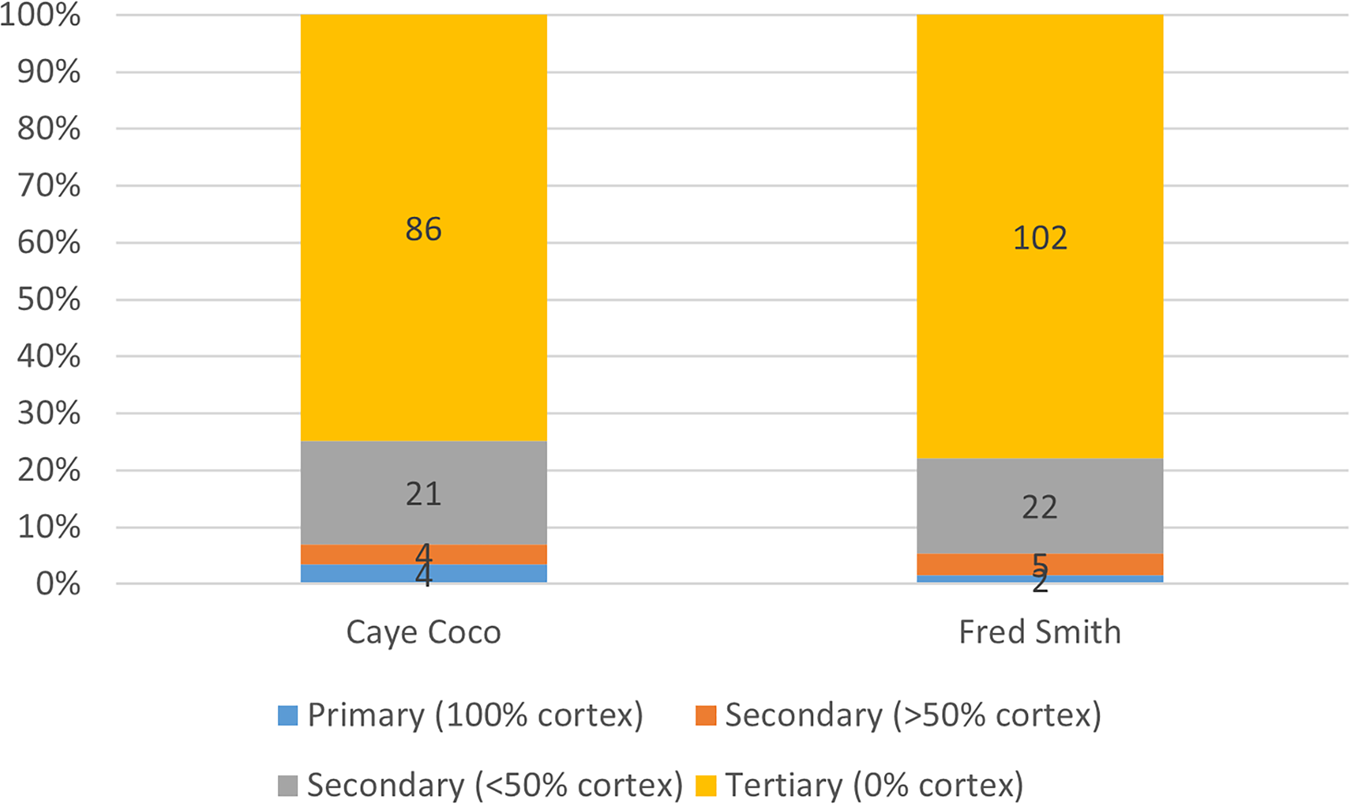
Most of the chipped stone recovered from Caye Coco and Fred Smith consisted of cortical and noncortical flakes (Tables 2 and 3). Some biface edge retouch/repair flakes were recovered at both sites. Flakes removed from biface edges were more abundant at Caye Coco (9.4%) than at Fred Smith (4.1%). This may indicate that more biface repair/resharpening was occurring on the island than on the shore of the lagoon; however, there were generally few biface edge repair flakes at either site. In the Caye Coco assemblage, only one cortical flake of indeterminate chert was deliberately unifacially retouched to modify its edge. Two unifacially retouched, cortical flakes (one fine-grained NBCZ chert; one indeterminate chert) were recovered from Fred Smith. All three flakes were retouched on the dorsal surface using percussion. Most of the flakes from Caye Coco are noncortical, tertiary flakes (n = 86, or 74.8%). Similarly, the flake debitage at Fred Smith is dominated by noncortical flakes (n = 102, or 77.9%). Overall percentages of noncortical and cortical flakes at both sites are essentially the same (Figure 6).
Cortical and noncortical flakes by dorsal cortex coverage at Caye Coco and Fred Smith, Freshwater Creek, Belize. (Color online)

Flake Types and Shatter by Raw Material Types from Caye Coco, Freshwater Creek, Belize.

Flake Types and Shatter by Raw Material Types from Fred Smith, Freshwater Creek, Belize.

As noted by Rosenswig and coauthors (Reference Rosenswig, Pearsall, Masson, Culleton and Kennett2014:318), these data indicate that neither Caye Coco nor Fred Smith was a location for significant tool production. The absence of large quantities of cortical debitage can be used as an indicator that little early stage reduction occurred at a site (Mauldin and Amick Reference Mauldin, Amick, Amick and Mauldin1989:70). However, the amount of cortical debitage at both sites, in addition to the percentages of shatter, suggests that at least some early stage decortication of cobbles/nodules was occurring. As such, these inhabitants may have removed some cortex from nodules at the source before transporting them to Caye Coco and Fred Smith and they may have traded for partially decorticated cores.
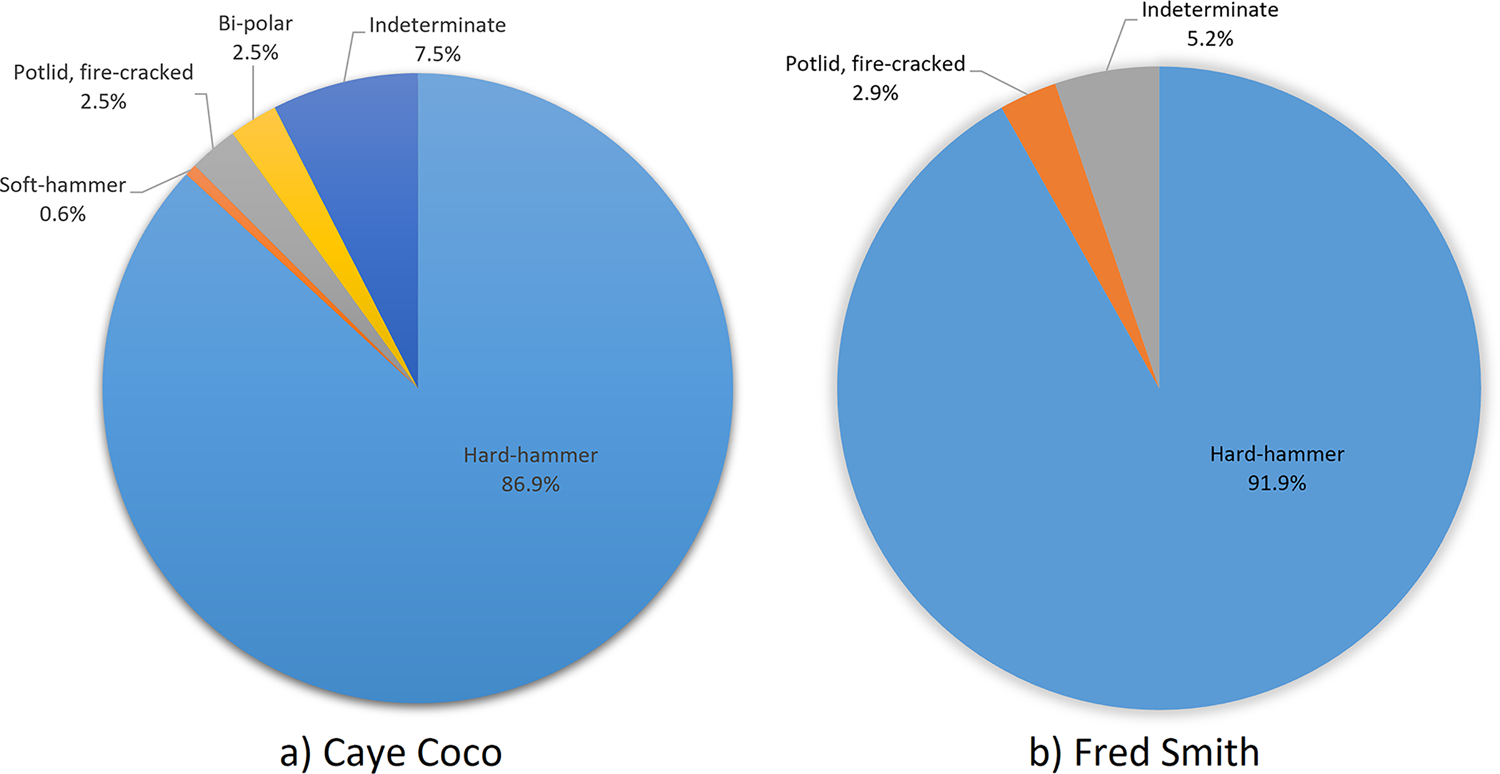
Based on the recovery of three hammerstones (two chert, one limestone) at Caye Coco and the large number of identifiable pieces of hard-hammer debitage at Caye Coco (n = 139, or 86.9%) and Fred Smith (n = 158, or 91.9%; Figures 7a and 7b), the hard-hammer technique was the main reduction method at both sites (Supplemental Text). There are two flakes and two pieces of shatter from Caye Coco that have evidence for impact on both their longitudinally opposite ends based on pronounced compression rings on interior surfaces and the absence of bulbs of force. Two have some pitting/crushing on both ends, which is consistent with axial bipolar reduction using a hard hammer and suggests bipolar reduction (Ahler Reference Ahler, Amick and Mauldin1989; de la Peña Reference de la Peña2015; Jeske and Lurie Reference Jeske and Lurie1993; Pargeter and Eren Reference Pargeter and Eren2017:90). Minimal use of bipolar reduction indicates that the Caye Coco inhabitants were not overly concerned about access to chert nor felt the need to maximize the use of the stone they acquired (see Andrefsky Reference Andrefsky1994, Reference Andrefsky and Andrefsky2008). Given overall shatter form, cortex coverage, and size, bipolar reduction was most likely infrequently used on some small round chert nodules/cores at Caye Coco (see Pargeter and Eren Reference Pargeter and Eren2017:92; Parry and Kelly Reference Parry, Kelly, Johnson and Morrow1987; Shott Reference Shott1999). Some differences in shatter size at both sites may reflect the use of bipolar reduction of small cobbles/cores on the island versus the shore (Supplemental Text 1).
Chipped stone artifacts (n = 160) by reduction/hammer type at (a) Caye Coco (n = 160) and (b) Fred Smith (n = 172), Freshwater Creek, Belize.

Based on the relatively small number of flake cores and the low quantity of flakes recovered during the excavations at both sites, simple flake production to supply local need was the main impetus for toolmaking. However, there is a notable difference in the percentages of flake cores and core fragments at the two sites. The higher percentage of cores and the ratio of flakes to cores and core fragments at Fred Smith (13.1:1) versus Caye Coco (118:1) demonstrate that more core reduction to produce flakes occurred on the shore of the lagoon.
Use-Wear Analysis
Method
We examined the chipped stone debitage from Caye Coco and Fred Smith using both low- and high-power use-wear analysis techniques. Because the sample sizes for both sites were relatively small, the majority of the artifacts were examined for traces of use. A total of 109 artifacts (63 from Caye Coco and 46 from Fred Smith) were deemed too badly damaged based on a combination of heavy patination (Supplemental Text 1), severe burning, and postdepositional damage to be included in the analysis. Consequently, 97 chipped stone tools (60.6% of the assemblage) from Caye Coco and 126 tools (73.3% of the assemblage) from Fred Smith were analyzed for use-wear traces. All artifacts were analyzed at low magnification (40×) using indirect light to examine edge microchipping and at high-power magnification (100×–400×) using incident light to detect micropolishes and striations (see Stemp Reference Stemp2001; Stemp et al. Reference Stemp, Helmke and Awe2010). A full description of the analysis techniques is available in Supplemental Text 1. Each location of use-related wear on a stone tool surface was recorded as an independent use zone (IUZ); as such, a single tool could have more than one IUZ (Stemp et al. Reference Stemp, Helmke and Awe2010; see also Aoyama Reference Aoyama2009; Vaughan Reference Vaughan1981).
Results
At both Caye Coco and Fred Smith, significant numbers of flakes and shatter possessed use-related wear. A higher proportion of the debitage from Caye Coco (n = 42 of 97, or 43.3%) had use-related wear than debitage from Fred Smith (n = 38 of 126, or 30.2%); however, fewer artifacts from Caye Coco were examined for traces of use-wear. If all the debitage from both sites are considered, 26.3% of the flakes and shatter from Caye Coco possess evidence of use compared to 22.1% of those from Fred Smith. Some flakes or pieces of shatter at both sites were used for more than one activity based on IUZs. At Caye Coco, there were 45 IUZs on the used flakes and shatter; three flakes (7.1%) had two IUZs. At Fred Smith, the 38 used flakes and shatter had a total of 44 IUZs; five flakes and one piece of shatter (15.8%) had two IUZs each.
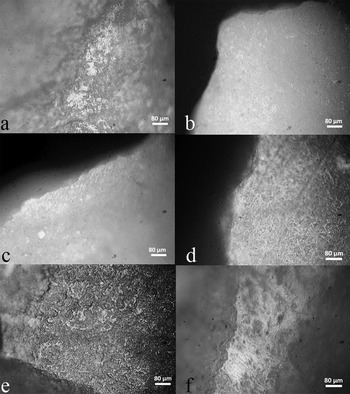
In terms of tool types, 26 of 50 (52.0%) flakes, retouched flakes, and fortuitous flake-blades; 7 of 10 (70.0%) biface edge retouch flakes; and 9 of 37 (24.3%) pieces of shatter from Caye Coco were used (Supplemental Text 1). At Caye Coco, use-wear on the chert debitage is primarily consistent with cutting/slicing indeterminate materials (7 IUZs, or 15.6%), indeterminate actions involving shell (6 IUZs, or 13.3%; Figure 8a), sawing wood (5 IUZs, or 11.1%), indeterminate actions involving hard contact materials (5 IUZs, or 11.1%; Figure 8b), and digging/hoeing soil (4 IUZs, or 8.9%). The flakes and shatter were also used for a variety of other tasks involving bone/antler (Figure 8c), dry hide, plants, and soft contact materials. The working of wood (10 IUZs, or 22.2%) and shell (7 IUZs, or 15.6%), in addition to other hard contact materials (11 IUZs, or 24.4%), dominated the activities at the island site.
Photomicrographs (200×) of used chert artifacts: (a) shatter from Caye Coco with use-wear consistent with an indeterminate motion (wedging?) on shell; (b) flake from Caye Coco with use-wear consistent with an indeterminate motion on a unidentified hard contact material; (c) flake from Caye Coco with use-wear consistent with cutting/slicing bone/antler; (d) flake from Fred Smith with use-wear consistent with whittling wood; (e) flake from Fred Smith with use-wear consistent with cutting fibrous or woody plants; (f) biface edge retouch flake (dorsal surface) from Fred Smith with use-wear consistent with adzing/chopping wood and soil contact. All use-wear images, except (e), from patinated artifacts.

At Fred Smith, 30 of 87 (34.5%) flakes, retouched flakes, and fortuitous flake-blades; 3 of 6 (50.0%) biface edge retouch flakes; and 5 of 33 (15.2%) pieces of shatter were used (Supplemental Text 1). At Fred Smith, use-wear on the chert debitage is mostly consistent with sawing wood (8 IUZs, or 18.2%; Figure 8d), sawing hard contact materials (7 IUZs, or 15.9%), and cutting plants (6 IUZs, or 13.6%; Figure 8e). Some tools were used to adze/chop wood (3 IUZs, or 6.8%; Figure 8f) and cut/slice wood (3 IUZs, or 6.8%). Debitage was also used for various other activities on bone/antler, shell, soil, stone, soft contact materials, and some indeterminate materials. There is a clear focus on working wood and plants at the site (23 IUZs, or 52.3%) and hard contact materials (11 IUZs, or 25.0%).
The use-wear data indicate different patterns of tool use at Caye Coco versus Fred Smith, even though the assemblages from both locations consist of the same types of flakes and shatter and the range of contact materials and motions is generally the same. At Caye Coco, use-wear consistent with wood contact is likely due to land clearance and horticultural activities and the manufacture of a wide range of wooden items that would likely have been needed for quotidian domestic tasks (Lewenstein Reference Lewenstein1987; Stemp Reference Stemp2001; Stemp and Harrison-Buck Reference Stemp and Harrison-Buck2019; for Chiapas, see also Pérez Martínez and Acosta Ochoa Reference Pérez Martínez and Ochoa2018). Biface edge flakes are associated with digging/hoeing in soil and some adzing/chopping of wood, most likely related to food production. Three flakes and some pieces of shatter were used on shell in a manner that is difficult to determine. The traces of contact with shell may be connected to working shell into objects of some kind or possibly are the result of processing/opening mollusks as a source of food. The contact with hard materials could represent more use of wood or shell, but this cannot be determined. Based on use-wear evidence, most debitage at Caye Coco was used on hard contact materials (bone/antler, shell, wood) and for longitudinal motions (cutting/slicing, sawing).
In contrast, on the shore at Fred Smith, there is a greater emphasis on cutting wood and plants than on the island, but there is still a heavy use of tools on hard materials. As at Caye Coco, biface edge flakes from Fred Smith provide use-wear evidence for adzing/chopping wood and digging/hoeing soil that are likely associated with land clearance and horticultural activities. Other uses of wood are likely related to daily domestic activities of various sorts (see the earlier discussion). An emphasis on cutting plants on the shore may also be connected to acquiring or processing plant foods (for Chiapas, see Acosta Ochoa and Pérez Martínez Reference Acosta Ochoa and Martínez2018; Acosta Ochoa et al. Reference Acosta Ochoa, Martínez and González2013) or some other domestic tasks, such as basketry or roof thatch. Like Caye Coco's debitage, most flakes and shatter at Fred Smith were used on hard contact materials (bone/antler, shell, stone, wood) and for longitudinal motions (cutting/slicing, sawing).
Although use-wear resulting from contact with wood exists at both the Freshwater Creek sites, the percentages are much lower than at Crawford Bank/Crooked Tree where specialized extraction of logwood has been proposed (Stemp and Harrison-Buck Reference Stemp and Harrison-Buck2019). Surprisingly, no use-wear consistent with contact with meat/skin/fresh hide was noted on the debitage from Caye Coco or Fred Smith. Perhaps animals, birds, or fish were not hunted or processed using stone tools on the island or the shore. However, the absence of this use-wear may be due to multiple factors, including short-term tool use on soft contact materials and postdepositional factors (see the next section).
Discussion
The results of the technological and use-wear analyses of the debitage from Caye Coco and Fred Smith can be discussed in terms of raw material procurement, tool reduction, residential mobility, and subsistence patterns of preceramic people in northern Belize.
Raw Materials
Because the bifaces, unifaces, and significant amounts of debitage at both sites were made from high-quality NBCZ chert, it is clear that the inhabitants were both willing and able to travel the roughly 20 km distance to procure this stone, even though lesser-quality lithic material existed essentially at their doorstep. It may also be that they traded with people closer to the NBCZ for partially decorticated cores. Reasons for obtaining higher-quality material may be related to the sharper edges it produced on fine-grained stone, especially because the majority of flakes at both sites were used for cutting or sawing, and the better-flaking quality of NBCZ chert in general. Furthermore, if preceramic occupants of the Freshwater Creek drainage were mobile during at least part of the year, periodically collecting higher-quality chert would not have required much extra effort. This would also suggest intimate familiarity with the environment of northern Belize.
Reduction Techniques
Hard-hammer flaking, which does not require tremendous skill, is clearly the primary method of tool production of bifaces, unifaces, and flake core reduction at both sites. The only notable difference in tool production at these sites is evidence for bipolar reduction at Caye Coco. This suggests that there was comparatively reduced access to chert on the island than the shore but that the island population was able to acquire good-quality stone. The lithic assemblages from Caye Coco and Fred Smith provide little evidence that local tool production of constricted unifaces or bifaces was occurring at either site beyond the needs of the inhabitants. The lack of significant numbers of formal tools like bifaces, the absence of more complex reduction techniques used to make stemmed bifaces, and the reliance on debitage as informal tools provide opportunities to comment on sedentism and subsistence practices at both sites.
Sedentism
Based on the radiocarbon dates from Caye Coco and nearby Betz Landing, a decrease in residential mobility in the Freshwater Creek drainage began sometime in the first to third millennium BC. These dates correlate well with evidence for increased food production in the Lowlands (see Lohse Reference Lohse2010; Rosenswig Reference Rosenswig2015). With the transition from a predominantly mobile to a more sedentary lifestyle, the Caye Coco and Fred Smith inhabitants would have reduced need for curated tools (those that were portable, maintainable, and functionally flexible and versatile) like bifaces and prepared cores. The need to curate stone tools is based on the expectation that mobile hunter-gatherers need to limit the amount of equipment they carry from place to place, including stone tools. It is also assumed that during their seasonal movement across a landscape, they would not necessarily encounter sources of knapping stone at every location and therefore had to conserve their stone tools until they could access lithic raw material and retool (Nelson Reference Nelson1991; Odell Reference Odell and Odell1996; for retooling at Callar Creek, see Horowitz Reference Horowitz2015). Reducing the number of tools needed, conserving lithic raw material, and extending tool use-life can be demonstrated by designing tools that would be both reliable and multifunctional (including flexibility and versatility), significantly resharpening tools, repairing and recycling tools, and using the resharpening/rejuvenation flakes as an additional source of tools (Bamforth Reference Bamforth1986; Binford Reference Binford and Wright1977, Reference Binford1979; Bleed Reference Bleed1986; McCall Reference McCall2012; Nelson Reference Nelson1991; Shott Reference Shott1986, Reference Shott1989). The need for hafted and composite tools may have declined as sedentism increased as well (Binford Reference Binford and Wright1977; Keeley Reference Keeley1982; Odell Reference Odell and Odell1996; Shott Reference Shott1989).
With reduced residential mobility, expedient or informal tools—those that were made for immediate use from already available stone with no prior planning, were not modified after initial production, and do not adhere to a specific template in terms of form or shape, such as flakes and basic core tools—should constitute the majority of the assemblage (Andrefsky Reference Andrefsky1998:xxiv; Binford Reference Binford and Wright1977; Bousman Reference Bousman1993:69; Parry and Kelly Reference Parry, Kelly, Johnson and Morrow1987). It is assumed that the use of expedient tools relied on ready access to raw material, either through planned stockpiling or proximity to a reliable source (Andrefsky Reference Andrefsky1994; Nelson Reference Nelson1991:64; Parry and Kelly Reference Parry, Kelly, Johnson and Morrow1987). Ethnographic support for reduced residential mobility based on lithic technology at Caye Coco and Fred Smith can be demonstrated by semi-sedentary or sedentary populations who made substantial use of expedient technology consisting of informal, minimally shaped, minimally retouched/unretouched, and unhafted (or simply hafted) tools that were intended for immediate use and were used for short amounts of time (e.g., Gallagher Reference Gallagher1977; Shott and Sillitoe Reference Shott and Sillitoe2005; Sillitoe and Hardy Reference Sillitoe and Hardy2003; see also Stemp et al. Reference Stemp, Graham, Helmke and Awe2021; Vaquero and Romagnoli Reference Vaquero and Romagnoli2018). Only a few flakes from Caye Coco and Fred Smith were retouched, and there is no evidence that debitage was hafted, although some of the crude bifaces and unifaces were. Based on use-wear, most flakes and shatter at both sites did not develop significant polish, which would be expected on tools that were used for short or minimal amounts of time.
Subsistence
In terms of subsistence strategies, Gingerich and Stanford (Reference Gingerich and Stanford2018) demonstrate, through experimentation, the advantages of using hafted bifaces for butchering large game. Tomka (Reference Tomka and Andrefsky2001:211) notes that processing requirements associated with repetitive butchery tasks by hunters of large game may have been more difficult when using small flakes versus large formal tools, given the loss of tool control. Therefore, the use of debitage as hand-held tools, in the absence of any obvious hunting weaponry such as bifacial projectile points or knives (see Stemp et al. Reference Stemp, Awe, Prufer and Helmke2016), would indicate little reliance on hunting large animals at Caye Coco and Fred Smith. Nevertheless, use-wear on the debitage demonstrates preferential selection of some debitage for use as tools based on artifact sizes. The difference in the mean length of used versus unused whole flakes is significant at both Caye Coco and Fred Smith (Supplemental Text 1). The selection of long flakes may be associated with a longer working edge on flakes used for longitudinal motions. It is also likely that longer and wider unhafted flakes were easier to hold, manipulate, and apply pressure than smaller ones (King Reference King2018; Sillitoe and Hardy Reference Sillitoe and Hardy2003:559; Stemp et al. Reference Stemp, Graham, Helmke and Awe2021; see also Gould Reference Gould and Wright1977, Reference Gould1980; Gould et al. Reference Gould, Koster and Sontz1971; Hayden and Nelson Reference Hayden and Nelson1981).
Lithic use-wear evidence for hunting, butchery, and consumption of animals is present at preceramic Crawford Bank/Crooked Tree (Stemp and Harrison-Buck Reference Stemp and Harrison-Buck2019) and at ancient Maya sites (Aoyama Reference Aoyama1999, Reference Aoyama2009; Lewenstein Reference Lewenstein1987; Stemp Reference Stemp2001, Stemp et al. Reference Stemp, Helmke and Awe2010, Reference Stemp, Graham, Helmke and Awe2021); however, neither Caye Coco nor Fred Smith yielded any stone tools with use-wear consistent with contact with meat/skin/fresh hide. There is also minimal evidence for hide-scraping and bone/antler-working, which is generally associated with hunter-gatherer campsites (Moore et al. Reference Moore, Brooks, Kimball, Newman and Kooyman2016:144). The absence of tools with use-wear consistent with contact with meat/skin/fresh hide is at odds with expectations of tool use associated with hunters at these two sites. Although it is possible that no such activities occurred at Caye Coco and Fred Smith, we suspect other factors also contributed to the absence of these types of use-wear. Expedient tools (particularly flakes and shatter) are expected to be used for short amounts of time. Therefore, it is likely some flakes and shatter at both sites were not used long enough for certain identifiable wear-related polishes and striations to form or for any polishes or striations to develop at all (Pevny Reference Pevny, Carr, Bradbury and Price2012:56–57). Poorly developed polishes may be detectable microscopically but cannot be assigned to a particular contact material type or can only be generally categorized in terms of hardness of contact material (King Reference King2018; Stemp Reference Stemp2001; Vaughan Reference Vaughan1981). Stone tools used on soft contact materials take longer to develop diagnostic polishes than those used on hard contact materials, and the fat and blood in meat, skin, and fresh hide may act as lubricants that further reduce the rate of development and quantity of polish formation (Keeley Reference Keeley1980; Stemp Reference Stemp2001; Stemp et al. Reference Stemp, Helmke and Awe2010; Vaughan Reference Vaughan1981). Moreover, the heavy to complete patination of many stone tools at both sites, in addition to variable degrees of intense burning, may have affected the survival or visibility of use-wear consistent with contact with meat/skin/fresh hide and other soft contact materials (Supplemental Text 1).
Evidence for adzing/chopping wood and digging/hoeing soil at both locations is likely connected to land clearing and other horticultural activities. Moreover, some debitage was used to work plants, but whether they were wild or domesticated cannot be determined based on use-wear alone. However, the starch grains from domesticates on a hammerstone and three crude bifaces confirm the presence of cultigens (maize, beans, squash, manioc, chili, root/tuber) in the Archaic period (Rosenswig et al. Reference Rosenswig, Pearsall, Masson, Culleton and Kennett2014:316, Table 2). Yet, bifaces and large unifaces represent a small proportion (3.9%) of the entire lithic assemblage at these sites. Even though 28 of 81 (34%) maize starch granules and those that resemble maize granules (“cf. maize”) on the seven sampled stone tools from the Freshwater Creek drainage Archaic period sites (Caye Coco, Fred Smith, Patt Work, Laguna de On, and Doubloon Bank Lagoon) “have evidence of damage consistent with milling” (Rosenswig et al. Reference Rosenswig, Pearsall, Masson, Culleton and Kennett2014:317), no grinding stones were recovered at any of these sites. At the earliest ceramic-using village sites in the Maya Lowlands where reliance on domesticated crops occurred, manos and metates are significant food-processing tools (e.g., Awe et al. Reference Awe, Ebert, James Stemp, Kathryn Brown, Sullivan and Garber2021; Hammond Reference Hammond and Hammond1991; McAnany and Ebersole Reference McAnany, Ebersole and McAnany2004). Moreover, in preceramic/early ceramic period organic soils containing maize pollen at Pulltrouser Swamp, Pohl and colleagues (Reference Pohl, Pope, Jones, Jacob, Piperno, deFrance, Lentz, Gifford, Danforth and Kathryn Josserand1996:365) recovered grinding implements. Thus, domesticated plant cultivation and cultigen-grinding/milling were occurring at Caye Coco and Fred Smith but on a small scale.
Stone Tools and Debitage at Other Preceramic Sites in Belize
A comparison of tool types and reduction strategies at Caye Coco and Fred Smith with those from other preceramic sites in Belize highlights important similarities and differences in lithic technology.
Northern Belize
Substantial amounts of debitage have been found in preceramic deposits from sites throughout northern Belize but, in most cases, the debitage has not undergone detailed qualitative and metric analyses (e.g., Hester et al. Reference Hester, Iceland, Hudler and Shafer1996; Iceland Reference Iceland1997; MacNeish and Nelken-Terner Reference MacNeish and Nelken-Terner1983a; Pohl et al. Reference Pohl, Pope, Jones, Jacob, Piperno, deFrance, Lentz, Gifford, Danforth and Kathryn Josserand1996). Preceramic biface, constricted adze, macroflake, macroblade, and blade technologies are known from Colha and the Kelly site, among others, in northern Belize (Hester et al. Reference Hester, Iceland, Hudler and Shafer1996; Iceland Reference Iceland1997, Reference Iceland and Powis2005; Shafer et al. Reference Shafer, Hester, Kelly, Hester, Eaton and Shafer1980). Flaking at Colha and other preceramic sites in the NBCZ is overwhelmingly dominated by hard-hammer percussion, although thinning flakes are reported (see Iceland Reference Iceland1997). Even though a Lowe point, a constricted adze, and bifacial axes were recovered from Pulltrouser Swamp, little else has been published about the lithic assemblage. The Lowe point may indicate an Early Archaic presence there, but it is associated with a Late Archaic radiocarbon date (Pohl et al. Reference Pohl, Pope, Jones, Jacob, Piperno, deFrance, Lentz, Gifford, Danforth and Kathryn Josserand1996). A Lowe point, a trimmed macroblade/constricted uniface, macroblades, and blades were recovered from aceramic deposits at Crawford Bank/Crooked Tree. At Crawford Bank/Crooked Tree, there are bifacial thinning flakes and repair flakes, including those produced using soft- and hard-hammer percussion, but most tools and flake production are the result of hard-hammer reduction (Stemp and Harrison-Buck Reference Stemp and Harrison-Buck2019). All lithics are undated; however, the evidence for soft-hammer flaking and the Lowe point at Crawford Bank/Crooked Tree seem to indicate an Early Archaic technology mixed in with Late Archaic tools. At Laguna de On, a couple of retouched unifaces were recovered, but most of the assemblage consists of flakes and shatter (Rosenswig et al. Reference Rosenswig, Pearsall, Masson, Culleton and Kennett2014).
Western Belize
The preceramic levels in the Actun Halal rockshelter and excavated paleosols at the Callar Creek Quarry and at Xunantunich contained debitage (Brown et al. Reference Brown, Jennifer Cochran and Mixter2011; Horowitz Reference Horowitz2015, Reference Horowitz2017; Lohse Reference Lohse2007). Based on available evidence, it appears the debitage at both Actun Halal and Callar Creek was produced through hard-hammer percussion, as was the constricted biface recovered from Actun Halal (Horowitz Reference Horowitz2015, Reference Horowitz2017; Lohse Reference Lohse2007). As with northern Belize assemblages, there has been minimal analysis of the debitage from western Belize; however, Horowitz (Reference Horowitz2015, Reference Horowitz2017) notes that the debitage from the paleosol at Callar Creek is larger than that from later ceramic-using periods and is primarily represented by a different type of chert from the chipped stone from ceramic periods.
Southern Belize. In southern Belize, a beveled biface fragment and three, possibly four, Lowe points have been recovered from radiocarbon-dated Late Paleoindian–Early Archaic deposits, as have other types of chipped stone tools, such as choppers, awls, and various scraper forms (Prufer et al. Reference Prufer, Alsgaard, Robinson, Meredith, Culleton, Dennehy and Magee2019, Reference Prufer, Robinson and Kennett2021). Expediently made stone tools and debitage occur throughout the occupation sequence, but stemmed points and bifacial thinning flakes are not found after about 6000 cal BC in these rockshelter deposits (Prufer et al. Reference Prufer, Robinson and Kennett2021:30). The preceramic lithic assemblages in the southern Belize rockshelters consist mostly of expedient tools and debitage produced through hard-hammer percussion. A more detailed analysis of the stone tools from the rockshelters is forthcoming.
Conclusion
Caye Coco and Fred Smith are among the very few preceramic sites in the Maya Lowlands with detailed technological and use-wear analyses of lithic debitage. These analyses reveal that small numbers of simple hard-hammer bifacial and unifacial tools were made at both sites using high-quality stone from the NBCZ and that the inhabitants of these sites primarily relied on expedient hard-hammer flakes to complete most tasks. The absence of projectile points, a reliance on simple bifaces and unifaces (some with adherent cultigen starches), and the substantial use of simple flake tools suggest a shift from a mobile hunting-and-gathering lifestyle to one that was more sedentary and incorporated horticulture. Moreover, in the earliest sedentary, Maya ceramic-using communities (ca. 1200–800 BC) in the Lowlands, hard-hammer expedient flakes and core tools dominate the lithic assemblages (Aoyama Reference Aoyama1999, Reference Aoyama2017; Awe et al. Reference Awe, Ebert, James Stemp, Kathryn Brown, Sullivan and Garber2021; Stemp et al. Reference Stemp, Awe, Kathryn Brown and Garber2018).
Technological and use-wear data indicate some differences in tool production and use between the two sites, most notably some bipolar reduction at Caye Coco and more subsistence activity associated with freshwater mollusks. The people at Fred Smith were using flakes and shatter on plants and wood to a greater degree than those at Caye Coco. Overall, the lithic raw materials, tool types, and use-wear on lithics from both sites indicate nonspecialized tasks, mostly representative of subsistence and domestic activities (Lewenstein Reference Lewenstein1987:Table 1). The absence of use-wear resulting from contact with meat/skin/fresh hide at both sites is important; however, whether it truly reflects the activities undertaken at both locations, is the product of postdepositional factors affecting the preservation of use-wear, or is some combination of these two factors is not clear.
Archaic period debitage is not the most glamorous artifact class collected by those working in the Maya area. Yet, these data provide important insights into both the settlement and subsistence patterns of the mid-Holocene inhabitants of the region. The lithic raw materials, tool types, reduction patterns, and the use-wear recorded on these artifacts document increasingly sedentary peoples with a generalized horticultural diet.
Acknowledgments
Excavations at the Caye Coco and Fred Smith sites were undertaken in 2001 with a research permit then held by Marilyn Masson from the Department of Archaeology (now the Institute of Archaeology) in Belize. Funding was provided to Rosenswig by the Albers Fund, Department of Anthropology, Yale University, and logistical support was provided by an undergraduate University at Albany field school. The authors thank the Institute of Archaeology in Belize for permission to excavate these sites and export materials for analysis.
Data Availability Statement
All raw data are available on request from W. James Stemp (jstemp@keene.edu).
Competing Interests
The authors declare none.
Supplemental Material
For supplemental material accompanying this article, visit https://doi.org/10.1017/laq.2022.5.
Supplemental Text 1. Debitage Data from Archaic Period Excavations at Caye Coco and Fred Smith, Freshwater Creek Drainage, Belize by W. James Stemp.