The human body, in addition to being a product of biology, is influenced by sociocultural and environmental factors that shape the expression of physical characteristics (Larsen Reference Larsen2002). As Joyce (Reference Joyce2005) discusses, archaeology offers a unique perspective to studying the body as a living experience and as a metaphor of society, separate from its physicality. The duality of the body as a biological and cultural entity has influenced bioarchaeological research in the last several decades. Social bioarchaeology attempts to reconstruct not only the biological aspects of the skeletal body but also the social and historical environments as part of a social identity reconstruction. Social identity is a complex structure that is defined not only by sex and gender but also by age, religious beliefs, ethnicity, and disability (Agarwal and Glencross Reference Agarwal, Glencross, Agarwal and Glencross2011). Identity can be conceived as a construction of social processes and personal choices; it is dynamic and can change throughout the life of an individual. Through the bioarchaeological study of the mortuary context, these different identity categories can be explored to arrive at an integrated approach to understanding past societies (Zakrzewski Reference Zakrzewski, Ikram, Kaiser and Walker2015). Although it is difficult to reconstruct such processes of self-identities from skeletal remains (Díaz-Andreu and Lucy Reference Díaz-Andreu, Lucy, Díaz-Andreu, Lucy, Babic and Edwards2005), it is theoretically feasible given that the sociocultural context shapes bodies and these modifications can be interpreted (Martin et al. Reference Martin, Harrod and Pérez2013).
Here we build on Scheper-Hughes and Lock's (Reference Scheper-Hughes and Lock1987) model of the “three bodies”— individual, social, and politic—as three interrelated spheres by which to study the trajectory of a human life. The individual biological body, or “body self” in the phenomenological sense, is related to lived experience and can be approached from the biological profile. Sex, age at death, laterality, stature estimation, ancestry, congenital anomalies, and other bioindicators are particularly important to the reconstruction of the biological body (Martin et al. Reference Martin, Harrod and Pérez2013:152). The sociohistorical context affects people's quality of life, and the social body reflects this relationship. To reconstruct the social body, not only bioindicators such as body modifications or gender expression are important but also the mortuary context (Martin et al. Reference Martin, Harrod and Pérez2013:153). Thus, bioindicators such as stature, oral health, and metabolic or infectious pathologies, as well as the archaeological context itself can be useful in estimating the quality of the diet, social roles, and occupations. The potential offered by the mortuary context to address social or symbolic aspects has already been postulated in work by Saxe (Reference Saxe1970) and Binford (Reference Binford1971). Finally, the social and political control exercised by social institutions can mold politic bodies; thus, the mortuary context and activity-related changes or injuries derived from traumatic events can be interpreted in view of social relationships, roles, social status, or conflict situations experienced by the people and societies under study (Martin et al. Reference Martin, Harrod and Pérez2013).
Although these “three bodies” can be analyzed as independent units with diffuse boundaries, they are overlapping. Furthermore, the multicausal nature of some bioindicators (for example, stature) can be interpreted within different bodies. Therefore, their study should be comprehensive, as enabled by a complete osteobiographical reconstruction. The “three bodies” model has been widely used in medical anthropology, but it has not been applied in bioarchaeological contexts in Argentina. Here we take on the challenge of analyzing the information provided by different bioindicators, usually found in osteological studies, using this theoretical perspective.
In this article, we apply a multidisciplinary perspective to study the human remains and associated materials—an axe, a pestle, a lithic pendant, and shell beads—recovered in an early late Holocene burial context: this burial provides the oldest direct evidence of the presence of grave goods in the province of Córdoba in central Argentina. We contribute to the discussion of the processes of social complexity that took place in the region in this period using Scheper-Hughes and Lock's (Reference Scheper-Hughes and Lock1987) tripartite model of the body. Using a relational perspective, we also describe aspects associated with the construction of social identities in hunter-gatherer societies in central Argentina.
Materials and Methods
The Site
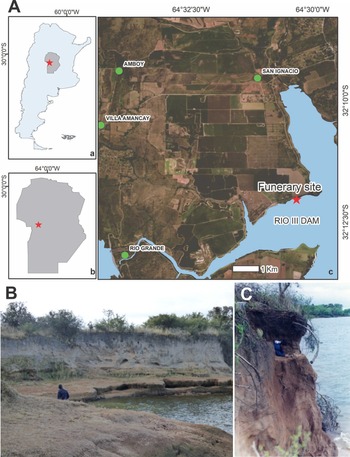
The funerary site is located on the banks of the Río Calamuchita Reservoir (Río III Dam), approximately 5 km north of the Río Grande, near the towns of San Ignacio, Villa Amancay, and Amboy in the Calamuchita Valley in the province of Córdoba, Argentina (Figure 1A–B). Today, this region is known as Sierras del Sur (Cabido et al. Reference Daniel, Cabido, Garré, Gorgas, Miatello, Ravelo, Rambaldi and Tassile2003), a mountainous area within the Chaco Serrano District with a temperate climate.
(A) Map showing the location of the funerary site in (a) Argentina, (b) Córdoba province, and (c) Calamuchita Valley; (B) general view of a sector of the coast; (C) the site at the time of the discovery (photographs by Daniel Álvarez). (Color online)

Local residents found the burial by chance in a ravine at a depth of 1.80 m. Several postdepositional processes resulted in the loss and deterioration of part of the anatomical pieces and the archaeological context. Given its location and the high risk of total destruction, it was excavated with archaeological techniques by paleontologist Daniel Álvarez from the Regional Historical Museum “Dr. Dalmacio Velez Sársfield” of Amboy (Figure 1C).
The 14C analysis was conducted at the Laboratory of Tritium and Radiocarbon (LATYR) at the Universidad de La Plata (UNLP) in Argentina. To calibrate the result of the laboratory analysis, we used OxCal version 4.4 (Bronk Ramsey Reference Bronk Ramsey2009) SHCal20 calibration curve for the Southern Hemisphere (Hogg et al. Reference Hogg, Heaton, Hua, Palmer, Turney and John Southon2020).
Bioarchaeological Analysis
We first recorded taphonomic variables, such as the degree of weathering (Behrensmeyer Reference Behrensmeyer1978), floriturbation, fauniturbation, and fractures (Lyman Reference Lyman1994); the degree of completeness (categorized as 25%, 50%, 75%, and 100%; Buikstra and Ubelaker Reference Buikstra and Ubelaker1994); and the integrity of the specimens (González Reference González2013). We then estimated the number of identified specimens (NISP), minimum number of elements (MNE), fragmentation index (FI = MNE/NISP), and minimum number of individuals (MNI; Buikstra and Ubelaker Reference Buikstra and Ubelaker1994; Lyman Reference Lyman1994; Mondini, Reference Mondini2003). Considering the anatomical elements and the degree of fragmentation, age-at-death was estimated based on the closure of the epiphyses (Brothwell Reference Brothwell Don1981) and dental formation and eruption (Smith Reference Smith1991). Sex estimation was based on characteristic cranial features (Krogman and İşcan Reference Krogman and Yaşar İşcan1962; Walker in Buikstra and Ubelaker Reference Buikstra and Ubelaker1994). Dental wear was recorded in the maxilla and mandible (Buikstra and Ubelaker Reference Buikstra and Ubelaker1994; Smith Reference Smith1984). We could not estimate skeletal laterality and height due to the high degree of long bone fragmentation.
Genetic Studies
We extracted ancient DNA from a canine tooth following the recommendations of Pääbo and collaborators (Reference Pääbo, Poinar, Serre, Jaenicke-Despres, Hebler, Rohland, Kuch, Krause, Vigilant and Hofreiter2004) to avoid exogenous DNA contamination. Hypervariable Region I (HVRI) of the mitochondrial DNA (mtDNA) was amplified and sequenced, and the maternal haplogroup was assigned. Chromosomal sex was assessed by PCR amplification of the amelogenin gene (see Supplemental Text 1 for further details on technical procedures).
Archaeomalacological Analysis
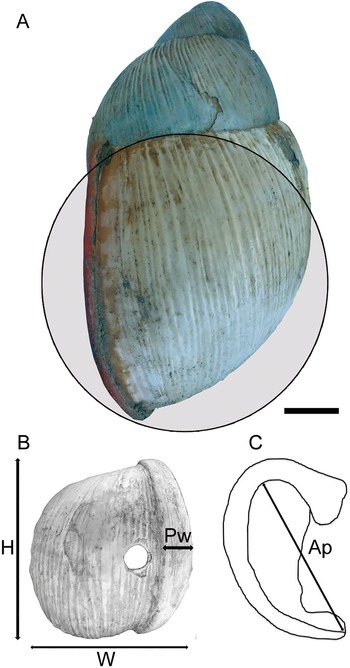
The quantitative unit used in the analysis was the number of human modified shell fragments (NF) or malacological artifacts. Given their characteristics, each artifact represents a different individual. Thus, the minimum number of individual animals (MNI) coincides with the number of fragments (NF). For taxonomic identification and artifact characterization, we considered size and morphological characteristics, such as the presence of peristome (a thickening of some gastropod shells) and external ornamentation (Gordillo Reference Gordillo2018). For each malacological artifact, we gathered the following data: weight, height, and width of the artifact; aperture size; peristome width (Figure 2; Table 1; see Supplemental Table 1 and Supplemental Text 2 for further details on technical procedures); presence of holes (perforations); and other macroscopic features observable to the naked eye, such as the presence of pigments.
Measurements obtained from each malacological artifact: H, height; W, width; Pw, peristome width; Ap, aperture size. (Color online)

Average Numerical Values Obtained from the Malacological Artifacts.

Characterization and Chemical Composition of Lithic Artifacts
The materials and chemical composition of a lithic bead and the stone axe were examined by scanning electron microscopy (SEM), energy-dispersive spectroscopy (EDS), and wavelength-dispersive spectroscopy (WDS). X-ray diffraction (XRD) was also used to study the lithic bead. These analyses were performed at the Laboratory of Electron Microscopy and X-ray Analysis (LAMARX-FAMAF-UNC) and at the Faculty of Chemical Sciences (UNC). The full details of these analyses can be found in Colombo and coworkers (Reference Colombo, Gisela Sario and Fabra2020). No microscopic results were obtained in the pestle analysis.
Results and Discussion
The results of the bioarchaeological, genetic, malacological, and lithic analyses are presented and discussed following the tripartite schema proposed by Scheper-Hughes and Lock (Reference Scheper-Hughes and Lock1987), as outlined in the introduction.
Individual Body
To analyze this body, we identified biological characterstics influenced by the social and cultural context: age, sex or gender, ancestry or kinship, congenital anomalies, and employment or occupation (Martin et al. Reference Martin, Harrod and Pérez2013:152). The antiquity of the human bones was confirmed with a radiocarbon dating of 3770 ± 90 14C years BP (LP 3623, human bone), which corresponds to a calibrated age of 4404–3850 cal BP (p = 0.954).
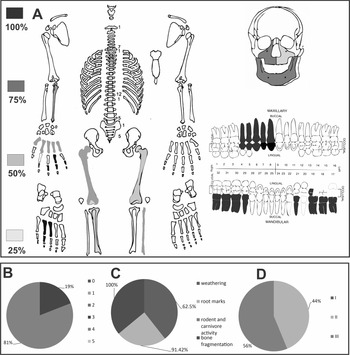
The sample has a NISP of 105 and an MNE of 24. The fragmentation index is high (FI = 0.22). We were able to identify elements belonging to the craniofacial skeleton (mandibular and maxillary); fragments of the ulna and radius, femur, tibia, and possibly left fibula; rib fragments; phalanges; carpals; metacarpals; and metatarsals. The first and second upper right incisors, the upper right canine, and both upper right premolars were recovered. In the lower jaw, the three molars from both sides, the second right premolar, and the first left premolar were present (Figure 3). The rest of the dental elements were missing. Due to the absence of parts of the maxilla and mandible, it was not possible to estimate whether the absence of teeth was pre- or postmortem.
(A) Degree of completeness of bone elements and dental elements recovered; (B) weathering; (C) taphonomic variables; (D) integrity.

The anatomical elements most represented are those of greater bone density and size. The skeletal remains are in a regular or poor state of preservation, fragmented, and with bone loss, particularly in the epiphyses. The degree of completeness is higher in the hands and feet bones (100%), followed by the skull (75%), and long bones (50% and 25%; Figure 3A). The most frequently observed taphonomic indicators on the bone specimens are weathering (degrees 3 and 4) and fragmentation (longitudinal fractures), followed by root marks (Figure 3B–C). The integrity of the remains is regular in most specimens (Figure 3A). We did not identify any alterations produced by rodents, carnivores, or humans.
The osteological analyses suggest that the human remains belonged to an adult male. Because the diagnostic elements of the skull or pelvis were not present, sex was determined from the characteristics of mental eminence (Buikstra and Ubelaker Reference Buikstra and Ubelaker1994). Male sex was then confirmed by PCR amplification of the amelogenin gene: fragments from both the X (106 base pairs) and Y (112 base pairs) chromosomes were observed. We determined adult status based on the complete eruption of the lower third molars (Scheuer and Black Reference Scheuer and Black2000) and the degree of closure of the metacarpal and metatarsal epiphyses and of the distal radius and fibula epiphyses (Mays Reference Mays2003). Because of the lack of additional diagnostic elements, it was not possible to further define an age range.
The DNA sequencing of a 400-bp region of the HVRI of the mtDNA and its comparison to the revised Cambridge Reference Sequence (Andrews et al. Reference Andrews, Iwona Kubacka, Chinnery, Lightowlers, Turnbull and Howell1999) revealed the presence of the diagnostic transitions for haplogroup A2: 16111T, 16223T, 16290T, 16319A, and 16362C. Additionally, the presence of the variant 16192T suggests that this sample may belong to the mtDNA subhaplogroup A2a or to the newly described subclade A2ay1 (García et al. Reference García, Nores, Motti, Pauro, Luisi, Bravi and Fabra2021). Finally, a mutation at position 16248T is unique to this A2 lineage.
Haplogroup A2, one of the main founder haplogroups widely distributed in the Americas, is present in 16.7% of the archaeological samples from Córdoba province and in 11.5% of the individuals in the Sierras region, which includes the Calamuchita Valley (Nores et al. Reference Nores, Fabra and Demarchi2011). The sample from Amboy is the oldest A2 individual in the province. Within A2, a mutation at position 16192, defining the subhaplogroup A2a, is found in very low frequencies in present-day individuals from Argentina (admixed populations from the provinces of Córdoba, Buenos Aires, Río Negro, and Chubut, as well as Mapuches from Patagonia), Brazil, Chile, and Peru. It is also found in an ancient individual from the Arroyo Seco 2 site in the province of Buenos Aires, Argentina, dated 6860 ± 60 years BP (Llamas et al. Reference Llamas, Schmitz, Valverde, Soubrier, Mallick, Rohland and Nordenfelt2016). Alternatively, the occurrence of the transition 16192T could be diagnostic of the lineage A2ay1, which was considered by García and coauthors (Reference García, Nores, Motti, Pauro, Luisi, Bravi and Fabra2021) to be a local clade that originated in Central Argentina. However, the lack of diagnostic information on the mtDNA coding region prevents us from precisely defining the maternal lineage of this individual. Finally, no modern or ancient sample analyzed so far carries the transition at position 16248. This pattern suggests that A2+16192-16248 is a local maternal lineage that could have originated in central Argentina, and its absence in later archaeological and contemporary samples could reflect its subsequent extinction during the late Holocene.
For reconstruction of the individual body, we examined oral conditions and pathologies that are considered progressive and therefore increase with age (Hillson Reference Hillson1996). All recovered dental elements showed severe dental wear, with almost complete loss of the crown, particularly on the occlusal surface: grades 6 and 7 according to Smith (Reference Smith1984). Regarding the pattern and shape of wear, there were observed variable direction planes, both in the upper and lower jaw (oblique from lingual to buccal, flat, or concave), which can be caused by physiological adaptation processes rather than parafunctional activities (González and Fabra Reference González and Fabra2018). As a result of wear, signs of alveolar retraction were observed, particularly in the upper jaw, which may correspond to compensatory eruption. Because of high tooth wear, no enamel defects, caries, or interdental grooves were observed.
Although there are several factors to consider when assessing the causes of tooth wear in archaeological populations—trauma, diet, extra-masticatory activities—it is likely to be directly linked to the degree of hardness of the food consumed and to cooking techniques (Hinton Reference Hinton1981). Regional archaeological information suggests that horticultural practices would have been introduced later, by 2000 years BP (Fabra and González Reference Fabra and González2019; Laguens et al. Reference Laguens, Fabra, Santos and Demarchi2009; Medina et al. Reference Medina, Pastor and Berberián2014). Thus, this individual would have lived in a community where hunting and gathering were the basic subsistence activities; hence, the inferred consumption of hard and fibrous food, meat, and even the bones of small animals would have caused stress on the chewing apparatus (Hinton Reference Hinton1981). A study conducted by González and Fabra (Reference González and Fabra2018) in populations in this region showed high rates of dental wear throughout the late Holocene caused by high masticatory pressure and the prevalence of flat dental wear, particularly in the Sierras region, from where this individual originated. The consumption of the hard fruits of the algarrobo (Prosopis sp.), chañar (Geoffroea decorticans), or even mistol (Ziziphus mistol; Recalde and Lopez Reference Recalde and Lopez2017; Tavarone et al. Reference Tavarone, Colobig and Fabra2019), as well as the processing techniques used and the incorporation of external particles during grinding, may all have contributed to generating these wear patterns (Heider and Lopez Reference Heider and Lopez2016). No dental tartar or tooth decay was observed. The absence of multicausal pathologies is probably related to the severe wear of the dental elements rather than to the dietary pattern.
Social Body
Analysis of his body, contextually situated, includes a detailed reconstruction of mortuary practices, body modification, gender expression, and other ways of embodiment (Martin et al. Reference Martin, Harrod and Pérez2013:153). Human remains were found on the bank of a ravine, at a depth of 1.80 m, in a stratum defined by a lighter, homogeneous silt sediment (loess). Above the remains lay a dark horizon of contemporary soil containing large clasts, without evidence of clay, and high contents of organic material and roots, with a thickness from the current floor level up to 90 cm deep.
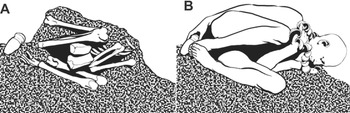
The first remains recovered were the snail shell beads on the edge of the ravine. The excavation then exposed the remains of the individual, inhumated in a left lateral decubitus position as a primary single burial (Figure 4A). The right upper limb was extended along the body, and the left arm was hyperflexed with the hand located on the right shoulder. The stone axe was held by or located near the right hand (Figure 4B). The lower limbs were hyperflexed over the thorax. The male was buried in a west–east (skull–feet) direction. From a series of photographs taken during the exhumation, we infer that the burial process began by placing this male in the pit in the same position in which he was found, with the necklace placed on his neck. Two unmodified rock fragments were placed between his two legs and above his left elbow. Although we have no material evidence of other elements used in the mortuary process, it is possible that the hyperflexion of the body was facilitated by the use of some fabric or leather. It is noteworthy that the positioning of the body is similar to others recorded in later burials in the valley (Zárate et al. Reference Zárate, González and Fabra2020) and in other areas of the province (Fabra et al. Reference Fabra, Salega and González2009); thus, we assumed that no taphonomic processes modified the original positioning. Surface archaeological materials (ceramic and lithic artifacts) have been recovered in other areas of the coast of the Río III Dam. Because this was an archaeological rescue, no systematic studies were conducted in the area. Intensive studies would have made it possible to verify or rule out the presence of other archaeological materials linked to this burial, which would allow us to consider this a multipurpose site. In the absence of other archaeological evidence, it would be interesting to think of this burial in the terms proposed by Cases and collaborators (Reference Cases, Rees, Pimentel, Labarca and Leiva2008) as linked to the archaeology of empty spaces.
(A) Position in which the human remains and artifacts were found; (B) reconstruction of the burial modality (drawings by Carlos E. Gómez).

Below the skull and in the thorax region, we recovered 22 malacological beads and a lithic round bead aligned on the left side of the body. In addition, a lithic axe was found at the feet of the individual. We were able to measure 20 malacological artifacts (two were broken at the time of analysis). Only one gastropod morphospecies was used: the native giant land snail from the genus Megalobulimus and attributed to the local species M. lorentzianus (see Supplemental Table 1 for average values of the malacological artifacts). All the holes in the artifacts were smaller than 10 mm and located in the midzone of the piece in a subcentral position near the peristome; they were subcircular, showing signs of polish. Finally, in 16 of the 20 beads, we observed traces of red coloration (pigment), either on the outer side (n = 3), internal side (n = 2), or both (n = 11); only four beads presented no visible signs to the naked eye. There was great uniformity in the mean weight of the ornaments and in the size of the shells. Each artifact (NF) was made with one snail specimen; therefore, at least an MNI of 22 different specimens were used.
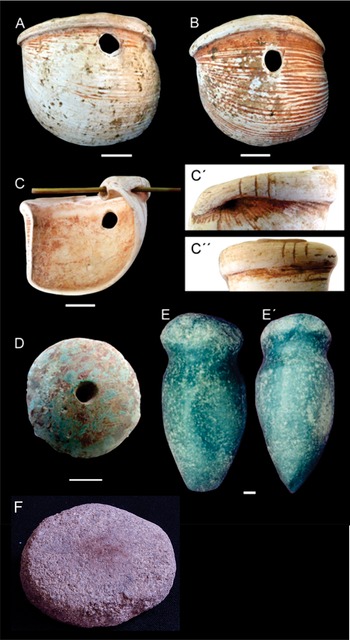
Figure 5A–C shows three of these malacological artifacts. The external coloration is whitish and opaque, and the peristome is purplish pinkish (Gordillo Reference Gordillo2018). Figures 5A and 5B are similar to each other, but 5C has two peculiarities. It includes the umbilical sector of the shell, and thus it has an opening or interior channel; this allows a thread or string to be passed through it, which is not possible in the other artifacts. It also has two sets of three parallel incisions (six lines in total) on the peristome (Figure 5C′–C″).
Elements found in the burial site next to the skeletal remains: (A–C) malacological artifacts; (D) lithic bead; (E) stone axe in frontal and lateral view; (F) mortar hand, top view (photographs by Sandra Gordillo and Mariana Fabra). (Color online)

The lithic bead (Figure 5D) was fashioned using polishing techniques in both sides and displays a conical hole in the central part. It is complete, weighs 29.5 g, and measures 4.18 cm (length), 3.94 cm (width), and 1.25 cm at the thickest part. The central hole has a diameter of 0.7 cm in one side and 0.3 cm in the reverse. The bead shows striations in different directions caused by the polishing process. It was carved from a heterogeneous material composed of quartz (locally stained with iron oxide) and a fine-grained mixture of muscovite (whitish to pale green or olive green), malachite (intense green), and a crisocola-like material (bluish green to pale green). Kaolinite was identified by XRD. Although it is difficult to estimate its origin, two options are possible: the raw material with which the bead was manufactured came from distant deposits, within a radius of between 100 and 200 km (such as Cerro Blanco near Tanti; Cerro Áspero in the Sierra de Comechingones, province of Córdoba; or from a similar geological environment), or it was collected from a nearby discrete outcrop (Colombo et al. Reference Colombo, Gisela Sario and Fabra2020).
The stone axe (Figure 5E) weighs 736 g and is 135.63 mm long; it is attached to the shaft in an area 28.49 mm long and 61.57 mm wide, with a groove. The active part (edge) is 26.71 mm long. We classified it as cuneiform. It shows a reduced head to a convex disc and a throat that in section forms a circle, located around one-quarter of the length of the stone axe. Macroscopically, the rock is dark gray with a fine-grained texture and appears fresh and compact. It is an intrusive igneous rock that, based on the modal percentages obtained with the SEM, corresponds to tonalite (i.e., mainly comprising quartz and plagioclase, with lesser amounts of potassic feldspar). Based on the petrography and chemical composition of the minerals, it is very unlikely that the axe was carved from materials collected close to the burial site. The most probable source of the rock are metaluminous dikes coming from the Eastern Sierras Pampeanas (Colombo et al. Reference Colombo, Gisela Sario and Fabra2020). We cannot confirm whether these objects were part of exchanges with other groups or there were exchanges of raw materials.
The pestle (Figure 5F) is polished on both sides because of friction activity. It weighs 162.6 g, measures 6.89 cm in length and 6.12 cm in width, and has a maximum thickness of 2.58 cm. The base has the shape of a pebble. The ends of the piece show evidence of impacts, with rock wear. In the center of this instrument, we observed residues of a red pigment.
There are several open questions to think about in reconstructing social identity. How was this male's identity constructed, in life and in his death, in connection with these materials? What happens after the death of a person, a situation that involves a physical and essential change in individual and collective identity? How do grave goods contribute to the identity construction of the person in different dimensions? How can we think of these objects when the person who made, carried, or used them dies? Or were these objects made to accompany this male in his mortuary ritual?
According to Laguens and Alberti (Reference Laguens and Alberti2019), mortuary rites are practices that allow the re-creation of individual and collective interrelations between socially and historically located humans, nonhumans, and things. These rites can be understood as social memories permeating bodies and objects; they are deeply ingrained social practices that allow understanding the world and the ontologies that govern them. Following Miller (Reference Miller1987), subjects are constructed as cultural subjects through the appropriation or use of external objects. Or, in the words of Olsen (Reference Olsen and Hodder2012), human beings are not independent of objects: they do not depart from them but emerge as subjects of such relationships.
We agree with Croucher (Reference Croucher, Carter and Philip2010) that the use of ornaments or other elements contributes to the construction of identity at the individual level; yet they can also transform social structures. Thus, it is important to note the role of these objects in the social identity of this person, in life or death, while distinguishing between materialities that have been part of the funeral accompaniment or the individual's grave goods. Following Berón (Reference Berón and Berón2018:287), we could consider as accompaniment the nonhuman materials included in the burial, which may have been used by the individual or been present in the grave because they are related to the cause of death, as in the case of projectile point tips. Conversely, grave goods could be specially prepared for any stage of the funeral ritual.
The use of mollusk shells can be traced back 75,000 years ago in South Africa (Henshilwood et al. Reference Henshilwood, d'Errico, Vanhaeren, Van Niekerk and Jacobs2004) and to more than 100,000 years ago in a Western Asian skull (Vanhaeren et al. Reference Vanhaeren, d'Errico, Stringer, James, Todd and Mienis2006), where beads made from marine gastropods were found. Beads produced from mollusks linked to human remains have also been reported in southern South America, such as the regions of Pampa and Patagonia (Cimino and Pastorino Reference Cimino, Pastorino and Berón2018; Ibáñez et al. Reference Ibáñez Saint Paul, Della Negra, Gordillo and Hajduk2018; Laporte Reference Laporte, Politis, Gutiérrez and Scabuzzo2014; Vignati Reference Vignati1930). In central Argentina, such beads were found by Berberián (Reference Berberián1984), who did not provide data on the sex of the individual, and by Fabra and coworkers (Reference Fabra, Gordillo and Piovano2012) and Gordillo and Fabra (Reference Gordillo and Fabra2018), whose findings are associated with female individuals. In our case study, these objects accompanied a male at his funeral ritual.
Regarding the necklace as an ornamental material, we found no indicators of use on the malacological artifacts. Because the findings are scarce both in the early and late Holocene, it is not possible to suggest a more frequent link with a particular sex. It is feasible, however, to claim that the presence of a necklace indicates that this person was significant to his community. Given the fragile nature of this material and the size and shape of the beads, the necklace can be interpreted as having been restricted to certain moments, as in ritual ceremonies or festivities. If it was fashioned for the funeral rite, it would be the only element of the set that could be considered grave goods. The mollusks that are linked to this burial are not believed to have been part of the dietary habits of these populations, in contrast to other sites where they were reported (Cimino and Pastorino Reference Cimino, Pastorino and Berón2018). They were possibly selected not only by virtue of their physical characteristics (hardness, color) but also because of their symbolic or spiritual features.
The remains of Megalobulimus shells in archaeological contexts have been recorded in Argentina, Brazil, Chile, Ecuador, Paraguay, Peru, Uruguay, and Venezuela; in many cases, they have been recovered outside their natural range, suggesting their high value and use in trade and exchange networks (Gordillo Reference Gordillo2019; Gordillo and Aschero Reference Gordillo and Aschero2020). Although in a South American context the main use of these shells would be ornamental (Gordillo Reference Gordillo2018, Reference Gordillo2019), there are also ethnographic records of use as a container for pigments or other substances associated with hallucinogenic paraphernalia (see Serrano Reference Serrano1945).
In the case of the axe, its use can be assumed prior to its inclusion in this grave because it has an active edge and complementary traces. The pestle has blow marks in its center that suggest its use in the processing of reddish pigments. Both the axe and the pestle would be elements used by this person or others from the community, considered significant in the life of this person, and were consciously incorporated into the mortuary ritual to accompany him in his death.
A change in the context of associations implies a change in relationships. In this case, in which the axe was probably used for woodworking and the pestle to grind seeds, fruits, or pigments, we wonder what new relationships would be developed between these objects and the subject after his death and their incorporation into the mortuary rite. Although no chemical analyses have been made yet, the similarity between the pigments found in the snail beads and in the pestle allows us to suggest an association between the presence of the pigments and their grinding at the time of the individual's death.
According to Laguens and Pazzarelli (Reference Laguens and Pazzarelli2011), everyday objects and those that are considered special are socially significant. If we think of objects resulting from relationships of different duration (Laguens Reference Laguens2008), they will keep that meaning so long as these relationships remain unaltered (Law Reference Law2000). Death can be understood as that phenomenon that changes relationships and therefore redefines the meaning of objects. We cannot view the relationship of this axe, pestle, or necklace dissociated from this funerary context.
The social identity of this male would have different dimensions associated with his age, gender, and role within the community. The material objects that were selected by his family or community members surely had meaning and were part of that identity, exceeding human life and transcending death. In agreement with Laguens and Pazzarelli (Reference Laguens and Pazzarelli2011), the objects—in this case, the axe, the necklace, and the pestle—can influence other entities with which they enter into relationship, producing certain effects or results. Here, the carrying of these objects (those that can be considered as accompaniment) is part of the social identity of this male in life and in death; for instance, the necklace may have fulfilled both accompaniment and grave goods functions.
Body Politic
This body is shaped by the political control exercised by different spheres or social institutions. The mortuary context, injuries derived from the use of the body or of traumatic origin, early death, or poor health can be read in terms of social relationships, roles, social status, or situations of conflict (Martin et al. Reference Martin, Harrod and Pérez2013:153).
Axes have been found with relative frequency in open-air archaeological sites associated with occupations between 1500 and 500 years BP and land-clearing activities, but they are rarely found in stratigraphy because of their high cost of elaboration, long useful life, and low discard rate, which is why their presence at grave sites becomes relevant. Axes recovered at the site of Potrero de Garay, also located in the mountain region of the province of Córdoba, were dated at 310 ± 75 14C years BP (Berberián Reference Berberián1984), but the earliest ones found so far are about 1500 years BP (Medina et al. Reference Medina, Imanol Balena, Coriale and Pastor2019). They are related to semipermanent villages in forested sectors of the mountain region of Córdoba, inhabited by peoples whose subsistence was based on a complementary strategy of hunting, collection, and horticulture on small plots (Laguens Reference Laguens1999).
The finding of this axe in a ~4,000-year-old grave allows us to think of the use of these objects several millennia earlier than proposed and fundamentally dissociates it from the exclusively horticultural use suggested by Medina and coworkers (Reference Medina, Imanol Balena, Coriale and Pastor2019). Instead, it was likely used for logging or wood processing or even as a weapon. It could be defined as valuable if we consider the investment of labor dedicated to its manufacture and polishing. The significance that the axe had as part of the social identity of this person is evidenced by its accompanying this male in his funeral ritual, thus bringing its active use to an end.
In the central region of Argentina in the transition between the middle Holocene (~8325–4250 years BP) and the late Holocene (<4250 years BP), following the subdivision proposed by Walker and coworkers (Reference Walker, Gibbard, Head, Berkelhammer, Björck, Cheng and Cwynar2019), studies suggest the development of certain technological and subsistence transformations that led to an increase in population density, a reduction in mobility circuits, and a process of intensifying the exploitation of resources such as vegetables and minor fauna. Likewise, political mechanisms, such as access to and delimitation of territories (Laguens and Bonnin Reference Laguens and Bonnin2009; Pastor, Rivero, et al. Reference Pastor, Diego Rivero, Diaz and Truyol2017; Rivero Reference Rivero and Salazar2015), were established to ensure social ties. Rivero (Reference Rivero and Salazar2015) proposed a model of social strategies based on pressures produced by population density after the middle Holocene. These pressures would have led to the use of low-investment lithic artifacts and increased usage of polished artifacts to process vegetables (such as the axe associated with this individual), of artifacts for ritual use, and of local raw materials, among others. These processes would coincide with a certain level of hereditary social inequality.
It has been suggested that both climatic change and population increase can explain the increase in social interaction, social status differences, search for prestige, and conflict in the mid to late Holocene transition (Clarke and Blake, cited in Laguens et al. Reference Laguens, Giesso, Bonnin and Glascock2007). The paleoclimatic record for the region of the eastern plains, 250 km to the northeast, indicates that around 4500 years BP, there was a shift in hydroclimatic conditions toward colder temperatures and scarce rainfall, causing a decrease in the flow of rivers and lakes (Piovano et al. Reference Piovano, Ariztegui, Córdoba, Cioccale and Sylvestre2009). In the Ongamira Valley, 200 km to the north, evidence shows that more humid conditions would have occurred after 3800 years BP (Izeta et al. Reference Izeta, Cattáneo, Robledo and Mignino2017). Additionally, a process of demographic increase and decreased mobility, starting from the middle Holocene, has been proposed at the macroregional level (Martínez and Gutiérrez Reference Martínez, Gutiérrez and Goñalons2004). During the late middle Holocene and the beginning of the late Holocene, the archaeological contexts for central Argentina suggest an increase in population densities and long-distance exchanges (González Reference González1960), the beginning of diet intensification and diversification processes, technological changes, and mobility of communities (Laguens et al. Reference Laguens, Giesso, Bonnin and Glascock2007; Pastor, Rivero, et al. Reference Pastor, Diaz and Tissera2017). At this time, even burial modalities differed from those practiced later, with simple primary burials coexisting with multiple secondary burials at the beginning of the late Holocene and no record of such mixed practices later (Fabra et al. Reference Fabra, Salega and González2009, Reference Fabra, Loupias, Salega, Tavarone, Guichón, Motti, Laborde, Martucchi and Valenzuela2017). In the Calamuchita Valley, particularly on the coast of Río III Dam, other human remains have been recovered in burial contexts (Zárate et al. Reference Zárate, González and Fabra2020), but none with this type of associated materials and antiquity. It is interesting to highlight a hunter-gatherer burial identified at the site of Central Nuclear 2 that differs from the analyzed one in this work because it is a secondary multiple burial, with a minimum number of five individuals, without any associated artifacts (Fabra and Pautassi Reference Fabra, Pautassi, Laferrere, Ribero and Diaz2009). From 3500 years BP, multiple secondary burials appear on the archaeological record (Fabra et al. Reference Fabra, Loupias, Salega, Tavarone, Guichón, Motti, Laborde, Martucchi and Valenzuela2017); there are also individual burials with evidence of greater elaboration in their construction—marked with stones, on an elevation, with greater visibility (Pastor, Rivero, et al. Reference Pastor, Diaz and Tissera2017)—that could be interpreted as indicating territorial claims and expectations of return to certain spaces (Prates and Di Prado Reference Prates and Di Prado2013). The co-occurrence of primary and secondary burials in the same valley, at the beginning of the late Holocene, suggests changes in the mobility strategies of hunter-gatherers and increased complexity of their social organization and rituality, reflected in the manipulation of bodies or the disposition of materials such as grave goods with certain individuals. The reduction in the mobility of hunter-gatherers could have resulted in greater use of nearby raw materials that were closer to housing sites, particularly by the end of this period. However, certain raw materials may have been obtained from relatively greater distances, especially for ornament making (Rivero Reference Rivero and Salazar2015).
Among the archaeological indicators of cultural mobility, mollusks occupy a prominent place within a symbolic space (Claassen, Reference Claassen and Cakirlar2011; Trubitt Reference Trubitt2003). The presence of marine mollusks in the central region of Argentina makes them elements of interest in terms of networks and exchanges (Gordillo Reference Gordillo2021a). However, the malacological materials recovered here, which represent a final stage within an operational chain of production, can also be recognized as prestige items, given that they came from areas far from the study area (regional but not local) and were scarce in burial contexts at the regional level (Gordillo Reference Gordillo2021b).
Long-distance interactions would have allowed the circulation and exchange of objects, including ideas, knowledge, and people. In our case, both the axe and the stone bead could have been produced from rocks located 200 km from the burial site (Colombo et al. Reference Colombo, Gisela Sario and Fabra2020). Similarly, the absence of the fossil Megalobulimus lorentzianus in the outcrops of this region suggests that the origin of the species could be traced to northwest Córdoba, 300 km away, where fossils at least 7,000–6,500 years old have been found (Gordillo and Boretto Reference Gordillo and Boretto2020). These objects produced with nonlocal raw materials would have participated in spheres other than just the economic one in ritual activities and would possibly be linked to the social status of those individuals or communities who obtained, produced, used, or carried them. Laguens and collaborators (Reference Laguens, Giesso, Bonnin and Glascock2007) have proposed that the appearance of these goods may suggest changes in social organization, where differences between people can be inferred from the material point of view. The social differentiation, as evidenced by a greater monumentality in the preparation of the tombs, can also be traced to 3500–3000 years BP, as proposed by Pastor, Diaz, and Tissera (Reference Pastor, Diaz and Tissera2017) based on the discovery of an elevated tomb at the Resfaladero de los Caballos site in Traslasierra Valley.
If we follow the interpretation of Pastor, Gordillo, and Tissera (Reference Pastor, Gordillo and Tissera2017) for a contemporaneous finding of Megalobulimus beads of about 3900 years BP in the Punilla Valley, the necklace could be thought of as a multisensory sound element (in addition to a visual one) to be used within a restricted ritual space. These artifacts were similar to those found in our work: they also had red pigments and were in opposite pairs. Thus, their visual and auditory quality, their size, and particularly the facing position of at least two beads also allow us to suggest the use of the necklace in ritual activities in a context of changes in the hunter-gathering societies of the region.
The construction of the social body and the existence of materialities linked to the person in life or exclusively made for its mortuary accompaniment—particularly those defined as ornaments such as the necklace—can be thought of as associated with the creation of a prominent social identity in the community. The axe, the lithic bead, the pestle, and the necklace are intertwined in networks of relationships that exceed their original or primary functions and acquire secondary roles (Laguens and Pazzarelli Reference Laguens and Pazzarelli2011) that would contribute to reproducing the differences in social roles between this individual and other members of his community, materializing relationships between objects and humans.
Conclusions
The social perspective in bioarchaeology, particularly an approach such as that proposed by Scheper-Hughes and Lock (Reference Scheper-Hughes and Lock1987), allows the reconstruction of individual, singular life stories in a narrative that accounts for three overlapping spheres: biological, social, and political. The “three body” framework has been applied for the first time in central Argentina in this case study, and the characteristics of the burial and its preservation show both its potential and its limitations. Its potential lies in rethinking the bioanthropological and archaeological information recovered to link it more closely to how biological, social, and political aspects influence the bodies. As mentioned by Martin and collaborators (Reference Martin, Harrod and Pérez2013:72), the application of this model allows for a multidimensional interpretation of the data. Its limitation, at least in this case study, is in the weight given to the mortuary context, because it was not possible to estimate age or height nor to detect, at least macroscopically in the recovered bones, pathological lesions of different origin.
The presence of objects that can be considered as funerary accompaniment or grave goods and their antiquity, going back to the beginning of the late Holocene, distinguish this burial in a regional archaeological context. It is interesting to think of the ruptures and continuities that this burial reveals. On the one hand, the use of large Megalobulimus shell beads could be restricted to this period, given that more recent findings of beads have shown other morphologies and different manufacturing techniques. On the other hand, axes like the one that accompanies this male are frequently found at open-air sites dated to the later late Holocene, although this is the earliest finding of an axe in a mortuary context. Considering the morphology and style, as well as the raw materials used in manufacture, these axes reveal ways of doing things shared over several millennia, which reflect continuity in the mode of understanding and relating to the world by the populations of hunter-gatherers of the hills of central Argentina. This work provides novel evidence to address the issue of the construction of social identity and the emergence of differences between individuals, materialized from the presence of certain objects, at the beginning of the late Holocene.
Acknowledgments
This research was financed by PICT 2015-3155 grant (FONCyT), CONICET (PUE 2016 IDACOR), and is part of project PICT 2020-2701. We are grateful to Daniel Álvarez and Marcelo Maldonado, who provided useful information on the site and the conditions of the archaeological finding. Carlos E. Gómez also helped us with a drawing that reconstructs the position of the different elements in the burial context. We thank Marcos Salvatore for the map in Figure 1 and Graciela Cabana for manuscript revision.
Data Availability Statement
Bioanthropological collections analyzed in the present study are curated in the Regional Historical Museum (Amboy, Calamuchita Valley, province of Córdoba).
Competing Interests
The authors declare none.
Supplemental Material
For supplemental material accompanying this article, visit https://doi.org/10.1017/laq.2022.39.
Supplemental Text 1. Genetic Analyses.
Supplemental Text 2. Archaeomalacological Analysis.