1. INTRODUCTION
The composer Constança Capdeville (1937–92) is a significant figure in contemporary Portuguese music who created a large number of music theatre works. These works comprise various different elements (e.g., music, text, gesture, image, recorded sounds on tape, props, costumes, light) which are treated as being in counterpoint Footnote 1 to each other as well as being combined. Music theatre is a performative genre that goes beyond clearly defined canons (e.g., opera) and challenges conventional forms, which in turn sets new performance challenges for musicians:
New music theatre is situated in the tradition of the 1960s and is linked to composers like John Cage, Mauricio Kagel, Dieter Schnebel, Vinko Globokar or György Ligeti. This form of music theatre arose, in short, out of a theatricalisation, that is, a performatisation of music-making itself, and out of an expansion of the concepts of material and composition to include extra-musical, visual realms – and thus out of a position of independence from, and implicit rejection or open criticism of, the bourgeois art form of opera. (Rebstock Reference Rebstock, Brauneck and ITI2017: 534)
Capdeville’s works are interdisciplinary by nature as they contain explicit theatrical elements and are intrinsically scenic: music and theatre are seen as one. They represent a new attitude to musicians’ activities on stage and for Capdeville there are no boundaries. The performers act, mime, use percussion instruments, play on the body of their instruments or on other objects integrated into the scene, or they interpret their instruments in unconventional ways or in unusual positions. Capdeville’s approach to gesture is key: it must serve the sound.
There are traces of the composer’s collaborative creative process in a wide variety of sources (scores, scripts, audio or video recordings, composer/musician sketches, notes, press reviews, images, slides, lighting directions, musical assistants), Footnote 2 and her work is characterised by the use of specific compositional processes and performance practices, and by collaborations with a multiplicity of authors, performers and technicians from different artistic fields. This complex process raises problems in terms of preservation. Most documentation of Capdeville’s music theatre works has still not been gathered properly, or it is not in good condition (e.g., the tape collection), and moreover there is no articulation and systematisation of the existing information in order to restore the performance of her work. This renders any analysis of her works problematic. Hence, it is essential to recover and safeguard all such materials, including the technological resources (even those that are obsolete in the current context), and to organise and document them. I will focus on the possibility of documenting music theatre works with the aim of preserving them, by both collecting and producing documentation through collaborations and interaction with the sources and performers.
Access to the materials is not straightforward as they are scattered across various locations and some formats are obsolete, which puts them at risk of being lost. The understanding of aspects of the performance and of the collaborative creative process are partially dependent on the documentation, but the testimonies of former performers are also essential. The inconsistency of the documentation and the lack of previous studies on the work’s production hampers the analysis and preservation of Capdeville’s music theatre pieces, but it is possible to address this by using a type of musicological archeology.
2. DOUBLE (1982): CONCEPTION AND DUALITIES
Double (1982) by Constança Capdeville is a paradigmatic music theatre work that illustrates the difficulty of analysis by conveying several musicological efforts in methodological terms. Its complexity and interest lie in its rather cryptic and hasty notation, which was also typical of improvised music by contemporaries of Capdeville such as Mauricio Kagel, Dieter Schnebel, Sylvano Bussotti, Luciano Berio and Luigi Nono. Also, the duality implicit in Double creates some analytic problems. For example, at various moments in the work, there is an interaction between the pianist and their double (the magnetic tape), which creates complex and dense textures that overlap and give the illusion that all these sounds emanate from the piano. The same thing happens with the other instruments and their doubles. This superimposition of structures happens in several works by Constança Capdeville, but it is most prominent in Double, in which an enormous aural density is generated.
Double was commissioned by the Calouste Gulbenkian Foundation (FCG) for the Sixth Gulbenkian Encounters of Contemporary Music (EGMC) in 1982. The work was written for voice, cello, piano, two percussionists, Footnote 3 mute choir, two magnetic tape recorders and light, and it is divided into ten sections: prologue, eight interventions Footnote 4 and epilogue. The only performance that took place featured António Wagner Diniz (baritone), João Paulo Santos (piano), Luísa Vasconcelos (cello), Jorge Peixinho and João Heitor (chess player–percussionists), Carlos Alberto Augusto Footnote 5 (tape recorder operation) and dancers from Dança Grupo (mute choir).
Concerning Double’s conception, in a programme note (sketch) from Capdeville’s collection, Footnote 6 the composer wrote that there were two fundamental lines to consider: 1) the coexistence of auditory and visual situations (sound, gesture, light) through the transformation of sound aspects into visuals (e.g., the use of light as a timbre function) and vice versa; and 2) the different interpretations of the element of time, Footnote 7 in which an instant is seen as a single habitable space, with an overlap of instants that favour verticality over horizontality, Footnote 8 creating time that can be excluded or ignored.
Double, as the title suggests, is built from various kinds of duality: the scenic-musical duality, which is expressed through the relationship between the aforementioned visual and the auditory situations and is typical of Capdeville’s aesthetics; the interaction between the performers and their doubles, to which the performers must react while also having their own path through the performance; and the visual and sound contrast between the players, each of whom is constantly integrated with their double into the whole, almost like a game. Each musician has their double, whether transmitted by the tape recording (which sometimes doubles the sound of live instruments) or transmitted by the images (e.g., there is a large mirror next to the piano that reproduces the image of the pianist, and occasionally person and reflection interact, giving some cues for entrances to the scene) or transmitted by the duplication of voices. In an interview with musicologist Manuel Pedro Ferreira, Capdeville said: ‘I want everything to be one, nothing lives independently, all elements are justified and live as one’ (Ramalho Reference Ramalho1982: 5). This statement is a good reflection of the idea behind Double, which consists of an overlap of elements that are harmonised to constitute the whole. Also, the programme note mentioned earlier indicates that the presentation of a vast number of simultaneous events distinguishes two aspects: the external counterpoint (visual elements) and the internal counterpoint (sound elements). The coexistence and cohesion of all these elements in the same time and space materialises the theatricality inherent in Capdeville’s work.
3. DOCUMENTING DOUBLE: COLLABORATIVE ASPECTS WITH THE COMPOSER
Double is composed of diverse layers of texts, sounds and images whose interrelation gives density to the work. Capdeville always referred to her particular concern with musical time and timbre research (Ramalho Reference Ramalho1982: 3). Although time can be arranged, it is always a transitory moment: it is an irrecoverable instant. This temporal perception is also evident in the way the composer considers and creates the recordings used in her performances. The magnetic tape recordings in Double are the result of several experiments that the composer carried out in previous years, Footnote 9 and it is the first time that she uses two tape recordings simultaneously in a live performance. The musical instruments and recorded sounds are so close that occasionally the distinction between them is imperceptible. Tapes play a crucial role in Capdeville’s music theatre works and it is therefore essential to preserve them in order to restore the work. Yet, considering the temporal issue in Double, Carlos Alberto Augusto noted that:
there is clearly, in this regard, an exploration, in Capdeville’s way, of the Cagean concept of randomness. The recorded part has a necessarily fixed time dimension. The part of the instruments, despite being often written or noted accurately, contains relative durations, since there is no absolute metronomic or temporal reference. The result will therefore always be random. The recording will always have the character of an absolute reference (temporal) above which the instruments slide, with fixed durations, but mobile in relation to the recording. Footnote 10
When it comes to the documentation of Double, the materials are scattered across several sources, as mentioned earlier. Besides the main collection belonging to the composer herself, currently housed at the National Library of Portugal (BNP), most former performers have kept their own materials in their private collections (with instructions written by the composer or by themselves) and these should be part of the main collection. It is therefore important to gather all the materials in order to systematise all information related to the work. My research methodology for studying Double included interviews, which helped articulate and solve some of the issues linked to the inconsistency of the available information. Interviews with the mute choir are an interesting example as I discovered a script that was specifically created for them, but I did not know its function in the work, nor which actors performed this role. Some of the interviewees did not remember that Dança Grupo had been part of the performance, so I had to dig a little deeper to discover their role and found that Serrão referred to participants from Dança Grupo taking part in Double (Serrão Reference Serrão2006: 33). Dança Grupo was directed by Elisa Worm at the time and she confirmed the presence of the group in the performance. It was also a challenge to access the scores belonging to the performers who participated in Capdeville’s performances as it was not easy to locate the performers, and when I traced them some did not remember the experience or could not find their materials or, simply, they had passed away. This search for new materials scattered across various sources and the need to locate and interview the main actors involved in the original performance led me to think of the research as musical archaeology, a way to get new knowledge about the work and understand hidden aspects of the performance and the collaborative creative process, which in my opinion is essential for the renewal of any music theatre work.
Most of the available information concerning Double belongs to Capdeville and it is currently stored at BNP. There one can find the following documentation:
-
One original score
-
Copies of scores (with different instructions)
-
Full score on acetate sheets (transparencies)
-
Sketch for the programme note (manuscript)
-
Sixth EGMC programme
-
One photo
-
Composer’s notes/sketches
-
Scripts (for sound, light and mute choir)
-
Two original tape recordings (Tape 5 and Tape 6). Footnote 11
These materials, in addition to the interviews with the various participants, constituted the starting point for the study of Double and its systematisation. The methodology used in this study was based on the systematic analysis of the tape recordings and the comparison of the various documents comprising the work. The recordings were compared with the scores and the scripts (sound, light, mute choir), and all additional documentation (composer’s notes/sketches, pictures, programmes). Initially, through studying the existing materials at BNP, it was thought that the recreation of Double’s aural structure would be impossible, since a lot of information was missing. Even though the sound retrieved from the two tapes gave a good foundation, it did not indicate how the various layers of material were articulated. The data were not clear: it was not known when the tapes entered the performance, if they were launched and heard in full or if the succession of recorded sounds was heard only in particular moments. Capdeville’s music theatre works are intrinsically scenic, and the connection between visual and sound elements is really prominent. On the other hand, the fusion between the various doubles hinders the distinction between acoustic and recorded sounds, so a video or audio recording of the performance from 1982 would be desirable, as it would facilitate the recovery process, but in the specific case of Double there is no video of the performance.
3.1. The text(s)
In most of Capdeville’s works, the composer uses texts in a seemingly random way or without a specific order. The texts, phrases or words are often deconstructed, but these choices are essentially due to her interest in the sound of the words or the phonetics. Through the performance, these fragments are interrupted, overlapped, repeated and deconstructed; subtexts are created offering various readings.
In Double, the following phrases or text fragments are used: Footnote 12
-
1935 Picasso Manifesto (fragment)
-
‘Voi ch’entrate (lasciate ogni speranza)’ and ‘Et facta est (lux)’, extracted from Inferno by Dante Alighieri (Capdeville uses passages of both texts)
-
Si La Rivoluzione Paranoico Criticizes L’arcangelismo Scientifico by Salvador Dalí (fragment extracted from the painter’s book)
-
Something is happening, but you don’t know what it is, do you know Mr. Jones? (phrase used)Footnote 13
-
Crucifixus (fragments of the poem, with the word being deconstructed or disintegrating, e.g., see following text)
-
Fik
-
Sik
-
Fixus Cixus
-
Cifixus
-
Cificixus
-
Crucifixus
-
Rex Absconditur or Wo bist du (single sentences)
3.2. Sources on tape
As this study progressed, a tape recording was found at the Gulbenkian Archives that corresponded to Double’s debut in 1982 (which I call the FCG Tape) that proved to be essential to understanding the articulation between the different layers of material and the distinction between acoustic and recorded sounds. However, in addition to the FCG Tape, the location of the score belonging to Augusto, who collaborated with Capdeville in recording the tapes used in the performance and in operating the magnetophone during the performance in 1982, was essential for this study, as it contained specific instructions about tape inputs. Thus, the FCG Tape (the tape recording of the live performance in 1982) and Augusto’s score enabled the process of recreating Double’s aural structure (see Figure 3). Moreover, the interviews with artists involved in the performance proved key to this study, helping to locate the various actors and allowing the production of new documentation regarding the work. For the analysis of tape recordings, the methodology adopted is grounded in the act of active listening, advocated by Alain Bonardi, based on the set of interactions between listeners and musical documents (Bonardi Reference Bonardi2000: 12). The FCG Tape and the original Tape 5 and Tape 6 (used in Double’s performance in 1982) were compared with additional documentation such as the scores and scripts (sound, light and mute choir). Active listening promoted an articulation between the various elements, except for the scenic part, as there was no chance to access videos from this unique performance. Through complementary information (e.g., composer’s notes explaining aspects of the movement and gestures specifically linked to the mute choir, the singer, the cellist and the pianist), it was possible to understand, albeit incompletely, the scenic elements. However, there is much more to explore in this regard; for a more detailed analysis of the work, it would be crucial to access the scores of the singer, the pianist and the cellist, since particular notes were written for the musicians, in the same way as the score belonging to Augusto (the sound technician) included specific notes about the entrances of the recordings that do not appear elsewhere.
Dança Grupo. Courtesy of Luísa Vendrell.

Location of musicians on stage in Double (1982). With permission from BNP.

Double’s aural structure

3.3. The mute choir
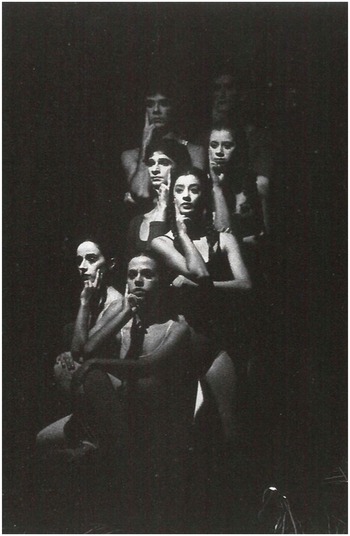
With regard to the mute choir, the information was initially scarce. However, the choreographer Elisa Worm, who did not remember in detail the performance of Dança Grupo in Double, suggested contacting the dancer Luís Carolino, who confirmed that the mute choir had indeed participated in Double’s debut. Carolino recommended getting in contact with other members of Dança Grupo, and after talking with dancers such as Luísa Vendrell, she provided a photo (Figure 1). Also Luís Carraça, another of the dancers contacted, provided information about their performance on stage. At the time, the members of Dança Grupo were Carlos Piçarra, Helena Vaz, Luís Carraça, Luís Carolino, Luísa Vendrell, Luísa Palha and Rosalina Santos. Elisa Worm also recalled the importance of the collaboration with choreographer Paula Massano (1949–2012), as they worked together to conceive the choreography. Footnote 14
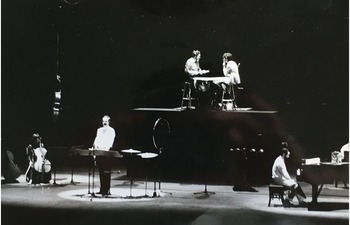
Carlos Piçarra remembered that the mute choir was not at the level of the stage – they performed on a higher platform and made gestures with their hands, composing figures (e.g., goddess Kâli). The dancer also recalled that the group was lit with an effect that gave the impression of hidden figures, and broken lighting that was designed to show they were acting as open and ephemeral syllables. The mute choir did not emit any sound, the sound of their voices was previously recorded, and during the performance Tape 6 reproduced all the mute choir’s sounds, while the performers made movements and opened their mouths as if the sound that came from the magnetic tape was coming from the dancers. At Double’s debut, there was a chess game between two percussion players who also did not emit any sound; the two performers were seated in high chairs and used timpani as a table. They were also raised on a platform (Figure 2) and their only action was to play the game. The percussion part (as it was referred to by Capdeville) of the chess players was accompanied by the second movement of Beethoven’s 3rd Symphony (Funeral March).
4. REBUILDING DOUBLE’S AURAL STRUCTURE: TAPES (SOURCES) VS TAPES (ELECTRONIC INTERVENTION)
4.1. Analysing excerpts of Double using iAnalyse
The iAnalyse software developed by Pierre Couprie allows musicologists to access a set of different files (images, sound, markers, among others), helping to interpret a work. Footnote 15 I chose iAnalyse to analyse some excerpts of Double, mainly because the software helps in carrying out analytical schemes that make it easier to visually understand the composer’s collaborative creative processes. It was particularly useful for the musical analyses and listening guide. Double is a music theatre work that includes electroacoustics (sounds recorded on tape), and the way it is represented goes beyond the traditional score. Capdeville wrote a full score, not in conventional notation, but using graphic marks and instructions. The individual scores for each performer are like the full score but with the addition of specific instructions written for that part. For example, in the pianist’s score, Capdeville drew screws to highlight a certain section in which the pianist would play the piano by pulling on the strings with a screw; she created her own symbol to represent the sound of the gong (which could be recorded or played live); she drew a kind of dotted cloud to indicate wind chime sounds (once again recorded or live); she made drawings of crotales and drumsticks to specify that the player should use them at a certain moment. Thus, to communicate her ideas, the composer represented gestures or recorded sounds with visual symbols that are not characteristic of conventional musical notation. In the existing documentation, there are also scripts (for sound/the electronic part, lighting and mute choir) that explain some aspects of the performance that are not included in either the composer’s score or the individual performers’ scores. Consequently, this poses a question: how can we analyse a work that is not linear in a traditional sense? The iAnalyse software was particularly important for the analysis of Double because on the FCG Tape, and we can hear several elements of the performance that are not written in the score. As iAnalyse allows the identification of elements that are not mentioned in the score, it serves as a listening guide. Footnote 16 For this article, I opted to analyse the following interventions: Prologue and Intervention 1, Intervention 4 and Intervention 5. Footnote 17
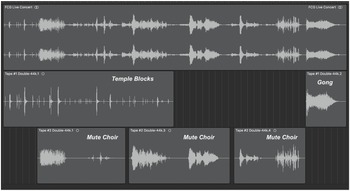
In Video Example 1, the Prologue and Intervention 1 are linked together, and audibly it is difficult to perceive the moment when the Prologue switches to Intervention 1. The Prologue begins with a sequence of recorded maracas, followed by a monologue including Picasso’s Manifest, vocal effects, a continuous background sound and wood sounds. Then the sound of a gong occurs. Capdeville called the gong sound generic and it appears occasionally throughout the monologue, then the sound of screws are introduced, in which the pianist plays the piano by pulling on the strings with a screw and the same effect is reproduced by the tape recording. Intervention 1 starts with this sequence of screws, then the recorded voice enters with ‘Voi ch’entrate’ (on Tape 6); after this the singer slaps their mouth and intones live the expression ‘Et facta’ (Video Example 1). In the video representations, the blue and purple markers on the score correspond to recorded sounds; live sounds are marked in red. Occasionally, the colours of the markers change when voices appear. Video Example 2 corresponds to Intervention 4 entitled ‘Rex Absconditur’. In this intervention recorded voices are combined with live spoken voice. The piano and the cello interact by playing a chord with space between each note. The intervention ends with the live expression ‘Nha-Cque’ spoken by the voice and accompanied by Barrica Indiana and cello (Video Example 2). Finally, Video Example 3 represents Intervention 5, in which several elements are combined. There is live voice, live cello, flexatone (played by the pianist), Tape 5, with a recorded solo of temple blocks, and Tape 6, which reproduces recorded interjections ‘Ah!… Hey! and so on…’ representing the sounds of the mute choir which, in turn makes expressions and gestures that do not emit any sound. At the end of Intervention 5 a recorded gong (from Tape 5) is heard; this sound is not mentioned in the documentation available, and this is discussed in section 4.2 (Video Example 3). The systematic study of recordings and the comparison between recordings, scores and other documentation is crucial to recovering works involving audio components. For example, when the recording merges with the live sound, the analysis of the waveform allows us to distinguish between recorded or live sounds, as shown in Figures 6 and 9.
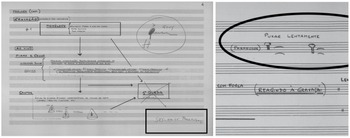
Double score: end of Intervention 2. Indication of tacet in the recording part. With permission from Carlos Alberto Augusto.

Double score: end of the Prologue and sequence of screws on the piano, which is the beginning of Intervention 1. With permission from Carlos Alberto Augusto.

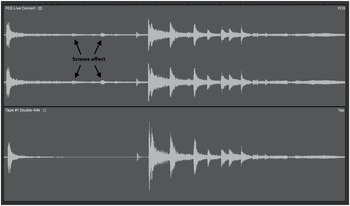
Waveform representation of the screws effect: live (FCG Tape) and recorded piano

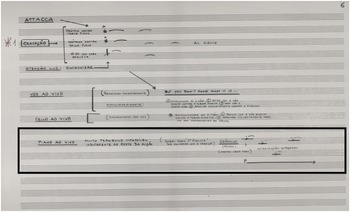
Double score: end of Intervention 1. With permission from Carlos Alberto Augusto.

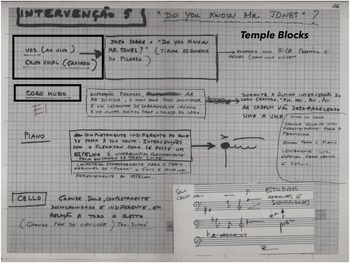
Double’s Intervention 5. With permission from Carlos Alberto Augusto.

Representation of the waveforms of the recordings used in Intervention 5: FCG Tape, Tape 5 and Tape 6, respectively.

4.2. Tapes (sources) vs tapes (electronic part)
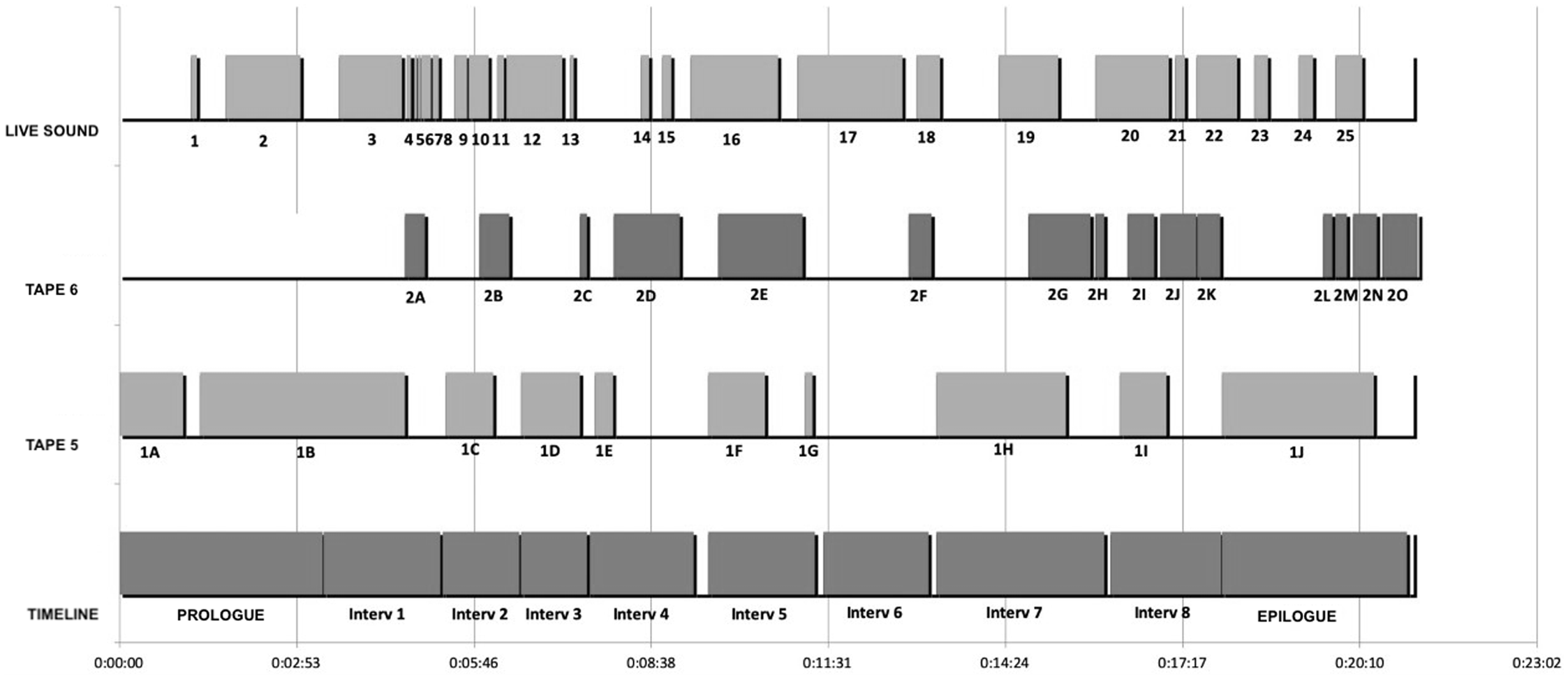
The graph in Figure 3 represents the aural structure of Double as conceived from the systematic analysis of the three existing tape recordings. The lack of a video recording of the performance means there is limited information on the lighting and scenic gestures or movements, so I opted to examine the sound elements, both recorded and live, in more depth in order to characterise the sound and observe the interactions between the tape recordings and their doubles (the performers who played live). However, as the composer gave the same importance to all elements of the work, and as the interaction between elements is central to its identity, whenever possible, scenic and lighting components have been indicated based on the remaining documentation (e.g., score, scripts, figures, images and composer’s suggestions).
The recordings combine manipulated sounds, especially through games with the doubles in which recorded and live sounds are heard and result in overlapping effects on the voice or instruments, which are often difficult to distinguish aurally. For this reason, when analysing the three recordings (FCG Tape, Tape 5 and Tape 6), it was necessary to compare the full score, the sound script and the score belonging to Augusto. Aural analysis was facilitated by Sonic Visualiser, which allowed the observation of the waveforms from the recorded sounds and the comparison of sounds that occasionally raised doubts (e.g., recorded gong). The software also served to determine the duration of each intervention and each sound. The sounds in the original tape recordings (Tape 5 and Tape 6) are prepared sequentially without overlapping elements. Both tapes were recorded at Capdeville’s house, in cooperation with Augusto, therefore without a ‘studio’ and without time constraints, as he himself says. Footnote 18 Augusto noted that in Double the tapes acted as a musical instrument, and his role, as a technician, was to materialise the composer’s ideas in technical terms. At the time, the recording of these tapes required several meetings with the various actors at Capdeville’s home. There, the performers recorded their doubles. For example, the baritone Wagner Diniz recorded the excerpt of Picasso’s Manifesto and texts ‘Voi ch’entrate’ and ‘Et facta est’ from Dante Alighieri’s Inferno. The cellist recorded the continuous solos, which were then mimicked during the performance, as well as pizzicato effects and attacks. The pianist recorded effects on the prepared piano. Often when these recordings were played back on tape during the performance, the pianist did not play the piano and performed other tasks, such as mimicking playing the gong (a gesture frequently used in Double); at other moments, the pianist interacted with his double (the recording or the mirror), with both performing the same effects, making it difficult to distinguish the pianist from his double. The mute choir recorded ironic vocal expressions, such as laughs, whispers, breaths, ‘ahs’ or ‘heys’; however, this was a scenic-visual part, as the choir just pretended to emit these sounds while performing certain movements.
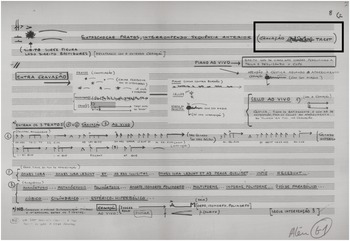
Double’s aural structure (Figure 3) has a timeline (the FCG Tape) divided into 10 sections, showing the duration of each intervention in minutes and seconds, as well as the remaining elements of the recordings (Tape 5, Tape 6 and the FCG Tape – the live sound heard throughout). The timeline also indicates that the work lasted around 21′03″, with the longest sections being the Prologue and Epilogue, lasting 3′18″ and 3′, respectively. The duration of the other interventions varies from 1′ to 3′. Figure 3 shows the sounds from Tape 5, Tape 6 and live sounds, which may have been intertwined with the recordings, therefore they are inaccurate in terms of duration. This structure helped to determine the relationships between the various recordings, allowing an understanding of their interaction; one can see how the sounds would have been played live and recognise, albeit with some difficulty, the duality of the recordings and live sounds, and see whether the recordings are simultaneous or asynchronous and identify their durations, including the silence. The restored structure also gives an overview of how the recordings are introduced during the performance. It would be very difficult to grasp the whole sequence from the score alone. As Tape 5 and Tape 6 were recorded sequentially, this organisation is maintained for the complete structure (Figure 3). Tape 5 comprises mostly instrumental sounds; and Tape 6 essentially includes the sounds of voices, although some sound effects from percussion, woodwind, cello and marbles (as an effect on the piano strings) are also heard. Turning now to the inputs and outputs of Tape 5, Tape 6 and FCG Tape, the Prologue and Intervention 1 are linked and it is difficult to hear when the Prologue moves into Intervention 1. Some interventions are divided by moments of silence. This could also serve to indicate changes in the different instrumental layers. In scores, silence is generally indicated as tacet (see Figure 4). In the score shown in Figure 5, the symbol of a gong appears with fortissimo (ff) in the circle, meaning that the recording of the gong should enter at that moment. Capdeville called the gong sound a generic moment; sounds of recorded wood are simultaneously heard, which end shortly afterwards, as if announcing a change. This generic moment links with the recorded sequence of screws (see square and ellipse in Figure 5), an effect recorded on Tape 5 (in which the pianist slowly drags screws across the piano strings).
In the sequence using screws, the pianist starts interacting with his double (Tape 5), performing the same effect but live, a moment in which live sound mixes with the recording. This moment is also the switch to Intervention 1. In the sound script, the Prologue and Intervention 1 are written on the same page: there is no exact division. The Prologue starts with a sequence of recorded maracas and then live maracas are heard, next both recorded and live sounds start to blend, then it turns into live maracas only. The pianist João Paulo Santos described how the composer recorded the sound of maracas saying that Capdeville used sugar packets (Magalhães Reference Magalhães2020: 261) as she was not satisfied with the real sound of the maracas and decided the sugar packets gave a better result for the recording. The amalgamation of recorded and live sounds happens quite frequently throughout Double – the effect of the screws is another example. Figure 6 shows the waveforms of the FCG Tape and Tape 5. The visualisation of the sonograms allows us to understand in which moments the performer plays live and how the interaction between the player and their double occurs (Tape 5). In the same figure, we can see that after the attack on the piano, the performer pulls the strings with a screw at least twice but, as expected, these sounds do not appear on Tape 5. At the beginning of the FCG Tape the line of the waveform is fuller, which is normal because this waveform resulted from the capture of the remaining frequencies emitted in the concert hall. The line of Tape 5 is smoother because only the sound of the piano is captured in the recording.
On Tape 6, the sound of crotales is produced by striking them against the beam of the piano or inside the piano box and wind chimes are struck with a drumstick. In Augusto’s score it is indicated that Tape 5 gives the input (*1). However this information is wrong because the sound relating to the crotales is recorded on Tape 6 (it should be indicated in the score as *2), and it was possible to confirm this by listening to the recordings, as well as through the sound script when it refers to Tape 6 (see Figure 7).
Intervention 5, entitled ‘Do you know Mr. Jones?’ (Figure 8), is paradigmatic since consideration of the score is not enough to understand the complete collaborative creative process. Turning to the tapes as a source of listening for a section that has so much hidden information plays an even more significant role in this part of the analysis.
In Intervention 5 several elements are combined simultaneously: live voice; live cello; flexatone, played by the pianist; Tape 5, including recorded solo temple blocks; and finally, interjections ‘Ah!’, ‘Hey!’ by the mute choir, which are recorded on Tape 6. This intervention ends with the sound of a recorded gong (which appears in both Tape 5 and Tape 6). This gong sound is not mentioned in any document in Capdeville’s collection, nor the score, nor the sound script. However, the sound is heard in the FCG Tape, Tape 5 and Tape 6: it is only made obvious through the recordings. The sonogram shown in Figure 9 highlights the three waveforms of the FCG Tape, Tape 5 and Tape 6. The top waveform shows the FCG Tape (performance from 1982), the middle waveform corresponds to Tape 5, and the bottom waveform relates to Tape 6. Figure 9 shows the last two waveforms arranged with the FCG Tape in order to highlight the inputs and outputs of each tape during the performance, also making it possible to see the interactions.
On the FCG Tape and Tape 5, the sound of the gong is heard but it is not described in the score. These data show the importance of studying the recordings systematically to extract details about the work’s performance. This confirms that the application of methodologies such as musicological archeology, the use of tapes as sources or the use of iAnalyse software to represent some parts (even those that are missing) of the work revealed appropriate practices for restoring the auditory structure of Double, demonstrating that the use of technology is essential to understanding and recovering collaborative creation processes in a composition and/or performance of this kind. This study is also important for framing the historical compositional practices of the time, while discussing issues in the taxonomy of analysis/composition in Capdeville’s music and how we can analyze her music, collaboration and performance. The aforementioned methodologies can be useful for future findings, especially in the context of electroacoustic music studies that face similar analytical problems.
5. CONCLUSION
The study of Double through the use of tape recordings as an analytical tool, the comparison of the recordings with the additional documentation (e.g., the score, scripts and other materials related to the work), and the new knowledge produced from interviews with former performers revealed features of the performance and information that was not clear from the available documentation. The study also revealed the appropriate methodology for restoring the aural structure of the work, reinforcing the importance of preserving an obsolete medium (magnetic tape) and all the related documentation. Double is a complex work in which several components must be controlled simultaneously, such as two tape recordings, gestures, lighting, scenic-visual elements and objects or small percussion instruments; considering the technology available at the time, this was not an easy task. The complexity of this work is increased by the various dualities involved: double games are generated by the interaction between the recordings and the performers, creating a sort of (possibly intentional) aural confusion for the listener beyond the visual dualities.
As mentioned previously, from the detailed study of the three recordings (the FCG Tape, Tape 5 and Tape 6) and by matching the score with the scripts and other complementary documentation, it was possible to restore the aural structure of Double, in which the recording inputs (from Tape 5 and Tape 6) and live sound (heard on the FCG Tape) are represented. However, there are still missing elements such as gestures or movements on stage, and lighting, as there is no video recording to help restore such components, although other means of finding out about gestures and movements might become available in the future. In order to complete this study of Double, interviews with the performers were of great help. Carlos Alberto Augusto, responsible for the sound projection, and Elisa Worm, choreographer of Dança Grupo, both provided testimonies that were fundamental to identifying missing features of the performance and illuminating certain aspects of the work. Using iAnalyse software was useful for representing these new elements, making it possible to add images, sounds or markers to specific moments of the piece and permitting the result of this analysis to be visualised in video format (see the experiments carried out with the Prologue and Intervention 1, Intervention 4 and Intervention 5 in section 4.1). These videos support the representation of collaborative creative processes and help to guide listening, although it is still necessary to have a complete documentation strategy that can embrace all facets that go beyond the aural listening included in works such as Double.
There are several difficulties in relation to the study and transmission of music theatre. Documentation is often dispersed across multiple sources, and, in many cases, the existing information cannot be cross-referenced as it is unknown or not systematised. Hence, it is essential to recover and safeguard all such materials, including the technological resources (even when obsolete in the current context), and organise and document them using appropriate methodologies for musicological preservation. This type of research requires an experimental interdisciplinary approach that utilises new computer tools to document and articulate disparate facets of diverse works. Other musicological approaches are also relevant here: observing the participation of artists in workshops; watching rehearsals and performances (attending productions and documenting them); analysing available recordings of previous performances; understanding the use of specific compositional processes, performance practices and collaborations with a multiplicity of authors, performers and technicians from different artistic fields. The study and systematisation of the different layers of materials left by Capdeville contribute to the study, preservation and renewal of the composer’s works, enabling future generations to become aware of a piece of cultural heritage that has great historical relevance in the context of contemporary Portuguese music. The production of new documentation using methods based on musicological archeology and the study of tape recordings as an analytical tool contribute to methodologies that are significant for electroacoustic music studies in terms of today’s musicology and could therefore make a valuable contribution to further studies.
Acknowledgements
This article was supported by the Portuguese Science and Technology Foundation (FCT) and Centro de Estudos de Sociologia e Estética Musical (CESEM; Centre for the Study of Sociology and Aesthetics of Music), Faculty of Social and Human Sciences (FCSH), Universidade NOVA de Lisboa, Portugal.