Emerging psychopathology in early adolescence is prevalent, with psychiatric disorders affecting approximately one in five adolescents (Costello, Copeland, & Angold, Reference Costello, Copeland and Angold2011). During the early stages of psychopathology, pluripotent signs of risk are often characterized by general psychopathology and distress, rather than domain-specific symptoms (McGorry, Hartmann, Spooner, & Nelson, Reference McGorry, Hartmann, Spooner and Nelson2018a). These indicators of risk are influenced by the development of inhibitory control and environmental expectations in early childhood, manifest in behavior, and could be measurable (Bowie, Reference Bowie2010). Inhibitory control deficits have been strongly linked to impairing and treatment-resistant negative symptoms in schizophrenia-spectrum disorders (Doege et al., Reference Doege, Kumar, Bates, Das, Boks and Liddle2010; Mittal et al., Reference Mittal, Pelletier-Baldelli, Trotman, Kestler, Bollini, Walker, Maddux and Winstead2016). Identifying the neurodevelopmental precursors of these deficits would provide the opportunity to focus intervention efforts on prevention of the developmental cascade leading to later psychopathology instead of rehabilitation. However, little is known about the predictive power of inhibitory control as related to risk for schizophrenia-spectrum disorders and whether risk can be identified through inhibitory control dysfunction in early childhood.
Inhibitory control is an ideal candidate for identifying risk for psychopathology broadly and for identifying discrete profiles of risk because it is implicated in schizophrenia and common internalizing and externalizing syndromes [e.g. anxiety and oppositional disorders, among others (McTeague, Goodkind, & Etkin, Reference McTeague, Goodkind and Etkin2016; Shanmugan et al., Reference Shanmugan, Wolf, Calkins, Moore, Ruparel, Hopson and Satterthwaite2016)]. However, the type of disruption varies by diagnosis type (Goschke, Reference Goschke2014; Nelson, Strickland, Krueger, Arbisi, & Patrick, Reference Nelson, Strickland, Krueger, Arbisi and Patrick2016) and may be a key mechanism differentiating among risk for different symptom domains (Shanmugan et al., Reference Shanmugan, Wolf, Calkins, Moore, Ruparel, Hopson and Satterthwaite2016). As previously mentioned, inhibitory control deficits are frequently present in schizophrenia-spectrum disorders (Doege et al., Reference Doege, Kumar, Bates, Das, Boks and Liddle2010; Mittal et al., Reference Mittal, Pelletier-Baldelli, Trotman, Kestler, Bollini, Walker, Maddux and Winstead2016). In contrast to psychosis, internalizing disorders are linked with high levels of inhibitory control (Goschke, Reference Goschke2014; Kooijmans, Scheres, & Oosterlaan, Reference Kooijmans, Scheres and Oosterlaan2000; White, McDermott, Degnan, Henderson, & Fox, Reference White, McDermott, Degnan, Henderson and Fox2011). Conversely, externalizing disorders are characterized by reduced inhibitory control (Kooijmans et al., Reference Kooijmans, Scheres and Oosterlaan2000; Schachar & Logan, Reference Schachar and Logan1990; Utendale & Hastings, Reference Utendale and Hastings2011).
In addition to the conceptual importance, inhibitory control can easily be measured behaviorally and is indexed by the event-related potential (ERP) N200 component (Chikara, Komarov, & Ko, Reference Chikara, Komarov and Ko2018; Rueda-Delgado et al., Reference Rueda-Delgado, O'Halloran, Enz, Ruddy, Kiiski, Bennett and Whelan2021). Electroencephalography (EEG) data used to generate ERPs can be collected with both adults and children, provided developmentally appropriate adjustments are made (Brooker et al., Reference Brooker, Bates, Buss, Canen, Dennis-Tiwary, Gatzke-Kopp and Schmidt2020). In addition to the robust links between inhibitory control and schizophrenia-spectrum disorders behaviorally, (Gotra et al., Reference Gotra, Hill, Gershon, Tamminga, Ivleva, Pearlson and Keedy2020; Mittal et al., Reference Mittal, Pelletier-Baldelli, Trotman, Kestler, Bollini, Walker, Maddux and Winstead2016) there is also a relationship with reduced N200 amplitudes to no-go trials (Doege et al., Reference Doege, Kumar, Bates, Das, Boks and Liddle2010; Groom et al., Reference Groom, Bates, Jackson, Calton, Liddle and Hollis2008). Internalizing problems have been linked with a lack of difference in N200 amplitudes across go and no-go trials (Hum, Manassis, & Lewis, Reference Hum, Manassis and Lewis2013) or increased N200 amplitudes (Moadab, Gilbert, Dishion, & Tucker, Reference Moadab, Gilbert, Dishion and Tucker2010). Externalizing problems have been linked with smaller N200 amplitudes on no-go trials in a go/no-go task (Moadab et al., Reference Moadab, Gilbert, Dishion and Tucker2010; Troller-Renfree, Zeanah, Nelson, & Fox, Reference Troller-Renfree, Zeanah, Nelson and Fox2018; Woltering, Liu, Rokeach, & Tannock, Reference Woltering, Liu, Rokeach and Tannock2013); however, conflicting results report both decreased and increased N200 amplitudes (Brooker et al., Reference Brooker, Bates, Buss, Canen, Dennis-Tiwary, Gatzke-Kopp and Schmidt2020). Given that effortful control, which develops by early preschool, is a precursor to later inhibitory control, it is a critical target for the identification of early risk profiles.
The late toddler and preschool age, marked by the development of effortful control (a dispositional trait reflecting the tendency to employ top-down control), denotes a shift of the anterior cingulate cortex and prefrontal cortex into the regulatory roles they occupy in adult cognition (Hoyniak, Petersen, Bates, & Molfese, Reference Hoyniak, Petersen, Bates and Molfese2018; Nigg, Reference Nigg2017). The rapid development of inhibitory control mechanisms begins around age 3 years (Watson & Bell, Reference Watson and Bell2013) and continues through early middle childhood (5–6 years) due to both biological (brain) development and contextual experiences (Carlson, Reference Carlson2005). Accordingly, study of inhibitory control during this period can provide a look at developing mechanisms and presage the later emergence of regulatory dysfunction. Notably, as contextual experiences in the environment influence inhibitory control, this is also a potential target for preventative intervention (Baker, Liu, & Huang, Reference Baker, Liu, Huang, Palermo and Bartoli2020).
The current focus of early intervention research is during the transitory period from childhood to adolescence, when the emergence of initial symptoms of schizophrenia-spectrum disorders occurs (Costello et al., Reference Costello, Copeland and Angold2011) because rapid brain development co-occurs with substantial role changes, hormonal changes and, commonly, exposure to additional stressors. Development of brain regions associated with emotion and reward processing early in adolescence is related to the increased sensitivity to emotional and social experiences observed during this period (Dumontheil, Reference Dumontheil2016). Extant research in the psychosis risk literature focuses on adolescence (e.g. Fryer et al., Reference Fryer, Roach, Ford, Donaldson, Calhoun, Pearlson and Mathalon2019) or uses retrospective methods (e.g., examining home video recordings; Walker, Reference Walker1990) with individuals already showing clinical or subclinical symptoms of psychosis in the interest of developing and implementing early interventions (Fusar-Poli, McGorry, & Kane, Reference Fusar-Poli, McGorry and Kane2017; McGorry et al., Reference McGorry, Hartmann, Spooner and Nelson2018a).
However, limited research has been conducted connecting early childhood, when mechanisms giving rise to inhibitory control are rapidly developing, with emerging symptoms in adolescence (Ashford, Smit, van Lier, Cuijpers, & Koot, Reference Ashford, Smit, van Lier, Cuijpers and Koot2008). The premorbid period of psychosis has been particularly neglected in research, though there are observable pre-symptomatic differences in children who later develop psychotic disorders in areas such as attachment (Blair, Nitzburg, DeRosse, & Karlsgodt, Reference Blair, Nitzburg, DeRosse and Karlsgodt2018) and motor abnormalities (Osborne, Walther, Shankman, & Mittal, Reference Osborne, Walther, Shankman and Mittal2020; Walker, Reference Walker1990). One exception to the retrospective focus is a single study which prospectively examined emotional and behavioral problems at ages 3 and 6 years and found associations with psychotic-like experiences (PLEs) reported at age 10 (Bolhuis et al., Reference Bolhuis, Koopman-Verhoeff, Blanken, Cibrev, Jaddoe, Verhulst and Tiemeier2018). No research is known to have linked early inhibitory control and electrophysiology to later PLEs.
In contrast, substantial prospective research has been conducted on internalizing (e.g. Hentges et al., Reference Hentges, Weaver Krug, Shaw, Wilson, Dishion and Lemery-Chalfant2020; Liu, Calkins, & Bell, Reference Liu, Calkins and Bell2018; Sætren, Augusti, & Hafstad, Reference Sætren, Augusti and Hafstad2021) and externalizing symptoms (e.g. Buss, Kiel, Morales, & Robinson, Reference Buss, Kiel, Morales and Robinson2014; Hentges et al., Reference Hentges, Weaver Krug, Shaw, Wilson, Dishion and Lemery-Chalfant2020; Quistberg & Mueller, Reference Quistberg and Mueller2020). This research demonstrates that many types of psychopathology share risk factors (i.e., childhood adversity, trauma; Ashford et al., Reference Ashford, Smit, van Lier, Cuijpers and Koot2008; Doan, Fuller-Rowell, & Evans, Reference Doan, Fuller-Rowell and Evans2012) and are associated with transdiagnostic neurodevelopmental phenotypes, most notably irritability (Damme, Norton, Briggs-Gowan, Wakschlag, & Mittal, Reference Damme, Norton, Briggs-Gowan, Wakschlag and Mittal2022; Klein, Dougherty, Kessel, Silver, & Carlson, Reference Klein, Dougherty, Kessel, Silver and Carlson2021; Wakschlag et al., Reference Wakschlag, Roberts, Flynn, Smith, Krogh-Jespersen, Kaat and Davis2019). In prior work from this sample, electrophysiology has been examined as related to irritability, indicating that higher irritability scores are linked with poor task performance and increased conflict monitoring (Deveney et al., Reference Deveney, Briggs-Gowan, Pagliaccio, Estabrook, Zobel, Burns and Wakschlag2019). Additional longitudinal research on early predictors of psychopathology risk, particularly with long-term follow-up, is essential and can aid in the identification of both general and specific risk factors for different types of serious mental illness (Costello et al., Reference Costello, Copeland and Angold2011; Goschke, Reference Goschke2014; MacNeill et al., Reference MacNeill, Allen, Poleon, Vargas, Osborne, Damme and Wakschlag2021).
The current study prospectively examines the relationship between neurocognitive task performance in early childhood as related to later PLEs in early adolescence at long-term follow-up. PLEs occur within the general population, yet higher levels indicate an increased vulnerability to developing psychotic disorders (Kelleher & Cannon, Reference Kelleher and Cannon2011). To the authors' knowledge, this is the first paper including prospective longitudinal brain:behavior prediction of PLEs. Utilizing tasks collected at the pre-school wave measuring cognitive functions impaired in schizophrenia-spectrum disorders (Gotra et al., Reference Gotra, Hill, Gershon, Tamminga, Ivleva, Pearlson and Keedy2020; Groom et al., Reference Groom, Bates, Jackson, Calton, Liddle and Hollis2008), we aim to identify risk markers for psychosis which are differentiable from pluripotent risk factors for psychopathology and which may inform probabilistic models of risk. An identifiable risk profile for psychosis in early childhood would improve the understanding of psychopathological mechanisms and introduce novel approaches to early identification and prevention prior to the emergence of symptoms of schizophrenia-spectrum disorders.
To do this, accuracy on a developmentally appropriate go/no-go task is examined for precursors to inhibitory control deficits seen in schizophrenia-spectrum disorders. In a complementary analysis, focusing on a subsample of children who participated in the same longitudinal time points but received the inhibitory task paired with an electrophysiology paradigm, we sought to determine whether preschool-aged N200 waves, a biomarker of inhibitory function, replicated the behavioral findings. The additional physiological measure provides conceptual confirmation of behavioral results and can add additional clues about rapidly developing mechanisms underlying inhibitory control. While examining these questions, we also interrogate specificity by including internalizing and externalizing symptom outcomes.
Methods
Participants
Participants included in the current analyses represented a sub-sample of the Multidimensional Assessment of Preschoolers Study (MAPS) sample who returned for long-term follow-up, pre-adolescent (ages 8–12) assessments. The MAPS study is a longitudinal study following participants from pre-school age (ages 3–5) through the transition to adolescence and enriched for psychopathology risk by oversampling for irritability and exposure to violence at initial recruitment (see Briggs-Gowan et al., Reference Briggs-Gowan, Estabrook, Henry, Grasso, Burns, McCarthy and Wakschlag2019; Wakschlag et al., Reference Wakschlag, Estabrook, Petitclerc, Henry, Burns, Perlman and Briggs-Gowan2015).Initially, 425 pre-school aged children were well-characterized through a series of developmentally-appropriate, lab-based tasks including EEG. Three hundred ten children attempted the go/no-go task, 93 of whom had concurrent EEG data (see Deveney et al., Reference Deveney, Briggs-Gowan, Pagliaccio, Estabrook, Zobel, Burns and Wakschlag2019 for detail). The current study focuses on the 107 participants with pre-school wave behavioral data on the go/no-go task, pre-adolescent wave data on internalizing symptoms, externalizing symptoms, and transition to adolescence wave PLEs (see online Supplementary Fig. S1). This analytic sample did not differ from those who attempted the task in terms of gender, poverty status, or racial background. Poverty status was assessed by meeting at least one of two criteria: the poverty threshold from the 2010 census based on family's income and household size or receipt of Temporary Assistance for Needy Family services. The current study is the first to publish results from the early adolescent wave PLEs.
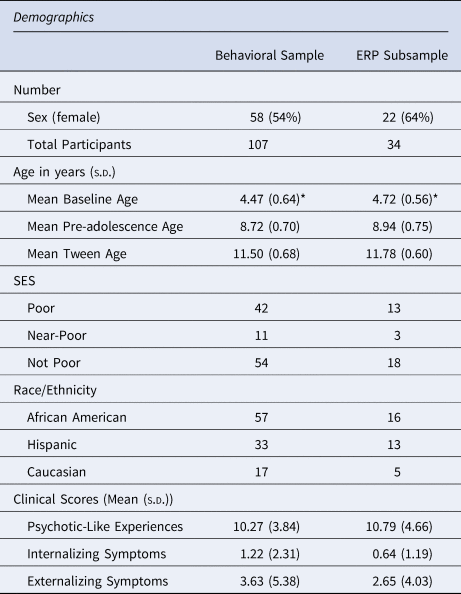
Of these 107 participants, there were 34 participants who had usable ERP data for the go/no-go task. Information about the age, race, sex, socioeconomic status, and clinical symptom scores for each of these groups is in Table 1. The group of participants with ERP data were significantly older than participants in only the behavioral sample, t(105) = −2.921, p = 0.004, and had higher accuracy on the go trials in block 2, t(79.641) = −2.220, p = 0.029. These differences are expectable given that children able to tolerate ERP data collection are often older and/or better able to tolerate frustration (Brooker et al., Reference Brooker, Bates, Buss, Canen, Dennis-Tiwary, Gatzke-Kopp and Schmidt2020). There were no other significant differences between the groups.
Demographic metrics

Demographic information for the full behavioral sample and the subsample of participants with ERP data. An asterisk indicates a significant difference between the two groups at p = 0.004.
Clinical outcomes
Assessment of internalizing/externalizing symptoms and PLEs were conducted across two waves during the transition to adolescence. (1) the pre-adolescent wave of the study when participants ranged from age 8 to age 11 and (2) during the ‘tween’ wave when participants ranged from age 9 to age 12. Assessment of internalizing and externalizing symptomatology was obtained during the pre-adolescent wave through parent interviews using the Diagnostic and Statistical Manual of Mental Disorders, 5th Edition version of the Kiddie Schedule for Affective Disorders and Schizophrenia-Present and Lifetime Version (K-SADS-PL; Kaufman, Birmaher, Brent, Ryan, & Rao, Reference Kaufman, Birmaher, Brent, Ryan and Rao2000). The number of clinically relevant symptoms present within internalizing (major depressive and separation anxiety) and externalizing (oppositional defiant, conduct, and attentional deficit hyperactivity) domains were summed to create internalizing and externalizing symptom scores.
During the ‘tween’ wave, youth participants completed a brief 7-item questionnaire about PLEs. This questionnaire, the Adolescent Psychotic-like Symptom Screener/Community Assessment of Psychic Experiences (APSS-CAPE; Dolphin, Dooley, & Fitzgerald, Reference Dolphin, Dooley and Fitzgerald2015; Kelleher & Cannon, Reference Kelleher and Cannon2011; Kelleher, Harley, Murtagh, & Cannon, Reference Kelleher, Harley, Murtagh and Cannon2011) asks participants the frequency at which they experience several common types of PLEs. Frequency was rated never, sometimes, often, or nearly always and converted to a number 1–4. For the current study, frequency scores for each of the items were summed and this total score was used. Internal consistency for the APSS-CAPE was good with Cronbach's Alpha at α = 0.81.
Neurocognitive tasks
Go/no-go task
The go/no-go task completed at the pre-school wave was a developmentally-appropriate task called the ‘Whack-A-Mole Task’ (WAM) based on the task developed by Sarah Getz and the Sackler Institute for Developmental Psychobiology (https://www.sacklerinstitute.org/cornell/assays_and_tools/WackAMole/mole_agree). The task was modified with IRB permission to include a frustration manipulation in the second of three blocks (Deveney et al., Reference Deveney, Briggs-Gowan, Pagliaccio, Estabrook, Zobel, Burns and Wakschlag2019; Lamm & Lewis, Reference Lamm and Lewis2010; Lewis & Stieben, Reference Lewis and Stieben2004; Stieben et al., Reference Stieben, Lewis, Granic, Zelazo, Segalowitz and Pepler2007). In this task, children helped Mr. Farmer save the vegetables in his garden by pressing a button to ‘whack’ the moles (go trials; 140 trials/block) and avoid pressing a button when an eggplant appeared (no-go trials; 60 trials/block). The first block began with 40 go trials to build up a prepotent response. Participants had 1500 ms to respond and received feedback in the form of a red and yellow flashing image which appeared following commission errors (button press on no-go trials) and omission errors (no button press after 1500 ms on go trials). See Fig. 1a.
(a) Depiction of experiment protocol from Deveney et al. (Reference Deveney, Briggs-Gowan, Pagliaccio, Estabrook, Zobel, Burns and Wakschlag2019). Go and No-go trials are indicated by the mole or eggplant, respectively. Blocks A and C always resulted in positive feedback. Block B had shorter response windows to promote errors and induce frustration, and was always followed by negative feedback. (b) Scatterplots of the correlation between accuracy on Go and No-go trials and later Internalizing Symptoms Score, Externalizing Symptoms Score, and Psychotic-Like Experiences Score.

During the non-frustration (first and third; A & C) blocks, the interstimulus (ISI) interval ranged from 1600 to 2200 ms and participants received positive feedback every 40 trials, regardless of performance, in the form of a happy Mr. Farmer surrounded by eggplants. Following these blocks, participants were told that they saved Mr. Farmer's vegetables and received a puzzle piece used to earn a prize from the treasure box at the end of the session. During the frustration (second; B) block, the ISI was shortened to 1500–1900 ms to promote errors and after every 40 trials, participants were presented with negative feedback, regardless of performance, in the form of a sad Mr. Farmer surrounded by moles. Following this block, participants were told that they did not save Mr. Farmer's vegetables and would not win a puzzle piece. All children won a prize at the end of the session.
ERP acquisition and processing
EEG data collected during the go/no-go task was collected using a SynAmp RT amplifier (Neuroscan) and a 32-channel Ag/AgCl Quick cap (Neuroscan; electrodes: FP1, FP2, F7, F3, Fz, F4, F8, FT7, FC3, FCz, FC4, FT8, T7, C3, Cz, C4, T8, TP7, CP3, CPz, CP4, TP8, P7, P3, Pz, P4, P8). Ag/AgCl electrodes placed above and below the left eye and bilaterally on the outer canthi were used to collect the vertical and horizontal electrooculogram, respectively. Data were referenced to the right mastoid during recording, digitized at 1000 Hz, and filtered using a 100 Hz low-pass filter. Impedances were kept below 10 kΩ. EEG data were re-referenced offline to the averaged mastoids and filtered using an FIR zero-phase shift low-pass 40 Hz filter. Automatic artifact rejection removed any data with amplitudes ±100 μV, and a regression procedure was used to remove eyeblinks (Semlitsch, Anderer, Schuster, & Presslich, Reference Semlitsch, Anderer, Schuster and Presslich1986). Artifact-free data were segmented into 1200 ms epochs with 200 ms pre-stimulus onset used for baseline correction. Data were averaged separately by trial type within each block and trials with incorrect behavioral responses were excluded. For go trials, participants had a minimum of 69 trials with a range of 319 and standard deviation of 86.0. For no-go trials, participants had a minimum of 26 trials with a range of 133 and a standard deviation of 36.8.
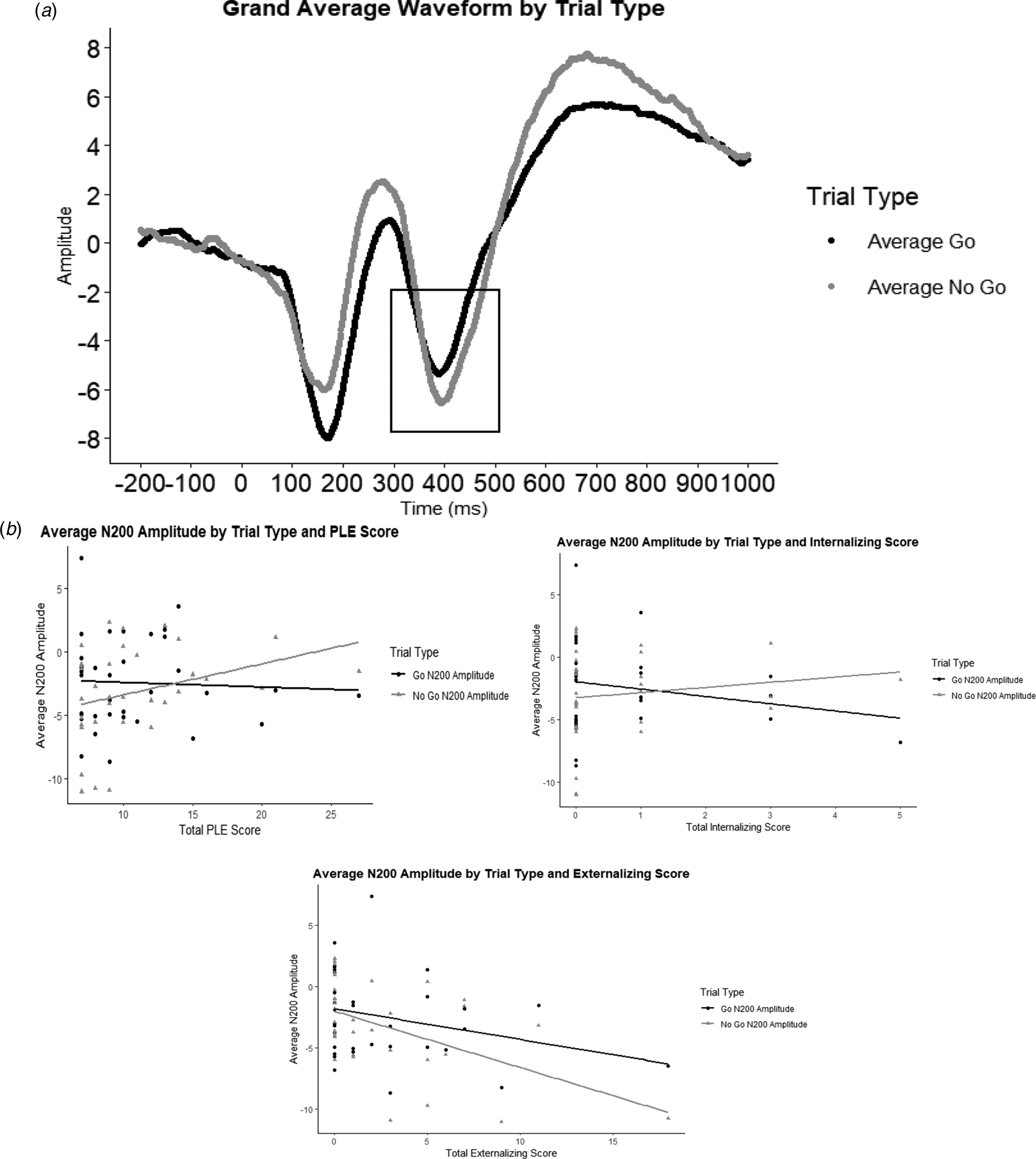
The N200 component was quantified as the mean amplitude between 300 and 500 ms averaged across frontocentral sites (F3, Fz, F4, FC3, FCz, FC4), based on previous literature in related tasks and populations (Grabell, Olson, Tardif, Thompson, & Gehring, Reference Grabell, Olson, Tardif, Thompson and Gehring2017; Lewis, Lamm, Segalowitz, Stieben, & Zelazo, Reference Lewis, Lamm, Segalowitz, Stieben and Zelazo2006; Stieben et al., Reference Stieben, Lewis, Granic, Zelazo, Segalowitz and Pepler2007) and inspection of grand average waveforms. Across these, the mean amplitudes for each site for go trials were: −3.42, −3.90, −2.15, −1.78, −2.76, −3.40; mean amplitudes for no-go trials were: −4.37, −4.86, −4.37, −2.80, −3.71, −3.47. The N200 component was maximal at Fz. As has been found with young children (Ciesielski, Harris, & Cofer, Reference Ciesielski, Harris and Cofer2004; Johnstone, Pleffer, Barry, Clarke, & Smith, Reference Johnstone, Pleffer, Barry, Clarke and Smith2005; Jonkman, Reference Jonkman2006), the N200 component occurred later than is typical for older children and adults. There were no significant differences in latency between trial type or significant correlations between latency and PLE or symptom scores.
Analytical strategy
To examine whether performance on the go/no-go task at pre-school age was related to subsequent PLEs, accuracy for each trial type in the three task blocks were added to a repeated measures ANCOVA as dependent variables. Covariates in the model were the total PLE score and internalizing and externalizing symptom scores. This analysis allows for the clinical outcomes data to remain continuous, providing additional information about the severity of subclinical signs of emerging psychopathology. Including internalizing and externalizing symptom data served as foils to determine the specificity to PLEs.
A complementary analysis was conducted with the subsample of participants with ERP data. Because N200 amplitude is hypothesized to be related to response inhibition (Deveney et al., Reference Deveney, Briggs-Gowan, Pagliaccio, Estabrook, Zobel, Burns and Wakschlag2019), individuals' N200 mean amplitudes were compared across go and no-go trial types for each block. Total PLE score and internalizing and externalizing symptom scores were added as covariates.
Results
Symptom scores
Pearson's correlations were performed between symptom scores to determine whether the symptom types co-varied. There was no significant correlation between PLE score and internalizing, r(105) = 0.006, p = 0.954, or externalizing symptoms, r(105) = −0.039, p = 0.690. Internalizing and externalizing symptoms were positively correlated, r(105) = 0.570, p < 0.001.
Go/no-go task behavioral performance
A repeated measures ANCOVA with factors of block and trial type found a significant effect of total PLE score, meaning that pre-school age behavioral task accuracy (percent of trials correct) predicted early adolescent PLEs, F(1,101) = 4.038, p = 0.047, η p2 = 0.036. As expected, there was also a significant interaction such that average accuracy in pre-school was lower on no-go trials than on go trials for individuals who later had a higher PLE score, indicating a specific deficit in inhibitory control rather than a general performance deficit, F(1,101) = 3.976, p = 0.049, η p2 = 0.041. There was no significant interaction between total internalizing symptom score and trial type, F(1,101) = 0.008, p = 0.931, η p2 = 0.003, or total externalizing symptom score and trial type, F(1,101) = 0.006, p = 0.686, η p2 = 0.001, which suggests this specific deficit predicts only later PLE scores. Lower accuracy during the frustration block compared to non-frustration blocks predicted later internalizing, F(2,202) = 5.618, p = 0.004, η p2 = 0.058, and externalizing symptoms, F(2,202) = 4.663, p = 0.010, η p2 = 0.045, but not later PLE scores, F(2,202) = 1.093, p = 0.337, η p2 = 0.011. Lower overall accuracy approached significance in predicting later internalizing symptoms, F(1,101) = 3.814, p = 0.054, η p2 = 0.033. There were no other significant relationships. See Fig. 1b. Results did not notably differ when age, gender, or poverty status were included in the model.
Go/no-go task event related potentials
For the subset of the sample with ERP data, a repeated measures ANCOVA with factors of block and trial type, covariates of total PLE score, internalizing, and externalizing symptom scores, and dependent variable of mean N200 amplitude was conducted. Consistent with previous literature linking higher N200 amplitude with higher inhibitory control, there was a significant main effect of trial type, such that the mean N200 amplitude was higher for no-go trials than for go trials, F(1,30) = 5.570, p = 0.025, η p2 = 0.144. This indicates that mechanisms underlying inhibitory control were more active on no-go trials, which require inhibitory control, than on go trials, which do not. As expected, having smaller N200 amplitudes on no-go trials than on go trials predicted higher PLE scores, F(1,30) = 6.075, p = 0.020, η p2 = 0.100. Smaller N200 amplitudes across trial type predicted later internalizing symptoms at a trend level, F(1,30) = 3.567, p = 0.069, η p2 = 0.080. Additionally, a larger difference in N200 amplitude between go and no-go trials predicted later externalizing symptoms at a trend level, F(1,30) = 3.404, p = 0.075, η p2 = 0.059. No other significant relationships were observed. See Fig. 2 for the grand average waveform and online Supplementary Figs. S2 and S3 for the grand average waveform of participants who did and did not report PLEs, respectively. Results did not notably differ when age, gender, or poverty status were included in the model.
(a) Grand average waveform for Go and No-go trials. Negative amplitudes are plotted down. Rectangle indicates the N200 waveform used in analyses. (b) Average N200 amplitudes for Go and No-go trials correlated with later Internalizing Symptoms Score, Externalizing Symptoms Score, and Psychotic-Like Experiences Score.

Discussion
The present study examined whether early childhood brain:behavior patterns of inhibitory control performance (assessed with a behavioral go/no-go task and concurrent ERP measures) predicted emerging psychosis symptoms measured by PLE scores in the ‘tween’ period (ages 9–12), a time when the first signs of schizophrenia-spectrum disorders emerge. We found meaningful predictive and parallel patterns at behavioral and neural levels. Lower behavioral accuracy on only no-go trials was associated with higher levels of participant-reported PLEs. This pattern was specific to PLEs and, in contrast, results indicated that lower behavioral accuracy in the preschool age predicted higher levels of internalizing and externalizing symptoms in pre-adolescence. Complementing the behavioral results, amplitude of the N200 component on no-go trials (indexing inhibitory control) was related to the level of PLEs, with higher PLEs associated with smaller N200 amplitudes. Taken together, these results suggest that distinct behavioral and electrophysiological profiles identified in early childhood which related to PLEs at the transition to adolescence may provide important and conceptually-relevant information about neurodevelopmental vulnerability to psychosis far earlier than previously demonstrated (Mittal & Wakschlag, Reference Mittal and Wakschlag2017).
Participants with higher PLE scores at age 9–12 achieved comparable accuracy during pre-school on the go trials to their low PLE peers; however, individuals with higher PLE scores had significantly lower accuracy on no-go trials when compared with participants with lower PLE scores. This difference highlights a specific deficit in inhibitory control which does not extend to overall performance, and is consistent with inhibitory control deficits in schizophrenia-spectrum disorders (Doege et al., Reference Doege, Kumar, Bates, Das, Boks and Liddle2010; Mittal et al., Reference Mittal, Pelletier-Baldelli, Trotman, Kestler, Bollini, Walker, Maddux and Winstead2016). Higher PLE scores were also associated with smaller mean N200 amplitudes on no-go trials, indicating a decrease in inhibitory control indexed by electrophysiology. This is consistent with predictions and behavioral results and may provide insight into mechanisms behind early inhibitory control deficits and risk for PLEs. Additionally, the brain:behavior patterns strengthen inference with both behavioral and physiological methods aligning. These results lend support to developmental models of psychosis risk (Cougnard et al., Reference Cougnard, Marcelis, Myin-Germeys, De Graaf, Vollebergh, Krabbendam and Van Os2007; Rajkumar, Reference Rajkumar2014) because disruptions in early childhood reflect similar patterns to later psychopathology and predict later PLE scores. Additionally, these findings indicate a potential early childhood marker of risk for schizophrenia-spectrum disorders which is discriminable from general risk for psychopathology, and a potential target for intervention (Baker et al., Reference Baker, Liu, Huang, Palermo and Bartoli2020; Pietto et al., Reference Pietto, Giovannetti, Segretin, Belloli, Lopez-Rosenfeld, Goldin and Lipina2018) if inhibitory control deficits increase risk itself (Abramovitch, Short, & Schweiger, Reference Abramovitch, Short and Schweiger2021). Further prospective longitudinal research with interview-based measures of psychotic symptomatology is necessary, including follow-up of those with elevated vulnerability to psychosis (i.e., high PLEs) through the risk period for developing schizophrenia. Some existing large, neurodevelopmental cohorts include both measures of inhibitory control and of PLEs or psychotic symptoms (e.g., Philadelphia Neurodevelopmental Cohort, Adolescent Brain and Cognitive Development) which provide the opportunity to replicate and extend the current findings in large samples. Additionally, incorporating psychosis outcome measures into further large neurodevelopmental cohort studies such as the HEALthy Brain and Child Development Study can provide additional information about markers of risk for psychosis in early childhood and inform preventative intervention efforts.
Interestingly, neither internalizing symptoms nor externalizing symptoms were linked with a specific deficit of inhibitory control. Both types of symptoms were behaviorally linked with lower overall performance under emotion induction conditions. However, there was no interaction between trial types indicating that, in contrast with PLEs, both types of trial demonstrated similar decrements in performance. Electrophysiological results indicated that lower N200 amplitude was related with higher internalizing symptom scores at a trend level, consistent with the mixed results found in previous studies (Hum et al., Reference Hum, Manassis and Lewis2013; Moadab et al., Reference Moadab, Gilbert, Dishion and Tucker2010). Higher externalizing symptom scores were predicted by N200 amplitudes at a trend level, with N200 amplitudes being higher on no-go trials than on go trials and a larger difference observed for those with higher externalizing symptom scores. Critically, these results support the finding of a specific deficit in inhibitory control that predicts later PLE scores but not later internalizing or externalizing symptoms.
Existing theories of developmental models of probabilistic risk for developing schizophrenia-spectrum disorders often conceptualize risk as progressive deviation from normative developmental trajectories (Insel, Reference Insel2010; Rajkumar, Reference Rajkumar2014). However, research has demonstrated the importance of genetic, pre-natal, perinatal, and early life influences (Blair et al., Reference Blair, Nitzburg, DeRosse and Karlsgodt2018; Davies et al., Reference Davies, Cipriani, Ioannidis, Radua, Stahl, Provenzani and Fusar-Poli2018; Kelleher & Cannon, Reference Kelleher and Cannon2011; MacNeill et al., Reference MacNeill, Allen, Poleon, Vargas, Osborne, Damme and Wakschlag2021; Owen, Craddock, & Jablensky, Reference Owen, Craddock and Jablensky2007; Vargas & Mittal, Reference Vargas and Mittal2022) in impacting risk for schizophrenia-spectrum disorders. The present study suggests that not only are these factors present early in life but also that they can be identified at both behavioral and neural levels. A more accurate representation of developmental models of risk for psychopathology may indicate that individuals with higher risk are not only deviating from normative developmental trajectories but also starting from a different neural position. For example, reduced interneuron activity in adolescent development (Insel, Reference Insel2010) may be confounded by starting at lower level of activity. Presuming that, as seen in the current study, it is possible to observe early differences indicative of different developmental trajectories, it follows that early intervention in early childhood (during the premorbid period) may interrupt the projected course of non-normative development.
The current study has several limitations. First, the lack of repeated measures of inhibitory control prevents an examination of developmental trajectories. Future research in this area could enhance understanding about the relationship between early inhibitory control deficits and later inhibitory control as well as a more nuanced conceptualization of the relationship between the development of inhibitory control and the emergence of psychopathology. Second, a smaller subsample with ERP data limits the ability to draw definitive conclusions about the relationship between an early index of inhibitory control and later psychopathology. Additional research with a larger sample size could confirm and elaborate on this relationship, including examining earlier waveforms indexing attention that may contribute to the observed effects. We also were not able to control for preschool age symptoms, though the prevalence of symptoms such as PLEs in this early period is likely rare (and difficult to assess with reliability and validity). This study examines only early symptoms which could be indicative of risk for disorders without the determination of final diagnoses for the participants in this sample. As such, the current analysis only discusses the relative degree of observed risk for psychosis and does not examine the presence or absence of psychopathology meeting diagnostic thresholds. We also measured PLEs with a brief survey as opposed to interview-based measures which, although far less resource intensive, may result in modestly inflated scores if normative experiences are also captured. Finally, negative symptoms are more closely related to inhibitory control deficits in schizophrenia. As a result, the current study may underestimate effects by using PLEs rather than subclinical signs of negative symptoms; however, methods of measuring these subclinical negative signs are currently less refined than those measuring positive symptom-like experiences such as PLEs.
Conclusions
The current study advances efforts in early identification of psychosis risk substantially, by prospectively linking for the first time both behavioral and neural markers at preschool age to PLEs experienced at 9–12. This analysis strengthens and modifies neurodevelopmental models for psychosis which extend into the premorbid period (Insel, Reference Insel2010; Mittal & Wakschlag, Reference Mittal and Wakschlag2017). By moving prediction of risk earlier, it may be possible to prevent the developmental cascade leading to the onset of psychotic symptoms instead of intervening in the adolescent and young adult periods (McGorry, Ratheesh, & O'Donoghue, Reference McGorry, Ratheesh and O'Donoghue2018b). Additional research in the premorbid period for psychosis is imperative for a fuller understanding of the neurodevelopmental mechanisms and potential targets for intervention during these early developmental stages.
Supplementary material
The supplementary material for this article can be found at https://doi.org/10.1017/S003329172300171X.
Acknowledgements
We gratefully acknowledge our MAPS study collaborators including Daniel Pine, Ellen Leibenluft, James Blair, Amelie Petitclerc, Joel Voss, Ryne Estabrook, and Christen Deveney as well as our study staff and the families that participated.
Financial support
This work was supported by the National Institute of Mental Health, awards R01MH082830, U01MH082830 to Lauren Wakschlag and U01MH090301 to Margaret Briggs-Gowan, and T32MH126368 supporting Katherine S. F. Damme.
Conflict of interest
We have no conflicts to disclose.
Ethical standards
The authors assert that all procedures contributing to this work comply with the ethical standards of the relevant national and institutional committees on human experimentation and with the Helsinki Declaration of 1975, as revised in 2008.