Introduction
One of the most fundamental questions within the study of divided societies deals with their long-term stability (Choudhry, Reference Choudhry2008a). Some authors have claimed that multinational identities and preferences will be associated with a risk of social division, eventually leading to a weakening of the bond between the components of the country and to the danger of secessionism (Erk and Anderson, Reference Erk and Anderson2009; Keil and Alber, Reference Keil and Alber2020). This will be especially the case in divided societies with strong, and potentially disruptive, cleavages along linguistic, ethnic or religious lines (Gagnon, Reference Gagnon2021; Lecours, Reference Lecours2021). Different socialization processes will lead to fundamental differences within public opinion, rendering it more difficult to maintain the status quo (Dupuy et al., Reference Dupuy, Verhaegen and Van Ingelgom2021; Medeiros et al., Reference Medeiros, Gauvin and Chhim2022). From a theoretical point of view, this question has led to an important academic debate. On the one hand, some authors argue that stability in a divided society is possible, as all communities involved will appreciate their group rights and the status quo the political institutions have to offer (Choudhry, Reference Choudhry and Choudhry2008b; Kelly, Reference Kelly2019). On the other hand, some argue that in the different communities, with their own media and education systems, different socialization processes will take place, leading to further divergence (Dupuy et al., Reference Dupuy, Verhaegen and Van Ingelgom2021), and this can express itself in different political preferences, which might make it difficult to maintain the political status quo (Medeiros et al., Reference Medeiros, Gauvin and Chhim2022). The risk of instability is further increased because political elites at the regional level have a strong incentive to advocate for more autonomy for their own regions (Massetti and Schakel, Reference Massetti and Schakel2016).
In this article, we investigate whether there are diverging trends in public opinion in three major divided systems. A divided society is defined by the fact that the risk of a breakup is salient (Choudhry, Reference Choudhry and Choudhry2008b), and all the societies we investigate have experienced in the past decades, in some way or another, a referendum on secessionism, in which a substantial part of all participants (but never the majority) expressed support for independence of their region or province. Although independence referenda can have other political motives, the observed high level of public support for secessionism makes clear that the long-term stability of these divided societies should not be taken for granted (Lecours, Reference Lecours2021; Sanjaume-Calvet, Reference Sanjaume-Calvet2021). In this article, we investigate the long-term trends in public opinion in three divided societies: Canada, the United Kingdom (UK) and Spain.Footnote 1 We first review the literature on why one could expect multinational divided societies to grow further apart—for instance, as a result of mobilizing events such as referendum campaigns (Medeiros, Reference Medeiros2019). Subsequently we present data and methods. Following the results of the analysis, we close with some observations on what these results imply about the long-term stability of divided societies.
Literature
Within the literature, there is a long-standing debate about the stability of divided societies (Lustick, Reference Lustick1979; Bogaards, Reference Bogaards2019). Some authors have argued that the different groups within such a society will find some sort of equilibrium, and that subsequently these groups will tend to keep this kind of status quo (Jakala et al., Reference Jakala, Kuzu and Qvortrup2018). Others, however, point out that divided societies are inherently unstable. In recent decades, some divided societies have indeed been confronted with endemic instability, violent conflict, civil war and secessionism (Aboultaif, Reference Aboultaif2019). Public opinion plays a major role in these debates (Swenden and Jans, Reference Swenden and Jans2006). To the extent that cleavages within public opinion become extremely large, it can be difficult to maintain the long-term stability of divided societies. From a socialization perspective, this is a plausible scenario. Groups of the population will be socialized in different cultural and institutional settings, thus leading to the socialization of a specific regional identity (Dupuy et al., Reference Dupuy, Verhaegen and Van Ingelgom2021; Poitras and Dufour, Reference Poitras and Dufour2022). This identity might express itself as different political preferences and support for different political parties, which could enhance the threat to governability (Erk and Anderson, Reference Erk and Anderson2009; Medeiros et al., Reference Medeiros, Gauvin and Chhim2022; Hooghe and Stiers, Reference Hooghe and Stiers2022). When the different regions of a divided society have their own media systems and education systems, younger generations will be most strongly socialized in this setting, and over a number of decades, this could lead to large, and even insurmountable, gaps in public opinion (Dupuy et al., Reference Dupuy, Verhaegen and Van Ingelgom2021). After a couple of decades, citizens could identify most strongly with their regional group and less strongly with the federation as a distinct political system.
The risk of instability is most clearly present in divided societies with a limited number of fundamental cleavages, based on language, ethnicity or religion, where the spectre of secessionism cannot be dismissed (Bogaards, Reference Bogaards2014). Over the past decades, divided societies such as Canada, Spain and the UK have experienced referenda on secessionism or regional autonomy. If these had been successful, the political systems of these countries would no longer exist in their current form (Laponce, Reference Laponce2010). All three recent referenda (Quebec in 1995, Scotland in 2014 and Catalonia in 2017) failed to deliver a majority to support regional independence. These referenda, however, do not just express (a lack of) support for secessionism; they might also have a socializing function. Participating in a referendum on regional independence, for instance, might have long-term consequences on the likelihood that someone will identify first with the regional level and then with the level of the country (Henderson et al., Reference Henderson, Johns, Larner and Carman2022; Medeiros, Reference Medeiros2019).
Another obvious example would be the federal kingdom of Belgium, which has not experienced a referendum but has been plagued by endemic political instability since a substate nationalist party (that is, in favour of secessionism) became the dominant political party in the largest region of the country (Hooghe and Stiers, Reference Hooghe and Stiers2022; Huyse, Reference Huyse and Lijphart1981). Two decades ago, Bermeo (Reference Bermeo2002: 105) could still confidently write: “In Spain and Belgium, federalization has held the growth of exclusive identities in check and stymied support for separatism.” In the current era, few authors would still support this claim in such a bold manner. Nevertheless, the analysis by Hooghe and Stiers (Reference Hooghe and Stiers2022) has shown that public opinion in the two major language communities of the country does not diverge, as one would expect following the socialization perspective. Most divided societies have known rather fundamental political conflicts, leading to concerns about stability; this type of salient and enduring conflict is, in fact, a defining characteristic of a divided society (Choudhry, Reference Choudhry2008a; Lustick, Reference Lustick1979). To some extent, this conflict can manifest itself in support for substate nationalist parties, but it is important to note that these parties do not always fully and adequately express the preferences of public opinion in general—or even of their own voters (Arrighi, Reference Arrighi2019). While some authors have argued that these substate nationalist parties reflect public opinion (thus effectively rendering a vote for these parties a “referendum in disguise”), others have shown that the electoral appeal of these parties tends to be multidimensional (Blanchet and Medeiros, Reference Blanchet and Medeiros2019). This could imply that even voters for these substate nationalist parties do not necessarily agree with all the policy options of these parties (Henderson, Reference Henderson2007). This means that if we want to determine the mood of public opinion, election results are not a reliable indicator, as electoral campaigns and a mix of different policy issues can have an effect on the way people vote. If we want to make a statement about the dynamics of public opinion in divided societies, it is clear we need reliable and long-term public opinion data. If different communities in a divided society evolve in opposing directions, it will become all the more difficult to find sufficient common ground within that society (Trzciński, Reference Trzciński2022).
In line with earlier studies on Belgium (Hooghe and Stiers, Reference Hooghe and Stiers2022), we focus in this article on trends in public opinion, as we assume this will be the most fundamental and enduring indicator of instability in divided societies. If polarizing trends are only situated among the party elites, for instance, leading to a difficult and lengthy process of government formation, elections could still serve to replace those elites, while obviously this is not the case for the population as a whole. While citizens can select different political leaders, politicians cannot select a different population. For the Belgian study, results showed that existing differences in public opinion between the two major language regions of the country have remained rather stable, despite a rather fundamental shift toward devolution in the country. Belgium, however, offers a very specific form of bipolar federalism, with only two communities of roughly equal size, and we do not know to what extent the findings from the Belgian study can be generalized. Therefore, in the current study we investigate the case of three divided societies—Quebec, Scotland and Catalonia—that have been or are confronted with secessionist dynamics in breakaway regions.
Case selection
A number of conditions must be met in order to empirically ascertain public opinion trends in divided societies. First, there has to be a consensus in the literature that the country forms a divided society where these divisions are salient (Choudhry, Reference Choudhry and Choudhry2008b: 4–5). Importantly, this division can develop on any structural cleavage, whether ethnicity, culture, religion, language, or some other criterion. Second, the issue of secessionism has to be salient, either by the presence of strong substate nationalist parties or by the occurrence of referenda on secessionism (Huysseune, Reference Huysseune2006). Third, since we are specifically interested in changes in public opinion, we need repeated cross-sections over a longer period of time. This means that Lebanon and Cyprus, which have often been considered classical examples of divided societies, cannot be included in the study. Since long-term public opinion data are not available for these countries, we cannot test the argument that as new generations are being socialized under conditions of a broad division of authority, they will gradually develop distinct value patterns (Dupuy et al., Reference Dupuy, Verhaegen and Van Ingelgom2021). Meeting this condition requires that only countries with a well-established survey tradition be included in this kind of study (Bélanger et al., Reference Bélanger, Nadeau, Henderson and Hepburn2018).Footnote 2
First, we focus on Canada, which is divided between an English-language majority in most of the country and a French-language minority heavily concentrated in the province of Quebec. Since the Quiet Revolution (révolution tranquille) of the 1960s, Quebec has more strongly emphasized its distinct identity compared to the rest of Canada. In 1995, the referendum on the independence of the province was defeated by a small margin, as 50.6 per cent of voters opted to stay in the Canadian federation (Nadeau et al., Reference Nadeau, Martin and Blais1999). Various attempts to change the Canadian constitution did not lead to any substantial changes, so with regard to the division of authority, nothing has changed during the previous decades. On a political level, however, the party system in Quebec has evolved in a manner different from the rest of country (Henderson, Reference Henderson2004). While the provincial authorities in Quebec continue to stress the role of a distinct identity, mostly based on language, we did not find any strong indications that public opinion in the major language groups of Canada would have continued to grow apart (Bridgman et al., Reference Bridgman, Nadeau and Stolle2022; Brie and Mathieu, Reference Brie and Mathieu2021; Medeiros, Reference Medeiros2019).
Since the Scotland Act of 1998, Scottish regional government has acquired more autonomy and has developed a distinct policy, using its power to stress Scottish identity (Pattie et al., Reference Pattie, Denver, Mitchell and Bochel1999; McMillan, Reference McMillan2020; Keating, Reference Keating2017). Here, too, a referendum on independence was organized, which took place in 2014; in this referendum, 55.3 per cent of voters indicated they wanted to remain within the UK. Some authors have noted that the intense debate on this referendum had a profound effect on public opinion in the region and could be considered a generation-defining event (Henderson et al., Reference Henderson, Johns, Larner and Carman2022). Following Brexit, however, there have been renewed calls for a second referendum, which thus far has yet to materialize. It should be noted that education, too, is a devolved power in Scotland, so that if a gradual socialization effect was occurring, it should have become visible after more than two decades of regional autonomy in this domain.
In Spain, the historical region of Catalonia received autonomy under the new Spanish constitution of 1978, and this was further expanded in 2006 (Boix, Reference Boix2006). This autonomous region is characterized by a distinct language and, under a system of asymmetrical federalism, a very large degree of internal autonomy. In the case of Catalonia, two referenda on independence were organized by the regional authorities (dominated by substate nationalist parties), but the 2017 referendum was declared illegal by the Spanish Constitutional Court (Punset Blanco and Tolivar Alas, Reference Punset Blanco and Alas2020). In this case, we lack historical evidence on whether public opinion in Catalonia actually developed distinctly from that in the “rest of Spain.”Footnote 3
What these three cases have in common is that there is a clear drive toward more regional autonomy, as witnessed by the fact that a more than substantial part of the population (in some cases, up to 49%) has voted for independence in recent decades. These regions all have strong substate nationalist parties that have their stronghold in the region or province. As such, we can consider them as ideal test cases for the current study on different socialization trends in divided societies. Theoretically, Belgium, with its division between Dutch-language and French-language communities, could serve as a case too (Faniel et al., Reference Faniel, Istasse, Lefebve and Sägesser2021), but this country has already been investigated (Hooghe and Stiers, Reference Hooghe and Stiers2022) and we will build on the results of that previous article.Footnote 4
Data and Methods
To investigate trends in political public opinion in the countries of interest, we use two different data sources. For the UK and Spain, we use data from the European Social Survey (ESS). This is a comparative European project that has collected data from representative samples of citizens in most European countries every two years since 2002 (ESS, 2020). The advantage of using this dataset is that it provides comparable data using the exact same question wordings over time and between the two countries over the past two decades. A disadvantage is that no questions specific to the country cases are included, but the main political attitudes are measured, as will be explained below. For the Canadian case, we bring together data from the Canadian Election Studies (CES), which is gathered around each federal election. These data also allow us to examine the past two decades (Blais et al., Reference Blais, Gidengil, Nadeau and Nevitte2000, Reference Blais, Everitt, Fournier, Gidengil and Nevitte2004, Reference Blais, Everitt, Fournier, Gidengil and Nevitte2006; Gidengil et al., Reference Gidengil, Everitt, Fournier and Nevitte2008; Fournier et al., Reference Fournier, Cutler, Soroka and Stolle2011, Reference Fournier, Cutler, Soroka and Stolle2015; Stephenson et al., Reference Stephenson, Harell, Rubenson and Loewen2019).Footnote 5 An important difference between the sources is that CES data are gathered at election time, whereas the ESS conducts surveys every two years, irrespective of electoral cycles. During election times, political issues—and therefore potential differences—might be more pronounced than during the electoral term. However, within countries we always focus on the same data source; and while there might be differences between countries, our interest here is on the evolution over time within countries.
To test whether public opinion diverges on important political issues, we focus on a range of political attitudes that have been shown to be important determinants of voting behaviour (De Vries et al., Reference de Vries, Hakhverdian and Lancee2013). Our logic is that conflicts are most likely to deepen and extend when groups of the population have different opinions on the most structural components of political decision making. Across countries, these fundamental attitudes on a left/right cleavage and on libertarian versus authoritarian values tend to shape political behaviour (Franklin et al., Reference Franklin, Mackie and Valen1992). We focus on this set of attitudes because we are interested in the stability of divided societies. If a breakup occurred, it would inevitably be a political process, and our focus therefore is on attitudes that are prone to lead to political conflict. For the time being, we leave aside attitudes that have to do with mere lifestyle differences that are far less likely to be associated with political conflict (Guinjoan and Rodon, Reference Guinjoan and Rodon2014).Footnote 6
Decades of electoral research have shown that a number of crucial attitudes have a strong impact on voters’ decisions (Arzheimer et al., Reference Arzheimer, Evans and Lewis-Beck2017). There is an impressive body of empirical research demonstrating that this set of political values structures political attitudes and conflicts throughout most liberal societies; indeed, they are the most powerful determinants of electoral choice in most liberal democracies (Lupton et al., Reference Lupton, Enders, Jacoby, Arzheimer, Evans and Lewis-Beck2017; Okolikj et al., Reference Okolikj, Goubin, Stiers and Hoogheforthcoming). The three basic structuring attitudes are (1) economic left/right divisions, (2) cultural conflicts between conservative and liberal groups within societies and (3) preferences with regard to the division of authority in systems of multilevel governance (Jæger, Reference Jæger2008; Kriesi et al., Reference Kriesi, Grande, Dolezal, Helbling, Höglinger, Hutter and Wüest2012). For comparability, we select a core set of attitudes that have been shown to structure electoral behaviour across electoral democracies (Franklin et al., Reference Franklin, Mackie and Valen1992; Nadeau and Blais, Reference Nadeau and Blais1993) and which we investigate in all three cases. While in some countries, more idiosyncratic vote determinants might play an important role too, these are more difficult to implement in comparative research. More details on how all variables are measured are included in Appendix A.
First, we look at the general ideological left/right continuum, which provides a summary measure of the issues that are salient in a certain place and time. Research has convincingly shown that the left/right dimension covers major social cleavages with regard to state intervention and redistribution (Dalton, Reference Dalton2008). For this measure, respondents are asked to position themselves on an ideological scale ranging from 0 (political left) to 10 (political right). In addition, this economic cleavage is measured with a specific question on how much redistribution citizens actually want, as previous research has shown that both theoretically and empirically, redistribution preferences are a clear expression of position on the ideological left/right division (Jæger, Reference Jæger2008; Goubin and Hooghe, Reference Goubin and Hooghe2022). Economic redistribution refers to the extent to which respondents favour active government intervention to reduce differences in income levels. As a traditional issue, it remains an important concern for many people, as also highlighted by the literature showing its effects on vote choice (Lewis-Beck et al., Reference Lewis-Beck, Nadeau and Foucault2013). Redistribution preferences are measured by respondents indicating their agreement with the statement that the government should take measures to reduce differences in income levels (ESS) or reduce the gap between the rich and the poor (CES).
Second, divisions between liberal and conservative values shape the political debate and choice set. In this case, we do not have a generally accepted self-placement on a liberal/conservative continuum, so this dimension will have to be included with measurements on specific issues. In most Western democracies, conflicts on the liberal/conservative dimension have crystallized on the issue of immigration, which has become a major voting issue (Hooghe and Marks, Reference Hooghe and Marks2018; Kriesi et al., Reference Kriesi, Grande, Dolezal, Helbling, Höglinger, Hutter and Wüest2012). We include it as a measure summarizing three well-tested and highly correlated survey items on the extent to which respondents think immigrants are good for the economy, enrich the cultural life of the country and make the country a better place to live (ESS)Footnote 7 or that immigrants make an important contribution to the country (CES survey; see Appendix A).Footnote 8 Providing equal rights to LGTB communities is another major issue that divides liberal and conservative views within societies (Hooghe and Meeusen, Reference Hooghe and Meeusen2013). We also know that issues surrounding LGTB rights are closely related to other value sets—for instance, those having to do with gender equality and abortion rights. In the ESS, respondents were asked to what extent they thought that gay and lesbian people should be free to live their lives as they wish. In the CES, respondents were asked to indicate whether they thought that gay and lesbian people should be allowed to get married.Footnote 9
Third, political conflicts can erupt over the issue of the division of authority within a multilevel government, and this cleavage will obviously be highly salient in divided societies. For the UK and Spain, we include a question on European unification, with respondents indicating whether they think the unification process should go further or has already gone too far. We selected this more general question because the ESS questionnaire does not include any country-specific questions that refer to the division of authority within a single country. For Canada, there is no equivalent indicator about multilevel governance, given the highly specific status of European integration.
Besides these variables of interest (which are included as dependent variables—see below), some control variables will be included in the models as well, since previous research has shown that these variables have a strong effect on the attitudes under consideration (Arzheimer et al., Reference Arzheimer, Evans and Lewis-Beck2017). First, the standard socio-demographic measures of gender, age and educational level are included. Gender distinguishes male (code 0) from female (code 1) respondents. Educational level distinguishes between less educated respondents (have not completed secondary education—reference category), moderately educated (completed secondary education) and more educated respondents (completed post-secondary education) in Canada, and it indicates the number of years of full-time education in the UK and Spain. We also control for income. Since the income measure included in the survey waves of the ESS varies substantially, we use a self-reported subjective perception of how easily the respondent can live within their current income, as this was included in every wave. For Canada, we use a measure of household income in broad categories. Finally, we control for language usually spoken at home (for the UK and Spain) or language first learned that the respondent still speaks (for Canada).
To test whether public opinion on important political issues and attitudes diverges over the past two decades, we estimate a series of ordinary least squares (OLS) models, with each time a different issue as the dependent variable.Footnote 10 For independent variables, we include the control variables discussed above, an indicator of survey wave (ESS) or election year (CES), and an indicator for the region of residence of the respondent. Here, we distinguish our main regions of interest: Quebec (versus rest of Canada); Scotland (versus rest of UK); Catalonia (versus rest of Spain). To test whether the differences between these regions and the rest of the country diverged over time, we include an interaction between year and region. To be able to assess the differences, the results of the interaction effect between year and region will be graphically presented here, while the full tables are included in Appendix B.Footnote 11 For comparability, all measures used as dependent variables, as well as the continuous independent variables, are rescaled so that their minimum observed value is 0 and their maximum observed value is 1. The standard errors are clustered by survey. Finally, in all models, we use the design weight for the ESS, and we use the household weight for all of Canada in the CES.
Results
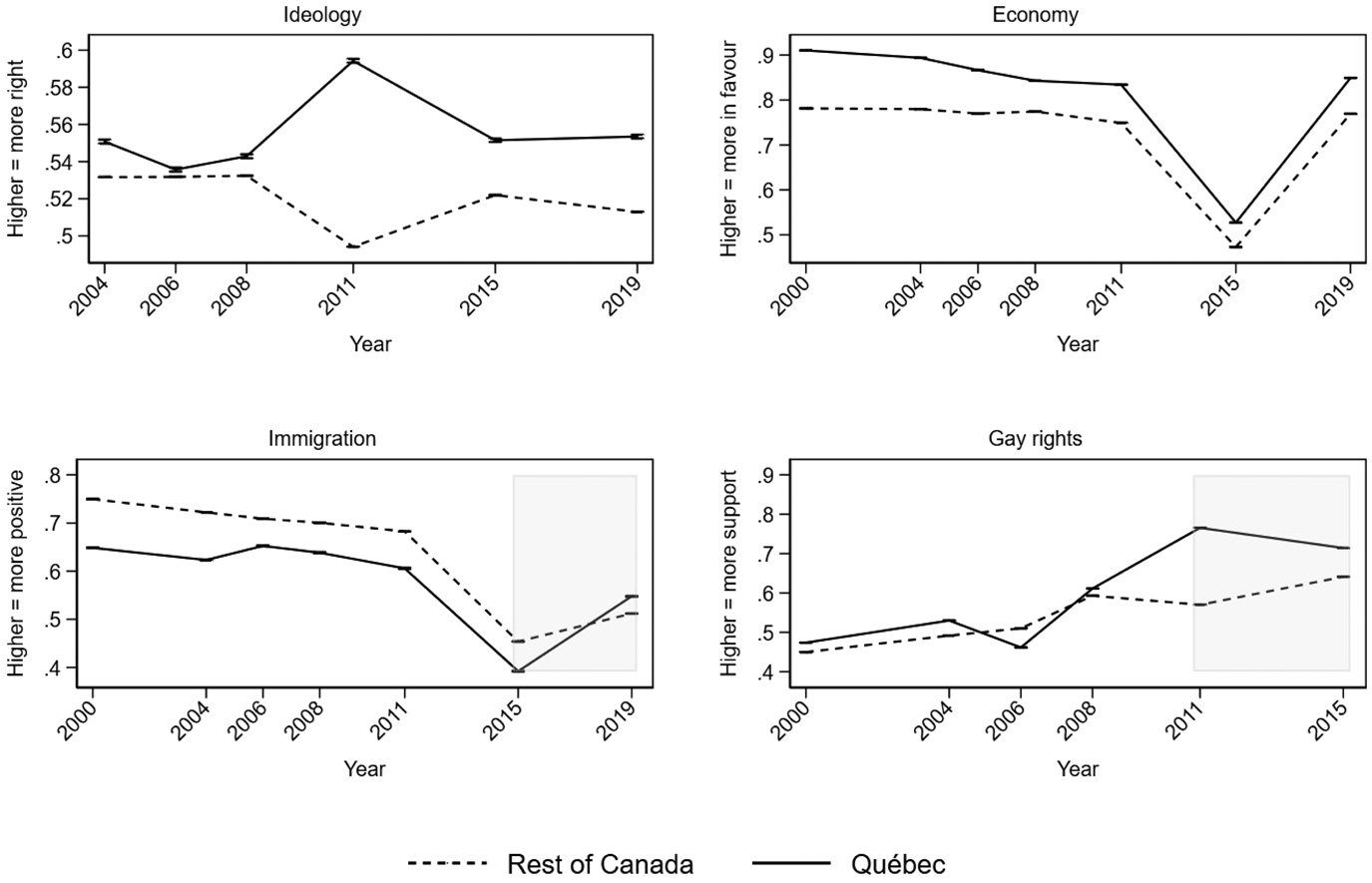
First, we investigate political attitudes in Quebec and the rest of Canada over the last 20 years. The results displayed in Figure 1 show the mean position of respondents from Quebec and the rest of Canada, respectively, in the different survey years on the different measures under investigation, based on interaction effects between region and year; the full tables are included in Appendix B. Note that the figures have a different range on the y-scale, depending on the observed range of the mean scores based on the variables ranging from 0 to 1.
Political attitudes in Quebec and the rest of the Canada over time
Note: Results from a model included an interaction between survey year wave and region. Full tables included in Appendix B. The light grey area indicates years with slightly different question wordings (see Appendix A).

The results in Figure 1 show considerable variation in some of the indicators of political attitudes. However, overall, the trends in Quebec and the rest of Canada are quite similar. In terms of general ideology, respondents from Quebec typically score higher (that is, more on the right side of the political spectrum) than respondents from the rest of the Canada. When looking at the difference between the two entities, they are quite similar, with an exception in 2011 in which the difference was almost a full point. Next, looking at salient political concerns, there is some variation (also due to differing measures in some years, as indicated with the light grey area—see Appendix A), but most importantly these trends are virtually the same in Quebec and the rest of Canada. In recent years, respondents are also substantially more positive about gay rights, and also here the trends are similar, with a strong increase in both entities, although the difference became larger over the last 10 years.
Taken together, the results for Canada do not provide strong support that different regions in federations would grow further apart over time. While we do find some differences, these are rather stable, while variables that show more variation also show similar trends. Next, we test whether we can draw similar conclusions in the case of the UK. The results are displayed in Figure 2.
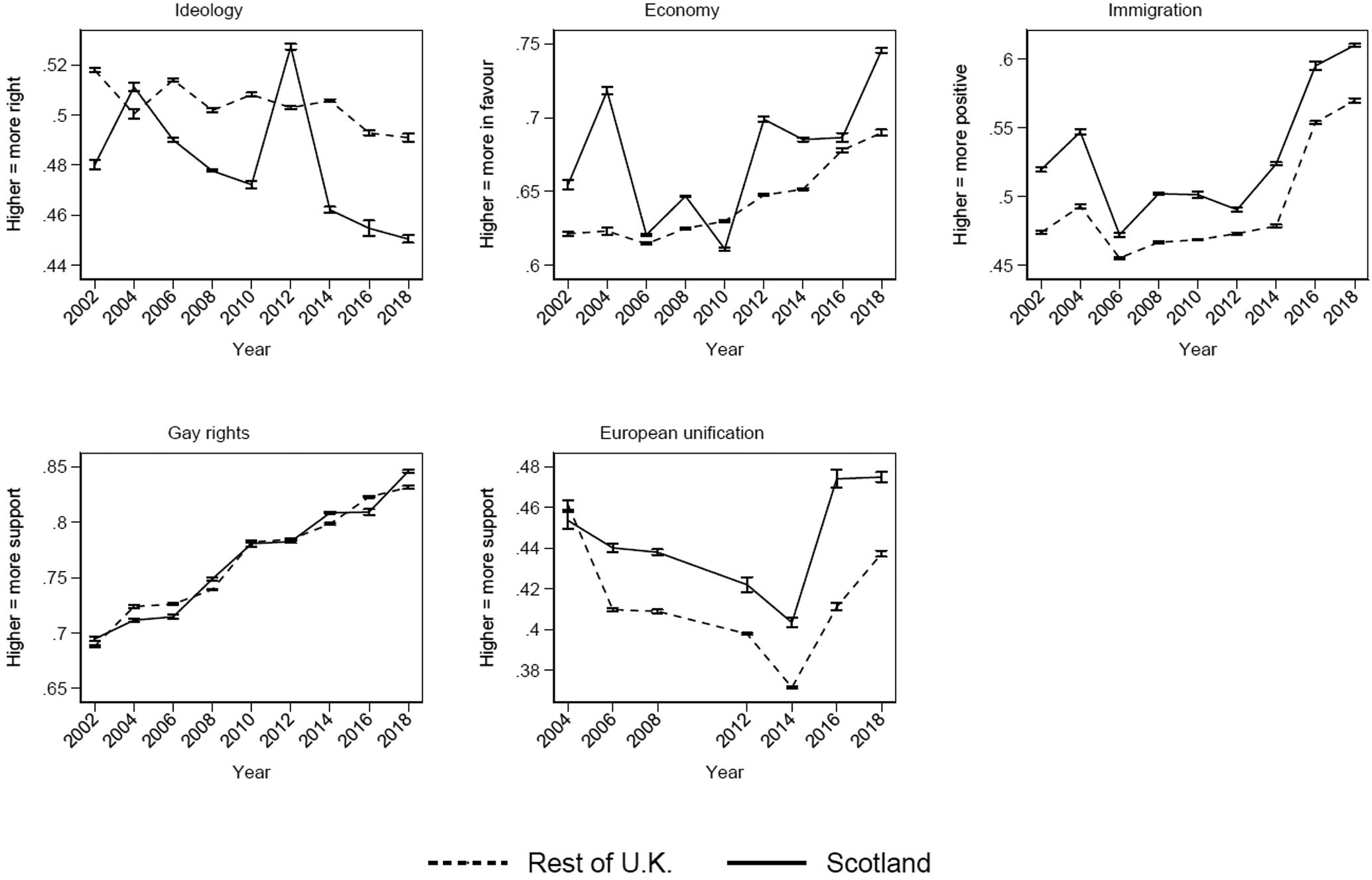
Political attitudes in Scotland and the rest of the UK over time
Note: Results from a model included an interaction between survey year wave and region. Full tables included in Appendix B.

As in the Canadian case, the results for the UK in Figure 2 show considerable variation in some of the indicators of political attitudes. However, overall, the trends in Scotland and the rest of the UK are quite similar. In terms of general ideology, Scottish respondents score lower than respondents from the rest of the UK. However, in two survey years (2004 and 2012), the association is reversed. Although all respondents seem to be moving to the left side of the spectrum somewhat, the gap between the two groups is the largest in recent years. This cannot be said for the other issues: respondents become more favourable of economic redistribution and immigration; and especially for the latter, the trends for both regions are, in fact, very similar. In recent years, respondents are also substantially more positive about gay rights, and also here the trends are almost equivalent. It is good to note we can observe a very clear trend in this regard over the two-decade observation period, indicating that this is a sufficiently long time span to be able to observe fundamental shifts in public opinion. Finally, there is more variation in opinions about European integration. In general, Scottish respondents are more favourable, and the difference is largest in 2016, the year of the Brexit referendum. However, overall, there are no strong diverging trends in these important political attitudes and opinions between the two geographical regions under investigation.
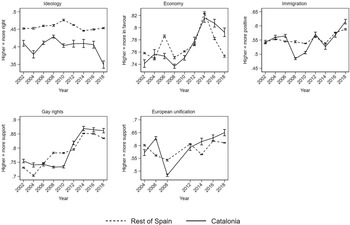
Finally, we repeat the analysis but this time with a focus on Catalonia and the rest of Spain. The results are displayed in Figure 3. The results are, overall, in line with those for Canada and the UK. First, there is a structural difference between Catalonia and the rest of Spain when it comes to general ideology, with the latter scoring consistently higher (that is, more on the right) than the former. Also here, the differences seem to have increased somewhat during the last years. Looking at the political issues of the economy and immigration, there is strong variation. Although there was a general upward trend in Catalonia and the rest of Spain between 2010 and 2014, in the last years, they decreased again. For immigration, there is a general upward trend toward more liberal attitudes. As we found in Canada and the UK, we find here an upward trend for support for gay rights and more stability when it comes to supporting further European unification. There is also no evidence for diverging trends in public opinion, and none of the recent historical events seems to have had any significant effect on public opinion.
Political attitudes in Catalonia and the rest of the Spain over time
Note: Results from a model included an interaction between survey year wave and region. Full tables included in Appendix B.

Taken together, the results show no strong support for diverging public opinion. We find the strongest evidence for this claim looking at general ideology, where there are more stable differences, which seem to become larger in the last years. The political issues of the economy and immigration show more variation but no consistent diverging difference. Support for gay rights increased substantially and in similar rates, and opinions on European unification also seem to be rather uniform throughout the countries under investigation—or at least vary at similar rates.Footnote 12
Conclusion
Will public opinion grow apart in divided societies? That is the main question we wanted to investigate in this article. While there is some research on the behaviour of political elites in divided societies, we do not know much about the dynamics of public opinion. More specifically, we investigated trends in public opinion in three divided societies over a two-decade period, following the analysis by Hooghe and Stiers (Reference Hooghe and Stiers2022) on Belgium. Such a long observation period usually should be sufficient to ascertain whether a socialization effect is occurring or not (Dupuy et al., Reference Dupuy, Verhaegen and Van Ingelgom2021).
The analyses show, first, that there are indeed rather strong political and attitudinal differences between regions, and most likely these differences could give rise to political tensions. In general, the populations of Scotland and Catalonia tend to have a more left-wing political orientation than their fellow citizens in the rest of their countries. In this respect, our results differ from those of an earlier study on Belgium, where it was shown that respondents in the region of Flanders (the region that voted most strongly for constitutional reform) had a more right-wing political profile, which is more in line with the results of Quebec here. While there are studies that have investigated why, for Scotland, this more progressive political profile developed partly in opposition to majority conservative governments in London (Massetti, Reference Massetti2018), it is rather striking to observe that a similar pattern was found in Catalonia. These left/right differences are, however, quite stable over the entire observation period, and we do not find any evidence that these differences are becoming systematically larger over time. In any case, it seems clear that there are rather distinct political identities in the divided societies we investigated. For various other indicators, we can observe that the different regions follow a similar trajectory. An obvious example here would be the emphasis on gay rights, as we can observe that all societies we investigated lean more strongly toward a more liberal value pattern. The fact that we observe such a clear trend demonstrates that an observation period of two decades is sufficient to document important and structural trends in public opinion.
There is not a single indicator where we can show that public opinions in the regions have grown, or are growing, further apart. In the three societies we investigated, the “distinct” regions are quite distinct on a number of important policy preferences, but these differences tend to be stable and well structured historically. As such, our results are in line with those reported by Hooghe and Stiers (Reference Hooghe and Stiers2022) for the Belgian case, as they show stable differences between public opinion between the two major regions of the country but without any systematic trends toward larger differences. Socialization processes, therefore, do not seem to lead to larger differences between the regions (Dupuy et al., Reference Dupuy, Verhaegen and Van Ingelgom2021). From the perspective of socialization studies, these long-term shifts do take place, as we could ascertain in the case of support for gay rights.
These gradual changes therefore take place, as Dupuy et al. (Reference Dupuy, Verhaegen and Van Ingelgom2021) note, but importantly, they seem to occur in a more or less similar form in all societies under investigation in this study. If we combine the accumulated evidence of these four cases, our conclusion has to be that, at least at the level of public opinion, we did not find any indicator for the trend toward further fragmentation of divided societies at the level of public opinion. This is all the more remarkable because in almost every case under investigation, regional authorities have authority over education, and they have used that power to stress regional identity and history in their curricula. Despite these efforts, we do not find any distinct socialization effects, even over a two-decade observation period. Furthermore, all three countries have experienced major political conflicts in recent decades, but we do not find any indication that diverging trends in public opinion could be held responsible for the stronger intensity of these conflicts. These findings allow us to be rather optimistic about the future stability of the divided societies we investigated: the distinct groups in society do not grow further apart. There is no structural trend to divergence—neither after institutional reform, nor after highly mobilizing events such as a referendum on secessionism.
Because we have only two decades of public opinion data, we have to note that as a limitation to this study, we cannot make any statements about the longue durée stability of divided societies. Given the lack of real long-term historical data on public opinion, this hypothesis cannot be tested, and that is clearly a limitation here.
It also has to be noted that in this study, we investigated trends at the level of public opinion, and here we find, first and foremost, indications for stability. At the level of political elites, on the other hand, other dynamics might be at play, as these elites might have an incentive to exacerbate conflicts, since this could strengthen their hold on regional power. This seems to be more a strategic consideration, and it does not seem to reflect any real trend in public opinion. Based on the current analysis, we cannot say anything about the behaviour of party elites, especially those of substate nationalist parties. Some studies, however, indicate that party elites opt for a more radical profile, thus potentially exacerbating conflicts within the federation (Lecours, Reference Lecours2021). These differences between public opinion and party elites, however, could imply that these party elites no longer adequately reflect public opinion in the region they claim to represent (Medeiros et al., Reference Medeiros, Gauvin and Chhim2022). It is also important to take into account the possibility of indirect effects, since events initiated by political elites, such as a heavily contested referendum campaign, could serve as a generation-defining event, thus leading to a long-term polarization of public opinion (Bélanger et al., Reference Bélanger, Nadeau, Henderson and Hepburn2018; Guinjoan, Reference Guinjoan2022). However, what the observed lack of congruence between public opinion and party elites implies for the long-term stability of divided societies is a topic for further research.
Supplementary material
The supplementary material for this article can be found at https://doi.org/10.1017/S000842392300029X.
Acknowledgments
An earlier version of this article was presented at the 2022 annual conference of the Canadian Political Science Association. We thank Félix Mathieu for his substantial comments on the paper. We acknowledge generous funding by the FWO research agency.
Competing interests
The authors declare none.