Five royal buildings are reviewed in this paper, they are the White Tower in London, the Great Hall of Chepstow Castle, the gatehouse of Tickhill Castle, Westminster Hall and the keep of Norwich Castle. They have been attributed to the first four kings after the Conquest, William i, William ii, Henry i and Stephen; there is little if anything attributed to Matilda, and decoration had moved on by the time of the Angevins. The aim of this paper is to study the use, in this particular secular context, of exterior decoration; the typical interior decorations such as wall-paintings and hangings were transient and perhaps personal, but any exterior effect would have been in stone, public and relatively permanent. Religious foundations of the Norman kings, for example the chapel in the White Tower, are not relevant and nor are their buildings in Normandy, where they were dukes, not kings. Further buildings made for the Norman kings other than those discussed here still exist, but they have little surviving decoration so they too are omitted, while the schemes for lost royal buildings cannot be evaluated, however impressive their fragments or contemporary descriptions. Interest will be focused on the historical factors that lay behind the choice of decoration at the five secular sites that was more at home at churches; it will be suggested that the spiritual message given by the various decorations had a political purpose, and the political purpose was sanctioned by religion.
It is necessary to emphasise that the decorations used on the five royal buildings had already been developed for churches: whitening, which will be suggested for the White Tower, was widely used for stone churches in Europe in the eleventh century, while geometric sculpture is a feature of the other four buildings and had been developed for churches in Normandy. Maylis Baylé examined the sculptural decoration of churches in Normandy and neighbouring regions, and showed that some motifs had been used individually earlier in the eleventh century over a wide area,Footnote 1 but it was the building of the two abbeys in Caen from the 1060s that was the occasion for the explosion of the géométrisme normand.Footnote 2 She explored factors relevant to this boom: the loot from the conquest of England could have financed the work; the use of patterns suitable for woodwork might indicate a local tradition transferred to stone, as suggested by Henri Focillon; contemporary decoration elsewhere, for example in Italy, used different forms; and residual Roman sculpture could have supplied the chip-carved star motif. George Zarnecki, in turn, pondered how Normandy more than any other region ‘became so addicted’ to geometric decoration, which is ‘so limited in its range of motifs, and so devoid of any religious significance’.Footnote 3 He instanced similarities with Italian figural sculpture, but his intuition that Italian influences had somehow brought about the changeFootnote 4 was dismissed by Baylé because there were few shared forms or motifs at the crucial time. Zarnecki mentions the presence in Normandy of the Italian monks Lanfranc and Anselm, ‘their prominence in the ecclesiastical and political life of the Duchy, and their friendship with William’; Baylé mentions more clerics (Maurille and John of Ravenna). It is known that duke William cooperated with the Church in bringing order to his duchy, and had a particularly long association with Lanfranc. Duke William supported the Truce of God movement, he had correspondence from the reformer Hildebrand (later Gregory vii) and obtained the support of Alexander ii for the invasion of England; it is reasonable to suggest that these Italian clerics, known to be concerned with church reforms, were the catalyst for the explosion of the géométrisme normand in the 1060s and 70s – not that they encouraged the immigration of Italian sculptors, but that the clerics themselves had observed the local motifs already present at churches, then selected and organised them into purposeful visual displays that could be carved by local craftsmen. It seems to have begun with the décor d’étoiles, perhaps to make the people think of the night sky and then lift their minds beyond it into heaven. The tympana of the region have some similarities to the slightly later tympana in England,Footnote 5 and it was in England that the full range of geometric patterns was developed and employed after the Conquest. The décor d’étoiles became, in England, the chip-carved saltire star pattern and its derivatives, as in figs 2, 4 and 5. These motifs have long been called ‘stars’ without much attention being paid to any possible significance in the word.
It is often supposed that fashions originated at major churches, appealed to visiting lay lords and were copied at their lesser churches; this is feasible, but writers tend to disregard other factors. Baylé’s primary finding, that the abbeys in Caen displayed the first brilliance of the geometric style, has in this way been turned into a stage for the patronage of William the Conqueror, which she would have found unfruitful since patronage alone does not explain the explosion in the use of the patterns, which had to exist before they could have a patron. Further, the abbeys were part of a penance imposed by the pope on William and Matilda for their irregular marriage, not a simple display of personal power. Baylé’s painstaking conclusion morphs into ‘The sunken star is an ornament which developed in the architectural sculpture of Normandy in the 1060s and 1070s, under the patronage of William the Conqueror … Norwegian kings of the late eleventh century used the motif … to propagate their own political identity, as well as emphasize their status as secular rulers in juxtaposition to the Church’.Footnote 6 The fame of a building would bring credit, but to assume that the decoration of a church was left to the choice of the patron while ignoring other factors, such as the professional interests of the clergy in the matter or the availability of the right sort of craftsmen, makes for dull history; the quotation also seems to suggest a fundamental rivalry between ruler and church, which misrepresents the medieval position. The actual functioning of the link between a secular patron and a sponsored building needs to be carefully considered.Footnote 7 It is hoped that the present study will add some nuance to current assumptions about patronage generally, by focusing on the interactions of William, duke and king, and Lanfranc, his adviser and archbishop.
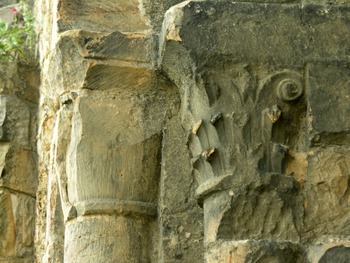
The five buildings are well enough known, in fact or record, to be featured in this review, although they are around a thousand years old. They dominated their landscapes, and there was little to compare with them even then. Richmond Castle, built probably for Alan the Red, a Breton, has an entrance archway, hall-block and small chapel perhaps datable to the 1080s; two foliate capitals survive, like those in Normandy, otherwise capitals are plain scallop types, with arches plain and square (fig 1). On the other hand, four of the royal buildings employ predominantly chequered patterns and blank arcading, drawn from a wider range of geometric patterns common at churches.
Richmond castle, capital of original entrance. Photograph: author.
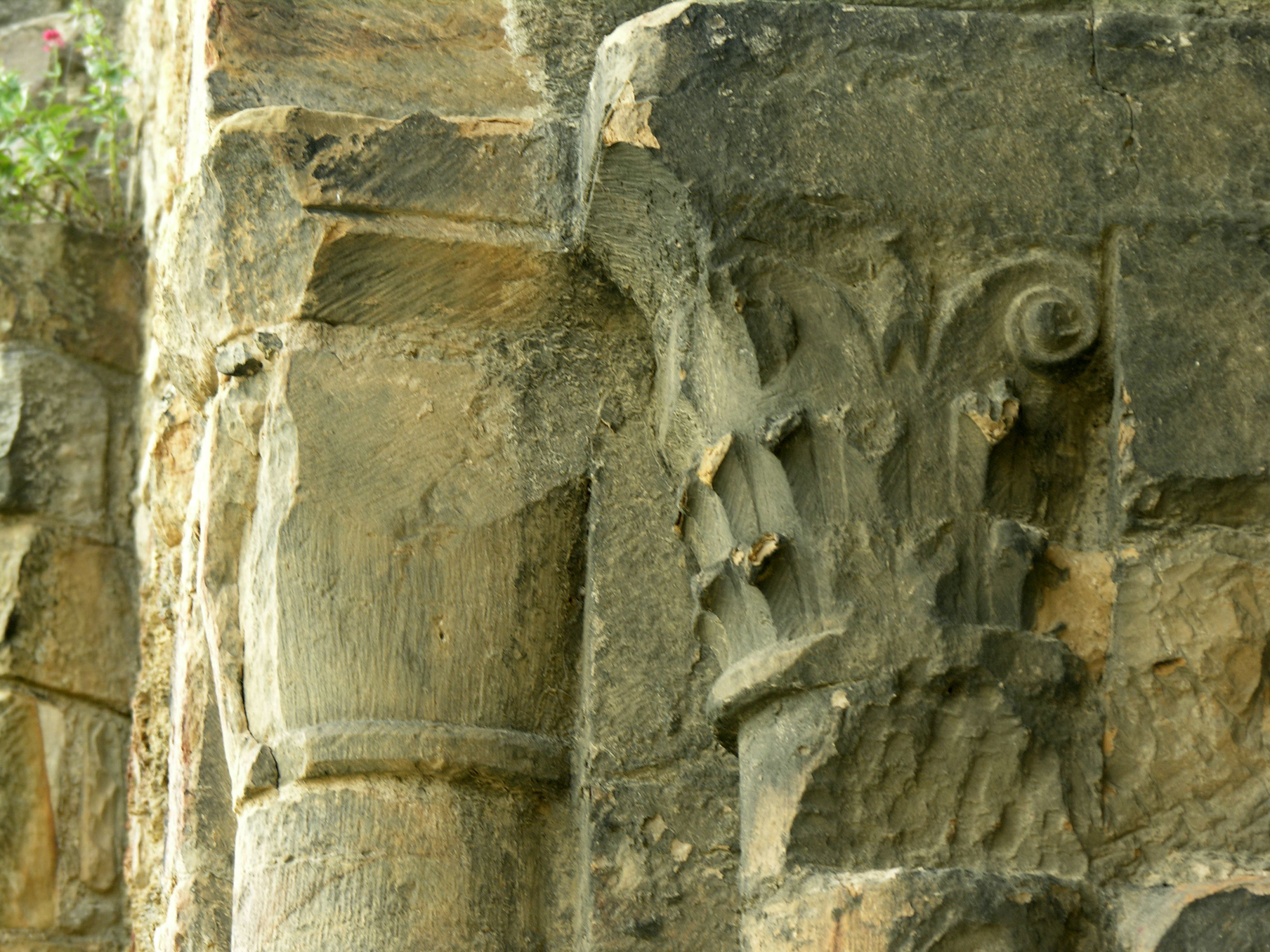
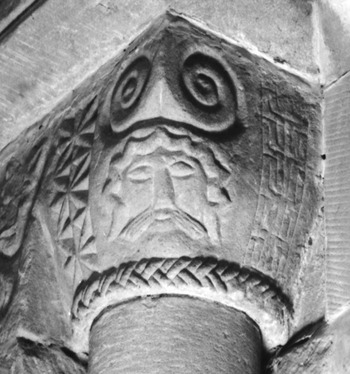
An analysis of the patterns on Romanesque churches in England has shown that they have regular placing and a shared logical content.Footnote 8 The corollary is that the relatively untrained sculptors then available were directed by the Church to follow a centrally-devised scheme or vocabulary of patterns, transmitted either in person or by ephemeral written instructions. A hint of the appearance of such documents is given by observing isolated rectangles filled with geometric patterns at three churches: Braithwell, Little Langford and Kirk Levington (fig 2). At the first is a rectangle with 4 × 2 saltire stars, and at the second a rectangle with three saltire stars with domes in the quadrants; these are on tympana among other motifs. At Kirk Levington two rectangles are on one capital of the chancel arch, they contain three eight-rayed stars, and a fret pattern as used in the Lindisfarne Gospels and the Gellone Sacramentary. It is as though these sculptors exactly copied a sample drawn on a list, alongside which we might suppose written entries would have described the meaning and use of the patterns sampled.Footnote 9 One aim of some reformers was to improve pastoral care; the many new stone churches would reasonably have been accompanied by visual aids provided in their decoration.
Kirk Levington church, chancel arch capital. Photograph: author.
The main conclusion of the analysis of geometric patterns was that patterns were placed in an orderly manner in relation to each other and to the building, and conformed to a simple cosmographical diagram showing heaven above the earth. The diagram had architectural form: heaven was thought of as the brilliantly-lit home or court of the invisible God, it was above the solid firmament that held the fixed stars, which in turn was supported over the earth on pillars.Footnote 10 Star patterns are common on lintels below blank or patterned tympana (at least twenty examples); where such a lintel was used below a figural representation of heaven (on another ten tympana), the lintel can be construed as representing the firmament. Hence, tympana with geometric patterns above a star lintel might also represent heaven. Such a doorway would work like an icon by representing an invisible ideal, thus focusing and stimulating belief.
Once the simoniac Stigand was removed in 1070, Archbishop Lanfranc and his continental bishops could engage in bringing about reforms in the English Church. Although no written mention of decorative arts as part of these efforts survives, the organisational changes made by Lanfranc, such as re-siting some cathedrals and curbing clerical marriage, promoted a closer oversight of the clergy, while his establishment of a system of archdeaconries and deaneries further served to enhance pastoral care – and provided a suitable machinery for circulating the instructions for decoration.
The simple patterns were more than a stop-gap until ‘real’ sculpture could be made: we see them used at cathedrals as well as village churches. A high spiritual status had long been recognised in geometric forms, whereas pictorial motifs were of the earth. The highest metaphor for heaven is beyond even geometry, it is a cloud so bright that God is invisible within it, God is light. The reverence for abstract pattern was inherited from earlier Christian usage and classical texts;Footnote 11 for example, there is the circular baptistery at Butrint, c 500, which has an elaborate mosaic pavement in which medallions with chequered patterns of polychrome tesserae mark out the font itself and the sector used by the bishop; elsewhere in this floor are birds, animals or leaves, things of paradise rather than the highest heaven.Footnote 12
In early medieval illuminated manuscripts, grid patterns can form the background to Christ in glory, while lesser features decorated with those patterns take on that sacred aura.Footnote 13 Chevrons and zigzagging patterns are used to represent the glory radiating from the Agnus Dei, or for the mandorla of Christ appearing at the end of the world.Footnote 14 Arcading, familiar in actual architecture, could represent the pillars supporting the sky, which are mentioned several times in the Old Testament.Footnote 15 Further, optical effects of movement are produced by saltire stars massed in grid patternsFootnote 16 and by irregularities in the circumferential width of chevron voussoirs; such movements could have been seen as expressing the active power of the invisible God. Destabilising optical effects have been observed in San Vitale, Ravenna, perhaps to enhance astonishment and prostration in the presence of God, and the emperor.Footnote 17 Such visual effects were appreciated in these early centuries, but are easily underestimated now. With literacy now dominant, sensitivity to visual displays, their reading, comprehension and retention, is lost to many.
Each royal building will be individually discussed below, but two general observations can be made here. Firstly, given the variety available at churches, it is striking that the royal patrons restricted themselves, or were restricted, to little more than grid patterns and arcading. The figured capitals at Westminster and Norwich are small and needed to be seen from close quarters, so were for individuals to admire; the large exterior views were given over to geometric decoration, and addressed the whole population. Any meanings assigned to sculptural decoration at the churches would have been just as readable at secular buildings, so how might these royal displays have been understood? The arcades represent the supports of the firmament over the earth; the grid patterns represent fields of stars. These combine to imply something higher than earth, something approaching God. Secondly, chevron mouldings seem not to have been used by the kings,Footnote 18 although they were very common at churches and are now the pattern most likely to be recognised as Norman by the layman.Footnote 19 If chevron was absent from the kings’ buildings, that could be because that pattern implied an even closer approach to the Godhead – as mentioned above, chevrons or zigzagging patterns were used in manuscripts to form a radiance enclosing a vision of God himself. Zigzagging patterns were appropriate at churches because God came there in the sacraments of the altar and font; the patterns used at the kings’ buildings – as they now survive – raise expectation of a state above that of earth, but not quite that ultimate vision.
Politically, it was a world in which the separation of church and state hardly existed, so the sharing of patterns should not be surprising. Historians agree that ‘there were both secular and spiritual powers … regarded as deriving from God: neither was absolute in its own right’,Footnote 20 ‘the ‘Church’ in the West was synonymous with society’Footnote 21 and, regarding the post-Conquest period particularly, ‘Ecclesiastical government was inseparable from royal and ecclesiastics are often found to be doing the king’s business rather than their own’.Footnote 22 This interdependence is expressed physically by the close juxtaposition of manor house and church in a village, or the grouping on one floor of a keep of an anteroom, audience chamber and chapel.Footnote 23 God was omnipresent. This belief kept society running and gave it legality; God ‘up there’ knows what we are doing. Clerics ran the secular state and they had easy access to the king, but they were feudal subjects with military duties or taxes to pay, and archbishops could be exiled like any secular lord. In the late eleventh century, when this study begins, church and state were particularly closely interwoven. The value of appreciating this fact is exemplified by a recent study of the Bayeux tapestry.Footnote 24
REVIEW OF DECORATION AT ROYAL SITES
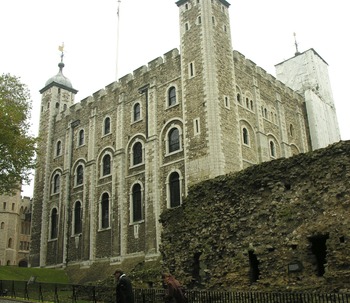
The White Tower in London was probably begun about 1075–9 and completed by 1100.Footnote 25 It was strategically placed in a corner of the still-visible Roman walls and in relation to the Thames estuary; the massive tower, a novel structure in itself, dominated the daily lives of the citizens.Footnote 26 John Goodall compares it to the castle at Colchester, of similar plan and date, planted directly on a Roman building, perhaps ‘as an attempt by the Conqueror to appropriate the Roman past and to present himself as a modern emperor’.Footnote 27 A donjon had a powerful presence that existed even if the owner were absent.Footnote 28 The White Tower has no surviving interior decoration apart from within the chapel; however, the four exterior faces of the massive tower are decorated, in a sense, by the regular ranges of windows and pilasters (fig 3). Unlike church towers, where the complexity of fenestration tends to increase upwards, the decorative emphasis on the White Tower is at the first-floor level, not the second, and this emphasis would have been greater with the original twin openings at that level: this is where the state rooms are.Footnote 29
The White Tower, London. Photograph: author.
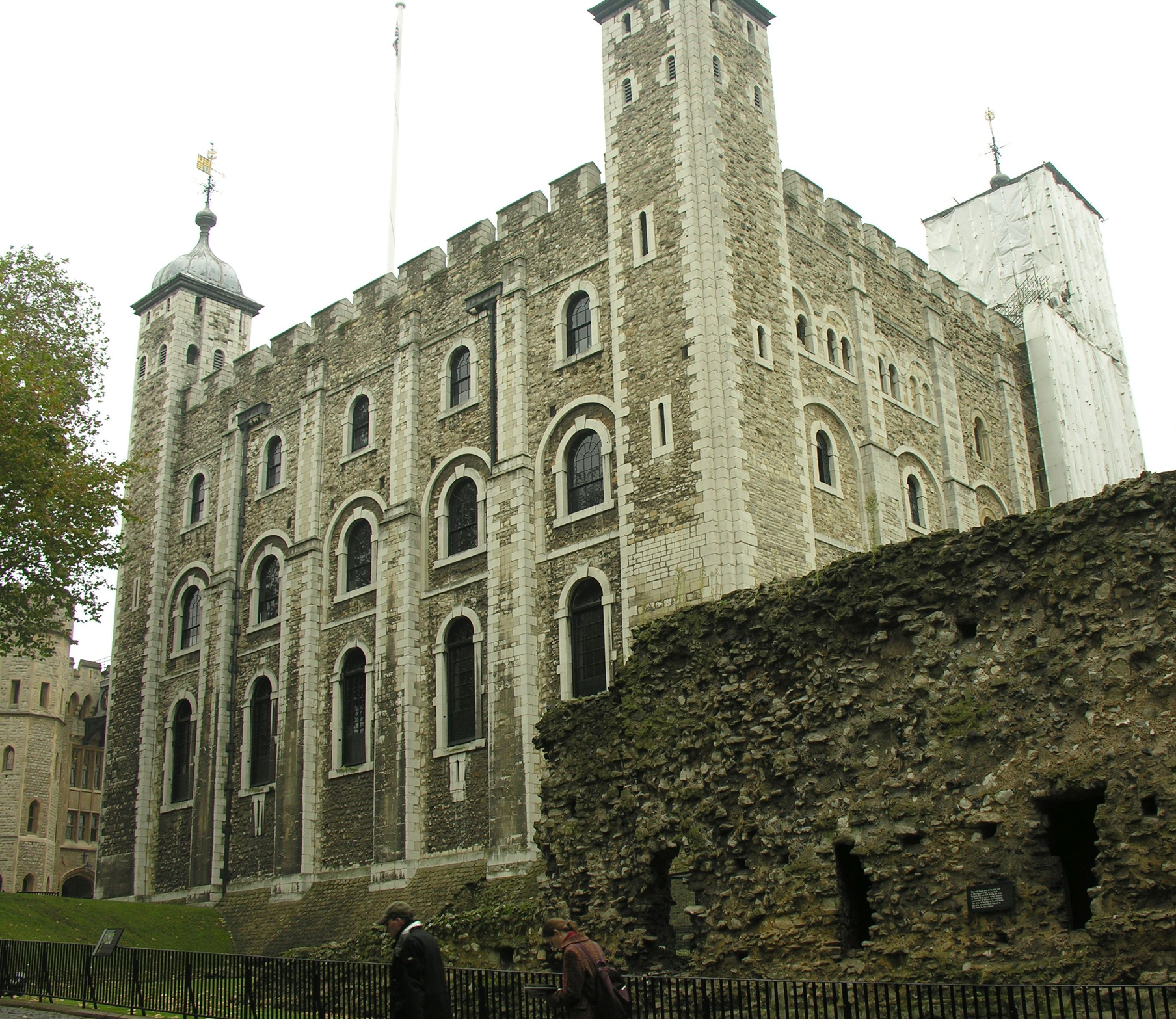
The epithet ‘White’ implies that at some stage the whole building was lime-washed. The tower may have earned its epithet ‘within a few years of 1100’, but this is uncertain,Footnote 30 while the first pictorial evidence is from the fifteenth century.Footnote 31 Rendering or lime-wash were common medieval treatments for church walls; this not only unified the appearance and could be red- or black-lined to mimic ashlar, but consolidated mixed fabric. Lime-washing was already a standard practice on the continent, as could be implied in the familiar phrase ‘a white mantle of churches’ attributed to Rodulfus Glaber, a Burgundian monk, at the turn of the millennium. There is physical evidence for the external application of lime-wash or other rendering to Anglo-Saxon churches,Footnote 32 so the practice was already present in England, adding to the possibility that ‘White’ was an early label for the great tower. The first written record of whitening the tower is c 1240. Henry iii ordered the walls to be ‘newly whitened’ or ‘whitened again’ (de novo est dealbatus), and ordered the gutters to be extended down to the ground to prevent discolouration.Footnote 33 The fact that the king foresaw the discolouration might also suggest that the tower had been whited before. It is reasonable to suppose, therefore, that the massive tower had a bright white coating from the first, producing an unmissable statement of earthly power.
The earliest surviving examples of carved or coloured geometric patterns on any secular building in Britain are at the Great Tower in the castle of Chepstow, Monmouthshire.Footnote 34 This toe-hold on the cliffs of the west bank of the Wye was established soon after the Conquest by William fitz Osbern, earl of Hereford and a long-time friend of the Conqueror. Domesday Book states Earl William built the castle,Footnote 35 and it had been assumed that he built the whole ‘Norman’ castle before 1071. More recently, it has been suggested that the Great Tower was built by King William. David Bates says ‘it is hard to believe that William fitz Osbern could have presided over the erection of so elaborate a building … everything therefore points to the later years of the Conqueror’s reign for the main phase of construction … it was a symbolic marker of his power in south Wales’.Footnote 36 That is, the Great Tower is to be associated with the campaign into south Wales by William i in 1081.
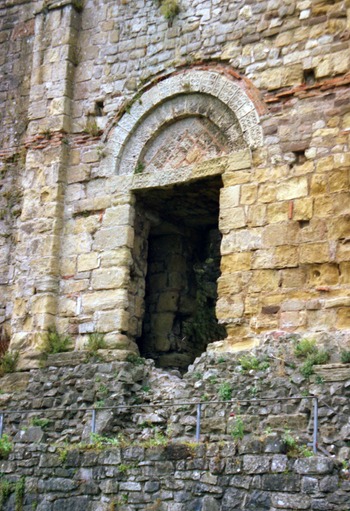
The doorway in the narrow east face of the tower (fig 4) has its tympanum, lintel and arches covered with chip-carved star pattern, as used at many churches in England built between the Conquest and c 1130 – although it would be hard to find another doorway that used this pattern in all three fields of tympanum, lintel and arch.Footnote 37 The rectangular tower has two levels (undercroft and hall) and three doorways: the patterned one on the east wall, and two undecorated in the north wall.
The doorway of the Great Tower, Chepstow Castle, seen from the bailey. Photograph: author.

There are various interpretations of the doorway on the east façade: as providing the chief general entrance from the bailey into the hall via a lost wooden staircase,Footnote 38 or as having a balcony and enhancing a ceremonial appearance.Footnote 39 If used for an appearance, those seeing the king from below in the bailey viewed him against a backdrop of (what they had been taught to see as) a representation of the power and imminent presence of God. There could have been a similar reading of the patterns if this had been the general entrance to the Great Tower: climbing the wooden stairs one would look up, see the patterns and expect to arrive in a place of superior power. This would have been reinforced by the interior decoration of the hall, with its arcades of decorated niches. Pamela Marshall thinks the hall could have held a large gathering, but solely for ceremonial purposes since there are no side-chambers or garderobes; she sees the niches surviving in the south and west walls as formal seating.Footnote 40 Some of the niches still have their plaster and paint with trellis grid pattern at the top.Footnote 41 It is disappointing that John Goodall dismisses this painting as ‘the remains of a zany decorative scheme …’,Footnote 42 but his remark illustrates the general disregard for the possible significance of ornament. The decoration of the Great Tower, inside and out, provided an environment that suggested not just elite worldly power, but the presence of sacred power: that William in his hall represented, deputised for, God.
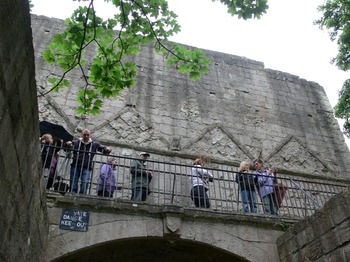
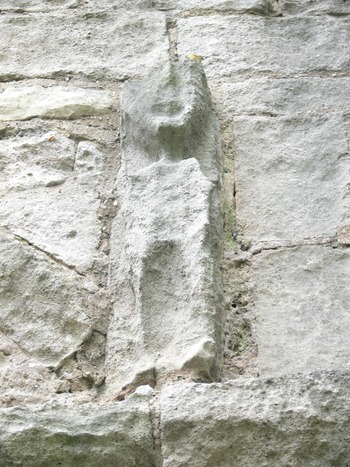
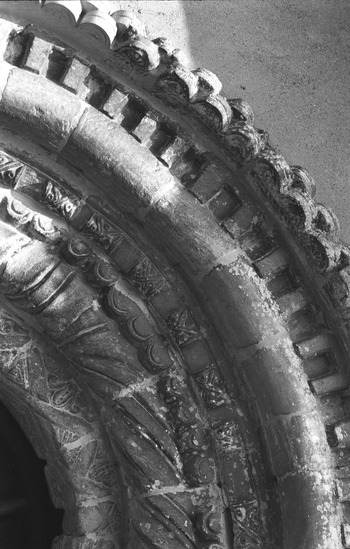
Tickhill Castle in Yorkshire consists of a motte inside a large walled enclosure, and the date of its gatehouse is unrecorded (fig 5). It is two-storeyed and rectangular; both the curtain wall and the gatehouse are attributed, on no very strong evidence, to Henry i (d. 1135), and may be earlier.Footnote 43 According to Orderic Vitalis, Robert of Bellême ‘demanded Blyth [that is, Tickhill] and all the land of his kinsman Robert of Bully as his right, and bought it from William Rufus with a great sum of money’. There are some obscurities in this, according to Marjorie Chibnall, ‘but it seems almost certain that he held it as a charge, and not in fee. [This is what] William Rufus did in Normandy, where he entrusted Robert of Bellême with the control of the key castle of Gisors without ever surrendering control of it’.Footnote 44 In other words, Chibnall is suggesting that Tickhill had been retained by William ii before it is recorded as belonging to Henry i. Either of these kings, therefore, might have commissioned the gatehouse. Above the main opening through the curtain wall and embankment, the width of the gateway has a row of four false gables, each filled with opus reticulatum carved with fields of star or cross patterns. Six recognisably human statues remain at the nine corners of the gables (fig 6). They seem appropriate to a castle – perhaps three watchmen, two men shouting defiance and two physically insulting attackers. Similar subjects occur on Irish castles,Footnote 45 and watchmen and exhibitionists are occasionally seen on church corbel tables.
The gatehouse at Tickhill Castle, Yorkshire. Photograph: David J Mercer.

A figure on the gatehouse at Tickhill. Photograph: David J Mercer.

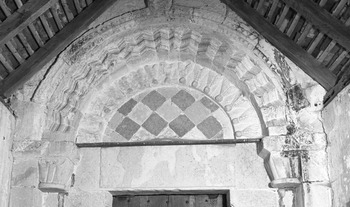
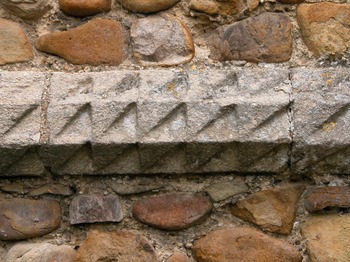
The great hall that outshines all others even now is Westminster Hall, begun by William ii around 1095 and in use by 1099.Footnote 46 Little distinctive decoration remains visible because of fourteenth-century alterations, but careful nineteenth-century recording preserved details found during restoration works. A conjectural exterior reconstruction has been made,Footnote 47 showing a rectangular building of twelve bays with clerestory windows. Along the parapet of the long side walls ran a band of chequered masonry set trellis-wise (compare figs 5, 7);Footnote 48 while above and below the windows ran string-courses carved with three rows of sawtooth ornament or canted squares, its extent in a string-course probably too small to generate an illusion of movement (cf fig 8).Footnote 49 On the north and south gable ends, at the level of the parapet on the side walls, a blind arcade ran across the base of the gable, filled with chequered masonry; below these blind arcades were three windows matching those on the side walls.Footnote 50 Sydney Smirke noted that some chequered surfaces were built up of Caen and Reigate stone, so they alternated cream and brown.
The tympanum of the north doorway of the church at Great Durnford, Wiltshire. Photograph: courtesy of the Corpus of Romanesque Sculpture in Britain and Ireland.

Sawtooth decoration at Haslingfield, Cambridgeshire. Photograph: Ron Baxter for the Corpus of Romanesque Sculpture in Britain and Ireland, https://www.crsbi.ac.uk/view-item?i=6509 (accessed 17 May 2022).

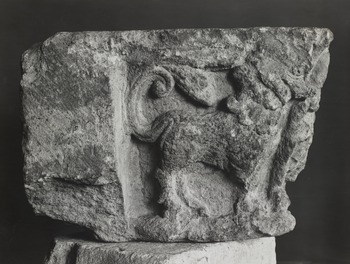
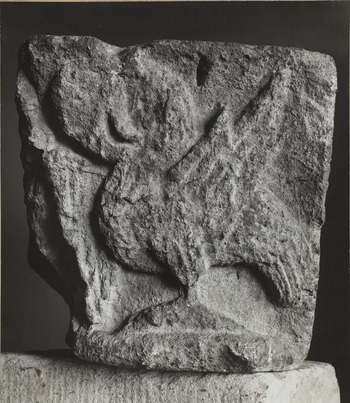
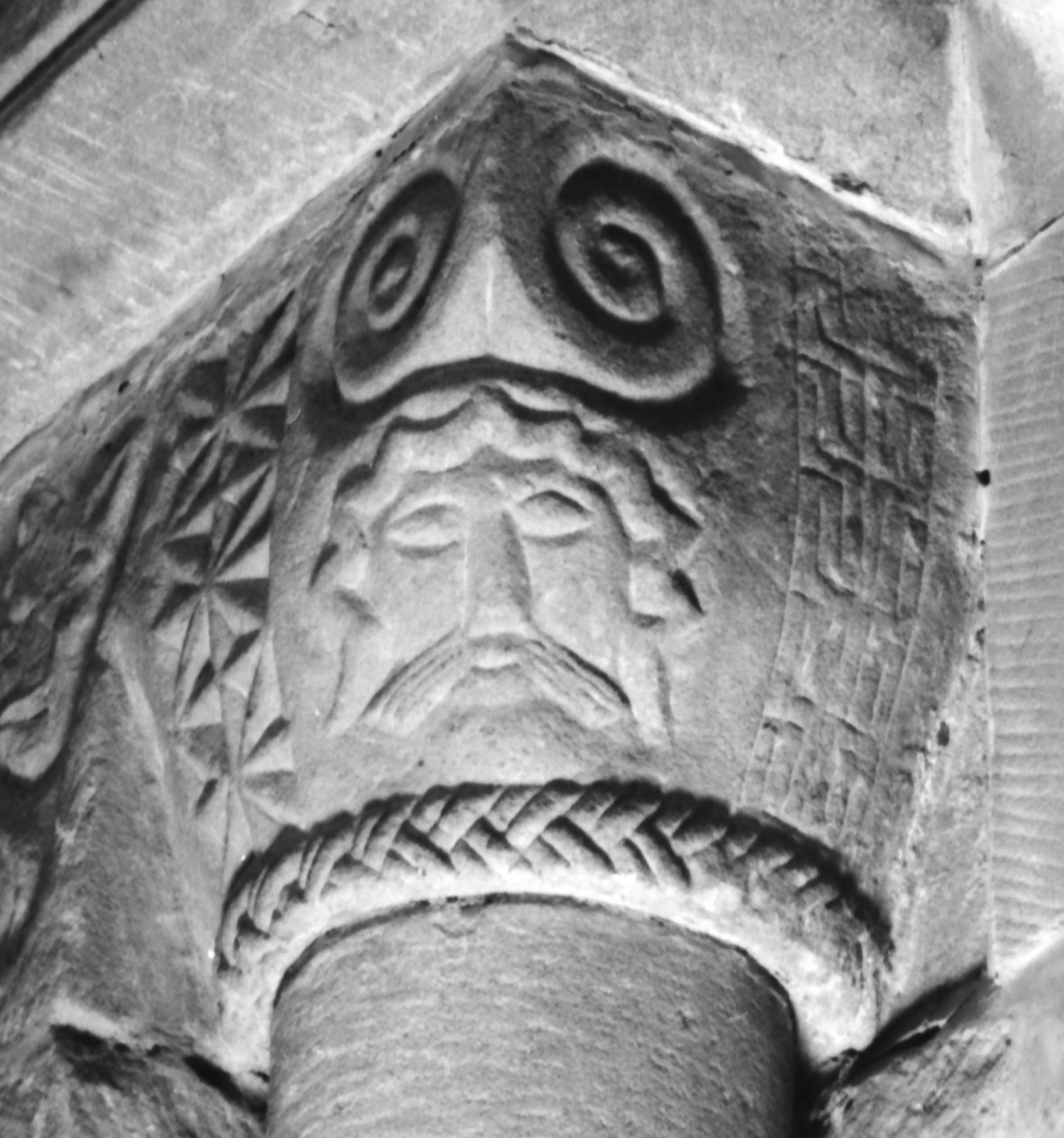
The north doorway was flanked by a large niche on each side; perhaps this arrangement was meant to suggest a Roman triumphal arch, like many Romanesque church facades.Footnote 51 A large later doorway replaced the first opening almost entirely. In 1822, J C Buckler sketched what he had seen ‘behind the ornamental porch which was built up against the old north wall at the end of the fourteenth century, [where he had] observed three large arches… the centre [arch] had been nearly cut away in forming the great doorway’ but passages of opus reticulatum remained in the blank arches on either side. Unlike the reconstruction, Buckler’s sketch shows the pattern only in the upper part of the arches, just as it occurs in the hall at Chepstow and on the church at Dymock.Footnote 52 In 1835 some ten carved capitals were discovered and assumed to have come from the Hall; they were ‘found embedded in masonry, with their faces much mutilated and set inwards… in the fourteenth century’.Footnote 53 It has been suggested by Lindy Grant that the carved capitals came from the original north doorway.Footnote 54 The heights of the capitals would suit a doorway,Footnote 55 and there is no evidence for any ‘blind arcades of the interior walls’ suggested by George Zarnecki to be the original site for these capitals; perhaps he was thinking of the clerestory arcade, where nineteenth-century drawings show the capitals as plain cubic. Although the reconstructed façade resembles that of a church, the subjects of the capitals suit a secular building, and no motif among them need refer solely to church teaching. The three capitals with both faces surviving show the ‘fable of the ass’,Footnote 56 the defence of a castleFootnote 57 and a lion and a bird (figs 9 and 10); these themes – fable, fighting or hunting, and animals in foliage – are thought to recur in the more fragmentary capitals.
Capital probably from Westminster Hall, a lion. Photograph: reproduced courtesy of Conway Library, Courtauld Institute of Art, London.

Capital probably from Westminster Hall, a bird. Photograph: reproduced courtesy of Conway Library, Courtauld Institute of Art, London.

Christopher Wilson suggests Westminster Hall was used for ceremonial feasts and perhaps for dispensing justice; the palace already had the smaller Lesser or White Hall for everyday use.Footnote 58 Both as crown-wearer and as judge, the king in his great hall was exercising a delegated sacred power, as Wilson was the first to demonstrate by quoting the coronation prayer Prospice:Footnote 59
Almighty God, look with clear gaze upon this glorious king and, just as you blessed Abraham, Isaac and Jacob, so with generous blessings of spiritual grace bathe him by your power with all fullness, inspire him, make him worthy.
Bestow upon him, Lord, both the dew of heaven and the richness of the earth, its abundances of corn, wine and oil and opulence of all fruits by the largesse of divine gift through long times, so that during his reign there may be soundness of bodies in his country, and peace inviolate in his kingdom,
And may the glorious dignity of his royal palace shine with the greatest splendour of his royal power in the eyes of all and appear to glitter with the brightest light and splendour like the most splendid lightning flashes filled with the greatest light.
Almighty God, grant him that he may be the mightiest conqueror of enemies to crush rebels and pagan nations. And may he be terrible enough to his enemies with the greatest strength of regal power, and to the aristocrats and high-ranking loyal nobles of his kingdom may he also be generous and loving, and devout so that he be feared and loved by all.
Also, may kings come forth from his loins through successions in times future to rule the whole kingdom here
And after glorious and productive times in this present life, may he merit everlasting joy in perpetual blessedness.Footnote 60
The prayer asks God for the blessings that would give national stability. In that context, the request that the royal hall should ‘shine … in the eyes of all’ might sound self-centred and even irrelevant; however, in the italicised petition, every phrase invokes light to a degree that would then have recalled heavenly light and the brightness of the vision of God – lightning in the Old Testament, for example, is often a sign of God’s presence. If this petition is applicable to Westminster Hall, as Wilson suggests, then the prayer combines with the exterior decoration to tell us that it is God’s power and glory that was acquired by William Rufus along with the crown. If, as is thought likely, the coronation of William i also included this prayer, it is possible that an initial whitening of the White Tower, and perhaps the White Hall too, would have been intended to represent in a striking and literal manner ‘the greatest splendour of his royal power’, shining in the eyes of all. Westminster Hall would not need whitening to achieve this, but displayed a similar message in patterns.
The mass following the coronation included the Christus vincit or Laudes regiae, an ancient litany of acclamations and prayers of which several Anglo-Norman versions survive.Footnote 61 The sacred powers invoked there to support the king – the Virgin and two archangels – were only surpassed by the three persons of the Trinity invoked on behalf of the pope. The queen had four apostolic supporters, and so on in grades, down to the chief men of England who are linked to four female saints. This litany again placed the powers available to the king in a spiritual level far above that of his subjects.
‘It is very important to keep in mind that the conceptual framework of power and culture was in many respects very different from one we would recognise’,Footnote 62 and perhaps the differences are most obvious in this matter of sacred kingship. Becoming an anointed king was of a different order to inheriting a dukedom or being a conqueror.Footnote 63 Once anointed and crowned, William acquired ‘a solemnity and authority that had not been present before’.Footnote 64 Several modern writers use metaphors of divinity when commenting on the Norman kings.Footnote 65 The prayer Prospice was at a climax of the coronation ritual, it came after the acclamation and was followed by the anointing. Then came the investiture with symbols of royal office.Footnote 66 Crown-wearing – up to three times a year at the greater festivals of the Church – re-staged the image of the newly-anointed king and would have been intended to remind onlookers of his God-given power.Footnote 67 It is suggested that the grid or star patterns and, if it existed this early, the whitening of the White Tower and of the Lesser Hall at Westminster were intended to promote this sense of sacred kingship by simulating brilliant, glittering light high above the viewer.
The acceptance of the quasi-priesthood of an anointed king was prevalent in Norman, Ottonian and early Salian sources, and among the Anglo-Saxons,Footnote 68 but Norman writers have been considered ‘the most prominent in all Europe’ in developing the notion of the priest-king.Footnote 69 The ‘Norman Anonymous’ asserts the divinity of kings by consecration, the fusion of the two natures, divine and human, and hence the king’s Christlike competence in both the temporal and spiritual realms’.Footnote 70 Royal sacred power probably reached its peak in the time of William i and William ii.Footnote 71 Exerting some control on kingship were the so-called Penitential Ordinances, c 1070, listing detailed penances for all who had taken part in the Norman invasion and conquest.Footnote 72 This would have tended to modify absolute power even though a penance could be commuted to gifts or foundations, as it was when William i founded Battle Abbey. The investitures controversy developed on the continent as the Church asserted its right to control church appointments, again limiting royal power. The crown-wearing ceremony is less often recorded in the time of Henry i and his successors.Footnote 73
An anecdote in the Vita Lanfranci, c 1140, illustrates the relationship between the anointed king and his consecrated archbishop:
During a certain festival, one of the three big ones, in which the crowned king [William i] was accustomed to hold court, on the day of the festival when the king was sitting at table adorned with his crown and regal robes [indumentis regalibus], and with Lanfranc next to him, a certain joker [scurra Footnote 74 ], on seeing the king radiant in gold and jewels, shouted in the hall [aula] in a loud voice of adulation ‘Look, I see God, look, I see God!’ Turning to the king, Lanfranc said ‘Do not allow such things to be said of you; they are not for man, but for God. Order him to be soundly flogged, so that he may never repeat such words.’ Following Lanfranc’s word, the king ordered this to be done. This very clever man [Lanfranc] knew that Herod Agrippa, struck by an angel, died because he did not reject, but accepted, the words of sycophants acclaiming him as God.Footnote 75
There are many views of this incident, but Bates sees Lanfranc chipping away at forming the king’s mind, as he did for decades,Footnote 76 while Cowdrey is more precise, saying ‘Lanfranc’s concern was less for the jester’s blasphemy than for the king’s pride’.Footnote 77 The king seated in state and wearing his crown resembled one picture men had of God enthroned in heaven – and all three men must have known that crown-wearing was meant to reflect that image as well as bring to mind oaths sworn at the coronation. Lanfranc condemned the scurra for pushing the metaphor too far in blasphemously equating William with God; while in advising the king to punish the man, he made sure William could not bask in the effect he made, but had publicly accepted that he was not God.
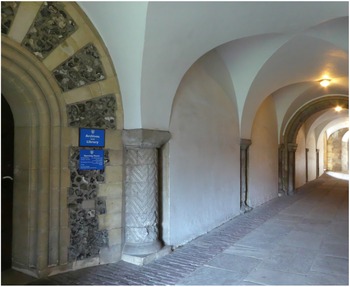
The combination of William and Lanfranc was powerful.Footnote 78 In Normandy before the conquest of England, Duke William ‘venerated Lanfranc as a father, respected him as a teacher, [and] loved him as a brother or son’.Footnote 79 It is recorded that ‘in Henry i’s reign an elderly monk of Battle Abbey commented that men of their day used to say that no two such figures were to be found together in one land as were King William and Lanfranc his archbishop’.Footnote 80 Lanfranc himself built a new cathedral and monastery at Canterbury; perhaps because of the urgency to shelter the community, there seems to have been little sculpture, and capitals are plain cubic or cushion throughout.Footnote 81 However, there are four decorated columns along the passage on the north side of the chapter house (fig 11).Footnote 82 Whatever their function in the cathedral priory, royal buildings, so far as we know, did not have such striking pillars, which are next seen in Durham cathedral.
Carved pillars in Canterbury Cathedral priory. Photograph: author.

A lesser version of Westminster Hall was built in Normandy, probably while William Rufus was the temporary ruler there in the absence of Duke Robert, c 1096–1100.Footnote 83 The Échiquier in Caen Castle is a free-standing six-bay great hall with shafted windows and corbels similar to those at churches, the entrance doorway has star patterns and one order of chevrons, while the window above it has billet moulding. In assigning the building to Rufus, Impey and McNeill detect regal ambitions in him even when in Normandy, where he was only duke. They quote the prayer Prospice from the coronation liturgy and suggest he could have used the hall for a crown-wearing.Footnote 84 Neither chevron voussoirs nor corbels have been reported from the fabric of Westminster Hall, but the exterior is carefully patterned elsewhere and may have had closer oversight than the duke’s hall in Caen.
The various large-scale decorations identified or postulated, and used successively at the four royal buildings reviewed above, suggest the evocation of a heavenly presence at or in the buildings: the kings were staging themselves as the immediate earthly agents of God’s power. These statements of power were largely produced by two basic patterns. In contrast, when describing laymen’s churches built in the 1130s or 40s, it is commonplace for the modern writer to exclaim at the richness and variety of ornament for so insignificant a building, which may then be ascribed to the wealth of the lay patron and his desire for status. The paucity of exterior decoration at royal buildings cannot be explained in that way, but, if it is accepted that there were religious limits on the patterns used in a secular building, the situation can be understood. William and Lanfranc shared a view of the world that allowed, in their lifetimes, a rational solution to problems of state and church. Less than a century later the same problems would lead to the murder of an archbishop and the public penance of a king.
Lanfranc of Pavia came to Normandy in the 1040s, was made abbot of St Etienne in 1066 and from 1070 governed the reformed church in England. From his experience in Normandy, he would have understood the language of geometric patterns as well as anyone did; he can hardly have disagreed with their selective employment on royal buildings, he most likely encouraged or even prompted it. There were always religious limits on a king, seen, for example, in the displaying of the Bayeux tapestry in Bayeux cathedral, probably for the dedication in 1077. However grand and well-attended that service, however much the narrative of the tapestry justified and lauded the Conqueror, the tapestry was displayed in the nave, not the eastern parts of the church where the altar and the relics were.Footnote 85 Lanfranc died in 1089, two years after the Conqueror. William Rufus had been raised in Lanfranc’s household, where his conditional powers must have been explained to him, and this belief seems to have governed his decoration of Westminster Hall.
The fifth royal building, the keep of Norwich Castle, has no firm dates. It may have been begun by William ii and finished by his brother Henry i, perhaps by the mid-1110s.Footnote 86 It has more recently been suggested that the decorated upper parts and fore-building were not begun before the 1120s, and perhaps were completed as late as 1140, so King Stephen might have been involved.Footnote 87 It has also been suggested that the motte was refashioned by William Rufus about the time of the transfer of the see from Thetford in 1094, and that the subsequent stone detailing ‘bears direct technical comparison to that of the cathedral rising beside it’;Footnote 88 however, despite some common patterns, there are distinct differences. The dating of the decorated parts of the keep would perhaps be best examined by considering the ‘most common motif on the keep … a trapezoidally shaped wedge extending onto an arch roll’,Footnote 89 a form which does not appear on the cathedral. This moulding was used on the unrestored walls, on arches in the blank arcade on the first floor of the west façade, on the third level of the north and east facades and on all openings in the Bigod Tower.Footnote 90 It survives on the entrance doorway and the vault of the fore-building, in a few other places outside and on some interior arches of windows and doorways. A consideration of this sculptural form, so typical of the building, is essential when looking for the rationale behind the decoration, but first I will give a brief overview of the decoration of the exterior of the keep and of the entrance doorway.
The large square tower and its arcading were not new in their visual effect, but must have recalled the White Tower; the minor sculpture on the entrance doorway entertains, as the capitals found at Westminster Hall could also have done. The four faces of the keep have much restored arrangements of arcading, which are rhythmic and intentionally decorative. On the west face ‘there was … a most striking use of reticulated masonry behind the upper arcade’.Footnote 91 This side, at least, reproduced the supports of the firmament and a view into heaven, much as suggested for Westminster Hall. There were two opportunities for an appearance doorway at Norwich: a short-lived lesser one facing onto the market placeFootnote 92 and the grand one in the fore-building on the east side overlooking the bailey. This has been much altered, and its row of three openings must be reimagined.Footnote 93
Protected by the fore-building, at the top of the main staircase, and with its own few steps, is an elaborate but restored doorway of four orders giving direct entrance into the great hall.Footnote 94 The first, or inner, order is plain, square and continuous; it might represent an original first order, but is usually discounted. The arches of the following three ornamented orders have angle rolls and wide shallow hollows. The third and fourth orders have some stylised foliage, but mostly feature small studs, now broken, all probably intended as stars; such knobs or domes have an infinite variety of treatment when used on churches. The label has large saltire stars and forms an arch over both the doorway and a blank arch to the right; again, mouldings are wide and shallow.
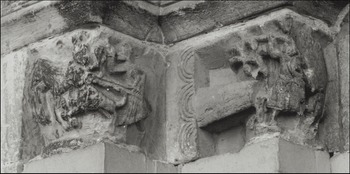
Individual ornamentation was concentrated on the capitals and on the voussoirs of the second order. Capitals on the left of the doorway have hunting scenes featuring a boar and a stag (fig 12). Neither scene suggests a Christian moral, but nor do they depict realistic twelfth-century hunts; there is something of the Greek hero about the man who has the feet of the rearing boar on his body, and also in the dog wrestling with the stag (however well-observed the arrangement of its slip-lead). The severely-damaged capitals on the right have animals in foliage, again with no discernible ‘sacred’ connotations apart from a triangular animal head emitting foliage.
Capitals on the left side of the doorway into Norwich Castle keep. Photograph: reproduced courtesy of Conway Library, Courtauld Institute of Art, London.

In the arch of the second order are wedges paired with twenty-nine assorted subjects, of which three are lost or seriously damaged; wedges continued down the jambs. Most subjects would not be out of place on a church, but there are five other motifs. Do the lion, bird and wyvern have a Christian significance, or, like the winged horse, might there be other allusions? The character of the kneeling man is uncertain;Footnote 95 on a doorway at Riccall, Yorkshire, a kneeling man has a cross on his shield, whereas, in the Westminster capital, the kneeling or collapsed armed man has attacked a castle and is being repulsed.Footnote 96 The range of subjects is comparable to that of the capitals found in Westminster Hall, but both sites are incomplete.Footnote 97
To return to the most common motif on the keep, the ‘trapezoidally shaped wedge extending onto an arch roll’ (fig 12). That description is unusually objective for a form that is endlessly redefined in the literature, even King elsewhere in his paper using ‘conventional beakhead’, ‘geometric beakhead’ and ‘beaker moulding’, to describe it.Footnote 98 A plain block like this one is unusual anywhere, or, as Heslop puts it, the beaker clasps ‘seem to come from nowhere’.Footnote 99 The finished form is hardly more than the first roughing-out of a radial block, but, as Ron Baxter demonstrates from sculpture at Westhall, Suffolk, the wedges – which he describes as ‘chamfered tapered bridges’ – were not intended to be carved further as they are too narrow.Footnote 100 A large number of wedges were needed for the keep; they were economical. Decoration was required for the upper arcading on at least three walls, over 50ft (18m) above the mound and higher still above the natural ground level. Some striking pattern was also necessary to emphasise the openings in the Bigod Tower; the moulding chosen for these places had to be effective over an unusual distance, bold, clear and lively. At a lesser height, billet moulding might have served; here, chevron moulding would have been the obvious choice, but it was not used. This seems a clear instance of secular royal buildings deliberately avoiding chevron. The situation recalls the passage quoted from the Vita Lanfranci – there were limits to a king’s glory. It is suggested that, due to both physical and religious restrictions, this stark wedge or beaker form was developed onsite for decorating this keep.
The wedge is not only found on the keep at Norwich, but occurs at eleven village churches in the region,Footnote 101 where it sometimes appears with orders of more delicate patterns (fig 13). These churches were presumably decorated by masons who had earlier worked on the keep. Ron Baxter suggests a date c 1140 for the work at Westhall, Suffolk, saying ‘The two doorways and the W window belong to the same campaign, which includes relatively early motifs (chip-carving, cushion capitals), but which must be dated c 1140 on the evidence of the multi-fluted capitals and the chevron ornament’.Footnote 102 The greater diversity of patterns used at village churches than on the keep illustrates once again that there was some kind of restriction on decoration at royal sites.
Patterns on the south doorway at Thwaite St Mary, Norfolk. Photograph: Jill Franklin.

CONCLUSION
Geometric patterns at churches could represent the cosmographic relationship of earth, firmament and heaven. The same interpretations of individual patterns have now been applied to the decoration of royal secular buildings and are found to correspond to the early medieval belief in sacred kingship. The survival of the five ancient buildings is in part due to their being royal possessions for much of their existence, and their decoration remains for us as witness to the nature of kingship in their day. It is visible evidence, which otherwise is concealed in a few boxed-away documents or the secondary sources of books, for a society in which order was predicated on the existence of God and mediated through a sacred king. Lack of space prevents an examination of developments further into the twelfth century, when other lords decorated their secular buildings using sacred patterns,Footnote 103 probably with related justification.
ACKNOWLEDGEMENTS
Thanks are due, once again, to Peter L Wood for translations from the Latin. Thanks are also due to Nathalie Cohen, Cathedral Archaeologist at Canterbury Cathedral, to Florence Scott, of Leeds University, regarding crown-wearing and to Edward Impey for sending his paper on the ‘castle’ capital. When other possibilities were lost in ‘lockdown’, the Conway Library supplied reference material and images for figs 9, 10 and 12, while the online archive www.crsbi.ac.uk was invaluable. Text by Maylis Baylé was supplied by John McNeill. Photographs were sent to me by James King and Jill Franklin in pursuit of the Norwich Castle ‘wedge’. Thanks for advice and discussion to John McNeill, Sandy Heslop, Jill Franklin and Malcolm Thurlby, to all anonymous reviewers of the several versions of this paper and my most grateful thanks to Barbara English for reading a late draft.