COMMON TO ANY RADICAL GROUP THAT UNDERGOES A MODERATE transformation is a deep suspicion from its critics about whether its transformation is genuine or not. Declaring a ceasefire or agreeing to participate in elections is often not proof enough of moderation for critics who also want groups to condemn their past behaviour, give up goals that challenge the state’s authority, and espouse a fundamental change in their values before the transformation is accepted as credible (de Zeeuw Reference De Zeeuw2008; Manning Reference Manning2004; Schwedler Reference Schwedler2011; Tezcür Reference Tezcür2010). This raises questions about what it means for a radical or violent group to moderate – what must change during this process and what, if anything, can stay the same?
The demand that a group must change its values and goals before it can be considered truly moderate is particularly prevalent when it comes to radical separatists. Governments and politicians often refuse to negotiate with radical separatist groups unless they give up trying to secede from the state or cease denying the existing state’s right to rule over a territory. For example, when José María Aznar was prime minister of Spain he initially refused to negotiate with the Basque separatist groups ETA (Euskada ta Askatasuna – Basque Country and Freedom) and Herri Batasuna (Popular Unity) in the late 1990s, even though conditions for a ceasefire looked promising, because Basque radicals refused to compromise on core demands about self-determination and their attachment to a rigid form of ethnic nationalism (Whitfield Reference Whitfield2014: 81–5). In 2000 after the Partiya Karkerên Kurdistanê (PKK – Kurdistan Workers’ Party) declared an unsteady ceasefire and changed its strategy from seeking independence to seeking autonomy within Turkey, the Turkish government refused to negotiate because of ongoing Kurdish attachments to a distinct identity and the possibility that this would lead to a return to separatist demands over time (Unal Reference Unal2014). After the Sunni Islamic fundamentalist Hamas won the 2006 Palestinian legislative elections, Israel refused to recognize the result because Hamas continued to reject the right of Israel to exist (Wilson Reference Wilson2006). Both changes in tactical behaviour and changes in values and goals are often demanded before separatists are accepted as having moderated.
But is it really necessary for radical separatist groups to give up their goals and values in order to become moderate actors, or is a change in strategic behaviour alone enough? What must change and what is not necessary to change in order for a radical group to be classified as a moderate actor? This article tackles these questions by analysing the precise meaning of moderation in the separatist context and offering a pathway by which to understand radical to moderate transformations. It argues that moderation has two dimensions, a ‘strategic behaviour’ dimension and a ‘values and goals’ dimension. In order to become a moderate group, radical separatists do not necessarily have to change their values and goals. A change in strategic behaviour away from using violence and attempting to overthrow existing institutions through revolution is sufficient. Moderation should be understood as a process of agreeing to work through existing institutions but without needing to dilute or forsake ethno-national values. In fact, it would be analytically limiting, and possibly politically damaging for the prospects of solving conflicts peacefully, to consider ethno-national radicals as having moderated only after they changed their core values or abandoned their claims to territorial sovereignty. Abandoning such values is not necessary for separatist groups to achieve moderation because there is nothing inherently anti-democratic in making an alternative claim to sovereignty.
The argument is generated using insights from the case of the transformation of Sinn Féin and the Irish Republican Army (IRA) (collectively known as Irish republicanism) in Northern Ireland. Over a 30-year period, Irish republicans went from attempting to overthrow violently the British state in Northern Ireland to co-ruling a reformed Northern Ireland through a power-sharing peace settlement. Their transformation serves as a ‘pathway case’ that illuminates the precise underlying causal pathways in the process of separatist moderation and the precise nature of the transformation they underwent, which can then be used to understand a larger class of similar cases (Gerring Reference Gerring2007). The republican case draws attention to both the drivers for change emanating from within Irish republicanism and to the role of the British state in enabling republicans to moderate their strategic behaviour whilst still retaining their long-term goals and beliefs towards the illegitimacy of British rule in Ireland. To build the argument, the article uses primary and secondary sources, including parliamentary debates, archival research, interviews with British political elites and a review of the official Irish republican newspaper, An Phoblacht (AP).Footnote 1
This article proceeds by providing a critique of existing understandings of moderation and highlighting the distinct nature of the moderation of ethno-national separatists. Next it turns to the case of Irish republicanism and shows how moderation in this case was extracted through contact with a stable set of democratic and pluralist institutions. Greater political inclusion led to republicans changing their strategic behaviour by abandoning outright revolution and accepting participation and reform instead. Republicans were not required to give up their core ethnic goals and values as part of this process, and they changed their behaviour in the hope of coming closer to realizing their goal of a united Ireland in the long term. That they retained their core values does not imply that there was only a shallow degree of moderation and, over time, Irish republicans undertook concrete actions to demonstrate clear commitments to their moderate path. Next the article demonstrates how this particular pathway to moderation was only possible because the British state tolerated the emergence of republicanism as a political force rather than suppressing it and because there was a stable set of democratic institutions in place. The article concludes by discussing the implications of this pathway to moderation for other cases.
MODERATION AND RADICAL SEPARATISM
Moderation is the abandonment of revolution and adoption of reformism instead (Schwedler Reference Schwedler2011). Radical groups are those that reject the ruling status quo in its entirety, refusing to recognize existing institutions and attempting to overthrow and replace them wholesale. Radicalism may entail the use of violence, but it also includes engaging in revolutionary politics to attack the existing system, such as anti-system behaviour, outbidding or building a parallel state. Reformists, on the other hand, are ‘those who don’t rock the boat’ and who ultimately ‘accept limited reforms that protect the power bases of the current elites’ (Schwedler Reference Schwedler2011: 350). While reformists may also seek to change the political system, they do so by working through existing institutions to achieve this gradually rather than attempting to overthrow them. While there is broad consensus that moderation is about going from revolution to reform, it is important to disaggregate this process further.
The moderation of radical separatists highlights the limitations of unidimensional definitions of moderation, such as Sanchez-Cuenca (2008), who suggests that moderation is simply convergence on the position of the median voter along an aggregate left–right dimension. Even setting aside the fact that the median voter may not be moderate in a polarized polity experiencing ethnic conflict, the other major drawback of a unidimensional understanding of moderation is that it assumes moderation is an even process across all the different issues that a radical group focuses on. In reality, political groups focus on a range of different policy dimensions and a party may be radical in its approach to some issues while being simultaneously moderate in others (Schwedler Reference Schwedler2006; Wickham Reference Wickham2004). A preferable way to understand moderation, therefore, is to see it in multidimensional terms, with the possibility that a group’s stance on some issues may moderate as part of this process, but other stances may remain unchanged, and it is necessary to disaggregate this process precisely.
Disaggregating what changes and what remains the same during moderation draws attention to the need to distinguish between changes in behaviour or strategy and changes in the values and goals of a radical group. In cases of religious radicals or anti-democratic rebels who refuse to submit certain policies to popular will, embedded moderation must entail clear changes in both strategic behaviour and in the values of a group. Changing behaviour from outright rejection to participation is not enough to demonstrate moderation because religious zealots and anti-democratic actors who embrace participation may not be normative democrats. It is possible that they may merely seek a democratic mandate to achieve their radical goals, such as aiming to win office in order to limit democracy and impose an authoritarian order upon society. The Islamic Salvation Front in Algeria, the ruling Justice and Development Party in Turkey and early Christian Democrats in Europe are all examples where the sincerity of moderation has been questioned. Therefore, a distinction has been drawn between behavioural moderation and ideological moderation. Ideological moderation is seen as more extensive than behavioural moderation and it entails abandoning radical goals and values that are not compatible with democracy and accepting popular sovereignty, political pluralism and the give and take of competitive democracy (Schwedler Reference Schwedler2006: 3; Tezcür Reference Tezcür2010: 10; Wickham Reference Wickham2004: 206).
When it comes to separatist groups and ethno-national radicalism, however, a change in values and goals is not necessary to become moderate, and only a change in strategic behaviour is required. This is because ethno-national values and goals do not clash with the principles of popular sovereignty and political pluralism. Clashes over self-determination and who should be the sovereign body in a territory are not necessarily clashes over whether the democratic will of the people should prevail or not. An alternative claim to sovereignty is often looking to redefine borders but seeks to do so within a democratic framework, and many radical separatists view themselves as fighting for democracy against imperialist oppression. Indeed, the only difference between radical and moderate nationalist groups is often whether they use violence, but the goals and ethnic values of radical and moderate ethnic groups are often the same (Hutchinson Reference Hutchinson2005). Groups such as Irish republicanism, Basque separatists, Kurdish nationalists and Kashmiri rebels all have a clear commitment to democracy. Unidimensional understandings of moderation are limited here precisely because they overlook the importance of distinctions between changes in strategic behaviour and changes in values and goals.
If instead a multidimensional understanding is adopted that distinguishes between behaviour and values, then it is possible to see how the moderation of some radical separatists solely requires a change in strategy but not in values. If a state accepts the pursuit of an alternative claim to sovereignty as long as this is done through reformist and peaceful means, it opens up a space for radical separatists to shift their strategic position. If the radical group responds by changing its means and showing clear commitments to distancing itself from their previous radical strategies, then moderation is possible, even if the radical group continues to hold values that valorize its ethnic group and dismiss the right of the existing sovereign.
The idea that value-change is not necessary for a group to become moderate is somewhat overlooked by critics of the use of power-sharing to solve self-determination conflicts. There is a large body of literature that demonstrates how political inclusion and accommodating institutional designs can elicit moderation (Mattest and Savun Reference Mattest and Savun2009; Schwedler Reference Schwedler2011; Walter Reference Walter2002). Advocates of power-sharing argue that designing institutions which offer radical groups a stake in executive power on condition they build coalitions with former adversaries creates a centripetal dynamic, pushing radicals in a moderate direction and encouraging them to adopt accommodating strategies (Garry Reference Garry2014; Hartzell and Hoddie Reference Hartzell and Hoddie2007; McCrudden et al. Reference McCrudden, McGarry, O’Leary and Schwartz2016; McEvoy Reference McEvoy2014; McGarry and O’Leary Reference McGarry and O’Leary2008). Critics argue that this merely facilitates the participation of radical groups without actually extracting any change in their ethnic positioning or their valorization of their ethnic group. Power-sharing is criticized because it fails to incentivize the building of cross-cutting political identities which may lead to a more harmonious and long-term settlement (Horowitz Reference Horowitz2014; Wilson 2001). Instead, power-sharing designs are seen as creating incentives for elites to reinforce divisive ethno-national politics in the hope of furthering their own power-base built on a strong ethnic vote (Reilly Reference Reilly2001; Snyder Reference Snyder2000). Yet if the primary emphasis in the process of moderation should be upon whether the separatist group has changed its behavioural strategy to become more reformist, then perhaps criticisms about a lack of value change and outreach to other groups are unnecessarily expecting too much.
I now turn to the case of Sinn Féin and the IRA in Northern Ireland to show how moderation is primarily concerned with the behavioural dimension and the values and goals dimension need not change.
THE NATURE OF THE MODERATION OF IRISH REPUBLICANISM
The Radical Basis of Irish Republicanism
The origins of Sinn Féin and the IRA in Northern Ireland were certainly revolutionary and violent; however, republicans were not an outright anti-democratic group. Indeed, their goal was to achieve a democratic, socialist united Ireland. At no point in their history did they favour an authoritarian or fascistic political order. They did not view their use of violence as an attack against democracy but rather they viewed violence as necessary to achieve self-determination because they rejected the possibility of achieving their goals under British sovereignty.Footnote 2 As such, they are best thought of as ‘ademocratic’, much as Hart (Reference Hart2003) described an earlier incarnation of the IRA in 1920s Ireland.
The IRA and Sinn Féin emerged in Northern Ireland in 1969, where their radicalism was based around three beliefs: a complete rejection of British sovereignty over Northern Ireland; a refusal to engage meaningfully with existing political institutions for fear of granting legitimacy to the Northern Irish political unit; and a belief in the use of violence to achieve their goal of a united Ireland. For some, the commitment to violence was more about defending Catholics in Northern Ireland against what they saw as an aggressive British state rather than fighting to unify Ireland, but either way there was a founding commitment to the use of violence (English Reference English2004). If a radical actor is one who demands revolution and wholeheartedly opposes the power configurations of the status quo, then this was clearly a radical position.
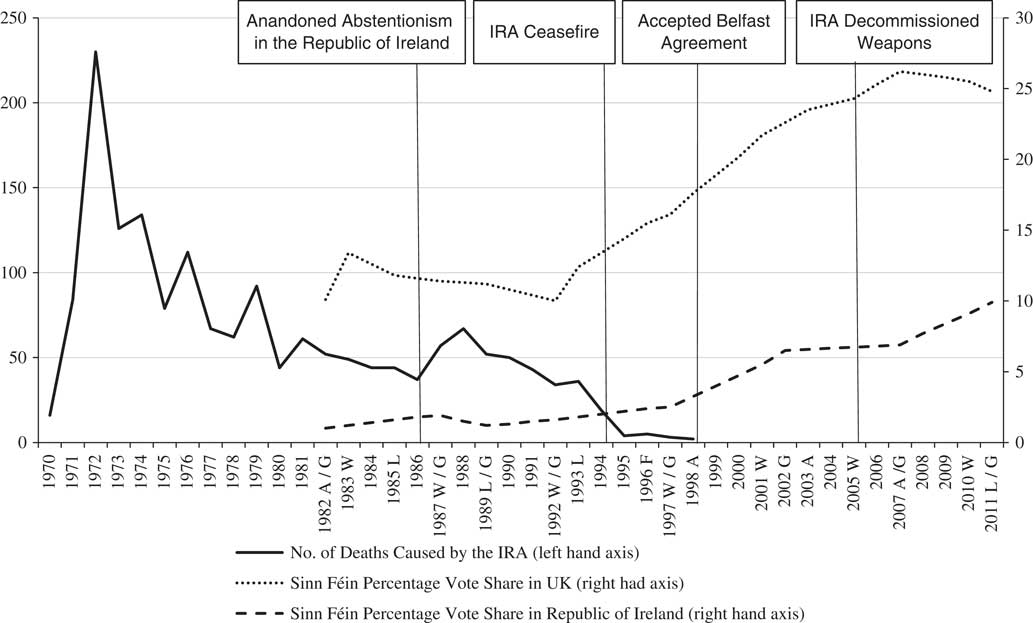
Throughout the 1970s, republicans adopted positions of violence and outright rejection. Contact with any existing institutions was seen as recognizing and accepting British rule, which instead meant it had to be overthrown through revolution. Sinn Féin pursued a policy of building a parallel state, even setting up four provincial parliaments and republican courts, as well as justifying extorting funds from local communities as a tax collection measure akin to that of the British or Irish states (Sinn Féin Reference Sinn1974).Footnote 3 Their goal of a united Ireland was pursued exclusively through the military might of the IRA, who it was anticipated would sap the will of the British to remain in Northern Ireland, and militarism was seen as the sole acceptable route to reunification (IRA 1973). In these early years, the IRA was at its most violent, killing almost half of the total number of victims attributed to it during the first seven years of its 30-year campaign (see Figure 1). Even when the IRA flirted with brief ceasefires in 1972 and again in 1974–5, they did not attempt to negotiate with the British so much as demand that the British met their goals entirely, including setting an immediate date for withdrawal from Northern Ireland.Footnote 4
The Number of Deaths Caused by the IRA Compared with the Percentage Vote Share of Sinn Féin Notes: A=Northern Ireland Assembly election, F=Northern Ireland Forum election, G=Republic of Ireland general election, L=Northern Ireland local government election, W=Westminster election. In proportional elections, the vote share is measured by percentage of first preferences. In addition, Sinn Féin also participated in three other local elections in Northern Ireland not displayed here, but which fit the same trend. The party obtained 16.9 per cent in 1997, 20.7 per cent in 2001 and 23.3 per cent in 2005.

The nature of republicanism’s radicalism has implications for the degree to which ideological change was needed or could be expected when they later underwent a moderate transformation. If ideological moderation means changing values to abandon goals that are incompatible with democracy, it is not the case that republican radicalism ever rejected such values. Republicans remained committed to popular sovereignty but fought to define who the rightful sovereign was. Their underlying commitment to democracy meant that when republicans came into contact with democratic institutions it was easier for them to accept these institutions as a strategic route to pursue their goals than if they rejected popular democracy (O’Boyle Reference O’Boyle2011). This was to be proven with their first serious forays into electoralism in the 1980s.
Moderation through Electoral Inclusion
Initial moderation began soon after the first meaningful republican contact with elections in 1981. It entailed acquiescing to elections in Britain and Ireland as providing a system of political order, even though republicans continued to argue that these were illegitimate elections. Contact with a pluralist set of elections imposed constraints upon republicans by forcing them to fractionalize their struggle into a series of short-term reformist aims, to act as a provider of club goods to their supporters by using the existing system rather than attempting to overthrow it, and to court the support of potential allies whose preferences did not support revolutionary action. In this way Sinn Féin moved towards reformism and accepting the status quo. However, the IRA continued to use violence alongside Sinn Féin’s electoral participation, and violence was not eliminated until the formal peace process. This was a process of adapting strategies and behaviour but republicans continued to stand by their view of the illegitimacy of British rule, their desire for a united Ireland, and the valorization of their ethno-national group.
Republicans’ initial engagement with elections was strategic and opportunistic. Following a hunger strike by IRA prisoners that gained international media attention, combined with the British government’s failure to make any concessions even while 10 republican prisoners died, there was a surge in popular sympathy towards republicanism which encouraged them to field an IRA hunger-striking prisoner as a candidate in a Westminster by-election. Bobby Sands was duly elected on a wave of public sympathy before dying less than one month later. Hunger-striking prisoners Kieran Doherty and Paddy Agnew were later elected to the parliament of the Republic of Ireland. These successes served to encourage republicans to contest all future elections in Ireland and Northern Ireland on an abstentionist basis (competing in elections but refusing to take up any seats won). Republicans certainly did not agree to compete in elections because they saw them as the rightful site to arbitrate over the future of Northern Ireland; rather it was about trying to use elections to challenge the very system the elections upheld.Footnote 5
These changes in direction were not uncontroversial within republicanism and they were part of a wider internal debate that began in the late 1970s. Spearheaded by Gerry Adams, alongside other mainly Northern republicans, a critique emerged of the abstract revolutionary idealism that characterized the early years of republicanism. Adams derided this as ‘spectator politics’ which was marginalizing the potential political influence of republicanism, but he initially failed to gain traction for a more explicitly political programme focused on improving the lives of everyday nationalists living in Northern Ireland. However, the hunger strike, and the potential for an increase in popular support which it was hoped would increase their political leverage, served as an external shock that allowed a new participatory direction to be pursued in a way that was hitherto blocked by militarists, who feared it was an inevitable road to compromise.
Competing in elections, even in a limited and strategic fashion, necessitated a dilution of outright radicalism. Winning the election required making appeals beyond republicanism’s core supporters. Securing the support of wider interests required expanding Sinn Féin’s policy programme and broadening the hitherto narrow focus on prison conditions to include policies aimed at improving the daily lives of their supporters. Kieran Doherty’s electoral agent announced that ‘during the election campaign we stated we were only concerned with one issue … the hunger strikers’ lives. While this is by far our prime aim, people have proved by the large vote that they care. It is therefore our duty on behalf of Kieran Doherty and his comrades to help the ordinary people.’Footnote 6 New policies on housing and unemployment were often framed within the core concerns of republicanism, such as discrimination stemming from the inherently sectarian nature of partition, but the emphasis in policy changed with the need to cater for elections. The problem for republicanism was that these new policies implied that the existing system could be reformed, thus undermining the case for revolution.
Recognizing political realities and acknowledging existing institutions gradually followed in the wake of the decision to participate in elections. The nationalist electorate had preferences for power-sharing and fluid national identities rather than an unswerving and overriding Irish identity that demanded a territorial expression (Coakley Reference Coakley2007). With this preference structure in place, Sinn Féin was never going to be able to win widespread support on the basis of denying the existing institutions of Northern Ireland and the Republic of Ireland. Therefore, in 1985 the party began an internal debate about abandoning its policy of abstentionism to the Republic of Ireland (for a full overview, see Bean Reference Bean2007). Those against the change, notably the party leader Ruairí Ó Brádaigh, argued that abstentionism was an inviolable principle that could not be altered without weakening the ideological foundation of republicanism and recognizing partition.Footnote 7 Yet ultimately the policy was abandoned on the back of the more powerful argument, best summed up by Tom Hartely, Sinn Féin general secretary, who stated that ‘there is a principle riding above all other principles and that is the principle of success’.Footnote 8 This was a tense and close-run affair that took two years to pass and resulted in a small split in the movement, showing that moderation was not inevitable but was deeply contested.
Changes in the direction of republicanism were possible because they were presented by the new Adams leadership as changes in short-term strategic tactics in an effort to bring republicanism closer to its undimmed long-term goal of a united Ireland. Engaging in more active electoral participation did not entail recognizing the legitimacy of the institutions which the elections filled, and throughout their electoral engagement the IRA maintained the armed struggle in a dual political and military approach known as ‘the Armalite and ballot box’. An editorial in An Phoblacht argued on 18 April 1981:
the republican attitude cannot be divorced from our total rejection of the six-county state [Northern Ireland] . . . Our attitude to constitutional politics is quite simple and clear cut. There is no such thing as constitutional politics in this country . . . [However,] there is room for republicans to examine if the struggle for independence can be improved by an intervention in the electoral process.
As such, short-term strategic changes sat alongside long-term continuities.
Moderation through Democratic Bargaining
The consolidation of moderation was about removing the final dimension of behavioural radicalism by abandoning the armed struggle. Through a process of informal and formal peace negotiations, republicans cemented their electoral participation, came to abandon violence and acquiesced to working through a reformed set of democratic institutions still under British sovereignty. Again republicanism’s core separatist values remained throughout this process. The sincerity of their moderation was proved through a series of symbolic practical acts, notably IRA decommissioning and protecting the new institutions from former comrades-in-arms turned dissident terrorists. The peace process was a fraught and tense affair with much prevarication over demilitarization and difficulty in establishing the new power-sharing institutions and moderation should not be seen teleologically from the position of today. The aim of this section is not to give a definitive account of the peace process, which is well covered elsewhere (such as Cox et al. Reference Cox, Guelke and Stephen2006 and many others). Instead, it is to show the nature of republican moderation through the peace process and how it was about tactical adjustments while retaining their separatist values and making the pursuit of a united Ireland a long-term goal that would now be realized through participation rather than revolution.
During the peace process republicans built a series of loose alliances with the Irish government and with their reformist nationalist rivals, the Social Democratic and Labour Party (SDLP). In order to make themselves ‘coalitionable’ to these groups and to exploit such alliances, republicans needed to abandon many of their remaining outright revolutionary features, most notably the use of violence. In a series of talks, the SDLP offered Sinn Féin the prospect of an alliance to pursue common objectives, also offering the possibility of bringing the Irish government into the alliance. However, the SDLP made it clear that Sinn Féin would need to abide by ‘democratic and peaceful methods and without any links or associations with any paramilitary organizations or with support or approval for such activity’ (Sinn Fein Reference Sinn1988).
Simultaneous secret talks with the British government meanwhile focused on demonstrating to republicans that they could agree to British institutions in Northern Ireland as a system of political rule without having to sacrifice their aspirations for a united Ireland. Peter Brooke, secretary of state for Northern Ireland, reinforced this message when he publicly declared that Britain ‘had no selfish strategic or economic’ interest in Northern Ireland, and he reiterated that Britain would accept Irish reunification if this was the peacefully expressed will of the majority (quoted in English Reference English2004: 269). Combined, these talks laid a foundation for what was to become a lasting IRA ceasefire in 1994 (with a short return to violence between 1996 and 1997) and a new participatory strategy within republicanism. Given that the groups with which republicans formed alliances also sought a united Ireland, and given that the British state recognized the pursuit of a united Ireland as a valid aspiration, republicans did not need to sacrifice their core ethno-national goals as part of this process.
Peace was subsequently secured through the Belfast Agreement of 1998, a power-sharing deal that lowered the risks for Sinn Féin of adopting a political path by providing the party with a guaranteed share of executive power based on the proportion of votes it secured, and that offered a potential route to a united Ireland. The complete specifics of the institutional design and how this extracted moderate concessions from the range of adversaries are well covered elsewhere (Garry Reference Garry2014; Moore et al. Reference Moore, Loizides, Sandal and Lordos2014; O’Leary Reference O’Leary1998; O’Leary et al. Reference O’Leary, Grofman and Elklit2005). What is important here is that the Belfast Agreement entailed a tactical adjustment for republicanism in the short term, but republicans also saw the Agreement as providing an opportunity to transition to a united Ireland in the long term (Reynolds 1999–Reference Reynolds2000). The Belfast Agreement included establishing a North–South Ministerial Council, which sought to coordinate government activity between the Republic of Ireland and Northern Ireland, and republicans hoped to use this to generate an ‘all-Ireland dynamic’ and build momentum towards reunification. As they declared, the Agreement ‘is not a political settlement. When set in the context of our strategy, tactics and goals, the [Agreement] is a basis for further progress and advance of our struggle.’Footnote 9 Strategic behavioural adjustments were undertaken to bring their separatist aspirations closer.
Extracting behavioural moderation through the inclusion of republicanism was possible even though these institutions remained under British sovereignty because it aligned the separatist goals of republicans behind the power-sharing deal and necessitated sacrifices in hardline rejectionist policies. Executive and legislative power were now linked to the size of a party’s electoral support, which encouraged republicans to maximize their vote shares by abandoning any remaining revolutionary positions and moving closer to their moderate rivals within the nationalist bloc in a Downsian logic (Garry Reference Garry2009). Republicans now appealed to the moderate preferences of nationalist voters, but they exploited the desire of the electorate to have the strongest voice possible protecting their ethnic community in the new power-sharing arrangements (Mitchell et al. Reference Mitchell, Evans and O’Leary2009). Thus they jettisoned rejectionist policies while retaining the valorization of their ethno-national group because this was not demanded of them.
If there was no core value change and if, indeed, behavioural moderation was only undertaken to bring long-term separatist goals closer, this raises the question of how republicans proved the sincerity of their commitment to the moderate path when inevitable doubts arose. Attempting to gain Unionists’ acceptance of republicans’ presence in government threw sharp relief upon republicanism’s ongoing radicalism. Although no longer engaging in direct violence against the British state, as late as 2005 significant IRA activity remained. The IRA refused to decommission its weapons, it was used to enforce the Belfast Agreement in nationalist areas, it continued to act as a policing body in local communities, IRA volunteers undertook the largest bank robbery in the history of the British and Irish states, three volunteers were arrested in Colombia training FARC guerrillas, and the IRA and Sinn Féin were accused of running a spy-ring in the Northern Ireland Assembly.
The first step in demonstrating their commitment to their new moderate strategy was IRA decommissioning, which was eventually completed in 2005. Decommissioning did not entail republicans rejecting their history of armed struggle or pathologizing what they continued to see as the justified historical use of violence. Rather, decommissioning was presented as a change in tactics undertaken in return for a reduction in the British military presence in Northern Ireland, and thus could be seen as a partial gain for republicans.Footnote 10 After the final act of decommissioning was complete, the IRA (2005) declared, ‘our decisions have been made to advance our republican and democratic objectives, including our … goal of a united Ireland and to end British rule in our country … We reiterate that the armed struggle was entirely legitimate.’
A further commitment to moderation was demonstrated in the evolving response of republican elites to ongoing violence by dissident terrorists – relatively small groups of former comrades-in-arms who rejected the peace process and continued to wage armed struggle. Following a dissident bombing in Omagh, Gerry Adams (Reference Adams1998) claimed that he ‘condemned it without equivocation’, but in reality Sinn Féin refused to cooperate with the investigation because it was led by the Royal Ulster Constabulary, with whom Sinn Féin had an historically fractious relationship. Yet, once in power, the party became more definite in its condemnation, abiding by the use of state resources to pursue dissidents. As late as 2012 an important tool used against dissident terrorists was non-jury courts, a legacy of the old regime that was formerly derided by republicans as anti-nationalist and anti-democratic and for which there remained ‘no façade of justification’ (Sinn Féin Reference Sinn1996), but they now acquiesced in wielding against their former comrades and new enemies (McDonald Reference McDonald2012). In this way, clear commitments to moderate behaviour were given without diluting their ethnic values.
THE NECESSARY CONDITIONS OF SEPARATIST MODERATION
For republican moderation to occur, a high degree of tolerance from the British state accepting the right of republicans to pursue separatist goals was necessary, as was a set of strong and stable democratic institutions. In order for republicans to agree to abandon armed struggle and revolution, they needed to be reassured that they could use political channels to pursue a united Ireland. A long history of British tolerance towards the politicization of Sinn Féin was important because it reassured republicans that entering the political arena and abandoning armed struggle did not entail having to compromise their core ethno-national identity and goals to which they were so strongly committed. Democratic state responses to anti-system challenges and to separatism can be located along a continuum ranging from highly tolerant and accepting of the challenger to highly suppressive (Walter Reference Walter2006). Tolerance towards separatist challengers is extremely difficult for many states to adopt, given the implications this may have for the contraction of their borders or the decentralization of power (Lustick Reference Lustick1993). However, Britain was consistently highly tolerant of Sinn Féin in many key respects, even while simultaneously implementing some of the toughest anti-terrorist legislation to combat the IRA in the democratic world. Britain distinguished between the goals of republicanism, which they accepted as legitimate, and the means of violence and revolution, which the British state sought to incentivize republicans to change.
From the early 1970s, Britain made it clear that it would be willing to allow Northern Ireland to secede from the Union if this was the majority will of the people of Northern Ireland and as long as this goal was not pursued through violence. British Prime Minister Edward Heath stated as early as November 1971, ‘if at some future date the people of Northern Ireland want unification and express that desire in the appropriate constitutional manner, I do not believe the British government would stand in the way’ (Northern Ireland Office 1972: part II, sec. 39). In 1974 Northern Ireland Secretary Merlyn Rees deproscribed Sinn Féin with the aim of encouraging it to ‘find a way back to political activity’ (Hansard 1974). Indeed, Sinn Féin was to remain a legal political organization throughout the conflict, in spite of waging a dual military and political campaign and many high-profile attacks by the IRA on the British state. Although British policy was to vary throughout the 1970s and 1980s according to how much emphasis the government put upon attempting to engineer a solution versus containing the conflict, and according to how much it implemented security measures versus engaging Sinn Féin in dialogue (Kerr Reference Kerr2011; O’Leary Reference O’Leary1997), a high degree of political tolerance towards Sinn Féin was consistently in place.
One such striking example of the tolerance of the British government in even the most trying of circumstances came during the hunger strikes and following republican victories in elections. In a briefing letter to Prime Minister Margaret Thatcher in June 1981, the Northern Ireland Office wrote:
We have tended to regard the involvement of the Provisionals [Sinn Féin and the IRA] in political activity as a development to be encouraged. But it is a development that requires a response from Government, as their terrorist activities receive a response … Unless their political exploitation of the hunger strike situation – and the resulting recrudescence of support for Provisional IRA – can be countered, then the Provisionals ‘going political’ can succeed where their terrorist activity has failed.Footnote 11
Similarly, the Irish premier Garret FitzGerald too wrote to Thatcher, warning her of the instability that Sinn Féin’s electoral victories were causing in Ireland.Footnote 12 Yet throughout the 1980s the British government refused to countenance suppressing political activity and instead focused on enhanced security measures to combat the IRA and attempts to marginalize, but not suppress, Sinn Féin through the Anglo-Irish Agreement (1985). Robin Butler, Thatcher’s principal private secretary, explained this decision as Britain’s consistent approach to all cases of decolonization and willingness to allow self-determination.Footnote 13 Tolerance was evident throughout the Belfast Agreement negotiations too, where the British made it clear that they would facilitate whatever the majority will of the people of Northern Ireland wanted to pursue, as long as this was decided democratically, and they did not stand in the way of any parties pursuing a separatist agenda.Footnote 14
Successive British governments were able to be highly tolerant of Sinn Féin because Westminster parties had nothing to lose by tolerating its emergence as a political force. The only major party to organize and compete in elections to Northern Ireland was the Conservative Party, with both the Labour Party and the Liberal Democrats refusing to do so. What is more, the Conservative Party did not compete until 1989 and never polled more than 6 per cent in this region. Northern Ireland as an issue was always of low electoral salience for voters in British elections and it was rarely mentioned by candidates or in manifestos (McGarry and O’Leary 1995). It has also been argued that Northern Ireland was never fully integrated into the politics of the UK and it was seen as separate and requiring different policies that would not be acceptable in the rest of the Union and often forgotten about by Whitehall and Westminster.Footnote 15 Thus, support in Northern Ireland was not crucial for the survival or fortunes of the major parties, and successive governments could pursue a high degree of bipartisanship and potentially unpopular policies, such as tolerating Sinn Féin and allowing for the possibility of secession.Footnote 16 The only exceptions to this were the governments of Jim Callaghan and John Major, who came to rely on the Ulster Unionist Party (UUP) to survive or to pass key votes. In both these instances, reliance on the UUP halted progress, with Callaghan merely seeking to contain the conflict and attempting no new initiativesFootnote 17 and Major’s peace process becoming derailed.
A strong set of stable institutions was also necessary to elicit moderation. The moderation process is inherently insecure, and parties are highly suspicious and uncertain of the motivations of their adversaries throughout. Therefore, a set of stable institutions that protect the interests of all parties going forward is crucial to securing a peace process (Hartzell and Hoddie Reference Hartzell and Hoddie2007; Walter Reference Walter2002). Institutional guarantees were essential for the British state to secure peace in Northern Ireland. For much of its history Northern Ireland was an anomalous political entity in many respects, which both sustained republicanism’s discontent and enabled its moderation. Since its creation in 1921, Northern Ireland was rejected as a legitimate site of political authority by a sizeable minority of the population. Many of its institutions were perceived by nationalists as inherently biased and incapable of providing a basis for fair political competition. Between 1921 and 1972, Northern Ireland was highly compatible with Hartzell et al.’s (Reference Hartzell, Hoddie and Rothchild2001: 185) definition of a weak polity as one that is ‘dominated by a single group or coalition of groups [that] acts aggressively toward out-group interests, exploiting and repressing their politically disadvantaged peoples, [that] combines the hardness of military and police strength with the softness of political illegitimacy’.
Yet, once devolution was suspended and direct rule from Westminster was imposed in 1972, weaknesses in the political system of Northern Ireland were steadily removed over the next two decades. Political reforms, equality measures and the legitimation of Irish nationalism all strengthened the central state. Reforms also meant stronger political institutions, and this is what sets Northern Ireland apart from many other sites of ethno-national conflict. Where other conflicts may suffer from a weak set of political institutions combined with poor socioeconomic outcomes, Northern Ireland had a long history of British democracy behind it and, although suffering from significant inequalities and relative poverty compared with other parts of the United Kingdom, it was a ‘first-world’ country. Institutions that operated in a stable and predictable way, combined with the absence of a destabilizing weak state, allowed republicans to commit to political participation. Once the risks for republicans of political participation were reduced even further by bringing in the guarantees associated with power-sharing, this allowed for even greater engagement. In this way, the macro-institutional framework was able to channel dissent into political participation and prevent it from returning to a form of violent expression (Alexander Reference Alexander2002; Snyder Reference Snyder2000).
CONCLUSION
Irish republicanism offers important insights into a possible pathway to moderation for other radical separatist groups within a democracy. This case highlights the importance of a multidimensional understanding of moderation, one which distinguishes between strategic behaviour and goals/values. Moderation is possible where there is an overlap in the strategies adopted by the state and the separatists along these two dimensions. If the ruling state insists that a separatist group only uses peaceful and reformist strategies, but alongside this shows a willingness to accept the pursuit of separatism through peaceful channels, then this opens up a space for separatists to pursue their goals exclusively through reformist politics. If the separatist group makes the same distinction, showing a willingness to accept reformism and abandon revolution, then it can retain its values and goals as long as they are pursued within an agreed institutional framework. The key lesson of the moderation of Irish republicanism for other cases of separatist moderation lies in how it highlights the importance of both the state and the separatist group distinguishing between strategic behaviour and goals without expecting a change in goals as part of this process.
Irish republican moderation entailed a series of strategic readjustments of the means they used to pursue a united Ireland, moving away from tactics such as refusing to recognize existing institutions, attempts at parallel state building and armed struggle. However, distinct from these strategic behavioural changes were their goals and values, which remained largely the same. The pursuit of a united Ireland became a long-term project that was more likely to be realized through reform and persuasion. While republicans agreed to work through the new institutions, they never accepted these institutions as legitimate or accepted the right of British institutions to rule Northern Ireland. Britain never expected Irish republicans to change their values towards British rule in Northern Ireland, it never demanded that republicans accept the legitimacy of Northern Irish institutions in order to work through them, and Britain accepted the pursuit of a united Ireland as a legitimate political aspiration. Retaining these goals was possible because an alternative claim to sovereignty was not in itself incompatible with democratic pluralism.
The pathway to moderation outlined here has important implications for future research, notably for studies of democratic state responses and counter-strategies to separatism. Most states tend to respond to separatist threats with suppressive measures rather than tolerance and accommodation, for fear that tolerating the threat will empower the separatist and lead to state contraction (Erk and Anderson Reference Erk and Anderson2010; Walter Reference Walter2006). Turkey’s response to Kurdish nationalism is typical here, which included proscribing Kurdish parties, refusing to accept the Kurdish identity as distinct from the Turkish identity, and the arrest and detention of Kurdish activists. Spain too, although granting some decentralization and cultural recognition to the Basque region, also engaged in party bans and some political suppression. However, more accommodating approaches that open up a space for the separatist group to gain political acceptance may allow for moderation in a way that suppression hinders. Examining the impact of state responses, the factors that incentivize a state to pursue accommodation, and the impact of institutional designs upon the degree of radicalism or moderation of separatists groups, would greatly enhance studies of ethnic conflict within democracies.
Acknowledgements
I would like to thank Bill Kissane, Ed Morgan-Jones and Zeynep Kaya, who all read and commented on earlier versions of this manuscript.