Introduction
Numerous studies have shown that switching between languages can produce general reductions in bilingual individuals’ language processing speed. For example, bilinguals are slower in naming pictures, making lexical decisions and naming numbers when the preceding trial involves a stimulus or response in a different language (Costa & Santesteban, Reference Costa and Santesteban2004; Grainger & Beauvillain, Reference Grainger and Beauvillain1987; Meuter & Allport, Reference Meuter and Allport1999), indicating persistent interference from the previous language after a language switch. Furthermore, several studies have shown that bilinguals are affected by within-language ambiguity: recognising that a word is a translation of another word takes more time for words with multiple translations (e.g., “sacred” or “holy” for “heilig”) than for words with a unique translation (e.g. “frog” for “kikker”; Boada, Sánchez-Casas, Gavilán, García-Albea & Tokowicz, Reference Boada, Sánchez-Casas, Gavilán, García-Albea and Tokowicz2013; Eddington & Tokowicz, Reference Eddington and Tokowicz2013; Laxén & Lavaur, Reference Laxén and Lavaur2010). However, few studies have investigated language switching effects on ambiguous words at the individual word level. Such cross-language priming effects could potentially exist both for cognates, which share a meaning across languages (e.g., the Dutch–English word “film”), and interlingual homographs, which have unrelated meanings (e.g., “room”, meaning “cream” in Dutch).
Although current models of bilingual processing like the Bilingual Interactive Activation plus (BIA+) model (Dijkstra & van Heuven, Reference Dijkstra and van Heuven2002) make no clear predictions about such cross-language priming effects because they contain no mechanisms by which experience can influence performance at relatively long timescales, predictions about the precise nature of word-specific language switching effects come from analogous ambiguity effects in monolingual listeners. Just as “room” is ambiguous to Dutch–English bilinguals, “ball” is ambiguous to monolingual English speakers. Rodd, Cutrin, Kirsch, Millar and Davis (Reference Rodd, Cutrin, Kirsch, Millar and Davis2013) found that, 20 minutes after hearing ambiguous words within disambiguating sentence contexts (e.g., “She found the perfect dress for the school ball”), listeners were biased to retrieve the primed meaning compared to an unprimed baseline. This ‘word–meaning priming’ endures at longer delays than semantic priming (when a synonym was presented during the priming phase), suggesting that the effect reflects a strengthening of the connection between the word-form representation and the primed meaning, such that the primed meaning becomes more readily available (possibly at the expense of alternative unprimed meanings). If an interlingual homograph's different meanings behave in a similarly competitive manner, an encounter with its Dutch meaning should delay access to the unrelated English meaning even minutes later. In contrast, facilitatory cross-language priming would be expected for cognates that share their meaning(s) in both languages, as the appropriate form-to-meaning mapping would be strengthened during priming.
These expectations rely critically on previous studies suggesting that bilingual speakers have one integrated lexicon and that access to it is language non-selective (see Dijkstra, Reference Dijkstra, Kroll and De Groot2005; Dijkstra & van Heuven, Reference Dijkstra and van Heuven2002; for a comprehensive review). Specifically, these studies show that (in the absence of priming manipulations) lexical decision times are faster for cognates than control words, suggesting cognates share a single representation in the bilingual lexicon, while response times to interlingual homographs are usually slower, due to competition between the two interpretations during lexical access. To model this, in the BIA+ model, cognates share both their orthographic and semantic nodes. Presentation of the cognate activates letter features and letters, which activate these nodes. Resonance between the orthographic and semantic representations results in faster recognition of cognates relative to non-cognates (Peeters, Dijkstra & Grainger, Reference Peeters, Dijkstra and Grainger2013). In contrast, interlingual homographs correspond to two orthographic nodes (one for each language) connected to two semantic nodes. The two orthographic nodes laterally inhibit each other and, presumably because they are identical, this competition is stronger than that between non-cognates, resulting in slower reaction times in comparison.
Previous work on this topic has produced mixed results. Cristoffanini, Kirsner and Milech (Reference Cristoffanini, Kirsner and Milech1986) primed cognates in a Spanish or English naming task and then measured English lexical decision times after a 10-minute delay. Similarly, Gerard and Scarborough (Reference Gerard and Scarborough1989) primed cognates and interlingual homographs in a Spanish or English lexical decision task and measured either Spanish or English lexical decision times. Both studies reported facilitative priming in the cross-language conditions for cognates. Gerard and Scarborough also reported a facilitative effect for the interlingual homographs. In contrast, Lalor and Kirsner (Reference Lalor and Kirsner2001), also using lexical decision tasks for both priming and testing, found no significant cross-language priming for interlingual homographs. Crucially, because these latter two studies used the same task for priming and testing, the results may have been influenced by task-specific priming that arises because participants make the same (positive) lexical decision response during both priming and testing (see Horner & Henson, Reference Horner and Henson2009). For the interlingual homographs, this task-related facilitation may have cancelled out the expected disruptive effect of language switching. For this reason, we used different tasks for priming and testing.
The current study used a modified version of the monolingual word-meaning priming paradigm (Rodd et al., Reference Rodd, Cutrin, Kirsch, Millar and Davis2013). In the priming phase, Dutch–English bilinguals read Dutch sentences that contained either a cognate, an interlingual homograph or the Dutch translation of an English semantic control word (to create a semantic priming control condition). After a filler task lasting approximately ten minutes, the impact of priming was measured using an English lexical decision (LD) task. The semantic prime control condition, in which only the word's meaning (and not its form) is repeated, should reveal whether any observed priming in the cognate condition reflects general semantic priming distinct from repetition of the specific word-form. If the latter were true, we would observe priming for the semantic controls. The three priming conditions were each compared to an unprimed baseline.
Methods
Participants
Thirty-two London-based Dutch–English bilinguals were paid for their participation. Three participants with mean lexical decision times above 1950 ms were excluded. The remaining 29 participants (11 male; mean age 28.4 years, SD = 7.2 years) had on average 19.5 years’ experience with English (minimum 11 years) and had been living in London on average for 4.8 years (range: 1 month–23 years). Participants rated their English proficiency an average of 8.8 out of 10. Participants’ subjective ratings of their use of Dutch and English in daily life for talking, listening, reading, writing and thinking revealed they used English more than Dutch for all activities (p < .001), except thinking (p = .33).
Materials
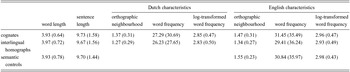
Thirty identical cognates, 30 identical interlingual homographs and 30 semantic control words were selected from previous studies (see Supplementary Materials Online; approximately half from Dijkstra, Grainger & van Heuven, Reference Dijkstra, Grainger and van Heuven1999, the rest from other studies). Interlingual homographs were defined as words that did not share any (part) of their meaning(s). Cognates shared (at least) their dominant meaning. To obtain Dutch primes for the English semantic controls, 13 Dutch–English bilinguals (4 male; mean age 21.2 years) with a minimum of 9 years’ experience with English (M = 12.7 years) translated 59 English words to Dutch using an online questionnaire. The 30 chosen semantic controls had a mean translation agreement of 92.7% (minimum = 62%). As they had already been used in previous research, the cognates and interlingual homographs were not pre-tested. The three word types were matched on length, SUBTLEX word frequency (Brysbaert & New, Reference Brysbaert and New2009; Keuleers, Brysbaert & New, Reference Keuleers, Brysbaert and New2010; for English and Dutch, respectively) and orthographic similarity (using OLD20; Yarkoni, Balota & Yap, Reference Yarkoni, Balota and Yap2008; Table 1).
Means (and standard deviations) for all key matching variables and sentence length. Orthographic neighbourhood refers to Yarkoni et al.'s (Reference Yarkoni, Balota and Yap2008) OLD20; Word frequency refers to the SUBTLEX word frequency in occurrences per million (see Brysbaert & New, Reference Brysbaert and New2009, for English and Keuleers et al., Reference Keuleers, Brysbaert and New2010, for Dutch); log-transformed word frequency refers to the SUBTLEX log transformed raw word frequency (log10[raw frequency+1]; LG10WF in the SUBTLEX databases).

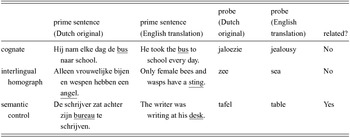
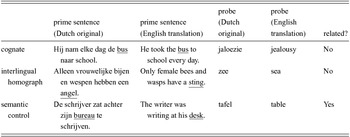
A Dutch sentence frame was constructed for each word (Supplementary Material, Table 2). Six additional practice sentences were created. To minimise any semantic ambiguity, target words were placed towards the end of the sentence. The 30 sentences in each condition were pseudorandomly divided into two sets, matched for all key variables, for use in the two versions (see Procedure). The probes assigned to the sentences for the semantic relatedness task were either very strongly related or completely unrelated to the sentence.
Examples of prime sentences for the semantic relatedness task. The lexical decision task targets are underlined.
The 90 non-words comprised fifteen Dutch words (e.g., “bron”), included to ensure participants only responded “yes” specifically to English words and not on the basis of overall familiarity, and 75 similar-length English-sounding pseudohomophones from previous studies (Rastle, Harrington & Coltheart, Reference Rastle, Harrington and Coltheart2002; Rodd, Reference Rodd2000; Rodd, Gaskell & Marslen-Wilson, Reference Rodd, Gaskell and Marslen-Wilson2002). Pseudohomophones (instead of regular non-words) were used to encourage relatively deep processing (Rodd et al., Reference Rodd, Gaskell and Marslen-Wilson2002).
Design and procedure
Half the words of each word type were primed (i.e., appeared during the priming phase) while half were unprimed (i.e., only occurred in the later test phase). Two versions of the experiment were created such that participants saw each experimental item only once but across participants items occurred in both the primed and unprimed conditions.
The experiment comprised three separate tasks: a Dutch semantic relatedness task (approximately 5 minutes), an English digit span task (approximately 10 minutes) and an English lexical decision task (approximately 7 minutes). On average, LDs to words were made 16 minutes after they were primed. The three tasks were presented separately (using Matlab R2012a), with no indication that they were linked. Responses were recorded via a standard keyboard. At the end, participants completed a language background survey in Dutch.
Dutch semantic relatedness task
This task served to prime the cognates, interlingual homographs and semantic controls. To ensure semantic processing, participants indicated via button presses whether the subsequent probe was semantically related to the preceding sentence. Participants read 3 practice sentences and 45 experimental sentences presented in different random orders. Each sentence remained on the screen for 4000 ms; each probe remained on the screen until the participant responded. The inter-trial interval was 1000 ms.
English digit span task
This task introduced a delay, while minimising exposure to additional linguistic material. It was conducted in English to minimise any general language switch cost on the lexical decision task. Each string comprised 4–9 digits. Each digit was presented for 500 ms with 500 ms between trials. Participants saw 5 practice strings followed by 54 experimental strings divided into 3 blocks. 15-second breaks were enforced after each block.
English lexical decision task
Participants saw all 180 stimuli (90 words, 45 of which were primed, and 90 non-words) and were asked to indicate via button presses, as quickly and accurately as possible, whether they were real English words or not. Twelve practice items were followed by 4 blocks of 45 stimuli. Block and item order was randomised across participants. Each block began with six fillers. Items remained on screen until participants responded, with a 500 ms inter-trial interval.
Results
Semantic relatedness task
High accuracy scores (M = 93.8% correct, SD = 3.1%, range 86.7%–97.8%) confirmed participants had processed the sentence meanings. There were no significant differences between the word types (cognates: M = 95.0%, SD = 10.6%; interlingual homographs: M = 93.5%, SD = 12.8%; semantic controls: M = 92.9%, SD = 22.1%) [F1 (2,62) = 1.4, p = .26, η2 p = .04; F2 (2,87) = 0.1, p = .87, η2 p <.01].
Digit span
Digit span (greatest string length recalled with at least 50% accuracy) was within normal limits (M = 6.0 digits, range 4–8 digits), confirming task engagement.
Lexical decisions
One cognate (“ark”) and two interlingual homographs (“arts”, “genie”) were excluded from the analysis due to accuracy rates below 60%.Footnote 1 Reaction times (RTs) for incorrect trials were discarded (4.1% of the data), as were RTs more than two standard deviations above a participant's mean (2.2% of the remaining data). All data points were above 300 ms. Mean RTs and accuracy were calculated for each condition across participants and items.Footnote 2
Reaction times
Because the hypotheses concerned specific comparisons between two of the three word types, two 2×2×2 repeated measures ANOVAs were conducted with three factors: word type, priming manipulation and version (Figure 1A; see Rodd et al., Reference Rodd, Cutrin, Kirsch, Millar and Davis2013, Experiment 3, for a similar approach). The main effect of version and its interactions with other variables are not reported (Pollatsek & Well, Reference Pollatsek and Well1995).
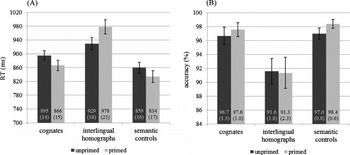
(A) Means of the lexical decision reaction times (in milliseconds) for the participants analysis by word type (cognates, interlingual homographs and semantic controls) and priming (unprimed and primed). Error bars represent the standard error of the mean adjusted for a within-participants design (Loftus & Masson, Reference Loftus and Masson1994). (B) Means of the lexical decision accuracy data (in percent correct) for the participants analysis by word type (cognates, interlingual homographs and semantic controls) and priming (unprimed and primed). Error bars represent the standard error of the mean adjusted for a within-participants design (Loftus & Masson, Reference Loftus and Masson1994).

Comparing cognates and interlingual homographs revealed a significant main effect of word type [F 1(1,27) = 10.2, p = .004, η2 p = .27; F 2(1,53) = 10.3, p = .002, η2 p = .16], where cognates were recognised faster than interlingual homographs, but no effect of priming (both ps > .40). Importantly, the word type×priming interaction was significant [F 1(1,27) = 5.6, p = .03, η2 p = .17; F 2(1,53) = 5.3, p = .03, η2 p = .09]: priming had a facilitatory effect for cognates, but an inhibitory effect for interlingual homographs.
Comparing cognates and semantic controls revealed no main effect of word type (both ps > .10). The effect of priming was marginally significant only in the participants analysis [F 1(1,27) = 3.1, p = .09, η2 p = .10; F 2(1,55) = 2.5, p = .12, η2 p = .04], such that primed words were recognised faster than unprimed words. There was no significant interaction between word type and priming (both ps > .10).
A further three 2×2 repeated measures ANOVAs were conducted, with the factors version and priming, to determine whether priming had been effective for each word type separately. These revealed a marginally significant facilitative effect of priming by participants for the cognates [F 1(1,27) = 4.1, p = .054, η2 p = .15; F 2(1,27) = 1.95, p = .17, η2 p = .07], but a marginally significant disruptive effect for the interlingual homographs [F 1(1,27) = 3.6, p = .07, η2 p = .12; F 2(1,26) = 3.3, p = .08, η2 p = .11]. The effect of priming was not significant for the semantic controls (both ps > .25).
Accuracy data
Comparing cognates and interlingual homographs revealed a significant main effect of word type [F 1(1,27) = 21.6, p < .001, η2 p = .44; F 2(1,53) = 10.0, p < .001, η2 p = .16], where cognates were processed more accurately than interlingual homographs. No other effects were significant (all ps > .40; Figure 1B).
Comparing cognates and semantic controls revealed a marginally significant main effect of priming by participants only [F 1(1,27) = 3.2, p = .09, η2 p = .11; F 2(1,55) = 2.6, p = .11, η2 p = .05], where primed items were processed more accurately than unprimed items. No other effects were significant (all ps > .60).
General discussion
This experiment shows that a single encounter with a cognate or interlingual homograph in one language can affect its subsequent processing in another language after an average delay of 16 minutes, and that this priming effect is influenced by the relationship between the Dutch and the English meanings. Before discussing these findings in detail, it should be noted that although overall lexical decision task performance may be influenced by a general language switching effect (which we attempted to minimise by conducting the preceding digit span task in English), any such effect would influence all items including the unprimed controls, and, therefore, cannot contribute to the observed priming effects.
Specifically, the cognates showed a 28 ms facilitatory priming effect, consistent with previous studies (Cristoffanini et al., Reference Cristoffanini, Kirsner and Milech1986; Gerard & Scarborough, Reference Gerard and Scarborough1989). In contrast, the interlingual homographs showed a 49 ms inhibitory effect. This significant interaction between word type and priming seems inconsistent with the results of Gerard and Scarborough (Reference Gerard and Scarborough1989) and Lalor and Kirsner (Reference Lalor and Kirsner2001), who found either facilitation or no priming with cross-language repetition of interlingual homographs. We suggest that in these studies, use of the same task for priming and testing phases resulted in masking of the interference effect by facilitatory priming due to stimulus-response binding, as in both tasks each critical item would be mapped to the same “yes” response (cf. Horner & Henson, Reference Horner and Henson2009), thereby masking the interference effect.
These results are consistent with the proposed explanation of word-meaning priming in the monolingual domain (Rodd et al., Reference Rodd, Cutrin, Kirsch, Millar and Davis2013): exposure to a word strengthens the connection between its form and the contextually appropriate meaning, so that during subsequent encounters with that word the primed meaning is more readily available, while access to the unprimed meaning is disrupted. This experiment suggests that similar processes operate in the bilingual domain: strengthening the form-to-meaning mapping enhances performance for words which share their form and meaning across languages (cognates), but interferes with processing of words that share their form but not their meaning (interlingual homographs). These findings are also consistent with claims that bilingual speakers’ lexical representations are not accessed in a language-specific manner (see Dijkstra, Reference Dijkstra, Kroll and De Groot2005; Dijkstra & van Heuven, Reference Dijkstra and van Heuven2002).
There was an unexpected non-significant 25 ms ‘priming effect’ for the semantic control words, such that priming for semantic controls and cognates did not differ significantly, a pattern inconsistent with the absence of semantic priming in Rodd et al. (Reference Rodd, Cutrin, Kirsch, Millar and Davis2013, Exp. 3). Most likely, however, this priming was not semantic in nature, but reflects long-term cross-language repetition (or translation) priming, such that upon presentation of the Dutch translation of the English semantic control, the semantic control word itself was also accessed and the connection between its form and meaning strengthened. Consistent with this account, Zeelenberg and Pecher (Reference Zeelenberg and Pecher2003) found long-term cross-language repetition priming with high-fluency Dutch–English bilinguals using non-cognates, though only when both the priming and testing task were conceptual in nature. Li, Mo, Wang, Luo and Chen (Reference Li, Mo, Wang, Luo and Chen2009) obtained similar results with low-fluency Chinese–English bilinguals. As there are some differences between the current study and those of Zeelenberg and Pecher (Reference Zeelenberg and Pecher2003) and Li et al. (Reference Li, Mo, Wang, Luo and Chen2009), most notably in the direction of the priming effect (they found L2-to-L1 priming only, whereas we observed L1-to-L2 priming) and the use of different tasks, further research is needed to determine whether the non-significant priming effect observed here was semantic in nature or reflects long-term translation priming.
In its current form, the BIA+ model (Dijkstra & van Heuven, Reference Dijkstra and van Heuven2002) cannot explain these results. The BIA+ framework incorporates short-term (cross-language) priming, such that each encounter with a word elevates its resting activation level (and decreases that of its neighbours). On subsequent encounters, this increase in nodal resting activity means that the recognition threshold is reached more quickly for regular words and cognates, and more slowly for interlingual homographs. However, this increase in resting activity is transient and is, therefore, unlikely to underlie the longer-term priming effect observed here.
In essence, the BIA+ is restricted to recognition and decision processes and is not a model that can learn from experience. As in the original Interactive Activation model (McClelland & Rumelhart, Reference McClelland and Rumelhart1981), all parameters in the model are set by hand (Dijkstra, Hilberink-Schulpen & van Heuven, Reference Dijkstra, Hilberink-Schulpen and van Heuven2010) rather than being learned on the basis of experience with the lexical items. Consequently, the BIA+ model, in its current form, cannot directly explain or predict how recognition processes are affected by long-term language switching, a situation bilinguals encounter on a regular basis (but see Grainger, Midgley & Holcomb, Reference Grainger, Midgley, Holcomb, Kali and Hickmann2010, for suggested extensions of the model to include learning). Although connectionist models that include learning algorithms could potentially accommodate the current findings, such a model (of long-term word-meaning priming) has not yet been implemented (see Rodd et al., Reference Rodd, Cutrin, Kirsch, Millar and Davis2013 for more).
Finally, the current experiment also contributes to the monolingual word recognition literature. In the monolingual domain, Rodd et al. (Reference Rodd, Cutrin, Kirsch, Millar and Davis2013) showed that long-term word-meaning priming can alter people's meaning preferences, as revealed by unspeeded responses on a word association task. This experiment confirms the presence of word–meaning priming on a speeded lexical decision task that is less susceptible to potential effects of demand characteristics than unspeeded word association. Together with previous monolingual studies, the current experiment supports the view that the interpretation of ambiguous words is strongly influenced by recent experience: meaning preferences are not stable, but are a fluid and dynamic property of a mental lexicon that is constantly changing in response to experience.
Supplementary Material
For supplementary material accompanying this paper, visit http://dx.doi.org/10.1017/S1366728915000395