One of the first and most important demands that parents place on their children is the requirement for self-control. Self-control allows the child and later the adult to fit in society and become a functional member of it. This tendency to control one's impulses, emotions, and behavior (Berger, Reference Berger2011; Moffitt et al., Reference Moffitt, Arseneault, Belsky, Dickson, Hancox and Harrington2010; Rothbart, Ellis, & Posner, Reference Rothbart, Ellis, Posner, Baumeister and Vohs2004) is considered a temperament trait that emerges in early infancy and develops throughout childhood to become an important aspect of adult personality (Berger, Reference Berger2011; Rothbart et al., Reference Rothbart, Ellis, Posner, Baumeister and Vohs2004). It involves processes such as delaying gratification, concentrating, planning, following instructions, and adapting emotions and behavior to situational requirements and social norms (Berger, Reference Berger2011). Because parents make active efforts from early in the child's development to foster self-control, they are likely to also modify their parenting based on children's ability for self-control, so that typically they should respond more positively to child behavior that reflects high rather than low levels of self-control. In the current paper, we study the effects of children's self-control, a trait partially determined by genetic factors, on their mothers' parenting, a process of evocative gene–environment correlation (rGe; Plomin, DeFries, & Loehlin, Reference Plomin, DeFries and Loehlin1977).
The Importance of Self-Control to Children's Functioning
The development of adequate self-control mechanisms has a profound impact on the individual's ability to function optimally throughout life and is important for successfully facing many educational, occupational, and social challenges. A large body of evidence, mostly based on comprehensive longitudinal designs, shows that lower levels of self-control in childhood are related to poorer outcomes in diverse life domains, from academic achievement and employment to health and social functioning (Duckworth & Seligman, Reference Duckworth and Seligman2005; Eisenberg et al., Reference Eisenberg, Fabes, Bemzweig, Karbon, Poulin and Hanis1993; Eisenberg, Fabes, Guthrie, & Reise, Reference Eisenberg, Fabes, Guthrie and Reise2000; Mischel, Shoda, & Peake, Reference Mischel, Shoda and Peake1988; Moffitt et al., Reference Moffitt, Arseneault, Belsky, Dickson, Hancox and Harrington2010; Nisbett et al., Reference Nisbett, Aronson, Blair, Dickens, Flynn and Halpern2012; Tangney, Baumeister, & Boone, Reference Tangney, Baumeister and Boone2004; for a review, see Berger, Reference Berger2011).
It is important that low self-control has been related to psychopathology and deviant behavior, with longitudinal studies finding a predictive relation between low self-control at preschool years and externalizing problems such as conduct problems, attention-deficit/hyperactivity disorder (ADHD), and aggression at school age and in adolescence (Bierman, Nix, Greenberg, Blair, & Domitrovich, Reference Bierman, Nix, Greenberg, Blair and Domitrovich2008; Caspi & Silva, Reference Caspi and Silva1995; Eisenberg et al., Reference Eisenberg, Fabes, Guthrie and Reise2000). Self-regulation (a form of self-control that involves adapting emotions and actions to situational requirements and social norms; Berger, Reference Berger2011) among adolescents was also found to be predictive of the onset of cigarette smoking (Novak & Clayton, Reference Novak and Clayton2001). Furthermore, in a large longitudinal study by Moffitt et al. (Reference Moffitt, Arseneault, Belsky, Dickson, Hancox and Harrington2010) that followed subjects from birth to the age of 32, low self-control in childhood predicted substance abuse and criminal behavior in adulthood. A meta-analysis examining the association between low self-control and delinquency reported that low self-control was among the strongest and most consistent predictors of antisocial behaviors (Pratt & Cullen, Reference Pratt and Cullen2000). For all these reasons, self-control has become a key behavioral phenotype and a focus of many studies. One important issue that remains to be addressed is how a child's endowment of self-control impacts his/her parents' behavior and what role specific genes might play in this process, if any.
Gene–Parenting Correlations in Children's Self-Control
Both genetic and parental influences have been argued to play a role in the development of self-control. Twin studies estimating genetic and environmental effects have found that approximately half of the variance in self-control and in phenotypes related to self-control, such as attention problems, may be attributed to genetic factors (Beaver, Wright, DeLisi, & Vaughn Reference Beaver, Wright, DeLisi and Vaughn2008; Rietveld, Hudziak, Bartels, van Beijsterveldt, & Boomsma, Reference Rietveld, Hudziak, Bartels, van Beijsterveldt and Boomsma2004). Nevertheless, despite the importance of genes, the environment contributes ~50% of the variance to the modulation of self-control. Many studies that have revealed associations between self-control or self-regulation and parenting behaviors tended to attribute the causal role to the parents, assuming that an optimal parenting style facilitates the development of self-control in children. Generally, parental responsiveness (responding to the child's needs and cues), positivity (expression of positive affect toward the child), and supportive directiveness (guiding the child in a respecting and supportive manner) have been related to higher levels of self-control in children, while parental negativity (expression of negative affect and hostility toward the child) and power assertion (controlling the child in a forceful and rough manner) have been related to lower levels of self-control (Berger, Reference Berger2011; Eisenberg, Smith, Sadovsky, & Spinrad, Reference Eisenberg, Smith, Sadovsky, Spinrad, Baumeister and Vohs2004; Kochanska & Knaack, Reference Kochanska and Knaack2003). A meta-analysis examining parental behaviors and self-regulation in preschoolers revealed a positive relation between parental positive control (gentle guidance and encouragement of the child) and self-regulation in children, and a negative relation between parental negative control (forceful and intrusive directiveness) and children's self-regulation, while the relation between parental responsiveness and self-control was not significant (Karreman, van Tuijl, van Aken, & Dekovic, Reference Karreman, van Tuijl, van Aken and Dekovic2006). Despite the importance of these studies, important elements in the parent–child relationship were unaccounted for (except for Kochanska & Knaack, Reference Kochanska and Knaack2003), such as the child's likely influence on parental behavior and the genetic variance shared by parents and children. Hence, correlations found between parental behaviors and child's self-control could also reflect a rGE and not solely parental influence on self-control.
Two rarely studied processes with regard to the development of self-control are the potential rGEs: passive rGE, in which parents' and children's shared genetic factors are the cause for their correlated behaviors (e.g., child's self-control and parents' positive parenting), and evocative rGE, in which child's genotype may influence parenting through the child's behavior (e.g., child's genetically driven low self-control may evoke less positive parental behaviors). Given the prominence of self-control as a trait that strongly impacts many aspects of the child's social interactions, it seems a plausible notion that the child's degree of self-control would also affect parental behavior. In fact, many of the relationships observed between parental behaviors and children's self-control may actually reflect a bottom-up relationship where the child's self-control affects parental behavior and not the reverse (Karreman et al., Reference Karreman, van Tuijl, van Aken and Dekovic2006). Consistent with this notion are the results of a recent twin study by Beaver, Ferguson, and Lynn-Whaley (Reference Beaver, Ferguson and Lynn-Whaley2010), which estimated genetic, shared environment, and nonshared environment effects on self-control. A significant bivariate correlation was observed between negative parenting and child's low self-control. However, further analysis revealed that the correlation was explained by genetic and child-driven effects, thus demonstrating the importance of accounting for them in analyses rather than solely focusing on parental effects.
The potential evocative rGE may be explained as follows: children who exhibit adequate self-control, in part due to genetic tendencies, may promote positive emotions in their parents, who are then likely to exhibit more positive parental behaviors. Conversely, children who, partially due to their genetic tendencies, show lack of control and compliance may evoke negative parental behaviors (Dix, Reference Dix1991; Karreman et al., Reference Karreman, van Tuijl, van Aken and Dekovic2006; Kochanska & Aksan, Reference Kochanska and Aksan1995). A similar process was demonstrated in a large twin study by Jaffee et al. (Reference Jaffee, Caspi, Moffitt, Polo-Tomas, Price and Taylor2004), which showed that parental use of corporal punishment was genetically mediated in part by children's genetic factors and that the genetic factors that influenced corporal punishment were largely the same as those that influenced children's antisocial behavior, suggesting a child-driven effect.
Serotonin Transporter Linked Polymorphic Region (5-HTTLPR), Self-Control, and Parenting
A good candidate gene for explaining a rGE for self-control is the 5-HTT gene solute carrier family C6, member 4 (SLC6A4). Many previous studies have found associations between the promoter region insertion/deletion (indel) in this gene (5-HTTLPR) and temperamental tendencies that may be related to self-control, for example, novelty-seeking and risk-taking behaviors (Kuhnen & Chiao, Reference Kuhnen and Chiao2009; Serretti et al., Reference Serretti, Mandelli, Lorenzi, Landoni, Calati and Insacco2006), reward dependence (Samochowiec et al., Reference Samochowiec, Syrek, Michał, Ryzewska-Wódecka, Samochowiec and Horodnicki2004), neuroticism (Munafo, Clark, Roberts, & Johnston, Reference Munafò, Clark, Roberts and Johnston2006), and fearfulness (Hariri et al., Reference Hariri, Mattay, Tessitore, Kolachana, Fera and Goldman2002). In addition, a recent meta-analysis associated 5-HTTLPR with selective attention to negative stimuli (Pergamin-Hight, Bakersmans-Kranenburg, van IJzendoorn, & Bar-Haim, Reference Pergamin-Hight, Bakersmans-Kranenburg, van IJzendoorn and Bar-Haim2012), a disposition that may be related to the tendency to inhibit certain behaviors in the face of negative cues. Although dopaminergic genes were also found to be related to attention deficits and impulsivity (Congdon, Lesch, & Canli, Reference Congdon, Lesch and Canli2008; Li, Sham, Owen, & He, Reference Li, Sham, Owen and He2006), they were not necessarily found to be associated with all aspects of self-control (Sheese, Voelker, Rothbart, & Posner, Reference Sheese, Voelker, Rothbart and Posner2007). Conversely, the SLC6A4 gene has been associated with different aspects and expressions of self-control, for example, impulsivity (Lee, Kim & Hyun, Reference Lee, Kim and Hyun2003), low self-control (Beaver, Ratchford, & Ferguson, Reference Beaver, Ratchford and Ferguson2009), self-regulation (Kochanska, Philibert, & Barry, Reference Kochanska, Philibert and Barry2009), and ADHD (Oades, Reference Oades, Müller and Jacobs2010). However, the results concerning the direction of the effect with either the long allele or the short allele have been mixed and at times even contradictory (Li et al., Reference Li, Wang, Zhou, Zhang, Yang and Wang2007; Manor et al., Reference Manor, Eisenberg, Tyano, Sever, Cohen and Ebstein2001).
When examining the results of these association studies, theoretical considerations regarding the transcription and expression of the 5-HTT should be taken into account. Serotonin is generally viewed as inhibiting approach behaviors and promoting the suppression of drives, and low serotonin levels are associated with impulsive behaviors (Stoltenberg & Vandever, Reference Stoltenberg and Vandever2009). The 5-HTTLPR polymorphism contributes to transcriptional efficiency of the 5-HTT gene. The short variant is associated with reduced transcription and expression of the transporter, leading to higher concentrations of serotonin in the synaptic cleft. The long variant is associated with higher levels of transcription and expression of the transporter, resulting in reduced serotonergic neurotransmission (Canli & Lesch, Reference Canli and Lesch2007; Lesch et al., Reference Lesch, Bengel, Heils, Sabol, Greenberg and Petri1996). Therefore, the most straightforward scenario would suggest that given the inhibitory properties of serotonin on behavior, the presence of the short 5-HTTLPR variant, leading to increased serotonergic tone, predicts enhanced self-control, whereas the presence of the long variant results in lower levels of self-control. The inconsistency in the direction of previous findings may be attributable to various factors such as gene–environment interactions (Belsky & Beaver, Reference Belsky and Beaver2011), sample sizes, measurements, ethnicity, age, and sex differences. In the current study, we focused on the direction of the effect indicated by the theoretical rationale (i.e., long allele leading to lower self-control) while keeping some of these issues in mind, especially sex differences.
The Difference Between Girls and Boys
Some studies suggest a gender-contingent influence of 5-HTTLPR on various behavioral phenotypes such as decision making (Stoltenberg & Vandever, Reference Stoltenberg and Vandever2009), aggression (Verona, Joiner, Johnson, & Bender, Reference Verona, Joiner, Johnson and Bender2006), and cortisol levels (Wüst et al., Reference Wüst, Kumsta, Treutlein, Frank, Entringer and Schulze2009). In rat brains messenger RNA levels and the binding site densities of the 5-HTT are influenced by sex hormones (McQueen, Wilson, & Fink, Reference McQueen, Wilson and Fink1997; McQueen, Wilson, Sumner, & Fink, Reference McQueen, Wilson, Sumner and Fink1999), and in humans it was demonstrated that the binding potential of 5-HTT differs between men and women in several brain regions (Jovanovic et al., Reference Jovanovic, Lundberg, Karlsson, Cerin, Saijo and Varrone2008). Therefore, it seems plausible that sex differences will also be observed when examining the association between this gene and self-control. Previous studies have found sex differences in the associations between serotonin and self-control related behaviors. For example, Manuck et al. (Reference Manuck, Flory, Ferrell, Dent, Mann and Muldoon1999) found that the tryptophan hydroxylase genotype (a gene coding for an enzyme involved in serotonin biosynthesis) is strongly related to impulsivity and aggression among men, while in women the relation was nonsignificant. Moreover, studies have shown that the same 5-HTTLPR allele may be related to different and even opposite types of serotonin brain functioning in men and women (e.g., in women, the short allele was related to higher levels of the main metabolite of serotonin, 5-hydroxyindoleacetic acid, in the cerebrospinal fluid, but it was related to lower levels of the metabolite in men; Williams et al., Reference Williams, Marchuk, Gadde, Barefoot, Grichnik and Helms2003), which may result in differential effects on behavioral pathways in males and females.
Regarding the development of self-control, sex differences may play an especially important role, since differences between boys and girls in self-control are well documented in the literature: Studies have consistently found that girls show more compliance than boys (Berger, Reference Berger2011; Kochanska & Aksan, Reference Kochanska and Aksan1995), receive higher scores on inhibitory and effortful control scales (Goldsmith, Buss, & Lemery, Reference Goldsmith, Buss and Lemery1997), and demonstrate better self-regulation (Berger, Reference Berger2011; Rothbart et al., Reference Rothbart, Ellis, Posner, Baumeister and Vohs2004) and higher self-control levels (Moffitt et al., Reference Moffitt, Arseneault, Belsky, Dickson, Hancox and Harrington2010) than boys. ADHD is also known to be more common in boys (Breton et al., Reference Breton, Bergeron, Valla, Berthiaume, Gaudet and Lambert1999).
It is intriguing that many studies show that boys and girls not only differ on self-control measures but also receive differential parenting and specifically differ on the levels of positive parenting that they tend to receive. Girls tend to receive gentler parenting that involves less corporal punishment and more sympathy, empathic concern, and parental involvement in comparison to boys (Carlo, Raffaelli, Laible, & Meyer, Reference Carlo, Raffaelli, Laible and Meyer1999; Jenkins, Rasbash, & O'Connor, Reference Jenkins, Rasbash and O'Connor2003; Lytton & Romney, Reference Lytton and Romney1991). Moreover, detrimental effects of low self-control on social functioning tend to be greater in boys than in girls (Berger, Reference Berger2011). Overlooking sex differences in many investigations may partly explain the mixed findings regarding the relation between parental positivity and self-control (Karreman et al., Reference Karreman, van Tuijl, van Aken and Dekovic2006). Hence, when examining a potential rGE with regard to 5-HTTLPR self-control and parenting, sex differences should be considered.
The Current Study
The overall hypothesis of the current study was that the child's 5-HTTLPR genotype affects the parenting he or she receives via the mediation of self-control (evocative rGE). Specifically, we hypothesized that a rGE will be found between children's 5-HTTLPR polymorphism and positive parenting. We also predicted that the rGE will be evocative (i.e., driven by the effect of the child's genotype on parental behavior) rather than passive and that this association will be mediated by the child's level of self-control. Sex differences in the process described above were predicted based on the possible sex-contingent effect of 5-HTTLPR and on the sex differences that characterize self-control levels and the parenting that boys and girls tend to receive.
Method
Participants
Families in this study were participants in the Longitudinal Israeli Study of Twins, a study of social development, in which parents of all Hebrew-speaking families of twins born in Israel during 2004–2005 were invited to participate (Avinun & Knafo, in press; Knafo, Reference Knafo2006). When the twins were about 3.5 years of age, families living in the Greater Jerusalem area were invited to participate in a lab visit. Each mother and her two children visited our lab.
The current sample (N = 189 families, 376 twins) consisted of children for whom self-control questionnaire data completed by the mothers during the lab visit were available. Of them, 194 (51%) were boys. The mean age of children was 44.3 months (SD = 3.1) and that of mothers was 35.2 years (SD = 5.5). Twins' zygosity was determined by DNA samples and, in cases where DNA was unavailable, by an algorithm calculated according to a parental questionnaire of physical similarity (Goldsmith, Reference Goldsmith1991). The children consisted of 90 monozygotic (MZ) twins (42 males, 48 females), and 286 dizygotic (DZ) twins (90 of a male pair, 72 of a female pair, 124 of a mixed-sex pair). The relatively large number of DZ twins in the sample may be due to the relatively widespread availability of in vitro fertilization procedures in Israel, stemming from the substantial subsidization of fertility treatments by the state. Forty-seven percent of the DZ pairs in the sample were conceived through in vitro fertilization. Mothers of DZ twins in the sample were slightly older than mothers of MZ twins (mean age = 35.6 vs. 33.8 years, respectively, ns). There were no significant differences in years of education or socioeconomic status between mothers of DZ and MZ twins.
Procedure
Visits were scheduled at a time when children were likely to be at their best and typically completed in less than 2 hr. During the session, the twins were observed individually in a series of tasks, while mothers completed questionnaires regarding the children's temperamental characteristics, including self-control, as well as demographic information and additional information beyond the scope of this paper. Mothers were then observed interacting separately with each twin during 10 min of free play. A colorful set of Play-Doh and modeling tools was provided, and the mothers were asked to play with their child as they would normally do. DNA samples isolated from buccal epithelial cells were collected from consenting mothers and their children, using mouthwash for mothers and cheek swabs for children. The protocol for the experiment was approved by the local ethics committee (Sarah Herzog Hospital, Jerusalem), and informed consent was obtained from all participating mothers.
For 320 of the children (171 boys, 149 girls) mother–child interactions were available (in the rest of the cases, the interactions either could not be conducted or could not be coded due to technical problems), and for 228 of them (116 boys, 112 girls), DNA was available (in the rest of the cases, either mothers declined giving samples or the quality of the sample did not enable analysis). Preliminary analyses showed that children and mothers whose DNA was not obtained or for whom mother–child interaction data were unavailable did not differ significantly from those providing data, on measures of self-control, parenting, or demographic variables (child's age, mother's age, and socioeconomic status), though there was a small difference in maternal education between families for whom mother–child interaction data was available and families for whom such data were not available (means of mothers' education years = 15.98 and 15.13, respectively, t = –3.10, p < .01).
Measures
Self-control
This measure consisted of four items regarding the child's self-control rated by the mother on a 0–2 scale (0 = not true/rarely, 1 = somewhat true/sometimes, 2 = certainly true/often). Items taken from the Strengths and Difficulties Questionnaire (Goodman, Reference Goodman1997) and from the Infant–Toddler Social and Emotional Assessment (Carter, Briggs-Gowan, Jones, & Little, Reference Carter, Briggs-Gowan, Jones and Little2003) addressed self-control related behaviors such as persistence, compliance, and concentration: “Keeps trying, even when something is hard”; “Generally well behaved, usually does what adults request”; “Thinks things out before acting”; and “Sees tasks through to the end. Good attention span.” The four items had an adequate internal consistency of 0.66. A factor analysis confirmed that all items loaded on a single factor (loadings = 0.63–0.81), explaining 53% of the variance.
Positive parenting
This is a multidimensional construct that included maternal warmth, autonomy support, negative affect (reversed), and responsiveness. Mothers' interactions with the children were digitally recorded and later scored by trained research assistants. Observers rated maternal behaviors for each 2-min segment, and then scores were averaged across the 10-min session. Different observers independently rated mothers' behaviors toward the two children within each twin pair.
Maternal warmth was rated according to the mother's expressed positive affect toward the child, both physically and verbally (e.g., smiles, hugs, affectionate looks, comments directed at the child, and expressing joy in the interactions). Ratings ranged from 0 (no expressions of positive affect) to 4 (frequent, repeated expressions of positive affect throughout the interaction), and the mean and standard deviation for the measure were 2.46 and 0.63, respectively. Autonomy support was defined as parenting behavior that enhances a child's sense of value and control of the situation, shows respect for child's ideas and choices, supplies feedback, offers choice, adapts to child's needs, and acknowledges child's cues (Hughes & Gottlieb, Reference Hughes and Gottlieb2002). The scale ranged from 0 (no signs of autonomy support: mother rarely offered the child choice, adapted to child needs, or provided feedback) to 4 (strong and consistent provision of autonomy support), and the mean and standard deviation for the measure were 2.5 and 0.6, respectively. Negative affect was rated according to mother's expressed negative affect toward the child, indicated by angry or hostile tone and facial expressions, expression of impatience or boredom, and verbal comments of dissatisfaction and criticism of the child. The scale ranged from 0 (little or no negative affect) to 4 (consistent, strong negative affect), and the mean and standard deviation for the measure were 0.34 and 0.4, respectively. Exceptional responsiveness reflects the frequency with which the mother responded to the child's needs (e.g., child's distress, child's bid for maternal attention, and child's need for instrumental help) in a prompt, precise, contingent, supportive, genuinely interested, and empathic manner (from Kochanska, Reference Kochanska1997). Each maternal response to the child's cues was rated to be included in one of the following categories: poor responsiveness, fair responsiveness, good-enough responsiveness, or exceptional responsiveness. Because only maternal behaviors that occurred in response to the child's behavior were rated on this scale, we controlled for the variability in the number of child-elicited events across dyads by dividing the number of exceptional responses by the total number of child-elicited events, resulting in a percentage of exceptional responsiveness out of all possible types of responses (Fortuna et al., Reference Fortuna, van IJzendoorn, Mankuta, Kaitz, Avinun and Ebstein2011). The mean and standard deviation for the measure were 5.18 and 8.06, respectively. All four parenting measures were moderately to highly correlated with one another (rs = .2–.6 in absolute value, p < .001).
A factor analysis confirmed that the mothers' warmth, autonomy support, and exceptional responsiveness loaded positively and maternal negative affect loaded negatively on a single factor (loadings = 0.56–0.82 in absolute value), which explained 53% of the variance. This factor was termed positive parenting. The consistency intraclass coefficient of maternal behaviors between the coders across the five 2-min segments based on 63 reliability cases was 0.87 (the intraclass coefficients for negativity, autonomy support, warmth, and responsiveness were 0.91, 0.84, 0.89, and 0.82, respectively).
5-HTTLPR polymorphism
Twins' DNA was isolated from buccal epithelial cells using buccal swab brushes that were kept after collection in a sterile tube containing 15 ml of Aquafresh mouthwash. Mothers' DNA was extracted from 20 ml of Aquafresh mouthwash samples. DNA was extracted using the Master Pure kit (Epicentre, Madison, WI). The 5-HTTLPR polymorphism (44 bp deletion/insertion) in the promoter region was characterized by a polymerase chain reaction (PCR) amplification procedure with the following primers: F5′-GGCGTTGCCGCTCTGAATTGC-3′ and R5′-GAGGGACTGAGCTGGACAACC-3′. PCR reactions were performed using 5 µl of Master Mix (Thermo scientific), 2 µl of primers (0.5 µM), 0.6 µl of magnesium chloride (2.5 mM), 0.4 µl of DMSO 5%, and 1 µl of water to a 9 µl total volume; then, 1 µl of genomic DNA was added to the mixture. All PCR reactions were employed on a Biometra T1 Thermocycler (Biometra, Güttingem, Germany). PCR reaction conditions were as follows: preheating step at 94.0°C for 5 min, 34 cycles of denaturation at 94.0°C for 30 s, reannealing at 55°C for 30 s, and extension at 72°C for 90 s. The reaction proceeded to a hold at 72°C for 5 min. All reaction mixtures were electrophoresed on a 3% agarose gel (AMRESCO) with ethidium bromide to screen for genotype.
Thirty percent of the children for whom DNA samples were available were homozygous for the long form of the 5-HTTLPR allele, 25% were homozygous for the short form of the allele, and 45% were heterozygous. The frequency of the 5-HTTLPR alleles in the sample conformed with the Hardy–Weinberg equilibrium (χ2 = 2.0, p = .16).
Analyses
Descriptive statistics and factor analyses were conducted using Statistical Package for the Social Sciences. Path analyses were conducted in Mplus (Muthén & Muthén, Reference Muthén and Muthén1998–2010). Since twins are interdependent, both genetically and with regard to psychological and parenting measures, we used Mplus, which allows the use of both twins by treating the data as nonindependent and considering twins as nested within families. When computing standard errors and model fit, the program takes into account nonindependence of observations. In addition, Mplus allows the analyses of a combination of ordinal data, such as the genetic data, and continuous data, such as the self-control and the positive parenting composites, so that all research variables could be included in the mediation model. For analysis purposes, the ordinal scale of the genotypes was set as follows: long/long allele homozygosity (l/l) = 1, long/short heterozygosity (l/s) = 2, short/short allele homozygosity (s/s) = 3.
Results
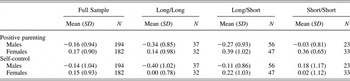
Table 1 presents descriptive statistics for boys and girls. Boys, as expected, showed significantly less self-control (β = 0.20, t = –2.97, p = .003). An examination of positive parenting showed that, in addition to being lower in self-control, boys also received less positive parenting from their mothers (β = 0.26, t = –3.54, p < .001; Table 1). These findings, together with the possible sex-contingent effect of 5-HTTLPR, which was suggested in previous studies (McQueen et al., Reference McQueen, Wilson and Fink1997, Reference McQueen, Wilson, Sumner and Fink1999; Stoltenberg & Vandever, Reference Stoltenberg and Vandever2009; Verona et al., Reference Verona, Joiner, Johnson and Bender2006; Wüst et al., Reference Wüst, Kumsta, Treutlein, Frank, Entringer and Schulze2009), proposed that there may be strikingly different processes taking place in girls and in boys, and this led us to examine boys and girls separately.
Descriptive statistics for boys and girls

Note: Significant sex differences were detected across genotype in both positive parenting and self-control (p < .01).
We used a two-level analysis that treats children as nested within families to examine the between-families effect of mothers' 5-HTTLPR genotype on their positive parenting and three within-family effects: (a) children's 5-HTTLPR genotype on the positive parenting they receive, (b) children's 5-HTTLPR genotype on self-control, and (c) children's self-control levels on positive parenting. The indirect effect going from children's 5-HTTLPR genotype through self-control levels to positive parenting was also examined in the model.
Within-family effects
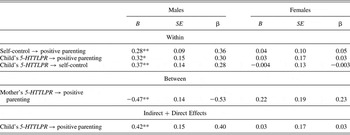
In males, there was a significant relationship between self-control and positive parenting, so that lower levels of self-control were associated with lower levels of positive parenting, as shown in Table 2. It is important that boys' 5-HTTLPR genotype affected their self-control levels, so that carriers of the short allele were characterized by higher levels of self-control. In addition, boys' genotype also affected positive parenting, suggesting an rGE so that short allele carriers received more positive parenting. As demonstrated in Table 1, these findings represent an additive effect of the 5-HTTLPR genotype in boys, so that the more short alleles a child carries, the higher self-control he is likely to exhibit and the more positive parenting he is likely to receive from his mother. In girls, neither of these effects was significant. Further analyses showed that randomly selecting one MZ twin per pair yielded very similar results.
Path model of the effects of 5-HTTLPR genotype and children's self-control levels on positive parenting

Note: 5-HTTLPR, serotonin transporter linked polymorphic region.
*p < .05. **p < .01.
Between-families effects
In order to be able to differentiate between passive and evocative rGE, mothers' 5-HTTLPR genotype was also included in the model. As can be seen in Table 2, mother's 5-HTTLPR genotype only affected parental behavior toward boys, so that mothers of boys who were carriers of the short allele tended to show lower levels of positive parenting. However, the effect of boys' 5-HTTLPR genotype on parenting was still significant when the mothers' genotype was included in the model, thus showing that the association between the child's genotype and the parenting he received is not explained by a passive rGE and supporting our hypothesis of an evocative rGE.
Indirect effects
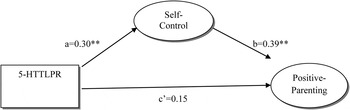
We hypothesized that the evocative rGE of boys' 5-HTTLPR on parenting is mediated by their self-control. An alternative model, in which positive parenting mediated the effect of boys' 5-HTTLPR genotype on their self-control, was tested. The indirect effect: boys' 5-HTTLPR → positive parenting → boys' self-control, was not significant (B = 0.14, SE = 0.09, β = 0.10, ns). Our hypothesized model showed a slightly stronger mediation effect in which boys' self-control significantly mediated the effect of their 5-HTTLPR genotype on positive parenting (B = 0.12, SE = 0.05, β = 0.12, p < .05). Figure 1 represents this mediation model.
Mediation of the relationship between the serotonin transporter polymorphic region gene and positive parenting in boys. The figure presents standardized regression coefficients: a, effect of genotype on self-control; b, effect of self-control on positive parenting; and c′, residual effect of genotype on positive parenting controlling for self-control.

Discussion
This is one of the first studies to show a specific child characteristic that mediates an effect of the child's genotype on parenting. The results of the current study demonstrate an evocative rGE whereby boys' 5-HTTLPR genotype affects the levels of positive parenting they receive, thus supporting the active role children play in shaping the overall parenting they experience. In addition, the current results suggest that boys' self-control levels mediate the effect of boys' 5-HTTLPR genotype on parenting, so that boys' 5-HTTLPR genotype affects their levels of self-control, which in turn affect the levels of positive parenting they experience. The mothers' 5-HTTLPR genotype affected their parenting behavior toward boys, but the effect of the children's genotype was over and above this effect, thus supporting an evocative rGE.
The evocative rGE
Correlations between children's behavior and parenting styles are often interpreted as demonstrating the causal effects of parenting. However, an increasing understanding of children's effects on parents and children's role in the socialization process (Grusec & Goodnow, Reference Grusec and Goodnow1994; Knafo & Galansky, Reference Knafo and Galansky2008, Kochanska, Reference Kochanska1995; Kuczynski, Marshall, & Schell, Reference Kuczynski, Marshall, Schell, Grusec and Kuczynski1997) sheds a different light on such correlational findings. Nonetheless, even though the notion of child effects is now more widely accepted, studies examining specific child genes as evocative modulators of parental behavior are scarce (Hayden et al., Reference Hayden, Klein, Dougherty, Olino, Laptook and Dyson2010; Lucht et al., Reference Lucht, Barnow, Schroeder, Grabe, Finckh and John2006; Mills-Koonce et al., Reference Mills-Koonce, Propper, Gariepy, Blair, Garrett-Peters and Cox2007). The current results provide important evidence for the effect of children's genes on their parents' parenting. Studies examining only behavior may argue for the influences of children's behavior on parents, but they are usually unable to clearly determine causality. Studies of evocative rGE involving specific genes that rule out passive rGE, such as the current study, may solve this problem, because they indicate a clear direction for the effect starting with the child's genetic setup.
The finding that the association between children's genotype and positive parenting may be partly mediated by self-control further underscores the important role of self-control in the child's developing personality. It adds to the body of literature that points at self-control as a salient trait in numerous facets of a person's life (Bierman et al., Reference Bierman, Nix, Greenberg, Blair and Domitrovich2008; Caspi & Silva, Reference Caspi and Silva1995; Duckworth & Seligman, Reference Duckworth and Seligman2005; Eisenberg et al., Reference Eisenberg, Fabes, Bemzweig, Karbon, Poulin and Hanis1993, Reference Eisenberg, Fabes, Guthrie and Reise2000; Mischel et al., Reference Mischel, Shoda and Peake1988; Moffitt et al., Reference Moffitt, Arseneault, Belsky, Dickson, Hancox and Harrington2010; Nisbett, Reference Nisbett, Aronson, Blair, Dickens, Flynn and Halpern2012). The current findings suggest that self-control not only affects peer and teacher relationships (Eisenberg et al., Reference Eisenberg, Fabes, Bemzweig, Karbon, Poulin and Hanis1993; Houts, Caspi, Pianta, Arseneault, & Moffitt, Reference Houts, Caspi, Pianta, Arseneault and Moffitt2010) but also contributes to the interactions between parents and their children. The differential parenting that boys with different levels of self-control tend to receive, at an age as young as 3 years old, may contribute to the shaping of their future characteristics and prove crucial to their developmental course, as will be discussed further below.
The direction of the association between the short 5-HTTLPR allele and self-control, which was found here to be positive, has been inconsistent in previous studies (e.g., Beaver et al., Reference Beaver, Ratchford and Ferguson2009; Lee et al., Reference Lee, Kim and Hyun2003; Li et al., Reference Li, Wang, Zhou, Zhang, Yang and Wang2007; Manor et al., Reference Manor, Eisenberg, Tyano, Sever, Cohen and Ebstein2001). The short allele has been shown to confer high susceptibility to the effect of environmental factors (Belsky & Beaver, Reference Belsky and Beaver2011; Carver, Johnson, Joormann, Kim, & Nam, Reference Carver, Johnson, Joormann, Kim and Nam2011). It is thus possible that it operates differently across contexts, such as cultural background and levels of sociodemographic risk. In addition, as mentioned earlier, other factors may account for the differences in findings, such as sample sizes, measurements, and ethnicity, as well as age and sex differences, which will be discussed below. It is interesting to note that mothers' 5-HTTLPR genotype showed an opposite effect on their parenting toward boys' than boys' own 5-HTTLPR genotype. That this effect was not found for mothers' parenting with regards to their daughters suggests another kind of child effect and possibly a Genotype × Child Gender interaction affecting maternal behavior. This possibility should be tested with a larger sample in future research.
Sex differences
Many studies show that boys have less self-control and receive less positive parenting (Carlo et al., Reference Carlo, Raffaelli, Laible and Meyer1999; Goldsmith et al., Reference Goldsmith, Buss and Lemery1997; Kochanska & Aksan, Reference Kochanska and Aksan1995; Lytton & Romney, Reference Lytton and Romney1991; Rothbart et al., Reference Rothbart, Ellis, Posner, Baumeister and Vohs2004). However, the biological and neurogenetic bases of this phenomenon remain obscure. The present study sheds light on this observation and suggests that the 5-HTTLPR polymorphism, and by implication serotonergic brain neural pathways, play an important role in these gender-contingent relationships. Our findings may indicate substantially different processes that take place in boys and in girls, both in the biological mechanisms leading from the 5-HTTLPR polymorphism to the self-control trait and in mother–son and mother–daughter dyads.
The current findings indicate that, at least in the early preschool years, the self-control trait is affected by the 5-HTTLPR polymorphism in boys but not in girls. Our finding is consistent with previous studies showing sex differences in the associations between serotonin and self-control related behaviors (e.g. Manuck et al., Reference Manuck, Flory, Ferrell, Dent, Mann and Muldoon1999) and between 5-HTTLPR and serotonin brain function (Williams et al., Reference Williams, Marchuk, Gadde, Barefoot, Grichnik and Helms2003). A possible neurochemical basis for these observed sex differences is an interaction between serotonin and gonadal sex hormones. Supporting this notion are rat studies showing that sex hormones affect the density of serotonin receptors and transporters in specific brain areas (Fink, Sumner, Rosie, Wilson, & McQueen, Reference Fink, Sumner, Rosie, Wilson and McQueen1999).
In addition, it is important to consider the developmental aspects of gender differences in psychopathology. Most psychopathologies with higher preponderance in males are early onset and are often diagnosed in childhood, whereas most psychopathologies that are more prevalent in females usually present themselves in adolescence (Rutter, Caspi, & Moffitt, Reference Rutter, Caspi and Moffitt2003; Zahn-Waxler, Shirtcliff, & Marceau, Reference Zahn-Waxler, Shirtcliff and Marceau2008) and are prompted by changes in gonadal hormones (Solomon & Herman, Reference Solomon and Herman2009). These observations suggest the idea that the 5-HTTLPR genotype confers risk at different developmental periods for males and females. For example, a recent meta-analysis (Calati, De Ronchi, Bellini, & Serretti, Reference Calati, De Ronchi, Bellini and Serretti2011) indicated that the short allele is more prevalent among women with anorexia nervosa, a disorder characterized by extremely high levels of self-control (Kaye, Gendall, & Strobe, Reference Kaye, Gendall and Strobe1998). These findings concerning anorexia are consistent with the current results that show the short allele is related to higher self-control. The idea of differential risk for boys and girls at different developmental periods may be further supported by a recent longitudinal study (Pulkkinen, Kokko, & Rantanen, Reference Pulkkinen, Kokko and Rantanen2012) that indicated different developmental pathways of self-control for males and females. This study showed that the continuity of the trait from childhood to adulthood is stronger in men, while in women the continuity seems to begin only in adolescence. Further research is clearly required in order to better understand sex differences regarding 5-HTTLPR and self-control, and the specific mechanisms associating the gene to sex differences in self-control are yet to be uncovered.
Our results also indicate that parental positivity is influenced by boys' self-control but not by girls' self-control. Low self-control in boys is more strongly related to aggressive behaviors, in comparison with girls (Carlo et al., Reference Carlo, Raffaelli, Laible and Meyer1999; DeLisi et al., Reference DeLisi, Beaver, Vaughn, Trulson, Kosloski and Drury2010). Therefore, parents may experience boys' low self-control as more troubling and disturbing, and respond to it in a more negative and impatient manner in comparison to girls' low self-control. Some researchers claim that the less positive parenting boys tend to receive and the greater use of physical punishment for boys may represent a parental reaction to boys' more defiant and aggressive behavior (Anderson, Lytton & Romney, Reference Anderson, Lytton and Romney1986; Gershoff, Reference Gershoff2002). Furthermore, research shows that boys' low self-control seems to have more detrimental consequences on the child's future life than girls' low self-control. Boys with low self-control not only show more aggressiveness in comparison to girls with low self-control but also show more social dysfunction (Eisenberg et al., Reference Eisenberg, Smith, Sadovsky, Spinrad, Baumeister and Vohs2004), more ADHD (Breton et al., Reference Breton, Bergeron, Valla, Berthiaume, Gaudet and Lambert1999), and in adolescence and adulthood they tend to exhibit more delinquency compared to girls with low self-control (DeLisi et al., Reference DeLisi, Beaver, Vaughn, Trulson, Kosloski and Drury2010; LaGrange & Silverman, Reference LaGrange and Silverman1999). These differences between boys and girls may account for parents' stronger reactions to boys' low self-control.
Another issue that may be relevant to sex differences in self-control and their influence on parenting is the rarely studied issue of extremely high self-control. Only a few studies have examined extremely high levels of self-control, which found them to be related to negative future outcomes such as depression (Block & Block, Reference Block and Block2006), obsessive–compulsive disorder (Frost, Steketee, Cohn, & Griess, Reference Frost, Steketee, Cohn and Griess1994), and poor adjustment (Letzring, Block, & Funder, Reference Letzring, Block and Funder2005). In most cases, these deleterious effects of extreme self-control were stronger among girls, which is consistent with the fact that girls are more prone to develop internalizing problems, often related to higher self-control (Zahn-Waxler et al, Reference Zahn-Waxler, Shirtcliff and Marceau2008). Such findings, combined with the previously noted finding of the association between girls' 5-HTTLPR genotype and anorexia nervosa (Calati et al., Reference Calati, De Ronchi, Bellini and Serretti2011), may indicate a relation between extreme self-control and psychopathology, which may be much more relevant in girls than in boys and may also have a genetic basis. A study by Kremen and Block (Reference Kremen and Block1998) also showed that while negative parenting was related to low self-control in boys, it was related to extreme self-control in girls. As we note below, our measure was not designed to address extreme forms of self-control, which should be studied in future research to address the possibility of evocative rGEs due to girls' high self-control.
Clinical implications
Our results add to the growing body of evidence that genetics play an important role in determining children's self-control. However, as mentioned earlier, processes in the development of self-control that are parent driven may still take place (for a review, see Berger, Reference Berger2011). Therefore, the process by which a boy's genetically driven low self-control evokes parental hostility and negativity may have further extensive influence on the child's development by creating a “vicious cycle” where parental negativity further hinders the child's ability to internalize self-regulatory skills and gain control over his impulses, owing to lack of parental positive guidance and support. In extreme cases, this vicious cycle might jeopardize the child's development of adequate levels of self-control and mark the beginning of a deterioration process toward psychopathology, aggression, and delinquency. Future longitudinal studies could address such cycles of influence and shed light on their underlying mechanisms.
The current study could contribute to the treatment of children with problems in self-control. Previous research had often construed the connection between negative parenting and problems with self-control as a causative link between the former and the latter (Kochanska & Knaack, Reference Kochanska and Knaack2003; Kremen & Block, Reference Kremen and Block1998; Nachmias, Gunnar, Mangelsdorf, Parritz, & Buss, Reference Nachmias, Gunnar, Mangelsdorf, Parritz and Buss1996). Although parent-driven processes may take part in the development of self-control, as the current study suggests, negative parenting might stem from the child's genetically driven low self-control. While in the first scenario treatment should focus on the parents and their parenting skills, in the second scenario more focus should be put on the child, supplying him with tools to deal with problems of self-control at an early age and teaching parents how they can encourage their child to use these tools, and especially how they can avoid the pitfalls of the vicious cycle of poor self-control and negative parenting. Future replications and further examination of the current results may also lead to increased special attention to children with a genetic risk of developing low self-control. Interventions might focus on providing children and their parents with relevant coping techniques and with suitable support to help them foster the development of the child's self-control in advance. In addition, raising awareness of parents as to the heritable component of self-control in their child should remove some of the burden of guilt that they might feel when faced with their child's self-control related problems and increase tolerance toward the child. Greater awareness of this issue should enable parents to more productively and efficiently adjust their parenting style and become more cooperative members of treatment when it is needed.
Strengths, limitations, and future directions
Our study has several notable methodological strengths. First, mothers' behavior was studied in a standardized lab setting, which allowed for studying mothers' different reactions to the two twins, which were coded by separate research assistants. Second, inclusion of mothers' genotype allowed us to rule out passive rGE and show that the current findings represent an evocative rGE. Third, the use of a twins nested in families design allowed the use of all data simultaneously, without the necessity to arbitrarily ignore half of the children participants (i.e., deleting a random twin out of each pair) or to conduct different analyses for different research variables.
One limitation of the current study is the relatively small sample size. This sample size reflects the need to use experimental observations of maternal behavior. Moreover, since we had a strong a priori hypothesis that led us to select the 5-HTTLPR polymorphism based on previous research linking it to self-control (Beaver et al., Reference Beaver, Ratchford and Ferguson2009; Lee et al., Reference Lee, Kim and Hyun2003; Oades, Reference Oades, Müller and Jacobs2010), it is unlikely that the current results are based on chance. To minimize multiple testing issues, we restricted genetic analyses to this single polymorphism. Other genes that may also be relevant to self-control and parenting (e.g., dopaminergic genes; see Berger, Reference Berger2011) should be studied in future research within larger samples. In addition, the mediation by self-control should be further examined in a longitudinal design that would enable further understanding of the relationship between self-control and parenting. Such research could also examine levels of self-control in the parents and their possible relation to positive parenting and parents' 5-HTTLPR.
We used mothers' report on children's self-control because at this age children spend a great deal of their time with their mothers, and mothers are highly knowledgeable of their behavior. Nevertheless, although the current results point to the effects that mothers' perception of their sons' self-control may have on their parenting, it would be preferable to study self-control with additional measures. One implication of using our current measure of self-control is that because most items were devised to address the presence of children's low self-control, the scale might not adequately represent the highly positive end of the temperamental distribution of self-control. As noted, extreme self-control may also be reflected in some psychopathologies, such as depression (Block & Block, Reference Block and Block2006), obsessive–compulsive disorder (Frost et al., Reference Frost, Steketee, Cohn and Griess1994), and anorexia nervosa (Kaye et al., Reference Kaye, Gendall and Strobe1998). It is important that anorexia nervosa is much more prevalent among females than males. Measures that allow detection of extreme self-control may show that parents do react to girls' behavior when it shows maladjusted self-control, at least in older ages. We are currently addressing these limitations in an ongoing longitudinal study of children's observed temperament.
Furthermore, estimations of maternal behavior were limited to a free-play interaction that may encourage more maternal positivity than maternal negativity, and thus capture a narrower range of behaviors. Although it would have been best to rely on more than one type of mother–child interaction, the free-play interaction was sufficient to detect the effect on maternal positivity. Finally, the focus on mothers, rather than both parents, is not unique to this study, because in many cultural contexts mothers are the main caretaker in early childhood. Nevertheless, fathers may play an important role in socialization, and the sex-differential findings of the current investigation reemphasize the need to include fathers in future investigations.
Conclusions
This study provides one of the first demonstrations for an evocative rGE process with measured polymorphisms. The finding that mothers' behavior depends upon children's genotype underscores the importance of understanding the child's role in family processes and opens the door for further investigation of rGE processes. Future research is needed in order to clarify the biological mechanisms that underlie the association between 5-HTTLPR and self-control (Hariri et al., Reference Hariri, Mattay, Tessitore, Kolachana, Fera and Goldman2002), and to shed light on the sex differentiating effect of 5-HTTLPR. This study contributes to the growing body of literature suggesting that parents are not only socialization agents but also change their behavioral repertoire in reaction to their child's behavior.