Introduction
Cultural disparities in neuropsychological test performance are well recognized. Neuropsychological test scores are affected by familiarity with testing situations (Ardila, Reference Ardila2005; Puente & Perez-Garcia, Reference Puente and Perez-Garcia2000), values and meanings behind specific test items (Ardila, Reference Ardila2005), attitudes toward time (Agranovich & Puente, Reference Agranovich and Puente2007; Perez-Arce & Puente, Reference Perez-Arce and Puente1996), modes of knowing (Ardila & Moreno, Reference Ardila and Moreno2001; Greenfield, Reference Greenfield1997; Luria, Reference Luria1976), and patterns of culture-specific abilities (Ardila, Reference Ardila1995, Reference Ardila2005; Puente & Perez-Garcia, Reference Puente and Perez-Garcia2000). Culture-specific influences are prominent in language structures (Kotik-Friedgut, Reference Kotik-Friedgut2006), approaches to learning, and value placed on education (Hedden, Park, Nisbett, Jing, & Jiao, Reference Hedden, Park, Nisbett, Jing and Jiao2002). Educational achievement further impacts neurocognitive functioning, with quality of education having greater impact on test performance than years of education, particularly for cultural minority groups (Ardila et al., Reference Ardila, Rosselli and Rosas1989; Ardila, Rosselli, & Rosas, Reference Ardila, Ardila, Bryden, Ostrosky, Rosselli and Steenhuis1989; Markopoulos et al., 1997; Manly et al., Reference Manly, Jacobs, Sano, Bell, Merchant, Small and Stern1999; Manly, Jacobs, Touradji, Small, & Stern, Reference Manly, Jacobs, Touradji, Small and Stern2002; Manly, Byrd, Touradji, & Stern, Reference Manly, Byrd, Touradji and Stern2004). As neuropsychological tests measure skills, knowledge, and abilities salient for the culture of the test makers (Ardila, Reference Ardila1995, Reference Ardila2005; Ardila & Moreno, Reference Ardila and Moreno2001; Golden & Thomas, Reference Golden and Thomas2000; Nell, Reference Nell2000; Puente & Agranovich, Reference Puente and Agranovich2004; Siedlecki et al., Reference Siedlecki, Manly, Brickman, Schupf, Tang and Stern2010), it is necessary to keep in mind that performance may be affected by lack of familiarity with or salience of the culture-bound constructs that are being measured by a particular test (Nell, Reference Nell2000; Puente & Agranovich, Reference Puente and Agranovich2004).
Test adaptation limited to adequate translation and content substitution does not eliminate culture-mediated differences as cultural effects cannot be equated with linguistic differences (Nell, Reference Nell2000). Still, many North American standardized tests are still being used in cross-cultural studies, often without sufficient adaptation (Paul et al., Reference Paul, Gunstad, Cooper, Williams, Clark, Cohen and Gordon2007). To ensure that tests are “fair to all test takers regardless of age, gender, disability, race, ethnicity, national origin, religion, sexual orientation, linguistic background, or other personal characteristics” (American Educational Research Association, 1999; Joint Committee on Testing Practices, 2004), it is important to “keep culture in mind” (Cole, Reference Cole1996) at every step of test development, administration, scoring and interpretation.
This study focuses on the relationship between culture-specific attitudes toward time and timed neuropsychological test performance in Russian and American participants. Although time attitudes have been identified as one of the potential sources of cultural influence on neuropsychological test results (Agranovich & Puente, Reference Agranovich and Puente2007; Paul et al., Reference Paul, Gunstad, Cooper, Williams, Clark, Cohen and Gordon2007; Perez-Arce & Puente, Reference Perez-Arce and Puente1996), and several surveys of time attitudes have been applied in cross-cultural settings (e.g., Block, Buggie, & Matsui, Reference Block, Buggie and Matsui1996; Rojas-Méndez, Davies, Omer, Chetthamrongchai, & Madran, Reference Rojas-Méndez, Davies, Omer, Chetthamrongchai and Madran2002; Sircova et al., Reference Sircova, Mitina, Boyd, Davydova, Zimbardo, Nepryaho and Yasnaya2007), none of the existing measures have been specifically linked to timed neuropsychological test performance. Given that most North American neuropsychological instruments are timed (e.g., Camara, Nathan, & Puente, Reference Camara, Nathan and Puente2000; Rabin, Barr, & Burton, Reference Rabin, Barr and Burton2005), it is likely that cultural attitudes toward time may affect test results.
Time attitudes: defining the concept
Time has been referred to as a “silent language” of a culture (Hall, Reference Hall1973). Cultural differences in temporal behavior have been extensively studied by philosophers, anthropologists, sociologists, social psychologists, consumer researchers, and marketing specialists (e.g., Block, et al., Reference Block, Buggie and Matsui1996; Cotte, Ratneshwar, & Mick, Reference Cotte, Ratneshwar and Mick2004; Hill, Block, & Buggie, Reference Hill, Block and Buggie2000; Ko & Gentry, Reference Ko and Gentry1991; Rojas-Méndez et al., Reference Rojas-Méndez, Davies, Omer, Chetthamrongchai and Madran2002).
Although time is a critical variable in mainstream American culture, it may have limited importance in other cultures. For instance, Perez-Arce and Puente (Reference Perez-Arce and Puente1996) pointed out that slowed performance on timed tests could mean prolonging a task of interest for a Hispanic patient, while a North American psychologist is likely to interpret such behavior as a sign of brain dysfunction. This observation may be related to a distinction between clock-time versus event-time orientation, which is associated with importance placed on punctuality and timeliness (Brislin & Kim, Reference Brislin and Kim2003; Levine & Norenzayan, Reference Levine and Norenzayan1999). Clock-time prevails in individualistic, industrial, Western-type societies (Hall, Reference Hall1973; Levine, Reference Levine1997; Rojas-Méndez et al., Reference Rojas-Méndez, Davies, Omer, Chetthamrongchai and Madran2002), where time is seen as a valued commodity to be “used wisely, saved, and not wasted” (Brislin & Kim, Reference Brislin and Kim2003, p. 369). In clock-time cultures, people are concerned with scheduled appointments, make sure their watches and clocks are precise, and consider it inappropriate to be late for scheduled events. Illustrations of this attitude are imbedded within culture (e.g., being paid hourly wages, hiring assistants to do less challenging work, and buying gadgets that are supposed to save time).
In contrast, the event-time orientation, which prevails in Latin America, Russia, some Eastern European, Mediterranean, and developing countries, places an emphasis on people and events rather than on schedules (Levine, Reference Levine1997): it is appropriate to participate in an event until it reaches its natural end and then start another event, without adhering to specific timeline. Such cultures tend to perceive time as more “flexible, elastic, relaxed, unlimited” (Brislin & Kim, Reference Brislin and Kim2003, p. 379), that is to be “enjoyed” rather than “saved” (Perez-Arce & Puente, Reference Perez-Arce and Puente1996; Puente & Agranovich, Reference Puente and Agranovich2004).
“RUSSIAN TIME” versus “AMERICAN TIME”
Historically, in Russian culture, timeliness, promptness, adherence to deadlines, and time efficiency have not been as relevant and/or critical as they are in American culture (Agranovich & Puente, Reference Agranovich and Puente2007; Manrai, Lascu, Manrai, & Babb, Reference Manrai, Lascu, Manrai and Babb2001; Manrai & Manrai, Reference Manrai and Manrai1995; Tongren, Hecht, & Kovach, Reference Tongren, Hecht and Kovach1995).Footnote 1 Furthermore, the two cultures are rather distinct in their methods of teaching and cognitive assessment. In North America, students are exposed to timed tests from the beginning of elementary school and become “test-wise” by learning that working quickly on their assignments is as important as doing them correctly (Nell, Reference Nell2000). In contrast, the Russian educational system historically has not used timed tests, has relied predominantly on oral exams, and educators have commonly provided extra time to finish an assignment, without penalty, placing an emphasis mostly on quality and depth of information processing rather than time efficiency. Therefore, people in Russia are seldom concerned with completing assignments or tests quickly or on time. This pattern is also reflected in approach to neuropsychological assessment, where the speed of testing is individualized (Grigorenko, Ruzgis, & Sternberg, Reference Grigorenko, Ruzgis and Sternberg1997; Homskaya, Reference Homskaya1999; Luria, Reference Luria1980; Mikadze, Reference Mikadze1997; Vasserman et al., Reference Vasserman, Dorofeeva and Meyerson1997).
Russian/Soviet business settings also have incorporated the event-time approach, where time is divided among various activities that seldom require promptness. Efficiency is not equal to the promise of the best outcome, but rather can be seen as a trade-off between quality and speed (Agranovich & Puente, Reference Agranovich and Puente2007; Tongren et al., Reference Tongren, Hecht and Kovach1995).Footnote 2
It is reasonable to expect that cultural time attitudes in educational and business settings are reflected in the approach to timed neuropsychological measures. In an exploratory study, Agranovich and Puente (Reference Agranovich and Puente2007) compared performances on timed and un-timed neuropsychological tests in closely matched samples of American and Russian adults. They chose eight tests from both North American and Russian/Lurian approaches, following suggestions for reducing cultural bias in cross-cultural studies. Participant were asked to rate their familiarity with timed procedures, subjective importance of completing tests “as fast as possible,” and relevance of the procedures to everyday experiences using a brief exploratory three-item Likert scale. The American group significantly outperformed the Russian group on timed tests (Ruff Figural Fluency Test and Color Trail Test), but no significant between-group differences were found on untimed tests. In addition, the Russian group rated relevance of and familiarity with testing procedures significantly lower than the American group, but these differences did not fully account for the effect of culture on timed measures. The findings, although only preliminary, suggested that differences in timed test scores might be attributed to culture-based attitudes to time-related constructs and/or lack of exposure to cognitive situations where speeded performance might be emphasized and/or rewarded.
To investigate further how culture-bound time attitudes may affect approach to and performance on timed tests, the present study examined the effect of the time attitudes on timed neuropsychological test scores in Russian and American adults, who completed a short battery of standardized timed neuropsychological tests along with the valid and reliable measure of attitudes toward time; the Culture of Time Inventory-33 Items (COTI-33, Agranovich & Panter, submitted). It was expected that American group would outscore the Russian group across the timed measures. It was also expected that group differences would be mediated by differences in attitudes toward time and timed test performance as measured by the COTI-33.
Method
Participants
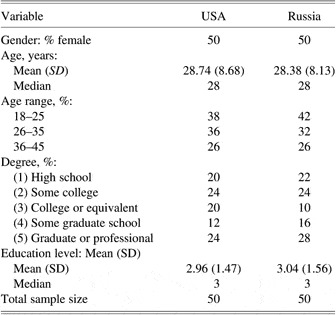
Two groups of 50 adult volunteers, age 18 to 45 years, were recruited in North Carolina and Ryazan (a relatively culturally homogeneous city in Russia), respectively. The samples were stratified and closely matched by sex (50.0% female in each group), age (t(98) = .21; p = .831), and level of education (t(98) = −.26; p = .793).Footnote 3 Given that both Russia and United States are culturally and linguistically diverse countries, representative sampling was confined to participants who were most reflective of majority culture, and those with primary languages of Russian or English, respectively. Furthermore, specific attention was paid to only include participants without prolonged exposure (i.e., history of education, employment, or long-term residence) to other countries/cultures. Some American volunteers were students at a large public university in the southeastern United States (n = 20) and received a partial credit for an introductory psychology course. Other qualified participants (recruited via email advertisement, through the informational email system, a word of mouth, and classified ads) received monetary compensation for participation in the study. Russian participants were recruited through similar methods, and 19 of them were students of local universities. Due to absence of participant pool system in Russia, all Russian volunteers received monetary compensation.
Within the American group, 82% of participants self-identified as Caucasian, 12% as African American, 2% as Hispanic, and 4% as Asian-American. Ethnic characteristics were not collected for the Russian sample, where all participants were white, and ethnically Russian. Although all efforts were made to select a diverse and representative sample (by including participants with a wide range of age, education, and vocational backgrounds), it was not feasible to include individuals with limited exposure to formal education, or those from severely disadvantaged social groups.Footnote 4 Demographic characteristics of the samples are presented in Table 1.
Demographic profiles of the American (USA) and Russian samples

Volunteers read and signed an Informed Consent in their native language. All data included in this manuscript were obtained in compliance with the regulations of the university's IRB, which approved the study.
Measures
To establish conceptual and functional equivalence of the measures used in this study, careful translation and back translation by independent bilingual individuals was conducted for test instructions and procedures.
Neuropsychological Assessment
A brief battery of standardized neuropsychological tests was administered individually in random order. Five tests were selected from the existing comprehensive neuropsychological tests compendium (Lezak, Howieson, Loring, Hannay, & Fischer, Reference Lezak, Howieson, Loring, Hannay and Fischer2004), according to the following criteria: (1) tests matched requirements for cross-cultural neuropsychological research (e.g., Puente & Agranovich, 2004; Brickman, Cabo, & Manly, Reference Brickman, Cabo and Manly2006; Helms, Reference Helms1997; Horton, Reference Horton2008; Manly, Reference Manly2008; Nell, Reference Nell2000) and have been previously used in cross-cultural studies; (2) were nonverbal, to minimize effects of language differences; (3) were reported to have high validity and reliability; and (4) were timed.
The following tests were included (time-based scores are listed in parentheses): Color Trails Test, Part I and 2 (CTT; Mitrushina, Boone, Razani, & D'Elia, Reference Mitrushina, Boone, Razani and D'Elia2005; completion time in seconds), Ruff Figural Fluency Test (RFFT; Ruff, Reference Ruff1996; the number of unique designs), Tower of London-Drexel University (ToLDx; Culbertson & Zilmer, Reference Culbertson and Zilmer1998, Reference Culbertson and Zilmer2001; initiation and total time), Symbol Digit Modalities Test (SDMT, Smith, Reference Smith1982: total correct). To ensure samples’ equivalence, Advanced Progressive Matrices, Part 1 (APM 1; Raven, Reference Raven1958, Reference Raven2000) was included as screening measure of general intelligence.Footnote 5 The test administration was un-timed and a score representing the total number of correct responses across trials was used in analyses.
Questionnaires
Culture of Time Inventory-33 Items (COTI-33, Agranovich & Panter, submitted) was administered to each participant upon completion of the neuropsychological assessment. The questionnaire is comprised of 33 statements reflecting five dimensions of time attitudes: planning, punctuality, time management, clock versus event-time orientation, and attitudes to timed tests. The measure was developed and validated in English and Russian on 1200 American and Russian respondents and was established to have good construct and discriminant validityFootnote 6 and reliability (Cronbach alpha across scales was greater than .80). The questionnaire was supplemented by a group of statements assessing participants’ familiarity with testing situation and timed and standardized tests (Familiarity Factor: I have taken timed tests before; These tests remind me of tasks I had to do in school; I have taken standardized tests before; I have done something similar to these tests before).
Evaluation Anxiety Inventory (EAI; Richmond, Wrench, & Gorham, Reference Richmond, Wrench and Gorham2001) was included to account for possible effect of evaluation anxiety on timed test performance. It was selected for its brevity in assessing the level of apprehension that people experience when evaluated (usually by testing). The internal consistency for the EAI was reported to be above .85.
Procedure
The investigation was conducted in three steps: (1) a health screening, completed before enrollment; (2) neuropsychological testing, and (3) completion of questionnaires online. Participants with a self-reported history of traumatic brain injury, neurovascular incidents, psychiatric or seizure disorders, learning disabilities, Attention Deficit Hyperactivity Disorder, or color blindness were excluded.
American participants were tested individually in a comfortable private office by the primary author. The Russian participants were tested at psychologists’ offices in Ryazan, where testing was conducted by a qualified psychologist who had undergone prior training in standardized test administration. Data in both countries were collected concurrently. To account for a possible experimenter effects, all test administration procedures were audio-recorded; test administration procedures were closely monitored via online, telephone, and video collaboration, and all questions and concerns that emerged during the practice trials were addressed. Subsequently, a qualified investigator evaluated selected recordings for adherence to time limits and standardized protocols.
Upon completion of the neuropsychological test battery, each participant filled out the online questionnaires in the testing room, and was subsequently debriefed and either given a course credit for participation or received monetary reimbursement.
Results
Exploratory Data Analyses
Between-sample comparison of mean ARM-1 scores revealed no significant differences in estimated intelligence (t(98) = 1.78; p = .198). Because the samples were well-matched according to demographic variables and intelligence, only the raw test scores were included in the analyses. The descriptive statistics for each score as well as tests for normality were used to describe the distributions for each group and examine presence of possible outliers in the data. The distributions for all dependent variables approached normal and no significant outliers were identified. Descriptive statistics are presented in Table 2.
Neuropsychological test results (raw scores) for the American (USA) and Russian groups

Note. CTT1 = Color Trails Test, Part 1, Completion Time, sec; CTT2 = Color Trails Test, Part 2, Completion Time, sec; RFFT = Ruff Figural Fluency Test, Number of Unique Designs; ToLDx = Tower of London, Drexel Edition, Initiation Time, sec; SDMT = Symbol Digit Modalities Test, Total Score. Cohen's d value below |.20| is considered small effect size, |.50| is medium, and above |.80| is large.
Group Differences in Neuropsychological Test Scores
As predicted, the American groups, on average, completed timed tests faster or produced more items within the allocated time. As shown in Table 2, significant group differences in test scores were larger for some timed tests than for others. A large effect size was noted for significant between-group differences on both CTT trials, confirming previously reported findings (Agranovich & Puente, Reference Agranovich and Puente2007).
Americans completed ToLDx faster than Russians (with medium effect size: d = .37). This discrepancy is attributable to significant difference in ToLDx initiation time (t(98) = 2.71; p = .008; d = .55), where Russians took on average 17 s longer to make the first move. The groups did not differ in execution time, but the Russians (M = 19.56), on average, completed the tasks in fewer steps than Americans (M = 28.54), t(98) = 2.48, p = .015. The Russian group also solved a larger number of problems using the minimum number of moves (ToLDx Total correct: M = 6.30 for the Russian group; M = 4.58 for the American group; t(98) = −3.81; p < .001).
Americans produced a significantly higher number of symbols on SDMT, t(98) = 2.30; p = .023; d = .47. Contrary to predictions, the group difference in RFFT's number of unique designs (p = .089; d = .37) or perseverative errors were not statistically significant.
Effect of Culture on the COTI-33 Scores
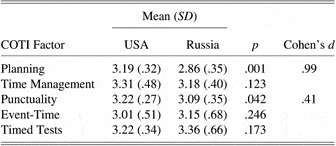
Between group comparisons of the COTI-33 total score revealed significant difference between the Russian (M = 3.15; SD = 0.23) and American (M = 3.27; SD = 0.22) groups (t(98) = 2.74; p = .007; d = .53), with American participants endorsing greater agreement with time-related rules, schedules, and efficiency demands compared to Russian participants. Cross-cultural comparisons of the factor scores revealed varied results. Significant effect of culture emerged only for two of the five COTI factors, Planning and Punctuality, where Americans endorsed greater tendency to follow a schedule and/or adhere to timelines. The Russian group scored higher on Event-time orientation, but the difference did not reach statistical significance. Descriptive statistics and results of the independent sample t test are presented in Table 3.
Comparison of COTI-33 factor scores for the American (USA) and Russian samples

Effect of Familiarity with Testing Procedures
American participants (M = 2.90; SD = 0.47) endorsed being more familiar than Russians (M = 2.36; SD = 0.72) with timed and/or standardized testing procedures (t(98) = 4.44; p < .001; d = .90). Familiarity with standardized testing procedures was negatively related to the scores on CTT1 (r = −.28; p = .004), CTT2 (r = −.31; p = .002), and ToLDx initiation time (r = −.21; p = .028), suggesting that individuals who lack familiarity with standardized testing procedures tended to take longer to complete these timed tests. Significant negative correlation was also found between SDMT score and familiarity with testing procedures (r = −.32; p = .026), indicating association of lower test score to less familiarity with standardized tests.
Qualitative analyses revealed that approximately half of the Russian sample reported lack of experience with timed (18% answered Never and 32% Seldom to the statement “I took timed tests before”) and/or standardized (22% endorsed Never and 24% Seldom in response to statement “I have taken standardized tests before”) tests. In contrast, in the American sample, none of the participants endorsed Never for either of these two questions, and only one participant answered Seldom to these questions.Footnote 7
Mediation Effect of Time Attitudes on Timed Neuropsychological Test Scores
A bootstrapping procedure for estimation of the total and specific indirect effects (Preacher & Hayes, Reference Preacher and Hayes2004, Reference Preacher and Hayes2008) was used to assess if differences in neuropsychological test performance were mediated by time attitudes assessed by COTI-33. Differences between the coefficients representing a total and a direct effect of culture on a test score, and significance of specific direct and indirect factor effects were examined for each of the outcome variables separately.Footnote 8
The relationship between culture and CTT1 score was mediated by the COTI-33 total score (effect = −1.27 (.69); p = .054). That is, the effect between culture and CTT1 score decreased when controlling for the time attitudes. Culture was a significant predictor of both COTI-33 total score and CTT1 score, and the COTI-33 score was a significant predictor of the CTT1 score, when controlling for the effect of culture. In particular, Planning had a significant effect on CTT1, and reduced the effect of culture on CTT1 scores, with the difference approaching significance (effect = −1.70 (.99); p = .051). Specifically, the effect of culture on the CTT1 score decreased when controlling for preferences in planning of one's daily activities and adhering to schedule.
No mediation effect of the total COTI-33 score (effect = −.16 (.80); p = .840) on the CTT2 results was observed. Inclusion of all factor in the mediation model simultaneously produced negligible reduction in the total effect, and the total indirect effect of the set of mediators was not significant (effect = 1.75 (2.24); p = .436). Neither individual factors nor the measure of familiarity had a significant or substantial mediation effect on the CTT2 score.
Although the total main effect of culture on RFFT score only approached significance (see Table 2), COTI-33 as a whole appeared to mediate the difference between cultures (total effect = −3.74 (1.90); p = .047). Examination of the individual factor's effects revealed a significant indirect effect of Event-Time orientation on RFFT results (effect = −1.68 (.70); p = .016), suggesting that higher endorsement of items constituting Event-Time (i.e., “When I am involved in an activity, I do not pay attention to time”) might be associated with lower RFFT scores. Greater endorsement of Event-Time orientation in the Russian sample appeared to explain the effect of culture for RFFT. The direction of differences (Russians scores higher than Americans on Event-Time, but lower on RFFT) and the presence of mediator effect suggest that more event-time oriented individuals might work less quickly on the task, placing more attention on the process than on the speed.
The difference in the ToLDx Initiation Time score was reduced by mediating effect of COTI-33 Timed Test factor (effect = −2.76 (1.28); p = .031). This finding suggested that individuals who tend to see benefits of and are familiar with time-limited tests (as in the American sample) might attempt faster performance time by quickly initiating on the task.
Examination of the relationship between the culture and SDMT score when controlled for effect of COTI-33 factors did not reveal total mediation effect (total effect = −.95 (.1.24); p = .44). Significant individual indirect effect on SDMT score was noted for Punctuality (−.76 (35); p = .029), indicating that lower SDMT scores in the Russian sample can be related to their lower ratings of items constituting Punctuality factor in the COTI-33.
Effect of Test Anxiety on Test Results
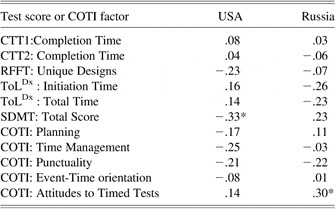
The relationship between Evaluation Anxiety Inventory (EAI) scores and results of neuropsychological tests and COTI-33 factor scores were examined in a correlational analysis. As shown in the Table 4, in the American sample, the only significant relationship was found between the EAI and SDMT (r = .33; p = .018). Of note, this result did not indicate that anxiety was associated with poor test performance but, on the contrary, suggested that higher scores on the test anxiety measure was associated with higher scores on SDMT. In the Russian sample, the EAI score positively correlated with the COTI-33 Timed-Test factor score (r = .31; p = .032), suggesting that individuals who found timed test stressful or undesirable tend to have higher level of test anxiety. However, given the type of evaluation procedures assessed by EAI is very uncommon in Russia, this relationship might simply indicate a higher level of apprehension toward unfamiliar evaluation procedures. Furthermore, many Russian participants commented on irrelevance of the statements in EAI to their experiences in evaluative situations. Overall, although statistically significant, these correlations are rather weak to indicate a strong influence of test anxiety on test performance.
Correlation of neuropsychological test scores and COTI-33 factors with Evaluation Anxiety Inventory (EAI) total score in the American (USA) and Russian samples

Note. CTT1 = Color Trails Test, Part 1; CTT2 = Color Trails Test, Part 2; RFFT = Ruff Figural Fluency Test; ToLDx = Tower of London, Drexel Edition; SDMT = Symbol Digit Modalities Test; *p < .05.
Discussion
Consistent with the proposed hypotheses, the American group achieved higher scores across the timed neuropsychological tests used in the study. These results confirmed and expanded previously reported findings (Agranovich & Puente, Reference Agranovich and Puente2007) and underscored that cultural differences affect performances even on tests that are relatively free of cultural bias. Large effect size of differences observed in CTT scores between the two matched samples exemplify cultural disparities in test performance even in tests developed explicitly for cross-cultural comparisons (Maj, D'Elia, Satz, & Janssen, Reference Maj, D'Elia, Satz and Janssen1993). The findings highlight the notion that “culture-fair” tests are difficult, if at all possible, to define and to develop, and once again underscore that assessment of culturally dissimilar individuals with instruments developed in and for North America could lead to misinterpretation of the lack of a culture-specific knowledge as a sign of functional or cognitive deficit.
In terms of time attitudes, significant group differences emerged in ratings of Planning and Punctuality, as well as in the total COTI-33 score, suggesting presence of cultural influences on these time-specific attitudes and behaviors. The findings supported the proposed hypothesis that, in an event-time oriented Russia (Tongren et al., Reference Tongren, Hecht and Kovach1995), subjective importance of punctuality and breaking the day in the time-based units is less salient than in the primarily clock-oriented United States. These findings are of great importance for understanding culture-specific behaviors in general and may have significant implications for psychological assessment.
It was hypothesized that time attitudes would mediate the group differences in timed test performance. Statistical analyses provided partial support for this hypothesis. Thus, COTI-33 score reduced the group differences for CTT1, a test designed to measure psychomotor speed and attention. Of interest, the effect of culture on test score decreased when controlling for preferences in planning daily activities or adhering to schedules. Values placed on punctuality affected scores on SDMT, another measure of psychomotor speed. Given that the Russian group scored significantly lower on both Planning and Punctuality domains, the difference between the groups in CTT1 and SDMT performances might, at least in part, be attributed to differences in these time attitudes. In contrast, COTI-33 factors did not significantly account for test score disparities on the more challenging part of the test (CTT2), requiring higher order of information processing, resistance to interference, and impulsivity control. Further exploration of cultural influences affecting performance on this test is in order.
Russian participants on average took significantly longer to initiate ToLDx task, but this group difference was reduced by the effect of COTI-33 scores and specifically by accounting for attitudes toward timed tests, suggesting that lack of exposure to time-limited testing may lead to differences in importance placed on the initiating task “as fast as possible,” and result in slower initiation time. Given that Russians on average completed the ToLDx tasks in fewer steps and solved a larger number of problems using the minimum number of moves, the findings indicate that less timed-tests-wise Russians might tend to put more emphasis on quality part of the instructions (i.e., solving the problem in fewer steps) than on the requirement to work on the test “as fast as possible.”
Undoubtedly, one explanation for the observed differences between Russian and American samples may lie in the differences in exposure to timed and or standardized tests, as was also previously reported by Ardila (Reference Ardila2005), Puente and Perez-Garcia (Reference Puente and Perez-Garcia2000), and Romero and colleagues (Reference Romero, Lageman, Kamath, Irani, Sim, Suarez and Attix2009) for Hispanic patients. Not only the Russian groups rated their familiarity with the used type of testing procedures significantly lower that the American sample, but also approximately half of the Russian participants reported never having taken a timed and/or standardized test before. Furthermore, across samples, individuals with lack of familiarity with standardized testing procedures took longer to complete CTT trials, to initiate moves on ToLDx, and obtained lower scores on SDMT. Because Familiarity factor did not fully explain group differences in time neuropsychological tests, further research should investigate presence of other culture-specific constructs that might contribute to observed differences. Consideration may be given to explorations of differences in cognitive styles and problem solving approaches and their impact on differences in standardized test scores.
Another possible explanation might lie in cultural differences in interactions with authorities and formal testing situations, which were reported to affect test results in other cultural groups (e.g., Ardila, Reference Ardila2005). It is possible that Russians and Americans treat authority (e.g., requests of the examiner) with different degrees of respect (Astakhova, DuBois, & Hogue, Reference Astakhova, DuBois and Hogue2010; Rivkin-Fish, Reference Rivkin-Fish2009). Alternatively, Russians might place less importance into “as fast as possible” part of instructions. A search for empirical support to these observations warrants future explorations.
Addressing the Challenges of Cross-Cultural Research
In cross-cultural studies, it is very important to ensure equivalence of approaches, conditions, methods, and procedures (American Educational Research Association, 1999; Helms, Reference Helms1997). However, such equivalences are difficult to achieve, when comparing psychological variables derived in different cultural contexts. In this study, cultural influences became apparent not only in the data patterns, but in the attitudes to testing, standardized instructions, “personal” questions, and to psychology as a science. Although all efforts were made to ensure equivalence of recruitment strategies, testing conditions, test items and procedures, culture-related challenges surfaced on every step of the study.
Levels of education
As was previously noted (e.g., Manly et al., Reference Manly, Jacobs, Sano, Bell, Merchant, Small and Stern1999; Marcopulos et al., Reference Marcopulos, McLain and Giuliano1997), equating culturally different groups by years of schooling might not be appropriate due to differences in educational systems and quality of education. Therefore, additional information about the quality of education was collected from Russian participants, including: the type of educational institution, nature of obtained degree (e.g., a full time program versus degree by mail), and length and quality of the program, as in contemporary Russia educational attainment is not always reflected in the degree on paper (e.g., Astakhova et al., Reference Astakhova, DuBois and Hogue2010; Nicholson, Bubal, Murphy, Rose, & Marmot, Reference Nicholson, Bubal, Murphy, Rose and Marmot2005; Rivkin-Fish, Reference Rivkin-Fish2009). The self-reported and experimenter-described levels of education were interpreted by the authors to arrive to a degree level that would be equivalent to North American hierarchy of educational attainments.
Mental health stigma
Although this study has implications for clinical neuropsychological assessment, it is important to test the hypotheses about the nature of cultural differences on the non-clinical samples first. For this purpose, participants were screened for neurological and psychiatric conditions that affect neuropsychological test performance. American participants answered screening questionnaire without complaint. In contrast, the Russian participants were more reticent, if at all agreeable, to answer questions about their mental and neurological conditions, given potential social stigmatization. To ensure equivalence of the two groups, the screening questionnaire in Russian was worded very carefully to avoid diagnostic labels, and was supplemented with explanation of rationale for such questions and repeated reassurance of confidentiality.
Attitudes toward testing
Importantly, the standardized testing approach used in this study is quite dissimilar to the testing approach generally used by the Russian psychological school (Homskaya, Reference Homskaya1999; Tupper, Reference Tupper1999). Observations during the data collection echoed previously reported by Ardila (Reference Ardila2005) cultural differences in attitudes to standardized testing procedures. Thus, formality of the testing situation “destroyed rapport” and “created psychological barriers” (Khodyreva, 2009, personal communication). Although instructions were carefully translated to maintain functional equivalence, it was important to keep translations as close to the original as possible to ensure procedural equivalence. The majority of Russian participants found instructions to be “too verbose,” and expressed “irritation with standardized instructions” despite numerous explanations of the procedures. These observations underline the necessity to adapt and adjust translated tests to make them culture-friendly, which may mean, perhaps, less formal. Adaptation of selected tests for use with Russian-speaking populations warrants further research.
Comments received from the Russian participants provided direct qualitative support to the main study hypothesis. Although the tests were timed and instructions repeatedly emphasized the need to work on each test “as fast as possible,” many Russian participants commented: “I understand that I could do it in a simple or faster way, but I like this way better,” or “It makes more sense to me to do it carefully, not quickly.”
Limitations, Implications, and Future Directions
The observed differences in time attitudes partially accounted for differences in the timed test scores. However, it is important to investigate further what culture-specific variables, if any, may explain the observed differences on tests that were designed to be as free as possible of cultural influences.
As it was important to ensure comparability of the samples and minimize variability in the data attributable to participant variables, the samples were closely matched by age, gender, and education. However, given that both Russia and the United States are fluid, multicultural, and diverse societies, it was not feasible to obtain a large enough sample to reflect the multitude of subcultures within each group. Although participant selection (including truncated educational range, inclusion of only participants with Russian or English native language, and sampling within limited geographic areas) constitute a limit to generalizability of the findings, the study results are likely reflective of the “mainstream” culture within both groups. Prior research (e.g., Block et al., Reference Block, Buggie and Matsui1996; Ko and Gentry, 1991) examined ethnic differences in time attitudes. Although this study was limited to exploration of between-group differences, further exploration of time attitude differentiation, particularly within those identifying as American, is warranted given the potential influence of acculturation (e.g., exposure and identification with mainstream American time values) and education on time attitudes. Future studies should also examine within group differences in terms of effect of time attitudes on time-based test performance.
Although this study was conducted with non-clinical samples, it has strong implications for working with neurologically impaired individuals, as using standardized tests in clinical assessment of individuals from cultural backgrounds dissimilar to that of test-makers can produce misleading results and erroneous interpretations. Without awareness of culture-specific time attitudes, it is easy to misinterpret one's prolonged initiation time, lack of focus on “as fast as possible” part of instructions, and/or overall lack of concern with efficiency and speed of performance as “psycho-motor slowness,” or “lack of initiation,” or “reduced processing speed.” Cultural norms and attitudes toward planning and efficiency may also play a role in patient's response to rehabilitation interventions, which often involve improving time management, using calendars and planners, and following specific schedules for various daily activities.
The study also has implications for assessment of immigrants from Russia and countries of former Soviet Union, as well as other countries where event-time based attitudes prevail. Although degree of acculturation, age of immigration, and degree of exposure to majority culture versus culture of origin in the United States may affect and change the time attitudes and perceived cultural norms, it would be still useful to consider patient's time perspective and incorporate assessment of time attitudes into the broader neuropsychological evaluation.
Acknowledgments
The authors are grateful for contribution to this manuscript from the JINS editor and the anonymous reviewers. We thank Dr. Marylyn Hartman and Dr. Leonid Dzantiev for their input into development and execution of the study. The information from this manuscript and the manuscript itself has never been published either electronically or in print. Part of the study was presented at a poster session at the 2010 Annual Meeting of the International Neuropsychological Society in Acapulco, Mexico. There are no financial or other relationships that could be interpreted as a conflict of interest affecting this manuscript. Partial financial support for the study was provided by the Smith Dissertation Research Award of the University of North Carolina at Chapel Hill.