INTRODUCTION
Greek Neolithic communities made and used vessels of two non-perishable materials: fired clay and stone. These two types of containers exhibit substantial differences regarding their frequency, as well as the level of scholarly interest they have attracted. Pots have been recovered in abundant quantities and at every site, and their morphological, technological, functional, economic and social dimensions have been explored systematically (e.g. Dimoula Reference Dimoula2017; Katsarou Reference Katsarou, Papathanasiou, Parkinson, Pullen, Galaty and Karkanas2018; Katsipanou-Margeli Reference Katsipanou-Margeli, Papathanasiou, Parkinson, Pullen, Galaty and Karkanas2018; Kotsakis Reference Kotsakis, Ivanova, Athanassov, Petrova, Takorova and Stockhammer2018; Pentedeka Reference Pentedeka, Sarris, Kalogiropoulou, Kalayci and Karimali2017; Psimogiannou Reference Psimogiannou, Papathanasiou, Parkinson, Pullen, Galaty and Karkanas2018; Tomkins Reference Tomkins, Mee and Renard2007; Urem-Kotsou Reference Urem-Kotsou2017; Reference Urem-Kotsou, Ivanova, Athanassov, Petrova, Takorova and Stockhammer2018; Vitelli Reference Vitelli1993; Reference Vitelli1999; Reference Vitelli2007). Stone vases, on the other hand, represent one of the rarest artifactual categories of Neolithic Greece. They have not been treated in a systematic manner and are largely known through superficial reports and cursory references. It is on this scarce and neglected type of artifact that I focus here.
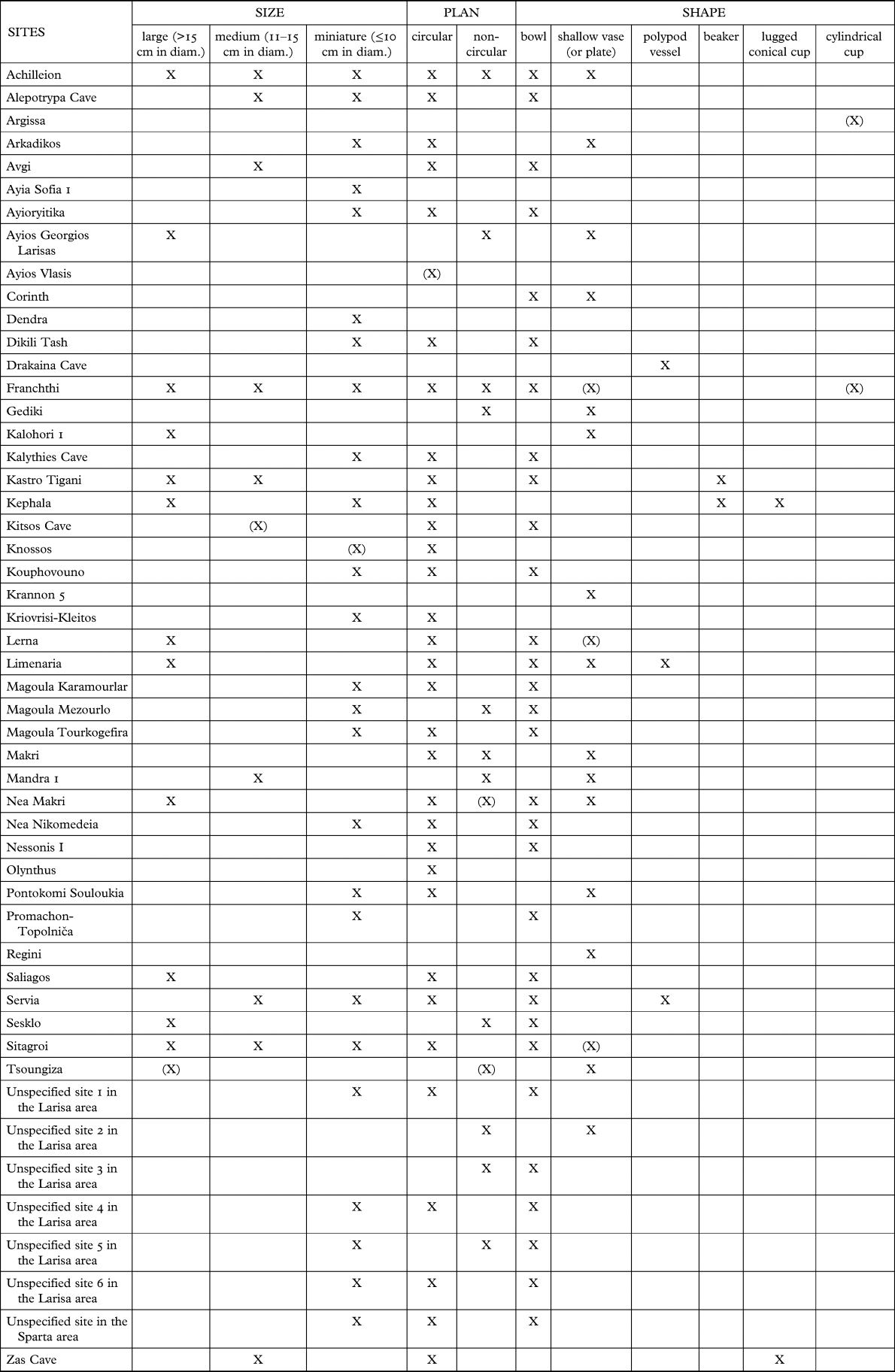
This article looks at Aegean Neolithic stone vessels through two different lenses. The first, a macro lens, zooms in on a single assemblage – that from the site of Franchthi – and explores its characteristics. The second, a wide lens, offers a panoramic view of stone vases from Neolithic Greece as it compares and contrasts the Franchthi assemblage with others along the axes of geographic and chronological distribution, morphological characteristics, raw material, manufacture, use, breakage, and discard. All Greek sites mentioned in this paper, along with relevant bibliographic references, are listed in Table 1.Footnote 1 Parenthetical numbers accompanying site names in the text match up with bibliographic references cited in Table 1.
Greek sites (with or without stone vessels) mentioned in the paper and relevant bibliographic references.

VESSELS VERSUS MORTARS
A ‘vessel’ is defined here as a container used to hold, serve, consume, mix, store and/or transport food and other substances (see also Adams Reference Adams2014, 218). A ‘mortar’, on the other hand, is defined as the concave stationary component of a toolkit that also includes a mobile element (i.e. pestle) and is used for processing food and minerals (see also Wright Reference Wright1992). These definitions refer to these objects’ intended or primary functions. In practice, the distinction is sometimes blurred when a vase is employed like a mortar and vice versa in the context of secondary use or recycling.
This paper focuses on stone objects whose main function was presumably that of a vessel. Stone artifacts assumed to have been intended as mortars are not discussed beyond this section. Given the lack of microwear analysis and the fragmentary state of most relevant Greek Neolithic specimens, differentiating vessels from mortars seems like an impossible task. Yet, it is not, since, as shown below, this is apparently a distinction drawn by the makers and users themselves.
Having personally examined the ground stone assemblages from Franchthi and several other sites and by thoroughly acquainting myself with other assemblages through the literature, I came to realise the existence of broad correlations between the absence or presence of (substantial) use wear and specific choices pertaining to raw material, morphology and/or manufacture. It thus appears that, as a rule, Aegean Neolithic people deliberately fashioned their vases in fine-grained lithologies that could take a good smoothing/polishing, shaped them so that the cavity took up roughly the whole body, added non-utilitarian elements such as ring bases, incised lines or knobs and generally invested time and energy in well finishing both the interior and exterior surfaces (see below). These same people, on the other hand, generally used coarser lithologies for the artifacts they intended for processing food and other substances, gave them simpler, thicker and heavier forms, carved cavities that often occupied only part of the body and chose not to put much effort into surface finish.
There is a notable exception to this general rule and concerns approximately 50 small cup-like artifacts unearthed at the site of Makriyalos (1). These are made of marble and have ground or even polished surfaces, but, given the substantial wear of their cavities, they were certainly used as mortars.
Indeed, it is the fundamentally emic (and obvious) character of the distinction between stone vessels and mortars that explains why the scholars who reported the relevant artifacts convey confidence in their respective identifications and, by extension, why indeterminate cases are rare in the literature (the latter are mentioned below).
Although stone mortars are beyond the scope of this paper, it is worth noting that they were even rarer than stone vases in Neolithic Greece. Besides Makriyalos, such artifacts are only known from Franchthi (Stroulia Reference Stroulia2010a, 54–6) and fewer than twenty other sites.Footnote 2 It is unlikely that stone mortars and the occasional bedrock mortarFootnote 3 covered all needs involving pounding, crushing, dehusking etc. Most likely a much larger number of mortars were carved in wood – something common ethnographically (e.g. Harlan Reference Harlan1967; Hillman Reference Hillman1984) – and thus not preserved.
FRANCHTHI AND ITS STONE VESSELS
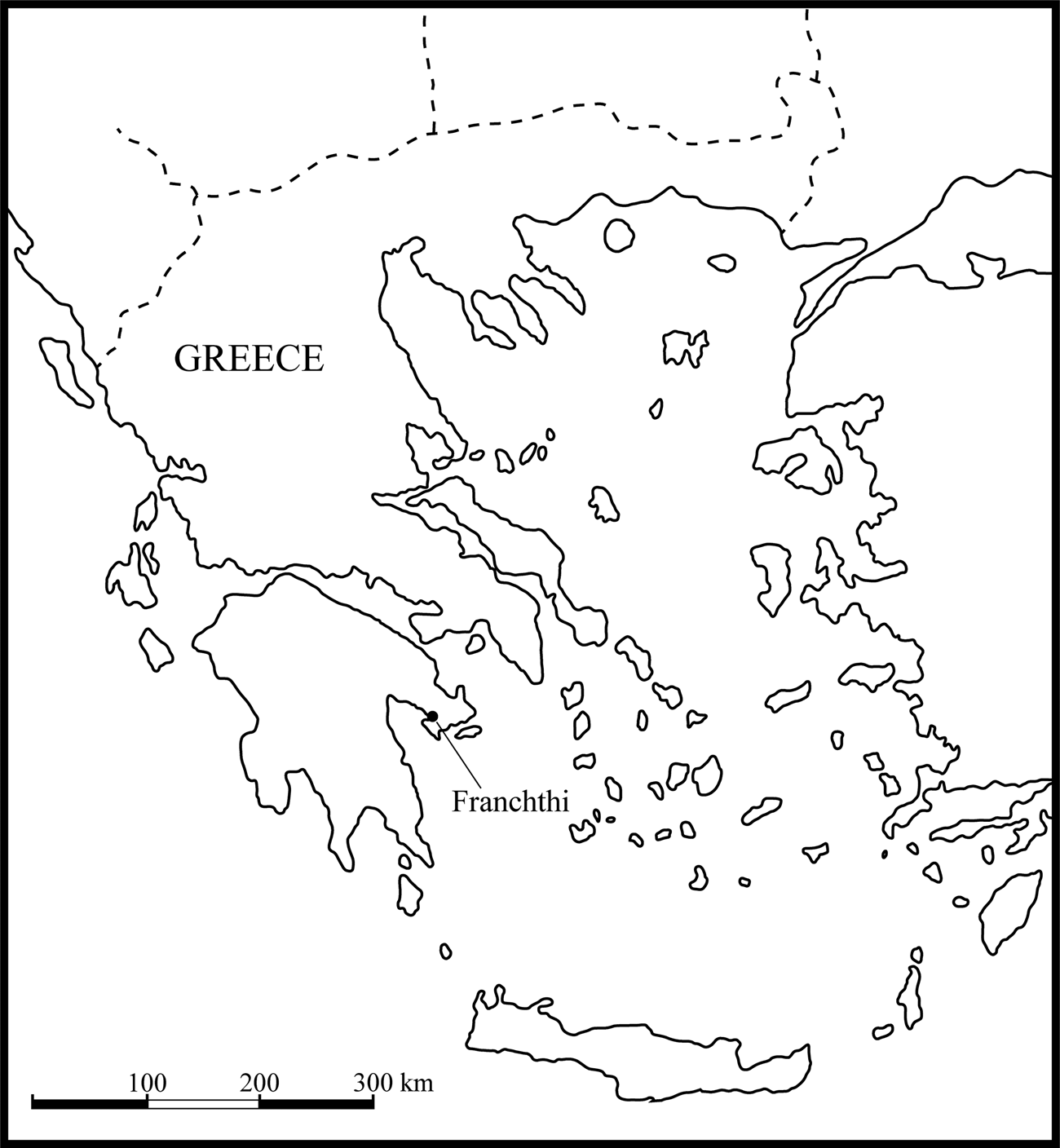
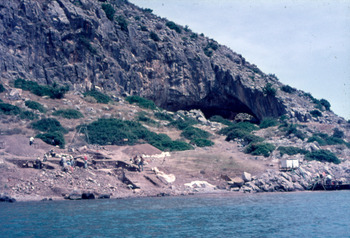
The site of Franchthi is located on the northern side of Kilada Bay in the southern Argolid, in the Peloponnese (Figs 1 and 2). Excavations carried out between 1967 and 1976 under the direction of Thomas W. Jacobsen revealed a deep and complex stratigraphy spanning over 35,000 years (c. 40,000–4000 bc). Starting at the early Upper Palaeolithic, continuing into the Mesolithic and ending in the Neolithic period, this long sequence of human occupation is rare not only in the Aegean but also in the Mediterranean (Farrand Reference Farrand2000).
Map of Greece showing the location of the site of Franchthi. Drawing: M. Strezewski.

View of Franchthi Cave (photo P0038517, courtesy of Indiana University Archives).

The interdisciplinary approach, technical innovations (e.g. use of water-sieving and submarine exploration) and high standards of recovery adopted by the Franchthi Project were pioneering at the time, making it a model for prehistoric fieldwork in Greece and elsewhere. The project is well known for its impressive scholarly output too: fourteen specialised volumes are in print, another four are in preparation, while the published articles number in the dozens.
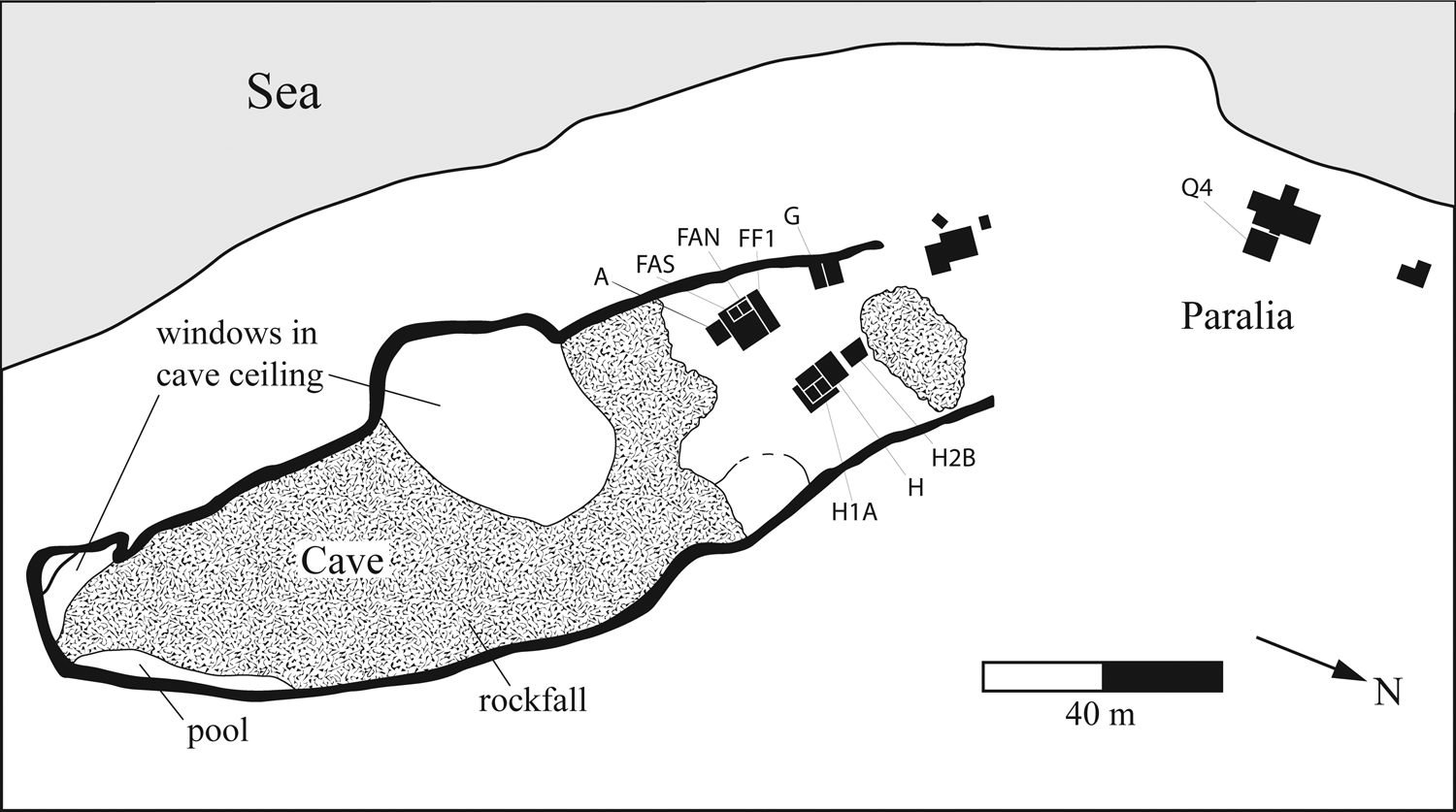
Evidence of human activity came from two integral but distinct areas: the cave and the so-called paralia (Fig. 3). The cave is a karstic formation about 150 m in length and 45 m in maximum width. At the very back is a small pool of spring-fed water. About two-thirds of the cave interior is covered by huge boulders, the result of massive rock-falls at various points in the cave's history. That is why trenches were dug only in the front part of the cave as well as on the terrace just outside the cave mouth. Paralia (the Greek word for beach) refers to a strip of land about 15 m wide located below the cave mouth and along the modern shoreline. For the excavation history and methodology as well as plans and sections of both cave and paralia trenches, see the work of Jacobsen and Farrand (Reference Jacobsen and Farrand1987; Reference Jacobsen and Farrand2000).
Plan of the site of Franchthi with names of trenches that yielded stone vessels (drawing courtesy of Indiana University Archives, modified by M. Strezewski).

The evidence suggests that in the Upper Palaeolithic and Mesolithic periods, foraging groups used the cave as a base camp for the exploitation of wild resources or as a habitation site at least on a seasonal basis. The introduction of domesticated plants and animals, the appearance of pottery and the building of structures on paralia mark the establishment of a Neolithic settlement in the seventh millennium bc. Even though all four main Neolithic phases are represented at Franchthi, hiatuses as well as changes in the nature of occupation have been discerned. The site was abandoned around 4000 bc (Farrand Reference Farrand2000; Reference Farrand, Galanidou and Perlès2003; Hansen Reference Hansen1991; Munro and Stiner Reference Munro and Stiner2015; Reference Munro and Stiner2020; Perlès Reference Perlès1987; Reference Perlès1990; Reference Perlès2004; Reference Perlès2018; Perlès, Quiles and Valladas Reference Perlès, Quiles and Valladas2013; Shackleton Reference Shackleton1988; Stiner and Munro Reference Stiner and Munro2011; Vitelli Reference Vitelli1993; Reference Vitelli1999).
The excavations unearthed enormous quantities of cultural and environmental remains that have shed light on both the lives of the groups that used the site at different periods and the ways in which they interacted with their natural and social surroundings. This material includes the few stone vessels presented in this article. All derive from the site's Neolithic component.
The Franchthi stone vase corpus comprises 13 specimens. With one exception – a nearly complete vessel – they consist of non-joining fragments. Due to their small size and/or atypical configuration, two additional fragments cannot be identified as vessels with certainty. Unless otherwise noted, the indeterminate cases are included in the following discussion. All 15 specimens are referred to by the prefix FS (for Franchthi Stone) and a number.
Fourteen specimens were recovered inside the cave, one on paralia. Given the small size of the assemblage, it is impossible to tell whether the concentration in the cave reflects the greater extent of the excavations at this part of the site,Footnote 4 a tendency to use and discard these artifacts in this area or both.
Only four specimens derive from undisturbed deposits. All are securely attributed to MN through their ceramic and lithic contexts (Perlès Reference Perlès2004, 69–131; Vitelli Reference Vitelli1993, 36–87; Reference Vitelli1999, 7–21). An additional five items were recovered in specific strata that were or may have been mixed with earlier or later material: one was assigned a probable EN date, three a probable MN date and another a probable FN date. The remaining six specimens were found in deposits too disturbed to yield useful chronological information. That most of the (securely and tentatively) dated specimens derive from the site's MN component is expected: this is the phase to which most of the Neolithic deposits have been attributed. No specimen has been assigned to LN. This is expected too, given the general paucity of material culture dating to this phase (Vitelli Reference Vitelli1993; Reference Vitelli1999).
Catalogue of Franchthi specimens
This section provides detailed descriptions of all the Franchthi specimens. All descriptions are based on examination that took place macroscopically and under low magnification (20x maximum). All specimens are listed in numerical order in two groups: first the specimens securely identified as vases, then the indeterminate cases. The following abbreviations are used exclusively in the catalogue: H = height; L = length; W = width; T = thickness; D = diameter; Min = minimum; Max = maximum. Height measurements are provided only for the nearly complete vessel and the fragmentary specimens which can be securely oriented.
Securely identified vases
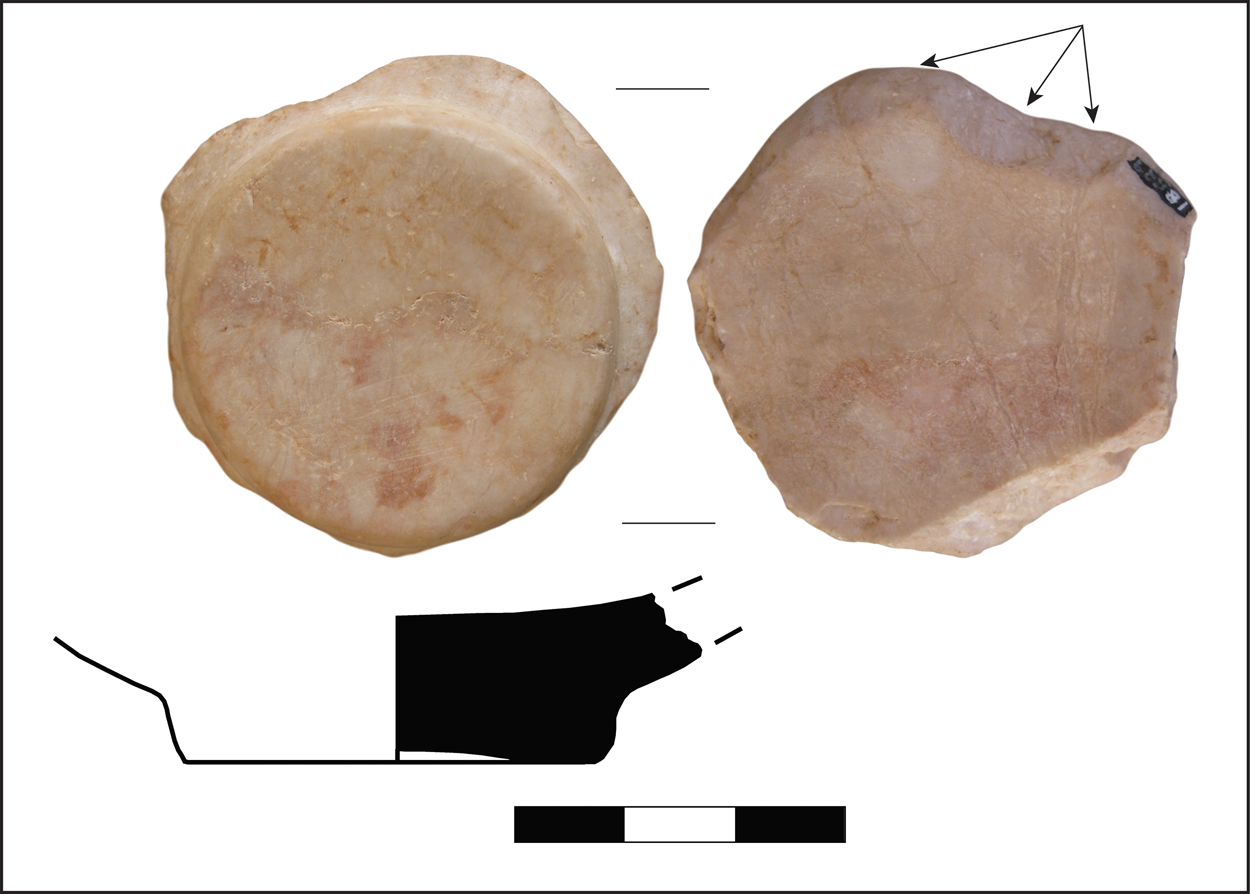
FS29 (Fig. 4)
FS29. Fragment with base and minor parts of surrounding walls. Exterior (left) and interior surfaces; section. Double arrow shows worn edges. Photos: A. Stroulia. Drawing by unidentified draftsperson from the Franchthi archives.

Fragment with base and minor parts of surrounding walls.
Cave; Trench: G; Unit: 16; disturbed deposits.
H: 1.5 cm; L: 5.0 cm; W: 4.9 cm; Min T: 0.7 cm (walls); Max T: 1.4 cm (base); Base D: 4.2 cm; Base H: 0.6 cm.
Raw material of creamy white colour macroscopically identified as marble.
This roughly round specimen includes a complete circular base that is slightly concave on the underside. The exterior and interior surfaces are smoothed, the former more so than the latter. Neither is polished. Several bunches of fine, roughly parallel striations – traces of abrasion that took place in the context of manufacture – are visible, mostly on the exterior. Chip scars are visible in three parts of the periphery, a possible indication that some of the fragment edges were at some point chipped to give it its current roughly round plan. Although less likely, the alternative hypothesis – this specimen is one of the pieces of a deliberately and systematically broken vase – cannot be ruled out. Whatever the case, some of the broken edges are worn smooth as a result of an unspecified use. FS29 is one of only two specimens in the Franchthi assemblage that preserve a vessel's bottom (the other being FS584). It appears to belong to an open bowl no more than 15 cm in diameter.
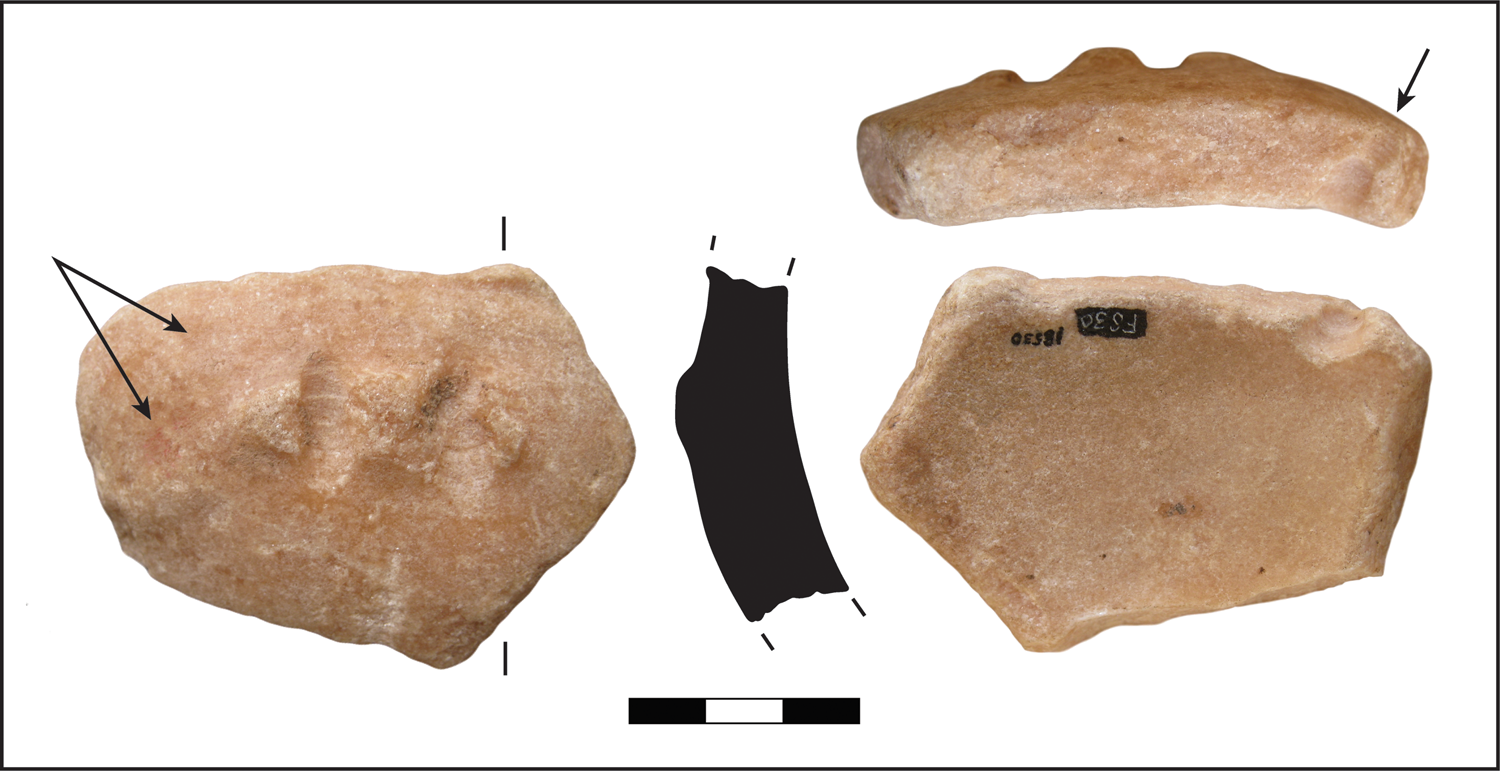
FS30 (Fig. 5)
FS30. Body fragment with lug from area below missing rim. Exterior (left) and interior surfaces; section; upper broken edge. Double arrow shows areas with faint traces of red colour. Single arrow shows location of broken hole. Photos: A. Stroulia. Drawing by unidentified draftsperson from the Franchthi archives.

Body fragment with lug from area below missing rim.
Cave; Trench: A; Unit: 40; probably FN.
H: 4.8 cm; W: 6.8 cm; Min T: 1.5 cm (area closest to missing rim); Max T: 1.8 cm (lug).
Rather coarse-grained raw material of beige white colour isotopically identified as marble from the south-eastern coast of Naxos (Cyclades) or, less likely, Sounion (Attica) (Herz Reference Herz1992).
This is one of the thickest specimens in the assemblage. Broken all around, it includes a damaged lug and a tiny part from an area below an offset rim. Before it was damaged, the lug was horizontal and convex, measured c. 3 x 3 cm and had two holes pierced from both directions. One of the holes is roughly vertical, measuring 1.6 cm and 0.6 cm in length and maximum width, respectively. Its two drilled sections are aligned. The other hole is slightly oblique, measuring 1.8 cm and 0.8 cm in length and maximum width, respectively. The two drilled sections in this case are somewhat misaligned. The lug broke at some point after (not during) the drilling process. Both exterior and interior are smoothed (the former more so than the latter) but not polished. Two areas of the exterior surface carry faint traces of red colour. These are probably the remnants of painted decoration, although the possibility of accidental contact with a colouring agent cannot be ruled out. One of the broken edges (just below the missing rim) bears traces of a biconical perforation. The two drilled sections are at an angle with each other. Moreover, one is larger than the other, indicating the use of different sized drills. Given its location close to the rim, this hole was probably meant for suspension, although the possibility that it was drilled in the context of mending cannot be excluded. The broken edges of this fragment appear weathered. FS30 belongs to a thick-walled open bowl that was more than 15 cm in diameter and 10 cm high.
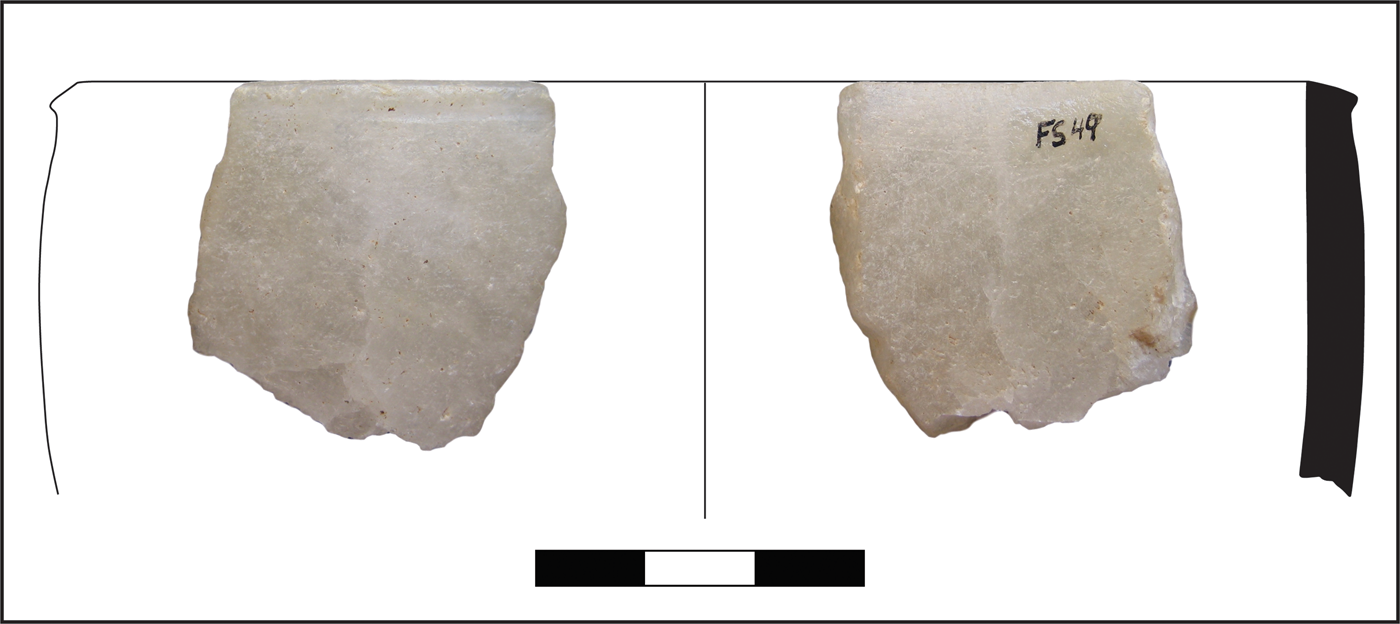
FS49 (Fig. 6)
FS49. Rim and body fragment. Partial vase reconstruction with exterior (left) and interior surfaces. Photos: A. Stroulia. Drawing by unidentified draftsperson from the Franchthi archives.

Rim and body fragment.
Cave; Trench: G; Unit: 25; probably MN.
H: 3.4 cm; W: 3.3 cm; T: 0.4–0.7 cm.
Although the raw material is fairly translucent, has a sugar white colour and looks like marble, its isotopic ratios were found to be more typical of limestone. Since, however, they did not match any of the known limestone isotopic ratios, the material was hypothesised to be local limestone (Herz Reference Herz1992).
The rim is 0.5 cm thick and obliquely flattened. Approximately 0.3 cm below the rim and roughly parallel to it is an incised line. Since it fades from one side to the other, it may not have encircled the entire rim. The exterior and interior surfaces are very smooth (the former more so than the latter), but neither is polished. In addition, both surfaces carry fine striations from abrasion that occurred in the context of manufacture. Those on the exterior are roughly parallel to the rim, while those on the interior follow different directions. Both surfaces also bear faint traces of pitting, presumably from a pecking process that preceded abrasion. FS49 belongs to a thin-walled bowl of medium size (c. 12 cm in diameter).
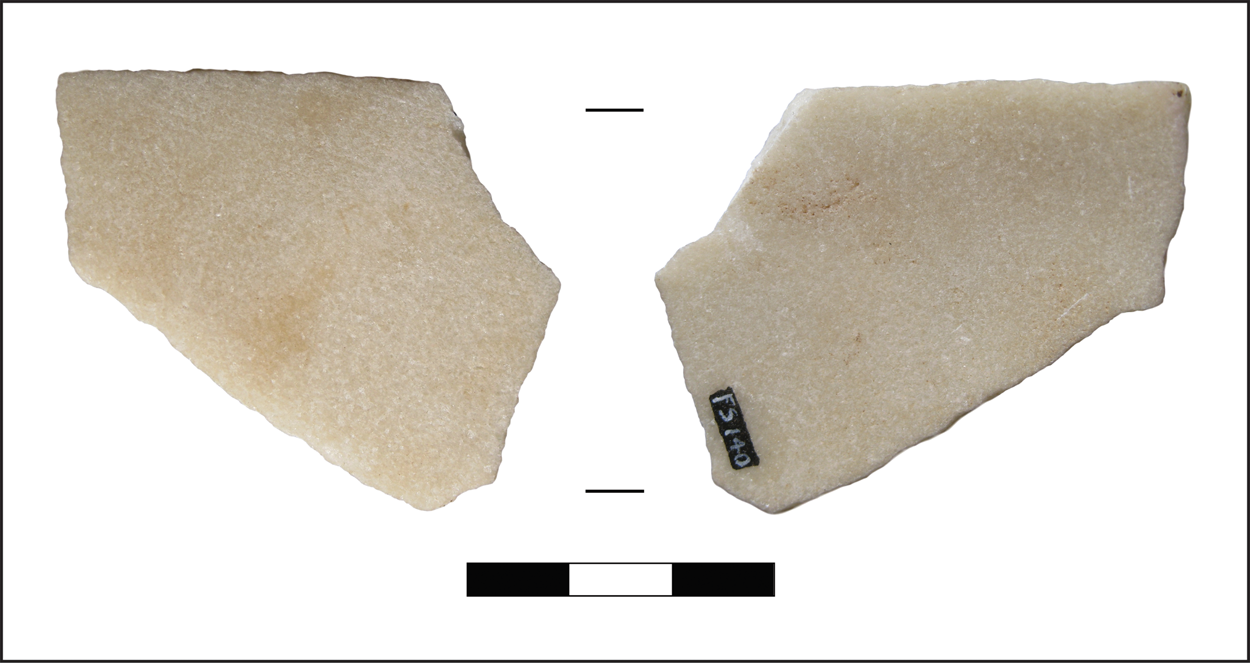
FS140 (Fig. 7)
FS140. Plain body fragment. Exterior (left) and interior surfaces. Photos: A. Stroulia.

Plain body fragment.
Cave; Trench: FF1; Unit: 38; disturbed deposits.
L: 4.8 cm; W: 4.1 cm; T: 0.6 cm.
Raw material of sugar white colour isotopically identified as marble from the south-eastern coast of Naxos or, less likely, Sounion (Herz Reference Herz1992).
The exterior and interior surfaces are smoothed but not polished. The exterior bears faint, roughly parallel striations from abrasion that occurred during manufacture. This fragment belongs to an open thin-walled bowl.
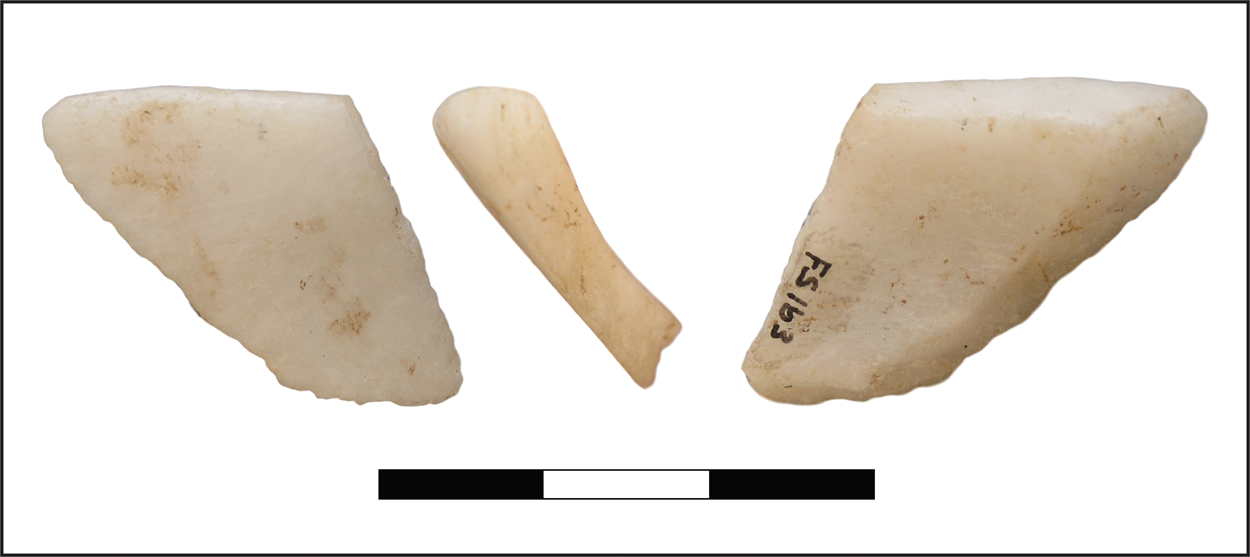
FS163 (Fig. 8)
FS163. Rim and body fragment. Exterior (left) and interior surfaces; profile (at a hypothetical angle). Photos: A. Stroulia.

Rim and body fragment.
Cave; Trench: H; Unit: 38; probably MN.
H: 2.6 cm; W: 1.9 cm; T: 0.4–0.6 cm.
Somewhat translucent, sugar white material macroscopically identified as marble.
The rim is curved, slightly thickened and crossed longitudinally by a subtle ridge – the result of bifacial abrasion. Overall, the surface is very smooth, with fine striations roughly parallel to the rim (on the interior) or in various directions (on the exterior). The vase shape cannot be reconstructed on the basis of such a small fragment, but both the smoothed interior and the low thickness point to a small open bowl.
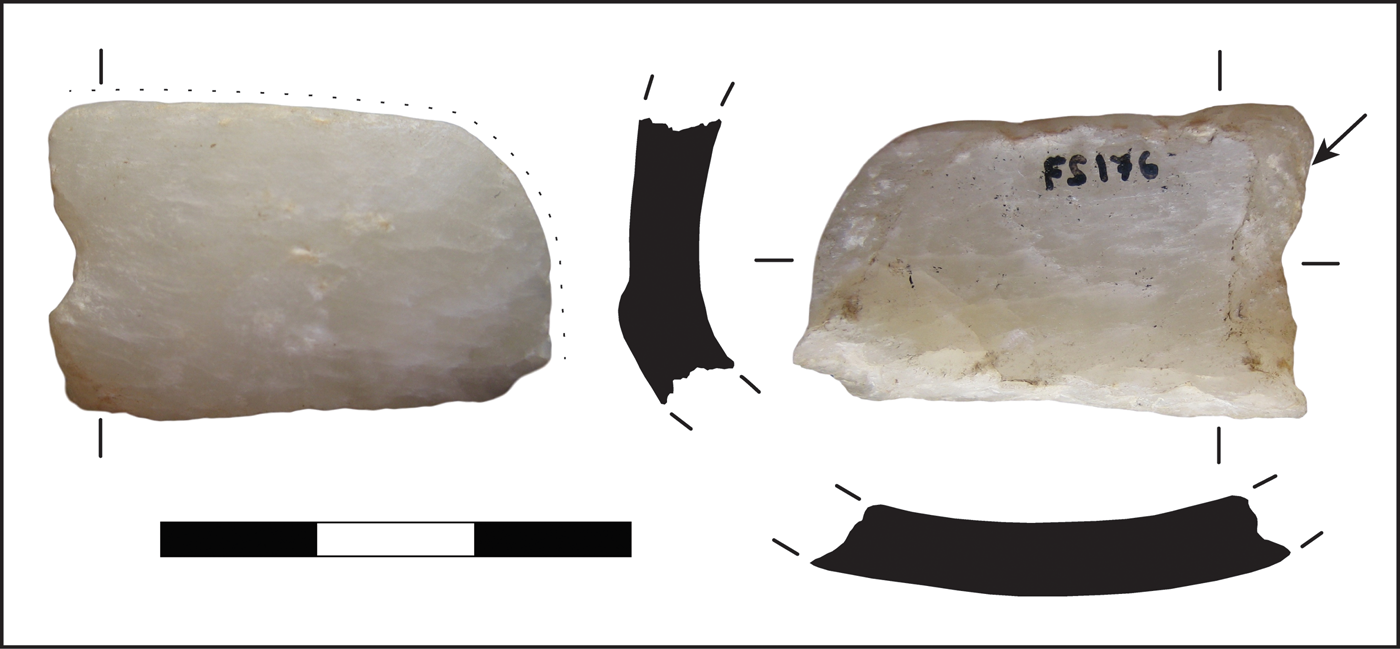
FS176 (Fig. 9)
FS176. Exterior (left) and interior surfaces; sections. Stippling indicates part of worn edge. Arrow indicates location of broken hole. Photos: A. Stroulia. Drawings by unidentified draftsperson from the Franchthi archives.

Body fragment with part of a knob.
Cave; Trench: FF1; Unit: 40B2; disturbed deposits.
L: 2.9 cm; W: 1.8 cm; T: 0.5–0.6 cm.
Somewhat translucent, sugar white material macroscopically identified as marble.
Broken all around, this specimen has a relatively strong (vertical and horizontal) curvature. The original vessel included an inconspicuous knob and a hole, parts of which are preserved on one of the broken edges. Whether the hole was drilled for suspension or mending is impossible to tell. The exterior and interior surfaces are well smoothed. A part of the broken periphery is curved in plan and smooth from an unspecified use. Given its strong curvature, FS176 possibly belongs to a miniature bowl with a tapering diameter towards the rim.
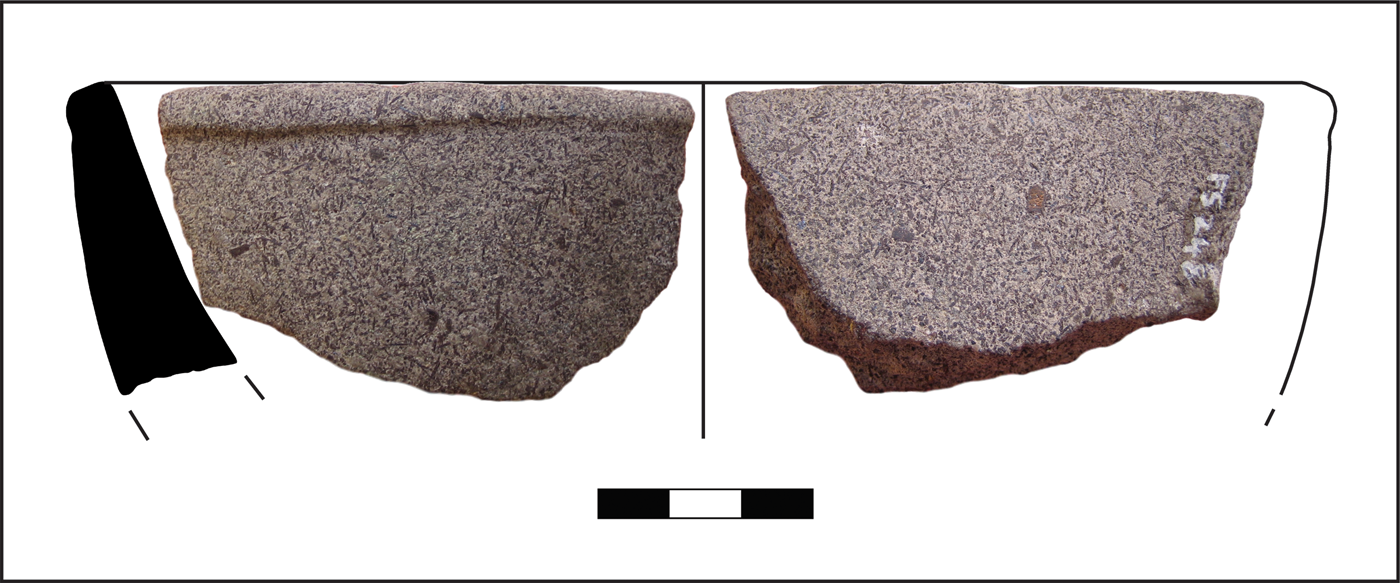
FS248 (Fig. 10)
FS248. Rim and body fragment. Partial vase reconstruction with exterior (left) and interior surfaces. Photos: A. Stroulia. Drawing by unidentified draftsperson from the Franchthi archives.

Rim and body fragment.
Cave; Trench: H1A; Unit: 89; probably EN.
H: 4.6 cm; W: 8.0 cm; Min T: 0.6 cm (rim); Max T: 1.8 cm (farthest from rim).
Gray volcanic material with biotite (black and gold mica) macroscopically identified as andesite.
The specimen's thickness gently tapers towards the rim, which is flattened. The rim's thickness slightly decreases from one side of the fragment to the other (from 0.7 to 0.6 cm). Below the rim is a thick, slightly diagonal, incised line that fades gradually from one side of the fragment to the other. It is unclear if it encircled the entire rim. The exterior and interior surfaces are smooth, the former less so than the latter. Neither is polished. FS248 has the highest maximum thickness in the Franchthi assemblage. This is also the only specimen carved in a non-white volcanic material. It belongs to an open thick-walled bowl c. 17 cm in diameter and at least 10 cm in height.
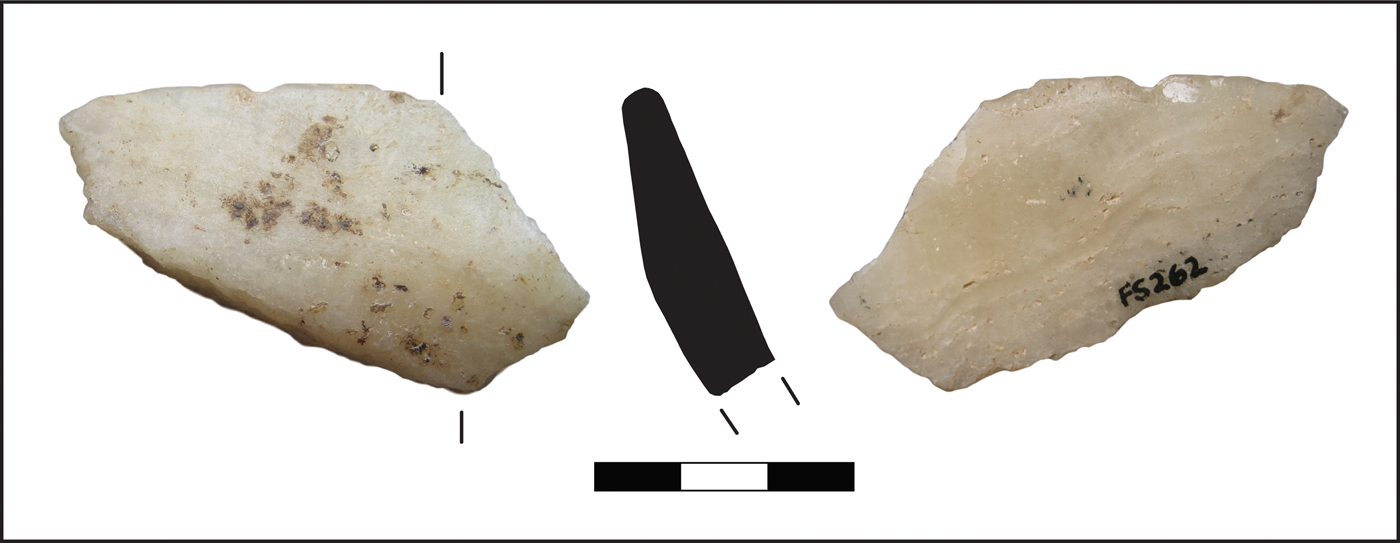
FS262 (Fig. 11)
FS262. Fragment with part of rim and gently carinated body. Exterior (left) and interior surfaces; section (at a hypothetical angle). Photos: A. Stroulia. Drawing: M. Strezewski.

Fragment with part of rim and gently carinated body.
Cave; Trench: H1A; Unit: 75; disturbed deposits.
H: 3.2 cm; W: 5.5 cm; Min T: 0.5 cm (rim); Max T: 1.1 cm (carinated part).
Although the raw material is fairly translucent, has a sugar white colour and looks like marble, its isotopic ratios were found to be more typical of limestone. Since, however, they did not match any of the known limestone isotopic ratios, the material was hypothesised to be local limestone (Herz Reference Herz1992).
This fragment shows no internal curvature. The carination shows only on the exterior, not the interior. The rim is curved. The exterior and interior surfaces are very smooth (the former less than the latter). Both, moreover, exhibit fine striations (parallel to the rim at least in the interior). The lack of internal curvature raises the suspicion that the original vessel was not circular but rather quadrangular as is complete specimen FS584 (see below). The rim is chipped. Whether this wear is post-depositional is not known.
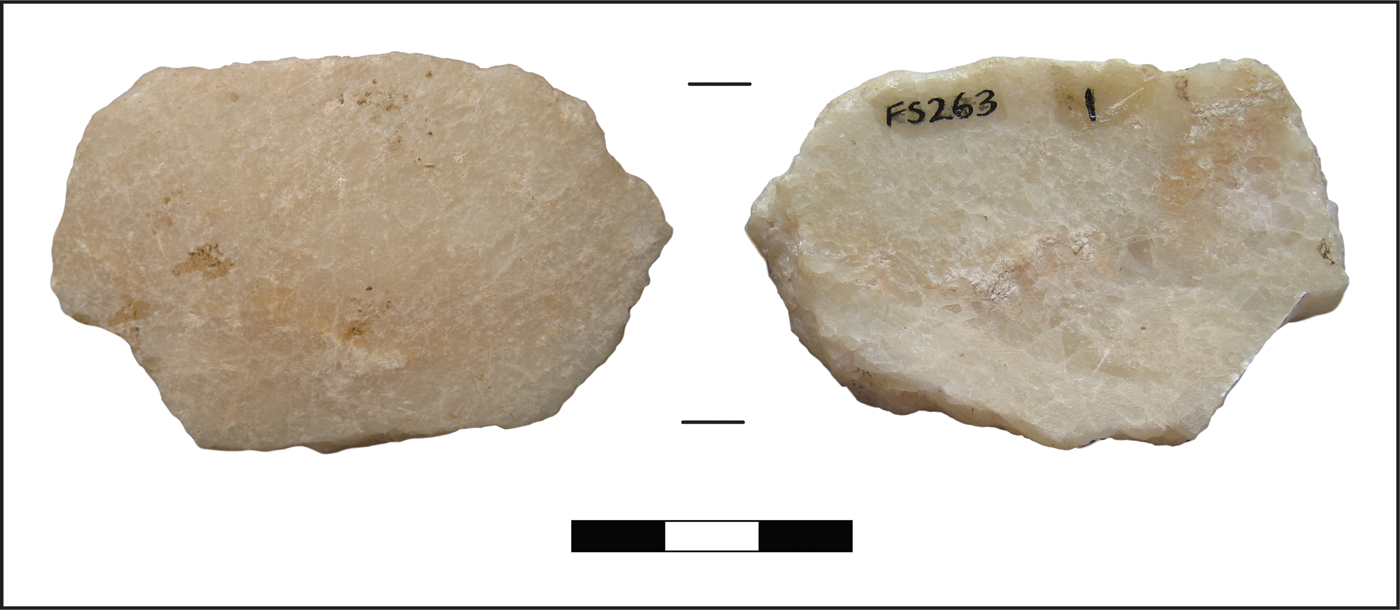
FS263 (Fig. 12)
FS263. Plain body fragment. Exterior (left) and interior surfaces. Photos: A. Stroulia.

Plain body fragment.
Cave; Trench: H1A; Unit: 76; disturbed deposits.
L: 6.4 cm; W: 4.1 cm; T: 0.6 cm.
Somewhat translucent sugar white raw material isotopically identified as marble from the Mani area (north of Cape Tainaron) or, less likely, Doliana (east of Tripolis) in the Peloponnese (Herz Reference Herz1992).
This specimen shows only a slight curvature. The exterior and interior surfaces are smoothed (the former more so than the latter). Both are also crossed by occasional fine striations of different directions. FS263 belongs to a thin-walled vessel, possibly of non-circular and/or very shallow shape, given the slight curvature.
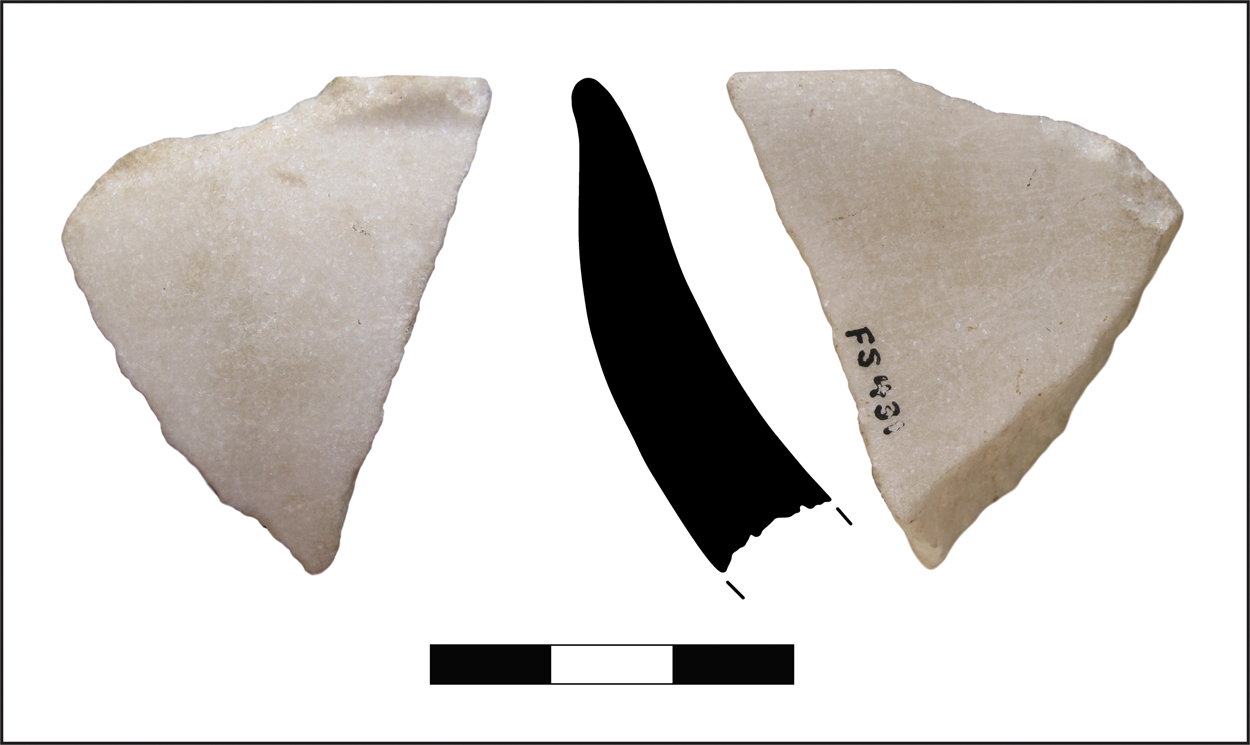
FS431 (Fig. 13)
FS431. Rim and body fragment. Exterior (left) and interior surfaces; section (at a hypothetical angle). Photos: A. Stroulia. Drawing by unidentified draftsperson from the Franchthi archives.

Rim and body fragment.
Cave; Trench: H2B; Unit: 44; probably MN.
H: 5.9 cm; W: 4.9 cm; Min T: 0.5 cm (rim); Max T: 1.4 cm (farthest from rim).
Sugar white material macroscopically identified as marble.
The thickness of this specimen tapers towards the rim, which is curved and offset. The exterior and interior surfaces are very smooth (the former more so than the latter). Fine striations parallel to the rim are visible, mostly in the interior. FS431 appears to belong to a relatively thick-walled open bowl more than 15 cm in diameter and 10 cm in height.
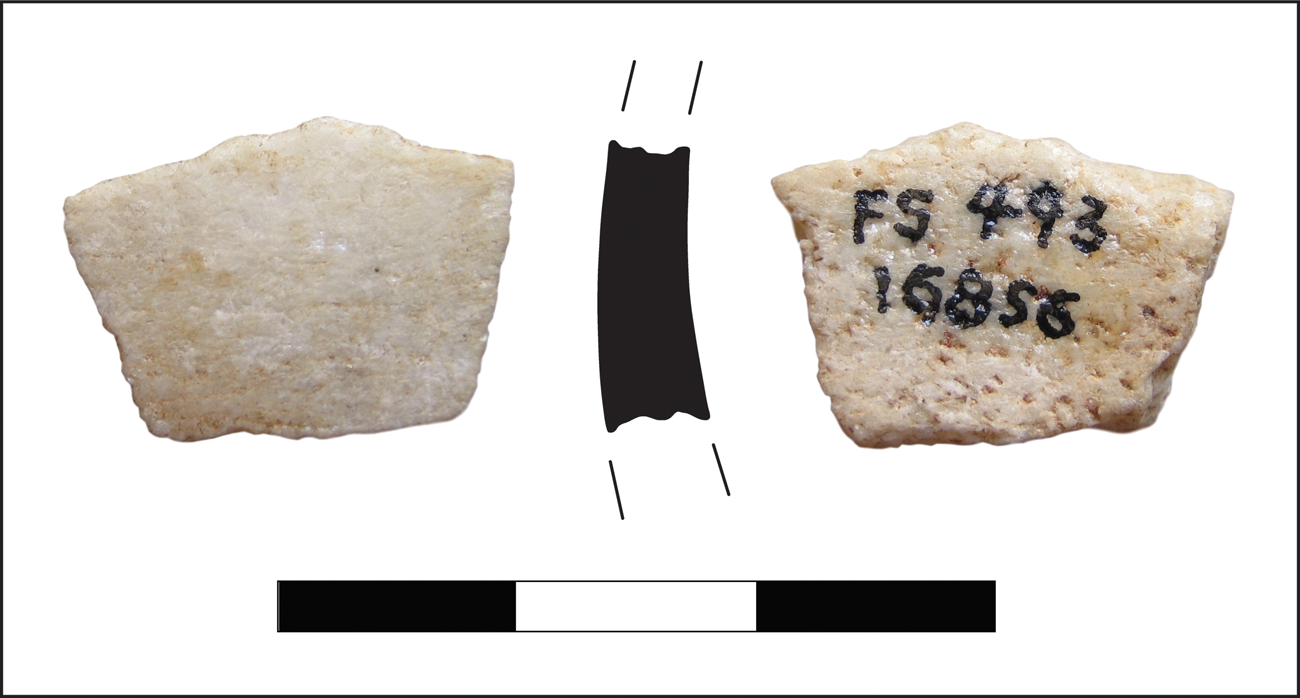
FS493 (Fig. 14)
FS493. Plain body fragment. Exterior (left) and interior surfaces; section (at a hypothetical angle). Photos: A. Stroulia. Drawing by unidentified draftsperson from the Franchthi archives.

Very small, plain body fragment.
Cave; Trench: FAN; Unit: 131; MN.
L: 1.7 cm; W: 1.2 cm; T: 0.5 cm.
Sugar white material macroscopically identified as marble.
The exterior surface is much smoother than the interior. The exterior exhibits fine, roughly parallel striations, while the interior shows brown pitting probably from a pecking process that preceded abrasion. The brown colour may imply a percussive tool of brown material. FS493 belongs to a very thin and probably very small vase.
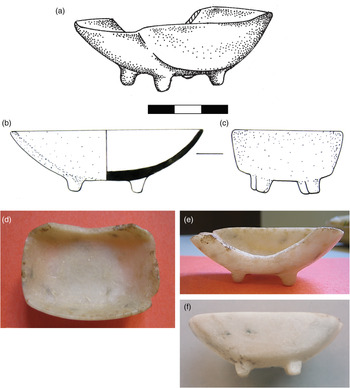
FS584 (Fig. 15)
FS584. Almost complete miniature bowl. (a) view from an angle; (b) longitudinal section; (c) transversal section; (d) top view; (e) view of side with scar; (f) view of side with crack. Photos (d) and (e): A. Stroulia. Photo (f): photo P0032734 courtesy of the Indiana University Archives. Drawings by unidentified draftsperson from the Franchthi archives.

Almost complete miniature footed bowl.
Cave; Trench: FAS; Unit: 141; MN infant burial.
H: 2.7 cm (including feet); L: 7.2 cm; W: 4.2 cm; Min T: 0.1 cm (rim); Max T: 0.4 cm (bottom).
Sugar white, translucent material macroscopically identified as marble.
FS584 is a miniature, open, rectangular vessel with four knob-like feet. This is the only non-fragmentary specimen in the assemblage. Yet, it is not intact, as it is missing a semicircular piece from the rim on one long side. Interestingly, a crack of similar size and shape is visible on the opposite side. The rim on the short sides, on the other hand, is nicked. The vase is concave longitudinally but carinated transversally with slightly flaring short sides. The wall thickness tapers towards the rim. Slightly angled, the feet are c. 0.5 cm in height, with one exception that is 0.1 cm lower. I am aware of no other Greek Neolithic stone vase with knob-like feet. Although both exterior and interior surfaces are smooth, the latter is less so than the former and also bears striations from the manufacturing process. Moreover, the areas around the junction of the vessel bottom and the feet are rougher than the other surfaces. The sophisticated shape of FS584 is unique among Greek Neolithic stone vases. This specimen is the product of extraordinary craftsmanship.
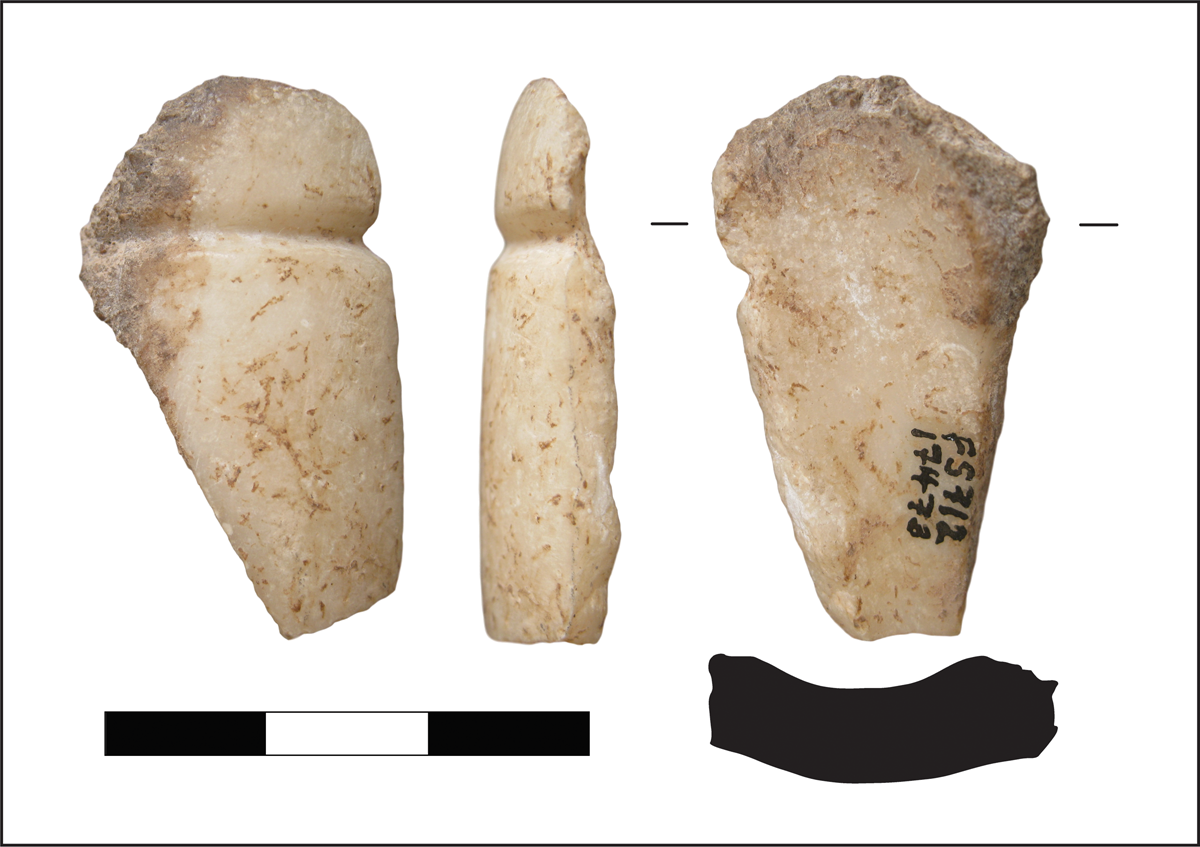
FS712 (Fig. 16)
FS712. Body fragment with incised line. Exterior (left) and interior surfaces; profile; horizontal section. Photos and drawing: A. Stroulia.

Body fragment with incised line.
Paralia; Trench: Q4; Unit: 55; disturbed deposits.
H: 3.7 cm; W: 2.1 cm; T: 0.4 cm.
Creamy white material macroscopically identified as marble.
This is the only specimen found on paralia. The pronounced, 0.3 cm-wide, incised horizontal line indicates that this fragment derives from an area close to the rim. The wall thickness tapers above this line. The fact that FS712 exhibits a strong horizontal curvature but almost no vertical curvature indicates that it was probably part of a small cylindrical vase (possibly a miniature cup c. 4.0 cm in diameter). Hollowing out the vessel must have required a drill. No drilling marks are visible, however.
Indeterminate specimens
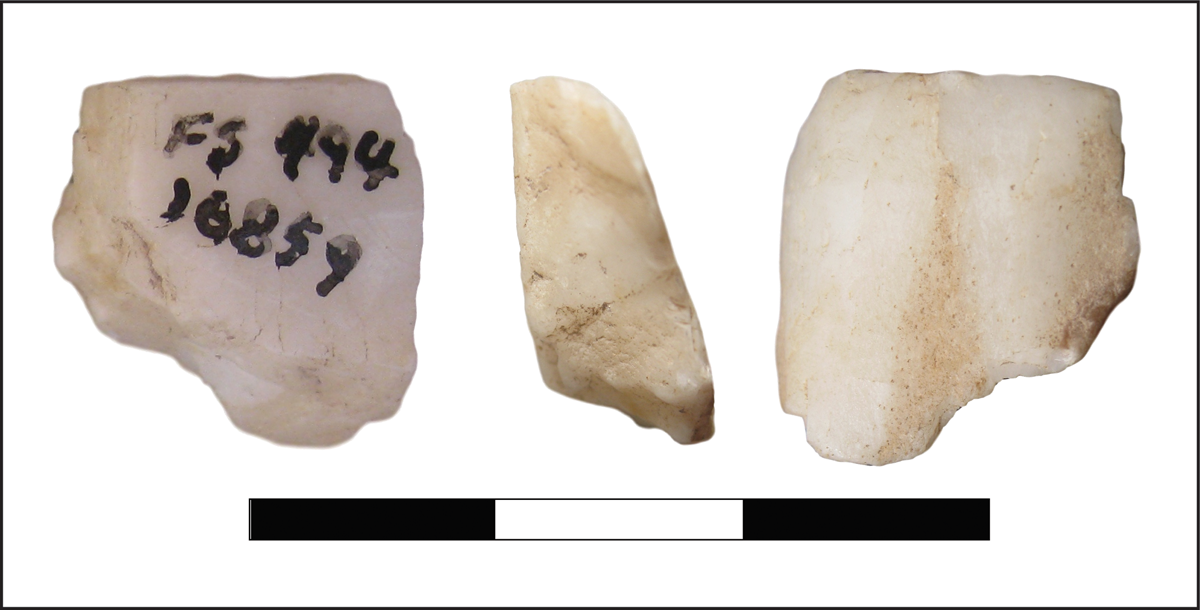
FS494 (Fig. 17)
FS494. Very small fragment that may or may not belong to a vase. Interior (left) and exterior surfaces; profile. Photos: A. Stroulia.

Very small fragment that may or may not belong to a vase.
Cave; Trench: FAS; Unit: 120; MN.
L: 1.5 cm; W: 1.4 cm; T: 0.7 cm.
Sugar white material macroscopically identified as marble.
This specimen has one convex and one flat face that meet at an acute angle on one side and are separated by a flat vertical surface on an adjacent side. The flat face is very smooth with fine parallel striations. The convex face is less smooth and includes a rougher area. The vertical flat surface is smooth and carries fine parallel striations as well. If from a vase, this specimen perhaps represents part of a lid. If not, perhaps it is part of an ornament.
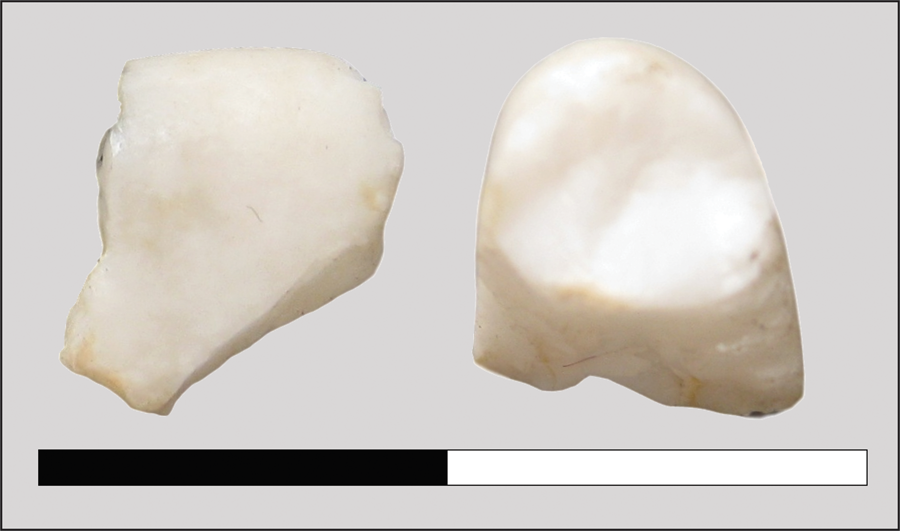
FS812 (Fig. 18)
FS812. Tiny fragment that may or may not belong to a vase. Interior surface (left) and profile. Photos: A. Stroulia.

Tiny fragment that may or may not belong to a vase.
Cave; Trench: FAS; Unit: 124; MN.
L: 0.8 cm; W: 0.8 cm; T: 0.7 cm.
Very fine-grained, sugar white material macroscopically identified as marble.
If from a vase, perhaps this specimen is part of a well smoothed rounded rim. If not, perhaps it is part of an ornament.
FROM FRANCHTHI TO THE GREEK NEOLITHIC
In this section, I use the Franchthi assemblage as a starting point to offer a synthesis of Greek Neolithic stone vessels. This synthesis is based on the information I was able to glean from generally undetailed reports and unsystematic references. All information is based on macroscopic examination. The discussion develops along the following axes: geographic and chronological distribution, assemblage size, morphological characteristics, raw materials, manufacture, use and breakage/discard.
Geographic distribution, assemblage size and chronological distribution
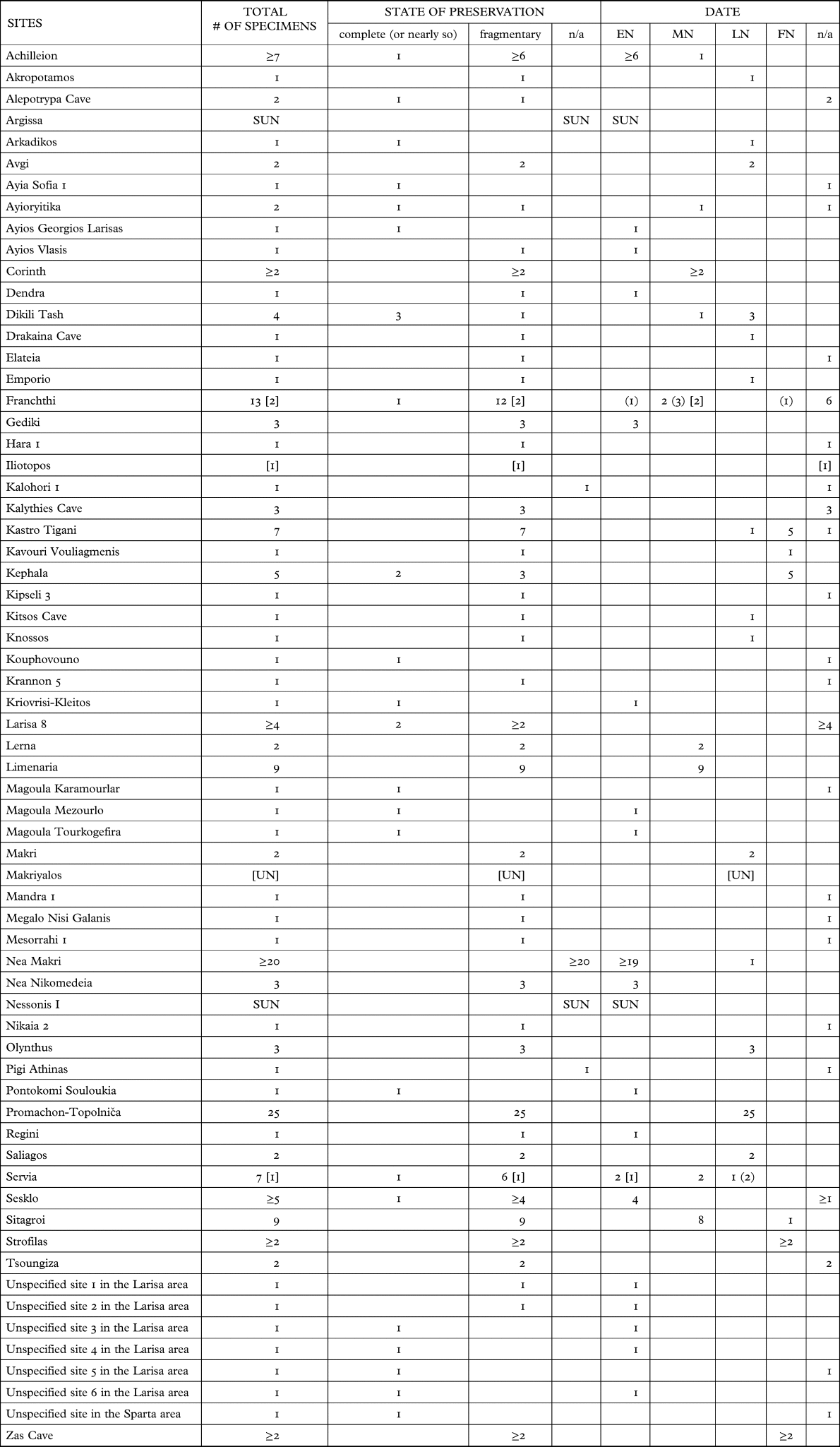
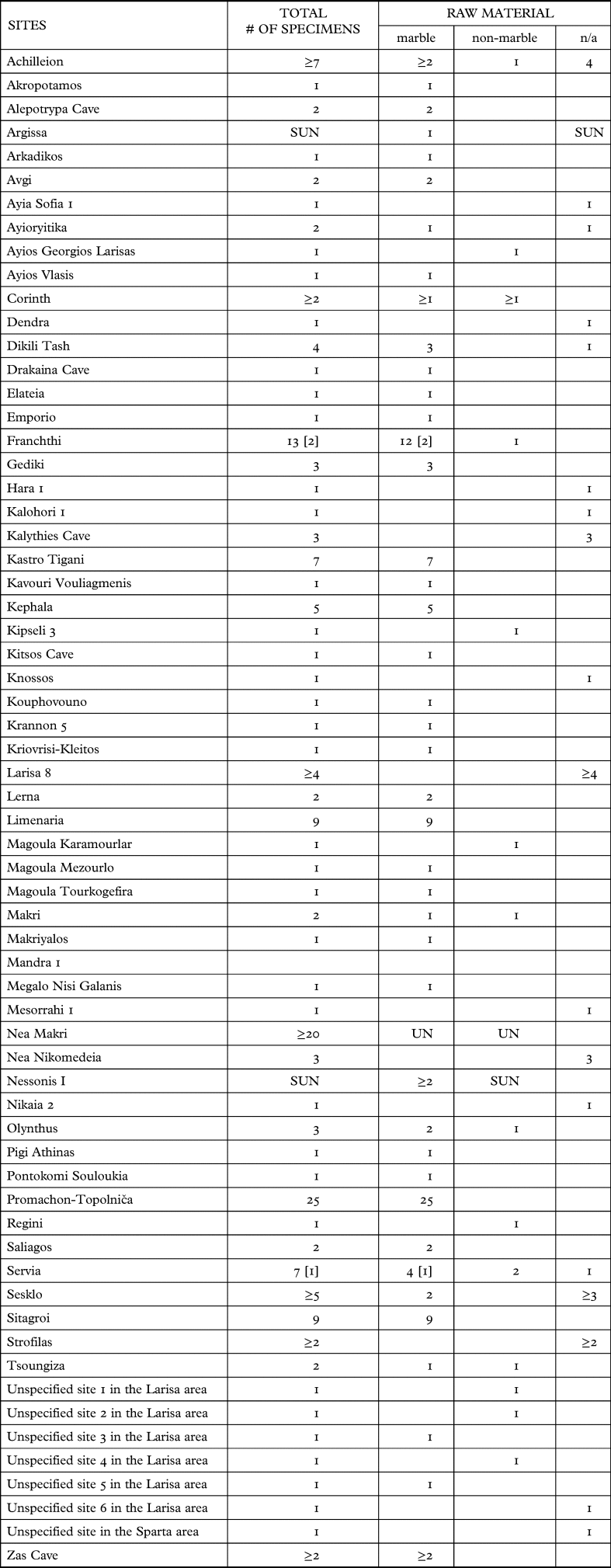
Franchthi is one of 65 Greek sites that yielded Neolithic stone vases. These sites exhibit a wide geographic distribution as they are found throughout the country: Thrace (Makri), Macedonia (Avgi, Servia, Pontokomi Souloukia, Megalo Nisi Galanis, Kriovrisi-Kleitos, Nea Nikomedeia, Pigi Athinas, Olynthus, Akropotamos, Dikili Tash, Promachon-Topolniča, Makriyalos, Iliotopos, Arkadikos and Sitagroi), Thessaly (Nessonis I, Achilleion, Sesklo, Gediki, Argissa, Magoula Karamourlar, Ayios Georgios Larisas, Magoula Tourkogefira, Magoula Mezourlo, Mandra 1, Ayia Sofia 1, Kalohori 1, Krannon 5, Kipseli 3, Larisa 8, Mesorrahi 1, Nikaia 2, Hara 1 and six unspecified sites in the area of Larisa), central Greece (Ayios Vlasis, Nea Makri, Kavouri Vouliagmenis, Elateia and Regini), the Peloponnese (Corinth, Alepotrypa Cave, Kitsos Cave, Lerna, Dendra, Tsoungiza, Ayioryitika, Kouphovouno and an unspecified site in the area of Sparta), the Ionian islands (Drakaina Cave), the Cyclades (Kephala, Saliagos, Strofilas and Zas Cave), the northern and eastern Aegean islands (Limenaria, Emporio, Kastro Tigani and Kalythies Cave) and Crete (Knossos). The above sites (including Franchthi), along with basic information regarding the number, state of preservation and dates of their specimens, are listed in Table 2.
Greek sites with Neolithic stone vessels and basic information regarding number of specimens, state of preservation and date. Several of the listed sites also yielded post-Neolithic specimens. The latter are not included. Brackets indicate specimens that may or may not be vessels. Parentheses indicate specimens of tentative date. Abbreviations: n/a = non-available; SUN = substantial unspecified number; UN = unspecified number.

Table 2 comprises both excavated and surface vessels. Some of the excavated specimens derive from exclusively Neolithic sites, while others come from sites that also have post-Neolithic components. For the latter sites, only secure Neolithic specimens were taken into account. Post-Neolithic specimens or those of uncertain date were not. All surface specimens, on the other hand, derive from sites which, according to the collected pottery, were occupied exclusively during the Neolithic. Those from sites with evidence of both Neolithic and later occupation were excluded. In addition, Table 2 includes a few indeterminate cases (all fragments, all but one of marble): two specimens from Franchthi, which may belong to vases or ornaments (see above); a single specimen from Iliotopos (1), another from Servia (2) and an unspecified number from Makriyalos (1), which may derive from mortars or vessels.
Comprising only 13 (or 15) specimens, the Franchthi assemblage is obviously small. Yet, along with those from Promachon-Topolniča, Nea Makri, Nessonis I and Argissa, it is one of the largest from Neolithic Greece. A precise number is available only for the assemblage from Promachon-Topolniča (4), which comprises 25 items. The exact size of the other three is unknown since none has been published systematically. All available information comes from brief references by the excavators. For Nea Makri, Theocharis mentions ‘over twenty’ vases in one publication,Footnote 5 while in another he states that ‘more specimens were found than the total number known from other sites’.Footnote 6 Regarding Nessonis I, the same scholar asserts that ‘stone vases are more abundant than anywhere else’ in Thessaly.Footnote 7 Finally, Milojćič mentions that stone vases occur ‘frequently’ at Argissa.Footnote 8 Comprising between six and ten specimens, the assemblages of Sitagroi (1,2), Limenaria (2) and Kastro Tigani (1) are relatively substantial. Each of the remaining assemblages – they represent the vast majority – has only one to five items (Table 2).
For obvious reasons, the total number of uncovered Greek Neolithic stone vessels remains unknown. However, I would estimate it to be somewhere in the vicinity of 250. There is no uncertainty, on the other hand, regarding the low frequency of stone vases per site. Indeed, it is this low frequency, coupled with the often limited investigation or unsystematic publication, that make me suspect that these artifacts were a part of the material inventory of a far higher number of sites than those listed above. I would not even rule out the possibility that most Aegean Neolithic communities employed such objects.
Be that as it may, it is important to note that stone vases were virtually absent from the Neolithic material culture of western EuropeFootnote 9 and appear to have been scarce in the rest of the Balkans (see Antonović Reference Antonović2003, 66, 83, 141; Takaoǧlu Reference Takaoǧlu2002; V. Vučković, pers. comm.; K. Bacvarov, pers. comm.). Such artifacts, on the other hand, are known from the Neolithic (Aceramic included) of Anatolia, the Levant and Egypt. It seems that the Greek stone vase industry belongs to a broader Near Eastern tradition that started in the Natufian period and continued into the Iron Age (e.g. Astruc Reference Astruc, Caneva, Lemorini, Zampetti and Biagi2001; Astruc et al. Reference Astruc, Le Brun, Vargiolu and Zahouani2002; Reference Astruc, Le Brun, Le Brun, Hourani, Córdoba, Molist, Pérez Aparicio, Rubio de Miguel and Martínez Lillo2008; Bevan Reference Bevan2007; Chasan and Rosenberg Reference Chasan and Rosenberg2018; Ebeling and Rosenberg Reference Ebeling and Rosenberg2015; Hamilton Reference Hamilton and Hodder1996; Manen Reference Manen, Guilaine and Le Brun2003; Reference Manen, Vigne, Briois and Tengberg2017; Mellaart Reference Mellaart1970, 149–52; Takaoǧlu Reference Takaoǧlu2005; Reference Takaoǧlu2006; Takaoǧlu and Bamyacɩ Reference Takaoǧlu, Bamyacɩ, Dietz, Mavridis, Tankosic and Takaoǧlu2018; Roodenberg Reference Roodenberg1986; Rosenberg Reference Rosenberg2008; Sperling Reference Sperling1976; Squitieri Reference Squitieri2017; Stocks Reference Stocks2003; Wright Reference Wright1991; Reference Wright1992; Reference Wright1993; Reference Wright2000; Reference Wright and Hodder2013).
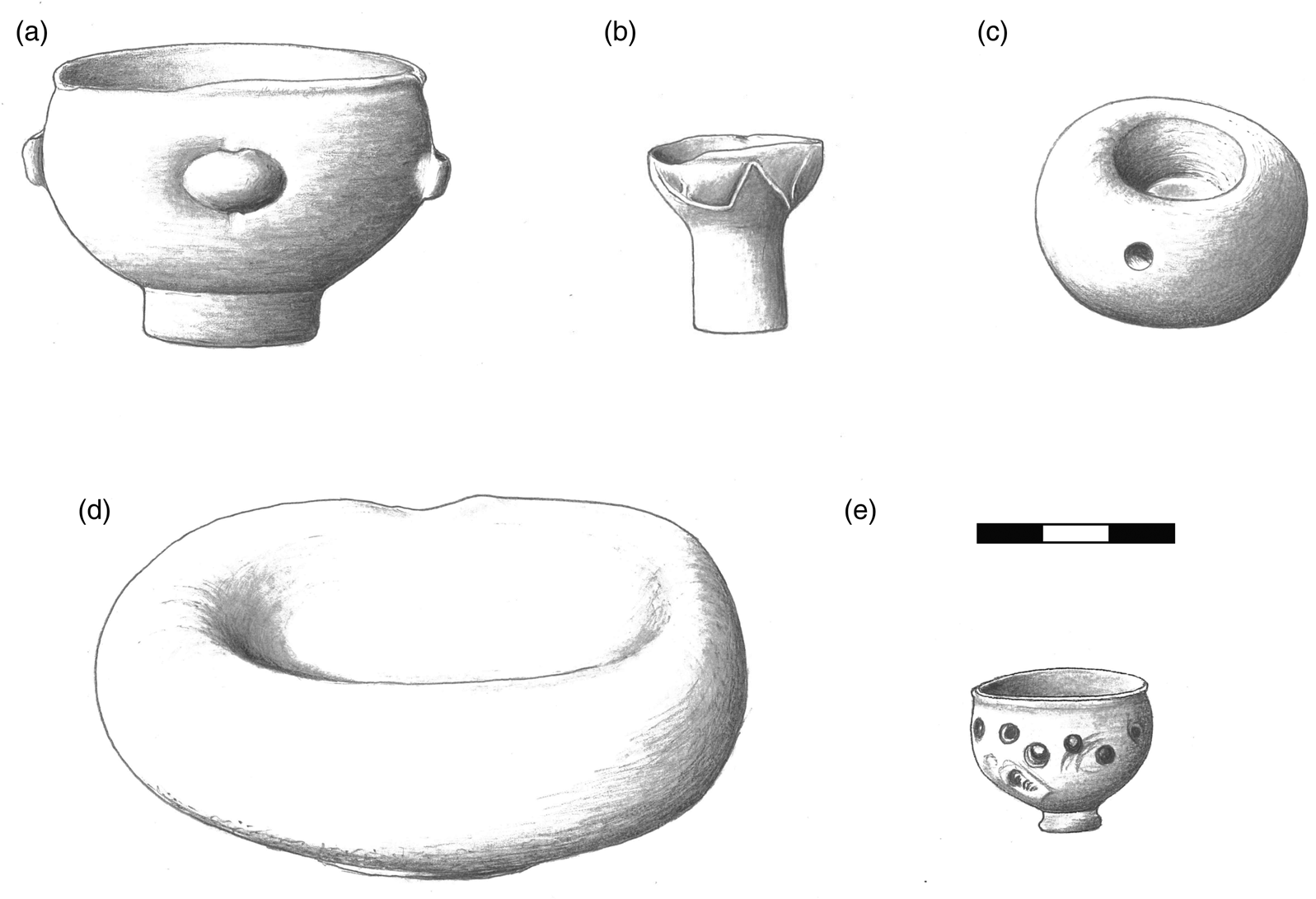
With the exception of miniature bowl FS584, the Franchthi specimens are fragmentary. Fragments represent the rule in the Aegean Neolithic as a whole. I am aware of only 26 other specimens that are complete or nearly so. They derive from 22 sites: e.g. Kephala (1,2) (Fig. 19ab), Kouphovouno (1,2) (Fig. 20a), Magoula Karamourlar (1) (Fig. 20b), Magoula Tourkogefira (1) (Fig. 20c), Magoula Mezourlo (1) (Fig. 20d), Servia (1,2), Sesklo (2,3) and an unspecified site in the Sparta area (Fig. 20e) (Table 2).Footnote 10 Size information is available for 24 of the complete vases. Like FS584, 21 are of miniature size (no longer and higher than 10 cm and 5 cm, respectively).
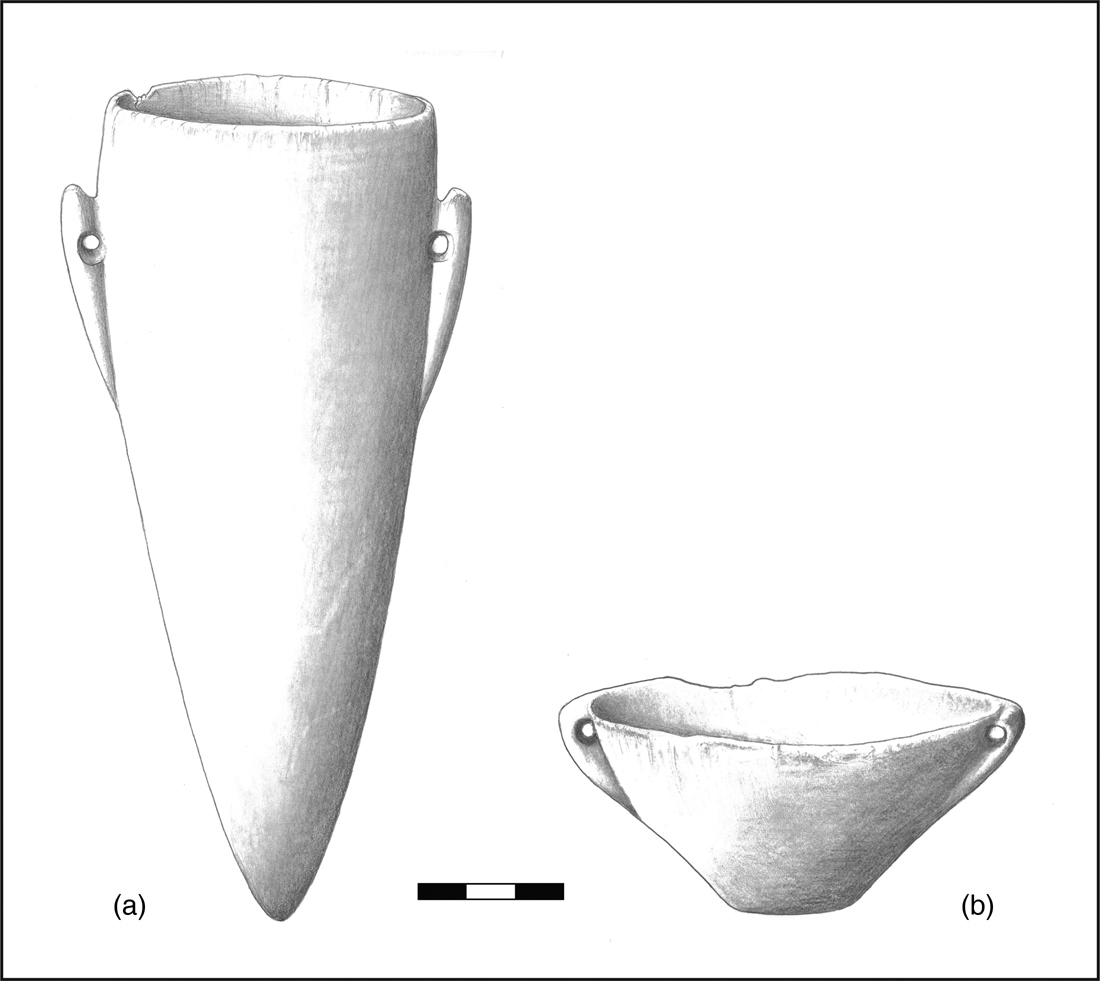
Complete vases from the cemetery of Kephala: (a) beaker (after Devetzi Reference Devetzi and Papathanassopoulos1996, 288, fig. 176); (b) miniature conical lugged cup (after Coleman Reference Coleman1977, pl. 76:171). Drawings: T. Gouliafas.

Complete miniature vases from: (a) Kouphovouno (after Devetzi Reference Devetzi and Papathanassopoulos1996, 288, fig. 175); (b) Magoula Karamourlar (after Theocharis Reference Theocharis1973, fig. 275); (c) Magoula Tourkogefira (after Devetzi Reference Devetzi and Papathanassopoulos1996, 287, fig. 172); (d) Magoula Mezourlo (after Devetzi Reference Devetzi and Papathanassopoulos1996, 287, fig. 174); (e) unspecified site in the area of Sparta (after Theocharis Reference Theocharis1973, fig. 209). Drawings: T. Gouliafas.

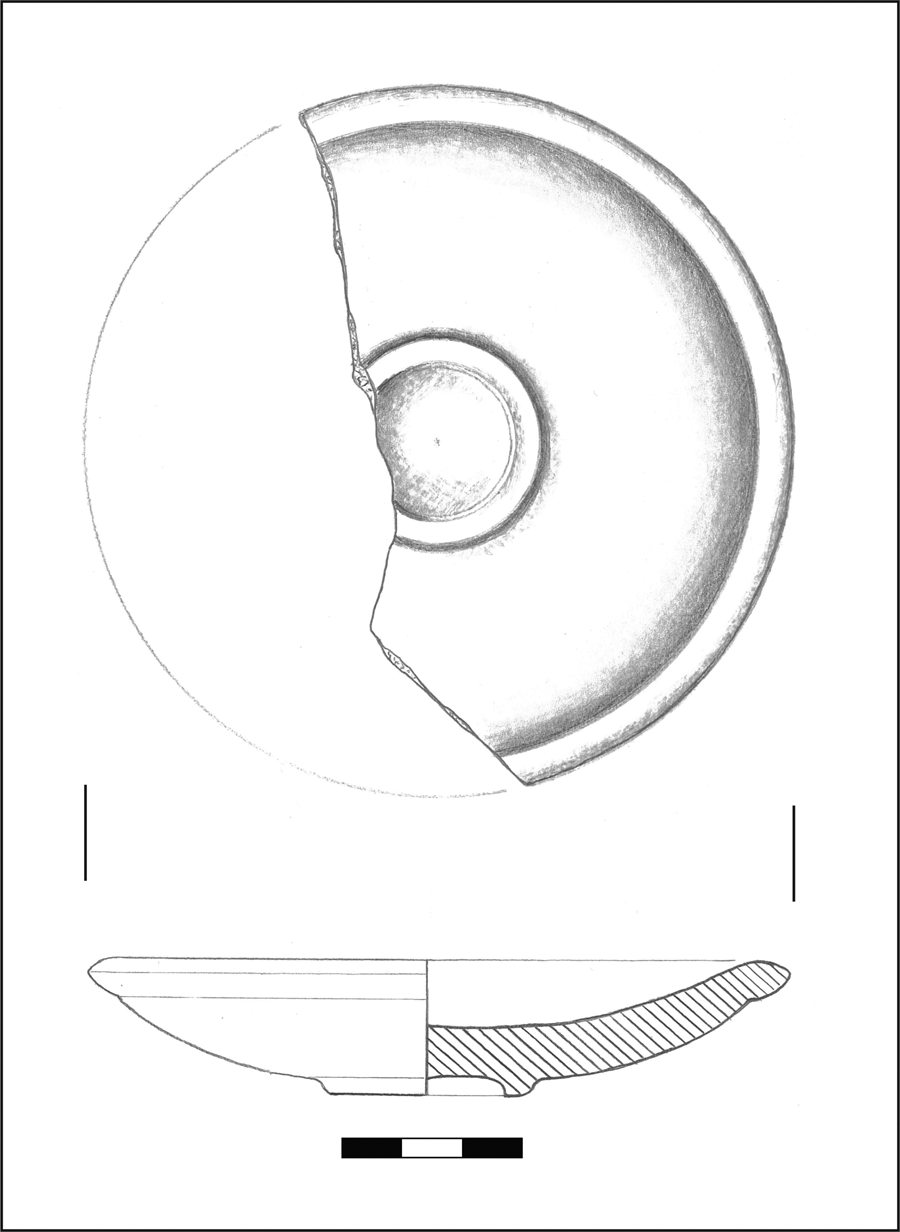
Most of the dated Franchthi specimens are attributed to MN, but, in Greece in general, it is the EN that features both the highest number of specimens and the widest distribution (see also Devetzi Reference Devetzi and Papathanassopoulos1996, 135). Three of the largest assemblages – from Nea Makri (1,2), Nessonis I (1,2) and Argissa (1,2) – are almost exclusively EN. This is the probable date of one Franchthi specimen (FS248), while at least 31 EN specimens have been reported from another 18 sites: e.g. Magoula Tourkogefira (1) (Fig. 20c), Magoula Mezourlo (1) (Fig. 20d), Achilleion (1,2,3,4) (Fig. 21), Sesklo (1,2,3,4) and Gediki (1,2,3) (Table 2).
Fragment of elaborate EN stone vase from Achilleion (after Gimbutas Reference Gimbutas, Gimbutas, Winn and Shimabuku1989, 258, fig. 18:6). Drawing: T. Gouliafas.

In fact, the beginning of the stone vase industry in the Aegean coincides with the establishment of sedentary communities and an agropastoral way of life, as suggested by specimens found in the earliest strata of Achilleion (1,2,3), Argissa (1,2) and Sesklo (4). Even more remarkably, one of the Achilleion specimens consists of a ‘superb’ (Perlès Reference Perlès2001, 222) dish (Fig. 21), indicating that, rather than the result of local experimentation, stone vase carving was one of the crafts imported to Greece along with other elements of the so-called Neolithic package.Footnote 11
I know of 20 secure MN specimens. Besides Franchthi, they derive from seven sites: Limenaria (1,2,3), Dikili Tash (1), Servia (2), Achilleion (3), Lerna (1), Corinth (1) and Ayioryitika (1) (Table 2). No LN specimen was recovered at Franchthi, but in the Aegean as a whole, this phase is much better represented than MN. One of the largest assemblages – that of Promachon-Topolniča (4) with 25 specimens – dates to LN. Another 29 secure LN specimens are known from 16 sites: e.g. Avgi (2) (Fig. 22), Sitagroi (1,2), Dikili Tash (2,3,4) and Saliagos (1) (Table 2).
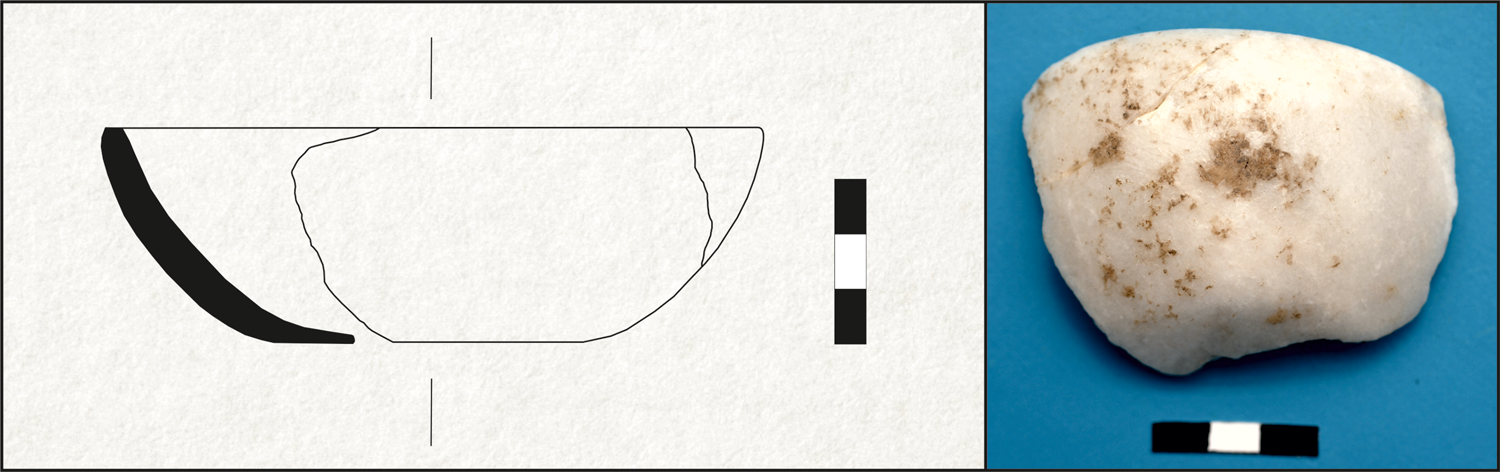
Fragmentary vase from Avgi (Bekiaris Reference Bekiaris2018, fig. 228; courtesy of T. Bekiaris).

Lastly, FN shows both the lowest numbers and the narrowest distribution. The 15 or so secure FN specimens, of which I am aware, derive from only five sites: Kephala (1) (Fig. 19), Zas Cave (1), Strofilas (1), Kastro Tigani (1) and Kavouri Vouliagmenis (1) (Table 2). Four of these sites are located on Aegean islands. The small number of specimens indicates a decline of the stone vase industry during this phase. Their concentration on Aegean islands suggests a transfer of the industry's centre of gravity away from the mainland.
Morphological characteristics
The Franchthi assemblage includes a single almost complete specimen: FS584. Of the twelve fragments securely belonging to vases, five are rims (FS49, FS163, FS248, FS262 and FS431), one is a base (FS29), while another six consist of plain or non-plain body sherds (FS30, FS140, FS176, FS263, FS493 and FS712). If they are parts of vases, fragments FS494 and FS812 perhaps represent a lid and rim, respectively.
On this basis, precise size information is available for only FS584, which is a miniature vessel. The latter may not be the only miniature specimen in the Franchthi assemblage, however. Characterised by a strong curvature and/or very low thickness, body sherds FS176, FS493 and FS712 possibly belong to miniature vessels too. Of the remaining specimens, FS29 and FS49 appear to derive from medium-size vases (less than 15 cm in diameter), while FS30, FS248 and FS431 come from large vessels (more than 15 cm in diameter). The nearly complete vase FS584 is 2.7 cm high. Given the absence of complete profiles, it is impossible to precisely determine the height of the vessels from which the fragments derive. Yet, judging from their dimensions, FS30, FS248 and FS431 appear to belong to vessels higher than 10 cm. Clearly, a variety of sizes are represented in the Franchthi assemblage.
Vases comparable in size to those from Franchthi are known from elsewhere. Large vases have been reported from several sites: e.g. Kephala (1,2) (Fig. 19a), Achilleion (3,4) (Fig. 21) and Sitagroi (1,2). Medium-sized specimens have been reported from several sites too: e.g. Avgi (2) (Fig. 22), Servia (2) and Alepotrypa Cave (1). Miniature vases, on the other hand, are known from a much larger number of sites: e.g. Kephala (1) (Fig. 19b), Kouphovouno (1,2) (Fig. 20a), Magoula Karamourlar (1) (Fig. 20b), Magoula Tourkogefira (1) (Fig. 20c), Magoula Mezourlo (1) (Fig. 20d) and an unspecified site in the area of Sparta (Fig. 20e) (Table 3). I doubt that the higher frequency of miniature specimens reflects a prehistoric reality. Most likely, this pattern is the byproduct of reporting and illustration biases that favored complete specimens.
Distribution of various stone vessel sizes, plans and shapes among Greek Neolithic sites. Only sites with relevant information are included. Parentheses indicate tentative identifications.

With the exception of the almost complete vase FS584, which is rectangular, and the possible exceptions of FS262 and FS263, which may belong to quadrangular vessels, the Franchthi specimens have a circular plan. As such, the Franchthi assemblage fits the general Greek picture, in which round vases predominate; see, for instance, specimens from Kephala (1,2) (Fig. 19ab), Kouphovouno (1,2) (Fig. 20a), Magoula Karamourlar (1) (Fig. 20b), Magoula Tourkogefira (1) (Fig. 20c), Achilleion (2,3) (Fig. 21) and Avgi (2) (Fig. 22). Subrectangular, elliptical, ovate and ‘parallelogram’ vessels were much less frequent; for examples, see specimens from Magoula Mezourlo (1) (Fig. 20d), Makri (1), Achilleion (1,2), Gediki (2) and Sesklo (2,3) (Table 3). Only one of the (secure or tentative) non-circular vases from Franchthi is dated: FS584 assigned to MN. Of the dated specimens reported from other sites, all but that from Makri is EN. This pattern possibly points to an earlier Neolithic tradition.
The nearly complete FS584 consists of a bowl, and most of the Franchthi fragments appear to represent bowls too (e.g. FS248 and FS431). If not part of a quadrangular bowl, FS263, with almost no curvature, may belong to a very shallow vessel, while FS712, with a strong horizontal but almost no vertical curvature, possibly belongs to a cylindrical cup. Again, the Franchthi assemblage appears to follow more general trends. The bowl and the shallow vase (or plate) are the two main Aegean Neolithic stone vase shapes. Bowls were typically circular and were made in two varieties. The first – characterised by a curving profile – is the most common. Examples derive from sites such as Avgi (2) (Fig. 22), Nessonis I (1,2) and Sitagroi (1,2) and date to EN, MN and LN. The second variety – characterised by a flaring profile – is known only from specimens found at Saliagos (1), Dikili Tash (4) and, possibly also, Kitsos Cave (1). All date to LN. Shallow vessels, on the other hand, were recovered at sites such as Achilleion (1,2,3,4) (Fig. 21), Gediki (2), Pontokomi Souloukia (2,3) and Limenaria (2). Most are non-circular, indicating a possible association between this plan and low height (Table 3).
The Aegean Neolithic stone vase industry includes a few rare types. The first two are discussed together. One is the so-called beaker, an elongated conical vase with a pointed bottom and diametrically opposed flat vertical lugs. The other is a conical, flat-based cup with similar lugs. I have securely identified only four beakers and two conical lugged cups in the literature. The chronological and geographic distributions of these two types are both restricted and overlapping. Both date to FN and derive only from Aegean islands – the beakers excavated at Kephala (1,2) (Fig. 19a) and Kastro Tigani (1),Footnote 12 and the cups at Kephala (Fig. 19b) and Zas Cave (1) (Table 3).
Two points are in order here. (a) The beakers represent the westernmost examples of a type known from sites in Anatolia, including Kulaksizlar, where such vases were produced in substantial quantities (Takaoǧlu Reference Takaoǧlu2002; Reference Takaoǧlu2005, 14; T. Takaoǧlu, pers. comm.). Given the macroscopic differences in raw material, the Aegean specimens are probably imitations of Anatolian prototypes rather than imports (Takaoǧlu Reference Takaoǧlu2004; Reference Takaoǧlu2006; Takaoǧlu and Bamyacɩ Reference Takaoǧlu, Bamyacɩ, Dietz, Mavridis, Tankosic and Takaoǧlu2018). (b) Beakers and conical lugged cups represent the earliest versions of two types that became common in the Cyclades in the Early Bronze Age (Getz-Gentle Reference Getz-Gentle1996, 52–5, 72–3).
The third rare type is the polypod vessel, known from a few MN and LN fragmentary specimens from Limenaria (1), Servia (1) and Drakaina Cave (1,2). Finally, the small cylindrical cup may represent another rare type. Fragmentary Franchthi specimen FS712 and a few fragments reported from Argissa (1,2) possibly belong to such cups.
The walls of the nearly complete Franchthi vase FS584 are 0.4 cm in maximum thickness. Most fragments belong to thin-walled vessels too, or so is suggested by their thickness, which does not exceed 0.8 cm. The exceptions are FS30, FS248, FS262 and FS431, the thickness of which ranges from 1.1 to 1.8 cm. Generally speaking, the EN Aegean yielded some thick-walled vases (see also Devetzi Reference Devetzi and Papathanassopoulos1996; Theocharis Reference Theocharis1967, 148). Examples include Franchthi specimen FS248 (of a tentative EN date) and specimens from Magoula Mezourlo (Fig. 20d), Achilleion (1,2,3,4) (Fig. 21), Nea Makri (1,2), Nessonis I (1,2) and Servia (2). However, EN specimens with thin walls (no more than 1 cm) are also known; from Nea Makri (1,2), for example. As a rule, later vases are thin-walled and thus comparable to most Franchthi specimens; see, for instance, the MN, LN and FN specimens from Limenaria (2,3), Avgi (2) (Fig. 22) and Zas Cave (1), respectively.
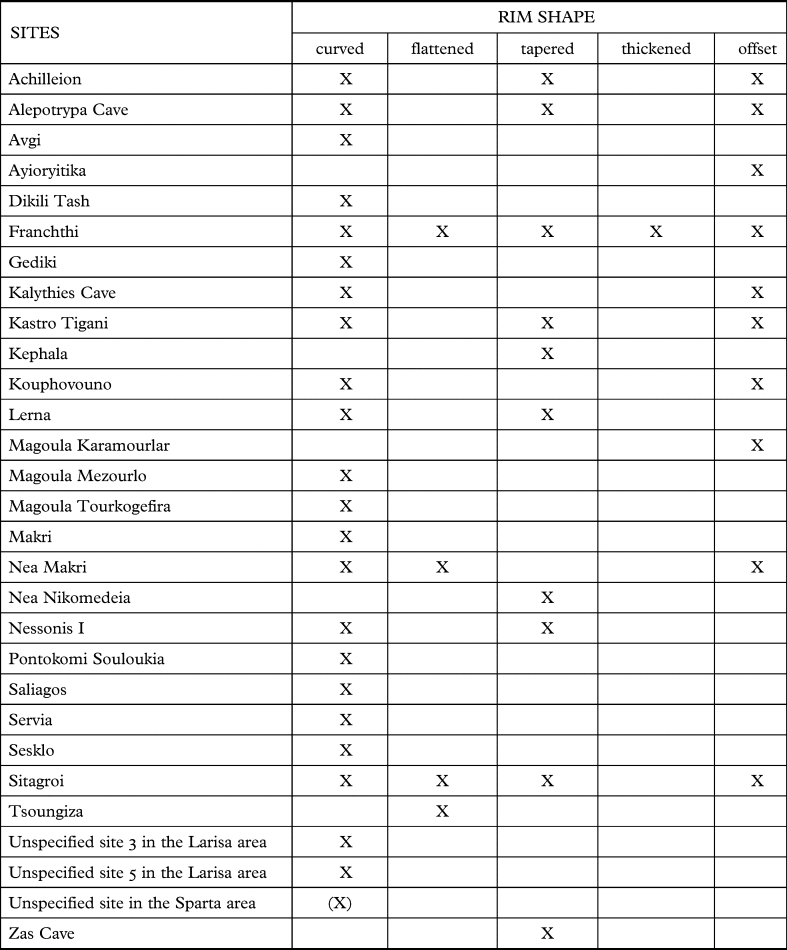
The preserved Franchthi rims are curved (FS163, FS262, FS584 and FS431) or flattened (FS49 and FS248). All are gently tapered apart from FS163, which is thicker than the body. Moreover, all rims are more or less offset apart from that of FS584. These variations are known from other sites: e.g. Achilleion (2,3,4) (Fig. 21), Avgi (2) (Fig. 22), Sitagroi (1,2), Tsoungiza (1) and Alepotrypa Cave (1) (Table 4).
Distribution of various stone vessel rim shapes among Greek Neolithic sites. Only sites with relevant information are included. Parentheses indicate tentative identifications.

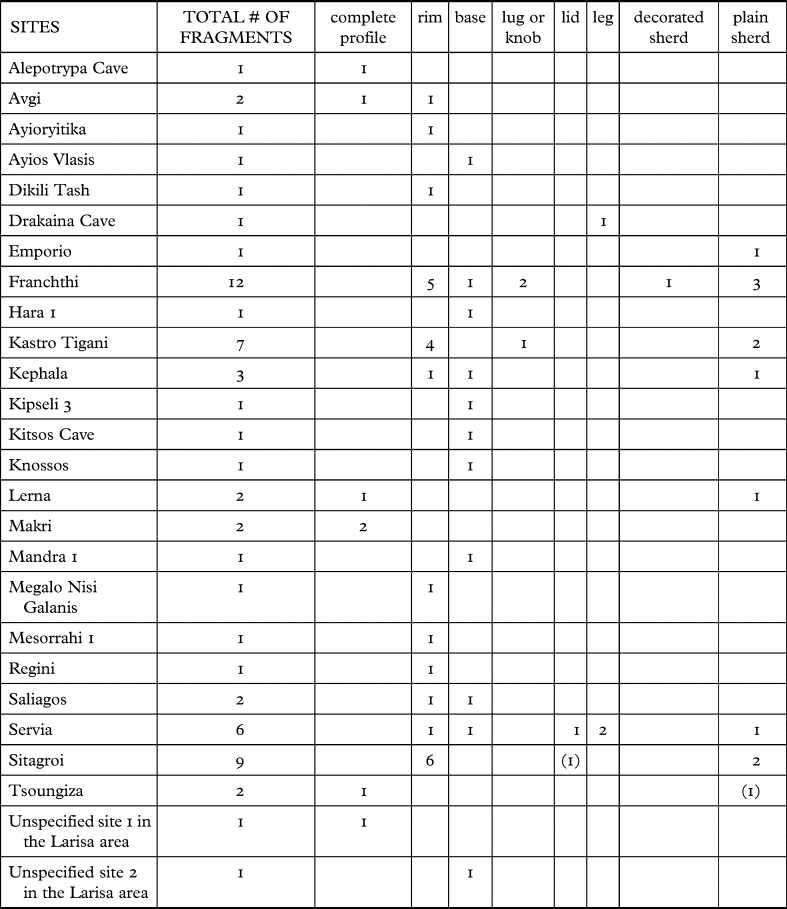
Only two Franchthi vessels – FS584 and FS29 – preserve their bottom part. Complete specimen FS584 has a convex bottom with four knob-like feet. No other Greek vase has such feet,Footnote 13 but conical legs were parts of polypod vessels at Limenaria (1) and Servia (1), while a zoomorphic leg was found at Drakaina Cave (1,2). FS29 has a disc base that is slightly concave on the underside. Disc, ring and, more rarely, stem and pedestal bases are known, for example, from Kouphovouno (1,2) (Fig. 20a), Magoula Karamourlar (1) (Fig. 20b), Magoula Mezourlo (1) (Fig. 20d), Achilleion (1,2,3,4) (Fig. 21), Ayioryitika (1) and an unspecified site in the Sparta area (Fig. 20e) (Table 5). Although typically circular and non-circular bases correspond to circular and non-circular vases, respectively, exceptions do exist: a ‘parallelogram’ vase found at unspecified site 2 in the Larisa area (1) has a circular ring base. Interestingly, the latter is off-centre as is the base of a specimen from Ayios Georgios Larisas (1).
Distribution of various stone vessel bottom configurations among Greek Neolithic sites. Only sites with relevant information are included.

Some vases lack a discrete base; see, for instance, the specimens with flat or concave bottoms from Avgi (2) (Fig. 22), Alepotrypa Cave (1) and Nessonis I (1). Yet others, such as the small hemispherical bowls from Magoula Tourkogefira (1) (Fig. 20c) and Arkadikos (1), or the pointed beakers from Kephala (1,2) (Fig. 19a) and Kastro Tigani (1), have no base at all (Table 5). Significantly, with their convex bottom, hemispherical bowls would not have been stable on a flat surface. The same probably applies to specimens with a stem base or a flat bottom that is disproportionally small compared to the rest of the body (see Figs 19b, 20b). As for the beakers, they would not have been able to stand on a flat surface at all.
A single Franchthi fragmentary specimen – FS30 – preserves parts of a large (c. 3 x 3 cm), convex, horizontal lug. A large, convex but vertical lug is part of a bowl from Alepotrypa Cave (1), and large, vertical but flat lugs are known from the beakers and conical cups of Kephala (1,2) (Fig. 19a–b), Kastro Tigani (1) and Zas Cave (1), while a zoomorphic one was part of a vessel from Olynthus (1). The complete vases have either a single lug (see Alepotrypa specimen) or a pair of diametrically opposed lugs (see specimens from Kephala). All but two of the lugs carry a single hole. The exceptions are those of FS30 and the Olynthus specimen, which are doubly pierced and unpierced, respectively. Lugs probably served as handles, although the zoomorphic example may have been purely decorative. The holes must have been used for suspension.
Not all holes are parts of lugs. I am referring here to a number of complete miniature vases: five specimens with one, two (diametrically opposed) or multiple holes by the rim from Alepotrypa Cave (1), Dikili Tash (1) and unspecified sites 1, 4 and 6 in the Larisa area; one specimen with several holes around the body from Magoula Karamourlar (1) (Fig. 20b); and a circular lid with three holes (all on one side) from Servia (1). I am also referring to a miniature vase fragment from Nea Nikomedeia (1), which bears two closely spaced holes below the rim. Given their number or arrangement on each vessel, the hypothesis that these perforations were meant to facilitate the attachment of a cloth cover is implausible. Most likely, they served suspension or had a decorative role. In addition, four fragments from Franchthi (FS30 and FS176), Megalo Nisi Galanis (1) and Avgi (2) preserve one hole below the rim or (in one case) farther down. The hole was probably part of the original design and was meant for suspension, although the possibility that it was drilled later for mending purposes cannot be ruled out. Three of these four fragments belong to larger vessels, while one (FS176) is probably part of a miniature. The fact that all holes securely identified as original (rather than later additions) belong to miniature specimens suggests a certain association between perforations and small vessel size.
One Franchthi fragmentary specimen – FS176 – includes part of an inconspicuous knob. Knobs are also found on vases from Kouphovouno (1,2) (Fig. 20a), Nea Makri (1) and Limenaria (3). All are more pronounced than that of FS176. The single complete specimen (Kouphovouno) carries four knobs, and the vessels, to which the fragments belong, perhaps had multiple knobs too. Knobs probably served as decorative elements.
Interestingly, the four knobs of the Kouphovouno vase (Fig. 20a) carry one incipient hole each. Two similar, diametrically opposed, holes are found on the body of a complete specimen from Magoula Tourkogefira (1) (Fig. 20c). A hypothesis that drilling was abandoned prematurely is untenable not only because both vases are finished, but also because each has more than one incipient perforation. On this basis, I would argue that there was never an intention to complete the drilling process and that these features represent decorative details.
Two Franchthi specimens, complete FS584 and fragmentary FS262, are carinated. These are the only such Greek Neolithic stone vases, of which I am aware. FS494 may or may not be part of a lid, but securely identified lids were found at Servia (1) and Promachon-Topolniča (4), while a tentative one has been reported from Sitagroi (2). The single complete specimen (from Servia) has a central knob and (as mentioned above) three holes. All specimens are of marble. The lids indicate that covers were part of the design of some Greek Neolithic stone vessels. They also suggest that the contents of these vessels were sometimes covered. What the purpose of covering was (e.g. to retain the temperature of the contained substances, prevent their spoilage or conceal them from view) is impossible to tell. Whether wooden or clay lids were also used with stone vases is equally unclear.
Fragmentary specimens FS49 and FS248 are each decorated with an incised line below, and roughly parallel to, the rim. The line of FS248 is slightly diagonal but both this and that of FS49 gradually fade from one side to the other, an indication that they may not have encircled the entire rim. FS712 does not preserve a rim, but the pronounced incised line it does preserve was likely located below the rim, too. Other specimens with (single or multiple) lines or grooves meant to accentuate the rim or embellish other parts of the body are known from Kouphovouno (1,2) (Fig. 20a), Alepotrypa Cave (1), Nea Makri (1,2), Sitagroi (1,2), Regini (1), Tsoungiza (1), Drakaina Cave (2), unspecified site 1 in the Larisa area (1), and the unspecified site in the area of Sparta (Fig. 20e).
A single Franchthi specimen, FS30, carries faint red traces on the exterior surface. They probably represent painted decoration. Alternatively, but less likely, they are the result of accidental contact with pigment. No painted vase has been reported from elsewhere, indicating that the natural (usually white) colour of the raw material was considered sufficiently attractive to be retained.
Despite their mostly fragmentary state, it is clear that the stone vessels from Franchthi and other Aegean sites were not made in simple forms. Characteristics such as thin walls, offset rims, incised lines and other decorative details reflect a choice to produce objects that were not only practical but also aesthetically pleasing. Significantly, miniature sizes and/or unstable bottoms suggest that in quite a few cases the producers chose to design vases that were elegant but not very practical (see, for example, the miniature specimens in Figs 19b and 20, as well as the beaker of Fig. 19a).
It is also clear that the Franchthi assemblage is typical of the Aegean Neolithic stone vase industry but includes unique features as well; see the knob-like feet of FS584 or the doubly pierced lug of FS30. I would in fact argue that this is the case with Greek Neolithic stone vase assemblages in general: they follow broad trends but often include unique features; see, for example, the zoomorphic leg and lug from Drakaina Cave (1,2) and Olynthus (1), respectively.
Although some specimens (especially shallow ones) may have imitated wooden receptacles (see Theocharis Reference Theocharis1967, 148), the typology of stone vessels was generally defined by pottery. The main forms, including rims, bases/bottoms/legs and lugs/knobs, are roughly similar to those found in pots; details such as rim-encircling incised lines appear also to have been transferred to stone from clay prototypes (see also Devetzi Reference Devetzi and Papathanassopoulos1996; Theocharis Reference Theocharis1956). If imitation of (or at least influence by) clay vessels represents the general rule, then the rule does not apply to the knob-like feet of FS584 from Franchthi as well as the beakers from Kephala (1,2) (Fig. 19a) and Kastro Tigani (1), which have no parallels in pottery. Neither does it apply to the intricate dish from Achilleion (3) (Fig. 21), which derives from EN deposits with no clay plates whatsoever. Significantly, these are the most elaborate vases of the Greek Neolithic. The above observations suggest that some stone carvers not only operated outside pottery traditions but were also extremely creative and accomplished artists.
Raw materials and their provenience
A single Franchthi specimen – FS248 – is carved in a gray volcanic material that includes biotite. According to macroscopic examination, it is andesite – a rock of high hardness. The material of the remaining fourteen specimens has a sugar, creamy or beige white colour, is often translucent and is or looks like marble. This is interesting: marble – a stone of medium hardness – is by far the most common material among stone vessels, but rare in the artifactual inventory of Neolithic Franchthi in general. It was used for only c. 30 out of thousands of ornaments (Perlès Reference Perlèsforthcoming), one of the 24 figurines (Talalay Reference Talalay1993, 8) and one of the two perforated objects known as maceheads (pers. observation).
Franchthi again follows a more general trend. Marble was employed rather rarely in the Aegean Neolithic but was the preferred lithology for stone vases. Although the data are sketchy, the vast majority (90 per cent) of the c. 140 non-Franchthi specimens, for which specific raw material information is available, are reported to be from marble (Table 6).
Basic raw material information for stone vessels found in Greek Neolithic sites. Brackets indicate specimens that may or may not be vessels. Abbreviations: n/a = non-available; SUN = substantial unspecified number; UN = unspecified number.

If incomplete, the evidence seems to suggest a certain evolution in the course of the Neolithic regarding the stone media and colours chosen for this artifactual category. Although white marble was used throughout this period, almost all specimens reported to be from rocks other than marble and of colours other than white date to EN. The aforementioned FS248 is one example. This is the only volcanic and non-white specimen in the Franchthi assemblage and the only one attributed (if tentatively) to EN. Precise numbers are lacking, but a variety of lithologies such as serpentinite,Footnote 14 sandstone, green schist and red ‘porphyrite’ – mostly of medium or high hardness – have been used for three of the largest and almost exclusively EN assemblages (Nessonis I [1], Argissa [1] and Nea Makri [1,2]) as well as for several EN specimens from Achilleion (3,4) (Fig. 21), Regini (1), Ayios Georgios Larisas (1) and unspecified sites 1, 2 and 4 in the Larisa area. It appears that the EN stone vase industry employed white marble as well as a variety of other stones and colours.Footnote 15 From MN on, however, the use of white marble became more or less exclusive as carvers ignored other lithologies and colours; see, for example, the MN, LN and FN specimens from Limenaria (1,2,3), Avgi (2,3) (Fig. 22) and Kephala (1,2) (Fig. 19ab), respectively. For rare deviations from this rule, see three LN specimens of schist, andesite and ‘gray-black stone’ from Makri (1), Servia (2) and Olynthus (1), respectively (Table 6). The focus on white marble continued, of course, into the Early Bronze Age with the much more abundant Cycladic productions (see Getz-Gentle Reference Getz-Gentle1996).
No thin sectioning has been conducted on Franchthi specimen FS248 to identify the source of its andesitic material. However, andesite or, more accurately, the variety represented in FS248, is found neither in the Franchthi area nor elsewhere in the Argolid (Runnels Reference Runnels1981, 66, 77–98; van Andel and Vitaliano Reference van Andel, Vitaliano, van Andel and Sutton1987). This variety may originate in the Saronic Gulf, c. 35–45 km to the north-east (Runnels Reference Runnels1981, 60–70, 104), as was probably the andesite of a few of the Franchthi grinding tools (Stroulia Reference Stroulia2010a, 34–5). This hypothesis is supported by the thin section of a LN Franchthi pot sherd; its local fabric was found to contain tiny pieces of andesite originating in the Saronic island of Aegina (Vitelli Reference Vitelli1993, 208–9; Reference Vitelli1999, 38).
Marble is not found in the Franchthi region either but occurs elsewhere in the Argolid: in the area of Nafplion, c. 40 km north-west of the site (van Andel and Vitaliano Reference van Andel, Vitaliano, van Andel and Sutton1987). Marble sources are, of course, also located in other parts of Greece. To determine the provenience of the marble-like material of the remaining vases, five were thin-sectioned and subjected to stable isotope analysis of oxygen and carbon (FS30, FS49, FS140, FS262 and FS263). Carried out about 30 years ago by N. Herz (Reference Herz1992), this petrographic project was the first of its kind for Aegean Neolithic stone vessels.
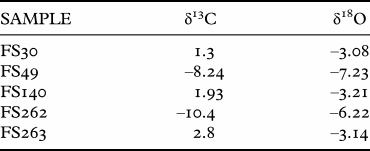
The results for samples FS30, FS140 and FS263 were quite straightforward (see Table 7). Their material was identified as marble. According to Herz (Reference Herz1992), the isotopic ratios for FS30 and FS140 were sufficiently close to have the same provenience. Herz proposed the south-eastern coast of the island of Naxos as the most likely source,Footnote 16 although he also considered Sounion, at the southern tip of Attica, as a possibility. The isotopic ratio for FS263, on the other hand, pointed to the Peloponnese. According to Herz, this marble variety originated probably in the Mani, north of Cape Tainaron (Laconia) or, less likely, at Doliana, east of Tripolis (Arcadia).
Results of stable isotope analysis for Franchthi samples (after Herz Reference Herz1992, 188).

The results for samples FS49 and FS262 were rather unexpected (see Table 7). While macroscopically they clearly resemble marble, their isotopic signatures did not match any known marble sources. Although Herz found them to be more typical of limestone, they did not match the limestones in his database either. Herz hypothesised both specimens to be of local limestone. Given the absence of marble-resembling limestones in the area, however, the question of both the raw material of FS49 and FS262 and its sources remains open. Be that as it may, it appears that the Franchthi vases were fashioned of materials found at substantial distances from the site.
The Franchthi assemblage is not the only one featuring exogenous materials. Stable isotope, mineralogical and petrographic analyses have been conducted on the assemblages of three other sites: Limenaria, Avgi and Drakaina Cave. Limenaria (2,3), on the northern Aegean island of Thasos, yielded nine MN specimens. All were found to be of Cycladic marble. Naxos was identified as the most likely source for the majority of samples, with Paros and Keros considered probable in a couple of cases. According to the Limenaria archaeologists, marble, along with obsidian, was imported from the Cyclades in the context of a trade network (Maniatis et al. Reference Maniatis, Papadopoulos, Dotsika, Kavoussanaki, Tzavidopoulos and Maniatis2009; Reference Maniatis, Dotsika, Kavoussanaki, Tzavidopoulos, Papadopoulos and Malamidou2012). These findings are quite remarkable, not only because these Cycladic islands are over 400 km away, but also because Thasos is itself endowed with extensive sources of good quality marble that have been exploited since ancient times (Melfos Reference Melfos2015). Apparently, the Neolithic inhabitants of Limenaria bypassed these sources in favor of far more distant ones.
Excavations at Avgi (2,3), a LN site in the area of Kastoria, north-western Greece, produced fragments of two marble vases (Fig. 22). The marble was found to originate in Naxos, although (for one sample) Paros could not be ruled out. This is impressive too, given the c. 500 km distance between these islands and Avgi. There is no marble in the area of Kastoria, but this material can certainly be found at less remote sources than those in the Cyclades (Bekiaris Reference Bekiaris2018, 189–90, 393–4; Melfos Reference Melfos2015). As suggested by the presence of Melian obsidian, Naxian (or Parian) marble was only one of the materials that linked Avgi (2) to the Cyclades. Equally interesting, excavations at the neighbouring LN site of Dispilio (1) uncovered no stone vessels, but yielded bracelets of Naxian marble. This can be taken as a possible indication that both the Avgi and Dispilio communities participated in the same exchange network that connected them with the Cyclades.
Only one stone vessel (a zoomorphic leg) was excavated at the LN site of Drakaina Cave (1,2), on the Ionian island of Kephalonia. Its raw material – white gray marble – also originates in Naxos, also hundreds of kilometres away. This is one of several foreign materials identified at the site. The others comprise obsidian, gabbro/dolerite and talc.
None of the five vases from the FN site of Kephala (1) (Fig. 19ab), on the Cycladic island of Keos, was thin-sectioned, but, according to Coleman (Reference Coleman1977, 5), their marble looks different from that occurring locally and is thus probably exogenous. For one specimen, in particular, he hypothesised a Naxian origin (Coleman Reference Coleman1977, 35). A non-local source was also suspected for the marble of the single Neolithic specimen from Emporio (1) and that from Elateia (1).
A local provenience, by contrast, has been reported on macroscopic grounds in three cases. Dixon (Reference Dixon, Elster and Renfrew2003a, 139–40; Reference Dixon, Elster and Renfrew2003b) identified the material of all specimens from Sitagroi as marble of probably local origin. According to Theocharis (Reference Theocharis1967, 148), the vases from Nessonis I are of local material.Footnote 17 Lastly, according to Evans and Renfrew (Reference Evans and Renfrew1968, 65), the marble of one of the two specimens from Saliagos ‘may well be of local origin’.
More analyses are needed, but the available data allow a few general points about the materials of Greek Neolithic stone vases and their sources: (a) the predominance of white marble suggests that this was considered to be the appropriate medium for stone vases, especially after EN; (b) given that practically all analysed samples are of exogenous materials, it can be reasonably assumed that the use of such materials was not uncommon, at least after EN; (c) as the Limenaria case illustrates, proximity to a source of raw material does not necessarily imply its exploitation for vase making; (d) since the Cyclades (and Naxos in particular) appear as a likely source of marble in all four analysed assemblages, and these come from different parts of Greece, it is plausible that a small number of sources were exploited for a substantial percentage of the vases.
Manufacture
Given the finished state of all Franchthi specimens and the absence of unworked pieces of marble or andesite, it is impossible to determine the original form of the raw materials. This is impossible for other Greek Neolithic stone vessels too due to the lack of relevant information. However, it is likely that the raw material consisted of loose pieces obtained at primary sources or water-rolled cobbles/boulders collected at secondary sources. Quarrying was probably not involved in the procurement of raw material, a hypothesis supported by the absence of prehistoric quarries on the islands of Naxos and Keros (Maniatis et al. Reference Maniatis, Papadopoulos, Dotsika, Kavoussanaki, Tzavidopoulos and Maniatis2009), two of the suggested sources for the analysed marble samples from Franchthi, Limenaria (2,3), Avgi (3) and Drakaina Cave (1,2) (see above).
The Franchthi vessels are generally well finished, only rarely preserving traces of earlier manufacturing stages. A detailed discussion of the production sequence is thus out of the question. However, I would hypothesise that the latter was carried out in roughly three or, possibly, four stages on the basis of the literature pertaining to: (a) Neolithic Near Eastern stone vase industries; (b) Bronze Age Aegean and Near Eastern vases manufactured without metal devices; and (c) experimental stone vase making. I present these stages below along with the limited direct or indirect evidence preserved on the vases from Franchthi and other Greek Neolithic sites.
The first stage in the stone vase manufacturing sequence consists of roughly shaping a stone block with the goal of defining the general contour of the vessel (including protruding parts such as lugs, bases, legs and carinations). As documented in a few Near Eastern assemblages, rough shaping can be carried out with direct or indirect percussion.
Direct percussion in the form of pecking was used at the Cypriote Pre-Pottery Neolithic sites of Khirokitia and Shillourokambos (Astruc Reference Astruc, Caneva, Lemorini, Zampetti and Biagi2001; Astruc et al. Reference Astruc, Le Brun, Vargiolu and Zahouani2002; Reference Astruc, Le Brun, Le Brun, Hourani, Córdoba, Molist, Pérez Aparicio, Rubio de Miguel and Martínez Lillo2008; Manen Reference Manen, Guilaine and Le Brun2003; Reference Manen, Vigne, Briois and Tengberg2017). Direct percussion in the form of both pecking and flaking, on the other hand, was employed at the Pre-Pottery Neolithic site of Bouqras in Syria and the Chalcolithic marble vessel workshop of Kulaksizlar in western Anatolia (Roodenberg Reference Roodenberg1986, 142; Takaoǧlu Reference Takaoǧlu2005, 28). According to Takaoǧlu, at the latter site, the block was first coarsely flaked into a shape and size that roughly approached those of the intended vessel. The resulting flake scars were eliminated by pecking. It was at this stage that lugs/knobs (when part of the design) were roughly formed. In an experimental replication, which entailed coarsely shaping a marble bowl and a beaker, Takaoǧlu (Reference Takaoǧlu2005, 28–9, 33) first employed spherical and elongated gabbro and basalt tools to remove large flakes, then split these tools into pieces to obtain pointed ends suitable for pecking.
Indirect percussion with flint chisels and punches was used for shaping the exterior of some Bronze Age Egyptian vessels. This process was replicated by Stocks (Reference Stocks2003, 141).
No traces of the first manufacturing stage are evident on the Franchthi specimens, but direct percussion in the form of pecking was used for the exterior shaping of a complete EN unfinished vessel from Sesklo (2,3,4,5) and a fragmentary specimen from Nessonis I (2), which, as far as I can tell from the illustration, is also unfinished.
It is unlikely that indirect percussion was used for Greek Neolithic vessels, given both the general absence of lithic chisels and punches compatible with stone vase shaping (C. Perlès, pers. comm.) and the fact that marble and the other used stones are not sufficiently soft for such treatment (see Bevan, Reference Bevan2007, 41, 57). On this basis, I would argue that direct percussion was the main method through which the first manufacturing stage was carried out for both the Franchthi vessels and those from other sites.
I should finally note that the use of a turntable is suspected by Perlès (Reference Perlès2001, 222) for the manufacture of the elaborate circular plate from EN Achilleion (Fig. 21). Both this device and a simple compass – perhaps in the form of a string with an attached piece of charcoal or sharp stone (see Getz-Gentle Reference Getz-Gentle1996, 16) – could have been employed in the first (and/or second) manufacturing stage for other circular vases as well.
The second stage in the stone vase manufacturing sequence consists of hollowing. A cavity can be created by: (a) direct percussion; (b) drilling; (c) scraping; or (d) abrasion.
(a) Study of unfinished vases showed that direct percussion by pecking was used for hollowing at Khirokitia and Shillourokambos (Astruc et al. Reference Astruc, Le Brun, Le Brun, Hourani, Córdoba, Molist, Pérez Aparicio, Rubio de Miguel and Martínez Lillo2008; Manen Reference Manen, Guilaine and Le Brun2003; Reference Manen, Vigne, Briois and Tengberg2017). A more complex variation of this theme, reported from the same sites, utilised pecking to create a circular groove. The resulting central ‘plug’ was removed by a single percussive blow. The process was repeated until the desired depth was reached.
The creation of a cavity through plain pecking was replicated by sculptor D. Yassur in the context of an experimental project. Yassur used hammers of non-vesicular basalt to peck out a cavity on a block of vesicular basalt (Squitieri and Eitam Reference Squitieri and Eitam2016). The same technique, along with quartzite hammers, was employed by R. Osborne to create a cavity on a granite cobble. Osborne, moreover, replicated the pecking variation that includes a central plug (Schneider and Osborne Reference Schneider and Osborne1996).
(b) Drilling (without metal devices) has several variations. The drill can be solid or tubular. A solid drill may consist of a wooden stick with an attached stone borer or a wooden rod. Crescent- and cone-shaped sandstone borers were found at the Kulaksizlar workshop, and a hollowing process involving such devices was experimentally tested by Takaoǧlu (Reference Takaoǧlu2005, 29–33). The use of a drill in the form of a wooden rod, on the other hand, was hypothesised by Morero and her colleagues on the basis of manufacturing traces preserved on some Minoan vases. Indeed, these scholars used an olive wood rod along with an abrasive and a lubricant to experimentally hollow out a marble vase (Morero and Procopiou Reference Morero, Procopiou, Astruc, Bon, Lea, Milcent and Philibert2006; Morero et al. Reference Morero, Procopiou, Vargiolu, Zahouani, Longo and Skakun2008).
A non-metal tubular drill often consists of a reed. Such drills were hypothesised for some Minoan vases on the basis of unfinished material and drill cores (Warren Reference Warren1969, 158). Their use was also replicated by Morero and her colleagues: the interior of a marble block was bored with a piece of bamboo and the help of an abrasive and a lubricant.Footnote 18 Interestingly, several Minoan vases bear evidence of a sequence that combined tubular and solid drilling. Also reproduced experimentally, this process entailed the initial employment of a hollow drill to form a deep circular groove and the subsequent use of a solid one for enlarging the groove and giving the walls the desired shape (Morero and Procopiou Reference Morero, Procopiou, Astruc, Bon, Lea, Milcent and Philibert2006; Morero et al. Reference Morero, Procopiou, Vargiolu, Zahouani, Longo and Skakun2008).
(c) Scraping appears to have rarely served as a hollowing technique. I located only two relevant references: from Khirokitia and Shillourokambos (Astruc Reference Astruc, Caneva, Lemorini, Zampetti and Biagi2001; Astruc et al. Reference Astruc, Le Brun, Vargiolu and Zahouani2002; Reference Astruc, Le Brun, Le Brun, Hourani, Córdoba, Molist, Pérez Aparicio, Rubio de Miguel and Martínez Lillo2008; Manen Reference Manen, Vigne, Briois and Tengberg2017).
(d) Abrasion was identified at Bouqras where it was used for hollowing out shallow vessels and plates or, in combination with pecking, for large open vessels (Roodenberg Reference Roodenberg1986, 143).
In the Franchthi assemblage, the smooth interior surfaces of FS49 and FS493 carry faint marks from pecking that preceded smoothing and thus possibly occurred in a hollowing context. Although lacking traces from a hollowing process, I would assume that the rectangular cavity of the nearly complete miniature bowl FS584 was fashioned by pecking, abrasion or both. If FS262 and FS263 belong to quadrangular or very shallow vases, similar techniques were likely used to shape their interiors. Beyond Franchthi, pecking, abrasion or both were probably involved in shaping the cavity of five shallow non-circular EN vessels from Magoula Mezourlo (1) (Fig. 20d), Ayios Georgios Larisas (1), Mandra 1 (1) and unspecified sites 2 and 3 in the Larisa area.
No drills or drill cores compatible with vase hollowing have been excavated at Franchthi. Neither do the Franchthi specimens carry parallel concentric striations in their interior surfaces. If direct evidence for drilling is lacking, indirect evidence is found in the small closed shape of FS176 and FS712. If these specimens were actually drilled, the absence of concentric striations indicates a certain effort to obliterate them.
Stone vase-related drills and drill cores are not known from other Aegean Neolithic sites either, but parallel concentric striations have been reported (or illustrated) for a few vases from Kephala (1,2) (Fig. 19ab), Magoula Tourkogefira (1) (Fig. 20c), Alepotrypa Cave (1) and Olynthus (1). Despite the lack of relevant information, for reasons that have to do with shape and/or size, I believe this technique was also used for the beakers from Kastro Tigani (1) and the circular miniature vessels found, for example, at Kouphovouno (1,2) (Fig. 20a), Magoula Karamourlar (1) (Fig. 20b), Achilleion (2) and an unspecified site in the area of Sparta (1) (Fig. 20e). A few of the drilled specimens date to EN. Clearly, drilling was used early in the Greek Neolithic as a technique for hollowing out stone vases (see also Perlès Reference Perlès2001, 222).
By contrast, there are reasons to believe that scraping was not used for hollowing in the Greek Neolithic stone vase industry: chert scrapers with heavy dull wear indicating work on a hard material are rather rare (C. Perlès, pers. comm.); moreover, scraping would not have been effective on the generally non-soft stones, from which vases were fashioned.
The third stage in the manufacturing process consists of finalising the vessel form. This involves thinning out the walls, regularising their surfaces, shaping the rim and protruding parts (e.g. base, legs, lugs and knobs), erasing marks from earlier manufacturing stages, drilling holes and adding decorative details (e.g. grooves and incised lines). Except drilling and decoration, all of the above can be carried out by abrasion. If the used tools are fine-grained enough, a smooth surface can be achieved at the same time. In experiments related to stone vase material uncovered at the Kulaksizlar workshop, Takaoǧlu (Reference Takaoǧlu2005, 32–4) replicated the abrasion process by using sandstone blocks.
Abrasion must have been used to thin out the walls of the Franchthi vessels, regularise their surfaces (and probably also produce their smooth texture), sculpt the knob-like feet of FS584, form the base of FS29 and shape the curved or gently flattened rims of FS49, FS248, FS163, FS262, FS431 and FS584.
The edge of a flake or blade served to incise the surface of limestone vessels at Khirokitia (Astruc Reference Astruc, Caneva, Lemorini, Zampetti and Biagi2001; Astruc et al. Reference Astruc, Le Brun, Vargiolu and Zahouani2002) and such may have been the tools used to incise the lines decorating Franchthi specimens FS49, FS248 and FS712. Small drills, finally, were used to produce the holes found on FS30 and FS176. Similar techniques and tools can be assumed for this stage for other Greek Neolithic vases.
A possible fourth manufacturing stage consists of smoothing the interior and exterior surfaces. A smooth finish can be achieved by rubbing with fine-grained sandstones as was observed at a modern Egyptian alabaster vase workshop (Hester and Heizer Reference Hester and Heizer1981, 20) and as replicated by Takaoǧlu (Reference Takaoǧlu2005, 32) in an experimental context. It is unclear if the Franchthi vases went through a fourth manufacturing stage. As mentioned above, their smooth surfaces could have been produced during the third stage, along with wall thinning and regularisation. The same applies to other Greek Neolithic vessels with smooth surfaces.
If smooth, the surfaces of the Franchthi specimens do not reflect light and thus were probably not polished. Alternatively, they may have been polished with a piece of cloth or leather (see Hester and Heizer Reference Hester and Heizer1981, 20), but the polished effect faded through time. A number of vessels from other sites, on the other hand, are certainly polished: e.g. Gediki (2), Nea Makri (2), Elateia (1) and Sitagroi (1) (see also Devetzi Reference Devetzi and Papathanassopoulos1996, 135). A long-lasting polish could have been achieved with the help of fine-grained stones (see Bevan Reference Bevan2007, 41–2; Takaoǧlu Reference Takaoǧlu2005, 32).
As mentioned above, a single Franchthi specimen carries faint red traces on its exterior that may represent painted decoration. If so, this vase must have undergone an additional stage, through which colour was applied to the surface.
The above discussion suggests that direct percussion (mostly pecking), drilling and abrasion were the main stone vase manufacturing techniques for both the Franchthi stone vases and those from Neolithic Greece in general. If so, it is important to note that pecking is a risky process not only because the recurring percussive blows increase the chance of breakage, but also because marble (the main vase raw material) is a fractious medium; drilling is also risky and requires skill and patience; abrasion, on the other hand, is relatively simple and carries no risk, but is certainly tedious (Bevan Reference Bevan2007, 43; Getz-Gentle Reference Getz-Gentle1996, 16; Takaoǧlu Reference Takaoǧlu2005, 32).
My reconstruction of the manufacturing sequence(s) for the Franchthi vessels is obviously hypothetical and full of gaps. However, regardless of precisely how they came to be, these finely designed, executed and finished objects can be considered as attractive and meticulous products of considerable investment in time and effort. Although it is hard to generalise on the basis of mostly superficially recorded fragments, and a certain degree of variability in the makers’ knowhow and level of dedication must be assumed, most vases from other sites appear to represent fine products of time-consuming manufacturing processes too.Footnote 19
If such vases represent the average, a few specimens are above average. With its miniature size, elaborate, non-circular, partly carinated shape and unique knob-like feet, complete specimen FS584 is extremely elegant. It is not an exaggeration to state that this is one of the most refined stone vases and indeed one of the most graceful non-perishable creations of the Greek Neolithic world. To the best of my knowledge, along with the much larger elaborate dish from Achilleion (3,4) (Fig. 21) and the four beakers from Kephala (1,2) (Fig. 19a) and Kastro Tigani (1), it represents one of the most challenging Aegean Neolithic stone vessels. All were fashioned by (possibly specialised) craftspeople who had an exceptional command of their medium and an outstanding mastery of the techniques involved.
In the above paragraphs, I have tried to shed light on the stone vase manufacturing process. In the following ones, I explore where this process took place. No unworked chunks of marble or andesite, no unfinished vessels, no other byproducts of stone vase manufacture were recovered at Franchthi. The excavations did produce close to 200 sandstone tools (Stroulia Reference Stroulia2010a, 27–115), but their shape, size and/or macroscopic use wear are generally incompatible with stone vessel making. A number of percussive tools were also found (Stroulia Reference Stroulia2010a, 94–105), but whether they were used to produce stone vases is impossible to tell, not only due to a lack of microwear analysis but also because there is nothing to suggest the use of specialised stone vase carving implements in the Aegean Neolithic. Instead, it can be assumed that similar tools were involved in the chaînes opératoires of stone vessels and other stone artifacts such as ornaments, figurines, ‘maceheads’ and celts.
Although the hypothesis of manufacture in an unexcavated part of the site or somewhere in the vicinity cannot be ruled out, it is more likely that the Franchthi vases were not produced locally. The secure or probable exogenous nature of their raw materials certainly supports this hypothesis. The small size of the assemblage also supports it, especially considering that these artifacts span several millennia. The extraordinary skill and expertise that produced the nearly complete miniature bowl FS584 could have been neither developed nor sustained with such a low output. On this basis, I would argue that stone vases arrived at the site ready-made. Given the variety of raw material sources suggested by the stable isotope analysis, I would further argue that these artifacts were imported from several different places. The Franchthi community was apparently involved in complex and extensive networks that allowed access to stone vessels produced in faraway places in the Peloponnese, Attica or the Cyclades.Footnote 20 To what extent the networks that brought the marble and andesite vases to the site coincided with those involving the marble ornaments, the single marble figurine, the single marble ‘macehead’ and the andesite grinding tools is not known. Whether they coincided with those involving other exotic materials, such as Melian obsidian, is also unknown.
Since stone vase manufacturing debris has not been reported for Limenaria, Drakaina Cave and Avgi, it is tempting to view their specimens – of documented Cycladic (mostly Naxian) marble – as ready-made imports too. Such a generalisation is unwarranted, however. Despite the foreign origin of the material of the MN specimens from Limenaria, the excavators consider morphological similarities with the site's pottery as evidence of local production (Maniatis et al. Reference Maniatis, Papadopoulos, Dotsika, Kavoussanaki, Tzavidopoulos and Maniatis2009; Papadopoulos and Malamidou Reference Papadopoulos, Malamidou, Erkanal, Hauptmann, Sahoglu and Tuncel2008, 429–30). I find this argument quite convincing given: (a) the specific character of these similarities – some of the marble vase fragments consist of legs resembling those of the many excavated polypod clay vessels; (b) the fact that polypod pots are uncommon in the archaeological record of MN Greece; (c) the absence of evidence of pre-LN human habitation in the Cyclades.
The excavators of Drakaina Cave do not discuss the form in which marble reached the site (Melfos, Stratouli and Voudouris Reference Melfos, Stratouli and Voudouris2020; Stratouli et al. Reference Stratouli, Sarpaki, Ntinou, Kotjabopoulou, Theodoropoulou, Melfos, Andreasen, Karkanas, Touchais, Laffineur and Rougemont2014). Personally, I find the evidence quite ambiguous. That the zoomorphic leg is Drakaina's single marble find favours the hypothesis that it was imported as a finished product. The fact, on the other hand, that the excavated pottery includes several zoomorphic polypod ‘rhyta’ and that such pots are not known from the Cyclades rather argues for local manufacture. To make matters more complicated, there is no guarantee that the zoomorphic pots were produced locally; the possible circulation of such vessels across large distances in the Balkans and beyond has long been a matter of debate (Biagi Reference Biagi2003; Mlekuž Reference Mlekuž2007).
Finally, the hypothesis that the two marble vases from Avgi were imported in a finished state is considered probable by Bekiaris (Reference Bekiaris2018, 394), who studied them. However, it is not easy to evaluate since these specimens lack diagnostic features and/or obvious morphological associations with other artifact types.
Be that as it may, the Limenaria and Franchthi cases are sufficient to suggest that marble was sometimes distributed in the form of raw material and other times in the form of finished vases. There is an apparent variation in the systems of production and circulation of marble and the vases produced from it. This variation is indeed comparable to that characterising obsidian, which also reached different sites around Greece in different forms (e.g. Perlès Reference Perlès1989; Reference Perlès1992).
Although no Neolithic stone vessel workshop has been identified in Greece, direct evidence of on-site manufacture does exist and comes from two sites. The first – Sesklo (2,3,4,5) – yielded an unfinished EN marble vessel. The second – Nessonis I (1,2,3) – yielded unworked pieces of local raw material as well as a probably unfinished vessel. No such telltale finds were reported from other sites, but I consider local manufacture as likely for the specimens from Sitagroi (3,4) and Saliagos (1), which are carved in what has been characterised as local marble, and those from Nea Makri (1,2,3), given both their large number and morphological similarities to the site's pots.
However, if the presence of local materials can be taken as evidence of local stone vase manufacture, the reverse assumption (as the Limenaria case suggests) must be treated much more cautiously. On this basis, local processing of local stones can, for example, be considered certain for Nessonis I but less certain for Sesklo, since nothing has been reported on the origin of the raw materials used for its stone vases.
There is still a lot that remains to be deciphered regarding the production of Greek Neolithic stone vases and where it took place. The available evidence, however, shows the coexistence of three approaches: (a) local manufacture in local materials; (b) local manufacture in exogenous materials; and (c) long-distance import of finished vases. Moreover, the above discussion underscores the significance of a case-by-case examination of assemblages, the value of contextual analysis and, perhaps above all, the need for detailed reporting.
Use
Only a single Franchthi specimen was found in situ: FS584. This extraordinary almost complete miniature bowl derives from MN burial Fr 48. According to Cullen (Reference Cullen and Papathanasiouforthcoming), who studied the contexts of the site's human remains, a neonate's grave was found in a 60 cm-deep pit, measuring 37 x 25 cm and covered near the bottom with a flat-topped capstone and possibly by other large stones as well. The extremely well-preserved skeleton was fully articulated, lying partially contracted on its left side. FS584 was positioned right side up, near the skull, just below the capstone. Another grave good, a partial, possibly burnt, clay bowl, was laid by the infant's right hand and 5 cm from the stone vase. For reasons to do either with orientation or state of preservation, it is reasonable to assume that both vessels were placed in the grave empty of contents. Sixteen animal bones (mostly caprine), several unworked marine shells, as well as a couple of fish bones were recovered from the area around the skeleton. Whether they are related to the burial (as the excavators suggested for the animal bones) or part of the sediment into which the grave was dug is unclear (see also Munro and Stiner Reference Munro and Stiner2020; M. Rose, pers. comm.).
Given his/her age, none of the (secure or non-secure) grave goods would have belonged to the deceased. They clearly represent offerings to the dead by the living. It is tempting to see the miniature stone bowl as a deliberate and appropriate grave good choice for such a young and tiny individual, but the much larger original size of the clay pot – c. 12 cm in height and 15 cm in maximum diameter (Vitelli Reference Vitelli1993, fig. 34a) – rather argues against such a hypothesis.
The state of preservation for these two artifacts is quite intriguing. A semicircular piece is missing from the rim of the stone bowl, with a crack of similar size and shape visible on the opposite side. As for the pot, only about half is preserved. Since all the burial-related sediment was water-sieved, there is no doubt that the stone vase was placed into the pit with its rim already chipped and the pot in a partial state (Cullen Reference Cullen and Papathanasiouforthcoming). Franchthi archaeologists raised the hypothesis of deliberate breakage (the crack possibly representing an incomplete version of such an act) – a practice that could have symbolised the loss of life, been part of a ritual toast or served to deter evil spirits (Jacobsen and Cullen Reference Jacobsen, Cullen, Humphreys and King1981; Cullen Reference Cullen and Papathanasiouforthcoming). If breakage was indeed intentional, the preserved and missing pieces could have participated in a process of ‘enchainment’ (e.g. Chapman Reference Chapman2000, 226) meant to create a material, tangible, lasting bond between the dead baby and the living.
If untestable, these hypotheses are certainly plausible. Smashing stone and clay vessels has been documented in burial and cremations pits at Pre-Pottery Neolithic Khirokitia (see Astruc et al. Reference Astruc, Le Brun, Vargiolu and Zahouani2002) and EN Soufli Magoula (1), respectively. More generally, the deliberate destruction of objects in mortuary contexts is known from Bronze Age, Classical, as well as modern Greece (e.g. Fossey Reference Fossey1985; Grinsell Reference Grinsell1961; Jacobsen and Cullen Reference Jacobsen, Cullen, Humphreys and King1981; Relaki and Tsoraki Reference Relaki, Tsoraki and Tsipopoulou2017), while ancient and modern examples from all over the world are found in the archaeological and ethnographic literature (e.g. Adams Reference Adams, Rowan and Ebeling2008; Brück Reference Brück2006; Grinsell Reference Grinsell1961; Hamilakis Reference Hamilakis and Branigan1998). The literature, finally, includes a couple of possible prehistoric cases of enchainment linking the mortuary and domestic domains (from Bulgaria and Britain) (Chapman and Gaydarska Reference Chapman and Gaydarska2007, 95–6).
Whether the two vessels with Franchthi burial Fr 48 were deliberately broken/damaged or served as elements in an enchainment process, one thing remains certain: the living chose to deposit into the grave items that were fragmentary or non-intact. There are other Aegean Neolithic instances of such mortuary behavior; see, for example, the cremation burials of Avgi (1) and Kremasti-Kilada (1), as well as the so-called Ossuaries of Alepotrypa Cave (3). Clearly, in the Greek Neolithic world, incomplete or fragmentary items served as vehicles of meaning and were subject to manipulation. In fact, the very notions of wholeness and partialness held by prehistoric people were likely different from those we archaeologists routinely employ to classify the materials they left behind. So must have been their definitions of usefulness and uselessness (see also Brittain and Harris Reference Brittain and Harris2010; Chapman Reference Chapman2000; Chapman and Gaydarska Reference Chapman and Gaydarska2007; Katsarou Reference Katsarou, Papathanasiou, Parkinson, Pullen, Galaty and Karkanas2018; Nanoglou Reference Nanoglou, Harrell and Driessen2015a; Stroulia Reference Stroulia2010b; Reference Stroulia, Papathanasiou, Parkinson, Pullen, Galaty and Karkanas2018; Stroulia and Chondrou Reference Stroulia, Chondrou and Driessen2013).
The excavations of the Franchthi Neolithic deposits uncovered 17 secure burials, 15 probable burials and a large number of isolated human bones and teeth.Footnote 21 They belong to both males and females and to all age classes. Of the proper burials, only five (including Fr 48) definitely contained grave goods, although the inclusion of perishable materials cannot be ruled out (Jacobsen and Cullen Reference Jacobsen, Cullen, Humphreys and King1981; Cullen Reference Cullen and Papathanasiouforthcoming). The goods in the other four graves (of three adults and one adolescent, all female) are ‘generally utilitarian in character’ (Jacobsen and Cullen Reference Jacobsen, Cullen, Humphreys and King1981, 88): pots, bone, obsidian and ground stone tools, and a spindle whorl. Several other artifacts – a possibly worked spondylus shell, a bone fishhook, a stone bead and a stone or shell stud – were found in the same units as the burials but were not clearly associated. One of these burials included several animal bones as well. All of these items may or may not have been intentionally deposited in the burials (Cullen Reference Cullen and Papathanasiouforthcoming). Based on the quantity of grave goods, Fr 48 is not the richest. Fr 59, of a middle-aged female adult, with eleven artifacts, is certainly more impressive. Yet, Fr 48 stands out, since (a) it is the only burial with secure grave goods at the site that belongs to an infant; (b) perhaps most importantly, it includes marble bowl FS584, which, with its (likely) exogenous material and origin, extraordinary craftsmanship and amount of involved labor, is by far the most luxurious of the grave offerings.
I would indeed argue that FS584 is one of the three most lavish grave goods known from the entire Greek Neolithic. The other two consist of stone vases as well. Both were recovered at the cemetery at Kephala (1,2) (Fig. 19ab) and their material – marble – is considered by the excavator as exogenous. The first specimen, an intact miniature conical lugged cup, was the only item in the grave of an adult female. The second, a complete beaker, was found partly broken in a grave that contained the remains of at least nine (mostly adult) individuals. A hypothesis of deliberate breakage is not supported by the excavation data. Other grave goods consist of pottery. Whether the two Kephala vases contained any dry or liquid substances is unknown. Since they accompanied adults, they may represent possessions of the deceased. Alternatively, they represent offerings to the dead by the living, as I hypothesised above for Franchthi specimen FS584.Footnote 22
The inclusion of such ‘expensive’ and presumably precious objects in burial contexts is remarkable, especially since grave goods are uncommon in the Greek Neolithic. If the significance of these exceptions is uncertain, one thing is beyond doubt: not only did certain individuals, families or groups have access to such objects, but they could also afford to take them out of circulation.
The above three stone vessels are the only ones from Neolithic Greece securely identified as grave goods. A fourth specimen – a Kephala (1) fragment that probably belongs to a beaker – may or may not have served a similar purpose. Recovered in an area around graves, this piece may belong to a vase deposited in a grave that was later disturbed. Alternatively, it derives from a vase placed near or on a grave during a funerary ceremony. Either way, it is safe to assume a mortuary function for this specimen too.
This may have not been the only function for these four specimens, however. The recovery of two fragmentary marble vases at the settlement of Kephala (1) (and thus in a residential context) raises the possibility that participation in the sepulchral arena was only the last stage in a biography that also included non-funerary functions. Indeed, if, as is reasonable to assume, the holes in the lugs of the two Kephala stone vases/grave goods served to facilitate suspension, they support this hypothesis: it is hard to envision hanging vases inside a grave. There is reason to believe that Franchthi miniature bowl FS584 too had a use life before it was delegated to accompany an infant to its final resting place: besides the substantial semicircular scar, the rim shows nicking in other parts, indicating that the vase was not in pristine condition when it entered the grave.
It is impossible to pinpoint the (likely) pre-funerary functions of these four vases, but their dimensions and/or shape may offer some clues. FS584 from Franchthi has diminutive dimensions and so does the Kephala cup (Fig. 19b). In fact, with its 2.8 cm-diameter base and 8.8 cm-diameter mouth, the latter could not have been very stable on a flat surface. With its pointed bottom, the complete Kephala beaker (Fig. 20a) certainly could not stand on a flat surface, and that was presumably the case with the beaker from which the Kephala cemetery fragment derives (see also Takaoǧlu and Bamyacɩ Reference Takaoǧlu, Bamyacɩ, Dietz, Mavridis, Tankosic and Takaoǧlu2018). I doubt that vases with such morphological characteristics would have served as mundane everyday containers for dry and liquid substances. Instead, it seems likely that they were used on special occasions throughout their life.
Of the remaining 23 complete Greek Neolithic vases, only two are accompanied by contextual information. Both derive from Dikili Tash (2,3,4,5) and date to LN. One was unearthed in a building that may have had a special function or a special position in the community given its exceptional wealth of finds – large quantities of stored crops and wild fruits/nuts, hundreds of ornaments (including gold beads) as well as indications of wine making. The other was found inside a room lying ‘on a sort of low platform’ along with ‘stone tools (axes, querns), vases (parts of three jars) … and a spondylus shell’. The same space included an oven and an ‘impressive’ concentration of four pots and a bucranium, all in a remarkable state of preservation (Darcque et al. Reference Darcque, Koukouli-Chryssanthaki, Malamidou, Treuil, Tsirtsoni, Todorova, Stefanovic and Ivanov2007, 249).
In two cases, it is the context of fragmentary specimens that has been reported. Most of the pieces from Promachon-Topolniča (3,4,5) derive from a very large and deep circular subterranean structure that stands out relative to the other, smaller, rectangular buildings of the site. These unique characteristics, coupled with rich contents (luxurious pottery, substantial number of bucrania, large quantities of tools, figurines, jewelry and animal bones), have led to a tentative interpretation of this structure as a communal building of a certain symbolic character. While the fragments are reported to be from miniature vessels, no details regarding spatial relations and possible refittings have been published. The fact, however, that multiple specimens shared the same space perhaps indicates that all were used together in the same context(s). The fragments from Limenaria, on the other hand, were found inside clay-coated storage pits. According to the excavators, the context of recovery perhaps indicates an attempt on the part of the site's inhabitants ‘to protect their valuable objects’ (Papadopoulos and Malamidou Reference Papadopoulos, Malamidou, Erkanal, Hauptmann, Sahoglu and Tuncel2008, 429).
Other specimens may not be accompanied by contextual information but carry some evidence of use. A small complete hemispherical bowl from Dikili Tash (1) carries a pair of diametrically opposed holes below the rim and traces of combustion in the interior. It appears to have been used suspended as a lamp. Traces of red pigment were identified in the interior of at least two specimens from Promachon-Topolniča (2,3,4). Devetzi (Reference Devetzi and Papathanassopoulos1996, 135) also mentions rare traces of pigment in vase interiors, without, however, providing specific references. All traces of colour presumably resulted from containing or mixing pigments. Finally, three specimens – from Magoula Mezourlo (1) (Fig. 20d), Ayios Georgios Larisas (1) and unspecified site 2 in the Larisa area (1) – carry macroscopic wear in their interiors which, according to Devetzi (Reference Devetzi and Papathanassopoulos1996, 135, 286–7), possibly resulted from tasks such as sharpening and grinding.Footnote 23 Given its localised nature, this kind of wear probably represents a secondary function of these specimens rather than a primary use as, for example, mortars. This hypothesis is supported by the specimens’ ring base, a design element not expected or known from mortars.
Be that as it may, I would argue (reproducing some points made by Perlès [Reference Perlès2001, 285, 289]) that the low frequency of stone vases, compared with the ubiquitous clay and (presumably) wooden containers, their probably not uncommon foreign material or origin, their usually labor-intensive production processes, their often diminutive sizes, their sometimes unstable bottoms, as well as the few known contexts point to valuable, non-everyday objects that were owned by a few individuals, families or groups. As Perlès (Reference Perlès2001, 289) noted, ‘Their possession and use probably conferred or confirmed a special role or status to the owner’ (see also Paleologou Reference Paleologou2007).
According to Perlès (Reference Perlès1992), moreover, visual display was probably a crucial component of the social functions of stone vases. Going one step further, Elster (Reference Elster, Elster and Renfrew2003a, 188) refers to them by the interesting term ‘presenters’: these objects did not just contain solid or liquid substances, but rather served to present their contents or were themselves presented. It is perhaps in such a context that we should interpret holes below the rim or pierced lugs, found in a number of specimens and presumably used for suspension: that perforations usually come in diametrically opposed pairs or in multiples perhaps implies that these vessels were not hung on a wall to merely be kept out of the way, but rather were suspended from the ceiling and thus meant to be viewed from all sides. What exactly the contexts of these presentations were and whether they had ritual dimensions are questions that for the moment remain unanswered.
It is worth noting that neither the wear nor the pigment traces mentioned above are necessarily incompatible with a use in non-ordinary occasions. I have in mind here the Franchthi MN Urfirnis saucers and basin bowls, which have been interpreted as ceremonial ware. According to Vitelli (Reference Vitelli1993, 213–19), these elaborately fashioned and decorated vessels show on their interior bottom extensive wear from a certain scraping task that took place in a ceremonial context. I also have in mind the colour traces found in the interior of some Early Cycladic stone vases that were deposited in graves. According to Getz-Gentle (Reference Getz-Gentle1996, 176–9), pigment was processed, mixed or stored in a funerary context.
I close this section with the elephant in the room: the substances that were contained within Aegean Neolithic stone vessels. Due to a lack of residue analysis, anything other than a few traces of pigment or combustion has not been identified. However, it can be reasonably assumed that bowls and plates were primarily used for dry or wet foods, while beakers, with their elongated forms, were best suited for liquids. It can also be assumed that cups served only one individual (at least at any one time). Larger vases, by contrast, indicate a certain degree of sharing.
There is no guarantee, however, that all stone vessels were meant to contain something. I am referring here to miniature specimens with tiny cavities and (in one case) perforations around the body (see, for example, specimens in Fig. 20bce). It is conceivable that such vases played a decorative role or were ‘staged’ in intimate arrangements that included figurines and other miniatures (see also Nanoglou Reference Nanoglou, Fowler, Harding and Hofmann2015b), but to pursue such a hypothesis, once again, requires substantial contextual detail. Use of these tiny vases as toys is unlikely given their scarcity and the significant investment of time and energy involved in their manufacture (see also Perlès Reference Perlès2001, 267–9).
Breakage (and more use)
Whatever their functions may have been, the vast majority of Greek Neolithic stone vessels broke at some point. Attempts at curation were rare: mending holes or evidence of repair are reported for only three specimens from Promachon-Topolniča (4), Avgi (2) and an unspecified site in the Larisa area mentioned by Devetzi (Reference Devetzi and Papathanassopoulos1996, 135). Whether the holes found on fragments FS30 and FS176 from Franchthi as well as that from Megalo Nisi Galanis (1) were drilled for mending is unclear, since the possibility that they were meant for suspension cannot be ruled out.
Be that as it may, a few of the fragments were apparently put to use. This is suggested by a base from Hara 1 (1) that was used as a grinding tool. It is also suggested by the broken but worn edges of five fragmentary specimens from Franchthi (FS29 and FS176), Emporio (1), Kephala (1) and Lerna (1). Given the lack of microscopic analysis, the tasks that produced this wear cannot be precisely determined.
Perlès considers the high rate of fragmentation of stone vessels intriguing. As she put it, these
were rare and certainly valued possessions, yet, they are rarely found intact … Why should stone vessels break so systematically …? Even if dropped on hard beaten clay floors, they would not break easily. Why are there no mending holes either, when the latter are frequent on broken clay vessels? … Was their breakage part of a ritual use? Or should we evoke, alternatively, the socially required destruction of valuable possessions?
(Perlès Reference Perlès2001, 285, 287)As mentioned above, deliberate breakage/damage is plausible for Franchthi FS584 found in situ in a mortuary context. It is also a possibility for Franchthi base fragment FS29, which shows some peripheral chipping, although the latter may also have resulted from an effort to give an accidental fragment a roughly round shape. However, the fact that most complete specimens consist of miniatures – less prone to accidental breakage than larger vases – rather argues against a general practice of intentional destruction.
Regardless of the processes that produced them, stone vase fragments exhibit an intriguing pattern. Most consist of what we, archaeologists, call diagnostic sherds. The Franchthi assemblage illustrates this pattern well. Of the twelve securely identified vase fragments, five are rims, one is a base, one includes the lower part of an offset rim as well as a lug, one features an incised line and another includes part of an inconspicuous knob. Only three plain body sherds have been recovered. Iterations of this pattern are found elsewhere. For example, the Sitagroi (1,2) stone vase corpus comprises nine fragments: six rims, one possible lid and two body sherds. Servia (1,2) yielded six fragments: two legs, a rim, a base, a lid and a body sherd. The Avgi (2) assemblage consists of two fragments: one preserves a complete profile (Fig. 22), while the other is a rim. The Saliagos (1) assemblage also comprises two fragments: a rim and a base. Kitsos Cave (1) and Drakaina Cave (1) yielded one fragmentary specimen each. It is a base or a leg (for additional examples, see Table 8).
Sites with relevant information on both the total number of fragmentary specimens and the vessel portion represented. Sites for which such information is not available are not included. Parentheses indicate tentative identifications.

Having no reason to consider this pattern as the product of slipshod fieldwork practices, I am inclined to view it as a reflection of a prehistoric reality. Stone vase fragments may have been subjected to some form of manipulation, in the context of which some were treated differently than others. As part of this manipulation, ‘non-diagnostic’ body sherds were perhaps taken outside the settlement, which would explain why they are rare. More evidence is required to test this hypothesis (and whether some form of enchainment was involved), but, if my understanding is correct, the fragments of Greek Neolithic stone vases had their own use lives.
CONCLUSIONS
Stone vessels represent some of the most superficially studied artifacts of Neolithic Greece. In this article, I have attempted to tackle this problem in two ways: first, by providing a detailed presentation of a specific assemblage – that from the well-known site of Franchthi; second, by using this assemblage as a point of departure to offer a synthesis of available information on Neolithic Aegean stone vessels. This last section summarises the results of this comparative approach. It also proposes lines of future research.
Stone vessels have been reported from 65 sites. The distribution of these sites is wide (they are found all over the country), but their number is limited (they represent only a small fraction of the hundreds of known Neolithic sites). Assemblages are typically miniscule, comprising between one and five vases. Only a few assemblages (including that from Franchthi) deviate from the rule, exceeding ten items. Unfortunately, due to sketchy reporting, the number of specimens making up the Aegean Neolithic stone vase corpus cannot be precisely determined. A total of around 250 may not be too far off, however.
While the low frequency per site seems to be an intrinsic characteristic of this material category, the small number of sites with such artifacts is probably an archaeological construct, due to limited site investigation or superficial publication. I consider it likely that many more Greek Neolithic communities employed such objects.
Their scarcity notwithstanding, Greek stone vases stand out in the European Neolithic. Such artifacts were essentially not a part of material culture farther west in the continent and were extremely rare in the Balkans. The Greek stone vase industry appears to belong to a Near Eastern tradition that has its origins in the Natufian period.
Stone vases appear in Greece in EN and indeed at the same time as the establishment of the Neolithic lifestyle. There is, moreover, evidence to suggest that stone vase carving was not the result of local experimentation, but rather one of the crafts colonists brought with them when they spread around Greece.
Of all four Neolithic phases, EN is the richest in the number of stone vases. This is also the phase with the largest number of sites with such artifacts. Although the longest Neolithic phase, FN exhibits the lowest numbers and the most limited distribution: four of the five sites with secure FN specimens are located on Aegean islands. It appears that not only did stone vase production decline towards the end of the Neolithic but it also moved from the mainland to the Aegean islands. Why these developments took place remains to be explored. Both, however, are remarkable given the extraordinary growth of the stone vase industry in this same geographic area in the Early Bronze Age (see Devetzi Reference Devetzi1993; Getz-Gentle Reference Getz-Gentle1996).
Greek Neolithic stone vase assemblages, including that from Franchthi, consist primarily of fragments. The vast majority of the two or so dozen complete specimens are miniatures and so is the single almost complete specimen from Franchthi. Besides miniatures, the Aegean stone vase corpus includes medium and large specimens. Both sizes are represented in the Franchthi assemblage too.
Although inevitably rough, the typology that emerged through my review suggests that Aegean Neolithic stone vessels were round with several non-circular exceptions. The majority represent bowls and shallow vases, with rare cases of pointed beakers, polypod vessels, conical lugged cups and, possibly also, cylindrical cups. The Franchthi assemblage certainly includes circular and non-circular bowls and perhaps also one shallow vessel and one cylindrical cup. Interestingly, there is evidence – tiny dimensions and unstable shapes – from both Franchthi and elsewhere suggesting that practical considerations were not always a priority.
Instead of producing plain, simple forms, Aegean Neolithic stone vase carvers (those responsible for the Franchthi assemblage included) typically chose to enhance their creations, by thinning out the walls, flattening, curving and/or tapering the rims, sculpting ring and other bases as well as adding knobs, incised lines and other decorative elements. Some of these features are more common than others, but a small number appear to be unique. Generally speaking, stone vase forms and decorative details have clay prototypes. The few exceptions with no ceramic parallels indicate that stone vase carvers sometimes worked independently from potters.
If patchy, the evidence indicates that the Greek stone vase size and shape repertoire did not remain static during the Neolithic. Only miniature vases were produced in all Neolithic phases. Otherwise, medium and large circular bowls with a curving profile were apparently common in the three first Neolithic phases but fell out of fashion in FN, non-circular shallow vases were mostly used in EN, polypod vessels appeared after EN, bowls with a flaring profile may have been an exclusively LN phenomenon, while the beaker and the conical lugged cup represent FN innovations. What triggered these changes, whether they signify differences in the use contexts and to what extent they follow pottery trends are questions that a future study (involving ceramic specialists) will hopefully address. Be that as it may, it seems that, of all phases, EN features the greatest diversity in stone vase sizes and shapes.
It is impossible to systematically reconstruct the manufacturing process(es) for the Greek stone vessels (including those from Franchthi), since they are well finished or, in rare cases, unfinished but unaccompanied by much relevant information. Nevertheless, on the basis of the limited available data, information from other (non-Greek Neolithic) industries and the literature on experimental stone vase making, I consider it likely that a variety of techniques and chaînes opératoires were employed. Significantly, stone vases shared manufacturing sequences, tools and/or lithological types with stone ornaments, ‘maceheads’, figurines and celts, raising the possibility that the same individuals were involved in several or all of these industries (see also Stroulia Reference Stroulia2010a, 70–1; Tsoraki Reference Tsoraki and Brysbaert2011). The hypothesis of cross-craft interaction is reinforced by the low output and often elaborate forms characterising some of these artifactual categories. Such forms could not have been produced by individuals who did not carve stone on a somewhat regular basis.Footnote 24
Our understanding of the manufacturing processes will be hopefully refined through future studies, but for the moment one thing is clear: Greek Neolithic stone vases are generally elegant and reflect skilful and time-consuming workmanship. Indeed, some, including the nearly complete miniature Franchthi bowl, appear to be the products of exceptional (and perhaps specialised) craftsmanship.
Most Greek Neolithic vases were carved in white marble. That also applies to the Franchthi assemblage, which includes only one specimen in another lithology and colour: a fragment of dark gray andesite tentatively attributed to EN. As it turns out, most Aegean vases carved in materials other than white marble also date to EN. Arguably, the EN stone vase industry exhibits not only the most prolific output and largest size and shape repertoire, but also the greatest lithological and colour range.
The almost exclusive use of white marble after EN suggests the existence of a certain koine that defined white marble as the ‘proper’ medium for this type of object. Why there was such a strong preference for white marble is hard to tell, but it is worth wondering whether the colour – rather than the raw material itself with its mechanical properties – was the most appealing factor for Neolithic vase carvers and users. Was the white colour perhaps meant to set stone containers apart from their darker counterparts made of clay, wood or grasses? And, to go one step further, was this perhaps the reason for which the surfaces of stone vessels were seldom, if ever, painted? These are some of the questions to be explored through a future comparative study of stone vases and pots.
Since neither marble nor appropriate andesite occurs in the region around Franchthi, the materials used for the vases can be considered exogenous. Stable isotope analysis of a few marble samples pointed to sources in the Cyclades, Attica or other areas in the Peloponnese. The andesite, on the other hand, probably originates in the Saronic Gulf. All specimens from Limenaria (2,3), Avgi (2,3) and Drakaina Cave (1,2) were archaeometrically shown to have been fashioned of Cycladic (mostly Naxian) marble. All three sites are located far from the Cyclades but closer to other sources of suitable marble. No other assemblage has been subjected to isotopic or other analyses, but on macroscopic grounds foreign (possibly Cycladic) marble was hypothesised for specimens from Kephala (1), Emporio (1) and Elateia (1). The use of local marble and other lithologies, by contrast, appears certain for specimens from Sitagroi (3,4), Nessonis I (1) and Saliagos (1). Clearly, the vases of some Aegean Neolithic sites were crafted in local stones, while those of others were carved in foreign materials.
The available information is too limited to permit an adequate assessment of the extent to which each of these two strategies was adopted by Greek Neolithic communities. A careful reading of the data, nevertheless, allows us to infer the following. (a) Given that all assemblages subjected to archaeometric analyses include or comprise exogenous stones, it can be reasonably assumed that the employment of such materials was not uncommon. (b) The use of exotic materials was definitely a deliberate choice since it occurred despite the existence of more proximate good quality sources. (c) With one possible exception (the Franchthi andesitic specimen tentatively attributed to EN), all vases made of certain or probable foreign materials post-date the EN – a possible indication that vase carving in non-local stones represents a post-EN phenomenon. Equally interesting, with this same exception, in all cases the exotic materials consist of marbles. Both patterns, coupled with the larger lithological variety characterising EN specimens, point to an EN tendency to exploit diverse local materials and a later preference for exogenous (possibly mostly Cycladic) marble. These hypotheses should be tested through future provenance studies, but, if my understanding is correct, not only did the stone vessel typology evolve but so did the raw material choices and source preferences during the course of the Neolithic.
The absence of unfinished specimens, manufacturing debris or unworked pieces of marble and andesite at Franchthi, along with the non-local origin of both materials, led me to suggest that stone vases entered the site ready-made. Whether Avgi (2,3) and Drakaina Cave (1,2) represent similar cases remains for the moment an open question, but even the Franchthi case alone indicates the existence of centres of production and trade networks that supplied vases to distant communities. The case of Limenaria (1,2,3), on the other hand, shows that local vase carving in exotic materials was also practiced. Finally, despite the lack of provenience studies, there is sufficient direct or indirect evidence from Nessonis I (1,2,3), Sitagroi (3,4) and Saliagos (1) to suggest that the most ordinary approach – local manufacture in local stones – was adopted as well. Apparently, the Greek Neolithic stone vase industry involved a variety of systems of acquisition and production of raw materials and finished items.
One more thing is noteworthy pertaining to marble, the most common of the stone vase raw materials. If it circulated regularly across vast distances during the Neolithic, as the evidence seems to suggest, then marble is similar to three other equally durable and far-travelled materials: obsidian (of course), honey flint and Spondylus gaederopus. Nevertheless, there is a fundamental difference, which concerns the geographic distribution of their sources. Let me explain. The sources of obsidian, honey flint and Spondylus in the eastern Mediterranean are localised and unevenly distributed. Obsidian is found in the southern Aegean, the Carpathian Mountains and also Anatolia (e.g. Georgiadis Reference Georgiadis2008; Kilikoglou et al. Reference Kilikoglou, Bassiakos, Grimanis, Souvatzis, Pilali-Papasteriou and Papanthimou-Papaefthimiou1996; Milić Reference Milić2016; Perlès Reference Perlès1989; Reference Perlès1992); honey flint is found in western Greece, Albania and Bulgaria (e.g. Melfos, Stratouli and Voudouris Reference Melfos, Stratouli and Voudouris2020; Perlès Reference Perlès2004, 10–11); finally, Spondylus shells are abundant in the Aegean Sea, but also occur in the Black Sea and the Adriatic (e.g. Nikolaidou and Ifantidis Reference Nikolaidou, Ifantidis, Stefani, Merousis and Dimoula2014; Theodoropoulou Reference Theodoropoulou, Ifantidis and Nikolaidou2011). If interested in obtaining one of these materials, communities living far from the sources had little choice but a demanding direct expedition or involvement in the ‘right’ trading network. Marble, however, although by no means abundantly available, outcrops in quite a few Greek locations in both the mainland and the Aegean islands (e.g. Herz Reference Herz1992; Maniatis et al. Reference Maniatis, Papadopoulos, Dotsika, Kavoussanaki, Tzavidopoulos and Maniatis2009; Melfos Reference Melfos2015; Melfos, Stratouli and Voudouris Reference Melfos, Stratouli and Voudouris2020; Melfos et al. Reference Melfos, Voudouris, Papadopoulou, Sdrolia and Helly2010), and virtually every community could procure it in more or less regional sources. The fact that some groups chose a ‘costly’ approach, bypassing these sources for other, much more distant ones, underlines the extraordinary position that exotica had in the Aegean Neolithic imaginary (see also Perlès Reference Perlès1992). The fact that other communities opted for a more ‘economic’ approach, contending themselves with local/regional marble varieties, possibly indicates that they had other priorities or lacked, so to speak, the ‘right connections’ that would provide access to faraway places. At any rate, the distribution of vases and other objects of exotic and local/regional marble is a subject that future research involving more provenance and contextual data should investigate. Moreover, when such data are available, the distributions of marble, obsidian, honey flint and Spondylus artifacts should be mapped and studied together in order to assess possible correlations in their space/time trajectories, clarify the relations among procurers, producers, recipients and middlemen, explore what was offered in return and, in general, gain a better appreciation of the scale, mechanics and role of exchange in the Neolithic Aegean (see also Kakavakis Reference Kakavakis, Stefani, Merousis and Dimoula2014; Urem-Kotsou Reference Urem-Kotsou and Molloy2016).
Contextual information for the Greek Neolithic stone vases is limited but significant. Four vases, including the almost complete miniature specimen from Franchthi, were involved in the sepulchral arena. The three complete specimens among them certainly served as grave goods. They can be considered as the most ‘expensive’ of the items that accompanied the dead in Neolithic Greece, given the substantial labor input and likely exogenous origin, as well as the rather simple character of the artifacts that accompany other burials. A few other stone vessels were excavated in non-mortuary contexts: buildings with rich contents and/or exceptional characteristics or carefully constructed storage pits. Macroscopic residue or wear, on the other hand, indicates that one specimen served as a lamp, while a few others contained pigment or served tasks such as grinding (probably in the context of secondary use or recycling).
To precisely determine the edible substances presumably contained in most stone vessels, systematic residue analysis is required. Unfortunately, such analysis is too late for the specimens discussed in this article (including those from Franchthi), which have already been cleaned. However, a systematic search for traces of these substances (and delaying washing) should be a priority for specimens recovered in future excavations.
There is still a great deal we do not know about the meaning, value and role of stone vessels or the ways in which Aegean Neolithic societies engaged with them. Nevertheless, the available contextual information, their scarcity, the often involved manufacturing processes or impractical morphology, and the evidence for long-distance circulation of raw materials (or end products) make me and other scholars suspect that stone vases were not ordinary containers that fulfilled everyday needs but rather objects of prestige reserved for extra-ordinary contexts. Their display, or the display of their contents, was probably a crucial dimension of their function.
If stone vases were special objects ‘consumed’ at special occasions, one might expect to find substantial evidence of curation. While evidence of an effort to give broken vases a second chance is rare, there is perhaps some indication of treatment and manipulation of the fragments themselves. The Greek Neolithic vase fragments consist primarily of ‘diagnostic’ sherds. What the meaning of these pieces was is one of the many questions that Aegean prehistorians should address when we undertake the long overdue systematic and contextual study of stone vases.
ACKNOWLEDGEMENTS
The staff of the Archaeological Museum of Nafplion provided the right conditions for my study of the Franchthi assemblage at the Leonardo Apotheke. Tracey Cullen, Catherine Perlès, Kaddee Vitelli, Turan Takaoǧlu, Mike Strezewski, the BSA editors and two anonymous reviewers read earlier drafts and offered comments, suggestions and inspiration; Cullen, Perlès, Areti Chondrogianni-Metoki, Giorgos Toufexis, Natalie Munro, Michael Fotiadis and Mark Rose shared unpublished information; Brad Cook of the Indiana University Archives supplied photographs or drawings for three of the figures, while Tasos Bekiaris gave permission to reproduce an illustration included in his PhD thesis; Vitelli, Vasilis Melfos, Yannis Maniatis, Odysseas Kakavakis, Ada Kalogirou and Katerina Psimogiannou patiently addressed questions pertaining to marbles, lithics, pottery or chronology; Turan Takaoǧlu, Ruth Shaffrey, Krum Bacvarov and Vesna Vučković provided useful information on Anatolian, western European and Balkan parallels; Strezewski, Takis Gouliafas and an unidentified draftsperson worked on the drawings; Paschalis Tounas, Maria Liossi and Eva Alram helped with translations; Alexandra Pentoti, Orestis Lindermayer and Aspa Menexiadi located and copied several obscure references. I am deeply grateful to all.