INTRODUCTION
The onset of sexual maturity for brachyurans is one of the main criteria used to describe population dynamics and structure (Pinheiro & Fransozo, Reference Pinheiro and Fransozo1998). Knowledge concerning the legal minimum size for fishing, for both commercially exploited and accidentally captured (by-catch) species, is important for preserving marine biodiversity, allowing animals to reproduce before capture (Conan et al., Reference Conan, Comeau and Moriyasu2001).
Reproductive maturity in crustaceans may be assessed based on three lines of evidence: morphometric, as changes in relative growth of secondary sexual characters (such as the cheliped and abdomen); by the presence of mature oocytes or spermatozoids/spermatophores; and by the capacity to copulate and carry embryos (Hartnoll, Reference Hartnoll1969, Reference Hartnoll1974; López-Greco & Rodríguez, Reference López-Greco, Rodríguez, Scharan and Valupel Klein1999; Viau et al., Reference Viau, López Greco, Bond-Buckup and Rodríguez2006). For brachyuran crabs, morphological changes in male chelipeds and in the female abdomen commonly characterize the transition from morphologically immature to the morphologically mature stage, which may be represented by pubertal moult (Hartnoll, Reference Hartnoll1974).
However, Majoidea crabs present a terminal moult (or pubertal moult, according to some authors – see Teissier, Reference Teissier1935; Hartnoll, Reference Hartnoll1978) after the prepubertal moult, featuring morphological maturity and the end of their growth (Hartnoll, Reference Hartnoll1974, Reference Hartnoll and Bliss1982; Sampedro et al., Reference Sampedro, González-Gurriarán, Freire and Muiño1999; Sal Moyano et al., Reference Sal Moyano, Gavio and Maggi2011). As a consequence, this group reveals some reproductive peculiarities that have frequently been the subject of investigation, mainly concerning (1) the number of allometric stages in males, which varies from two (Comeau & Conan, Reference Comeau and Conan1992; Corgos & Freire, Reference Corgos and Freire2006) to three stages (Hartnoll, Reference Hartnoll1963, Reference Hartnoll1974; Carmona-Suárez, Reference Carmona-Suárez2003), (2) different mating behaviour patterns for male morphotypes, as observed for Libinia emarginata Leach, 1815 and Libinia spinosa Milne-Edwards, 1834 by, respectively, Laufer & Ahl (Reference Laufer and Ahl1995) and Sal Moyano & Gavio (Reference Sal Moyano and Gavio2012), or (3) the synchronism between gonad and morphometric maturities, which may occur concomitantly or one preceding the other (Corgos & Freire, Reference Corgos and Freire2006).
The species Libinia ferreirae Brito Capello, 1871 shows a wide distribution in the western Atlantic, occurring from Venezuela to Brazil (from Pará to Santa Catarina State), from the coastal region to depths down to 35 m, preferably in muddy bottoms (Melo, Reference Melo1996). As a typical brachyuran, it plays an important role in marine food webs, occupying several different levels (Rocha et al., Reference Rocha, Gasalla, Rossi-Wongtschowski, Soares, Pires-Vanin, Muto, Cergole, Aidar, Mesquita, Mesquita, Gianesella-Galvão, Vega-Perez and Jarre-Teichmann1998). Additionally, this species may present symbioses with algae, sponges and cnidarians, among other animals, using them as camouflage, which may have contributed to its evolutionary success. This characteristic allows these crabs to move over a wider area with a lower predatory rate, besides increasing the distribution of several sedentary or sessile species with which they are associated (Nogueira Junior & Haddad, Reference Nogueira Junior and Haddad2005; Hultgren & Stachowicz, Reference Hultgren, Stachowicz, Stevens and Merilaita2011).
Knowledge of the size at onset of sexual maturity in L. ferreirae would enable us to better understand and preserve the marine community, since this species has suffered constant indirect exploitation by the shrimp fishing fleet in the south-eastern Brazilian littoral (Graça-Lopes et al., Reference Graça-Lopes, Tomás, Tutui, Severino-Rodrigues and Puzzi2002). Thus, this study investigated the sexual maturity of the spider crab L. ferreirae in south-eastern Brazil, based on morphometric and gonadal analyses.
MATERIALS AND METHODS
Biological sampling
Crabs were captured monthly from February 2013 to January 2014, in the complex lagoon-estuarine system of Cananéia-Iguape, and its adjacent oceanic area, in São Paulo state, using a shrimp boat fitted with double-rig nets. In order to capture juvenile and adult individuals, sample stations (i.e. trawls) were previously determined at isobaths from 5 to 15 m deep (25°04′43″S 47°50′34″W).
Captured crabs were frozen and kept in insulated boxes filled with ice until morphometric measurements and gonadal analyses were performed. The specimens were identified according to Melo (Reference Melo1996) and Tavares & Santana (Reference Tavares and Santana2012), and they were separated by sex, based on the abdomen shape for adults (elongated pattern for males and oval for females) and on the number of pleopods for juvenile individuals (two pairs for males and four pairs for females) (Melo, Reference Melo1996; Almeida et al., Reference Almeida, Hiyodo, Cobo, Bertini, Fransozo and Teixeira2013).
Abdomen closure and gonadal maturation
Individuals of both sexes were assessed by abdomen adherence to the thoracic sternite. Individuals considered here as immature presented a sealed abdomen, with cementing substances present in the contour of the abdomen (which do not allow its extension) (Bolla & Negreiros-Fransozo, Reference Bolla and Negreiros-Fransozo2015). Individuals showing an unlocked abdomen were considered here as adults, wherein the abdomen could be easily flexed even with the presence of a press-button mechanism, but without cementing substances. Thus, the adult individuals were considered able to reproduce (Haefner, Reference Haefner1990; Guinot & Bouchard, Reference Guinot and Bouchard1998), as they can display movements which expose their gonopods to females.
After this categorization, a gonad macroscopic analysis was conducted, for both sexes, and development stages were characterized according to shape, colour and size, for ovaries, testes and vas deferens, following Choy (Reference Choy1988), Abelló (Reference Abelló1989) and Sal Moyano et al. (Reference Sal Moyano, Gavio and Maggi2011). Thus, the gonad development stages registered, according to the literature above, were: four stages for females, i.e. (1) immature, with sealed abdomen; (2) rudimentary, with thin and whitish-coloured ovaries and unlocked abdomen; (3) developing, with thin and light orange-coloured ovaries and unlocked abdomen; and (4) developed, with thicker and dark orange-coloured ovaries and unlocked abdomen. Likewise, three gonad development stages were characterized for males: (1) immature, with sealed abdomen and unrecognizable vas deferens; (2) rudimentary, with a translucent and thin vas deferens and unlocked abdomen; and (3) developed, with a thicker and white-coloured vas deferens and unlocked abdomen (for more details see Choy, Reference Choy1988 and Abelló, Reference Abelló1989). We adopted here the following abbreviations in the analysis and graphs: the individuals in immature gonad stages as immature females (GI♀) or males (GI♂); and individuals in rudimentary, developing or developed gonad stages as mature females (GM♀) or males (GM♂).
The presence of ovigerous females (i.e. bearing embryos retained on the pleopods) was recorded, identifying their functional maturity, as well as providing evidence of the reproductive period (Sal Moyano et al., Reference Sal Moyano, Gavio and Maggi2011).
Relative growth and morphometric maturity
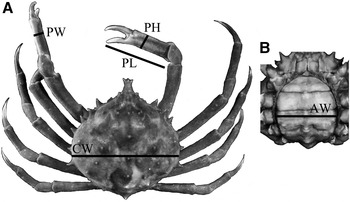
The measurements used for the morphometric analyses were based on a study carried out by Sal Moyano et al. (Reference Sal Moyano, Gavio and Maggi2011). For females, carapace width (CW) and abdomen width (AW) (closest to the fifth abdominal segment) were measured. For males, the length (PL), width (PW) and height (PH) of the propod, in addition to the carapace width (CW), were measured (Figure 1). Measurements were made using digital callipers (accuracy 0.01 mm) and, for individuals with a CW less than 5 mm, a microscope/stereoscope (Zeiss® Stemi SV6) was utilized, equipped with an image capture system (Zeiss Stemi 2000-C) (accuracy 0.0001 mm).
Libinia ferreirae Brito Capello, 1871. Morphological structures measured for morphometric growth analyses. (A) carapace width (CW), length (PL), height (PH) and width (PW) of the propodus; (B) abdomen width (AW).

Relative growth analyses followed the allometric model proposed by Huxley (Reference Huxley1950), in which equations were calculated for both males and females separately. Data were ln-transformed to fit a linear model and allometry (positive, negative or isometry) was verified by Student's t-test, at a 5% level of significance (α = 0.05) (Sampedro et al., Reference Sampedro, González-Gurriarán, Freire and Muiño1999).
In order to separate the morphometric phases, data from separated sexes were submitted to a ‘K-means clustering’ analysis (Sokal & Rohlf, Reference Sokal and Rohlf1979), commonly used in similar studies (see Sampedro et al., Reference Sampedro, González-Gurriarán, Freire and Muiño1999; Corgos & Freire, Reference Corgos and Freire2006; Hirose et al., Reference Hirose, Bolla and Negreiros-Fransozo2010). Such analysis is based on the establishment of predetermined groups, attributing each empirical point to any group by means of an iterative process that minimizes the variance inside groups and maximizes it among groups. Then, a discriminant analysis is applied in order to discriminate the characteristics of each group, allowing the reallocation of each point to the group that best represents it, classifying each group into distinct categories: immature (MI♂), adolescents (AD♂) and morphometrically mature adults (MM♂) for males; and immature (MI♀) and morphometrically mature adults (MM♀) for females. Subsequently, to verify the accuracy of each group, the slopes (b) and intercepts (a) of the equations of all groups were tested using covariance analysis (ANCOVA), at a 5% level of significance (α = 0.05) (Zar, Reference Zar1999).
It is important to note that, for males, the estimated value of morphometric maturity was based on the relationship, among all tested (PL, PW and PH vs CW), that presented the highest determination coefficient (r2 ), for all size groups, since this coefficient indicates the best fit of the equations to the empirical data (Zar, Reference Zar1999).
When an overlap between size groups was detected in all analyses (both gonadal and morphometric), individuals were grouped into size classes (interval: 3 mm of CW for gonadal analyses; 2 mm of CW for morphometric analyses) and the size at the onset of sexual maturity was determined by means of CW50 by fitting the following logistic function: %Adults = 1/1 + er(CW-CW50), where CW50 corresponds to the carapace size in which 50% of the individuals are considered mature and r corresponds to the curve slope (modified from Aguillar et al., Reference Aguillar, Malpica and Urbina1995; Vazzoler, Reference Vazzoler1996). For all maturity values, 95% confidence intervals were obtained using the bootstrap interaction method (Macro-supplement for Microsoft Excel®).
Nevertheless, when there was no overlap between size groups, morphometric maturity was determined based on the mean value between the largest individual from a size group and the smallest individual from the next size group.
RESULTS
A total of 346 crabs were collected. The proportion of females (68%) was significantly (χ2 < 0.001) higher than that of males (32%). For females (non-ovigerous, N = 97; ovigerous, N = 137), the CW ranged from 3.09 to 71.64 mm; the smallest ovigerous females had a CW of 38.08 mm. A size comparison between sexes showed a greater size variation of CW (6.29 to 77.84 mm) in males (N = 112) than in females. However, males showed a lower mean size (CW = 37.81 mm, against 42.19 mm of females) (Mann–Whitney rank sum test, U statistic = 15294; P = 0.012).
Gonadal maturity
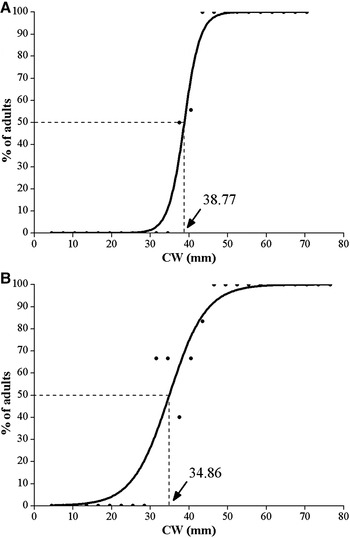
Based on the logistic curves, gonadal maturity (CW50) for females was a CW of 38.77 mm, with a 95% confidence interval between 37.49 and 40.12 mm (bootstrap interactions: 10 000) (Figure 2A), which is close to the size of the smallest functionally mature female (smallest ovigerous female: CW of 38.08 mm). The largest GI♀ had a CW of 41.3 mm.
Libinia ferreirae Brito Capello, 1871. Gonadal maturity (CW50) for females (A) and males (B).

For males, gonadal maturity (CW50) was at 34.86 mm, with a 95% confidence interval between 30.91 and 38.02 mm (bootstrap interactions = 10 000) (Figure 2B). The smallest males with rudimentary and developed gonad were, respectively, a CW of 31.83 and a CW of 35.12 mm; the largest GM♂ had a CW of 43.11 mm.
Relative growth and morphometric maturity
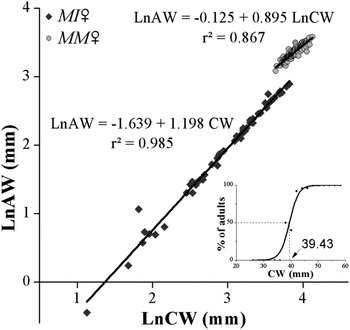
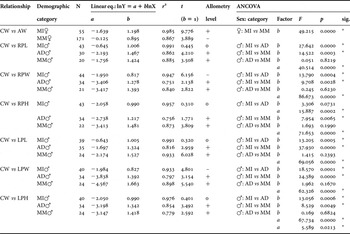
For females, the relative growth analysis indicated that the MI♀ group showed positive allometric growth and there was a terminal moult marked by an elevated change in AW and a decreased degree of allometry (ANCOVA, P < 0.05) (Table 1). There was an overlap in CW between 38.08 mm (smallest MM♀) and 45.69 mm (largest MI♀). The size increment from MI♀ to MM♀ was 0.9 mm for CW and 8.73 mm for AW (this calculation was performed with the mean values of the overlapping data). The morphometric maturity estimated was CW50 39.43 mm of CW, with a 95% confidence interval between 38.09 and 40.64 mm (bootstrap interactions: 10 000) (Figure 3).
Libinia ferreirae Brito Capello, 1871. Relationship between carapace width (CW) and abdomen width (AW), considering immature (MI♀) and mature (MM♀) females. r 2 = determination coefficient; Inset graph: CW50 results on the overlap between MI♀ and MM♀.

Libinia ferreirae Brito Capello, 1871. Relative growth analysis between males (♂) and females (♀), for all the relationships.

CW, carapace width; AW, abdomen width; RPL, RPW, RPH, length, width and height of the right propodus; LPL, LPW, LPH: length, width and height of the left propodus, respectively; MI, immature; AD, adolescent; MM, morphometric mature; N, number of individuals; a, linear coefficient; b, angular coefficient; r 2, determination coefficient; t, Student's t-test; 0, –, +, isometry, negative and positive allometries, respectively; ANCOVA, covariance analysis; sig., significant for α = 0.05.
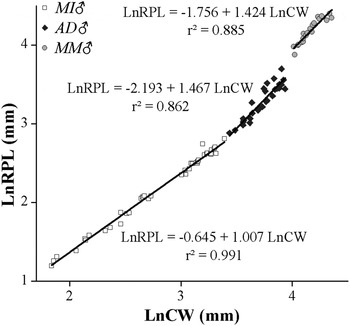
For males, the relative growth of the right propodus length (RPL), in relation to the CW, presented the highest determination coefficient (r2 ), among all relationships tested, and revealed three allometric groups: (1) MI♂ that showed isometry, small CW and PL; (2) AD♂ that showed high positive allometry in the chelipeds; and (3) MM♂, which also showed positive allometry and the largest CW and PL (Figure 4). A similar pattern was observed when analysing the left PL and the PH (both left and right), but only partially found when analysing the PW (both left and right) because the MI♂ group showed negative allometric growth (ANCOVA, P < 0.05) (Table 1).
Libinia ferreirae Brito Capello, 1871. Relationship between carapace width (CW) and right propodus length (RPL) for immature (MI♂), adolescent (AD♂) and morphometrically mature (MM♂) males. r 2 = determination coefficient.

Considering that there was no overlap among the size groups of the males, the morphometric maturity obtained for AD♂ and for MM♂ was, respectively, a CW of 30.41 and 53.25 mm. The covariance analysis (ANCOVA) significantly validated the separation of all groups for both males and females (Table 1).
DISCUSSION
The higher proportion of females, observed in the present results, diverges from previous studies performed for L. spinosa and L. emarginata, in which the abundance of males was higher (Sal Moyano et al., Reference Sal Moyano, Gavio and Maggi2011) or similar to that of females (DeGoursey & Auster, Reference DeGoursey and Auster1992). Therefore, it is likely that either there is a differential occupation of habitats between sexes and the distribution of males was not included in these samples or, indeed, the population has a higher abundance of females. However, reproductive capability may not be, necessarily, injured by the lower abundance of males, since Majoidea females, due to the presence of a seminal receptacle, do not require periodic copulae and can show several spawns with only one spermatic mass from a single copula (González-Gurriarán et al., Reference González-Gurriarán, Fernández, Freire and Muiño1998). Additionally, males can mate with several females in same season (Hartnoll, Reference Hartnoll1969; Diesel, Reference Diesel, Bauer and Martin1991; Sainte-Marie & Lovrich, Reference Sainte-Marie and Lovrich1994).
The sexual dimorphism observed between the largest individuals of each sex of L. ferreirae is expected, as females grow to a lesser extent than males in the terminal moult, probably since they allocate a higher amount of energy to egg production (Hartnoll, Reference Hartnoll and Bliss1982). Additionally, smaller females could facilitate the mating and post-copulatory guarding behaviour by MM♂, which could offer better protection to females during or after copula (Hartnoll, Reference Hartnoll1969; Conan & Comeau, Reference Conan and Comeau1986).
It was possible to observe that L. ferreirae presents different sizes at maturity for both sexes, in addition to the occurrence of the AD♂ group, as already reported for other Majoidea species (see Hartnoll, Reference Hartnoll1963, Reference Hartnoll1974; Sampedro et al., Reference Sampedro, González-Gurriarán, Freire and Muiño1999; Carmona-Suárez, Reference Carmona-Suárez2003; Sal Moyano et al., Reference Sal Moyano, Gavio and Maggi2011). Sexual maturity of Majoidea crabs is still much discussed, mainly in relation to the sequence in which gonad and morphometric maturity occurs.
Gonad maturity
Studies carried out on the species Maja squinado (Herbest, 1788), Hyas coarctatus Leach, 1815, Inachus dorsettensis (Pennant, 1777) and L. spinosa indicated that gonad and morphometric maturity could be coincident with similar body sizes for females (Bryant & Hartnoll, Reference Bryant and Hartnoll1995; Sampedro et al., Reference Sampedro, González-Gurriarán, Freire and Muiño1999; Sal Moyano et al., Reference Sal Moyano, Gavio and Maggi2011), as observed in our investigation. However, this does not seem to be a rule for Majoidea crabs; gonad maturity can occur after morphometric maturity (see Jones & Hartnoll, Reference Jones and Hartnoll1997) or before, as attested by Alunno-Bruscia & Sainte-Marie (Reference Alunno-Bruscia and Sainte-Marie1998) studying Chionoecetes opilio (O. Fabricius, 1788), in which it was found that females acquired gonad maturity first and subsequently reached morphological maturity with the terminal moult.
For males, gonad maturity was found to occur prior to morphometric maturity. It is proposed that this pattern could favour the reproductive success of AD♂ males, like an opportunistic copula, especially when there is a high abundance of reproductive females in the environment or when MM♂ are rare in the environment, as suggested by Sampedro et al. (Reference Sampedro, González-Gurriarán, Freire and Muiño1999) and Sal Moyano et al. (Reference Sal Moyano, Schiariti, Gilberto, Diaz Briz, Gavio and Miazan2012). Thus, AD♂ could remain in prepubertal intermoult for a longer time before they perform their terminal moult (Laufer & Ahl, Reference Laufer and Ahl1995; Sampedro et al., Reference Sampedro, González-Gurriarán, Freire and Muiño1999; Sal Moyano & Gavio, Reference Sal Moyano and Gavio2012). Elner & Beninger (Reference Elner and Beninger1995) have suggested that C. opilio AD♂ bearing spermatophores inside the vas deferens could opportunely copulate or, according to Laufer & Ahl (Reference Laufer and Ahl1995), increase their mating opportunities by ‘sneak’ mating. Indeed, this behaviour was reported for L. spinosa by Sal Moyano & Gavio (Reference Sal Moyano and Gavio2012), as AD♂ successfully copulated when MM♂ were absent or in agonistic behaviour with other MM♂ males. However, further studies should be performed, under laboratory conditions, to verify if these copulas could produce a viable brood.
Relative growth and morphometric maturity
For L. ferreirae females, the relative abdominal growth suggests a clear separation between immature individuals and those that are able to reproduce, a pattern commonly observed for Majoidea, wherein such a morphometric split occurs after the terminal moult, concomitant with sudden alterations in the allometric coefficients. Positive allometry (b = 1.19) during the immature phase indicates that the abdomen is being prepared to become an embryo-incubating chamber, a process that will be completed after the terminal moult and consequent beginning of the mature phase (Hartnoll, Reference Hartnoll1974, Reference Hartnoll and Bliss1982; Sampedro et al., Reference Sampedro, González-Gurriarán, Freire and Muiño1999).
Regarding L. ferreirae males, relative growth relationships revealed the existence of two significantly different groups of allometric growth (the MI♂ and AD♂ groups) and one size allometry group (MM♂) where the increase is the result of males of different sizes undergoing their terminal moult. Morphologically mature males presented a higher allometry level, associated with cheliped size, than MI♂ and AD♂. This fact is related to the terminal moult, which provides high sexual dimorphism in males, as was also found in M. squinado and L. spinosa by Sampedro et al. (Reference Sampedro, González-Gurriarán, Freire and Muiño1999) and Sal Moyano et al. (Reference Sal Moyano, Gavio and Maggi2011), respectively. Many authors have proposed that the male morphotypes are a result of the ontogenetic process they go through to reach maturity and ensure reproductive success (Hartnoll, Reference Hartnoll1963; Homola et al., Reference Homola, Sagi and Laufer1991; Laufer & Ahl, Reference Laufer and Ahl1995). Nevertheless, the terminal moult is not necessarily the maturation moult, because spermatophores can be found inside spermatic ducts even before terminal moult, as assumed by Elner & Beninger (Reference Elner and Beninger1995), Laufer & Ahl (Reference Laufer and Ahl1995), Rotllant et al. (Reference Rotllant, Takac, Liu, Scott and Laufer2000) and Sal Moyano et al. (Reference Sal Moyano, Gavio and Cuartas2010). It is also important to note that AD♂ are grouped based only on morphology because of their small cheliped and are close to the pubertal moult. However, they can include physiologically mature or immature individuals.
A larger cheliped is of great importance in reproduction, because it is useful for both combat and female protection during mating and may be a decisive factor in the selection of the male by females (Sal Moyano & Gavio, Reference Sal Moyano and Gavio2012). Therefore, although the occurrence of mating by AD♂ crabs could be an important reproductive strategy in situations where larger animals (with larger secondary sexual characters) are rare or absent (López-Greco & Rodríguez, Reference López-Greco, Rodríguez, Scharan and Valupel Klein1999), only MM♂ present post-copulatory guarding behaviour, such as embracing and female guarding when other males approach, while AD♂ rapidly depart from the female after mating (Laufer & Ahl, Reference Laufer and Ahl1995; Sal Moyano & Gavio, Reference Sal Moyano and Gavio2012). In addition, AD♂ seem to imitate female behaviour when they are close to MM♂, thereby avoiding confrontation and so increasing their mating opportunities in opportunistic cohorts (Laufer & Ahl, Reference Laufer and Ahl1995; Sal Moyano & Gavio, Reference Sal Moyano and Gavio2012).
Therefore, further laboratory experiments aiming to observe mating among females and the different male morphotypes are necessary to better understand functional maturity and its relationship with the reproductive process. Furthermore, studies concerning population structure, distribution, growth and longevity should be conducted in order to understand which factors drive the population biology of L. ferreirae.
ACKNOWLEDGEMENTS
The authors are grateful to many colleagues from the Group of Studies on Crustacean Biology, Ecology and Culture (NEBECC) and the Laboratory of Biology of Marine and Freshwater Shrimp (LABCAM) for their assistance with sampling and laboratory analyses. All the sampling was conducted according to the licence provided by the Brazilian Institute of Environment and Renewable Natural Resources (IBAMA) to A. L. Castilho.
FINANCIAL SUPPORT
We are grateful to the São Paulo Research Foundation (Biota/FAPESP, process #2010/50188-8 and #2014/13770-1), to CAPES CIMAR (financial support and post-graduation scholarship No. 23038.004310/2014-85) and to the Brazilian Council of Scientific and Technological Development (CNPq) (Research Scholarship PQ 308653/2014-9) for providing financial support.