Introduction
Dr. Anna Pou, a surgeon on the faculty of Louisiana State University School of Medicine (New Orleans, Louisiana USA), was supervising residents at Memorial Medical Center in New Orleans when Hurricane Katrina hit on Monday, August 29, 2005. Dr. Pou remained at the hospital following the storm with other health care providers who were marooned, working in almost unimaginably difficult conditions, while awaiting rescue. For four days, a small staff struggled to care for critically ill patients in a dark building with no electric power, no fresh water, a flooded first floor, a nonfunctional sanitation system, and an interior temperature above 100°F.Reference Okie 1
At least 34 patients died at Memorial Medical Center during and after the storm, and shortly thereafter, media reports began to suggest that some had been euthanized. In July 2006, Dr. Pou and two nurses were arrested, accused of administering morphine and midazolam to kill four elderly patients. The filing of criminal charges for failure to meet expected standards of care made the growing concern among health professionals about care provided during extreme emergencies or disasters all too real.Reference Gebbie, Peterson, Subbarao and White 2 Questions arose around the world as to what may lead to censure, penalties from licensing boards, or even lawsuits.
When the Attorney General agreed not to pursue charges against the nurses in exchange for their testimony against Dr. Pou, members of the community rallied in support of Pou, calling her a hero for remaining on duty when other doctors had fled. Numerous medical organizations issued statements in her defense.Reference Okie 1 In August 2007, the grand jury failed to indict on possible murder charges in the deaths of these four patients, plus five others on the same floor. But had the damage already been done? Will health care workers question their duty to treat next time they are faced with extreme circumstances? Ethically speaking, when does the right to protect oneself from serious risk outweigh the duty to treat patients in need?
Updated following the September 11th, 2001 terrorist (New York USA) attacks and subsequent anthrax threat, the American Medical Association’s (AMA; Chicago, Illinois USA) “Social Contract with Humanity” provides some guidance around professional responsibility:
We, the members of the world community of physicians, solemnly commit ourselves to…apply our knowledge and skills when needed, though doing so may put us at risk.
Further:
...because of their commitment to care for the sick and injured, individual physicians have an obligation to provide urgent medical care during disasters. This ethical obligation holds even in the face of greater than usual risks to their own safety, health, or life. 3
While the AMA has moved in the right direction by outlining professional obligation, it fails to transparently detail how failure to comply with these obligations will be managed and whether any limitations should be placed on this professional responsibility.
Recent Australian research exploring these questions from the prehospital perspective identified that paramedic decisions around professional obligation and responsibility will largely depend on their individual risk assessment, perception of risk, and their value systems. The majority (86%) of paramedic participants favored the idea that duty to treat should not be considered an unlimited and absolute obligation.Reference Smith, Burkle, Gebbie, Ford and Bensimon 4 Upon further reflection and discussion, paramedic participants began to contemplate the idea of legitimate or acceptable limits on a paramedic duty to treat, but failed to address what would constitute an “acceptable limitation.”
This study builds upon this existing Australian research to further explore this idea of acceptable limitations on duty to treat during disaster and to identify a range of acceptable limits from the perspectives of both paramedics and members of the community. Identifying these acceptable limits and understanding the ethical-social expectations of paramedics in advance of a disaster may assist the prehospital workforce to respond willingly and appropriately.
Methods
This research employed qualitative methods to gather perspectives of both paramedics and community members living in Victoria, Australia. Focus groups and interviews were developed utilizing an adapted Grounded Theory approach. Grounded Theory refers to a specific methodology on how to get from systematically collecting data to producing a multivariate conceptual theory.Reference Glaser and Strauss 5 , Reference Glaser 6 The classic approach to Grounded Theory allows the researcher to explore a research question or concept with no prior hypothesis. Therefore, the data collected can be evaluated in a completely impartial manner.Reference Locke 7 Essentially, the researcher is a “blank slate” and will have no pre-conceived ideas as to how the research question or concept will be answered.
While the core goal of Grounded Theory was very suitable to this research, the expectation that the researchers would be entirely impartial in their outcomes evaluation was not realistic, especially given the work experience of the researchers. Therefore, some aspects of the Grounded Theory approach were adapted to accurately reflect the qualitative approach used in evaluating the findings of the focus groups and interviews.
More recent work by one of the founders of Grounded Theory8,9 builds on the classic Grounded Theory but acknowledges a researcher’s prior knowledge and experience. Using this modified approach to Grounded Theory, the impact of the researcher is more extensive, with research methods actually incorporating the background of the researcher rather than discounting it.
Research participants were invited to participate through a mix of convenience and snowball sampling methods. Participants were not financially reimbursed for their participation. The focus group discussions were 90 minutes in length and were held in five different locations across Victoria, Australia (two metropolitan locations and three regional/rural locations). All focus groups and interviews were audio-recorded and transcribed. The focus groups and interviews were unscripted, but several prompts around defining duty to treat and identifying acceptable standards of care were utilized to help guide the discussions. Thematic analysis was completed using NVivo (QSR International; Melbourne, Australia).
Ethics approval was granted by the Edith Cowan University Committee on Ethical Research on Humans (Joondalup, Western Australia) to conduct focus groups with paramedics in Australia (Project Number: Project 13448).
Participants
Five focus groups and 13 interviews, with a total of 48 participants consisting of 19 paramedics and 29 community members, were conducted. There was a mix of both paramedics and community members in all five focus groups, and a total of 26 females and 22 males participated in the focus groups and interviews.
Paramedic Participants
Paramedic participants ranged in age from 29 to 52 years (32% identified as female and 68% identified as male); 43% of paramedic participants had more than 10 years of experience working as a paramedic (range 1.5 years to 14 years).
Community Participants
Community participants ranged in age from 35 to 64 years (68% identified as female and 32% identified as male); 62% of community participants identified that they had utilized emergency prehospital care within the previous five years. Two participants were directly related to a paramedic; however, their relatives were not present at the focus group the participants attended.
Results/Discussion
Duty to Treat
Duty to treat as a concept was not comprehensibly understood by either paramedic participants or community participants. Paramedics indicated that they understood their duty to treat during normal, everyday operations; however, there were mixed ideas around whether this duty expanded from everyday operations with an individual patient as the focus to extreme circumstances such as disasters, where the point of care may often transfer to the greater population. Community members often used the terms “duty,” “obligation,” “responsibility,” and “role” in an inter-changing manner – highlighting the confusion as to what duty to treat actually meant:
If they put on that uniform… you know, if they have decided that this is the job they want, then yes, I see that as having a certain level of duty attached (Community Member – female).
I think it’s their job, you know, their role. So yes, there is a certain level of duty or obligation that comes with that (Community Member – male).
When asked if paramedics have a duty to treat during extreme circumstances, like a disaster, all 48 participants agreed that paramedics have some form of duty; however, a clear definition of what that duty actually is was not agreed upon in any of the focus groups, nor was clearly articulated in any of the interviews. It appeared that the concept of duty to treat during a disaster was still largely ambiguous. Discussions on this topic usually veered towards a comparison of disaster types, with most participants (both paramedic [86%] and community member [95%]) agreeing that paramedics have a clear duty to treat during more “conventional” disasters, such as transport, non-terrorist, and single-perpetrator-related events. Of note, Melbourne, the capital city of Victoria, had witnessed two non-terrorist-related, vehicular-moded, mass-casualty incidents within the past two years. Much of the discussion around duty to treat initially focused on these events, given their salience in the participant’s memories, and all participants agreed that paramedics had an absolute duty to treat during these types of events.
There was much greater variance, however, when duty to treat was considered in the context of terrorist-related events. The September 11th terrorist attacks were raised in four of the five focus groups and just under one-half of the interviews as an example of how responding to terrorist attacks can directly impact paramedics. All paramedic participants indicated that they had a clear duty to treat following a terrorist attack, despite acknowledging the associated risk of response. In contrast, less than one-half (42%) of community members expected paramedics to respond following a terrorist-related event:
We saw what happened to all those poor emergency services workers on 9/11, they ran into those towers trying to help people, and so many of them died…I don’t know, I just think if that was my husband, I wouldn’t want him putting his life in danger, I just don’t think that is part of the job (Community Member – female).
All focus groups and interviews discussed paramedic duty to treat within the context of infectious disease outbreaks and pandemics. Both paramedic and community member participants found it difficult to clearly articulate what a paramedic’s role and duty to treat were during these types of extreme circumstances. When asked if paramedics have an obligation to work during a disaster like a pandemic, responses varied widely and covered a wide spectrum of views ranging from those who posited an absolute unlimited duty to treat, to those who maintained that a limited duty existed.
One paramedic participant posed the question: “Don’t we accept a professional obligation when we become a paramedic, and as such, accept a certain level of risk”? This was met with a range of responses focusing on acceptable levels of risk and the question of whether there is an automatic expectation that paramedic health and well-being comes second to that of their patients. All paramedic participants agreed that being a paramedic comes with some level of risk; community members were less likely to expect paramedics to respond despite personal risk:
This has been a really interesting discussion, I never really thought about it before, but now… well, I just don’t expect a paramedic to put themselves at risk to treat me, either during a disaster, or even on a normal day. I don’t think it’s ever ok to expect them to put their life on the line. Now police and fire, well I think that’s a different thing. They train for it, you know, risk and hazards. But paramedics, no. And I am not just saying that because there are a few of you here in the room today (laughter) (Community member – male).
Participants started to consider potentially placing limitations on duty to treat, with one community member suggesting that:
Paramedics should not have to put themselves at risk or be put in situations where, like, going to work means that you might catch some disease or be exposed to something and then take it home to your wife and kids – I think we need to remember that this is just a job (Community member – female).
Likewise, a paramedic suggested that he accepted that on an individual level, he should retain the right to refuse. However, he indicated that as a health care professional, he would need to justify any refusal to work:
You know, I can’t just say I don’t feel like working, or I don’t want to work.
I would have to actually have a good reason for why (Paramedic, male).
These discussions opened up the possibility that there can be legitimate limits that could justify a paramedic’s decision to “opt out” of their duty to treat. Eventually, each group of paramedics and community members began to articulate what could constitute “acceptable limits.”
Acceptable Limits on Duty to Treat
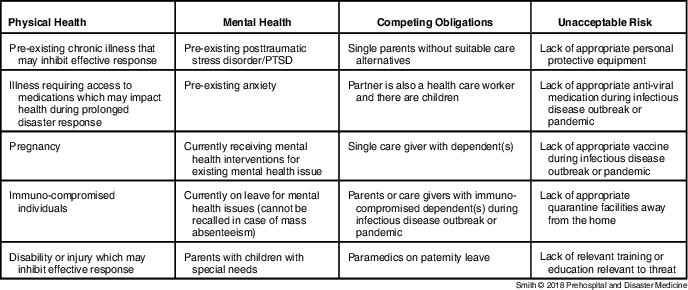
Research participants were asked to consider what would be acceptable reasons for paramedics not having to respond during a disaster. Responses to these questions were used to develop a range of acceptable limitations. The acceptable limitations identified by the research participants are presented in Table 1.
Acceptable Limitations on Paramedic Duty to Treat During Disaster

Both paramedic and community member participants agreed that acceptable limitations on paramedic duty to treat during disaster are required. Thematic analysis of the transcripts of the focus groups and interviews identified four key themes, or re-emerging topics, during the discussion of limits on duty to treat. These recurring themes were: physical health; mental health; competing personal obligations; and unacceptable levels of personal risk. Within each of these themes, participants provided specific examples of when these limits could be applied.
These individual examples were further analyzed to identify recurring sub-themes. For example, within the key theme of physical health, 14 participants suggested that paramedics with existing illnesses, such as asthma, diabetes, and heart disease, could have their duty to treat limited when these illnesses could impact on the paramedic’s ability to fulfill their role. These responses were grouped together as one sub-theme: pre-existing chronic illness that may inhibit effective response. The reported sub-themes are deliberately broad to ensure they cover as many of the individual examples provided throughout the focus group discussions and interviews.
The findings of this research were consistent with existing literature, suggesting a lack of clarity and consensus of what is expected of health care workers in disasters and epidemics.Reference Strauss and Corbin 9 – Reference Bensimon, Tracy, Bernstein, Shaul and Upshur 11 These findings also echo previous research exploring the limitations of duty to treat and professional obligations.Reference Sokol 12 – Reference Reid 15 The researchers identified that while some paramedics felt that they have an unlimited duty to care, overwhelmingly, the consensus among the 48 paramedic and community member participants is that they do not. When attempting to categorize and position themselves, around 75% of participants placed themselves somewhere in the middle – arguing that while paramedics do indeed have professional obligations, there have to be limits in place and an agreement by paramedics and employers alike that duty to treat during disaster is neither absolute nor unlimited. This research has also made a significant new contribution of knowledge in identifying potential limitations on duty to treat during disaster, which could be transferrable to other health care workers.
The Impact of Paramedic Registration
The Australian National Registration and Accreditation Scheme (NRAS) was established in 2010 to ensure the safety of consumers of health services by registering health practitioners. Under the National Scheme, National Boards and the Australian Health Practitioner Regulation Agency (AHPRA; Melbourne, Australia) work together to ensure that practitioners are appropriately qualified and competent to practice a registered health profession. National Boards exercise functions in accordance with the Health Practitioner Regulation National Law, as in force in each Australian State and Territory. Australian Health Ministers agreed on the November 6, 2015 to progress the inclusion of paramedics under the National Scheme, and on March 24, 2017, Ministers met as the Australian Health Workforce Ministerial Council to consider a draft of the Health Practitioner Regulation National Law Amendment Bill 2017 that would amend the national law to regulate paramedics under the National Scheme.
Subject to the national law being amended, Australian paramedics will be able to be registered nationally for the first time, the title “paramedic” will be protected nationally, and paramedicine will be a registered health profession. National regulation of paramedics is expected to start in the second half of 2018. Once paramedic regulation is official, an associated code of ethics of prehospital response should be developed as a priority, which should give some guidance to paramedics regarding duty to respond.
Limitations
The findings reported in this publication are based on the responses of a small number of paramedics (n=19) and community members (n=29) from one state in Australia. Future research should repeat these focus groups with a greater number of paramedics and community members from across Australia. It will also be of interest to replicate this research study in the future once paramedics are included in the NRAS and Australian paramedics become registered health care professionals with an associated prehospital code of ethics. Further research may also expand on the discussion of duty to respond from an ethical context and focus also on the moral and legal aspects that influence this concept.
The qualitative methodologies utilized throughout this research allow for exploration of individual perceptions, feelings, and needs. They are not, however, without their limitations. For example, descriptions of risks, hazards, or situations experienced by a research participant will potentially be biased by their reliability of recall, previous experience, and the way in which the discussion of the risk, hazard, or situation is framed. Furthermore, an individual’s intrinsic psychological processes may also influence how they experience certain types of events.
Conclusion
The Australian prehospital profession has not yet facilitated a comprehensive discussion regarding paramedic role and responsibility during disasters.
Whether paramedics have a duty to treat under extreme conditions and what acceptable limitations may be placed on such a duty require urgent consideration. This qualitative research encouraged discussion within the paramedic profession and broader community on this important issue and identified that both paramedic and community members agree that acceptable limitations on paramedic duty to treat during disaster are required. These limitations should be based on consideration of paramedic’s physical health, mental health, their competing personal obligations, and personal risk. The authors have provided an important new contribution of knowledge by identifying acceptable limitations on paramedic duty to treat from the perspective of both paramedics and the community. However, it is only with the engagement of a more broadly representative segment of the prehospital profession and greater Australian community that appropriate guidance on limiting standards of care under extreme conditions can be developed and integrated within prehospital care in Australia.