In 2015, the U.S. Department of Health and Human Services (HHS) reported that 55 million women had gained access to all contraceptives approved by the U.S. Food and Drug Administration for free, after Affordable Care Act (ACA) regulations required most health insurance plans to cover “preventive health care services without cost sharing” (HHS 2015). Two and one-half years later, the Donald Trump administration issued new rules directly threatening those gains by expanding ACA exemptions for people with religious or moral objections to birth control (IRS, EBSA, and HHS 2017). In response, women's organizations quickly mobilized their allies in advocacy organizations and the mass public. The American Association of University Women (AAUW), the Center for Reproductive Rights, and the Center for American Progress collected signatures from other organizations on a comment opposing the changes. Concurrently, the National Women's Law Center (NWLC) emailed an action alert to members of its mailing list, encouraging women to submit their own comments to the Trump administration, stating “We need you to submit your comment and demand HHS rescind these harmful and discriminatory rules immediately.” As it had been a few years earlier, when 32 women's organizations commented on the Barack Obama administration's contraception mandate (English Reference English2019a), rulemaking was back in the spotlight, and women's organizations were there for it.
The debate over contraceptive coverage was just one of many recent rules that had important consequences for women. Since 2012, federal agencies have issued or eliminated rules on issues such as funding for family planning clinics that provide abortions, student loans, racial segregation and other forms of discrimination in federal housing, and wages for tipped workers (HUD 2018; U.S. Office of the Assistant Secretary for Health 2018; U.S. Office of Population Affairs 2016; U.S. Office of Postsecondary Education 2018; US Department of Labor 2017). Research has found that while rulemaking has long been associated with business groups lobbying on rules related to the government's involvement in the economy, women's advocacy organizations, which I define as organizations (both liberal/feminist and conservative/anti-feminist) whose missions indicate that they explicitly focus on representing women or their interests in politics and/or the policy-making process, also participate in rulemaking. Between 2007 and 2012, 82 women's organizations submitted 1,021 comments in response to 264 rules (English Reference English2019b).
These findings and the increasing importance of rulemaking raise important questions about the biases that could result from women's organizations’ participation in this process. First, are some women's organizations more likely to participate in rulemaking than others? If so, are they wealthier and more likely to be structured like political insiders (e.g., to be located in DC, hire lobbyists, register to lobby, and form political action committees) than nonparticipants? Second, how do women's organizations participate in the rulemaking process? Do they follow the template for participation set by the business groups and economic interests that tend to dominate the process (Furlong and Kerwin Reference Furlong and Kerwin2005; Golden Reference Golden1998; Haeder and Yackee Reference Haeder and Yackee2015; Strolovitch Reference Strolovitch2007; Yackee Reference Yackee2011; Yackee and Yackee Reference Yackee and Yackee2006)? Or do they participate in unique ways because they focus on representing women in the policy-making process, articulating their interests, mobilizing their constituents and supporters, and creating a sense of women's solidarity in addition to pursuing the types of technical policy changes that other organized interest often recommend (Grossman Reference Grossmann2012; Katzenstein Reference Katzenstein1998; Kenney Reference Kenney2003; Strolovitch Reference Strolovitch2007; Weldon Reference Weldon2011; Woliver Reference Woliver2018)? Third, given their relatively limited resources and unique goals, do women's organizations rely on relatively low-cost participation methods (e.g., coalition comments) more often than methods that are more expensive but potentially more influential (e.g., informally contacting agencies or writing their own unique comments)?
By answering these questions, I show that women's organizations’ participation in rulemaking follows a different template than the one used by their counterparts in business and economic groups. However, even women's advocacy organizations are subject to biases in participation that favor well-resourced groups with greater (potential) access to bureaucratic officials. Most notably, I find that a relatively small number of women's organizations frequently participate in rulemaking, typically using methods that do not require many resources or insider access to rulemakers, such as signing on to coalition comments. Coalition participation may be appealing because it allows women's organizations to “get the most bang for their buck” by simultaneously lobbying for policy changes, articulating their shared interests to allies and constituents, and taking actions that they can use to claim credit with their constituents and/or other supporters. Unfortunately, women's organizations’ preference for low-cost, coalitional advocacy may also mean that women's organizations’ participation in rulemaking could be susceptible to different biases (e.g., biases toward advantaged women that Strolovitch [Reference Strolovitch2007] found exist within coalitions) than the ones typically associated with business interests’ dominance in the rulemaking process.
WOMEN'S ORGANIZATIONS’ UNIQUE APPROACH TO RULEMAKING
Rulemaking occurs after Congress passes a law. The process allows bureaucrats, through consultation with interested citizens and organizations, to “fill in” many of the important technical details (e.g., for the ACA, which preventive services insurance plans were required to cover without a copay and which plans would be exempt from those requirements) that are needed to implement laws on a daily basis (Kerwin and Furlong Reference Kerwin and Furlong2011). Though there are some variations, the process as laid out in the Administrative Procedure Act (APA) of 1946 is relatively simple, with less potential for gridlock and far fewer veto points than the legislative process. Agencies draft a proposed rule, publish it in the Federal Register, collect and consider comments on the proposed rule from interested citizens and organizations, and then issue a final rule (Kerwin and Furlong Reference Kerwin and Furlong2011). When agencies review the comments, they have considerable discretion to accept or reject commenters' suggestions as they see fit (Kerwin and Furlong Reference Kerwin and Furlong2011). This simple process is increasingly important, as agencies now implement thousands more rules than Congress passes laws, and an estimated 90% of laws now originate in agencies, not Congress (Carpenter et al. Reference Carpenter, Judge-Lord, Libgober and Rashin2020; GAO 2017; U.S. Congress 2017; Warren Reference Warren2004, 64). Given these developments, 40% of interest group lobbying now occurs after Congress passes a law (You Reference You2017). Often, the process is biased in favor of corporations and businesses because they participate at higher rates and/or submit higher-quality comments than other participants, leading agencies to include more of their suggestions in their final rules (Furlong and Kerwin Reference Furlong and Kerwin2005; Golden Reference Golden1998; Haeder and Yackee Reference Haeder and Yackee2015; Yackee Reference Yackee2011; Yackee and Yackee Reference Yackee and Yackee2006).
Studying women's organizations’ participation in rulemaking provides an opportunity to examine how well previous findings about businesses’ advantages “travel” from economic interest groups to potentially biased advocacy organizations. We already know that superior resources drive biases toward business by allowing them to participate in rulemaking more often and more effectively (Furlong and Kerwin Reference Furlong and Kerwin2005; Golden Reference Golden1998; Haeder and Yackee Reference Haeder and Yackee2015; Yackee Reference Yackee2011; Yackee and Yackee Reference Yackee and Yackee2006). Those biases also have significant substantive political and economic effects. For example, banks earned an additional $3.2 to $7 billion when they participated in the rulemaking process (Libgober and Carpenter Reference Libgober and Carpenter2018). We also know that advocacy organizations, public interest groups, and citizen groups do not participate in rulemaking as frequently as business groups (Furlong and Kerwin Reference Furlong and Kerwin2005; Golden Reference Golden1998). But we do not know as much about how those differences in participation are related to the differences between advocacy organizations and economic interests in terms of their political goals.
Unlike economic interests or business groups, advocacy organizations focus on representing marginalized social groups during the policy-making process (e.g., women, people of color, the poor, and/or members of the LGBTQ community), articulating group interests to policy makers and members of the public, and cultivating a sense of group consciousness or identity based on group members’ linked fate (Grossman Reference Grossmann2012; Katzenstein Reference Katzenstein1998; Kenney Reference Kenney2003; Strolovitch Reference Strolovitch2007; Weldon Reference Weldon2011; Woliver Reference Woliver2018). Typically, they achieve these goals by sharing policy-relevant information, such as research reports, personal stories, or policy proposals, through meetings with policy makers, invited testimonies to policy makers, comment- or letter-writing campaigns, public events, legal briefs, social media, and the media. Like economic interests, advocacy organizations have their own problems with bias, and they are more likely to focus on the issues and concerns of their most advantaged members (English Reference English2019a, Reference English2019b; Strolovitch Reference Strolovitch2007). Consequently, questions about biases and exclusion have been at the center of women's activism for 50 years. From the lesbian exclusion policies of the National Organization for Women (NOW) in the late 1960s to recent concerns about racial and ethnic exclusions leading up to the 2017 Women's March, women's organizations have long been challenged to address their biases in favor of middle- and upper-class white heterosexual women (Rosen Reference Rosen2006; Stockman Reference Stockman2017). Building on these insights, I focus on women's organizations’ participation in rulemaking to provide a case study of how advocacy organizations that have long wrestled with questions about bias and inclusion lobby bureaucrats.
I assume that women's organizations, as advocacy organizations, participate in rulemaking to achieve two goals: (1) securing the implementation of their preferred policy outcomes and (2) fortifying long-term support from the members and/or supporters they claim to represent. Thus, in the short term, they behave like other organized interests and submit comments to rulemakers to encourage them to make changes to their proposed rules, lay the groundwork for legal challenges to agencies’ final rules, or sound the alarm about women's policy concerns (Carpenter et al. Reference Carpenter, Judge-Lord, Libgober and Rashin2020; Furlong and Kerwin Reference Furlong and Kerwin2005; Golden Reference Golden1998; Haeder and Yackee Reference Haeder and Yackee2015; Lubbers Reference Lubbers2019; McCubbins and Schwarz Reference McCubbins and Schwartz1984; Yackee Reference Yackee2011; Yackee and Yackee Reference Yackee and Yackee2006; Wagner Reference Wagner2010). However, in the long term, they participate in rulemaking to cultivate and promote women's shared group consciousness and develop a demonstrated record for action among their members or constituents that will help the organization maintain itself by attracting dues-paying members or active participants in the future. For example, the action alert that NWLC issued in response to the Trump administration's revised contraception rules encouraged individuals to identify with the NWLC and/or women as a group by including language about “our (emphasis added) health, rights, and equality” and how “We [implying women, emphasis added] can't go back” to the days when we have to choose “between putting food on the table and basic health care.” It even concluded with text that said, “Thank you, as always, for resisting with us” (emphasis added) and a donation button that linked to the NWLC's fundraising website.
Thus, just as organized interests use amicus curiae briefs to fundraise and claim credit and members of Congress use speeches and legislative activities to develop a reputation for action (Collins Reference Collins and Grossman2014; Hansford Reference Hansford2004; Mayhew Reference Mayhew1974; Solberg and Waltenburg Reference Solberg and Waltenburg2006), women's organizations’ action alerts and comment-writing campaigns can help mobilize supporters and fundraise, in addition to promoting shared group interests and specific policy changes. These solidarity and fundraising goals may be particularly important for women's organizations because they claim to represent a large, diverse group (American women), which makes them more likely to face collective action problems and organizational maintenance issues than smaller, more narrowly defined groups, such as those that represent businesses or other economic interests (Olson Reference Olson1965; Schattschneider Reference Schattschneider1960; Schlozman, Verba, and Brady Reference Schlozman, Verba and Brady2012; Walker Reference Walker1983). Rulemakers’ biases in favor of marginal changes and/or partisan/ideological misalignments with the current administration mean that women's organizations may not be able to achieve both goals simultaneously (English Reference English2016b; Golden Reference Golden1998; Sapiro 2008; West Reference West2004; Yackee and Yackee Reference Yackee and Yackee2006). However, their attention to two different audiences (bureaucrats and their supporters) and two different goals (policy change and group consciousness/organizational maintenance) means that women's organizations have strong incentives to participate in rulemaking, even when their comments and participation may not produce substantive policy changes in the short run.
As political actors who claim to represent women, women's organizations may also participate in rulemaking because it allows them to share their comments and concerns with a group of policy makers who better represent women descriptively. In 2014, women accounted for 43.2% of federal employees and held 34.0% of managerial or supervisory positions in the Senior Executive Service, compared with only 18.7% of seats in the U.S. Congress (Center for American Women and Politics 2018; OPM 2018a, 2018b). Therefore, when women's organizations lobby bureaucrats, they can increase the chances that policy makers will understand the full range of women's experiences and respond to their suggestions (Dolan Reference Dolan2000; Mansbridge Reference Mansbridge1999).
At a more macro level, participating in rulemaking allows women's organizations to substantively represent women by providing them with an opportunity to debate which proposed rules and changes would best serve women's interests. For example, when women's organizations submit comments on Regulations.gov, they simultaneously address two important audiences: their constituents who identify as women and the agencies that will implement the rules. Thus, their form letter comments (like the NWLC one described earlier) help make citizens aware of the process and mobilize them to submit their own comments (Balla et al. Reference Balla, Beck, Cubbison and Prasad2019; Balla et al. Reference Balla, Beck, Meehan and Prasad2020; Benjamin Reference Benjamin2006; Coglianese Reference Coglianese2006; English Reference English2019a, Reference English2019b; Lubbers Reference Lubbers2010), and they give the women whom they engage in the debate the opportunity to reflect on whether women's organizations are, in fact, serving their interests. For example, if a NWLC supporter goes on the organization's website, reads the NWLC's comment, and agrees with it, she can submit her own comment (using the NWLC's template or writing one herself) that legitimizes and reinforces the way the organization represented and discussed her interests. Conversely, if she disagrees with the comment that the NWLC posted, she may submit her own comment that challenges the ways the organization depicted her interests. Through this iterative process, women's organizations’ comments contribute to the process of constructing women's policy interests from the ground up by giving a diverse array of women the opportunity to debate and discuss their needs. Because economic interests are often more clearly and narrowly defined (Olson Reference Olson1965; Schattschneider Reference Schattschneider1960; Schlozman, Verba, and Brady Reference Schlozman, Verba and Brady2012; Walker Reference Walker1983), economic interest groups may not be as motivated to use their rulemaking participation to engage in this iterative group representation process. Crucially, women receive these representational benefits even if agencies do not respond to women's organizations’ comments or low-quality form letter comments (Balla et al. Reference Balla, Beck, Meehan and Prasad2020; Benjamin Reference Benjamin2006; Coglianese Reference Coglianese2006; Lubbers Reference Lubbers2010). This procedural approach to representation also aligns with recent research indicating that women's representation is a broader process or series of ongoing debates that occur in a wide variety of venues and stages of the process (Celis et al. Reference Celis, Childs, Kantola and Krook2014; Escobar-Lemmon and Taylor-Robinson Reference Escobar-Lemmon, Taylor-Robinson, Escobar-Lemmon and Taylor-Robinson2014).
In addition to placing a greater emphasis on group solidarity, advocacy organizations, such as women's groups, may also focus on a wider array of rules than business groups or other economic interests, leading them to participate in unique ways. Much of what we know about business interests and potential biases toward business during rulemaking comes from studies primarily focused on the implementation of regulatory rules about the degree to which the government should regulate the economy (e.g., Furlong and Kerwin Reference Furlong and Kerwin2005; Haeder and Yackee Reference Haeder and Yackee2015; Yackee and Yackee Reference Yackee and Yackee2006). However, women's advocacy organizations often participate in rulemakings related to redistributive or moral policy issues, which produce different kinds of politics that could incentivize different forms of rulemaking participation (English Reference English2016b, Reference English2019a, Reference English2019b). Both types of policy are ripe for opening up the scope of conflict and cultivating a sense of group identity and linked fate. Redistributive policies typically allocate or reallocate wealth, property, and/or rights among different politically or socially relevant groups in society (Lowi Reference Lowi and Noll1985). They also produce clear winners and losers, highly salient debates about the meaning of equality, and debates about the degree to which members of marginalized groups, such as women, should benefit from policy changes. Therefore, women's organizations may participate in redistributive rulemakings, not only to shape final policy outcomes but also to frame the debate in ways that encourage women (or other allies) to identify with the organization and its policy goals. Likewise, moral policy debates promote increased public participation because they focus on core beliefs and values that both experts and nonexperts can understand (Meier Reference Meier1999; Mooney Reference Mooney and Mooney2001). Given their emphasis on core beliefs, moral policy debates also provide little room for compromise, increasing their potential to produce highly salient public controversies and again providing women's organizations with a unique opportunity to frame the debate in ways that encourage women to feel a sense of solidarity with the organization (Meier Reference Meier1999; Mooney Reference Mooney and Mooney2001).
Because redistributive policy debates and moral policy debates both call attention to individuals’ rights and core beliefs, advocacy organizations that participate in moral and redistributive rulemakings may also participate in the process to shape final rules and to lay the groundwork for future legal challenges to agencies’ final rules. For example, a former U.S. Department of Education official indicated that when the department conducted a rulemaking on single-sex classes in public schools in the early 2000s, it viewed women's organizations’ comments as the first drafts of amicus briefs they would file in cases challenging the rule in court (English Reference English2016b). Laying that groundwork is important because courts are more likely to hear cases challenging rules when groups have already submitted comments registering their objections to a rule (Carpenter et al. Reference Carpenter, Judge-Lord, Libgober and Rashin2020; Lubbers Reference Lubbers2019; Wagner Reference Wagner2010). Submitting comments to build a case for future litigation distinguishes women's organizations from the economic interests that participate in financial rulemakings but rarely threaten to file future litigation (Carpenter et al. Reference Carpenter, Judge-Lord, Libgober and Rashin2020; Libgober and Rashin Reference Libgober and Rashin2018).
Altogether, the differences between women's organizations and traditional economic interest groups may mean that women's advocacy groups participate in rulemaking less often because they “may not perceive any benefit” to participating in the process (Furlong and Kerwin Reference Furlong and Kerwin2005, 361). However, they may also simply deviate from the template for participation set by wealthy business groups that lobby for changes on regulatory policy rules, perhaps focusing more on building coalitions, mobilizing public comment-writing campaigns, and working to expand the scope of conflict by shining light on a process that is often dominated by political insiders working outside the public eye (Golden Reference Golden1998; Schattschneider Reference Schattschneider1960; West Reference West2004; Yackee and Yackee Reference Yackee and Yackee2006).
We also do not yet know whether relatively well resourced and economically advantaged women's organizations, like their well-resourced business counterparts, are disproportionately likely to participate in the process, potentially further biasing rulemaking in favor of those others who are the most advantaged. Research has already found that when women's organizations participate in rulemaking, their comments introduce another form of bias into the process. For instance, their comments most often refer to women as one large broad-based homogeneous group, even when the proposed rules explicitly mention differences between women based on race and class (English Reference English2019b). Women's organizations’ comments also pay the most attention to women's differences in terms of sexual orientation, followed by their differing gender identities; races, ethnicities, or nationalities; and socioeconomic status (English Reference English2019b).
Prior research sheds some light on the sources of these biases, but it does not yet tell the whole story. We know that context matters. Women's organizations' comments refer to women's sexual orientations, gender identities, and class more often when bureaucrats first mention those differences in their proposed rules (English Reference English2019a, Reference English2019b). They are more likely to discuss the concerns of LGBTQ women when the media do not cover the rulemaking process (English Reference English2019b). We also know that the types of women's organizations that participate in the process shape the content of the debate, as women's organizations’ comments contain more references to marginalized women when intersectional women's organizations that represent women based on their sexual orientations, gender identities, races, ethnicities, nationalities, or socioeconomic statuses participate in the process (English Reference English2019a, Reference English2019b). However, we do not know as much about precisely which women's organizations do and do not participate in the process and how they participate, raising additional questions about whether there are systematic differences between the women's organizations that do and do not lobby rulemakers.
HYPOTHESES: METHODS OF PARTICIPATION AND POTENTIAL BIASES
To answer these questions, I test five hypotheses about how women's advocacy organizations participate in rulemaking. First, women's organizations have a number of options for how they can lobby rulemakers. Each option comes with its own unique costs and benefits. The first and most straightforward way they can participate is through the APA process. In those cases, agencies are more likely to respond to high-quality comments that demonstrate an understanding of the policy and/or any relevant laws when they revise their proposed rules (McKay and Yackee Reference McKay and Yackee2007; Yackee and Yackee Reference Yackee and Yackee2006). The expertise needed to draft those comments is not cheap; research on rules related to the Dodd-Frank Act found that simply writing a comment could cost as much as $100,000 (Libgober and Carpenter Reference Libgober and Carpenter2018). With costs that high, there is a good chance that many women's organizations will not be able to participate in the process, even when they have some stake in the issue (McKay and Yackee Reference McKay and Yackee2007). For example, the median women's organization respondent in my survey had an annual budget of $550,000; for that organization, a $100,000 comment would require spending 18% of the organization's annual budget. Similarly, the NWLC submitted the most comments (48) of any large, broad-based, nationally focused women's organization between 2007 and 2013 (English Reference English2016a). During that period, the NWLC spent $2 million on lobbying (Center for Responsive Politics 2021a). In contrast, the U.S. Chamber of Commerce spent nearly $700 million on lobbying during the same seven-year period (Center for Responsive Politics 2021b). These data indicate that the costs associated with writing comments may be particularly difficult for women's organizations to bear on their own, especially when compared with business groups and economic interests.
Second, because writing comments is so expensive, women's organizations can participate in the process by working in coalition with other like-minded organizations. Advocacy organizations have long pooled limited resources to facilitate their participation in the policy-making process, particularly when they face strong opposition (Hojnacki Reference Hojnacki1998; Strolovitch Reference Strolovitch2007). Thus, participating in coalitions could also be an appealing option for women's organizations during controversial rulemakings on issues, such as health care, abortion, and contraception (English Reference English2019a; Reference English2019b). The downside of coalitions is that they can introduce pressures to compromise with other organizations, potentially diluting a women's organization's efforts to represent its own constituents, members, or supporters. They may also replicate biases toward advantaged women that exist within many advocacy organizations (Strolovitch Reference Strolovitch2007).
The third option is informally contacting agencies while they are developing their proposed rules. Women's groups may have more influence when they use this method than when they submit comments because participating at the early stages of the process and having face-to-face contact with bureaucrats allow them to directly reinforce, reiterate, or even repeat their arguments as necessary (Yackee Reference Yackee2011). Informal communications with bureaucrats may also allow them to respond to potential problems or critiques, to share more data and information, or even to block unwanted rules from further consideration during the crucial agenda-setting stage of the process (Yackee Reference Yackee2011). Plus, bureaucrats are often biased in favor of making only limited, marginal changes to their proposed rules, so women's organizations should want to participate as early as possible in the process, to try to ensure that their perspectives are included in both the proposed and final rules (Golden Reference Golden1998; Kerwin and Furlong Reference Kerwin and Furlong2011; West Reference West2004, Reference West2009). Though there are many benefits to contributing to the preproposal development of rules, this method of participation is likely only accessible to women's organizations that have insider access to sympathetic bureaucratic officials. Therefore, organizations that are smaller, less well known, located outside Washington, DC, or ideologically opposed to the current administration may not be able to participate at this stage of the process.
Finally, women's organizations could lobby rulemakers by mobilizing members of the public to submit comments. Since the mid-2000s, a wide array of cabinet-level departments and agencies have collected comments using Regulations.gov or their own agency websites (Carpenter et al. Reference Carpenter, Judge-Lord, Libgober and Rashin2020; McDonald Reference McDonald2014). As a result, women's organizations’ staffers can now easily direct members of the public to participate in the process by submitting their own comments online (often using form letters that the organization has drafted for them) (Balla et al. Reference Balla, Beck, Cubbison and Prasad2019; Balla et al. Reference Balla, Beck, Meehan and Prasad2020; Benjamin Reference Benjamin2006; Lubbers Reference Lubbers2010). These comment-writing campaigns can be expensive, and advocacy organizations, including women's groups, may mobilize form letter comments that are less substantive than those coordinated by regulated economic interests (Balla et al. Reference Balla, Beck, Cubbison and Prasad2019; Balla et al. Reference Balla, Beck, Meehan and Prasad2020). However, I expect that women's organizations will still find them appealing because they allow the organizations to take advantage of their existing donor lists and mailing lists to share rulemaking information and raise money while also lobbying agencies (Skocpol Reference Skocpol2003). They also do not require the same level of expensive technical expertise, as the goal is not to produce comments full of arguments based on legal precedents or empirical research, but to show that women's organizations can “sound the alarm” by mobilizing the public to participate in the process, build public support for their proposed changes, and raise money (Collins Reference Collins and Grossman2014; Hansford Reference Hansford2004; McCubbins and Schwarz Reference McCubbins and Schwartz1984; Solberg and Waltenburg Reference Solberg and Waltenburg2006; Skocpol Reference Skocpol2003).
Thus, these form letter comments often contain just a few nontechnical paragraphs, like the NWLC comment cited earlier, which should make them cheaper to produce than formal technical comments from the organizations’ leaders. However, form letters do have some downsides. One is that thousands of low-quality comments can irritate bureaucrats (Benjamin Reference Benjamin2006; English Reference English2016b; Lubbers Reference Lubbers2010). Another is that the rulemaking process is often dominated by policy insiders with technical expertise (Golden Reference Golden1998; West Reference West2004; Yackee and Yackee Reference Yackee and Yackee2006), so mobilizing people to participate in the process may not allow women's organizations to fundraise as effectively or promote the same sense of group solidarity and linked fate as they could by mobilizing voters, lobbying legislators, or planning protests.
Ultimately, I expect that women's organizations will use the method that best allows them to achieve their group solidarity, fundraising, and policy-making goals given the type and number of resources they have available. Therefore, I hypothesize that women's organizations will participate in rulemaking using the “cheapest” methods possible and the ones that are the least likely to require access to bureaucrats. Consequently, women's organizations should only rarely consult on rules before they are proposed or draft their own unique comments. My first hypothesis states:
H1 (Cheap Participation): Women's organizations will most often participate in rulemaking by signing on to coalition comments and organizing form letter comment campaigns.
Although I expect that women's organizations will most often participate in rulemaking by submitting coalition comments, all four methods of participation require resources and staff to monitor the process, build relationships with bureaucrats, and mobilize the public. Bureaucrats are also more likely to respond to expensive high-quality comments that demonstrate an understanding of the policy and/or any relevant laws when they revise their proposed rules (McKay and Yackee Reference McKay and Yackee2007; Yackee and Yackee Reference Yackee and Yackee2006). Hence, my second hypothesis states,
H2 (Resources): Women's organizations with larger budgets and larger staffs should be more likely to participate in the rulemaking process than women's organizations with smaller budgets and staffs.
The next two hypotheses test my expectations about how women's organizations differ from business groups or other economic interests when they participate in rulemaking. Because businesses’ advantages over other participants in the rulemaking process tend to come from their superior resources, including policy experts, legal experts, revolving-door lobbyists, and insider access, that other participants lack (Ban and You Reference Ban and You2019; Haeder and Yackee Reference Haeder and Yackee2015; Kerwin and Furlong Reference Kerwin and Furlong2011; McKay and Yackee Reference McKay and Yackee2007; West Reference West2004, Reference West2009; Yackee Reference Yackee2011; Yackee and Yackee Reference Yackee and Yackee2006), I expect women's organizations that are structured more like insider business groups will be more likely to participate in the process. Thus, my third hypothesis states,
H3 (Political Insiders): Women's organizations with middle- and upper-class staffers, Washington, DC headquarters, lobbying registrations, DC lobbyists, and/or political action committees (PACs) should be more likely to participate in the rulemaking process than women's organizations that lack those resources.
Because women's organizations are uniquely focused on mobilizing their supporters in addition to lobbying for policy change and prior literature suggests writing comments or amicus briefs can help organizations’ mobilize constituents and raise money (Collins Reference Collins and Grossman2014; Hansford Reference Hansford2004; Solberg and Waltenburg Reference Solberg and Waltenburg2006), I expect that organizations will make decisions about whether to participate in rulemaking with an eye toward how their funders will respond to their participation in the process. Given their unique focus on group solidarity, the rise of checkbook participants, and the importance of their dues-paying members (Grossman Reference Grossmann2012; Katzenstein Reference Katzenstein1998; Kenney Reference Kenney2003; Skocpol Reference Skocpol2003; Strolovitch Reference Strolovitch2007; Weldon Reference Weldon2011), I expect women's organizations should use their participation in the process to appeal to their donors by claiming credit for policy changes or highlighting the importance of proposed policy changes for their donors/members. Therefore, my last hypothesis states,
H4 (Contributions): Women's organizations that heavily rely on individual contributions and membership dues should be more likely to participate in the rulemaking process than those that do not heavily depend individual contributions or membership dues.
My last hypothesis considers whether there are differences in participation between liberal women's organizations and conservative ones. Women's organizations should participate in the process regardless of whether they share ideological policy goals with the current administration. When a sympathetic administration proposes a rule, women's organizations should participate in the process to shape the proposal itself and demonstrate there is a broad-base of support for the administration's proposed rule in case the rule is challenged in the future, particularly since agencies are also more likely to incorporate supporters’ suggestions into their final rules (English Reference English2016b; Golden Reference Golden1998; Haeder and Yackee Reference Haeder and Yackee2015; West Reference West2004; Yackee and Yackee Reference Yackee and Yackee2006). In contrast, organizations that oppose the administration's proposed rule should participate to lay the groundwork for future legal challenges (Carpenter et al. Reference Carpenter, Judge-Lord, Libgober and Rashin2020; Lubbers Reference Lubbers2019; Wagner Reference Wagner2010). Thus, my final hypothesis states,
H5 (Ideology): Liberal women's organizations and conservative women's organizations should have similar levels of participation in the rulemaking process.
THE SURVEY SAMPLE AND RESPONDENTS
To test these hypotheses, I conducted an original survey of women's organizations’ staff members that provides the first systematic analysis of women's organizations’ participation in rulemaking. Following the literature on rulemaking and advocacy organizations (Furlong and Kerwin Reference Furlong and Kerwin2005; Marchetti Reference Marchetti2014, Reference Marchetti2015; Strolovitch Reference Strolovitch2007), I relied on three published directories to identify 471 women's organizations that could be included in the sample. It is often difficult to identify and survey advocacy groups, such as women's organizations, because they may fold, change their names, or shift their focus over time (Goss Reference Goss2013; Grossmann Reference Grossmann2012; Marchetti Reference Marchetti2014, Reference Marchetti2015; Staggenborg Reference Staggenborg1988; Strolovitch Reference Strolovitch2007; Schlozman, Verba, and Brady Reference Schlozman, Verba and Brady2012; Walker Reference Walker1983). Thus, the published directories provided the best available proxy for the entire universe of women's advocacy organizations that were actively working to influence federal-level policy makers when I conducted this study.
Using the National Council of Women's Organizations (NCWO) Directory and Congressional Quarterly's Washington Directory, I identified both liberal/feminist and conservative/anti-feminist women's organizations that were active in national politics. I included both liberal/feminist and conservative/anti-feminist organizations because both types of groups claim to speak on behalf of American women (Deckman Reference Deckman2016; Goss Reference Goss2013; Kenney Reference Kenney2003; Schreiber Reference Schreiber2008; Strolovitch Reference Strolovitch2007; Weldon Reference Weldon2011; Woliver Reference Woliver2018). The Women of Color Organizations and National Projects Directory also allowed me to identify women's organizations that specifically focused on women of color who have long been excluded from the broader women's movement (Rosen Reference Rosen2006).
Altogether, the directories produced a list that was primarily composed of 501(c)(3) (charities and foundations), 501(c)(4) (social welfare), 501(c)(5) (labor and agricultural organizations), and 501(c)(6) (business league) nonprofits, particularly since the NCWO's membership was limited to nonprofit, nonpartisan groups (Woliver Reference Woliver2018). More specifically, the sample contains groups that focused on advocating for women in the policy-making process (e.g., NWLC, NOW, Concerned Women for America, Independent Women's Forum), promoting women's nonpartisan political participation (e.g., League of Women Voters), or directly working on providing a variety of social services for women (e.g., Planned Parenthood, DC Rape Crisis Center). Some organizations also lobbied for more specific subgroups of women based on their occupations (e.g., Business and Professional Women's Foundation, Coalition of Labor Union Women) or their identities as members of multiple marginalized groups (e.g., National Asian Pacific American Women's Forum, the National Congress of Black Women, National Center for Lesbian Rights, MANA). Beyond nonprofits, it also includes organizations dedicated to electing female candidates on both sides of the aisle (e.g., EMILY's List, Susan B. Anthony List). Next, I searched for websites for all 471 of those organizations to determine whether they were still operating and to locate email addresses for their leaders and/or government relations/public policy staff members who are the most likely to submit comments (English Reference English2016b, Reference English2019a, Reference English2019b).
Using the directories and the organizations’ websites, I identified 277 women's organizations that were still open for business, and I used their staff directories to collect the personal email or mailing addresses for the staff members who were primarily responsible for their lobbying or advocacy work. In June 2017, I sent all those staff members a personalized email on university e-letterhead inviting them to participate in my study. To maximize response rates, that letter indicated that the survey would be brief (15–20 minutes) and that respondents would not be asked to provide any information that could be used to identify their organizations. I emphasized brevity to minimize some of the challenges and nonresponse biases associated with asking extremely busy executive directors and public policy staffers to complete a survey on top of their other time consuming responsibilities (Marchetti Reference Marchetti2014, Reference Marchetti2015). I also conducted the survey in multiple waves over the summer because policy-making activity in Washington, DC, tends to slow down then, particularly during Congress's annual August recess. I promised confidentiality to increase the chances that professional policy staffers would be willing to share sensitive information about their organizations’ lobbying and advocacy strategies with me.
Two weeks after the potential respondents received the invitation letter, they received the link to the Qualtrics questionnaire. I followed up with each organization three times after that to ask that they complete the questionnaire by August 31, 2017. Ultimately, staffers from 66 (23.8%) of the 277 organizations that I identified participated in the survey, making my response rate comparable with Furlong and Kerwin's (Reference Furlong and Kerwin2005) study of interest group participation in rulemaking and Marchetti's (Reference Marchetti2014) study of intersectional advocacy among groups focused on women's rights, socioeconomic justice, racial minority rights, disability rights, and LGBTQ rights.
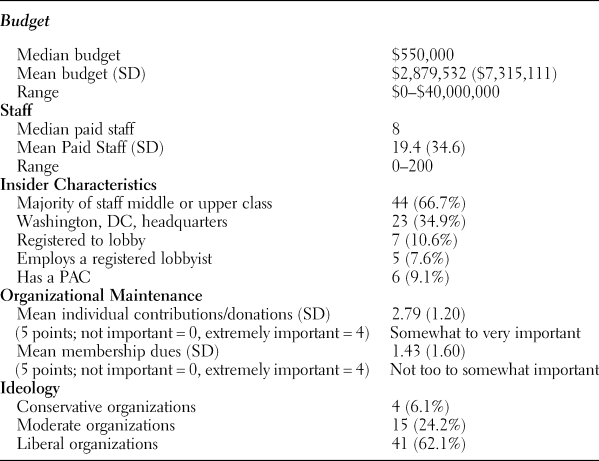
Table 1 provides information about the 66 respondents. It indicates that the women's organizations that participated in the study varied a great deal in terms of resources, with budgets and staff ranging from $0 and no paid staff members to $40,000,000 and 200 paid staff members. The median participant had a budget of $550,000 and 8 paid staff members, and the mean participant had a budget of $2,879,532 and a staff of 19.4. Among the respondents, budgets were highly correlated with the number of staff members (r = 0.93), registering to lobby (r = 0.64), and hiring a DC lobbyist (r = 0.71). Without a directory that provides a comprehensive listing of the entire universe of active women's organizations in the United States (Marchetti Reference Marchetti2014, Reference Marchetti2015; Strolovitch Reference Strolovitch2007), it is difficult to determine precisely how well the sample represents the entire population of women's organizations. However, to provide some comparisons, I used ProPublica's (2021) “Non-Profit Explorer” to collect data on total revenues for the 15 organizations that submitted 10 or more comments between 2007 and 2013. In 2018–19, the average annual revenue for those organizations was $32,928,710, with a median of $10,547,348.Footnote 1 Thus, the respondents are, on average, smaller than the women's organizations that are most active in rulemaking.
The Respondents (66 Organizations)

In line with existing research that indicates women's organizations frequently hire professionals and/or policy insiders in response to pressure from their funders to hire staffers who are familiar with policy professionals’ norms and standard operating procedures (Banaszak Reference Banaszak2010; Goss Reference Goss2007, Reference Goss2013; Schlozman, Verba, and Brady Reference Schlozman, Verba and Brady2012; Skocpol Reference Skocpol2003; Staggenborg Reference Staggenborg1988; Strolovitch Reference Strolovitch2007), the majority (66.7%) of the respondents came from organizations that primarily employed middle- or upper-class people. However, many women's organizations still have strong connections to social movements and limited resources (Banaszak Reference Banaszak2010; Goss Reference Goss2013; Staggenborg Reference Staggenborg1988; Strolovitch Reference Strolovitch2007). Therefore, most of the respondents were not located in Washington, DC, did not register to lobby, did not employ a lobbyist, and did not have a PAC. As with other advocacy organizations (Goss Reference Goss2007, Reference Goss2013; Skocpol Reference Skocpol2003; Staggenborg Reference Staggenborg1988; Strolovitch Reference Strolovitch2007), the respondents primarily relied on individual contributions and foundations for funding. Because of the historical composition of the women's movement, 62% of the respondents were liberal, but 6% of them were conservative, reflecting the rise of conservative women's organizations in recent years (Deckman Reference Deckman2016; Goss Reference Goss2007; Schreiber Reference Schreiber2008; Strolovitch Reference Strolovitch2007; Rosen Reference Rosen2006).
Given the relatively small number of respondents, I supplemented my survey findings with data on the comments that women's organizations submitted using Regulations.gov. I relied on data from 2007 to 2013 for this analysis because 2007 was the first year that all of the cabinet-level agencies voluntarily used Regulations.gov and 2013 was the most recent year for which comments were available when the data were collected. Though not all agencies use Regulations.gov to collect comments, I relied on it because it is the only website that provides easy access to rulemaking comments across a wide array of issue areas and agencies. Thus, in addition to analyzing the survey data, I also identified, downloaded, and analyzed 1,021 comments that 82 women's organizations submitted on 264 different rules over a seven-year period spanning two presidential administrations.Footnote 2 These data provide additional, identifiable information on which women's organizations participated in the process and the role of coalitions in rulemaking.
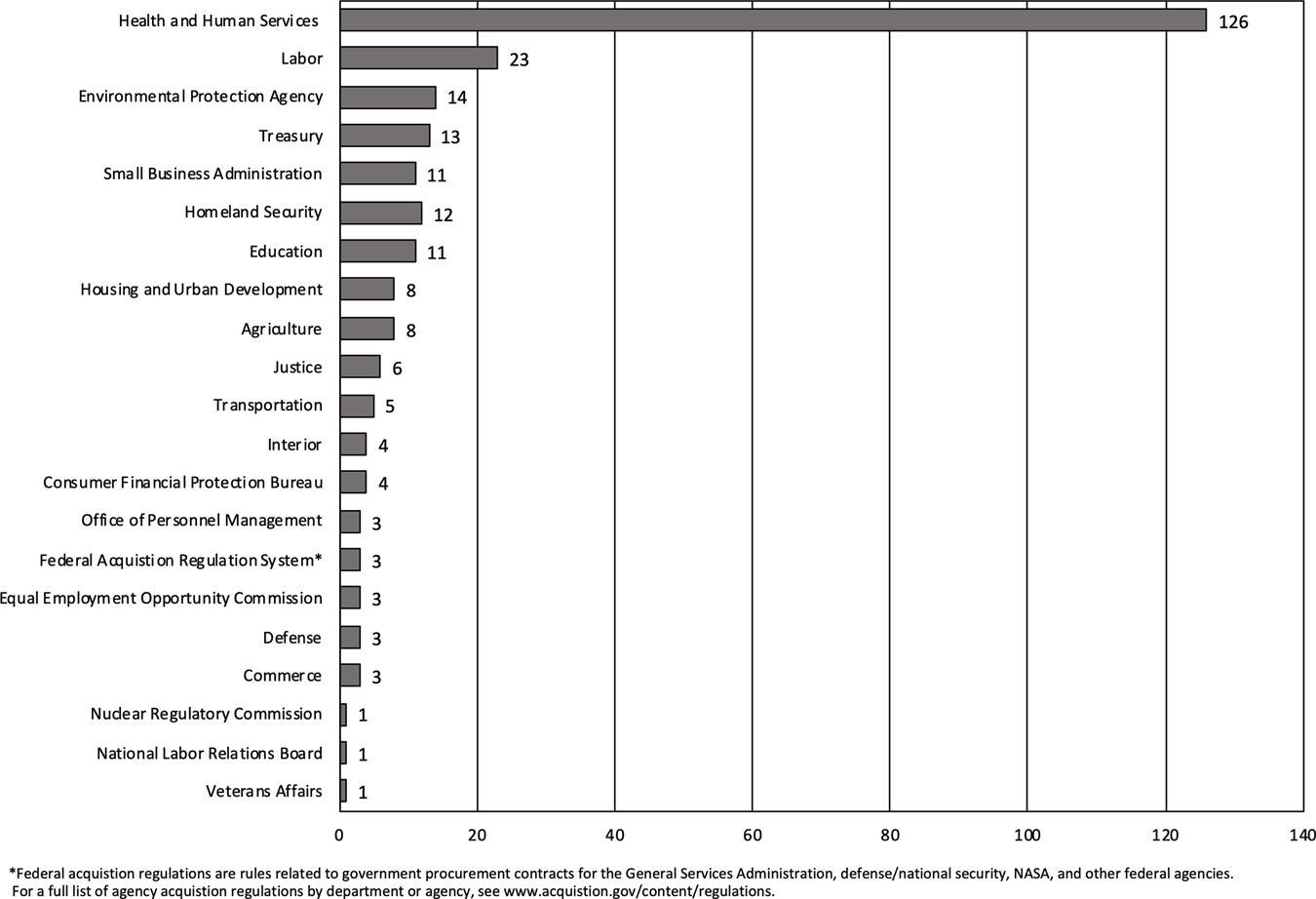
As Figure 1 indicates, women's organizations submitted comments to agencies located within 21 cabinet-level departments or independent agencies. Given women's traditional interests in health care and reproductive rights and the heavy focus on ACA implementation in the early 2010s (Carroll, Dodson, and Mandel Reference Carroll, Dodson and Mandel1991; English Reference English2019a, Reference English2019b; Sapiro Reference Sapiro1981; Swers Reference Swers2002), women's organizations submitted the most (126) comments to agencies located within the HHS. The three rulemakings that they commented on most often focused on reproductive rights; they submitted 71 comments on a 2009 rule rescinding Bush-era conscience clause protections for health care workers and 91 comments on two rules related to the contraception mandate. Building on women's interests in education, children and families, housing, and gender equality (Carroll, Dodson, and Mandel Reference Carroll, Dodson and Mandel1991; Sapiro Reference Sapiro1981; Swers Reference Swers2002), they also targeted the Departments of Labor, Education, and Housing and Urban Development. However, women's organizations also went beyond women's traditional interests by also submitting comments to the Environmental Protection Agency, Department of Treasury, and Small Business Administration, among others.
Number of Rulemakings Women's Organizations Participated in by Agency, 2007-2013

Reflecting the low salience of most rulemakings (Golden Reference Golden1998; West Reference West2004; Yackee and Yackee Reference Yackee and Yackee2006), only 32.5% of the rules that women's organizations commented on received any coverage in American newspapers during their public comment periods, and the median number of comments agencies received on rules they commented on was 237.5. Thus, participation in blockbuster rulemakings, such as the one related to the contraception mandate, which received a great deal of media coverage and 472,082 comments, was exceptional (English Reference English2019a).
Large, nationally focused organizations participated in the process most often. The five women's organizations that submitted the largest numbers of comments were Planned Parenthood (159 comments), the American Nurses Association (51 comments), the NWLC (48 comments), the League of Women Voters (41 comments), and the AAUW (37 comments). NOW, Legal Momentum, Women Impacting Public Policy, and the YWCA also submitted at least 10 comments between 2007 and 2013.
RESULTS
Participation
Before I tested my hypotheses, I examined women's organizations’ participation in the rulemaking process. Eighteen respondents (27.3%) reported that their organization had participated in the process, 21 (31.8%) indicated that their organization had not, and 27 (40.9%) stated they did not know if they organization participated.Footnote 3 Next, I asked the respondents from organizations that had participated to indicate approximately how many rulemakings their organization had participated in during the last year.
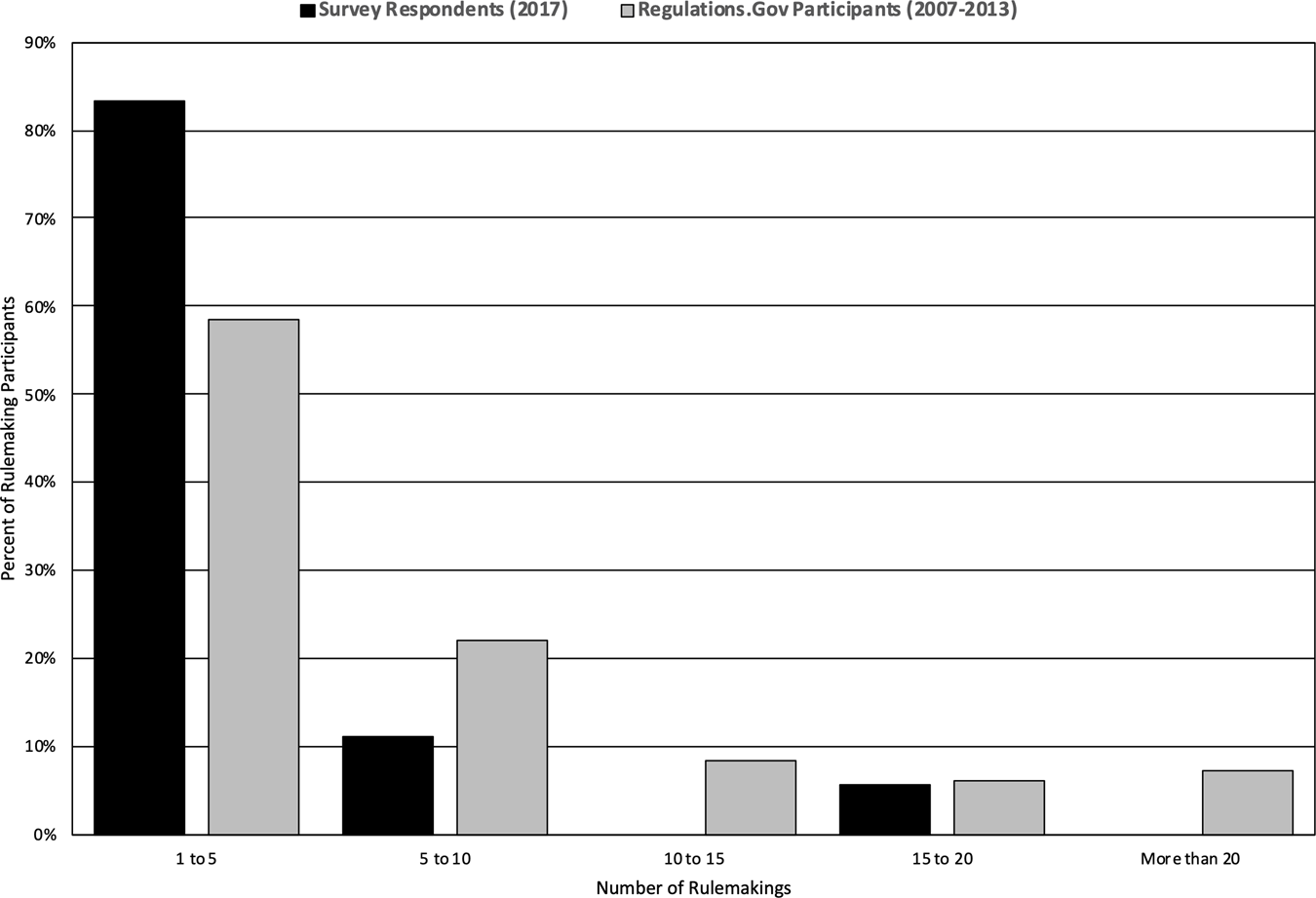
Figure 2 indicates that most (83.3%) of the women's organizations that participated in rulemaking did so relatively infrequently, submitting fewer than five comments per year. The Regulations.gov data also show that most (58.5%) of the 82 women's organizations that submitted comments between 2007 and 2013 sent in fewer than 5 comments during the seven years studied, and only 13.4% of them submitted more than 15 comments (Figure 2). However, one organization participated in 15 to 20 rulemakings per year, suggesting that at least one women's organization is uniquely committed to engaging in the rulemaking process.
Number of Rulemakings that Women's Organizations Participated In

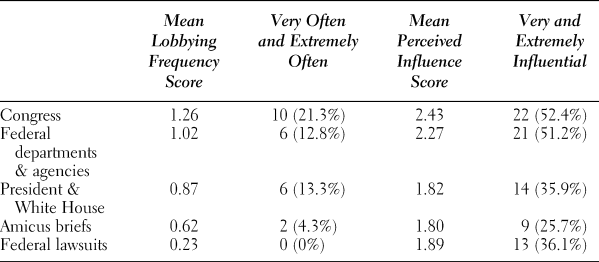
Because the results indicate that a relatively small number of organizations participate and they do so relatively infrequently, I compared rulemaking participation with women's organizations’ efforts to lobby other federal policy makers by asking them to use a 5-point scale (0 = never to 4 = extremely often) to indicate how often their organizations lobbied members of Congress, lobbied federal departments and agencies, lobbied the president and the White House, submitted amicus briefs, and filed federal lawsuits. Those results (Table 2) indicate that while women's organizations most often lobbied members of Congress, lobbying federal departments and agencies was a close second. With mean lobbying frequency scores of 1.26 and 1.02, the results show that women's organizations report that they lobby both Congress and the bureaucracy either “not too often” or “somewhat often.” The results in Table 2 also suggest that women's organizations’ staffers only see Congress as slightly more influential than agencies.
Women's organizations’ lobbying activities and their perceptions of influence

Notes: Lobbying frequency is measured on a 5-point scale (0 = never, 1 = not too often, 2 = somewhat often, 3 = very often, 4 = extremely often); influence is measured on a 5-point scale (0 = not influential, 1 = not too influential, 2 = somewhat influential, 3 = very influential, 4 = extremely influential)
Cheap Participation
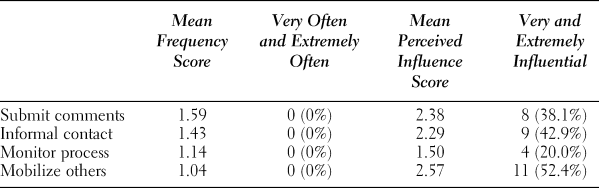
The cheap participation hypothesis (H1) indicated that I expected women's organizations would most often lobby rulemakers by submitting coalition comments or organizing mass comment campaigns. To test that hypothesis, I first asked respondents a series of questions about how often they (1) monitor the Federal Register or Regulations.gov, (2) submit comments to federal departments or agencies in response to proposed rules, (3) mobilize members of the public to submit comments in response to proposed rules, and (4) informally contact departments or agencies before the publication of a proposed rule. I also asked them to rate how influential each of those activities are on a 5-point scale ranging from “not too influential” to “extremely influential.” The responses, shown in Table 3, demonstrate that women's organizations most often participate in rulemaking by submitting comments to agencies.
Rulemaking actions taken and perceptions of influence

Notes: Frequency is measured on a 5-point scale (0 = never, 1 = not too often, 2 = somewhat often, 3 = very often, 4 = extremely often); influence is measured on 5-point scale (0 = not influential, 1 = not too influential, 2 = somewhat influential, 3 = very influential, 4 = extremely influential)
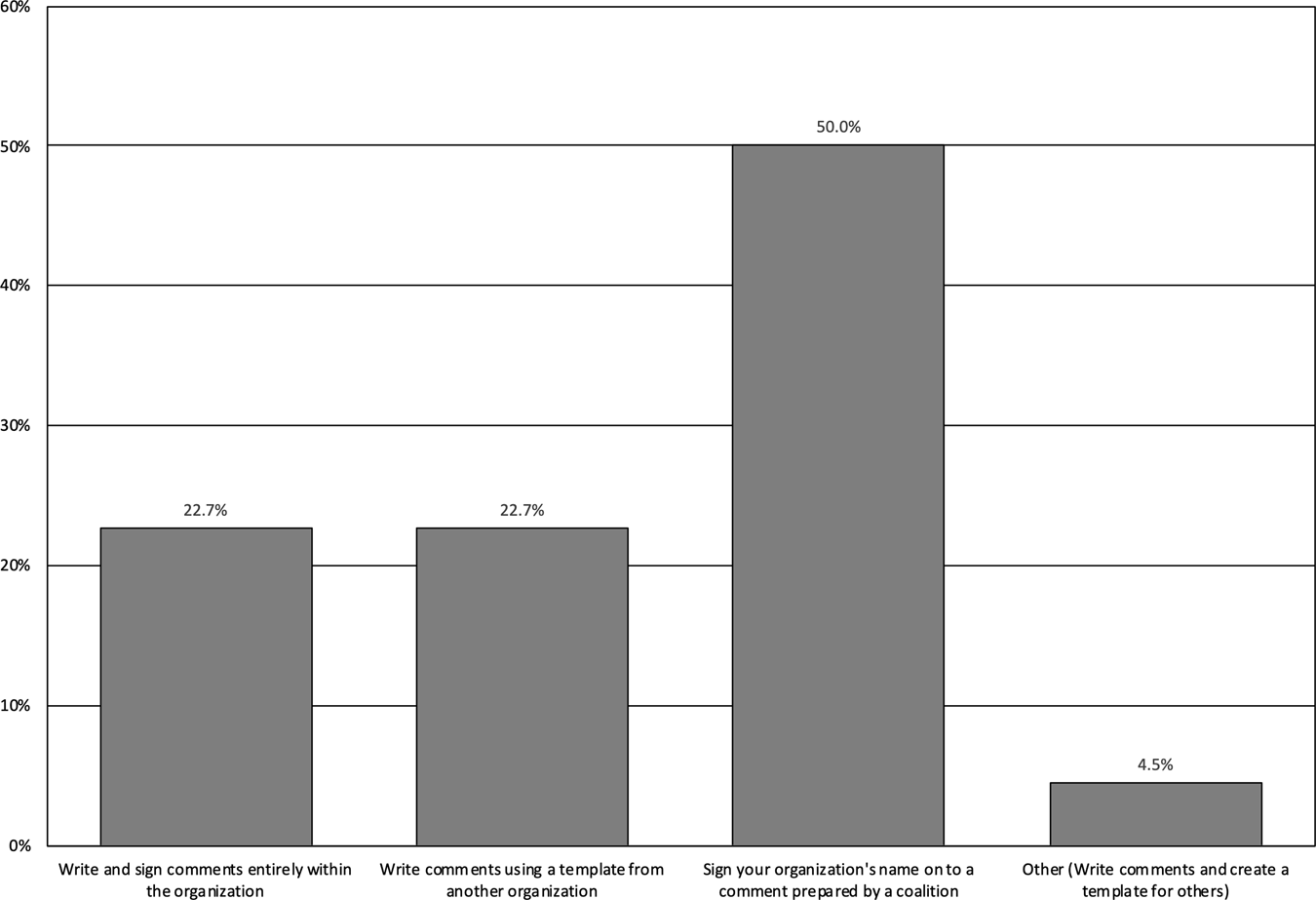
Since submitting comments was a popular form of participation, I also asked the respondents to indicate how their organization typically submits comments. They were presented with four options and asked to choose one: “(1) Write and sign comments entirely with your own organization, (2) Write comments using a template or draft language provided by another organization, (3) Sign your organization's name onto a comment that was prepared by a coalition of organizations, and (4) Other.” As expected, Figure 3 shows that women's organizations often rely on others for assistance when they submit comments. Fifty percent of the respondents reported that their organizations typically participated in the process by signing on to comments that a coalition of organizations prepared. The Regulations.gov data support this finding, indicating that 32.2% of the 1,021 comments that women's organizations submitted during those seven years were from coalitions. In addition to participating in coalitions, Figure 3 shows that 22.7% of women's organizations wrote their comments using templates provided by other organizations, and only 22.7% of respondents reported that their organizations wrote their own comments. Though I expected comment-writing campaigns would be popular, only one organization drafted its own comments and created templates for others, again indicating that one specialized women's organization may coordinate the broader movement's participation.
Methods that Women's Organizations Used to Submit Comments to Rulemakers

Resources
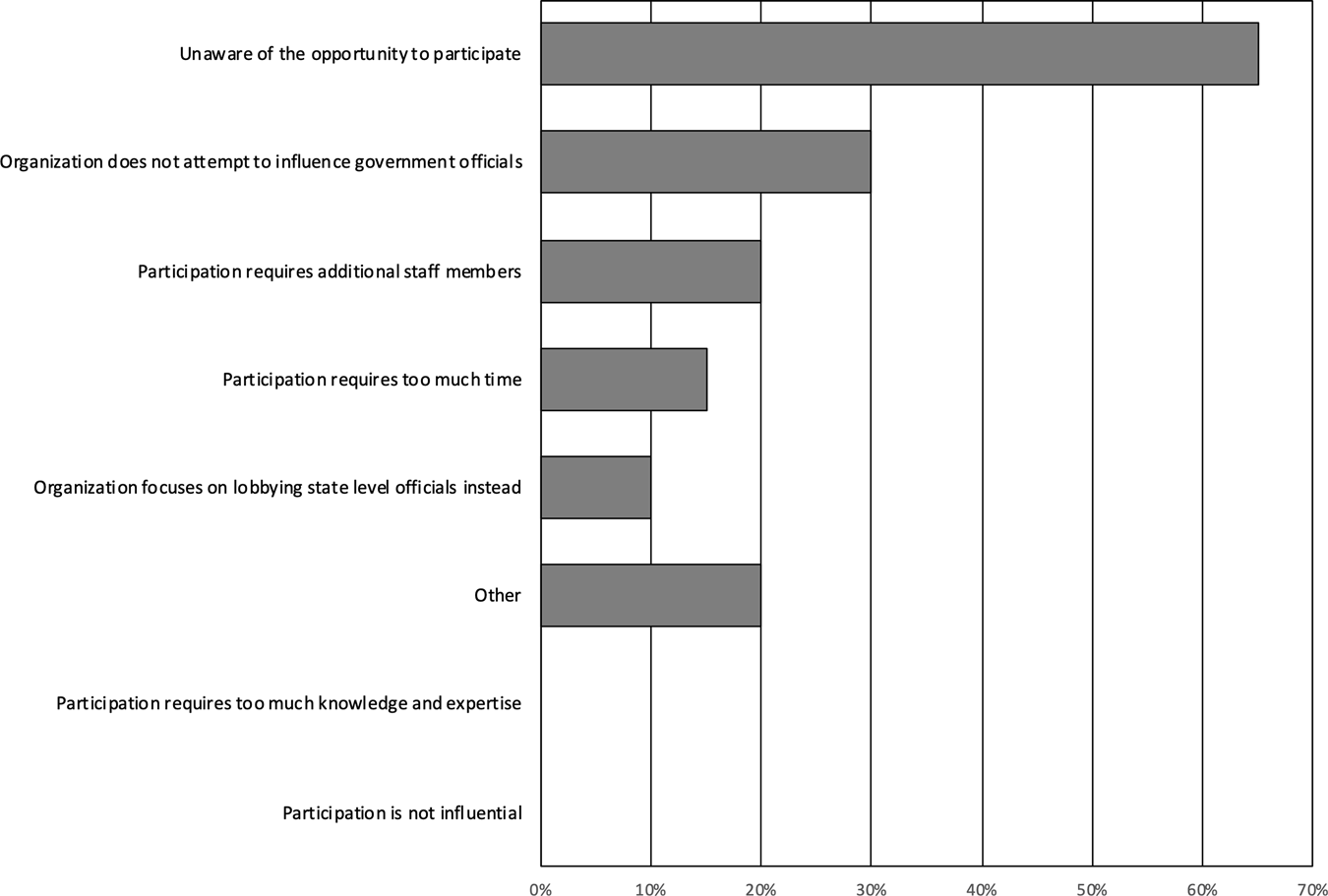
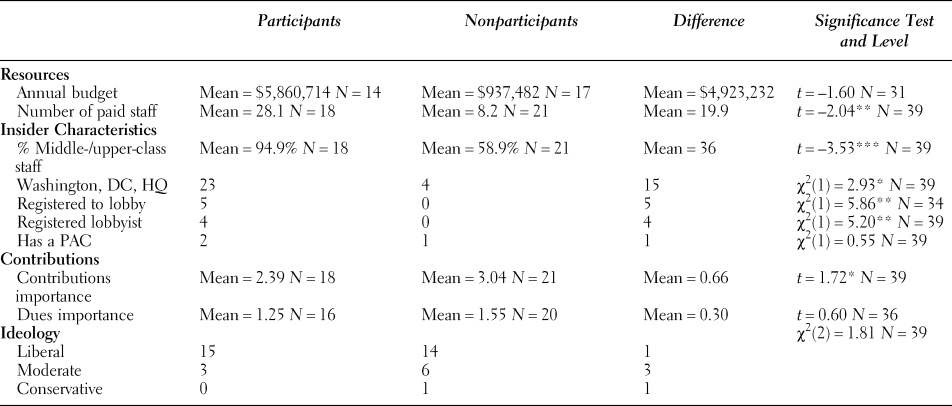
Thirty-two percent of respondents indicated that their organizations did not participate in the process, so I asked respondents who did not engage in rulemaking to explain why their organizations did not participate. Respondents were presented with eight reasons for nonparticipation and told to select all that apply. The responses to that question (Figure 4) show that 65.0% of nonparticipants were not aware of the opportunity to participate, 20.0% indicated they needed more staff, and 15.0% reported that participation takes too much time. Together, these responses provide tentative support for the resources hypothesis (H2), which stated that women's organizations with larger budgets and staffs should be more likely to participate in the process. Similarly, Table 4 shows that the mean annual budgets for women's organizations that participated in rulemaking were six times larger ($5,860,714) than those of nonparticipants ($937,482). Rulemaking participants also had staffs that were, on average, three times larger than nonparticipants. With a relatively small number of respondents, multivariate analyses regression analyses are inappropriate and subject to error. Therefore, I instead conducted a series of bivariate analyses (two-tailed difference-of-means tests and chi-square tests) to provide a preliminary, tentative analysis of whether those resources were significantly associated with participation in the process. Those results should also be used carefully, but the findings in Table 4 show that organizations with larger staffs were significantly (p ≤ .05) more likely to participate than those with fewer staffers.
Reasons Women's Organizations Did Not Participated in the Rulemaking Process

Characteristics of participants and nonparticipants

*** p ≤ .01; ** p ≤ .05; * p ≤ .10.
Political Insiders
To test the political insiders hypothesis (H3), I examined whether participants were more likely to hire upper- or middle-class staffers, be located in DC, register to lobby, hire lobbyists, and/or form PACs. The results of those analyses (Table 4) show that, as expected, women's organizations that are structured more like political insiders are more likely to participate in the process. Participants had 1.5 times as many middle- and upper-class staffers, and a two-tailed difference-of-means test indicates that they were also significantly more likely to participate in rulemaking (p ≤ .01). Participants were also approximately six times more likely to be located in DC, a difference that a chi-square test indicated was marginally significant (p ≤ .10). Five participants were registered to lobby and four hired DC lobbyists, compared with zero of each for nonparticipants. Thus, registering to lobby and hiring DC lobbyists were also significantly (p ≤ .05) associated with rulemaking participation.
Contributions
To test the contributions hypothesis (H4), I examined whether organizations’ funding sources were associated with rulemaking participation. Thus, I asked respondents to report, on a 5-point scale, how important individual contributions or donations (e.g., donations from direct mail or email and canvassing) and membership dues were for their organization. The results appear in Table 4. Contrary to expectations, nonparticipants were more likely to rely on individual contributions than participants, and that difference was marginally significant (p ≤ .10). Nonparticipants were also more likely to rely on membership dues, but those differences were not statistically significant.
Ideology
Finally, I examined whether ideology was associated with differences in participation (H5). To test this hypothesis, I asked respondents to use a 7-point scale (1 = extremely conservative to 7 = extremely liberal) to describe their organization's ideology. Given the small number of respondents, I grouped those responses into three categories: liberal, moderate, and conservative. As Table 4 indicates, there were few differences between participants and nonparticipants. Thus, as expected, ideology was not significantly related to rulemaking participation.
DISCUSSION
My study provides the first systematic analysis of how women's advocacy organizations participate in rulemaking, yielding a number of important new findings. First, it shows that some women's organizations participate in the process, but many women's organizations face notable challenges in accessing this policy-making venue. Thirty-two percent of the respondents indicated that their organizations had not participated in rulemaking, and even among the participants, most women's organizations’ staffers reported that their organizations had participated in fewer than five rulemakings in the past year. In contrast, previous research shows that business organizations and trade associations tend to engage in 19.14 and 9.48 rulemakings per year, respectively (Furlong and Kerwin Reference Furlong and Kerwin2005; Yackee and Yackee Reference Yackee and Yackee2006). Moreover, one-quarter of women's organizations’ staffers reported that their organizations did not participate because they needed more staff or time to do so, and all of the nonparticipants lacked lobbyists and were not registered to lobby. Therefore, many women's organizations may not participate in rulemaking as often as other groups do, because they lack the resources, most notably, the staff members and lobbyists, needed to participate effectively. Participants were also much more likely to be located in Washington, DC, further indicating that insider access to the agency officials may be a prerequisite for rulemaking participation.
Despite these challenges, some women's organizations still find ways to lobby rulemakers, and they do so in ways that deviate from the template set by businesses and other economic interests. For example, women's organizations heavily rely on coalitions, as the majority of participants (72.7%) indicated that they typically signed on to comments that a coalition prepared or used templates that other organizations circulated to write their comments. The fact that one organization indicated that it often drafts comments for other organizations to use, also reveals that a women's organization with rulemaking expertise may be taking the lead in coordinating rulemaking participation for the broader movement. It is possible that organization is willing to coordinate rulemaking campaigns because doing so allows them to develop their niche or reputation as one of the only women's organizations with extensive experience and expertise in regulatory policy making (Gray and Lowery Reference Gray and Lowery1996; Heaney Reference Heaney2004). That organization may also lead coalitions because it recognizes that the potential policy gains could outweigh the costs and challenges associated with trying to coordinate rulemaking participation among a diverse array of women's organizations and women's policy interests (Nelson and Yackee Reference Nelson and Yackee2012). While other organized interests also rely on coalitions to shape policy proposals, formally influence rulemakers, or demonstrate to their constituents or other members of the public that they are actively engaged in the issues despite their limited resources (Hojnacki Reference Hojnacki1997; Nelson and Yackee Reference Nelson and Yackee2012), the fact that almost three-quarters of women's organizations participated in this way suggests coalitions (and potential biases within them) may be particularly important for organizations that represent members of marginalized groups.
Women's organizations’ reliance on rulemaking coalitions raises three intriguing questions for future research. First, while many advocacy organizations join coalitions to overcome their resource limitations, those coalitions also have a tendency to downplay the concerns of the most disadvantaged people they claim to represent (Hojnacki Reference Hojnacki1997; Strolovitch Reference Strolovitch2007). Therefore, future research based on an analysis of coalition comments or interviews with coalition participants should examine how coalitions of women's organizations decide which subgroups of women to focus on when they participate in the process. Do they forge compromises by downplaying the concerns of relatively disadvantaged women, such as women of color, poor women, and LGBTQ-identified women, as Strolovitch (Reference Strolovitch2007) suggests they might?
Second, more research is needed to examine whether advocacy organizations focused on other demographic groups (e.g., racial or ethnic minorities, the poor, members of the LGBTQ community, or the elderly) also heavily depend on coalitions when they participate in rulemaking. Each of these groups faces their own unique advantages and disadvantages, which may make coalitions more or less appealing to them. For example, research indicates that racial minorities often benefit from higher levels of linked fate than groups focused on gender (Dawson Reference Dawson1994). Thus, racial justice advocacy organizations may be even more likely to rely on coalitions. Organizations that exist to represent the poor are also relatively few and far between (Schlozman, Verba, and Brady Reference Schlozman, Verba and Brady2012), so they may need to rely more heavily on coalitions than women's organizations. In contrast, policies such as Social Security have produced resources (including additional income and free time) that have fueled elderly political participation and the formation of organized groups, such as AARP, that can lobby on behalf of senior citizens (Campbell Reference Campbell2003). Thus, those organizations may have enough of their own resources that they do not need to rely on coalitions in the same way that women's organizations, racial justice organizations, and organizations for the poor would.
Third, more research could also determine precisely when and why women's organizations’ coalitions form during the rulemaking process. Hojnacki (Reference Hojnacki1998) has found that coalitions are more likely to form when opposition groups are strong. Thus, it is possible that women's organizations’ are most likely to use coalitions to participate in rulemaking when they face strong opposition, particularly since many controversial rules related to health care, abortion, and contraception have attracted unusually high levels of attention and polarized opinion in recent years (English Reference English2019a, Reference English2019b). In those cases, coalitions may provide an important form of counteractive lobbying while also helping women's organizations take advantage of the opportunities that controversial rulemakings create for cultivating group solidarity and sense of women's linked fates.
Women's organizations’ preference for signing on to coalition comments over coordinating mass comment-writing campaigns is also intriguing, especially when combined with the unexpected finding that women's organizations that do not participate in rulemaking are more likely to rely on individual contributions than those that do. Do women's organizations prefer coalition comments simply because they are more effective than form letter campaigns? Do they believe coalition comments do a better job of helping them articulate group interests by working with like-minded organizations? Are they afraid comment-writing campaigns would be ineffective because they could simultaneously confuse ordinary citizens who typically know little about the rulemaking process and annoy agencies that dislike low-quality form letter comments (Balla et al. Reference Balla, Beck, Meehan and Prasad2020; Benjamin Reference Benjamin2006; Coglianese Reference Coglianese2006; Lubbers Reference Lubbers2010)? Have they found that comment-writing campaigns do not help them raise money very effectively? Interviews with women's organizations staffers could help answer these questions and better understand their preference for coalition comments over form letters.
Lastly, my findings shed new light on previous studies that have found that women's organizations’ rarely advocate for marginalized women, such as poor women, women of color, and LGBTQ women, when they submit comments to rulemakers (English Reference English2019a, Reference English2019b) by suggesting that those exclusions could be related to the mobilizations of bias that occur when relatively advanced/political insider women's advocacy organizations participate in rulemaking and/or comment-writing coalitions. My findings about biases in this process and the limited participation of organizations that have small staffs, do not hire lobbyists, and primarily employ low-income people also suggest that more research is needed to understand why those women's organizations do not participate. Is it simply due to a relative lack of staffing resources or are there other reasons they avoid the process? For example, might they prefer more confrontational outsider strategies, such as protests and marches instead?
CONCLUSION
Though it is not traditionally considered a site of women's representation, some women's organizations recognize that rulemaking has an important influence on policy and they participate in the process. However, others, particularly those with smaller, poorer staffs and few lobbying resources, do face some challenges or barriers to participation. Unlike other organized interests, those findings mean that many women's organizations that wish to participate in rulemaking are heavily reliant on help from other like-minded organizations, and the organizations that are the most likely to participate are the ones that have the most resources and that employ the most economically advantaged women. Consequently, the most disadvantaged women may be doubly disadvantaged in this policy-making venue as women's advocacy organizations do not participate in rulemaking as often as business groups do, and smaller, poorer women's organizations do not participate as often as women's organizations with larger staffs and more resources. Together, these findings suggest that women's organizations are interested in rulemaking, but the organizations that participate and the coalitions that they join, may be less likely to represent some of the most disadvantaged women, adding to rulemaking's biases toward those individuals and organizations who are the most advantaged.
SUPPLEMENTARY MATERIAL
To view supplementary material for this article, please visit https://doi.org/10.1017/S1743923X21000350