Inappropriate antibiotic use is reported in 30%–50% of antibiotics prescribed in the acute-care hospital setting.Reference Fridkin, Baggs and Fagan 1 Antimicrobial stewardship programs are effective in limiting inappropriate antibiotic use.Reference Schuts, Hulscher and Mouton 2 In the outpatient setting, peer comparison was an effective antimicrobial stewardship intervention in the management of outpatient upper-respiratory infections, with a decrease in the rate of antibiotic prescription from 35% to 19.2%.Reference Meeker, Linder and Fox 3 Peer comparison may also be effective in the inpatient setting. We describe a practical system of attributing anti-MRSA agent prescription in the inpatient setting and identifying outlying prescribers.
METHODS
The University of Maryland Medical Center (UMMC) is a 772-bed, tertiary-care hospital with approximately 600 active antibiotics ordered daily. The study was conducted from January 2015 to June 2015. During this time, the UMMC antimicrobial stewardship program consisted of 2 part-time adult infectious diseases (ID) physicians and 1 clinical ID pharmacist. An antibiotic report was generated daily containing patient identifiers, antibiotic order, dose, frequency, indication, primary service, prescriber, and ID consulting team. Restricted antibiotics required approval by an antimicrobial stewardship team member or ID specialist for continued use beyond the first dose prescription. Prescribers of all antibiotics were required to document indication with each antibiotic order.
As part of standard practice at UMMC, the antimicrobial stewardship team adjudicated the appropriateness of each antibiotic order during a “time out” review process that occurred 48–72 hours after the initial order. Recommendations were given directly to members of the primary service. Appropriateness of indication was determined by culture, site of infection, risk of toxicity, and allergies under guidance from the UMMC Antibiotic Guidelines.Reference Heil and Schmalzle 4 All data were stored in a clinical database used for tracking and reporting antibiotic use.
Vancomycin was first line for MRSA infections. However, ceftaroline (second line), daptomycin (excluding pneumonia), and linezolid (excluding endocarditis and bacteremia) were used as acceptable alternatives in patients who met criteria. Linezolid was the first-line antimicrobial agent for vancomycin-resistant enterococci (VRE) infections. However, VRE bacteremia and endocarditis were acceptable indications for daptomycin or when linezolid was contraindicated. Daptomycin, linezolid, and ceftaroline were restricted antibiotics.
Vancomycin, ceftaroline, daptomycin, and linezolid use were compared among 14 ID-trained physicians on the primary medicine ID services, identified as prescribers A–N. Days of therapy (DOT) normalized to 100 service days was the metric for comparison. Although no precedent metric exists, we sought to accurately compare prescribers with variable patient encounters. Analogous to patient days or days present which is used for National Healthcare Safety Network reporting, service days reflect the number of days the prescriber was assuming care of patients on that particular service. 5
Data Analysis
Peer comparison was made among prescribers A–N comparing DOT per 100 service days of each individual antibiotic. An outlying prescriber was defined as a prescriber with DOT per 100 service days 2 standard deviations (SD) above the mean. All analyses were conducted using Microsoft Excel software (Redmond, WA).
RESULTS
During the study period, 127 unique anti-MRSA agents for 96 patients were prescribed by the primary medicine ID services. On average, there were 9 patients per unique anti-MRSA agent per provider (range, 2–33), with 32 mean service days (range, 10–76). The most common indications for an anti-MRSA agent were skin and soft-tissue infections (n=41) and bacteremia or sepsis (n=37), followed by bone and/or joint infections (n=18). Overall, 84 antibiotics were prescribed for empiric treatment, 42 were prescribed for definitive treatment, and 1 was prescribed for surgical prophylaxis.
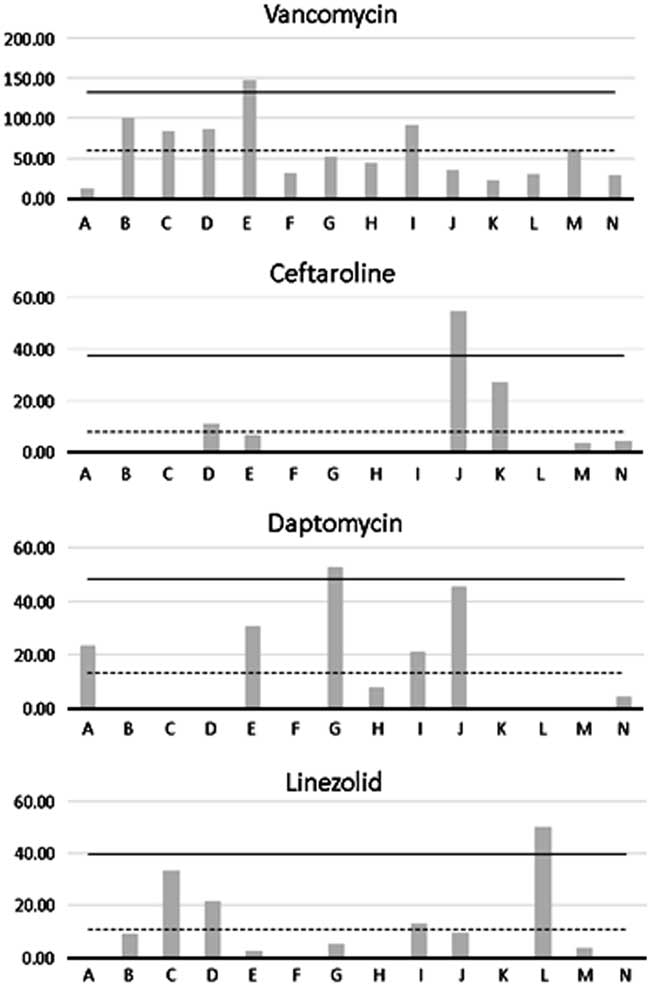
Figure 1 summarizes the comparison data. One prescriber was identified as an outlier for each agent. Vancomycin was the most commonly prescribed anti-MRSA agent with a mean of 60 DOT per 100 service days. Prescriber E was identified as an outlying vancomycin prescriber. The second-line anti-MRSA agents were ceftaroline, with a mean of 38 DOT per 100 service days, daptomycin, with a mean of 35 DOT per 100 service days, and linezolid, with a mean of 11 DOT per 100 service days. Prescribers J, G, and L were identified as outliers for ceftaroline, daptomycin, and linezolid prescription, respectively.
Peer comparison using days of therapy (DOT) per 100 service days (y-axis) for anti–methicillin-resistant Staphylococcus aureus (anti-MRSA) agents among prescribers A–N (x-axis). Dashed line: mean DOT per 100 service days. Solid line: mean DOT per service days +2 standard deviations (SD).

Prescriber E prescribed vancomycin for 23 patients (mean, 7; range, 1–23); 17 of these 23 prescriptions (74%) were for empiric therapy, and 10 prescriptions (43%) were for skin and soft-tissue indications. Prescriber E also had the most service days (76 days). Prescriber G prescribed daptomycin for 5 different patients (mean, 2.1; range, 0–6); 3 of these 5 prescriptions (60%) were for empiric therapy, and 3 (60%) were for skin and soft-tissue indications. For 1 patient, prescriber J made a ceftaroline prescription with definitive therapy (mean, 1.17; range, 0–2) for vancomycin-intermediate S. aureus bacteremia. Prescriber L made a linezolid prescription for 1 patient with definitive therapy (mean, 1; range, 0–1) for coincident MRSA and VRE infections.
Noncompliance with anti-MRSA agent guidelines UMMC-wide was observed in 255 of 521 reviews (49%). The primary ID service only had 10 reviews; among them, 3 were documented to be noncompliant. Only prescriber E was included in this noncompliant subset.
DISCUSSION
Our study demonstrates a proof of concept in attribution of anti-MRSA agent prescription within the primary ID medicine services. Comparing DOT per 100 service days among prescribers is a potential method of identifying outlying prescribers. Using this approach, we identified 1 outlying prescriber for each of the 4 anti-MRSA agents.
A peer-comparison strategy has a large spectrum of potential applications. Curbing the use of anti-MRSA agents in the hospital is of interest due to resistance, toxicity, and cost concerns, and daptomycin is a particular target.Reference Sievert, Rudrik, Patel, McDonald, Wilkins and Hageman 6 – Reference Dela-Pena, Kerstenetzky, Schulz, Kendall, Lepak and Fox 8 As part of a new Joint Commission Standard, antimicrobial stewardship programs and hospitals are required to track antibiotic prescription, to implement prescriber education, and to report antibiotic utilization data back to the prescribers. 9 Therefore, a reliable measure for tracking and reporting is important.
We standardized DOT to service days for each provider to adjust for differences in patient volume. We chose service days because these data are easily accessible from service schedules at our institution. Although rate of antibiotic prescription (ie, number of antibiotic prescriptions per encounter) was used in a peer-comparison intervention in the management of outpatient upper-respiratory infections, our experience suggests that this metric may be inadequate in the inpatient setting.Reference Meeker, Linder and Fox 3 For instance, initial antibiotic prescription does not capture duration of therapy in suspected bacterial infections; therefore, prompt, judicious de-escalation practices (ie, discontinuing vancomycin for MRSA-negative culture) would not be accounted for. A cumulative measure of individual antibiotic consumption is needed to capture indiscriminate patterns of prescription.
However, this study has several limitations. Service days do not account for the number of patients; therefore, the at-risk population may be underrepresented. Additionally, patient and culture variability may significantly bias the comparison. Patients who cannot be discharged and remain on long-term antibiotics in the hospital for an appropriate indication are another source of bias. Excluding guideline-compliant outliers would have been ideal if that information had been available. Our study had inconsistent documentation of guideline compliance and we did not adjust for it. Validation of DOT per service days as a surrogate for guideline compliance needs be done on a larger sample.
Finally, the best method of implementing inpatient peer comparison and its clinical impact are unknown. Ideally, peer-comparison data (ie, Figure 1) would have been presented to prescribers, bringing awareness to individual prescription patterns and influencing future antibiotic choices. Further input from behavioral and social science will be important when studying outcomes of peer-comparison interventions.
In conclusion, we demonstrate a peer-comparison approach to anti-MRSA agent prescription among ID physicians with the use of DOT per service days. Larger-scale studies validating this method and looking at outcomes of implementation into practice need to be performed.
ACKNOWLEDGMENTS
Financial support: No financial support was provided relevant to this article.
Potential conflicts of interest: All authors report no conflicts of interest relevant to this article.