1. INTRODUCTION
Terahertz (THz) waves with frequency in the range 0.1–10 THz are lying between infrared (IR) and microwave (MW) radiation in the electromagnetic spectrum. There are many applications for these waves such as communication, quality control, tomography, security screening, explosive detection information etc. (Siegel, Reference Siegel2004; Shen et al., Reference Shen, LO, Taday, Cole, Tribe and Kemp2005; Zhong et al., Reference Zhong, Redo-Sanchez and Zhang2006; Kleine-Ostmann & Nagatsuma, Reference Kleine-Ostmann and Nagatsuma2010; Bartman et al., Reference Bartman, Litvak and Suvorov2011; Tao et al., Reference Tao, Padilla, Zhang and Averitt2011; Kim et al., Reference Kim, Kim, Park, Han and Son2012; Pawar et al., Reference Pawar, Sonawane, Erande and Derle2013; Akyildiz et al., Reference Akyildiz, Jornet and Han2014). Various techniques have been employed for THz generation using high power lasers. The laser based THz emitters involving electro-optic crystals (ZnTe, GaAs, LiNbo3, etc.), semiconductors and photoconductive antennas (Jepsen et al., Reference Jepsen, Jacobsen and Keiding1996; Hashimshony et al., Reference Hashimshony, Zigler and Papadopoulos1999; Lee et al., Reference Lee, Meade, Perlin, Winful, Norris and Galvanauskas2000; Faure et al., Reference Faure, Tilborg, Kanidal and Leemans2004; Glyavin et al., Reference Glyavin, Luchinin and Golubiatnikov2008; Vodopyanov, Reference Vodopyanov2008; Chen et al., Reference Chen, Zhou, Werley and Nelson2011).
Several experimental and theoretical analyses for the THz generation via filamentation process have been carried out (Liu et al., Reference Liu, Houard, Prade, Akturk, Mysyrowicz and Tikhonchuk2007; Houard et al., Reference Houard, Liu, Prade, Tikhonchuk and Mysyrowicz2008; Bhasin & Tripathi, Reference Bhasin and Tripathi2011). Plasma is an ideal medium which conquers the damage problem of neutral materials when focusing intensity of the pump laser is high (Li et al., Reference Li, Wang, Li and Sheng2012).
Sun and Zhang (Reference Sun and Zhang2014) by taking advantage of low ionization potentials of alkali atoms, have demonstrated THz wave generation from cesium and rubidium vapor plasmas.
Chen et al. (Reference Chen, Yamaguchi, Wang and Zhang2007) have showed experimentally THz generation in the laser-induced plasma from a series of noble gases. Chauhan and Parashar (Reference Chauhan and Parashar2014) have considered two laser beams, which are obliquely incident on plasma slab for different electron density profiles. Many plasma based schemes have been studied in the presence of a transverse magnetic field and without it by different laser beam profiles such as Gaussian beams, triangular, top-hat, super-Gaussian (Malik et al., Reference Malik, Malik and Nishia2011a , Reference Malik, Malik and Stroth b , Reference Malik, Malik and Stroth2012, Reference Malik, Singh and Sajal2014; Malik & Malik, Reference Malik and Malik2013; Varshney et al., Reference Varshney, Sajal, Singh, Kumar and Sharma2013; Singh & Malik, Reference Singh and Malik2014, Reference Singh and Malik2015; Varshney et al., Reference Varshney, Sajal, Singh, Kumar and Sharma2015). Singh et al. (Reference Singh, Singh and Sharma2013) have reported THz generation by mixing of two cosh-Gaussian laser beams in a density rippled plasma. Malik and Singh (Reference Malik and Singh2015) have proposed THz radiation by super-Gaussian lasers in rippled density plasma with an external transverse magnetic field. They realized the efficiency about 25%.
In this work, we study THz radiation generation by mixing of two cosh-Gaussian laser beams in rippled density plasma in the presence of magnetic field, which is applied parallel to lasers propagation. This paper is organized as follows: In Section 2, we study nonlinear oscillatory current density due to the ponderomotive force developed during photo mixing of two laser beams in the presence of static magnetic field. In Section 3, we evaluate the THz radiation field and its efficiency. In Section 4, we present the results and discussion of analytical investigations. Conclusions are presented in Section 5.
2. CALCULATION OF NONLINEAR CURRENT DENSITY
We present a model to produce THz radiation by mixing of two cosh-Gaussian laser beams in plasma when electron–neutral collisions are considered. Plasma has rippled modulated densityn = n
0 + n
β
e
ik
β
z
,. where n
β and k
β are the amplitude and wave number of the density ripples. Laser beams incident on magnetized plasma with frequencies ω1, ω2, and wave vector
 $\bf\,{\vec k}_1$
,
 $\bf\,{\vec k}_2$
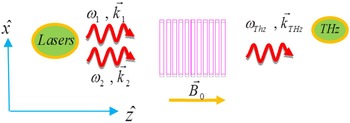
, propagating along the z-axis and polarized toward the x-direction. The applied static magnetic field is along the z-direction parallel to the laser beams propagation direction Figure 1.
Schematic diagram of THz radiation generation in the presence of axial magnetic field in the rippled density plasma.

The initial field distribution of the laser beams are taken as
 $\vec E_j = \hat xE_{0j}\cosh (xb/w_0)\exp ( - ({x / {w_0}})^2)\exp (i(k_jz - {\rm \omega} _jt))$
with j = 1, 2. Here, b and w
0 are the decentered parameter and the beam width, respectively. Due to Faraday rotation, the plane of polarization of the laser beam rotates as it propagates in the z-direction in plasma. Therefore, at z ≠ 0 we have
 $$\eqalign{{\vec E}_j\left \vert {_z} \right. & = \left( {\hat x\cos ({\rm \theta} _{{\rm F}{\rm \omega} _j}) + \sin ({\rm \theta} _{{\rm F}{\rm \omega} _j})\hat y} \right) \cr & \quad \times E_{0j}\cosh \left( {\displaystyle{{xb} \over {w_0}}} \right)\exp ( - ({x / {w_0}})^{2})\exp (i(k_jz - {\rm \omega} _jt)),} $$
where
 ${\rm \theta} _{{\rm F}{\rm \omega} _j} = 1/2(K_{{\rm R}{\rm \omega} _j} - K_{{\rm L}{\rm \omega} _j})z = {\rm \xi} _{{\rm \omega} _j}z$$
 $$\eqalign{K_{{\rm R}{\rm \omega }_j} & = \displaystyle{{{\rm \omega }_jn_{{\rm R}j}} \over c},\quad K_{{\rm L}{\rm \omega }_j} = \displaystyle{{{\rm \omega }_jn_{{\rm L}j}} \over c}, \cr & \quad n_{{\rm R}j}^2 = 1 - \displaystyle{{{\rm \omega }_{\rm p}^2 } \over {{\rm \omega }_j({\rm \omega }_j + i{\rm \upsilon }_{{\rm en}} - {\rm \omega }_{\rm c})}},} $$
 $$n_{{\rm L}j}^2 = 1 - \displaystyle{{{\rm \omega} _{\rm p}^2} \over {{\rm \omega} _j({\rm \omega} _j + i{\rm \upsilon} _{{\rm en}} + {\rm \omega} _{\rm c})}},$$
where ωc = eB
0/mc,
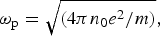 ${\rm \omega} _{\rm p} = \sqrt {(4{\rm \pi} n_0e^2/m)}, $
and υen are electron cyclotron frequency, plasma frequency, and collision frequency, respectively.
Lasers due to gradient in their fields, exert a nonlinear ponderomotive force to the electrons
 $${\vec F}_{\rm p}^{\,{\rm NL}} = - \displaystyle{m \over 2}{\vec \nabla} ({\vec v}_1\cdot {\rm} {\vec v}_2^{\,\,\ast} ),$$
where
 ${\vec v}_j = {{e{\vec E}_j} / {m(i{\rm \omega} _j - {\rm \upsilon} _{{\rm en}})}}$
, m and e are the electron mass and charge. By solving continuity equation the nonlinear electron density perturbations due to ponderomotive force are obtained as:
 $$\eqalign{n_{\rm e}^{{\rm NL}} & = \displaystyle{{n_0({\rm \omega} + i{\rm \upsilon} _{{\rm en}})} \over {{\rm \omega} m({({\rm \omega} + i{\rm \upsilon} _{{\rm en}})}^2 - {\rm \omega} _{\rm c}^2 )}} \vec \nabla. \bigg( {(\vec F_{\rm p}^{\,{\rm NL}} )}_x\hat x - \displaystyle{{{\rm \omega} _{\rm c}} \over {i({\rm \omega} + i{\rm \upsilon} _{{\rm en}})}}{(\vec F_{\rm p}^{\,{\rm NL}} )}_x\hat y \cr & \quad + \displaystyle{{({({\rm \omega} + i{\rm \upsilon} _{{\rm en}})}^2 - {\rm \omega} _{\rm c}^2 )} \over {{({\rm \omega} + i{\rm \upsilon} _{{\rm en}})}^2}}{(\vec F_{\rm p}^{\,{\rm NL}} )}_z\hat z \bigg),}$$
where ω = ω1 − ω2 is the beating frequency. The nonlinear density perturbation produces a self-consistent space-charge electric field
 $\vec E = - \vec \nabla {\rm \phi} $
leads to a linear density perturbation
 $n_{\rm e}^{\rm L} = - {{{\rm \chi} _{\rm e}\vec \nabla. (\vec \nabla {\rm \phi} )} / {4{\rm \pi} e}}$
, where
 ${\rm \chi} _{\rm e} = - {({\rm \omega} + i{\rm \upsilon} _{{\rm en}}){\rm \omega} _{\rm p}^2} / {{\rm \omega} ({({\rm \omega} + i{\rm \upsilon} _{{\rm en}})}^2 - {\rm \omega} _{\rm c}^2 {\rm )}}$
is the electric susceptibility. By the combination of Poisson's equation
 $\vec \nabla. (\vec \nabla {\rm \phi} ) = 4{\rm \pi} e(n_{\rm e}^{\rm L} + n_{\rm e}^{{\rm NL}} )$
and equation of motion
 $md\vec v_{\rm \omega} ^{\,{\rm NL}} /dt = \vec F^{\,\rm L} + \vec F^{\,{\rm NL}} - \vec v_{\rm \omega} ^{\,{\rm NL}} \times (e{\rm B}_0/c)\hat z $
 $ - m{\rm \upsilon} _{{\rm en}}\vec v_{\rm \omega} ^{\,{\rm NL}} $
,
 $\vec F^{\,\rm L} = e\vec \nabla {\rm \phi} $
:
The nonlinear electron velocity is obtained
 $$\vec v_{\rm \omega} ^{\,{\rm NL}} = \left[ {{\rm \delta} _x^{\prime} \hat x + {\rm \delta} _y^{\prime} \hat y + {\rm \delta} _z^{\prime} \hat z} \right]\exp \left( {i\left[ {kz - {\rm \omega} t} \right]} \right),$$
where k = k 1 − k 2 and δ x ′, δ y ′, and δ z ′ are defined as follows:
 $$\eqalign{{\rm \delta} _x^{\prime} & = \displaystyle{{ - 1} \over {mi{\rm \omega}}} \displaystyle{{{\rm \gamma} (D + 1) + D{\rm \omega} _{\rm c}^2 /{\rm \omega} ({\rm \omega} + i{\rm \upsilon} _{{\rm en}})} \over {({\rm \gamma} ^2 + {({\rm \omega} _{\rm c}/i{\rm \omega} )}^2)}}\displaystyle{{ - e^2E_{01}E_{02}} \over {m({\rm \omega} _1{\rm \omega} _2 - i{\rm \upsilon} _{{\rm en}}{\rm \omega} + {\rm \upsilon} _{{\rm en}}^2 )}} \cr & \quad \times \left( {\displaystyle{{2b} \over {w_0}}\sinh \left( {\displaystyle{{xb} \over {w_0}}} \right) - \displaystyle{{4x} \over {w_0^2}} \cosh \left( {\displaystyle{{xb} \over {w_0}}} \right)} \right) \cr &\qquad \cosh \left( {\displaystyle{{xb} \over {w_0}}} \right)\exp \left( { - 2{\left( {\displaystyle{x \over {w_0}}} \right)}^2} \right)\cos \left( {({\rm \xi} _{{\rm \omega} _{\rm 1}} - {\rm \xi} _{{\rm \omega} _2}^{\ast} )z} \right)} $$
 $$\eqalign{{\rm \delta} _y^{\prime} & = \displaystyle{1 \over {mi{\rm \omega}}} \displaystyle{{{\rm \gamma} (D{\rm \omega} _{\rm c}/i({\rm \omega} + i{\rm \upsilon} _{{\rm en}})) + {\rm \omega} _{\rm c}/i{\rm \omega} (D + 1)} \over {({\rm \gamma} ^2 + {({\rm \omega} _{\rm c}/i{\rm \omega} )}^2)}} \cr & \quad \displaystyle{{ - e^2E_{01}E_{02}} \over {m({\rm \omega} _1{\rm \omega} _2 - i{\rm \upsilon} _{{\rm en}}{\rm \omega} + {\rm \upsilon} _{{\rm en}}^2 )}} \left( {\displaystyle{{2b} \over {w_0}}\sinh \left( {\displaystyle{{xb} \over {w_0}}} \right) - \displaystyle{{4x} \over {w_0^2}} \cosh \left( {\displaystyle{{xb} \over {w_0}}} \right)} \right) \cr &\quad \cosh \left( {\displaystyle{{xb} \over {w_0}}} \right)\exp \left( { - 2{\left( {\displaystyle{x \over {w_0}}} \right)}^2} \right)\cos \left( {({\rm \xi} _{{\rm \omega} _1} - {\rm \xi} _{{\rm \omega} _2}^{\ast} )z} \right)} $$
 $$\eqalign{{\rm \delta} _z^{\prime} & = \displaystyle{1 \over {\rm \gamma}} \displaystyle{1 \over {mi{\rm \omega}}} \left( {D\displaystyle{{({({\rm \omega} + i{\rm \upsilon} _{{\rm en}})}^2 - {\rm \omega} _{\rm c}^2 )} \over {{({\rm \omega} + i{\rm \upsilon} _{{\rm en}})}^2}} + 1} \right)\displaystyle{{e^2E_{01}E_{02}} \over {m({\rm \omega} _1{\rm \omega} _2 - i{\rm \upsilon} _{{\rm en}}{\rm \omega} + {\rm \upsilon} _{{\rm en}}^2 )}} \cr & \quad \times \cosh ^2\left( {\displaystyle{{xb} \over {w_0}}} \right)\exp \left( { - 2{\left( {\displaystyle{x \over {w_0}}} \right)}^2} \right) \cr & \qquad \left( \matrix{ik\cos \left( {({\rm \xi} _{{\rm \omega} _1} - {\rm \xi} _{{\rm \omega} _2}^{\ast} )z} \right) \hfill \cr - ({\rm \xi} _{{\rm \omega} _1} - {\rm \xi} _{{\rm \omega} _2}^{\ast} )\sin \left( {({\rm \xi} _{{\rm \omega} _1} - {\rm \xi} _{{\rm \omega} _2}^{\ast} )z} \right) \hfill} \right)} $$
 $$D = \displaystyle{{ - {\rm \chi} _{\rm e}} \over {(1 + {\rm \chi} _{\rm e})}},\quad {\rm \gamma} = 1 - {\rm \upsilon} _{{\rm en}}/i {\rm \omega}, $$
Nonlinear current density
 $\vec J_{\rm \omega} ^{\,{\rm NL}} $
is deduced as:
 $$\eqalign{& \vec J_{\rm \omega} ^{\,{\rm NL}} = - \displaystyle{1 \over 2}n_{\rm \beta} \exp (ik_{\rm \beta} z)e\vec v_{\rm \omega} ^{\,{\rm NL}} = - \displaystyle{1 \over 2}en_{\rm \beta} \cr & \quad \left[ {{\rm \delta} _x^{{\prime}} \hat x + {\rm \delta} _y^{\prime} \hat y + {\rm \delta} _z^{{\prime}} \hat z} \right]\exp \left( {i\left[ {{k}^{\prime}z - {\rm \omega} t} \right]} \right),}$$
where k ′ = k + k β.
3. TERAHERTZ RADIATION GENERATION
The wave equation of the THz radiation is obtained from the Maxwell's equations as
 $$\nabla ^2\vec E_{\rm \omega} - \vec \nabla (\vec \nabla. {\rm} \vec E_{\rm \omega} ) + \displaystyle{{{\rm \omega} ^2} \over {c^2}}{\overline{\overline {\rm \varepsilon} }} \vec E_{\rm \omega} = \displaystyle{{ - 4{\rm \pi} i{\rm \omega}} \over {c^2}}\vec J_{\rm \omega} ^{\,{\rm NL}},$$
where
 ${\overline{\overline {\rm \varepsilon}}} $
is electric permittivity tensor with components
 ${\rm \varepsilon} _{xx} = $
 ${\rm \varepsilon} _{yy} = 1 - {\rm \omega} _{\rm p}^2 ({\rm \omega} + i{\rm \upsilon} _{{\rm en}})/{\rm \omega} (({\rm \omega} + i{\rm \upsilon} _{{\rm en}})^2 - {\rm \omega} _{\rm c}^2 {\rm )}$
,
 ${\rm \varepsilon} _{xy} = - {\rm \varepsilon} _{yx} =$
 $i{\rm \omega} _{\rm p}^2 {\rm \omega} _{\rm c}/{\rm \omega} (({\rm \omega} + i{\rm \upsilon} _{{\rm en}})^2 - {\rm \omega} _{\rm c}^2 {\rm )}$
,
 ${\rm \varepsilon} _{zz} = 1 - {\rm \omega} _{\rm p}^2 /{\rm \omega} ({\rm \omega} + i{\rm \upsilon} _{{\rm en}}),$
and ε
xz
= ε
yz
= ε
zx
= ε
zy
= 0 (Bittencourt, Reference Bittencourt2004).
Taking fast phase variations in
 $\vec E$
as
 $\vec E = \vec E_0(x,z)\exp (i[{k}^{\prime}z - {\rm \omega} t])$
the x and y components of Eq. (4) which are suitable for the THz emission can be derived as:
 $$\eqalign{\displaystyle{{\partial E_{0x}} \over {\partial z}} + & \displaystyle{1 \over {(c^2/{\rm \omega} ^2{\rm \varepsilon} _{yx})4i{k}^{{\prime}}(({\rm \omega} ^{2}/c^{2}){\rm \varepsilon} _{xx} - {{k}^{{\prime}2}})}} \cr & \times \left( {\displaystyle{{c^2} \over {{\rm \omega} ^2{\rm \varepsilon} _{yx}}}{\left( {\displaystyle{{{\rm \omega} ^2} \over {c^2}}{\rm \varepsilon} _{xx} - {{k}^{{\prime}2}}} \right)}^2 + \displaystyle{{{\rm \omega} ^2{\rm \varepsilon} _{yx}} \over {c^2}}} \right)E_{0x} \cr & + \displaystyle{{{\rm \pi} {\rm \omega}} \over {{k}^{{\prime}}c^{2}}}\left( { - \displaystyle{1 \over 2}en_{\rm \beta} {\rm \delta} _x^{{\prime}}} \right) \cr & + \displaystyle{1 \over {c^2/{\rm \omega} ^2{\rm \varepsilon} _{yx}(({\rm \omega} ^2/c^2){\rm \varepsilon} _{xx} - {{k}^{{\prime}2}})}}\displaystyle{{{\rm \pi} {\rm \omega}} \over {{k}^{{\prime}}c^{2}}}\left( { - \displaystyle{1 \over 2}en_{\rm \beta} {\rm \delta} _y^{{\prime}}} \right) = 0,}$$
 $$\eqalign{\displaystyle{{\partial E_{0y}} \over {\partial z}} + & \displaystyle{1 \over {(c^2/{\rm \omega} ^2{\rm \varepsilon} _{yx})4i{k}^{\prime}(({\rm \omega} ^2/c^2){\rm \varepsilon} _{xx} - {{k}^{\prime}}^2)}} \cr & \times \left( {\displaystyle{{c^2} \over {{\rm \omega} ^2{\rm \varepsilon} _{yx}}}{\left( {\displaystyle{{{\rm \omega} ^2} \over {c^2}}{\rm \varepsilon} _{xx} - {{k}^{\prime}}^2} \right)}^2 + \displaystyle{{{\rm \omega} ^2{\rm \varepsilon} _{yx}} \over {c^2}}} \right)E_{0y} \cr & + \displaystyle{{{\rm \pi} {\rm \omega}} \over {{k}^{\prime}c^2}}\left( { - \displaystyle{1 \over 2}en_{\rm \beta} {\rm \delta} _{_y} ^{{\prime}}} \right) \cr & - \displaystyle{1 \over {c^2/{\rm \omega} ^2{\rm \varepsilon} _{yx}(({\rm \omega} ^2/c^2){\rm \varepsilon} _{xx} - {{k}^{\prime}}^2)}}\displaystyle{{{\rm \pi} {\rm \omega}} \over {{k}^{\prime}c^2}}\left( { - \displaystyle{1 \over 2}en_{\rm \beta} {\rm \delta} _x^{\prime}} \right) = 0.}$$
The exact phase matching condition, in the rippled density plasma, requires
 $${{({\rm \omega} ^2{\rm \varepsilon} _{xx}} / {c^2}} - {k}^{{\prime}2}) = \mp ({{{\rm \omega} ^2i{\rm \varepsilon} _{yx}} / {c^2}}).$$
Here, we have two phase matching conditions, above sign corresponds to left-hand circularly polarized (LCP) waves and below sign corresponds to right-hand circularly polarized (RCP) waves. The wave numbers of density ripples are obtained as
 $k_{\rm \beta} = {\rm \omega} /c(\sqrt {{\rm \varepsilon} _{xx} \pm i{\rm \varepsilon} _{yx}} - 1)$
. Density ripples with periodicity 2π/k
β are required to be constructed in the plasma, for the maximum momentum transfer (phase matching condition) from lasers to the electrons in plasma. Propagation of RCP or LCP wave depends on tuning this periodicity to RCP or LCP waves. By substituting phase matching conditions in Eqs (5) and (6), relation between E
0x
and E
0y
is found as
 $E_{0y} = \mp iE_{0x}$
. Therefore THz amplitude can be written as follows:
 $$\left \vert {E_{{\rm Th}z}} \right \vert = \left \vert \matrix{\left( {\displaystyle{{2b} \over {w_0}}\sinh \left( {\displaystyle{{xb} \over {w_0}}} \right)\cosh \left( {\displaystyle{{xb} \over {w_0}}} \right) - \displaystyle{{4x} \over {w_0^2}} {\cosh} ^2\left( {\displaystyle{{xb} \over {w_0}}} \right)} \right) \hfill \cr \times \left( {i{\rm \delta} _x + {\rm \delta} _y} \right)\exp \left( { - 2{\left( {\displaystyle{x \over {w_0}}} \right)}^2} \right) \hfill} \right \vert,$$
where
 $$\eqalign{{\rm \delta} _x = & \displaystyle{{ - 1} \over {mi{\rm \omega}}} \displaystyle{{{\rm \gamma} (D + 1) + (D{\rm \omega} _{\rm c}^2 )/{\rm \omega} ({\rm \omega} + i{\rm \upsilon} _{{\rm en}})} \over {({\rm \gamma} ^2 + {({\rm \omega} _{\rm c}/i{\rm \omega} )}^2)}}\displaystyle{{ - e^2E_{01}E_{02}} \over {m({\rm \omega} _1{\rm \omega} _2 - i{\rm \upsilon} _{{\rm en}}{\rm \omega} + {\rm \upsilon} _{{\rm en}}^2 )}} \cr & \times \displaystyle{{iz {\rm \pi} {\rm \omega} en_{\rm \beta}} \over {c^2{k}^{\prime}}}{\rm sinc}\left( {({\rm \xi} _{{\rm \omega} _{\rm 1}} - {\rm \xi} _{{\rm \omega} _2}^{\ast} )z} \right),} $$
 $$\eqalign{{\rm \delta} _y = & \displaystyle{1 \over {mi{\rm \omega}}} \displaystyle{{{\rm \gamma} (D{\rm \omega} _{\rm c}/i({\rm \omega} + i{\rm \upsilon} _{{\rm en}})) + {\rm \omega} _{\rm c}/i{\rm \omega} (D + 1)} \over {({\rm \gamma} ^2 + {({\rm \omega} _{\rm c}/i{\rm \omega} )}^2)}} \cr & \quad \displaystyle{{ - e^2E_{01}E_{02}} \over {m({\rm \omega} _1{\rm \omega} _2 - i{\rm \upsilon} _{{\rm en}}{\rm \omega} + {\rm \upsilon} _{{\rm en}}^2 )}} \displaystyle{{iz {\rm \pi} {\rm \omega} en_{\rm \beta}} \over {c^2{k}^{\prime}}}{\rm sinc}\left( {({\rm \xi} _{{\rm \omega} _1} - {\rm \xi} _{{\rm \omega} _2}^{\ast} )z} \right).} $$
The efficiency of the emitted radiation is the ratio of the energy of THz radiation and the energy of the incident lasers. Following methods used in (Malik et al., Reference Malik, Malik and Stroth2012, Reference Malik, Singh and Sajal2014) the efficiency of the THz radiation (η) is calculated as:
 $$\eqalign{{\rm \eta} _{{\rm eff}} = & \displaystyle{{\sqrt 2} \over {w_0^4 E_{0j}^2 (\exp ({\rm \beta} ^2/2{\rm \alpha} ) + 1)}}\left \vert {\displaystyle{{z{\rm \pi} {\rm \omega} en_{\rm \beta}} \over {2{k}^{\prime}c^2}}\left( {i{\rm \delta} _x + {\rm \delta} _y} \right)} \right \vert ^2 \cr & \times \left[ {\left( \matrix{b^2w_0^2 \displaystyle{1 \over 2}\left( {\exp \left( {\displaystyle{{{\rm \beta} ^2} \over {\rm \alpha}}} \right) - 1} \right) + \displaystyle{2 \over {\rm \alpha}} \hfill \cr + \displaystyle{1 \over {\rm \alpha}} \left( {\left( {\displaystyle{{2{\rm \beta} ^2} \over {\rm \alpha}} + 1} \right)\exp \left( {\displaystyle{{{\rm \beta} ^2} \over {\rm \alpha}}} \right) + 1} \right) \hfill \cr - \displaystyle{{2bw_0{\rm \beta}} \over {\rm \alpha}} \left( {\exp \left( {\displaystyle{{{\rm \beta} ^2} \over {4{\rm \alpha}}}} \right) + \exp \left( {\displaystyle{{{\rm \beta} ^2} \over {\rm \alpha}}} \right)} \right) \hfill \cr + \displaystyle{4 \over {\rm \alpha}} \left( {\displaystyle{{{\rm \beta} ^2} \over {2{\rm \alpha}}} + 1} \right)\exp \left( {\displaystyle{{{\rm \beta} ^2} \over {4{\rm \alpha}}}} \right) \hfill} \right)} \right],}$$
where
 ${\rm \alpha} = (2/w_0)^2$
, β = 2b/w
0.
4. RESULTS AND DISCUSSION
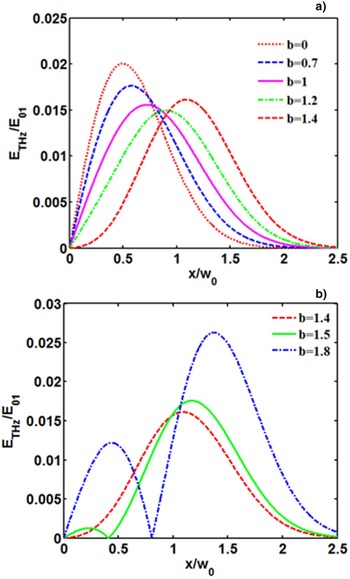
Figure 2 shows the amplitude profile of the THz radiation as a function of the transverse distance (x/w 0) for different values of decentered parameter. The THz field amplitude has a maximum point when decentered parameter is changed from zero (Gaussian beam) up to about 1.4. As Figure 2a illustrates the form of the curves remain roughly unchanged. By increasing the value of decentered parameter two maximum points appear in THz field amplitude (Figure 2b). For values (about) b ≥ 1.8 the maximum value of the THz field amplitude is greater than Gaussian beam (the case b = 0). From these figures it is clear that THz radiation can be achieved at a desired position by changing the decentered parameter.
Transverse profile (x/w 0) of THz radiation for different values of decentered parameter. (a) b ≤ 1.4, (b) b ≥ 1.4.when ω1 = 2.4 × 10¹⁴ rad/s, ω2 = 2.15 × 10¹⁴rad/s, ωp = 2 × 10¹³ rad/s, n β/n 0 = 0.3, W 0 = 0.05 mm.

The incident laser beam amplitude profile as a function of the transverse distance (x/w
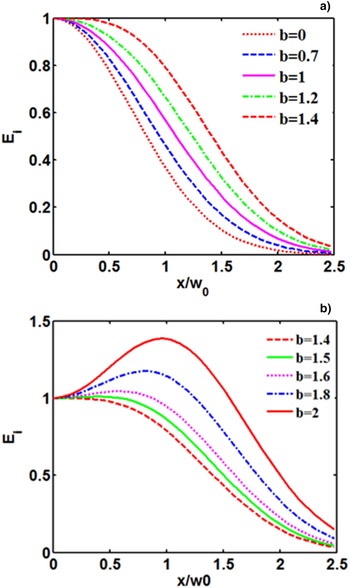
0) for different values of decentered parameter can be seen in Figure 3. The curve of incident laser beam has an inflection point for b ≤ 1.4 (Fig. 3a) since pondermotive force is related to the gradient of incident laser fields
 $[\vec F_{\rm p}^{{\rm NL}} \propto \vec \nabla (\vec E_1\cdot {\rm } \vec E_2^{\ast} )]$
this inflection point appears in THz amplitude as a maximum point (Figure 2a). Amplitude of the incident laser has a different profile for b > 1.4 (Figure 3b) it has a maximum point and two inflection points. The maximum point appears as a zero amplitude in the THz field and two inflection points appear as two maximum points in the THz field (Fig. 2b). The root is obtain from
 $(b/2)\tanh (xb/w_0) = (x/w_0)$
, in the case of decentered parameter 1.5, x/w
0 = 0.4134 and for decentered parameter 1.8, x/w
0 = 0.8. For decentered parameter (about) b ≥ 1.8, shape and distribution of the laser intensities change in such a way to create a steep gradient. This makes the ponderomotive force stronger and leads to stronger THz radiation (Fig. 2b, 3b).
Transverse profile (x/w 0) of laser electric field magnitude for different values of decentered parameter. (a) b ≤ 1.4, (b) b ≥ 1.4.

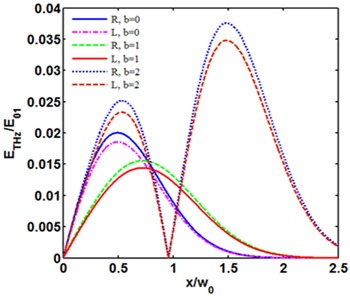
The amplitude profile of the THz radiation as a function of the transverse distance (x/w 0) for RCP and LCP waves is plotted in Figure 4. This figure shows THz amplitude of RCP wave for different values of decentered parameter is slightly larger than LCP wave.
Transverse profile (x/w 0) of THz radiation for different values of decentered parameter.

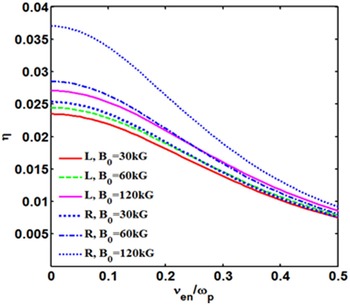
In Figure 5, the efficiency is plotted as a function of normalized collision frequency. Collisions make the electric permittivity tensor imaginary which leads to resistivity and extracts energy from electrons in collisions, consequently the efficiency decreases. High-frequency collision drastically reduces efficiency and counteracts the positive effect of magnetic field.
Normalized the efficiency as a function of normalized collision frequency for different values of magnetic field strength.

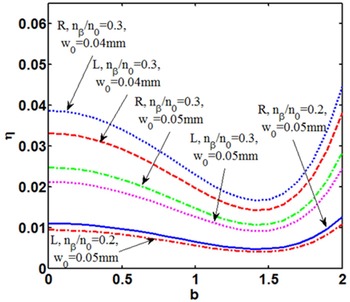
The effect of beam width, amplitude of rippled density and decentered parameter on the efficiency is shown in Figure 6. The efficiency is increased with the magnitude of density ripples, which is also evident from Eq. (3); because more electrons participate in the oscillating current, which consequently generates efficient THz radiation. The larger beam width reduces the efficiency and a small change in beam width leads to the larger variation in the efficiency magnitude. This figure also shows the efficiency has a minimum point when decentered parameter is about 1.5. From Figure 6 and precedent figures it is clear that by balancing decentered parameter, beam width and density ripples amplitude, we can find a point with good efficiency and overcome the effect of collisions in plasma.
Efficiency of THz radiation generation versus decentered parameter for different values of beam width and amplitude of rippled density; ω/ωp ≈ 1.4.

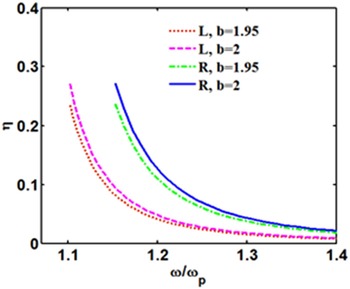
In Figure 7, variation of the efficiency of THz radiation generation versus normalized beating frequency for the case
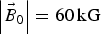 $\left\vert {{\vec B}_0} \right\vert = 60\,{\rm kG}$
is illustrated. In the collisionless plasma the RCP wave has a right-hand cut-off frequency
 ${\rm \omega} _{\rm R} = ({\rm \omega} _{\rm c} + $
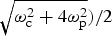 $\sqrt {{\rm \omega} _{\rm c}^2 + 4{\rm \omega} _{\rm p}^2} )/2$
and the LCP wave has a left hand cut-off frequency ωL = ωR-ωc, reflection point for RCP wave occurs in larger frequency than LCP wave. THz wave can propagate in plasma when beating frequency is greater than cut-off frequency (Bittencourt, Reference Bittencourt2004). In other words, the frequency of generated THz waves must be in the propagation region. This figure shows the efficiency of RCP wave in large beating frequency is greater than LCP wave. However, for small beating frequency where RCP wave cannot propagate in plasma LCP wave is a good substitute. Figure 7 shows the efficiency of order 27% can be achieved by employing large decentered parameters.
Efficiency of THz radiation generation versus normalized beating frequency.

5. CONCLUSION
Our calculations show that photo-mixing of two cosh-Gaussian laser beams in corrugated plasma in the presence of axial (parallel) magnetic field is remarkable technique for generating effectual THz radiation. Electric permittivity tensor elements are imaginary when collisions are included, leads to resistivity which extracts energy from electrons Proper choice of decentered parameter, beam width, amplitude of density ripples and magnetic field strength can reduce the effect of collisions. In large decentered parameter the amplitude of THz radiation field has two maximum points which it helps to achieve high THz radiation with careful choice of related parameters. Depending on the phase matching conditions LCP or RCP waves could be generated. THz amplitude of RCP wave for different values of decentered parameter is slightly larger than LCP wave.
ACKNOWLEDGMENT
Authors thank members of Department of Physics, Iran University of Science & Technology for their helpful discussion.