Over the last decade, the number of children raised in non-English language households has rapidly increased (Child Trends, Reference Duñabeitia, Hernández, Antón, Macizo, Estévez, Fuentes and Carreiras2014). Today, nearly 1 in 3 children, amounting to about 23 million children, in the United States live in a home environment where English is not the primary language (Child Trends, 2014). A vast majority of these children are dual language learners. Dual language learners (hereafter, DLLs) are children who are acquiring two languages simultaneously or are still developing their primary language as they learn a second one (Gutierrez, Zepeda & Castro, Reference Gutierrez, Zepeda and Castro2010). Despite the rapid increase in DLLs, our knowledge about oral language and cognitive development in this population continues to be limited (Hammer, Jia & Uchikoshi, Reference Hammer, Jia and Uchikoshi2011). Complicating efforts to understand DLLs is the fact that the term dual language learners encompasses a large group of individuals with a wide range of experiences with two languages. Second language exposure in DLLs varies greatly, ranging from some who are exposed to their second language only in school to others who receive second language exposure at home from birth (Peña & Halle, Reference Peña and Halle2011).
Compared to monolingual children, DLLs receive less exposure in each of their two languages (Peña, Gillam, Bedore & Bohman, Reference Peña, Gillam, Bedore and Bohman2011). This results in differing growth trajectories for the two languages (e.g., Spanish and English) that are influenced by contextual and interactional factors (Rojas & Iglesias, Reference Rojas and Iglesias2013). In addition, DLLs in the United States are often only taught and assessed in their second language or mainstream language (i.e., English). Consequently, they perform at lower levels than monolingual children on standardized tests of language development. Unfortunately, for many of these children, this means starting school at a disadvantage. Researchers have demonstrated that once a child starts to fall behind grade level, it is incredibly difficult for that child to ever catch up to his peers (Collier & Thomas, Reference Collier and Thomas1989).
Considering that this population is at risk for poor educational outcomes (Páez, Tabors & López, Reference Páez, Tabors and López2007), it is critical for researchers and educators to achieve a better understanding of the relation between language and cognition in DLLs. Thus, one of the goals of the current study is to assess the relations between vocabulary and executive functions in DLLs in a dual immersion program. For the purposes of this study, DLLs are restricted to children who are in dual immersion programs.
Bilingualism and executive functions
Executive function (EF) is generally defined as the processes that allow individuals to monitor and control their attention, thoughts, and actions to achieve goal directed behavior (Best & Miller, Reference Best and Miller2010; Carlson, Reference Carlson2005). Although the exact cognitive processes that underlie EF are still debated in the field (Barkley, Edwards, Laneri, Fletcher & Metevia, Reference Barkley, Edwards, Laneri, Fletcher and Metevia2001), it is generally agreed that EF includes the following three skills: inhibition, cognitive flexibility, and working memory (Best & Miller, Reference Best and Miller2010; Miyake, Friedman, Emerson, Witzki, Howerter & Wager, Reference Miyake, Friedman, Emerson, Witzki, Howerter and Wager2000). These cognitive processes have been shown to play a vital role in emotion regulation, school readiness, and academic achievement (Blair & Razza, Reference Blair and Razza2007; Espy, Bull, Martin & Stroup, Reference Espy, Bull, Martin and Stroup2006; McClelland et al., Reference McClelland, Cameron, Connor, Farris, Jewkes and Morrison2007).
EF is a malleable skill that does not merely reflect an individual's inheritance but is also influenced by experience (Groot, De Sonneville, Stins & Boomsma, Reference Groot, De Sonneville, Stins and Boomsma2004; Kolb & Gibb, Reference Kolb and Gibb2011; Kolb, Mychasiuk, Muhammad, Li, Frost & Gibb, Reference Kolb, Mychasiuk, Muhammad, Li, Frost and Gibb2012). For instance, SES and cultural differences in early development have been implicated in the development of EF (Hackman & Farah, Reference Hackman and Farah2009; Oh & Lewis, Reference Oh and Lewis2008). In addition, exposure to two languages (i.e., bilingualism) has been found to be associated with the development of EF (Barac & Bialystok, Reference Barac and Bialystok2012; Carlson & Meltzoff, Reference Carlson and Meltzoff2008).
A great deal of research has examined the cognitive advantages and disadvantages associated with learning two languages in development (Carlson & Meltzoff, Reference Carlson and Meltzoff2008). Although historically the findings of the research emphasized the disabling effects of bilingualism (Hakuta, Reference Hakuta1986), more recent work has depicted a balanced picture that also highlights the benefits of dual language exposure (Bialystok, Reference Bialystok2015). After a comprehensive review of the literature, Bialystok (Reference Bialystok2015; Reference Bialystok2001) has concluded that exposure to two languages affords advantages in EF, specifically in conflict resolution and monitoring.
The prevailing theory about the bilingual advantage in EF is that bilingual children have additional practice in exercising selective attention due to the ongoing demands of coordinating two languages (Bialystok, Reference Bialystok2001; Green, Reference Green1998). According to this account, bilingual children's two languages are active in daily interactions in either language (Brysbaert, Reference Brysbaert1998; Francis, Reference Francis1999; Smith, Reference Smith, Groot and Kroll1997), and so in order to avoid unwanted intrusions, bilingual children learn to inhibit their non-target language (Bialystok, Reference Bialystok2001; Green, Reference Green1998). In order to achieve the ability to inhibit the irrelevant language, bilingual children rely on domain-general suppression mechanisms (Bialystok, Reference Bialystok2001). As a result, with extensive dual language exposure bilingual children are able to practice their abilities in selection and inhibition, which become enhanced over time (Bialystok, Reference Bialystok2015).
Previous studies have shown that bilingual children exhibit an advantage in EF (e.g., Carlson & Meltzoff, Reference Carlson and Meltzoff2008; Foy & Mann, Reference Foy and Mann2014; Barac & Bialystok, Reference Barac and Bialystok2012). For instance, Barac and Bialystok (Reference Barac and Bialystok2012) compared Chinese–English, French–English, and Spanish–English bilingual children to English-speaking monolinguals on a non-verbal task of executive control. They found that the bilinguals’ performance on the EF task was indistinguishable amongst the three groups and surpassed that of the English monolinguals, thus indicating an advantage in cognitive control favoring the bilinguals.
However, there have also been notable failures to demonstrate the bilingual advantage in conflict resolution (e.g., Gathercole et al., Reference Gathercole, Thomas, Kennedy, Prys, Young, Guasch, Roberts, Hughes and Jones2014; Morton & Harper, Reference Morton and Harper2007). In a recent study, Duñabeitia, Hernández, Antón, Macizo, Estévez, Fuentes, and Carreiras (Reference Duñabeitia, Hernández, Antón, Macizo, Estévez, Fuentes and Carreiras2014) compared 252 monolingual Spanish children to 252 Basque–Spanish bilingual children (ages 8–13 years). The Basque–Spanish bilingual children were in schools that taught 50% of the academic subjects in Basque and the other 50% in Spanish. The researchers administered two versions of the Stroop task (words and numbers) and did not find any differences between the monolingual and bilingual children. In a recent review examining these failures to support the proposal of bilingual advantage in inhibition in children and adults, Hilchey and Klein (Reference Hilchey and Klein2011) caution that the application of the inhibitory control model (Green, Reference Green1998) proposed as an explanation of the bilingual advantage in cognitive control is questionable. This has led some to speculate that the bilingual advantage in EF may not exist (Paap, Johnson & Sawi, Reference Paap, Johnson and Sawi2015).
An alternate explanation to the enhanced inhibition claim (Bialystok, Reference Bialystok2001) is that the bilingual advantage in cognitive control is a result of constructing and maintaining effective goal representations in working memory (Colzato, Bajo, van den Wildenberg, Paolieri, Nieuwenhuis, La Heij & Hommel, Reference Colzato, Bajo, van den Wildenberg, Paolieri, Nieuwenhuis, La Heij and Hommel2008). These goal representations may facilitate the codes (or mental representations) for goal-relevant information by increasing their activation. So, bilinguals may not, in fact, be better at active inhibition or controlling interference from irrelevant information; instead they may be better at maintaining attention on task relevant information or ‘reactive inhibition’. In effect, because bilinguals actively support task-relevant information in their mental representation they automatically reduce attention resources for task-irrelevant information. Consequently, these local mechanisms may afford bilinguals an advantage in selecting between goal-relevant and goal-irrelevant information. The assumption within this proposal is that through dual language exposure bilinguals achieve improved focus on goal-relevant information; so what appears to be an advantage emerging from inhibitory processes may actually be due to facilitation of task-relevant representations in a system that has limited cognitive resources (Colzato et al., Reference Colzato, Bajo, van den Wildenberg, Paolieri, Nieuwenhuis, La Heij and Hommel2008).
A reasonable conjecture underlying both proposals of bilingual advantage in EF is that extensive exposure to bilingual experience would be required for the benefits to emerge. But it remains unclear as to what constitutes as ‘extensive’ or sufficient bilingual experience (Morton, Reference Morton2010). Dual immersion programs, with their controlled linguistic input, provide an optimal framework for addressing this question.
Vocabulary and executive function development in dual immersion programs
Although it is generally acknowledged that there is some association between vocabulary development and EF, the exact dimensions of this relationship are less understood (Nicolay & Poncelet, Reference Nicolay and Poncelet2013b; Singer & Bashir, Reference Singer and Bashir1999). Prior research with monolingual children found that those with enhanced EF tend to have larger vocabularies (e.g., McClelland, Cameron, Wanless & Murray, Reference McClelland, Cameron, Wanless, Murray, Saracho and Spodek2007). The developmental trajectory of children's oral language in dual immersion programs, however, may be dissimilar from children in monolingual instructional settings (Hermanto, Moreno & Bialystok, Reference Hermanto, Moreno and Bialystok2012). While some research suggests that children enrolled in dual immersion programs develop vocabulary in their second language (hereafter L2) at a rate similar to that of native speakers (Nicolay & Poncelet, Reference Nicolay and Poncelet2013b), other studies suggests that these children's vocabulary in the L2 lags behind that of native speakers even after several years of immersion exposure (Hermanto et al., Reference Hermanto, Moreno and Bialystok2012). Hence, the association between vocabulary and EF in DLLs is more difficult to predict.
Moreover, it is especially important to consider DLLs who learn their L2 in elementary school, as past research indicates that simultaneous (learning both their languages at the same time) and sequential learners (learning one language at a time) differ in the ways in which their oral language skills develop (Hammer et al., Reference Hammer, Jia and Uchikoshi2011). For example, research indicates that while Latino simultaneous bilinguals, under the age of 3 years, have a combined vocabulary that is equivalent to a monolingual (Conboy & Thal, Reference Conboy and Thal2006), this may not be the case for sequential bilinguals (Peña & Halle, Reference Peña and Halle2011) who begin learning Spanish as a L2 in school after age 5. In addition, the context of a dual immersion classroom can complicate L2 learning. In combination with learning two languages, and content in two languages, DLL children are also learning rules about using the two languages in a bilingual environment (Nicolay & Poncelet, Reference Nicolay and Poncelet2013b). One assumption is that in order to succeed in a rapidly shifting linguistic environment, DLL children likely engage attentional capacities related to EF (Nicolay & Poncelet, Reference Nicolay and Poncelet2013b). However, more research is needed with these populations to clearly understand the development of EF and language in elementary school.
Our work is situated within the competition and entrenchment account of second language development proposed by Hernandez, Li, and MacWhinney (Reference Hernandez, Li and MacWhinney2005). This model emphasizes the processes of language acquisition as opposed to the outcomes. According to Hernandez and colleagues (Reference Hongwanishkul, Happaney, Lee and Zelazo2005), language-associated developmental processes in bilinguals who learn their L2 early in development differ from those who learn their L2 late in development due to differences in exposure and brain plasticity. Both exposure and brain plasticity influence L2 learning because words from the L2 learned later in development start out as parasitic associates of the words in their first language (hereafter L1). For example, in order to use the word manzana the emerging bilingual will have to think of the word apple. Hence, words from L2 will cluster closely with relevant representational and phonological information from L1. With increased exposure and strategic use the lexical base for L2 could be reorganized to attain some individual integrity without parasitic dependence on the L1. For example, the proficient bilingual should be able to think of manzana independent of apple. But, this process would be influenced by the plasticity of the bilingual brain. Thus, the competition and entrenchment account proposes that younger bilinguals achieve reorganization of their L2 faster and easier than older bilinguals (Hernandez et al., Reference Hernandez, Li and MacWhinney2005).
The current literature has paid little attention to DLL children in the US and the development of EF related processes in within a dual immersion classroom context (Esposito & Baker-Ward, Reference Esposito and Baker-Ward2013; Hammer et al., Reference Hammer, Jia and Uchikoshi2011). More research on this topic has been conducted with European bilinguals (Nicolay & Poncelet, Reference Nicolay and Poncelet2013a; Nicolay & Poncelet, Reference Nicolay and Poncelet2015; Poarch & Van Hell, Reference Poarch and Van Hell2012). For instance, Nicolay and Poncelet (Reference Nicolay and Poncelet2013a; Reference Nicolay and Poncelet2015) conducted a longitudinal study with French-speaking children attending English immersion schools in Belgium. Their findings revealed that children in English immersion programs outperformed their monolingual peers in several attentional/executive tasks. The authors speculated that the demanding language environment of an immersion program, which requires a child learn content and a second language concurrently, was responsible for strengthening the children's attentional capacities (Nicolay & Poncelet, Reference Nicolay and Poncelet2015).
However, it should be noted that American dual language immersion programs vary in the amount of L2 exposure they provide (i.e., 90:10 or Sequential Dual Language and 50:50 or Simultaneous Dual Language) depending on their educational goals (Berens, Kovelman & Petitto, Reference Berens, Kovelman and Petitto2013). Although 50:50 (or Simultaneous Dual Language) programs provide equal amounts of L1 and L2 exposure, they differ from the European dual language immersion programs in two key ways. First, a vast majority of the dual immersion programs in the US teach in Spanish and English with the aim to make the child proficient in English while maintaining their heritage language (Potowski, Reference Potowski and Farr2005). Second, children in 50:50 dual immersion programs in the US are exposed to text (i.e., reading and writing) in two languages from the very beginning, unlike immersion programs in Belgium where children are exposed to text in their two languages sequentially (i.e., reading in L1 or L2 in first grade and reading and writing in the other language in second grade (Nicolay & Poncelet, Reference Nicolay and Poncelet2013a).
Current study
The goals of this study were: 1) to explore differences in EF abilities between monolingual children in a traditional classroom context and DLLs in a 50:50 immersion program, and 2) to examine the relations between vocabulary and EF in Spanish–English DLLs. To address these goals, we assessed the vocabulary and EF of children who were in a 50-50 Spanish–English dual immersion program and compared their performance to children who were in traditional classrooms where the medium of instruction was English. To measure EF we used two tasks, the Dimension Change Card Sort (DCCS) task (Zelazo, Reference Zelazo2006) and the Lexical Stroop Sort (LSS) task (Wilbourn, Kurtz & Kalia, Reference Wilbourn, Kurtz and Kalia2012). The DCCS required children to resolve a conflict between relational attributes by inhibiting a prepotent response. For the LSS measure, children were asked to allocate attentional resources to categorize information correctly based on attributional similarity (e.g., does the color match the auditory label?) and relational similarity (e.g., does it go into the color gobbler or the object gobbler or the mismatch gobbler?) simultaneously.
Considering previous research comparing DLLs to monolinguals has found an advantage in EF favoring the DLLs (e.g., Barac & Bialystok, Reference Barac and Bialystok2012; Esposito & Baker-Ward, Reference Esposito and Baker-Ward2013; Nicolay & Poncelet, Reference Nicolay and Poncelet2015; Poarch & Van Hell, Reference Poarch and Van Hell2012), our first prediction was that the DLLs would outperform the monolinguals on the DCCS. Although EF benefits, favoring DLLs, in language-based tasks have not been reported our research has shown that children's performance on the DCCS and LSS are positively correlated (Wilbourn et al., Reference Wilbourn, Kurtz and Kalia2012) so we predicted that if the DLL children outperformed the monolinguals on the DCCS task they would also show an advantage on the LSS. In order to succeed in the two EF tasks we used in our study, children would have to devote attentional resources to remember relational rules used to sort stimuli; so our second prediction was that the children's performance on the two EF tasks would be positively associated. Since previous research has shown that EF and vocabulary development are positively associated in DLLs (Nicolay & Poncelet, Reference Nicolay and Poncelet2013b), our final prediction was that children's performance on the EF tasks would be associated with their vocabulary.
Methods
Participants
Children were recruited from a public elementary school as part of a larger longitudinal study. This particular school serves both middle and lower socioeconomic communities with approximately 65% of children receiving free or reduced lunch subsidies. Parents received a take-home letter and were asked to return the signed consent and demographic form. Parents of 123 children consented to participate in the study. Participants who were crib bilinguals (i.e., born into a bilingual home) were excluded from analyses reported here, though analyses including these participants yielded very similar results. Crib bilinguals represented 8 participants, 5 of whom were Spanish–English bilinguals (3 from DLL program, 2 from Traditional program) and 3 who were Asian bilinguals (2 from DLL program, 1 from Traditional program). The final sample consisted of 115 (63 = males, 53 = females) children (kindergarten - 3rd grade; M age = 7.47 years, range 5.70 to 9.72 years) from diverse racial and ethnic groups (i.e., 38% African American/Black, 27% Caucasian/White, 16% Hispanic, and 6% Other). Approximately 60% of parents reported having at least some college experience with another 20% having completed college.
Out of 115, 61 children were enrolled in a dual-language immersion program (hereafter DLL) where half of the daily instruction was in English and half in Spanish. In this two-way immersion program, about half of the children in each class are native-English speakers and the other half are native-Spanish speakers. Children in the DLL program received math and social studies instruction in Spanish, and science instruction in English. Children received literacy instruction in both languages.
In our sample, DLL children were native English-speaking (n = 35) or native Spanish-speaking children (n = 26) who had not received formalized second language exposure or instruction prior to entering kindergarten. For the native-English speakers, admission into the program is based on a lottery system and they were not allowed to enroll in the program after kindergarten. Due to the underrepresentation of native-Spanish speakers in the program, all native-Spanish speakers were eligible to enroll in the program in any grade. The remaining 55 participants were all native English-speaking monolinguals recruited from traditional English-only classrooms (hereafter, Traditional). All participants received stickers and pencils for their participation.
Procedure
Participants were tested towards the end of the spring term to ensure that the kindergarten DLL children had been exposed to a second language for at least 9 months, since previous research has shown that length of exposure in immersion programs impacts performance on EF measures (Bialystok & Barac, Reference Bialystok and Barac2012). Children were tested, after receiving parental consent and child oral assent, individually in a quiet room in the school by one of four trained female experimenters (2 English monolinguals, 2 Spanish–English bilinguals). All instructions were given in English unless requested otherwise by the participant. Participants were tested in two different sessions on two different days. Each testing session lasted approximately 15–20 minutes. With the exception of the Spanish vocabulary task, which was only completed by DLL children, both groups were administered the same tasks.
Assessments
Vocabulary
The Peabody Picture Vocabulary Test (PPVT-IV; Dunn & Dunn, Reference Dunn and Dunn2007) and the Test de Vocabulario en Imagenes Peabody (TVIP; Dunn, Padilla, Lugo & Dunn, Reference Dunn, Padilla, Lugo and Dunn1986) were used to assess children's English and Spanish receptive vocabulary, respectively. These are standardized tasks where participants are shown four pictures on a page and asked to point to the image that matches the presented word (e.g., “alligator”). Standard protocol for task administration was followed (Dunn et al., Reference Dunn, Padilla, Lugo and Dunn1986; Dunn & Dunn, Reference Dunn and Dunn2007). Per the instruction manuals, raw scores were translated into standardized scores based on the age of the participant, yielding a mean of 100 with a standard deviation of 15 for each task.
Dimensional Change Card Sort task (DCCS)
Children from kindergarten to second grade were administered a computerized version of the standard preschool and advanced versions of the Dimension Change Card Sort task (DCCS; Hongwanishkul, Happaney, Lee & Zelazo, Reference Hongwanishkul, Happaney, Lee and Zelazo2005; Zelazo, Reference Zelazo2006). Third graders were not given this task because the DCCS was developed for use with children up to age seven (Zelazo, Reference Zelazo2006).
The DCCS is an executive function task that assesses cognitive inhibition and attentional control. This task requires children to sort cards based on two dimensions, color and shape. In the pre-switch trials, children sort by one dimension (e.g., shape). In the post-switch trials, children must sort by the alternate dimension (color instead of shape). Children were given 12 trials of this version of the task. Children who did not pass at least 5 trials did not continue to the advanced border trials (Zelazo, Reference Zelazo2006). For the advanced border trials, participants viewed the same cards, except that some had a thick black border around them and some did not. After the experimenter explicitly highlighted the border, she explained that, “If the card has a border, you sort by color. But, if the card doesn't have a border, you sort by shape”. Children completed 12 border trials. Children's accuracy and perseverative errors (i.e., sorting by previous rule) were recorded (Zelazo, Reference Zelazo2006).
Lexical Stroop Sort task (LSS)
The LSS task is a computerized EF task that assesses phonological processing in lexical access, in addition to cognitive flexibility and inhibitory control (Wilbourn et al., Reference Wilbourn, Kurtz and Kalia2012). This task has previously been validated against the DCCS as an effective measure of executive functions (EF) in school aged children (Wilbourn et al., Reference Wilbourn, Kurtz and Kalia2012). The LSS was administered to children from kindergarten to third grade.
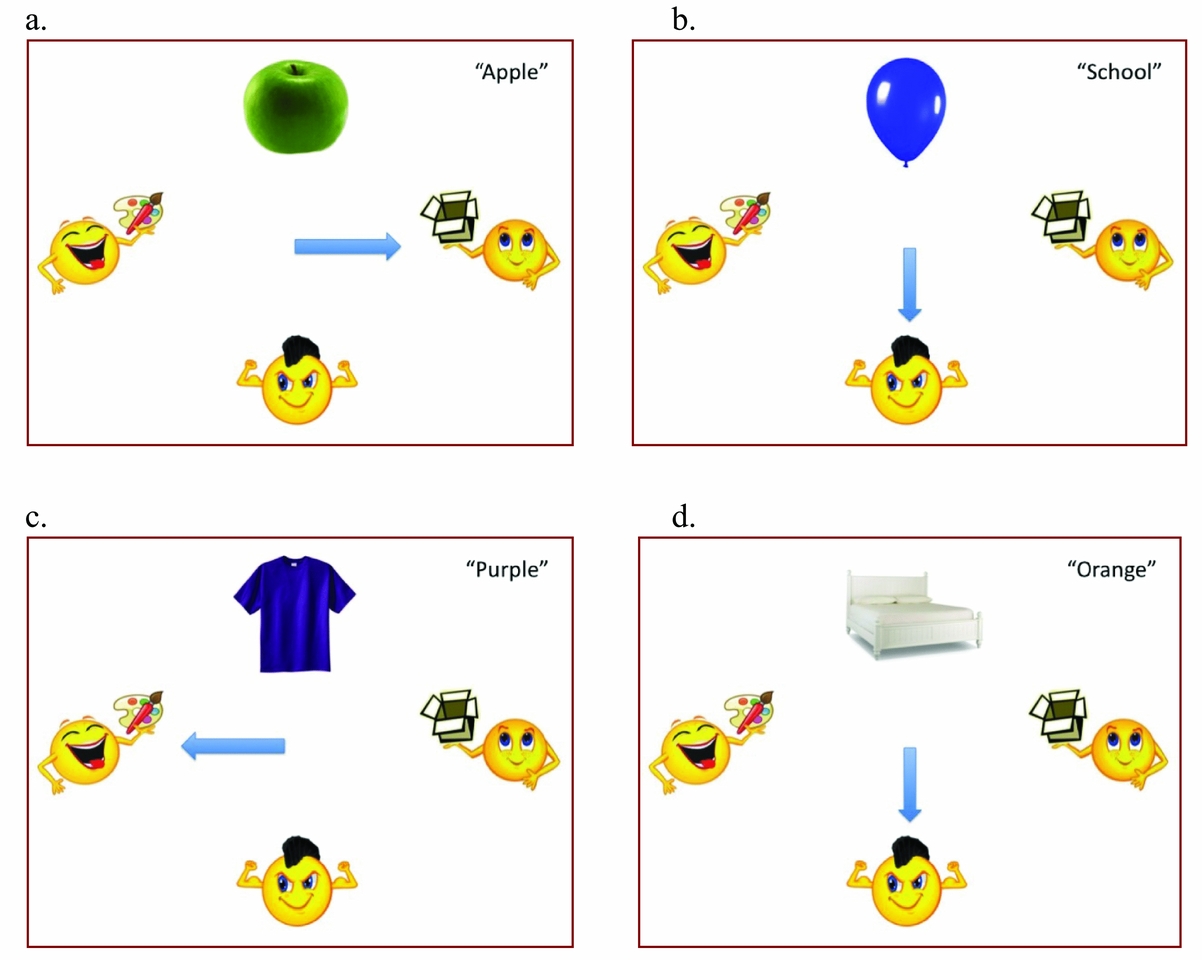
The LSS was administered using a touch screen monitor. Children were introduced to three ‘gobblers’. They were told that the object gobbler was collecting objects and the color gobbler was collecting color. The mismatch gobbler tricked people and should be given the mismatched items. Second, the children were informed that it was their job to help the object and color gobblers while avoiding being tricked by the mismatch gobbler. Finally the children were told that they would see a picture and hear a word at the same time. If the word matched the object then they would give it to (touch) the object gobbler. If, however, the color of the object matched the word then they would give it to (touch) the color gobbler. If there was a mismatch between the word (e.g., green) and the object (e.g., red car) they were to give it to (touch) the mismatch gobbler. See Figure 1. Children completed 20 test trials of this task. Children's accuracy and errors (i.e., sorting by the wrong rule) were recorded.
Depictions of the four possible sorting options for the Lexical Stroop Sort (LSS): (a) Object Match, (b) Object Mismatch, (c) Color Match, and (d) Color Mismatch. Words enclosed within quotation marks denote the presented auditory labels, and were not visually displayed on the screen. Arrows denote the correct sorting selection for each example.

Difference in performance on the DCCS and LSS as a function of program, children's age, vocabulary and parents’ education are not controlled in the schematic.

Results
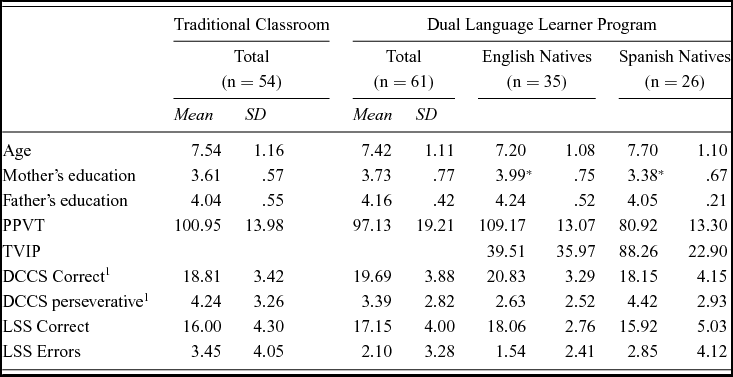
Table 1 presents the descriptive statistics on demographics and children's performance on receptive vocabulary and EF tasks. For all statistical analyses, the alpha level was set at .05 and automatic corrections were used for unequal sample sizes across groups (Neter, Kutner, Nachtsheim & Wasserman, Reference Neter, Kutner, Nachtsheim and Wasserman1996). Preliminary analyses did not reveal a significant main effect or interactions with gender, thus all subsequent analyses were collapsed across gender. Since mothers’ education correlated with fathers’ education (r = .25, p = .005), a combined variable parent education was created by averaging the two. Although we did not find any differences between the Traditional and DLL program on parental education, we did control for it in all our analyses considering that mothers of native Spanish speakers reported lower education levels than native English speakers in the DLL program, F (1, 111) = 10.78, p = .002 (see Table 1).
Descriptive statistics of children's age, parental education levels, vocabulary, and executive functions as a function of program and native language.

*Significant difference in maternal education across English and Spanish native students in the DLL program, F = 10.78, p = .002
Note. PPVT = Peabody Picture Vocabulary Test standardized scores; TVIP = Test de Vocabulario en Imagenes Peabody; DCCS = Dimension Change Card Sort; LSS = Lexical Stroop Sort Task
Parental Education: 1 = no high school diploma – 5 = graduate school degree
1 Because third grade students did not complete the DCCS, the number of participants for this task for this task are n = 42 for Total Traditional and n = 42 for Total DLLs, n = 28 for English natives and n = 14 for Spanish natives within the DLL program
Vocabulary
We assessed children's performance on the PPVT using a one-way ANCOVA, with Program entered as a between-subjects variable and children's age and parents’ education as covariates. We conducted the analyses with children's raw PPVT scores to ensure that we did not control for any age effects twice. Children's English vocabulary did not differ as a function of program, F (1, 111) = 2.29, p = .13.Footnote 1 The analyses also revealed that children's age F (1, 111) = 13.72, p < .001, η p2 = .11, and parent education levels F (1, 111) = 20.09, p < .001, η p2 = .15 were positively associated with their vocabulary scores.
Since both native-Spanish and native-English speaking children were enrolled in the DLL program, we conducted additional within-program analyses to examine differences in receptive vocabulary (PPVT & TVIP) between these two language groups. Again, we used raw scores for our analyses, and co-varied children's age and parental education levels. In addition, Bonferroni corrections were used to adjust for sample size differences. As expected, a significant main effect of Native Language emerged, F(1, 57) = 33.72, p < .001, η p2 = .372, confirming that the native-English speaking children generated higher raw scores on the PPVT than the native-Spanish speaking children, 95% CI [23.19, 47.60]. Alternatively, for Spanish receptive vocabulary, a significant main effect of Native Language, F (1, 57) = 33.06, p < .001, η p2 = .367, confirmed that the native-Spanish speakers (M = 52.23, SD = 16.75) generated higher raw scores on the TVIP than the native-English speakers (M = 21.40, SD = 19.19), 95% CI [14.70, 30.42].
Finally, we also examined differences in PPVT raw scores between native-English speakers in the DLL program and children in the Traditional program. No significant differences emerged as a function of Program, F(1, 85) = 2.41, p = .12. However, children's PPVT scores were positively related to their age F (1, 85) = 23.46, p < .001, η p2 = .22 and parents’ education levels F (1, 85) = 9.24, p < .001, η p2 = .10. Footnote 2
Executive function
Since we were interested in the relation between children's vocabulary and EF, and English PPVT scores were common to both DLL and monolingual children, in these analyses children's raw scores on the PPVT were used as covariates.
DCCS
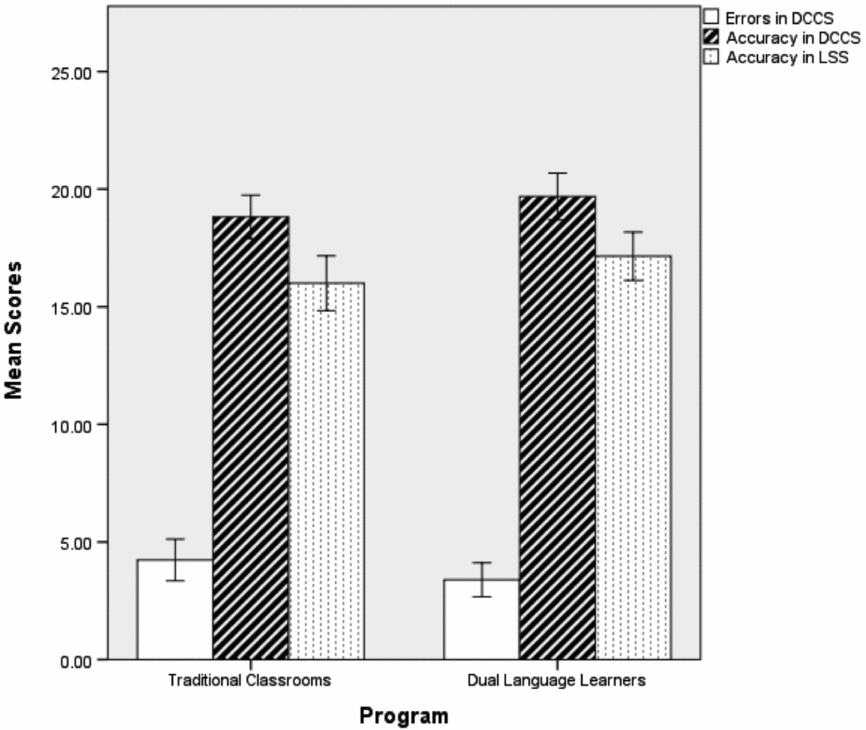
To assess children's performance on the DCCS task, we subjected the average number of correct responses to a one-way between-subjects ANCOVA, with Program administered as a between-subjects variable and children's age, their PPVT scores, and parents’ education serving as covariates. The analysis revealed that DLL children performed significantly better than their peers in the Traditional program. Children in the DLL program had more correct responses, F (1, 79) = 7.65, p = .007, η p2 = .09, 95% CI [.58, 3.52] and made fewer perseverative errors than their peers in the Traditional program, F (1, 79) = 8.86, p = .004, η p2 = .10, 95% CI [-3.13, -.62]. Children's accuracy on the DCCS was related to their PPVT scores F (1, 79) = 16.64, p < .001, η p2 = .18. Children's perseverative errors were also related to their vocabulary, F (1, 79) = 7.25, p = .009, η p2 = .085.Footnote 3
LSS
Children's accuracy and number of errors on the LSS was also subjected to a series of one-way ANCOVAs with Program as the between-subjects variable and children's age, PPVT scores, and parent education serving as covariates. Similarly to the DCCS, children in the DLL program were significantly more accurate F (1, 110) = 5.25, p = .024, η p2 = .05, 95% CI [.20, 2.78] and made fewer errors F (1, 110) = 6.02, p = .016, η p2 = .05, 95% CI [-2.76, -.29] than their peers in the Traditional program on the LSS. Children's age F (1, 110) = 4.01, p = .05, η p2 = .035 and performance on the PPVT F (1, 110) = 22.18, p < .001, η p2 = .17 was associated with their accuracy on the LSS. Children's performance on the PPVT F (1, 110) = 11.04, p < .001, η p2 = .09 and parent education F (1, 110) = 4.95, p = .03, η p2 = .04 was related with the number of errors on the LSS.Footnote 4
Differences in EF as a function of native language
We also examined differences within the DLL group through a series of one-way ANCOVAs with native language (Spanish vs. English) as a between-subjects variable. Children's age, raw PPVT and TVIP scores, and parent education were entered as covariates. Children's performance on the DCCS (either for number of correct or perseverative errors) did not differ as a function of native language. Children's PPVT performance was related to their accuracy, F (1, 36) = 7.03, p = .012, η p2 = .16, and children's age was associated with the number of perseverative errors on the DCCS, F (1, 36) = 4.54, p = .04, η p2 = .11
For accuracy on the LSS, no differences emerged in performance between native Spanish and English speakers. Children's age F (1, 55) = 4.25, p =. 04, η p2 = .07, PPVT scores F (1, 55) = 12.96, p < .001, η p2 = .19, and parent education F (1, 55) = 4.19, p = .05, η p2 = .07 were found to be associated with accuracy on the LSS. Analysis of the errors on the LSS revealed no differences between native Spanish and native English speakers. Parent education F (1, 55) = 8.04, p = .006, η p2 = .13 and performance on the PPVT, F (1, 55) = 4.67, p =.035, η p2 = .08 was related to errors on the LSS. Footnote 5
Correlations
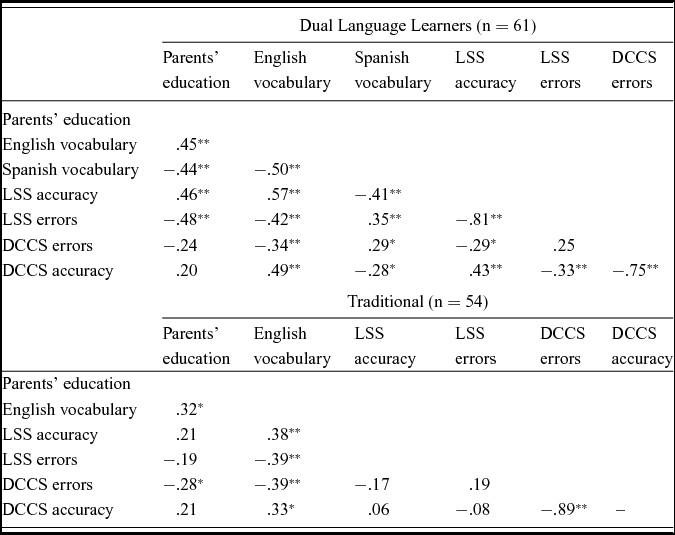
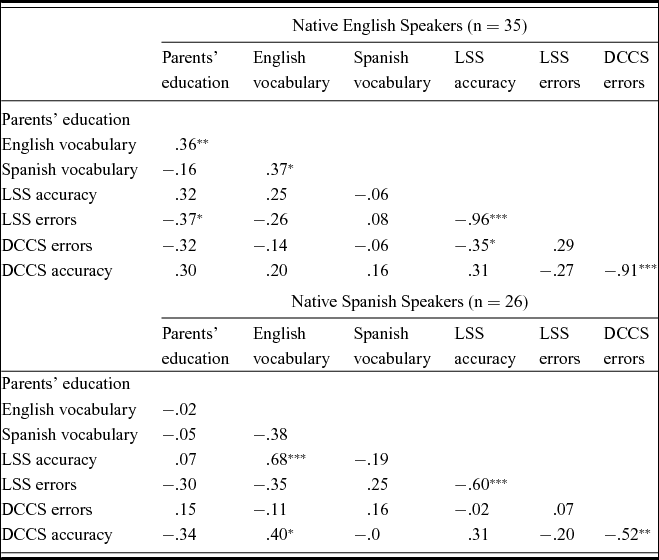
In order to examine associations between parents’ education, children's vocabulary, and executive functioning, partial correlations controlling for age were conducted separately for the DLL and Traditional groups (see Table 2). Parents’ education and English vocabulary was associated with EF for both groups. However, performance on one EF task was associated with another for the DLLs but was unrelated for the children in the Traditional classrooms. For the DLLs, Spanish vocabulary was negatively associated with parents’ education, English vocabulary, and accuracy on the two EF tasks. However, Spanish vocabulary was positively associated with errors on the DCCS and the LSS. Finally, partial correlations between oral language and executive functions were conducted separately for Native English and Native Spanish speakers in the DLL program (see Table 3).
Correlations between parents’ education, vocabulary, and EF as a function of program with children's age controlled.

* p = .05 ** p = .01; PPVT = Peabody Picture Vocabulary Test; TVIP = Test de Vocabulario en Imagenes Peabody; DCCS = Dimensional Change Card Sort; LSS = Lexical Stroop Sort Task
Correlations between parents’ education, vocabulary, and EF as a function of native language the DLL program with children's age controlled.

* p = .05 ** p = .01 *** p < .001; PPVT = Peabody Picture Vocabulary Test; TVIP = Test de Vocabulario en Imagenes Peabody; DCCS = Dimensional Change Card Sort; LSS = Lexical Stroop Sort Task
Discussion and conclusions
The current study examined the relations between vocabulary and executive functions in Spanish–English dual language learners (DLLs) from the US who were becoming literate in both their languages. Even though the role of dual language exposure in children's cognitive development is still being debated (Barac, Bialystok, Castro & Sanchez, Reference Barac, Bialystok, Castro and Sanchez2014), we are only just beginning to explore cognitive development in DLLs. The majority of previous research has been conducted with bilingual children who received formal instruction in one of their languages. Very few studies have examined EF-related processes in DLLs (Nicolay & Poncelet, Reference Nicolay and Poncelet2015; Poarch & Van Hell, Reference Poarch and Van Hell2012) and still fewer have studied the relation between vocabulary and EF in DLL children in the US (Esposito & Baker-Ward, Reference Esposito and Baker-Ward2013). In view of the fact that DLLs are at risk for poor educational outcomes (Páez et al., Reference Páez, Tabors and López2007), it is relevant that we understand the developmental processes underlying language and cognition in this population. Thus, the goals of this study were to examine the impact of dual language exposure on EF, and to explore the relations between vocabulary and EF in DLL children.
Dual language immersion and vocabulary
First, we examined differences in children's vocabulary as a function of program. The analyses indicated that children from traditional classrooms and the DLLs had equivalent English receptive vocabularies. This finding is not consistent with previous work indicating that bilinguals have less developed receptive vocabularies than monolingual children (Bialystok, Luk, Peets & Yang, Reference Bialystok, Luk, Peets and Yang2010; Hammer et al., Reference Hammer, Jia and Uchikoshi2011). It is important to note that we compared the performance of the native English speakers from the DLL program to that of the monolingual English speakers from the traditional classrooms and also failed to find differences. Thus, our findings could not be the result of linguistically-gifted children in the DLL program driving better performance for the DLLs. Since children's vocabulary is associated with school success and EF development (Blair & Razza, Reference Blair and Razza2007; Wilbourn et al., Reference Wilbourn, Kurtz and Kalia2012), the fact that the DLLs are performing at par with their peers in a monolingual program in standardized vocabulary measures is an important finding that needs more study.
However, we also need to highlight that native English and native Spanish speakers in the DLL program did differ in their English and Spanish receptive vocabularies. Native English speakers demonstrated larger English vocabularies than their Spanish-native peers, whereas native-Spanish speakers demonstrated larger Spanish vocabularies than their English-native peers. This finding could mean that the two language groups are developing their first language at a faster rate than their second language or they have more cumulative exposure in their first language since they started learning it earlier. In addition, the mean standardized scores for the two languages are very similar for the native Spanish speakers (PPVT = 80; TVIP = 88) but differ tremendously for the native English speakers (PPVT = 109; TVIP = 40). These results indicate that the pattern of developing bilingualism differs for the two language groups. But more research needs to be conducted before any firm conclusions can be drawn.
However, it is possible that the measures used in our study did not capture the full extent of the language abilities of the DLLs. Previous research has shown that standardized measures may not capture the complexity of bilingual language development (Peña et al., Reference Peña, Gillam, Bedore and Bohman2011). Furthermore, we are limited by the fact that we assessed children from only one school. Given that DLL programs vary in their structure and function (Berens et al., Reference Berens, Kovelman and Petitto2013; Gomez, Freeman & Freeman, Reference Gomez, Freeman and Freeman2005), it is possible that our findings may be driven by the instructional constraints of this particular program. Finally, we did not examine the home environment variables (e.g., parents reading to children) that could have influenced the development of children's vocabulary (Place & Hoff, Reference Place and Hoff2011).
Interestingly, we found that DLLs’ Spanish vocabulary performance was negatively associated with their English vocabulary scores. This finding provides support for the competition and entrenchment model proposed by Hernandez and colleagues (Reference Hernandez, Li and MacWhinney2005). According to this model, differences in exposure, reduced brain plasticity, and greater first language entrenchment can create a competition between the first and second language. The first language interferes with the bilingual's ability to learn their second language since the second language is parasitically related to the first language. For example, in order to use the word gato, the native English bilingual will initially think of the word cat. It should be noted that the pattern of relations between English and Spanish vocabulary appear to differ for native English and native Spanish speakers in the DLL program; although the sample sizes are too small to draw any meaningful conclusions. In addition, we do not have information about children's home language exposure (e.g., exposure to books and TV in English and Spanish) so these findings must be considered preliminary. Future research using a controlled paradigm that allows for comparison between early and late bilingual DLLs will provide valuable insight on this issue.
Dual language immersion and executive functioning
After investigating children's language development, we examined differences in EF between children enrolled in the Traditional and DLL programs while controlling for English vocabulary. In terms of accuracy and perseverative errors on the Dimensional Change Card Sorting (DCCS) task (Zelazo, Reference Zelazo2006), the findings revealed that DLL children were more accurate and made fewer perseverative errors relative to their monolingual peers in the traditional classrooms. On the LSS or Lexical Stroop Sort task (Wilbourn et al., Reference Wilbourn, Kurtz and Kalia2012), the DLL children were again more accurate and made fewer errors than their monolingual peers. Overall, these findings indicate that DLL children exhibit benefits in EF compared to children from traditional classrooms. This finding is consistent with previous research conducted with DLLs in the European context (Nicolay & Poncelet, Reference Nicolay and Poncelet2015; Poarch & Van Hell, Reference Poarch and Van Hell2012).
However, in view of recent criticism (Paap et al., Reference Paap, Johnson and Sawi2015), it is important to point out that a more complex picture emerges if we examine our analyses conducted without vocabulary as a covariate. Removing vocabulary scores as a covariate did not impact our finding of group differences in the DCCS but the results on the LSS became non-significant. Why would vocabulary scores impact group differences in LSS, but not DCCS? Unlike the DCCS, the LSS task was specifically designed to tap into children's language processing skills (Wilbourn et al., Reference Wilbourn, Kurtz and Kalia2012). It requires children to process relational information through their phonological loop and semantic knowledge base at both levels (i.e., stimulus attributes and abstract if-then level). As such, performance on the LSS is dependent on children's vocabulary and working memory processes. Thus, we believe that it is important to control for vocabulary scores in our analyses for two reasons. First, children's English vocabulary, for both DLLs and monolinguals, was correlated with their performance in both EF tasks, the DCCS and the LSS (see Table 2). Second, native Spanish speakers and native English speakers differed in their English vocabulary scores.
Executive function and bilingualism
A popular theoretical explanation proposes that continuous exposure to two languages affords bilinguals an advantage in attentional control (Green, Reference Green1998). Practice with suppressing the language system irrelevant to the task at hand requires bilinguals to exercise their attention resources, which enhances their skills in inhibition (Bialystok, Reference Bialystok2001). While our data on the DCCS task provide some support for this proposal, other theories seem more likely.
An alternate explanation to the enhanced inhibition claim (Bialystok, Reference Bialystok2001) is that bilinguals may be better at selecting between goal-relevant and goal-irrelevant information (Colzato et al., Reference Colzato, Bajo, van den Wildenberg, Paolieri, Nieuwenhuis, La Heij and Hommel2008). The assumption within this proposal is that bilinguals achieve improved focus on goal-relevant information through stronger maintenance of their goals in working memory, which provides them with more support for goal-relevant cognitive representations (Colzato et al., Reference Colzato, Bajo, van den Wildenberg, Paolieri, Nieuwenhuis, La Heij and Hommel2008). We believe this proposition may be better at explaining why the DLL children outperformed the monolinguals on the LSS task, despite having lower vocabulary scores. Since ‘reactive inhibition’ is assumed within this model, it is possible to speculate that the DLLs’ performance on the two EF tasks is driven by stronger goal maintenance in working memory. Examination of the associations between the two EF tasks provides some support for our claim. The associations between the two EF tasks differed for the two groups. Performance on the two EF tasks was unrelated for the monolinguals but positively related for the DLL group, indicating shared variance between tasks.
Many researchers agree that the development of EF is associated with children's language development (Cragg & Nation, Reference Cragg and Nation2010; Kuhn, Willoughby, Wilbourn, Vernon-Feagans, Blair & The Family Life Project Key Investigators, Reference Kuhn, Willoughby, Wilbourn, Vernon-Feagans and Blair2014; Nicolay & Poncelet, Reference Nicolay and Poncelet2013b) and our results provide some support for this idea. Children's performance on the EF tasks was positively associated with their English vocabulary scores. However, for the DLLs, Spanish vocabulary was negatively related to their accuracy on the LSS and unrelated to their performance on the DCCS. It should be pointed out that the association between vocabulary and EF tasks appear to differ for native English and native Spanish speakers in the DLL program; although the small sample sizes make it impossible for any meaningful discussion of this finding. Future research examining the differential relations between vocabulary and EF as a function of native language within a DLL program will enhance our understanding on this matter.
When we consider that the LSS task (Wilbourn et al., Reference Wilbourn, Kurtz and Kalia2012) required children to access their semantic knowledge base in English and take into account evidence in favor of the competition model (Hernandez et al., Reference Hernandez, Li and MacWhinney2005), it is unsurprising that DLLs Spanish vocabulary is negatively associated with their performance on the LSS. Taken together, our results indicate that the association between language and EF development is both nuanced and complex in DLLs and needs further examination. Although researchers agree that they are related the exact dimensions of the relationship between language development and EF are less clear (Jacques & Zelazo, Reference Jacques and Zelazo2001; Kirkham, Cruess & Diamond, Reference Kirkham, Cruess and Diamond2003; Singer & Bashir, Reference Singer and Bashir1999). Our findings provide further impetus for a systematic examination of the relation between oral language and EF in development.
Although current findings are similar to previous work demonstrating an EF advantage favoring DLLs (Barac & Bialystok, Reference Barac and Bialystok2012; Esposito & Baker-Ward, Reference Esposito and Baker-Ward2013; Nicolay & Poncelet, Reference Nicolay and Poncelet2015; Poarch & Van Hell, Reference Poarch and Van Hell2012), our results also differ from that of Anton, Duñabeitia, Estevez, Hernandez, Castillo, Fuentes, Davidson and Carreiras (Reference Anton, Duñabeitia, Estevez, Hernandez, Castillo, Fuentes, Davidson and Carreiras2014), Duñabeitia et al. (Reference Duñabeitia, Hernández, Antón, Macizo, Estévez, Fuentes and Carreiras2014), and Carlson and Meltzoff (Reference Carlson and Meltzoff2008). Anton and colleagues (Reference Anton, Duñabeitia, Estevez, Hernandez, Castillo, Fuentes, Davidson and Carreiras2014) did not find a bilingual advantage on the ANT task favoring the Basque–Spanish bilingual children in their study. Unlike our study, Anton et al. (Reference Anton, Duñabeitia, Estevez, Hernandez, Castillo, Fuentes, Davidson and Carreiras2014) only used a single measure of EF for their study so concerns about task impurity make it difficult to determine the specificity of their findings (Carlson & Meltzoff, Reference Carlson and Meltzoff2008). Duñabeitia and colleagues (Reference Duñabeitia, Hernández, Antón, Macizo, Estévez, Fuentes and Carreiras2014) also found that monolingual and bilingual children performed equivalently on two Stroop tasks. However, the children in their sample were older than ours and they did not account for SES effects. Finally, Carlson and Meltzoff (Reference Carlson and Meltzoff2008) found that DLLs were equivalent to monolingual children in conflict control. In comparison to our sample, the children in the study by Carlson and Meltzoff (Reference Carlson and Meltzoff2008) had spent only six months in the immersion program prior to testing. Previous research has shown that advantages for DLLs in psycholinguistic tasks requiring executive control emerge gradually and children may need up to two years of immersion experience before exhibiting the benefits associated with bilingualism (Bialystok, Peets & Moreno, Reference Bialystok, Peets and Moreno2014).
It should be noted that we cannot make any claims about the causal direction of the EF benefits we found. It is possible that DLL children have enhanced metacognitive skills that drive their second language and EF development. According to Hernandez and colleagues (Reference Hernandez, Li and MacWhinney2005), late bilinguals must engage metacognitive strategies like rehearsal, encoding, and imagery to overcome parasitic interference from their first language. It could be that the continuous use of these metacognitive strategies is responsible for the advantages we found in DLLs’ EF performance. Due to the paucity of research with this population, it is difficult to draw any firm conclusions at this point. It is also possible that unmeasured cultural factors may have influenced our results. For instance, it is possible to speculate that parents who choose to send their children to a dual immersion program are more likely to use parenting strategies that enhance EF related abilities in their children. Nevertheless, our study adds to our understanding of the impact of dual immersion language exposure, in classrooms, on developing EF skills and contributes to the limited literature on the relation between vocabulary and EF in DLL children.