1. Introduction
One of the basic questions in second language acquisition (SLA) research is what accounts for students' differential success in language learning. The individual factors that influence language learning have been widely researched in the past 30 years (for a recent overview see Dörnyei, Reference Dörnyei2005). The variables along which language learners differ are generally sub-divided into affective, cognitive and personality-related individual differences (Gardner, Reference Gardner1985). With some overlaps, motivation, language learning anxiety and self-confidence are generally listed among affective factors, whereas personality-related differences comprise traits such as openness to experience, conscientiousness, extraversion, agreeableness and emotional stability (Costa and McCrae, Reference Costa and McCrae1992). The cognitive factors that are held to be important predictors of success in language learning are intelligence (Skehan, Reference Skehan and Cook1986), foreign language aptitude (Carroll and Sapon, Reference Carroll and Sapon1959; Carroll, Reference Carroll and Diller1981) and working memory capacity (for an overview see Sawyer and Ranta, Reference Sawyer, Ranta and Robinson2001). The role of intelligence and foreign language aptitude in second language acquisition has been extensively researched, and in the past ten years a number of studies have been conducted on how verbal working memory capacity influences language learning. Most studies on the role of verbal working memory capacity in L2 learning concentrated on various aspects of vocabulary learning, and they usually involved a relatively small number of participants (e.g. Papagno and Vallar, Reference Papagno and Vallar1995; Service and Kohonen, Reference Service and Kohonen1995; Speciale, Ellis and Bywater, Reference Speciale, Ellis and Bywater2004; Masoura and Gathercole, Reference Masoura and Gathercole2005). The group of participants were either highly motivated university students with good cognitive capacities (e.g. Papagno and Vallar, Reference Papagno and Vallar1995; Speciale et al., Reference Speciale, Ellis and Bywater2004) or children (e.g. Service and Kohonen, Reference Service and Kohonen1995). Very few research projects investigated the general effect of verbal working memory capacity on the acquisition of various L2 skills such as listening, reading, writing and speaking (but see Harrington and Sawyer, Reference Harrington and Sawyer1992; Fortkamp, Reference Fortkamp1999; O'Brien, Segalowitz, Collentine and Freed, Reference O'Brien, Segalowitz, Collentine and Freed2006).
Our research aimed to fill the gap of studies on the relationship of verbal working memory capacity and the acquisition of the four major L2 skills and thereby contribute to our understanding of how different components of working memory serve as cognitive determinants of language learning success at various stages of the acquisition process. We also intended to investigate an under-represented age-group in this field, namely young adolescent learners, who constitute a major proportion of the language learning population in foreign language environments. Since in Hungary, a large number of secondary school students aged between 14 and 15 years have been recently participating in intensive language training programs, we were interested in to what extent the level of proficiency in the various L2 skills attained by the end of a one-year intensive language training program correlates with performance in tests of phonological short-term and general working memory capacity. In this paper we describe a study that we conducted in two consecutive years. We analyzed the different role that phonological short-term memory capacity, measured with the help of a non-word test, plays in achievement in a complex language proficiency test in the case of students who started intensive language learning from a beginner level and those whose level of English competence was pre-intermediate at the beginning of the school-year. We also included a new measure of working memory capacity: the backward digit span test (Morra, Reference Morra1994), which does not only require the temporary storage but also the manipulation of stored information.
In this paper, we first describe the working memory model and discuss previous research investigating the role of working memory in language learning. After the description of the methods used in our research, we present the results obtained, and discuss how they support a relationship between phonological short-term memory, working memory and foreign language learning.
2. Review of literature
For almost half a century, foreign language aptitude was considered to be one of the most important cognitive pre-determinants of success in second language acquisition (Ehrman and Oxford, Reference Ehrman and Oxford1995). The traditional construct of language aptitude, however, has been seriously challenged recently. Important problems with Carroll's (Reference Carroll and Diller1981) conceptualization of aptitude for language learning include that it is unclear how parts of the test he developed relate to the components of language aptitude, how foreign language aptitude and intelligence interact, and what relevance foreign language aptitude has in different types of acquisition contexts (Sawyer and Ranta, Reference Sawyer, Ranta and Robinson2001; Robinson, Reference Robinson2005). The relationship of verbal working memory capacity and foreign language aptitude is also unclear. Miyake and Friedman (Reference Miyake, Friedman, Healy and Bourne1998, p. 361) proposed that verbal working memory should be equated with foreign language aptitude since it can “capture the essence of the three important components of the language aptitude suggested by Skehan (Reference Skehan1989) – a language analytic capacity, memory ability and phonetic coding ability”. Sawyer and Ranta (Reference Sawyer, Ranta and Robinson2001) also argue that working memory subsumes the main components of language aptitude. Robinson (Reference Robinson and Robinson2002), however, points out that language aptitude is a dynamic construct that includes other cognitive abilities in addition to working memory capacity.
The most widely accepted conceptualization of short-term memory today is the working memory model developed by Baddeley and Hitch (Reference Baddeley, Hitch and Bower1974; Baddeley, Reference Baddeley1986). While previous theories of memory systems focused on the storage function of memory, the new model, as its name suggests, adapts a more dynamic approach. This conceptualization of working memory combines storage with the processing and manipulation of information, thus in this view working memory plays a far greater role in cognitive activities such as comprehension, reasoning and learning than previously assumed (Baddeley, Reference Baddeley2003).
The working memory model comprises a multi-component memory system consisting of the central executive, which coordinates two modality-specific subsystems, the phonological loop and the visuo-spatial sketchpad. Later, a fourth component was added to the model: the episodic buffer, which uses multi-dimensional coding, integrates information to form episodes, and is in communication with long-term memory (Baddeley, Reference Baddeley2000). The visuo-spatial sketchpad works with visual and spatial information, while the phonological loop is specialized for the manipulation and retention of speech. The central executive, “the most important but least understood component of working memory” (Baddeley, Reference Baddeley2003, p. 835), has several functions, including attentional control, directing the flow of information through the system and planning (Gathercole, Reference Gathercole1999).
The most widely researched component of working memory is the phonological loop. This subsystem consists of a phonological store, which holds information for a few seconds, and an articulatory rehearsal process, which refreshes decaying information amongst other functions. The rehearsal process is analogous to subvocal speech and takes place in real-time, resulting in a limited span of immediate memory (after a certain number of items, the first one will fade before it can be rehearsed). Phonological loop capacity is often measured by tasks involving immediate serial recall of numbers (digit span) or words (Baddeley, Reference Baddeley2003). One of the most widely used tests of phonological short-term memory capacity is the non-word repetition test, where participants have to repeat non-words of varying length. Non-words are words that do not exist in the given language but conform to its phonotactic rules. Participants' short-term memory capacity may then be expressed in terms of the non-word span, which is the highest number of syllables the participant could repeat in at least 50% of the cases. Other tests of phonological short-term memory include alphabet span (Craik, Reference Craik, Klix and Hagendorf1986) and forward digit span (Botwinick and Storandt, Reference Botwinick and Storandt1974).
Reading and listening span (Daneman and Carpenter, Reference Daneman and Carpenter1980) as well as the backward digit span task are considered complex verbal memory tasks. The backward digit span task is also part of the Wechsler IV intelligence test for children (Gathercole and Alloway, Reference Gathercole, Alloway, Thurman and Fiorello2008) and is hypothesized to be strongly related to general fluid intelligence (see Engle, Kane and Tuholsky, Reference Engle, Kane, Tuholski, Miyake and Shah1999). The backward digit span and the reading and listening span tasks are frequently regarded as instruments testing more than just the phonological short-term memory: they are claimed to assess the capacity of complex verbal working memory including the functioning of the central-executive, which is responsible for regulating attention (Gathercole, Reference Gathercole1999; Hale, Hoeppner and Fiorello, Reference Hale, Hoeppner and Fiorello2002). We have to note, however, that there is also evidence, mainly from studies using factor analysis, that tests measuring phonological short-term memory capacity and instruments assessing complex verbal working memory capacity are in fact diagnostic tools that tap the same underlying construct (for the most recent study on this issue see Colom, Shih, Flores-Mendoza and Quiroga, Reference Colom, Shih, Flores-Mendoza and Quiroga2006). Complex working memory has been found to influence mathematical abilities (Logie, Gilhooly and Wynn, Reference Logie, Gilhooly and Wynn1994 cited by Gathercole, Reference Gathercole1999) as well as intellectual abilities such as following directions, note-taking, writing and reasoning (Engle et al., Reference Engle, Kane, Tuholski, Miyake and Shah1999). In a recent paper Gathercole and Alloway (Reference Gathercole, Alloway, Thurman and Fiorello2008) argue that working memory “acts a bottleneck for learning” (p.23). They point out that
the acquisition of knowledge and skills in complex domains such as literacy and mathematics requires the gradual accumulation of knowledge over multiple learning episodes, many of which will take place in the structured learning environment of the classroom. Learning is thus an incremental process that builds upon the knowledge of structures and understanding that have already been acquired: any factor that disturbs this acquisition will have deleterious consequences for the rate of learning. (p.13)
Language learning is in this respect very similar to the acquisition of literacy and arithmetic skills and also requires that children maintain information in working memory while engaging in various cognitive activities.
A great number of studies investigated the relationship between phonological short-term memory capacity and first language acquisition. Young children show considerable variation in both phonological loop capacity and vocabulary knowledge, and these two variables are closely related. The relationship is particularly strong between non-word repetition and native vocabulary knowledge, with correlation coefficients ranging between 0.4 and 0.6 and is independent of nonverbal intelligence (for a recent review see Gathercole, Reference Gathercole2006). Baddeley (Reference Baddeley1986) argued that the phonological loop plays a crucial role in the learning of new words by storing unfamiliar sound patterns while long-term representations are built, which supposes a direct link between short-term memory and long-term learning. This link between short-term memory and long-term knowledge, however, is not unidirectional. Research evidence shows that words are easier to recall than non-words (Hulme, Maughan, and Brown, Reference Hulme, Maughan and Brown1991), and non-words that conform to the phonotactic rules of the participants' first language are easier to recall than non-words which are less “wordlike” (Gathercole, Reference Gathercole1995), which indicates that long-term knowledge also influences processing in phonological short-term memory (Gathercole, Hitch, Service and Martin, Reference Gathercole, Hitch, Service and Martin1997).
The link between phonological short-term memory and new word learning was extended to the learning of foreign languages by Service and her colleagues (Service, Reference Service1992; Service and Kohonen, Reference Service and Kohonen1995), who found that the ability to repeat English-sounding pseudowords was a good predictor of English language learning success (as expressed by children's grades in English) among Finnish primary school pupils during the first three years of training. Cheung's study (Reference Cheung1996) conducted with 12-year-old Chinese high school students indicated that non-word span was the best predictor of second language vocabulary learning among those participants whose vocabulary level was below the group average, while in the case of the subgroup with a wide range of vocabulary no such relationship was detected between the two variables. According to Cheung, this suggests that there is an interaction between phonological short-term memory and long-term phonological knowledge about the L2, which explains that in the case of high-vocabulary participants their long-term knowledge supported the learning of new words. Papagno and Vallar (Reference Papagno and Vallar1995) showed that short-term memory and word-learning abilities are related among adults as well. In a study with university students, Speciale et al. (Reference Speciale, Ellis and Bywater2004) found that both phonological sequence learning and phonological short-term memory capacity contribute to vocabulary learning. In the beginning of learning a language, these two variables were separable and contributed to vocabulary learning independently. As students progressed in language learning, they began to recognize the phonological regularities of the language, and vocabulary knowledge contributed to increasing the efficiency of short-term phonological storage as well as the learning of further sequences. These results indicate that the ability to learn phonological sequences also contributes to vocabulary learning, and that the combination of the two variables has more explanatory power than that of phonological short-term memory capacity alone.
Some researchers claim that phonological short-term memory plays a more general role in second language acquisition than just supporting vocabulary acquisition. Ellis (Reference Ellis1996) argues that language learning is mostly sequence learning, and even abstract grammatical knowledge is a product of the analysis of sequences. As short-term memory is responsible for remembering sequential information, its role in language learning is far greater than previously supposed. Ellis suggests that the acquisition of syntax is also related to short-term memory capacity. Ellis and Sinclair (Reference Ellis and Sinclair1996) present experimental evidence that rehearsing foreign language material has beneficial effects on both comprehending and learning foreign language material, metalinguistic knowledge of grammar, accuracy in pronunciation and productive grammatical fluency and accuracy. O'Brien et al. (Reference O'Brien, Segalowitz, Collentine and Freed2006) showed that there is a link between phonological memory and oral production skills and that the nature of relationship between measures of phonological short-term memory and various assessments of oral performance is different between proficient and less-proficient L2 speakers.
Studies assessing the role of complex verbal memory capacity in second language acquisition have mainly used the reading span test developed by Daneman and Carpenter (Reference Daneman and Carpenter1980). Harrington and Sawyer (Reference Harrington and Sawyer1992) found a strong correlation between reading span scores and achievement on a reading and grammar test. Their results with tests of phonological short-term memory also demonstrated that the relationship between digit and word span tasks and reading performance and grammatical knowledge was weak. A strong relationship between working memory capacity and the acquisition of syntactic knowledge was also indicated by Miyake and Friedman's (Reference Miyake, Friedman, Healy and Bourne1998) study. Mackey, Philp, Egi, Fujii and Tatsumi (Reference Mackey, Philp, Egi, Fujii, Tatsumi and Robinson2002) also point at the advantage of students with high working memory scores in noticing syntactic regularities, which similarly to Miyake and Friedman they explain with reference to the attention regulating function of working memory.
As we have seen, there is convincing research evidence for a relationship between phonological short-term memory and working memory capacity and certain aspects of foreign language learning, but to our knowledge, the differential role of phonological short-term and working memory in the acquisition of the five major constituents of second language competence: linguistic knowledge (including vocabulary and syntax), reading, writing, speaking and listening skills has not been investigated within a single study using relatively large number of participants. In our research we were not only interested in whether phonological short-term and working memory capacity exert different influence in second language acquisition, but also aimed to reveal whether phonological short-term memory shows a different relationship with L2 performance in the case of two groups of secondary school students taking part in an intensive language training program: those who were beginners at the end of the school-year and those whose level of proficiency was judged to be pre-intermediate in September. Our research questions were the following:
1. Is there a difference in the role of phonological short-term memory capacity between lower and higher level learners?
2. How does phonological short-term memory capacity influence the acquisition of vocabulary, grammar, reading, writing, speaking and listening skills?
3. Do the two different measures of verbal working memory capacity (non-word repetition and backward digit span) contribute differentially to the acquisition of vocabulary, grammar, reading, writing, speaking and listening skills?
3. Method
3.1 Participants
Our research was conducted in a Hungarian–English bilingual secondary school in Budapest. The participants were so-called zero-grade students, who took part in an intensive language training program from September to June, in order to achieve a level of proficiency in English which enables them to be instructed in English in several subjects during their secondary school studies. These students would be ninth graders in a conventional Hungarian secondary school, and their age was between 15 and 16 years.
In order to ensure sufficient number of participants, the study was conducted in two consecutive years. Out of the 144 students enrolled in the program, 121 students participated in the study (the 23 students were excluded either because their L1 was not Hungarian, or because they were not present at one of the testing occasions), 52 participants were male and 69 students were female. Twenty-one students in the program had learned English before coming to the school, and they began learning from the pre-intermediate level in September. 100 students had either not learned English in primary school, or the level of proficiency they reached was assessed as elementary in a placement test, and therefore they started from beginner level.
The students studied English in eleven small groups (9 beginner and 2 pre-intermediate) and they were taught by five teachers who collaborated very closely. The teaching method was communicative combined with focus-on-form instruction.
3.2 Procedures
We used a non-word span test to measure students' short-term memory capacity and a backward digit span test to assess working memory capacity. The non-word test was administered at the end of the academic year in May in both years. The backward digit span test was only used in the second year, after the results with the phonological short-term memory test in the first year showed a weak relationship between L2 achievement and non-word repetition scores. Due to the fact that all the students in the second year of the study when this test was administered were beginners, this test was not taken by learners at a higher level of proficiency. As their end-term exam, the students completed a Cambridge First Certificate language exam, which was identical in both years. We used the results of this test as the measure of second language proficiency. Results on the two tests were correlated. For the statistical analyses we applied the SPSS (Statistical Package for Social Sciences) 13.0 for Windows software.
3.3 Tests of working and phonological short-term memory
The backward digit span task, which intended to measure students' working memory capacity, was adapted from a Hungarian version of the digit span test (Racsmány, Lukács, Németh, and Pléh, Reference Racsmány, Lukács, Németh and Pléh2005). Students were tested individually by the two authors in a quiet room. Backward digit span was calculated as the sum of the highest number of digits the participants were able to repeat correctly at least twice.
The Hungarian version of the non-word span test was developed by Racsmány et al (Reference Racsmány, Lukács, Németh and Pléh2005). It consists of 36 non-words which conform to the phonotactic rules of Hungarian. The non-words are presented in a specific order, and participants have to repeat them one by one. Each non-word consists of one to nine syllables, and a set of four non-words corresponds to each number of syllables (the sets are not presented together). We recorded the test material with a digital voice recorder and presented it using portable CD players. Each student was tested separately in a quiet room by the authors of the article.
On the basis of the participants' performance, their non-word span was calculated, which is the highest number of syllables the participant can repeat in 50% of the cases (at least two times). This is the most widely accepted indicator of phonological short-term memory capacity. However, as we found that this indicator was sometimes contradictory (for instance when a participant repeated two seven-syllable words but only one six-syllable word), we also used the weighted average of the number of repeated syllables, which differentiates between two participants with a seven-syllable non-word span if one repeated all the words below the eight-syllable level, and the other failed to repeat some of the words with lower number of syllable. Waters and Caplan (Reference Waters and Caplan2003) also recommend the use of both span and score calculations in tests of verbal working memory.
We selected the non-word span test because of its attested validity in assessing phonological short-term memory capacity (Baddeley, Reference Baddeley2003; Gathercole, Reference Gathercole2006). Our decision to use an L1 based non-word repetition test was motivated by the fact that L2 non-word repetition ability is influenced by the knowledge of the phonological regularities of the L2 (Cheung, Reference Cheung1996; Masoura and Gathercole, Reference Masoura and Gathercole1999), therefore any correlation found between L2 non-word repetition ability and proficiency test scores might be the result of the fact that L2 non-word repetition ability itself is also an indirect measure of L2 competence.
3.4 Cambridge First Certificate Exam
The students' end-term exam was a Cambridge First Certificate Exam, which was administered by the teachers of the school. The written paper consists of reading and listening comprehension, composition, and Use of English test. The reading and listening comprehension sections contain three texts each, accompanied by multiple-choice items and questions requiring short answers. In the composition task students had to write in three different genres, which were evaluated based on their content and accuracy. The oral exam consisted of an interview, a picture description task and a problem-solving task in pairs. Students' performance both in the writing and speaking component was assessed independently by two teachers who did not teach the students during the school year. The teachers participated in a rater training session prior to the exam and final scores were agreed on by both teachers. The Use of English test measured students' knowledge of vocabulary and grammatical constructions.
4. Results
4.1 An overview of the general characteristics of the participants
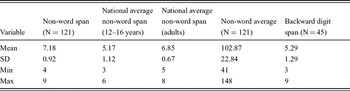
As far as the phonological short-term memory capacity of the students is concerned, the results show that the students' non-word span was relatively high. The participants were able to repeat 7.18 syllables, which is higher than the national average of this age group as found by Racsmány et al. (Reference Racsmány, Lukács, Németh and Pléh2005), whose participants aged between 12 and 16 scored 5.17 syllables. Our students' non-word span is even higher than that of the adult Hungarian national average (6.85 syllables – Racsmány et al., Reference Racsmány, Lukács, Németh and Pléh2005). In our sample, 56.2% of students scored 7 syllables and above, whereas in the corresponding age group in the national sample only the highest 10 percentile of the population was able to repeat 7 syllables. The standard deviation in our population is somewhat lower than that of the same age group in Racsmány et al.'s study (see Table 1).
The descriptive statistics of the phonological short-term memory test and working memory test results.

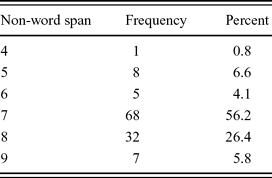
The distribution of the scores closely approximates the normal curve, although it is slightly negatively skewed. This suggests that we can regard the distribution of non-word span in our sample as normal. Among our participants, seven students reached the maximum score of nine syllables, and 32 learners were able to repeat eight syllables (see Table 2). Most students (N = 68) fell into the seven-syllable range. 56.2% of the participants scored in the average range, while 11.2% of the learners were below and 32.2% above the average in terms of their non-word span. One student could only repeat words consisting of four syllables, while eight students had a five-syllable working-memory span. This shows that there is enough variation in the non-word span of the participants to carry out meaningful analyses of the relationship of verbal working memory capacity and second language proficiency. If we compare the students who were judged to be beginners in September and those who were identified as pre-intermediate learners, we find no significant differences in their phonological short-term scores (see Table 4). No significant difference in the non-word test scores of male and female students could be detected either (t = 0.79; p = 0.43).
The distribution of the non-word span scores (N = 121).

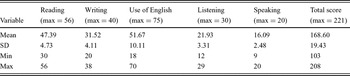
As regards the language test results, the students performed well in the proficiency exam: on average they scored 76.28% on the test. Their performance was best in the reading component, whereas their scores were the lowest in the Use of English test (see Table 3).
The descriptive statistics of the proficiency test scores (N = 121).

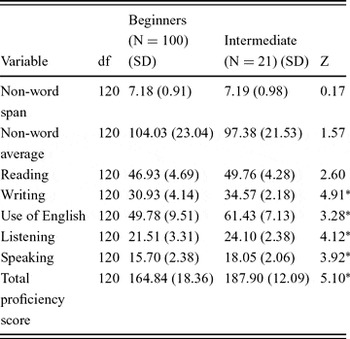
We compared the students who were considered to be beginners in September and those whose level of proficiency was already pre-intermediate at the beginning of the school-year in terms of their language test results and phonological short-term memory scores by means of the Mann-Whitney U-test, which is the non-parametric counterpart of the t-test. Our selection of a non-parametric test was motivated by the fact that the number of students in the two groups was very different (21 learners in the pre-intermediate and 100 students in the beginner group). In order to reduce the probability that significant differences are found between groups due to the repeated use of the same statistical procedure, the method of Bonferroni correction was applied when establishing the significance levels. The results show that the pre-intermediate group achieved significantly more points in every component of the exam except for the reading paper (see Table 4).
The comparison of beginner and pre-intermediate learners' proficiency and phonological short-term memory scores.

*p < 0.001
The students who were beginners when the intensive language teaching program started scored 23 points less out of the maximum number of possible points (221 points) than their more advanced peers. As the standard deviation figures suggest, the group of beginning learners was more heterogeneous in terms of proficiency than the pre-intermediate group. Even though the two groups differ only by 23 points, which is approximately 10% of the possible maximum score, the effect size calculation shows that the difference between the two groups is large (Cohen's d = 1.25). For this reason and also because the two groups followed different patterns of development: one from beginner to near upper-intermediate level, and the other from pre-intermediate to high upper-intermediate level, we treated the two groups as separate when analyzing the relationship of phonological short-term memory and language proficiency test scores.
4.2 The relationship of phonological short-term memory and proficiency test scores
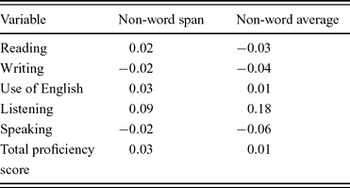
If we perform correlational analyses to establish the relationship of phonological short-term test scores and results in the various components of proficiency test in the case of the beginner and pre-intermediate group, the following findings emerge. As regards the students who were beginners at the start of the school-year, it can be seen that performance on the non-word test does not seem to be an important factor in explaining success at the end of the term test since no significant correlation emerged between measures of phonological short-term memory and achievement on the various components of the language test (see Table 5).
The correlation of phonological short-term memory and proficiency test scores in the case of the beginner group (N = 100).

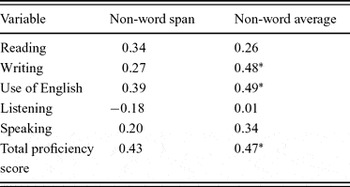
In the case of the learners who were judged to be at the pre-intermediate level in September, the average non-word score is moderately correlated with students' performance in the Writing and Use of English paper and with the total number of points students achieved in the test. Among the components of the oral test, average non-word score was found to be significantly correlated with the number of points students received for their fluency (r = 0.46; p = 0.03) and range of vocabulary (r = 0.57; p = 0.01).
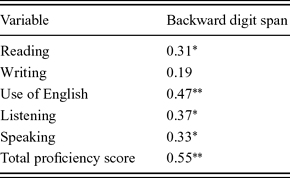
In the case of the backward digit span, however, it was found that the relationship of all the sub-tests and backward digit span is statistically significant with the exception of the writing component. Backward digit span accounts for as much as 30.25% of the variance in the performance of the complete language test for students who were beginners when the school-year started. As regards the sub-scores of the speaking component, we can see two significant relationships with backward digit span: accuracy (r = 0.42; p < 0.01) and vocabulary (r = 0.35; p < 0.05). We found no significant correlation between students' performance on the working memory test and non-word span (r = 0.13; p = 0.38) and average non-word repetition score (r = 0.07; p = 0.62).
5. Discussion
Our results provide support for the assumption that the phonological loop and general working memory are distinct constructs since we found no meaningful correlations between performance on the backward digit span and the phonological loop task. This finding is in line with the results of studies conducted by Gathercole, Tiffany, Briscoe, Thorn and ALSPAC team (Reference Gathercole, Tiffany, Briscoe and Thorn2005) and Gathercole, Alloway, Willis and Adams (Reference Gathercole, Alloway, Willis and Adams2006) that indicate that phonological short-term memory and working memory develop independently of each other in children and might cause different types of learning difficulties.
Our study also suggests that phonological short-term memory and general working memory contribute differently to the success of language learning. While phonological short-term memory capacity was found to play no role in the foreign language acquisition processes of students starting from a beginners' level, performance on the backward digit span task in this group shows remarkably high correlations with overall language proficiency test scores as well as with achievement in three of the major skills: reading, listening and speaking and on the use of English test. If we examine the three skills, what they all have in common is that they require learners to hold verbal material in phonological memory as well as to carry out other cognitive processes simultaneously. In the case of speaking, L2 learners have to store already processed bits of their message in memory while planning or linguistically encoding the next segment of their utterance (see Kormos, Reference Kormos2006). While reading and listening, students also have to maintain processed bits of the text in memory as well as read or listen to the next part simultaneously, otherwise they will not be able to understand the text as a whole (for an overview of psycholinguistic processes of reading and listening in L2 see Harrington, Reference Harrington and Robinson2001). The important role working memory capacity seems to play in L2 reading and listening in our study is not surprising given the results of previous research in the field of second language acquisition (Harrington and Sawyer, Reference Harrington and Sawyer1992) and of earlier studies in cognitive psychology in which it was found that backward digit span influences literacy skills and understanding instructions in L1 (Gathercole, Brown and Pickering, Reference Gathercole, Brown and Pickering2003). Speaking in L2 is the task that poses very high attentional demands on learners (Kormos, Reference Kormos2006), therefore the high correlations between backward digit span and speaking scores probably reflect that working memory is also responsible for regulating attention in cognitive processing (Baddeley, Reference Baddeley2003). As regards the relatively strong relationship between performance on the Use of English test and working memory scores, we might assume that working memory affects the acquisition of syntactic and vocabulary knowledge also through its attention regulating function. As argued by Miyake and Friedman (Reference Miyake, Friedman, Healy and Bourne1998) and Sawyer and Ranta (Reference Sawyer, Ranta and Robinson2001), attention is at the core of noticing and encoding both new pieces of information as well as regularities in long-term memory, which constitutes the basic mechanism responsible for learning words and rules of grammar in L2.
The correlation of phonological short-term memory and proficiency test scores in the case of the pre-intermediate group (N = 21).

*p < 0.05
Correlations of working memory and proficiency test scores (N = 45).
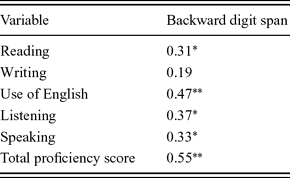
*p < 0.05, **p < 0.01
An interesting finding of our study is that phonological short-term memory seems to play a different role in influencing the second language acquisition processes of students starting from the beginners' level and those students having pre-intermediate level of proficiency at the beginning of the course. Our results indicate that in the case of the students who were beginners in September, phonological short-term memory capacity is not related to any constituent of language proficiency. In the case of students, however, who were already at a pre-intermediate level when the school-year started, we can see that significant correlations with non-word repetition scores emerge in the composition task and in the Use of English component, as well as in the case of the whole language proficiency test. In the case of both the composition score and the achievement in the Use of English paper, knowledge of vocabulary and grammatical accuracy are the main components that are assessed, whereas among the oral test components, significant correlations only appear in the case of the scores awarded for the range of vocabulary and fluency. Unfortunately, in the case of the Use of English test most tasks assess both lexical and grammatical knowledge in an integrated manner, and in accordance with the rating guidelines of the exam, compositions were judged holistically. Therefore, we have no information on to what extent range of word knowledge and syntactic and morphological accuracy contributed to the final points in these two tasks. Nevertheless, we might speculate that at the level of competence the formerly pre-intermediate group achieved by the end of the school-year, which is high upper-intermediate, most students display accurate and already proceduralized or perhaps automatized grammatical processing. Therefore, what differentiates among them is most probably the knowledge of vocabulary and the ability to retrieve words quickly and efficiently. The hypothesis that the source of differences between students in the more advanced group lies in the range of words and expressions they succeeded in acquiring during the school-year is also evidenced by the strong correlation between scores awarded for the range of vocabulary and phonological short-term memory test results. It seems that for higher level learners the ability to store verbal material in working memory plays an important role in acquiring a wide repertoire of words and expressions. This finding is in accordance with earlier studies which suggested that the achievement in the L1 non-word repetition test is a good predictor of the success of L2 vocabulary acquisition (Masoura and Gathercole, Reference Masoura and Gathercole1999; Speciale et al., Reference Speciale, Ellis and Bywater2004). It is also quite likely that not only the encoding of vocabulary items in memory is affected by phonological short-term memory capacity, but the ability to access words easily and quickly, which is reflected in the correlation of the non-word repetition test and fluency scores for pre-intermediate learners. Fluency also presupposes the knowledge of a sufficient number of ready-made lexical units or formulae (Pawley and Syder, Reference Pawley, Syder, Richards and Schmidt1983), the acquisition of which constitutes an important part of language learning especially at higher proficiency levels (for a recent review see Wray, Reference Wray2002). The ability to form larger units from smaller constituents, that is, to chunk has been supposed to be affected by working memory capacity (Zhang and Simon, Reference Zhang and Simon1985). Therefore it seems quite logical to suppose that the effect of phonological short-term memory capacity that manifests itself in the oral fluency score of the more advanced participants is also due to student variability in the ability to form linguistic chunks.
Our findings contradict the results of a number of earlier studies, however, which found that phonological short-term memory capacity plays a more important role in the case of less proficient speakers and its effect diminishes with the development of L2 competence (e.g. Cheung, Reference Cheung1996; Speciale et al., Reference Speciale, Ellis and Bywater2004; Masoura and Gathercole, Reference Masoura and Gathercole2005). The explanation for this contradiction might lie in the different nature of learning processes of the two groups of students. For students to reach a solid intermediate level of knowledge within a year, most of the learning took place through explicit instruction of grammatical constructions and vocabulary followed by practice activities in various formats. Therefore their learning processes were primarily explicit, which require the memorization of rules and their application. This kind of learning is very similar to the acquisition of literacy skills in the case of L1 children and even bears a lot of resemblance to learning mathematics. Thus, for students starting from the elementary level, it was the general working memory capacity that played an important role in influencing their success. In the case learners who progressed from pre-intermediate to upper-intermediate level, this kind of explicit learning was less frequent as they already acquired the majority of syntactic structures in primary school, and their learning processes were more implicit. If we consider studies on the relationship of phonological short-term memory and vocabulary learning both in L1 and L2, it is exactly the implicit learning of words that seems to be influenced by non-word repetition ability (Masoura and Gathercole, Reference Masoura and Gathercole2005). Students at the intermediate level acquire a high number of words through incidental exposure in reading and listening texts, and this acquisition process is aided by high phonological short-term memory capacity.
6. Conclusion
In this paper we explored the role of verbal working memory capacity in the success of the acquisition of various language skills and competencies during a one-year long intensive English language training program. Our study addressed the question of what the relationship is between phonological short-term and complex working memory capacity and performance in an end of year reading, writing, listening, speaking and use of English test. The participants of the research were secondary school students aged 15/16 in the first intensive language training year of a bilingual education program. Our study indicates that phonological short-term memory capacity plays a different role in the case of beginners and pre-intermediate students in intensive language learning. Whereas in the case of beginners there was no meaningful correlation between non-word repetition scores and English proficiency test results, for the pre-intermediate students we found a highly significant relationship between the Use of English, the writing test and the overall proficiency test results. The backward digit span test, which is a complex measure of working memory capacity, correlated very highly with overall English language competence, as well as with reading, listening, speaking and use of English test scores of students who started learning English from the beginners' level.
From these results, we concluded that phonological short-term memory and general working memory capacity plays a different role in instructed second language acquisition. In the case of the students whose development proceeded from pre-intermediate to high upper-intermediate level the success of the acquisition of words and formulaic sequences and the ability to retrieve and apply this knowledge efficiently was assumed to be related phonological short-term memory capacity. As for students starting from a beginners' level, complex verbal working memory was supposed to aid explicit learning mechanisms, mirroring the role of working memory, which acts as a bottleneck in the acquisition of L1 literacy skills and mathematical abilities.
Since in our study we used a Hungarian non-word repetition test, our findings also highlight the important role phonological and general working memory capacities measured in L1 might play in L2 acquisition. Sparks and Ganschow conducted a series of studies which indicated that L1 literacy skills serve as the foundation for L2 learning (e.g. Sparks and Ganschow, Reference Sparks and Ganschow1991, Reference Sparks and Ganschow2001). Dyslexic learners were also found to have limited verbal working memory capacity in addition to deficits in phonological/orthographic processing (Jeffries and Everatt, Reference Jeffries and Everatt2004). In their case, these impaired skills and capacities lead to increased difficulties in foreign language learning (for an overview see Schneider and Crombie, Reference Schneider and Crombie2003). Our study indicates that even small variations in verbal working memory capacity in a group of learners with no apparent learning disabilities might contribute to differential success in L2 learning.
From our study it also follows that if we want to understand the cognitive factors playing a role in instructed second language acquisition, it is important to investigate psychological determinants of general classroom learning such as components of working memory capacity as the correlations obtained in our study reach the level of relationship usually identified between foreign language aptitude and L2 achievement. If language learning is regarded be fundamentally similar to any other kind of learning (for the most recent discussion of this position see Ellis, Reference Ellis2006), it is perhaps more reasonable to seek the explanation for differential success in language learning in general cognitive abilities than to posit the existence of a construct specific to second language learning, i.e. foreign language aptitude.
Our study has several limitations, one of which is the relatively small sample size of the group of students who were above the elementary level at the beginning of the school-year. The other shortcoming of our research is that relatively few students fell into the low phonological short-term memory range, which might result in us not detecting all the significant correlations that might exist between phonological short-term memory capacity and L2 learning. The correlational design allows us only to draw conclusions concerning relationships, but it is impossible to claim that verbal memory capacity is the cause of the differences in students' performance.