Introduction
Investigations of the associations between depression, anxiety and cognitive function have provided conflicting evidence regarding the direction and strength of these relationships. Most studies have found that greater levels of depression and/or anxiety are associated with poorer cognitive performance and a greater risk of cognitive decline, mild cognitive impairment and dementia.Reference Beaudreau and O’Hara1–Reference Yates, Clare and Woods6 However, other studies have found no association between depression or anxiety and cognitive function.Reference Becker, Chang, Lopez, Dew, Sweet and Barnes7, Reference de Bruijn, Direk, Mirza, Hofman, Koudstaal and Tiemeier8 While differences in the methods of assessing mood and cognition may account for some of the variation, it is possible that other psychosocial factors may moderate the association between mood and cognition.
Several previous reviews have assessed the associations between cognition and either depression or anxiety in older people.Reference Beaudreau and O’Hara1, Reference Kindermann and Brown9 While overall these reviews have reported that those with depression or anxiety have poorer cognitive performance than those without a mood disorder, the individual studies included in the reviews have shown mixed results. For instance, in the 40 studies included in the Kindermann and BrownReference Kindermann and Brown9 review, the effect of depression on cognition ranged from a strong negative effect to a moderate positive effect. Examination of potential moderators of the association indicated a significant difference by education; when the depressed and non-depressed groups were well-matched on education there was a weaker negative effect of depression on cognition. This may suggest that educational level, a commonly used proxy measure of cognitive reserve, plays a role in the association between depression and cognition.
Cognitive reserve is proposed to account for the incongruity between the levels of dementia pathology observed through autopsy or imaging and the individual's cognitive ability.Reference Mortimer, Snowdon and Markesbery10 As cognitive reserve cannot be directly measured, it is frequently assessed in terms of the cognitive activities thought to increase it, most commonly educational level, complex occupational activity, and engagement in cognitive activities. These proxy measures of cognitive reserve are associated with better cognitive function and a reduced risk of cognitive decline and dementia.Reference Opdebeeck, Martyr and Clare11–Reference Valenzuela and Sachdev13 Cognitive reserve has also been associated with cognitive function in people with Parkinson's disease, HIV, multiple sclerosis and traumatic brain injury.Reference Benedict, Morrow, Weinstock Guttman, Cookfair and Schretlen14–Reference Kesler, Adams, Blasey and Bigler17 In addition, greater educational level and participation in cognitively stimulating leisure activities in later life are associated with less risk of experiencing depression and lower scores on measures of depressive symptoms.Reference Adams, Leibbrandt and Moon18–Reference Ross and Mirowsky28 A number of studies have noted that mood disorders, most commonly depression, are associated with reduced brain volume and increased hippocampal atrophy,Reference Ballmaier, Toga, Blanton, Sowell, Lavretsky and Peterson29–Reference Lampe, Pol, Janssen, Schnack, Kahn and Heeren31 both of which are associated with poorer cognitive performance in older people.Reference Sandu, Staff, McNeil, Mustafa, Ahearn and Whalley32 This evidence supports the proposition that depression and cognitive impairment share an underlying mechanism.Reference Byers and Yaffe33–Reference Leonard35 As cognitive reserve is thought to help maintain cognitive function through increased resistance to neuropathology, it may be reasonable to hypothesize that proxy measures of cognitive reserve may also account for some of the variance in findings regarding the associations between mood and cognition, playing a moderating role.
To date, however, evidence about the possible moderating role of cognitive reserve in the association between mood and cognition has been conflicting. In several studies, negative associations between mood and cognition have been found in those with lower but not higher levels of cognitive reserve,Reference Opdebeeck, Nelis, Quinn and Clare36 while in others there was a negative mood–cognition association in those with higher but not lower levels of cognitive reserve,Reference O’Shea, Fieo, Hamilton, Zahodne, Manly and Stern37 and in yet other studies there was no moderating effect of cognitive reserve.Reference Bhalla, Butters, Zmuda, Seligman, Mulsant and Pollock38 Given these apparent variations in the available evidence, we aimed to systematically review the existing studies to try to establish whether cognitive reserve, indicated by educational level, occupational complexity and/or engagement in cognitively stimulating leisure activities, acts as a moderator in the association between mood and cognition in older people. The review was limited to studies that investigated whether cognitive reserve, assessed by proxy measures, moderated the association between mood and cognitive function, impairment or decline in older people without dementia or other neurodegenerative conditions; including specific clinical groups, such as those with dementia, would have risked confounding the results.
Methods
Literature search strategy
In order to identify studies assessing whether cognitive reserve moderates the association between mood and cognition in later life, a search was conducted of the electronic databases ScienceDirect, PubMed, PsycInfo and CINAHL on 19 March 2015. Each database was searched for the terms (a) cognitive OR cognition AND (b) depress* OR mood OR anxiety AND (c) ‘cognitive reserve’ OR ‘brain reserve’ OR educat* OR occupation* OR activ* OR leisure AND (d) old* OR later life OR elder* OR aging OR ageing in the title, abstract or keywords. The reference sections of included studies were searched for additional papers not identified in the initial search.
Inclusion and exclusion criteria
Studies were included in this systematic review if (a) at least 80% of participants were aged over 60 or the information for those aged over 60 was reported separately, (b) at least 80% of participants were community-dwelling older people, (c) a proxy measure of cognitive reserve, specifically educational level, occupational status, cognitively stimulating leisure activities, or a combination of these was used, (d) a standardized measure of depression or level of self-reported depressive symptoms was used, and (e) a cross-sectional or longitudinal outcome measure of cognitive function was reported.
Studies were excluded if (a) more than 10% of the sample consisted of people with a neurological disorder or a disorder that may affect cognitive functioning (e.g. dementia, multiple sclerosis, Parkinson's disease, HIV, traumatic brain injury or stroke), (b) the study was an intervention or randomized controlled trial, and (c) the authors reported a biological or pathological proxy measure or outcome only.
Procedure
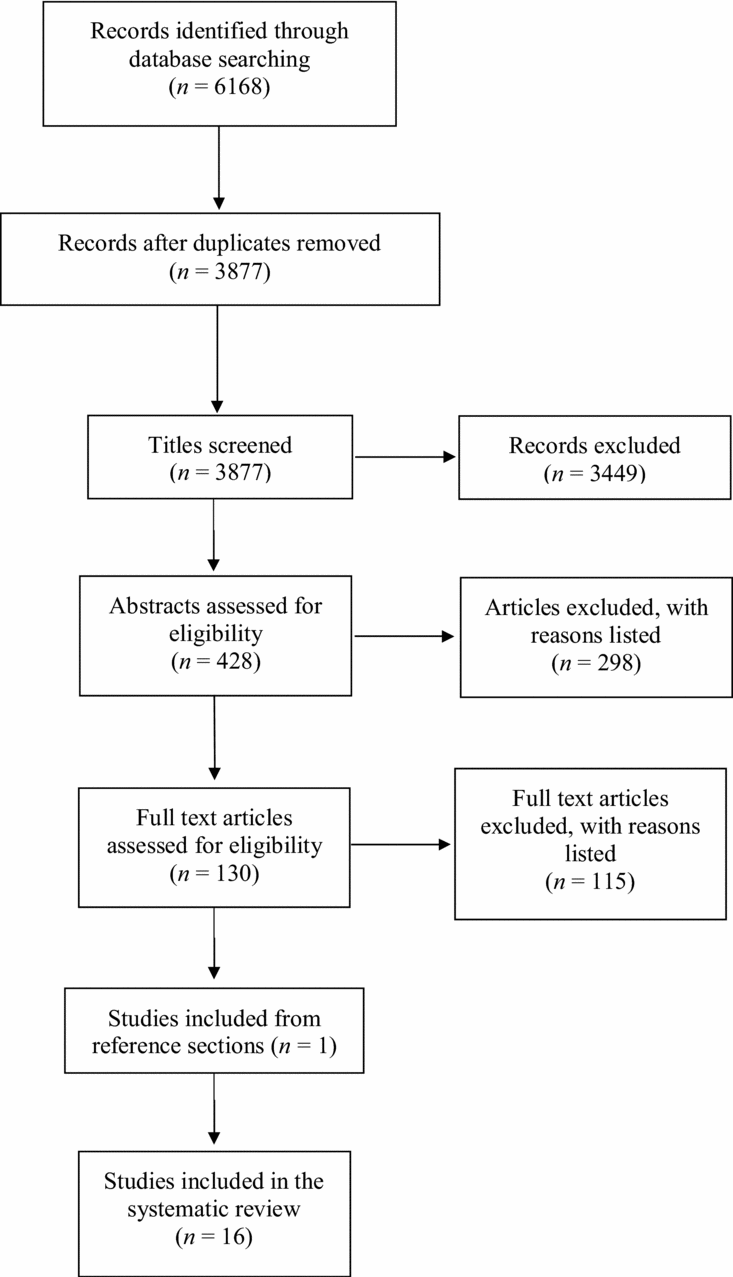
A summary of the procedure for selecting studies for inclusion can be seen in Figure 1. The searches identified 3877 unique titles that were evaluated in relation to the inclusion criteria, and those clearly unrelated to later life (e.g. child, animal or autism studies) were excluded. The remainder of the titles (n = 2625) were independently screened by two reviewers. The two reviewers achieved 98% agreement on inclusion/exclusion; where there was disagreement the title was retained for abstract screening. The primary reasons for exclusion after title screening were: the study focused solely on children, adolescents, animals or clinical populations. The lead author and second reviewer independently screened the abstracts of the remaining articles. The reviewers achieved 92% agreement on the inclusion/exclusion of articles. Where agreement could not be reached, the full text was retrieved for screening. The primary reasons for exclusion after abstract screening were: the study did not utilize a measure of cognitive reserve, depression or anxiety, or cognition.
Study selection

Full texts were retrieved for the remaining 130 articles and the methods and results sections were evaluated against the inclusion criteria. This resulted in 15 articles that satisfied the inclusion criteria. The articles rejected at this stage were primarily rejected because more than 20% of the population was from a clinical sample or aged under 60 (n = 13), there was no proxy measure of cognitive reserve or mood measure (n = 10), there was no cognition measure (n = 19), or the study did not consider whether a proxy measure of cognitive reserve moderated the association between mood and cognition (n = 69). In the majority of studies that did not assess any moderation effect analyses were adjusted for the cognitive reserve proxy measure or mood measure only. Searching the reference sections of the included studies resulted in the inclusion of one additional study.
Results
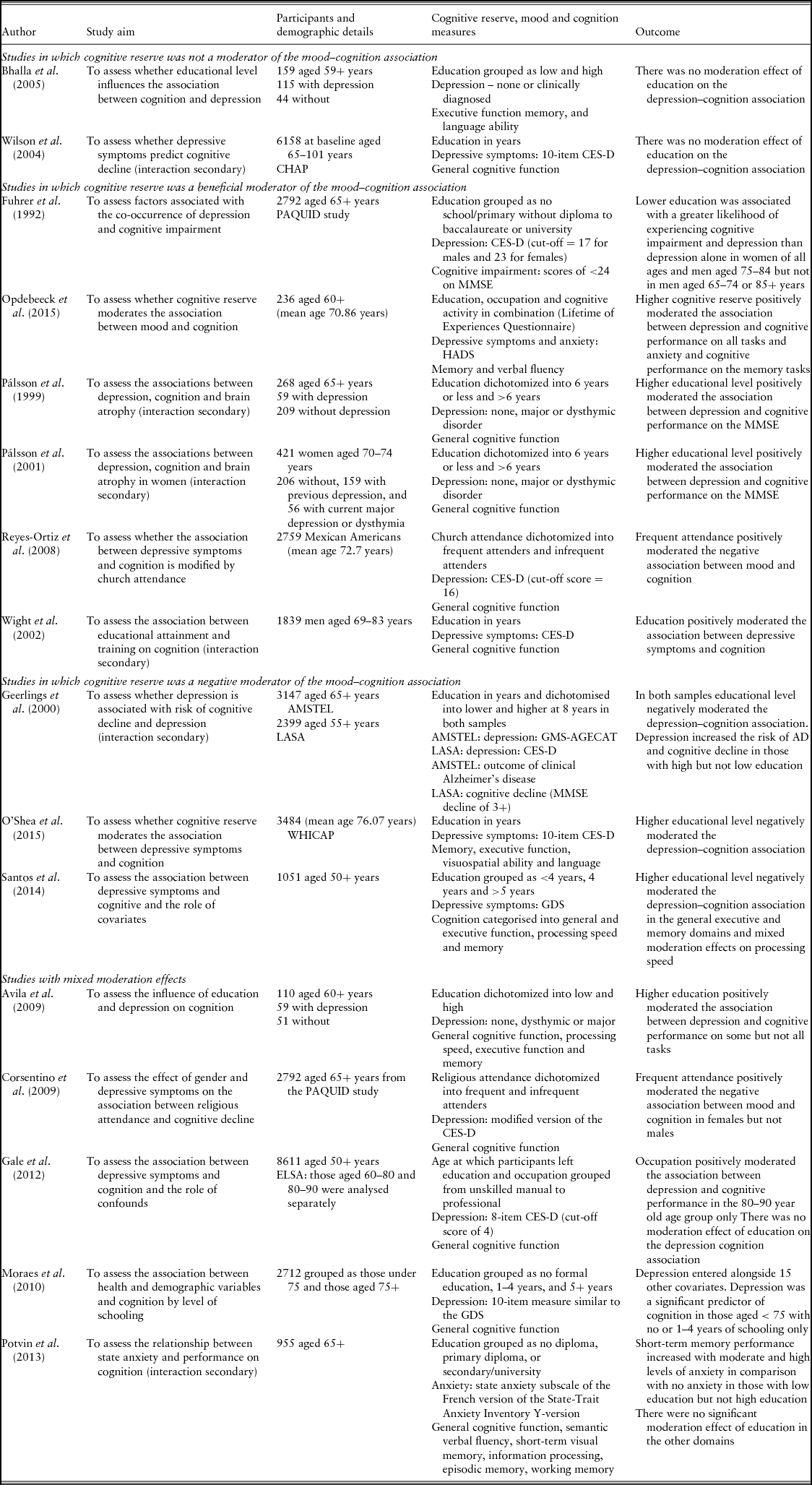
The search identified 16 studies with a total of 37,101 unique participants. The vast majority of the studies assessed whether educational level moderated the association between depression and cognitive function or decline (n = 12), with one study examining whether educational level moderated the association between anxiety and cognition.Reference Potvin, Bergua, Meillon, Le Goff, Bouisson and Dartigues39 Only one study considered whether occupation, using an occupation-based measure of social class, acted as a moderator of the depression–cognition association.Reference Gale, Allerhand and Deary40 Two studies considered whether religious attendance, suggested by the authors of both studies to be a cognitive activity that contributes to cognitive reserve, moderated the depression–cognition association.Reference Corsentino, Collins, Sachs-Ericsson and Blazer41, Reference Reyes-Ortiz, Berges, Raji, Koenig, Kuo and Markides42 Only one study combined the three key indicators of cognitive reserve (education, occupation and cognitive activity), and assessed whether the association between depressive symptoms and anxiety and cognition differed in those with low and high cognitive reserve.Reference Opdebeeck, Nelis, Quinn and Clare36Table 1 provides details of the sample, proxy measure of cognitive reserve, mood and cognition measures, and outcome for each of the included studies. The majority of the studies considered only educational level as a potential moderator, and only two studies assessed whether the proxy measure of cognitive reserve moderated the association between anxiety and cognition. The following results are grouped by whether the proxy measures of cognitive reserve moderated the association between mood and cognition or not, with those studies that found no moderation effect discussed first.
Studies included in the systematic review, with demographic, cognitive reserve proxy measure, mood measure, and cognitive outcome details, grouped by reported moderation effect found
CHAP, Chicago Health and Aging Project; CES-D, Centre for Epidemiological Studies Depression Scale; PAQUID, Personnes Agées Quid; MMSE, Mini Mental State Exam; HADS, Hospital Anxiety and Depression Scale; AMSTEL, Amsterdam Study of the Elderly; LASA, Longitudinal Aging Study Amsterdam; GMS-AGECAT, Geriatric Mental State Automated Geriatric Examination for Computer Assisted Taxonomy; GDS, Geriatric Depression Scale; WHICAP, Washington Heights/Hamilton Heights Inwood Columbia Aging Project; ELSA, English Longitudinal Study of Aging.
Studies in which cognitive reserve was not a moderator of the mood–cognition association
Two studies reported that although there was a main effect of depression on cognitive performance, there was no difference in the associations between depression and cognition according to the educational level of participants across all the cognitive function measures employed.Reference Bhalla, Butters, Zmuda, Seligman, Mulsant and Pollock38, Reference Wilson, de Leon, Bennett, Bienias and Evans43 In the study of Bhalla and colleagues,Reference Bhalla, Butters, Zmuda, Seligman, Mulsant and Pollock38 the level of education was relatively homogenous and there were few participants with lower levels of education; this lack of variability could account for why there was no moderation effect of educational level on the association between depression and cognition. However, Wilson and colleaguesReference Wilson, de Leon, Bennett, Bienias and Evans43 included participants with a wide range of education and still noted no moderation effect; indeed, these two studies employed very different methodologies, as can be seen from Table 1. Bhalla and colleaguesReference Bhalla, Butters, Zmuda, Seligman, Mulsant and Pollock38 suggested that a possible explanation for these results is that lowered mood might overwrite the protective effect of education on cognitive performance. However, this was not the case in the following set of studies.
Studies in which cognitive reserve was a moderator of the mood–cognition association
Nine studies found that proxy measures of cognitive reserve moderated the association between mood and cognition in older people across different cognitive function measures. In six of these nine studies, the negative association between mood and cognition was stronger in those with lower than higher levels of cognitive reserve. Of these six studies, four utilized educational level,Reference Fuhrer, Antonucci and Dartigues44–Reference Wight, Aneshensel and Seeman47 one considered religious attendance as a cognitively stimulating leisure activity,Reference Reyes-Ortiz, Berges, Raji, Koenig, Kuo and Markides42 and one combined educational level, occupational complexity and engagement in cognitive leisure activities to provide an overall indicator of cognitive reserve.Reference Opdebeeck, Nelis, Quinn and Clare36 In all of these studies, having a higher level of cognitive reserve, indicated by one or a combination of the three key proxy measures, appeared to be somewhat protective against the observed negative main effect of clinical depression or depressive symptoms on cognitive function. In addition, in the one study that included a measure of anxiety, higher levels of anxiety were associated with poorer performance on memory tasks in those with lower levels but not higher levels of cognitive reserve.Reference Opdebeeck, Nelis, Quinn and Clare36 Three of these studies made some effort to match the cognitive reserve groups for levels of depression.Reference Opdebeeck, Nelis, Quinn and Clare36, Reference Pálsson, Aevarsson and Skoog45, Reference Pálsson, Larsson, Tengelin, Waern, Samuelsson and Hallstro46 This could be an important factor in explaining differences in the observed associations given that previous research has suggested that higher levels of education, occupational complexity and engagement in cognitive activities are associated with reduced risk of experiencing clinical depression and lower scores on measures of depressive symptoms.
In contrast, the three other studies observing that a proxy measure of cognitive reserve acted as a moderator of the association between mood and cognition found the opposite effect.Reference O’Shea, Fieo, Hamilton, Zahodne, Manly and Stern37, Reference Geerlings, Schoevers, Beekman, Jonker, Deeg and Schmand48, Reference Santos, Costa, Cunha, Portugal-Nunes, Amorim and Cotter49 In these three studies, higher levels of depressive symptoms had a stronger association with poorer cognitive function or greater cognitive decline in those with higher educational level than in those with lower educational level. O'Shea and colleaguesReference O’Shea, Fieo, Hamilton, Zahodne, Manly and Stern37 suggested that these results could be due to the higher level of cognition seen in those with higher education, indicating that those individuals have more to lose whereas those with lower education were already performing at a lower level regardless of depressive symptoms. However, this explanation does not correspond with results from the six studies that noted a stronger negative association in those with lower levels of the proxy measures of cognitive reserve than those with higher levels. All of these studies varied considerably in their methodology (see Table 1), making it difficult to account for the opposing results.
Studies with mixed moderation effects
Five studies reported that proxy measures of cognitive reserve moderated the association between mood and cognition in some but not all of the groups or cognitive domains assessed.Reference Potvin, Bergua, Meillon, Le Goff, Bouisson and Dartigues39–Reference Corsentino, Collins, Sachs-Ericsson and Blazer41, Reference Avila, Moscoso, Ribeiz, Arrais, Jaluul and Bottino50, Reference Moraes, Pinto, Lopes, Litvoc and Bottino51 In all but one of these studies, depressive symptoms had a stronger association with cognition in those with higher than lower levels of the proxy measure of cognitive reserve assessed in at least one age or gender group or for one of the cognitive measures assessedReference Gale, Allerhand and Deary40, Reference Corsentino, Collins, Sachs-Ericsson and Blazer41, Reference Avila, Moscoso, Ribeiz, Arrais, Jaluul and Bottino50, Reference Moraes, Pinto, Lopes, Litvoc and Bottino51 (see Table 1). These studies varied considerably in their methodology. For instance, Avila and colleaguesReference Avila, Moscoso, Ribeiz, Arrais, Jaluul and Bottino50 assessed whether there was a significant interaction between education and depressive symptoms on 16 different cognitive measures across multiple domains while Corsentino and colleaguesReference Corsentino, Collins, Sachs-Ericsson and Blazer41 focused on differences in the associations by age group. Moraes and colleaguesReference Moraes, Pinto, Lopes, Litvoc and Bottino51 grouped participants by age and educational level and regressed depression alongside 15 other covariates on cognition, making it difficult to disentangle the results. One study reported mixed results when considering the associations with anxiety, with better performance on one of the seven cognitive measures employed in those with moderate and high levels of anxiety in comparison with those with no anxiety in the lower but not in the higher education group.Reference Potvin, Bergua, Meillon, Le Goff, Bouisson and Dartigues39 Avila and colleaguesReference Avila, Moscoso, Ribeiz, Arrais, Jaluul and Bottino50 suggest that the mixed moderation effects may be due to differences in the domains assessed and measures used. Those instruments wherein education moderated the association might be more sensitive to the effects of education; this could explain why there was an interaction on some measures and not others. However, this explanation does not account for the differences between groups of participants or why some studies report a main effect of education but not an interaction. The variation in the methodology of these studies makes it difficult to form a cohesive picture of the results; however, the majority of the significant findings indicated that depression has a stronger negative association with cognition in those with lower levels than in those with higher levels of education, occupation based social class, or attendance at religious activities.
Discussion
This study is the first to systematically review the evidence as to whether proxy measures of cognitive reserve moderate the association between depression or anxiety and cognitive function in older people. The 16 studies identified by this review were disparate in their methodology and findings. Of the 15 studies that assessed whether individual or combined proxy measures of cognitive reserve influence the association between clinical levels of depression or low levels of depressive symptoms and cognition, most suggested that cognitive reserve is beneficial. People with higher levels of cognitive reserve, indicated by educational level, more frequent religious attendance, or a combination of the three most common proxy measures, had better cognitive functioning regardless of depression level than those with lower cognitive reserve. In addition, in several of these studies, higher levels of depression were significantly associated with poorer cognition in those with lower but not higher levels of cognitive reserve. This evidence suggests that cognitive reserve may go at least some way towards moderating the negative association between depression and cognition. However, opposing findings were reported by five studies, ranging from no association to an association between depression and cognition in those with higher cognitive reserve only. Additionally, in four other studies, the proxy measures of cognitive reserve moderated the association between mood and cognition positively for some cognitive measures or some participant groups but not for all. The following sections will consider possible explanations for the disparate findings, discuss limitations of the review, and draw conclusions from the available evidence.
Methodological issues
There was significant variation across studies in the proxy measures of cognitive reserve, the measures of mood employed, and the methods of assessing cognitive function. We will address the variance in the methods employed to assess each of these complex and multi-faceted constructs in turn. The vast majority of studies considered only one commonly used proxy measure of cognitive reserve, with educational level the most frequent proxy measure employed. The average levels of education of participants in the individual studies ranged from very low levelsReference Avila, Moscoso, Ribeiz, Arrais, Jaluul and Bottino50 to very high levelsReference Bhalla, Butters, Zmuda, Seligman, Mulsant and Pollock38 with no trend for similar education levels to show the same direction of moderation of the association between mood and cognition. Only one study considered a measure of occupational status as an independent moderator, and the only cognitive activity measure employed was religious attendance, utilized by two studies. These three studies all found that these measures were beneficial moderators of the association between depressive symptoms and cognitive function; however, the small number of studies makes it difficult to draw definitive conclusions about these specific proxy measures of cognitive reserve. Only one study considered cognitive reserve in terms of a proxy measure that combines educational level, occupational complexity, and engagement in cognitively stimulating activities across the lifespan. However, it has recently been suggested that cognitive reserve is not static but rather results from a lifetime of exposure to cognitively stimulating experiences.Reference Nucci, Mapelli and Mondini52–Reference Whalley, Dick and McNeill58 To fully assess whether cognitive reserve moderates the association between mood and cognition it would seem prudent to include measures that evaluate a lifetime of experiences rather than assessing education, occupation or engagement in cognitive activities individually.
The measures of depression also varied considerably; most notably some measures considered the differences between those with clinically diagnosed major depression and those with no depression while others considered depressive symptoms on a continuous scale designed to assess the level of symptoms that does not provide a clinical diagnosis. Measures of depressive symptoms are very different from clinically diagnosed depression; clinical depression requiring intervention is likely to exert a much stronger influence on functioning than mild levels of depressive symptoms in community-dwelling older people. As such, we could reasonably have expected differences in the moderation effect of proxy measures of cognitive reserve on the association between clinical depression and cognition and depressive symptoms and cognition. However, there was no trend for proxy measures of cognitive reserve to show the same direction of moderation on the association between either type of depression measurement and cognition.
The methods of assessing cognition also varied considerably, from brief tests of general cognition such as the Mini-Mental State ExaminationReference Folstein, Folstein and McHugh59 and more in depth neuropsychological assessment across multiple cognitive domains to measures of cognitive decline over time. Education has been differentially associated with different cognitive domains in several previous studies.Reference Davey, Dai, Woodard, Miller, Gondo and Johnson60–Reference Zahodne, Nowinski, Gershon and Manly64 Additionally, in a recent meta-analysis, each of the three proxy measures of cognitive reserve varied in its associations with different domains of cognitive functioning.Reference Opdebeeck, Martyr and Clare11 However, this cannot explain the variations observed in this review, as there was no consistency in moderation effects according to cognitive domain assessed or in those studies that considered general cognitive function measures only. Without any consistency in the samples or methods of studies that showed a beneficial moderation effect of higher cognitive reserve levels on the negative association between mood and cognition, it is difficult to say why some studies report this finding while others found no moderation effect or indeed an opposing effect. However, as the majority of studies showed a beneficial moderation effect it seems reasonable to tentatively conclude that, in general, having higher levels of cognitive reserve may reduce the negative effects that depression exerts on cognition.
There may, however, be several possible confounding factors that result in the disparities between the moderation effects noted in the studies. The most notable of these may be cohort effects. There were significant cohort differences, including generational, geographical and racial differences. For instance, regarding geographical difference, four of the six studies that reported a beneficial moderation effect of cognitive reserve on the association between mood and cognition were conducted in Europe. In contrast, both studies in which there was no moderation effect were conducted in the USA. The aims of the studies also varied, with some setting out to specifically assess whether proxy measures of cognitive reserve moderate the association between mood and cognition whereas for others the moderation effect analysis was secondary to the main aim of the study (see Table 1). However, studies that considered the moderation effect as the main aim of the study are represented among those reporting each type of effect or no effect, as are studies in which assessing the moderation effect was secondary to the main aim. In sum, while there were a number of possible confounding factors, ranging from methodological differences to differences in study aims, none of these appears to relate to specific types of moderation effect.
Limitations
Due to the disparate methodology used in the studies included in this review it was not possible to carry out a meta-analysis that can avoid the bias associated with narrative reviews.Reference Lyman and Kuderer65 However, meta-analytic methods ignore differences across studies;Reference Borenstein, Hedges, Higgins and Rothstein66 given the large variations seen in the relatively small number of studies available on this topic, a narrative systematic review was in any case deemed more appropriate. One of the major limitations of this review is our inability to address whether proxy measures of cognitive reserve moderate the association between anxiety and cognitive function. This was unavoidable as only two studies assessed whether the association between anxiety and cognition differed according to level of cognitive reserve, suggesting that this area has been under-researched to date. Given the heterogeneity of the methods employed and the results of these two studies, the question of whether proxy measures of cognitive reserve, individually or in combination, moderate the association between anxiety and cognition remains unanswered.
Conclusion
Cognitive reserve appears to moderate the negative effect that many neurological conditions and injuries have on cognition,Reference Benedict, Morrow, Weinstock Guttman, Cookfair and Schretlen14–Reference Kesler, Adams, Blasey and Bigler17 and perhaps further investigation may provide greater support for the supposition that it can also moderate the negative effect that mood disorders may have on cognition. If this is the case, it provides extra incentive to encourage people to engage in the activities that are associated with higher levels of cognitive reserve across the lifespan. It is not possible to give a definitive answer to the research question posed by this review until more studies, using consistent methods to assess cognitive reserve across varied samples of older people, have investigated whether cognitive reserve moderates the association between mood and cognition in later life. However, the current evidence assessed in this review suggests that we can tentatively conclude that cognitive reserve is a beneficial moderator of the negative associations between mood and cognition.
Acknowledgements
We are grateful to Dr Gill Toms for her help in screening articles for this review. This research was funded by a Bangor University, School of Psychology PhD scholarship awarded to Carol Opdebeeck.
Conflicts of interest
None