

Recent advances in understanding tumour survival signalling pathways have supported a migration of cancer treatment from untargeted cytotoxic therapy to selectively targeted therapeutics. Targeted therapeutics directed against specific molecules in malignant cells have been approved by the US Food and Drug Administration (FDA) and enable initial attempts at personalised cancer treatment. By analysing genetic abnormalities of a patient's tumour, unusual gene and protein expression can be determined and used to guide selection for specific targets.
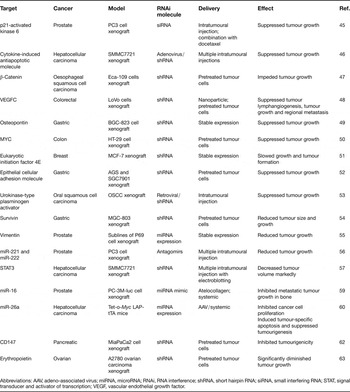
RNA interference (RNAi) is a sequence-specific, naturally occurring mechanism for gene silencing induced by double-stranded (ds) RNA that was first discovered in the nematode Caenorhabditis elegans – work for which Andrew Fire and Craig Mello were awarded the 2006 Nobel prize for physiology or medicine (Ref. Reference Fire1). The pathway of RNAi has been found in cells of nearly every multicellular organism and might have evolved as a defence against viral dsRNA (Ref. Reference Hannon2). Target-specific RNAi can knockdown a gene with high specificity and selectivity, thereby providing an important tool for personalised cancer therapy, as demonstrated in numerous animal xenograft studies (Table 1). However, many issues need to be resolved for RNAi treatments to translate from the laboratory to the clinic, including an effective targeted delivery system and a more comprehensive understanding of possible off-target effects (Ref. Reference Rao3). RNAi-based approaches are reviewed here as part of a new division being established for cancer management.
Examples of in vivo use of RNAi

Abbreviations: AAV, adeno-associated virus; miRNA, microRNA; RNAi, RNA interference; shRNA, short hairpin RNA; siRNA, small interfering RNA; STAT, signal transducer and activator of transcription; VEGF, vascular endothelial growth factor.
Personalised cancer gene therapy
Human tumours show profiles of gene expression that are different not only from normal tissue, but also from each other. This can explain the differing responses to treatment (Ref. Reference Kaklamani and Gradishar4). Part of the differential gene expression involves altered levels of microRNA (miRNA) in malignant cells (Ref. Reference Lu5). miRNAs are endogenous, noncoding RNA molecules that play a key role in regulating the gene expression pattern of a variety of developmental and physiological processes (Ref. Reference Tong and Nemunaitis6). Classifying tumours by their miRNA levels provides further information on the aberrant gene expression pattern of individual tumours (Ref. Reference Lu5). Recent studies have demonstrated that the pattern of gene expression can be classified into categories for clinical outcome prediction and for treatment response (Ref. Reference Wang7).
In our evaluation, targets for therapy should be based on the degree of connectivity of dynamic genomic–proteomic nodes in a patient-data-based network model, rather than targeting the more highly active metabolic pathways in rapidly proliferating cancer cells in accord with traditional chemotherapy principles (Ref. Reference Bild8). Highly connected targets are more vulnerable to attack because of the impact on the entire network (Ref. Reference Albert, Jeong and Barabasi9). The disordered cancer circuitry in malignant tissue can cause the cells to become highly dependent on a specific rewired pathway. The disruption of pathways that produce robustness to certain attacks often also causes increased fragility to other perturbations (Ref. Reference Weinstein10). Therefore, in theory, knockdown of a rewired oncogenic tumour-specific pathway should lead to cell death in malignant tissues without significantly disturbing normal cell functionality (Ref. Reference Rao3).
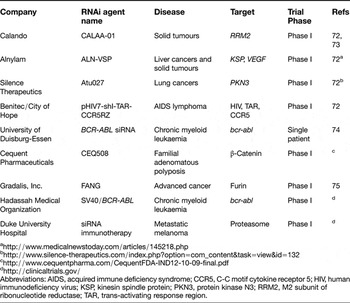
Each patient has a genetically different tumour, with a distinct rewiring of protein pathways. In order to find the optimal targets, malignant and nonmalignant tissue can be analysed in the context of global protein-interaction networks, providing information to create a prioritised list of potential gene and protein targets for each patient (Ref. Reference Nemunaitis11). For example, we recently identified two scaffold proteins [RACK1 (GNB2L1) and stathmin 1 (STMN1)] as uniquely elevated within malignant tissue in comparison with matched same-organ nonmalignant tissue, and highly connected with several procancer gene signals (Ref. Reference Nemunaitis11). We constructed and verified activity of a unique bifunctional short hairpin RNA (bi-shRNA) targeting stathmin 1 (Ref. Reference Rao12) and are currently processing the Investigational New Drug (IND) application to treat patients demonstrating elevated stathmin 1 in their malignant tissue. RNAi therapy of patients demonstrating target signal upregulation is also under way in several clinical trials around the world (Table 2).
Cancer therapy in clinical trials based on RNAi

Abbreviations: AIDS, acquired immune deficiency syndrome; CCR5, C-C motif cytokine receptor 5; HIV, human immunodeficiency virus; KSP, kinesin spindle protein; PKN3, protein kinase N3; RRM2, M2 subunit of ribonucleotide reductase; TAR, trans-activating response region.
Mechanism of RNAi
Single-stranded antisense RNA was initially shown to cause interference as a result of hybridisation of the antisense and the mRNA target site (Ref. Reference Fire13). However, it was also observed that treatment with the sense strand caused a similar reduction of gene function (Ref. Reference Guo and Kemphues14). It was then demonstrated that dsRNA caused much more interference than each strand individually. Only a few molecules of dsRNA were required to achieve this effect, which indicated hybridisation was not the only mechanism of gene knockdown (Ref. Reference Fire1).
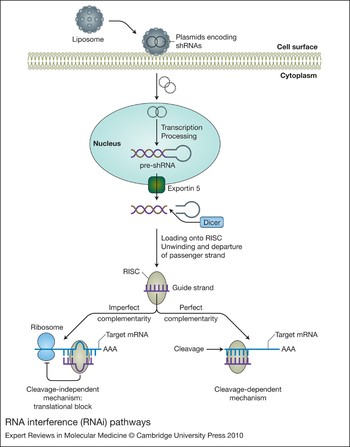
RNAi can be modelled by both cleavage-dependent and cleavage-independent mechanisms (Fig. 1). It can be induced by small interfering RNA (siRNA; dsRNA of 21/22 nucleotides with a two-nucleotide overhang on the 3′ end), microRNA (miRNA; endogenously produced noncoding RNA of approximately 22 nucleotides in length), or short hairpin RNA (shRNA; a DNA plasmid encoding short RNA with a stem–loop structure).
RNA interference (RNAi) pathways. Cleavage-dependent and -independent RNAi pathways are illustrated here with reference to bifunctional shRNA. The shRNA expression vector is shown entering the cell cytoplasm via a liposome delivery system, and enters the nucleus for expression. After nuclear entry, shRNA expression vectors are transcribed into primary transcripts by host RNA polymerases, and the transcripts are then processed by a microprocessor complex in the nucleus into a stem–loop structure and transported into the cytoplasm. In the cytoplasm, the stem–loop structure is further processed into mature shRNAs by Dicer in the RISC-loading complex, resulting ultimately in a single guide strand loaded onto the RISC for activity. In the bifunctional shRNA approach, two stem–loop RNA molecules are encoded, with the aim of increasing the efficiency of gene knockdown through efficient loading onto multiple types of RISC loading complexes: one has perfect complementarity for the target sequence, which results in cleavage of the target mRNA; the other has imperfect complementarity, which results in knockdown via translational repression. By contrast, siRNA and conventional shRNA rely on cleavage-dependent RISC for activity, whereas cleavage-independent RNAi is the predominant mechanism undertaken by miRNA. Note that RNAi via shRNA and vector based miRNA-mimics requires expression from engineered constructs in the nucleus, whereas siRNAs or oligonucleotide-based miRNA mimics or antagomirs remain in the cytoplasm seeking entry into the RISC.

siRNA mechanism: cleavage-dependent RNAi
The mechanism of RNAi begins with the cleavage of long dsRNA molecules into siRNAs by the RNAse III enzyme Dicer (DICER1) in the cytoplasm. Dicer protein contains an N-terminal helicase domain, an RNA-binding domain called Piwi/Argonaute/Zwille (PAZ), two RNAse III domains, and a dsRNA-binding domain (Ref. Reference Bernstein15). The PAZ domain of Dicer specifically recognises and binds to the 5′ phosphate of dsRNA with a two-nucleotide 3′ overhang (Ref. Reference Ma, Ye and Patel16). The two RNAse III domains each cut a single strand of the dsRNA and their alignment results in the two-nucleotide overhang. The 21/22-nucleotide siRNA product length is due to the distance between the PAZ binding domain and the active sites of the RNAse III domains (Ref. Reference Zhang17). Dicer interacts with the TAR RNA-binding protein (TRBP/TARBP2P) or protein kinase R (PKR)-activating protein (PACT) to mediate siRNA production. TRBP and PACT are structurally related but provide opposing regulation of RNA-dependent protein kinase (PKR) (Ref. Reference Kok18).
The complex of ds siRNA, Dicer and TRBP/PACT is then loaded into the RNA-induced silencing complex (RISC) (Ref. Reference Hammond19). Perfectly processed siRNA (most exogenously applied siRNA) can be loaded onto RISC without the TRBP/PACT–Dicer complex, but every other RNAi source must be processed for loading (Ref. Reference Rao3). The siRNA–TRBP/PACT–Dicer complex recruits Argonaute 2 (Ago2/EIF2C2) through TRBP/PACT to form the RISC loading complex (RLC) (Ref. Reference Robb and Rana20). The RLC initiates siRNA unwinding and determines which strand is assembled into the RISC by preferentially binding the strand with lower thermodynamic stability at the 5′ end, which becomes the guide strand (Ref. Reference Tomari21). The passenger strand is cleaved by Ago2 and departs the complex, facilitating assembly of RISC (Ref. Reference Matranga22). RISC mediates sequence-specific binding of the guide strand RNA to the corresponding target mRNA mainly with the 5′ seed region (nucleotides 2–8) of the siRNA (Ref. Reference Ma23). The mRNA is then cleaved by Ago2 at the centre of the oligonucleotide duplexed with it, concluding the cleavage-dependent RNAi mechanism (Refs Reference Schwarz, Tomari and Zamore24, Reference Hammond25). RISC remains bound to the single-stranded siRNA and can execute several rounds of cleavage (Ref. Reference Gregory26). The protein Tudor-SN (SND1) is also a part of RISC and degrades RNA and DNA nonspecifically, suggesting it degrades the mRNA after cleavage (Ref. Reference Banan and Puri27).
miRNA mechanism
The miRNA family of RNA is transcribed by RNA polymerase II (pol II) into a capped and polyadenylated primary transcript (pri-miRNA). The pri-miRNA transcript is processed into a stem–loop configuration of 60–110 nucleotides, known as pre-miRNA, in the nucleus by a ‘microprocessor’ complex, containing the nuclear RNase III enzyme Drosha (RNASEN) and its cofactor DGCR8 (a ds-RNA-binding domain protein) (Ref. Reference Tang28). Drosha also generates a two-nucleotide 3′ overhang that can be recognised by Dicer for further processing in the cytoplasm (Ref. Reference Hammond25). This pre-miRNA is exported to the cytoplasm by exportin 5 (XPO5) (Ref. Reference Tang28). Dicer cleaves the pre-miRNA to form mature miRNA and integrates the miRNA duplex with argonaute-containing RISC, much as it does for siRNA (Ref. Reference Meister and Tuschl29). In addition to Ago2, the argonaute proteins Ago1, Ago3 and Ago4, which do not have endonuclease activity, can also be assembled into RISC for cleavage-independent interference (Ref. Reference Preall and Sontheimer30).
mRNA target recognition by miRNA usually requires a perfect nucleotide match in the seed sequence of the miRNA (Ref. Reference Sethupathy, Corda and Hatzigeorgiou31). If the miRNA is perfectly complementary to the mRNA, Ago2 cleavage of the mRNA will occur just as it does for siRNA (Ref. Reference Meister32). However, mRNA that binds to miRNA with imperfect complementarity experiences translational blockage due to the formation of a bulge sequence in the middle of the A-form helix, making it unsuitable for cleavage. This cleavage-independent mechanism of RNAi is the predominant mechanism undertaken by miRNA (Ref. Reference Pillai, Bhattacharyya and Filipowicz33). As a result of the ability to affect translation of mRNAs with imperfect complementarity, a single miRNA can act on several mRNA targets and mRNAs can be the target of multiple miRNAs (Ref. Reference Sethupathy, Corda and Hatzigeorgiou31). Up to a third of protein-coding mRNAs are susceptible to regulation by miRNAs (Ref. Reference Krek34).
shRNA mechanism
shRNAs are synthesised in the nucleus of cells, further processed and transported to the cytoplasm, and incorporated with the RISC for silencing activity (Ref. Reference Cullen35) The processing of shRNA is presumed to be very similar to the maturation pathway of miRNA, so studies on miRNA have provided the foundation of our understanding of shRNA synthesis (Ref. Reference Zeng and Cullen36). shRNA is transcribed by either RNA pol II or III through promoters on the expression cassette. RNA pol II creates a transcript with a hairpin-like stem–loop structure that is processed in the nucleus by the microprocessor complex (Ref. Reference Lee37). This creates pre-shRNAs containing a two-nucleotide 3′ overhang, which are transported to the cytoplasm by exportin 5, much like pre-miRNA. The loop of the hairpin is removed by the complex containing Dicer and TRBP/PACT to form ds siRNA with a two-nucleotide 3′ overhang, which is loaded onto RISC as described earlier (Ref. Reference Yi38) Pre-shRNA has been found to be a part of the RLC, so it is possible that pre-shRNA directly associates with the RLC by a different Dicer–TRBP/PACT complex (Ref. Reference Landthaler39). After loading onto RLC, and passenger-strand departure, shRNA should behave the same as siRNA or miRNA, causing cleavage of mRNA or translational blockage.
Bifunctional shRNA mechanism
A bifunctional shRNA is designed to induce both the cleavage-dependent and cleavage-independent mechanisms of RNAi (Ref. Reference Rao12). It consists of two stem–loop shRNA structures: one of fully matched passenger and guide strand to incorporate with the cleavage-dependent RISC, and one composed of mismatched strands for incorporation with the cleavage-independent RISC. This design should increase efficacy as a result of the unique loading into the RISC complex. A higher level of efficacy (greater knockdown at equivalent dosing) and altered kinetics in a head to head comparison with siRNA to the same target has in fact been observed (Refs Reference Rao3, Reference Rao12).
Delivery methods
One of the biggest obstacles for RNAi use in vivo is achieving efficient delivery of the dsRNA required to induce RNAi. Delivering shRNA has more in common with traditional gene therapy than with the delivery of siRNA or antisense oligonucleotides because the nucleic acid must be delivered to the nucleus (Ref. Reference Vorhies and Nemunaitis40) Therefore, previous research on delivering plasmid DNA can be adapted for the delivery of shRNA, and antisense delivery technology can be modified for the delivery of siRNA (Ref. Reference Pardridge41).
Numerous methods of delivery are being used; natural and synthetic polymers, lipid complexes, and viral vectors are the most common (Ref. Reference Gondi and Rao42). In addition, effort is being made to create targeting systems so the nucleic acid is delivered only to tumour cells. Delivery vehicles can be complexed with monoclonal anitbodies, peptides, small-molecule ligands, or aptamers to recognise markers on the cell surface (Ref. Reference Hughes and Rao43).
In vivo use of RNAi
RNAi has become a standard procedure for gene knockdown in cells, which can be used to determine gene function by inhibiting a specific gene and analysing the phenotypic change. This knowledge of gene function is being used to characterise and identify signalling pathways for tumourigenesis and to evaluate possible targets for drugs or future RNAi therapy (Ref. Reference Devi44). There have been numerous in vivo studies for cancer treatment using RNAi targeting a plethora of genes, and some of them are summarised here (Table 1). Moreover, systemic administration of cancer-relevant miRNAs or antagomirs (antagonists of miRNA) may provide opportunity for further novel cancer therapy investigation.
p21-activated kinase 6
Malignant prostate tissue overexpresses p21-activated kinase 6 (encoded by PAK6). The effect of PAK6 inhibition with siRNA was investigated in vivo in combination with the chemotherapy drug docetaxel. The siRNA was delivered intratumourally to nude mice with prostate tumour xenografts. After six weeks, the control group's average tumour size was 475 mm3; mice treated with docetaxel alone had an average tumour size of 210 mm3; the group treated with siRNA alone averaged 68 mm3; and the combination treatment led to an average tumour size of 47 mm3. The PAK6-siRNA inhibited cell growth of prostate cancer cells by causing cell cycle arrest at the G2–M phase. Tumour growth was inhibited by both PAK6-siRNA and docetaxel alone, yet groups treated with both PAK6-siRNA and docetaxel showed a larger decrease in tumour volume than either treatment alone (Ref. Reference Wen45).
Cytokine-induced antiapoptotic molecule
Hepatocellular carcinoma (HCC) overexpresses cytokine-induced antiapoptotic molecule (CIAPIN1). CIAPIN1 knockdown in HCC cells in vivo by adenovirus-mediated siRNA (AdsiCIAPIN1) delivery inhibited cell growth by blocking entry into the S phase of the cell cycle. Nude mice with HCC xenografts treated with AdsiCIAPIN1 injected intratumourally had tumours that were more than sixfold smaller than the control group after eight weeks. The treatment was also shown to induce apoptotic cell death in the tumours (Ref. Reference Li46).
β-Catenin
β-Catenin (CTNNB1) is overexpressed in many forms of cancer, especially oesophageal cancer. A plasmid with U6-promoter-driven expression of shRNA was used to induce RNAi to silence β-catenin expression in oesophageal squamous cell carcinoma (ESCC) cells. Nude mice xenografted with ESCC cells showed an average tumour size of 909.3 mm3 when treated with the β-catenin-silencing plasmid, compared with 2684.4 mm3 in mice treated with a different plasmid, and 2722.6 mm3 in untreated mice. β-Catenin silencing showed growth inhibition by G0–G1 cell cycle arrest but did not induce apoptosis (Ref. Reference Wang47).
Vascular endothelial growth factor
The vascular endothelial growth factor (VEGF) family of growth factors is known to induce angiogenesis, and members of this family are required for cancer progression and metastasis. A DNA plasmid expressing siRNA for vascular endothelial growth factor C (VEGFC) was complexed with CaCO3 nanoparticles and used to treat colon carcinoma cells in vivo. Mice xenografted with colon carcinoma cells were treated with the CaCO3–DNA complex by direct injection into the tumour mass and showed an average tumour size of nearly half the untreated or saline-treated tumours. The treatment also significantly inhibited lymph-node metastasis and lymphangiogenesis (Ref. Reference He48).
Osteopontin
Osteopontin (OPN) is overexpressed in a majority of gastric cancers and is associated with pathogenesis. Transfection of a vector expressing siRNA for OPN into human gastric cancer cells significantly inhibited growth and invasiveness of those cells in vitro. It also decreased expression of several other proteins that are important in breast and melanoma cell migration, growth and invasion. Nude mice with gastric cancer xenografts that received intratumoural injections of a poly(ethylene imine) (PEI)–OPN vector complex had an average tumour size that was about a third of untreated tumours. Half of the treated mice survived until the end of the study (60 days), whereas no untreated mice survived to day 40 (Ref. Reference Gong49).
MYC
The MYC proto-oncogene family is thought to contain central regulators of cell growth, and deregulation of expression is associated with several types of cancer. Elevated expression of MYC is commonly seen in colon cancer. Nude mice with colon cancer xenograft tumours that received intratumoural injections of siRNA targeting MYC showed a 40% reduction in MYC expression and experienced reduced rates of tumour growth, exhibiting an average tumour size that was half of that observed in untreated mice. The treated mice had large areas of cytonecrosis that inhibited tumour cell proliferation (Ref. Reference Zhang, Ge and Tian50).
Eukaryotic initiation factor 4E
Eukaryotic initiation factor 4E (EIF4E) plays an important role in protein translation, which is upregulated in breast cancer. A vector using the survivin promoter was created to provide shRNA-mediated knockdown of EIF4E. Human breast carcinoma cells transfected with this vector showed a reduction in EIF4E mRNA and protein expression, as well as downregulation of expression of VEGF, basic fibroblast growth factor (FGF2) and cyclin D1 (CCND1), which are all proteins associated with the progression of cancer. Nude mice with breast cancer xenografts treated with the vector showed significantly smaller tumours, averaging 233.5 mm3 compared with 397.7 mm3 for mice treated with a control plasmid. Mice with treated xenografts also showed enhanced chemosensitivity to cisplatin, seen by decreased tumour size in mice treated with cisplatin and the shRNA plasmid, which was 134.5 mm3, compared with 208.9 mm3 in mice treated with cisplatin and a control plasmid (Ref. Reference Dong51).
Epithelial cellular adhesion molecule
Epithelial cellular adhesion molecule (EPCAM) is overexpressed in gastric cancer, with increased lymph-node metastasis in patients with higher levels of EPCAM expression. Nude mice received xenografts from two gastric cancer cell lines (AGS and SGC7901) for in vivo study. The tumour volume for both types of xenograft was about half the size in mice treated with EPCAM-siRNA vectors delivered by Lipofectamine 2000 compared with untreated mice. EPCAM-siRNA significantly reduced the expression of cyclin D1, causing cell cycle arrest at the G1 phase (Ref. Reference Wenqi52).
Urokinase-type plasminogen activator
Urokinase-type plasminogen activator receptor (u-PAR; PLAUR) is overexpressed in many types of malignant tumours. A retroviral vector expressing siRNA for PLAUR was injected intratumourally into nude mice with oral squamous cell carcinoma xenografts; 30 days after treatment, the treated mice had an average tumour size of 1382 mm3, whereas the control group treated with saline had an average tumour size of 4181 mm3. The number of apoptotic cells increased in the treated xenografts, with the treated group showing an average of 32.7 compared with 2.7 for the control group. Proliferation-related Ki-67 (MKI67) was inhibited by the treatment, and protein expression levels of u-PAR, matrix metalloproteinases MMP2 and MMP9, VEGFC, VEGFD, and the VEGF receptor VEGFR-3 (FLT4) were significantly reduced in treated tumours (Ref. Reference Zhou53).
Survivin
Survivin (BIRC5) is overexpressed in gastric cancer and its inhibition by siRNA has been assessed in vivo. Gastric cancer cells were treated with a plasmid expressing siRNA targeting survivin or a control plasmid, and subcutaneously injected into mice. Four weeks after injection, mice that received treated cancer cells showed an average tumour size of 831 mm3; the average tumour size in mice that received cells treated with a control plasmid was 2617 mm3; and mice that received untreated cells had an average tumour size of 2536 mm3. Thus the treatment resulted in significant tumour growth inhibition. The percentage of apoptotic cells was much higher in treated cells (27.63%) than in cells with a control plasmid (2.15%) or in untreated cells (2.31%) (Ref. Reference Chen and Deng54).
Vimentin
Vimentin, an intermediate filament protein, often has expression patterns correlating with the advent of metastatic cancer cells, such as increased motility, invasive ability and poor prognosis. There is considerable sequence homology between vimentin and miR-17-3p, a member of the miRNA cluster 17-92, suggesting that expression of vimentin is regulated by miR-17-3p. It is thought that miR-17-3p is a tumour suppressor because its expression is low in turmourigenic and metastatic cell lines but is higher in less tumourigenic cell lines. The effect of an shRNA plasmid expressing miR-17-3p was tested in vivo by giving mice prostate cancer xenografts and treating half of them. After 31 days, mice receiving the plasmid expressing miR-17-3p had an average tumour size less than half of that seen in mice receiving no treatment. An examination of the tumours excised from the mice showed a negative correlation between miR-17-3p expression and vimentin expression, as well as a negative correlation between tumour growth and miR-17-3p expression (Ref. Reference Zhang55).
miR-221 and miR-222
miR-221 and miR-222 are highly homologous miRNAs and their upregulation has been described in several types of cancer. Their role in tumourigenesis is shown by their target mRNA, p27, a negative regulator of cell cycle progression. Small synthetic RNAs with perfect complementarity to the specific miRNAs, known as antagomirs, can be used to silence the endogenous miRNAs. Mice were given a prostate cancer xenograft on each flank; one was treated with anti-miR-221 and anti-miR-222 antagomirs and the other was treated with a control antagomir. At 33 days, the average size of treated tumours was 197.2 mm3, whereas the control tumours had an average size of 276.82 mm3 (Ref. Reference Mercatelli56).
Signal transducer and activator of transcription 3
Signal transducer and activator of transcription 3 (STAT3) acts in a signalling pathway closely associated with the proliferation, differentiation and apoptosis of cells. Constant activation of STAT3 can promote carcinogenesis, and persistently activated STAT3 has been observed in HCC cells and tissues. Mice given HCC xenografts were treated with shRNA targeting STAT3, shRNA with no homology to human gene sequences, or saline (PBS) by intratumoural injection coupled with an electric impulse (electrotransfection). The average tumour size in mice treated with PBS was 0.67 g; in mice treated with the non-targeted shRNA the average tumour size was 0.6 g; and mice treated with shRNA targeting STAT3 had an average tumour size of 0.18 g. The protein levels of STAT3, phosphorylated STAT3, VEGF, survivin and MYC were downregulated in the treated mice, yet expression of caspase 3 (CASP3) and p53 (TP53) were upregulated (Ref. Reference Li57).
miR-16
miR-16 has lower levels of expression in prostate cancer and has the capacity to reduce the proliferation of prostate cancer cells (Ref. Reference Schaefer58). To evaluate miR-16 as a therapy for bone-metastatic prostate cancer, synthetic miRNA was created. Mice were given prostate cancer xenografts that can form tumours in bone and treated intravenously with a complex of the miR-16 mimic and atelocollagen, a control miRNA mimic with atelocollagen, or atelocollagen alone. Tumour development was monitored in vivo by bioluminescent imaging. At the end of the experiment (day 28), mice in the control miRNA group and the atelocollagen-only group showed the presence of tumours in several places by increased luminescence, yet mice treated with the miR-16 mimic showed no increase in luminescence (Ref. Reference Takeshita59).
miR-26a
Preclinical evidence supports the therapeutic potential of miR-26a expression in HCC (Ref. Reference Kota60). miR-26a directly downregulates cyclins D2 (CCND2) and E2 (CCNE2) and induces a G1 arrest in human liver cancer cells. Expression of miR-26a inhibits tumour cell proliferation in vitro and significantly inhibits cancer progression in vivo. Delivery of miR-26a may provide therapeutic potential via targeting cyclins D2 and E2.
CD147
CD147 (BSG) is a highly conserved glycoprotein that is overexpressed on many epithelial cancer cells, especially malignancies of the pancreas (Ref. Reference Zhang61). It is required for the function and expression of monocarboxylate transporter 1 (MCT1, SLC16A1/), MCT3(SLC16A3) and MCT4 (SCL16A4), and has been linked to expression of lactate transporters. The effect of CD147 silencing was observed in vivo by giving mice xenografts of pancreatic cancer cells, or clones of those cells expressing shRNA targeting CD147. Half of each group was then treated with doxycycline, creating four treatment groups. There was no significant difference in tumour size between mice that did not receive doxycycline. However, mice with unchanged pancreatic cancer xenografts treated with doxycycline had an average tumour size of 89.7 mm3, whereas mice with a xenograft from cloned pancreatic cancer cells expressing shRNA targeting CD147 and treated with doxycycline had an average tumour size of 39.7 mm3 (Ref. Reference Schneiderhan62).
Erythropoietin
Erythropoietin (EPO) is a glycoprotein hormone made in the kidney in response to hypoxia and acts through its receptor EPOR. Ovarian cancer cells showed high EPOR expression, but did not express EPO under normal or hypoxic conditions in vitro. In addition, exogenous EPO introduced to the ovarian cancer cells in vitro had no biological effect. Ovarian cancer cells transfected with shRNA targeting EPOR and a negative control vector were xenografted into mice. After seven weeks, mice with xenografts treated with the control plasmid had an average tumour size approximately ten times the average size in mice with treated xenografts. The difference in tumour growth was predominantly due to decreased proliferation in treated cells because the rates of apoptosis were similar between the groups. This suggests there is an EPO-independent, EPOR-mediated mechanism of growth in some cancer cells (Ref. Reference Paragh63).
Clinical trials
There are currently numerous cancer therapy trials based on RNAi technology (Table 2). A clinical trial involving targeted delivery of siRNA by Calando Phamaceuticals is in Phase I. The delivery system utilises a cyclodextrin-containing polymer, which self-assembles into a nanoparticle with nucleic acid, and this is the first targeted delivery of siRNA in humans. Conjugates of adamantine (AD) with polyethylene glycol (PEG) (AD-PEG) and AD-PEG-transferrin (TF) were added to the surface to provide steric stabilisation and targeted delivery of the nanoparticle, respectively. Transferrin is used to target cancer cells because many cancer types are known to overexpress the transferrin receptor. This system is used to deliver siRNA against ribonucleotide reductase subunit 2 (RRM2) intravenously (Ref. Reference Davis64). Anti-RRM2 siRNA exhibits antiproliferative activity in several types of human cancer cells as well as mouse, rat and monkey cells due to the complete sequence homology between these organisms at the target site (Ref. Reference Heidel65). A dose-escalation study in monkeys showed no significant side effects until 27 mg/kg, which is equivalent to 20–100 times larger than doses showing efficacy in mice. The effect seen was an increase in blood urea nitrogen and creatinine, indicative of renal dysfunction (Ref. Reference Heidel66). The trial is intended to treat adults with solid tumours who are refractory to standard-of-care therapies and the first patient was treated in May 2008 (Ref. Reference Davis64).
Another Phase I clinical trial is being conducted by Alnylam Pharmaceuticals on patients with advanced liver cancers or other solid tumours with liver involvement. The trial utilises two siRNAs in a lipid nanoparticle that uses stable nucleic-acid–lipid particle (SNALP) technology, which was developed by Tekmira Pharmaceuticals (Ref. Reference Semple67). The siRNAs target kinesin spindle protein (KSP/KIF11) and VEGF (http://www.medicalnewstoday.com/articles/145218.php). The antitumour effect of VEGF was discussed earlier, and the effects of KSP inhibition include cell-cycle arrest and induction of apoptosis (Ref. Reference Tao68). A study by Tekmira Pharmaceuticals tested the therapeutic effect of KSP inhibition using the SNALP delivery method on mice with liver tumour xenografts. The median survival time of treated mice was 28 days, compared with a median survival time of 20 days in mice treated with a control SNALP formation (Ref. Reference Judge69).
Silence Therapeutics has recently begun a Phase I study to address the safety, tolerability and pharmacokinetics of Atu027 (http://www.silence-therapeutics.com/index.php?option=com_content&task=view&id=132). It contains an siRNA lipoplex constructed to target protein kinase N3 (PKN3), and inhibition of this kinase in vitro in primary endothelial cells impairs tube formation in the extracellular matrix and cell migration. The complex has been tested in vivo by systemic infusion in mice, rats and nonhuman primates. Mice with prostate cancer xenografts treated with Atu027 showed an average tumour volume of less than half that seen in mice injected with a sucrose solution. Treated mice also showed half as many lymph-node metastases compared with the sucrose-treated control. The lymphatic vessel density in the tumour area was decreased in treated mice, yet the blood vessel density was not significantly affected. Atu027 was tested for toxicity in Cynomolgus monkeys at doses of 0.3, 1.0 and 3.0 mg siRNA/kg every fourth day. PKN3 gene expression levels were determined from lung tissue taken from the animals after the last dose and silencing was observed for all three doses at a significant level as compared with sucrose-treated animals. An additional study conducted at doses of 0.03 and 0.1 mg siRNA/kg determined that 0.3 mg siRNA/kg was the lowest active dose (Ref. Reference Aleku70).
Concluding section
The ability to detect pathways that malignant tissue depends on combined with the specific gene-knockdown ability of RNAi may change cancer treatment. The capability of providing personalised care to cancer patients allows therapy to be specifically tailored for each case. However, there is still work to be done for this technology to be readily available as a therapy. The target sequence on the mRNA of a targeted gene must be selected carefully because shifting an siRNA by only a few nucleotides can drastically affect its silencing function (Ref. Reference Miyagishi and Taira71) A carefully chosen target sequence is imperative to limit off-target effects from harming the patient further. A targeted delivery system with minimal toxicity must be devised to specifically administer the nucleic acid treatment to malignant cells without harming healthy cells.
If these issues can be resolved, personalised RNAi therapy focusing on patient-cancer-specific targets should become standard cancer treatment, either alone or in combination with other treatments. However, many limitations need to be overcome for personalised RNAi therapy to become a reality. First of all, safe, robust and specific systemic delivery of the RNAi therapeutic needs to be demonstrated early (Phase I) during clinical trial. Next, sufficient knockdown of the target protein, ideally to >75% reduction compared with baseline, needs to be achieved (later Phase I to Phase II). Follow-up assessment of the malignant tissue would need to determine the possibility of tumour cell signalling adaptation; furthermore, possible off-target knockdown within nonmalignant tissue should be investigated to demonstrate safety (Phase II). Finally, correlation of target knockdown with tumour regression will need to be observed at a high enough frequency during Phase II to justify Phase III investigation.
Not addressed in this review, but of critical importance, is the necessity of relevant targeting delivery vehicles that are safe and effectively deliver RNAi to the malignant cell sites. Moreover, confidence in the target through appropriate bioinformatic assessment and high-throughput proteogenomic determination will be required for expanded clinical use.
Acknowledgements and funding
The authors appreciate the input of the anonymous peer reviewers and thank them for their valuable comments. The authors also thank Susan Mill for her assistance in the preparation of the manuscript.