1. Introduction
Two major central banks, the European Central Bank (ECB) and the Federal Reserve (FED) conducted reviews of their monetary policy strategies.Footnote 1 A feature of both strategy reviews was that they paid considerable attention to employment-related issues, even when this is not mandated by law, as is the case of the ECB. The FED examined the relation between monetary policy strategy and employment outcomes, see Feiveson et al. (Reference Feiveson, Gornemann, Hotchkiss, Mertens and Sim2020), and the ECB launched a workstream that looked at similar issues for the euro area, see Brand et al. (Reference Brand, Coenen, Lydon, Obstbaum and Sondermann2021).
Both of these background documents looked at heterogeneity, either between households or among countries in the monetary union. Distributional issues were an important factor in both cases. Chairman Powell stated that “Our revised statement reflects our appreciation of a strong labour market, particularly for many in low- and moderate-income communities.” (Powell, Reference Powell2020). The ECB similarly mentions concern for heterogeneity by stating “…the medium-term orientation provides flexibility to take account of employment in response to economic shocks, giving rise to a temporary trade-off between short-term employment and inflation stabilisation without endangering medium-term price stability.” and “… important to […] account for uncertainty, heterogeneity and ongoing structural changes shaping the outlook for economic activity and employment in the euro area and its member countries.” (ECB, 2021).
In the euro area, the heterogeneity dimension is not only important across households, but also across countries, and this is particularly the case for labour markets, which are less integrated than those of the US and are governed by country-specific legislations. These differences in labour market institutions and regulations between countries of the monetary union can give rise to heterogeneous responses across countries, even in response to a common shock. Our paper provides an analytical framework that addresses both cross-country and within-country labour market heterogeneity in a monetary union. In particular, we develop and use a new version of the Euro Area within the GLobal Economy model (the EAGLE model), augmented with an enhanced labour market that is modelled using search-and-matching frictions as in Mortensen and Pissarides (Reference Mortensen, Pissarides, Mortensen and Pissarides1999) in all blocs. Each country is modelled as a two-agent New Keynesian model (a so-called TANK model) with Ricardian (“wealthy”) and non-Ricardian (hand-to-mouth, HtM, or “poor”) households. The main novelty is that each type of agent faces a labour market with its own particular characteristics regarding job finding and separation rates, bargaining power, and wage rigidity. The latter is modelled following the approach of Bodart et al. (Reference Bodart, de Walque, Pierrard, Sneessens and Wouters2006) and de Walque et al. (Reference de Walque, Pierrard, Sneessens and Wouters2009), which allows distinguishing wage stickiness for new hires and for existing employees. Importantly, because HtM households are constrained in terms of consumption smoothing, their consumption depends on their labour income, which in turn depends on the labour market situation for these households.
This distinction between labour markets is important, as recent empirical evidence suggests that labour markets do not exhibit the same properties across the entire wealth (or earnings) distribution. A typical finding is that labour market outcomes in terms of employment and hours worked tend to be more volatile at the left tail of the distribution. See, for instance, Guvenen et al. (Reference Guvenen, Schulhofer-Wohl, Song and Yogo2017), Cairó and Cajner (Reference Cairó and Cajner2018), Amberg et al. (Reference Amberg, Jansson, Klein and Picco2022), Broer et al. (Reference Broer, Kramer and Mitman2022), Bilbiie et al. (Reference Bilbiie, Primiceri and Tambalotti2023), Herman and Lozej (Reference Herman and Lozej2023), Patterson (Reference Patterson2023) and Cantore et al. (Reference Cantore, Ferroni, Mumtaz and Theophilopoulou2023), who all document higher volatility at the left tail of the labour market distribution in terms of earnings or wealth. Higher labour market volatility at the bottom of the distribution, where most income is from labour earnings and where marginal propensity to consume is high, can have material aggregate implications, as it increases the volatility of aggregate consumption.
After calibrating the model to capture cross-country and cross-household labour market characteristics, we then use the model to study the implications of cross-country heterogeneity in labour market institutions for the conduct of monetary policy in a monetary union. We first compute responses to a common contractionary demand shock (which pushes inflation and output in the same direction) across the monetary union under three different monetary policy rules: a benchmark Taylor rule that includes a response to inflation and unemployment (IT rule), a Taylor rule that includes a response to inflation and an asymmetric response to unemployment (ASUT), and average inflation targeting (AIT) rule. For all these three rules, we distinguish between cases with low (zero) weight on the unemployment gap and a positive weight on the unemployment gap. We then compute responses to an inflationary supply shock (which pushes inflation and output in the opposite directions), and compare the performance of the rules in terms of inflation and employment stabilisation, and in terms of cross-country and cross-household heterogeneity within the monetary union.
Our paper relates to the literature that assesses the performance of alternative Taylor rules. For a survey see Taylor and Williams (Reference Taylor, Williams, Taylor and Williams2010). It also relates to the literature about the interaction of monetary policy and labour market frictions as in the seminal work by Cooley and Quadrini (Reference Cooley and Quadrini1999) and Faia (Reference Faia2009), among others. In terms of the focus on monetary policy rules, the paper close to ours is Bundick and Petrosky-Nadeau (Reference Bundick and Petrosky-Nadeau2021), who investigate possible effects of switching from an interest rate rule that includes a response to deviations of unemployment from its steady state value to one that stabilises shortfalls. Feiveson et al. (Reference Feiveson, Gornemann, Hotchkiss, Mertens and Sim2020) also investigate monetary policy strategies, but focus on household heterogeneity. Our paper is related, but distinct from both, as we use a multi-country open economy model featuring a more detailed labour market structure, and a monetary union setup. This allows us to focus more on cross-country heterogeneity within a monetary union, while it still allows some analysis of monetary policy implications for different households.Footnote 2
Our main findings are as follows. First, if monetary policy responds to the unemployment gap, then this tends to have more favourable effects on unemployment. It results in lower unemployment increase after a contractionary demand shock and after a contractionary supply shock. While this does lead to a faster and stronger increase in inflation, it also results in a fast return of inflation to lower levels after a supply shock. Responding to unemployment tends to lower inequality between and within countries of the euro area. Second, if monetary policy ignores unemployment and responds only to inflation, this leads to larger fluctuations of output and (un)employment. Moreover, these fluctuations increase divergence between the euro area economies as well as within-economy divergence among households. The effect on between-household consumption differences is, however, different for expansionary and contractionary shocks. When the central bank does not respond to unemployment, the difference between consumption of different types of households goes in favour of the HtM households after an expansionary demand shock, while after an inflationary supply shock this difference goes in favour of Ricardian households.
This paper proceeds as follows. Section 2 presents the details of the model. Section 3 presents the monetary policy rules. Section 4 presents the empirical stylised facts and the way we used them to calibrate the model. Section 5 discusses the results of the different shock scenarios as well as some robustness checks. Section 6 analyses the implications of labour market heterogeneity and Section 7 concludes.
2. The Model
2.1 Overview
The core model on which we build is the EAGLE model, which is a multi-country dynamic general equilibrium model of the euro area within the world economy, see Gomes et al. (Reference Gomes, Jacquinot and Pisani2010) and Gomes et al. (Reference Gomes, Jacquinot and Pisani2012). The model shares the same theoretical setup as the ECB’s New Area Wide model, (Christoffel et al. Reference Christoffel, Coenen and Warne2008) or the IMF Global Economy Model, GEM (Laxton and Pesenti, Reference Laxton and Pesenti2003). It is a large scale micro-founded model of a monetary union that consists of an open economy version of the New Keynesian paradigm. Given the purpose of our analysis, the version used here includes a significantly expanded and micro-founded labour market block, which we describe in detail in Section 2.4.
In the model, the world economy consists of three blocs. Two blocs are members of a monetary union, the euro area (EA). Thus, these two blocs (Home and the Rest of the euro area, REA) have a common nominal exchange rate and a common nominal interest rate. Regarding the monetary authority, the central bank sets the domestic short-term nominal interest rate according to a Taylor-type rule, by reacting to consumer price inflation, and unemployment gap, both defined at the euro area level. In the simulations we use alternative monetary policy rules for the euro area that are described in Section 3. The remaining bloc, the rest of the world (RW), has its own nominal interest rate and nominal exchange rate. The monetary authorities in this bloc set the domestic short-term nominal interest rate according to a Taylor-type rule that reacts to domestic variables (inflation and output growth). In all blocs, fiscal policy is conducted at the country level. All regions trade with each other at the levels of intermediate goods, with a matrix of bilateral trade flows based on recent historical averages. International asset trade is limited to non-contingent nominal bonds denominated in US dollars. We provide the key model equations below and the full model equations in Online Appendix F.
2.2 Firms
In each country there are two types of firms. One type produces final non-tradable goods under perfect competition using domestic tradable goods, imported tradable goods and non-tradable goods. Final goods can be used for private consumption (
 $Q_{C,t}$
) and for private investment (
 $Q_{I,t}$
). They are assembled from tradable goods,
 $TT_{h,t}$
and non-tradable goods,
 $NT_{h,t}$
, with
 $h \in [C, \ I]$
using the constant elasticity of substitution technology. There is also a final public good that is fully biased towards domestic non-tradable intermediate goods. In the case of consumption goods (
 $h=C$
):Footnote 3
 \begin{equation} Q_{C,t} =\left [ \nu _{C}^{\frac {1}{\mu _{C}}} TT_{C,t}^{\frac {\mu _{C}-1}{\mu _{C}}} + \left (1-\nu _{C}\right )^{\frac {1}{\mu _{C}}}NT_{C,t}^{\frac {\mu _{C}-1}{\mu _{C}}}\right ]^{\frac {\mu _{C}}{\mu _{C-1}}}, \end{equation}
where:
 \begin{equation} TT_{C,t} =\left [ \nu _{TC}^{\frac {1}{\mu _{TC}}}HT_{C,t} ^{\frac {\mu _{TC}-1}{\mu _{TC}}} + \left ( 1-\nu _{TC}\right ) ^{\frac {1}{\mu _{TC}}}IM_{C,t}^{\frac {\mu _{TC}-1}{\mu _{TC}}}\right ]^{\frac {\mu _{TC}}{\mu _{TC-1}}}. \end{equation}
Similarly, tradable goods are a composite bundle of of domestic tradable goods,
 $HT_{C,t}$
, and imports,
 $IM_{C,t}$
, which, in turn, are also a composite of imports from other regions.Footnote 4 Parameters
 $\mu _C$
,
 $\mu _{TC}$
(and
 $\mu _{IMC}$
in the case of the import bundle) are intratemporal elasticities of substitution between the inputs in the production functions, while
 $\nu _C$
and
 $\nu _{TC}$
(
 $\nu _{IM_C}$
in the case of the import bundle) are weights (quasi-shares) of the inputs into the production functions.
The other type of firms produces intermediate goods, which are produced by an array of firms under monopolistic competition. A set of intermediate goods firms produces tradable goods and another set produces non-tradable goods, using domestic labour and capital, combined according to a Cobb–Douglas technology. For the case of tradable goods:Footnote 5
 \begin{equation} Y_{T,t} = z_{T,t}K_{T,t}^{\alpha _{T}}N_{T,t}^{1-\alpha _{T}}-\psi _{T}, \end{equation}
where
 $\psi _{T}$
is a fixed cost. The inputs are homogenous capital services,
 $K_{T,t}$
, and labour services,
 $N_{T,t}$
. Capital services are supplied by domestic households under perfect competition, yielding that demand for capital is determined by its marginal product being equal to the rental rate, while labour demand is determined by the marginal product of labour at intermediate goods firm being equal to the cost of labour determined by labour packers, as described below.
 $z_{T,t}$
is a sector-specific productivity shock. The market power implies that firms set nominal prices and charge a markup over marginal costs. Nominal prices are sticky (see Online Appendix F for the definition of the corresponding price indices).
2.3 Households
There are two types of infinitely-lived households in each country, Ricardian (
 $s=i$
) and HtM (
 $s=j$
). Households gain utility from consuming and suffer disutility from working. Households maximise lifetime utility:
 \begin{equation} E_{t}\left [ \sum \limits _{k=0}^{\infty }\beta ^{k}\left ( \frac {1-\kappa }{1-\sigma }\left ( \frac {c_{s,t+k} -\kappa C_{s,t+k-1}}{1-\kappa }\right ) ^{1-\sigma }-\frac {1}{1+\zeta }h_{s,t+k}^{1+\zeta }\right ) \right ], \end{equation}
where
 $c_{s,t}$
is consumption,
 $\beta$
is the discount rate,
 $\sigma$
is the inverse of the intertemporal elasticity of substitution and
 $\zeta$
is the inverse of the elasticity of hours worked,
 $h_{s,t}$
, with respect to the real wage.
 $\kappa$
is the degree of habit formation in consumption of each type of households, where the habit depends on the aggregate consumption of the type,
 $C_{s,t}$
.
Ricardian households have access to financial markets, where they buy and sell domestic government bonds and internationally traded bonds denominated in US dollars (as well as an euro denominated bond traded within euro area blocs), accumulate physical capital, rent their services to firms, supply labour and hold money for transaction purposes. HtM households have only access to money balances, which means that their ability to intertemporally smooth consumption is limited.
2.4 Labour market
The labour market features search frictions as in Mortensen and Pissarides (Reference Mortensen, Pissarides, Mortensen and Pissarides1999), but adds sticky wages by means of staggered wage setting, and a potential to distinguish wage stickiness of new hires and existing workers. This approach follows broadly Bodart et al. (Reference Bodart, de Walque, Pierrard, Sneessens and Wouters2006) and de Walque et al. (Reference de Walque, Pierrard, Sneessens and Wouters2009). In addition, we distinguish between labour market segments for Ricardian and HtM households, each of which can have their own unemployment, hours worked, wage setting, and different . wage rigidities for new hires and existing workers.
The aim of this relatively complex structure is to capture the labour market more realistically in an otherwise two-agent model, in particular the fact that it is likely that wages for new hires are more volatile than wages for existing workers (see e.g. Haefke et al. (Reference Haefke, Sonntag and Van Rens2013) and Lydon and Lozej (Reference Lydon and Lozej2018)) and that it is likely that poorer households are often those for whom employment outcomes are more susceptible to business cycle fluctuations than for richer households. This is in line with the evidence for several countries (see Cairó and Cajner (Reference Cairó and Cajner2018) for the US, Broer et al. (Reference Broer, Kramer and Mitman2022) for Germany, and Herman and Lozej (Reference Herman and Lozej2023) for a selection of European countries).
More volatile employment outcomes for a particular segment of wealth distribution are not important in a representative-agent framework, where income fluctuations can be smoothed by risk sharing among the households. However, as outlined in the above papers, labour market at the bottom of the income distribution is different than at the top. This is why we need this relatively complex setup of the labour market to be able to capture the more volatile properties of the labour market for HtM households. This has broader implications, because the fluctuations in this labour market, due to the inability to smooth consumption, affect aggregate consumption and aggregate fluctuations.
We assume a continuum of labour firms in each labour market segment, with each labour firm employing one worker. Labour firms pay labour taxes, bargain with households over wages, and post vacancies at a per-period fixed cost. If they find a worker, they sell homogeneous labour services to a labour packer, which aggregates labour from the Ricardian and HtM labour market segments and sells aggregated labour services to intermediate goods firms.
The flows on the labour market are as follows. The number of workers in segment
 $s$
(recall that
 $s=i$
for Ricardian and
 $s=j$
for HtM households) that are employed after the matching process has been completed,
 $nde_{s,t}$
, evolves as follows:
 \begin{equation} nde_{s,t}=(1-\delta _{x,s})\ nde_{s,t-1} + M_{s,t}, \end{equation}
where
 $M_{s,t}$
is the number of new matches formed in a period, and
 $\delta _{x,s}$
is the fraction of existing employment relationships that have (exogenously) separated in each period. The number of matches
 $M_{s,t}$
is defined according to the following matching function:
 \begin{equation} M_{s,t}=\phi _{s,M}(un_{s,t})^{\mu _s}(vac_{s,t})^{1-\mu _s}=p_{s,t}^{W} un_{s,t}=p_{s,t}^{F} vac_{s,t}, \end{equation}
where
 $\phi _{s,M}$
is matching efficiency,
 $un_{s,t}$
is the number of searching workers,
 $vac_{s,t}$
is the number of vacancies,
 $p_{s,t}^{W}$
is the matching probability for workers of each type,
 $p_{s,t}^{F}$
is the matching probability for firms, and
 $\mu _s$
is the elasticity of the matching function with respect to unemployment in each segment.
The probability for a searching worker to find a job is
 \begin{equation} p_{s,t}^W=\frac {M_{t}}{un_{s,t}}=\phi _{s,M}(\frac {vac_{s,t}}{un_{s,t}})^{1-\mu _s} \end{equation}
and the probability of a firm finding a worker is
 \begin{equation} p_{s,t}^F=\frac {M_{s,t}}{vac_{s,t}}=\phi _{s,M}(\frac {vac_{s,t}}{un_{s,t}})^{-\mu _s} .\end{equation}
The number of unemployed workers who search for work at the beginning of period t (i.e., the number of workers who enter the matching process,
 $un_{s,t}$
) is equal to those who were unemployed at the end of period
 $t-1$
after the
 $t-1$
matching has been completed (i.e.,
 $une_{s,t-1}$
), plus the newly separated workers (i.e.,
 $\delta _{x,s}nde_{s,t-1}$
):
 \begin{equation} un_{s,t}=une_{s,t-1}+\delta _{x,s} nde_{s,t-1}. \end{equation}
These workers are the ones who receive unemployment benefits. The population of each bloc in the model is standardised to 1, and so is the mass of households in each segment, so that the number of unemployed at the end of the period in a segment
 $s$
is
 $une_{s,t}=1-nde_{s,t}$
. Total unemployment in a bloc is a weighted unemployment across labour market segments, where
 $\omega$
is the share of HtM households:
 $une_{t} = \omega \, une_{j,t} + (1-\omega ) une_{i,t}$
.
2.4.1 Value functions
We will require two sets of value functions. One set of value functions is for wages that have been renegotiated in the current period, and one set of values for wages that have not been renegotiated. We assume that wages that have not been renegotiated are indexed to inflation. The notation follows closely the notation used in Bodart et al. (Reference Bodart, de Walque, Pierrard, Sneessens and Wouters2006) and de Walque et al. (Reference de Walque, Pierrard, Sneessens and Wouters2009).
Value functions for a labour firm
Let
 $A^F(w^*_{s,t})$
denote the value of a job for a firm employing a worker from household type
 $s \in [i, \ j]$
, where
 $w^*_{s,j}$
is the renegotiated wage. Following Bodart et al. (Reference Bodart, de Walque, Pierrard, Sneessens and Wouters2006), it will be convenient to use this value in marginal utility terms, so we define
 ${\mathcal{A}}^F(w^*_{s,t}) \equiv u'(c_{s,t}) A^F(w^*_{s,t})$
, where
 $u'(c_{s,t})$
is the marginal utility of consumption of household
 $s$
. The value of a job with a renegotiated wage for a labour firm can then be written as
 \begin{equation} \begin{split} {\mathcal{A}}_t^F(w^*_{s,t}) &= u'(c_{s,t}) \left (h^{\alpha _H}_{s,t}x_{s,t} - h_{s,t}w^*_{s,t}(1+\tau _t^{wf})\right ) \\ &+ \beta (1-\delta _{x,s})\left [(1-\xi _{w,s}){\mathcal{A}}_{t+1}^F(w^*_{s,t+1}) + \xi _{w,s}{\mathcal{A}}_{t+1}^F(w^*_{s,t}) \right ] \end{split}_. \end{equation}
Here the term
 $h^{\alpha _H}_{s,t}$
denotes the effective hours that a labour firm produces from hours
 $h_{s,t}$
supplied by the worker from household
 $s$
.Footnote 6
 $x_{s,t}$
is what the labour packer pays for such unit of labour. The first term in the brackets on the right-hand side of equation (10) therefore measures earnings of the labour firm from selling hours worked. But for these hours it has to pay to the household hourly wage, which is in this case newly renegotiated,
 $w^*_{s,t}$
. Because we assume that labour firms pay some labour taxes (social security contributions), the cost for the labour firm is increased by taxes paid, at the rate
 $\tau _t^{wf}$
. In the next period, if the firm and the worker do not separate, which occurs with probability
 $(1-\delta _{x,s})$
, two cases can arise. In the first case, which occurs with the probability
 $(1-\xi _{w,s})$
, wages are renegotiated and the value of the worker for the labour firm is again the value of a worker with a renegotiated wage, just in the next period,
 ${\mathcal{A}}_{t + 1}^F(w^*_{s,t + 1})$
. With probability
 $\xi _{w,s}$
wages are not renegotiated and the firm is in next period stuck with the next period’s worker value at the current wage,
 ${\mathcal{A}}_{t + 1}^F(w^*_{s,t})$
.
Free entry condition
A firm posting a vacancy for household type
 $s$
must pay a per-period constant cost
 $\psi _s$
for having a vacancy open. If
 $\kappa _{w,s}$
denotes the probability that a firm cannot renegotiate the wage for a newly hired worker from household type
 $s$
, then the value of employing a new worker is, in monetary terms (recall,
 ${\mathcal{A}}^F(w^*_{s,t}) \equiv u'(c_{s,t}) A^F(w^*_{s,t})$
, and the same for the value at average wage), equal to the weighted average of the value of a worker at a newly-renegotiated job and the value of a worker hired at average wage. The free-entry condition is therefore:
 \begin{equation} \psi _s = p^F_t \beta \frac {u'(c_{s,t + 1})}{u'(c_{s,t})} \left [(1-\kappa _{w,s}){\mathcal{A}}_t^F(w^*_{s,t + 1}) + \kappa _{w,s} {\mathcal{A}}_t^F(w_{s,t + 1})\right ]. \end{equation}
Value functions for a worker
Similarly as for labour firms, we can define value functions for workers. Again we have two types of value functions, one for a newly-renegotiated wage and one for the average wage, for each type of household. The value of a job, net of the value of unemployment, for a worker with newly-renegotiated wage is
 \begin{equation} \begin{split} {\mathcal{A}}_t^H(w^*_{s,t}) &= u'(c_{s,t}) \left (h_{s,t}w^*_{s,t}(1-\tau ^{wh}_{t}) - b_{s,t}\right ) - \chi \frac {h_{s,t}^{1+\varphi }}{1+\varphi } \\ &+ \beta (1-\delta _{x,s})\left [(1-\xi _{w,s}){\mathcal{A}}_{t+1}^H(w^*_{s,t+1}) + \xi _{w,s}{\mathcal{A}}_{t+1}^H(w^*_{s,t}) \right ] \\ &- \beta p^W_{s,t} \left [(1-\kappa _{w,s}){\mathcal{A}}_{t+1}^H(w^*_{s,t+1}) + \kappa _{w,s}{\mathcal{A}}_{t+1}^H(w_{s,t+1}) \right ]. \end{split} \end{equation}
The first line of equation (12) denotes, in utility terms, first the net gain of having a job, which is hours worked times wage net of taxes paid by the household, at a rate
 $\tau ^{wh}_{t}$
and net of opportunity cost of having a job, which are unemployment benefits,
 $b_{s,t}$
.Footnote 7 The second term in the first line is the disutility of hours worked.Footnote 8 The second line represents the value of having a job in the next period, which occurs with the probability
 $(1-\delta _{x,s})$
. This job can be either at the newly renegotiated wage or at the current wage. The last row of equation (12) is the opportunity cost of having a job, which is the value of being unemployed. If a worker is unemployed, then there is a probability
 $p^W_{s,t}$
to find a job, which can be either at a newly-renegotiated wage with probability
 $(1-\kappa _{w,s})$
, or at an average wage, with probability
 $\kappa _{w,s}$
.
2.4.2 Wages and hours
Assuming standard (efficient) Nash bargaining between households and labour firms, every period, wages and hours worked are determined by maximising the following expression, where
 $eta_s$
measures the bargaining power of workers of type
 $s$
:
 \begin{equation} \max _{w^*_{s,t},h_{s,t}} \left (A_t^H(w^*_{s,t})\right )^{\eta _s} \left (A_t^F(w^*_{s,t})\right )^{1-\eta _s}. \end{equation}
The result is that wages are split according to the Nash sharing rule:
 \begin{equation} \eta _s (1-\tau _{t}^{wh})A_t^F(w^*_{s,t})=(1-\eta _s)(1 + \tau _{t}^{wf}) A_t^H(w^*_{s,t}). \end{equation}
The intuition for the above rule is that households and labour firms bargain over each other’s matching surpluses, where the surplus of the firm is the value of the worker (because in equilibrium the value of the vacancy is zero), and for the household the value of the match is the net gain from being employed (relative to being unemployed), both evaluated at the currently-negotiated wage. The above equation thus determines
 $w^*_{t,s}$
.
The average wage is a weighted average of the average wage from the previous period and the wages of new hires, where the weights are the share of workers who have kept their employment and wage from the previous period in total current employment,
 $\frac {(1-\delta _{x,s})nde_{s,t-1}}{nde_{s,t}}$
, and the share of newly hired workers at the new wage,
 $\frac {M_{s,t}}{nde_{s,t}}$
. Note that only a fraction
 $\xi _{w,s}$
of workers that have kept their jobs are able to index wages to trend inflation. The average wage is therefore determined as follows:
 \begin{equation} \begin{split} w_{s,t} &= \frac {(1-\delta _{x,s})nde_{s,t-1}}{nde_{s,t}}\left [\xi _{w,s} \frac {1 + \overline {\pi }}{1 + \pi _{t-1}}w_{s,t-1} + (1-\xi _{w,s})w^*_{s,t} \right ] \\ & + \frac {M_{s,t}}{nde_{s,t}}\left [\kappa _{w,s}w_{s,t} + (1-\kappa _{w,s})w^*_{s,t} \right ], \end{split} \end{equation}
where the first row is the average wage of existing workers and the second row is the average wage of new hires, with the number of new matches
 $M_{s,t}$
counting the number of new hires.Footnote 9
Similarly, hours worked are determined by per-period Nash bargaining, and after taking into account the wage decision (equation 14), hours worked expression is:
 \begin{equation} \alpha _{H}x_{s,t}(h_{s,t})^{\alpha _{H-1}}=\frac {\chi }{u'(c_{s,t})}\frac {(1 + \tau _{t}^{wf})}{(1-\tau _{t}^{wh})}(h_{s,t})^{\varphi }. \end{equation}
The term on the left is the marginal revenue from labour services brought about by an additional hour worked and the term on the right is the marginal disutility of having to work an additional hour, in after-tax consumption terms.
Note that throughout our notation we have assumed that hours worked do not depend on wages. Equation (16) shows that under the assumption of efficient Nash bargaining, this is indeed the case.Footnote 10
2.4.3 labour packer
Labour from Ricardian and HtM households is aggregated by a labour packer using a CES technology, as follows:
 \begin{equation} n_t^{1-\frac {1}{\eta _L}} = \left [(1-\omega )^{\frac {1}{\eta _L}} \left (nde_{i,t}h_{i,t}^{\alpha _H} \right )^{1-\frac {1}{\eta _L}} + \omega ^{\frac {1}{\eta _L}} \left (nde_{j,t}h_{j,t}^{\alpha _H} \right )^{1-\frac {1}{\eta _L}} \right ], \end{equation}
where
 $n_t$
are aggregate labour services and
 $nde_{s,t}h_{s,t}^{\alpha _H}$
are total labour services provided by labour firms in household segment
 $s$
. Parameter
 $\omega$
measures the share of HtM households in the economy and
 $\eta _L$
the degree of substitution between Ricardian and HtM households.
3. Monetary policy rules
We consider three different types of monetary policy rules in the euro area.
Benchmark Taylor rule
 \begin{equation} r_{t}=\varphi _{r}\,r_{t-1} + \left ( 1-\varphi _{r}\right ) \left ( r^{\ast } + \pi ^{\ast } + \varphi _{\pi }\left ( \pi _{t}-\pi ^{\ast }\right ) + \varphi _{u}\,\hat {u}_{t} \right ) + \epsilon ^R_t, \end{equation}
where
 $r_{t}$
is the annualised nominal interest rate,
 $r^{\ast }$
is the annualised long-run equilibrium real interest rate,
 $\pi _{t}$
is the annual price inflation rate,
 $\pi ^{\ast }$
is the annual inflation target, and
 $\hat {u}_{t}$
is the unemployment gap, i.e. the gap between the unemployment rate
 $une_t$
and its steady-state level,
 $\overline {une}$
.Footnote 11
 $\epsilon ^R_t$
is a shock.
Taylor rule with an asymmetric response to unemployment.
 \begin{equation} r_{t}=\varphi _{r}\,r_{t-1} + \left ( 1-\varphi _{r}\right ) \left ( r^{\ast } + \pi ^{\ast } + \varphi _{\pi }\left ( \pi _{t}-\pi ^{\ast }\right ) + I_{u\gt u^{\ast }}\varphi _{U}\,\hat {u_{t}} \right ) + \epsilon ^R_t, \end{equation}
where
 $I_{u\gt u^{\ast }}\varphi _{U}$
is an indicator function that takes the value 1 if the unemployment rate is above its steady-state value
 $u^{\ast }$
and 0 otherwise. This rule follows Board of Governors of the Federal Reserve System (2022) and Bundick and Petrosky-Nadeau (Reference Bundick and Petrosky-Nadeau2021).
Average inflation targeting rule.
 \begin{equation} r_{t}=\varphi _{r}\,r_{t-1} + \left ( 1-\varphi _{r}\right ) \left ( r^{\ast } + \pi ^{\ast } + \varphi _{\pi }\left ( \bar {\pi }_{t}^{T}-\pi ^{\ast }\right ) + \varphi _{u}\,\hat {u}_{t} \right ) + \epsilon ^R_t, \end{equation}
where
 $\bar {\pi }_{t}^{T}$
is the annualised average inflation rate over the past
 $T$
years (
 $T$
is the averaging window, which we set to be equal to 4 years).
4. Calibration
This section describes the sources used for the calibration and the rationale for the choices that were made when calibrating the model. We calibrate Home to Germany, where we have made two major updates to the calibration of the original EAGLE model. First, we have updated the national accounts data used for the calibration up to 2019. In line with the existing models of similar size (e.g., Bayoumi et al. (Reference Bayoumi, Laxton and Pesenti2004), Faruqee et al. (Reference Faruqee, Laxton, Muir and Pesenti2008)), we calibrate the great ratios and trade direction based on national accounts, while keeping in line with the empirical estimates in Christoffel et al. (Reference Christoffel, Coenen and Warne2008)) for the euro area. Second, we provide more detail on the calibration of the labour market in the model, which is a novel feature of the model.
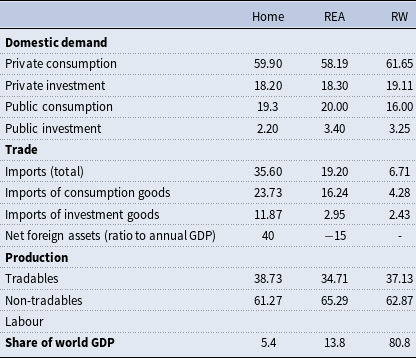
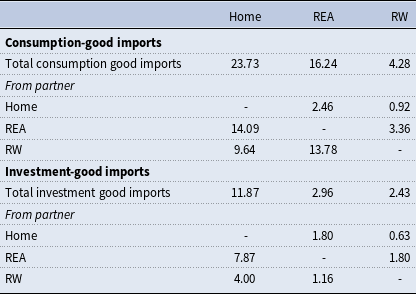
The values for the great ratios are reported in Table 1. The sample we use is from 1999-2019, which covers the period from the start of the euro to the beginning of the COVID-19 crisis. Compared to earlier calibrations (Gomes et al. (Reference Gomes, Jacquinot and Pisani2010) and Gomes et al. (Reference Gomes, Jacquinot and Pisani2012)) countries have become more open, the share of public investment in Europe has declined, and the interest rate has been lower. Moreover, compared to the original EAGLE model, we merged the two blocs outside the euro area (originally the US and the rest of the world). So, the merged bloc is less open, because the trade between the merged blocs becomes internal trade within the merged bloc. Table 2 reports the corresponding trade matrix.
Steady-state national accounts (ratio to GDP, %)

Note: REA = Rest of the euro area; RW = Rest of world, incl. the US.
International linkages (trade matrix, share of domestic GDP, %)

Note: REA = Rest of the euro area; RW = Rest of world, incl. the US.
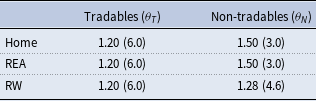
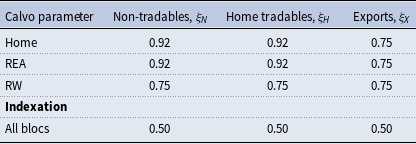
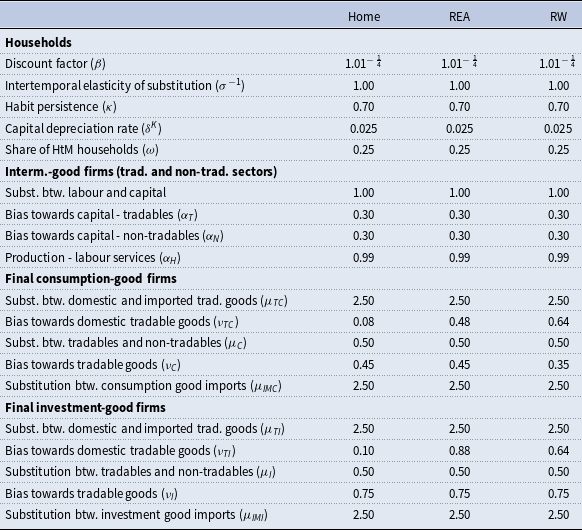
For nominal rigidities related to goods prices, we report the markups in Table 3 and the parameters governing price setting in Table 4. These follow the estimates from Christoffel et al. (Reference Christoffel, Coenen and Warne2008) and the calibration in Gomes et al. (Reference Gomes, Jacquinot and Pisani2012). Table 5 shows the calibration of the household and firm sectors. In line with the low real interest rates observed in the sample period, we calibrate the household discount factor to correspond to 1% real interest rate per annum (see the Online Appendix F for the corresponding equations).
Price markups (implied elasticities of substitution)

Note: REA = Rest of the euro area; RW = Rest of world, incl. the US.
Nominal rigidities (prob. that the price remains the same)

Note: REA = Rest of the euro area; RW = Rest of world, incl. the US.
Households, entrepreneurs, and firms behaviour

Note: REA = Rest of euro area; RW = Rest of world, incl. the US.
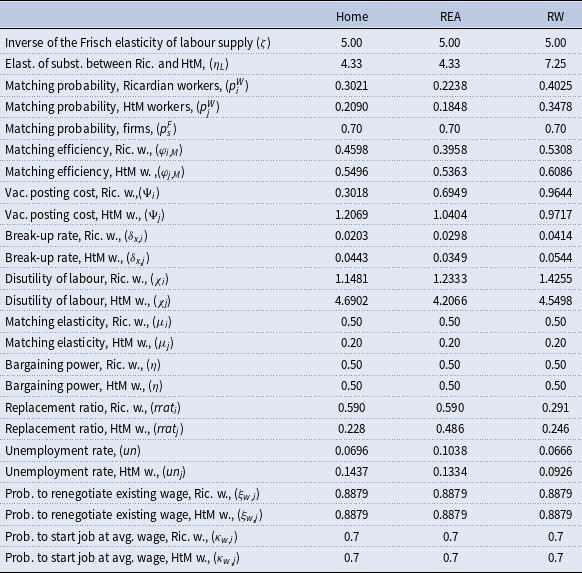
The details of the labour market calibration are reported in Table 6. The labour supply elasticity is set to 0.2 (its inverse,
 $\zeta =5$
) and is lower than typically in the literature (0.5, or its inverse
 $\zeta =2$
) to mitigate the response of hours worked, in line with empirical evidence that hours per worker (intensive margin) are relatively stable compared to unemployment (extensive margin).Footnote 12 Matching probabilities of Ricardian and HtM workers come from own estimates, computed using the OECD and Eurostat data for unemployment duration by educational attainment for 2017 and 2018 using the method of Shimer (Reference Shimer2012), where we assume that HtM households are those with below upper-secondary education and Ricardians are those above upper secondary education.Footnote 13 The matching probability for firms in both segments is based on the estimates for the US in Ramey et al. (Reference Ramey, den Haan and Watson2000), with similar values used in Stähler and Thomas (Reference Stähler and Thomas2012). Unemployment rates are averages from 2004 to 2019, based on OECD data. As for job finding rates, we assume that the unemployment rate for HtM households is the unemployment rate for persons with educational attainment below upper-secondary. Matching efficiency and vacancy posting costs are calibrated to fit matching probabilities. The outcomes are roughly in line with the literature (for instance, Jung and Kuhn (Reference Jung and Kuhn2014) find that the matching efficiency in Germany is low compared to the US, which also comes out of our calibration). We calibrate the break-up rate of HtM to match the level of unemployment in this group in each bloc, while we use the break-up rate of Ricardians to match the overall rate of unemployment. Because the unemployment rate of HtM households is larger, this also results in larger break-up rate for this group of households across blocs. Bargaining power has been set to 0.5, for both groups of households, in line with the literature. We calibrate the matching elasticity for Ricardian households to 0.5, which is in the middle of the range reported by Petrongolo and Pissarides (Reference Petrongolo and Pissarides2001). For the HtM households, we set this elasticity to a lower value of 0.2, to prevent that a cyclical increase in unemployment of HtM households would generate numerous new matches. Unemployment benefits are set as a proportion of the steady-state wage (the replacement ratio). Replacement ratios are based on the OECD estimates. We use one-year horizon for Ricardian households and two-year horizon for HtM households, reflecting the fact that the latter are more likely to be long-term unemployed, to determine the replacement ratios. Finally, probabilities to renegotiate an existing wage and the probabilities to start the new job at the average wage were taken from de Walque et al. (Reference de Walque, Pierrard, Sneessens and Wouters2009). Because we have no evidence that these rates differ between Ricardian and HtM households, we kept them the same across both groups.
Labour market

Note: REA = Rest of the euro area; RW = Rest of world, incl. the US.
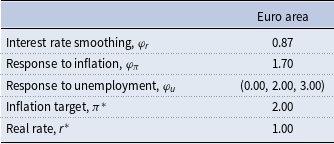
We parametrise the euro area monetary policy rules as shown in Table 7. The parameters are in line with Gomes et al. (Reference Gomes, Jacquinot and Pisani2010) and Gomes et al. (Reference Gomes, Jacquinot and Pisani2012).Footnote 14 The new parameters
 $\varphi _{u}$
and
 $\varphi _{I}$
that determine the weight on unemployment and asymmetric reaction to are set in line with Rudebusch (Reference Rudebusch2010) and Elias et al. (Reference Elias, Irvin and Jordà2014). We consider several weights for the response of the central bank to unemployment.
Monetary policy rules

5. Scenarios
We compute the responses of a number of variables to a contractionary aggregate demand shock across the euro area, proxied by the contractionary monetary policy shock. We report the results of an expansionary monetary policy shock in the Online Appendix A. Next, we consider an inflationary aggregate supply shock, which is contractionary for real activity (and employment), and therefore leads to a trade-off between stabilising prices and worsening economic activity.
These shocks provide us the framework to analyse and compare the performance of different monetary policy rules (benchmark Taylor rule with IT, ASUT, AIT) for a stylised set of circumstances encountered by policymakers. The three rules by design already differ in terms of how actively the central bank responds to an increase in inflation. In addition, for each rule, we also distinguish between cases with low (zero) weight on the unemployment gap and with positive weight on unemployment gap (defined as the difference between steady state unemployment and actual unemployment).
5.1 Contractionary demand shock
We pick the monetary policy shock as a ”representative” demand shock because it has the advantage that it illustrates the properties of the model in response to a shock that is widely studied in both theoretical and empirical literature. Moreover, it helps to understand what monetary policy reaction does when we discuss the responses to a supply shock in the next subsection. The shock size is standardised to achieve a 1 p.p. maximum decrease in inflation (annualised) under the benchmark rule (IT) with a positive weight on unemployment, and this size of the shock is kept fixed across simulations with different monetary policy rules.Footnote 15
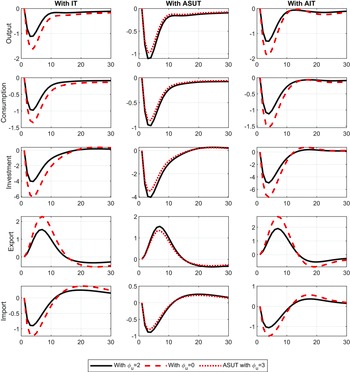
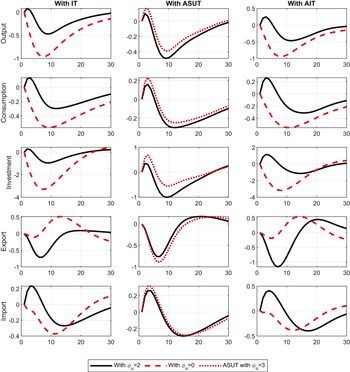
Contractionary demand shock: area-wide demand components.Notes: Horizontal axes: quarters; vertical axes: percent deviations from the steady state. All variables are in real terms.

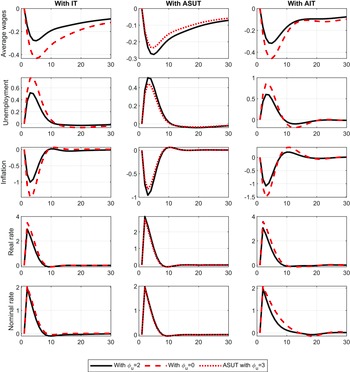
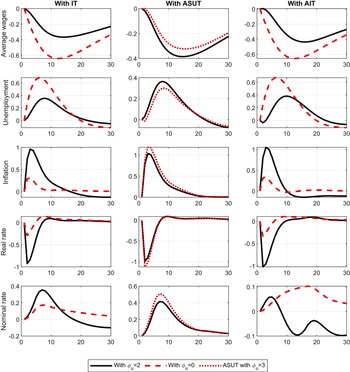
Figures 1 and 2 show the euro-area-wide variables for the three interest rate rules, one in each column, and for different weights placed on unemployment. The full black line shows the case when the central bank responds to the unemployment rate and the dashed red line shows the case where the central bank does not respond to unemployment. For the ASUT rule the case where the weight on unemployment is zero always corresponds to the strict inflation targeting rule, i.e., to dashed red lines in the leftmost column of the figure, which is why we show as an alternative the ASUT rule with stronger response to unemployment (
 $\phi _u$
=3).Footnote 16
Contractionary demand shock: area-wide variables.Notes: Horizontal axes: quarters; vertical axes: percentage point deviations from the steady state, except wages, which are in precent deviations. Interest rates and inflation are annualised.

Two observations stand out. First, fluctuations in all variables are more pronounced when the weight on unemployment in the monetary policy rule is zero or small. These fluctuations are longer-lasting for real variables, while inflation returns to its initial level faster, especially considering the fact that it falls more initially. The latter happens because forward-looking firms anticipate lower demand in the future, which implies lower wages and lower marginal costs, which translates in faster and stronger initial fall in inflation, but also to its faster return to initial level. When the central bank rule responds to unemployment, it counteracts the decline in unemployment, which means that after the initial shock, interest rates endogenously tighten somewhat less due to the increase in unemployment. Because the increase in unemployment is persistent, the central bank returns its interest rate to the initial level faster compared to the case with no unemployment in the monetary policy rule (this is the most evident for the AIT case in Figure 2). This causes a lower and less persistent tightening of the real interest rate, which counters the reduction of economic activity. Note that the losses in output, employment, and consumption are the lowest in the case of the ASUT with the strongest response to unemployment (dotted red line in Figure 1).
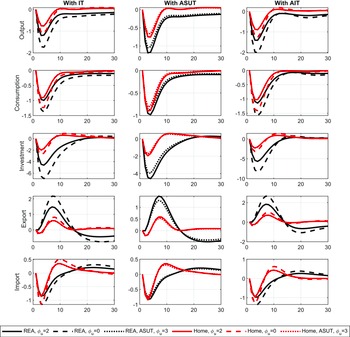
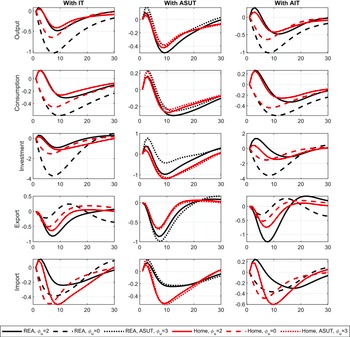
Contractionary demand shock: country-specific demand components.Notes: Horizontal axes: quarters; vertical axes: percent deviations from the steady state. All variables are in real terms.

Second, fluctuations tend to be more pronounced under the AIT rule, even when the rule does include a response to unemployment. The reason is that the AIT rule is relatively slow to react, so interest rates endogenously respond more slowly and more persistently to economic developments, which delays the return of the interest rate to the initial level (the nominal interest rate for AIT returns to the initial level only after around 12 quarters, whereas for the other cases this happens about four quarters earlier, see bottom-right chart in Figure 2). This is reflected in the longer-lasting elevated level of the real rate, with the corresponding negative consequences for the aggregate consumption and demand. Including the response to unemployment helps alleviate this persistence, but does not undo this property of the AIT rule.
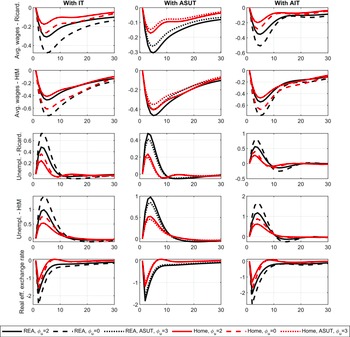
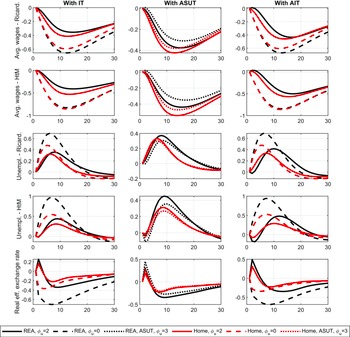
Contractionary demand shock: country-specific variables.Notes: Horizontal axes: quarters; vertical axes: percent deviations from the steady state, except unemployment, which is in percentage point deviations. All variables are in real terms.

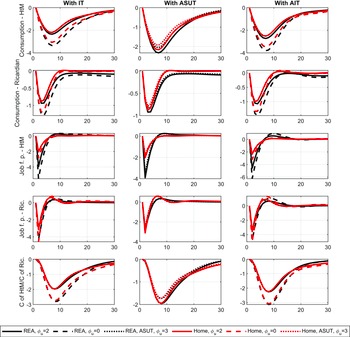
Contractionary demand shock: country-specific variables.Notes: Horizontal axes: quarters; vertical axes: percent deviations from the steady state, except job finding probabilities and relative consumption, which are in p.p. deviations. All variables are in real terms.

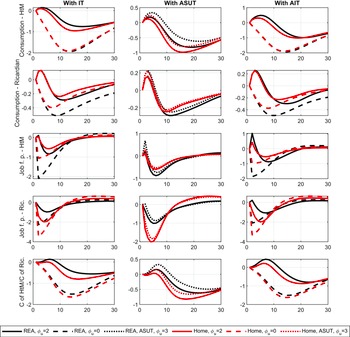
Figures 3 to 5 show country-specific outcomes in the euro area for the three monetary policy rules. Home is shown with red lines and the rest of the euro area with black lines. Note the considerable differences between the responses of the two regions regardless of the monetary policy rule. This reflects in part the differences in the labour markets, but also differences in the structure of the economy. One such difference between the EA blocs is in terms of the import-content of investment, where Home imports a much bigger share of investment goods than the REA, and are therefore more affected by the euro appreciation that follows monetary tightening. This is part of the reason why imports in Home decrease as much as in the REA even though investment and consumption decrease by less. Another reason for the differences is the export orientation of the two euro-area blocs. Home is much more open to the RW, while the REA is more closed. This leads to a different degree of exposure to the euro exchange rate and therefore different fluctuations in exports, as can clearly be seen in Figure 3.
Differences in labour market structure also lead to some divergence between countries. For instance, while Home’s output decreases by about a two thirds as much as the REA output, unemployment of both types of households increases by half as much or less than in the REA. Figure 5 explains where among the households this dampening of unemployment occurs. In Home, most of the dampening of unemployment is among the poor HtM households. There, the job finding probability decreases the least, compared with the Ricardian households. This is not the case in the REA, where most of the adjustment in employment and job finding is on the side of the poor HtM households. This holds across all the rules and regardless of whether the central bank attaches some weight to unemployment or not.
Interestingly, if the central bank does not react to unemployment after an expansionary shock, consumption level of the poor households in both EA regions decreases by more than the consumption level of richer Ricardian households and therefore leads to an increase in consumption inequality. Here it is useful to recall the statement of Chairman Powell (Reference Powell2020) that we cited in the Introduction, namely the “… appreciation of a strong labour market, particularly for many in low- and moderate-income communities …”. In the case of a contractionary demand shock, this line of thinking implies that central banks seeking to reduce inequality in consumption should allow for somewhat less persistent tightening in response to a weak labour market. This is akin to the asymmetric unemployment targeting rule, which would ignore unemployment whenever it decreased below its steady-state value (or respond less to its increase), as displayed in the middle panel of the figure.Footnote 17
Inflationary supply shock: area-wide demand components.Notes: Horizontal axes: quarters; vertical axes: percent deviations from the steady state. All variables are in real terms.

Another important takeaway from the cross-country comparison is that the divergence between two intra-EA regions tends to be the strongest when fluctuations are large in absolute terms, which happens when monetary policy does not respond to unemployment. Similarly, the inequality in consumption within countries also increases more strongly when the central bank does not react to unemployment, see bottom panels of Figure 5.
Inflationary supply shock: area-wide variables.Notes: Horizontal axes: quarters; vertical axes: percentage point deviations from the steady state, except wages, which are in precent deviations. Interest rates and inflation are annualised.

5.2 Inflationary supply shock
We now investigate the performance of monetary policy rules under the shock scenario that induces a trade-off between stabilising inflation and unemployment. To achieve this, we simulate a symmetric and equal increase in markups in tradable and non-tradable sectors in both blocs of the euro area.Footnote 18 As before, the size of the shock is calibrated to achieve a 1 p.p. maximum increase in the euro-area-wide inflation under the benchmark rule and the size of the shock is kept the same across policy rules.
Figures 6 and 7 show the euro area-wide outcomes. The supply shock generates an increase in inflation and a negative impact on economic activity. The fluctuations in (un)employment, aggregate demand and its components are again stronger if the central bank pays no attention to unemployment, while in this case inflation shows a much milder increase (figure 8, figure 9).
Inflationary supply shock: country-specific demand components.Notes: Horizontal axes: quarters; vertical axes: percent deviations from the steady state. All variables are in real terms.

Compared to the other two rules, AIT tends to attenuate or even neutralise the negative real impact of the shock in the first few quarters when the central bank reacts to unemployment, mainly because this rule stipulates a slower increase followed by a reduction in the nominal rate, which results in a stronger drop in real interest rate and hence an increase in Ricardian households’ consumption in the short run. Recall that these households represent 75% of all households and that their consumption level is about a quarter higher than consumption of HtM households, so that Ricardian households have a strong influence on aggregate consumption. This effect on Ricardian households’ consumption due to a lower real rate is present for all rules and can also be observed for the more aggressive ASUT rule in the middle column. Moreover, in the case of the AIT rule this effect is sufficiently strong that it prevents the short-run increase in unemployment, which shields the income and consumption of HtM households in the short run (these effects can most clearly be seen by looking at full lines in the bottom row of Figure 10).
Because the supply shock generates an increase in unemployment, it triggers a stronger monetary policy response whent he weight on unemployment gap is larger. For instance, the ASUT rule in its more aggressive version achieves a lower peak increase in unemployment than AIT that responds to unemployment. Therefore, the ASUT rule better mitigates the effect of the shock on unemployment but at the cost of higher inflation.
Figures 8 to 10 show the responses across countries, members of the euro area. Home is shown in black and the REA in red lines. Compared to the contractionary demand shock, the responses of both EA blocs to the shock are somewhat less divergent. The main reason for this is that production functions of Home and the REA do not differ as much as their structures of aggregate demand. Nevertheless, we still see some common properties of the monetary policy rules. First, we again observe a much stronger divergence between Home and the REA when monetary policy only responds to inflation (impulse responses shown with dashed lines tend to be more apart than impulse responses shown with full lines, with the exception of wages and consumption of HtM households). This holds across all three types of rules (IT, ASUT, AIT).
Inflationary supply shock: country-specific variables.Notes:Horizontal axes: quarters; vertical axes: percent deviations from the steady state, except unemployment, which is in percentage point deviations. All variables are in real terms.

Second, we can see how the effect of lower real rate stimulates consumption of Ricardian households in the short run when central bank reacts to unemployment in Figure 10. Across the rules, but especially for ASUT and AIT, this temporary increase in aggregate demand increases job finding probability of HtM households, which for a short period of time protects their employment, income and consumption. The reason why there is an increase in job finding probability for HtM households is that their wages decrease by more than wages of Ricardian households, which shifts aggregate labour demand from firms more towards the now cheaper labour of HtM households. In this case we also observe that the divergence between Ricardian and HtM households’ consumption is limited (bottom panels of Figure 10). This is in stark contrast with the case where central bank only responds to inflation and where employment, wages, and job finding probabilities fall across the board already on impact. In this case, we also see a strong increase in inequality in terms of consumption in both EA blocs, as HtM households’ consumption decreases my much more than consumption of Ricardian households.
Inflationary supply shock: country-specific variables.Notes: Horizontal axes: quarters; vertical axes: percent deviations from the steady state, except job finding probabilities and relative consumption, which are in p.p. deviations. All variables are in real terms.

5.3 Robustness checks
To make sure our results are robust, we perform a number of robustness checks with respect to the key choices. Our results remain unchanged, but the robustness checks offer some insights that we report in the main text. We relegate the more detailed explanation Online Appendices.
First, we investigate whether the slope of the wage Phillips curve matters for the trade-off between inflation and (un)employment. This is a natural question to ask in the context of an inflationary supply shock, which increases inflation and raises unemployment. While a detailed investigation of this question is outside the scope of this paper, we show in the Online Appendix D that more wage flexibility can alleviate the decline in employment after an inflationary supply shock and at the same time lead to lower inflation under all rules considered. It does, however, come at a cost of increasing within-country consumption inequality.
Second, it is not a priori clear that the bargaining power of Ricardian and HtM households is the same. In Online Appendix E we briefly discuss the mixed empirical evidence on this issue, and then conduct a robustness check for our main results for the case where the bargaining power of HtM households is lower than the bargaining power of Ricardian households. Lower bargaining power of HtM households makes their wages more flexible, causing them to fall by more in the case of an adverse shock. However, the loss of income due to wages is mostly offset by the lower increase in unemployment, so that our main results are not materially affected.
Finally, because a typical Taylor rule is more likely to feature the output gap rather than unemployment gap (even though this may not necessarily be the case, see e.g. Bundick and Petrosky-Nadeau (Reference Bundick and Petrosky-Nadeau2021)), we have checked if our results are robust to this modification. Our main results hold even if we consider the output gap in the rules. The reason is that the unemployment gap and the output gap are highly correlated in the model, even conditional on the chosen set of shocks.Footnote 19 The results are available upon request.
6. Implications of labour market heterogeneity
One issue of interest is to investigate how much of the observed differences in cross-country responses are due to labour market heterogeneity across countries alone. To isolate this effect, we perform a counterfactual, where we ”equalise” labour markets across the euro area by setting all the calibrated quantities in the rest of the euro area to be identical as in Home. We call this a homogeneous labour market case. Note that this will not eliminate all cross-country differences (the latter are due to many factors, including trade orientation and country size), but it will isolate the effect of labour market differences.
When making the labour market homogeneous within the euro area, we changed several parameters, but only a few are changed by a large amount. It turns out that the most important one is the replacement ratio for the HtM households, which is 0.486 in the REA and 0.228 in Home, implying a 53% lower value in the REA when we perform the counterfactual.Footnote 20 Note that such difference is in line with the low level of unemployment benefits for long-term unemployed in Germany after the ”Hartz IV” reform of 2005 (Hochmuth et al. Reference Hochmuth, Kohlbrecher, Merkl and Gartner2021).
Recalibrating the replacement rate of the HtM households in the REA to a lower level has several effects. First, the total surplus from finding a job on the HtM market increases, as the outside option of the HtM households is lower. This can be seen if one looks at equation (12), where the terms
 $b_{s,t}$
take into account the present value of expected future unemployment benefits. The smaller the
 $b_{s,t}$
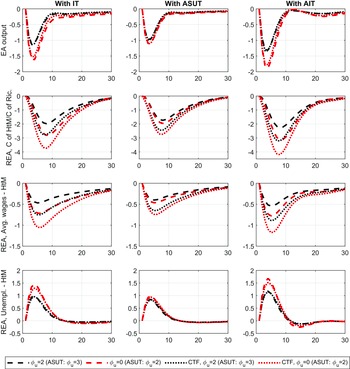
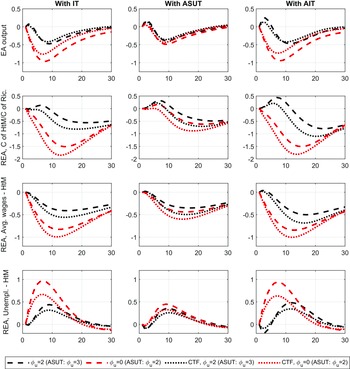
, the larger is the value for the household of working, because the outside option of being unemployed and receiving unemployment benefits is smaller. In Nash bargaining (see equation 14), this increase in household’s surplus is split between the household and the labour firm, which is why the per-period surplus of the firm as well as the present value of this surplus are higher than in the case where the replacement ratio and hence unemployment benefits are high. Note that this is in line with the findings and mechanisms in Hochmuth et al. (Reference Hochmuth, Kohlbrecher, Merkl and Gartner2021).Footnote 21 The implication of higher firm surplus is that it fluctuates less in percentage terms (see Hagedorn and Manovskii (Reference Hagedorn and Manovskii2008)) and with it the vacancy creation. Because vacancies are the main driver of unemployment fluctuations, this means that we observe lower fluctuations in unemployment of HtM households in the REA. This is true for all shocks considered in the counterfactual: the contractionary (and deflationary) demand shock in Figure 11 and the contractionary (and inflationary) supply shock in Figure 12.Footnote 22 Note that these figures show the counterfactual where all calibrated labour market quantities have been equalised between Home and the REA.Footnote 23
Negative demand shock counterfact.: home and REA labour markets “equalised.”Notes: Benchmark (dashed lines) and counterfactual simulation (CTF, dotted lines) with all labour market parameters in the REA set to equal those in Home. Horizontal axes: quarters; vertical axes: percent deviations from the steady state, except relative consumption and unemployment rate, which are in p.p. deviations. All variables are in real terms.

The first row in these figures shows aggregate euro-area-wide output, with the benchmark responses shown as dashed lines and the counterfactual responses shown as dotted lines. The key observation is that after a contractionary demand shock there is not much difference in the aggregate output response between the benchmark and the counterfactual case, regardless of whether the central bank responds to unemployment or not. The difference in euro-area-wide output response is slightly larger following a negative supply shock (Figure 12) for inflation targeting and average inflation targeting, and even here only in the case where the central bank does not respond to unemployment.Footnote 24 The lack of material difference in the counterfactual aggregates is that the key change in “equalisation” of the labour markets affected the HtM households, which represent only a small fraction (25%) of households and also have relatively low consumption.Footnote 25
Supply shock counterfactual: home and REA labour markets ”equalised.”Notes: Benchmark (dashed lines) and counterfactual simulation (CTF, dotted lines) with all labour market parameters in the REA set to equal those in Home. Horizontal axes: quarters; vertical axes: percent deviations from the steady state, except relative consumption and unemployment rate, which are in p.p. deviations. All variables are in real terms.

The remaining rows of Figures 11 and 12 show the most interesting quantities for the REA, i.e., the bloc of the euro area that we modified in the counterfactual. Again the dashed lines show the benchmark simulation and the dotted lines the counterfactual. The main finding is that the fluctuations of within-country consumption inequality between unconstrained Ricardian and constrained HtM households are amplified in the REA in the counterfactual, compared to the benchmark. After a contractionary shock, HtM households are worse off relative to unconstrained households – consumption inequality increases (and after expansionary shocks they are better off – consumption inequality decreases, see online appendix). This holds for all monetary rules considered.
The main reason for exacerbated within-country inequality fluctuations are wages of HtM households, which become more volatile and this dominates the less volatile response of unemployment. Because most HtM households are employed (despite higher unemployment rate than Ricardian households), wage income dominates and this leads to higher fluctuations in consumption of HtM households. Moreover, because the counterfactual gap between wages and unemployment benefits of HtM households is larger than in the benchmark simulation, this implies that even a smaller increase (decrease) in unemployment after an contractionary (expansionary) shock will lead to a smaller (larger) gain in income for those that have become unemployed (employed).
7. Conclusion
In this paper we analyse the impact of changing the degree to which central banks respond to unemployment developments, in addition to inflation. One reason for looking at the labour market is because of its importance for the incomes low- and medium-income households. Another reason, especially in the euro area, is also the heterogeneity of labour market institutions across countries. To analyse these issues, we first construct a model with realistic features of the labour market in Europe, in particular in terms of differences between labour markets for Ricardian and HtM households. We do so by first augmenting a model of the euro area within the global economy with real and nominal frictions on the labour market. Real frictions take the form of Diamond-Mortensen-Pissarides search-and-matching frictions, which give us unemployment in equilibrium. Then we add nominal wage rigidities using the staggered wage setting, adapted to search models. Moreover, we distinguish between Ricardian and HtM households, with the latter having the labour market that exhibits a greater degree of sensitivity, as observed in empirical studies. This gives us a realistic framework, with a global TANK model of the euro area with labour market frictions that differ across types of households.
Using this augmented model we look at the performance of several monetary policy rules, namely inflation targeting, inflation targeting with an asymmetric response to unemployment, and average inflation targeting, where each of these rules includes some interest rate inertia, and can respond to the inflation gap and to the unemployment gap, to different degrees. We then analyse the performance of these rules, conditional on whether they feature the response to unemployment gap or not, in two settings. The first setting is a contractionary aggregate demand shock that pushes inflation and unemployment in the opposite directions, and the second is an inflationary supply shock that increases inflation and reduces employment. This latter shock creates a trade-off for a central bank between stabilising inflation and unemployment.
We find that, first, responding to unemployment leads to lower fluctuations in unemployment and real economic activity across all rules, but with higher inflation in the short term in the case of the supply shock. Second, across all types of rules, assigning some weight to (un)employment tends to reduce cross-country differences in response to shocks within the monetary union. Third, also across all rules, responding to unemployment tends to reduce the differences in consumption levels of different types of households within the economy after a contractionary shock.
Supplementary material
The supplementary material for this article can be found at https://doi.org/10.1017/S1365100525000367
Acknowledgement
The authors would like to thank the co-leads of the Strategy Review Workstream on Employment (Claus Brand, Günter Coenen, Reamonn Lydon, Meri Obstbaum and David Sondermann), Jelena Zivanovic, two anonymous referees, and the participants of 2022 Dynare Conference, the 2022 Computing in Economics and Finance conference, the 25th Annual INFER Conference, and the participants of the Strategy Review Workstream on Employment. The opinions expressed are those of the authors and do not reflect views of the Bank of Portugal, the Central Bank of Ireland, or the European Central Bank. Any remaining errors are the sole responsibility of the authors.