Occasional performance breakdowns in mature, proficient language users have traditionally been used in psycholinguistics to provide insights onto the mechanisms of “normal” language processing, its preferences, and limitations (Fromkin, Reference Fromkin1984; Garrett, Reference Garrett and Newmeyer1988; Pritchet, Reference Pritchet1988). Learners’ errors can be just as useful in that they may offer insights onto how learners’ grammatical representations and processing develop across time (e.g., children's overgeneralization errors; Marcus et al., Reference Marcus, Pinker, Ullman, Hollander, Rosen and Xu1992) and how they are affected by factors such as age of acquisition, cognitive maturation, and cross-linguistic influences (e.g., Antón-Méndez, Reference Antón-Méndez2010).
The research presented here systematically compares adult and child learners’ production and comprehension of English possessive determiners (possessives, henceforth) to investigate the extent to which difficulties with possessive-antecedent gender agreement surface across populations and modalities (i.e., production vs. comprehension), thus reflecting the existence of generalized processing/acquisition biases. The ultimate goal of this research is that of contributing to our understanding of similarities and differences between first language (L1) and second language (L2) processing and acquisition.
This study takes as its starting point the fact that possessives have been shown to be an area of difficulty for some adult learners of English (see White, Muñoz, & Collins, Reference White, Muñoz and Collins2007, and references therein) and asks whether these difficulties stem from L1 transfer, as is usually believed, or rather reflect generalized language processing/learning biases.
The results of an elicited production study with adult L2 learners of English from different L1 backgrounds (Antón-Méndez, Reference Antón-Méndez2011) showed that L1 Italian and L1 Spanish speakers of English often (about 15% of the time) produce sentences in which the gender of the possessive (e.g., “her” in “her sister accompanies the boy to school”) matched that of the possessum (“sister”), rather than that of the possessor (“boy”). That is, instead of producing target structures in which a third-person singular possessive agrees in number and gender with the features of a possessor noun, so that “his” is used to refer to the possessions of a male (e.g., his brother/sister), and “her” to the possessions of a female (e.g., her brother/sister), these speakers produced structures in which possessives agreed in gender with possessum nouns, that is, the nouns denoting the thing possessed, mirroring grammatical patterns in their L1.Footnote 1 By contrast, possessive gender errors in L2 learners whose L1 (Dutch), similarly to English, requires possessives to agree in gender with the possessor were low (around 3%) and comparable to those of native English speakers (around 5%; see Slevc, Lane, & Ferreira, Reference Slevc, Lane and Ferreira2007). These findings suggested that possessive gender errors in the speech of adult L2 speakers are the result of transfer of L1 agreement procedures. We will call this the L1 transfer hypothesis (L1H).
However, this is not the only possible explanation for the observed pattern. Languages like Italian or Spanish, in which possessives agree with “local” possessum nouns within the noun phrase (NP; “*[Maryi [VP loves [NP hisi brother]]”) rather than with nonlocal antecedents (as in English), are typologically preferred (Corbett, Reference Corbett2006), perhaps because of a generalized processing preference for local dependencies, which we will refer to as the generalized local bias hypothesis (GLBH). It is thus possible that the agreement errors produced by the L1 Spanish or L1 Italian speakers are not solely (or mainly) attributable to L1 transfer, as previously hypothesized, but rather to such purported local bias. If so, L1 transfer and the local bias together could have conspired to create the observed pattern of results: L1 Italian and L1 Spanish English speakers would be prone to produce local agreement errors because of GLBH and perhaps also because of L1H, while Dutch speakers would not be vulnerable to it because this default procedure could have been actively “inhibited” due to requirements present in their L1.
A second issue that was left unresolved by the previous research on possessive gender errors in English learners concerns whether difficulties with possessive gender agreement characterize learners’ comprehension as well as production profiles, thus reflecting nontarget grammatical representations that underlie agreement procedures in both domains. That is, regardless of whether the observed tendency for possessives to match the features of a local noun stems from a generalized or an L1-induced bias, we do not know whether this bias applies in comprehension as well as in production for (some) English learners and may therefore reflect a representational error, as opposed to being better conceived of as a production-specific performance error (Gruter, Lew-Williams, & Fernald, Reference Gruter, Lew-Williams and Fernald2012).
The research presented below attempts to address both of these issues, namely, whether the GLBH or the L1H is the best explanation for learners’ possessive gender errors and whether these errors are representational or performance based. For this, we examined performance in comprehension as well as in production for two groups of learners whose performance could not be influenced by L1 transfer: adult L2 learners of English whose L1 is Mandarin, and 3- to 4-year-old monolingual child learners of English.
Mandarin L2 learners of English were chosen because in spoken Mandarin, pronouns are not gender marked; eventual errors of local agreement observed in the performance of this population could thus not be attributed to the L1H. For instance, in spoken Mandarin, possessives agree in person and number with the possessor, but do not overtly agree with either the possessor or the possessum in gender: “tā de fùqīn” (3rdSg.Poss father) means both “her father” and “his father,” although the written character for the third-person possessive does vary depending on the gender of the possessor (her father: “她的父亲” vs. his father: “他的父”). The age range of the L1 population was chosen because at this age children reliably produce agreement inflections (Bassano, 2000; Keeney & Wolfe, 1972; Rissman, Legendre, & Landau, 2013) but still display substantial error rates in both production and comprehension (Johnson, deVilliers, & Seymour, 2005; Lukyanenko & Fisher, 2014; Pérez-Pereira, 1991).
EXPERIMENTAL PROSPECTUS
We administered an elicited production task to a group of adult Mandarin–English speakers and a group of monolingual English-speaking children, as well as a group of adult native English speaker controls; we also examined both online (through eye tracking) and offline (via an act-out task) comprehension performance in all groups.
In the production portion of the study, participants were prompted to produce simple monoclausal sentences in which the gender of the possessum (e.g., “sister”) was either the same or different from that of the possessor (Katie or John; e.g., match condition: “Katie gave a present to her sister”; mismatch condition: “Katie gave a present to her brother”). We reasoned that if the production patterns previously observed for L1 Italian and L1 Spanish adult L2 speakers of English (Antón-Méndez, Reference Antón-Méndez2011), in which the features of a possessive occasionally match the features of the possessum noun rather than those of the possessor, are the result of L1 transfer, this error pattern should not characterize the production of adult L1 Mandarin speakers and child monolingual learners of English. However, if the above errors are the result of a generalized preference for establishing agreement within a local domain, this type of production pattern should characterize the production profiles of these learner groups as well. Specifically, if the gender features of the possessum noun can interfere with those of the possessive, we should observe a higher rate of possessive gender errors in contexts in which the gender features of the possessum noun differ from those of the possessor (mismatch conditions), compared with contexts in which the gender features of the possessum and those of the possessor match. More specifically, under the GLBH, in mismatch conditions, learners are expected to be prone to producing possessives whose gender features match those of the local possessum rather than those of the possessor (e.g., Katie gave a train to his brother). Errors should instead not be observed in match conditions: in these cases, regardless of whether the gender features of the possessive pronoun underlyingly match those of the possessor or the possessum, the possessive will bear the target gender features (e.g., Katie gave a train to her sister).
Note that this does not entail that, under the L1H, the production performance of child and L1 Mandarin learners is predicted to be error free: these groups of learners might still be expected to produce more errors than adult native speakers because they will occasionally fail to follow the agreement procedure of the target language and might choose the possessive at random. For example, these learners might occasionally use masculine possessives in lieu of feminine ones and vice versa. If so, possessive errors will be found both in match conditions (e.g., *“Katiei gave a present to hisi sister”; *“Johnk gave a present to herk brother”) and in mismatch conditions alike (e.g., *“Katiei gave a present to hisi brother”; *“Johnk gave a present to herk sister”).Footnote 2 Alternatively, because the masculine gender has traditionally been used as the default unmarked gender in English (Alpher, Reference Alpher1987; Jacobsen, Reference Jacobsen1977), learners might display a tendency toward overuse of the masculine possessives as the default, unmarked gender (e.g., *“Katiei gave a present to hisi brother/sister”). This tendency would give rise to an effect of the possessor's gender on accuracy rates, resulting in higher error rates for sentences where the possessor is female. Crucially, however, under the L1H, errors are not predicted to be modulated by gender match between the possessor and the possessum; therefore, neither effects of gender match nor an interaction between gender match and possessor gender are expected.
The same group of learners was also administered a comprehension task. In the comprehension portion of the study, participants heard spoken instructions and were asked to act them out by moving objects in a copresent visual world. The instructions learners received were constructed to detect whether learners had a tendency to expect gender agreement between the possessive determiner and the possessum noun before the possessum noun was processed: participants were familiarized with two characters and their respective female and male siblings (John, together with his brother and sister; Katie, together with her brother and sister) and told to hand an object to one of them (e.g., “Give an apple to his/her little brother/sister”).
If these leaners’ grammars require, or at least show a bias for, gender agreement between a possessive and the possessum noun (i.e., if learners’ grammars resemble, at least in part, the grammars of adult languages like Italian), nontarget performance patterns in comprehension should closely parallel production patterns. More specifically, if learners’ representations are in line with the GLBH, during online sentence processing, predictive looks to a referent that matches the gender of the possessive determiner should be observed after hearing the possessive (e.g., looks to a male sibling after hearing “his”), but before the possessum noun is heard.Footnote 3 Moreover, according to this hypothesis, high act-out errors are expected in both match and mismatch conditions. This is because, if there is an expectation that possessives agree with possessum nouns, structures in which the possessive and the possessum mismatch in gender would be ungrammatical, while structures in which the possessive and the possessum match in gender would be globally ambiguous, as phrases like “her sister” or “his brother” should refer equally well to the sister of a female or a male character, and the brother of a female or male character, respectively.
In contrast, if possessive gender errors are the result of L1 transfer, child and L1 Mandarin learners might be expected to produce overall more act-out errors than adult native speakers because they will occasionally fail to use the agreement features on the possessive pronoun to determine the target referent. However, errors are crucially not expected to stem from participants using the gender features of the possessive as predictors of the gender features of the possessum. If participants’ errors stem from failing to use the gender features of the possessive to zoom in on the target referents, learners’ occasional act-out errors should be found across experimental conditions and likely to be associated with participants choosing the correct-gender referent from the nontarget family (e.g., occasionally choosing Katie's brother in response to “Give a train to his brother”). Alternatively, participants might display a tendency to use the masculine possessive as the default, allowing it to refer to both female and male possessors. This pattern would give rise to an effect of the possessor's gender on accuracy rates, resulting in higher error rates for sentences where the possessor is the female character.
Finally, it is possible that possessive errors stem from a generalized tendency to compute agreement relations within local domains, but that, for the phenomenon at hand, this bias is only active in production. In other words, it is a logical possibility within the GLBH that in production, but not in comprehension, the features of the upcoming possessum are available and can interfere with the planning of the possessive. This pattern could be expected because, in production, the possessive and the possessum are arguably part of the same planning unit (Konopka & Brown-Schmidt, Reference Konopka, Brown-Schmidt, Goldrick, Ferreira and Miozzo2014), which may allow the gender features of a not yet uttered, but planned, constituent (i.e., the possessum) to interfere with the planning and execution of the possessive, perhaps similar to what happens in the case of attraction errors (e.g., Bock & Miller, Reference Bock and Miller1991; Solomon & Pearlmutter, Reference Solomon and Pearlmutter2004; Vigliocco, Butterworth, & Garrett, Reference Vigliocco, Butterworth and Garrett1996). In contrast, these conditions are not present during comprehension, as the features of the possessum noun are not yet available during the processing of the possessive, with the consequence that the processing and interpretation of the information carried by the possessive can be completed before the possessum noun is processed, therefore not interfering with the processing of the possessive.
EXPERIMENT 1: ELICITED PRODUCTION
Method
Participants
A total of 84 participants were tested in this experiment: 35 monolingual English speaking children, 25 adult L1 Mandarin L2 English speakers, and 24 adult English native speakers. Adult participants (monolingual and L2 speakers) were recruited at the University of Pennsylvania. Child participants were recruited at childcare centers in Philadelphia.
Data from 11 participants were excluded due to program malfunctioning (L2 adults: N = 1), inability to carry out the task (children: N = 5), language background (children: N = 2; L2 learners: N = 1), or experimenter error (children: N = 2). Data from 27 children (age range = 36–64 months, mean age = 48 months, SD = 7 months; 13 females), 23 adult L2 speakers (age range = 18–34, mean age = 25.37, SD = 5.75; 17 females), and 24 adult native speakers (age range = 18–22, mean age = 19.85, SD = 1.3; 14 females) were included in the analyses below.
L2 speakers’ acquisition of English was mainly through formal settings in their home country, that is, China (age of first exposure range = 4–16, mean = 10.22, SD = 3.29). At the time of testing, they were all living in the United States (length of residence range = 1 month–6 years, mean = 1.72 years, SD = 2.08 years). English proficiency for the adult L2 learners was assessed through the comprehension portion of the Michigan Test of English Language Proficiency (University of Michigan, 1961). The adult L2 learners were judged to be high-intermediate/advanced with respect to their English proficiency (proficiency range = 22/45–44/45; mean proficiency = 39/45, SD = 6.2). The children received a small toy for their participation in the study. The L2 speakers were compensated in the amount of $10. The adult native speakers received course credit for their participation.
Materials and design
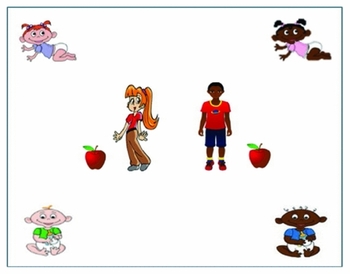
The production portion of the study consisted of 2 practice items followed by a total of 16 experimental trials in a 2 (possessor gender [female (N = 4) vs. male (N = 4)]; manipulated within participants, but between items) × 2 (gender match [match (N = 4) vs. mismatch (N = 4)]; manipulated within participants and items) design. Practice and experimental items were the same for adult and child participants. However, the version administered to adult participants also contained 16 filler trials; filler trials were removed from the child version of the experiment due to time constraints. Participants were first familiarized with two young adult characters and their siblings. The adult characters appeared in the center of the computer display, next to an object (e.g., an apple); their siblings (or inanimate objects, in the filler trials) appeared in one of the four corners of the display. In order to highlight family relationships, skin color was manipulated across the two families (see Figure 1). The characters’ position on the display was counterbalanced across trials. All the names and prompts were recorded by the same female voice.
Example of experimental setup for production.

All trial types prompted participants (see Procedure below for details) to produce a sentence containing a subject (e.g., “Katie”) and a two-place predicate (e.g., “gave,” “put”), followed either by two NPs (e.g., experimental items: “gave her brother an apple”) or a NP and a prepositional phrase (e.g., experimental items: “gave an apple to her brother”; fillers: “put the umbrella on the small chair”). Filler trials resembled experimental trials in that the visual displays always involved two different types of potential targets (e.g., chairs and tables) that differed along one dimension (e.g., size: a big table and a small table, a big chair and a small chair). Practice and filler trials differed from the experimental ones in that the production of a possessive was only expected for experimental trials, while an adjective was expected for filler trials (e.g., small, big, blue, etc.).
For experimental items, gender match (match vs. mismatch, as exemplified in the (a) and (b) examples below) between the possessor and the possessum was manipulated within subjects and items. Two experimental lists were constructed so that each experimental item was seen only once by each participant. Half of the experimental items contained a female subject/possessor and half a male subject/possessor:
-
(1)
-
a. Gender match (female possessor–female possessum): Katie gave an apple to hersister.
-
b. Gender mismatch (female possessor–male possessum): Katie gave an apple to herbrother.
-
-
(2)
-
a. Gender match (male possessor–male possessum): John gave an apple to his brother.
-
b. Gender mismatch (male possessor–female possessum): John gave an apple to hissister.
-
Trial order was the same for both lists and consisted of a single fixed random order. Finally, two additional lists were created in which the order of the experimental trials was reversed.
Procedure
Stimulus display was controlled by E-Prime experiment software (version 2.0.8.79) in the Windows XP operating system. Participants were first familiarized with the two young adult characters, a female (Katie) and a male (John), and their respective siblings (a baby sister and brother). At the beginning of each trial, the characters were named as they appeared on the screen (e.g., “John's little brother,” “John's little sister,” etc.). Once all the characters had been named, participants were asked to press the space bar to see an action. The actions always involved one of the two adult characters placing an object (e.g., an apple) next to one of their own siblings (experimental items) or one of the inanimate objects (filler items). Participants were then asked to describe what had happened (e.g., “What did John do?”). If participants’ first description of the action did not include a possessive (experimental items; e.g., “John gave the apple to the sister”) or an adjective (filler items; e.g., “John put the umbrella on the chair”), the experimenter asked for clarification (e.g., “Whose sister?” or “Which chair?”), and the participant was prompted to produce the whole sentence again (“Can you say the whole thing again from the beginning?”)
Transcription and coding of production data
A trained research assistant transcribed participants’ responses. A subset of the responses (30%) was independently transcribed by a second research assistant; intertranscriber agreement was high (98%), and disagreements were resolved through discussion. Scoring of productions was performed independently by the two authors. Intercoder agreement was also high (97%), and disagreements were resolved by discussion. Responses were excluded from further analyses if participants produced the wrong subject (e.g., if a female subject was used instead of a male subject and vice versa); this error type was only observed in children (N = 25/432, of which N = 15 and N = 10 with female and male possessors, respectively). Participants’ first responses were always scored, regardless of whether participants later corrected themselves. Therefore, for example, a production like “He . . . She gave a pillow to her sister” in response to a trial in which Katie handed a pillow to her sister was excluded from further analyses because the first attempt included an incorrect subject.
The remaining productions were coded as correct if the target possessive and the target possessum noun were used, as in (3). Nontarget productions belonged to one of three main categories: no possessive as in (4)–(5), possessum gender error as in (6), and possessive gender error as in (7):
-
(3) John gave a train to his (little) sister.
-
(4) John gave a train to the/a sister/baby.
-
(5) John gave a train to John's sister.
-
(6) John gave a train to his brother. (target possessum: “sister”)
-
(7) John gave a train to her sister. (target possessive: “his”)
Adult native speakers were at ceiling with respect to their correct production of possessives. Productions with possessive gender errors like (7) were the most common nontarget production overall (47/407 for children; 48/368 for adult L2 learners). Nontarget productions with no possessive were relatively common among children (18/407) but infrequent for adult L2 learners (7/368). Nontarget productions with possessum–noun gender errors mainly occurred in the child group (27/407 for children; 1/368 for adult L2 learners). Nontarget productions with possessum–noun gender errors or where no possessive was produced were excluded from further analyses, because they did not provide interpretable evidence with respect to gender agreement processing.
Inferential statistics on production data are presented as the results of linear mixed-effects logistic regression models performed using R software (version 3.1.3; R Core Team, 2013). The random effect structures of the models always included the maximal random structure justified by the data; if the initial maximal random structure models failed to converge, the random structures were simplified following the procedure outlined in Barr, Levy, Scheepers, and Tiley (2013) until convergence was reached (see below for details about each of the models). For simplicity, we graph production patterns in terms of proportions but performed inferential statistical analyses on untransformed binary data.
Results and discussion
Here, we report how production accuracy with respect to the gender features of possessives changes as a function of possessor gender (male vs. female) and gender match between the agreement controller (i.e., the possessor) and a noun structurally related to the possessive (i.e., the possessum) for the two learner groups. The performance of adult native speakers of English was not included in the statistical analyses due to ceiling performance. To examine the existence of any reliable differences between our learner groups, our analysis also included the effect of learner group (monolingual children or adult L2 speakers) together with its interaction with possessor gender and gender match. We predicted that, if the production patterns previously observed for L1 Italian and L1 Spanish adult L2 speakers of English (Antón-Méndez, Reference Antón-Méndez2011), in which the features of a possessive occasionally match the features of the possessum noun rather than those of the possessor, are the result of L1 transfer, this error pattern should not characterize the production of adult L1 Mandarin speakers and child monolingual learners of English. In contrast, if the above errors are the result of a generalized preference for establishing agreement within a local domain, this type of production pattern should characterize the production profiles of these learner groups as well.
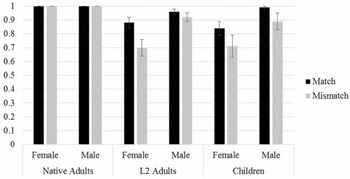
In line with the GLBH, according to which possessive gender agreement errors in production are a general phenomenon that should manifest itself in learners, rather than a consequence of L1 transfer, Figure 2 shows a remarkably similar performance across experimental conditions for the two learner groups. Differently from the error-free production of adult native speakers, both groups produced a substantial number of errors across conditions. Both groups produced substantially higher errors rates in mismatch (18% and 25%, respectively) than in match conditions (9% and 8%, respectively). In addition, both groups produced a higher number of errors when the possessor was the female (21% and 24%, respectively), rather than the male character (6% and 9%, respectively), but this error pattern was not modulated by gender match. Finally, the performance of L2 adult learners and monolingual children did not differ significantly from each other, and both groups showed similar error patterns across experimental conditions.
Mean production accuracy as a function of group, possessor gender, and gender match.

These conclusions are supported by the results of the statistical analyses. First, a linear mixed-effects model, which included the fixed effects of gender match, possessor gender, learner group, and all interactions was applied to the data. Due to convergence issues, the random-effect structure for this model only included by-subject random intercepts. Error rates were higher when the possessor was female rather than male, indicating perhaps a default tendency to produce masculine possessives (estimate = –1.37, SD = 0.30, p < .001); moreover, error rates were higher in mismatch than in match conditions (estimate = 1.63, SD = 0.30, p < .001), indicating that the gender features of a possessive can be influenced by those of a not yet uttered, structurally related local noun. No effect of learner group and no interactions (all ps > .10) emerged, indicating that both groups reacted similarly to the experimental manipulations.
Second, a linear mixed-effects model, which included the fixed effects of gender match between the possessor and the possessum (match vs. mismatch), possessor gender (male or female possessor), and interactions, was applied to each of the learner groups separately, to examine whether the statistical patterns reported above independently characterize those of each of the two groups. Due to convergence issues, the random-effect structure for this model only included by-subject and by-item random intercepts.
For both L2 and child learners, error rates were higher in mismatch than in match conditions (L2 learners: estimate = –0.97, SD = 0.40, p = .02; children: estimate = –1.81, SD = 0.45, p < .001); the gender of the possessor also had a significant effect on accuracy rates for both groups (L2 learners: estimate = 1.53, SD = 0.42, p < .001; children: estimate = 1.75, SD = 0.45, p < .001). For both learner groups, error rates were overall highest for the feminine mismatch condition (~0.30, as opposed to ~0.10 in the masculine mismatch condition), and no interaction between gender match and possessor gender emerged for either group (all ps > .10), indicating that the local noun had a similar influence on the features of the possessive for female and male possessors alike.
To summarize, the results of the production portion of our study show that nontarget productions in which the gender features of a possessive pronoun match those of a local possessum, rather than those of the possessor, are quite common in the speech of L1 Mandarin L2 English adult learners and monolingual English child leaners. In turn, these findings suggest that similar performance patterns previously reported for L1 Spanish and L1 Italian adult learners of English are unlikely to be the sole product of L1 transfer. In contrast, these findings suggest that the tendency to perform agreement locally, within the NP, might be a general characteristic of learners’ production systems, regardless of L1 background and age of acquisition. Moreover, the present findings indicate that nontarget production errors are overall higher when the possessor is female as opposed to male, and highest in mismatch conditions when the possessor is female. This pattern might stem from an overall tendency to overproduce the masculine pronoun in cases of uncertainty, which would result in higher overall gender errors for the female possessor condition and highest errors in the “hardest” gender mismatch–female possessive condition.
EXPERIMENT 2: COMPREHENSION
To examine whether observed difficulties with gender agreement on possessives are due to processes engaged only during production or whether they reflect a more fundamental feature of English learners’ grammatical representations, the participants in this study were also administered a comprehension task. If learners’ representations with respect to gender agreement on possessives differ from those of the target language, they should arise in comprehension as well as in production. If, in contrast, difficulties with possessive gender agreement are a production-specific issue, comprehension performance is expected to be unaffected by the factors at play in production.
Method
Participants
A subset of the participants who took part in the production experiment also took part in an act-out comprehension experiment.Footnote 4 A total of 59 participants were tested in this experiment: 17 monolingual English-speaking children (age range = 37–52 months, mean age = 44 months, SD = 6 months; 9 females), 19 adult L1 Mandarin L2 English speakers (proficiency range = 22/45–43/45; mean proficiency = 38/45, SD = 6.5; 15 females), and 24 adult English native speakers (10 females). Of the 17 child participants run in this experiment, 1 (male, age = 52 months) completed less than half of the experimental session, and his data was excluded from further analyses.
Materials and design
The design of the comprehension experiment was analogous to that of the production experiment. Participants were familiarized with the task via 2 practice trials, and were then presented with a total of 16 experimental trials in a 2 (possessor gender [female (N = 4), male (N = 4)] manipulated within participants but between items) × 2 (gender match [match (N = 4), mismatch (N = 4)], manipulated within participants and items) design. The adult version of the study also included 16 filler items (see Materials and Design for Experiment 1) in addition to the experimental items. Both experimental and filler items prompted participants to place an object next to some other object/character (e.g., “Give the apple to his little sister” or “Put the book on the small table”). Similar to in experimental trials, where the identity of the target was partially disambiguated by the prenominal possessive (e.g., “Give the apple to his . . .”), in filler sentences the identity of the target object was partially disambiguated by the prenominal modifier (e.g., “Put the book on the small . . .”) but was completely disambiguated only at the end of the sentence (e.g., “Put the book on the small table”). The inclusion of the adjective “little” in between the possessive and the possessum noun (“Give the apple to his little sister,” “Give the present to her little brother,” etc.) was intended to maximize our ability to observe how participants used the features of the possessive predictively to narrow down the set of potential referents by delaying the onset of the possessum noun.
Practice and experimental items were the same for adult and child participants. Due to time constraints, however, children were not presented with filler trials.
Similar to the production experiment, possessor gender and gender match (match vs. mismatch) between the possessor and the possessum were manipulated within subjects and items. Two experimental lists were constructed so that each experimental item was seen only once by each participant. Trial order was the same for both lists and consisted of a single fixed random order. Two additional lists were created in which the order of the experimental trials was reversed.
Procedure
In order to avoid comprehension to production priming, the comprehension experiment was always administered after the production one. Adult participants were administered the comprehension and the production portions of the study during the same experimental session, with a break of 5–10 min in between the two. The experimental session took between 40 and 50 min in total. Due to time constraints, children were administered the two portions of the study in two separate sessions of approximately 30 min each, which were scheduled at a maximum of 2 weeks apart.
Stimulus display was controlled by E-Prime experiment software (version 2.0.8.79) in the Windows XP operating system. For adult participants, the stimuli were delivered on a Tobii T120, which sampled eye position at 60 Hz; the stimuli were displayed via its built-in 17-in. monitor set to 1024 × 768 pixels (43.2-cm viewing size). The spatial resolution of the T120 is approximately 0.5 degrees visual angle. Stimulus display was controlled by E-Prime experiment software version 2.0.8.79 in the Windows XP operating system, running on a Dell Precision M4400 laptop with 3.48 GB RAM, a 2.66-GHz dual processor, and an NVIDIA Quadro FX 770M card with 512 MB video memory. The laptop was disconnected from the Internet to increase timing accuracy. Audio for the stimuli was presented through two speakers positioned on either side of the T120 monitor.
At the beginning of each trial, participants were refamiliarized with the two young adult characters, which appeared next to an object (e.g., an apple) located at the center of the display, and their respective siblings (a baby sister and brother), each of which appeared in one of the four corners of the display. After the characters were introduced as they appeared on the screen, adult participants fixated and clicked on the object in the center of the screen to hear a prerecorded instruction (e.g., “Give the apple to his little brother”). Experimental sentences always prompted participants to “give” an object to one of the siblings of the adult characters. Filler sentences always prompted participants to move an object to the vicinity of another object (e.g., “on top of,” “next to,” or “behind”). Participants then carried out the prompts using the computer mouse.
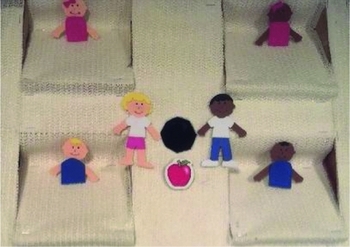
Pilot testing indicated that the majority of children in this age range could not successfully use the mouse to move the characters around on the screen, thus preventing us from collecting and analyzing their act-out performance. The experimental procedure was thus modified for this group, and this portion of the study was conducted with real objects placed on an inclined podium. The inclined podium was placed in front of the participant at the beginning of the experimental session (see Figure 3). At the center of the podium was a hole for a video camera, which was focused on the participant's eyes; the camera sample eye position was at 30 Hz. At the beginning of each trial, the experimenter would position a prop in each of the four quadrants as well as the center of the podium. Each object was pointed at, and named by the experimenter. At the beginning of each trial, the child was instructed to look at the center of the podium. A prerecorded sentence was then delivered via the speakers positioned on either side of the podium, and the child carried out an action in response to it. A second camera recorded the child's actions and the position of the objects on the podium. No feedback was given regarding the accuracy of the action.
Example of the experimental setup for comprehension (child version).

Transcription and coding for eye movement data
For adult participants, eye movements were recorded with a Tobii T120 eye-tracker (60 Hz). Their actions were automatically scored via E-Prime and later checked manually. Children's actions were independently coded from the video recordings by two research assistants. No disagreements between the coders were found. Children's eye movements were coded frame by frame from the video recordings obtained from the camera placed behind the podium. The digital camera recorded at a speed of 30 Hz (i.e., a frame every 33 ms). The video and audio annotation software ELAN (version 4.6.1.) was used to annotate the onset and offset of each experimental sentence, and the onset, offset, and direction of each eye fixation for the duration of the sentence until 2000 ms after sentence offset. Six possible codes were used for each fixation: top left, top right, bottom left, bottom right, middle, and other. A fixation was coded as “other” if the child's eyes were closed, not visible, or the direction of the eye gaze could not be determined.
For both the adult and the child versions of the comprehension experiment, trials were excluded if the proportion of fixations that could not be determined (i.e., were coded as “other” in the case of children, and as “track loss” in the case of adults) exceeded 40% of the fixations. This criterion resulted in the exclusion of 6% of the trials for adult L2 participants, 8% of for the adult native speakers, and 9% for child participants. One child participant was excluded because this criterion resulted in the exclusion of more than 50% of the data. Once this participant and the trials with excessive track loss were excluded, average track loss was 16% for adult L2 learners, 15% for adult native speakers, and 7% for child learners.
Three research assistants coded all the children's videos for eye fixations; subsequently, the videos were independently coded by a fourth research assistant. Disagreements were adjudicated by the first author. Average intercoder agreement was very good (κ = 0.81, p < .001).
Two measures of participants’ comprehension performance were collected. The first was a measure of participants’ final interpretations of the experimental sentences, that is, whether they correctly acted out the instructions. Inferential statistics on this data are presented as the results of a linear mixed-effects logistic regression model.
The second measure was an online measure of participants’ interpretations as sentences unfolded, that is, how participants used the information provided by the possessive to inform and guide their exploration of the visual display (i.e., their eye movements). Growth curve analysis (Mirman, Reference Mirman2014) was used to analyze visual inspection patterns across time.
Both sets of analyses were performed using R software (version 3.1.3) with R adds-on lme4 and lmerTest. The latter package, which provides Type 3 and Type 1 F tests for fixed effects, and likelihood ratio test for random effects, was used to calculate p values for models of eye movement data. The denominator degrees of freedom for these tests were calculated using the Satterthwaite approximation.
For simplicity, we graph patterns in terms of proportions, but performed inferential statistical analyses on untransformed binary data for the act-out performance, and empirical logit (elogit, henceforth) transformed data for the eye movement patterns (Barr, 2008).
Results and discussion
Offline measures of comprehension
Act-out performance. The results of the production study reported above show that learners produced a substantial amount of gender errors in structures in which the features of the possessor and those of the possessum nouns did not match, thus indicating the existence of a generalized tendency in English learners to match the gender features of a possessive with those of a local, possessum noun. Here we ask whether this tendency is production specific, and might only arise when the possessive and the possessum noun are both simultaneously available to the processing system (as is arguably the case in production), or is instead reflected in comprehension as well, and as such might indicate that the generalized local bias is a default characteristic of developing grammars. In the first case, difficulties with possessives are not hypothesized to arise in comprehension. However, if the proposed GLBH applies in comprehension as well as in production, learners are expected to display overall comprehension difficulties with English possessives (see Experimental Prospectus for specific predictions).
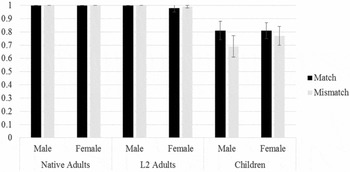
In keeping with the structure of the results of the production portion of the study, Figure 4 reports how the accuracy of speakers’ final interpretations of structures involving a possessive and a local possessum noun changed as a function of group (children, L2 speakers, and adult native speakers), gender match, and possessor gender for the three groups. As is apparent from the figure, the adult native and nonnative speakers in our sample produced virtually no errors in the act-out task. This result is not surprising for the adult native speakers, given their flawless performance in the production experiment. However, the nearly error-free performance of adult L2 learners (five errors in total, four of which in mismatch conditions) contrasts with their (flawed) production performance. In contrast, children produced a substantial number or errors overall (23% on average), with numerically higher error rates associated with mismatch conditions (27%), as compared to match conditions (19%), and with trials in which the possessor was male (25%), rather than female (21%).
Mean act-out accuracy as a function of group, possessor gender, and gender match.

Due to lack of variance in their act-out performance, no statistical analyses were performed on the adult data. In line with the statistical models applied to the production data, a linear mixed-effects model was applied to the children's act-out data; the model included the fixed effects of gender match between the possessor and the possessum (match vs. mismatch) and possessor gender (male vs. female), together with their interaction. The maximal converging random-effect structure included by-subject and by-item random intercepts and by-subject random slopes for the main effect of gender match.
Overall, children's performance was quite error prone, albeit significantly above chance (mean accuracy = 0.77; p > .001). While mismatch conditions were associated with numerically higher act-out errors than match conditions, this difference did not reach significance (estimate = –0.75, SD = 0.44, p = .09). Different from what was observed in the production experiment, the gender of the possessor did not affect accuracy rates (estimate = –0.28, SD = 0.34, p = .40). There was also no interaction between possessor gender and gender match (estimate = –0.57, SD = 0.67, p = .40).
Overall, the majority of act-out errors (43 errors out of 57 total errors) involved children giving an object to a sibling of the target gender but of the nontarget family (e.g., giving a cake to John's brother in response to “Give a cake to her little brother,” referred to here as the “nontarget-family same-gender” referent). The frequency of this type of error did not differ significantly across mismatch and match conditions (22 errors out of 33 total errors vs. 21 errors out of 24 total errors, respectively; estimate = 1.20, SD = 0.74, p = .10). The second most common error type in mismatch conditions (10 errors out of 33 total errors) involved children handing an object to a sibling of the target family but of the nontarget gender (e.g., giving a cake to Katie's sister in response to “Give the cake to her little brother,” referred to henceforth as the “target-family different-gender” referent). This error never occurred in match conditions (i.e., children never gave a cake to Katie's brother in response to “Give the cake to her little sister”).
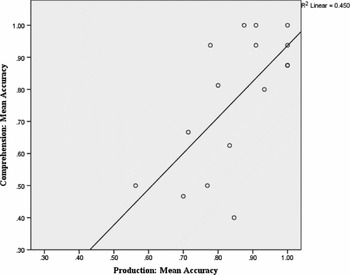
To further explore the existence of a parallel tendency in production and comprehension for child learners of English to assume that elements in a close syntactic relationship should agree in terms gender features, we conducted a correlation analysis aimed at determining whether production and comprehension performance would go hand in hand within individuals. As shown in Figure 5, a significant correlation between overall accuracy performance in production and comprehension across children emerged, r (16) = .67, p = .004, even when age was controlled for, r (13) = .70, p = .004.
Correlation between children's overall accuracy scores in production and comprehension.

INTERIM SUMMARY
The results of the production and comprehension measures presented so far for the adult speakers in our study are quite clear: adult native speakers’ performance is flawless in both production and comprehension, while L1 Mandarin L2 English speakers produce a substantial amount of agreement errors in the elicited production task, but perform at ceiling in the comprehension task. These results indicate that the tendency for a local possessum noun to influence the features of the possessive is not confined to speakers for whom this option is implemented in the grammar of their L1 (e.g., L1 Italian and L1 Spanish L2 learners), but rather it is a more generalized phenomenon that cuts across L1 backgrounds. The present data indicate that this generalized tendency for local agreement is unlikely to reflect nontarget grammatical representation, as L2 speakers’ act-out patterns did not show any sign of confusion or interpretative uncertainty in the act-out task; such difficulties would have been expected if the structures presented to the participants could have been perceived as either globally ambiguous (match condition) or ungrammatical (mismatch condition). The performance pattern of English-speaking children, in contrast, might indicate that these children's grammatical representations are not yet targetlike: children's performance, albeit substantially above chance, was overall quite error prone in both production and comprehension; moreover, performance in production and comprehension was significantly correlated for this group even when age (and thus, at least in part language proficiency) was controlled for, thus potentially reflecting nontarget grammatical representations.
Alternatively, children's production difficulties might stem from the same tendency for local agreement, while their overall low performance in the comprehension task might simply indicate that the task was demanding and children occasionally forgot kinship among characters. If so, the correlation between production and comprehension performance could be a reflection of individual differences in working memory among our child participants: children with more limited working-memory capacity might be more likely to forget kinship among the characters, and thus produce more act-out errors, as well as be more likely to forget the gender identity of the possessor in production and thus make the possessive agree with the local possessum noun. Because we did not collect working memory or related executive function tasks to this population, we leave this issue open for further research.
To further probe the extent to which participants’ grammars as a whole are nontargetlike, we investigated how the gender information provided by possessives is used in real time.
Online measures of comprehension: Eye movements
Here, we first investigated whether participants make use of the gender features of a possessive in a nontargetlike manner, that is, whether, due to a general tendency to expect gender agreement within a local domain, upon hearing a possessive, participants show a preference for possessums that match the possessive in terms of gender features (e.g., showing an advantage for brothers upon hearing “his”). The dependent variable in this analysis (see Same-Gender Preference below) was elogit-transformed looks to the siblings that matched the gender features of the possessive (the “same-gender” referents) compared to the siblings that did not (the “different-gender” referents). More specifically, this looking preference was calculated by taking, for each child/item combination, the natural log of the time spent looking at the same-genderreferents (e.g., the two male siblings, when the possessive was “his”) plus 0.5, all divided by the time spent looking at the different-gender referents (e.g., the two female siblings, when the possessive was “his”) plus 0.5. We hypothesized that, to the extent that possessive errors stem from nontarget grammatical representations, a preference for the same-gender referents over the different-gender referents should emerge as soon as the possessive is processed. The window of interest in this case goes from the onset of the possessive until the onset of the possessum (“his/her little,” 1800 ms on average due to the slow speech rate used in the recordings).
A final analysis was conducted to investigate the extent to which participants instead make use of the gender features of the possessive in a targetlike manner during sentence processing, that is, to zoom in onto the target family as soon as the possessive becomes available (e.g., zooming in on John's family upon hearing “his”). The dependent variable in this analysis (see Target-Family Preference below) was elogit-transformed looking preference for siblings belonging to the target family (e.g., John's siblings) compared to the competitor family (e.g., Katie's siblings) during the same time window. More specifically, this looking preference was calculated by taking, for each child/item combination, the natural log of the time spent looking at the “target-family” referents (e.g., the John's siblings, when the possessive was “his”) plus 0.5 all divided by the time spent looking at the “nontarget-family” referents (e.g., Katie's siblings, when the possessive was “his”) plus 0.5.
Growth curve analysis (Mirman, Reference Mirman2014) was used to analyze the eye movement data for the three groups of participants separately. In these analyses, a significant intercept indicates a preference for a referent (or a set of referents) over another. In our case, a significant intercept indicates a preference for the same-gender referents over the different-gender referents in the Same-Gender Preference analyses, and a preference for the target family over the nontarget family in the Target-Family Preference analyses below. An effect of the fixed effect (e.g., possessor gender) on the intercept (i.e., a main effect) would reflect an overall difference in preference scores between two levels of the factor (e.g., female vs. male possessor), shifting one upward or downward overall. Finally, an effect of the linear term on the intercept would indicate an overall rise (or fall) in preference scores (i.e., same-gender preference or target-family preference), while an interaction between the linear time term and the fixed factor (i.e., possessor gender) would reflect a difference in the angle of the two preference curves (i.e., a difference in the overall rise or fall in looking preferences for the two levels of the fixed factor possessor gender).Footnote 5
The models included the effects of the linear time term, possessor gender, and their interaction as fixed effects, but did not include the effect of gender match (match vs. mismatch) nor its interaction with the other factors, as these analyses are based on eye movement patterns before the possessum noun is heard and, thus, no effect of gender match could have arisen at this point.
The R add-on package lmerTest was used to calculate p values for the maximal models. The random-effect structure of the models included by-subject random intercepts, together with by-subject random slopes for the main effect of time, possessor gender, and their interaction.
Same-gender preference
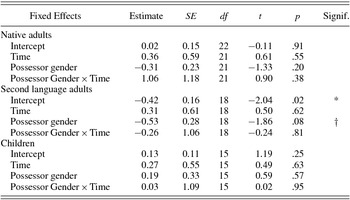
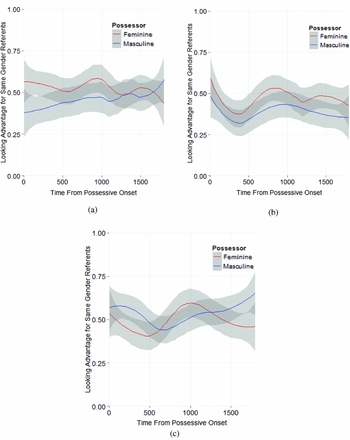
Overall, the adult participants in our study did not show evidence of using the gender feature of the possessive to (incorrectly) infer the gender of the possessum noun. None of the groups showed a preference for the same-gender referents during the critical time window, as indicated by the fact that the intercept did not differ from zero and there was no effect of the time term on the intercept (see Table 1 and Figure 6a–c). The adult L2 group showed a marginal effect of possessor gender on the intercept (estimate = –0.53, SD = 0.28, p = .08), which was not modulated by the time term. Possessor gender did not have a significant effect on the intercept, nor did it interact with the time term for the monolingual groups.
Linear mixed effects model of (Elogit) same gender overall looking preferences, fixed effects of time (linear), possessor gender, and their interaction for native adults, second language adults, and children

Note: The random effects structure included intercept and effect of time, possessor gender, and their interaction for subjects. R-code was used with lmerTest: Elogit ~ Time × Possessor Gender + (1 + Time × Possessor Gender || Subject). The degrees of freedom were calculated using the Satterthwaite approximation.
†p < .10. *p < .05.
Average same-gender advantage scores as a function of possessor gender and time for (a) native adults, (b) second language adults, and (c) children.

Target-family preference
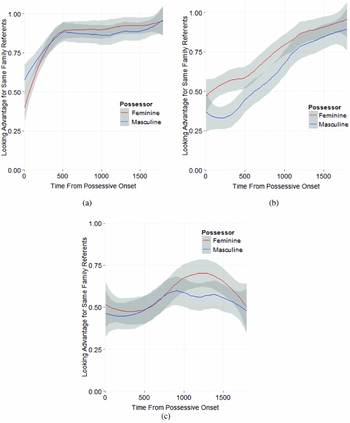
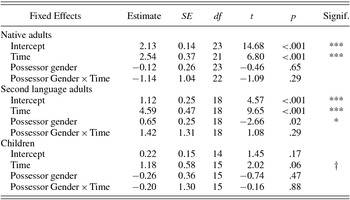
Overall, all groups of participants showed some evidence of using the features of the possessive in real time to correctly narrow down the set of potential target referents to the target family. As can be seen in Figure 7a–c, a preference for the target family over the nontarget family emerged during the critical time window for the adult participants. For adult participants, an overall target-family preference emerged during the time window of interest, as indicated by the fact that the intercept was significantly above zero for both adult groups (adult native speakers: estimate = 2.13, SD = 0.14, p < .001; adult L2 learners: estimate = 1.12, SD = 0.25, p < .001). This overall target-family preference did not reach significance for children (estimate = 0.22, SD = 0.15, p = .16) during this time window.
Average target-family advantage scores as a function of possessor gender and time for (a) native adults, (b) second language adults, and (c) children.

A significant effect of the time term on the intercept, indicating a linear increase in target-family preference scores after the onset of the possessive, also emerged for both adult groups, but was only marginal for the children (estimate = 1.18, SD = 0.58, p = .06, see Table 2). In contrast to the monolingual groups, the adult L2 group showed an effect of possessor gender on the intercept (estimate = –0.66, SD = 0.25, p = .02), which was not modulated by the time term. This effect might reflect the fact that the masculine possessor can act as the default, and thus refer to both families, in the grammars of these L2 learners. In other words, similarly to how the masculine possessive can occasionally be used by this group of speakers to refer to the family of the female character in production, in comprehension the masculine possessive seems to initially be taken to refer to either family, and thus be associated with slower convergence onto the target family. For the monolingual groups, in contrast, possessor gender did not have a significant effect on the intercept, nor did it interact with the time term.
Linear mixed effects model of (Elogit) target family looking preferences, fixed effects of time (linear), possessor gender, and their interaction for native adults, second language adults, and children

Note: The random effects structure included intercept and effect of time, possessor gender, and their interaction for subjects. R-code was used with lmerTest: Elogit ~ Time × Possessor Gender + (1 + Time × Possessor Gender || Subject). The degrees of freedom were calculated using the Satterthwaite approximation.
†p < .10. *p < .05. ***p < .001.
A final analysis was conducted to investigate whether the child participants displayed a delayed preference for the target family, once the possessive pronoun had been processed. To investigate this issue, we examined a time window of the same length as the “possessive window” (1800 ms), starting after the onset of the possessum noun. In line with offline comprehension data, which showed above chance comprehension accuracy, during this time window children displayed an overall preference for the target-family referents (estimate = 0.66, SD = 0.20, p = .005), which increased linearly over time (estimate = 2.1, SD = 0.41, p < .001).
GENERAL DISCUSSION
The first aim of this study was to investigate the extent to which previously documented possessive errors produced by L2 speakers of English are better conceived of as an L1 transfer phenomenon or as a generalized local bias phenomenon. In these errors, the gender features of a local noun (i.e., the possessum noun following a possessive) are found to occasionally interfere with gender agreement between an agreement controller (the antecedent NP, or possessor) and the agreement target (the possessive). If due to L1 transfer, these errors should only occur in the speech of learners whose L1s (e.g., Italian or Spanish) implement this type of agreement (Antón-Méndez, Reference Antón-Méndez2011). If they are a more general phenomenon, they should also surface in the speech of L2 learners whose language background does not bias them one way or the other (L1 Mandarin speakers of English) as well as child L1 learners. The results of our elicited production study are most compatible with the GLBH: when the gender of the antecedent and the possessum noun mismatched, both children and adult L2 speakers produced a substantial number or errors (with average error rates as high as 30%). Possessive gender errors were significantly lower for match structures, as the latter would be produced accurately regardless of whether the gender features of the possessor or the possessum were passed on to the possessive. It is important to note that our results indicate that L1 transfer is not responsible for the observed possessive errors, but it may actually be responsible for their absence, that is, for targetlike performance in an L2: the highly accurate performance of Dutch L2 speakers of English (Antón-Méndez, Reference Antón-Méndez2011) may be due to the similar possessive agreement paradigm in Dutch and English, suggesting that a potentially default tendency in production to compute gender agreement locally can be actively counteracted by the presence of a dominant language system where this tendency has to be inhibited. In line with the idea that the observed tendency for local agreement is lost with continued experience to an incompatible language system, adult native speakers of English did not make any errors in this study. However, it is also possible that the experimental task used in this study, which had been designed to be performed by children and L2 learners, was too easy for adult native speakers. While these results replicate previous findings (Santesteban, Foucart, Pickering, & Branigan, Reference Santesteban, Foucart, Pickering and Branigan2010), under more taxing experimental circumstances (i.e., time pressure), native speakers have been shown to produce the same kind of error as our learners (Slevc et al., Reference Slevc, Lane and Ferreira2007), albeit to a much lower degree (~5% errors), indicating perhaps that a local agreement bias may not be completely lost with proficiency in the language, but rather more effectively inhibited. We leave this question open to further research.
The second aim of this study was to investigate the extent to which the tendency, observed in some English learners, for possessives to occasionally agree with structurally related and linearly closer possessum nouns is better conceived as a production phenomenon, or might instead characterize learners’ grammars as a whole, and as such might also surface in (online and offline) measures of comprehension. We found that, in contrast with what was observed in production, this local agreement bias did not characterize the comprehension profiles of adult L2 speakers: virtually no act-out errors were produced by this group and their eye movement patterns indicated that the features of the possessive noun were used in real time to identify the gender of the possessor (target-family advantage), but not that of the possessum (no same-gender advantage). In other words, while in production Mandarin–English speakers behaved, to a certain extent, as if they were learners of a language with NP-internal gender agreement such as Italian, in comprehension they did not show any indication of such a bias.
Finally, it is important to notice that online comprehension results showed increased looks to the target family after hearing the possessive and before encountering the possessum noun. This implies that adult learners can use morphological evidence in their L2 predictively, which accords with other findings in the literature (e.g., Garrod, Gambi, & Pickering, Reference Garrod, Gambi and Pickering2013; Kutas, DeLong, & Smith, Reference Kutas, DeLong and Smith2011; Pickering & Garrod, Reference Pickering and Garrod2013). This is quite remarkable given claims of specific difficulties in the acquisition of morphosyntax in late L2 learners (Clahsen & Felser, 2006; Ullman, Reference Ullman and Sanz2005; although see Foucart & Frenck-Mestre, Reference Foucart and Frenck-Mestre2012; Sagarra & Herschensohn, Reference Sagarra and Herschensohn2010, for other cases of online targetlike use of L2 morphosyntax).
The comprehension patterns exhibited by the children in our study were more complex. Children's act-out patterns are, at least partially, compatible with nontargetlike representations: overall, their performance was in quite error prone across conditions, and a significant correlation between production and comprehension performance was observed across individuals. As we observed in our introductory section, overall high error rates in comprehension would be expected if a learner's parses were occasionally generated by a nontarget, Italian-like, grammar as a match condition would be ambiguous for the listener with respect to family kinship (i.e., it is not possible to know whose sister to give something to when hearing the Italian counterpart of “give a pen to her sister”), and a condition where the possessive and the possessum noun mismatch in gender (i.e., the Italian counterpart of “give a pen to his sister”) would be ungrammatical. Both conditions would thus be expected to give rise to interpretative uncertainty, as was found.
However, children's act-out errors might also be the consequence of limitations in memory-dependent abilities, which are known to be more limited in children than in adults (Logie & Maylor, Reference Logie and Maylor2009; Maylor & Logie, Reference Maylor and Logie2010). These cognitive limitations could affect both the memory of the verbal prompt itself and the memory of family relations (even though participants were reminded of them at the start of every trial). When forgetting the exact form of the prompt, possessive determiners may be more easily forgotten both because “memory for lexical items is a function of the degree of processing or elaboration they receive at the time of encoding,” with function words being associated with shallower processing (Caramazza, Zurif, & Gardner, Reference Caramazza, Zurif and Gardner1978, p. 662), and because memory for words that occur in the middle of a series is worse than memory for words that appear at the end (and the beginning) of a series (e.g., Deese & Kaufman, Reference Deese and Kaufman1957). In this case, children would be expected to perform an action with the “nontarget-family same-gender” sibling as the goal: in other words, “his little sister” may turn into “x’s little sister” and be resolved as “her little sister” or “his little sister.” These errors (wrong family but correct sibling) were the most common type of error observed in children's act-out performance (43 out of a total of 57 act-out errors). In contrast, when it is the possessum noun that is forgotten, children are instead expected to perform an action with the “target-family different-gender” as the goal: “his little sister” may become “his little x” and be resolved as either “his little brother” or “his little sister.” In line with the reasons sketched out above, these target-family different-gender errors, which involve forgetting a content word, were rarer (10 out of a total of 57 act-out errors). The other memory-related issues children may incur is forgetting family relations among the characters. As children in the age range tested here have been shown to occasionally fail to use perceptual factors (e.g., skin color, in our case) as a cue to classify and differentiate among individuals (Aboud, Reference Aboud, Phinney and Rotheram1987; Hirschfeld, Reference Hirschfeld and Medin1994), it is possible that they may have failed to use in a successful manner the perceptual factors employed here to highlight kinship among the characters. These errors, being independent of the processing of linguistic features, should not be affected by the match manipulation.
Unfortunately, the eye movement patterns collected during sentence processing failed to provide conclusive evidence in favor of either the grammar-based or the memory-based explanation of children's act-out errors. Against the nontarget grammar hypothesis, children's looking patterns in the comprehension experiment did not indicate a preference for same-gender over the different-gender referents. At the same time, however, children's looking patterns also failed to indicate a significant preference for the target family during the same target window. Only a marginal linear increase in looks to the target family emerged during the critical time window (although this preference became significant in the subsequent time window) after the possessum was heard, in line with the hypothesis that possessive gender errors are production specific in both learner populations.
In summary, in accordance with the GLBH, the present results allow us to conclude with confidence that possessive gender errors characterize the production of English learners, regardless of age and cognitive maturity, suggesting the existence of a tendency, in production, to establish agreement within local domains. These results also indicate that this tendency does not uniformly surface in both production and comprehension, as no evidence of such a local bias emerged in the comprehension patterns of adult learners, and only some weak evidence in that direction in those of children (i.e., high error rates, correlation between error rates in production and comprehension, and lack of significant preference for target family during the early time window). More research on this topic, possibly with younger children and adult L2 learners whose L1s display NP-internal possessive–possessum agreement, is needed to adjudicate this issue.
The generalized local agreement bias
Throughout this paper, we have been talking about local bias to describe the experimental finding that speakers of English, a language in which there is no syntactic gender agreement and NP-internal agreement of features (i.e., number) is limited, sometimes produce an incorrect possessive that matches the gender features of the following noun (more so in the case of learner populations such as children and L2 speakers). Where does this bias come from? Why is it more pronounced in learners than in native speakers?
Our data did not address these questions directly and our answers can, thus, only be speculative at this point. Nonetheless, it is worth noting that many languages do display NP-internal agreement as a grammatical rule and that, cross-linguistically, syntactic proximity between controller and target in an agreement relation increases the likelihood that the agreement would be formal rather than semantic (see Corbett's, Reference Corbett1979, agreement hierarchy). It thus seems that there is a general tendency across languages for nouns and their determiners to share features, which could be the result of speakers’ underlying biases to imbue constituents that go together and refer to the same thing with the same phi features. These biases would then be more likely to surface as a default preference in language learners, even if this preference is not instantiated in the target grammar. This local agreement bias was observed in the production patterns of monolingual English-speaking children, who have not been exposed to local gender agreement in the language spoken around them, and in L1 Mandarin L2 learners, who have not been exposed to local gender agreement in either their L1 or their L2.
We suggest that NP-internal agreement, the local agreement tendency, could be an inherent bias, an inbuilt preference that has to be “unlearned” by speakers of languages where it does not apply.
Differences between production and comprehension
The question then is why, since an inherent bias toward local NP-internal agreement appears in the production of (less experienced) English speakers, we did not find consistent evidence for it in comprehension. Here is where differences between production and comprehension, in terms of aims, needs, and affordances, might come to the fore. In production, the speaker is required to plan ahead in order to make decisions that often depend for their grammaticality on constituents not yet uttered. In the case of possessive NPs, the two constituents, determiner and noun, are likely part of the same processing/planning unit (Konopka & Brown-Schmidt, Reference Konopka, Brown-Schmidt, Goldrick, Ferreira and Miozzo2014). The two are thus tightly linked in the speaker's mind. The speaker, in planning the NP, should be processing the two constituents together (Brown-Schmidt & Konopka, Reference Brown-Schmidt and Konopka2008; Martin, Crowther, Knight, Tamborello, & Yang, Reference Martin, Crowther, Knight, Tamborello and Yang2010; Wheeldon, Ohlson, Ashby, & Gator, Reference Wheeldon, Ohlson, Ashby and Gator2013), which could favor a general tendency in languages toward formal agreement within the local NP unit, and, in the particular case under study, an erroneous initial bias toward local agreement even when it does not exist in the target language.
In comprehension, in contrast, the possessive and the possessum noun do not need to be part of the same processing unit, since, due to the incremental nature of sentence processing, the information carried by the possessive could be interpreted before the possessum noun is heard (at least in the conditions of this experiment where there was an intervening adjective). In other words, the listener initially has only access to the information provided by the possessive and uses its features to narrow down the set of relevant referents. At this point, interference from the possessum is not possible, as it has not been heard yet. When the possessum noun is finally heard, the listener can further narrow down the subset of relevant referents and zoom in onto the target referent. The gender features of the possessum noun might thus not (retroactively) interfere with the processing of the possessive because the parser has already committed to an interpretation of the pronoun by this point in the sentence and no trigger for revision is present.
Are possessive errors attraction errors?
We have just explained the possessive gender errors found in production as the result of a tight syntactic link between an agreement target, the possessive, and a potential agreement source, the possessum noun, that is ultimately not the agreement source but, given the syntactic configuration, could have been. Therefore, while there are similarities between these errors and the prototypical attraction error where an interloper noun can wrongly be processed as the agreement source (e.g., “cabinets” in “the key to the cabinets are on the table”: Bock & Miller, Reference Bock and Miller1991; for other types of agreement see Antón-Méndez, Nicol, & Garrett, Reference Antón-Méndez, Nicol and Garrett2002; Santesteban, Pickering, & Branigan, Reference Santesteban, Pickering and Branigan2013), there are also important differences that make us question whether the possessive gender errors studied here can be considered an instance of attraction.
The most notable difference between attraction errors in the literature and this particular gender error is that the interloper in this case is a potential source of agreement for the target, both because cross-linguistically the noun in an NP tends to agree with its determiner and because English allows this relationship in the case of number agreement with demonstratives (e.g., “this word” vs. “these words”). Thus, in our view, the present phenomenon is likely to be associated with a different mechanism than attraction errors because the possessum is not an interloper that has been (or whose features have been; Bock & Eberhard, Reference Bock and Eberhard1993; Vigliocco & Nicol, Reference Vigliocco and Nicol1998) mistakenly promoted to a syntactic position that triggers agreement; it is in the right syntactic position to trigger agreement.
Furthermore, in most documented cases of attraction errors, the attractor is a modifier to the agreement source, and/or it intervenes between the agreement source and the target in the utterance (see, e.g., Bock, Nicol, & Cutting, Reference Bock, Nicol and Cutting1999, for antecedent–pronoun agreement; Franck, Vigliocco, Antón-Méndez, Collina, & Frauenfelder, Reference Franck, Vigliocco, Antón-Méndez, Collina and Frauenfelder2008, for noun–adjective agreement; Hartsuiker, Antón-Méndez, & van Zee, Reference Hartsuiker, Antón-Méndez and van Zee2001; and Vigliocco & Nicol, Reference Vigliocco and Nicol1998, for subject–verb agreement); agreement errors where the attractor does not intervene or modify the agreement source have been found to be different in terms of origin and outcomes (Staub, Reference Staub2009, Experiment 4; but see Franck, Soare, Frauenfelder, & Ricci, Reference Franck, Soare, Frauenfelder and Ricci2010, for an alternative analysis of these structures). In any event, even in those cases where the interloper is not thought to intervene between source and target, it does precede the agreement target. Agreement attraction in contexts in which the attractor follows the agreement target at all points in the derivation have not been reported in the literature, and have even been ruled out on theoretical grounds (Franck, Reference Franck2011). This reinforces the conclusion that the reason for attraction errors is that the attractors or interlopers are processed in close temporal or structural relationship with the agreement source they supplant (Bock & Cutting, Reference Bock and Cutting1992; Staub, Reference Staub2009), which is not the case here.
That the data from our native speakers showed no influence of the potential interloper on possessive agreement may be an additional clue that this configuration is not conducive to regular attraction errors. Although it is true that the lack of errors here could just be due to ceiling effects, given that Slevc et al. (Reference Slevc, Lane and Ferreira2007) did find a small but significant amount of possessive gender errors with a more demanding task, and that failures to elicit possessive gender errors in native speakers has also been reported before. Santesteban et al. (Reference Santesteban, Foucart, Pickering and Branigan2010) also found flawless performance for adult English speakers in constructions with a possessive determiner as opposed to those with a possessive pronoun (e.g., “the waitress says that the son is hers”) where regular attraction conditions are met.
In sum, possessums are neither structurally nor conceptually related to the real agreement source for possessives in English (the possessor), they do not intervene between the agreement source (the possessor) and the target (the possessive), and they follow rather than precede the possessive. This makes possessive gender errors differ in important ways from prototypical attraction errors. In our view, then, until more definitive evidence can be presented to support an interpretation of these possessive gender errors as a form of attraction, they are probably best analyzed in their own terms, rather than as a special case of attraction.
Possessor gender effects
One last aspect of our results that requires further discussion is the (somewhat) inconsistent presence (and direction) of possessor–gender effects in production and comprehension. The production results show that both adult and child learners of English are more accurate at producing masculine, as opposed to feminine, possessives. That is, both learner groups occasionally produce masculine pronouns when a feminine pronoun is instead expected, above and beyond any effect of gender match between the gender of the possessor and that of the possessum. This pattern might result from the use of the masculine as the default or unmarked gender in colloquial English (see Alpher, Reference Alpher1987; Jacobsen, Reference Jacobsen1977). While this pattern did not emerge in the comprehension of child learners (no effect of possessor gender emerged in either act-out performance or online looking patterns), it is consistent with the L2 learners’ looking patterns, which indicated faster target-family convergence for the feminine, as opposed to the masculine, possessives. That is, to the extent that the masculine pronoun in these grammars can be occasionally used to refer to a female possessor, but not vice versa, it is to be expected that the siblings of the female character could be occasionally considered as the target referents of a possessive masculine possessive, thus giving rise to slower convergence patterns onto the target referents (i.e., the siblings of the male character).
Limitations and further questions
There are a number of limitations and several important issues left unresolved by our investigation. One potential concern of the present study is perhaps the fact that, while the L1 of our L2 learners (Mandarin) does not display gender agreement on possessives in the spoken language, it does so in the written language. More specifically, in the written language, Mandarin resembles English, rather than Italian, in that possessives match the gender of the possessor (his: pronounced “tā de,” written “他的”; her: pronounced “tā de,” written “她的”), rather than that of the possessum noun. While it would have been ideal if the L1 of our adult L2 learners did not mark gender on possessives in either the written or the spoken modality, we believe that, as it is the primary modality, the one that does not mark gender on possessives, Mandarin is a sufficiently good choice. In addition, the fact that L1 Mandarin speakers showed a tendency for local agreement between the possessive and the local noun in English, even though the opposite type of agreement is found in their L2 and in their written L1, if anything, strengthens our claim that this is a generalized learner phenomenon.
The account for agreement errors on possessives put forth in this paper, according to which these errors stem from learners’ tendency to compute agreement relationships within a local structural domain, lends itself to a set of clear predictions that were however not tested in the current study. For example, our proposal predicts that adult L2 and monolingual child learners of languages like Italian should not display particular difficulties in their production of agreement on possessive pronouns, and that eventual agreement errors in which the features of the possessive match those of the nonlocal possessor should only occur as the result of L1 transfer (i.e., should be observed only in learners whose L1 displays nonlocal agreement, but not in learners whose L1 does not display either form of agreement) at early stages of proficiency. Furthermore, to the extent that the GLBH is correct, it predicts that number agreement errors should be observed in the productions of child and adult learners of English when the possessum noun is plural (e.g., Katiei gave a present to theiri cousins), since the possessive and the plural noun are found in the same critical local configuration that gave rise to gender errors in our study. In contrast, agreement errors should not be observed when the possessive and a local noun are linearly adjacent, but are not part of the same structural unit; for example, the possessive is not expected to match the features of a local noun that is not part of the same constituent (e.g., † “Katiei gave John hisi sweater”). It is our hope that future research will systematically address these questions and help paint a more complete picture of agreement phenomena in L1 and L2 acquisition.
Conclusions
The present investigation into the production and comprehension of nominal gender agreement uncovered both similarities and differences between child and adult learners’ processing and acquisition profiles. The production patterns of these groups were not only extremely similar to one another but also, even when nontargetlike, they were constrained by the same factors: gender agreement errors do not appear at random, but seem to be the result of a potentially language-specific tendency for masculine possessives to act as default in English and a potentially cross-linguistic tendency to establish agreement within a local domain.
In contrast, the two groups differed in terms of their comprehension patterns: the performance of adult learners was virtually error free, indicating that, at least for this group, the tendency to establish agreement within a local domain is not a general characteristic of the language processing system, but rather only emerges in production, when the possessive and the possessum are part of the same processing unit. Children's comprehension patterns were less accurate than those of adult native speakers and presented some indication that the proposed local agreement bias might be active in comprehension as well as in production. The observed differences in the comprehension profiles between these learners’ groups might stem from children's immature cognitive skills and reduced working-memory capacity, or might instead be an indication that the observed local agreement bias is harder to inhibit in production due to the tighter link between the possessive and the possessum in this modality, and so be more likely to surface even in adult populations.
ACKNOWLEDGMENTS
Both authors contributed equally to the work reported here. We thank Alon Hafri for assistance with the E-Prime script used for stimulus presentation and data collection. Thanks to Yi Lin, Sarah Hendry, Ceiridwen Redman, and Kristina Woodard for their assistance with data collection, transcription, and scoring. This research was supported by a grant from the Department of Behavioural, Cognitive and Social Sciences of the University of New England to Inés Antón-Méndez; during data collection and manuscript preparation, Lucia Pozzan was partially funded by the Marica De Vincenzi Foundation and Eunice Kennedy Shriver National Institute of Child Health and Human Development Grant 1-R01-HD-37507 awarded to Lila Gleitman and John Trueswell.