Judging from the literature on English-speaking children, noun morphology has not played a central role in theoretical accounts of specific language impairment (SLI). However, this impression has more to do with the nature of noun morphology in English than with noun morphology more generally. Accounts of SLI as reflected in other languages suggest that noun morphology can have considerable theoretical importance. One account that seems especially relevant is that of Clahsen (Reference Clahsen1989, Reference Clahsen1991, Reference Clahsen, Ritchie and Bhatia1999; Clahsen & Hansen, Reference Clahsen and Hansen1993). Clahsen proposed that the grammatical impairments seen in children with SLI are due to a deficit in establishing the structural relationships of agreement. This account, which we refer to as the “grammatical agreement deficit” account, was initially applied to German, but Clahsen (Reference Clahsen, Ritchie and Bhatia1999) later identified grammatical characteristics of children with SLI learning other languages that seemed consistent with his proposal.
Several different grammatical details are assumed to be adversely affected by this grammatical agreement deficit. These include verb inflections, auxiliary and copula forms that must agree with the subject according to person and number, gender and number agreement between determiners and nouns, and case markings on pronouns, determiners, and noun suffixes, among others. For example, in English, children with SLI are expected to have difficulty with third person singular –s, finite auxiliary be (e.g., is, are) forms, finite copula forms, subject/nominative pronouns (e.g., he, she), possessive pronouns (e.g., his, hers), and the genitive inflection 's.
The grammatical agreement deficit account has not received a great deal of attention in studies in English, in part because, for this language, it does not appear to hold any advantage over alternative accounts. Verb inflections, as well as auxiliary and copula forms involving subject–verb agreement, are clearly weaknesses in English-speaking children with SLI but seem to be successfully handled by accounts such as the extended optional infinitive account (Rice, Reference Rice, Levy and Schaeffer2003; Rice & Wexler, Reference Rice and Wexler1996). Although nominative case marking on pronouns can be problematic in English SLI, this detail, too, is addressed by the extended optional infinitive account (Wexler, Reference Wexler, Levy and Schaeffer2003). Several other grammatical details falling within the purview of the grammatical agreement deficit account are not operational in English. For example, determiners do not make case or gender distinctions in English as they do in other languages. According to Clahsen's grammatical agreement deficit account, accusative case should also be problematic, but accusative case in English is the default case for pronouns (e.g., me is an appropriate answer to a question such as Who wants ice cream?) and thus does not reveal errors. This seems to leave possessive 's as a form in English that is predicted to be problematic by the grammatical agreement deficit account that is not addressed in the extended optional infinitive account. Although the data are limited, the available evidence suggests that English-speaking children with SLI are less consistent in using possessive 's than are younger typically developing (TD) children matched according to mean length of utterance (MLU; Leonard, Reference Leonard1995).
In contrast, the grammatical agreement deficit account does provide a means of explaining grammatical weaknesses that are seen in other types of languages. For example, Swedish-speaking children with SLI have great difficulty with article + adjective + noun sequences, which involve both gender and number agreement along with a distinction in definiteness (Leonard, Salameh, & Hansson, Reference Leonard, Salameh and Hansson2001). German-speaking children with SLI make errors in the selection of determiners (Clahsen, Reference Clahsen1989). For example, nominative case determiners are sometimes used in contexts requiring accusative case. Unfortunately, although the grammatical agreement deficit account provides a plausible explanation of these errors in Swedish and German, interpretation of the data is somewhat complicated. Definiteness is not subject to the grammatical agreement deficit account, and it is not known if the difficulty experienced by Swedish-speaking children with SLI in the use of article + adjective + noun sequences is attributable to gender and number, or to definiteness. Similarly, in German, determiners make a distinction in definiteness along with gender and number and case marking. Attributing a problem to one particular feature involving agreement (e.g., case), therefore, is not straightforward. In addition, some German determiners (definite and indefinite feminine singular, definite and indefinite neuter singular, and definite plural) do not make a distinction between nominative and accusative case.
Clahsen and colleagues (Clahsen, Bartke, & Göllner, Reference Clahsen, Bartke and Göllner1997; Clahsen & Dalalakis, Reference Clahsen and Dalalakis1999; Eisenbeiss, Bartke, & Clahsen, Reference Eisenbeiss, Bartke and Clahsen2005) have presented an alternative to the grammatical agreement deficit account that posits a narrower deficit regarding agreement. According to this account, referred to here as the “subject–verb agreement deficit” account, only the verb agreement features are adversely affected in the grammar of children with SLI. This narrower view received support from a study by Eisenbeiss et al. (Reference Eisenbeiss, Bartke and Clahsen2005). These investigators found that a group of five German-speaking children with SLI had no special difficulties expressing structural case (e.g., nominative, accusative, or genitive).
However, it is not yet clear that agreement problems in children with SLI are limited to subject–verb agreement. First, the Eisenbeiss et al. (Reference Eisenbeiss, Bartke and Clahsen2005) study employed spontaneous speech samples, and the number of genitive and accusative case contexts in these samples was quite limited (no genitive contexts were found for any of the children with SLI). Second, as noted earlier, the article + adjective + noun agreement sequences that are problematic for Swedish-speaking children with SLI might be attributable to problems with gender or number agreement. Third, a recent study of noun morphology in Hungarian-speaking children with SLI by Lukács, Leonard, and Kas (Reference Lukács, Leonard and Kas2010) found that accusative case suffixes were omitted more frequently by these children than by a group of younger TD children. In that study, an experimental task was used, carefully controlling the contexts for structural accusative case. However, Lukács et al. did not examine other structural cases. Together these findings suggest that earlier proposals of a grammatical agreement deficit should not be reduced to that of a subject–verb agreement deficit without additional supportive evidence.
In the present study, we examine noun morphology agreement in children with SLI who are acquiring Finnish, a language that permits us to avoid some of the natural confounds that exist in other languages. We focus on noun suffixes in Finnish that express grammatical case. Finnish is an agglutinating language such that case suffixes appear as separate morphemes that can appear in a sequence, separate from suffixes that mark number (plural) or other grammatical functions. For example, the Finnish word for “street” with the partitive case suffix is katu-a; the plural form with the same case has a plural suffix that appears between the noun stem and the partitive suffix, as in katu-j-a.
The presence of case suffixes in Finnish along with the single-function nature of each suffix provides a clear view into grammatical case proficiency in children with SLI. For this reason, Finnish permits an evaluation of whether grammatical cases are problematic for children with SLI and whether the grammatical agreement deficit account offers a plausible explanation for these difficulties. We begin with a brief sketch of the Finnish case system.
THE FINNISH CASE SYSTEM
Finnish is characterized by a rich case system with some 15 cases. The order of suffixes is fixed (e.g., the suffix for plural must precede the suffix for case). All cases except the nominative have a distinct case suffix (Helasvuo, Reference Helasvuo, Klippi and Launonen2008; Karlsson, Reference Karlsson1999, pp. 19–20). Grammatical gender is not employed in Finnish, and therefore there is no suffix that expresses this function. Although Finnish noun morphology can be characterized as agglutinating, it also displays various morphophonological alternations such as grade alternation and alternations of the stem-final vowel.
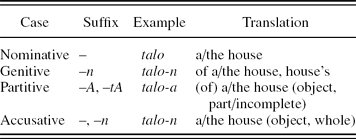
The Finnish case system is usually divided into three types of cases: grammatical cases, locative cases, and marginal cases. Only grammatical cases are discussed here, because they constitute the focus of the present investigation. Table 1 provides a description of the grammatical case forms in Finnish. The forms are shown with singular nouns, consistent with the context in which they were examined in the present study. Because there is no suffix for singular, the case suffixes used with singular nouns appear directly after the noun stem. The cases generally correspond to prepositions or postpositions in Indo-European languages (Karlsson, Reference Karlsson1999, p. 5). The grammatical cases perform important and clearly defined grammatical functions (Sulkala & Karjalainen, Reference Sulkala and Karjalainen1992, p. 208) and are constrained by syntactic factors (Helasvuo, Reference Helasvuo2001, p. 37).
The grammatical cases of Finnish

Nominative case is unmarked in Finnish and generally represents the subject of the sentence. In many instances, the nominative case form is equivalent to the noun stem, given that for many words the nominative form is not modified when the suffix for another case is added. However, in many other instances, the nominative form must be modified to accommodate a suffix for another case, as the examples below illustrate. The genitive usually indicates possession or origin, but it is also used for marking the head of a postposition (Karlsson, Reference Karlsson1999, pp. 91–95). It corresponds to preposition or adjective structures or compound nouns in many European languages. The suffix for genitive singular is always –n, which is added to the noun stem (e.g., talo house-NOM “house”  talo-n, house-GEN “house's”). However, the stem is often modified by consonant gradation (e.g., tyttö, girl-NOM “girl” tytö-n; girl-GEN “girl's”; tehdas, factory-NOM “factory” tehtaa-n, factory-GEN “factory's”).
The partitive case has suffix forms in the singular (–a/–ä, –ta/–tä, –tta/–ttä), which are reduced to two (-a/-ä, -ta/-tä) when preceded by a plural morpheme. The partitive may function as object, subject, or complement (Karlsson, Reference Karlsson1999, pp. 76–79). The nominative and partitive cases are semantically complementary; whereas the nominative expresses a concrete or abstract whole or a definite quantity (e.g., maito, milk-NOM “milk” in Maito on pullossa, “The milk is in the bottle”), the partitive expresses an indefinite or nonlimited quantity (e.g., maito-a, milk-PARTIT “milk” in Pullossa on maito-a, “There is (some) milk in the bottle”).
Probably the most controversial case in the Finnish case system is the accusative case (see for example, Helasvuo, Reference Helasvuo2001, pp. 46–50; Maling, Reference Maling, Holmberg and Nikanne1993; Reime, Reference Reime, Holmberg and Nikanne1993; Toivainen, Reference Toivainen, Holmberg and Nikanne1993). It is actually a collective name given to a certain set of cases that mark direct objects (Karlsson, Reference Karlsson1999, p. 100). The accusative does not have a stable ending, as the suffix can take the form of either –n or –t. In most declarative and interrogative contexts, the form –n is used (e.g., sinä lue-t kirja-n, you read-2SG book-ACC, “you read the book”), which is homophonous with the genitive (Laalo, Reference Laalo, Stephany and Voeikova2009). However, accusative –n and genitive –n are easily distinguishable because they are used in different syntactic contexts (e.g., Helasvuo, Reference Helasvuo2001, p. 38). In this sense, the homophony is comparable to noun plural –s and possessive 's in English, where syntactic context prevents confusion between the two. When used as an imperative or in the passive, the singular form of the accusative may be morphologically unmarked like the nominative (e.g., lue kirja!, read-IMP book, “read the book!”; kirja lue-taan, book read-PASS, “the book is read”). Finally, in plural noun contexts and with certain personal pronouns functioning as the object, the –t accusative ending is used.
The grammatical cases of Finnish differ in their frequency of use. Based on conversational data reported by Helasvuo (Reference Helasvuo2001), nominative case is the most frequent case followed, in order, by partitive, accusative, and genitive cases. In written text, reported by Hakulinen et al. (2004), the order from most to least frequent is nominative, genitive, partitive, and accusative.
THE ACQUISITION OF FINNISH GRAMMATICAL CASES BY TD CHILDREN
Numerous studies have been devoted to the acquisition of case suffixes by TD Finnish-speaking children. Several of these have been single-case studies or studies of a small number of children based on diary data (Laalo, Reference Laalo1997, Reference Laalo1999, Reference Laalo, Stephany and Voeikova2009; Niemi & Niemi, Reference Niemi and Niemi1985; Räisänen, Reference Räisänen1975). Other studies have involved larger numbers of children (Lyytinen, Reference Lyytinen1978; Stolt, Reference Stolt2009; Toivainen, Reference Toivainen1980). According to these studies, the very first form used in the speech of Finnish-speaking children is the inflectionally unmarked nominative singular, although some nouns may be first used in the partitive. These early partitive forms seem to be first learned as unanalyzed wholes, and children use only one form for most words (Laalo, Reference Laalo1997, Reference Laalo1999, Reference Laalo, Stephany and Voeikova2009; Toivainen, Reference Toivainen and Slobin1997). Laalo (Reference Laalo, Stephany and Voeikova2009) has noted that certain words expressed with the partitive serve primary needs of children (e.g., asking for food by using partitive forms such as leipä-ä, bread-PARTIT, “some bread,” and mehu-a, juice-PARTIT, “some juice”). Because of the memorized nature of these forms, the incidence of errors is very low.
The genitive and accusative forms typically emerge around the age of 1 year, 7 months (1;7) to 1;10 and appear to be the first forms to systematically contrast with the early-emerging nominative and partitive forms. The early acquisition of these two grammatical cases has been attributed to their pragmatic importance and formal simplicity (i.e., the suffix –n is a short and stable marker). The relatively early use of these forms is illustrated rather well in a recent study of 35 children by Stolt (Reference Stolt2009). Based on spontaneous speech samples, Stolt found that by age 2 years, 88.6% of children were using partitive forms in at least some contexts, 57.1% were using accusative forms on occasion, and 45.7 % were using genitive forms to some degree. Of course, these figures reflect the case forms that children happened to produce during a speech sample. When the use of these forms was evaluated by parents’ completion of the Finnish Communication Development Inventories (Lyytinen, Reference Lyytinen1999), reflecting the children's use of these forms more generally, the figures were even higher; 34 of the 35 children (97.1%) were reported to be using both the partitive and the genitive forms. (The accusative is not included in the Finnish Communication Development Inventories.)
Although children make relatively few errors in their acquisition of the case system, a few error patterns can be identified. One important issue in the acquisition of the Finnish case system is the mastery of the complex interplay between stem forms and suffixes (Laalo, Reference Laalo, Stephany and Voeikova2009; Toivainen, Reference Toivainen and Slobin1997). For some children, there seems to be a trade-off between concentrating on the suffixes themselves and a focus on the morphophonological alterations of the noun stem that might be required. It is not uncommon to find children produce the correct suffix but produce “quantitative” or “qualitative” errors in the word stem. An example of the former can be seen when the accusative of takki, “coat,” is produced as *takki-n instead of taki-n. An example of the latter occurs when the genitive of noita, “witch,” is produced as *noita-n instead of noida-n. Errors involving the wrong choice of case suffix form (while retaining the correct case) can also occur. For example, the partitive with a plural for kissa, “cat,” might be produced as *kisso-i-ta (cat-PLUR-PARTIT) instead of kisso-j-a (cat-PLUR-PARTIT).
Thus, it can be seen that TD children acquire grammatical case suffixes relatively early, although we are not certain when adultlike levels of use are seen. It is clear that even when children are using the appropriate case, the morphophonological modifications to the stem needed for suffixation may sometimes be incorrect.
NOUN SUFFIX USE IN FINNISH SLI AND RELATED EVIDENCE
Systematic studies of Finnish-speaking children with SLI are rare. To our knowledge, the only study that deals with the use of Finnish noun suffixes is the study by Niemi (Reference Niemi1999). He devised a production task for the partitive plural form for 19 TD children (aged 10 years) and 12 children with SLI (aged 10 to 11 years). Sixty items were used, which included high- and low-frequency nouns and structurally comparable pseudowords. Niemi found that the TD children were much more accurate than the children with SLI. The poor performance on the part of the SLI group was due primarily to their tendency to overgeneralize the more frequent plural partitive suffix. This study is helpful in demonstrating that Finnish-speaking children with SLI may have problems with noun suffix use. However, the case was not manipulated (all items were in partitive case), which suggests the need to examine case suffix use more systematically in Finnish-speaking children with SLI.
Kunnari and colleagues (Reference Kunnari, Savinainen-Makkonen, Leonard, Mäkinen, Tolonen and Luotonen2011) studied the use of verb inflections that mark tense and agreement in 5-year-old Finnish-speaking children with SLI. These children were less accurate in their use of these inflections than both TD same-age peers and TD 3-year-olds. The patterns noted in the children's errors were not compatible with accounts such as the extended optional infinitive account. Although there was no evidence that problems with tense were central to the children's lower accuracy, errors of agreement were quite frequent. The low accuracy of these children and their pattern of errors were generally consistent with a deficit involving agreement. However, the verb inflection data provided no means to assess the relative adequacy of the alternative agreement accounts, namely, the broader grammatical agreement deficit account and the narrower subject–verb agreement deficit account. For the present study on grammatical case suffix use, we recruited the same children seen in the Kunnari et al. study to determine if their problems with agreement extended beyond that of subject–verb agreement to grammatical case.
Although the children with SLI in the Kunnari et al. (Reference Kunnari, Savinainen-Makkonen, Leonard, Mäkinen, Tolonen and Luotonen2011) study showed lower overall percentages of correct use of verb inflections (M = 67%) than both the TD 3-year-olds (M = 89%) and the same-age peers (M = 90%), their use was in keeping with that seen in children with SLI acquiring other languages with a rich inflectional morphology and well above that seen in children with SLI acquiring a language such as English. Leonard (Reference Leonard, Bishop and Leonard2000) has pointed out that there is somewhat of a paradox in that, in every language studied, children with SLI seem to have extraordinary problems with at least certain details of inflectional morphology, yet these children do better in an absolute sense if their language has a larger number of inflections. Leonard attributes this fact to the likelihood that children learning such languages must focus their limited resources on inflectional morphology, because this aspect of grammar is not only frequent but also often provides more reliable information than word order. Accordingly, in the present study, the prediction that Finnish-speaking children with SLI will have greater difficulty with grammatical case suffixes than TD children (as predicted by the grammatical agreement deficit account) is accompanied by the expectation that, in acquiring a language with a rich morphology, these children will nevertheless show considerable use of these forms.
MORPHOPHONOLOGY IN CHILDREN WITH SLI
Because Kunnari et al. (Reference Kunnari, Savinainen-Makkonen, Leonard, Mäkinen, Tolonen and Luotonen2011) focused exclusively on the children's use of the verb inflections of tense and agreement, they selected only those verbs whose stems undergo no morphophonological changes when inflections are added. However, it is possible to distinguish errors in morphophonological alternation from errors in grammatical case. Given the prevalence of morphophonological changes in Finnish case suffix use, we include in the present study both noun stems that undergo morphophonological change when a suffix is added and those that do not.
Problems with morphophonological changes could take one of two forms. First, children could fail to make the change and add the suffix to the nominative form. Second, children might simply select the nominative form to avoid using the modified stem + suffix, either because they find the stem change itself difficult or because the modified stem + suffix combination would pose difficulty for them. There seems to be a precedent for the latter possibility. Marshall and van der Lely (Reference Marshall and van der Lely2006) found that English-speaking children with SLI were less likely to use the past tense –ed inflection when the stem + inflection combination formed a sound pair (e.g., /gd/ in hugged) that did not appear in any monomorphemic word. In contrast, past tense –ed productions were more likely if the stem + inflection combination formed a sound pair that occurred as well in monomorphemic words (e.g., /ft/ appearing in both coughed and soft). The TD comparison children were equally proficient in using past tense –ed with both types of sound pairs.
The main goal of the present study was to assess the adequacy of the broader grammatical agreement deficit account of SLI by determining if Finnish-speaking children with SLI would be weaker in grammatical case use than younger or same-age TD children. Differences favoring the two TD groups would be consistent with the broader grammatical agreement deficit account. A second goal was to determine whether problems with the morphophonological changes involved in noun case suffix use would accompany weaknesses in expressing grammatical case.
METHOD
Participants
A total of 45 monolingual Finnish-speaking children participated in the study, 15 in each of three groups. These children had served as participants in the Kunnari et al. (Reference Kunnari, Savinainen-Makkonen, Leonard, Mäkinen, Tolonen and Luotonen2011) study of verb inflection use described earlier. Six children from the Kunnari et al. study (two from each group) did not participate in the present study. All children came from comparable socioeconomic backgrounds. The first group consisted of children with SLI (10 boys, 5 girls, M age = 5;2, range = 4;0–6;6) recruited from the area of the Northern Ostrobothnia Hospital District in Finland. The ethical committee of this hospital district approved the study. The age range of 4;0 to 6;6 was selected because it constitutes the age range in which morphosyntactic deficits are well documented in children with SLI across languages (Leonard, Reference Leonard1998, Reference Leonard and Schwartz2009). Although children in Finland are seen regularly in well-baby clinics from birth until school age, 4 years is the approximate age at which a diagnosis of language impairment is first made.
All children met the criteria for SLI. Each child scored above 85 on a measure of nonverbal intelligence, the Wechsler Preschool and Primary Scale of Intelligence—Revised (Wechsler, Reference Wechsler1995), passed both a hearing screening (20 dB at 250, 500, 1000, 2000, 4000, and 6000 Hz) and an oral–motor examination, had no evidence of frank neurological dysfunction or impaired social interactions, and had no history of chronic otitis media. Furthermore, each of these children scored at least 1.25 SD below chronological age level (M standard score = 62.53, SD = 9.35) on a test of expressive language, the Finnish standardization of the Reynell III (Edwards et al., Reference Edwards, Fletcher, Garman, Hughes, Letts and Sinka1997). Based on preliminary data for the Finnish adaptation of the Peabody Picture Vocabulary Test (PPVT; Dunn & Dunn, Reference Dunn and Dunn1981), the children scored at least 1 SD below the mean for their age. Based on a 100-utterance spontaneous speech sample, the children's MLUs in words averaged 3.02 (SD = 0.82) and their MLUs in morphemes averaged 4.23 (SD = 1.24). All children demonstrated the ability to produce, with at least 80% accuracy, all of the speech sounds required for the grammatical suffixes under investigation. The minimum accuracy level of 80% was based on previous research on grammatical morpheme use by children with SLI (e.g., Leonard, Eyer, Bedore, & Grela, Reference Leonard, Eyer, Bedore and Grela1997). Finally, we also verified that the children were able to produce words that matched in length the suffixed nouns under investigation.
The remaining two groups participating in this study were TD children. These children were recruited from eight day nurseries, and permission to study them was received from the head of the Day-Care and Family Work Unit of the City of Oulu. All children were reported to be developing in a typical fashion according to parental and teacher report. Fifteen TD children (8 boys, 7 girls, M age = 5;2, range = 4;1 to 6;3) served as the age control group (TD-A group). The age of each participant in this group was within 3 months of age of a child in the SLI group. These children's standard scores on the Finnish standardization of the Reynell III averaged 101.20 (SD = 14.87). Their MLUs in words averaged 3.72 (SD = 0.80), and their MLUs in morphemes averaged 5.40 (SD = 1.16), based on a 100-utterance sample of spontaneous speech. All children scored within 1 SD of their age based on the preliminary data for the Finnish adaptation of the PPVT.
The remaining 15 children were younger TD children (TD-Y group; 9 boys, 6 girls, M age = 3;8, range = 3;5 to 3;11). They scored within normal limits on the Finnish standardization of the Reynell III (M = 96.64, SD = 8.49) and within 1 SD of the mean for their age based on the preliminary data for the Finnish adaptation of the PPVT. Their MLUs averaged 3.51 (SD = 0.66) and 5.08 (SD = 0.97) in words and morphemes, respectively, based on a 100-utterance sample of spontaneous speech. The use of younger TD children was designed to detect whether the difficulties experienced by the children with SLI with noun case suffix use resembled the developmental patterns seen in younger children. As noted below, 10 of the TD-Y children were close MLU matches for 10 children with SLI, allowing us to compare children with SLI to a subset of younger TD children who produced sentences of the same length as the children with SLI.
Procedures
The children's use of the case suffixes was assessed through specifically designed probe tasks. Three case forms were examined: the partitive, the accusative, and the genitive. There were 12 items that assessed the children's use of the partitive with singular nouns, 12 items that examined the genitive with singular nouns, and 10 items that evaluated the use of the accusative with singular nouns, creating a total of 34 items. (An administrative error led to the unintended selection of 10 rather than the intended 12 items for accusative case.) The nouns selected for the items were familiar to children from 3 years of age and beyond according to the Finnish Communication Development Inventories and Kunnari (Reference Kunnari2000). Four words each in the partitive and accusative tasks and 6 words in the genitive task required a morphophonological change. Word length (the stem plus suffix) in the probe nouns varied from two to four syllables.
Two types of prompts were used for assessing inflections: computer-presented animations and a set of drawings depicting objects (Mayer–Johnson/Comp-Aid, 2006). The use of animations allowed us to devise obligatory contexts for particular suffixes that are very difficult to create with drawings. For each probe item, the examiner asked a question or made a request that, in conjunction with the animation or drawing, created an obligatory context for the suffix of interest. The separate grammatical contexts associated with accusative and genitive case, and utilized in the present study, made it highly unlikely that the children's use of the suffix –n would be an attempt to use an accusative suffix in a genitive context or vice versa. Pilot testing with four TD children from age 4;3 to 6;3 was used to ensure that the nouns selected for the probes were familiar to children and that the task did yield productions of the target forms. The animations and drawings accompanied by the questions and requests yielded reliable response attempts; therefore, practice items were not employed. Appendix A provides examples of the probes used for each case type. Four alternative orders of presentation were created and employed for each of the participant groups. Administration of the accusative and partitive items required approximately 3 min; approximately 5 min were required for the genitive items. The children responded readily, and no problems of attention were detected during the administration of the items.
Scoring and reliability
All probe sessions were audio- and videorecorded and transcribed orthographically. For all of the items of each probe, the presence of obligatory contexts of the case suffix of interest was noted. If a child provided a noun that was different from the one targeted (e.g., lady's instead of woman's), that response was considered scorable if the noun was relevant to the situation. Items for which the child gave no response or produced a response unrelated to the item were deemed unscorable and excluded from further analysis. Although children were very receptive to the tasks, unscorable responses sometimes occurred and were more likely to come from the SLI group; 6%, 3%, and 11% of these children's responses to accusative, partitive, and genitive items, respectively, were unscorable, whereas only 1% of the responses of both the TD-A and TD-Y children were unscorable for each of these item types. For each scorable response, the accuracy of the case suffix was coded.
Productions that were accurate in both the choice of case and the form of the stem were scored as correct. We also examined all errors and performed separate analyses of productions that showed incorrect case and productions that contained the appropriate case suffix but reflected an error in the formation of the stem.
Both intra- and interjudge reliability of scoring was assessed using the responses of three children in each group selected randomly. Intrajudge scoring agreement for the probes was 92.2% for the SLI group, 100.0% for the TD-A group, and 97.2% for the TD-Y group across the three case types. Interjudge reliability was 85.9% for the SLI group, 98.2% for the TD-A group, and 97.0% for the TD-Y group.
RESULTS
Accuracy
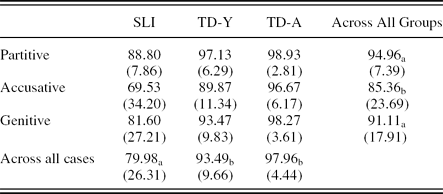
A summary of the children's accuracy appears in Table 2. Accuracy was examined through a mixed model analysis of variance (ANOVA) with participant group (SLI, TD-A, TD-Y) as a between-subjects variable and type of case (partitive, accusative, genitive) as a within-subjects variable. Arc sine transformations of the percentage correct data were employed to meet ANOVA assumptions of homogeneity of variance and normal distribution. ANOVA effect sizes were computed using partial eta squared and effect sizes for significant differences between specific groups or cases were computed using Cohen d. Following Cohen (Reference Cohen1988), d values of 0.2, 0.5, and 0.8 were regarded as small, medium, and large effect sizes, respectively. A significant main effect was found for participant group, F (2, 42) = 15.19, p < .001, partial η2 = 0.420. Least significant difference testing indicated that the children with SLI were less accurate than both the TD-A (p < .001, d = 1.235) and the TD-Y (p < .001, d = 0.757) children. A main effect for type of case was also observed, F (2, 84) = 4.53, p = .014, partial η2 = 0.097. Least significant difference testing revealed that the children's accuracy on accusative case items was significantly lower than on both partitive (p = .004, d = 0.511) and genitive (p = .049, d = 0.308) case items. Partitive and genitive items did not differ in accuracy (p = .342). There was no Participant Group × Type of Case interaction, F (4, 84) = 0.48, p = .750, partial η2 = 0.022.
The children's mean (standard deviation) percentages correct for partitive, accusative, and genitive case items
Note: Means in the same row or column with different subscripts are significantly different from each other. Comparisons apply only to main effects, because the interaction was not significant. SLI, specific language impairment; TD-Y, younger typically developing; TD-A, typically developing age control group.
Errors of grammatical case and morphophonology
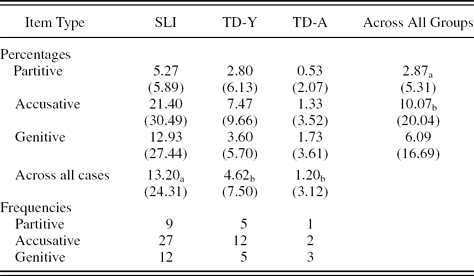
Along with accuracy, we examined the types of error committed in the children's inaccurate productions. The first analysis of errors pertained to errors of case; the second analysis dealt with morphophonological errors, that is, errors with correct case but an inappropriate form of the noun stem. It should be noted that we found no errors in which both the case and the stem form were incorrect. A summary of the findings for case errors appears in Table 3. Again, a mixed model ANOVA was employed, with arc sine transformations of the percentage of scorable productions that constituted case errors. Participant group showed a significant main effect, F (2, 42) = 3.33, p = .045, partial η2 = 0.137. The children with SLI had a significantly larger percentage of responses with case errors than did the TD-A children (p = .018, d = 0.599), but the difference between the children with SLI and the TD-Y children was only marginally significant (p = .065, d = 0.452). A main effect was also found for suffix type, F (2, 84) = 3.86, p = .025, partial η2 = 0.084, with accusative errors significantly higher in percentage than partitive errors (p = .007, d = 0.449). However, differences were not seen between accusative and genitive errors (p = .180) or between genitive and partitive errors (p = .157). No Participant Group × Suffix Type interaction was seen, F (4, 84) = 1.94, p = .111, partial η2 = 0.085.
The mean (standard deviation) percentages of productions constituting case errors and frequency of case errors for partitive, accusative, and genitive case items
Note: Mean percentages in the same row or column with different subscripts are significantly different from each other. Means with no subscript do not differ from the remaining means. Comparisons apply to main effects only, because the interaction was not significant. SLI, specific language impairment; TD-Y, younger typically developing; TD-A, typically developing age control group.
For the children with SLI, the most frequent substitute was the production of a nominative form, which, as noted earlier, has no overt suffix. Nominative forms were the most frequent substitute for accusative, partitive, and genitive items. Examples include nominative takki, “coat,” for accusative taki-n, nominative ovi, “door,” for accusative ove-n, and nominative lapsi, “child,” for genitive lapse-n. Partitive forms were also used as a substitute for accusative items. For example, the partitive form takki-a, “coat,” sometimes replaced the accusative form taki-n, and the partitive form ove-a, “door,” occasionally substituted for the accusative form ove-n. Nominative forms were also used as a substitute by the TD-Y children. However, for these children, nominative forms were the most frequent substitute only for genitive items, as in nominative joulupukki, “Santa Claus,” for genitive joulupuki-n. For partitive items, accusative forms were the most frequent substitute, and for accusative items, partitive forms were the most frequent substitute.
It is important to note that although nominative forms do not have a suffix, it is difficult to describe productions of a nominative in some of these other contexts as an omission of a suffix. Note that in the examples above, the children produced ovi for ove-n and lapsi for lapse-n. If only an omission of a suffix was involved, these errant productions would be expected to take the form of *ove and *lapse, respectively.
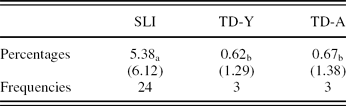
The second type of analysis of children's errors dealt with use of the correct case suffix but an inappropriate form of the stem. Given that only 14 of the 34 items required morphophonological alterations when using the appropriate suffix (no more than half of the items in each of the three conditions), the three participant groups' errors of this type were compared by collapsing the data across the three cases. A summary of the findings is provided in Table 4. Using arc sine transformations of the percentage data, a group difference was found, F (2, 42) = 8.17, p = .001, partial η2 = 0.280, with the children with SLI showing a higher percentage of responses with these morphophonological errors than both the TD-A children (p = .001, d = 1.060) and the TD-Y children (p = .001, d = 1.073). The TD-A and TD-Y children were very similar in their use of these errors (p = .974).
The mean (standard deviation) percentages of productions constituting morphophonological errors with correct case and frequency of morphophonological errors for the three groups of children
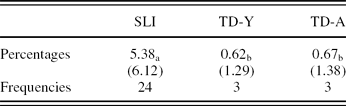
Note: Means with different subscripts are significantly different from each other. SLI, specific language impairment; TD-Y, younger typically developing; TD-A, typically developing age control group.
All morphophonological errors were cases in which the children failed to change the noun stem to accommodate the case suffix. In some instances, the children neglected to make the “quantitative” consonant change. For example, although the nominative form for “coat” is takki, the correct accusative form is taki-n. Instead, some children added the correct accusative suffix without altering the consonant quantity in the stem, resulting in *takki-n. Other errors might be regarded as a failure to make a “qualitative” consonant change. For example, the nominative form of “witch” is noita and the correct genitive form is noida-n. However, some children produced the correct genitive suffix without changing the consonant in the stem, leading to the production *noita-n. Finally, there were cases in which the nominative stem form was retained instead of altering the final vowel in the stem. For example, whereas the correct accusative form of “door” is ove-n, some children employed the vowel of the nominative while adding the correct accusative suffix, resulting in *ovi-n. Failures to make all of these types of changes were seen in the responses of the children with SLI. The TD-A and TD-Y children, in contrast, made very few morphophonological errors of any type, as is clear from Table 4.
Thus far, we have discussed overt morphophonological errors. However, as noted earlier, it is possible that children could avoid a morphophonological change in the stem by simply using the nominative form instead. Thus, what is technically a case error might have been motivated by avoidance based on morphophonology. To explore this possibility, we compared the nominative substitutions made by the children with SLI in items requiring a morphophonological change in the stem to accommodate the suffix (as in ovi replacing the correct form ove-n, “door”) with the nominative substitutions made in items not requiring such a change in the stem (as in auto replacing the correct form auto-n, “car”). We found that the tendency for nominative substitutions was the same across both item types. Thus, it would seem that although the children with SLI committed overt morphophonological errors, there is no evidence that they were trying to avoid morphophonological changes by selecting the simpler nominative form.
An inspection of the SLI data revealed that errors of case and errors of morphophonology did not always come from the same children. Five children with SLI made errors of case only, two committed errors of morphophonology only, and the remaining eight made errors of both types.
Do case suffixes pose disproportionate difficulty for children with SLI?
The children with SLI were significantly less accurate on our task than the TD-Y children even though they were 18 months older on average. This finding certainly suggests a weakness on the part of the children with SLI. However, such a finding does not indicate the degree to which noun suffix difficulty was part of the children's more general language deficit or instead represented a weakness that exceeded the children's problems in other areas of language. We addressed this issue in part by selecting 10 children from the TD-Y group whose MLUs in words formed very close matches with 10 of the children with SLI.
For this comparison, each of the 10 children in the TD-Y group had an MLU that was within 0.2 words of the MLU of a child in the SLI group. These MLUs, based on 100-utterance spontaneous speech samples, ranged from 3.02 to 4.65 (M = 3.505, SD = 0.475) for the 10 children with SLI and from 3.01 to 4.75 (M = 3.515, SD = 0.475) for the 10 TD-Y children. MLU in words was used rather than MLU in morphemes because the latter is highly influenced by suffix use (which is abundant in Finnish) and thus matching according to this measure could have served to reduce the magnitude of the differences in noun suffix use that actually existed between the two groups. However, it proved to be the case that the two groups of 10 children were also similar when their MLUs computed in morphemes were compared, t (18) = 0.49, p = .632. This p value exceeds .50, the value recommended as a minimum for matching two groups (Mervis & Robinson, Reference Mervis and Robinson1999). For the 10 children with SLI, MLUs in morphemes averaged 4.97 (SD = 0.67); for the 10 TD-Y children, MLUs in morphemes averaged 5.13 (SD = 0.83).
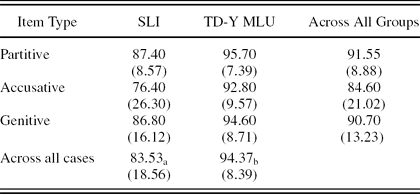
Arc sine transformations of the children's percentages of correct noun suffix use were examined using an ANOVA with participant group (SLI, TD MLU matches) as a between-subjects variable and type of case (partitive, accusative, genitive) as a within-subjects variable. A summary of the findings can be seen in Table 5. A significant main effect was seen for participant group, F (1, 18) = 5.89, p = .026, partial η2 = 0.246, indicating that the children with SLI were significantly less accurate in their use of noun suffixes than were the younger MLU-matched TD children. This finding suggests that when the children with SLI could produce utterances of the same length as those of the younger TD children, the children with SLI were nevertheless weaker in their use of the noun case suffixes. Neither the main effect for type of case, F (2, 36) = 1.05, p = .361, partial η2 = 0.055, nor the interaction between participant group and type of case, F (2, 36) = 0.24, p = .792, partial η2 = 0.013, was significant.
The mean (standard deviation) percentages correct for partitive, accusative, and genitive case items
Note: Means in the same row with different subscripts are significantly different from each other. Comparisons apply to the main effect for participant group only, because neither the main effect for type of case nor the interaction was significant. SLI, specific language impairment; TD-Y MLU, younger typically developing children matched according to mean length of utterance.
DISCUSSION
The children with SLI were significantly less accurate than both TD-A and TD-Y children in the grammatical case suffix task employed in this study. They produced more responses constituting errors of case, and they also produced a greater number of responses that represented errors of a morphophonological nature. When comparisons were confined to children with SLI and TD-Y children with very similar MLUs, the finding of lower accuracy for the SLI group persisted.
Before discussing the implications of these findings, we acknowledge one limitation of the study. The rich morphology of Finnish led us to expect that the absolute accuracy levels of the children with SLI would be somewhat high, as noted in the Introduction. That group differences were readily detected despite the advantages of a rich morphology is important because it shows that problems are not limited to languages with a sparse morphology where suffixes might play a less central role. However, the rather high accuracy levels seen in the SLI data suggest that these children's problems might have been subtle. Alternatively, it is possible that our tasks were not tapping the children's grammatical case abilities at a very deep level. Perhaps tasks requiring a stronger grasp of case suffix use might have yielded lower scores and an even greater difference between the children with SLI and the two TD groups.
Nevertheless, the differences that were observed allow us to address the two questions of this investigation: whether children with SLI have deficits that extend beyond subject–verb agreement to include problems with grammatical case, thus supporting the broader grammatical agreement deficit account; and whether weaknesses in morphophonology are seen in addition to grammatical case difficulties.
Do weaknesses in grammatical case suffix use constitute support for the grammatical agreement deficit account?
The Kunnari et al. (Reference Kunnari, Savinainen-Makkonen, Leonard, Mäkinen, Tolonen and Luotonen2011) study of verb inflection use by the same Finnish-speaking children studied here produced results consistent with both the broader grammatical agreement deficit account and the narrower subject–verb agreement deficit account. However, our finding in the present study that weaknesses were also seen in grammatical case suffix use, which are morphemes that are independent of subject–verb agreement, would seem to suggest that the children's agreement deficits extended beyond subject–verb agreement. Our examination of the errors committed by the children provided additional support for this view. Errors specific to case (e.g., nominative replacing genitive and partitive replacing accusative) were much more likely to come from the children with SLI.
However, an alternative interpretation of the data should be acknowledged. The children with SLI might have differed from the TD groups because of a significant but broad-based language deficit rather than because they had problems with grammatical agreement in particular. Consider the evidence that is compatible with such a view. The experimental measures used in the present study and the study of Kunnari et al. (Reference Kunnari, Savinainen-Makkonen, Leonard, Mäkinen, Tolonen and Luotonen2011) with the same children did not include any measures that were unrelated to grammatical agreement. Therefore, the boundaries of the children's significant weaknesses in language are difficult to discern.
However, one piece of evidence from the present study can be used to argue that some details of language were weaker than others in the children with SLI. Recall that we compared subgroups of 10 children with SLI and 10 TD-Y children who were well matched according to MLU. The children with SLI were significantly less accurate than these younger MLU-matched children in using the case suffixes. Differences of this type are often characterized as evidence for “extraordinary” problems in a particular area of language (e.g., Leonard, Reference Leonard1998) because the differences are seen between two groups who were selected to be similar in some other language ability. Furthermore, when two groups are matched according to MLU, there is no reason to believe that output limitations were responsible for the weaker abilities seen in the children with SLI. We do not claim that the language deficits of the children with SLI were limited to difficulties with grammatical agreement. This account, like others that deal with grammatical deficits in SLI, acknowledges that other problems in language are present in these children. However, the finding from the comparison employing MLU matching does suggest that these children's weaknesses in the use of grammatical agreement go beyond their below age level abilities with regard to sentence length.
Along with being less accurate than the TD groups, the children with SLI seemed to differ in certain respects in the nature of their case errors. For the children with SLI, errors on accusative case items were most often productions of the basic nominative case form. In contrast, although the TD-Y children sometimes used a nominative in place of an accusative case form, they were more likely to produce a partitive form as a substitute for the accusative. This type of substitution is not surprising, given that both partitive and accusative suffixes are used to mark direct objects. The partitive is viewed as the “strongest” direct object case in Finnish (Karlsson, Reference Karlsson1999, p.101), because it is used for the direct object in a wider range of circumstances, such as when the direct object is indefinite, when the action does not have a clear end result, and when the sentence is negative, among others. It is also interesting to view these different substitution patterns from the standpoint of the frequency of occurrence of these case forms in Finnish. Recall that nominative forms are more frequent in Finnish than partitive forms, which in turn are more frequent than accusative forms. It appears that the children with SLI often selected the most frequent form of all (a nominative) as a substitute whereas the TD-Y children selected a more frequent form (a partitive) that overlapped with the accusative in grammatical function.
The relatively high incidences of errors involving nominative for accusative forms by the children with SLI do not appear to constitute omissions, that is, failed attempts to articulate the accusative suffix. Earlier, we noted that the nominative forms produced, such as ovi, “door,” differ in segmental details from the stem required for the accusative suffix; therefore, a true omission of the suffix in accusative ove-n would be *ove.
Although unlikely, there is another possible explanation for apparent productions of the nominative form in place of the accusative. Recall that, in select contexts, the accusative has no overt case suffix, that is, it is identical to the nominative case form. These contexts are imperatives and passive forms, and thus quite unlike the contexts in which accusative case was assessed in our task. Nevertheless, it is possible that when a nominative form seemed to be used as a substitute, the children were intending instead to express accusative case but were simply less familiar with the specific contexts in which the stem form variant could be employed. If this were true, the errors could be viewed as the selection of the incorrect accusative form rather than an error of case.
We think this explanation is quite unlikely for three reasons. First, the TD-Y children were more likely to produce partitive forms in place of accusative forms; only occasionally did they produce a nominative in accusative case contexts. This would suggest that the TD-Y children were more likely than the children with SLI to select the incorrect case. That is, following this scenario, the dominant error of the children with SLI would involve selecting the appropriate accusative case but choosing the wrong accusative case variant (the one identical to the nominative form), whereas the TD-Y children's dominant error would involve selecting the incorrect case (the partitive).
Second, the most frequent errors on partitive and genitive case items by the children with SLI were also nominative form productions. It does not seem parsimonious to assume that nominative-appearing productions on accusative case items were actually stem-only variants of the accusative, whereas they were actual nominative case productions on partitive and genitive case items.
Third, in the study of Hungarian-speaking children with SLI by Lukács et al. (Reference Lukács, Leonard and Kas2010) described earlier, the children with SLI showed frequent productions of stem-only forms on accusative case items. As in Finnish, the stem only serves as a nominative case form in Hungarian, but, unlike Finnish, Hungarian has no stem-only variant for accusative case. Therefore, productions of this type in Hungarian cannot be interpreted as the child's intention to express accusative case.
We believe a more plausible interpretation of the overuse of nominative forms by the SLI group is that the children were less proficient than their TD peers and simply selected a common, familiar, and phonologically simpler form of the noun in cases of uncertainty. Earlier we noted that in both conversational data and written text, nominative case forms are the most frequent in Finnish, and their stem-only nature renders them less complex than other forms. These characteristics would make them suitable forms to use as a type of default. This treatment of the nominative form as a default allows for the possibility that this form had no case status in the children's grammars, at least when used as a substitute. Thus, our use of the term “nominative form” can be interpreted to mean a stem that is physically identical to a noun with nominative case. We do not claim that partitive or genitive case is necessarily replaced by nominative case in these instances of stem-only substitutions.
Are difficulties with noun morphology limited to problems with grammatical case?
A second finding of the present study was that the children with SLI produced a larger number of responses that represented morphophonological errors than did the TD-Y and TD-A children. These were productions that reflected the appropriate case. However, the children failed to change the vowel or the consonant from the nominative form to the form required when a suffix was added. For example, the accusative form for the nominative ovi, “door,” should be ove-n but was sometimes produced as *ovi-n, a failure to change the vowel. The accusative form of the nominative takki, “coat,” should be taki-n but was sometimes produced as *takki-n, a quantitative error of consonant gradation. That significant differences were seen between the children with SLI and the two TD groups is noteworthy considering that only 14 of the 34 test items involved morphophonological alterations when using the noun stem with a case suffix.
Our finding that the children with SLI had more difficulty than younger TD children with the morphophonological requirements of case suffix use resembles a previous finding by Lukács, Leonard, Kas, and Pléh (Reference Lukács, Leonard, Kas and Pléh2009) for Hungarian-speaking children with SLI. These investigators found that children with SLI were less accurate than younger control children in using verb inflections. However, the differences between these groups became even larger when the children's productions were also scored for accuracy in making the morphophonological changes in the stem needed for inflection use.
Evidence from Hebrew-speaking children with SLI also seems to provide supportive evidence that morphophonology can be problematic in SLI. Dromi, Leonard, Adam, and Zadunaisky-Erlich (Reference Dromi, Leonard, Adam and Zadunaisky-Erlich1999) found that Hebrew-speaking children with SLI had difficulties with “binyanim,” which are the phonological templates within which consonantal roots are placed to form words. Often the same root changes meaning slightly depending on the template. For example, the root g-d-l in one template, as in godel, means “grows,” whereas the same root in another template, as in megadel, changes the meaning to the transitive “grows something.” Dromi et al. (Reference Dromi, Leonard, Adam and Zadunaisky-Erlich1999) observed that children with SLI were much more likely than younger TD children to select a verb with the correct tense and agreement but make errors that approximated a different template. In some instances, the resulting production did not correspond to an existing word, as when mitlabeshet, “she gets dressed,” was produced as *melabeshet, a form that resembles another template but is not used for this consonantal root.
Earlier it was noted that errors in morphophonology and errors in grammatical case were not always seen in the same children. Although eight children with SLI made both types of error, the remaining children made only one of the two types of error. This raises the possibility that the two types of errors have different sources. This seems very plausible given recent studies indicating that there are at least two heritable yet separable types of deficits associated with SLI (Bishop, Adams, & Norbury, Reference Bishop, Adams and Norbury2006). Future research should be devoted to uncovering the basis for difficulties with morphophonological alternation to determine whether the problem reflects a more general phonotactic weakness or is instead a problem strictly tied to the process of altering stems to accommodate a suffix.
Whatever the source of the problem, the presence of these morphophonological difficulties has implications for the study of grammatical deficits in SLI. Measures of children's accuracy in producing adultlike forms may not always provide a clear picture of the children's grammatical abilities. In the present study, it was necessary to isolate errors of grammatical case from errors that were failures to modify the stem when the correct case suffix was attached. Only the first of these seems to reflect a weakness in the domain of grammar.
In summary, the Finnish-speaking children with SLI exhibited difficulties in the use of grammatical case suffixes. Lower accuracy was seen even when the children with SLI were compared to younger TD children matched for MLU. These findings suggest that the children's problems with agreement extended beyond subject–verb agreement and therefore seem consistent with the broader grammatical agreement deficit proposed by Clahsen (Reference Clahsen1989, Reference Clahsen1991, Reference Clahsen, Ritchie and Bhatia1999). The children with SLI relied to a greater extent than their TD peers on using the nominative form, which is a more frequent and less complex form in Finnish. The choice of this form as a substitute further supports the children's lack of facility with grammatical case. However, problems were not limited to case; the children with SLI were also more likely to inappropriately leave the stem unaltered when attaching a suffix. Although discovery of the basis for this type of error must await future research, it is important in the meantime that studies of deficits in SLI separate errors that are more clearly grammatical in nature from those, such as errors of morphophonology, that might have a different source.
APPENDIX A
Examples of probe items
ACKNOWLEDGMENTS
The research reported here was supported by Grant R01 DC00458 from the National Institute on Deafness and Other Communication Disorders, National Institutes of Health (to L.B.L.) and by the Academy of Finland (to S.K.). The authors thank the children and their families for participating in the project.