Introduction
Violence in family and other intimate relationships is preventable. There is a renewed focus on primary prevention through population-wide public awareness and education campaigns in Australia to reduce high levels of domestic violence. A national evidence-based primary prevention framework titled Change the Story (Our Watch, 2015a) acknowledges that ‘An Australia free of violence against women and their children is an Australia where women are not only safe, but respected, valued and treated as equals in private and public life’ (p. 1). As an outcome of The National Plan to Reduce Violence Against Women and their Children 2010–2022 (Australian Government, 2016), this framework sets out a coordinated national approach to respectful relationships education strategies with young people, and features a whole of school and community approach. The National Plan to Reduce Violence Against Women and their Children 2010–2022 (Australian Government, 2016) and State reports, such as the Special Task Force on Domestic Violence Queensland (2015), recognise that young people are a major part of the solution when tackling violence in relationships. There has recently been an encouraging shift in focus from directing interventions at young people to engaging with young people on these issues.
There is an international movement that promotes the resourcing of young people as agents of positive change, not simply the targets on major social issues (United Nations Children's Fund [UNCF], 2012). This movement to engage young people in positive social change programmes is consistent with Article 12 of the United Nations Convention on the Rights of the Child which states that ‘. . .children have the right to participate in decision-making processes that may be relevant in their lives and to influence decisions taken in their regard—within the family, the school or the community’ (UNICEF, 2006, p.1). The benefits to youth wellbeing and social development arising from active participation in social change are widely recognised (Harris, Wyn, & Younes, Reference Harris, Wyn and Younes2007; Maddaleno & Breinbauer, Reference Maddaleno and Breinbauer2005; Restless Development, 2016; UNCF, 2012; Wong, Zimmerman, & Parker, Reference Wong, Zimmerman and Parker2010). As such, there appears to be value in applying youth participation models to domestic violence prevention.
Effective youth participation strategies are considered to be those in which young people initiate or share decision making and responsibility with adults (Tiffany, Exner-Cortens, & Eckenrode, Reference Tiffany, Exner-Cortens and Eckenrode2012; Wong et al., Reference Wong, Zimmerman and Parker2010; Zeldin, Krauss, Collura, Lucchesi, & Sulaiman, Reference Zeldin, Krauss, Collura, Lucchesi and Sulaiman2014). Models and guiding principles of youth participation have been developed to promote youth empowerment. Researchers and practitioners in the youth field do not generally promote one approach as superior to another, but support principles that guide, rather than prescribe, good practice. It is argued that children and adolescents ‘cannot be expected to carry the full burden of empowering themselves and their communities. Adults ought to share in this responsibility’ (Wong et al., Reference Wong, Zimmerman and Parker2010, p.105). Similarly, Zeldin et al. (Reference Zeldin, Krauss, Collura, Lucchesi and Sulaiman2014) conclude that ‘Youth-adult partnership . . . derives its influence when adults have the willingness and ability to share power, while concurrently preparing youth through scaffolding, mentoring and direct instruction’ (p. 338). Two exemplar models of active youth participation in Australia – the Australian Youth Climate Co-alition (http://www.aycc.org.au) and the anti-poverty movement, Oaktree (http://www.oaktree.org.au) – were useful in guiding the model adopted by R4Respect, which is the subject of this study. Both models are led by young people, but Oaktree engages adults in governance and administrative roles.
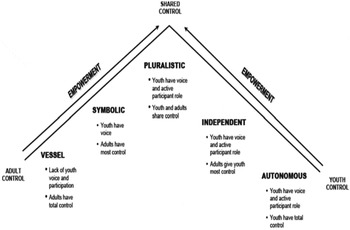
The participation of young people in youth engagement models can range from manipulation of young people by adults and tokenistic input; the provision of advice (a youth advisory model); joint participation (an adult–youth partnership), or can be youth led with young people taking responsibility for all aspects of the programme (Wong et al., Reference Wong, Zimmerman and Parker2010). A Typology of Youth Participation and Empowerment (TYPE) pyramid developed by Wong et al. (Reference Wong, Zimmerman and Parker2010) illustrates five types of youth participation within an empowerment theoretical framework (see Figure 1). Within the TYPE model, it is possible for a strategy to include a combination of youth participation methods, ranging from adult control in which young people are vessels of adult direction, through to more autonomy and control by young people.
The TYPE pyramid (Insert p.4). Source: Wong et al. (Reference Wong, Zimmerman and Parker2010).

In order to achieve best practice in youth participation, the United Nations (2005) recommended the following:
provide adequate funding, introduce innovative ways to spread information, furnish training to facilitate intergenerational collaboration, and create organizational structures that welcome new voices. . .Efforts should be undertaken to foster intergenerational relationships and strengthen the capacity of young people to participate meaningfully and equally with other generations in programs and activities that affect them (pp. 72–73).
In consultation with Australian youth organisations, Seymour (Reference Seymour2012) developed a practice guide to inform inclusive and ethical youth development models. The six principles that underpin this guide are as follows:
-
• Learning and development of young people via planned training and mentoring.
-
• Leadership and decision making that recognises the views of young people and develops their expertise.
-
• An inclusive ethos that values and fosters diversity.
-
• Community service in which young people make a valuable contribution to the wellbeing of others.
-
• Partnerships and social networks that young people help to build and nurture.
-
• Ethical promotion and safety of young people formalised in programme policies.
The quality and effectiveness of youth participation is influenced by the principles, values and relationships within the models being applied (Seymour, Reference Seymour2012; Wong et al., Reference Wong, Zimmerman and Parker2010; Zeldin et al., Reference Zeldin, Krauss, Collura, Lucchesi and Sulaiman2014). The structural elements of programmes are also important, such as supportive adult facilitators, capacity building of young people, clear roles, inviting space, safety, financial support and giving a voice to young people in programme decision making (Tiffany et al., Reference Tiffany, Exner-Cortens and Eckenrode2012; Walker, Pereznieto, Bergh, & Smith, Reference Walker, Pereznieto, Bergh and Smith2014). While studies report various benefits and challenges with youth participation (Campbell & Robards, Reference Campbell and Robards2013; Denison et al., Reference Denison, Tsui, Bratt, Torpey, Weaver and Kabaso2012; Valente, Ritt-Olson, Stacy, Unger, & Okamoto, Reference Valente, Ritt-Olson, Stacy, Unger and Okamoto2007), there is a lack of evidence-based measures of youth participation models and the outcomes they achieve (Tiffany et al., Reference Tiffany, Exner-Cortens and Eckenrode2012; Zeldin et al., Reference Zeldin, Krauss, Collura, Lucchesi and Sulaiman2014). Campbell and Robards (Reference Campbell and Robards2013) reported that health promotion and help-seeking messages were most effective when directed to young people in ways they were more likely to relate to, especially when the young people themselves were engaged in promoting the messages. Peer-led interventions have been used to reach and influence young people in ways that differ from teacher-led interventions. In working to promote HIV awareness and safe sex practices among young people in developing nations, Denison et al. (Reference Denison, Tsui, Bratt, Torpey, Weaver and Kabaso2012) found that peer-to-peer discussions were effective. Similarly, Valente et al. (Reference Valente, Ritt-Olson, Stacy, Unger and Okamoto2007) found benefits in promoting information on substance abuse when social networks among young peers were activated. Moreover, approaches that feature active youth participation were beneficial when young people as advocates attracted media attention and sympathy, which can contribute to policy change (Delgado & Staples, Reference Delgado and Staples2008). While scholarly research are under-developed, it indicates that peer-to-peer approaches in public health promotion are worth pursuing and requires ongoing evaluation.
There are, however, challenges with recruiting, mentoring and sustaining the involvement of young people in a manner that goes beyond tokenism (Denison et al., Reference Denison, Tsui, Bratt, Torpey, Weaver and Kabaso2012; UNCF, 2012). Some claim that many adults do not have the necessary skills or the confidence in young people to share decision making with them, and societal norms and institutional structures are not commonly designed to support adult–youth partnerships (Walker et al., Reference Walker, Pereznieto, Bergh and Smith2014; Zeldin et al., Reference Zeldin, Krauss, Collura, Lucchesi and Sulaiman2014). Walker et al. (Reference Walker, Pereznieto, Bergh and Smith2014) reported that one of the primary obstacles for many adults is their view that ‘. . .young people [are] “incomplete”, immature, with no proposals or analytical capacity to contribute based on their life experiences in topics that affect them’ (p. 8). They also highlighted the need to provide financial assistance as a way of sustaining young people in programmes; the need to build individual capacities and create spaces that encourage young people; and the need to manage gender dynamics so that gender equality is fostered (Walker et al., Reference Walker, Pereznieto, Bergh and Smith2014). To overcome some of these programme challenges, mentors and role models for the young people can be helpful – particularly as a way to support and include young people who are thought to be least resourceful and who are disengaged from community activities.
To date, the youth participation models and research appear to be focussed on improving youth civic participation. Apart from the US-based One Love (http://www.joinonelove.org), there does not appear to be youth participation programmes that have young people take a lead in domestic violence prevention or promoting respectful relationships among their peers. A comprehensive international assessment of domestic violence preventative interventions with young people found that all were led by adults, yet participants recognised that youth input could improve current programme delivery. Stanley et al. (Reference Stanley, Ellis, Farrelly, Hollinghurst, Bailey and Downe2015) noted that participants raised ‘. . .the potential to use the power of the peer group, with young people taking safe action to influence their peers’ (p. 28). The evidence indicates that domestic violence prevention activities are most effective when they are long term, not one-off, delivered by trained staff and embedded in curricula through a whole of school and community approach (Our Watch, 2015b; Stanley et al., Reference Stanley, Ellis, Farrelly, Hollinghurst, Bailey and Downe2015). There is an important role for young people and peer influence in this work.
To generate evidence about which youth participation approaches are effective in domestic violence prevention, there is a need to measure youth participation to inform effective practice models, such as R4Respect. Measures of youth participation most commonly focus on the quantity of time spent on tasks (Bohnert, Fredricks, & Randall, Reference Bohnert, Fredricks and Randall2010). In response to the lack of evidence-based measures of youth participation, Tiffany et al. (Reference Tiffany, Exner-Cortens and Eckenrode2012) developed the Tiffany–Eckenrode Program Participation Scale (TEPPS) to measure quality of participation and Zeldin et al. (Reference Zeldin, Krauss, Collura, Lucchesi and Sulaiman2014) developed the youth–adult partnership (Y-AP) as a typology of participation types with a nine-item scale. Together, TEPPS and Y-AP offer a specific assessment tool and itemised scale with questions for programme participants and stakeholders.
The R4Respect Strategy
The R4Respect strategy was initiated by YFS Ltd – a non-government community support agency based in Logan, Queensland. YFS Ltd. identified a need to counter the disturbing attitudes and behaviours that many young people have in relation to interpersonal abuse and violence. These violence affirming attitudes were reported nationally by Our Watch (2015c). The National Youth Attitudes Survey found that
-
• one in four young people think it is pretty normal for guys to pressure girls into sex;
-
• 15% of young people think it is ok for a guy to pressure a girl for sex if they are both drunk; and
-
• 16% of young people think that women should know their place (Our Watch, 2015c).
Moreover, a national personal safety survey reported that since the age of 15 years, one in six Australian women had experienced physical or sexual violence from a former or current partner (ABS, cited in Australian National Research Organisation for Women's Safety, 2016). R4Respect was designed as a strategy through which young people could challenge these disturbing views and experiences among their peer group via youth-led social media messaging, community events and peer-to-peer educations sessions. The programme logic for R4Respect is based on two theoretical foundations and bodies of evidence as follows:
-
• Domestic violence is a gender-based violence, with men the predominant perpetrators, and respectful relationships education with young people can overcome the gendered attitudes and values that underpin this violence (Flood & Kendrick, Reference Flood and Kendrick2012; Australian Government, 2016; Special Task Force on Domestic Violence, Queensland, 2015).
-
• Young people are capable of being agents of change, rather than simply targets for change (UNCF, 2012; Zeldin et al., Reference Zeldin, Krauss, Collura, Lucchesi and Sulaiman2014).
R4Respect aims to build four pillars of action: (1) recruitment, training and mentoring of young people from diverse backgrounds to understand and promote respect in relationships; (2) engagement of young people through educational sessions and the development of digital communication strategies; (3) outreach and community awareness activities with a goal to build a youth movement and (4) evaluation of the strategy. The R4Respect core areas of activity – peer education and engagement of young people through social media – were informed by evidence of inadequate information, communication and technology (ICT) knowledge and skills within the human services workforce, and the need to be overcome this deficit in order to improve work with young people and to connect with them through the use of technology (Health and Community Services Industry Skills Council, 2013). The increasing availability of ICT provides practitioners in the health and community services industry opportunities to foster the active participation of young people ‘in a space where they are most comfortable: online’ (Anker, Reinhart, & Feeley, Reference Anker, Reinhart and Feeley2011).
R4Respect and this evaluation are grounded in an asset-based framework that views young people as resources to be developed, not problems to be managed (Roth & Brooks-Gunn, Reference Roth and Brooks-Gunn2003). In contrast, deficit models focus on the problems some young people experience, such as substance abuse or crime, rather than their strengths and capacities (Bakshi & Joshi, Reference Bakshi, Joshi, Arulmani, Bakshi, Leong and Watts2014; Walker et al., Reference Walker, Pereznieto, Bergh and Smith2014). The community agency that developed the programme recruited young people as ‘Youth Ambassadors’ (YAs) who could relate to the diversity of life experiences of the local population. The R4Respect strategy began as an adult–youth partnership with a view to young people taking more control as they gained experience and skills.
Method
The purpose of this study was to conduct a process evaluation of the nature and extent of the youth participation approach in R4Respect. Process evaluation is defined as ‘. . .a type of formative evaluation (that is, typically occurs in the early stages of an initiative) that focuses on the intervention itself (as opposed to the outcomes) and should occur throughout the “life” of an initiative’ (Smith & Ory, Reference Smith and Ory2014, p. 112). The purpose of a process evaluation is to identify areas that are working well as well as those areas that may benefit from change to enhance service delivery (Parker & Lamont, Reference Parker and Lamont2010). The priority for R4Respect was to assess the nature and quality of the youth participation processes. Outcome evaluation is also considered important, but due to the limited research resources available to YFS Ltd., a decision was made to measure the knowledge and behavioural change outcomes for participants in future research. The research questions were as follows:
-
1. What is the nature and extent of the YA participation in R4Respect?
-
2. Is R4Respect actively engaging young people in the strategy?
-
3. How can the R4Respect youth participation model be improved?
Design
The evaluation adopted qualitative research methodologies. Youth participants and adult stakeholders were interviewed to assess the capacity of the R4Respect model to meet its youth participation objectives. Written consent was obtained from participants. For those young people aged under 18 years, written consent was obtained from their parent or carer. Ethics approval was granted by the authors’ university human ethics committee. Informed by principles of research with young people, effort was made to maximise the benefits of research to young people and minimise any ethical concerns, including power imbalances that may arise between adult researchers and youth researchers and subjects (Heath, Brooks, Cleaver, & Ireland, Reference Heath, Brooks, Cleaver and Ireland2009; Kirby, Reference Kirby2004). A research assistant aged under 24 years was engaged to conduct interviews with the YAs (the research assistant was accompanied by the co-researcher for three interviews), assist in the analysis of themes, and provide cross-checking of the interpretation of the narrative data with participants. A reference group that included two YAs and the research assistant was also established, but the YAs only participated in two meetings. The use of this strategy will need to be improved in any similar, future research. These strategies aimed to encourage the YAs to speak up openly. For example, as one of the adult researchers was known to the YAs as a mentor, it was important that they did not feel inhibited to speak critically about the programme.
Research Participants
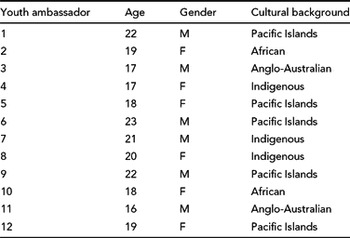
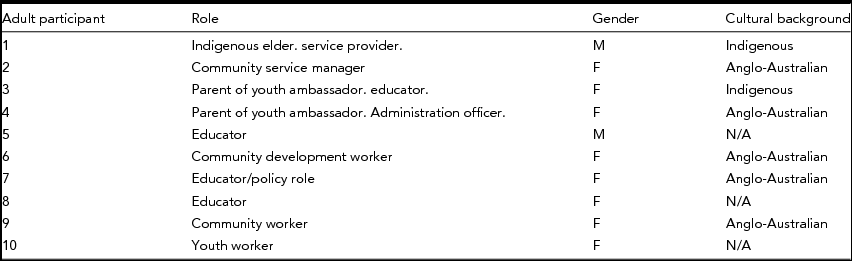
The study consisted of two participant pools: 12 YAs who accepted scholarships to work on R4Respect and 10 adult stakeholders who were involved with the YAs in some capacity through R4Respect. The stakeholders included educators from schools, youth organisation staff, sponsors and parents of two of the YAs. The views of the adult stakeholders were considered helpful to the research because their support helped build the reputation and capacity of R4Respect and played a role in attracting funding. Tables 1 and 2 provide demographic characteristics for each participant.
Characteristics of youth ambassadors as research participants.

Characteristics of adult research participants.

Data Collection
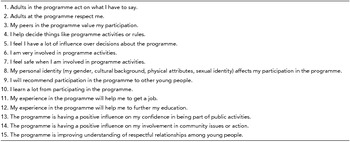
Interview questions were adapted from the TEPPS (Tiffany et al., Reference Tiffany, Exner-Cortens and Eckenrode2012) and aimed to assess how young people experienced the programme principles, structures and outcomes. TEPPS is a 20-item measure using five-point Likert scales that are structured around four sub-scales to assess participation: personal development; voice/influence; safety/support and community engagement. The TEPPS seeks to explore young people's views on a variety of issues including adults in the programme act on what I have to say; I feel I have a lot of influence over decisions about the programme, and the programme is having a positive influence on my confidence in being part of public activities. The TEPPS is considered most effective when combined with follow-up interviews which explore the items in more detail (Tiffany et al., Reference Tiffany, Exner-Cortens and Eckenrode2012). As this was a small-scale qualitative study, TEPPS items informed the interview schedule for YAs and adult stakeholders. The scale was not used to rate and quantify youth participation; it provided qualitative data only through interviews. The TEPPS items were also used with adult stakeholders; however, they were rephrased in a way that collected their views and observations of the ways that the young people appeared to be experiencing their involvement in R4Respect. The scale was adapted for adult stakeholders by removing several items and by adding two new items. To keep the interviews and data analysis manageable, several TEPPS items were excluded. These were: I feel close to at least one staff member at the programme; there is at least one staff member that I can go to for support or help with a problem; I have friends who also take part in the programme; the programme finds ways to involve my family and the programme has had a positive influence on how people in my community treat me. An item was added to assess diversity – that is, how the gender or identity of the YAs (particularly in relation to cultural origin, sexual orientation or mobility) may impact on their participation. Consistent with the process evaluation aims, participants were also asked to provide ideas on ways to improve R4Respect (see Table 3). Participants were informed that the interviews would be of approximately 45 minutes duration, but on average they ran for 35 minutes.
Adaptation of the TEPPS scale to inform the interview schedules.

All 12 YAs were interviewed individually and they all agreed to have the interviews audio recorded. YAs were also invited to participate in a supplementary group interview near the completion of the research in which the same interview schedule was used. Five of the young people participated in the group interview and it lasted for 1 hour. The purpose of the group interview was to tilt the balance of power (at least in numbers) towards the group, thereby reducing the interviewers’ influence over the participants. The group interview is also useful as a data gathering technique and a consciousness raising process through which human sharing and interaction take place (Madriz, Reference Madriz, Denzin and Lincoln2005). These features can help maximise peer support and learning for young people during the research process.
Adult stakeholders were interviewed individually. This was their choice based on the time that they were available. All agreed to the audio recording of interviews.
Data Analysis
The narrative data acquired through the interviews was subjected to thematic analysis (Braun & Clarke, Reference Braun and Clarke2006). One researcher identified, analysed and reported patterns within the data, leading to the selection and categorisation of themes on the basis of three main criteria: views commonly expressed by adults and young people; differences in views of young people compared to adults and views from either youth or adult participants that stood out as disparate. No analytical software was used. In excess of 20 codes were initially identified, and these were categorised and developed into six themes which were selected on the basis that they captured common ideas and they exposed the main differences between the views of youth and adult participants. It is recognised that there can be problems in making sense of people's experiences and ‘. . . it is always possible that your research subjects, or other researchers analysing your data, could come to different conclusions’ (Ramazanoglu & Holland, Reference Ramazanoglu and Holland2002, p.160). To enhance consistency in interpretation of data, the research assistant contributed to the thematic analysis enabling comparative analysis and cross-checking to occur. There was a high level of agreement among the research team in this thematic analysis.
Findings
The findings are discussed within three main areas: the level and nature of the young people's participation; the personal benefits and outcomes from their participation and ways in which R4Respect could be improved. Within these areas, six themes have been selected that capture the breadth of views from participants:
-
1. The level and nature of the young people's participation.
Theme 1: Young people feel valued and included in their roles.
Theme 2: R4Respect is moving towards a youth-led model.
Theme 3: The importance of diversity in culture and gender.
-
2. The outcomes from their participation.
Theme 4: Skills development, leadership and networking.
Theme 5: Positive impact on other young people.
-
3. Ways in which R4Respect can be improved.
Theme 6: Greater capacity and structure needed for R4Respect.
Young People Felt Valued and Included in Their Roles
Overall, the YAs felt valued by their peers and adult stakeholders. They commonly stated that ideas, suggestions and input by YAs were discussed and considered by ambassadors and adults. They acknowledged that feedback received from adults had been constructive and it had been well received by the young people. One YA expressed this as ‘People within R4Respect and YFS have practised the message they have been teaching to young people of respecting other people’. The YAs stated that they are encouraged to create new projects and events and propose those to external groups and organisations. These perceptions aligned positively with the voice/influence sub-scale of the TEPPS and they were affirmed by external stakeholders. They cited examples of the young people taking responsibility for decision making, planning and delivery of educational messages in the programme. One said it was clear that ‘. . .Young people are heard and can have a voice at the decision-maker level’.
The main concerns expressed by the young people related to the lack of clarity in their roles and capacity to make decisions, as well as the unequal participation among the group, as illustrated in the following comments by youth participants:
My status within the group is not as great as others. . .
The structure of the R4Respect ambassador group can be unfair at times, when the people here today in this room are all so involved and dedicated, and others have been really uninvolved.
R4Respect is Moving Towards a Youth-led Model
There was overwhelming support from the YAs and stakeholders for R4Respect to keep developing the peer-to-peer, youth-led model. Stakeholders were more cautious than the YAs about moving quickly to a youth-led model given the complexity of the gender-based violence that underpins the R4Respect, the need to maintain high standards of service when delivering programmes in schools with students and the need to apply protocols for disclosure of harm.
The YAs acknowledged that their influence is increasingly shifting the model from an adult–youth partnership to being more youth led. Their decision making is evident in the organising and running of meetings without the presence of adult mentors and the planning of events and school visits. Less responsibility was evident in relation to corporate and government partnerships and requests for funding. Their growing ‘voice’ was expressed by two YAs as:
Our whole motive is young people talking to young people, so young people running the ship from top to bottom is our overall aim, and that will allow us to engage better with schools. It takes out the factor where kids might be intimidated by adults and people more intelligent than they are.
It is becoming increasingly youth led, and that adds to being able to connect with young people and having an organisation that really practices what its message is.
The adult stakeholders all provided positive feedback on the youth participation and peer-education aims of the R4Respect programme, which was evidenced by their willingness to recommend the model to others. Stakeholders described the benefits that can occur when young people relate well to and engage with other young people.
Any model that involves young people learning – and learning from peers – can be effective.
Yes, evidence of them planning and presenting themselves.
Inclusive, rigorous, merit-based process – gives youth a strong voice.
R4Respect is youth led which encourages young people to participate and be involved. . .young people are interested and learn from the YAs. . .follow the YAs up after the sessions and on social media. . .the program is unique and works well because it is youth led from young people within the Logan community.
Adult stakeholders expressed some concern about the lack of direction they observed and the capacity of the programme to deliver its stated aims. One stakeholder stated that ‘. . .direction was lacking when the adults took a step back. . .that having the entire movement directed by young people may not be beneficial to the organisation’. This person observed the young people performing well in peer to peer education sessions, but expressed a need for adults to remain actively involved in the organisation of R4Respect. Other adults noted that more young people are needed to take the pressure off the small group and that more funding and training is needed to maintain the quality and capacity of R4Respect. Several stakeholders recognised the complexity in the gender-based analysis and content that the YAs deliver, and the quality control that schools require when they invite programmes into their schools. They suggested that adult mentors may need an active ongoing role in the organisation of R4Respect and training of the YAs.
Diversity in Culture and Gender
In establishing R4Respect, there was a determined effort to recruit young people from diverse cultural and socio-economic backgrounds so that the programme reflected, and could appeal to, the cultural diversity of the Logan community. In addition, it was considered vital to include young men in an active role to challenge other young men about respectful relationships. Adding the diversity item to TEPPS extended the information obtained within the safety/support sub-scale of TEPPS. This addition proved to be helpful as the YAs stated that the diversity – a mix of females and males from different cultures and ages – worked well for the programme. Comments included:
My mixed culture helps me to relate to young people in Logan.
I have not felt that my age has hindered impact.
Having males and females presenting helps to get the message across.
The adult stakeholders also commented favourably on the inclusive features of R4Respect:
It assists young people to connect with positive mentors from their culture having the ambassadors from various cultures.
From my observation I believe that having young males within the group of ambassadors has been beneficial to the program as other young males have connected well with the male ambassadors.
Great to have cultural diversity that represents the wider Logan community.
It's really helpful to have male Ambassadors in a field heavy with females. . . it's good to do gender balance in presentations.
No participant raised safety concerns. All YAs felt included and supported, although to varying degrees.
Skills Development, Leadership and Networking
Feedback on the programme indicated that the YAs are acquiring new skills and confidence. Several YAs acknowledged that they felt terrified when first speaking up publicly – particularly to media. Several YAs expressed pride in their achievement of reaching over 3500 secondary students in Logan and beyond in less than 12 months and for speaking publicly at over 20 community events. Comments from the YAs included:
I feel like I really will make a difference.
This is good for my study . . . and my career.
I am building confidence and public speaking skills.
This has opened a lot of opportunities.
The YAs said that they expanded the R4Respect facebook followers from 200 to 1300 during the course of the research, but they also expressed their preference for face-to face contact rather than social media. It became apparent that their primary experience of social media is for social purposes, rather than strategy as required in R4Respect. The YAs welcomed ongoing training in social media strategy. The YAs spoke of the benefits of networking and said they are learning a lot by meeting with a wide range of people, including support service professionals, politicians and survivors of domestic violence. The YAs all indicated that their own understanding of domestic violence, dating violence and related issues was limited at the start of the programme, but it had grown throughout the training and discussion with others. They cited the wide range of learning experiences they encountered, positive effect on future employment and importance of the R4Respect message as the primary reasons for them staying involved in the programme. Moreover, the opportunity for paid casual work to supplement the financial scholarship enabled several YAs to commit more time than others and assume leadership roles.
The adult stakeholders all indicated that they were playing a role in building awareness of the R4Respect programme and the positive youth development they were observing. The adult stakeholders affirmed that the YAs were learning a range of skills. Comments included:
Young people are speaking genuinely, not scripted.
They learn about themselves, grow in confidence. . .learn that violence is a choice.
Adult stakeholders also expressed concern, however, that the complexity and sensitivity of issues such as domestic violence required young people to have a high level of training and support in managing the issues and any disclosures of harm among young people. They suggested that R4Respect will need to be consistently responsive to the need to complement prevention activities with the availability of early intervention and support so that participants disclosing harm can obtain help. Currently, the YAs follow a protocol of referral to teachers or community leaders and the provision of information to participants on helpful services.
Positive Impact on Other Young People
The YAs all said that they aspired to be role models for young people in the community, and champions of respectful relationships, especially within their own culture. Overall, they felt that they were developing as helpful role models to others. The YAs commonly stated that the presentations in schools were having a positive influence on students and that this is reflected in feedback and social media received after presentations. R4Respect has not yet acquired resources to conduct outcomes research or develop a robust survey process for obtaining and analysing participant feedback from educational sessions or for assessing attitude change in young people; however, the YAs have designed and used a short survey to obtain participant feedback. This survey was not part of this evaluation, but the results were cited by a youth participant who reported that in one of the recent sessions with 90 Year 11 students from a secondary high school, 89% of the students agreed that R4Respect had given me a better understanding of respectful relationships and domestic violence and 85% agreed that they would recommend more programmes like R4Respect in schools. Overall, the YAs were positive about their contact with students and other community links they were making – but they wanted to reach more young people.
It was apparent that adult stakeholders valued the role of the YAs and their capacity to engage well with others. Several of the adult stakeholders who had witnessed the YAs facilitating activities with students and adults spoke of how well they gained interest from people of diverse cultures, backgrounds and ages. The educators among the stakeholders spoke favourably about the power of peer-to-peer education on respectful relationships education. Comments included:
This subject is better when YAs deliver . . .young people can relate to them better.
You can see the students taking notice of the youth ambassadors.
Young people get involved, quite engaged in the process.
R4Respect has limited capacity to conduct an evaluation of changes in the attitudes of young people following exposure to presentations from YAs. They used a brief survey after some activities, but this was not applied consistently after all sessions. This was identified by some participants as an area for future evaluation.
Suggested Improvements to R4Respect
The YAs and adult stakeholders offered comparable suggestions regarding the need for enhanced funding and more YAs to improve the youth model underpinning R4Respect. One of the YAs stated that ‘More funding is needed, while we are all young people we still all have our own lives. Incentives are important to keep people involved and active within the group’. Two suggestions from adult stakeholders to increase capacity were:
. . .a few young people are carrying responsibility. . .we need more Youth Ambassadors.
More funding so they can do more. . .Better budget needed. Greater number of ambassadors.
The main point of difference between YAs and adult stakeholders was the YAs desire for a clear structure, more equal roles and decision making, whereas the adult stakeholders focussed on enhancing the capacity of R4Respect by enlisting more youth members, more training and more funding. Adult stakeholders also differed from the YAs in suggesting a more enduring role for adult mentors in the programme. Several YAs commented on a lack of direction and inequity within the group, with some young people not meeting the responsibilities of the scholarship. A number of YAs were critical of some young people who they felt may be taking the scholarship money, but not doing as much work as the others. It was evident that the YAs all endured financial hardship and that the scholarship and any other casual work and reimbursements of costs was an important feature of the programme, and one that facilitated their participation. Some of the YAs’ suggestions were:
Assign Ambassadors to specific roles, duties and positions to ensure responsibility and progression of ideas.
You need to make sure young people can deliver the gender-based analysis and respond to questions that students raise.
The need to build capacity and sustain the programme were identified as major issues. In addition, the need for the YAs to be well equipped to deal with complex and sensitive issues and to follow a protocol for handling disclosures of harm from young people were all discussed at some length by adult stakeholders.
Discussion
The R4Respect model is a participatory, peer-education model that aims to prevent domestic and intimate partner violence by building awareness of respect in relationships. This evaluation showed that the participation of YAs in R4Respect was active, yet variable for individuals; their voices within the group and publicly were becoming stronger; they felt supported; and they received numerous invitations and praise from adult stakeholders that indicates positive community engagement. The study affirmed that the R4Respect programme was (1) inclusive of young people from diverse backgrounds; (2) fostered participation and skills development for the young people involved; (3) encouraged young people to learn and lead a programme to raise awareness of domestic violence and respectful relationships and (4) worthy of continued development as a model of youth participation.
Personal Development
There were high expectations on the YAs to readily acquire confidence and skills to present interactive sessions in schools, to speak at public events and to be strategic in using social and mainstream media. They responded well by acquiring skills and confidence to fulfil many public speaking responsibilities. They also felt better prepared for future employment. The high expectations are not unusual given the need to demonstrate the worth of a new programme and build its profile in order to attract funding and support. This approach can be demanding on the young people and pose a risk that their understanding and communication of the complex issues will not be adequate. To date, only half of the YAs are equipped to lead educational sessions with students. Ongoing training, mentoring and support for the YAs to extend their understanding of gender-based violence and the impacts on young people, families and communities, will need to be an ongoing area of programme development.
Voice and Influence
The views of adult stakeholders and YAs were consistent in showing that YAs have a growing voice in the programme decision making. This is primarily in relation to events and school visits, which the YAs were taking increasing responsibility for. The quest for corporate and government partnerships and funding remained a task that staff at YFS Ltd. and mentors undertook. To foster more equal participation by all youth members, YAs suggested that the roles and structure within the programme needed to be clarified. While the YAs praised the support from adult mentors, they did not explicitly suggest that an ongoing role for adult mentors was needed. Adult stakeholders, on the other hand, suggested the need for continued involvement of adult mentors with experience in gender-based training and analysis.
In relation to the TYPE Pyramid youth participation model (Wong et al., Reference Wong, Zimmerman and Parker2010), R4Respect fits within the symbolic to pluralistic category. The YAs controlled most of the peer education, but overall programme governance and financial responsibility rested with adult mentors and staff at YFS Ltd. Prominent researchers in the youth participation field are supportive of Y-APs in which adults take responsibility for sharing power and empowering young people (Wong et al., Reference Wong, Zimmerman and Parker2010; Zeldin et al., Reference Zeldin, Krauss, Collura, Lucchesi and Sulaiman2014). In evaluating the TEPPS, Tiffany et al. (Reference Tiffany, Exner-Cortens and Eckenrode2012) noted that high quality participation is ‘. . . contingent upon structural elements within programs that enable youth to access supportive adults, learning opportunities, safety, and voice in program decision-making’ (p.289). The support of adult mentors as trainers; members of governance structures; as funders and collaborators, is common in Australian and international youth models. Given the concerns raised by adult stakeholders about the capacity of R4Respect to sustain its work without adequate funding, to grow and maintain high standards of training and knowledge, this mentoring role may be useful to retain until the programme is on a more solid foundation financially and developmentally.
Safety and Support
The YAs did not feel unsafe, just anxious at times. They felt well supported by peers, adult stakeholders and the mentors they engaged with, including school staff. Three YAs relinquished their scholarships after several months, and new YAs were recruited readily to these vacancies. The reasons cited for the decision to leave included language and communication was too complex, the demands of study commitments, and the need for paid work. YFS Ltd. recognise that attrition is to be expected, and that cyclical recruitment of YAs is needed as new scholarship funds become available and vacancies arise. It will be useful for YFS Ltd. and the R4Respect youth members to monitor attrition and respond to any negative factors that impact on attrition.
The risks identified related to the difficulties that can arise in public educational sessions when young people raise complex and sensitive issues about domestic violence that the YAs are not equipped to manage. This can lead to misinformation or compromise the integrity of the programme. There is also a risk that disclosures of harm by young people may not be handled appropriately by other young people. There was no suggestion that this had occurred, but by raising this concern adult stakeholders provided a reality check to the sponsor of the programme, that ongoing training and support to the YAs is needed to mitigate risks.
Community Engagement
Feedback from the external stakeholders and the achievements of R4Respect showed that the YAs were providing a valued community service through the peer education model. Having YAs from diverse cultures and backgrounds fostered good community connections and engagement. The feedback from a stakeholder that ‘. . .more Anglos are needed’ indicates that R4Respect was noticed for its cultural diversity. The challenge appears to be in building capacity to reach more young people in schools, groups and online. The YAs, and some external stakeholders, supported the recruitment of additional YAs with social media skills to improve the reach of the programme messages to young people not involved in school or community groups. It was difficult for R4Respect as a new programme to attract funding for new YAs and paid staff. Funding cuts to youth engagement activities and youth organisations places new programmes, like R4Respect, in a difficult position of having to compete within a highly competitive funding pool (Youth Affairs Council of Victoria, 2015). This withdrawal of support for specific youth programmes provides further impetus for youth participation principles to be integrated into all models and organisations that work with young people.
Implications and Conclusion
R4Respect has the capacity to captivate the interests of young people and service providers in new ways of responding to complex social problems, like violence in intimate relationships. It has the capacity to generate new models of service delivery that have an enduring impact on the wellbeing of many young people. These new models include greater use of peer-to-peer education and strategic use of social media to engage with young people.
The study has provided critical reflection and ideas for improvements to maintain quality, capacity and growth within R4Respect. The main limitations of this study related to the short time frame and the early stage of the programme. It is recommended that future evaluations, of this or related programmes, could be usefully conducted later in the programme life and extend beyond 9 months, particularly as there is turnover in youth members. While this study was not resourced to incorporate evaluation of attitude change or educational outcomes for the students and others exposed to the respectful relationships education, this will be vital in assessing its effectiveness into the future.
The study showed that the R4Respect YAs have a strong sense of mission to improve their own skills and knowledge to lead strategies that reduce the violence and harm that young people can endure in their relationships. The movement of R4Respect from a pluralistic model to one where the young people are more independent and autonomous in all aspects of governance and service delivery with majority decision-making control will need more time and resourcing to develop, but its guiding principles are consistent with those recommended by researchers. The R4Respect youth team appear to be off to a good start as agents of social change.
Acknowledgements
The research is funded by the Queensland Government 2015 Advance Queensland Knowledge Transfer Partnerships Program.