Introduction
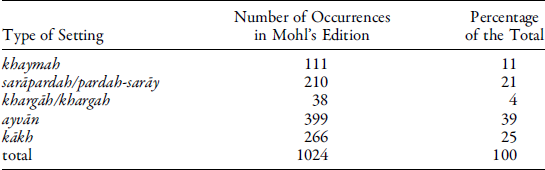
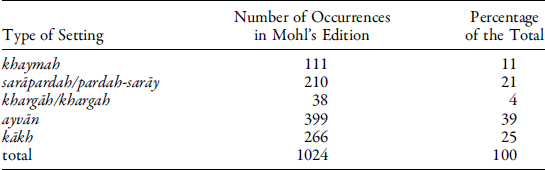
Because the Shāh-nāmah is all about the deeds of kings, foes and heroes of ancient Iran, it is no wonder that many episodes take place on a battlefield or a hunting ground. In such a setting, it is no wonder either if tents are ubiquitous. In his painstaking work on the lexicon of Firdawsī’s Shāh-nāmah, Fritz Wolff has counted a total of 359 occurrences for sarāpardah (variant: pardah-sarāy), khaymah and khargāh (variant: khargah) (see Table 1).Footnote 1 These three terms of tentage complete ayvān and kākh in the royal court paradigm. But while ayvān and kākh can easily be translated as “palace” (ayvān being the audience hall, and by synecdoche the whole palace), the translation of the terms of tentage, and especially khargāh, has been more problematic.
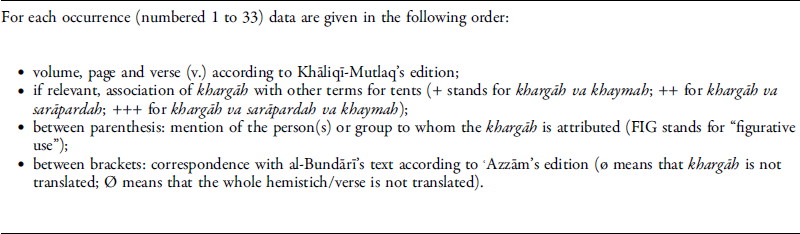
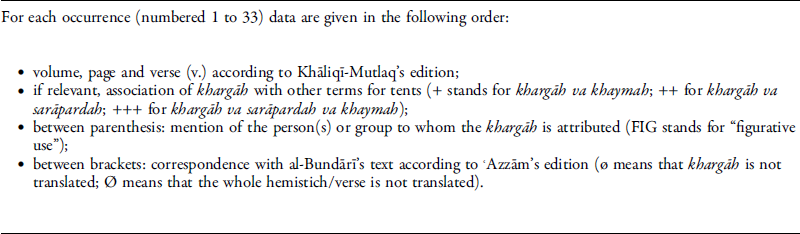
Firdawsī (d. 416/1025) never bothers to say what a khargāh is. Nor does he mention any of its components (trellis, pole, guys, felt covering and the like) that might shed light on its structure. This is not surprising given Firdawsī’s “stylistic economy” (description are seldom, the nouns are “presented in their unmodified generic form”).Footnote 2 But this lack of description is itself informative: it shows that the khargāh was a common artifact for Firdawsī’s audience—in contrast, the Taqdīs throne of Khusraw Parvīz is described at length. Al-Fath al-Bundārī’s Arabic translation of the Shāh-nāmah does not help. Most of the verses referring to khargāh in Firdawsī do not appear in this translation composed in 620–21/1223–47 (see Table 2, in which I have noted all the correspondences between Khāliqī-Mutlaq’s edition of the Shāh-nāmah and ʿAzzām’s edition of al-Bundārī’s translation). When these verses are indeed translated, al-Bundārī often drops the reference to khargāh. For example, about the gathering of Tūrānian pahlavāns (hero, paladin) around the Khāqān, Firdawsī had “bih khargāh-i khāqān-i Chīn āmadand,” but al-Bundārī merely writes “fa-atū l-khāqān” (see Table 2: item no. 10). Or al-Bundārī translates khargāh along other terms of tentage with the umbrella term khiyam, “the tents.”Footnote 3 Khargāh is kept only five times (with its Arabic spelling kharkāh). It is translated in one unique occurrence by the vague mawduʿ, “place.”Footnote 4
Likewise, modern translators and commentators have had great difficulty finding an equivalent. Jules Mohl chose the umbrella term “tente” but his successors have been less cautious. Reuben Levy for example opts for “pavilion” although nothing in Firdawsī’s text supports such a specific meaning—a pavilion being technically a tent with a central pillar and crowned by a disk supporting the gores that form its roof and walls.Footnote 5 Dick Davis’ translation of this term is no more satisfactory. Depending on the context, Davis renders khargāh as “the Turks’ tents,” “imperial tent,” “pavilion,” “tent,” but also “place,” and even “castle” and “palace hall,” when it is translated at all. Such interpretations are at best ambiguous, and often untenable.Footnote 6
The various glossaries of the Shāh-nāmah are no more helpful. The Ottoman lexicon of ʿAbd al-Qādir Baghdādī has no entry for khargāh. Wolff’s Glossar distinguishes two senses: firstly, khargāh as a common noun meaning a tent (either a large tent, “Groβzelt,” and/or a royal tent, “Königzelt”); secondly, khargāh as a proper noun referring to a province.Footnote 7 The distinction does not come from Mohl’s translation used by Wolff and has no solid basis, as we will see below. Persian commentaries or lexicons of the Shāh-nāmah give circular definitions: for Jalāl Khāliqī-Mutlaq, Parvīz Atābakī and ʿAlī Ravāqī, a khargāh is a sarāpardah and/or khaymah(-yi buzurg).Footnote 8 Likewise, Jalāl al-Dīn Kazzāzī devotes a note to the term khargāh but totally evades the technical aspect.Footnote 9 Recent publications are representative of the stalemate on the issue. Zahrā Darrī explains that the metaphor khargāh-i āsimānī is based on the fact that both the khargāh and the sky are of large size.Footnote 10 This interpretation reflects a folk etymology (khar means “large,” hence khargāh: khar-gāh, “large place,” cf. khar-gūsh, “large ears,” i.e. rabbit) derived from Dihkhudā’s notes but not documented in classical sources.Footnote 11 In a contribution to the Shahnama Studies, Marjolijn van Zutphen affirms that khargāh could mean a “pleasant place” (jāy-i khushī).Footnote 12 This is a figurative use derived from the fact that in Iranian courts the khargāh was the setting of wine-and-music parties (bazm), as shown by Rūdakī or Manūchihrī poetry. But while it could indeed serve as a “pleasant place,” this kind of tent could also serve in less pleasant occasions (like when it is used as a prison), as will be seen.
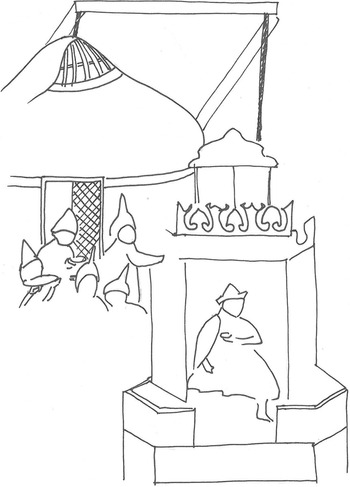
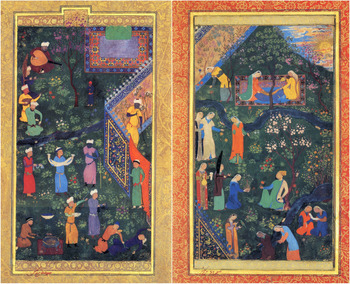
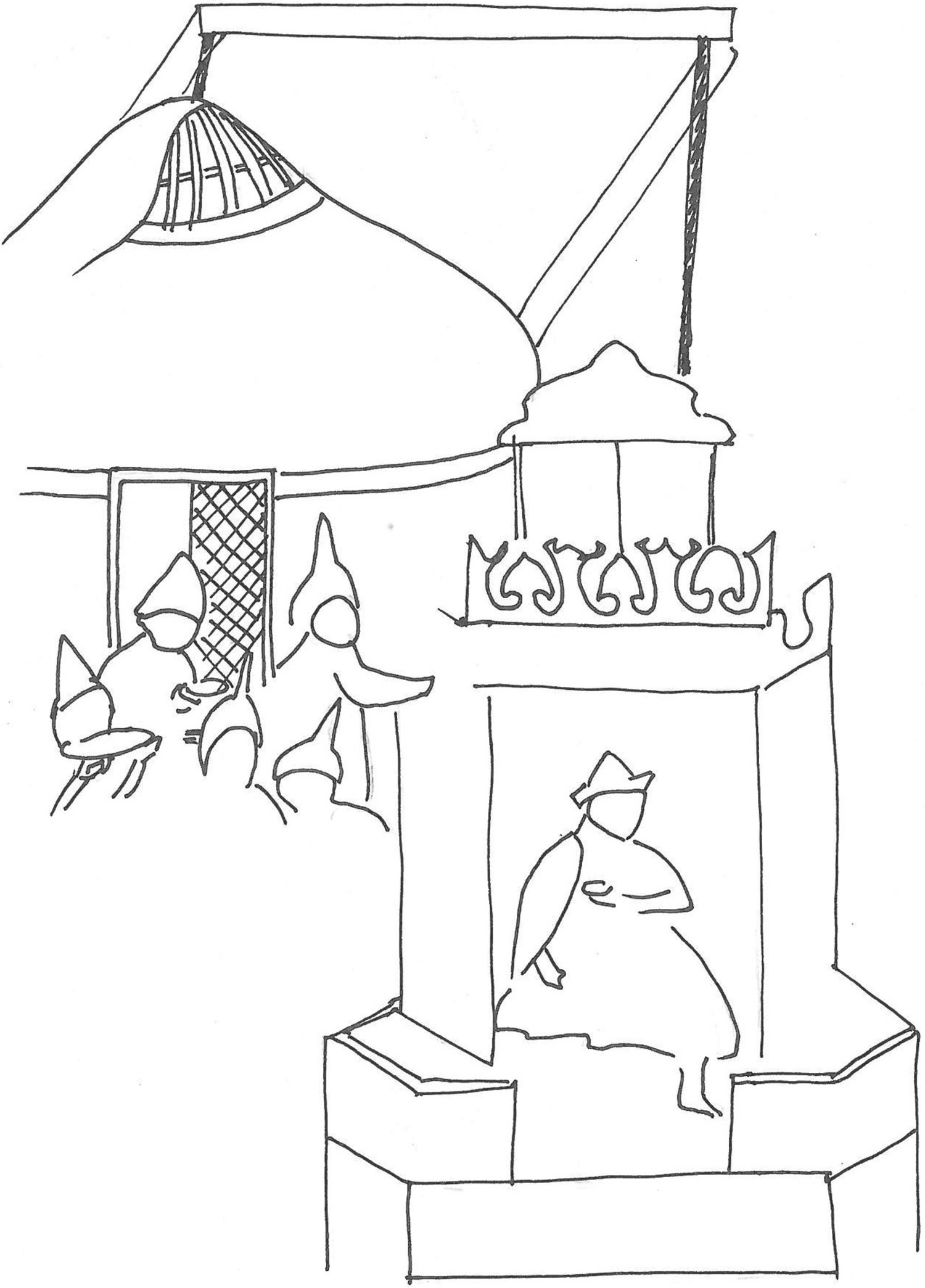
Needless to say, the paintings in the manuscripts of the Shāh-nāmah do not help us understand what Firdawsī had in mind since they were produced several centuries after his death. The illustration of tents (and anything else, for that matter) is a topic in itself beyond the scope of this paper. Let us just say that the absence of historicizing in the depiction is obvious. For example, in the paintings of the Shāh-nāmah made for the Safavid king Tahmāsp during the years 1522–37, the tented encampments are represented in the fashion of early sixteenth-century Iran, with its classical combination of pole-tents, awnings and trellis tents (see Figure 1). This last type of tent, which corresponds, we shall see, to what Firdawsī called khargāh, is represented in a way totally inconsistent with what the text tells us.Footnote 13
King Farīdūn on his Throne, in Front of a Trellis Tent (Khargāh) and an Awning.
Source: Drawing by D. Durand-Guédy, adapted from a detail of the Shāh-nāmah of Safavid Shāh Tahmāsp, folio 38v, reproduced in Canby, The Shahnama.
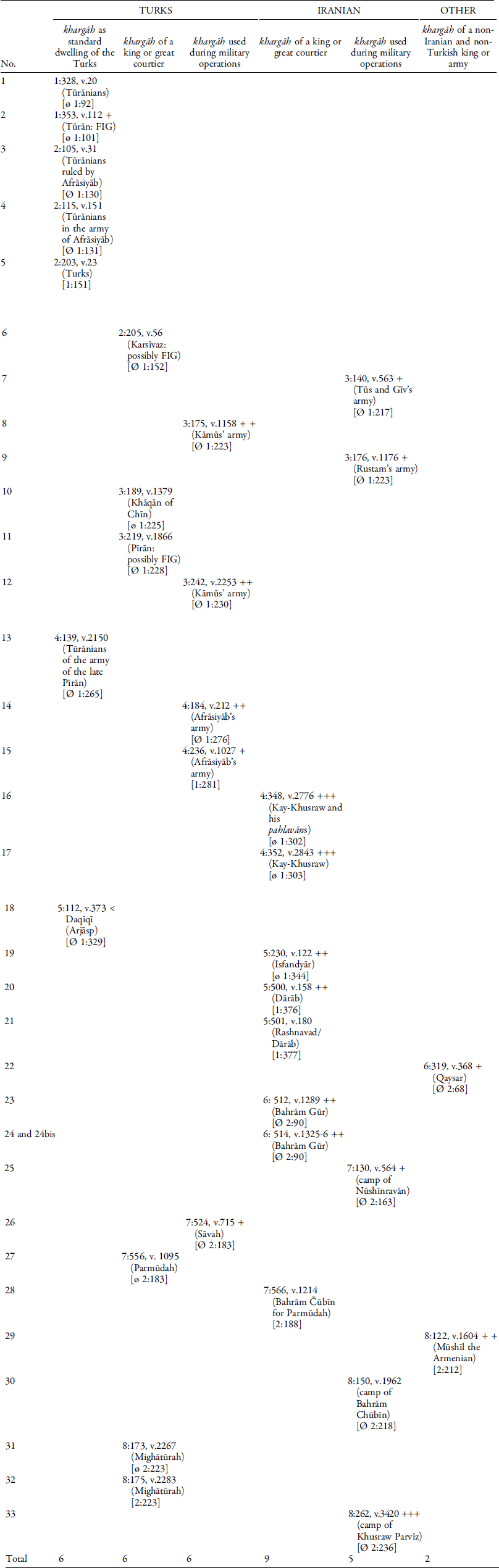
In this article I aim to give a clearer understanding of the term khargāh in the Shāh-nāmah. For that purpose, I have noted all its occurrences in Table 2 by their order of appearance (no. 1 to 33) in Firdawsī’s text. Each entry references Khāliqī-Mutlaq’s edition. It also indicates the civilizational context (Tūrān, Iran or other) as well as the social status of its user (ordinary people, soldiers or elite). My analysis of this material is first based on the data given by Firdawsī. It is only in a second step that I compare it with the results drawn from contemporary texts (chronicles and other narrative sources), which was the subject of a previous article.Footnote 14
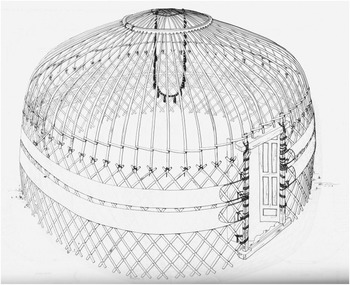
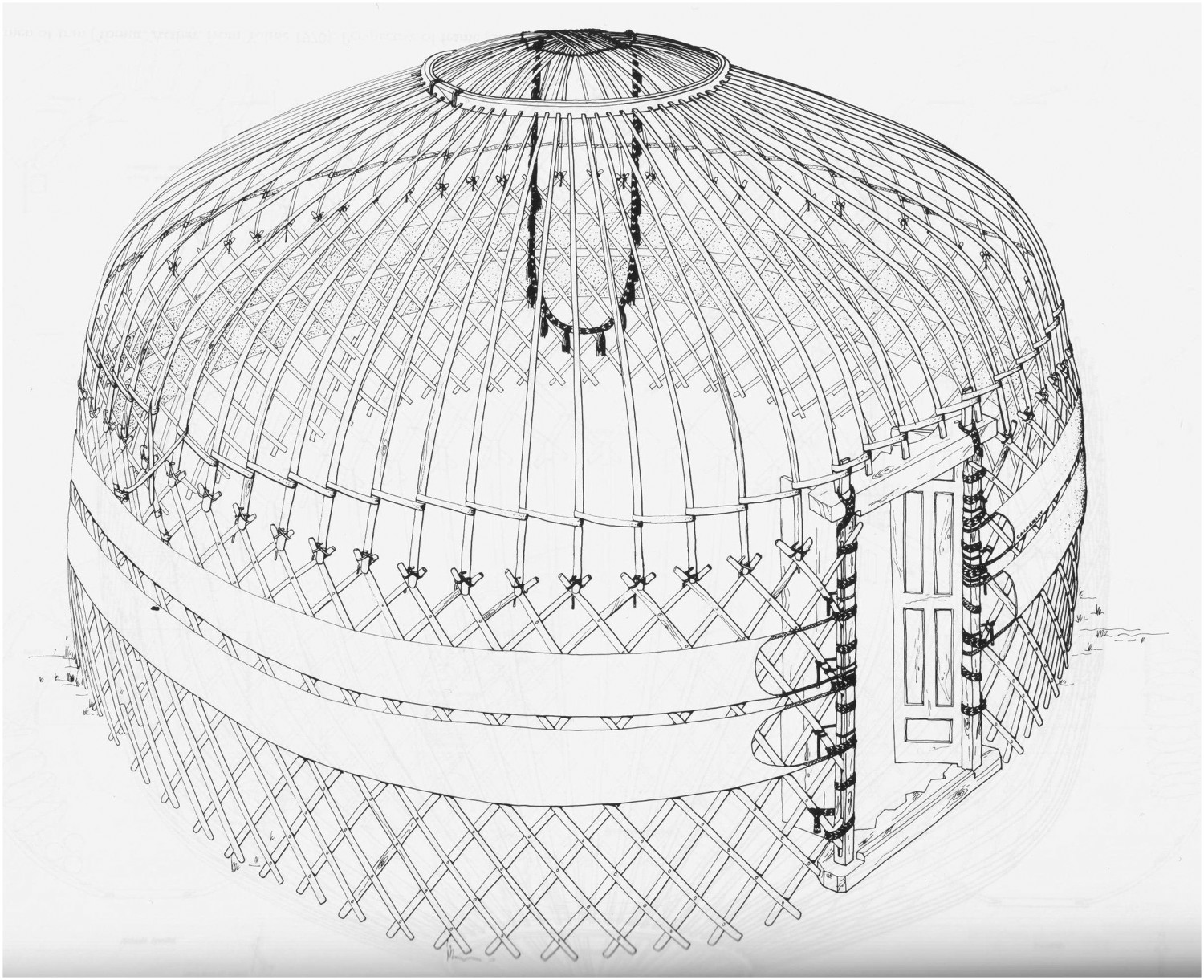
I argue that the way the term khargāh appears in the Shāh-nāmah is consistent with what can be learnt from the analysis of the wider historical, literary and geographical corpus. This equivalence justifies translating khargāh as “trellis tent” (aka yurt), that is a particular kind of framed tent with a folding wooden structure (including a trellis wall) and a felt covering (see Figure 2).Footnote 15
Trellis Tent of Yomut Türkmen (of Iran) without Felt Covering.
Source: Drawing by P. A. Andrews, Felt Tents, plate a2. Courtesy of the author.
Firdawsī’s text provides us with six main pieces of information, which will be dealt with in the following order: (1) khargāh originates in Tūrān; (2) khargāh is never a proper noun; (3) Tūrānian elites also use khargāh; (4) the khargāh appears in Iran during Kay-Khusraw’s reign; (5) in Iran the khargāh remains a status symbol; (6) khargāh, sarāpardah and khaymah are related terms but they are not equivalent.
Khargāh Originates in Tūrān
Khargāh appears 34 times in Khāliqī-Mutlaq’s edition of the Shāh-nāmah but the first six occurrences only relate to Tūrānians, i.e. Turks—both terms being synonymous in Firdawsī’s text. In the very first occurrence, khargāh is even introduced as a marker of Tūrān. The story unfolds as follows: during Zaw’s reign, Iranians and Tūrānians endeavor to find a political solution to the war which started with Manūchihr seeking revenge for the killing of his father Īraj. Both parties eventually agree to return to the partition of the world as set forth by Farīdūn, Īraj’s father. The territories attributed to Tūr (hence, “Tūrān”) are introduced as follows:Footnote 16

[no. 1] From Rūdābad and Shīr to Tūr’s territory, from this part of the earth All the way to Chīn and Khutan, kingship was given to this group (anjuman) [i.e. Afrāsiyāb and the Tūrānians],
Zaw and Zāl should renounce the territory where it is customary to use the khargāh.Footnote 17
Tūrān is explicitly referred to by a technical feature: it is “the country where people use khargāh” (marzī kujā rasm-i khargāh). This kind of designation is striking but not exceptional. The chronicler al-Balādhurī (d. 279/892) speaks twice of “tent-people” to refer to the Bedouins (ahl khibāʾ) and to the Berbers (ahl ʿamūd).Footnote 18 Outside the paradigm of tent, the Bakhtiyaris of Central Zagros referred to the Persians as the “tight pants” (lori: shawlār-tang).Footnote 19 And in the Secret History of the Mongols, Chingiz Khan is made to refer to the sedentary population as “the people of wooden doors,” an expression still used by the Shahsavan of Azarbayjan today.Footnote 20
Other verses show that the khargāh was indeed the standard dwelling in Tūrān. In the story of Rustam and the seven heroes in the hunting-ground of Afrāsiyāb, the mightiest pahlavāns of Kay-Kāvūs follow Rustam in the dasht-i Tūrān. When they reach the region of Sarakhs,

[no. 3] the plain was filled with khargāhs and khaymahs; they were astonished by the great number of deer.
The story of Siyāvakhsh (Siyāvush) starts in a similar setting. Two Iranian pahlavāns, Tūs and Gīv, leave for a hunting expedition in the plain of Daghūʾī, west of Sarakhs:

[no. 5] Turks were not far from this place; the ground was darkened by khargāhs.Footnote 21
Likewise, in the aforementioned story of the Seven Heroes, after the soldiers sent by Afrāsiyāb suffer a terrible defeat, the dwelling of the soldiers of Tūrān is referred to as khargāh:

[no. 4] Two-thirds of the soldiers who fought in the battle did not come back to their khargāh.Footnote 22
Later, during Kay-Khusraw’s Great War to avenge Siyāwakhsh’s murder, Tūrānian soldiers refuse to return to Tūrān with the brothers of their late general and they justify themselves as follows:

[no. 13] Should we return, Gūdarz and the King [Kay-Khusraw] would drive elephants and the army after us,
Not a single one of us would escape with his life, or see [again] his khargāh and his folk.
Here again, the khargāh is depicted as the locus of family life (khān-u-mān) in Tūrān.
The Tūrānian origin of the khargāh in the Shāh-nāmah is consistent with what we know of the origin of the trellis tent: it first appeared in Central Asia at the time of the Türk Qaghanate (sixth century AD) and was the mobile dwelling used by Turkic-speaking pastoral nomads.Footnote 23 The word itself has a Central Asian origin, possibly derived from Turkic kërekü (in any case it has no Pahlavi root, despite later reconstruction by lexicographers).Footnote 24
As noted in the introduction, Firdawsī never bothers to describe a khargāh. The metaphor used in occurrence no. 5 (zamīnash zi khargāh tārīk būd) could suit the trellis tent, whose felt covering, originally white, becomes darker with time.Footnote 25 However the same could be said of the iconic “black tent” (a guyed tent) of the wider Middle East. Perhaps more significant is the fact that at the beginning of the thirteenth century, al-Bundārī decided not to translate the syntagm “kujā rasm-i khargāh būd” to define Tūrān (no. 1).Footnote 26 The reason may be that when al-Bundārī was writing, two centuries after the Saljuq conquest, the Türkmen pastoral nomads using the khargāh/trellis tent were living in the heart of the Islamic lands. Such a technical and outdated definition of Tūrān could have been confusing for al-Bundārī’s readership.
Khargāh is Never a Proper Noun
In 1903 Paul Horn proposed to read khargāh in one verse of the Shāh-nāmah as a proper noun. The verse is found in the passage in which the Tūrānian king Pashang evokes Farīdūn’s partition of the earth:

[no. 2] From khargāh as far as Māvarā al-nahr (Transoxania), which is limited by the Oxus,Footnote 27
This was our territory (bar-u-būm) during King [Farīdūn]’s reign and Īraj never set his eyes on that country.
For Horn, the khargāh in question derives from the toponym Kharghān in Bukhara.Footnote 28 He does not give any source to support this assumption but he obviously had in mind the toponym Kharghānkāth mentioned by al-Samʿānī near Bukhara.Footnote 29 Wolff followed Horn’s reading and inserted a sub-entry for “Xargāh, Geographischer Name, Provinz.”Footnote 30 However, this hypothesis is difficult to accept because Kharghānkāth lies within Māvarā al-nahr: rhetorically speaking, quoting two overlapping place names as the boundaries of a piece of land to stress its vastness would be totally counterproductive. Here khargāh is more likely to be understood as a metonymy to speak of “the country in which people are accustomed to live in khargāh”; in other words, the lands inhabited by nomadic Turks, beyond the urban oasis of Māvarā al-nahr.Footnote 31 Indeed, Firdawsī had already defined Tūrān as “the territory where it is customary to use the khargāh” (no. 1).
Such metonymical use is attested in contemporary texts. The author of the Hudūd al-ʿālam (written 372/982–83) speaks of “a mountain [which] extends westwards between the Toquz-Oghuz (tughuzghuzz), the Yaghmā and various khargāhs (khargāhā-yi mukhtalif) until it joins the Mānesā mountains.”Footnote 32 Here khargāh could be understood as “encampments,” as does Minorsky, but also as “territories inhabited by nomadic Turks.”Footnote 33 Likewise in 378/988 Ibn Hawqal says of the fortified area around Tarāz, in Inner Asia: “he who crosses it enters the khargāhs of the Qarluqs” (al-ʿābir bihā dākhil fī kharkāhāt al-kharlukhiyya).Footnote 34 Along the same lines, khargāh was also used to mean “household” in a given nomadic population: al-ʿUtbī (d. 427/1036 or 431/1040) writes that the forces of the Turks who migrated to Central Asia from the borders of China “exceeded 300,000 khargāhs.”Footnote 35 But the most significant argument in support of a metonymical use is a verse of Daqīqī’s Shāh-nāmah quoted by Firdawsī (Daqīqī died around 366/976). Jāmāsp, the vizier of king Gushtāsp, foresees the outcome of battle against the Turk Arjāsp, and tells Gushtāsp:

[no. 18] Wherever this king [i.e. Gushtāsp] turns his face, he will make rivers of enemy blood flow,
nobody will be able to withstand this king; he will vanquish the shāh-i khargāh [i.e. Arjāsp]
It is very unlikely indeed that Daqīqī meant to refer to Arjāsp as the “king of a region called Khargāh.” Indeed, Jāmāsp’s long speech aims to emphasize Gushtāsp’s power. Why would he speak of his master’s foe as the ruler of a small territory somewhere in Transoxiana? Instead Arjāsp, the mighty king of Tūrān, could be called the “king of the khargāhs” because Tūrānians/Turks were said to be living in khargāhs. Shāh-i khargāh is here synonymous with “king of the Tūrānians.”Footnote 36
Now, and this is a delicate point, while khargāh can never be taken as a geographical proper noun in Firdawsī’s Shāh-nāmah, such a reading may be considered for other texts. Thus, in his travelogue to Central Asia and China, Abū Dulaf Misʿār b. Muhalhil (mid-fourth/tenth century) reports that immediately after leaving Bukhara, his caravan came across a “tribe in a country known as khargāh (qabīla fī balad yuʿrifu bi-l-kharkāh) that was crossed within one month.”Footnote 37 Abū Dulaf also mentions an eponymous tribe to whom its eastern neighbors pay tribute: the Takhtākhs “send tribute (itāwa) to Kharkāh [or: to the Kharkāhs] because of their proximity with the lands of Islam (li-qurbihim ilā l-Islām).”Footnote 38 This aberrant usage of khargāh can be explained if we remember that Abū Dulaf, a man of Arab extraction living in Western Iran, never undertook the travels he pretends to relate. Instead, as Minorsky put it, he relied on his “Sindbad-like imagination” to build upon what he may have heard during a sojourn in Bukhara, sometimes before 331/943.Footnote 39
Strikingly, a similar interpolation found its way into later versions of the Shāh-nāmah. Minorsky seems to be the first to have remarked that “khargāh as the name of a country lying somewhere near India is mentioned in the Shāh-nāma, ed. Vullers.”Footnote 40 This conundrum can now be solved thanks to van Zutphen’s work on the Farāmarz-nāmah, an epic poem composed sometime in the sixth/twelfth century and building on an episode mentioned in the Shāh-nāmah. On several occasions the anonymous author of the Farāmarz-nāmah states that Rustam’s son, Farāmarz, has been sent to conquer a territory (marz) called Khargāh. Since this Khargāh is connected to Qannauj (the capital of northern India), we have a vague idea of its alleged location. At a later date, passages from the Farāmarz-nāmah or inspired by it were reintegrated into manuscripts of Firdawsī’s text. They contain many interpolations and one of them is precisely the marz-i khargāh. This is how the proper name khargāh came to figure in Vuller’s edition of the Shāh-nāmah.Footnote 41
In Tūrān, Khargāh is Used by Elites and Ordinary People Alike
In Tūrān, the khargāh is the dwelling of ordinary people (nomads in no. 3; rank and file warriors in nos. 4 and 13), but it was also used by the elite. In the story of Kāmūs of Kashān, Firdawsī explicitly mentions the khargāh of the Khāqān of Chīn around which Tūrānian pahlavāns gathered on the eve of a great battle with the Iranians (no. 10). And in one of the last parts of the Shāh-nāmah, Firdawsī mentions twice the khargāh of Mighātūrah, one of the main courtiers of the Khāqān of Chīn. After Bahrām Chūbīn spoke ill of him,

[no. 31] Mighātūrah left the presence of the Khāqān and went in haste toward his khargāh.
Then, during a single combat, Bahrām Chūbīn told Mighātūrah:

[no. 32] You did not kill me; do not run toward your khargāh.
Likewise, the young Tūrānian woman captured by the pahlavāns Tūs and Gīv on the plain of Daghūʾī (the very plain which was “filled with khargāhs” in no. 5) introduces herself at the Iranian court as follows:

[no. 6 ] She says: “on my mother’s side, I am a princess of royal blood (khātūnī-am), on my father’s side I am descended from Farīdūn,
My grandfather is the sipahdār Karsīvaz [i.e. Afrāsiyāb’s brother], whose khargāh is the center of that country (bidān marz khargāh-i ū markaz-ast).”
The centrality of Karsīvaz’s khargāh is reminiscent of the way the traveler Tamīm b. Bahr (second/eighth century) describes the Uighur camp outside the capital Balāsāghūn (nowadays Mongolia): the tents of the khāqān lay at the center, and were surrounded by his troops, the great generals had pitched their own camps concentrically at a distance.Footnote 42
This socially undifferentiated use of khargāh is consistent with ʿAbbāsid geographical writings on Inner Asia: in these sources, the khargāh is said to be used by ordinary nomads (such as the Khazars in their capital Atil or the Bulghārs who have “wooden buildings in which they spend the winter, while in summer they disperse with their khargāhs”), as well as the elite (such as the leaders encountered by Ibn Fadlān during his journey to the Bulghār capital).Footnote 43 Depending on who occupied it, the structure of the tent was the same, but its furnishings as well as its size varied.Footnote 44
Since powerful men lived in khargāhs, the word khargāh logically came to designate power itself. This is another metonymical use which is illustrated by a speech attributed to Pīrān, Afrāsiyāb’s general. During Kay-Khusraw’s Great War, Gūdarz advises Rustam against accepting Pīrān’s peace offers. Pīrān’s duplicity, says Gūdarz, can be deduced from his past actions. In one episode Pīrān had taken advantage of the situation as follows :

[no. 11] A messenger of Pīrān arrived to say this “I loathe war and battle-field,
I am the slave of the king [Kay-Khusraw] and I want neither territory nor khargāh.”
In no. 6 (Karsīvaz’s granddaughter’s speech), the “khargāh at the center of the country” refers to the dwelling and by extension to the power of Karsīvaz. In this verse (no. 11) it is solely a metonymy for power. This is also the case when the Tūrānian Sāvah wanted to ward off Bahrām Chūbīn from attacking. He has him told:

[no. 26] [I have] more weapons, khargāhs and sarāpardahs than you can imagine.
Khargāh u pardah-sarāy is a synecdoche for the pahlavāns, each of them followed by an army (sarāpardah is discussed in detail below).Footnote 45
The Khargāh Has Spread to Iran during Kay-Khusraw’s Reign
One of the most striking outcomes from a systematic enquiry on the use of the term khargāh in the Shāh-nāmah is how it spread outside Tūrān. From Kay-Khusraw’s reign onward, we also find khargāh on the Iranian side. The first relevant occurrence happens during the war against the Tūrānian king Kāmūs of Kashān. Beaten by the Turks, the Iranian army led by Tūs and Gīv has to leave its baggage on the battlefield and hastily takes refuge on the Hamāvand Mountain. Surrounded on all sides, the position of the Iranians quickly becomes untenable:

[no. 7] The old Gūdarz told Tūs: “For us there is no way outside fighting,
We have supplies for only three days and no road is open,
We have no khaymah, no khargāh, no equipment, no luggage; how long will [our] famished army resist?”
During the same war, when the Tūrānian pahlavān Hūmān notices that “new khargāhs and khaymahs” have been pitched in the Iranian camp, he concludes that the Iranians have received reinforcements (no. 9). Khargāhs are also mentioned in the royal camp of Kay-Khusraw. Determined to relinquish the throne, Kay-Khusraw asks Zāl to summon the pahlavāns and to prepare a royal audience:

[no. 16] Take the sarāpardah outside the city and carry the royal standard in the plain,
With as many khargāh and khaymah as there are, build a place to hold audience.
This sudden irruption of khargāhs in Iran during Kay-Khusraw’s reign is striking because he was the most Tūrānian of the Iranian kings. Kay-Khusraw was born in the palace of the Tūrānian king Afrāsiyāb, from the union of a Tūrānian princess (Farangīs) and an exiled Iranian prince (Siyāvakhsh) whose mother was herself of Tūrānian descent. Afrāsiyāb had ordered the newborn to be taken away, wary as he was of having a potential rival brought up at his court. Kay-Khusraw was entrusted to the care of Tūrānian shepherds on the Qulā Mountain (east of modern Tashkent), and he spent the first seven years of his life among them, unaware of his real identity. Thus, Kay-Khusraw grew up considering as his family the very people who had been earlier described in the Shāh-nāmah as dwelling in khargāhs. Afrāsiyāb eventually reunited him with his mother and gave him the territory formerly held by his father Siyāvakhsh. When the armies of Iran invaded Tūrān seeking revenge for Siyāvakhsh’s murder, Afrāsiyāb again sent Kay-Khusraw far away, lest he be brought back to Iran by Rustam. During the six years of Iranian occupation of Tūrān, Kay-Khusraw remained on the shores of the Sea of Chīn, a purely Tūrānian milieu.Footnote 46 After the Iranians evacuated Tūrān, seven years passed until the Iranian pahlavān Gīv finally found him and brought him back to Iran. If we add up the figures provided by Firdawsī, Kay-Khusraw was at least twenty years old when he first came to Iran. So far he had spent all his life in the marz-i khargāh.Footnote 47 Firdawsī does not say whether Kay-Khusraw brought khargāhs with him but, intentionally or not, his text gives us a key to understanding how such an iconic artifact of Tūrān found its way to Iran during this specific reign.
The spread of the trellis tent outside its original environment is not dated in historical sources. However, converging evidence indicates that it was a familiar element at the Buyid and Samanid courts, i.e. during Firdawsī’s lifetime. In Transoxania the trellis tent had been adopted by Sogdian elites much earlier, as texts and images show.Footnote 48
After Kay-Khusraw’s reign khargāhs are found everywhere in the Shāh-nāmah: in Tūrān of course, but also in Iran, and further in Armenia and Rūm (i.e. the Roman/Byzantine West). Just before the attack launched by Shāpūr dhū l-aktāf, the Roman camp at Ctesiphon is described as follows:

[no. 22] The whole plain was filled with khargāhs and khaymahs, but who could guess that he [Shāpūr] would attack?
Caesar was intoxicated with wine in the sarāpardah; there was not a place [left empty] by the army in this region.
This mention of khargāh in Caesar’s camp is interesting since historians contemporary with Firdawsī (such as Miskawayh) mention khargāhs for Byzantine armies.Footnote 49
In Iran the Khargāh Remained a Status Symbol
When a khargāh is mentioned on the Iranian side, Firdawsī often gives us no indication about who used it. Thus, in the wake of the battle between the Sassanid Nūshīnravān with Romans, the king’s instructions were passed to his men:

[no. 25] A herald whose name was Rashnavād memorized the speech of the king,
He ran through the army camp and passed [in front of] each khaymah and each khargāh,
Shouting: “Ô innumerable army, the order of the vigilant king is that …”
Similarly, khaymah va khargāh are mentioned without further indication in the case of the armies of Tūs and Gīv (during the war against Kāmūs of Kashān, no. 7), of Rustam (during the same war, no. 9) and of Bahrām Chūbīn (during his war against Khusraw Parwīz, no. 30).
Nevertheless, everything indicates that in Iran the khargāh was not for the rank-and-file soldiers, unlike Tūrān. Two arguments back this assumption. The first is that every time the owner of a khargāh in Iran is mentioned in the Shāh-nāmah, it is either a pahlavān or the king, never ordinary soldiers, as could be the case in Tūrān (this is why in Table 2 there is no column “khargāh as standard dwelling” for the Iranian side). The second argument is the association of khargāh with sarāpardah. This last term deserves to be introduced in more detail.
Let us consider Bahrām Gūr’s hunting expedition on the plain of Jazz. Khargāh is mentioned twice at short intervals. This first occurrence is rather uninformative:

[no. 23] [Bahrām Gūr] led the army on the hunting ground, ten thousand gallant horsemen,
They brought with them khargāhs and sarāpardahs, as well as tents (khaymah) and stalls (ākhur) for the steeds and the beasts of burden.Footnote 50
Shortly after, after reconnoitering the forest in which he has planned to hunt, Bahrām Gūr returns to his private quarters, which are composed of a sarāpardah, a khargāh and an ordinary tent:
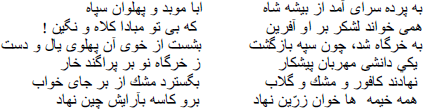
[nos. 24 and 24bis] The king came out of the forest to his sarāpardah, accompanied by the priests (mobād) and the pahlavāns of his army,
The whole army called praise upon the king and said: “God forbid the crown and the signet ring should be without you!”
While the army broke up, [Bahrām] went to the khargāh; he washed the sweat from his head and hands,
A wise and good domestic had removed the thorns from [around] the new khargāh,
Camphor, musk and rose-water had been put [inside] and he had spread musk on the bed,
He had [also] placed in the [other] tents (khaymah-hā) golden dining-tables and china cups upon them.
The way khargāh is mentioned for Isfandiyār is identical. After killing the lions (his second labor), the king returns to his khargāh and sarāpardah (no. 19).
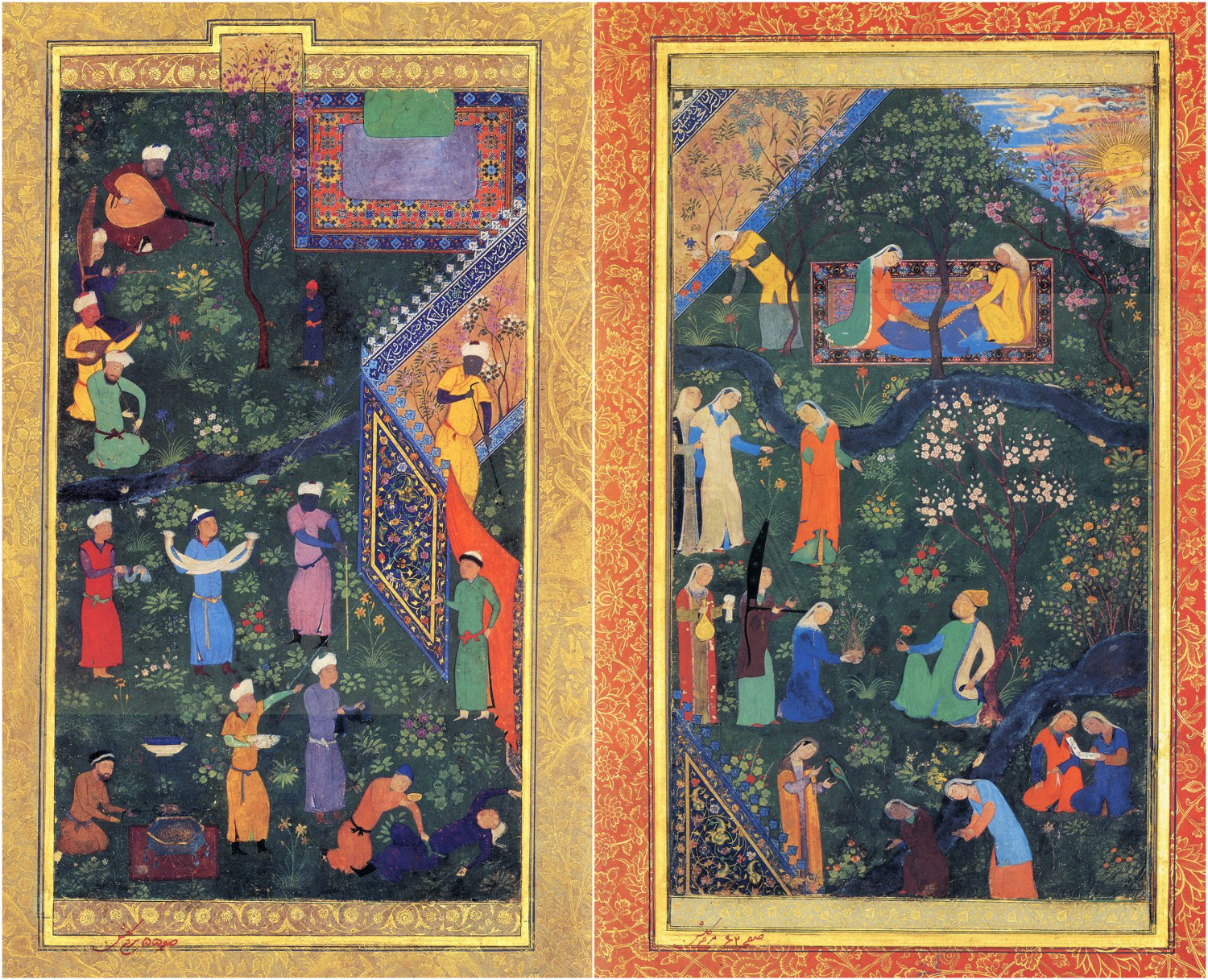
What is a sarāpardah? It is not a tent, but a cloth enclosure in which tents can be erected (see Fig. 3). The fact that sarāpardah is on several occasions abbreviated as pardah to comply with metric constraints is a clear indication of its form (pardah means curtain). As telling is the fact that al-Bundārī translates Persian sarāpardah as Arabic surādiq but never uses surādiq to translate khargāh or khaymah. It shows that a sarāpardah was not a tent.Footnote 51 Wolff gives two meanings for sarāpardah. One is “Zeltvorhang,” which is correct.Footnote 52 Another is “Königszelt, Fürstenzelt” (royal or princely tent), which is an interpolation. Indeed, none of the occurrences listed under this sub-entry indicates that sarāpardah could be anything other than an enclosure, and some occurrences explicitly contradict it. For example, the sarāpardah wherein Tūr and Salm are waiting for the return of their messenger to their half-brother Īraj is not a tent but a cloth enclosure:
When [the messenger] arrived in sight of the West, he saw that a sarāpardah had been erected in the plain,
He looked above the sarāpardah and the king of the West was inside (bi-pardah-andarūn),
A silken tent (khaymah) had been set up, equipped with a sitārah tent and everyone had turned away (jāy pardākhtah).Footnote 53
Because of its size, a sarāpardah is more visible than a tent from afar. That explains why Surkhāb, in the famous episode in which he gazes from a distance at the Iranian camp to spot his father Rustam, points to the sarāpardahs (each one of a different color) of the various pahlavāns, not to their tents.Footnote 54
Curtain Enclosure (Sarāpardah).
Source: Painting by Bizhād, ca. 1490, Muraqqaʿ Gulshan, 27, Tehran, Gulistān Museum.
The very function of the sarāpardah was to differentiate spaces, to set up a spatial hierarchy and, more specifically, to delineate the space of the leader (king or pahlavān). As such, it is not by chance that the term comes up so often in a work dedicated to kings and pahlavāns: there are 210 occurrences of sarāpardah in the Shāh-nāmah according to Wolff, nearly twice as many as khaymah, and six times more than khargāh (see Table 1). But unlike the sarāpardah, the khargāh was not a tool for distinction by itself. It is because we never see it used by ordinary Iranians on the one hand, and also because it is almost systematically associated with the sarāpardah that we can affirm that in Iran the khargāh was a status symbol as well.Footnote 55
What happened during the last audience of Kay-Khusraw is telling. The king gathered his pahlavāns and began to reward them with material gifts: he bequeathed his gardens to Gūdarz, his horses to Tūs, and his weapons to Gīv. But the most emblematic items of kingship he gave to his uncle Farīburz:

[no. 17] Palace (ayvān), khargāh, sarāpardah, as well as the khaymah and stall for the horses,
The king gave [them] to Farīburz son of Kāvūs, along with the armor, helmet and gilded hat.Footnote 56
The khargāh was a sign of the king’s presence, as much as the sarāpardah, the palace and the gilded hat. These items are bequeathed to Farīburz because he is the only person of royal blood (he is the king's uncle) and the only one who could have succeeded him had fate so decreed.
In this passage, the khargāh and the sarāpardah are associated in one hemistich, and khaymah and ākhur (stall) in another. The same format can be found elsewhere, as in the hunting parties of Bahrām Gūr (see above no. 23) or later of Khusraw Parwīz:

[no. 33] For the throne, the khargāh, the sarāpardah, as well as for the khaymahs and the stalls (ākhur) for the mounts,
More than five hundred camels had been chosen for this [hunting] party.
The first hemistich contains the royal paraphernalia (khargāh, sarāpardah, throne or palace), the other hemistich what is needed for the king’s retinue. In the description of Bahrām Gūr’s private quarters, there is one khargāh but several khaymahs. The former is the personal dwelling of the king while the khaymahs appears to be “service tents,” obviously of the guyed type.
Consequently, a guest of royal rank should be accommodated in a khargāh, not an ordinary khaymah. This happened to Dārāb, Ardashīr’s son abandoned at birth by his mother Humā. After he learned that the persons who had taken care of him were not his biological parents, he left and joined the army. On the campaign trail, he lacked everything: “he had neither khargāh nor sarāpardah nor khaymah nor companion nor guide” (no. 20).Footnote 57 But after a supernatural event convinced the army general that Dārāb was not an ordinary soldier, he showed him consideration and gave order to his servants:

[no. 21] He ordered that they find clothes and prepare a place [for Dārāb] in [his own] khargāh,
A fire like a mountain was kindled and a huge quantity of aloe-wood, musk and amber was consumed.
What distinguished the khargāh of the great courtiers (Iranian or Tūrānian) from the khargāh of the ordinary nomads was not its structure, but its size and furnishing. This is clearly shown by Bahrām Chūbīn’s decision to humiliate King Parmūdah not only by putting him into fetters, but also by installing him in a “narrow khargāh” (yikī tang khargāh shud jāy-i ū) (no. 28). For a king, size was of the essence.
Here again the result drawn from Firdawsī’s text echoes contemporary sources, in particular the highly reliable chronicle of Hilāl al-Sābiʿ (d. 448/1055). The Iraqi author reports that in 451/1060, after the Saljuq sultan Toghrïl Beg came to Iraq and rescued the Abbasid caliphate from the pro-Fatimid amir al-Basāsīrī, he ordered a khargāh erected for the Caliph al-Qāʾim.Footnote 58 Of course Toghrïl Beg was a nomad, a pure Tūrānian in Firdawsī’s categories. But strikingly, half a century before the Saljuqs conquered southwestern Asia, the khargāh was already an essential element of royal paraphernalia in Iran. The rich documentation available about Buyid kingship leaves no doubt about that. For example, when Amir Sharaf al-Dawla captured his brother Samsām al-Dawla in 376/987, he had a khargāh set up for him. Likewise, when their father ‘Adud al-Dawla received the Kurdish leaders in his Luristan campaign (371/982), his guests were “seated in a khargāh.”Footnote 59 It is because the khargāh/trellis tent was already a status symbol in the wider Iranian world (and Baghdad was part of it) that Caliph al-Qāʾim had no problem sitting in one—it would have been different, I presume, if the trellis tent had been associated exclusively with recently Islamized Turkish nomads.
Lastly, we may note that khaymah does not always have the technical sense of guyed tent opposed to khargāh/trellis tent. In the Shāh-nāmah like in other narrative sources, khaymah was also a generic term for tents. Let us consider the description of Afrāsiyāb’s camp after he fled the Iranians. Kay-Khusraw’s scouts made the following report:

[no. 15] Very soon a scout arrived from the plain and said: “The air is darkened by the dust raised up by the army,
Khargāhs and khaymahs fill the whole plain but there is nothing else: there is not one of their soldiers inside the khaymahs.”
In the first hemistich, khaymah and khargāh are two different kinds of tents (as the guyed tent type contrasts with the trellis tent type), while in the second hemistich, khaymah is to be understood in its generic sense, meaning that all the tents of the camp are empty. Consequently, khaymah can also refer to royal tents. For example, on his way to fight the Romans, Nūshīnravān stopped at the great fire temple of Ādhargushasp. After attending a religious ceremony with the priests, he had a khaymah set up in front of the temple, and in the presence of his troops, he gave instructions for the margraves (marzbān).Footnote 60 We cannot know what this tent looked like. However, in the aforementioned passage about Tūr and Salm, the silken khaymah inside the sarāpardah cannot be a trellis tent (the wooden structure of the trellis tent makes a silk covering very unlikely). It could be a luxury pole tent with a silken covering, like the ones so frequently represented on Persian paintings.
Let us sum up our argument. Given that when Firdawsī gives details, the khargāh is associated with kings or pahlavāns in Iran (no. 16, 17, 19, 20, 21, 23, 24), we can assume that the same is true in the other cases. In other words, the khargāh(s) mentioned in Iranian armies in items nos. 7, 9, 23, 25, 30 were for the king or his pahlavāns, and not for the rank-and-file soldiers. This is a noticeable difference from Tūrān where khargāhs were used for all social strata and embodied a social practice (rasm-i khargāh). In Iran the khargāh remained exclusively a status symbol. Its introduction at the court did not imply a change of lifestyle: the urban location of the Iranian court can be deduced from several facts. Like Kay-Khusraw’s order for his last audience to have the sarāpardah carried “outside the city,” which shows that his palace was inside the city (no. 16). This is also clear from the episode during which the Sassanid Khusraw Parvīz returns from his exile among the Romans to confront his rival Bahrām Chūbīn. One of his companions told him about the loyalty of one of his vassals, the Armenian king Mūshīl, who refused to submit to Bahrām Chūbīn:

[no. 29] He told him: “O sun-face king, why don’t you benevolently ask Mūshīl?
Because since you left Iran for Rum, he has not slept in a place inhabited and cultivated (ābād-būm).
The sarāpardah and the plain have become his abode, the khargāh and the khaymah his palace.”Footnote 61
From these verses we understand that in Iran the sarāpardah and the khargāh played in wartime the role played by the palace in peacetime.
Concluding Remarks
An overall analysis of the 33 occurrences of khargāh in Firdawsī’s Shāh-nāmah has shown that in this text, this word refers to a certain type of tent originating from Tūrān and adopted afterwards by non-Tūrānian elites as a status symbol. From this finding we can reach two conclusions. Firstly, the khargāh tent may be considered as the most outstanding example of exchange between Tūrān and Iran in the Shāh-nāmah. Unlike the social structure, which is from the start very similar in Tūrān and Iran (a king surrounded by his pahlavāns), and unlike some features which are specific to either world (for example, in Tūrān, the helmet with two feathers, the way of fastening one’s belt, and of course the turki language), the khargāh is an irrefutable loan item from Tūrān to Iran.Footnote 62 As such, it counterbalances everything that can be said about the irreducible opposition in the nature of Iran and Tūrān, opposition best symbolized by the “water versus fire” paradigm.Footnote 63 If Iranians (and beyond them Romans) could adopt a Tūrānian technique, this might be proof that the gap could be bridged.
This leads us to the second conclusion: the characteristics of the khargāh in the Shāh-nāmah perfectly fits the results obtained from narrative contemporary sources: the trellis tent was called khargāh in Persian (the expression al-qubba al-turkiyya was used in Arabic at first but was later replaced by kharkāh); it was used by elites and ordinary nomads alike in Turkic Central Asia before it spread in the Iranian (sedentary) world; in Iran it became a status symbol for the military and civil elites. Such an adequation confirms Kowalski’s thesis about the Tūrānians: “For Firdawsī, [Tūrānians] are always quite simply Turks without any distinction, the Turks whom he himself knew from direct observation, ultimately the Turks who were his contemporaries and whom he naïvely transported into the past.”Footnote 64
The fact that Firdawsī first mentions khargāh on the Iranian side during the reign of a king raised in Tūrān is truly astonishing. Is it mere happenstance or does it vouch for an unsuspected cohesion of the whole work? That is a vast question that cannot be addressed here but we hope that this short piece of research can play a part in the wider issue of the historicity of the Shāh-nāmah.