INTRODUCTION
Although speakers and addressees have a large repertoire of conventional lexical meanings, they can go beyond these to communicate a seemingly indefinite number of context-dependent meanings. Metonymy is one case of this, where an expression is used to refer to something that falls outside its conventional denotation, with a clear associative relation linking the conventional denotation and the contextually determined, metonymic one. Consider Nunberg's (Reference Nunberg1979) classic example in (1):
-
(1) The ham sandwich left without paying.
Uttered by one waiter to another in a restaurant, the expression the ham sandwich refers to the customer who ordered the ham sandwich, and exploits the immediate accessibility (or salience) of the associative relation between the customer and his order. Another common case is the use of names of artists or authors to refer to their works, as in Woolf is on the top shelf. While such metonymic uses by adults are common, little is known about how metonymy is understood or used by children. Do young children understand the pragmatics of metonymy, and do they use metonyms themselves? If so, when does this ability emerge in development?
Children rely early on their pragmatic abilities in word learning, and are sensitive to speaker intentions (Bloom, Reference Bloom2002), discourse status (Akhtar, Carpenter & Tomasello, Reference Akhtar, Carpenter and Tomasello1996), and speakers’ word choices (Clark, Reference Clark1997). Young children also make use of context in interpreting class extensions (Bushnell & Maratsos, Reference Bushnell and Maratsos1984), polysemy (Rabagliati, Marcus & Pylkkänen, Reference Rabagliati, Marcus and Pylkkänen2010), and, under some conditions, metaphors (Özçaliskan, Reference Özçalışkan2005) and scalar terms (Papafragou & Musolino, Reference Papafragou and Musolino2003; but see also Noveck, Reference Noveck2001). Does this early pragmatic skill extend to metonymy?
In this study, we investigate how three- to five-year-olds understand and produce novel metonyms. We tested their ability to understand and explain metonymic meanings in a comprehension task designed for their level of world knowledge and linguistic skill. We also looked at their ability to produce metonyms in two tasks. In the first, we focused on their use of metonymy as a shorthand device, and in the second, on its use in naming animates based on a salient property. Evidence that young children can manage metonymic meanings would support the view that preschool children start to use figurative language early, along with some of the relevant pragmatic inferences.
The pragmatics of metonymy
We can distinguish between two kinds of metonymy: referential metonymy, which relates one entity with another (e.g. The ham sandwich for ‘The customer who ordered the ham sandwich’, as in (1) above), and propositional metonymy, which relates two propositions (e.g. The athlete made it to the podium for ‘The athlete won a medal’) (Warren, Reference Warren2006). In this study, we focus on referential metonymy. The primary communicative function of referential metonymy is usually taken to be that of economizing on processing effort in making a reference. On this view, a metonym is a shorthand for a more elaborate expression, and the aim is quick and easy referent identification (Lakoff & Johnson, Reference Lakoff and Johnson1980; Nunberg, Reference Nunberg1979; Papafragou, Reference Papafragou1996). Metonymy as a shorthand device differs from linguistic abbreviation (or ellipsis), where actual words are omitted (e.g. uttering The Commons for The House of Commons), in that it picks out a salient aspect of a referent to ‘stand for’ the referent as a whole, and is therefore sometimes described as a form of “cognitive abbreviation” (Nerlich & Clarke, Reference Nerlich and Clarke2001, p. 255). A metonymic shorthand of course also involves a kind of linguistic abbreviation in the sense that, in most cases, there exists a readily available paraphrase (e.g. The ham sandwich vs. The customer who ordered the ham sandwich); however, it does not involve actual linguistic ellipsis.
Referential metonymy is often described as a ‘regular’ process, where metonymic expressions instantiate underlying patterns, either in the form of stable conceptual associations (so-called ‘conceptual metonymy’; cf. Lakoff & Johnson, Reference Lakoff and Johnson1980; Radden & Kövecses, Reference Radden, Kövecses, Panther and Radden1999) or even as the result of some kind of (lexical) rule (Apresjan, Reference Apresjan1974; Copestake & Briscoe, Reference Copestake and Briscoe1995; Frisson & Pickering, Reference Frisson and Pickering2007). For example, the metonymic relation producer for product is productive and makes it possible to understand the utterance John likes to read Needham as referring to books written by the author Needham, even though we might have never heard of this author before (Frisson & Pickering, Reference Frisson and Pickering2007). How are such metonymic patterns acquired? And are children as sensitive to them as adults? Our preliminary analyses of conversational interactions between children and their caregivers from the CHILDES database (MacWhinney, Reference MacWhinney2000) suggested that one productive metonymic pattern available to young children is component for game, linguistically realized as play NP, as in Let's play (the) zebras (‘the game that has zebras as a salient component’). Metonymy, then, could well serve early on as a productive referential strategy for young children.
While much has been said about metonymy as a shorthand referential device in the theoretical literature, another communicative function of referential metonymy has received less attention, namely its use to highlight a particular property of the referent, thereby giving rise to a slight (sometimes witty or playful) deprecation of the referent (e.g. The big mouth is coming to the meeting). In these cases, referential metonymy serves as a naming device, much as nicknames do, where a salient property of an individual or object is used to create a new name (Papafragou, Reference Papafragou1996). While the use of (derogatory) metonymic nicknames (e.g. Four Eyes, Chubby, Skinny Bones, etc.) is well documented among primary school children (Crozier & Dimmock, Reference Crozier and Dimmock1999), little is known about its use among preschoolers. Use of metonyms with a naming function might require more metalinguistic ability than simple shorthand uses, since the speaker replaces a conventional term with a new one to achieve a certain effect.
Children's metonymic skills
In metonymy, salient associative relations (typically, relations of contiguity) are exploited for the purpose of communication. The ability to identify such relations is present early on. Categorization studies show that hierarchical classification and identification of (part–whole) contiguity relations emerge early in the preschool years (Rosch, Mervis, Gray, Johnson & Boyes-Braem, Reference Rosch, Mervis, Gray, Johnson and Boyes-Braem1976). Also, many of children's early referential strategies exploit salient associative relations, and thus have an affinity with metonymy. Some iconic gestures made by infants bear a part–whole, ‘metonymic’ relation to the meaning represented, e.g. clapping hands for ‘baseball game’, smacking lips for ‘food’, and so on (Acredolo & Goodwyn, Reference Acredolo and Goodwyn1988; Kendon, Reference Kendon2004; Mittelberg, Reference Mittelberg2006). This is also true of some early referring expressions, e.g. onomatopoeias such as bow-wow for ‘dog’, and vroom-vroom for ‘vehicle’, and some strategies young children use to fill gaps in their vocabulary. For instance, overextensions based on perceptual, spatio-temporal, and functional contiguity (e.g. toy for ‘a bag which habitually contains toys’, cf. Huttenlocher & Smiley, Reference Huttenlocher and Smiley1987), could be viewed as precursors to metonymy (Nerlich, Clarke & Todd, Reference Nerlich, Clarke, Todd, Panther and Radden1999). Also, when children coin new words, one highly productive strategy they rely on in English is zero-derivation, that is, the use of nouns as verbs (e.g. to gun for ‘to shoot’). Children begin to rely on this option as young as age two (Bushnell & Maratsos, Reference Bushnell and Maratsos1984; Clark, Reference Clark, Wanner and Gleitman1982). These lexical innovations appear to follow the ‘metonymic’ rule that almost any noun denoting an object can be used as a verb for talking about some state, process, or activity associated with that object (Clark & Clark, Reference Clark and Clark1979; Schönefeld, Reference Schönefeld, Bauer and Valera2005). Another productive operation for coining nouns is compounding, and young English-speaking children frequently construct novel root compounds for subcategories (Clark, Gelman & Lane, Reference Clark, Gelman and Lane1985; see also Konieczna & Kleparski, Reference Konieczna and Kleparski2006), some of which could be metonymically motivated (e.g. clown-boy for ‘the boy who is a clown’, daddy-seed for ‘the seed that is a daddy’), highlighting a salient characteristic of the entity in question. In short, since even very young children exploit salient associative relations for the purpose of communication, the main prerequisite for metonymy use appears to be present early on. Does metonymy serve a communicative function similar to other early referential strategies attested in compensating for vocabulary gaps and/or limited expressive ability?
Note that the notion of metonymy used throughout this paper is broader than the one assumed by classical rhetoric, where the speaker is seen as consciously ‘replacing’ a conventional, literal expression with a related metonymic one. Instead, we follow contemporary pragmatic theory which, drawing on theoretical arguments and evidence from psycholinguistic studies, rejects such a sharp distinction between figurative and literal utterances and proposes that figurative utterances, which arise naturally and spontaneously for purposes of communication, exploit features that also occur in a range of ordinary ‘literal’ utterances (Wilson & Sperber, Reference Wilson and Sperber2012). In referential metonymy, the speaker exploits accessible associative links in making a reference. In this way, a use of what we call a ‘referential metonym’ would depend on the ability to recognize and make use of such associative links in identifying a referent, but would not necessarily have to involve knowledge of the conventional term for the intended referent (though this would typically be the case in more sophisticated uses).
Figurative language development: metaphor and metonymy
Most research on figurative language development has focused on children's ability to produce and understand metaphor (e.g. John is a lion ), a matter of debate for several decades (see Gibbs, Reference Gibbs1994, for a review). Earlier studies observed that children tended to interpret metaphors literally, and concluded that metaphor comprehension was a complex skill that did not emerge until late in development (e.g. Asch & Nerlove, Reference Asch, Nerlove, Kaplan and Wapner1960; Billow, Reference Billow1975; Winner, Rosenstiel & Gardner, Reference Winner, Rosenstiel and Gardner1976). Some researchers also proposed that there is a ‘literal stage’ in figurative language development, characterized by a tendency towards literal interpretations, before children attain a more sophisticated level of figurative use (e.g. Levorato & Cacciari, Reference Levorato and Cacciari2002; Winner, Reference Winner1988/1997). However, more recent studies suggest that the lack of comprehension found in earlier studies of metaphor may have resulted from the complexity of the tasks, and in fact attest to an early metaphoric ability in both comprehension and production, emerging during the preschool years (see Deamer, Reference Deamer2013; Gottfried, Reference Gottfried1997; Özçalışkan, Reference Özçalışkan2005; Pouscolous, Reference Pouscolous2011).
Few studies have explored children's metonymic skill directly, and, to the best of our knowledge, none has investigated preschoolers’ ability to produce metonyms. In one comprehension study with a forced-choice task, Nerlich et al. (Reference Nerlich, Clarke, Todd, Panther and Radden1999) found that four- and five-year-olds outperformed two- and three-year-olds, but both groups did better when they received ‘clues’ that made the association between the literal and metonymic reference explicit. Another study compared comprehension of metonyms and metaphors with conventional figurative meanings, from age five to thirty-seven years (Rundblad & Annaz, Reference Rundblad and Annaz2010). Overall performance improved with age, but comprehension developed more slowly for metaphors than for metonyms. This was interpreted as supporting the view that metonymy is more basic, cognitively, than metaphor.
These studies raise a general methodological question: Were the researchers in fact measuring vocabulary the children had already acquired or their pragmatic skill with metonyms? When children acquire lexicalized metonyms (e.g. Lego, where the name of the brand is used to refer to the toy bricks), they do not necessarily make the association that renders the metonym transparent; rather, the metonym could be acquired as a conventional term for the referent in question – only later will they learn that Lego is a brand name. While understanding a novel metonym requires pragmatic skill and relies on contextual knowledge to license the metonymic association, comprehension of a lexicalized metonym may simply depend on whether the child has already acquired its conventional meaning.
A recent study investigated novel metonym and metaphor comprehension and found that comprehension increased with age, with some metonyms and metaphors understood even by the youngest participants, aged three (Van Herwegen, Dimitriou & Rundblad, Reference Van Herwegen, Dimitriou and Rundblad2013). This suggests an early-emerging pragmatic capacity for dealing with novel figurative meanings, thus supporting recent results on metaphors. While providing some insight into the metonymic ability of preschoolers, this study mainly aimed at comparing the long-term developmental trajectories of novel metonym and metaphor understanding in typically developing individuals and individuals with Williams syndrome. To gain a clearer picture of metonymic ability, we need research on preschoolers’ comprehension and production of metonyms.
Hypotheses
We began this research with the following expectations:
-
1. Given the evidence of some early figurative language ability in young children, we expected that, if children were presented with novel metonyms in a context where the underlying association was perceptually available and primed by the linguistic context, they should be able to understand some novel metonyms. We also expected children to get better at interpreting and explaining metonymic meanings with age (Task 1).
-
2. Given their attested early ability to make use of salient associative relations for communicative purposes, combined with some figurative understanding, we expected children to be able to produce some metonyms at an early age. Our first elicitation task was designed to test whether referential metonymy offered children a strategy for referring with shorthands rather than ‘more literal’, descriptive phrases that might be more demanding syntactically or conceptually (Task 2). Metonymy might be a more economical alternative in planning terms, by allowing children to seize on a salient property of the referent with which to pick out the whole. Our second elicitation task focused on referential metonymy with a naming function, testing whether young children could create metonymic names for individuals based on salient characteristics (Task 3). Since metonymic naming might require more metalinguistic skill, we expected that the ability to produce this kind of referential metonymy would be acquired later. In this task, we also looked at whether children were helped by exposure to examples of common metonymic uses (e.g. property for individual).
EXPERIMENTAL TASKS
We collected data with three different tasks from forty-seven children and twenty-seven adults: the first task tested metonymy comprehension, and the second and third tested metonymy production. Each task was presented as a game, so the study as a whole was perceived as a game session by the children.
The children fell into three age groups: 20 three-year-olds (M = 3;6, SD = 0;4); 14 four-year-olds (M = 4;6, SD = 0;3); and 13 five-year-olds (M = 5;4, SD = 0;3). Half the children in each group were female, half male. The children were from largely middle- to upper-class families, ethnically representative of the population in the Bay Area of Northern California, and all were acquiring English as a first language.
The adults were twenty-seven native English-speaking undergraduates at Stanford University. Half were female, half male. They received class credit for their participation.
TASK 1
The goal of the first task was to find out whether three-, four-, and five-year-olds understand novel metonyms, and whether they can reason verbally about their meanings. Unlike earlier studies (Nerlich et al., Reference Nerlich, Clarke, Todd, Panther and Radden1999; Rundblad & Annaz, Reference Rundblad and Annaz2010; but cf. Van Herwegen, et al., Reference Van Herwegen, Dimitriou and Rundblad2013), we relied on novel metonyms based on part–whole relations, with a salient physical property used to make reference to a person. By using novel metonyms, we avoided the problem of determining whether a metonymic interpretation signalled actual understanding or simply prior acquisition of a conventional meaning. We used a forced-choice story task with pictures, where the metonyms were all transparent in that they depended on perceptually available information. The contextual information needed to make a correct metonymic interpretation was immediately accessible, so comprehension did not require activation of any background knowledge. We therefore expected some metonyms to be understood by even the youngest children, and a general increase in metonymic skill with age.
We also asked children to explain their choices. We expected that the ability to reason about metonymic meanings would improve with age, but that this kind of reflection might emerge later than comprehension itself, as has been shown for children's explanations of metaphorical meanings (Özçalışkan, Reference Özçalışkan2005).
METHOD
Materials
The stimuli consisted of ten sets of four pictures, each set presented in two steps. First, the experimenter showed a large picture (see Figure 1) that introduced a scenario involving two or more people, one of whom had a salient characteristic, e.g. a pair of giant ears, a brightly coloured hat, a bicycle helmet, etc. While showing the picture, the experimenter told a short story, the last part of which contained the target sentence mentioning the salient property. In the metonymic condition, the target referred metonymically to the bearer of the property, as in (2):
-
(2) This story is about these two girls. They are standing outside talking before going home from work. After they have been talking for a while, the helmet gets on her bike and rides home.
Fig. 1.Sample stimuli for Task 1: introductory picture for ‘the helmet’ story.


In the literal condition, the target referred directly to the property itself, as in (3):
-
(3) This story is about these two women. They are doing the dishes. It gets very hot in the kitchen, so the bright jacket is placed on a chair.
The linguistic context of the stories supported the intended – metonymic or literal – reading. Next, the experimenter showed three small pictures, close-ups of each individual in the story and the salient property by itself (see Figure 2), and children had to choose the matching picture from this set.
Sample stimuli for Task 1: answer set for ‘the helmet’ story.

The pictures were taken by the first two authors, colour printed, and plasticized. One set was used in a warm-up trial, and the remaining nine sets in experimental trials. The experimental items consisted of six metonymic stories and three literal stories.
Procedure
The task was presented as a game and took about 12 minutes to complete. The child was first shown the warm-up picture set, followed by the other nine. Order of presentation was randomized across subjects and ages. For each picture set, the experimenter told the child a story while showing the first picture (Figure 1). After the final, target sentence, the experimenter asked the child to pick out the picture (from the next three) that matched the story. The child had the following choices:
-
Figure 2a: The bearer of the property (i.e. the metonymic referent).
-
Figure 2b: The property by itself (i.e. the literal referent).
-
Figure 2c: Another participant in the story (i.e. a distractor).
If necessary, the experimenter repeated the story. At the end, the experimenter asked the child to explain her choice (Why did you choose that picture?). The same procedure was followed with adults.
RESULTS
The participants’ answers to the nine forced-choice questions were treated as a categorical variable and coded as metonymic reading, literal reading, or distractor. Since children chose the distractor in only a small number of cases (5% in the metonymic condition, 3% in the literal condition), we discarded these responses in subsequent analyses.
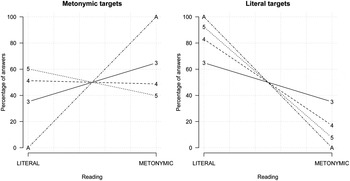
Figure 3 presents the percentages of metonymic and literal readings in the two conditions by age (three, four, five, and adult).
Percentages of literal and metonymic readings in the two conditions (metonymic vs. literal targets) in Task 1: 3 = Three-year-olds (nmet = 108; nlit = 57), 4 = Four-year-olds (nmet = 80; nlit = 41), 5 = Five-year-olds (nmet = 78; nlit = 39), A = Adults (nmet = 162; nlit = 81).

Metonymic and literal conditions
Using SPSS, we analyzed the data using logistic regression, which is more appropriate for categorical data than ANOVA (see Jaeger, Reference Jaeger2008). Adults were not included in the logistic regression analyses given their ceiling performance in both conditions (cf. Figure 3) and the absence of variance in their responses.
We examined comprehension of the target items as a function of the predictor variables age (three vs. four vs. five, with three as the baseline) and condition (metonymic vs. literal, with metonymic as the baseline). To examine age differences in comprehension in the two conditions, we included an interaction term between age and condition. The analysis revealed a significant main effect of age (p = ·004) and a significant interaction between age and condition (p < ·001). First, in measuring the effect of age at baseline, we observed that, compared with three-year-olds, four-year-olds were less likely to choose metonymic readings of metonymic targets (B = –0·66, OR = 0·52, p = ·028, 95% CI [·29, ·93]), and five-year-olds even less so (B = –0·97, OR = 0·38, p = ·001, 95% CI [·38, ·69]), In other words, there was a decrease in the number of correct metonymic readings, and an increase in the number of wrong literal readings, from age three to five.
Second, to examine age differences within the literal condition, we ran an additional logistic regression with the same dependent and predictor variables as before but with literal as the baseline for condition. This analysis also showed a significant main effect of age on comprehension (p = ·008). Compared with three-year-olds, both four-year-olds (B = 0·97, OR = 2·63, p = ·053, 95% CI [0·99, 6·99]) and five-year-olds (B = 1·87, OR = 6·49, p = ·005, 95% CI [1·77, 23·74]) were more likely to provide a correct interpretation for a literal target (although the effect was only marginally significant for the four-year-olds), and comprehension improved with age. This trend is the inverse of that observed in the metonymic condition, where the youngest children outperformed the older ones.
Comparison of the two conditions
A simple logistic regression analysis of the effect of condition (metonymic vs. literal) on the dependent variable type of reading (metonymic vs. literal) showed a clear effect of condition on type of reading (p < ·001), with children overall being more likely to choose a metonymic reading in the metonymic condition than in the literal condition (B = 1·40, OR = 4·02, 95% CI [2·52, 6·44]). This suggests some early understanding of novel metonymy among children aged three to five. However, the significant interaction between age and condition (p < ·001) showed that age affected comprehension in both conditions. First, we observed that condition had no effect on three-year-olds’ comprehension of target items (p = ·990), which suggests that they did not find the metonyms harder than the literal items. Second, the interaction analysis showed a clear effect of condition for four-year-olds (Interaction odds ratio (IOR) = 2·63/0·52 = 5·06), who were about five times as likely to give correct answers in the literal than in the metonymic condition, and a large effect on five-year-olds’ comprehension in the two conditions (IOR = 6·49/0·38 = 17·07). This group was about seventeen times more likely to provide a correct answer in the literal condition compared to the metonymic condition. Thus, children appeared to have more difficulty with novel metonyms as they got older.
Explaining their answers
Next, we examined the explanations children gave for their choices in the metonymic condition. Adults were excluded from this analysis as well, given their ceiling performance. Children's explanations of their correct interpretations of novel metonyms fell into three categories:
-
• A relevant explanation demonstrated clear understanding. This could involve making the association between person and property explicit (e.g. Because the girl has a helmet), substituting the metonymic for the literal referent, suggesting that the child had made the relevant association (e.g. Cause she's about to ride home), or rejecting the literal content of the target sentence (e.g. Cause the moustache is sitting down first. [Pointing to the literal referent]: Not this one, where the moustache is sitting down alone.).
-
• A semi-relevant explanation involved repetition of the metonym (e.g. Cause that's the big beard) or a paraphrase of the target sentence.
-
• An irrelevant explanation was uninformative as to whether the child had understood the metonym (e.g. Cause it's pretty). We also included in this category cases in which children provided no answer.
Where children had given a wrong literal interpretation of the novel metonym, we divided their explanations into three additional categories:
-
• acceptance included what seemed to be straightforward acceptance of the literal meaning (e.g. Cause the helmet is on the bike riding home).
-
• explicit comment was for cases where the child chose the literal interpretation but commented on its absurdity (e.g. But the helmet can't ride a bike!) and/or on what the speaker had actually ‘said’ (e.g. Cause this one has the helmet, you didn't say the person with the helmet).
-
• irrelevant answers were uninformative or irrelevant explanations (e.g. Cause that's the right picture), as well as those cases where children provided no answer.
To check inter-rater agreement, the first two authors coded 100 explanations randomly selected from the children's explanations for Task 1. They were unaware of the child's age when coding the answers. We used Fleiss’ kappa (Fleiss, Reference Fleiss1971), measured using the irr package in R: κ = ·86. According to Landis and Koch (Reference Landis and Koch1977), a κ value above ·81 indicates almost perfect agreement.
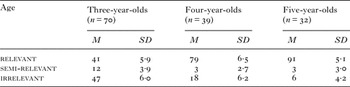
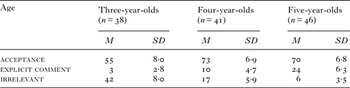
The percentages of children's explanation types are presented in Tables 1 and 2. Table 1 shows that for metonymic interpretations, all ages tended to offer relevant explanations. A simple logistic regression analysis of the effect of age (three-year-olds vs. four-year-olds and five-year-olds) on the production of relevant explanations was significant (p < ·001). Compared with the three-year-olds, both four-year-olds (B = 1·70, OR = 5·48, p < ·001, 95% CI [2·20, 13·63]) and five-year-olds (B = 2·62, OR = 13·67, p < ·001, 95% CI [3·78, 49·17]) were more likely to produce explanations of this type. However, an additional simple logistic regression analysis, with the same predictor and dependent variables but using five-year-olds as the baseline category for age, showed that the difference between the four-year-olds and the five-year-olds was not significant (p = ·207).
Percentages and standard deviations of explanation types for metonymic readings of metonymic items in Task 1, by age

Percentages and standard deviations of explanation types for literal readings of metonymic items in Task 1, by age

Inversely, there was a decrease in irrelevant explanations with age for correct metonymic interpretations. A simple logistic regression showed a significant effect of age on this explanation type (p < ·001), with four-year-olds (B = –1·41, OR = 0·25, p = ·003, 95% CI [·10, ·63]) and five-year-olds (B = –2·59, OR = 0·08, p = ·001, 95% CI [·02, ·34]) significantly less likely to provide irrelevant explanations than three-year-olds. A similar age effect was found for irrelevant explanations of literal interpretations (see Table 2), with three-year-olds more likely than the other two age groups to provide such explanations (three-year-olds vs. four-year-olds: B = –1·26, OR = 0·28, p = ·001, 95% CI [·10, ·80], three-year-olds vs. five-year-olds: B = –2·34, OR = 0·10, p = ·001, 95% CI [·03, ·37]).
Finally, a simple logistic regression showed an effect of age on the production of explicit comments for literal interpretations of metonyms (p = ·031), with five-year-olds more likely to produce explanations of this type than three-year-olds (B = 2·45, OR = 11·63, p = ·022, 95% CI [1·43, 94,83]). However, three-year-olds and four-year-olds did not differ here (p = ·225).
DISCUSSION
Overall, these results show that children as young as three appear able to understand novel metonyms when the context makes the association transparent, but that, contrary to expectation, children did less well as they got older. Our results also show that their reasoning about metonymy improves with age, although only for those children within each group who interpreted the metonyms correctly.
All the children had some way to go to attain adult levels of understanding. Compared with adults, always correct in both conditions, children overall provided contextually appropriate metonymic interpretations only about half the time. Still, they provided significantly more metonymic interpretations for metonyms than for literal items. And their explanations for correct interpretations show that, in most cases, their answers did indeed signal understanding. However, the four- and five-year-olds appeared to find literal items easier to understand than metonyms.
Children's growing preference for literal interpretations appeared, at first, quite puzzling. What could cause three-year-olds’ performance to be closer to that of adults than to that of children only a year or two older? A ‘U-shaped’ development has been observed in several cognitive domains (e.g. Karmiloff-Smith, Reference Karmiloff-Smith1992). One well-known example comes from the acquisition of morphology, where children use correct irregular forms, then over-regularize them, and finally produce the correct forms, as in the verb went > goed > went in English (Bowerman, Reference Bowerman, Stavy and Strauss1982; Ervin, Reference Ervin and Lenneberg1964). This has been hypothesized to be part of the process of developing the underlying cognitive representational systems involved, so that, despite adult-like performance, the youngest children rely on strategies different from those of adults. Let's suppose that in metonymy comprehension, three-year-olds are using a pragmatic interpretive strategy that is ‘naively optimistic’ (Sperber, Reference Sperber and Khalfa1994) in the sense that they take the first appropriate interpretation that comes to mind in context to be the one intended by the speaker. This might involve seizing on anything that allows identification of a referent (e.g. the helmet, the moustache, etc.), based on the contextually available associative link between the property and its bearer. This interpretation would be the most accessible, least effortful one that, at the same time, brings about a satisfactory result (i.e. it is ‘relevant’ in Sperber and Wilson's terms, Reference Sperber and Wilson1986/1995): in the present case, it would match the story, be compatible with what children know about the world, allow further inferences about what will happen next, and so on. Children who use such a naively optimistic strategy will accept the outcome as a good enough interpretation of the speaker's intended meaning. In the metonymic condition, where the context supported the metonymic interpretation, there would often be overlap between the meaning arrived at via a naive interpretation strategy and the one intended by the speaker. Our data provide some evidence that the youngest children were indeed employing such a strategy: three-year-olds hesitated much less than older children in making their interpretations. So even though they were often successful in their interpretations of novel metonyms, the three-year-olds could have been using a different interpretive strategy in which they went immediately for the first interpretation that was accessible and relevant. Adults, however, are likely to have used a more sophisticated strategy, in which they inferred that the speaker plausibly intended them to identify the metonymic referent on the basis of her utterance, the contextually available associative link between the property and its bearer, and the contextual evidence provided by the story (i.e. they were ‘sophisticated understanders’ in Sperber's terms, Reference Sperber and Khalfa1994).
One possible objection here might be that rather than identifying referents on the basis of metonymic associations, the three-year-olds were using some kind of primitive interpretation strategy where people are treated as agents by default, so they always chose a person as the intended referent. But notice that most children picked the person with (not the one without) the salient property, which shows that something more than a person-as-default-agent strategy must be in play. It is possible that the property-for-person pattern could be one of the earliest forms of metonymy proper to emerge in young children because of the prototypical mapping of people and agents. This also underlies adult uses of this metonymic pattern.
As an explanation of the older children's tendency to choose literal interpretations of novel metonyms, we propose that it could be a by-product of their growing metalinguistic awareness – their ability to reflect on language and its use (Gombert, Reference Gombert1992; Karmiloff-Smith, Reference Karmiloff-Smith1992; Tunmer, Pratt & Herriman, Reference Tunmer, Pratt and Herriman1984). Metalinguistic awareness is clearly present in four-year-olds (Doherty & Perner, Reference Doherty and Perner1998). They recognize that words are objects in themselves, and have meanings that can be abstracted from contexts. For instance, it is at age four to five that children show some delight in responding to indirect requests like Can you open the window? with Yes and a smile. This metalinguistic awareness could play a role in distinguishing between what is said (literal) and what is communicated (pragmatic), an ability that has been found to emerge around the same age (Vosniadou & Orthony, Reference Vosniadou and Orthony1983). This might lead children to overemphasize literal meanings, and so result in the literal preference we observed. There is some support for this in children's explanations in the metonymic condition: the older children, five-year-olds in particular, frequently hesitated between a literal and a metonymic answer. Furthermore, they sometimes commented explicitly on the literal content of the utterance with the metonym, usually with reference to its nonsensicality (Girl (5;4): “Because the glasses are reading. [Laughs]. Glasses can't read.”), or referred back to what the experimenter had actually said in her utterance (Boy (5;2): “Cause the giant ears are going to drive. That's what you said.”). This type of explicit reflection was almost entirely absent in three-year-olds.
The literal bias shown by older children, then, could be due, not to an inability to understand novel metonyms, but to a conflict between two highly activated interpretations, one focused on linguistic meaning, the other on speaker meaning – a conflict that will eventually be resolved as children's linguistic and pragmatic abilities mature further. So the outcome here, where children's metalinguistic reflection leads to a wrong result, gives the impression of poorer metonymic skill in the older children, while they are in reality attending to a larger picture than the younger children. Note also that in the metonymic condition, the metonymic interpretation should be easier to derive than the literal one: in context, the perceptually available association between the property and its bearer, combined with children's knowledge of the world, should make it more accessible, which could explain why three-year-olds did well. In this way, the four- and five year olds might be using a more ‘cautious’ interpretation strategy (Sperber, Reference Sperber and Khalfa1994), in which they are able to take into account that the speaker might have misjudged what would be most accessible or relevant to them. At the same time, their reflections on literal sentence meaning might have caused them to lose track of what the speaker might plausibly have intended to convey by her utterance.
It is tempting to ask whether this possible conflict between literal and speaker meanings is what earlier studies of metaphor comprehension tapped into, concluding that children are unable to understand metaphors (e.g. Asch & Nerlove, Reference Asch, Nerlove, Kaplan and Wapner1960; Billow, Reference Billow1975; Winner et al., Reference Winner, Rosenstiel and Gardner1976), and whether their results might have been different had they tested children under age four.
Another factor that might have influenced the five-year-olds’ literal answers is their ability to work with story worlds. By age five, children have usually seen many cartoons (e.g. Dora the Explorer) and are willing to accept that characteristics of the world they know can be violated. How this story world ability might interact with figurative language skills in forming hypotheses about speaker-intended meanings, though, remains an issue for further investigation.
Our finding that children's explanations of novel metonymic meanings improved with age for those children who provided correct metonymic interpretations, with four- and five-year-olds demonstrating metonymic understanding in their explanations significantly more often than three-year-olds, is consistent with previous findings on children's ability to put metaphorical meanings into words (Keil, Reference Keil1986; Özçalışkan, Reference Özçalışkan2005; Stites & Özçalışkan, Reference Stites and Özçalışkan2013). Although the older children chose metonymic interpretations less often than the younger ones, they demonstrated more explicit understanding of metonymy.
There was also a decrease with age in irrelevant explanations for correct interpretations of the metonyms. However, an irrelevant explanation should not be seen as evidence for a lack of understanding, given that understanding usually precedes the ability to paraphrase or explain (Özçalışkan, Reference Özçalışkan2005; Vosniadou, Reference Vosniadou1987; Winner, Engel & Gardner, Reference Winner, Engel and Gardner1980). We found the same pattern for literal interpretations of novel metonyms. Not only does children's ability to reason about metonymic meanings improve, but their metalinguistic ability allows for more explicit reflection on both linguistic and communicated meanings overall.
TASK 2
Our second and third tasks focused on whether three- to five-year-olds can produce referential metonyms, and, if so, whether these include metonyms with both shorthand and naming functions. Task 2 focused on referential metonyms used as shorthands, and looked at whether metonymy offers a useful referential strategy for children in place of fuller referring expressions that might be more demanding syntactically and/or conceptually.
As our analysis of the CHILDES corpus revealed, play NP (giving rise to the metonymic relation component for game) appears as a productive pattern by age three, e.g. “I was playing cherry” (3;0, CHILDES, Eng-USA/Weist/emi13.cha). We find the play NP pattern both in children's speech and adults’ child-directed speech, e.g. “You like to play zebras?” (3;2, CHILDES, Eng-USA/Weist/ben10.cha). We made use of this pattern to test whether preschoolers could produce a metonym as shorthand to refer to a game for which they did not know the name (play-context), or whether they would prefer to use a fuller, more ‘literal’, descriptive phrase. As before, we were concerned with whether children could come up with novel metonyms given an appropriate context.
We expected younger children to produce more metonyms and fewer descriptions than older children and adults. Since their expressive abilities are less developed, use of metonyms as shorthands might be particularly useful as a communicative strategy early on.
METHOD
Materials
We designed two pairs of simple games using familiar objects:
-
Set 1: Straws. The player had to put one straw inside a plastic glass, then two straws inside a second glass, and so on, and fill as many glasses as possible in 20 seconds. Marbles. The player had 20 seconds to iteratively place a glass upside down and a marble on top to build the largest possible tower.
-
Set 2: Magnets. The player was given several small magnets and a large black magnet board, and had 20 seconds to stick as many magnets on the board as possible. Stickers. The player was given several small stickers and a sheet of paper, and had 20 seconds to place as many stickers on the paper as possible.
Procedure
The task, presented as a game, took about 5 minutes to complete. The experimenter started by saying Now you get to choose which game we play. I have two games for you to choose from. Let me show you what they are. Children were shown the two games of a set, one after the other. The experimenter did not name the games, but gave each child the instructions for playing them, demonstrating with the objects involved (In the first game, you get to use a board and some magnets. You have 20 seconds to put as many magnets on the board as you can. In the other game, you get to use paper and some stickers. You have 20 seconds to put as many stickers on the paper as you can). Then she put the two games out of sight and asked Which of the two games would you like to play?, in this way forcing the child to come up with a referring expression for one of the games. After letting the child play the game chosen, the experimenter asked if the child wanted to play the second game (So, do you want to play the other game too?), to which the child always answered affirmatively. The experimenter then asked the child to tell her which one it was (Which one did you want to play?), and so elicited a referring expression for the second game too. The same procedure was followed for the second pair of games.
The same procedure was followed with adults, but they were told that the task was aimed at children and that they did not have to actually play the games if they did not want to.
RESULTS
We classified the four referring expressions produced by each participant into one of the following types:
-
i. metonym (e.g. the stickers, the marbles)
-
ii. compound (e.g. the sticker game, the marble one)
-
iii. description (e.g. the game with the stickers, the game where you time me for the marbles)
-
iv. other (e.g. don't know)
-
v. na (if the participant did not give any answer)
As in Task 1, the first two authors rated a random set of 100 answers to check inter-rater agreement, and obtained a high value: κ = ·94. The na cases, which amounted to 9% of the sample, were treated as missing data and excluded from the overall analysis. However, we observed that, with a few exceptions, three-year-olds were responsible for most nas, suggesting that this age group had more difficulty than the others. Some of the youngest children seemed to find it hard to remember the game presented as the first of the two in each set, especially after playing the other (second) game.
The dependent variable of answer type was treated in two ways in the analyses. In order to investigate our hypothesis that metonymy might be a particularly useful referential strategy for children, as well as our expectation that younger children would produce more metonyms and fewer descriptions than the older children and adults, we first treated each individual answer type (metonym, compound, and description) as a dichotomous variable, and analyses were performed using logistic regression. Then, in order to compare the production of answer types (metonym, compound, and description) between ages (three, four, five, plus adults), we treated answer type as a multilevel categorical variable, with analyses performed using multinomial regression.
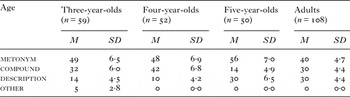
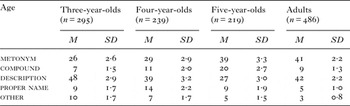
In the first, logistic regression analyses we examined the differences in age for each answer type (see Table 3). We started by investigating production of metonyms as a function of age (three, four, five, and adults), with three-year-olds as the baseline for age. The analysis revealed no significant differences between three-year-olds and the other age groups (p = ·268). For compounds, there was a significant effect of age (p = ·026), with five-year-olds less likely to produce compounds than three-year-olds (B = –1·07, OR = 0·34, p = ·030, 95% CI [·13, ·90]). However, four-year-olds (p = ·272) and adults (p = ·826) did not differ from three-year-olds. Finally, for descriptions, we found a significant effect of age (p = ·009), with five-year-olds (B = 1·01, OR = 2·73, p = ·040, 95% CI [1·05, 7·14]) and adults (B = 0·99, OR = 2·68, p = ·023, 95% CI [1·15, 6·30]) more likely to produce descriptions than three-year-olds. Four-year-olds, however, did not differ significantly from three-year-olds (p = ·521).
Percentages and standard deviations of answer types elicited in Task 2, by age

In the second, multinomial regression analysis, we investigated the effect of age on the dependent variable of answer type (metonym, compound, and description), with metonym as the baseline, and the productions of four-year-olds, five-year-olds, and adults against those of the three-year-olds (metonyms: 49%, compounds: 32%, and descriptions: 14%). (other answers were removed due to the zero values for adults, four-year-olds, and five-year-olds.) For compounds vs. metonyms, there were no significant differences at any age, although five-year-olds tended to produce fewer compounds than metonyms compared with three-year-olds (B = –0·96, OR = 0·38, p = 062, 95% CI [·14, 1·05]). For descriptions vs. metonyms, adults were about three times as likely to produce descriptions over metonyms compared with three-year-olds (B = 0·99, OR = 2·70, p = ·032, 95% CI [1·09, 6·68]), but the comparisons between three- and four-year-olds (p = ·611) and three- and five-year-olds (p = ·195) were not significant.
DISCUSSION
These results support use of the form play NP as a productive metonymic pattern for both children and adults. More generally, the results support the view that preschoolers (and adults) use metonyms, that is, shorthand referential expressions based on associative conceptual links, in referring to things in the world around them.
Children's reliance on metonyms rather than compound nouns or descriptions in the play-context suggests that this pattern might be particularly useful to them as a referential strategy, compared to adults, who showed no preference for any one strategy over another. While there were no age differences in children's preference for metonyms, our results support the expectation that younger children would produce fewer descriptions than the older children and adults. Could it be that metonymy is more important as a referential strategy in the earlier stages of language acquisition, when children's vocabulary and expressive abilities are more limited? Notice that a metonym in the form of a noun phrase is simpler than a full descriptive phrase syntactically, and, perhaps, conceptually as well, being less costly in terms of short-term memory or planning for speaking.
One objection here might be that it is the conventionality of the play NP pattern that is responsible for the metonyms produced, rather than this reflecting a preference for metonymy as a referential device more generally. But even if play NP were stored as a linguistic unit in the child's memory (cf. Arnon & Snider, Reference Arnon and Snider2010), its use still requires the ability to pick out a salient feature of a game and use that to identify the game as a whole – in other words, it requires some metonymic ability.
The finding that the younger children produced more compounds to name the games is consistent with previous work on children's use of novel root compounds (e.g. Clark et al., Reference Clark, Gelman and Lane1985). In the play-context, their noun–noun compounds could also be analyzed as metonymic (cf. Konieczna & Kleparski, Reference Konieczna and Kleparski2006), since the children used, as the referent of the modifier noun in the compound, a part of the game that they found salient or that they could remember easily (e.g. the sticker game). Our results reveal for the first time that in addition to the well-documented process of compounding, metonymy offers young children another option for referring to entities for which they lack a conventional term. This also shows the close relationship that exists between metonymy and noun–noun compounding: both processes are based on the exploitation of salient associative relations and may serve similar communicative functions (Wilson & Falkum, Reference Wilson and Falkum2014).
TASK 3
Our third task was designed to further explore children's ability to produce metonyms. This time we used an open naming task and focused on metonyms with a naming function. Our goal was to see whether children were willing to take a salient property of an individual (person, animal, fantasy creature) and use it to create a new, metonymic label for that entity (e.g. The Long Nose, The Funny Hat, Big Eyes, etc.). In addition, we wanted to see whether children were sensitive to the presence of a metonymic pattern (e.g. property for individual) in their productions. The regularity of metonymy, claimed to derive from such metonymic patterns, has been taken to be one of its distinctive features (Apresjan, Reference Apresjan1974). While some have appealed to patterns of underlying conceptual associations, so-called ‘conceptual metonymies’ (Lakoff & Johnson, Reference Lakoff and Johnson1980; Radden & Kövecses, Reference Radden, Kövecses, Panther and Radden1999), others have appealed to (lexical) rules of sense extension (Copestake & Briscoe, Reference Copestake and Briscoe1995; Frisson & Pickering, Reference Frisson and Pickering2007). Regardless of whether such metonymic patterns are seen as part of the conceptual or the linguistic system, one question is how they are acquired, and whether children are as sensitive to them as adults.
As in Task 2, we expected children to be able to produce at least some metonyms, but that, given the higher demands of metonymic naming on the child's abilities, this strategy might be more accessible to the older children than to the younger ones. Given adults’ sensitivity to metonymic patterns (Frisson & Pickering, Reference Frisson and Pickering2007), we also expected participants to produce more metonyms when exposed to a target pattern. Finally, if metonymy is available as a naming strategy for young children, we wondered whether they would be more likely to produce metonyms when shown unfamiliar types, namely fantasy creatures, for which they lacked a conventional label, than when they were presented with familiar types, namely people and real animals.
METHOD
Materials
We selected a total of eighteen digital pictures from the Web. Each one depicted an individual (a person, a real animal, or fantasy creature) with a distinctive property. The individuals were of either familiar (persons, real animals) or unfamiliar (fantasy creatures) types. In one condition, we used three additional pictures to introduce examples of the metonymic pattern property for individual (a cat with a hat, a horse with its mane on fire, and a man with a large moustache). The experimenter called them The Winter Hat, The Fire, and The Moustache, respectively. The pictures were presented on an Apple MacBook computer screen.
Procedure
Just as before, the task was presented to the children in the form of a game that took around 7 minutes to complete. The children were divided into two even groups. Subjects in the first group were shown one of the pictures on the computer, occupying the entire screen, and asked to help the experimenter come up with a name for the person or animal on display. The experimenter first asked: Can you help me find names for my friends? What would you call him/her/it? Then the pictures were displayed one at a time. The task was identical for subjects in the second group except that they were first given three examples of possible names that exemplified the metonymic pattern property for individual (e.g. The Moustache). The order of presentation of the pictures was randomized across subjects and ages. The same procedure was followed for the adults.
RESULTS
We classified the names produced by the children and adults into one of the following types:
-
i. metonym (e.g. Black Lips, The Hat)
-
ii. compound (e.g. Scarf Cat, The Blanket Girl)
-
iii. description (e.g. Duck With Shoes On, The Flying Magic Horse)
-
iv. proper name (e.g. Laura, Arie)
-
v. other (e.g. Merengue, Tata)
-
vi. na (if the participant did not give any answer)
As in Tasks 1 and 2, the first two authors rated a random set of 100 answers to check inter-rater agreement, and obtained a high value: κ = ·89.
Table 4 presents the percentages of each answer type produced in Task 3, by age. Both children's and adults’ metonymic names were creative and diverse (e.g. “Yellow Eyes”, “Fat Moustache”, “Black Lips”, “The Hotdog Hat”, “The Snow-Scarf”, etc.). The na cases, 7% of the sample, were treated as missing data and excluded from the overall analysis.
As in Task 2, the dependent variable of answer type was treated in two ways in the analyses. In order to investigate any age differences in metonymic namings, we first focused only on the participants’ metonym answers, which we treated as a dichotomous variable and analyzed using logistic regression. Then, in order to compare the production of metonymic names against that of other answer types, we treated answer type as a multilevel categorical variable, which we analysed using multinomial regression.
In the first, logistic regression analysis, we examined the dependent variable of metonym production as a function of the predictor variables age (with three-year-olds as the baseline), examples (yes vs. no), and familiarity of the individual depicted (familiar vs. unfamiliar). To compare children's sensitivity to the metonymic pattern with that of adults, we included an interaction term between age and examples in the analysis. The analysis revealed a significant main effect of age (p < ·001) and a significant interaction between age and examples (p < ·001). First, measuring the effect of age in the no-example condition, we observed a developmental trend in the children towards a higher production of metonyms with age, with four-year-olds about four times (B = 1·47, OR = 4·33, p < ·001, 95% CI [2·23,8·44]) and five-year-olds about five times (B = 1·61, OR = 5·02, p < ·001, 95% CI [2·60, 9·70]) more likely to produce metonyms than three-year-olds. However, the production of metonyms among adults in this condition did not differ significantly from that of the three-year-olds (p = ·507). Second, we observed a clear effect of examples on three-year-olds' metonym productions (B = 1·65, OR = 5·19, p < ·001, 95% CI [2·76, 9·77]). The interaction analysis further showed a large effect of examples on adult's metonym production (IOR = 17·02/0·79 = 21·54), but no effect on either four- (IOR = 2·34/4·33 = 0·54) or five-year-olds (IOR = 5·67/5·02 = 1·13). Finally, the analysis revealed a significant main effect of familiarity (B = 0·96, OR = 2·62, p < ·001, 95% CI [1·95, 3·51]), with participants producing more metonyms for familiar types (persons and real animals) than for unfamiliar ones (fantasy creatures).
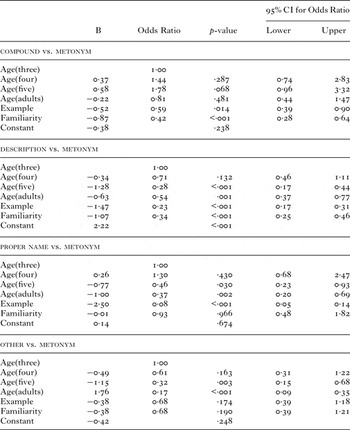
In the second, multinomial logistic regression analysis, we investigated the effects of the predictor variables of age, example, and familiarity on the dependent variable of answer type (metonym, compound, description, proper name, other), with metonym as the baseline category. The baselines for the predictors were identical to those in the logistic regression analysis. The answers for each age group were compared against those of three-year-olds (cf. Table 4). Table 5 summarizes the results.
Percentages and standard deviations of answer types elicited in Task 3, by age

Multinomial logistic regression analysis for the production of answer types in Task 3 with the predictors Age(three), Example(no) and Familiarity(unfamiliar) (N = 1239)*

note: * Baselines in parentheses.
Not surprisingly, whether the participant was given examples first significantly affected their production of all answer types (except other: p = ·174), with the largest effect observed for proper names (OR = 0·08), with an increase in OR of 12·2 in the absence of exposure to examples. Table 5 also shows significant age effects on some answer types. For compounds, we observed a tendency for five-year-olds to produce more than three-year-olds did (OR = 1·78, p = ·068), but there were no significant differences by age groups. Three-year-olds were significantly more likely to produce descriptions than five-year-olds (OR = 0·28) and adults (OR = 0·54), but did not differ significantly from four-year-olds (p = ·132). Similarly, five-year-olds (OR = 0·46) and adults (OR = 0·37) produced fewer proper names than three-year-olds, but there were no significant differences between three- and four-year-olds (p = ·430). The familiarity of the depicted individual predicted the production of compounds and descriptions, with participants being less likely to produce compounds (OR = 0·42) or descriptions (OR = 0·34) than metonyms when the referents were familiar types.
It should be noted that, due to the division of each age group, the number of subjects was quite small in this task. However, we had repeated observations and the number of valid observations was large (n = 588 in the no-example condition, n = 651 in the example condition). Since our p-values were generally small (<·001) for the majority of the statistically significant predictor variables, the conclusions drawn are likely to be well founded, but our findings should be viewed as preliminary.
DISCUSSION
The results from Task 3 provide further support for the view that preschoolers can produce referential metonyms, in this case metonymic names based on salient properties for animate beings. The results also show that prior exposure to examples of a metonymic pattern affects the number of metonyms adults produce. For children, though, only the three-year-olds, but not the four- or five-year-olds, appeared to be influenced by the examples given. Also, contrary to our expectations, unfamiliar types of referents did not increase metonym production. In fact, familiar types proved more likely to elicit metonyms than unfamiliar ones, which were in turn associated with a greater likelihood of compounds and descriptions.
Overall, participants produced metonyms about one-third of the time in Task 3. This number needs to be considered in the light of the variety of possible terms that could apply to any one type of individual, and the fact that this was an open-ended task, especially in the no-example condition. Metonymy, then, is clearly available as a productive labelling strategy for both preschoolers and adults.
In this task, age was a significant predictor of metonym production, with older children producing more metonymic names. Unlike the shorthands elicited in Task 2, which required the ability to represent and exploit a part-for-whole relation in making a reference, the metonymic names produced here required a higher degree of metalinguistic ability, taking a familiar term as a new name for an individual. The greater production of metonymic names by four- and five-year-olds compared with the three-year-olds when given no examples is consonant with the emergence of certain metalinguistic skills around age four (Doherty & Perner, Reference Doherty and Perner1998).
Exposure to examples of a metonymic pattern had an effect only on three-year-olds (and adults), but not on the older children: this was unexpected. But note that the age differences found for the interaction between age and examples pattern with those found in Task 1, where three-year-olds also looked more like adults than did the older children. One explanation could be that the three-year-olds chose the first terms that came to mind, without reflection, so the examples they heard could have made metonym production more accessible. Although three-year-olds rarely produced metonymic nicknames spontaneously, our findings suggest that they could already extract some metonymic patterns. The older children, however, may have used a more reflective strategy in which they focused on coming up with names that would fit the individuals in the pictures. This could have outweighed any effect of prior exposure to examples of metonymic names.
We also found age differences for other answer types in this task, not just for metonyms. Unlike in Task 2, the youngest children were more likely to produce descriptions than other ages. Using descriptions may have been easier in this task than in referring to the games in Task 2, since children did not have to remember any earlier instructions. In addition, metonymic naming could be more demanding in the metalinguistic skill required. This could explain the relatively low number of metonyms produced by three-year-olds in the no-example condition. Ease of production could then explain reliance on other answer types, in particular descriptions and proper names, from three-year-olds compared with five-year-olds and adults.
Finally, the finding that pictures of people and familiar animal types elicited more metonyms than compounds or descriptions suggests that referential metonymy of this kind serves mainly to create additional names for individual types already known to children.
GENERAL DISCUSSION
The goal of this study was to investigate preschoolers’ skill in interpreting and producing novel metonyms. Our focus was on whether young children could cope pragmatically with metonymic meanings, and, if so, whether we could identify a stage at which this skill emerged, and whether this corresponded to the emergence of other kinds of figurative language. We considered two issues: first, whether children could understand novel metonyms in contexts where the metonymic association was available perceptually and linguistically; and second, whether the same children could produce referential metonyms, both with a shorthand and a naming function. However, since metonymic names appear to be more complex than metonymic shorthands, we proposed that the ability to produce metonymic names might be a later acquisition.
We found some support for both proposals. First, the results of Task 1 suggested that, by age three, children are pragmatically skilled enough to understand some novel metonyms in context, although they have some way to go before they reach an adult level of understanding. Children also became better able to explain metonymic meanings between age three and age five. Surprisingly, performance on the comprehension task appeared to decrease with age, with older children more likely to choose literal than figurative interpretations of novel metonyms.
Second, the results of Task 2 suggested that preschoolers can use metonymy as a shorthand referential strategy. This form of metonymy was equally prevalent in three-, four-, and five-year-olds. The results also showed that three-year-olds produced fewer descriptions than the older children in the play-context, suggesting that they found it easier to use a metonym than a more ‘literal’ description, where the latter might be more complex syntactically and conceptually. Finally, the results of Task 3 suggested that the ability to produce metonymic names for individuals based on salient properties also emerges in the preschool years, but slightly later than metonymic shorthands.
The metonymic skill of preschoolers
Based on these results, what picture can we draw of preschoolers’ metonymic skill? Our findings suggest that three-year-olds are already pragmatically skilled enough to understand some novel metonymic expressions in context. They are also able to produce referential metonyms with a shorthand function based on part–whole relations linking objects with salient properties. Then, between ages four and five, we also see a growing ability to produce metonymic (nick-)names for familiar animate beings, and to explain metonymic meanings. The increasing tendency in older children to interpret some metonyms literally reflects – we suggest – this growing metalinguistic ability, which may lead them to overemphasize literal meanings. Their newly acquired ability to distinguish between linguistic meaning and speaker meaning may create conflicts that they do not yet know how to resolve. A typical example comes from a boy (5;2) who chose the metonymic reading first, then ‘corrected’ himself: “No actually, it's this one. Cause you said ‘The big beard gets in the canoe first’.”
But do three-year-olds show true understanding of metonyms in the comprehension task? Notice that most of them did not seem able to reflect on their meanings, that is, reflect on what the speaker could have ‘meant’, although such meta-reflection is not required for proper understanding. Indeed, three-year-olds could be ‘naive’ interpreters in this task in the sense that they follow a path of least effort in constructing an interpretation of the speaker's utterance, which could have involved seizing on anything (e.g. the helmet, the moustache, etc.) that allowed them to identify the referent. As Sperber (Reference Sperber and Khalfa1994) pointed out, a naive interpretation strategy could yield adequate comprehension whenever the speaker is benevolent and skilled enough to realize what is relevant and salient for the addressee at that instant. In the comprehension task, we tried to achieve this by giving practice trials for metonymic interpretations first, and making sure that the metonymic association was perceptually available, even salient, in context. However, older children may have been following a more ‘cautious’ interpretation strategy, one that takes into account the possibility that the speaker could have misjudged what would be most accessible and relevant on that occasion. Older children's frequent hesitations between metonymic and literal interpretations give support to the possibility that they were relying on a more advanced comprehension strategy than the younger ones, albeit one that led them astray.
One question that remains is at what point in development children begin to improve their performance, before they reach adult-like levels of comprehension. In Van Herwegen et al.,'s (2013) study of novel metonym and metaphor comprehension in children aged three to seventeen, most six-year-olds managed some metonyms and metaphors, which suggests that children have begun to improve already at this age. However, we need to look at a wider age range to establish the full developmental trajectory for novel metonym comprehension.
One unexpected finding in Task 3 was that exposing children to examples of a specific metonymic pattern only had an effect on the productions of the three-year-olds and the adults. Without examples, we elicited metonymic names mainly from the four- and five-year-olds. Why did the age groups differ in this way? Could it be that, with examples, the three-year-olds produced metonyms as a least effort option, much as we have suggested they did in comprehension, rather than actively and reflectively constructing metonymic names on the basis of salient properties for the individuals being referred to? Even if this were the case, it remains to be explained why three-year-olds were sensitive to, and able to extract the metonymic pattern property for individual from the examples provided, while the four-and five-year-olds apparently did not.
Referential strategies
The two production tasks provide some insight into the strategies young children can use in referring to things that lack a ready-made category label (Task 2) or proper name (Task 3). The morphologically simplest strategy is to use simple noun phrases in the form of metonymic shorthands (the straws, the moustache). The use of novel compound nouns (the straw game, the moustache man) reflects another option, one that is slightly more complex morphologically. The third, most complex type, with modified noun phrases for the target referents (the game with the straws, the man with the big moustache ), offers yet another means of referring where there is no ready-made term. Each referential strategy the children employed reflects a path into the kinds of uses adults make of these devices. One common context for the first two strategies is news headlines, e.g. “Syria and Iraq can't be solved by western boots on the ground” (The Guardian, 28.05.2015), “Ruling in death of Ferrari woman” (referring to a woman who wanted to be buried in her Ferrari; cf. Clark & Clark, Reference Clark and Clark1979, p. 767), etc., both exploiting salient associations in making shorthand reference.
In Task 2, three-year-olds’ frequent use of simple noun phrases in the form of metonymic shorthands, and relatively rare use of modified noun phrases, suggests that morphological complexity may play some role in choices of referential expression. It also suggests that the production of a metonym – at least in this task – may actually be conceptually easier than production of a more elaborate, ‘literal’ description. Further support for this comes from possible precursors to metonymy: overextensions, early symbolic gestures, onomatopoeias, even denominal verbs, produced by very young children to compensate for gaps in their current vocabulary. In Task 3, however, the youngest children's preference for modified noun phrases over simple ones in the naming of animate beings, suggests that the demands of metonymic naming can sometimes outweigh morphological complexity.
Taken together, the findings from Tasks 2 and 3 show for the first time that for children, metonymy may serve a function similar to compounding, as a productive option for referring to entities that lack a conventional label or proper name. Interestingly, the findings from Task 3 also suggest that the referential functions of metonymy and compounding may to some extent be complementary, with metonyms used to name familiar individual types and compounds unfamiliar ones.
Metonymy vs. metaphor
Our findings suggest that children's ability to deal with metonymy starts to emerge early on, with some ability to understand, produce, and explain metonyms already established by age three. This is a year or two earlier than has been suggested for metaphor (cf. Özçalışkan, Reference Özçalışkan2005; Stites & Özçalışkan, Reference Stites and Özçalışkan2013), and adds support to the view that metonymy may be conceptually simpler than metaphor (Rundblad & Annaz, Reference Rundblad and Annaz2010; but cf. Van Herwegen et al., Reference Van Herwegen, Dimitriou and Rundblad2013). It also suggests that metonymy and metaphor may be rather different processes, as some pragmatic theories have proposed (e.g. Papafragou, Reference Papafragou1996; Wilson & Carston, Reference Wilson, Carston and Burton-Roberts2007). However, the literal preference in comprehension among older children patterns with similar findings from studies of metaphor (e.g. Asch & Nerlove, Reference Asch, Nerlove, Kaplan and Wapner1960; Billow, Reference Billow1975; Winner, Reference Winner1988/1997; Winner et al., Reference Winner, Rosenstiel and Gardner1976), and suggests that both abilities interact with and depend on the development of more general metalinguistic and pragmatic skills. A crucial point is what underlies the notion of a ‘literal preference’. Some researchers have taken it to involve a primitive form of comprehension, prevalent until school age, in which linguistic input is processed piece-by-piece without taking context into account (Levorato & Cacciari, Reference Levorato and Cacciari2002). But the fact that production does not seem to be affected, and that five-year-olds, for all their literal-mindedness, show signs of employing a more sophisticated comprehension strategy where they reflect explicitly on what the speaker might have meant by the choice of linguistic expression, leads us to treat these findings as more compatible with a view that takes the literal preference to involve no more than a tendency to choose literal over figurative interpretations at a certain stage in development, due to some form of competition between the two. The parallel development of the child's metalinguistic and pragmatic skills may simply give a false impression of primitive understanding.
Finally, these findings suggest that a key next step is to explore how the acquisition of figurative devices such as metonymy interacts with the development of other communication-relevant abilities – one being metalinguistic awareness – which plausibly influence children's figurative language competence.