1. INTRODUCTION
Currently within the context of the Dutch Building Practice, it is difficult for different disciplines in the design phase to give adequate answers on the built-environment questions from society. Inadequate design processes result in a productivity loss in the Dutch building design processes of approximately 10% of the total construction costs per year (USP Marketing Consultancy, 2004, 2008). To reduce these failure costs, collaboration between different design disciplines becomes of considerable importance, as the design tasks that designers are confronted with become progressively more difficult. The synergy between different disciplines involved is necessary to not only attain the best designs based on existing knowledge but to create new design concepts as a basis for innovation. It no longer suffices to merely solve the problems that arise at the level of detailing on the borderlines of the disciplines.
We looked at design methodology as a route to support and improve the design process. As stated by Cross (Reference Cross2001), design methodology includes the study of how designers work and think; the establishment of appropriate structures for the design process; the development and application of new design methods, techniques, and procedures; and reflection on the nature and extent of design knowledge and its applications to design problems.
As well explained in the work of Cross (Reference Cross2001, Reference Cross2006), design is not a scientific activity. However, in the past, a number of prescriptive design methods were developed as a result of “the aspirations to scientise design” (Cross, Reference Cross2001, p. 49). These attempts were largely based on the view of design as an ill-structured problem solving activity (Simon, Reference Simon1969). Even though design undoubtedly includes stretches of “normal” ill-structured problem solving (Dorst & Royakkers, Reference Dorst and Royakkers2006, p. 641), any model or description method that tries to reduce design to ill-structured problem solving is bound to miss important aspects of the design activity (Hatchuel, Reference Hatchuel2002). Recognizing the fact that design is not a scientific or merely a problem solving activity, we wondered if any of the existing and largely neglected prescriptive design methods could help us to understand design by using them for design pedagogy.
Design became an international concern in the early 1960s. Held in London in 1962, the Conference on Design Methods is generally regarded as the event that marked design methodology as a subject of inquiry (Jones & Thonley, Reference Jones and Thornley1963). In the United Kingdom, the Feilden Report (Feilden, Reference Feilden1963) concluded that design was of paramount importance and asked for more effective design management, more attention to customer requirements, and more cooperation in design teams (Blessing, Reference Blessing1994). The origins of new design methods in the 1960s were based on the application of “scientific” methods derived from operational research methods and management decision-making techniques in the 1950s (Cross, Reference Cross2007). The first design methods or methodology books that appeared were by Asimow (1964), Archer (Reference Archer1965), Jones (Reference Jones1970), and French (Reference French1971).
However, in the 1970s came the rejection of design methodology by even some of the founding fathers themselves, such as Alexander and Jones. Fundamental issues were raised and design problems were characterized as “wicked” problems, unamenable to the techniques of science and engineering. This resulted in a proposal for a new generation of methods by Horst Rittel, moving away from attempts to optimize and toward recognition of satisfactory or appropriate solutions (Simon, Reference Simon1969). Herbert Simon (Reference Simon1969) is regarded as the founding father of “a science of design,” establishing the foundations that would be “a body of intellectual thought, analytic, partly formalizable, partly empirical, teachable doctrine about the design process.” There was a desire to “scientize” design.
In the 1980s, engineering design methodology of the systematic variety developed strongly. A series of books on engineering design methods began to appear that were written by Hubka (Reference Hubka1980), Pahl and Beitz (Reference Pahl and Beitz1984), French (Reference French1985), Andreassen and Hein (Reference Andreasen and Hein1987), and Cross (Reference Cross1989). After the doubts of the 1970s, the 1980s saw a period of substantial revival and consolidation of design research. Since then, there has been a period of expansion through the 1990s right up to today: design as a coherent discipline of study has definitely been established in its own right (Cross, Reference Cross2007). However, there is no clear picture (e.g., Finger & Dixon, Reference Finger and Dixon1989a, Reference Finger and Dixon1989b; Horváth, Reference Horváth2004; Bayazit, Reference Bayazit2004) and many models of design exist (e.g., Jones, Reference Jones1970; Cross, Reference Cross1994; Wynn & Clarkson, Reference Wynn, Clarkson, Clarkson and Eckert2005; Pahl et al., Reference Pahl, Beitz, Feldhusen, Grote, Wallace and Blessing2006). That makes it difficult to choose and implement design models in practice.
In addition, Macmillen et al. (Reference Macmillan, Steele, Austin, Spence and Kirby1999) state that none of the existing models of the building design process succeeds in capturing ways to help a new design team overcome the stimulating but potentially chaotic period at the start of a project when team members have conflicting aims, priorities, and expectations, and need to find ways to construct shared goals, objectives, and problem ownership.
To improve building design process an integral approach is needed. Such an integral approach represents a broad view on the world around us that continuously needs to be adapted and developed from sound and documented experiences that emerge out of interactions among practice, research, and education. This integral approach can eventually lead to an integral process, team, and method, all of which are the required conditions for the design of the end product. The integral design (ID) method, developed from 2004 to 2008 in the Department of Architecture, Building and Planning of University of Technology Eindhoven (Savanovic et al., Reference Savanović, Trum and Zeiler2006; Savanovic & Zeiler, Reference Savanović and Zeiler2007a, Reference Savanović and Zeiler2007b), represents a specific translation of the broad notion of the generally recognized need for an integral approach in building design (Quanjel & Zeiler, Reference Quanjel and Zeiler2003). The main aim of the ID approach behind the ID method was to improve conceptual design on both the process and product levels in order to increase the potential for creation of new sustainable solutions (Zeiler, Reference Zeiler2007). Positive results at these two levels are expected to trigger and support the much needed culture change in (Dutch) building design practice (Wichers Hoeth & Flevier, Reference Wichers-Hoet and Fleuren2001). Such an integrated approach shows high promise to reduce failure costs; and improved design quality can eventually lead to an integral process, team, and method, which are all required conditions for the design of the end product: the building (Seppänen et al., Reference Seppänen, van Steenberghe and Suur-Uski2007).
We first explain the theoretical background of our design method in Section 2. In Section 3, we report on the results of the application of tools from the design method applied in the workshops that were held for professional architects and engineers. Our “multidisciplinary master design project for sustainable climatic design,” which brings back the experience from the practice to the university, is described in Section 4. The differences between students and professionals are reported in Section 5. The discussion is given in Section 6 and the conclusions can be found in Section 7.
2. METHODOLOGY
As complexity and scale of design processes in architecture and in building services engineering increase, as well as the demands on these processes with respect to costs, throughput time, and quality, traditional approaches to organize and plan these processes may no longer suffice van Aken (Reference Van Aken2005). This implies defining a process methodology that acts as a “bridge” between architectural elements such as shapes and material on the one hand, and the aspects of indoor climate issues such as overheating and ventilation on the other. Crucial point by using experiments, in relationship to the “theoretical” model of the design process, is the connection to a “realistic” model that is part of the design practice.
2.1. Methodical design
A specific design approach was developed at the University of Twente in The Netherlands in the late 1960s, formalized in the 1970s into “Methodical Design” (van den Kroonenberg, Reference Van den Kroonenberg1978, Reference Van den Kroonenberg1985, Reference Van den Kroonenberg1987), and elaborated theoretically by de Boer (Reference De Boer1989) and Blessing (Reference Blessing1994). Methodical design is based on the combination of ideas and characteristics of the German design school and the Anglo-American design school.
Most prescriptive German and Swiss models (e.g., Matousek, Reference Matousek1962; Hansen, Reference Hansen1968; Roth et al., Reference Roth, Franke and Simonek1972; Koller, Reference Koller1976; Hubka, Reference Hubka1980; Pahl, 1984; Beitz, Reference Beitz1985) focus on the design process as executed by the mechanical designer and on a systematic generation of solutions (from abstract to concrete).
The English and American approaches of the Anglo-American school (e.g., Hall, Reference Hall1962; Asimov, Reference Asimov1964; Archer, Reference Archer1965; Greogory, Reference Gregory1966; Krick, Reference Krick1969; Jones, Reference Jones1970) generally extend the design models to other parts of the product life cycle, including the context in which the design process is executed.
When developing his design method, van den Kroonenberg took only the most essential elements of the many different design methods that were proposed at that time (Blessing, Reference Blessing1994). He focused on the need for a methodical ordering of the design activities in an overall design framework. Unfortunately, van den Kroonenberg published only a few papers in English. Nevertheless, he, Blessing, and de Boer are mentioned in the overview of the development of design in Pahl et al. (Reference Pahl, Beitz, Feldhusen, Grote, Wallace and Blessing2006).
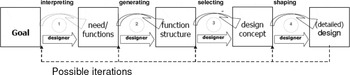
This design method was chosen for further development into an ID method, because it is still one of the few models that explicitly distinguishes between stages and activities and the only method that emphasizes the recurrent execution of the process on every level of complexity (Blessing, Reference Blessing1994). The distinctive feature of our ID method is the four-step pattern of activities that occurs at each level of abstraction within the design process with possible iteration loops (see Fig. 1): interpretation (define/analyze), generating (generate/synthesize), selecting (evaluate/select), and shaping (implement/application).
The four-step pattern of the integral design method with possible iteration loops.

By introducing different levels of abstraction the ID method allows the designer to limit the complex design question to smaller subquestions. Abstraction to us is the selective examination of certain aspects of a problem, and this helps the designer to decompose a complex design question into problems of manageable size. This simplification by abstraction leads to viewing designing as a process in which the concepts of function, behavior, and structure of artifacts play a central role (Vermaas & Dorst, Reference Vermaas and Dorst2007).
A distinguishing feature of ID is the use of morphological charts for design activities in each phase of the design process. In these morphological charts the functions and aspects to be fulfilled are listed vertically in a kind of matrix, and connected possible solutions to these functions and aspects are listed horizontally. By using morphological charts each design discipline can list, from their own perspective, the necessary functions and aspects decomposed from the program of demands and the related possible solution to them. Now every designer sees the results of the different interpretations from the morphological charts and they can discuss aspects that are not clear to them. The reflection in action on the design process is immediately initiated through this. The advantage of this approach is that the discussion comes after the preparation of the individual morphological charts. As each designer uses his personal interpretation and representation in relation to his specific discipline-based knowledge and experience, this gives an overview of different discipline-based interpretations of the design brief. This results in a combined interpretation of the design problem.
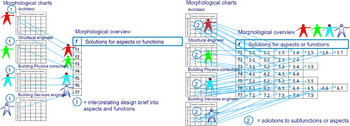
The morphological charts made by each designer can be combined then to a morphological overview. This morphological overview is generated by combining the different morphological charts made by each discipline after discussion on and the selection of functions and aspects of importance for the specific design. The whole process is done in two steps: first, the functions and aspects, and second, the possible related solutions (see Fig. 2).
Building the morphological overview. Step 1: the morphological overviews show the agreed functions and aspects (1) of the different morphological charts. Step 2: the morphological overview with the agreed on subsolutions (2) from the separate morphological charts. [A color version of this figure can be viewed online at journals.cambridge.org/aie]

The ID method is used as a framework for structuring the design process and the reflection on the design process itself. By using multidisciplinary morphological overviews derived from the combination of monodisciplinary morphological charts, communication can be structured between design team members. The design process becomes more transparent, and this increases the possibility to teach the method.
Morphological overviews offer the possibility for reflection on the design results by the design team members. With the help of the concept–knowledge (C-K) theory of Hatchuel and Weil (2003), we especially focus on the generation of new concepts and new design knowledge.
2.2. C-K theory
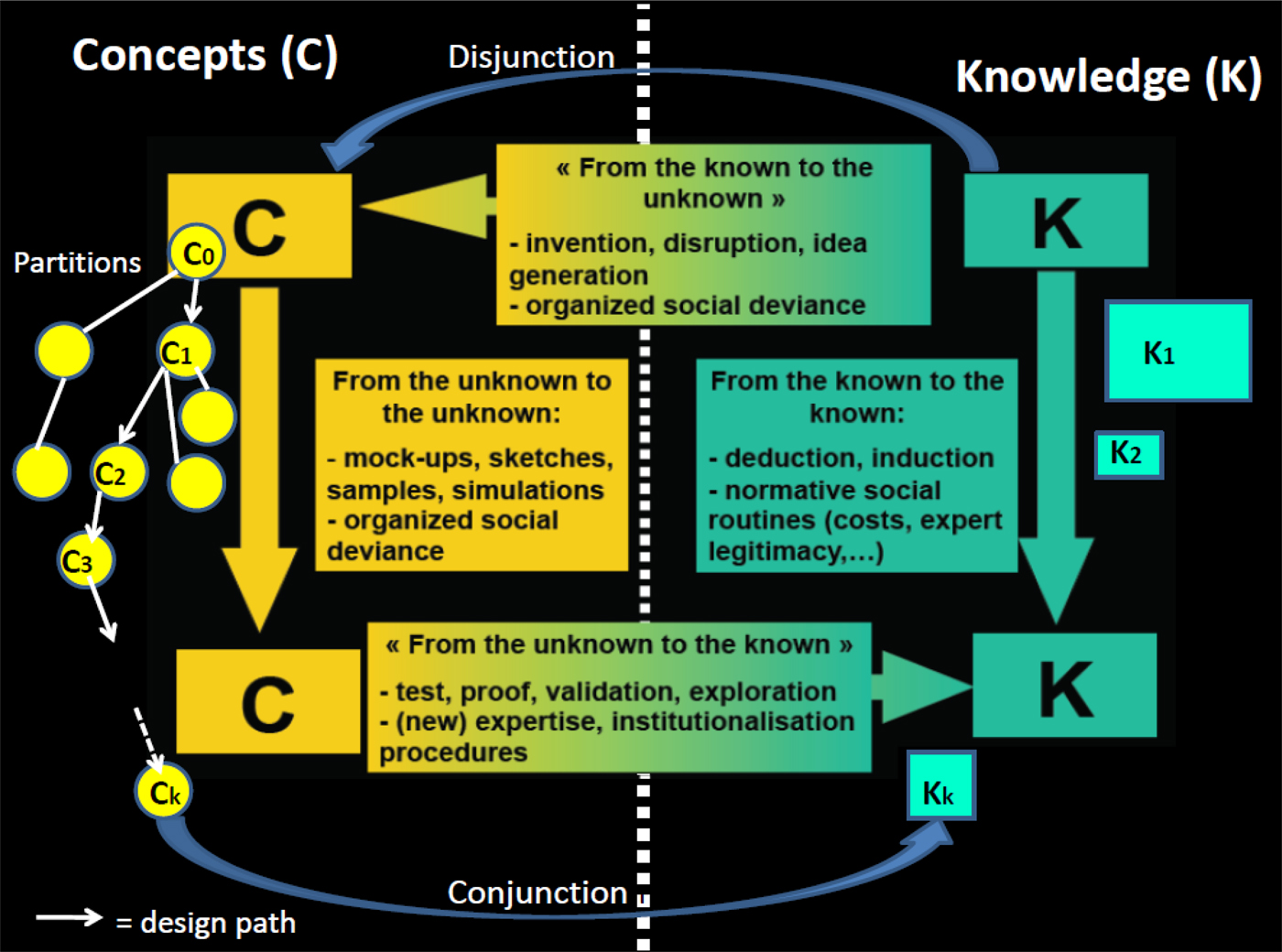
Generally speaking, design is a creative process based around the transformation of knowledge and information about the actual needs of a principal into a solution to fulfill those needs. The knowledge and information has to be transformed into new unknown concepts if solutions based on existing knowledge are not adequate. As such, we can make the distinction between the known (knowledge) and the unknown (concepts). This distinction determines the core propositions of C-K theory (Hatchuel & Weil, Reference Hatchuel and Weil2007). C-K theory defines design as the interplay between two interdependent spaces having different structures and logics. This process generates the coexpansion of two spaces: space of concepts C, and space of knowledge K. Within this research, in the case of a multidisciplinary building design team, the available knowledge within this team represents space K. Because Hatchuel and Weil's (2002, p. 11) C-K theory defines a piece of knowledge as a “proposition with a logical status for the designer or the person receiving the design,” all explicit representations of a design team's knowledge are considered to form part of space K. This is their initial object–design–knowledge K that participants bring into the design team. The overview of this knowledge is captured using morphological design tools. From the perspective of C-K theory, the initial object–design–knowledge that participants bring into the design team defines space K. From here two types of synthesis are possible: the representations are either combined using the K → K operator or are transformed using the K → C operator. A space of concepts is necessarily tree structured as the only operations allowed are partitions and inclusions, and the tree has an initial set of disjunctions (Shai et al., Reference Shai, Reich, Hatchuel and Subrahmanian2009). A design solution is given by the first concept Ck to become a true proposition in K (see Fig. 3). The other branches of C are concept expansions that do not reach a proposition that belongs to K (Hatchuel & Weil, Reference Hatchuel and Weil2007). If we add new properties (K → C) to a concept, we partition the set into subsets (see example C1 in Fig. 3); if we subtract properties, we include the set in a set that contains it. No other operation is permitted. After partitioning or inclusion, concepts may still remain concepts (C → C) or can lead to the creation of new propositions in K (C → K; see Ck to Kk after evaluation in Fig. 3 and step 4′ in Fig. 4).
The concept–knowledge (C-K) design square (Hatchuel et al., Reference Hatchuel and Weil2009). [A color version of this figure can be viewed online at journals.cambridge.org/aie]

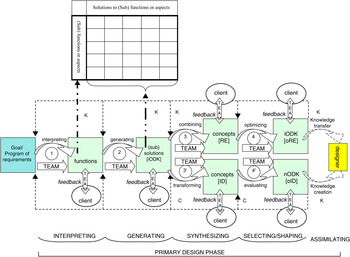
The integral design method and the relation with the morphological overview and concept–knowledge (C-K) theory. [A color version of this figure can be viewed online at journals.cambridge.org/aie]

Starting with initial object design knowledge (iODK; Fig. 4) about the needs of the principal that have to be fulfilled, ODK is made explicit through the morphological overview. This enables designers to use the knowledge gathered in the morphological overview for the creation of design solutions by selecting combinations of subsolutions from the morphological overview. These combinations are either ID concepts (IDC) when new elements (e.g., Ck transformed into Kk) are introduced or just “plain” combinations of known subsolutions [e.g., K2 in Fig. 3, i.e., redesign (RE)].
Optimizing chosen redesigns (oRE) will gradually lead to detailed solutions, iODK (step 4 in Fig. 4). More interesting with the focus on innovation are the possibilities of expanding the solution space with ID (sub)solutions (step 3′, Fig. 4, ID), in order to create new ODK (step 4′, Fig. 4, nODK). Solutions acquired through transformation of iODK into ID (step 3′ in Fig. 4) are regarded as ID solutions. These can be triggered by (aspects of) presented (sub)solutions and their possible connections. This process can be supported with different creativity stimulating techniques, such as TRIZ, whenever necessary.
2.3. The different roles of a designer within a design team
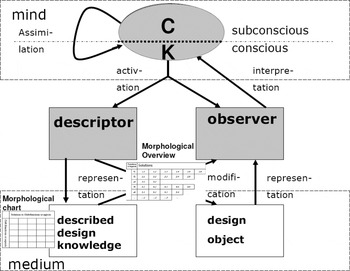
The thinking within design teams is the key to improvement of the design process (Badke-Schaub & Stemple, Reference Badke-Schaub and Stemple2002). The different roles of a designer are essential in a design team. The designer is a descriptor of the design object; as soon as he has sketched or described the design object, he also becomes an observer within his own design process. When we look at a representation of a design team, we can more easily see the different roles, because when one designer is active as the descriptor, the other automatically becomes an observer till she becomes active and the roles are changed (Fig. 5).
The interaction model of designing within a team with a changing role of the designer as either a descriptor or observer; C, concept; K, knowledge.

Figure 5 shows the dualistic role pattern of a designer. Sometimes he or she is a descriptor of his or her own activated mental design process, although at other times in the design process he or she observes the activities of the other design team members. This rather simple model provides us with a basis to look into design pedagogy: representations and processes. By structuring the interactions of the designers from different disciplines in the conceptual phase of building design, it is possible to support members of every discipline to handle tasks and to supply information from other disciplines. The ID method thus makes it possible to teach design in a structured and transparent way using morphological overviews. We introduced the morphological overview as element of the prescriptive ID method and used its morphological overviews as a descriptive element for reflective practice. Thus, in one way the morphological overview is used in a prescriptive way as a tool to structure the information from and the communication between the different design disciplines involved in the conceptual phase of the design process. In another way the morphological overview is used in a descriptive way to reflect the ideas and actions of the design team members.
Using morphological overviews as a design tool, all interpreted functions and all generated (sub)solutions, which are represented by “chunks” of ODK, can be structured. In the ID method morphological overviews can be used for interpreting the actions of the designers. There is a descriptive/reflective focus on the prescriptive ID method with the use of its process elements: morphological overviews. The above described theoretical approach was tested in a series of five workshops.
2.4. Methodology workshops
Since 2005, the authors, the Dutch Royal Society of Architects (BNA), and the Dutch Association of Consulting Engineers (ONRI) organized a series of five workshops with experienced professionals from both organizations who voluntarily applied to participate. The participants of each discipline were randomly assigned to design teams, which would ideally consist of one architect, one building physics consultant, one building services consultant, and one structural engineer. Starting with a 3-day practicelike “building team” concept, in which all disciplines are present within the design team from the start, the ID method workshops have finally evolved to a 2-day series (Savanovic & Zeiler, 2007a, 2007b).
Measurements were conducted in four different ways:
1. through direct observations of design teams' activities (from within teams themselves, using observation forms),
2. by taking photographs of and during the design team's work (in 10-min intervals),
3. through an analysis of the materials that the design teams produced, and
4. by asking participants to fill in a number of questionnaires (one after each day).
Administering the questionnaires made it possible to further evaluate the use of morphological overviews as the most important tool within the total design pedagogical setting of the ID method.
3. EXPERIMENTS: WORKSHOPS FOR PROFESSIONALS
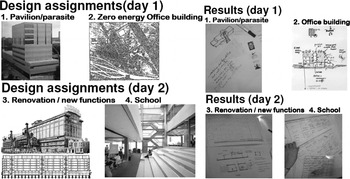
In our series of five workshops for experienced architects and engineers the average age of the participants (all members of either BNA or ONRI) was 42, and they an average of 12 years of professional experience. The workshops start with a lecture introducing ID and are followed with other supportive/informative lectures about sustainable energy systems and the use of morphological overviews. The design tasks during the 2 days are on the same level of complexity and have been used in all workshops. The design tasks and some of the results are provided in Figure 6.
Design assignments and some of the results during the 2-day workshops.

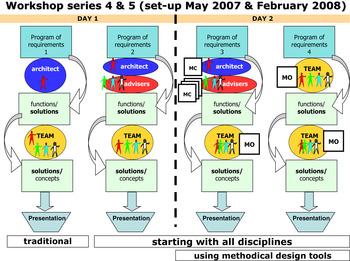
Workshops series 4 and 5, four different design setups of participants and use of morphological charts (MCs) or morphological overviews (MOs) during the design sessions within 2 days. [A color version of this figure can be viewed online at journals.cambridge.org/aie]

After each design session the participants present the results to each other and get feedback from the organizers. Starting with the traditional sequential approach during the first two design sessions on day 1 (see Fig. 7), which provide reference values for comparing the effectiveness of the method, the perceived “integral approach” is reached through phased introduction of two major changes:
1. all disciplines start working simultaneously within a design team setting from the very beginning of the conceptual design phase, and
2. morphological overviews of the ID process model are applied.
The second setup of the design sessions allows simultaneous involvement of all design disciplines on a design task, aiming to influence the amount of considered design functions/aspects. Additional application of morphological overviews during the setup of the third design session demonstrates the effect of transparent structuring of design functions/aspects on the amount of generated (sub)solution proposals. In addition, the third setting provides the possibility of one full learning cycle in the use of morphological overviews.
The goal of the new workshop setting was to provide as smooth a transition as possible from traditional to team design. Besides two main changes, namely, simultaneous start by all disciplines and the use of morphological overviews in a design team setting, a possibility for an individual learning cycle was introduced. In order to be able to effectively apply a new approach, one has to first understand it and then make it your own (Jones, Reference Jones1992). Although we believe that this is also possible to achieve within a design team setting, the previous attempts showed and confirmed that longer periods of time are needed for this type of team evolvement to happen. However, the ultimate aim of the ID method was to avoid both the time-consuming evolvement as well the obsolete design team preselection stages by focusing on explication and integration of the available discipline-bound object–design–knowledge within a design team. For this purpose most effort was directed on testing if morphological overviews were a suitable tool for this task, which the reactions from participants of all three previous workshops confirmed.
There was a clear distinction made between days 1 and 2 in that participants worked with morphological overviews only during the second day. There was a total of four design sessions per day in the new configuration. The new first two sessions of day 1 remained the same as the two sessions of the previous workshop day 1. The change was that during the third session participants from all disciplines started working simultaneously but separately from each other on a new design task. In the fourth session they were joined in design teams. The same formula was repeated during the first two design sessions of day 2, again using a new design task, with the notable difference that this time participants were to use morphological overviews. This provided an opportunity to work individually with morphological overviews in session 1 before subsequently trying them out in team settings during session 2. The final, fourth design task was to be tackled in the last two design sessions.
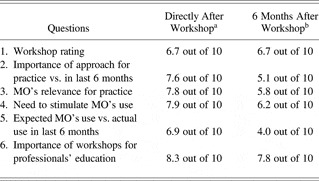
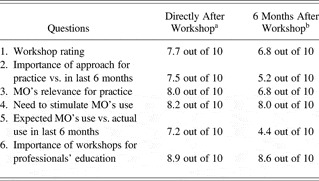
Questionnaires administered directly after the workshops and after a period of 6 months gave a good idea about the participants' appreciation of the workshops (see Table 1).
Participants' evaluations of workshop 4

Note: MO, morphologic overview.
a95% reactions, 21/22 of last-day participants.
b56% reactions, 9/16 of all-days participants.
The workshop was repeated in order to test these results. It turned out that the average ratings were higher than ever before; and none of the participants mentioned the possible redundancy of the last design setting, which was a big issue during the previous workshop. After 6 months the participants thought that it was necessary to stimulate the use of morphological overviews, even though they did not manage to use them in practice. Our interpretation is that this shows that they still value the possibility of its use in random design team settings (Table 2).
Participants' evaluations of workshop 5

Note: MO, morphologic overview.
a94% reactions, 15/16 of last-day participants.
b71% reactions, 10/14 of all-days participants.
4. MULTIDISCIPLINARY MASTER DESIGN PROJECT
The workshop structure of the ID research project was applied in the educational multidisciplinary master design project. The basis of this project was the use of the learning-by-doing workshop approach with its use of morphological overviews.
The concept of the ID workshops for professionals was the startup workshop of our multidisciplinary masters' project in the Department of Architecture, Building, and Planning at the University of Technology Eindhoven. Students from architecture, building physics, building services, building technology, and structural engineering were offered the opportunity to participate. The selection procedure was the same for BNA-ONRI-Knowledge Centre Buildings and Systems (KCBS) workshops; the only criterion for participation was being a member of the “master students group.” To motivate the students a contest was organized for the project with an engineering company sponsoring the prize money and organizing an excursion and the external jury. The students were assigned to design teams of different disciplines to have all disciplines (architecture, building services, building physics, and construction) represented in each team. The whole project took 14 weeks. The students were intensively supervised by staff from each discipline, and the meetings with the individual staff members were according to a strict scheme. After the sessions with the students the staff assembled and reflected on the meetings. The design assignments thus far were an office building with “sustainable comfort,” a zero energy solution (2005–2006), a 24/7 zero energy university faculty building (2006/2007), a cradle-to-cradle school in the heart of a large city (2007–2008), and a green building for the Faculty of Architecture of the Technical University of Delft (2008–2009).
Such a complex task requires early collaboration of all design disciplines involved in the conceptual building design. Development of knowledge and skills and the ability to realize this aim is the main task of the multidisciplinary masters' project “ID.” During the first week the BNA-ONRI-KCBS workshop formula was used to start the design teamwork. Therefore, this is not described again. This makes it possible to compare the results and design approaches of the students with those of the professionals (Savanovic & Zeiler, 2007a, 2007b).
5. RESULTS
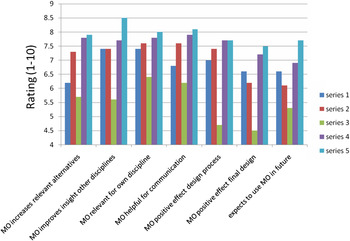
Over the past 5 years the ID approach has been tested in a series of five workshops, typically including around 20 participants and lasting for 2 or 3 days. A total of 124 designers participated in the workshop series, in which 74% of the designers were present during all of the days. Directly at the end of the workshop the participants were asked to fill in a questionnaire on the importance of the use of morphological overviews within the design process and on the concept of the workshops themselves. The participants had to rate the answers between 1 (very poor) and 10 (excellent). The average results were then determined; they varied between 7.5 and 8.1. Thus, the experience by the professionals was positive (see Fig. 8).
The overview of the results of the questionnaires on the participants' professional workshop series 1–5; MO, morphological overview. [A color version of this figure can be viewed online at journals.cambridge.org/aie]

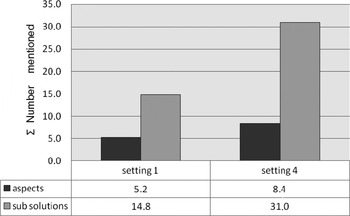
Concerning the results of our approach, we looked into the extension of the solution space and the analysis possibilities of the design process through morphological overviews. A comparison is now made between settings 1 and 4 of final workshop 5. Figure 9 shows the number of aspects and subsolutions generated by the teams in settings 1 and 4; this clearly shows that, as expected, more aspects and subsolutions were generated in setting 4 compared to setting 1 (see also Fig. 7).
The averages of the amount of design aspects and subsolutions generated by design teams during design settings 1 and 4.

5.1. Comparing professionals and students
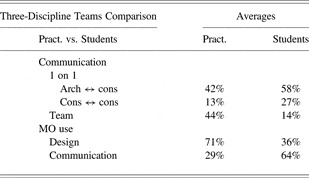
A comparison of experienced professionals and students revealed big differences regarding communication as well as use of morphological charts (Table 3). The student teams showed much more difficulty in reaching shared understanding, leading to less team communication but at the same time to more intensive use of morphological overviews for communication purposes.
Comparison of observation results between practitioners' and students' three-discipline design teams

Note: Arch, architect; Cons, consultant; MO, morphologic overview.
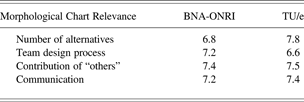
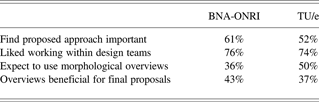
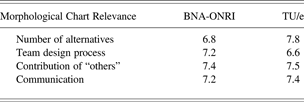
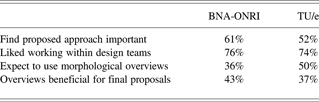
The questionnaires helped to further evaluate the use of morphological charts. The importance of the proposed approach for education purposes was emphasized by 52% of students, 41% were in doubt, and only 7% did not see any benefit in its use. The student evaluations showed that students were generally more cautious than professionals: 21% of students considered the use of morphological overviews irrelevant for their discipline. However, none of the students thought that the use of morphological overviews had a negative impact on communication within design teams. The majority of students were convinced that the use of morphological overviews was beneficial in many aspects. Seventy-four percent (with an average rating of 7.8) considered morphological overviews to lead to a greater number of relevant alternatives. Similar to professionals, the students also considered morphological overviews beneficial in three key areas: the team design process (6.6), to raise the awareness of the contribution from other disciplines (7.5), and for communication (7.4). Again, student results were highly positive in terms of the benefit of working within design teams. Here the average rating was 7.8. There were key differences between the results of students and professionals. Students, on average, considered the effect that morphological overviews had on final design proposals rather negatively, with only 37% of participants considering it beneficial. This aspect was given a slightly higher rating by professionals, with 43% considering it positive. However, the students were more positive than the professionals in their expectation of the use of morphological overviews in their future carriers; 50% of students rated their future use as “highly likely” (Table 4 and Table 5).
Ratings of BNA-ONRI and TU/e workshop participants (1–10 scale) on use of morphological charts
Note: BNA-ONRI, Royal Institute of Dutch Architects and Dutch Association of Consulting Engineers; TU/e, University of Technology Eindhoven.
Positive reactions by BNA-ONRI practitioners and TU/e students
Note: BNA-ONRI, Royal Institute of Dutch Architects and Dutch Association of Consulting Engineers; TU/e, University of Technology Eindhoven.
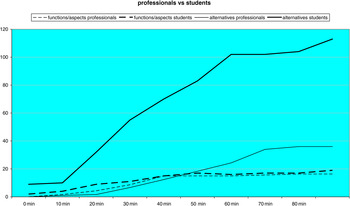
The work of student design teams was also photographed in 10-min intervals. In Figure 9 it is interesting to note the average development of the number of generated alternatives by the professional and by the student design teams is shown. It is interesting to see that there is no big difference in the definition of the amount of aspects, but the number of proposed alternatives and the way the teams generate them is completely different. Generally speaking, the professional design teams tended to define the aspects first and then produce the relevant alternatives. This was even more obvious with four-discipline design teams. In Figure 9 only the results of the three-discipline design teams are shown. The student design teams generated the proposals and the functions/aspects more in parallel. However, they continued generating new proposals even during the third and final day of the workshop series. It appeared that they often did not know what to do with the produced (sub)results. The experience of the professional designers seemed to give them some advantage regarding this phase of the conceptual building design. These results indicated that students should not be used for the development of an ID method, because they apparently have difficulties making the integration step. The development should instead be done with professionals and the developed method used for education of students. In contrast, the amount of proposed alternatives by student teams was much bigger, meaning that the potential for discovering new possibilities could also be larger. It needs to be stressed that the quality of the generated alternatives/proposals was not assessed. The purpose was to research if the use of the morphological charts would lead to a widening of the field of possibilities, which did seem to be the case. The comparison between three-discipline and four-discipline professional design teams showed (see Fig. 10) that this is even more evident with the more complex teams. That is something we were not able to confirm with the student design teams, because all of them were composed of three different design disciplines.
The number of produced functions or aspects and alternatives by professional and student design teams. [A color version of this figure can be viewed online at journals.cambridge.org/aie]

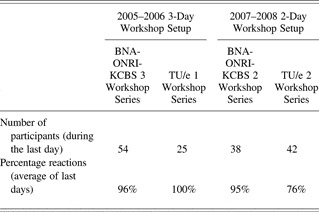
In the present stage of our research the focus was on the theoretical workshop model and the extensive testing in the professional setting. As a result of this we have only made an overall comparison between the results of the questionnaires held for professionals compared to that of the students. The number of participants is given in Table 6.
Number of returned questionnaires for initial series of 3-day workshops and later series of 2-day workshops for professionals and students

Note: BNA-ONRI-KCBS, Royal Institute of Dutch Architects, Dutch Association of Consulting Engineers, and Knowledge Centre Buildings and Systems; TU/e, University of Technology Eindhoven.
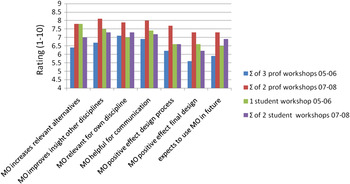
The results of the comparison of the questionnaires are given in Figure 11. Remarkable is that for the 3-day workshops the students are more positive than the professionals on all aspects, where as for the 2-day workshops the professionals are more positive than the students.
A comparison of the results of the questionnaires for the initial series of 3-day workshops and the later series of 2-day workshops for professionals and students; MO, morphological overview. [A color version of this figure can be viewed online at journals.cambridge.org/aie]

It was also remarkable that there was the same pattern in rating for the 2-day workshops for students compared to that of the professionals: on average, there is a difference of nearly 1.3 points. This is not the case for the 3-day workshops. We again see the lowest rating for the influence of morphological overviews on the design process and for the influence of the use of morphological overviews on the final product design. There is still a high score for the increased insight in their own discipline (7.0 students vs. 7.9 professionals, on a scale of 1–10) and that of the others (6.7 students vs. 8.1 professionals). In addition, all of the participants think that the use of morphological overviews is helpful in communication (6.9 students vs. 8.0 professionals).
6. DISCUSSION
Different workshops series with professionals where initiated to test and analyze what kind of aspects are of influence on knowledge exchange during design processes. The chosen setting is that of reflective practice (Schön, Reference Schön1983). Using human subjects in laboratory experiments to study design theory provides some insight. However, extending results from a laboratory experiment to conclusions for the engineering practice is a risk. The effect of macrocognition describes the differences in cognitive functions performed in natural versus artificial, laboratory settings. The real-world setting requires activities in ways that artificial settings can rarely simulate. Schön (Reference Schön1987) has proposed a practicum as a means to “test” design(ing). Where a practicum is as Schön describes (1987, p. 37), “a virtual world, relatively free of the pressures, distractions, and risks of the real one, to which, nevertheless, it refers.” In Schön's practicum a person or a team of persons has to carry out the design. A practicum can assess a design method and the degree to which it fits human cognitive and psychological attributes (Frey & Dym, Reference Frey and Dym2006). Simulation of the “typical” design situation is crucial. A workshop can be seen as a specific kind of practicum. It is a self-evident way of working for designers that occurs both in practice as during their education. As such, a workshop provides a suitable environment for testing the approach. In addition to the full design team lineup, there are a number of other advantages of workshops with regard to standard office situations while simultaneously retaining the practicelike situation as much as possible. Workshops make it possible to gather a large number of professionals in a relatively short time, to repeat the same assignment, and to compare different design teams and their results. Nevertheless, the workshops are a virtual world as explained by Schön (Reference Schön1983, p. 162): “contexts for experiment within which practioners can suspend or control some of everyday impediments to rigorous reflection-in-action.” Schön refers further to the dilemma of rigor and relevance in professional practice. There is a choice to stay on the high, hard ground: “A high, hard ground were practitioners can make effective use of research-based theory and technique,” or to descend to the swamp as described by Schön (Reference Schön1983, p. 42): “a swampy lowland where situations are confusing” and engage the most important and challenging problems.
As other research fields show, using human subjects as study objects in laboratory experiments can provide valuable insights (Frey & Dym, Reference Frey and Dym2006). However, generalizing the results from experiments entails a certain risk. The real-world setting requires activities in ways that artificial settings can rarely simulate.
Further research is needed to look more closely at the actual mental mechanism to stimulate the occurrence of innovative design concepts. This research offers a tool to explicate design knowledge, but a lot of the implicit knowledge still stays hidden within the designers themselves. How to activate this knowledge and to make it easier to explicate it to the other designer of the team is therefore one of the things to investigate in the future.
7. CONCLUSION
At University of Technology Eindhoven an ID method has been developed to teach a supportive design method for building design for professionals and students. The basis for the development of support to improve building design was provided by a workshop formula in which different disciplines could engage in face-to-face team design in combination with a morphological approach for the explication of discipline-based object–design–knowledge using morphological charts and transformation of this knowledge into ID concepts using the resulting morphological overviews. As demonstrated by the ID project (Quanjel & Zeiler, Reference Quanjel and Zeiler2003), a workshop setting can be applied as “training” for ID in both practice and education. Using it primarily as a learning tool, a workshop setting can at the same time serve to test the ID method.
In workshops with experienced professionals a first prototype of the ID method was developed integrating four key elements: the design team, design model, design tool, and design setting. Within the ID method the structured presentation of object–design–knowledge is guided by using morphological charts. The underlying assumption of the method is that the exchange of knowledge of different disciplines will lead to a better shared understanding of the task while simultaneously guaranteeing the benefits of a heterogeneous team to generate a broad variety of solutions. The design method supports knowledge transfer and knowledge creation that stimulates innovation on the product and process level.
Two cases were discussed in which the connection was made between industry and university in fields of design education. First, we described the multidisciplinary workshops to professional (architects and engineers). Second, our multidisciplinary master student project was highlighted. The professional workshops were organized for research into a new design education concept for architectural and engineering master students. This led to a setup of student workshops as the starting point of a multidisciplinary master design project. Our workshop formula, based on the ID approach with the use of morphological overviews, is appreciated both by professionals and students. Our presented approach of combining education for students and professionals is meaningful in the field of building design. Besides the good ratings of the questionnaires by the participants of both the student workshops and the professional workshops, the best proof of success may be the fact that the workshops have become part of the permanent professional educational program of BNA since 2006. An additional “proof” for success is the fact that the largest Dutch building services consulting company asked us to provide training for their employees within the company, based on the concept of the workshops. Sixteen professionals attended this workshop and their overall rating of appreciating was 7.5 on a 1–10 scale. Furthermore, an ID method course will be facilitated by the Dutch Society for Building Services Engineers and will start in the second half of 2011.
We believe that our workshop formula based on the ID approach with the use of morphological overviews gives our students some useful support tools for the design problems they have to face in practice. However, it is far more important that they have learned to structure the design process themselves, which makes the process more transparent and communication about the design process with other stakeholders easier.
ACKNOWLEDGMENTS
The Knowledge Centre Buildings and Systems (University of Technology Eindhoven), Kropman BV, and the Stichting Promotie Installatietechniek Foundation supported this research.
Wim Zeiler is a Professor of building services at the University of Technology Eindhoven and is also employed part time at Kropman BV, a building services contractor. Prof. Zeiler's research addresses the link between design and practice, including how architects and engineers can improve their cooperation while working on sustainable building designs.
Percia Savanović is a Project Manager of IDS at the Society for Building Research in the Netherlands. After being trained and working as an architect, he finished his PhD on the ID method in the context of sustainable building design in 2009.