Notwithstanding any other provision of this Act, no benefits shall be payable under the State plan to any person … for any period of disability due to pregnancy or resulting childbirth, miscarriage, or abortion.
—Temporary Disability Benefits Law, New Jersey, L. 1948, c. 43: 21–25
Disabilities caused or contributed to by pregnancy, childbirth, or related medical conditions, for all job-related purposes, shall be treated the same as disabilities caused or contributed to by other medical conditions, under any health or disability insurance or sick leave plan available in connection with employment.
—Equal Employment Opportunity Commission, Guidelines on Discrimination Because of Sex, 1972
In 1972, the EEOC issued guidance stating that disabilities arising from pregnancy and childbirth could not be excluded from employment-related disability insurance programs. Two 1974 Supreme Court cases—Geduldig v. Aiello and General Electric v. Gilbert—soon contradicted that guidance by ruling that pregnancy-related disabilities could, in fact, be excluded from the California State Disability Insurance system and private employers’ fringe benefit plans, respectively. In reaction, Congress passed the Pregnancy Discrimination Act (PDA) of 1978, an amendment to Title VII of the Civil Rights Act. Both the 1972 EEOC guidance and the PDA framed pregnancy as a cause of disability rather than as a disability in and of itself; thus, disabilities caused by pregnancy must be treated the same as other disabilities. Under the PDA, not only private employers and the State of California but also the other three states with statutory temporary disability insurance (TDI) programs were required to extend equal coverage to women who experienced pregnancy-related disability.
Geduldig and General Electric were landmarks in the fight against employment-related sex discrimination, but they are also likely the only context in which most people have ever heard of statutory TDI programs. Initially called “cash sickness” insurance, TDI is a little-studied New Deal-era statutory social insurance providing cash benefits to workers who are unemployed due to nonoccupational short-term illness or injury. Only four states—Rhode Island, California, New Jersey, and New York—ever established TDI systems. Designers conceived of TDI as a partial wage replacement for male breadwinners who were laid up by off-the-job sickness. The benefit would tide them and their dependents over until the men were well enough to return to work. Pregnant women of course did not fit this mold. From the 1940s until the passage of the PDA in 1978, statutory TDI programs systematically denied women disability benefits or paid lower levels of benefits for pregnancy-related conditions. This phenomenon was part of systemic employment discrimination rooted in policy makers’ breadwinner gender ideology—that is, the idea that men should engage in paid labor as breadwinners while women stayed at home performing unpaid domestic labor.
The marginalization of pregnancy-related disability in TDI is an aspect of the creation of what Suzanne Mettler calls “divided citizenship.”Footnote 1 New Deal federal policies primarily protected breadwinning white men, whereas the policies that most affected men of color and women, such as Unemployment Insurance (UI), were more precarious and left to states to shape and administer.Footnote 2 Three of the four statutory TDI systems were coordinated with UI and therefore also limited working women’s access to benefits by excluding part-time, seasonal, and waged domestic workers. The case of pregnancy-related disability in TDI systems illustrates how, within a social insurance system already excluding many women, women who would otherwise be eligible faced further exclusion from full social citizenship when they became pregnant.
The postwar period was also an inflection point in the construction of European and American social welfare states, including in the realm of gender. Faced with the tasks of rebuilding a devastated physical environment, providing health care and financial support to ailing populations, and restoring postwar economies, European states established comprehensive social welfare systems. In contrast, the US instead developed what Jacob Hacker calls a “divided welfare state” that privatized many of the same provisions.Footnote 3 Moreover, European states facing labor shortages developed policy innovations to keep women working, including paid maternity leaves, family allowances, and public childcare. In contrast, maternity supports that had helped American women participate in the labor force during the war were rolled back. Care work, including childrearing, was left to individual women and families despite labor feminists’ advocacy of public solutions.Footnote 4 Maternity leave was relegated largely to the realm of employer fringe benefits or negotiated as part of collective bargaining agreements. If TDI had covered pregnancy-related disability, it could have functioned as a stand in for a European-style maternity benefit. Instead, it reinforced the gendered postwar employment landscape in which American women, especially mothers, were pushed out of the workplace.
The case of pregnancy-related TDI in the New Deal era furthermore suggests that the concept of disability in employment was itself gendered. Policy makers often did not consider pregnancy-related medical conditions to be “true” disabilities deserving of insurance coverage. In contrast, nonoccupational illnesses and injuries that were viewed as being universal—unmarked by gender—were accepted as compensable disabilities no matter their cause. When the breadwinner gender ideology animating New Deal social welfare programs collided with gendered ideas of disability, the result was a form of social insurance that excluded or marginalized pregnancy-related disability.
This study begins by situating pregnancy-related disability at the intersection of gender, public policy, and disability. Then it traces the development of statutory TDI programs, beginning with Rhode Island’s, as part of a New Deal-era vision for comprehensive social insurance for breadwinning men. Faced with an immediate and unexpected flood of pregnancy-related claims from women workers, Rhode Island Unemployment Compensation Board (UCB) administrators were forced to choose whether to treat pregnancy as a compensable disability. Their decision to do so led to the TDI trust fund’s insolvency and to officials’ ongoing efforts to walk back benefits; to redefine pregnancy-related disability as not being a “real” disability; and to advise California, New Jersey, and New York lawmakers against covering pregnancy-related disabilities in their TDI systems.
Gender, Public Policy, and Disability
Pregnancy-related disability in TDI offers the opportunity to examine the interaction between gender and disability, a theme ripe for more elaboration in the disability studies literature. Douglas Baynton and Lennard Davis have both described the historical association of femininity with feebleness of mind, physical frailty, and weakness of character.Footnote 5 Audra Jennings has also explored how in the postwar era disability was seen as depriving men of their masculinity by preventing them from becoming breadwinners within a structure of predominantly white heterosexual marriage. At the same time, disabled women were robbed of their femininity and prevented from achieving the idealized status of mothers and wives.Footnote 6 The present study builds on these approaches by analyzing how gender ideology prevented certain kinds of disabling medical conditions from being defined as disabilities.
In particular, the breadwinner gender ideology inspired many policy makers and implementers to exclude pregnancy-related conditions from classification as disabilities in the context of employment. They did so even though medical conditions related to pregnancy and childbirth could without question prevent women from being able to work. Pregnancy causes anatomical and physiological changes in all organ systems, sometimes overloading stressed organs or revealing underlying medical conditions.Footnote 7 Complications of pregnancy can include diabetes, high blood pressure, and hemorrhage. Childbirth can cause damage to internal organs and life-threatening blood loss, require major abdominal surgery under general anesthesia, and result in a woman’s inability to stand or walk for weeks. Yet, these conditions were either classified as nondisabilities or treated as not being “real” disabilities because of their connection to pregnancy and childbirth. At the same time, men and nonpregnant women who had nearly identical disabling conditions—for example, diabetes, abdominal surgery, or inability to stand—were granted disability benefits regardless of the cause of those conditions.
The exceptional status of pregnancy was reinforced by the diagnostic categories of the International Classification of Diseases, Injuries and Causes of Death. All pregnancy-related diagnoses were grouped together as “Deliveries and Complications of Pregnancy, Childbirth, and the Puerperium.” Subcategories included, for instance, “delivery with specified complication.” In TDI programs, the subcategories were erased. For example, Rhode Island TDI reports organized by diagnosis included only one line under the category “Deliveries and Complications of Pregnancy”: “pregnancy.” Pregnancy itself was thus presented as the disability rather than the disabling conditions it caused. This practice allowed administrators and legislators to treat pregnancy differently from other compensable disabilities and to target it when seeking cost-reduction measures.
Because it was the cultural norm for women to leave the workforce permanently after giving birth, administrators argued that pregnancy-related disabilities were not real disabilities that workers would return from expeditiously. Furthermore, in all the TDI programs outside of Rhode Island, legislators and administrators acknowledged that disabilities related to pregnancy were, in fact, real disabilities but declined to cover them nonetheless because benefit payments strained TDI trust funds. It seems highly unlikely that other apparently gender-neutral disabilities could have been excluded in this way.
Disability-Related Social insurance
Organized labor sought the establishment of TDI to protect a class of workers who had been left out of New Deal programs: those experiencing nonoccupational temporary disability. Permanently disabled people were similarly left uninsured. However, through the unstinting efforts of disabled individuals and organizations of disabled people, Social Security expanded into Disability Insurance in 1956 and Supplemental Security Income in 1972.Footnote 8 People temporarily unemployed due to off-the-job sickness had no access to Worker’s Compensation (WC) because their disabilities were not work related. Neither were they eligible for UI benefits because they were unable to accept work that they might be offered. As veterans returned home with disabilities and other health problems related to their military service, the need for comprehensive disability insurance became even more acute.
In the late 1930s and 1940s, some supporters of social insurance at the federal level were interested in establishing TDI. On the administrative side, Assistant Secretary of Labor Arthur Altmeyer, one of President Roosevelt’s most important advisors on Social Security and a member of the technical board that drafted the 1935 Social Security Act, urged the inclusion of nonoccupational illness insurance in the Act. Initially a proponent of a state-level UI system, he came to embrace the idea that the federal government rather than state governments should be responsible for many social insurance programs. By the late 1930s, he strongly advocated for creation of a federal nonoccupational disability program.Footnote 9 On the legislative side, the Wagner-Murray-Dingell Bills of 1943 and 1945 both provided for federal-level TDI as part of comprehensive national social insurance and a national health care system. However, faced with overwhelming resistance from insurers, the American Medical Association, and employers, efforts to establish a federal TDI system failed.Footnote 10 Instead, the Social Security Board (SSB) encouraged states to create statutory TDI systems coordinated with UI and provided support in the form of advice and draft legislation.
The majority of US state legislatures considered models of statutory social insurance covering temporary disability during the mid- to late-1940s.Footnote 11 However, only four states—Rhode Island (1942), California (1946), New Jersey (1948), and New York (1949)—and the Railroad system (1946) established them then. Elsewhere, TDI instead became available to many workers through voluntary plans provided by employers as fringe benefits or for individual purchase on the free market.
Rhode Island: Pregnancy Disability and the Cash Sickness Pioneer
In 1941, members of the Rhode Island UCB sought out the SSB’s approval for and assistance with establishing a statutory cash sickness program. With the support of organized labor, the UCB and SSB then drafted legislation that was introduced in the Rhode Island state legislature in February 1942.Footnote 12 Nathan Sinai, a public health economist at the University of Michigan and frequent consultant to 1940s-era TDI administrators, wrote: “[f]rom all of the evidence obtainable, no one or no group that might have been expected to oppose the legislation”—for example, the insurance industry—“took the bill very seriously.”Footnote 13 Nor was the Rhode Island Medical Society (RIMS) involved in the creation of the bill, much to the later consternation of the organization’s executive secretary, John Farrell. He excoriated legislators for their “failure to consult at any time the medical profession upon whom it is now apparent the burden for future success of the plan will devolve.”Footnote 14 Nevertheless, the bill passed easily in both the House and Senate in April 1942. After one year of accumulating contributions to the trust fund, the first claims were paid out in April 1943. Footnote 15
The state established the TDI trust fund quickly by diverting funds from the state’s UI system to the cash sickness program. On the eve of World War II, unemployment rates had fallen to low levels in highly industrialized and unionized Rhode Island. As a result, the state’s UI trust fund accumulated a surplus of $28 million by early 1942 largely because Rhode Island, like only seven other states, required both employee and employer contributions.Footnote 16 Rhode Island unions saw the surplus as an opportunity to establish a new statutory cash sickness program by diverting two-thirds of the employee contributions to it. There is no evidence of employers objecting to this transfer, likely because it did not affect their contributions. Cash sickness insurance thus required neither new taxes nor a new administrative system because it would be implemented by the UCB.Footnote 17
The new law required all UI-eligible workers to participate. In the words of a UCB report, cash sickness insurance was
designed to maintain … the family income of the worker who is forced to quit work because of illness. It was assumed that in most cases this would be a temporary condition and the worker would return to his regular employment as soon as his health permitted.Footnote 18
However, it did not formally provide job security. Eligible workers could also seek cash benefits if they became ill while already unemployed. The benefit amount was determined by a calculation of wage credits based on the worker’s wages and total income the previous base year. The total amount paid out in benefits was thus determined by eligibility requirements, duration of benefits, and generosity of the cash payment, all of which could be adjusted to ensure the fund’s solvency.
Only after the legislation had passed did opposition to the program begin to materialize. Insurance companies came out strongly against what they dubbed the state “monopoly” of cash sickness. They preferred that employers purchase private TDI or self-insure rather than being required to participate in the “compulsory” state program. Administrators, insurance companies, and medical professionals all expressed deep concern about workers “malingering” to collect unearned benefits.Footnote 19
Only a year after benefits began paying out, the cash sickness fund started to run a deficit. Analysts and administrators identified three main causes. First, a significant number of workers were collecting both WC and cash sickness payments.Footnote 20 Second, some workers were collecting benefits even though they had no intention of returning to the labor force. The culprits here were older workers who had come out of retirement and women who had entered the labor force to help with the war effort. Finally, the pregnancy benefit was identified as the most important factor leading to trust fund insolvency.Footnote 21
The Pregnancy “Problem”
As originally written, the Rhode Island cash sickness law was silent on the question of whether pregnancy-related disability was covered. However, pregnant workers immediately began to apply for benefits. In the absence of legislative guidance, administrators had to decide quickly whether to consider pregnancy a compensable disability. As a UCB report noted in 1947, “[a]fter considerable argument both pro and con, it was decided that pregnant women were entitled to benefits if they met the other eligibility requirements. This was an administrative decision and was not a part of the law.”Footnote 22
Unfortunately, this is the extent of our knowledge of the discussion because the Rhode Island state legislature and relevant administrative units, including the UCB and its subcommittees, did not preserve minutes or legislative histories. Both labor and the Rhode Island Medical Society (RIMS) were consulted in the decision, but neither the report nor RIMS documents reveal the content of the consultation.Footnote 23 It seems certain that the decision related to the vital importance of women in Rhode Island’s wartime economy. Both the state and employers had strong incentives to induce women to return to the workplace following childbirth. The June 1942 Children’s Bureau and Women’s Bureau of the US Department of Labor (USDOL) guidelines for wartime maternity leave similarly reflected this objective at the federal level.Footnote 24
Pregnancy: A Disability or Not?
The Rhode Island UCB’s decision to include pregnancy-related disabilities in the TDI program remained controversial because there was little consensus inside or outside the state government about whether pregnancy constituted a disability. The state’s definition of “sickness” (later renamed “disability” in the law) was very broad: It was a physical or mental condition that prevented a worker from engaging in their usual or regular employment. Some difficult pregnancies and births would seem to fit that definition clearly. On the other hand, many pregnancies and births went smoothly, and therefore some mothers were physically unable to work only briefly after giving birth. For this reason, some critics of pregnancy-related TDI argued that pregnancy was not a disability but a natural physical process that therefore should not be covered. From an administrator’s point of view, classifying pregnancy itself as a disability would sow inequity and confusion. Women workers would be eligible to collect TDI benefits from the day they confirmed a pregnancy, potentially entitling them to many months of benefits. Additionally, a doctor’s view of whether a pregnant woman should be allowed to work could be subjective and influenced by cultural or community standards rather than by medical diagnosis.Footnote 25
Rhode Island administrators faced another objection that acknowledged pregnancy was a disability but viewed it as “self-inflicted” or voluntary, creating a moral hazard that should exclude it from coverage. Administrators were unable to accept this claim for two reasons. First, other voluntary conditions, such as elective surgery, were already covered; in addition, alcoholism was classified as a disabling condition even though some critics argued that it was voluntary or self-inflicted. Second, Rhode Island’s very broad definition of disability did not disqualify self-inflicted illness or injury, so pregnancy coverage could not be excluded even if considered a voluntary or self-inflicted condition. Eventually, the administrators threaded the needle by covering complications of the natural processes of pregnancy and childbirth rather than pregnancy itself.
The Pregnancy Disability Benefit
The cash sickness program provided partial wage replacement for women during the time their physicians judged them physically unable to work due to “deliveries and complications of pregnancy, childbirth, and the puerperium.”Footnote 26 Thus it was distinct from a maternity benefit, which would grant a pregnant woman leave before and after childbirth without regard to her specific medical condition. There was no guarantee that women disabled by pregnancy would be able to receive payments for the full period of disability or that they would receive the maximum 20 weeks of benefits. As she would with any type of disability, a postpartum woman might exhaust her benefits before she was fully recovered. Indeed, women were much more likely than men to exhaust their benefits because women’s lower wages meant they earned fewer wage credits for the same hours of work. Women were therefore on average eligible for lower benefit payments, for a shorter time, than their male coworkers.
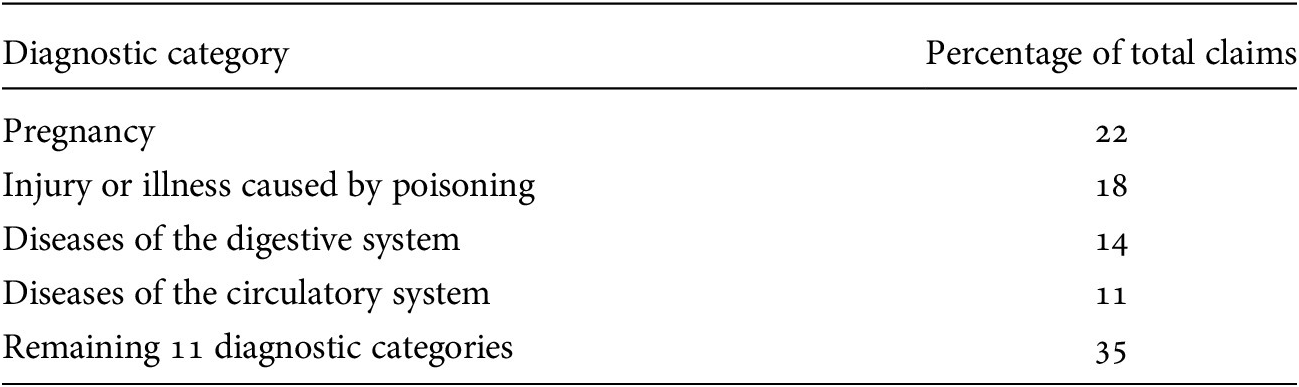
Nevertheless, pregnancy cases usually made up between 20% and 30% of all claims. As an example, the breakdown of claims from 1949 is shown in Table 1.
Percentage of Rhode Island Cash Sickness Claims by Diagnostic Category, 1949Footnote 27

Pregnancy disability payments were also the largest single cash outflow: For example, in the first benefit year, 1943, pregnancy benefits made up roughly 17% of all compensation paid.Footnote 28 Administrators and politicians were quick to blame pregnancy benefits for the program’s insolvency. In the words of the UCB report for 1943–1944, “[i]f the pregnancy payments had not represented such a large portion of the total cost of operation, the Cash Sickness fund could have built up a modest surplus on the basis of a 1% tax.”Footnote 29 It could be argued that if any of the major diagnostic categories had had lower payouts, then the system would not have been stressed. However, other categories such as “injury or illness caused by poisoning” were more clearly the kinds of disability framers envisioned. We can infer from the UCB administrators’ statement that one reason they thought pregnancy disability was a “problem” was that they did not think it was a legitimate form of disability.
Contributing to the high cost of the pregnancy benefit was the large number of women in the workforce even before WWII began. The state was highly industrialized, its main industries being textiles, machinery and tools, and jewelry. The first and last employed a high percentage of women. The US Bureau of Labor Statistics reported that in Rhode Island “about 38 percent of the workers in manufacturing in October 1939 were women; by October 1943 the proportion had risen to about 41 percent … in the textile industry the proportion … rose from 46 percent in October 1939 to 51 percent in October 1943.”Footnote 30 This unusually high proportion of female workers, many married and in their childbearing years, meant that benefit usage differed from what would be expected in a workforce of male breadwinners and single women.
The Funding Crisis and the Decline of Pregnancy Coverage, 1946 and Onward
As problems with the cash sickness program emerged in the first years of its operation, the law was amended in 1943 and 1946. However, some of the amendments broadened eligibility rather than narrowing it. For example, the 1943 amendments allowed workers to draw both WC and cash sickness benefits simultaneously. It became clear that structural changes were necessary to keep the system afloat in the postwar economic contraction.Footnote 31 Higher unemployment decreased contributions to the TDI trust fund; veterans returning to civilian workplaces had more health problems than other workers; and payouts based on higher wages from the previous (wartime) base year meant that the fund could not pay the benefits due. During 1944–1945, the fund ran a significant deficit; in the first half of 1946, it skyrocketed.Footnote 32 An infusion of funds was necessary to rescue the cash sickness system. Therefore, beginning July 1 1946, the entire employee contribution to the UI fund was temporarily diverted to the trust fund. The legislature also received federal permission to transfer an additional one-time infusion from the UI trust fund.Footnote 33
In addition to finding new sources of revenue, the 1946 amendments sought to reduce outlays by reducing benefits. The compensation paid to workers collecting both WC and TDI payments was capped. Furthermore, people who had not worked during the previous six months were deemed unattached to the labor market and ineligible for benefits.Footnote 34 On this note, the UCB administrator noted in 1947 that “even a cursory survey of the pregnancy claims will indicate that the women have left the labor market and, in most instances, do not intend to return to work after the birth of their child.” However, he provided no data to substantiate this assertion. A 1952 Women’s Bureau study found women’s return to work varied between 3% for nonmanufacturing and 30% for manufacturing jobs, meaning that in industrial Rhode Island it is likely many women did resume working.Footnote 35 In the end, lawmakers and administrators decided to treat pregnancy disability differently from, and less favorably than, other types of disability claims.
In defense of this change, administrators argued that women who received pregnancy-related disability benefits were depriving more deserving claimants of their own. The UCB argued that pregnancy cases prevented “the majority of the covered workers of the state” from receiving a more reasonable level of benefit by increasing the maximum TDI weekly benefit from $18 to $25, as had recently happened for UI.Footnote 36 It is difficult to imagine administrators making these arguments during wartime, when women’s labor was vital to the war effort. During the postwar period, however, the resurgence of the breadwinner gender ideology strengthened the expectation women would step aside for returning servicemen.Footnote 37 The UCB wrote this expectation into policy and law even though women still made up about 40% of the state’s postwar workforce and the number of women engaging in paid labor increased over the next years.
Ultimately, the pregnancy benefit threatened the well-being of the TDI trust fund because the system’s financing model assumed pregnancy would not be covered and set tax rates accordingly. In 1949, Thomas Bride, chairman of the UCB, argued that the proportion of claims in the 20–29 age group was much higher than “normal”—31%—because of the high number of pregnancy cases. “[I]f our system excluded payments in pregnancy cases,” he wrote, “the size of this group would revert to normal since approximately one-half of all claims in this age bracket were for pregnancy.”Footnote 38 Bride’s recommendation to restore the trust fund’s solvency was thus to eliminate pregnancy-related disability coverage rather than to increase revenue. The TDI tax rate on workers’ salaries could have been raised, or the state could have required an employer contribution. However, reflecting the views of labor and the RIMS, a Providence Journal editorial opined that a tax increase on workers should be used only as a last resort and that eliminating “double dipping” and other costly items should be addressed first.Footnote 39 Requiring an employer contribution would have met with strong opposition from business interests, who complained that the already high UI tax was making Rhode Island businesses uncompetitive.Footnote 40 Indeed, the attraction of setting up a TDI system with surplus funds from the UI system had been precisely that it did not raise taxes on either workers or employers. Another approach might have been to transfer monies from the general fund, but there is no evidence that this method was ever considered. Cutting back the pregnancy benefit seems to have been the only politically acceptable solution.
Considering how frequently both administrators and politicians blamed the pregnancy-related disability benefit for the cash sickness fund’s insolvency, it is rather surprising that legislators did not simply eliminate it in the 1946 amendments. No politicians or advocacy groups openly defended pregnancy-related disability. Even the state’s greatest advocate for working women and children, Margaret Ackroyd, chief of the Rhode Island Department of Labor’s Division of Women and Children, did not publicly involve herself in the struggle over pregnancy disability, saying it was outside the remit of her division’s focus on wages, hours, working conditions, and child labor. Ackroyd worked more publicly for the preservation of the pregnancy disability benefit in 1949 and 1951 when legislators proposed amendments to scale back or eliminate it. At that time, she approached the USDOL Women’s Bureau for assistance with statistics and strategies to show the need for coverage.Footnote 41 However, even without a strong public supporter, the pregnancy disability benefit survived: A Providence Journal editorial opposed eliminating the pregnancy-related disability benefit because “Rhode Island” had found it neither “socially nor economically desirable” to do so.Footnote 42
The only institution coming out strongly in favor of the pregnancy-related disability benefit was the Rhode Island Medical Society (RIMS). When the state legislature proposed amendments to the cash sickness law in 1945, RIMS criticized them harshly. The Society conveyed members’ anger at having been excluded from the process of writing the initial TDI bill and other laws related to the medical profession. A RIMS report demanded the legislature make changes to the TDI law “to obtain the continued cooperation of the Society in the operation of the act.”Footnote 43 RIMS’s cooperation was indispensable because physicians had to certify that workers were disabled. The Society demanded that the pregnancy-related disability benefit stay. The report stated that “[s]ickness from pregnancy should not be distinguished from sicknesses from other causes, and it should be equally compensable.” RIMS expressed the view that although pregnancy itself was not a disability, a woman could become disabled or ill due to conditions caused by, or complications of, pregnancy. In justifying this decision, the RIMS report notes,
In a state such as Rhode Island[,] which even in normal times had one of the highest percentages in the nation for the employment of women[,] there should be no effort made to penalize the female worker who is required to contribute to this sickness compensation fund by denying to her benefits due by reason of her absence from regular employment because of complications arising from pregnancy.Footnote 44
The RIMS statement makes two arguments that might have caught legislators’ attention. First was the appeal to the importance of keeping women in the labor force during wartime. Second, this approach would reduce the cost of the pregnancy benefit. Simply being pregnant was not sufficient; a woman had to obtain certification of inability to work. Ultimately, the Society recommended that pregnancy-related disability benefits should be provided for 12 consecutive weeks, six prepartum and six postpartum, at the same compensation level as other disabilities.Footnote 45
There is no direct evidence for why RIMS took such an uncompromising position on pregnancy-related disability. We can posit, however, that it was related to the medicalization of pregnancy and childbirth starting in the 1920s. Prior to that time, most American women gave birth at home, attended by midwives or family members. This reinforced the idea that childbirth was a “natural process.” By the 1940s, male obstetricians in hospitals were pushing midwives aside. By 1950, nearly all white women gave birth in hospitals. Medical interventions such as caesarian sections, general anesthesia, and the use of forceps even in uncomplicated births made childbirth the province of (mostly male) physicians.Footnote 46 Positioning themselves as the gatekeeping experts on maternal health, RIMS’s physicians could speak with authority about pregnancy-related complications and frame them as disabilities. RIMS had the power to destroy the TDI system altogether by refusing to participate in it and chose to use this leverage to defend the medicalization of pregnancy and related conditions.
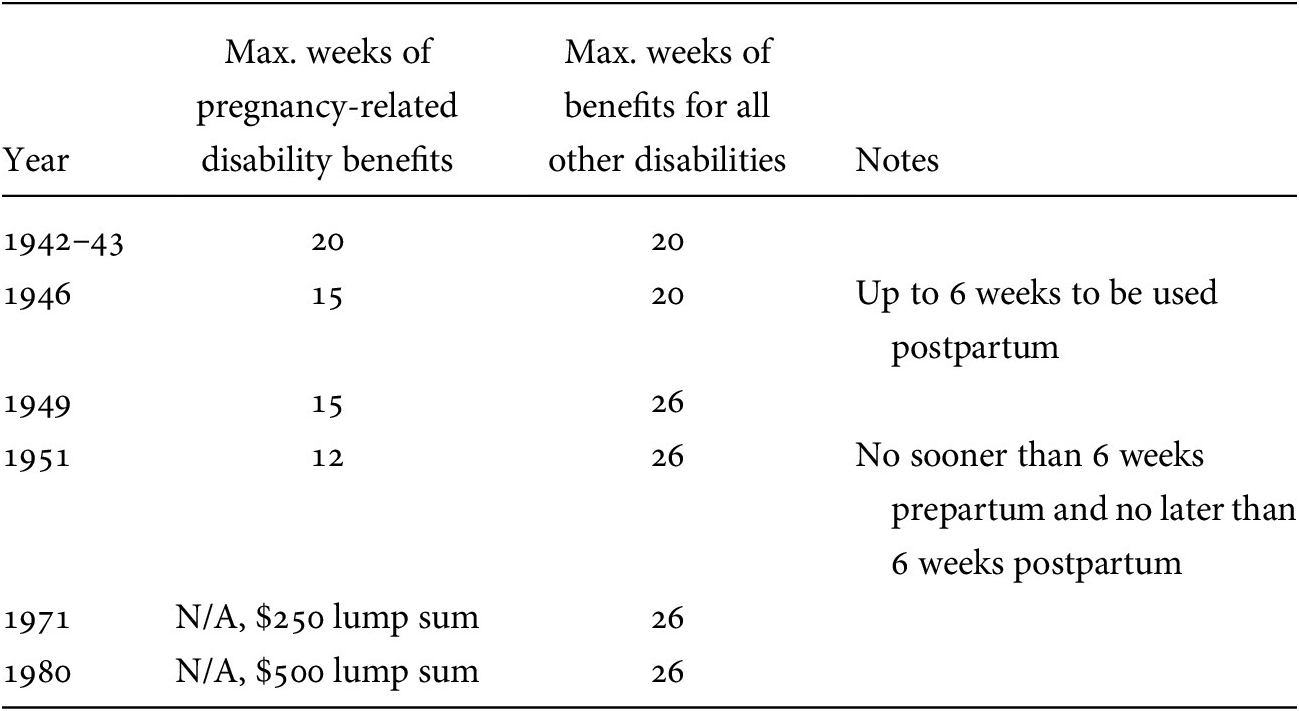
Consequently, the legislature moved in 1946 to limit the length of time women could draw pregnancy-related disability benefits but not to eliminate the pregnancy benefit altogether. Although workers claiming disability from all other causes continued to be eligible for 20 weeks of benefits, the maximum pregnancy benefit was cut to 15 weeks. It was available during the last few weeks of pregnancy and the period immediately after childbirth barring “unusual complications,” not specified.Footnote 47
Afterward, the maximum pregnancy benefit remained lower than that for other disabilities. In 1949, the pregnancy benefit remained capped at 15 weeks, but the limit for all other illnesses increased from 20 weeks to 26 weeks.Footnote 48 In 1951, the maximum pregnancy benefit was reduced from 15 to 12 weeks. Yet in approximately half of the first 6,000 pregnancy claims processed that year, claimants used fewer than 12 weeks because they had exhausted their benefit before then.Footnote 49 In the late 1960s, the pregnancy-disability benefit was delinked from earnings entirely, replaced with a $250 lump sum (see Table 2) when a woman returned to work. Thus, the disability benefit was transformed into a maternity benefit. This new policy ensured that women could not collect benefits unless they returned to the labor market. Following the passage of the PDA in 1978, Rhode Island increased the lump sum to $500. It only gave equal treatment to pregnancy-related disability after it lost the Barone v. Hackett pregnancy discrimination case in 1983.Footnote 50
Maximum Rhode Island TDI Benefit Length, Pregnancy-Related Disabilities versus All Other Disabilities Footnote 51

Complications of pregnancy and childbirth survived as a form of compensable disability in the Rhode Island TDI system despite debates over whether they were a legitimate form of disability. Legislators and administrators were unable to exclude pregnancy-related disabilities simply by declaring them not to be real disabilities. Instead, they pared down the pregnancy benefit to cut costs and ultimately transformed the benefit into a low lump-sum maternity payment. Rhode Island administrators subsequently advised other states to exclude pregnancy-related disabilities from their nascent TDI systems.
TDI beyond Rhode Island
Other states and the federal government were watching Rhode Island’s experiment with cash sickness. The Federal Railroad Retirement Board established a TDI program for railroad workers in a 1946 amendment to the Railroad Unemployment Insurance Act, covering pregnancy disability for its small number of female employees.Footnote 52 Many state legislatures began to explore statutory TDI systems in the early 1940s; by 1947, 21 states had considered TDI programs, and at least seven more had done so by 1958.Footnote 53 During the postwar years, the Social Security Administration recommended that states follow Rhode Island’s example in establishing TDI programs coordinated with their existing UI systems and provided them model legislation.Footnote 54 However, during the next several decades, only three additional states—California, New Jersey, and New York—did so. On advice of Rhode Island administrators, all three excluded pregnancy-related disabilities from coverage.
California was the second state to establish a statutory TDI program. Legislators there had explored a cash sickness program since the early 1940s and finally passed a TDI bill in January 1946.Footnote 55 Like Rhode Island’s, California’s 1935 UI law required both employer and employee contributions to the UI fund, leading to an enormous reserve during the low-unemployment war years. The employee contribution was diverted to the TDI trust fund, with the federal stamp of approval in the form of the Knowland Amendment to the Social Security Act and the Federal Unemployment Tax Act in the summer of 1946. Due to business and insurance industry pressure, California’s system featured not only a trust fund like Rhode Island but also a private option that allowed employers to purchase private TDI policies or self-insure as long as the benefit was at least as good as the public plan.Footnote 56
California’s TDI law framers explicitly excluded pregnancy-related disability claims based on the recommendation of a 1945 report of the State Senate Interim Committee on Unemployment Insurance. The Committee had studied the Rhode Island case thoroughly and consulted with the cash sickness program administrators there.Footnote 57 Rhode Island administrators had announced in speeches, publications, and reports that pregnancy coverage had rendered the system insolvent. They also counseled the Californians to exclude pregnancy from coverage.Footnote 58 Based on those discussions and on its own financial analysis, the California committee concluded that diverting the current employee UI contributions to a state-run TDI program would be sufficient to keep the trust fund solvent even if it included pregnancy coverage. Nevertheless, the committee recommended that pregnancy disability be excluded, noting in its report:
Assuming a similar frequency and duration of sickness, California could finance a program identical with that provided by the Rhode Island law. However, the program recommended by your committee excludes several of the very high cost items which are found under the Rhode Island Cash Sickness Act and would reduce the total cost of such a plan by at least 30 percent.Footnote 59
One of those high-cost items, in addition to double-dipping with WC, was pregnancy disability. In the words of the secretary of the California Employment Stabilization Commission, “[p]regnancy, or a condition arising out of or connected with it, is not ‘disability,’ up to its termination, and for four weeks thereafter.”Footnote 60 Only a woman who was still unable to work four weeks after giving birth, miscarrying, or having an abortion could claim disability benefits. Feedback from the Rhode Island administrators caused the California program to set this firm limit.
The Knowland Amendment allowed all states to divert employee UI contributions to TDI, thus creating an opportunity for more states to establish their own systems. Alabama, Indiana, Louisiana, Kentucky, New Hampshire, and New Jersey had all at one time collected employee contributions and were therefore eligible to use them for TDI. Of these states, only New Jersey succeeded in passing a TDI law; perhaps not coincidentally, the reserve of employee contributions in its UI trust fund—$180 million—was by far the largest among those states. All the other states either tried and failed to pass TDI laws or made no serious attempt to establish a TDI system at all.Footnote 61
Motivated by its surplus UI funds, New Jersey passed a statutory TDI bill in 1948 after studies of both the Rhode Island and California experiences.Footnote 62 Like California’s, the law established a hybrid system, with a state fund administered by the UI office running parallel with private insurance. The state also established two separate tracks in the TDI system: (1) state or private disability insurance for people who suffered nonoccupational illness while employed and (2) a state fund for people who became disabled while unemployed. Footnote 63
Like California’s, the New Jersey TDI program specifically excluded all disabilities related to pregnancy and childbirth. Going further than California, it eliminated the exception that allowed women who were still unable to work four weeks after giving birth to receive benefits. The wording of the statute is noteworthy: it excluded “any period of disability due to pregnancy or resulting childbirth, miscarriage, or abortion.”Footnote 64 The statute thus acknowledged that pregnancy-related medical conditions were disabilities but declined to cover them.
New Jersey’s organized labor opposed the exclusion of pregnancy-related disability. The AFL and CIO representatives to the 1946 state postwar economic commission insisted that pregnancy be a compensable disability. That year, the ILGWU likewise urged that the New Jersey program cover “periods of disability to prior to and subsequent to pregnancy.”Footnote 65 Furthermore, in 1948 the official CIO Council supported including pregnancy-related disabilities and declared their exclusion “socially undesirable.”Footnote 66 However, business interests prevailed, and pregnancy-related disabilities were excluded.
Similarly, the New York TDI system established in 1949 excluded pregnancy-related disability. The state legislature’s Joint Committee on Industrial and Labor Conditions commissioned a report on the California TDI system and adopted many aspects of that state’s program based on it. Two unique aspects of New York’s TDI program were that it was coordinated with WC rather than with UI and that it was funded entirely by new taxes.Footnote 67 The committee’s 1947 report and recommendations paid little heed to the Rhode Island system except as a cautionary tale and contained no discussion of pregnancy disability. The final bill excluded “disability caused by or arising in connection with a pregnancy,” with the exception that a woman who developed a pregnancy-related disability after returning to work was eligible for benefits after two weeks of employment.Footnote 68
The Fate of TDI and Pregnancy Disability in the 1950s
Following the passage of TDI bills in New Jersey and New York, it initially appeared that the future of TDI might be bright. Washington State passed a bill that included a public fund and excluded pregnancy-related disability. However, a citizen petition against the bill forced it onto the ballot in November 1950 before it could go into effect. Support from labor could not overcome the antitax and anticommunist message of business-led opponents, and the initiative won by a large margin, dooming the TDI system.Footnote 69 These antitax and anticommunist themes characterize the major sources of opposition to statutory TDI programs in other states during the 1950s. Many state legislatures studied existing TDI programs, and in some states, like Massachusetts, TDI bills appeared on the legislative docket annually until the late 1950s. However, no additional bills passed.
Throughout those years, exemplifying one of the characteristics of federalism, the Federal government interceded in interstate policy diffusion through issuing publications encouraging states to establish TDI systems. The publications gave mixed messages about the advisability of including pregnancy-related disability benefits in state legislation.Footnote 70 In 1953, the DOL Bureau of Economic Security suggested three models states might use: disability benefits for a fixed number of weeks before and after childbirth without proof of disability, a maternity benefit outside the regular disability system, or pregnancy-related disability treated like any other disability. But it also noted that “[i]f the labor force includes a substantial proportion of married women,” costs might be too high, and under such circumstances no pregnancy coverage might be desirable.Footnote 71
In a peculiar coda to the 1940s-era struggles over pregnancy-related disability, the New Jersey TDI system, which had had the strictest no-pregnancy policy, added coverage for it in 1961. In the late 1950s, New Jersey’s UI fund was on the brink of insolvency after a period of high unemployment. The state was one of only 14 where pregnant women were allowed to collect unemployment insurance—as long as they could persuade officials they were both actively seeking work and intending to return to work following childbirth.Footnote 72 Seeking to decrease UI payouts, administrators argued that pregnant women should be excluded from UI coverage because they were unattached to the labor market. In 1958, the New Jersey Employment Security Council therefore recommended pregnant women be excluded from UI coverage for eight weeks before and four weeks after childbirth.Footnote 73 However, organized labor objected strenuously, as it did to all the Council’s other proposals for benefit reduction. In one colorful criticism of the pregnancy exclusion, the New Jersey AFL secretary-treasurer even accused the Council of being “officially opposed to motherhood.”Footnote 74
In 1961, labor and business finally agreed to a compromise in which pregnant women would be transferred from UI to TDI from four weeks before to four weeks after childbirth, easing the financial burden on UI. However, employers frequently terminated the employment of pregnant women earlier than four weeks before childbirth. Many women were thus already unemployed at the time they filed disability claims and therefore collected benefits from the disability-during-unemployment fund. However, the TDI system received no additional revenues to finance pregnancy-related disability.Footnote 75 By 1967, pregnancy-related disability payments made up merely 3.8% of outlays paid from the state TDI fund that covered employed workers. However, they made up 57% of payments from the disability-during-unemployment fund, leading to its insolvency.Footnote 76 It was not until the passage of the PDA that New Jersey’s TDI system dropped the eight-week cap on pregnancy-related disability benefits. The other three statutory TDI programs with state trust funds, the TDI program in Puerto Rico, and Hawaii’s law requiring employers to purchase private TDI policies also followed suit. Since then, pregnancy-related disability has been treated in the same way as any other disability in state TDI systems.
Conclusion
The fate of pregnancy-related disabilities in TDI systems illustrates how convergence of the breadwinner ideology and gendered ideas of disability limited women’s access to full economic and social citizenship during the postwar era. Even if they met restrictive UI and TDI eligibility requirements, TDI-eligible pregnant women could not receive benefits when faced with what might be the most serious disability of their working lives.
The case of TDI further illustrates that gendered understandings of disability as a category prevented pregnant and postpartum women from being considered truly disabled for the purposes of employment. In Rhode Island, pregnancy-related disability was treated as a lesser type of disability due lesser benefits. In the other three TDI states, policy makers went even further by acknowledging that pregnancy-related conditions could be disabling but were not deserving of benefits. The reason given for the exclusion of pregnancy-related benefits was a financial one—that is, that those benefits would bankrupt TDI trust funds. However, this obstacle could have been overcome through the restructuring of revenue sources if policy makers had considered pregnancy-related conditions to be true disabilities. This raises questions about what, for the purposes of employment policy, a real disability is and the extent to which gendered ideologies of disability might affect the classification of other illnesses, injuries, or impairments as temporary disabilities.
The 1940s-era doubts about whether pregnancy-related conditions were real disabilities relate to a simultaneous debate about what constituted real work deserving of coverage by social programs. Only some occupations, mostly white men’s jobs, qualified for OAI and UI, whereas seasonal and female-dominated, part-time, or paid domestic labor were excluded. But even qualifying women workers did not always have equal economic citizenship, such as when they were denied UI benefits while pregnant. Labor feminists, as Cobble calls them, fought to get women equal access to existing social insurance programs and to establish new ones such as paid maternity leave. In the end, they often gained maternity supports through employers’ fringe benefits and collective bargaining agreements instead.Footnote 77 However, many working women had no access to these benefits. For them, statutory TDI programs could have been vehicles for social provision of maternity benefits. Instead, TDI became a lost opportunity that as of 2023 has yet to be realized.