Introduction
A major cause of death in Irish men aged 15–24 is suicide (CSO, 2010). In a European context, suicide rates in Ireland are relatively low at 10.9/100 000, ranking 21st out of 31 EU countries in 2010. In the 0–19 age group, Ireland’s suicide rate is disproportionately high at 5.12/100 000, ranking second highest out of 29 European countries (MacKay & Vincenten, Reference MacKay and Vincenten2014). Suicide in children or adolescents under 15 is rare. Malone et al. (Reference Malone, Quinlivani, Mcguinness, Mcnicholas and Kelleher2012) recently reported on Irish suicide rates in under-18s. In the 5–14 age group, total suicide rates were 1.6/100 000 (males: 2.2, females: 1.03). Rates for older adolescents are not well described, as most countries report suicide rates in the 15–24 age bracket. Wasserman et al. (Reference Wasserman, Cheng and Jiang2005) analysed rates for countries that collected separate information for the 15–19 age group up to 1999 and found a global mean suicide rate of 7.4/100 000 (males: 10.5, females: 4.1). In an Irish context for those in the 15–17 age group, total suicide rates were 9.4/100 000 (males: 13.5, females: 5.1) (Malone et al. Reference Malone, Quinlivani, Mcguinness, Mcnicholas and Kelleher2012). These results are mirrored in a population-based study in the southwest of Ireland that found annual suicide rates of 10/100 000, with the incidence in males three times higher (McMahon et al. Reference McMahon, Keeley, Cannon, Arensman, Perry, Clarke, Chambers and Corcoran2014). Another recently published Irish population-based study found a lifetime prevalence of suicidal thoughts/behaviour of 21.1% in a cohort of 19–24 year olds (Hurley et al. Reference Hurley, Connor, Clarke, Kelleher, Coughlan, Lynch, Fitzpatrick and Cannon2015). In a global context, youth suicide in Ireland is consistently above the mean, particularly for young males (Wasserman et al. Reference Wasserman, Cheng and Jiang2005). This is despite point prevalence of psychiatric disorders being comparable with international rates (Lynch et al. Reference Lynch, Mills, Daly and Fitzpatrick2006).
Definitions of suicidal ideation, suicidal behaviour and self-harm vary (Silverman et al. Reference Silverman, Berman, Sanddal, O’carroll and Joiner2007). The US National Institute of Mental Health define suicidal behaviour as ‘behavior with a nonfatal outcome, for which there is evidence (either explicit or implicit) that the person intended at some (nonzero) level to kill himself/herself’. Suicidal ideation is defined as ‘any self-reported thoughts of engaging in suicide-related behavior’ (Pearson et al. Reference Pearson, Stanley, King and Fisher2001). This definition differentiates suicidal ideation and behaviour from non-suicidal self-harm, even though some have argued this separation is artificial (Arensman & Keeley, Reference Arensman and Keeley2012). Deliberate self-harm is a broader concept with higher prevalence (Skegg, Reference Skegg2005). Deliberate self-harm includes acts involving varying range of motives and intent, and can be an expression of distress rather than an actual wish to kill oneself (Hawton & James, Reference Hawton and James2005).
Non-suicidal self-harm behaviour is more common in females, and those affected are less likely to attend a General Practitioner (GP) or other health professional (De Leo & Heller, Reference De Leo and Heller2004). The latest Irish figures indicate that rates of deliberate self-harm are at their highest for females aged 15–19 (619/100 000) and for males aged 20–24 (512/100 000) (Griffin et al. Reference Griffin, Arensman, Corcoran, Wall, Williamson and Perry2014).
Suicidal ideation represents a strong indicator of vulnerability to future suicide attempts (Bebbington et al. Reference Bebbington, Minot, Cooper, Dennis, Meltzer, Jenkins and Brugha2010) and may indicate an underlying diagnosis of depression (Evans et al. Reference Evans, Hawton, Rodham and Deeks2005). Adolescent suicidal ideation is associated with a twofold increase in future psychiatric disorders, a 12-fold increase in future suicide attempt by the age of 30 as well as poorer overall functioning (Reinherz et al. Reference Reinherz, Tanner, Berger, Beardslee and Fitzmaurice2006). The international lifetime prevalence of suicidal ideation in adolescents is estimated at 21.7–37.9%, and the prevalence of adolescent suicidal behaviour is estimated at 1.5–12.1% (Nock et al. Reference Nock, Borges, Bromet, Cha, Kessler and Lee2008). One Irish study of adolescents found that of those identified ‘at risk’ of having a mental health disorder 45.7% expressed suicidal ideation. Of the ‘not at risk’ group, 13% expressed suicidal ideation (Lynch et al. Reference Lynch, Mills, Daly and Fitzpatrick2004). Suicidal ideation or behaviour can go undetected until the patient presents in crisis, often to secondary services such as emergency departments. Many patients with suicidal ideation, particularly children, never present to secondary services, and their only interaction with healthcare providers may be with their GP. Community-based studies have found that rates of healthcare-seeking behaviour in teenagers with high levels of depression and anxiety are in the range of 13–36% (Zachrisson et al. Reference Zachrisson, Rodje and Mykletun2006; Mauerhofer et al. Reference Mauerhofer, Berchtold, Michaud and Suris2009; Fuller-Thomson et al. Reference Fuller-Thomson, Hamelin and Granger2013). The majority of young people attending their GP present with primarily medical or somatic complaints, but many have clinically significant levels of psychological distress or occult suicidal ideation or behaviour, despite presenting for another issue (Schichor et al. Reference Schichor, Bernstein and King1994; McKelvey et al. Reference McKelvey, Pfaff and Acres2001; Joiner et al. Reference Joiner, Pfaff and Acres2002). In fact, there is evidence that suicidal ideation and high levels of psychological distress can lead to a lower likelihood of an adolescent choosing to consult with their GP (the ‘help-negating’ effect of suicidal ideation) (Wilson et al. Reference Wilson, Deane, Marshall and Dalley2010).
Even when the reason for presentation is clear, depressive disorders and suicidal ideation or behaviour can easily be missed (Hickie et al. Reference Hickie, Davenport, Naismith, Scott, Hadzi-Pavlovic and Koschera2001; Hickie et al. Reference Hickie, Fogarty, Davenport, Luscombe and Burns2007; Fitzpatrick et al. Reference Fitzpatrick, Nwanolue-Abayomi, Kehoe, Devlin, Glackin, Power and Guerin2011). Detection rates of mental health disorders in children and adolescents by GPs are as low as 14% in mild, and 17% in moderate symptoms of underlying mental health disorder (Kramer & Garralda, Reference Kramer and Garralda1998). In one London study, only 26% of children meeting criteria for a mental health disorder on a questionnaire were also identified in a GP consultation. When parental concern was expressed, recognition increased from 26% to 88% (Sayal & Taylor, Reference Sayal and Taylor2004). Some studies suggest that even when disorders are recognised, onward referral rates are lower than that might be expected (Garralda & Bailey, Reference Garralda and Bailey1988; Evans & Brown, Reference Evans and Brown1993). This therefore represents a particular challenge for GPs who may be limited in terms of time, specialised skills and confidence in dealing with this complex patient group (Veit et al. Reference Veit, Sanci, Young and Bowes1995; Leahy et al. Reference Leahy, Schaffalitzky, Armstrong, Bury, Cussen-Murphy, Davis, Dooley, Gavin, Keane, Keenan, Latham, Meagher, Mcgorry, Mcnicholas, O’connor, O’dea, O’keane, O’toole, Reilly, Ryan, Sanci, Smyth and Cullen2013).
Despite concerns over suicidal ideation or behaviour, little research has been done in the Irish primary care context. We therefore aimed to carry out a descriptive study of Irish GPs’ experience regarding suicidal ideation or behaviour in children and adolescents.
Methods
The study design was a descriptive, cross-sectional, questionnaire survey. We randomly selected 20% (n=480) of GPs from the Irish Medical Directory (IMD) and invited them to participate. Randomisation was based on one author (E.K.) numbering all entries in the IMD, with another author (E.K.) generating a list of 480 numbers using an online random number generator (www.stattrek.com/statistics/random-number-generator.aspx). The IMD is a national database of GPs, updated on an annual basis. We estimated that around two-thirds would respond, which would give us a 5% margin of error with 95% confidence level. Our questionnaire was study specific, but derived from one used in national surveys of GPs in schizophrenia (Gavin et al. Reference Gavin, Cullen, O’donoghue, Ascencio-Lane, Bury and O’callaghan2005; Simon et al. Reference Simon, Lauber, Ludewig, Braun-Scharm, Umbricht and Swiss Early Psychosis2005). The questionnaire had 24 items that assessed aspects of the management of child and adolescent suicidal ideation or behaviour in general practice. The questions were a mix of tickbox and free-text response fields. Responses from free-text fields were summarised for quantitative analysis. The questionnaire took 5–10 minutes to complete. The questionnaire did not contain any identifying information, ensuring anonymity.
Questionnaires were sent in two stages. In the first stage, a questionnaire, pre-addressed envelope and postcard were posted to GPs. The postcard was marked with a unique identifier number. The GPs were asked to return the completed questionnaire and postcard separately to avoid further mailings and maintain confidentiality. In the second stage, we resent the questionnaire to non-responders to reduce response bias. The questionnaires were coded, entered into a spreadsheet and later imported to PASW (version 18.0.3; IBM/SPSS Inc., USA, 2009) for descriptive statistical analysis. The ethics committee of St. John of God Hospitaller Services granted ethical approval for this study.
Results
In total, 198 GPs replied, representing a response rate of 41%. Seven of the questionnaires were returned blank (three were from GPs no longer in practice and two from GPs who did not see patients under the age of 18.) This response rate gave us an increased sampling error of ±6.8% versus our expected sampling error.
Experience of suicidal ideation and behaviour
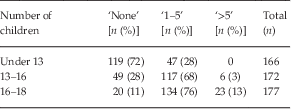
In total, 184 (93%) of respondents saw at least 50 children and adolescents a year in each age bracket of our survey (i) <13, (ii) 13–16, (iii) 16–18 (see Table 1).
Number of patients with suicidal ideation or behaviour by age group

General practitioners (GPs) were asked How many children or adolescents are seen in your clinic annually with suicidal ideation or behaviour? There were three reply options: ‘none’, ‘1–5’ or ‘>5’. The number of GPs who selected the respective options is indicated by three age brackets.
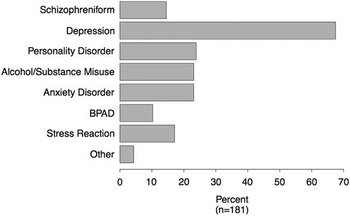
In total, 157 (79%) GPs had been involved in the treatment of a child or adolescent with suicidal ideation or behaviour in their career. Presentations of suicidal ideation and behaviour was relatively rare, with 36% reporting seeing no such presentations, 58% seeing between one and five such presentations and 6% seeing more than five such presentations annually in the group as a whole. Presentations of suicidal ideation and behaviour increased with age, with the highest rate in ages 16–18. The majority of GPs (55–66%) reported seeing between one and five children or adolescents aged 13–18 annually with a psychiatric illness. This also increased with age, with 54 (27%) GPs stating they saw at least fifteen 16–18 year olds annually with a psychiatric illness. GPs were asked to identify what underlying diagnoses they felt would present with suicidal ideation or behaviour. In total, 181 GPs identified specific diagnoses, and of these, n=123 (68%) gave depression as the most frequently observed category, followed by personality disorder, n=43 (24%) (see Fig. 1).
Diagnoses frequently presenting with suicidal ideation or behaviour. General Practitioners were asked to identify diagnoses that they felt were associated with a presentation of suicidal ideation or behaviour in children and adolescents.BPAD: bipolar affective disorder.

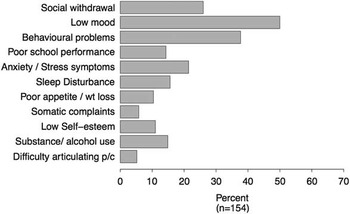
In total, 154 GPs identified specific symptoms that were frequently encountered in this patient group. The most commonly observed symptom was low mood, n=77 (50%), followed by behavioural problems, n=58 (38%) (see Fig. 2).
Symptoms most commonly seen with suicidal ideation or behaviour. General Practitioners were asked to identify the symptoms that typically accompanied suicidal ideation or behaviour in children and adolescents.

Initial management
In total, 119 (62%) GPs reported they would initiate psychotropic medications for children and adolescents presenting with suicidal ideation or behaviour. However, 111 (93%) GPs reported they would only do so ‘rarely’. In total, 62 (34%) of GPs reported they would ‘never’ initiate psychotropics in this patient group. With regard to specific medication use, 108 (91%) of GPs would prescribe antidepressants, 9 (8%) would consider antipsychotics and 12 (10%) reported prescribed benzodiazepines. In total, 18 GPs reported they would consider a combination of psychotropic medications. Information on age differences in prescribing were not recorded, nor rationale behind prescribing.
Of those who prescribe antidepressants, 79 (90%) reported prescribing selective serotonin reuptake inhibitors (SSRIs). Fluoxetine was the most commonly reported prescribed SSRI [n=53 (67%)], followed by escitalopram, [n=12 (15%)]. If medications were prescribed, 104 (87%) of responders stated they closely monitored the progress of the patient through clinical assessments and reviews with family or parents. This typically involved weekly or fortnightly reviews. In total, 6 (5%) reported they included lab investigations such as ECG (electrocardiogram) or regular bloods as part of their medication monitoring progress. In total, 16 (13%) reported they would not follow-up these patients themselves, but refer them to specialist services for monitoring.
In total, 121 (63%) GPs referred patients to CAMHS, independent counselling or psychotherapy services. Of these, referring to independent services was twice as likely to be the initial management approach rather than referrals to CAMHS [n=79 (41%) v. n=43 (22%)]. Other referral options identified by GPs included social welfare services, n=11 (6%) and mental health support groups, n=5 (3%). In total, 121 GPs indicated that they would use or refer to psychotherapy. This included generic counselling, n=100 (83%), followed by family therapy, n=35 (29%) and cognitive behavioural therapy (CBT), n=18 (15%).
Further management and relationship with CAMHS
GPs reported that this patient group was difficult to manage. In total, 18 (11%) reported ‘always’, 94 (55%) reported ‘usually’ and 52 (31%) reported ‘rarely’ having difficulty with these patients. Only six GPs (4%) reported ‘never’ having difficulty with this group.
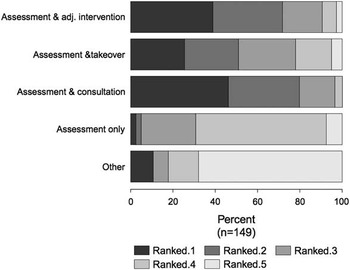
GPs were asked whether they felt a specialised response team would be useful. In total, 173 GPs completed this question and of these n=169 (98%) would welcome a response team. GPs were then asked to rank a number of different options for the role of the specialised response team, should one be available. In total, 143 GPs completed this question (see Fig. 3).
Role of specialised intervention team. This stacked barplot shows the percentage of respondents who ranked a specific intervention role on a rank from 1 to 5, with 1 being the preferred choice. The darkest shade of grey corresponds to first ranking. The highest number of first ranks was ‘assessment and consultation with GP regarding management’.

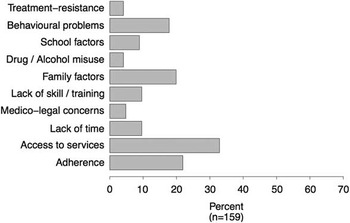
GPs were asked what particular difficulties they had in managing this group of patients. In total, 146 GPs gave a valid free-text response (see Fig. 4).
Most common difficulties encountered. General Practitioners were asked to identify the most common difficulties they encountered in managing children and adolescents with suicidal ideation or behaviour. This was a free-text response item.

Access to services was identified as a primary barrier [n=48 (33%)]. Of those who felt access was a common difficulty, the single most problematic aspect was waiting times, reported by 39 (46%) GPs. This was followed by uncertainty in the responsibility for management of 16–18 year olds, reported by 24 (28%) GPs. Of note, in the Irish healthcare system, adolescents between 16 and 18 can sometimes fall between CAMHS and adult services (Clayton & Illback, Reference Clayton and Illback2013). In total, 9 (11%) GPs reported a lack of support or guidance from specialist services, whereas 9 (11%) GPs reported difficulties in accessing multidisciplinary team services directly from CAMHS. Only 2 (2.4%) reported difficulty with a lack of admission beds or out-of-hours/emergency response service.
In total, 157 GPs (87%) reported they would refer difficult-to-manage cases to CAMHS, whereas only 11 (6%) would refer to general adult psychiatric services, 8 (4%) to independent mental health services, 3 (2%) to social services and 2 (1%) would refer to paediatric services. Regarding follow-up, 65% of responding GPs (n=154) reported that less than a quarter of children and adolescents presenting with suicidal ideation or behaviour were lost to follow-up by the GP themselves (see Table 2). GP’s estimation of the corresponding value for loss to follow-up by CAMHS was 43.9% (n=157).
Follow-up of patients

General Practitioners (GPs) were asked to estimate (a) the percentage of their patients with suicidal ideation/behaviour who went on to attend an appointment with CAMHS, (b) the percentage of patients lost to follow-up by CAMHS and (c) the percentage lost to follow-up by themselves.
Discussion
GPs are potentially well placed to identify children or adolescents at risk of suicide, as they remain the first point of contact and referral route for most health issues (Sayal et al. Reference Sayal, Yates, Spears and Stallard2014). In total, 93% of GPs who responded to this survey saw at least 150 children or adolescents a year. Most (79%) had been involved in the treatment of suicidal ideation or behaviour in a child or adolescent at some stage in their career. Previously discussed epidemiological data show that rates of suicide increase with age in the under-18s in Ireland. In line with this, only 28% of our GP sample reported seeing children (under 13) with suicidal ideation or behaviour. These rates increased to 72% for those aged 13–16 and 89% for those aged 16–18.
However, this patient group can be difficult to identify and manage. They may present with repeated somatic complaints rather than psychological distress (Kramer & Garralda, Reference Kramer and Garralda1998; Beckinsale et al. Reference Beckinsale, Martin and Clark2001; McNeill et al. Reference McNeill, Gillies and Wood2002). Only 5% of our respondents identified somatic complaints as a possible presenting symptom of underlying suicidal ideation, suggesting a low index of suspicion for psychiatric diagnoses in patients with medically unexplained symptoms (Shain, Reference Shain2007). Our respondents saw a high number of children and adolescents, yet most reported seeing only between one and five annually with either suicidal ideation or behaviour, and similar rates for psychiatric disorders overall. This could indicate a low detection rate by GPs, however, we do not know the prevalence of mental health problems in the GPs cohort. Our findings were similar to those seen in a Canadian postal survey of GPs, which found that 80% of respondents had seen adolescents who had attempted suicide (Gilbert et al. Reference Gilbert, Maheux, Frappier and Haley2006). They and others have suggested that GPs should actively screen for mental health problems to improve detection rates (Rickwood et al. Reference Rickwood, Deane and Wilson2007; Horowitz et al. Reference Horowitz, Ballard and Pao2009; Williams et al. Reference Williams, O’connor, Eder and Whitlock2009).
The majority of respondents stated they would refer onward as part of initial management, mostly to independent services. For difficult to manage cases, however, the majority stated that they referred cases directly to CAMHS. The quality of independent counselling and psychotherapy is difficult to appraise. Meta-analytic evidence supports the use of CBT for the treatment of depression in children and adolescents (Klein et al. Reference Klein, Jacobs and Reinecke2007; Watanabe et al. Reference Watanabe, Hunot, Omori, Churchill and Furukawa2007). However, the evidence base for CBT for suicidal ideation or behaviour is much more limited, although there is some promise for CBT in this group of patients also (Robinson et al. Reference Robinson, Hetrick and Martin2011). The findings do suggest that GPs are willing to refer to alternate services if they are available. In recent years in Ireland, innovative youth mental health programmes such as Jigsaw/Headstrong have provided services that compliment traditional CAMHS models (Illback et al. Reference Illback, Bates, Hodges, Galligan, Smith, Sanders and Dooley2010; O’Keeffe et al. Reference O’Keeffe, O’Reilly, O’Brien, Buckley and Illback2015). These types of programmes may help prevent patients falling between gaps that exist in the current service system.
Pharmacotherapy is often used as a first-line intervention for moderate to severe depression in primary care. The use of medication may be associated with lower suicide rates in adolescents (Gibbons et al. Reference Gibbons, Hur, Bhaumik and Mann2006). One systematic review suggested that children and adolescents may respond positively to SSRIs, especially fluoxetine, but also demonstrated a link between SSRI use and increased risk of suicidality (Hetrick et al. Reference Hetrick, Merry, Mckenzie, Sindahl and Proctor2007). Fluoxetine, although not currently licenced in Ireland for those under 18, is the only SSRI recommended as a first-line treatment in children or adolescents by the National Institute of Clinical Excellence (NICE) guidelines (NICE, 2005). In our sample, about two-thirds of respondents stated that they would be willing to initiate psychotropics for this group, albeit mostly rarely. NICE recommends that medications should be initiated at tertiary level. Fluoxetine is the medication of choice, and although fluoxetine was the most commonly prescribed medication, a significant portion reported prescribing other SSRIs. Appropriate pharmacotherapy in this group is important, as the majority of children or adolescents who complete suicide have a psychiatric diagnosis and are un-medicated (Vasa et al. Reference Vasa, Carlino and Pine2006). GPs reported that this was a difficult patient group, and accessing services contributed significantly to this. Most felt that rapid access or a specialised response team would be helpful, suggesting that GPs feel that managing these patients appropriately requires significant input from tertiary services, and that their role, whilst important, is at times facilitatory rather than in primary management. Models already successful in other specialist services with limited resources include the National Healthlink Project in Ireland. This is a national referral and enquiry programme in Ireland for oncology and neurology allowing GPs to access rapid triage of and advice from tertiary services.
This survey identifies the primary care perspective on an important area of child and adolescent healthcare. Further studies from both primary care and emergency departments/CAMHS will help to develop our knowledge of the deficiencies and strengths of services already in place, and allow the planning of future improved services. Our data indicate that a combined approach to management is important to GPs, and that many GPs feel there is a gap between primary care and CAMHS in terms of access, clear referral pathways and communication of information. Many patients identified by GPs are reported to be lost to follow-up, either by CAMHS or primary care. This is significant as high rates of consultation with GPs before suicide is consistently reported in adults (Lynch et al. Reference Lynch, Mills, Daly and Fitzpatrick2004; Ougrin et al. Reference Ougrin, Banarsee, Dunn-Toroosian and Majeed2011). Others have also found that children and adolescents are less likely to attend follow-up appointments, therefore extra effort may be needed to engage this patient group (McCarty et al. Reference McCarty, Russo, Grossman, Katon, Rockhill, Mccauley, Richards and Richardson2011).
A clear majority felt that the care offered to children and adolescents could be improved. A high percentage would consider initiating pharmacotherapy, perhaps due to a perceived lack of available alternatives and delay to outpatient tertiary review. Traditionally, there were long waiting times for CAMHS in Ireland. However, there has been an approximate 50% reduction in the number of patients on waiting lists for community CAMHS from 2007 to 2011 (HSE, 2011). Increasing GPs awareness of reduced waiting times may therefore facilitate more referrals. A consequence of this may be a rebound increase in waiting times for assessments. If this were the case, an alternative to standard mental health treatment could come from emerging online intervention programmes. Although the evidence base for such interventions is in its infancy, there are encouraging early results from programmes such as the Reach Out! Online Community Forum in Australia (Webb et al. Reference Webb, Burns and Collin2008). Further research is clearly warranted in this area (Christensen et al. Reference Christensen, Batterham and O’dea2014). A randomised controlled trial of an internet-based CBT intervention (Re-frame IT) among school students experiencing suicidal ideation is also underway (Robinson et al. Reference Robinson, Hetrick, Cox, Bendall, Yung, Yuen, Templer and Pirkis2014).
Targeted education programmes with clear and practical information regarding at-risk group identification and management may go some way to improving the care GPs can provide (Healy et al. Reference Healy, Naqvi, Meagher, Cullen and Dunne2013). This is especially true in Ireland, where one study has showed that only 32% of Irish GPs had postgraduate training in psychiatry or psychological therapies. (Copty & Whitford, Reference Copty and Whitford2005). Reports and guidelines also tend to stress the importance of GP education and training in this area (World Health Organization, 2000; World Health Organization, 2014). However, the GPs who responded to our survey did not rate further training and education as a priority or a major barrier to improved care for children and adolescents with suicidal ideation or behaviour. It is also not clear what form these educational interventions should take, but a systematic review and meta-analysis of this is currently underway and may clarify this issue (Tait & Michail, Reference Tait and Michail2014).
To our knowledge, this is the first study specifically describing Irish GP management of suicidal ideation or behaviour. One previous survey examined GPs experience of the spectrum of youth mental health problems, but only in the Midwestern region (Healy et al. Reference Healy, Naqvi, Meagher, Cullen and Dunne2013). Our sample was national, representing both urban and rural practice. The survey was completed anonymously, allowing practitioners to be honest in their responses and minimise social desirability bias.
There are a number of limitations to this study. Our survey, although used in similar studies, was not formally validated. Being retrospective in nature, surveys are vulnerable to recall bias. The response rate of 41% was also lower than expected, with possible non-response bias. Other published GP surveys have similar response rates (Stallard et al. Reference Stallard, Richardson, Velleman and Attwood2011; Murphy et al. Reference Murphy, Vellinga, Walkin and Macdermott2012), and there is evidence of declining response rates to postal surveys (Cook et al. Reference Cook, Dickinson and Eccles2009; Wilkinson, Reference Wilkinson2009; Merry, Reference Merry2010). Researchers have on the other hand found that physician surveys are more resilient to the effects of non-response than the general public (Flanigan et al. Reference Flanigan, Mcfarlane and Cook2008). We posted surveys twice to non-responders in an attempt to increase the response rate. A higher rate may possibly have been achieved using an electronic survey, however, there is no current agreement as to which form of survey delivery has the best response rates, which vary from one study to another (Cunningham et al. Reference Cunningham, Quan, Hemmelgarn, Noseworthy, Beck, Dixon, Samuel, Ghali, Sykes and Jette2015). Information on diagnosis and prevalence were also based on GPs subjective experience and beliefs and should be treated as such, rather than as an objective measures. We also did not collect demographic information (age, years in training, location, etc.) from GPs. Although this may have helped anonymity, especially for GPs in smaller communities, it limited the scope for data analysis.
Our findings suggest that further improvement to, and information regarding access to CAMHS is still an area of need, despite recent progress. Further research to investigate models that facilitate integration between primary and specialist services in child and adolescent mental health is necessary in this regard, as our data indicate that GPs would welcome more interaction with CAMHS or other youth mental health services. Although education and training of GPs is often stressed as a way of improving outcomes, this was not reflected by the GPs who participated in this study.
Acknowledgements
The authors would like to acknowledge the Lucena Foundation for financial and administrative support and Greystones Medical Centre, Ireland for administrative support.
Conflicts of Interest
The authors declare that they have no competing interests. This research received no specific grant from any funding agency, commercial or not-for-profit sectors.
Ethical Standards
The authors assert that all procedures contributing to this work comply with the ethical standards of the relevant national and institutional committee on human experimentation with the Helsinki Declaration of 1975, as revised in 2008. The study protocol was approved by the local REC.